
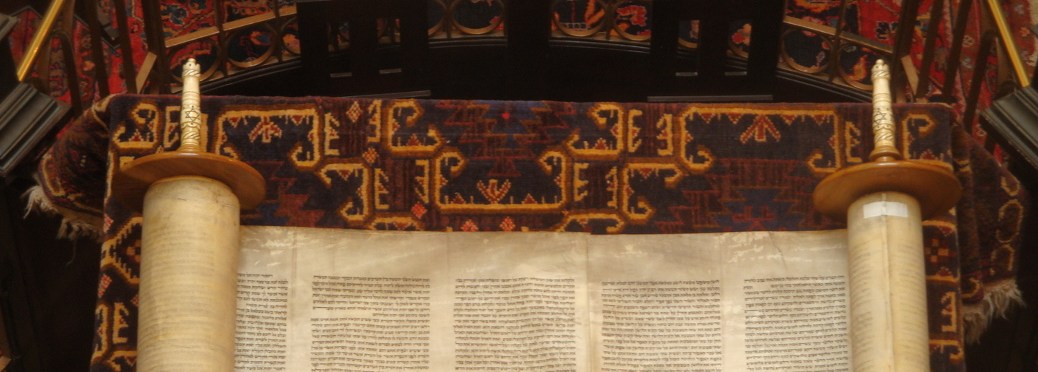
Question: What if I believe only in the written text of the Torah?
Answer: I’m glad to hear that you have such strong faith in the “Hebrew Bible.” My question is, how do you know that this is true? Certainly, you must be relying on tradition. Otherwise, how do you know that the words you have before you are the original words written by Moses and the prophets? How do you know that they ever received this to begin with? What other way is there than to rely on the integrity of the Jewish people over the ages?
-Rabbi Tzvi Freeman
-from “What If I Believe in Only the Written Text of the Torah?”
Chabad.org
Rabbi Freeman has written a multi-part series on the nature of Midrash which I plan to explore. The above-quoted text isn’t part of that series but I think it’s a good place to start my own investigation for a couple of reasons. The first, as I previously mentioned, is I have my doubts of the effectiveness of the philosophy of sola scriptura as practiced by certain expressions of “the Church”. I really don’t believe that most Christians really, really access “scripture alone.” To be fair, I believe they think they do and that they are sincere in their convictions, I just think they are either blind to the presence of interpretive tradition, or if aware of it, they do not believe it has as much influence on their “vision” as it actually does.
One of the things I admire about Judaism is that it admits to relying on tradition to interpret the Bible and in fact states that it is impossible to understand what the Bible is saying without a system of interpretation and tradition to use as a lens.
That’s going to freak out a lot of Biblical literalists in the Church and this isn’t the first time I’ve made such a statement (see Removing the Garments of Torah and The Purpose of Torah in New Testament Judaism series for examples).
I do want to state upfront that just because a tradition exists, either in the Christian or Jewish frameworks, doesn’t mean we should automatically accept it as fact and truth. On the other hand, without tradition (and I agree with the Jewish perspective on this), at least to some degree, we’d never be able to understand let alone implement various portions of the Bible.
I should also mention at this point that many (most?) Hebrew Roots groups echo the question stated above, believing in the accuracy and authority of the written Torah but disdaining any of the Rabbinic commentaries which are used to interpret and operationalize Torah (and how do they tie their tzitzit and lay their tefillin without relying on Rabbinic tradition?). Such groups seem to take what they want from normative Judaism while escorting the Rabbinic sages and their rulings and interpretations to the nearest dust bin.
And that, really, is Judaism: a faith in the integrity of the Jewish experience as transmitted to us by previous generations. It turns out that everything we believe, including faith in the word of the written Torah, is based on this faith in the Jewish people. Perhaps that is the reason we call it Judaism (or Yahadut, or Yiddishkeit) and not “Torahism” (or Karaism)—because the most basic faith we have is in the Jewish people, and from there extends our faith in the written word and in the prophets.
As I read Rabbi Freeman, I get the impression that one of the functions of Judaism is to provide the traditions by which Jews interpret the Torah. This gets complicated in that there is no one “Judaism” and thus no one authoritative interpretation of Torah, although within the larger “Judaism” construct, meanings heavily overlap.
But how the Chabad traditionally interprets a portion of the Torah and how to perform the associated mitzvot may differ greatly from how a Reform or Conservative synagogue may read and understand the same material. Thus, from an outsider’s point of view, it makes Judaism seem very inconsistent, highly variable, and the meaning taken from the Bible to be incredibly fractured.
But what about the untold hundreds or even thousands of denominations, subgroups, and sects of Christianity? The answer my Pastor would give me is that there is only one right answer, which is why the Fundamentalist movement was established in the early days of the 20th century…to create (or return to) that one “right” answer. My Pastor has tried to explain the core meaning of Fundamentalism to me, apart from all of the media hype and unfair interpretation of the “label,” and I’ve recorded that understanding on my blog so I wouldn’t lose track.
Really, Fundamentalism at its center is just “getting back to the basics” of Christianity, but those “basics” were established barely a hundred years ago. Would the apostles have understood their faith in the same way as John MacArthur, R.C. Sproul, or Steven J. Cole?

So the best we can say at this point is that Judaism and Christianity both heavily utilize tradition to tell each religious body and their various subgroups (actually, each of the subgroups have their own traditions) what the Bible is supposed to be saying and how we are to live out what the Bible tells us in our individual and corporate worship lives.
I’ve also recently mentioned the story of Hillel, Shammai, and the Three Converts, which Rabbi Freeman too mentions in his commentary.
Another gentile who accepted only the Written Torah, came to convert. Shammai refused, so he went to Hillel. The first day, Hillel taught him the correct order of the Hebrew Alphabet. The next day he reversed the letters. The convert was confused:”But yesterday you said the opposite!?” Said Hillel: “You now see that the Written Word alone is insufficient. We need the Oral Tradition to explain G-d’s Word.”
Rabbi Freeman’s point, citing Hillel, is “that without an oral tradition, there is no written Torah. Written symbols on a scroll are meaningless without context. We have no clue what the words mean, or even whether they are at all true.”
But is that really true? Does not understanding the original language in and of itself impart some meaning? Of course, you also have to understand the historic, cultural, national, linguistic, traditional, theological (and many other) contexts involved that subtly or significantly modify the meaning of the plain text. Could the overall understanding of those contexts be codified to become an interpretative tradition?
Because the prevailing interpretations have probed Paul’s text without sufficient appreciation of the powerful role of ironic inversion at work, at the formal as well as functional level, the interpretation of the apostle’s scathing rhetoric has exaggerated and, regardless of other plans, continues to accentuate the differences that are imagined to separate Christian and Jewish identity, behavior, and even intentions toward God and neighbor. The legacy of this perception of the Jewish other has proven often tragic for the Jewish people, at least in a world that has been often dominated by those who look to Paul to shape reality, and for others, as a foil to justify their twisted construal of what is right.
-Mark D. Nanos,
from the Prologue of his book (pg 2)
The Irony of Galatians: Paul’s Letter in First-Century Context
It is Nanos’ belief that Christianity’s understanding of the basic nature and personality of the apostle Paul has changed not very much since the days of the so-called “Church fathers” and hardly at all in the last five-hundred years since the Reformation. While the Church doesn’t cite time-honored Christian tradition as the necessary element to understand the letters of Paul or as required to comprehend his actions as recorded in Luke’s Book of Acts, nevertheless, my recent reviews of some of the sermons of John MacArthur have convinced me completely that Christianity’s understanding of the meaning of scripture is totally reliant on revered Christian traditions.
When, on occasion, I’ve tried to challenge those traditions (and not the scriptures themselves), the reaction I observed could at least be called resistance.
Judaism has its traditions as well, but Jewish authorities are quite upfront about saying that they have a tradition and that, as far as Rabbi Freeman goes, “Judaism-colored glasses” (my phrase, not his) are required when reading the Word of God.
The Torah says to rest on the seventh day. I once met a man who told me that he tried to keep the Sabbath as written in the Torah, but it was too hard—by four in the afternoon he just had to get up out of bed! Who says his interpretation is worth anything less than anyone else’s?
The Torah says that “these words should be totafot between your eyes.” What on earth are totafot? Where is “between your eyes”? When do you wear them, and how?
The Torah says, “You shall slaughter an animal as I have commanded you.” What was it that G‑d commanded Moses? How can we know? There seems to be no hint whatsoever in the entire Five Books of Moses. Obviously, everybody knew what Moses had been told; they did it all the time, and nobody needed it in writing.
 Good points, Rabbi Freeman. Of course modern Christians would say all that stuff is dead and gone, so who cares if we don’t know how to properly rest on Shabbat, figure out what “totafot” means or how to put them “between your eyes,” and what the correct method of “slaughtering an animal” was as required by God?
But even if I took the Christian point of view, I’d have to admit those things meant something once. Just how were they enacted in ancient days without sufficient written instructions? When asked, how did Moses answer those questions? In the days of the Temple, how did Solomon address those issues? And did Jesus even obey those requirements since the Temple still stood during his “earthly ministry?”
It seems like neither Christianity or Judaism can exist and practice their faiths without a rich tradition of…tradition.
Protestants, as I experience them anyway, seem to have a deep-rooted resentment against a central authority in religion. I’ve heard Evangelicals say some pretty rough things about Catholics and their Pope, and I’ve listened to more than one Christian say (more or less) that it was part of God’s plan for the Apostles to die off so “Christian authority” could be de-centralized. Never mind that Christians tend to revere the “Church fathers” and particularly the authors of the Reformation. Some churches, including the one I attend, even celebrate Reformation Day.
The oral tradition also includes later decisions and exegeses made by those who led the Jewish people and were empowered to make decisions on their behalf. These are the seventy elders in every generation, as established originally by Moses himself (read all about it in Numbers 11). It is to these sages that Moses refers when he charges the Jewish people that if anything is to difficult for them to solve, they must take it to these wise leaders, and “do not turn from whatever they tell you, not to the right and not to the left” (read that one in Deuteronomy 17:8–12). Otherwise, what on earth are we supposed to do when Faraday discovers how to harness electrical power? Is it fire? If not, what is it? So, a rabbinical assembly came to the consensus that we will treat it as fire, and not turn it on or off on the Shabbat. Now all the Jewish people can keep one rule and one Torah.
These same sages were empowered to protect the Jewish people from breaking the Torah by “building fences” about the prohibitions. If you can walk right up to the edge of a serious transgression, it’s unlikely that no one is going to fall off. Which should provide an answer to your question about the boundaries for walking on Shabbat.
All this is seen by Christians as “adding to the Bible.” I’ve heard Matthew 23:4 and the surrounding text applied to Rabbinic Judaism as a whole, casting all Jewish practices into the same bucket and observant Jewish people under a bus.
On the other hand, try telling people in a church to do away with their Christmas and Easter (or Resurrection Day) observances because they’re “man-made traditions” (not to mention the previously cited “Reformation Day”) and you’ll likely start a riot (OK, probably an angry and offended discussion, not a riot).
Christians don’t like the Rabbinic sages for the same reason they don’t like the Pope. They don’t like or trust a central authority that can establish binding religious rulings over their lives. It interferes with the “freedom of the gospel” they enjoy, but do Christians really have that much freedom?
It depends on the church and which Pastors and teachers are favored, with their books enshrined in the church’s library or bookstore. Which books are studied by the Wednesday night woman’s group or deemed worthy of possessing lessons to be followed by the men’s ministry? Are preachers like John MacArthur, R.C. Sproul, and Steven J. Cole considered the “sages” of modern Evangelical Christianity? Do the churches that follow their particular teachings not rely on these men and their theologies and doctrines to interpret the Bible for them?
But allow me to summarize the most crucial point: You can choose to believe in a book. Or you can choose to believe in a divine revelation. The divine revelation was encoded into a book by Moses, but its light never ceased to shine. In every generation, more and more of it enters into the world, through the medium of those sages who study the book and its surrounding traditions and all the accumulated wisdom that has unfolded over the millennia. One day, we will see how all that we unfold was contained in those original words Moses wrote. But to access it all now, make yourself part of the Jewish people, and have a little faith in us. After all, if it weren’t for us, where would that little book be?
To be fair, the whole concept of a set of traditions being required for understanding what God’s Divine Revelation means, especially as adapted across multiple generations, is alien to Christian thought, even if it’s not foreign to Christian interpretative practice. We just don’t talk about it, like some dirty family secret, some hidden skeletons in the Church’s closet.
 Also to be fair, Rabbi Freeman wouldn’t have written such an article if some Jewish people, perhaps a lot of Jewish people, weren’t as critical of midrash and oral tradition as we Christians are.
R. Freeman offered some additional resources for the Jewish (and Christian?) curious including The Essential Talmud by Rabbi Adin Steinsaltz, R. Freeman’s own article Is It Really the Torah, Or Is It Just the Rabbis, and a series of audio teachings by Rabbi Lazer Gurkow called The Oral Tradition. You also might consider Is Torah Just For Jews?
I encourage you to read the responding comments to Rabbi Freeman’s article (scroll down) so you can see that among individual Jewish people, what the Rabbi professes is not a “slam dunk” in their minds and hearts. Hopefully, that will help dispel the idea held among some Christians that Jewish people are “all the same,” meant in the worst possible manner.
When the Church and its “sages” disregard and denigrate Jewish traditions while upholding Christianity’s own long history of interpretive tradition (all the while denying its existence), then it participates in another historical tradition of the Church that, while also “hidden,” is nevertheless still a potent force in the lives of many Gentile believers: anti-Semitism and supersessionism.
For more on the same topic, see Tradition!, According to the Traditions: A Primer for Christians, and Introduction to Messianic Judaism: Tradition!, my review of Rabbi Dr. Carl Kinbar’s article “Messianic Jews and Jewish Traditions”.


 Morning Meditations