Tag Archives: Paul

Questioning Paul

Read today’s article, where you, in part, again defend Paul. Obviously, I have to come to read him very differently and would like to run something by you. Can you give me your thoughts on the following words of Paul, namely in Galatians 4:21-26 (and a bit beyond, in Galatians 5-1)?

“21 Tell me, you who want to be under law, do you not listen to the law? 22 For it is written that Abraham had two sons, one by the bondwoman and one by the free woman. 23 But the son by the bondwoman was born according to the flesh, and the son by the free woman through the promise. 24 This is allegorically speaking, for these women are two covenantsone proceeding from Mount Sinai bearing children WHO ARE TO BE SLAVES; she is Hagar. 25 Now this Hagar is Mount Sinai in Arabia and corresponds to the present Jerusalem, for she is in slavery with her children26 But the Jerusalem above is free; she is our mother. “

“It was for freedom that Christ set us free; therefore keep standing firm and do not be subject again to a yoke of slavery.” (Galatians 5-1)

Here Paul, although supposedly speaking figuratively, plainly says that the covenant on Mount Sinai produced slaves (even though the opposite actually happened there – Jews were freed from slavery there, becoming servants of G-d). According to Paul, Jews who are still bound by Torah and the Mosaic covenant are not the spiritual children, but the children of the flesh and are born not of Sarah, but of Hagar. Christians (primarily his Gentile audience), however, are Sarah’s true children, who are free. Following Torah as given on Mount Sinai, according to Paul, is a yoke of slavery from which Christ came to set humanity free (Galatians 5-1).

Would love to hear what you thought of the above. May be the billions of Christians over the many centuries didn’t misread Paul after all but received much of their view of Judaism from him?

-from a private email discussion

There’s a lot more to this conversation. For a little background, the person asking the above-quoted questions is a Jewish friend of mine who believes that Paul was anti-Torah and anti-Judaism.  He very gently but firmly is questioning my faith and our exchange, from my point of view, has reached something of an impasse. Not being a theologian or a historian, especially within the context of Messianic Judaism, I don’t always have all the convenient answers at my fingertips.

A “normative” (i.e. not Messianic) Jewish person has a wide variety of resources to draw from, such as Jews for Judaism, in questioning the validity of the “Christian texts,” while in response, all I’ve got is me.

For obvious reasons (obvious to my regular readership), I can’t really rely on traditional, Evangelical Christian apologetics, since I’m often a critic of Evangelical Christian theology.

To add a bit of dimension, where I “stalled” in the conversation, my friend questioned whether one could look at Paul’s letters in the same fashion as the writings of Moses. Moses received direct revelation from God while Paul was writing letters. Can his letters be elevated to the point of scripture inspired by the Holy Spirit? Moses knew he was recording the thoughts of God. Could Paul have imagined that his letters would also be included in canon?

In the body of believers, we tend to see deep theological meaning in Paul’s letters. Further, we (or at least I) believe that there are messages “encoded” within said-letters that are difficult to understand without a “Rabbinic” comprehension of the text. Scholars such as Mark Nanos and Roy Blizzard have written erudite works unpackaging the “hidden” meanings within Paul’s writing. But the Sages in more normative Judaism across the long centuries and into the modern era, reading the letters of Paul from a Rabbinic perspective, see nothing but a condemnation of Jewish people and Judaism in Paul’s writings. If Paul’s letters are so “Jewish” that most Christians don’t “get” Paul, why don’t most Jewish sages “get” Paul the way we do when peering through a Messianic Jewish lens?

The Jewish PaulIn line with the above, I’ve attempted to answer the “Hagar and Sarah” question with my own commentary based on Ariel Berkowitz’s paper A Torah-Positive Summary of Sha’ul’s Letter to the Galatians. However my explanation of more hidden meanings doesn’t seem to pass the “pshat test,” whereby the plain meaning of the text is still the primary meaning, even if there are other more hidden and even mystic meanings contained within.

Finally, many if not most of Paul’s letters were written to a primarily Gentile audience, with many or most of them having limited literacy (according to my source) and for those fresh out of paganism, virtually no apprehension of Judaism, Jewish thought, Hebrew idiom and word play, and Jewish symbolism. If Paul were writing to a bunch of Rabbis or other learned Jews, we could understand Paul crafting letters with great amounts of complicated theological detail, but wasn’t he trying to get his ideas across to mostly common Greek-speaking people?

It’s possible that no one can answer these questions or at least that no one will be willing to answer these questions on my blog, so I may continue to be stuck until subsequent investigation (which experience tells me could be months or years) helps me to understand where the answers lie (or, Heaven forbid, that there are no answers to give to my Jewish friend). I should say that my primary goal isn’t to “convert” him or otherwise convince him to become “Messianic.” My goal is to show why any intelligent and reasonable person could accept the writings in what the Church calls “the New Testament” as scripture at all and why we would go jumping through all of the hoops we have been in order to refactor Paul as pro-Torah and pro-Judaism after nearly two-thousand years of Church doctrine has been teaching the exact opposite?

I plan to put links to this blog post in the relevant groups in both Facebook and Google+. I’d like to encourage the readers there to post your responses here so my friend (and any other interested parties) can read them. If they’re “trapped” in closed groups on either of those social networking platforms, then they will not be available for my audience here.

Thank you.

Book Review: The Irony of Galatians

The Irony of GalatiansFinally, I want to acknowledge the victims of certain interpretations of Paul’s voice, especially those who have suffered the Shoah. Their suffering cannot be separated from the prejudices resulting from those interpretations any more than it can be wholly attributed to them. To them I dedicate the effort represented in this book.

-Mark D. Nanos
from the Acknowledgments, pg ix
The Irony of Galatians: Paul’s Letter in First-Century Context

I know I also began my blog post Prologue to the Irony of Galatians with this quote, but I think it’s important to remember a little bit about where Nanos is coming from in writing “Irony”. It’s not just another scholarly book addressing an interpretation of a New Testament letter, and it’s not even just presenting a new perspective on Paul. It’s aimed at correcting a nearly two-thousand year old injustice to the Jewish people by what eventually became the Christian Church, started by the so-called Church Fathers who reinvented the Bible to say that the Jewish people and Judaism became passé if not completely evil, perpetuated by the authors of the Reformation, and culminated in the most incredible evil of the twentieth century, an evil that still sends echos into this day and this hour: the Holocaust.

I know that some hard-core Evangelicals such as John MacArthur might say that the classic Christian interpretation of Galatians is the correct one and that the Church can hardly be blamed for how it’s been used against the Jewish people over the long centuries of exile, all the pogroms, all the torture, all the forced conversions, all the assimilation, all the deaths. He might say (I’m not saying he ever breathed a word of this, I’m just “supposing”) that most Jewish people have failed to “move on” and leave the Law behind, and that they should give up the past and embrace grace and Jesus Christ instead.

But what if that’s wrong? What if Paul never wrote something that he intended to be twisted into a declaration of condemnation against his own people, against the Torah, against the Temple, and even against himself? Christian apathy and the reluctance to overcome its own inertia (in most cases) has resulted in an almost total lack of desire, let alone any activity directed at reading Paul’s letters through fresh eyes, removing the “tradition” colored glasses and donning lenses more appropriate to how a first-century Jewish scholar would have seen the Messiah in context and how he intended his audience, in this case the Gentile believers in the various synagogues in the area of Galatia, to read his “ironic rebuke” of their apparent foolishness (I’m getting to all of that).

What if we’ve got Paul all wrong? What if that results in our having to re-examine and even to re-create what it is to be a non-Jewish worshiper of the God of Israel with the Son of God, the Moshiach, Yeshua of Nazareth as the doorway?

Nanos doesn’t go that far in his book, but it’s the logical consequence of his writing if we accept his conclusions.

Let’s dive in.

Before reading/hearing Paul’s polemical assault, the influencers appeared very differently to those he now addresses in Galatia, as trusted guides, likely even friends, who had their best interests in mind. Rather, I suggest that the influencers represented Jewish communities in Galatia that were concerned about the integration of these particular Gentiles, who were, through their involvement in the (still Jewish) Jesus subgroups, an integral part of the larger Jewish communities at this time. But their appeal to traditional norms maintained in the present age apart from Christ to modify the identity expectations of Paul’s children in Christ threatened the addressees’ interests in ways that neither the influencers nor the addressees perceived accurately–according to their parent, Paul. We have only his response.

This response implies that these Gentiles declared themselves to be identified with the Jewish communities in a new and disputable way, as righteous ones apart from proselyte conversion.

-Nanos, “Conclusion: The Irony of Galatians,” pg 317

The Mystery of RomansI probably should have started with the Conclusion and then worked through the body of the book. Like Nanos’ Romans book, “Irony” is densely packed with details as Nanos first attempts to refute the traditional Christian interpretations of Paul in general and the Galatians letter in specific, and then presents his own evidence for the premise he suggests, that this letter is not Paul’s major attempt to torpedo the Torah, Judaism, and the Jewish people, but rather what he calls an “ironic rebuke” written to his Gentile disciples who frankly he believes should have known better than to listen to the Jewish (quite possibly proselytes themselves) influencers who neither had faith in Yeshua as Messiah nor believed that Gentiles could ever fully integrate and participate in Jewish worship and community life without undergoing the proselyte rite and converting to Judaism.

While reading this book, on more than one occasion, I felt I had gotten lost in the forest, unable to see the grand landscape for the trees, and there are a lot of “trees” in this book. I took an amazing number of notes that still riddle the pages of “Irony,” and could possibly form a small book themselves if bound between their own covers. However, this book is the result of Nanos’ doctoral dissertation so you can expect it to be tough reading (for most of us, anyway).

Like “Romans”, “Irony” presupposes that the Gentile believers in Galatia were involved in the local synagogues as the only likely venue for them to practice worship of Israel’s God and to learn more about the teachings of Messiah which after all, were contained in the Torah and the Prophets. Where else does one learn Torah than among Jewish teachers and students in a synagogue?

But as Nanos presents the situation, some of the Jewish people, “agents of social control” in the Jewish community, had a problem. As I stated above, how could they understand, since Nanos states these Jewish influencers were not disciples of Yeshua/Jesus, that these righteous Gentiles could be fully equal co-participants in Jewish worship and community without undergoing the proselyte rite? Apparently, these Gentiles, in the absence of Paul or any other Jewish believer and teacher, were being successfully convinced that faith in Messiah was not enough and that they must too undergo circumcision and take on the full yoke of Torah, as it applies to the Jewish people, in order to complete their devotion to God as “Messianic” disciples.

But the ideas Nanos presents in “Irony” aren’t exactly radical.

The next Sabbath nearly the whole city assembled to hear the word of the Lord. But when the Jews saw the crowds, they were filled with jealousy and began contradicting the things spoken by Paul, and were blaspheming.

Acts 13:44-45 (NASB)

Some men came down from Judea and began teaching the brethren, “Unless you are circumcised according to the custom of Moses, you cannot be saved.”

Acts 15:1 (NASB)

You may have to read all of Acts 13 for context, but as you may recall, on Paul’s first trip to the synagogue at Pisidian Antioch, his message of the good news of Messiah for all of the people present, born Jews, proselytes, and God-fearing Gentiles, met with great success. The Jewish members of the synagogue followed Paul and his companions after they left Sabbath services for the day, urging them to return the following Shabbat and to teach more. It was only when large numbers of pagan Gentiles who had heard of this good news invaded the synagogue that the synagogue leaders, threatened by their presence and the implications involved, turned against Paul and drove him out.

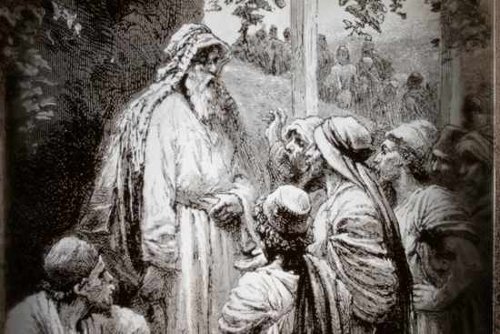
ancient-rabbi-teachingAccording to Nanos, something similar may have been operating among the influencers since how could they be sure these “righteous Gentiles” who in no way were progressing on the path to becoming proselytes, weren’t also involved in community pagan rites? The only way to be sure, would be to confirm their commitment to Hashem and the Jewish people by having them convert to Judaism.

Also, in the eyes of most Jews, the statement of Acts 15:1 seemed incredibly obvious. One does not come to Hashem except through Judaism.

Paul knew the truth, but he wrote his letter to the Galatians most likely before the Acts 15 legal decision handed down by the Council of Apostles that dictated the formal status and identity of the Gentile disciples within the Jewish community as something like “strangers living among us (Israel)”. Paul’s “gospel” was a radical idea at the time (and still is for most Jewish people today), that by faith could the Gentiles be grafted in to the community of Israel, coming to the Father by way of the Son.

As I mentioned in my previous review, according to Nanos, Paul was not a happy camper at hearing his students were defecting from their faith in Messiah and joining the more traditional path toward becoming proselytes. But rather than crafting a logical, dispassionate, and scholarly theological paper, he wrote a hopping mad “ironic rebuke,” whereby he took his Gentile followers to task for acting like inconsistent teenagers following after the “cool kids” in school rather than what they knew to be the truth.

But without understanding that Paul was being ironic, and sarcastic, and “snarky,” we could completely misunderstand what he was saying and who he was saying it to. If we believed that he was talking to Gentile and Jewish believers, and if we believed he was condemning circumcision, the Torah, and the Temple to that entire population, then we might conclude that Paul was himself “Law-free” and advocating for all Yeshua-believers, including Jewish disciples, that they become “Law-free” as well. Sounds like the exact accusations leveled against Paul in Jerusalem by Jewish people from the diaspora we find in Acts 21 (specifically from verse 17 onward), accusations that Paul steadfastly denied throughout a number of legal proceedings for the remainder of the book of Acts.

Assuming Paul wasn’t lying, then believing that Paul was against the Law, against the Temple, and against the formal practice of Pharisaic Judaism for believing Jewish people as most Christians interpret the Galatians letter just doesn’t make sense.

If approached as a theological tractate or an oration in a court of law, for example, or as a polemical attack on Jewish identity and Law observance as Galatians has often been read, then an entirely different set of expectations shapes the interpretive process than those suggested herein. But if Galatians exemplifies a letter of ironic rebuke designed to address the source they had been running when confident that their understanding of the meaning of Christ was legitimate–rightly so according to Paul’s revealed good news–then the guardians of the majority or dominant communities, who are guided in their sensibilities and responsibilities by long-standing membership and reference group norms, will no doubt consider it their rightful duty to obstruct such a course.

-Nanos, pg 319

It’s not a matter of changing a single word of the Galatians letter, but rather, shifting your perspective on what Paul was intending when he wrote it. We only have this letter to tell us what was going on with his addressees in Galatia and to suggest (Paul doesn’t tell us outright) who the influencers were. The method of interpretation makes all of the difference and as I’ve said before, Protestant Christianity has a very definite tradition about how to interpret Galatians and the rest of the Bible. The real challenge is getting the Church, from the average person sitting in a pew on Sunday morning, to the Pastoral staff, to the governing bodies of the various denominations, to the New Testament scholars and students in seminaries and universities, to set aside those traditions long enough to read what Paul is saying as a devoted disciple of Moshiach who was zealous for the Torah and never taught against the Law of Moses or the Temple of God.

Not an easy task to be sure.

The Jewish PaulBut if we read not just Galatians, but the rest of the record of Jewish and Gentile interactions in the Apostolic era with an eye on the tremendous social difficulties involved in even attempting to integrate these two populations in the synagogue under the radical notion that Gentiles did not have to adopt Jewish identities in order to be fully equal co-participants in the worship of God through Messiah, then we come up with a very different picture of the lives of the first Gentile believers and even what our lives as Christians should be today, particularly relative to the Jewish people and Judaism.

Which brings us back to Nanos’ statement about Shoah in the introduction to “Irony”.

The vast majority of the text, while it seems quite logical to me, would really require someone well-studied in New Testament scholarship to critically analyze. What Nanos writes makes sense to me primarily because it fits my own overarching view of the message of the Bible, but without traveling a similar educational path to Nanos or others like him, I don’t doubt I could miss quite a lot. But while I don’t have the ability to intimately examine each and every bit of research and evidence “Irony” presents, I can see that the final conclusion, at least generally, fits the portrait in which I have come to see the Apostle to the Gentiles, a Jewish man who was given the extraordinary task of bringing the good news of the Messiah to the pagan nations of the world; a man who centuries after his death, has been (in my opinion) falsely accused both by Christians and Jews, of being a traitor to his own people, of abandoning the Torah, abandoning the practice of his forefathers in the worship of God, and twisting the teachings of a humble itinerant Rabbi in the Galilee into a brand-new religious form that has no resemblance to the way Jesus taught the Torah of Moses to the “lost sheep of Israel.”

I’m glad I read this book but it certainly wasn’t easy. I consider myself educated but not in this field of study. However, this is a necessary book to work through for Christians because we must be shaken up and startled out of our complacency and our interpretive traditions. Even if you’re not willing to accept a view of Paul and his letter to the Galatians that exactly matches Nanos’ description, the very attempt should help convince you as it continues to convince me, that historic and modern Christianity has made a terrible mistake in how we see Paul. There’s a lot more to learn or relearn about Paul. “The Irony of Galatians” by Mark Nanos is but one step on that journey.

Is Sola Scriptura Enough to Understand Paul?

Apostle-PaulIs the Torah to be considered as a dead husband that nobody liked anyway? This is the way many Christians interpret Romans 7:1-6: “For the woman who has a husband is bound by the law to her husband as long as he lives. But if the husband dies she is released from the law of her husband” (verse 2 of Romans 7:1-6). Paul refers to an ancient halachah (principle of the law) to illustrate his new relationship to the Torah because of his faith in Jesus. But one question is never asked when studying Romans 7:1-6. And it is only when the full impact of Paul’s Jewish heritage is understood in light of his entire teaching concerning the believer’s response to the Torah that this question can be carefully considered. Nonetheless, we must ask: Was Paul speaking about the death of the Torah or was he referring to the death of the flesh? Is the Torah, for Paul, a dead husband?

Brad H. Young
“Is Paul Against the Law?”
Biblescholars.org

Dr. Roy Blizzard promoted this article on his Facebook page, and since I’ve read both Blizzard and Young in the past, I was interested in seeing how their perspectives have developed.

What I read made me think of how I recently brought up the issue of sola scriptura in relation to a presentation given by Pastor Steve Lawson at John MacArthur’s Strange Fire conference last October.

I found myself wondering if sola scriptura as offered by Lawson would match up with how Young is interpreting Paul in Romans 7.

To interpret Paul correctly on this passage, it is first imperative to recognize that the saying, “when a person dies he is free from the law and the commandments” (kivan shemet adam naaseh chofshi men hatorah vehamitzvot), was a well-known concept in halachah, which probably was almost proverbial in ancient Jewish thought (b. Nidah 61b and parallels). When Paul says that he is writing to those who know the law (Romans 7:1), it is clear that he speaks concerning a practice of halachah with which the Jews in the congregation of Rome would be quite familiar. The marriage laws concerning a woman and her husband would also be fairly well known. Of interest to the issue is the fact that Rabban Gamaliel the Elder, who according to Luke was the teacher of Paul in his early days as a student in Jerusalem, addressed questions relating to these laws in the Mishnah. Gamaliel the Elder taught that a woman is free to remarry even if only one witness gives testimony that her husband had died (m.Yeb. 16:7). Scholars have noted that the passage in Romans 7:1-6 might well betray the influence of Paul’s teacher Gamaliel. While the similarity between Paul and Gamaliel on this point of halachah should not be denied, it is also true that such teachings were probably common knowledge to Jewish men and women who lived pious lives according to their devout faith. Paul could have been acquainted with this principle from many sources, including Gamaliel the Elder.

-Young, ibid

sola scripturaI tried to choose the most representative paragraph in Young’s brief article to illustrate that a thorough understanding of not only scripture but of Judaism (or the various Judaisms) as it (they) existed during Paul’s lifetime is absolutely essential to correctly understanding Paul. Without addressing the complete social, religious, historical, national context in which Paul was writing, plus his education and as much of his “psychology” as we can apprehend after all this time, we are quite likely to get Paul wrong and, as a result, construct completely erroneous theologies, doctrines, and dogmas based on our misunderstanding, all the while believing we are standing on the rock-solid foundation of “sola scriptura.”

But am I being unfair? After all, I do believe the Bible (correctly understood) is the basis for a life of faith. I just think it’s more complicated than reading the Bible and taking the text (especially in English) at face value.

I recalled that a gentleman named Tim Hegg, who is well-known in Hebrew Roots circles, took exception to another criticism of sola scriptura, written by First Fruits of Zion (FFOZ) author, Pastor Jacob Fronczak for Messiah Journal issue 111 (Fall 2012).

The full text of Hegg’s rebuttal can be found at TorahTalkOnline.com (PDF) but I’ll take the liberty of inserting the relevant quotes here.

According to Hegg, Fronczak asserted “it (the Bible) needs no outside help to be correctly interpreted”as a tenet of sola scriptura. Hegg responded:

Wrong!

Sola Scriptura holds that the Bible must be interpreted according to its historical, grammatical sense. This means that knowing the history, culture, and language in which the inspired word is given is necessary for receiving its divinely intended message. But Sola Scriptura also states that the Bible is self-interpreting, meaning that since it is God’s inspired word as a whole, it is never self-contradictory. Therefore, the truth of the Scriptures is found in the whole of the Bible’s message, allowing the whole to interpret the parts

The first part of Hegg’s response sounds good, but it is dependent upon how well the interpreter knows the “historical grammatical sense” and how much they’re willing to take into account the “history, culture, and language in which the inspired word” was given. In other words, would the interpreter who is an adherent of sola scriptura take into consideration ancient Jewish thought and Paul’s relationship with Rabban Gamaliel the Elder when attempting to understand Paul’s relationship with and description of the function of Torah in the community of first century Jewish believers?

Also, when Hegg says that “the Bible is self-interpreting, meaning that since it is God’s inspired word as a whole, it is never self-contradictory. Therefore, the truth of the Scriptures is found in the whole of the Bible’s message, allowing the whole to interpret the parts,” he seems to be leaving out the necessity of understanding the context to its fullest degree.

By that, I mean in order to resolve those areas of the Bible that seem internally inconsistent (how Paul in some parts of the Bible seems pro-Torah and in other parts seems anti-Torah), we have to employ a much wider net of information gathering than I think Christian interpretive tradition is willing to allow.

Here’s more about what I mean:

If Paul employs a known analogy from halachah in Romans 7:1-6, perhaps the Jewish tradition can throw light upon Paul’s message and the conclusion he desires to draw from the evidence he cites. The sage, R. Simeon ben Pazzi, taught “…and the servant is free from his master”(Job 3:19). A person, as long as he lives is a servant to two masters: the servant of his Creator and of his [evil] inclination. When he does the will of his Creator, he angers his inclination, and when he does the will of his inclination, he angers his Creator. When he dies, he is freed, ‘the servant is free from his master!’ (Ruth Rabbah 4:14, M. Lerner pp.78-80). Rabbi Simeon ben Pazzi’s saying, “When he dies, he is freed…” not only recalls Paul’s words in Romans 7:1-6, but also provides a clear parallel in thought to his discussion of the servant who either is enslaved to his evil inclination or to his Creator in the preceding chapter of Romans. In Romans chapter 6, Paul teaches that an individual is either a servant of sin to obey the flesh or a servant of righteousness to obey God.

-Young

In order to grasp the meaning of how Young is understanding Paul, not only is understanding other areas of scripture necessary, but understanding ancient, and to a certain degree, modern Judaism is required as well. If you had no idea Paul was employing “a known analogy from halachah in Romans 7:1-6,” you might not consider investigating Jewish tradition in order to “throw light upon Paul’s message.”

Rabban GamalielThe conclusion you draw about what Paul is saying can be dramatically altered by inserting or omitting the Jewishness of Paul’s thinking, education, life experience, personal history, and teachings. If Paul was a disciple of Rabban Gamaliel, we know, as a disciple, he would have memorized his Master’s teachings to the degree that he could teach from the same perspective and understanding. To the degree that Paul became a disciple of Jesus (although not in a traditional sense), Paul would also have studied and memorized all of the teachings of this Master. If we don’t understand the full impact of what that means in terms of the late Second Temple model of Jewish discipleship and look to the relevant sources that would support authentic comprehension of Paul’s letters, we’re going to miss the point of everything Paul wrote, and as a result, misunderstand the very fabric of what it means to be a Christian.

I encourage you to read the full content of Young’s commentary on Paul and Romans 7. It only takes a few minutes, but it may also open your eyes, not only to Paul as you’ve never seen him before, but to the level of complexity involved in approaching and interpreting the scriptures. Sola scriptura is a good, basic place upon which to stand, but if you aren’t employing the proper interpretive tools to correctly understand “scripture alone,” you aren’t going to have a very accurate view.

The Church created a basic set of interpretations early on in order to foster separation between Gentile Christianity and Judaism, with Judaism and the Jewish people cast in the role of the villain. We like to think we’ve come a long way in revising our understanding of the Bible, but the deep core of those original interpretations lives on, underground, unseen, and most Christians are unconscious of how much they permeate their (our) Biblical thinking. We have it within ourselves to dismantle those ancient assumptions and to take a fresh look at Paul. Interestingly enough, we’ll have to go back even before the so-called “Church fathers” to our “Jewish fathers” and their fathers, to the Jewish Paul and the Jewish Gamaliel, to see a vision of Jesus and of Paul that has been lost since the time of the apostles.

Only with such a lens can we see not only what Paul wrote, but the intent, the thought, the heart he used to pen his letters and what he wanted his original audience and us to understand.

The Mystery of Romans: A Review of Chapter One

The Mystery of RomansMoreover, Paul does not seem to be confronting an inflated view of the Torah in Rome among the Christian gentiles (“judaizing”) as is often assumed. Instead, he confronts the failure of the Christian gentiles in Rome to respect the role of Torah in the life of Israel as God’s special gift; in fact, he emphatically elevates the status of the Torah. Note, for example, the great advantage of the Jewish people is “that they were entrusted with the oracles of God” (3:2), and elsewhere in the litany of Jewish privileges he includes “the giving of the Law” (9:4); that the “Law is spiritual” (7:14) and again, “the Law is holy, and the commandment is holy and righteous and good” (7:12); and further that “the gifts [which clearly included as central the Law; cf. 9:4] and the calling [Israel’s election] of God are irrevocable” (11:29). Paul refers to the “Law of faith (3:27) and asserts that he is not teaching that faith nullifies the Law: “Christ is the end [goal] of the Law” (10:4). In fact, he even regards the “love” he is calling for among his Christian gentile readers “the fulfillment of the law” (13:8-10; cf. 8:4), not a demonstration of its failure but the embodiment of its true aims.

-Mark D. Nanos
“Chapter 1: To the Jew First and Also to the Greek,” pg 22
The Mystery of Romans: The Jewish Context of Paul’s Letter

No, I haven’t given up on my serial review of the articles in First Fruits of Zion’s (FFOZ) periodical Messiah Journal issue 114, but I’m also reading the Nanos “Romans” book (his book on Galatians is waiting in the wings) and I want to discuss my impressions so far (just gotten through Chapter 1 at this point).

As I read, I usually keep some post-it notes and a pen handy to take notes and stick on the appropriate pages for later reference (beats marking up the inside of the book with my poor handwriting). All I’m going to do here is review my notes and do a “data dump” into this blog post, along with a few of my thoughts on the matters brought up. To start off, I can certainly see why Nanos is considered “Messianic Judaism-friendly”.

For instance, in footnote 5 on page 23:

I don’t mean to suggest the doing of the Law was an “entrance requirement” for salvation, but rather the application of the Law and Jewish customs to the lifestyle of those believing in Jesus as the Christ; for the Jew believing in Christ Jesus would continue to be a Jew and thus obey the Law, and the gentile believing in Christ Jesus would continue to be a gentile and thus not under the Law, however, the gentile would now through Christ Jesus have a new relationship with Israel that made it necessary to respect the “rules of behavior” that had been developed in Judaism to define the minimal requirements of Law and custom for the “God-fearing” gentile wishing to associate with God and his people. Thus the phrase “Law-respectful gospel” is offered here to contrast with the “Law-free gospel” usually assumed to represent Paul and Pauline Christianity, incorrectly in my opinion.

A lot is packed into that one short paragraph regarding Nanos and his opinions on the relationship Jews and Gentiles in Messiah have with Torah, the Gospel, and each other. He is definite that the “Messianic Jew” remains a Jew and thus fully bound to the Torah of Moses, while the Gentile is bound, not to Torah as such, but to the essentials of the Acts 15 legal ruling that authoritatively established the halachah for Gentile admission into “the Way.”

Nanos, in my opinion, is also correct in saying that much of Christianity believes that Paul established a “law-free gospel” for both Gentiles and Jews in Christ and that the Church’s viewpoint has largely ignored what Paul was really saying. The quote from page 22 of the Nanos book above shows multiple examples of how Paul had a high view of Torah for the Jewish people in Messiah (and all of Israel). We also see from the “footnote 5” quote that Gentiles were admitted into the community of Messiah but with a different legal status than the Jews, one that did not make them “Israel” but that affirmed the Jewish people as “Israel” and “God’s people”. Gentiles are “associating” with God and Israel within the Messianic body.

That’s disturbing language for some Christians and Hebrew Roots adherents as it appears to develop “classes” within the body of Messiah, with the Jews in the ascendant position and the Gentiles being subordinate to them. My Pastor is an example of a Christian who believes Jews and Gentiles are totally uniform in identity and status based on the absence of the Law, while many in Hebrew Roots believe in the same uniformity, but based on an identical binding of Jew and Gentile to Torah.

Nanos also associates “Law-respecting lifestyle” for the Gentile with the concept of halachah, which literally means “walking” and denotes rules of behavior, usually as legally defined within a Rabbinic Jewish court system. As Nanos says, “it denotes rules of behavior…and is a frequent idiom in the Bible as well for discussing proper behavior” (pg 22, footnote 6). This again harkens back to the Acts 15 decision for Gentile disciples, which Paul appears to be upholding in his letter to the Romans (chapters 5-16, according to Nanos, and particularly chapter 14).

Upon his arrival he would execute his customary two-step pattern to ensure the restoration of the dispersed of Israel in the synagogues of Rome first, thereafter bringing the good news to the gentiles also, which was, surprisingly, a necessary part of the process of Israel’s restoration, a “mystery” in which those addressed shared an extremely significant role.

-Nanos, pg 26

everlastingI’ve been writing about the “extremely significant role” of gentile Christians as “a necessary part of the process of Israel’s restoration” ever since I attended my first FFOZ Shavuot conference in May of 2012. I often include a link to my blog post Provoking Zealousness as an illustration of this principle. I originally wondered where Boaz Michael came up with such a concept, and I can see now that in part, it must have come from the research and writing of Mark Nanos.

In May 2012, this whole idea of the Gentiles exalted role in relation to Israel was as clear as “Mississippi mud” to me, but I chose to struggle with it rather than discarding it out of hand. I’m glad I did. Things are much clearer for me now.

Paul’s concerns are those of a Jewish missionary, and his message and framework of thinking are those of one who considers himself working within the historical expectations of Israel — the Savior of Israel has come to Zion to rebuild the tabernacle of David and to bring light to all the nations — for the One God of Israel is the One God of the whole world.

-ibid, pp 26-7

I don’t know if Boaz Michael was thinking of Nanos when he conceived of and authored his book Tent of David: Healing the Vision of the Messianic Gentile, but the connection seems very apparent, and dovetails well with Boaz’s message to the “Messianic Gentile” audience of the book in how we have a critical role in restoring Israel that must be communicated to our traditionally Christian brothers and sisters in the Church.

Notwithstanding the many historical concerns associated with harmonizing the Paul of Romans with the Paul of Luke-Acts (note the conclusion of Beker, “Luke’s Paul as the Legacy of Paul,” p. 511: “The history of research has made it abundantly clear that the attempt to harmonize the historical Paul with the Paul of Luke-Acts has come to a radical end”), features of Luke’s presentation of Paul’s view of Law-respectful behavior and his two-step missionary pattern are to be noted in the Paul we meet in the text of Romans (see particularly chapters 4 and 5 herein). Note the challenge of Jervell, “Retrospect and Prospect in Luke-Acts Interpretation,” on p. 403: “What made the Lucan Paul possible? We have at least three different Pauls: The Paul of the Pauline letters, the Paul of Acts, and the Paul of the deuteropauline letters and Pastorals…”

-ibid, pg 28, footnote 13

I include this note here to illustrate that the confusing image I get of Paul in different parts of the New Testament isn’t some failing on my part. New Testament scholars experience Paul this way too, and struggle to make sense of how one man can present himself or be presented in such contradictory ways. Just who the heck is Paul, anyway? If we are to accept that the New Testament is the inspired Word of God and therefore “profitable for teaching, for reproof, for correction, for training in righteousness,” (2 Timothy 3:16) then we must believe that all that we read of Paul and about Paul is correct and consistent with a single man, who himself was consistent in regard to his faith in Messiah and his approach to the Jewish people, the Torah, and God.

So if the fault in understanding Paul isn’t to be found in an inconsistent and flawed New Testament record, it must be found in ourselves and how we are reading that inspired record. Where is the Holy Spirit when we need Him the most?

These observations challenge the prevailing views of Paul’s purpose for writing to Rome and, necessarily, the hermeneutical assumptions that lie behind the interpretation of Romans. Was Paul opposed to the practice of the Law and Jewish customs in the church in Rome? Did he believe that the church needed to sever ties with Judaic notions of righteous behavior? Was legalism his central concern, that is, faith versus works or grace versus the law? Was the church a completely separate institution from the synagogue that must seek to assert a Law-free interpretation of salvation and Christian behavior over against Judaism?

-ibid, pp 28-9

My Pastor would probably say “yes” to answer all those questions and then move on as if nothing were wrong, but I can’t do that. Nanos can’t either.

This reading of Romans suggests that the traditional answers to these questions are inadequate and that the historical situation addressed in Romans should be approached in a vastly different light than it has been in the past. For example, the message derived from Paul’s letter to Galatia should not be allowed, as it has so often in the past, to dictate the probable interpretation of Paul’s intentions toward Rome. The implied audience and the circumstances are quite different, including the important fact that Paul had an instrumental role in the development of the community he wrote to in Galatia while he had never been to Rome. Galatians was written to confront Christian gentiles attempting to “judaize,” and thus, in the opinion of Paul, to compromise the universal application of the promised salvation to all people equally through faith in Jesus Christ, whether Jew or gentile, for Paul emphatically argued that the One God of Israel was also the One God of the nations equally accessible to gentiles through faith in Jesus Christ.

ibid, pg 29

Mark NanosTraditional answers are inadequate and we cannot apply the situation and circumstances that inspired Galatians to what we see in Romans. We cannot ignore the context of each letter, the period of time in which each one was written (in all likelihood, Galatians was written before the Acts 15 decision and Romans afterward), Paul’s intent, his state of mind, the identity of his audience, and how they likely would receive and comprehend Paul’s words within their historic, cultural, linguistic, educational, and national context…a context which we either largely lack or ignore in favor of our historical, cultural, and traditional interpretation of Paul within the Christian Protestant church.

Nanos goes on to give a smart summary of why Paul wrote Galatians and how his motivation was different in writing Romans based on different circumstances. The Gentiles in the Galatian churches were somehow led to believe that only by converting to Judaism and observing all of the Torah mitzvot in the manner of the Jews could they be justified before God. This may have been driven by Jewish ethnocentrism or the belief that the Jews and only the Jews had the inside track with God, the Messianic Gospel notwithstanding.

In Romans, the problem seemed to be the opposite among the Gentiles. They believed that the grace of Jesus Christ diminished if not extinguished the binding of the Jewish believers and non-believers to Torah and even watered down any Gentile sensibilities required for Gentile/Jewish fellowship within the synagogue. There seems to have been a dynamic play between the Gentile position and the Jewish “pushback”, with each population asserting that they had the upper hand, the Gentiles because of grace and the Jews because of the Law. Paul was trying to “balance both sides of the equation,” so to speak. No easy task as anyone from the modern Messianic Jewish movement has discovered in speaking with our more traditional Christian brothers in the Church.

These traces have survived in the texts of Romans and the Apostolic Fathers in spite of Roman Christianity’s later disregard for these Jewish roots as it developed into the thoroughly gentile organization (the “gentilization” of the church).

-ibid, pp 32-3

It wasn’t that long ago that I had my own gentilization experience in my Sunday school class, and I can tell you it was disturbing. According to Nanos, we see the first, encroaching shadows of this behavior among the Gentile disciples in the synagogue in Rome, and it has been “snowballing” ever since.

Nanos repeatedly declares in this chapter of his book that Paul’s letter to the Romans was a reminder to the church in Rome, a large group of Gentiles associating with Jews under the authority of the synagogue, “of the importance of their ‘obedience of faith’…to clarify just how important the halakhah that had been developed in the synagogues of the Diaspora to define the behavior incumbant upon righteous gentiles really was now for redefining the Christian gentiles…” (ibid, pg 34).

In modern Judaism, there is also the concept of righteous Gentiles usually associated with those non-Jews who served some role in rescuing Jewish victims of the Nazi Holocaust, but a Gentile can be considered righteous as a Noahide as well. I find it rather illuminating to classify the status of the early Gentile believers in Jesus the Messiah as “righteous Gentiles” seeing that no one, Jewish or Gentile, has any righteous standing before God apart from faith in Messiah.

On page 37, Nanos states that the Gentile believers were “equal coparticipants in the blessings of God through faith without the need to become Jews.” He goes on to say that the Gentile “coparticipants” possessed an “explicit obligation…to serve non-Christian Jews in love by subordinating themselves to the authority of the synagogue…” inserting the idea that the problem with the Jewish/Gentile relationship in the synagogue did not only involve believing Jews. Was this the first recorded occasion of (Gentile) Christians playing the “grace” and “salvation” card in a game with the Jewish people, asserting superiority over the ancient people of God? Many Christians have historically played that card and many Churches today continue to do so, much to their shame.

However, Romans includes the unmistakable caveat that while Israel’s historical place is preeminent it is not exclusive, and while Christian gentiles must practice the intentions of the apostolic decree they must not misunderstand this and assume, as some were being tempted to assume in Galatia, that they are thereby in need of placing themselves fully under the Law…in order to be equal coparticipants in the blessings God promised to Abraham and revealed in Jesus Christ for all who believe in Him.

-ibid, pp 38-9

returning-the-torahI know I continue to repeat myself, but how like the current difficulties we experience in the Messianic movement were the struggles of Paul and the “church” in Rome. Paul could see clearly their dilemma and ours, but in the final chapter of his life, he was helpless to stop the rift between Gentiles and Jews from forming and ultimately dividing them and us. The question is, can we succeed where Paul (apparently) failed? Paul knew the answers we struggle so hard to acquire and yet he still couldn’t stop destiny’s cruel hand. On the last page of this chapter (40), Nanos reiterates what he said before about the true role of the Gentile in the Jewish community of “the Way”:

…Paul’s intended trip to Rome to bring about in Rome the beginning of the “fulness of the Gentiles.” This procedure would mark, paradoxically, the end of the suffering of the part of Israel presently hardened as it triggered the saving jealousy of “some of them,” resulting in the eschatological restoration of “all” of Israel — for of at least one mystery Paul was certain: “all Israel will be saved.”

The only hope Christianity and the Messianic Jewish movement has of coming to terms and then to unity is in the realization of Paul’s goal for the Romans, the proper orientation of the Gentile believers, not only to Messianic Jews, but to Israel as a whole, and that by provoking Jewish “zealousness” to repentance and Torah, we will not only help in sealing that ancient and bleeding wound, but summon the coming of Messiah, Son of David, may he come soon and in our day.

If this is what only one chapter of the Nanos “Romans” book holds, I’m looking forward to reading (and reviewing) the rest of it.


What Church Taught Me About Jews and the Torah

paul-editedThen after an interval of fourteen years I went up again to Jerusalem with Barnabas, taking Titus along also. It was because of a revelation that I went up; and I submitted to them the gospel which I preach among the Gentiles, but I did so in private to those who were of reputation, for fear that I might be running, or had run, in vain. But not even Titus, who was with me, though he was a Greek, was compelled to be circumcised.

Galatians 2:1-3 (NASB)

Paul came also to Derbe and to Lystra. And a disciple was there, named Timothy, the son of a Jewish woman who was a believer, but his father was a Greek, and he was well spoken of by the brethren who were in Lystra and Iconium. Paul wanted this man to go with him; and he took him and circumcised him because of the Jews who were in those parts, for they all knew that his father was a Greek.

Acts 16:1-3 (NASB)

I know I’ve written in this before, but during Pastor’s sermon in church this morning (as I write this), I had a small revelation. Pastor was preaching on Acts 16:1-5 and in the course of his preaching, I had plenty of material to take notes on and plenty of points where I know Pastor and I don’t see eye to eye.

But of course, he had to bring up the issue of Paul’s circumcision of Timothy, even though he believes that after the crucifixion of Christ, the Jewish believers were no longer obligated to observe the Torah mitzvot. Fortunately, he contrasted the circumcision of Timothy with the following:

It was for freedom that Christ set us free; therefore keep standing firm and do not be subject again to a yoke of slavery. Behold I, Paul, say to you that if you receive circumcision, Christ will be of no benefit to you. And I testify again to every man who receives circumcision, that he is under obligation to keep the whole Law. You have been severed from Christ, you who are seeking to be justified by law; you have fallen from grace. For we through the Spirit, by faith, are waiting for the hope of righteousness. For in Christ Jesus neither circumcision nor uncircumcision means anything, but faith working through love.

Galatians 5:1-6 (NASB)

We are pretty sure Paul wrote his letter to the Galatians before the Acts 15 decision of the Jerusalem Council and thus before the events involving Timothy in Acts 16. But comparing these two statements makes Paul seem like a hypocrite, doesn’t it? If circumcision and non-circumcision mean nothing, why did he circumcise Timothy? Because he gave into Jewish peer pressure and was worried about what Jewish people would say of Timothy when he was accompanying Paul? That doesn’t sound like the no-nonsense, no compromises Paul that I know.

Remember, the question in Acts 15:1-2 was whether or not the Gentiles had to be circumcised in order to enter into the Jewish religious community of “the Way” as co-participants and disciples of Jesus. The Council’s final legal decision (Acts 15:19-22) which was recorded in a letter (Acts 15:23-29) that was later transmitted to the various Gentiles in different communities in the diaspora (Acts 15:30-32, Acts 16:4-5). Gentiles were allowed to enter the Messianic congregation without being circumcised.

It’s been said in some Christian commentaries that Paul also encouraged Jews to give up on circumcising their children. He was even accused (falsely) of this by other Jews (Acts 21:21). In trial after trial, Paul defended himself and said he had done nothing against Jewish or Roman law (Acts 25:8, 28:17). In his sermon today, my Pastor even agreed that it was right for Jewish believers to be circumcised as a requirement of the Abrahamic covenant (Gen. 17:9-14). However, he says that the Abrahamic and Mosaic covenants aren’t directly connected and while the Abrahamic covenant was meant to be permanent, the Mosaic was always intended to be temporary.

Except he’s got a few problems.

The first is that in the Tanakh (Old Testament), no where do I read that it was God’s intension to “expire” the Torah upon the entrance of Messiah (or at Messiah’s death). In fact, I get the very clear intension that God took the Torah and Torah observance by Jews quite seriously, and meant for Jewish Torah observance to be continual.

Also, there’s what Paul said in Galatians 5:3:

And I testify again to every man who receives circumcision, that he is under obligation to keep the whole Law.

Paul inexorably links circumcision (he was talking about ritual conversion to Judaism, but I’ll also read into it the circumcision of people born Jewish) to obligation to observe all of the Torah mitzvot.

Paul by RembrantIn another blog post, I attempted to establish a continuing Jewish obligation to observe the mitzvot based on the past commands of God in the Torah and the future Messianic prophesies we read in the Tanakh. Dr. Stuart Dauermann, interestingly enough, posted something quite similar on Facebook (which I can’t find at the moment) making the same argument.

The “weakness” of my argument, if you will, was in not being able to locate support in the Apostolic scriptures, especially something written by Paul, that firmly establishes continued Torah observance for Jews during that time frame and extending into our present era…that is, until now. Ironically, I have my Pastor to thank for making the connection, not that he meant to.

In Galatians 5 and in other portions of that letter, Paul firmly links circumcision to Torah observance, warning the Gentiles (and presumably the Jews) in the churches in Galatia, that being ethnically Jewish or a Jewish convert does not justify you before God. Only faith and grace does that (salvation is not contingent upon being circumcised or not being circumcised). He also says that anyone who is circumcised (because they are a Jewish male or are a Gentile male undergoing conversion) is obligated to observe the entire Torah. So far so good.

Next, in Galatians 2, we see Paul deliberately using the Greek man Titus as an example of a Gentile believer who does not require circumcision (conversion to Judaism and obligatory Torah obedience) in order to be saved and be an equal co-participant in the community of “the Way.”

In Acts 15 and confirmed in Acts 21:25, we see a binding legal decision rendered by the authorities of the Apostolic Council in Jerusalem that the Gentiles do not have to be circumcised (convert) and obey the Law of Moses in order to be justified before God and to be co-equal community members.

And in Acts 16 Paul circumcises Timothy because he has a Jewish mother and, if we believe Paul in Galatians 5, then the act of circumcision (which is a covenant requirement for all Jewish males) must also confirm that Timothy is (and probably always was since he’s considered Jewish) obligated to keep all of the Torah.

We don’t know the reasons he wasn’t circumcised on the eighth day. Timothy’s mother married a Gentile. Perhaps his Greek father forbade it. Perhaps Timothy’s mother was an “assimilated” Jewish person, living in the Diaspora (was this a problem for many Jews living in the Diaspora in those days?), having fallen away from Jewish practices (which seems odd, even to me, because she was such a faithful believer and Jewish faith in Messiah at that point in history was a very Jewish way of life). We probably won’t know the answer to these questions this side of Messiah’s return, but we do know that Paul circumcised Timothy because his mother was Jewish and everyone knew Timothy’s mother was Jewish.

And this isn’t the only example of a Jewish man being circumcised “late in the game,” so to speak.

Now it came about at the lodging place on the way that the Lord met him and sought to put him to death. Then Zipporah took a flint and cut off her son’s foreskin and threw it at Moses’ feet, and she said, “You are indeed a bridegroom of blood to me.” So He let him alone. At that time she said, “You are a bridegroom of blood”—because of the circumcision.

Exodus 4:24-26 (NASB)

Moses too was living apart from his people. He married Zipporah, a Midianite woman, fathered a son by her, lived among Midianites, was a shepherd in Midian for forty years…

…and in all those years, he never circumcised his son. Even Zipporah knew better, at least in time to prevent a disaster.

So I’ll suggest that we can’t say Timothy not being circumcised on the eighth day was incredibly unusual, especially for Jewish people living away from the Jewish community (and according to some news articles, this is a problem among the Jewish people today).

I know, my Pastor isn’t likely to accept my arguments, but I think they’re good ones. I think they should be taken seriously. I think we can establish from the Biblical record, in Torah, in the Prophets, and in the Apostolic Scriptures, that the Torah was founded by God for the ancient Israelites and for all their descendants:

Now not with you alone am I making this covenant and this oath, but both with those who stand here with us today in the presence of the Lord our God and with those who are not with us here today…

Deuteronomy 29:14-15 (NASB)

Rolling the Torah ScrollVirtually all reliable commentators agree that the ones with whom the covenant was made, yet who were not there at Sinai, were all the future generations of Israel, the Jewish people, projected forward in time.

The Torah speaks of the expectation of Israel to observe the Torah of Moses from the point it was given at Sinai and into the future. The Prophets speak of the future Messianic Age, where Torah will be observed as it was in days of old, and Messiah, the Prince, will offer sacrifices at the Temple. And Paul says that anyone circumcised, which is definitely any convert to Judaism and any Jewish male under the covenant obligation to be circumcised, is also obligated to observe the entire Torah. James and the Council made a legally binding ruling that only the Gentiles in the Jewish movement of Messiah were exempt from circumcision and full Torah obligation.

It really doesn’t get more plain than that. We have witnesses in the ancient past at Sinai, in the day of Paul, and prophetic witnesses that speak to the future, all of them, every single one, telling us that those obligated to be circumcised because of Abraham, the Jewish people, must all perform the Torah mitzvot because of covenant requirements.

All of the physical descendants of Abraham, Isaac, and Jacob have a covenant obligation to be circumcised. The descendants of Jacob stood at Sinai and received the Mosaic covenant obligation. The later covenant adds to the earlier one. Paul understood that one leads to another. The Church must catch up with this understanding.

It’s all in the Bible. All you have to do is look.

Christianity Today and Why Paul is Not Anti-Judaism

paul-on-the-road-to-damascusThe misconception about Paul with the longest historical pedigree is that he was anti-Jewish. Many imagine that after his Damascus Road experience, Paul immediately rejected Judaism and embraced Christianity. They assume that in the first century these were two clearly distinguishable religions. Before his encounter with Christ, the thinking goes, Paul was wrapped up in a legalistic pursuit of salvation and was teaching others a similar philosophy. So great was his passion that he persecuted the Christians who taught salvation by grace through faith. After his conversion, everything changed. He embraced God’s gracious salvation by faith in Christ and rejected the system of dead rituals bound up in Judaism. Paul left Judaism, therefore, and turned to Christianity.

-Timothy Gombis
“The Paul We Think We Know” (originally published 7-22-2011)
Christianity Today

Someone posted this on Facebook today and as I was reading it, I wanted to jump up out of my chair and scream YES! YES! Someone finally GETS IT!

OK, I’m not really that emphatic in my behavior but it does excite me that someone writing for a traditional Christian publication understands what I understand and what I’ve been trying to communicate in the church I attend for nearly a year.

Let’s cut to the chase. What does Gombis really think about Paul and more importantly, Paul’s struggle to integrate non-Jewish disciples into a Jewish religious stream?

The problem in the early church, therefore, was not the temptation toward legalistic works righteousness. They faced the communal challenge of incorporating non-Jewish converts into the historically Jewish people of God. First-century Judaism didn’t have a legalism problem; it had an ethnocentrism problem. The first followers of Jesus were all Jewish, and had difficulty imagining that the God of Israel who sent Jesus Christ as their Savior could possibly save non-Jews without requiring them to convert to Judaism. This is the issue in Acts 15, when Christian Jews from Judea urged the Gentiles in Antioch, “Unless you are circumcised, according to the custom taught by Moses, you cannot be saved” (Acts 15:1).

While the early church leaders decided in theory that non-Jewish believers in Jesus were not required to become Jews (Acts 15:13-21), many churches struggled with the practical challenges of becoming healthy multiethnic communities. Paul, as pastor and theologian, addresses these challenges by claiming that “no one will be declared righteous in God’s sight by the works of the law” (Rom. 3:20). This is not a condemnation of Judaism as inherently legalistic, but an affirmation that God does not justify a person merely because he is ethnically Jewish. Jews and non-Jews approach God on equal terms when it comes to salvation (emph. mine). All have sinned and all stand in need of God’s redeeming grace in Christ (Rom. 3:23-24). Therefore all who are in Christ are equal siblings in God’s new family (Gal. 3:26-28).

The “in theory” comment seems to relate to the ongoing struggle to integrate, with anything approaching seamlessness, Jewish and Gentile disciples within a single religious and social framework, but I’ll return to that issue in a moment. The main point here is that Paul did not reject Judaism for Christianity, supported continued Judaism and Torah observance for Jews, and identified the primary problem among Jewish believers and their difficulty in accepting Gentle disciples not as legalism but ethnocentrism. Many of the believing and non-believing Jews could not accept Gentiles as equal participants of a Jewish religious branch without requiring that they convert to Judaism. After all, whoever heard of Jews and Goyim being equal in the sight of God? Gombis already quoted this verse, but it should be repeated.

Some men came down from Judea and began teaching the brethren, “Unless you are circumcised according to the custom of Moses, you cannot be saved.”

Acts 15:1 (NASB)

PaulThis was the core problem Paul faced in his mission to the Gentiles and it would always haunt him. It was the cause of most of his major problems with the various Jewish communities in Israel and the diaspora. He would never see a day when this conflict was ultimately resolved and the echo of his struggle still rings in our ears. That is, if we’ll actually let ourselves listen.

But what about Paul, Judaism, and his relationship with Jewish disciples?

A second reason why we cannot envision Paul as anti-Jewish is that even after his conversion, Paul remained a Jew. He did not imagine that he was inventing a new religion, nor did he leave Judaism to join the Christian church. At the end of his third missionary journey, Paul arrived in Jerusalem and, at the suggestion of James, went through purification rituals at the temple (Acts 21:23-26). Paul saw no contradiction at all between his commitment to Christ and his faithful participation in Jewish practices. Explaining his ministry before a variety of audiences, Paul emphasized his Jewish identity and claimed to be acting in faithfulness to the God of Israel. Before the Jewish Council in Jerusalem, he declared, “My brothers, I am a Pharisee, descended from Pharisees. I stand on trial because of the hope of the resurrection of the dead!” (Acts 23:6, emphasis added). And to King Agrippa, he again claims to be a Pharisee whose hope is in the promises of God to Israel (Acts 26:4-6).

Third, Paul never calls upon Jews to reject Judaism. Instead, he exhorts them to recognize Jesus as their Messiah and welcome his non-Jewish followers as siblings in God’s new family. We get a glimpse of his preaching to Jews in Acts 17:1-3: “When Paul and his companions had passed through Amphipolis and Apollonia, they came to Thessalonica, where there was a Jewish synagogue. As was his custom, Paul went into the synagogue, and on three Sabbath days he reasoned with them from the Scriptures, explaining and proving that the Messiah had to suffer and rise from the dead. ‘This Jesus I am proclaiming to you is the Messiah,’ he said.”

The Paul of the New Testament, therefore, is not anti-Jewish. He was faithful both to the Scriptures and to his Jewish heritage. He preached Jesus as the promised Messiah of Israel, but was insistent that salvation in Christ was not limited to ethnic Jews. According to his gospel, all Jews needed to receive Jesus as Messiah, and all followers of Jesus—Jewish and non-Jewish—needed to embrace one another as siblings in God’s global family in Christ.

I’m stunned that this is being published in an online Christian venue. I’m absolutely shocked. I’m pleased beyond wonder. Paul never stopped being a Jew, never stopped Jewish observances, and absolutely never, ever encouraged any Jew to abandon Jewish practice, lifestyle, and faith. Turning to Messiah is a completely Jewish act and does not require the slightest deviation from Jewish Torah observance.

But what about “in theory?”

Gombis isn’t suggesting that in theory, the Gentiles became Jews either by formal conversation (which Paul opposed) or in action but not name by observing the mitzvot in a manner identical to the Jewish disciples. The author is only acknowledging what I have been saying all along: that in principle, the requirement was to unite Jewish and Gentile disciples of the Master within a multiethnic, multinational framework where all could share in the grace and salvation of God without anyone being compelled to surrender their unique and individual national and ethnic identity.  In practice, this was never accomplished and ultimately, both populations pursued wildly different trajectories. Their struggles are what we see in the Messianic Jewish and Hebrew Roots movements today.

walking_discipleEarlier, I posted my review of the First Fruits of Zion television series episode Raising Disciples. This is particularly relevant to today’s “extra meditation” because we encounter the topic of disciples as imitators. What did Paul say to the Gentile disciples he was raising up about imitating their Master?

In 1 Corinthians 11:1, he told them to “be imitators of me, just as I also am of Christ.” but we don’t know what they are supposed to imitate. My suggestion is that the manner of Jewish and Gentile imitation is not identical across the board, since it would obliterate Jewish and Gentile distinction in the body of disciples and thus eliminate the problem of Gentile integration. If Jewish and Gentile disciples were identical and homogenous, the basis for schism would have been severely blunted if not done away with entirely.

However, it was a given that Jewish disciples were intended to continue Jewish practice according to Gombis and the legal decision rendered by James and the Council was that the Gentiles had no identical obligation. By common association, the Gentile disciples might have acted very similarly to their Jewish counterparts, at least to an outside observer, but there remained a difference in obligation between the Jewish and non-Jewish disciples within the body of Messiah.

That probably isn’t a very satisfying answer, but I’m still thrilled that a Christian online magazine is promoting a view of Paul that is so close to my own. Now if I could just send this link to every church Pastor in the country with a note saying “READ THIS!” and if they’d keep an open mind while doing so, I’d consider it a step forward.

Interestingly enough, today is Hoshana Rabbah, the traditional day of judgment for the nations of the world. How will God and Israel judge us if we do not learn to see Paul and the Messiah in the manner Timothy Gombis suggests?