Tag Archives: Paul

If Paul Had Circumcised Gentiles

under-law-torahWe are Torah Submissive, meaning that we try to obey to the divine instructions revealed in the Pentateuch. We recommend Torah observance for Christians (= believers in Messiah Yeshua) as the proper way of sanctification of their lifestyle. We do not believe however that eternal salvation is merited or gained by performing specific commandments. In other words, we are not legalists.

-from the Doctrinal Position page
at Messianic613’s Weblog

I once read a comment written by the author of the above-quoted statement on someone else’s blog saying that a “One Law” position seemed the most likely consequence of the requirement to integrate Gentiles into the first century Jewish movement called “the Way.” This was based on that author’s personal understanding of the New Testament record and the Bible as a whole.

I wish I could find the original comment but it’s lost in the vast wasteland of the blogosphere and I wouldn’t know how to retrieve it. Still, I hate not being able to adequately cite my source when crafting a response. (I also want to say at this point, that although I don’t agree with all of said-author’s opinions, I find this person to be intelligent and reasonable in all comments and rebuttals.)

Given all that, I found myself wondering this morning what was the easiest thing for Paul to do as Christ’s (Messiah’s) chosen emissary to the Gentiles. In the Book of Acts, Luke records in the first six or seven chapters how “the Way” was being established in Jerusalem and Judea. The Spirit was given to the Apostles in Acts 2:1-4 and afterward, Peter spoke boldly for the Messiah. Many Jews in Jerusalem, both native and visiting from the diaspora for Shavuot, became disciples (Acts 2:37-42). Peter began teaching at Solomon’s Portico (starting at Acts 3:11), the early Messianic community among the Jews was formed (starting at Acts 4:32), and in spite of persecution from the ruling Jewish authorities, the Messianic disciples did not cease in their work (Acts 5:41-42).

Acts 8 shows us how the gospel message of the Messiah began to spread out from Jerusalem and Judea, extending into other parts of Israel and into Samaria. Philip encounters the Ethiopian Eunuch (a study unto itself) which results in that message being taken south, at least to the descendants of those Jews who journeyed to that land in the time of Solomon. But God had further plans for the good news of Messiah than to have it shared only with Jews and Samaritans.

The Lord said to him, “Get up and go to the street called Straight, and at the house of Judas look for a man of Tarsus named Saul. At this moment he is praying, and he has seen in a vision a man named Ananias come in and lay his hands on him so that he might regain his sight.” But Ananias answered, “Lord, I have heard from many about this man, how much evil he has done to your saints in Jerusalem; and here he has authority from the chief priests to bind all who invoke your name.” But the Lord said to him, “Go, for he is an instrument whom I have chosen to bring my name before Gentiles and kings and before the people of Israel; I myself will show him how much he must suffer for the sake of my name.”

Acts 9:11-16 (NRSV)

Saul (Paul), the persecutor of Jewish disciples of “the Way” was chosen specifically by Messiah as his instrument to take the name of Messiah before the Gentiles as well as before kings and the people of Israel.

But what did it mean to take the name of Messiah before the Gentiles?

Woe to you, scribes and Pharisees, hypocrites! For you cross sea and land to make a single convert, and you make the new convert twice as much a child of hell as yourselves (emph. mine).

Matthew 23:15 (NRSV)

When the meeting of the synagogue broke up, many Jews and devout converts to Judaism followed Paul and Barnabas, who spoke to them and urged them to continue in the grace of God (emph. mine).

Acts 13:43 (NRSV)

These two, quick quotes tell us that it wasn’t particularly unusual for non-Jews to convert to sects of Judaism. We also know from Acts 10:1-2 and Acts 13:16 that Gentiles who were called “God-fearers” also attended synagogue and were devout but not necessarily on a “track” to convert, and God-fearing Gentiles, although they likely shared some religious and lifestyle practices with the Jewish people, were not considered Jewish or members of the covenants as were born Jews or the “devout converts to Judaism.”

Paul was specifically selected to fulfill the following mandate:

Go therefore and make disciples of all nations, baptizing them in the name of the Father and of the Son and of the Holy Spirit, and teaching them to obey everything that I have commanded you.

Matthew 28:19-20 (NRSV)

Apostle-Paul-PreachesBut how was he supposed to do that, exactly? I know, based on your understanding of the Bible and the last two-thousand years of Christian and Jewish history, you think the answer is obvious (although that answer isn’t the same for everyone), but it wasn’t actually that clear-cut back in the day.

Then certain individuals came down from Judea and were teaching the brothers, “Unless you are circumcised according to the custom of Moses, you cannot be saved.” And after Paul and Barnabas had no small dissension and debate with them, Paul and Barnabas and some of the others were appointed to go up to Jerusalem to discuss this question with the apostles and the elders.

Acts 15:1-2 (NRSV)

There seemed to be a disagreement, even among the Jewish disciples within the Way, as to just how to integrate the Gentiles. As we can see here, there were some Jewish people who advocated for the Gentiles to become devout converts to Judaism. Paul and Barnabas disagreed with that opinion. It took a decision by James and the Council of Apostles in Jerusalem to settle the matter, but even then, it wasn’t really settled (It was before God but not, apparently, before men).

When they heard it, they praised God. Then they said to him, “You see, brother, how many thousands of believers there are among the Jews, and they are all zealous for the law. They have been told about you that you teach all the Jews living among the Gentiles to forsake Moses, and that you tell them not to circumcise their children or observe the customs. What then is to be done? They will certainly hear that you have come. So do what we tell you. We have four men who are under a vow. Join these men, go through the rite of purification with them, and pay for the shaving of their heads. Thus all will know that there is nothing in what they have been told about you, but that you yourself observe and guard the law. But as for the Gentiles who have become believers, we have sent a letter with our judgment that they should abstain from what has been sacrificed to idols and from blood and from what is strangled and from fornication.”

Acts 21:20-25 (NRSV)

“After I had returned to Jerusalem and while I was praying in the temple, I fell into a trance and saw Jesus saying to me, ‘Hurry and get out of Jerusalem quickly, because they will not accept your testimony about me.’ And I said, ‘Lord, they themselves know that in every synagogue I imprisoned and beat those who believed in you. And while the blood of your witness Stephen was shed, I myself was standing by, approving and keeping the coats of those who killed him.’ Then he said to me, ‘Go, for I will send you far away to the Gentiles.’”

Up to this point they listened to him, but then they shouted, “Away with such a fellow from the earth! For he should not be allowed to live.”

Acts 22:17-22 (NRSV)

up_to_jerusalemAs we can see, even after the declaration by the Council about the status of Gentiles in the Jewish Yeshua (Jesus) movement, it appeared to be very confusing to even thousands of Jewish believers, all zealous for the Torah, just exactly what Paul was teaching to the Jewish and Gentile disciples in the diaspora. Was he teaching Jews to abandon Torah? Was he teaching uncircumcised Gentiles to observe Torah like the Jews? Paul appears to deny both allegations. Jews didn’t have a problem with what Paul taught about the Torah and Messiah. They only had a problem with the Gentiles being included without being circumcised and made to convert to Judaism!

It seems that the easiest thing for Paul to have done and the least dangerous way for him to fulfill his mission, was to enact the Matthew 28:19-20 mandate by converting Gentile disciples to Judaism! It would have solved all or at least most of his problems among the Jewish people. It would have been completely consistent with the practices of other branches of Judaism in his day. No one would have batted an eye.

So why didn’t he do that?

While Peter was still speaking, the Holy Spirit fell upon all who heard the word. The circumcised believers who had come with Peter were astounded that the gift of the Holy Spirit had been poured out even on the Gentiles, for they heard them speaking in tongues and extolling God. Then Peter said, “Can anyone withhold the water for baptizing these people who have received the Holy Spirit just as we have?” So he ordered them to be baptized in the name of Jesus Christ. Then they invited him to stay for several days.

Acts 10:44-48 (NRSV)

If Peter thought that Cornelius and his Gentile household should be made to convert in order to enter into the Messianic movement, between the Gentiles receiving the Spirit and baptism by water, the males should have been circumcised. But he didn’t order this to be done. We have no record in the Bible that this was ever done to Cornelius, the males in his household, or any of the male Gentile disciples of the Messiah (you may disagree based on Timothy, but remember that Titus was a specific example of a Gentile not being circumcised, see Galatians 2:3).

Peter presented his experiences with Cornelius as legal testimony in the Acts 15 proceedings.

The apostles and the elders met together to consider this matter. After there had been much debate, Peter stood up and said to them, “My brothers, you know that in the early days God made a choice among you, that I should be the one through whom the Gentiles would hear the message of the good news and become believers. And God, who knows the human heart, testified to them by giving them the Holy Spirit, just as he did to us; and in cleansing their hearts by faith he has made no distinction between them and us. Now therefore why are you putting God to the test by placing on the neck of the disciples a yoke that neither our ancestors nor we have been able to bear? On the contrary, we believe that we will be saved through the grace of the Lord Jesus, just as they will.”

Acts 15:6-11 (NRSV)

Peter saw first hand how Gentiles had their hearts cleansed by faith and received the Holy Spirit, even as the Jews did, but were not required to be circumcised and take on the full weight of the Torah in the manner of the Jews (for my opinion on the full implications of the Acts 15 decision on the Gentile disciples, see my multi-part Return to Jerusalem series).

john-the-naziriteMost Christians believe that what Paul did was to abandon the Torah and teach other Jews to do so, as well as teaching the Gentiles that grace replaced the Law. Paul denied this during multiple legal hearings and I don’t believe he was lying. Some people believe that Paul obligated the Gentile disciples to the full weight of the Torah mitzvot in the manner of the Jews without requiring them to convert, but my understanding of the NT record makes this unlikely as well (For more on this, see The Evidence of Luke and The Evidence of Acts 15).

It is also apparent, although it would have been the easiest option for Paul to use, that he did not require the Gentiles to convert to Judaism in order to become members of “the Way.” If that were his tactic, then I seriously believe very few Gentiles would have gone that route, which would have severely inhibited if not stopped cold dead the spread of the good news of the Jewish Messiah among the Gentiles.

Go to Acts 15:30-31 to find the statement supporting how the Gentiles felt about not having to be circumcised and not being obligated to take on the full weight of the Law which, as Peter said, was “a yoke that neither our ancestors nor we have been able to bear.” To force the full yoke of Torah upon the Gentile disciples, Peter said, would be “putting God to the test.” which, as we’ve already learned, is a “no-no.”

Jesus answered him, “It is said, ‘Do not put the Lord your God to the test.’”

Luke 4:12 (Deut. 6:16)

It might have been easier on Paul and easier on the Jewish people involved in “the Way” to have accepted a message of the good news that included Gentiles actually converting to Judaism, but I don’t think that’s what God wanted. From what I can tell, it would have severely inhibited mass Gentile adoption of faith in Messiah, if circumcision of the males and full adherence to the Law were necessary. It’s interesting to note that if those were indeed requirements, we probably wouldn’t have anything called “Christianity” today and we might even have (although this is debatable) a branch of Judaism that continued to worship a first century Rabbi/Prophet as Moshiach. If that were the case, Gentiles would be welcome to join that faith only if they were willing to convert, but otherwise, they would not be considered full members.

Given how few Gentiles convert to Judaism in the world today, how would the whole world be taught the good news of Messiah, come to faith, and believe? How would the Matthew 28:19-20 mandate be fulfilled?

Romans 11:25 and the Healing of Calloused Wounds

palms of a elderly woman, isolated on black copyspace, grain addedIn spite of Paul’s explicit effort to check prideful attitudes toward Jews among the non-Jews to whom he writes in Rome, a negative characterization of Jews naturally arises from Paul’s use of πώρωσις in Romans 11:25, which is typically translated “hardening,” and thus, “a hardening has come upon part of Israel” (NRSV), or “that a partial hardening has happened to Israel” (NASB). Whether translated to indicate that only some Israelites have been hardened, as in the NRSV, or that Israel itself has been hardened to some degree, as in the NASB, commentators also regularly conflate this reference to hardness with God’s hardening of the heart of Pharaoh–although Paul does not refer to the heart of Israelites being hardened. A negative judgment of the condition of the Jewish other is thereby perpetuated, however unwittingly, within an interpretive discourse surrounded by language designed to argue against just such hostile assessments of their condition.

‘Callused,’ Not ‘Hardened’: Paul’s Revelation of Temporary Protection Until All Israel Can Be Healed (PDF), pp 1-2
by Mark D. Nanos, Rockhurst University, Paper Presented at the Central States SBL, St. Louis, March 22, 2010

I found a link to this paper at another blog a few days ago and went through Nanos’ treatment of this short section of Romans 11. I’m glad I did. I won’t go through all of the content (although I suppose I could since it’s only 34 pages), but I want to draw attention to the “hardness” of Israel as is described in most Bible translations of Romans 11:25.

As Nanos says, “commentators also regularly conflate this reference to hardness with God’s hardening of the heart of Pharaoh–although Paul does not refer to the heart of Israelites being hardened. A negative judgment of the condition of the Jewish other is thereby perpetuated…”

“Hard-hearted Israel” gets a bum rap in Nanos’ opinion and he goes out to prove it in his paper.

Πώρωσις Versus Σκληρός

Sklerōs is regularly applied to the hardening of the heart in the sense of being strengthened to express firm, stubborn resistance to God’s will, or being insensitive to it. Paul uses the verbal form, σκληρύνω, in 9:17-18, in keeping with the usage in Exodus 9:12, 16, where it metaphorically describes God’s hardening of Pharaoh’s heart (LXX usually for Hebrew ‫ , שׁה‬also). The σκληρός word group has to do with things hard or rough to the touch, harsh sounds, or harsh or bitter tastes and smells. When used metaphorically, it generally connotes harsh or hard in the sense of austere, stern, insensitive, or stubborn. Instead of eliminating Pharaoh, God is represented as making him stubbornly resistant to God’s will so that the people of Israel would be freed. This hardening is undertaken in order to heighten the impact when Pharaoh is ultimately compelled to change his mind in the face of the inexorable suffering that his resistance provokes. In this way, God’s power and thus name are made known among the nations.

-Nanos, pg 3

Well that doesn’t sound too good if applied to Israel’s response in Romans 11:25. However, there’s hope.

But Paul does not use σκληρός or cognates to describe the state of Israelites; instead, he uses πώρωσις in 11:25 (and as a passive verb in v. 7: ἐπωρώθησαν) to describe the state of some (many) of his fellow Israelites. Πώρωσις (verb πωρόω) refers to a “callus” (verb: to callus) not to “hardness” per se.

Πώρωσις is not a word common to the Tanakh. It is used once in verbal form in the Septuagint, Job 17:7, to refer to eyes “growing dim” from anger or grief  MT: ‫ . כהה‬As will be discussed, the context indicates that it is not “hardness,” or even “blindness” per se, but “impairment” of sight that is at issue, which is better expressed by the Greek variant πεπήρωνται. Πώρωσις is not used in the Pseudepigrapha, Josephus, or Philo. It is common in medical discussions in antiquity. According to Hippocrates, De alimento 53, it has to do with a process of healing following an injury: “Marrow nutriment of bone, and through this a callus forms [Μυελὸς τροφὴ ὀστέου, διὰ τοῦτο ἐπι πωροῦται]” (Loeb; trans. W. H. S. Jones). In other words, the formation of a callus—which involves a process of hardening, to be sure—is to offer protection so that the injured area can sustain life. It promotes healing of broken bones or wounds, not harm or destruction, or metaphorical resistance. It creates an area less sensitive to touch, but that too is a positive feature versus the continuation of the sensation of pain where the injury occurred.

-Nanos, pp 3-4

broken_branchesHow interesting. First of all, it explains why the word “blindness” or some variant is sometimes used instead of “hardened” for Israel or the heart of Israel, but the more important comparison is between “hardened” and “callused” (you can find a number of different translations for Romans 11:25 at biblehub.com). If a branch is broken on a tree (a related metaphor of Paul’s in this context), that doesn’t rule out new growth at all.

If Nanos is right and the word we typically read as “hardened” is more properly rendered as “callused,” then the implication of this verse and probably this entire chapter of Paul’s letter takes a different direction. Instead of suggesting that Israel became “hard” to the good news of Messiah and so it was given to the Gentiles, it seems that part of Israel is temporarily callused until a time of healing can take place. They are “less sensitive” to the gospel for a certain period of time for the sake of self-protection (and for the sake of the Gentiles), but will eventually heal and become more sensitive again.

Wow!

Oh, there’s more:

If Paul meant “callus,” that need not carry the negative valence that “harden” does. Instead, it would offer a more positive and arguably more salient choice that has to do with the healing and protecting process that takes place after an injury has occurred, such as after a branch has been broken or broken off. The translation “that a callus has happened to Israel” expresses the perfect active verb γέγονεν (“has become”) here. It allows the dative “to” or “for Israel” to be expressed. If discussing a callus in English, we would express this as “has developed” or “has formed”: “that a callus has developed/formed for Israel.” Either way, this also communicates the idea that the callus “has happened” for the benefit of some Israelites or Israel. (Of course, even the translation “callus” contains a value judgment that is at the very least patronizing, for Paul believes that his fellow Jews not joining him in declaring Christ to the nations have suffered a wound that elicits the need for this protective measure; but at the same time his point is that this is a part of the way God is working, using them, so that these Israelites are still a part of the way God is announcing the message to the nations.)

-Nanos, pp 18-19

It’s hard for me not to copy and paste large portions of the text from the Nanos paper because I find his commentary and conclusions so uplifting, but I don’t want to “reinvent the wheel,” so to speak. You can click the link I provided above and read the entire article for yourself. All I want to do is to introduce one small idea based on how a word or two is translated from the Greek into English. I also want to issue a reminder that interpretation begins at translation, not afterward. The fact that not one single translation I’m aware of uses “callused” and that they all use some variation of “hardened” or “blinded” indicates that either Nanos is a lot smarter than other Christian Bible translators, or that he doesn’t possess the specific perspective or theological bias as they do.

On the last page or so of Nanos’ paper, he offers his own translation, which I seriously recommend we consider because it paints a portrait of an Israel that has been injured and needs time to heal, not one that is permanently hardened against Messiah. Israel is temporarily insensitive to the Messiah, ironically both for its own sake and for the Gentiles. But the idea of temporary injury and healing tells us that Israel will heal and that, as Paul says, All of Israel will be saved.

When the time of the Gentiles becomes full, we are going to see some big changes. They’re starting to happen now.


As They Were Ministering To The Lord

prayingWhile they were worshiping the Lord and fasting, the Holy Spirit said, “Set apart for me Barnabas and Saul for the work to which I have called them.”

Acts 13:2 (NRSV)

Last Sunday, I was wondering how Pastor Randy was going to preach for an entire hour on just three verses from the Bible. He told me there was a lot packed in those three verses (Acts 13:1-3) and he was right. However, his explanation of the Greek word translated as “worshiping” in the above quoted verse was especially interesting.

According to TheFreeDictionary.com, the word “leitourgia” (which is rendered as “worshiping” above) is related to the English word “liturgy:”

  1. A prescribed form or set of forms for public religious worship.
  2. often Liturgy Christianity The sacrament of the Eucharist.

[Late Latin ltrgia, from Greek leitourgi, public service, from leitourgos, public servant, from earlier litourgos : liton, town hall (from los, dialectal variant of los, people) + ergon, work; see werg- in Indo-European roots.]

That’s a lot to pack into the word “worshiping” and reading that verse in English totally obscures the meaning of what’s being said. It might have made more sense to translate the word as “ministered” (which the King James Version actually does) in order to render the meaning more accurately.

According to Pastor Randy, the sense of the word can refer to the duty of the Levitical Priests in the Temple in Jerusalem and as the dictionary definition states above, addresses the discharge of a public office.

But what was that about liturgy again?

Pastor Randy didn’t touch on this, but what may also have been communicated by Luke when he used the word “leitourgia” was that the worshiping of God was being performed using liturgical prayer, or more specifically, a Jewish prayer service.

This isn’t beyond the realm of possibility if we consider that the “church” in Syrian Antioch was actually a synagogue servicing believing Jews and Gentiles. What other model for worship of the Jewish Messiah would they have?

The other day I wrote a blog post citing New Testament scholars Larry Hurtado and Paul Trebilco on the topic of “Early Christian Identity.” That source, along with many others I’ve quoted from over the many months I’ve been writing this blog, continued to confirm that the early Jewish believers in the Jewish Messiah unquestionably identified themselves as Jews worshiping (ministering, praying liturgically, providing a service to God) within a wholly Jewish context.

The Huffington Post recently published an article called The Apostle Paul Lived and Died as a Dedicated Jew written by psychologist, college professor, and journalist Bernard Starr, who expands greatly on this topic in his book Jesus Uncensored: Restoring the Authentic Jew

PaulMost Christians and Jews don’t have a problem with the idea that Jesus was a Jew and lived a completely Jewish lifestyle, but when Paul comes up in conversation, most folks aren’t really sure who he was or what he was up to. Actually, I’m being generous. Most Christians and Jews actually believe Paul took the Jewish teachings of Jesus and made up a new religion called “Christianity.”

In the article I mentioned above, Starr writes:

It’s widely acknowledged that Jesus was a thoroughly practicing Jew throughout his life. Anglican Priest Bruce Chilton expressed that conclusion explicitly and concisely in his book “Rabbi Jesus”: “It became clear to me that everything Jesus did was as a Jew, for Jews, and about Jews.”

But what about Paul, the Apostle to the Gentiles? It’s generally accepted that Paul was the true founder of a new religion called Christianity. Biblical scholar Gerd Ludemann, author of several books about Jesus and Paul including “Paul: Founder of Christianity,” affirms that “Without Paul there would be no church and no Christianity.” Ludemann adds, “He’s the most decisive person that shaped Christianity as it developed. Without Paul we would have had reformed Judaism … but no Christianity.”

Paul converted Jews and then Gentiles to Jewish Christianity, basing these conversions on his belief in the teachings, resurrection and divinity of Jesus. But powerful evidence within “Acts of the Apostles,” the book of the New Testament that chronicles Paul’s mission, reveals that Paul, like Jesus, remained a dedicated Jew until his execution. In fact, if Paul had simply stated that he was no longer a Jew but the leader of a new religion, he would not have been imprisoned or executed.

Actually, that last part is probably not true. It was a crime in the Roman empire to promote an illegal religion. If Paul was spreading the “good news” about a form of Judaism, as attorney and Bible scholar John Mauck asserts in his book Paul on Trial: The Book of Acts as a Defense of Christianity, then he was innocent of the charge of “atheism”. If, on the other hand, he really had “converted” from Judaism to Christianity and was promoting a brand new religion to Jews and Gentiles, he was guilty and would have deserved to be sentenced to a harsh punishment by the Roman court up to and including death, according to Roman law.

However, both Starr and Mauck emphasize the same thing: That Paul, as the Apostle to the Gentiles, lived a lifestyle completely consistent with that of an observant Jew and even died as a Jew. He didn’t “convert” in the sense that he left Judaism for a new religious form. He did “convert” in the sense that he recognized that Yeshua (Jesus) was indeed the prophesied Messiah, and from that Jewish platform and the mission given to him by Messiah in visions, he proceeded with unabashed courage to take the Gospel of Messiah “first to the Jews and also to the Gentiles,” in order to fulfill the command Jesus uttered in Matthew 28:19-20:

Go therefore and make disciples of all nations, baptizing them in the name of the Father and of the Son and of the Holy Spirit, and teaching them to obey everything that I have commanded you. And remember, I am with you always, to the end of the age.”

Paul didn’t create a new religion and he didn’t abandon being Jewish or “morph” the Jewish “Way” into something alien to the Jewish disciples.

According to Starr:

Still, Paul said nothing about a new religion. On the contrary, he presented himself to the Roman Jewish community as a loyal Jew who was being persecuted for his revisionist views. Since the Romans had no quarrel with him, as a Roman citizen, and with the Sanhedrin a continent away, there would be no viable case against Paul — if he had denounced his affiliation to Judaism and declared a new religion. At this point in his life, facing trial and execution for blasphemy against Judaism, didn’t Paul have every reason to sever his tie to Judaism? The Sanhedrin, representing traditional Judaism, sent a clear message by their action against Paul: “We will not accept your beliefs and teachings about Jesus.” Despite this definitive rejection, Paul didn’t choose the obvious way out of the clutches of the Sanhedrin: declaration of a new religion. This strategy never even showed up for discussion. Paul chose to go to his death as a Jew. Why?

Paul’s vision was to make his brand of Judaism — with the recognition of Jesus as the Jewish Messiah — a world religion easily accessible to everyone. He never surrendered that passion. But after his death the accelerating conversion of Gentiles to a movement that began as Jewish Christianity became increasingly distanced from Judaism — and a new religion was launched.

derek-lemanLast week, Derek Leman published a blog post called Jewish “Unbelief,” Romans 11, Isaiah in which he supported (rightly in my opinion) the position that “Jewish unbelief” in Jesus as Messiah was a temporary state and initiated by God for the sake of the Gentiles. God never intended to abandon His people Israel and in the end, “all of Israel will be saved.”

Derek is supporting the same points I am; that the Jewish believers remained Jewish and maintained normative Jewish religious practices as disciples of Messiah. He also soundly (again) refutes traditional replacement theology (supersessionism). The Gentile Christians did not replace the Jews in the covenant promises and God’s love for Israel and His devotion to them has never wavered.

I was so impressed with this particular blog post of Derek’s that I sent the link to Pastor Randy last Wednesday morning. During my Wednesday evening conversation with Pastor, I found that he had printed the blog post. He agreed with everything Derek wrote up until this point:

  • Unbelief in Torah and Yeshua.
  • Unbelief in Yeshua; belief in Torah.
  • Unbelief in Torah; belief in Yeshua.
  • Belief in both Torah and Yeshua.

The core of the disagreement is the word “Torah.” He and I still haven’t settled upon a mutual definition of the word (it’s not all that easy to define) and our conversations about Torah tend to get a little “slippery” in how we apply it in the days of Paul vs. modern times. Pastor isn’t convinced that Jesus ever intended for the Jewish disciples to conform to the Torah mitzvot much beyond the lifetime of Paul and certainly not after the New Testament canon was closed.

But what about the Torah in the days of Paul?

You see, brother, how many thousands of believers there are among the Jews, and they are all zealous for the law.

Acts 21:20 (NRSV)

I quote from this verse fairly often. Thousands of Jewish believers all zealous for the Torah. I think Pastor can accept this because, after all, it’s right there in scripture.

So Paul lived and died fully and completely as an observant Jew and, based on what I read in the New Testament record as well as what I’ve written, including my conclusions on Acts 15 taken from Mauck’s Paul on Trial book, Paul never taught the Jewish believers to set aside Torah, nor did he teach the Gentile believers they had to keep Torah in an identical manner to the Jews.

The part I emphasized is important to note (especially for my critics) since I don’t say that Torah doesn’t apply to Gentile believers at all. In fact, we see that Christians are often better at performing some of the weightier matters of the Torah than much of Messianic Judaism and (as far as I can tell since they don’t blog, write, or teach about this aspect of Torah), just about all of the Hebrew Roots movement.

praying_jewWhat can we say then? Paul was born, lived, and died a Jew. Even after his encounter with the Messiah and being commissioned as an Apostle to the Gentiles, he remained completely Jewish, taught other Jewish believers to maintain the Torah mitzvot, and defended himself by stating that he never committed the crimes against the Jewish people and against the Temple of which he was accused. He was a Pharisee of Pharisees.

And, to return to the beginning of this missive, just before he and Barnabas were sent out by the congregation at Syrian Antioch on what has been called “Paul’s first missionary journey,” he and the other Messianic Jews and Gentiles were “praying, prophesying, teaching, fasting, working, and ministering/worshiping/praying liturgically in the manner of the Jews” together.

At the end of his article, Starr tells us:

Nevertheless, an understanding of the deep connection to Judaism held by the founders of Christianity should highlight the common ground of Judaism and Christianity and pave the way to reconciliation between the two faiths.

I’m convinced that in the coming days of the Messiah, he will teach us that there is only one faith; faith in the God of Israel. Right now, two peoples are contained in two separate religious expressions: Judaism and Christianity. One day, Moshiach will reconcile us as two peoples, Israel and the people of the nations called by His Name, occupying a single body: the body of Messiah.

May he come soon and in our day.

The Tzemach Tzedek once told his son, my grandfather, an incident in his experience, and concluded: For helping someone in his livelihood, even to earn just 70 kopeks (a small, low-value Russian coin) on a calf, all the gates to the Heavenly Chambers are open for him.

Years later my grandfather told this to my father and added: One should really know the route to the Heavenly Chambers, but actually it is not crucial. You only need the main thing – to help another wholeheartedly, with sensitivity, to take pleasure in doing a kindness to another.

“Today’s Day”
Thursday, Sivan 28, 5708
Compiled by the Lubavitcher Rebbe; Translated by Yitschak Meir Kagan
Chabad.org

108 days.

The Evidence of Luke

Apostle-Paul-PreachesIn writing about Jesus, the early church, and the travels of Paul, Luke weaves his defense against the many charges made against Paul and the followers of Jesus. The accompanying chart shows the defenses put forth to Theophilus just in Acts (most of the defenses raised in Luke are discussed in the chapter on Luke). Some defenses are subtle: assertions of verifiable facts which belie the accusations. Others are explicit: citation of legal precedent directly contrary to the arguments of Paul’s opponents. In light of the number and breadth of charges, I have placed them in to two general categories for ease in analysis…

-John W. Mauck
“Chapter 4: For the Defense”
Paul On Trial: The Book Of Acts As A Defense Of Christianity (Kindle Edition)

This book was authored by an experienced attorney who believes that Luke and Acts were written as a formal legal argument for the defense of Paul as he awaited a hearing before Nero in Rome. Mauck’s analysis encompasses not just the immediate charges that were brought against Paul in Jerusalem (Acts 21-22), but any other charges that Paul may have faced or potentially could have faced as a result of his evangelical activities anywhere in the Roman empire. Maulk isn’t the only one to believe this is how Luke/Acts functions, and if he’s correct, then the points Luke makes in his writings are not only of critical interest as theological information to religious scholars and lay readers, but as actual legal evidence to the validity of the Jewish sect known as “the Way” as a legitimate Jewish religious stream (important in Paul’s case since Roman law only recognized Judaism as a legal religious movement outside the Roman/Greek pantheon of “gods”).

I was reading Chapter 4 last week and the chart provided by Maulk details the fifty-nine arguments in defense of Paul. I realized that the chart as a whole was a very nice compression of the entire Book of Acts and that many of the items supported a number of my positions on Acts as legal evidence. I won’t present all fifty-nine items in the following chart, only those that speak to specific points.

The original chart has four columns. The first cites the specific item being defended, the second and third columns indicate which charge or charges it involves. The fourth column gives an example or cites scripture illustrating the defense of the charge. For the sake of space and how WordPress blogs are laid out, I’ve eliminated the two middle columns.

Defense Passage Illustrative of Defense
1. Our faith is based on the Tanakh
Acts 26:22b-23 “[I am] saying no other things than those which the prophets and Moses said would come – “that the Christ [Messiah] would suffer, that He would be the first to rise from the dead, and would proclaim light to the Jewish people and to the Gentiles.”
2. The Inclusion of Gentiles was always God’s plan for the Jewish faith.
Acts 15:16-17 quoting Amos 9:12 So that the rest of mankind may seek the Lord
3. We are a self-governing sect within Judaism
Acts 1:15-26; Acts 3:42-47; Acts 4:32-35; Acts 6:1-7
4. Rejection of Jesus by Jewish leadership can be explained.
Acts 3:17 (ignorance); Acts 5:17 (jealousy); Acts 13:45 (jealousy); Acts 5:28 (fear)
6. The apostles and Paul are subject to duly constituted authority.
Acts 13:1-3; Acts 15:23 The apostles and the elders, and the brethren. To the brethren who are of the Gentiles…
7. The followers of Jesus are faithful Jews.
Acts 2:41; Then those who gladly received his word were baptized…about three thousand…
11. The presence of female prophets and evangelists is foretold in Torah.
Acts 2:17-18; quoting Joel 2:28-29 (Joel 3:1 in Heb).
25. Paul did not initiate inclusion of Gentiles, other Jewish leaders did so.
Acts 10 (conversion of Cornelius); Acts 15 (Jerusalem council)
28. The Gentile church and the Jewish church did not disconnect
Acts 11:19-29 (many Greeks in Antioch believed and joined the Jewish congregation)
38. Paul’s message was accepted by many Jews who checked the scriptures
Acts 17:10-15 they searched the Scriptures daily…
40. Our assemblies are not illegal collegia, but Jewish worship.
Acts 18:7-8 Paul moves preaching from synagogue to next-door home of synagogue leader.
43. The teachings of the Jewish prophet John confirm the Jewishness of faith in Jesus.
Acts 19:1-7 (encounter with disciples of John in Ephesus)
47. Paul was not teaching the Jews of the Diaspora to stop following Torah.
Acts 21:21-24 (meeting between Paul and James the leader of the Jerusalem congregation)
48. Paul’s opponents are anti-Gentile
Acts 22:21-22 (riot when Paul uses the word “Gentile” in his speech)
49. The Sanhedrin itself has sharply differing views on Jewish theology
Acts 23:9-10 (internal dispute over resurrection of the dead)
52. Even those accusing Paul of leaving Judaism admit the Way is a sect of Judaism
Acts 24:5 …a ringleader of the sect of the Nazarenes.

Point one is really both for Jewish and Christian readers, emphasizing that the “Christian” faith is based on documented scriptural evidence from the Tanakh or Old Testament. That states faith in Jesus is Jewish to both target audiences.

judaismPoint two is primarily for Christian readers illustrating that God didn’t bring us in after the Jews “failed” to accept Jesus as Messiah. We were supposed to be part of the “plan” all along with no Jewish “failure” implied.

Point three emphasizes to both audiences that “the Way” is Jewish.

Point four explains that having the Jewish leadership of the day reject Jesus as Messiah is not proof of the invalidity of Jesus as Messiah.

Point six shows that the authority of the early Jewish movement of Messiah is a Jewish movement under Jewish authority and that authority extended to both Jewish and Gentile members.

Point seven supports Jewish members remaining faithful (Torah observant) Jews after coming to faith in Jesus.

Point eleven I include since some people (OK, just one guy) in the blogosphere has “issues” with women in certain leadership roles, so I thought I’d offer evidence that women were intended all along to assume the roles of prophets and evangelists within “the Way.”

Point twenty-five is more for Jewish audiences who believe that Paul “invented” a new religion that included Gentiles at the expense of Jews and Judaism. In fact, Gentile inclusion not only involved Peter (Acts 10) and James and the Council (Acts 15) but a number of other Jewish believers who participated in preaching the Good News to the Gentiles in Syrian Antioch prior to the involvement of Barnabas and Paul (Acts 11).

Point twenty-eight is interesting since it can be interpreted a couple of ways. For some portions of the Hebrew Roots movement who are part of what could be called “the inclusionist group,” it could mean that Jewish and Gentile believers were identical units in every respect. For the Messianic Jewish movement and those within it who adhere to a “bilateral ecclesiology” viewpoint, it could mean that the early groups of believing Jews and Gentiles worshiped together in the synagogue (Acts 15:21) as part of the teaching/training of Gentiles in “the Way” of Messiah as differentiated from full conversion to Judaism and Torah observance.

Point thirty-eight says both that normative Jewish people accepted Jesus as the Messiah and that evidence in scripture supported the Messianic claim.

Point forty again verifies that “the Way” was not some newly invented religion but a functioning Judaism.

Point forty-three again verifies the “Jewishness” of the teachings of and Jewish faith in Jesus.

Point forty-seven supports that Paul was not teaching against Torah to the Jews.

Point forty-eight explains that Jewish hostility against “the Way” did not involve objections to believing in Jesus as Messiah but was specifically directed against Gentile involvement in the movement.

Point forty-nine illustrates that there was no one overarching “Judaism” or Jewish belief system in that day, and shows that even though there was some Jewish opposition to faith in Jesus, it did not mean such faith was not a legitimate Judaism.

Point fifty-two again confirms that even Paul’s Jewish opponents believed “the Way” was Jewish.

While Luke had one specific agenda for his writings, I have a different (though related) one for the use of the above-cited information. I want to “prove” the validity of “the Way” as Jewish to modern Jewish and Christian audiences. I’m hardly saying that I believe Gentile Christians are “Jewish” or should take on obvious Jewish identity markers or practices, but I do want to communicate that supersessionist and anti-semitic thoughts and practices in the church are not sustainable when examined against the Biblical record.

I want to illustrate also that since the faith of ancient Jews in Jesus as the Messiah was considered as an acceptable and valid form of Jewish worship, the same is true today, particularly within valid Messianic Jewish worship communities. I’m not trying to chase Jews into the church since, despite Maulk’s use of language, Peter, Paul, James, and the rest of the Jewish apostles and disciples didn’t worship and congregate in “church,” they did so at the Temple in Jerusalem and in synagogues in Israel and the diaspora. There is nothing about the Jewish worship of the Jewish Messiah that goes against Jewish Torah observance, Jewish lifestyle, and Jewish devotion to Hashem within a specifically Jewish community.

synagogueFinally, I want to demonstrate that while Jewish and Gentile believers worshiped closely together in community at the beginning of the movement of the Way, they were not necessarily identical units, with Gentiles observing the full yoke of Torah in the manner of Jews but without becoming proselytes. That’s the weakest of my arguments, since the chart information doesn’t address it specifically, but then, Maulk probably never considered that Gentiles could or would be required to take on the full Torah as normative Gentile behavior within the Way. Nothing in Luke or Acts even brings up the issue of full Gentile Torah observance as an expectation of Paul’s and in fact, the opposite is true.

The chart does say four things. That Gentile inclusion into the Kingdom was always part of the plan (Acts 15), that James and the Council made a ruling that was specifically tailored for Gentile inclusion and it applied to no other population, specifically Jewish believers (again Acts 15), that such a decision didn’t violate “the Way” as a Jewish sect (see points 3, 7, 25, 28, and 47), and that there was mutual community participation between Jews and Gentiles, at least in the early days of the movement (Acts 11).

It’s not incredibly overwhelming evidence and I don’t doubt that the various reader populations I’ve been addressing will continue to object, but hopefully I’ve given everyone something to think about. I’ve probably even raised objections among some Messianic Jews relative to the “closeness” between believing Jews and Gentiles I see demonstrated in Acts 11. At that point in history the only place where they could learn anything about Jewish religious practices and theology as related to Jesus was the synagogue. Paul and Barnabas spent an entire year educating the believing Gentiles in Antioch. I think it’s valid to say that they had close relationships which included table fellowship (although Galatians 2 seems to show that nothing is perfect).

I know I’m stirring the pot again and no doubt emotions are also being stirred among some folks reading this. But like I said, I hope a few new ideas and possibilities are also moving around. I hope and pray they produce healthy dialogue.

Peace.

135 days.

Gathering Jerusalem

paul-in-romeHe lived there two whole years at his own expense, and welcomed all who came to him, proclaiming the kingdom of God and teaching about the Lord Jesus Christ with all boldness and without hindrance.

Acts 28:30-31

So ends Luke’s chronicle on the acts of the apostles in what we know today as the Book of Acts. Paul is left in Rome as a prisoner of Caesar in a rented abode, still in chains and guarded by a member of the Praetorian guard. We have only bits and pieces from Paul’s letters and other documents to help us understand what happened to him afterward and the fate to which he finally arrived.

The abrupt end of the book leaves the reader wondering why Luke closed the narrative at that point. He does not grant any specific stories about Paul’s activities in those two years, and he does not mention the outcome of his appeal before the emperor. It seems like a strange and unsatisfying place to conclude the story.

-D Thomas Lancaster
Study for “Behar (On the Mountain)”
Commentary on Acts 28:16-31
Chronicles of the Apostles, Volume 6,  pg 837
First Fruits of Zion (FFOZ) Torah Club

This is the conclusion, as far as Luke’s narrative is concerned, of Paul’s long, dangerous, and confusing journey from Jerusalem to Rome, a journey which began under the shadow of grim prophesy.

While we were staying for many days, a prophet named Agabus came down from Judea. And coming to us, he took Paul’s belt and bound his own feet and hands and said, “Thus says the Holy Spirit, ‘This is how the Jews at Jerusalem will bind the man who owns this belt and deliver him into the hands of the Gentiles.’” When we heard this, we and the people there urged him not to go up to Jerusalem. Then Paul answered, “What are you doing, weeping and breaking my heart? For I am ready not only to be imprisoned but even to die in Jerusalem for the name of the Lord Jesus.” And since he would not be persuaded, we ceased and said, “Let the will of the Lord be done.”

After these days we got ready and went up to Jerusalem. And some of the disciples from Caesarea went with us, bringing us to the house of Mnason of Cyprus, an early disciple, with whom we should lodge.

When we had come to Jerusalem, the brothers received us gladly. On the following day Paul went in with us to James, and all the elders were present. After greeting them, he related one by one the things that God had done among the Gentiles through his ministry.

Acts 21:10-19

Even before Paul entered Jerusalem, he knew he might not be leaving the Holy City again, at least not in this life. Yet he did as a result of false accusations against him, having been accused by Jews from Asia of teaching against the Temple, against Jews keeping Torah, and even bringing a Gentile into the Temple past the court of the Gentiles.

As I said, none of it was true, but Paul defended himself as he was taken from one city to the next, from one court venue to the next. And even though he had done no wrong, because of the accusations against him and the threats against his life, Paul finally appealed to Caesar to hear his case, and his assurance of a one-way journey to Rome and the emperor was complete.

But he never saw Jerusalem again. Never saw Peter or James or the elders and apostles again. Never offered sacrifices in the Holy Temple again.

While Paul’s ultimate fate remains a mystery, what about the Council of Apostles in Jerusalem?

Last Sunday, Pastor Randy said a funny thing from the pulpit and he repeated it during last Wednesday night’s conversation with me.

Now those who were scattered because of the persecution that arose over Stephen traveled as far as Phoenicia and Cyprus and Antioch, speaking the word to no one except Jews. But there were some of them, men of Cyprus and Cyrene, who on coming to Antioch spoke to the Hellenists also, preaching the Lord Jesus. And the hand of the Lord was with them, and a great number who believed turned to the Lord.

Acts 11:19-21

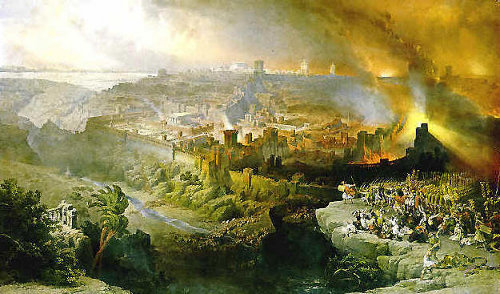
Apostle-Paul-PreachesPastor said this was the beginning of the process of transferring authority from Jerusalem to Syrian Antioch. What? Transferring authority? I’d never heard of such a thing. How could any city but Jerusalem be the geographic and spiritual center of our faith? I had always believed that the ultimate authority over the “church” was always wielded from Jerusalem, that is until 70 CE when the Romans leveled the Temple, razed Jerusalem, and sent the vast majority of the Jewish population into the diaspora. Only then was authority transferred from the Jewish apostolic council to the Gentiles, and this by force.

But according to Pastor Randy, once the original apostles, those who walked with Jesus and who witnessed the resurrection, died…their authority was not automatically passed down to others, either their heirs or any other appointed elders. There is only one record of an apostle being replaced and that was long before the trials of Paul.

So one of the men who have accompanied us during all the time that the Lord Jesus went in and out among us, beginning from the baptism of John until the day when he was taken up from us—one of these men must become with us a witness to his resurrection.” And they put forward two, Joseph called Barsabbas, who was also called Justus, and Matthias. And they prayed and said, “You, Lord, who know the hearts of all, show which one of these two you have chosen to take the place in this ministry and apostleship from which Judas turned aside to go to his own place.” And they cast lots for them, and the lot fell on Matthias, and he was numbered with the eleven apostles.

Acts 1:21-26

Protestantism tends to discourage the idea of a more permanent intent for the Council of Apostles because it smacks of the authority of Rome in Catholicism and other Ecumenical Councils who exercise authority over the faithful, many times to the detriment of the faithful. So Pastor’s thoughts could be a reflection of his perspective and education.

Be that as it may, the Council of Apostles disappears from Jerusalem and from history, certainly by 70 CE if not before.

But what about the centrality of Jerusalem? If you believe there will be a Third Temple (as I do) from where Messiah will reign in Jerusalem, then you cannot dispense with Jerusalem. If you believe that each year the Gentile nations must send representatives to Jerusalem to celebrate Sukkot (Zechariah 14:16-19), then you cannot dispense with Jerusalem. Jerusalem is the focus, the nexus for all of our prophetic hopes in the return of the Messiah. If the apostles and the council vanished from Jerusalem with no successors, did “authority” shift to Antioch?

Now there were in the church at Antioch prophets and teachers, Barnabas, Simeon who was called Niger, Lucius of Cyrene, Manaen a lifelong friend of Herod the tetrarch, and Saul. While they were worshiping the Lord and fasting, the Holy Spirit said, “Set apart for me Barnabas and Saul for the work to which I have called them.” Then after fasting and praying they laid their hands on them and sent them off.

Acts 13:1-3

It certainly seems so, but let’s think about this. The first large group of Gentiles to become disciples of the Master and to receive and extensive education in his teachings and (very likely) in the Torah were the Antioch Gentile God-fearing believers. Antioch also became a good “jumping off place” for Paul and his fellow apostles to go to the Gentiles in the diaspora with the good news of the Messiah (but going to the Jews first, of course). And while Antioch seems to have been a major center of Jewish/Gentile Messianic worship and evangelism, Paul continued to return to Jerusalem (Acts 15 and 21) to receive authoritative rulings on difficult matters and to bring donations for support of the Jewish “saints” in Israel.

fall-of-jerusalemAntioch may have been the center of the Jewish/Gentile interface of the Way, but Jerusalem was the heart, soul, and final authority over the movement.

But when there were no more living apostles in Jerusalem, did God close the door on Jewish authority over the Way, even over the Jewish members?

Lest you be wise in your own sight, I do not want you to be unaware of this mystery, brothers: a partial hardening has come upon Israel, until the fullness of the Gentiles has come in. And in this way all Israel will be saved…

Romans 11:25-26

This and other references of Paul’s, indicate that whatever separation there may be between the Jewish people and King Messiah is only temporary, which includes the separation between the King and Jerusalem. The “authority” left Jerusalem temporarily, but the Throne of the King has always been in the City of David.

The Lord swore to David a sure oath from which he will not turn back: “One of the sons of your body I will set on your throne.

Psalm 132:11

When Jesus returns as Lord of Israel and Lord of all, the authority will return to Jerusalem again. I don’t think even Protestant resistance to “apostolic authority” can deny that we all have one King and he is the authority and author of our lives.

“Jerusalem, Jerusalem, who kills the prophets and stones those who are sent to her! How often I wanted to gather your children together, the way a hen gathers her chicks under her wings, and you were unwilling. Behold, your house is being left to you desolate! For I say to you, from now on you will not see Me until you say, ‘Blessed is He who comes in the name of the Lord!’”

Matthew 23:37-39 (NASB)

Good Shabbos.

145 days.

Paul the Christian Pharisee

paul-the-phariseeNow when Paul perceived that one part were Sadducees and the other Pharisees, he cried out in the council, “Brothers, I am a Pharisee, a son of Pharisees.

Acts 23:6

Paul used the present tense, “I am a Pharisee,” not “I was a Pharisee.” Christian commentaries are uncomfortable with the statement, and they usually try to dodge the implications by explaining that he used to be a Pharisee prior to becoming a Christian.

Did Paul perjure himself before the Sanhedrin (a grave sin) by saying, “I am a Pharisee” instead of saying, “I was a Pharisee”? If so, none of his accusers had the wherewithal to challenge him on it. If he was no longer a Pharisee at the time of the trial, his testimony would be easy enough to discredit.

-D. Thomas Lancaster
Torah Club, Volume 6: Chronicles of the Apostles
from First Fruits of Zion (FFOZ)
Torah Portion Tazria (pg 711), Commentary on Acts 23:1-24:27

I suppose you could say this is a continuation of my previous “meditation,” Paul the Apostle, Liar, and Hypocrite and earlier commentaries. As I continue to read through Lancaster’s “Chronicles of the Apostles” Torah Club study, I continue to follow Paul through his various “legal problems” and his journey that will eventually lead to Rome, Caesar, and death. I also continue to watch as Paul repeatedly defends himself against the charges brought against him by the Jewish authorities of the Sanhedrin. From Paul’s point of view, he did nothing wrong to the Jewish people, to the Torah, to the Temple, or even to Rome.

Paul argued in his defense, “Neither against the law of the Jews, nor against the temple, nor against Caesar have I committed any offense.”

Acts 25:8

In verse 7 of the same chapter, Luke records that “…the Jews who had come down from Jerusalem stood around him, bringing many serious charges against him that they could not prove.”

As we’ve seen in earlier chapters of Acts and in my earlier commentaries on those chapters (thanks to Lancaster and the Torah Club), there simply was no evidence to support the wild accusations that had been made against Paul. He should have been set free, and except for various political reasons, finally including Paul’s appeal to Caesar and Rome, he never was.

Not only do I want to pursue the scriptures and commentaries that support Paul’s innocence, but I want to continue to illustrate how Paul never imagined that being an apostle of Jesus required in any sense, surrendering observance of the Torah mitzvot and the lifestyle of a Jewish Pharisee, nor did he expect this of other believing Jews.

All believers could claim to adhere to Pharisaic doctrine, but not all of them could claim to actually be Pharisees. Paul concluded his testimony with the declaration, “Brethren, I am a Pharisee, a son of Pharisees; I am on trial for the hope and resurrection of the dead!” (Acts 23:6).

-Lancaster, ibid

That statement might come as a shock to you if you’ve been taught that all Pharisees were horrible, legalistic monsters and hypocrites. After all, Jesus had some pretty rough things to say to the Pharisees.

“Woe to you, scribes and Pharisees, hypocrites! For you are like whitewashed tombs, which outwardly appear beautiful, but within are full of dead people’s bones and all uncleanness. So you also outwardly appear righteous to others, but within you are full of hypocrisy and lawlessness.

Matthew 23:27-28

On the other hand, Jesus also said this:

The scribes and the Pharisees sit on Moses’ seat, so do and observe whatever they tell you, but not the works they do.

Matthew 23:2-3

Do what they say but not what they do. What do they say?

And when he had said this, a dissension arose between the Pharisees and the Sadducees, and the assembly was divided. For the Sadducees say that there is no resurrection, nor angel, nor spirit, but the Pharisees acknowledge them all.

Acts 23:7-8

For Paul, the Pharisaic belief in the resurrection of the dead and a life in the world to come was lived out by his faith in Yeshua (Jesus) as the risen Messiah King.

That is why his faith was “counted to him as righteousness.” But the words “it was counted to him” were not written for his sake alone, but for ours also. It will be counted to us who believe in him who raised from the dead Jesus our Lord, who was delivered up for our trespasses and raised for our justification.

Romans 4:22-25

The doctrine of “the Way” was generally Pharisaic and in believing in the resurrection, so is modern Christianity.

I know, that’s probably a stretch for most of you, but if you follow the logic of Paul’s defense as recorded by Luke, it is very compelling. Lancaster comments further on this point.

The teaching and beliefs of Yeshua, Paul, and all the apostles echo the theology of the Pharisees. A Pharisee could become a disciple of Yeshua and still be a Pharisee…

-Lancaster, pg 713

Not so the Sadducees or any other branch of Judaism that did not believe in resurrection.

Even though the Master sometimes disagreed with the specific priorities of the oral law, He and the apostles practiced and transmitted Pharisaic, rabbinic tradition and interpretation. Their teachings and methods of biblical exegesis mirror those of the Pharisees. The Sadducees, on the other hand, were the first-century equivalents of Karaite Jews and sola-scriptura Protestants. They rejected most Jewish tradition, oral law, and rabbinic exegesis.

-ibid

paul-in-chainsFrom a modern Christian’s point of view, we almost want to make the Sadducees the heroes of the story because they rejected Jewish oral law and traditions, and Jesus heavily criticized the Pharisees for some of their traditions. But while many of the Pharisees far exceeded the Torah’s intent by creating enormous burdens from their rulings that weighed heavily on the Jewish people, Jesus did not criticize their core teachings. Being a Pharisee wasn’t the problem. Being a hypocrite and a liar was. Paul was the former but never the latter.

But Paul had a “confession” to make.

But this I confess to you, that according to the Way, which they call a sect, I worship the God of our fathers, believing everything laid down by the Law and written in the Prophets, having a hope in God, which these men themselves accept, that there will be a resurrection of both the just and the unjust. So I always take pains to have a clear conscience toward both God and man.

Acts 24:14-16

Paul admitted to the charge of belonging “to the sect of the Nazarenes,” but he rejected any implication that the teachings of the Way deviated from normative Jewish expression. To Paul, faith in Yeshua was not simply one more sect of Judaism, it was “the Way of the LORD,” a spiritual restoration and redemption of all Israel that transcended sectarian divides. He admitted to “believing everything that is in accordance with the Torah and that is written in the Prophets.” He declared his hope in God, a hope which his accusers also cherished.

-Lancaster, pg 723

There’s one sentence in my last quote from Lancaster that I hope you caught. Here is is again:

To Paul, faith in Yeshua was not simply one more sect of Judaism, it was “the Way of the LORD,” a spiritual restoration and redemption of all Israel that transcended sectarian divides.

This is as true today as it was the moment Paul said it. Faith in Yeshua the Messianic King is not just a way for the world to be saved (which, of course, is no small thing) but it is the way to spiritual restoration and redemption of all Israel. That is the critical piece of knowledge both Jews and Christians must understand. Jesus doesn’t stand in opposition to the Jewish people, he stands for their redemption as a people and their restoration as a nation.

The good news of forgiveness from sins, salvation, and a life in the world to come is what we focus on as Christians, but most of the time, we miss why Jesus is uniquely special to the Jewish people. He doesn’t just save the individual Jewish soul as he does the individual Gentile soul, he saves Israel, he restores their nation to the head of all nations, he gathers his people back to him and to their Land, and he is their King, the King of the Jews, even as he is also the King of the World.

Paul, the “Christian” Pharisee knew all that, and the evidence of his innocence is also a shining lamp for every Jew and Gentile who turns away from darkness and to the light. To turn toward the light, we Gentiles must surrender a life of disobedience and learn to love, listen, and obey God. For a Jew to turn toward the light of the world in Messiah, they also must learn to obey, but Torah observance for the Jew is part of that obedience. We in the church are obedient, not only when we refrain from sin, but when we act to encourage our Jewish brothers and sisters in the faith to continue to live wholly Jewish lives in accordance with the commandments.

Paul lived his life enthusiastically as a disciple of Jesus Christ…and as a Pharisee.

162 days.