Tag Archives: religion

This Can’t Be It

That-s-all-folks“Fear is the parent of cruelty.”

-James Anthony Froude

I’ve tried to be fearless in pursuit of God and chronicling my journey along the way. I can pretty much put up with name calling and people disagreeing with me. What I can’t tolerate is being the source of pain for other human beings, and yet no matter what I do or say, I end up hurting someone. I don’t think you can really blog in the religious space without stepping on toes, but we were commanded to love one another, not to step on each other’s toes.

Far from pronouncing judgment and condemnation and trying to constantly correct others, Yeshua taught his disciples to be peacemakers, merciful, meek, humble, patient, and longsuffering, even under persecution (Matthew 5:1-10). Rather than boasting about being right, we should seek to do what is right.

-Boaz Michael
“Becoming a Shaliach,” pg 95
Tent of David: Healing the Vision of the Messianic Gentile

I’ve come that close to shutting down this blog on more than one occasion over the differences between being right and doing right, but never closer than I have with today’s “meditation.” I had a email “conversation” with a friend who both (without his realizing it) triggered the desire to close up shop and then encouraged me to keep on going. I won’t go into the details, but all kinds of misunderstandings can happen when we rely on the Internet for communication. I’m thankful that God is patient and that He gave me the time to reconsider my original course of action.

The image at the top of this missive was the one I originally selected and I decided to keep it because one: I love Looney Toons, and two: as a reminder that the show must go on.

You are not required to complete the task, you are not free to withdraw from it … but be aware that the reward of the righteous will be given in the World to Come.

-Pirkei Avot 2:21

strengthSo the sages say I can’t give up, even when I want to, even when I don’t think I’m doing such a good job, even when any blog post I create can be sharply diverted from its course by someone commenting off topic. I guess like Bugs Bunny and company, as well as everyone in show business has traditionally said (and as I said above), “the show must go on.”

But as I wrote yesterday, I need to spend a lot of time at the feet of my Master, learning, studying, meditating, and pondering on his words and his teachings. If what I do isn’t about serving God and showing love, then it’s not worth it at all. I need you, my readers, to understand that. I think a lot of you do, but there’s always the potential for the more “controversial issues” in the religious blogosphere to get in the way, especially through comments and conversation.

You hypocrite, first take the log out of your own eye, and then you will see clearly to take the speck out of your brother’s eye.

Matthew 7:5 (NASB)

Even when I express frustration at what happens at church sometimes, I am absolutely not placing myself above the church or criticizing other human beings in the church. We’re all running madly along the edge of a razor blade anyway, desperate to not fall one way or the other and be sliced to ribbons on the blade of our own folly.

For man is born for trouble, As sparks fly upward.

Job 5:7 (NASB)

This much is true, but I’m reminded that in some corners of Judaism, the Divine in each of us can be seen as “sparks” and these “sparks” always desire to fly upward to rejoin their Source, the Holy One of Israel. This same train of thought states that we are all put into this life to search for very specific “sparks,” the shards of Divinity “with our name on them,” so to speak. It is our task to uncover these sparks to send them upward again. The world is in disguise, covered with mud, and blood, and worse, but that’s not how it was created and that’s not how it’s going to end up. Beneath the disguise is something beautiful. Beneath the masks of ugly, base humanity we wear, we are beautiful people made in God’s image. All we need to do is learn how to uncover the world and ourselves to see the beauty that God built into Creation and into us.

bugs-bunnyIf that is my mission, then as you can see, I have little time to focus on “negativity.” If I’m tempted to take pot shots at someone else or some organization, I should take the Master’s rather sarcastic words from Matthew 7:5 to heart.

The blog post I originally intended for today was difficult to write and I couldn’t think of a single portion of scripture that seemed to fit. After some reflection and no small amount of influence from the Holy Spirit, this “replacement” for today’s “morning meditation” is more in touch with who I believe I am in Messiah.

It’s funny how something as simple as a childhood memory can remind you of what’s really important. Thanks, Chuck Jones. You’ll never know how much of a hero you are, and through your artwork, humor, and a scrappy little “wascally wabbit,” how much you showed me that being down doesn’t mean being out. On with the show, this is it.

Overture, curtains, lights
This is it, you’ll hit the heights

Tonight what heights we’ll hit
On with the show this is it

Peace.

Christianity Today and Why Paul is Not Anti-Judaism

paul-on-the-road-to-damascusThe misconception about Paul with the longest historical pedigree is that he was anti-Jewish. Many imagine that after his Damascus Road experience, Paul immediately rejected Judaism and embraced Christianity. They assume that in the first century these were two clearly distinguishable religions. Before his encounter with Christ, the thinking goes, Paul was wrapped up in a legalistic pursuit of salvation and was teaching others a similar philosophy. So great was his passion that he persecuted the Christians who taught salvation by grace through faith. After his conversion, everything changed. He embraced God’s gracious salvation by faith in Christ and rejected the system of dead rituals bound up in Judaism. Paul left Judaism, therefore, and turned to Christianity.

-Timothy Gombis
“The Paul We Think We Know” (originally published 7-22-2011)
Christianity Today

Someone posted this on Facebook today and as I was reading it, I wanted to jump up out of my chair and scream YES! YES! Someone finally GETS IT!

OK, I’m not really that emphatic in my behavior but it does excite me that someone writing for a traditional Christian publication understands what I understand and what I’ve been trying to communicate in the church I attend for nearly a year.

Let’s cut to the chase. What does Gombis really think about Paul and more importantly, Paul’s struggle to integrate non-Jewish disciples into a Jewish religious stream?

The problem in the early church, therefore, was not the temptation toward legalistic works righteousness. They faced the communal challenge of incorporating non-Jewish converts into the historically Jewish people of God. First-century Judaism didn’t have a legalism problem; it had an ethnocentrism problem. The first followers of Jesus were all Jewish, and had difficulty imagining that the God of Israel who sent Jesus Christ as their Savior could possibly save non-Jews without requiring them to convert to Judaism. This is the issue in Acts 15, when Christian Jews from Judea urged the Gentiles in Antioch, “Unless you are circumcised, according to the custom taught by Moses, you cannot be saved” (Acts 15:1).

While the early church leaders decided in theory that non-Jewish believers in Jesus were not required to become Jews (Acts 15:13-21), many churches struggled with the practical challenges of becoming healthy multiethnic communities. Paul, as pastor and theologian, addresses these challenges by claiming that “no one will be declared righteous in God’s sight by the works of the law” (Rom. 3:20). This is not a condemnation of Judaism as inherently legalistic, but an affirmation that God does not justify a person merely because he is ethnically Jewish. Jews and non-Jews approach God on equal terms when it comes to salvation (emph. mine). All have sinned and all stand in need of God’s redeeming grace in Christ (Rom. 3:23-24). Therefore all who are in Christ are equal siblings in God’s new family (Gal. 3:26-28).

The “in theory” comment seems to relate to the ongoing struggle to integrate, with anything approaching seamlessness, Jewish and Gentile disciples within a single religious and social framework, but I’ll return to that issue in a moment. The main point here is that Paul did not reject Judaism for Christianity, supported continued Judaism and Torah observance for Jews, and identified the primary problem among Jewish believers and their difficulty in accepting Gentle disciples not as legalism but ethnocentrism. Many of the believing and non-believing Jews could not accept Gentiles as equal participants of a Jewish religious branch without requiring that they convert to Judaism. After all, whoever heard of Jews and Goyim being equal in the sight of God? Gombis already quoted this verse, but it should be repeated.

Some men came down from Judea and began teaching the brethren, “Unless you are circumcised according to the custom of Moses, you cannot be saved.”

Acts 15:1 (NASB)

PaulThis was the core problem Paul faced in his mission to the Gentiles and it would always haunt him. It was the cause of most of his major problems with the various Jewish communities in Israel and the diaspora. He would never see a day when this conflict was ultimately resolved and the echo of his struggle still rings in our ears. That is, if we’ll actually let ourselves listen.

But what about Paul, Judaism, and his relationship with Jewish disciples?

A second reason why we cannot envision Paul as anti-Jewish is that even after his conversion, Paul remained a Jew. He did not imagine that he was inventing a new religion, nor did he leave Judaism to join the Christian church. At the end of his third missionary journey, Paul arrived in Jerusalem and, at the suggestion of James, went through purification rituals at the temple (Acts 21:23-26). Paul saw no contradiction at all between his commitment to Christ and his faithful participation in Jewish practices. Explaining his ministry before a variety of audiences, Paul emphasized his Jewish identity and claimed to be acting in faithfulness to the God of Israel. Before the Jewish Council in Jerusalem, he declared, “My brothers, I am a Pharisee, descended from Pharisees. I stand on trial because of the hope of the resurrection of the dead!” (Acts 23:6, emphasis added). And to King Agrippa, he again claims to be a Pharisee whose hope is in the promises of God to Israel (Acts 26:4-6).

Third, Paul never calls upon Jews to reject Judaism. Instead, he exhorts them to recognize Jesus as their Messiah and welcome his non-Jewish followers as siblings in God’s new family. We get a glimpse of his preaching to Jews in Acts 17:1-3: “When Paul and his companions had passed through Amphipolis and Apollonia, they came to Thessalonica, where there was a Jewish synagogue. As was his custom, Paul went into the synagogue, and on three Sabbath days he reasoned with them from the Scriptures, explaining and proving that the Messiah had to suffer and rise from the dead. ‘This Jesus I am proclaiming to you is the Messiah,’ he said.”

The Paul of the New Testament, therefore, is not anti-Jewish. He was faithful both to the Scriptures and to his Jewish heritage. He preached Jesus as the promised Messiah of Israel, but was insistent that salvation in Christ was not limited to ethnic Jews. According to his gospel, all Jews needed to receive Jesus as Messiah, and all followers of Jesus—Jewish and non-Jewish—needed to embrace one another as siblings in God’s global family in Christ.

I’m stunned that this is being published in an online Christian venue. I’m absolutely shocked. I’m pleased beyond wonder. Paul never stopped being a Jew, never stopped Jewish observances, and absolutely never, ever encouraged any Jew to abandon Jewish practice, lifestyle, and faith. Turning to Messiah is a completely Jewish act and does not require the slightest deviation from Jewish Torah observance.

But what about “in theory?”

Gombis isn’t suggesting that in theory, the Gentiles became Jews either by formal conversation (which Paul opposed) or in action but not name by observing the mitzvot in a manner identical to the Jewish disciples. The author is only acknowledging what I have been saying all along: that in principle, the requirement was to unite Jewish and Gentile disciples of the Master within a multiethnic, multinational framework where all could share in the grace and salvation of God without anyone being compelled to surrender their unique and individual national and ethnic identity.  In practice, this was never accomplished and ultimately, both populations pursued wildly different trajectories. Their struggles are what we see in the Messianic Jewish and Hebrew Roots movements today.

walking_discipleEarlier, I posted my review of the First Fruits of Zion television series episode Raising Disciples. This is particularly relevant to today’s “extra meditation” because we encounter the topic of disciples as imitators. What did Paul say to the Gentile disciples he was raising up about imitating their Master?

In 1 Corinthians 11:1, he told them to “be imitators of me, just as I also am of Christ.” but we don’t know what they are supposed to imitate. My suggestion is that the manner of Jewish and Gentile imitation is not identical across the board, since it would obliterate Jewish and Gentile distinction in the body of disciples and thus eliminate the problem of Gentile integration. If Jewish and Gentile disciples were identical and homogenous, the basis for schism would have been severely blunted if not done away with entirely.

However, it was a given that Jewish disciples were intended to continue Jewish practice according to Gombis and the legal decision rendered by James and the Council was that the Gentiles had no identical obligation. By common association, the Gentile disciples might have acted very similarly to their Jewish counterparts, at least to an outside observer, but there remained a difference in obligation between the Jewish and non-Jewish disciples within the body of Messiah.

That probably isn’t a very satisfying answer, but I’m still thrilled that a Christian online magazine is promoting a view of Paul that is so close to my own. Now if I could just send this link to every church Pastor in the country with a note saying “READ THIS!” and if they’d keep an open mind while doing so, I’d consider it a step forward.

Interestingly enough, today is Hoshana Rabbah, the traditional day of judgment for the nations of the world. How will God and Israel judge us if we do not learn to see Paul and the Messiah in the manner Timothy Gombis suggests?

Born Again Idol Worshipper

jesus-idolAs Rabbi Abraham Isaac Kook, the great Kabbalist and philosopher living at the turn of the century put it, “There is faith that is actually denial, and there is denial that is actually faith.” When a person says that he believes in God, but in fact, that God he believes in is really a conceptual spiritual idol, an image of God that he has conjured up, then his faith is actually denial of truth, heresy. However, when a person professes atheism because he just can’t believe in some almighty king with a white flowing beard floating somewhere in outer space, in a sense he is expressing true faith, because there is no such God.

-Rabbi David Aaron
“Chapter One: Getting Rid of God,” pg 7
Seeing God: Ten Life-Changing Lessons of the Kabbalah

In Christian thinking, that human failure is inherent in human nature, one of the results of original sin, Adam’s rebellion against God’s will in the Garden of Eden as recorded in Genesis 3. That blemish is transmitted from one generation to another to all of humanity through the sexual act. Jesus’ vicarious death on the Cross then represents God’s gracious gift, which erases that original sin and grants salvation to the believer who accepts Jesus’ saving act.

But in Jewish sources, the very fact that the prophets urge the people of Israel to unblock their hearts, to open their eyes, to remove the obstacles that get in the way of their relation to God suggests that this obstacle is more a matter of will, not at all inherent epistemological obstacle to recognizing God’s presence in the world.

Any time we install a feature of creation and call it God, we are committing the sin of idolatry, the Jewish cardinal sin. It need not be a material object; it can be something much more abstract or elusive: a nation, history itself (as in Marxism), financial reward, or another human being.

-Rabbi Neil Gillman
“Introduction,” pp x-xi
The Jewish Approach to God: A Brief Introduction for Christians

It’s not really pleasant to be called an idol worshipper but that’s exactly what happened to me recently.

No, it wasn’t done in an unkind way and I understand the complete sincerity of the person involved and their desire to be “a light to the world,” so to speak, by encouraging me to reconsider what this person believes is a very bad decision on my part…worshipping a man as God.

I think it’s rather amazing that I checked out both Rabbi Aaron’s and Rabbi Gillman’s books from my local library a week or more ago, before I knew I’d be having this conversation with my friend. In reading their first chapters, they both seem to be speaking to the idea of worshipping idols, albeit from different directions. Rabbi Gillman’s book sounds somewhat like my friend in that it’s a Jewish person attempting to be a light to the nations by writing to Christians and letting us know how we’re not getting it right. We aren’t examining the Bible through the correct lens. There are just too many areas of the Tanakh (Old Testament) that either fail to speak of God becoming man and Messiah, or that directly speak against such a thing.

My friend and I have had these conversations before and while I try very hard to take his suggestions and information and examine them objectively, I continue to run headlong into my faith in Jesus as Messiah. I’ve been challenged to re-examine that faith against the Tanakh and seek my answers within its pages. Can we “prove” Jesus is the Messiah without touching the New Testament at all?

Some of those who were with us went to the tomb and found it just exactly as the women also had said; but Him they did not see.” And He said to them, “O foolish men and slow of heart to believe in all that the prophets have spoken! Was it not necessary for the Christ to suffer these things and to enter into His glory?” Then beginning with Moses and with all the prophets, He explained to them the things concerning Himself in all the Scriptures.

Then their eyes were opened and they recognized Him; and He vanished from their sight. They said to one another, “Were not our hearts burning within us while He was speaking to us on the road, while He was explaining the Scriptures to us?”

Luke 24:24-27, 31-32 (NASB)

I suppose I just cheated because I’m quoting from the New Testament, but look at what’s being said. Jesus, using only Moses and the Prophets (which makes perfect sense as none of the New Testament writings existed during this time in history), “explained to them all the things concerning Himself in all the Scriptures.”

If I take that statement at face value, that means it’s possible to support having faith in Jesus as Messiah using only the Torah and the Prophets. Too bad Luke didn’t record what Jesus actually said. It would have made things a lot easier to investigate.

crossLately, I’ve been writing a lot to Christians in the church defending Messianic Judaism and the observance of the Torah mitzvot by believing Jews. I’ve spent almost no time at all directly addressing Jewish people who are religious but have no faith in Jesus, and who see worshipping Jesus as God as idolatry. Rabbi Aaron implied, based on the above-quoted passage of his book, that someone who doesn’t believe in a God that is not credible because He is quantifiable, physical, and definable, has more faith than a person who can point to Jesus as “the image of the invisible God” (Colossians 1:15). Is worshipping Jesus worshipping an “image?” Is worshipping Jesus who lived a human life actually worshipping a man?

You shall not bow down to their gods, nor serve them, nor do after their works: but you shall utterly overthrow them, and quite break down their images.

Exodus 23:24 (American King James Version)

So watch yourselves carefully, since you did not see any form on the day the Lord spoke to you at Horeb from the midst of the fire, so that you do not act corruptly and make a graven image for yourselves in the form of any figure, the likeness of male or female…

Deuteronomy 4:15-16 (NASB)

Those two verses don’t seem to have a direct bearing on the worship of God in corporeal, living form, since “images” and “graven images” address more manufactured items, like statues and such.

This all goes to the heart of how we Christians understand that Jesus was at once human and Divine. For most Jewish people, this does not compute. Rabbi Gillman’s book is written specifically to refute Christianity, although I’m certain with the best intentions.

When Christians try to explain their/our faith to most other groups, we rely a lot on the New Testament and we speak in all manner of “Christianese.” However, does this work very well with most Jewish people? The majority of Messianic Jewish people I know came into the movement by way of the church. Most of them became familiar with and invested in the Torah and a lived Jewish experience only later on. Faith in Jesus preceded a Jewish understanding of faith in Jesus.

Not being Jewish and not having that lived experience and education, I can only present the basis of my faith from a Christian/Gentile point of view.

A lot of Jewish people have a point in “defending” themselves against Christianity. Conversion and assimilation are considered a real threat to Jewish continuance forward in time. While I don’t believe that God would ever allow the extinction of the Jewish people and of Israel, Jewish people are still afraid. Further more, people like my friend and Rabbi Gillman authentically believe they are providing Gentile Christians a service in explaining how we are mistaken and how to correct our mistakes.

This is the sort of dialog that the church hasn’t done well at during the past twenty centuries or so. But if we can’t show from the Tanakh that Jesus is Messiah and Lord, what can we Gentiles in Christianity say to the Jewish people who challenge the validity of our faith and our identity in Christ?

It’s Time To Let Go

finding-nemo-let-goMARLIN: “Dory!”

DORY: “He says, “It’s time to let go!”. Everything’s going to be all right.”

MARLIN: “How do you know, how do you know something bad isn’t gonna happen?”

DORY: “I don’t!”

-dialog from the film Finding Nemo (2003)

You’ve probably seen this film at one point or another and if you have kids, you’ve probably seen it a lot. Marlin (voiced by Albert Brooks) and Dory (voiced by Ellen DeGeneres), after having gone through many adventures, have been swallowed by a whale. The forgetful Dory, who apparently can speak whale, was asking the sea mammal for directions to Sydney, Australia when the creature gulped down her and Marlin with a chaser of krill. We all know that this was the whale’s best effort to give Dory and Marlin a free ride to their destination, but the ever pessimistic Marlin just feels like today’s hot lunch special.

Dory has another point of view made of optimism and trust (and short-term memory loss). When the water inside the whale recedes and Dory and Marlin are about to fall down the whale’s throat, Marlin grabs onto something and clutches it and Dory for dear life. The whale tells Dory (in whale talk) to let go and Dory translates for Marlin. That’s where we pick up the dialog above.

MARLIN: “How do you know, how do you know something bad isn’t gonna happen?”

DORY: “I don’t!”

You won’t read this until Tuesday, but I’m writing it on Sunday afternoon. Three times at church this morning, I must have heard someone say to humbly trust God for everything and not our own efforts.

Trust in the Lord with all your heart and do not lean on your own understanding.

Proverbs 3:5 (NASB)

Yeah, I’m pretty sure that’s the basis for such a thing in the Bible.

I’m not always happy with the sorts of religious systems we develop just to try to understand what God is saying to us in the Bible. It’s sometimes amazing to me that so many different and contradictory meanings can be squeezed out of the scriptures. Really, if God caused the Bible to be written in human language so that human beings could understand what He’s saying (and since He’s God, what He’s saying to us must be pretty important), then why is the Bible so incredibly difficult to comprehend in a unified fashion?

But then sometimes, suddenly the Bible can be very clear.

‘You shall also count for yourselves from the day after the sabbath, from the day when you brought in the sheaf of the wave offering; there shall be seven complete sabbaths. You shall count fifty days to the day after the seventh sabbath; then you shall present a new grain offering to the Lord. You shall bring in from your dwelling places two loaves of bread for a wave offering, made of two-tenths of an ephah; they shall be of a fine flour, baked with leaven as first fruits to the Lord.’

Leviticus 23:15-17 (NASB)

In his sermon, Pastor said this was the command for the people of Israel to acknowledge God’s provision to them on Shavuot. Last week, we talked about offering God the firstfruits, the very best of the barley crop before anyone else could “sample the goods.”

God gives us everything. He needs nothing from us in return. And yet, He directed the Children of Israel to give back to Him by these festivals so that the Israelites could realize where everything comes from and acknowledge God’s goodness and generosity.

You open Your hand And satisfy the desire of every living thing.

Psalm 145:16 (NASB)

I have been young, and now am old, yet I have not seen the righteous forsaken or his children begging for bread.

Psalm 37:25 (ESV)

birkat-hamazonBoth of those scriptures are incorporated in the Birkat Hamazon or “Grace After Meals,” a blessing typically said by observant Jews after a meal. In my previous congregation, on Shabbat, we would recite it after our oneg meal and before the teaching began. It’s a wonderful reminder of God’s provision for all humanity and that everything we have truly comes from Him.

In my struggles with “religious systems” and trying to integrate within traditional Christianity, I haven’t really been relying on God. Oh, it’s not as if God hasn’t been involved and has been absent when I needed help, I just haven’t been asking Him, at least very regularly. If I have to rely only on the brain I have inside my skull, I’m not going to get very far. Maybe that’s why I haven’t gotten very far. Then again, I’m not sure how far God wants me to go, or in what direction.

I know I still want to write about things like the comparison between Christian Dispensationalism and Rabbinic Judaism and how they both seem to rely on a post-Biblical evolution of their religious design structures in order to adapt to changes in environment and history (and this is a comparison that wouldn’t find much traction in the church). I also have to decide to finally follow Dory’s advice and let go.

It’s not up to just me to fight, let alone win any battles. Sure, I have to show up and be prepared, but I’m hardly the star attraction. I’m not the general. I’m not leading the army. The spotlight isn’t centered on me, nor to I want it to be.

Well, sometimes, maybe a little, but that’s my error.

I’ve been trying too hard to hang on because I was afraid something bad might happen…well, not exactly, but close enough. I’ve been fighting too hard and worrying too much about getting my point across when I know it’s not my point. It’s God’s. And if it’s God’s point, it’ll get across. Who can resist God? If I’m not speaking about God’s point, then no one will listen anyway.

So in the present case, I say to you, stay away from these men and let them alone, for if this plan or action is of men, it will be overthrown; but if it is of God, you will not be able to overthrow them; or else you may even be found fighting against God.”

Acts 5:38-39 (NASB)

I probably have been resisting God. Most of us do, though we are loath to admit it.

I still need to do what I believe God wants me to do, but I also need to let God take the lead, so to speak, and not think that it’s all my effort. I also need to better realize that whatever I have is from God and not find it so difficult to give back. If I really trust God, then it’ll all work out by His will.

Let me hear your kindness at dawn, for in You have I placed my trust; let me know the way I should walk, for to You have I lifted my soul.

Psalm 143:8 (Stone Edition Tanakh)

It’s time to let go.

Systems

broken-crossThe eye sees, and the heart desires.

-Rashi, Numbers 15:39

People cannot help when an improper impulse comes to mind, but they certainly can stop themselves from harboring the thought and allowing it to dominate their thinking. Yet, sometimes one may be responsible even for the impulse itself.

While some impulses are completely spontaneous, others arise out of stimulation. If a person reads, hears, or sees things which can provoke improper thoughts and feelings, he or she is then responsible for the impulses that are the consequences of that reading, listening, or observing.

This concept is especially important in our era, when not even a semblance of a code of decency exists as to what may or may not be publicly displayed. All varieties of media exploit our basest biological drives.

Given the interpretation of the right of free speech under which such provocative displays occur, the government has no way to restrain them. However, each person has not only a right, but also an obligation to be his or her own censor. No one has to look at everything that is displayed nor hear everything that is broadcast. Those who fail to exert their own personal censorship are tacitly stimulating immoral impulses, and for that alone they are liable.

Today I shall…

…try to avoid looking, hearing, and reading things which can have a degenerating effect.

-Rabbi Abraham J. Twerski
“Growing Each Day, Elul 16”
Aish.com

I know that Rabbi Twerski was thinking of something else entirely, but when I consider trying to avoid exposing myself to things that have a “degenerating effect,” I have to include the world around me, including the world of “religion.” Well, “degenerating” isn’t the right term. “Discouraging” is.

Although you won’t read this until Sunday morning, I’m writing this on Thursday in response to my Wednesday night meeting with my Pastor. We were supposed to be discussing Chapter 8 in D. Thomas Lancaster’s book The Holy Epistle to the Galatians, but we got sidetracked on a few things.

I bring up the book because of my Pastor’s response to it. He told me that he was having difficulty accepting some of Lancaster’s assertions early on in the book out of concern that if he assented, he would end up traveling down a trail he didn’t agree with. That’s how I felt last night as Pastor and I talked about salvation, Jewish people, and the future of Judaism and Torah. I felt like I was being led to agree with doctrines that I wasn’t comfortable with but didn’t know how to refute. In going over the little pamphlet about Baptist Distinctives (that is, what makes the Baptist church different from all other churches), I could feel myself being tugged down the “garden path,” so to speak.

I ended our meeting by stepping out of the bowl of alphabet soup, all the letters and words of denominational doctrine and distinctives, and exploring actual experiences and relationships.

Well, sort of.

I’ve often imagined what it would have been like to live in the late Second Temple period in Jerusalem. What would it have been like to go into the Court of the Gentiles at the Temple. How many people would be there? Who would I see? What would the air smell like? Then, I’d humbly kneel and pray to Hashem. This close to the actual “house of prayer for all peoples,” would I feel the tangible presence of the God of Israel? Would I hear the songs of the priests ministering in the inner court?

0 RI’ve often imagined what it would have been like to be one of the non-Hebrew shepherds tending the flocks of Abraham in Canaan. In the heat of the day, I watch him in the distance, studying his mannerisms and appearance, knowing that this is a man, among all human beings, who has spoken to God “face to face.” In the evenings after a meal, around the fire, would he teach us of his God? What would he tell us about a relationship with Him? How does one pray to the God of Abraham as a humble shepherd? In blessing Abraham, would I be blessing God and also myself? What a hard and yet simple life, living close to a prophet and to the One God.

We read “Bible stories” about “Bible characters” as if reading morality fables or fairy tales. We “know” that they’re real, but do we? It’s just words on a page. Does “Biblical inerrancy” result in forgetting that Abraham was and is a real human being? Do we discount the moments of his life we don’t find in the Bible but nevertheless, moments that must have occurred? When, in reading the Bible and praying, do we allow Abraham to stop being a work of “fiction” and become a living, breathing, talking, experiencing human being?

Religion is all about systems, and Christianity, in all of its flavors, is just another series of systems. The systems exist to tell us what the Bible means and how we are supposed to live our lives. The systems tell us what is right and what is wrong, who is right and who is wrong, and what, if anything, we’re supposed to do about it.

But the systems totally ignore awe, majesty, terror, magnificence, and everything else everyone from Abraham in Canaan to a lowly, nameless goy in the Court of the Gentiles would experience in a living, breathing, bleeding, authentic, moment-by-moment encounter with God; the sights, sounds, smells, touches, tastes, thoughts, feelings, and dreams of actually being there instead of just reading the Bible and especially instead of filtering the Bible and everything else through religious systems that so very much remove us from authenticity and the jarring, electrifying, naked connection to our Creator.

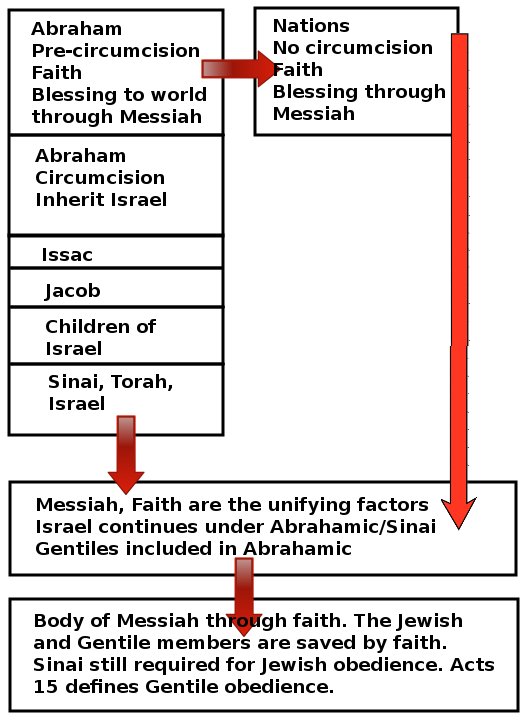
I tried to explain how I thought that Jews and Gentiles both are a part of the unified body of Christ and yet the Jewish connection to the Sinai covenant and its conditions, the Torah, are not undone by that unity. I drew a diagram, which I’ve reproduced below, to explain my thoughts. “But the Jewish people haven’t accepted Christ, so they can’t be saved,” he says (I’m paraphrasing). “Not just faith in ‘a Messiah’ but ‘The Messiah,’ in Jesus,” he says (I’m paraphrasing again).

Something’s wrong. I’m agreeing to things I’m not sure about. My Pastor is so sure of so many things that I think we can only see through “a glass darkly,” and that exist as much in the realm of God as they do in the material world. I don’t know how to explain it, so it’s difficult to know what to say.

covenant_chart1And there are so many other people who seem so sure about unsure things. I suppose it shouldn’t have surprised me that U.S. Army PFC Bradley Manning, just one day after being sentenced to 35 years in Federal Prison for releasing 700,000 secret military documents to Wikileaks, should come out as transsexual and declare that he wants to live the rest of his life as a woman, obviously changing how prison will be “applied” to Manning.

Religious systems. We craft them saying that we see their foundations in the Bible. But we craft them to say whatever we believe is important to us, and thus they reflect the political and social agendas and imperatives of the occupants of these systems. Extracting religious systems from the Bible is supposed to be guided by the Holy Spirit, but because human beings are involved, they end up dramatically contradicting each other, sometimes (often?) based on generational changes in attitudes.

I’ve mentioned before that I don’t think I’d make a good Baptist, not because I have anything against Baptists per se, but because I don’t think any denomination or modern religious stream, old school or new, holds all the keys and unlocks all the doors.

I know they think they do. They all think they do. But being an outsider, I can see a different perspective. I can see lots of perspectives, and none of them make a lot of sense. Pastor pretty much agrees with what he reads in Thomas Schreiner’s book 40 Questions About Christians and Biblical Law and I can barely stand a single thing Schreiner wrote.

Pastor is also reading Rudolph’s and Willitts’s book Introduction to Messianic Judaism: Its Ecclesial Context and Biblical Foundations. He’s just finished the chapter written by Scott J. Hafemann, “The Redemption of Israel for the Sake of the Gentiles” and he likes it very much. I’m going to re-read it to refresh my memory of the text. What did the Pastor see in this chapter that we can agree upon?

Can there be a peace? Or is the only peace in the presence of God and to heck with the systems?

Hoping for Salvation

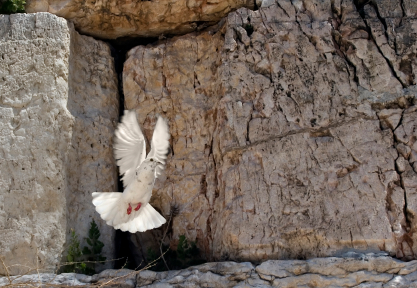
white-pigeon-kotelEach day we hope for Your salvation.

-Shemoneh Esrei

The Talmud states that one of the questions that will be posed to each person on his or her day of judgment is, “Did you look forward to salvation?” While the question refers to anticipating the ultimate Redemption, it can also refer to the salvation of the individual.

Positive attitudes beget positive results, and negative attitudes beget negative results. Books have been written about people who have recovered from hopeless illnesses because, contrary to medical opinion, they did not give up hope. On the contrary, they maintained a positive attitude. While this phenomenon may be controversial (for many people are skeptical that cheerful outlooks can cure), people certainly can and have killed themselves by depression. With a negative attitude, a person suffering from an illness may even abandon those practices that can give strength and prolong life, such as the treatment itself.

I have seen a poster that displays birds in flight. Its caption comments, “They fly because they think they can.” We could do much if we did not despair of our capacity to do it.

Looking forward to Divine salvation is one such positive attitude. The Talmud states that even when the blade of an enemy’s sword is at our throat, we have no right to abandon hope of help.

No one can ever take hope from us, but we can surrender it voluntarily. How foolish to do so.

Today I shall…

…try to always maintain a positive attitude and to hope for Divine salvation.

-Rabbi Abraham J. Twersky
“Growing Each Day, Elul 11”
Aish.com

Recently, I’ve written a number of reviews on portions of Thomas Schreiner’s book 40 Questions About Christians and Biblical Law. If you’ve read them, you know my feelings about Schreiner’s point of view on the Torah of Moses and how (or if) the Torah carries forward for the Jewish people into Apostolic times and beyond.

I want to take a step backward from that perspective this morning (but not too big a step). I’ve commented previously on the commonalities between Hebrew Roots, Messianic Judaism, and Christianity, as well as the fundamental platform upon which all who have faith in Yeshua (Jesus) as Messiah (the Christ) stand. While ultimately there is a dividing line between people who have faith in God through Jesus and those who do not, we can’t afford to dispense with authentic people of God who differ from us based on our opinions on “the Law” or how we understand God’s Word.

All people of faith face the same struggles. We are opposed by people who deny the existence of God, who deny that there is a core morality that is never-changing, who believe that human beings are the ultimate moral and intellectual force in the universe.

How can one be certain of the authority of the T’nach in all its particulars? The answer to this is based on common sense, and if one approaches the question open-mindedly and without prejudice, one must come to this conclusion. To put it very briefly, and going back from our present generation to preceding generations, we have before us the text of the T’nach as it was transmitted from one generation to the other by hundreds and thousands of parents of different backgrounds to their children. Even during the times of the greatest persecutions, and even after the destruction of the Beth Hamikdash, there always survived hundreds and thousands of Jews who preserved the text of the T’nach and the traditions, so that the chain has never been broken.

-from correspondence by Rabbi Menachem M. Schneerson
27th of Shevat, 5723 [February 21, 1963]
posted at Chabad.org

The Lubavitcher Rebbe has critics not only in Christianity but in different branches of Judaism, but the struggles he describes are the same as ours. Although I wouldn’t make a good Chabadnik for a number of reasons (not the least of which is the fact that I’m not Jewish), I often find their published writings and philosophies to be beautiful and reflective of God, especially when contrasted against criticisms against Torah and Judaism. No, it’s not that Judaism isn’t also critical of Christianity.

Furthermore, there is a basic difference between our Jewish tradition and those of other faiths, such as Christianity or Islam. For, whereas in the latter cases the traditions go back to one individual or a limited number of individuals, our traditions go back to a revelation which was experienced by a whole people at once, so that at no time did we have to place our trust in the veracity of one, or a few, individuals.

tallit-prayerThe Rebbe is being very “even-handed” in his response to Christianity in this letter. Some Jewish criticisms are far more biting.

I’m not saying we should compel religious Jews to abandon the practices of their faith or attempt to drive Christians from their (our) views on Jesus, but I am saying that we should stop trying so hard to jockey for position in order to establish our “lead” in the “race” by forcing the “defeat” of others.

Similarly in regard to the Torah. For the Torah, too, already contains the methods and principles whereby it is to be interpreted. Therefore, the traditional interpretation of the Torah is already contained in the Torah itself, and it is nothing but a continuation of the written Torah itself, so that only both together constitute one living organism.

I know one of the criticisms Christianity levels against religious Judaism is that Judaism interprets scripture according to a set of prescribed traditions. The assumption is that, by comparison, Christianity (in all its flavors and forms including Hebrew Roots) uses a Biblical hermeneutic that objectively examines the text and arrives at conclusions based only on what the words are saying in their various original languages.

But if anything convinces me that Protestant Christianity is also plumb full of traditions, it is theological texts such as Thomas Schreiner’s book. Only the fact that Schreiner must speak to a specific tradition of Christian Biblical interpretation can explain why he must base his theories on certain portions of the Bible, while ignoring other scriptures that directly refute his conclusions on the Torah’s purpose in ancient and modern Judaism (including Messianic Judaism). Also, the widely varying denominations that span the realm of Christianity are no different than the multiple streams of Jewish transitions and communities. How can one tradition criticize another when we all employ the same dynamics?

When Jews read in the Shemoneh Esrei, “Each day we hope for Your salvation,” it summons visions of the Moshiach coming to redeem and restore the Jewish people and Israel. And yet, those words should also bring to mind the second coming of Christ for anyone in the church. We may not agree as to the identity of Messiah, but the fact remains that we are all awaiting his ascent to the Throne of the King in Jerusalem, and his reign of peace throughout the Earth.

Right now, we all exist like a handful of sand slipping out from between clenched fingers, or millions of tiny shards of shattered glass strewn across a cold, dark ground. We’re broken apart. We’re disconnected. We’re separated and isolated. Each tiny shard cries out into an infinite universe, “I am the only one who truly knows God!” For the atheists, the “god” is themselves, the human being as final authority. For each religious person, it is the claim that we each “own” God. We claim Him exclusively as our private possession and denigrate all the other people in all the other faiths as mistaken, wrong, bad, evil.

From God’s point of view, what must we look like except a crowd of kindergarteners on a playground, each one of us chasing after the ball and screaming, “Mine! Mine!” I’m embarrassed to be reminded of the cartoon seagulls in the film Finding Nemo (2003).

And that is the much vaunted human race, religious and otherwise. No wonder in the Bible, we people are often compared to sheep.

And yet, every once in a while, someone among the “seagulls” and “sheep” rises higher and climbs above.

At the final ascent,
he clings to any crack or crevice
to pull higher.

That is where we are now:
Any spark of light that comes your way,
squeeze all you can from it.

-Rabbi Tzvi Freeman
“Mountain Climbing”
Based on letters and talks of the Rebbe, Rabbi M. M. Schneerson
Chabad.org

free-birdIt is easy in the study of the Bible to get caught up in the mechanics and lose our connection to the spirituality. When we “know” God, is that knowledge supposed to be exclusively intellectual, or is knowing God a transcendent experience…or both? Either extreme has its pitfalls and, as I’ve been trying to communicate, can lead us to believe that our little group, church, congregation, denomination, whatever, is the one, the only one that has the corner market on God.

We must become more than the sum of our doctrines. We must become the people God made us to be. We must seek Him with unbridled desire and not be tempted to control His image and put it into our box. In longing to fly, we must be willing to fall.

“One who romanticizes over Judaism and loses focus of the kingdom of Heaven can be compared to a carpenter who is infatuated with the hammer, rather than the house it was meant to build.”

-Troy Mitchell

“Our work involves trying to dance when others only know how to wrestle.”

-Rabbi Carl Kinbar

“Do not seek Christianity and do not seek Judaism. Seek an encounter with God.”

-Tom

Each day, I hope for your salvation, God. How long, O’ Lord, how long?