Tag Archives: spirituality

Walking In Footsteps

The Midrash offers the following parable to illustrate the advantages of being holy. This can be compared to a simple businessman who was going along when he met a kohen gadol. Obviously, it would be a great honor for the businessman to travel with the kohen gadol. Not surprisingly, when he found out that they were both going in the same direction, he asked the kohen gadol permission to accompany him. “My son, I am a kohen. Therefore I am only permitted to travel on a pure path. To avoid impurity, I must make sure that my steps do not go over any graves. If you wish to be careful to only go in a path which is appropriate for me, I will gladly allow you to join me. But if not, in the end I will leave you and go on my own pathway.”

Similarly, when Moshe broached the subject of purity with Yisrael, he said, “Because God your Lord goes with you in your camp to save you.”

Reishis Chochmah explains this Midrash. “God is absolutely holy and separate from the material world. How are we to emulate Him and become holy even regarding material matters in which we must indulge? The answer is that we must sanctify our thoughts. Holy thoughts are the root of all sanctification. The more we think about holy things the easier it will be for us to sanctify the material. And the more sanctify the material the more we will be able to sanctify our thoughts!”

Daf Yomi Digest
Stories Off the Daf
“The Path of Purity”
Niddah 71

Finally, brothers, whatever is true, whatever is honorable, whatever is just, whatever is pure, whatever is lovely, whatever is commendable, if there is any excellence, if there is anything worthy of praise, think about these things. What you have learned and received and heard and seen in me — practice these things, and the God of peace will be with you.

Philippians 4:8-9 (ESV)

It isn’t easy. Walking a path of holiness, I mean. It isn’t easy to be human; to be mortal and try to walk in God’s footsteps. I suppose the task seems a little more approachable for Christians when we imagine we’re walking in the footsteps of Jesus. God is just so…so vast, so infinite, so…God. Jesus, at least, we can picture as a human being, as a mortal (though not really) as one whose path we can attempt to walk with some reasonable expectation of success.

And in fact, as disciples of the Master, walking the Master’s path is exactly what we’re supposed to be doing.

Oh really?

You therefore must be perfect, as your heavenly Father is perfect. –Matthew 5:48 (ESV)

So Jesus said to them, “Truly, truly, I say to you, the Son can do nothing of his own accord, but only what he sees the Father doing. For whatever the Father does, that the Son does likewise. –John 5:19 (ESV)

Oh well. Guess that didn’t work. Trying to follow Christ’s footsteps is, for all intents and purposes, trying to follow God’s footsteps. But can this be done? After all, most of us aren’t holy men or tzaddikim or saints, or “super-Christians.” Most of us are just…us, people, human.

Seek not to follow in the footsteps of the wise; rather seek what they sought.

Matsuo Bashō

Although Matsuo Bashō did not follow a Jewish or Christian religious tradition, I find his words to be most illuminating under the circumstances. As I continue to follow my own path, not only in life, but the “path” of writing this meditation, I can see there is only one goal: to seek God.

As the businessman who walked with the kohen gadol had to choose to walk a path of purity if he were to be with his holy companion, if we choose to follow God as disciples of the Master, we too must choose a path of purity. How can this be done when the world we live in is anything but sanctified and pure? As the midrash has already been explained to us, we must carry our purity with us by conforming our thoughts, emotions, and actions to those things we know are from God. We learn this path by reading the Bible, from studying the teachings it contains, by associating with others who also walk their own path as disciples of Jesus who are seeking God.

Like I said, it isn’t easy.

One of the reasons I write these meditations each day is to focus my day on following the path. I’m not always successful and both my internal states and my external environment often conspire to pull me off the trail or to stall me in one spot, sometimes for a rather lengthy sojourn. When I get distracted or even feel lost, I try to retreat to a point on the path I am sure of and one that I know contains a marker to point me in the right direction.

The Alter Rebbe repeated what the Mezritcher Maggid said quoting the Baal Shem Tov: “Love your fellow like yourself” is an interpretation of and commentary on “Love Hashem your G-d.” He who loves his fellow-Jew loves G-d, because the Jew has with in himself a “part of G-d Above.” Therefore, when one loves the Jew – i.e. his inner essence – one loves G-d.

“Today’s Day”
Friday, Menachem Av 12, 5703
Compiled by the Lubavitcher Rebbe
Translated by Yitschak Meir Kagan
Chabad.org

For the past few days, I’ve written a meditation or two on the topic of love, and particularly Christian and Jewish love. We see from the quote above that for many religious Jews, loving each other and even their “inner essence,” is deeply connected to loving God. This is also true for Christians:

A new commandment I give to you, that you love one another: just as I have loved you, you also are to love one another. By this all people will know that you are my disciples, if you have love for one another.” –John 13:34-35 (ESV)

But in expending our love to our family, our friends, to the fellowship of believers, and to the struggling and conflicted world around us, we must never forget that to give means we must also receive. It’s not selfish to want and even need to be loved. Certainly, we can’t expect the whole world to love us and being Christians, we can in fact, expect much of the world around us to show us anything else besides love.

It’s very draining.

But we do have our families, our friends, our companions in the faith to help sustain us as we walk a path in the footsteps of God, which seems like an impossible task. Our goal is equally impossible; to seek and find God, to be perfect as He is perfect. To focus only on the light and not be distracted by the encroaching shadows. But God so loved the world and that includes us, not just as a group, but as individuals. Each of us is precious to God.

“So have no fear of them, for nothing is covered that will not be revealed, or hidden that will not be known. What I tell you in the dark, say in the light, and what you hear whispered, proclaim on the housetops. And do not fear those who kill the body but cannot kill the soul. Rather fear him who can destroy both soul and body in hell. Are not two sparrows sold for a penny? And not one of them will fall to the ground apart from your Father. But even the hairs of your head are all numbered. Fear not, therefore; you are of more value than many sparrows. –Matthew 10:26-31 (ESV)

This isn’t to say that our path will always be secure with no challenges or stress. Far from it. But it does mean that whatever we face and even when we feel that we can no longer see the next step on which to place our foot, God is there, too.

Not long ago, I wrote about fear and insecurity as a challenge to faith and urged all “secure” believers to be compassionate toward their weaker brothers and sisters. Today, while I can’t promise the easy path to anyone who is a disciple, I can promise a path, a definite direction, a concrete goal. The things of holiness and faith seem sometimes confusing and indistinct was we negotiate our way through a world built out of moral relativity and public opinion, but God is One and He is perfect and He is present and He will not abandon us…even in those times when we feel utterly alone.

You can choose to believe in a G‑d aloof from all things, a distant G‑d that leaves you in the hands of so many worldly troubles.

Or you can put your trust in a G‑d that carries you as a nursing mother carries her suckling infant by her bosom; as a father carries his child high upon his shoulders; as an eagle carries its fledgling young upon its wings.

Make room for Him and He will enter. As large as you allow your trust to be, so will be the space that He will fill.

-Rabbi Tzvi Freeman
“Open Wide”
Based on letters and talks of the Rebbe
Rabbi M. M. Schneerson
Chabad.org

The signs may not look the same on my path as they do on yours. The mile markers may appear completely different. Even the terrain, the scenery, the sky and the ground of my path may be totally dissimilar to your own. After all, we’re different people, at different points on the path, and with different paths to walk. And yet we have the same companion, we are following the same footprints, and we have the same goal.

We don’t follow the wise men or the sages because they are not the goal, but we take our cues from them. We seek what they sought. We seek to follow the path that leads to God. May He always walk with you and with me.

Where Is Your Heart?

A guest who had traveled from afar once visited the saintly Chofetz Chaim, Rabbi Yisrael Meir Kagan zt”l, and was taken aback by the Rabbi’s simple living conditions. The home was lacking the most basic furnishings! When he relayed his surprise, the Chofetz Chaim asked him, “And where is your furniture? Why didn’t you bring it?” The guest replied with the obvious, “I’m just passing through here. I live quite a distance from here, and there I have many furnishings to decorate my home.” “I’m following the same practice,” responded the Chofetz Chaim. “In this world I’m just passing through. My real home is in the next world, and with the eternal treasures produced from my service of the Al-mighty I am furnishing that future home.”

-Rabbi Mordechai Dixler
“Those People Are In Tents!”
Commentary on Torah Portion Balak
ProjectGenesis.org

“Do not lay up for yourselves treasures on earth, where moth and rust destroy and where thieves break in and steal, but lay up for yourselves treasures in heaven, where neither moth nor rust destroys and where thieves do not break in and steal. For where your treasure is, there your heart will be also.

Matthew 6:19-21 (ESV)

I know. This is pretty elementary. Most relatively new Christians are taught that what we have in the here and now is transitory while our true home and treasure lies with God.

Rabbi Dixler uses this principle in his commentary on last week’s Torah Portion, but adds that it’s not just living here temporarily that’s important, but our attitude about it.

Bilaam was hired to curse the Jewish nation, but was denied the ability to do so. In fact, he eventually formulated a number of blessings and praises, including “How goodly are your tents, Jacob, your dwelling places, Israel!” (Numbers 24:5) The Jews were indeed dwelling in tents at the time, but the message was that they not only dwelt in tents, but their attitude was in tents. All the wealth and possessions they had, whatever “stuff” they collected, was understood for what it was — temporary, like a tent. What they really valued and focused on was their everlasting spiritual acquisitions in their service of the Al-mighty. (Sefer Taam V’Daas)

Of course, this is midrash and not necessarily absolute fact as far as the Children of Israel are concerned, but it is also long-established Jewish tradition and this tradition teaches a lesson.

But maybe not the lesson you are thinking about.

Let the faith of God be in you. For amen, I say to you, anyone who says to this mountain, “Be lifted up and moved into the middle of the sea,” and does not doubt in his heart, but rather believes that what he says will be done, so it will be for him as he has said. Therefore I say to you, all that you ask in your prayer, believe that you have received it, and it will be so for you. And when you stand to pray, pardon everyone for what is in your heart against them, so that your Father who is in heaven will also forgive your transgressions. But as for you, if you do not pardon, neither will your Father who is in heaven forgive your transgressions.

Mark 11:22-26 (DHE Gospels)

This verse is used to fuel the “name it and claim it” theology, which seems to be a subset of the prosperity theology; a gross distortion of the intent of Jesus when he’s describing faith. Faith isn’t about greed and it isn’t about “magic tricks.” We see by the words of the Master in the latter portion of the quote, it’s about mercy, grace, and compassion.

It’s also about conditional forgiveness.

Huh?

I thought God’s forgiveness through the sacrifice of Jesus and the grace of Christ our Lord was unconditional. I thought we couldn’t merit salvation or buy our way into Heaven. I thought it was a free gift. All I have to do is believe.

Sure. Except that’s not exactly what Jesus said, is it?

There seems to be a bit of craziness involved in some of the beliefs of the church (or at least some churches). If our treasures are stored in Heaven rather than on earth, and we are told everything here is temporary, then why are we so concerned with praying for “stuff” so we can get “stuff?” I don’t get it.

What’s more, we seem to see that while material “stuff” isn’t supposed to be such a big deal, people are. In fact, people are such a big deal to God that Jesus tells us we are only forgiven to the degree that we forgive others.

I’m sure I’ve written about this before, but it needs to be repeated from time to time.

According to midrash, the Israelites lived in tents realizing that their true hope was with God and not their physical possessions. When Jesus tells us to “love your neighbor as yourself” in Matthew 5:43 and Mark 12:31, he’s quoting what God said to the Israelites in Leviticus 19:18, so the lessons of Jesus are not disconnected from the understanding and faith of the ancient Israelites.

If you claim to have faith, what is your faith in? How far does that faith go? Is it dependent on what God gives you, or could your faith endure living in a tent as a homeless person or a homeless family? Does your love of other people only extend to how much stuff God gives you (so you have tangible proof of God’s love) or could you love your neighbor, even if you were destitute?

We tend to feel more forgiving when we believe God has forgiven us, but turn the equation completely around. Forgive others first. Grant people mercy, compassion, grace, and hope. Value human beings more than the crap you collect in your living room and your garage.

Then turn to God and ask Him to forgive you.

God so loved the world that He gave His only Son. How does God show love today? By giving us stuff? No. By how much you give your love to others because you love Him.

If you want to receive love and forgiveness, give them away first.

A Creative Life

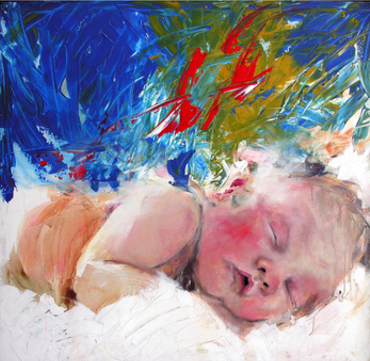
The Chazon Ish, zt”l, teaches how we should relate to a new baby. “The astounding miracles of matrimony, birth and raising a child open a person’s heart and eyes and his ears to see that nothing ‘just happens.’ This experience should awaken any thinking person’s ability to be emotionally moved.

“This is the meaning of the Midrash Tanchuma on the verse וילדה זכר And she birthed a male.’ The Midrash applies the verse, ‘ ואין צור כאלוקינו ’ to this. It explains there that the word צורcan be understood to refer to צייר which means one who fashions. In this context the verse is saying that there is none who can fashion like God does. A human makes a picture on the wall. Can it move? Can it breathe? Can it speak? God creates man who moves, breathes and speaks. An expert painter has many types of paint to create a picture. God can create a human from one drop.

“We see from here that one who sees a child should be filled with wonder. Studying a child should bring one to contemplate the works of God. Giving this any thought should lead one to the same conclusion as the Midrash: ‘There is צייר , no artist like God.”

Rav Yechiel Michel Stern pointed out the obvious question on this midrash: “It seems strange that our sages took the verse ‘ ואין צור כאלוקינו ’ out of the simple meaning. Usually the word צור literally rock, means forceful or powerful, and does not refer to an artist or fashioner.

“The Maharsha in Berachos answers this question. Since the verse tells us that there is no צור like God it implies that there are others which should be referred to as צור , but they cannot be compared to God. Clearly, here we are speaking not of the one and only Rock, but of a different meaning related to the root צור!”

Daf Yomi Digest
Stories Off the Daf
“The Ultimate Artist”
Niddah 41

In Rabbi Yaakov Menken’s commentary on last week’s Torah Portion Chukat, he addresses the mystery behind the sin that resulted in the death of Aaron and Moses being denied entry into the Land of Promise. For many, trying to comprehend what sin Aaron and Moses committed that was worth so terrible a price is extremely difficult. But we must remember that not only were Aaron and Moses born to accomplish a very high purpose, but we see that the more exalted a person’s holiness, the more is required of them. In other words, the higher you fly, the further you have to fall.

Precisely because the Bible is dealing with individuals on an exalted spiritual level, if it were to tell us merely what they did, we would be unable to perceive anything wrong. For those people, their behavior was no less a transgression than if a more common individual had committed a major sin such as murder, adultery or idolatry — and thus the Prophets use severe language, similar to HaShem’s own words that Moshe and Aharon “did not believe” in Him. Just like the anthropomorphic references to HaShem Himself, these passages use language which we can understand, so that we can learn from them, but are not intended to be taken literally at all.

Every human being is just that — human — and no one is perfect. Even as we are humbled by recognition of the heights reached by prophets and great scholars, we should never lose hope, or imagine that those who came close to G-d were truly angels, without inner struggles or difficulties. This is the lesson the Torah brings home to us when attributing unimaginable ‘sins’ to our forebears. And yet it is also incumbent upon us to realize that we could be, ourselves, so close to HaShem that our ‘sins’ would be something we could not even recognize today.

Perhaps one of the reasons why this event in the Bible is nearly impossible for most of us to understand is that the majority of us are not tzaddikim; exceptionally righteous ones. Our worldview does not operate at such an exalted level. In the same manner, this is most likely what made it difficult for Christ’s own disciples to understand him at times and, what continues to contribute to what we often refer to as “the difficult sayings of Jesus” as seen from the perspective of the 21st century believer.

I know most Christians like to think of Jesus as ultimately approachable, friendly, kind, and understandable, but in spite of 1 Corinthians 2:16, we may be forced to admit that the mind of the Messiah is beyond most of us. Even the sins of those lesser than the Messiah but still exalted Holy ones are difficult to comprehend. Hence the following from Rabbi Menken:

On Rosh HaShanah, there is a tradition to go to a body of water and “cast off” one’s sins, as it were, and ask that they be covered over like water covers and hides the fish who swim within it. Many Chassidim have a custom to take bread crumbs along and throw them in, to give physical expression to this idea.

It is said that after a particular Chassidic Rebbe threw crumbs into the water in accordance with this custom, one of his Chassidim bounded into the lake and began to retrieve them. When questioned, the Chassid explained: “what the Rebbe considers his ‘sins’ are Mitzvos where I’m concerned!”

For years, I couldn’t understand this story or its intended lesson. A transgression is a transgression! But then, I heard that the Chofetz Chaim, Rabbi Yisrael Mayer HaKohein Kagan (perhaps the greatest known Torah scholar of the last century) once repented on Yom Kippur for having wasted eight minutes from Torah study during the previous year.

Can we imagine wasting merely eight minutes in an entire year? I would be extremely happy to say that I had managed to waste no more than eight minutes on a given afternoon! Maybe, maybe I’ve spent a few hours without wasting eight minutes once in my life. Maybe.

It’s impossible to imagine being able to account for every moment of every day, save eight minutes (I would almost be relieved to be told that I had heard this story incorrectly). And this is what the Chassid was saying: for us, it would be a great Mitzvah! The sins of great people occur at such a level of precision, that _reaching_ that level, to be worthy of being judged at that level, would be a phenomenal achievement.

Previously, I momentarily seemed to disregard a passage from 1 Corinthians 2, but I’d like to revisit those words in the context of Paul’s epistle:

Now we have received not the spirit of the world, but the Spirit who is from God, that we might understand the things freely given us by God. And we impart this in words not taught by human wisdom but taught by the Spirit, interpreting spiritual truths to those who are spiritual.

The natural person does not accept the things of the Spirit of God, for they are folly to him, and he is not able to understand them because they are spiritually discerned. The spiritual person judges all things, but is himself to be judged by no one. “For who has understood the mind of the Lord so as to instruct him?” But we have the mind of Christ. –1 Corinthians 2:12-16 (ESV)

This part of Paul’s letter makes it seem like, with the guidance of the Holy Spirit, all believers and disciples of the Jewish Messiah should have an equal ability to comprehend the Word of God, as if we were Jesus Christ himself. But do we? If we did, you’d think that the endless myriad of questions I post on this blog wouldn’t exist or would just be rather moot. You’d think instead of the 35,000+ Christian denominations (and counting) that exist in the world, we’d have only one. You’d think that we would all have the identical understanding of God and the very same template for organizing the community of faith.

You’d think God would have finished writing the Word upon our hearts by now. But apparently, He hasn’t.

As we saw in the “Story Off the Daf” from which I quoted earlier, God can be considered a magnificent artist. He fashions each and every one of us miraculously and He has repeated His artistry in an endless progression from the beginning of Genesis until now. He is creating His “paintings” still, and will continue to do so until a point in time we cannot yet even begin to grasp.

And He has created us for many purposes, all of which serve His will. But all that being true, He gave us the gift of self-determination to the point where only a human being may actively and purposefully defy the will of God. In other words, we can take the incredibly wonderful work of art that was created by the hand of God and turn it into the moral equivalent of a velvet painting of Elvis (and I apologize to all of the fans of Elvis Presley and those of you who enjoy velvet paintings).

I can hardly accuse Aaron and Moses of such a sin against God. It is God who held them both responsible for how they chose to treat His “artwork”. And while you and I (or at least I) are not tzaddikim and we do not operate at the level of Aaron or Moses (and certainly not at the level of Christ), we have been created as God’s handiwork to serve a purpose and a goal. We are responsible for what we do with our lives. There are consequences for choosing not to live as we were designed to live.

The end of the lives of Aaron and Moses give us an idea of those consequences. We also have examples such as Nadab and Abihu.

Who are we and where do we come from? Do we have a purpose in life, or is everything we do random and meaningless? Is this all there is or is there something more?

We spend all our lives trying to answer questions like these. Even those of us who adhere to a specific religious tradition encounter great difficulties in answering what should be the simplest questions about our faith. Now we see that these questions and their answers aren’t just meaningless exercises in philosophy. They are what define us, not just as individuals, but as a species. If we are simply the most evolved animals on the planet, then it pretty much doesn’t matter what we do. Go ahead and destroy the physical environment and contribute to our extinction. It doesn’t matter. The planet will eventually recover and even if it doesn’t, so what? We will have exterminated ourselves, but the Universe goes on.

But what if we have been created by the “Master Artist” for a higher purpose? If there are consequences, for good or for bad, for the manner in which we live out our lives, then our every action does matter, our every decision does have an impact beyond that of the moment. Our words, behavior, and feelings are all part of a greater design that contributes to the infinite tapestry of Creation. Each individual life is personally important as an artistic act of God and it matters to Him how things are going for us each and every day.

Just recently, I compared a life of faith to a bird in endless flight. Given the example of Aaron and Moses, we can see how “dangerous” it is to fly as high as they did, because with one subtle failure, they lost their wings and fell back to earth in disgrace. And yet the wonder and majesty that they beheld, especially Moses who spoke to our infinite “Artist” as one might speak to a dear and close friend…isn’t that worth even so great a risk? Isn’t soaring through space, nearing the court of the Mighty One, tasting the excitement, the freedom, the glory of approaching even the tiniest thread of the hem of the living God worth our time, our effort, even our very lives?

The Artist with His brush, puts the finishing touches on His latest painting and looks upon it with satisfaction. The painting, moments away from birth, stares back at the Creator and smiles with gratitude and love.

Then, as a child might send a paper airplane aloft with a single flick of the wrist, we are sent up into the Heavens and born into our lives. May we fly with the wings of an angel and live with the soul of His Image.

Why can’t He provide simple, clear directions and let us just follow His Divine plan? Why does He place these challenges before us, forcing us to make our own decisions, to chisel out our own paths?

Because He desires a home in our world
—not a home manufactured in heaven and transported downward to earth,
but a home made in our world
out of worldly materials,
chosen, designed and constructed
by citizens of our world.

-Rabbi Tzvi Freeman
“Made On Earth”
Based on letters and talks of the Rebbe
Rabbi M. M. Schneerson
Chabad.org

When Christians Do Good

We are seriously getting love aimed at us by a little church nearby. Out of the blue, the pastor had contacted me wanting to know if some of their members could do anything for us and he wouldn’t take no for an answer unless it really was no.

Today some amazingly nice folks showed up and hauled off to the dump our junk too big for our own vehicle, in one of the guy’s large truck.

Meanwhile, the ladies scoot in to do some cleaning while visiting with Heidi.

And meanwhile another great guy is walking me around our deck, explaining to me how he is going to prep the bannister and then paint it for us.

And they’re coming back tomorrow!

-Joe Hendricks

I embarrass Joe and Heidi on my blog a lot so I’ll try not to do it again today, but I want to show you how the church isn’t evil.

Joe is a cancer survivor and Heidi has multiple organs that are cancer involved including her brain. I know compressing their struggle into a single sentence seems rather cold, but I’ve written other blog posts about them, and I want to show you another picture today.

In spite of their amazing and horrendous struggles, their faith remains absolutely steadfast in God. They aren’t (as far as I know) involved in a church on a regular basis but rather, take God with them wherever they go, which is often into the mountains and onto the hiking trails near their home in Washington’s Puget Sound area.

I was surprised, very pleasantly so, when Joe posted the above-quoted statement on his Facebook page. It came out of a clear blue sky, as the saying goes. I guess that’s how miracles happen.

Maybe I’m overstating the point. After all, aren’t Christians supposed to do good things for other people without it being miraculous or even unusual? Not according to some atheists and people from other religious and philosophical traditions. All of the evil in the world is typically blamed on religion in general and Christianity in particular. Everything from the Lindbergh kidnapping to global warming has been blamed on Christianity (well, maybe not exactly). Even though some other spiritual people who disagree with the validity of Christianity claim to “respect our path,” there is little respect in describing us at our worst as pagan worshiping, war-mongering, racists.

I have to admit that I don’t often trust the church myself. I find the church rather intimidating. Beneath the facade of friendliness and good fellowship, what judgmentalism and harsh opinions do they harbor about me, a Christian who doesn’t go to church, who is married to a Jewish wife, has Jewish children, and who (if given a choice) prefers a siddur to a hymnal? On my blog, religious though it is, I am “flamed” more often by Christians than by atheists or people adhering to less traditional spiritual philosophies (though that could just be a result of me being beneath the notice of these other philosophies).

But this is exactly why Joe’s recent statement on Facebook is so important. The church can be a force for good in the world. The church can express itself as warmth, compassion, caring, and love. The church, often accused as merely a house of prayer and bigotry, can actually do something to help other people, such as hauling away junk, cleaning a house, doing some painting, and continuing to be a presence in the lives of two wonderful people who need the presence of God’s servants in their lives and in their home.

I know Christianity’s detractors will say that this is only one instance (and a rare one at that) of Christians doing something good. Then, these detractors will cite numerous examples from the mainstream news of Christians doing harsh, bigoted, rotten, and evil things.

But what makes the six o’clock news, Christians going a kindness (I don’t think Joe saw any cameras from CNN at his place the other day) or the Westboro Baptist Church (who I don’t consider Christian at all) desecrating the name of Jesus by picketing the funeral of another fallen American warrior? So who do atheists and various spiritual people look to when they want to get an example of who a Christian is?

OK, it’s not a simple as that, but sometimes it seems to be. Sometimes it seems like people just don’t want to see the good that Christianity does. They only want to point to its flaws, both in the present and historically. People seem to want to define themselves and whatever philosophy they follow in terms of who they oppose and the church makes a convenient target to oppose.

But they are also, at their best, a reflection of what they were taught by Jesus Christ. Visit the sick. Feed the hungry. Comfort the grieving. Make peace between one person and another. And although it doesn’t say so in the Bible, clean someone’s house when they’re too sick to do it themselves. Haul away the garbage that is too big for someone else to haul away. Look around someone’s home, notice that their deck needs painting, and then paint it.

In other words, do whatever good that needs to be done if for no other reason than because God is good and it’s the right thing to do.

If you have something against Christianity, you can react two ways. You can complain about Christians, or you can do what the best of them do. You can help people who need help instead of elevating yourselves by pointing at what the worst of those who claim to be Christian (but by their actions, show themselves to be anything else but) are doing.

You therefore must be perfect, as your heavenly Father is perfect. –Matthew 5:48 (ESV)

I don’t care who you are. If you want to be good, do good.

Considering Life and Randomness

Despair is a cheap excuse for avoiding one’s purpose in life. And a sense of purpose is the best way to avoid despair.

-Rabbi Tzvi Freeman from his book
Bringing Heaven Down to Earth
quoted from sichosinenglish.org

A rabbi was once called to a hospital to see a Jewish teenager who was suicidal. Feeling that he was a good-for-nothing who could not get anything right, the boy had attempted to take his own life. But even his suicide attempt failed. Seeing that he was Jewish, the hospital staff called the rabbi to come and try to lift the boy’s dejected spirits.

The rabbi arrived at the hospital not knowing what to expect. He found the boy lying in bed watching TV, a picture of utter misery, black clouds of despair hanging over his head. The boy hardly looked up at the rabbi, and before he could even say hello, the boy said, “If you are here to tell me what the priest just told me, you can leave now.”

Slightly taken aback, the rabbi asked, “What did the priest say?”

“He told me that G‑d loves me. That is a load of garbage. Why would G‑d love me?”

It was a good point. This kid could see nothing about himself that was worthy of love. He had achieved nothing in his life; he had no redeeming features, nothing that was beautiful or respectable or lovable. So why would G‑d love him?

The rabbi needed to touch this boy without patronizing him. He had to say something real. But what do you say to someone who sees himself as worthless?

“You may be right,” said the rabbi. “Maybe G‑d doesn’t love you.”

This got the boy’s attention. He wasn’t expecting that from a rabbi.

“Maybe G‑d doesn’t love you. But one thing’s for sure. He needs you.”

This surprised the boy. He hadn’t heard that before.

-Rabbi Aron Moss
“The Rabbi and the Suicidal Teenager”
Chabad.org

I’ve heard this before and on the surface, it sound pretty good. It sounds like you would never have been born and wouldn’t have continued to live if you didn’t have some important part to play in God’s plan. It also sounds like if you took yourself out of God’s plan (by suicide for instance) there would be a big hole punched into the middle of that plan.

Seems like a really fragile and vulnerable plan. Since human beings have free will, we can commit a thousand different actions that would be contrary to God’s master plan for Creation. If one human being were to kill himself before fulfilling his or her part in the plan, what would God do? Is there a “plan B?”

I want to finish with the Rabbi Moss commentary before continuing:

The very fact that you were born means that G‑d needs you. He had plenty of people before you, but He added you to the world’s population because there is something you can do that no one else can. And if you haven’t done it yet, that makes it even more crucial that you continue to live, so that you are able to fulfill your mission and give your unique gift to the world.

If I can look at all my achievements and be proud, I can believe G‑d loves me. But what if I haven’t achieved anything? What if I don’t have any accomplishments under my belt to be proud of?

Well, stop looking at yourself and look around you. Stop thinking about yourself, and start thinking of others. You are here because G‑d needs you — He needs you to do something.

My friend, you and I know that happiness does not come from earning a big salary. Happiness comes from serving others, from living life with meaning. I am convinced that all you need to do is focus outward, not inward. Don’t think about what you need, but what you are needed for. And in finding what you can do for others, you will find yourself.

Let’s get the easy stuff out of the way first. Does fulfilling your part in God’s plan for your life automatically mean you’re going to be happy about it?  Look at the Apostle Paul’s life. After being commissioned by Jesus to be the emissary to the Gentiles and to spread the Good News of Christ to the nations (Acts 9), was his life happy? It may have been fulfilling and rewarding in the sense that Paul knew he was doing what God was asking, but it was hardly happy or even comfortable. Paul was beaten, left for dead, had to run for his life, was shipwrecked, and bitten by a poisonous snake. He was finally executed in Rome after a lengthy stay as a prisoner. That doesn’t sound like “happy” to me.

But Rabbi Moss isn’t talking about happiness, he’s talking about serving others as part of God’s plan and in doing so, finding yourself. If you had a chance to fulfill a great purpose in life and to serve God in bringing many otherwise lost people to Him, wouldn’t you do it, even if it meant personal hardship?

Actually, that’s a tough question, especially for many Christians in western nations who aren’t typically called upon to make such great sacrifices and to suffer such hardships. In theory, our answer should be “yes,” but in practicality, I’m not so sure we’d all jump up and down enthusiastically and yell out, “Pick me!”

Now let’s dig a little deeper. Paul’s purpose in life was unmistakable. Jesus appeared to him in a vision and told him what he wanted. A few days later, he sent a human messenger to him to tell Paul his next steps. We see in other parts of the Bible how Paul seemingly had other supernatural experiences which no doubt re-enforced his life’s purpose.

But all that stuff doesn’t happen to most of us. Even if it did and we saw visions and heard voices telling us to do such and thus, most Christians around us would think we were nuts and recommend us to the nearest psychiatrist.

But as far as I can tell, most of us don’t have supernatural experiences to tell us what our life’s purpose happens to be. Most of us have to figure it out, seemingly on our own.

Rabbi Moss suggests to his (possibly fictional) suicidal teenager that as a young person, he has most likely not yet had the opportunity to fulfill his life’s purpose. God needs him to do that, so he has to stay alive until that purpose if completed. But what is that purpose? How do you know what it is? How do you know when you’ve done it? Do you just wait around and hope you can figure out what it is and then perform it when opportunity strikes?

Tough questions. Here’s another one. If you do figure out what your purpose in life is and you have already completed it, what’s the purpose in continuing to go on?

Running out of timeOK, that’s somewhat unfair, because the question assumes that your purpose in life is to commit one act that is easily defined and can be performed in a relatively quick manner, like changing a tire, or helping an older person across the street. But what if that’s it? You’ve done what God created you to do. You may have years or even decades of life still left in you. What now?

Of course, your purpose might be long-lasting and multi-dimensional. You could have been created to be a parent and a grandparent and to influence and support your family across your entire lifetime. In that case, you can never fulfill your purpose until God dictates that it is time for you to die.

Reflecting back on everything I’ve just written, it would seem that, if we accept the premise Rabbi Moss provides, we know we haven’t fulfilled our purpose in life because we’re alive. We assume that when we die, we’ve completed what we were created to do.

But what about “suicide” and “plan B?” If free will allows a certain number of people to kill themselves, what happens to God’s plan? Is it irreparably thwarted? That hardly seems likely since God is God. Being human, we tend to think of the progression of time, fate, and the universe relative to God’s plan as rather linear. Step 1 leads to step 2 and then to step 3 and so on. But if we accept that, we’re saying that no sort of randomness is possible in a created universe. But if we have free will, that can’t be true.

If God’s plan includes the possibility of randomness and further, the possibility that not all people born will fulfill their plan (so far, I’ve only included the single reason of suicide, but people may fail to fulfill their plan for a variety of other reasons tied in to their free will and the free will of people in their environment), then God must have a “plan B” (and I’m sure it’s much more complicated than this) to compensate. If one person who is to fulfill some aspect of God’s plan dies, then there must be a method (that is totally outside of human awareness) of shifting people and events around to accomplish God’s goals in this instance.

That means in an absolute sense, as individuals, we are not indispensible to God. We can be replaced. God doesn’t have an ultimate need for our individual lives.

Rabbi Moss’ story may seem compelling and we can even see how it might have turned around this depressed and suicidal boy, but it’s also not too hard to work our way around his argument, either. When Rabbi Freeman says, “Despair is a cheap excuse for avoiding one’s purpose in life. And a sense of purpose is the best way to avoid despair,” it sounds like he is being too dismissive of someone else’s despair. If Rabbi Moss (or whoever was the Rabbi in the story of the suicidal teenager) had walked into the room, dropped Rabbi Freeman’s two sentence “bomb,” and walked out, do you think it would have done any good?

People have better days and worse days. Having a purpose in life is usually pretty important, but most of the time, it gets lost in the day-to-day shuffle of going to work, interacting with our families, paying the bills, and whatever other tasks we’re expected to perform just because of the roles we play in the various areas of our lives. Most of the time, we don’t give our overarching purpose much thought. It only comes up when you read blog posts such as this one or encounter a personal life crisis.

The raw fact is that many of us may never become aware of some higher and nobel purpose of our life, let alone one that is assigned to us by Heaven. Most of us, if we have an awareness of God at all, will live our day-to-day existence, try to love, strive not to hate, read our holy book, pray, and by the time we die, we can only hope that we did whatever we were supposed to do.

That’s not a particularly satisfying thought and Rabbi Moss tells a better tale than I do, but who’s to say if life works out this way or that?

I can’t.

God as a Teacher

Talmud StudyThe metaphor of God as teacher and human beings as His pupils, a metaphor that gains prominence in the rabbinic period, is also an apt means of describing the covenantal relationship. God as teacher encourages His pupils to think for themselves and assume intellectual responsibility for the way Torah is to be understood and practiced. The fact that the rabbis not only declared that the age of prophecy had ended, but insisted also that the talmudic sage ranked higher than the prophet, seems to suggest that the community has a higher appreciation of its covenantal relationship to God when it sees Him as its teacher than when it sees Him as an authoritarian voice dictating His will through the prophets.

God as a loving husband and the devoted teacher do not require reward and punishment to play a significant role in the covenantal relationship. They are not frameworks of absolute power of one covenantal partner over the other, but frameworks in which the integrity of both partners is recognized and the human partner is enabled to feel personal dignity and to develop the capabilities of responsibility.

-Rabbi David Hartman
from the Introduction of his book
A Living Covenant: The Innovative Spirit in Traditional Judaism

Are you a God-fearing man, Senator? That is such a strange phrase. I’ve always thought of God as a teacher; a bringer of light, wisdom, and understanding.

-Erik Lehnsheer/Magneto (played by Ian McKellen)
X-Men (2000)

I just did two strange and different things, at least from a Christian point of view. I used Rabbi Hartman’s quote to describe God as primarily a teacher, and I quoted a comic book movie to do the same thing. Strange. Interestingly enough, the character of Eric (Magneto) Lehnsheer is portrayed as a Jewish Holocaust survivor, so his perspectives may have a place in today’s “meditation.”

It’s not as if Judaism doesn’t see God as a Judge, but He is not only a Judge (and I need to be careful here, since I’ve mischaracterized aspects of Judaism before). The Bible is replete with “marriage metaphors” in which God is portrayed as a loving husband to a sometimes faithless Israel. While this metaphor is occasionally used by Christianity to justify the supersessionist view that the church (the loyal wife) has replaced Israel (the faithless wife), in fact, God has also said that He will take back Israel when she turns back to Him and that He will never permanently abandon her.

However, I’m less interested in discussing the topic of supersessionism and more interested in exploring God as our teacher. As Rabbi Hartman seems to say, this casts God in a completely different light than the one by which we are accustomed to viewing Him. It also nicely fits into how Judaism sees the role of human authority within the realm of faith. I continue now with Hartman as he speaks in his book’s Introduction.

When Christian ministers ask me at what age or on what occasion I received my calling as a rabbi, I often find myself hesitating over how to respond. If I answer it began when I entered yeshivah at age five to study Bible and Talmud, they might believe that I am likening myself to Jeremiah, who received his prophetic calling as a child. If I tell them that I never received a calling but was ordained after my teachers concluded that I was intellectually capable of rendering competent decisions regarding what is prohibited and permitted by Jewish law, they might be shocked at meeting a modern version of a Pharisee. They could perhaps find confirmation for the allegation that legalism had replaced the living guidance of God.

…Yet, as a traditional halakhic Jew, I know that a rabbi is a teacher whose spiritual role is premised on possession of an intellectual understanding of the Jewish tradition and commitment to the Jewish people. A direct call from God is not required to legitimize activity as a rabbi in Israel.

I can only imagine that the confusion Rabbi Hartman expects of the Christian ministers he references is reflected in the minds and hearts of any Christians reading this missive. Indeed, Judaism is often seen as a legalistic, works-based, and spiritually “dead” faith for exactly the reasons Rabbi Hartman states. And yet he also says that a “rabbi is a teacher whose spiritual role is premised on possession of an intellect understanding of the Jewish tradition,” presupposing that rabbis actually have spiritual roles in Judaism. So where is the spirituality?

What is spirituality?

According to Wikipedia, spirituality “refers to an ultimate or an alleged immaterial reality; an inner path enabling a person to discover the essence of his/her being; or the “deepest values and meanings by which people live.” That’s probably not a very helpful definition, but spirituality is difficult to define, largely because the spirit cannot be conclusively demonstrated in a material world.

In some branches of Christianity, spirituality is considered synonymous with emotion, or more specifically, an emotional experience that is inspired by a spiritual encounter with God (or one that bypasses God and focuses specifically on Jesus Christ). We tend to think of spirituality as a “feeling.” Most Christians don’t tend to relate to spirituality as a thought or as something that happens when we study and learn from a teacher or rabbi.

And yet, Rabbi Hartman seems to be saying that learning Torah and Talmud is a spiritual experience. I don’t know if that’s what he’s actually saying, but I think I can make a case for it. I think that in Judaism (this is just my opinion, of course), the sense of a Jew’s identity is inexorably tied to Jewish history, traditional Jewish thought, Talmudic study, midrash, halachah, and understanding. You might even think of the passionate debates that occur in yeshivah as a metaphor for a Jew “wrestling with God.” (Genesis 32:22-32)

The concept of wrestling or debating with God may seem alien and even sacrilegious to a Christian, even though we have ample examples from the Bible. Look at Abraham boldly debating with God over the fate of Sodom and Gomorrah (Genesis 18:16-33) and Moses pleading with God to spare the Children of Israel after the sin of the Golden Calf. (Exodus 32:9-14). Can a Christian even understand this the way a Jew can?

That said, Rabbi Hartman doesn’t see a complete dissonance between Jews and Christians.

…those early experiences were given profound intellectual and philosophical support in the years of my graduate study at Fordham University. Living with the Jesuits, sensing the intellectual and spiritual integrity of my teachers, observing how our different faiths were reciprocally enriched through our encounters – these were experiences that I could not ignore in developing my own appreciation of what it is to stand as a covenantal Jew before God.

I can’t say that all Jews will agree with Rabbi Hartman’s statements and I’m sure not all Christians will either. We see, based on everything I’ve written and quoted up to this point, that Christianity and Judaism conceptualize themselves and their relationship with God on a spiritual level in fundamentally different ways. We see God and how we are supposed to connect to Him from two totally different directions. And yet there are the occasional glimmers when, if we try hard enough, we just might be able to understand that we have a few things in common, as Rabbi Hartman pointed out in his description of his time among the Jesuits.

But God is One. He is the God of the Jews and the nations. He makes the rains descend on not only Jews and Christians, but on the righteous and unrighteous alike. He sent His “only begotten son” “not wishing that any should perish, but that all should reach repentance.” (2 Peter 3:0 ESV)

If God is our teacher, is He providing two wholly dissimilar lessons, one for the Jews and the other for everyone else? Christianity doesn’t think so, but their (our) solution is to replace the original lesson God taught at Sinai with the one taught by Jesus at Calvary. Traditional Jews believe that God teaches a larger lesson (the Torah) to the Jews and a subset of that lesson (the Noahide laws) to the nations.

I don’t agree with either viewpoint and believe that it is God’s intention to ultimately reconcile Israel with the nations as co-existing covenant members, Sinai and Messianic, standing side-by-side in front of the throne of God. I don’t know how to completely articulate this relationship yet, especially in terms of our mutually dependent roles being described in scripture, but I believe it is well worth pursuing.

We see that at the end of all things, the ” throne of God and of the Lamb will be in it (the city), and his servants will worship him.” (Revelation 22:3 ESV) I believe those servants are both Israel and we from among the nations who have demonstrated an enduring faith, who have “fought the good fight,” and “have finished the race.” (2 Timothy 4:7)

If God is speaking to both the Jew and the Christian (and indeed, to the entire world), we must discover what the lesson is and what our teacher wants us to learn. Jesus was rightly called “teacher” and “rabbi” and he taught as did the other rabbis during the late Second Temple period in Israel. This was an experience that his disciples found to be completely consistent with how other disciples learned from their rabbis. From what we see in the Bible, it was also consistent with how we Christians experience spirituality, love, compassion, and truth.

Some Jewish thinkers believe that the Second Temple was destroyed, not because of general faithlessness among the Jews, but because of the sin of baseless hatred between one Jew and another. The counterpoint to this sin, and what some believe will aid in the coming of the Messiah, is for Jews to show unrestrained love by…

reaching out to another person – any other person – and showing him care, consideration, and concern. Do a favor for someone else, not because there is a reason to do so, but because you care for him.

“Keeping In Touch: The Three Weeks”
Based on the teachings of the Lubavitcher Rebbe
Rabbi Menachem M. Schneerson
Adapted by Rabbi Eli Touger
Chabad.org

If we are trying to hear the lessons being taught by our rabbi and Master, perhaps reaching out to everyone, Jew and Gentile alike, with care, consideration, and concern, might be a good place to start.

A river of life flows through the inner worlds, emerging from there into your own, carrying with it all your needs.

You need to know about that river, for it carries upstream as well.

When you celebrate that river with a blessing for your food, out loud and with joy, then your voice echoes back with even greater force, replenishing all the higher worlds through which the river passes on its way. The channels of life are widened and their currents grow strong.

Take care of your river. Invest in it and reap the dividends.

-Rabbi Tzvi Freeman
“The Echo Upstream”
Based on letters and talks of the Rebbe
Rabbi M. M. Schneerson
Chabad.org