Tag Archives: Strange Fire

The Challies Chronicles: Conrad Mbewe and Pentecostal Witch Doctors

Conrad MbeweThe first session of the final day at the Strange Fire conference brought Conrad Mbewe back to the pulpit. Phil Johnson introduced him by sharing how others have called him the Spurgeon of Africa. Today he brought message entitled, “Are We Preachers or Witch Doctors?”

Mbewe then contrasts Paul’s exhortation in 2 Timothy with the present picture in Zambia. He shares two newspaper clippings from July concerning evangelical preachers. In the first, a clergyman impregnated 10 women before his wife came forward about the scandal. She came forward after witnessing the scourge on the children in this church and the presence of the witchcraft taking place. In the second clipping two clergy men took two women into the mountains and sexually assaulted them. They first visited their home and took prayer requests and then led them into the mountain.

Pastor Tim Challies liveblogging
Strange Fire Conference: Preachers or Witch Doctors?”
Challies.com

As Conrad Mbewe chronicles the abuses of Pastors against members of their flock in Zambia, no one could possibly disagree with having evangelical preachers who are sexually assaulting women being called out, removed from their positions of authority, and hopefully arrested and incarcerated. How could any believer of good conscience support preachers and other church leaders behaving in such a destructive manner?

But, of course, the inference is that the Pentecostal movement is driving such abuses and as a denomination, are responsible for this criminal behavior, and therefore Pentecostalism must be stopped. Can a connection between the events being reported by Mbewe and all Pentecostals everywhere be reasonably made?

Conrad asks, “How can this be happening so frequently among so called evangelical churches today?” His response: a seismic shift in how people view the pastor. What is read in 2 Timothy is not the popular view today. It is because of how the view of the “man of God” has evolved today. Pentecostalism’s visit to Africa did not primarily emphasize the preaching and teaching component of the “man of God.” Now the “man of God” is primarily seen as the deliverer. Preaching has lost emphasis. It has become motivational platitudes followed by shouting and chanting.

The same thing can be seen in America on popular TV channels, but with different colored skin and nicer buildings. There are biblical quotes tossed about followed by a demon possessed, crazy and maddened looking preacher.

Yet, the important part of any service is what happens next. The “man of God”, wrested out of the context of 2 Timothy, takes on the role equivalent to a witch doctor.

While Mbewe lays the blame for the abuses he reported above fully upon the Pentecostals and their lack of emphasis on scriptural sufficiency and preaching, others who commented on this Challies blog post didn’t agree:

There are certainly issues that need to be studied, analysed and discussed in the contemporary pentecostal movement in Africa and worldwide. We need to understand their theological and liturgical practices–their strengths, weakness, meanings and innovations. Scholars of contemporary pentecostal movement have been at it for more than two decades. It would be very helpful to dialogue with their findings and suggestions. One of their major findings is that contemporary pentecostal movements underline that their members must “make a complete break with the past,” that is, they must completely disassociate themselves with African Indigenous Religions (henceforth ATR)–contrary to Mbewe’s claims. Scholarly findings also associate its theology of prosperity, deliverance and breakthroughs with the neo-liberal economy of the globalization era. On the overall, I find Pastor Mbewe’s take on it simplistic, upsetting and misleading. Basically, he blames it all on ATR. In the process, his comparisons are misleading misrepresentations of ATR, that serves to demonize the latter. If indigenous healers were to be brought into this conversations, they would not recognize the picture that is painted about them. But since evangelicals are unlikely to want to hold such dialogue with indigenous healers, it is as that proverb warns us: until the lion tells the story, the hunter will always be the hero. The image given about Indigenous healers is of course colonial, as attested by Mbewe’s reference to indigenous healers as “witchdoctors.” Mbewe’s colonial perspective is also attested in his wish to call for the West to rescue Africa from itself. His two opening stories harp on the colonial stereotypes of Africa as sexually immoral. His reference to western medicine as conventional medicine is so telling. Since Christianity has existed side by side with ATR for more than two centuries, why is this only happening now? Why has ATR not confused the church before, until now? Both the contemporary pentecostal movement and the indigenous healers would be appalled by Mbewe potrait (sic) and interpretation of the phenomena. Mbewe’s approach is suspect and must be heard as such. Those who hear him will do well to hear him with a pinch of salt.

Musa Dube

I am a charismatic Pastor in East Africa. Sadly however, I can confirm that what is said here is quite true. Of course, I do not agree that this is a charismatic problem but rather an aberration that claims to be Christian and Charismatic but is in fact neither. It would be wrong however, to say that the problem is confined to “charismatic” churches.

This problem manifests itself in these pseudo churches as false miracles etc. etc. But in the churches more palatable to McArthur (sic) and others, it manifests itself in double lives that pay mere lip service to the theology of the church. Polygamy, tribal politics, regular visits to the witch doctor (the traditional kind rather than the Bible carrying one) all thrive in Calvinist churches across the continent of Africa. They are preached against in the pulpit of course but hey, everyone does it. In very high number of cases, even the Pastor does it because of course that is just for preaching

This is because the problem is not charismatic theology but syncretism and This is not confined to any one church as anyone who has lived in Africa knows.

We may be charismatic but we are working hard to preach against hypocrisy in all denominations. Our focus is upon the work of the cross which unites us and demands a response from us all.

Sean McIntyre

Witch huntOf course, the larger body of people commenting on the blog post expressed split opinions, but I think it’s important to understand that a simple comparison between what Mbewe reports and what all Charismatics represent cannot be made. Mbewe’s logic goes something like:

  1. Some Pentecostal-influenced preachers in Africa are sexually abusing women and practicing witchcraft.
  2. Therefore all Pentecostals, Pentecostal teachings and Pentecostal/Charismatic preachers everywhere support abusing women and practicing witchcraft.

I agree with Musa Dube to the degree that Mbewe’s presentation is rather two-dimensional and lacks sufficient depth to establish the point he’s trying to make. Also, we have a report that such abusive activities are not confined to churches with Pentecostal affiliation but are rather multi-denominational.

Again, I want to say that in no way can I or any reasonable person of faith support sexual abuse of women, whether by clergy or anyone else.

Mbewe was invited to a radio broadcast panel discussion in Zambia about miraculous healing. There was a Catholic trying to ride the fence. Then there were two charismatics invited. One could not come because he was sick. He lied. Conrad saw this man shopping in the mall with his wife directly afterward with a trolley of goods.

During the broadcast the other charismatic and Mbewe locked horns. He challenged listeners to call in if they had been healed. Like a New Testament Elijah he taunted the charismatics for an hour due to the lack of calls. Two calls came in. The first a man who attested to a girl with unequal legs being healed 8 years ago, a very stale testimony for a country that claims to have healing crusades from prophets, bishops and “the man of God” all the time. The second came from a woman who chastised Mbewe as a dead theologian. There were only two calls in a nation where miraculous gifts happen all the time. The charismatic pastor responded that the people are shy. Unfortunately a week later he suffered a stroke and died after being in a coma for a week. None of his friends came to his aid and raised him because they knew it was all a fraud and a lie.

While this is all very dramatic, and while it likely establishes that claims of a large number of miraculous healings taking place in Africa are false, it still doesn’t make the larger point in painting the entire Pentecostal church with the same broad and tainted brush.

I know Mbewe’s presentation is only one among many, and I know that “Strange Fire” is meant to be taken as an entire unit, but even putting Mbewe’s discussion in the context of the entire conference doesn’t make what he is saying any more applicable to the entire world of Pentecostal believers. I may not agree with the basic premises of Pentecostalism, but I don’t believe they are all abusive and criminal either.

OK, maybe I’m being a little harsh because Mbewe didn’t come out and indict the Pentecostal church in such a manner. He only said that any church that does not depend solely on scripture and its sufficiency in building and leading the body of Christ is ripe for an infusion of witchcraft, sexual abuse, and other demonic influences.

And speaking of demonic, I know I quoted this above, but of everything Mbewe said, it especially drew my attention:

The same thing can be seen in America on popular TV channels, but with different colored skin and nicer buildings. There are biblical quotes tossed about followed by a demon possessed, crazy and maddened looking preacher. (emph. mine)

Although Mbewe called the preacher “maddened looking” as opposed to “maddened,” he declared that the preacher in his example (I don’t know if he was thinking of any TV preacher in particular or just throwing out generalizations) was “demon possessed” as opposed to something such as “like he was demonized.” As I’ve said before, I find it interesting that cessationists can say there are no longer any “gifts of the spirit” given to human beings, but that human beings can certainly be possessed by demons and exhibit strange and even supernatural behaviors. The equation doesn’t seem to balance out and gives the impression that evil forces have more influence than God.

But that’s just my personal observation.

Don’t worry. There’s only one presentation left, MacArthur’s final appeal, then Challies writes his own summary of the lessons he learned from the conference. After that, Challies writes two additional blog posts, both on MacArthur’s answers to his critics. I’ve briefly scanned those answers and MacArthur comes across as somewhat more reasonable than I found him and the others while presenting at the conference.

I know the conference was last October and it may seem as if I’m beating a dead horse, but these issues won’t go away just because a couple of months have passed. Beyond that, there’s the influence of MacArthur’s Strange Fire book (which I’d like to review, but I’m not willing to shell out cold, hard cash for the privilege) to consider.

doveThe topic is wearing on me too, which is why, in addition to Life of Pi, I’ve just started reading Gifts of the Spirit, which is a compilation of the presentations given at the First Fruits of Zion Gifts of the Spirit Conference held last Spring during Shavuot at the Beth Immanuel Sabbath Fellowship in Hudson, Wisconsin.

I attended the conference and wrote numerous blog posts, including this one describing my experiences. However, all that was before MacArthur, “Strange Fire,” discussing MacArthur and “Strange Fire” with my Pastor, and my blogging on “Strange Fire,” so I need to even things out, so to speak, and revisit the spiritual side of the coin by reading “Gifts”.

So far in “Gifts,” I’ve learned (relearned) that a number of the presenters, including First Fruits of Zion (FFOZ) staff, previously worshipped in and even grew up in the Pentecostal church. I look forward to going back to the “Gifts of the Spirit” and comparing that conference experience with the Challies Chronicles of “Strange Fire.”

The Challies Chronicles: The Puritan Commitment to Sola Scriptura

The Westminster DivinesThe final session on day two of the Strange Fire conference was led by Steven Lawson who spoke on “The Puritan Commitment to Sola Scriptura.” This was another historical message meant to demonstrate how our forebears were committed to the doctrine of Scripture alone.

Tonight the focus of our study will be another historical theology overview of a critical issue that ties in wonderfully with this entire conference.

-Pastor Tim Challies liveblogging
Strange Fire Conference: Scripture Alone,” October 18, 2013
Challies.com

I have a strange relationship with Sola Scriptura (scripture alone) having written about it on a few occasions. My general understanding is when a Christian says “sola scriptura,” they mean “only scripture” in the sense that any contextual cues that the original audience may have had available to them that would have modified their understanding of scripture beyond the plain meaning of the text are never allowed for us in the 21st century. It would interfere with too much of our Protestant tradition if we had to read the various sections of the Bible in a manner consistent with the original authors and readers, that is to say, with a Jewish perspective.

So you can imagine as I approached this next “strange” and “fiery” presentation, I was a little hesitant. Nevertheless, I said I would see this project through to its end and so I shall.

Rome said “We accept Scripture, but also Church tradition, ecclesiastical hierarchies, etc.” But the Reformers said “No, it’s sola scriptura. If anything else is added to the foundation of the church, the foundation will be split and unable to hold the rest of the doctrines of the gospel of Jesus Christ.

If I’d been in the room when Lawson made that statement, I’d have had a terrifically difficult time keeping a straight face. Is Lawson actually suggesting that the Catholics view scripture through the lens of Church tradition but the Protestant Church in the modern age (inheritors of the “Reformers”) does not?

Upon the foundation of sola scripture are three massive pillars which frame and uphold the gospel in its most basic formulation—by grace alone, through faith alone, and in Christ alone. And when this foundation and these pillars are in place, the crown can be erected across which is written soli Deo gloria.

And you don’t call that artificial structure a “tradition?” Where does it say such a thing in the Bible directly and how much inference and interpretation through the lens of tradition does it take to create this structure of pillars?

What are the distinguishing marks out of the Bible itself regarding sola scriptura?

Lawson then goes through a list of the “distinguishing marks” of sola scriptura as defined by the Westminster Divines, which according to Wikipedia, are “a synod composed of theologians (or “divines”) and members of Parliament appointed to restructure the Church of England…The Assembly met for ten years (1643–53), and in the process produced a new Form of Government, a Confession of Faith, two catechisms (Shorter and Larger), and a liturgical manual for the Churches of England and Scotland.”

bet_midrash_temaniI don’t suppose they consulted a more ancient Hebraic lens in looking at scripture before making such decisions. Probably not.

In that case, I have to believe they missed a step or two (or three or four).

You can read the Challies blog post to get the full list of “distinguishing marks,” but I think Lawson must have been building up to point number nine:

Ninth, and finally, sola scriptura implies the finality of Scripture. That there is no new revelation to be given to man after the close of the canon of Scripture, the faith once and for all delivered to the saints (Jude 3).

There is no adding to the Bible once canon is closed. I think most people can believe in that. We don’t see radically different versions of the Bible circling around different streams of Christianity and Judaism (keeping in mind Christianity has a whole section of the Bible that Judaism discounts).

Whenever God opens the heavens to bless his people, the devil opens his mouth to blast them. At the exact same time as the Westminster Divines were writing the Confession, the Quakers were forming. They claimed to be receiving new revelations and prophecies. They were lead by a man named George Fox. At the heart of their theology was this message, that one can be saved apart from the Scripture, that there is an inner light in all man, and this inner revelation makes salvation for all humanity possible. They called this light within the “indwelling spirit” which they claimed was even in unbelievers.

As they gathered together, the Quakers claimed that they had the Holy Spirit within them. Their worship services had no ordained pastors. They would all sit in a building like we’re sitting here and would be encouraged to meditate, and as you would feel prompted, you were encouraged to stand up and speak your thoughts to others. This commitment to be open and uncautious led them into all kinds of bizarre behaviors and beliefs, including going naked as a sign of judgment to others.

I’m telling you, if you take one step off of sola scriptura you have put your foot on a theological banana peel that will send you down till you hit bottom.

OK, I see where Lawson is going with this. The Puritans were giants for establishing sola scriptura but the Quakers undermined that principle by claiming direct (and new) revelation from the Holy Spirit detaching themselves from scripture entirely, thus Lawson draws a comparison between Christian Evangelicals (MacArthur, et al) and Pentecostals/Charismatics.

I like the banana peel analogy. I think it’s cute.

But let’s take a look at what else the “Divines” believed in:

While the issue of biblical inerrancy, the belief that there are no errors in the Bible, did not arise until the eighteenth century, the divines clearly did not believe the Bible to contain any errors. Many of the divines held a rather mechanical view of biblical inspiration, believing that not only the words but the letters and vowel points of the Hebrew text were inspired by God, while often acknowledging that the text was at the same time written by humans in their own styles. They did not make any distinction between essential and incidental matters with respect to biblical inspiration.

Source: Letham, Robert (2009). The Westminster Assembly: Reading Its Theology in Historical Context. The Westminster Assembly and the Reformed Faith. Phillipsburg, NJ: P&R Publishing. ISBN 978-0-87552-612-6.

This doesn’t torpedo the “Divines” as a valid information source for Lawson’s presentation, but it does add an interesting bit of color to this assembly, or at least some of their members, since according to Jewish Virtual Library:

Because of this system of assigning numerical values to letters, every word has a numerical value. There is an entire discipline of Jewish mysticism known as Gematria that is devoted to finding hidden meanings in the numerical values of words. For example, the number 18 is very significant, because it is the numerical value of the word Chai, meaning life. Donations to Jewish charities are routinely made in denominations of 18 for that reason.

oral-tradition-talmudThe point I’m trying to make is that you can’t hand-pick the little bits and pieces of history that support an argument without dragging along the rest of the historical, cultural, and theological context to which those bits are attached. I seriously doubt that Lawson would take on board a belief that each letter and vowel point, or for that matter, the numerical value of each Hebrew letter, were particularly significant let alone inspired by God.

One “slippery slope” I think Lawson failed to take into account in his presentation was how difficult it would be to apply a “good guys” and “bad guys” paradigm to the current Evangelicalism vs. Pentecostalism debate using a historical precedence. While I certainly don’t support the historical Quaker’s method of worship and how they conceptualized theology (from what little I know about it), I can’t say that it directly speaks to the current debate, anymore than “the Divines” (and their views on the significance of the letters and vowel points of the Hebrew in the Bible) could be considered directly applicable to Lawson’s and MacArthur’s side of the conversation.

My conclusion is that, while Lawson’s presentation may have carried with it some interesting historical information, it contributed little if anything to the overall presentation of “Strange Fire” and their case against the Pentecostals/Charismatics. I know where he was going with this, but Church history has many strange and even cruel (and even murderous) aspects. One must take great care in summoning history into the present as if they are indistinguishable. They’re not, as I’m sure the apostle Paul could attest.

The Challies Chronicles: Interlude Courtesy of the Rabbis

Ismar SchorschA third-century Palestinian amora, Rabbi Hanina bar Yitzhak, posited that three common experiences are merely unripened fruit (novelet) of phenomena unknown to us: sleep (foreshadowed death), dreaming (prophecy), and Shabbat (the world to come). Hence to dream is but a faint reflection of the intensity of a direct communication from God. The Talmud speaks of the ratio of these relationships as being one-sixtieth. Together, these views of Rabbi Yonatan, Rava, Rav Hanina, and the Talmud add up to a consistent effort to limit the potency of dreams as recorded throughout the Tanakh, without fully denying the possibility of fleeting contact with the Divine.

The shift away from revelatory dreams mirrors what Rabbis had done with prophecy itself. They declared it to have ended with the destruction of the Second Temple, to be found henceforth only among “fools and children.” In a culture reconstituted around the centrality of a sacred book rather than a sacred space, the scholar outranked the prophet. Exegesis replaced prophecy as the key to determining God’s will.

-Ismar Schorsch
“Living in Two Worlds,” pg 157
Commentary on Torah Portion Miketz
Canon Without Closure: Torah Commentaries

This is another brief interruption in my Challies Chronicles series which seeks to take the live blogging of Pastor Tim Challies on John MacArthur’s Strange Fire conference, and use it as a platform for analysis and critique.

As I was reading Schorsch’s commentary on last week’s Torah reading, the above-quoted text jumped out at me. The essence of what Schorsch writes, that the Rabbis shifted away from certain “gifts of the Spirit” and toward a more “Bible-based” platform for understanding the revelation of God, seemed like it should be something MacArthur would agree with. Of course, the framework of Judaism would probably result in MacArthur immediately rejecting this information, since it comes from an “alien” (i.e. “Jewish”) source.

But since I stand outside of MacArthur’s own framework, I am at liberty to see the parallels. Evangelical Christianity didn’t invent this shift in perspective nor is it the sole owner of the material. It is true that Ismar Schorsch is only one author and represents the Conservative branch of Judaism, nevertheless, he is mining a rich field of Rabbinic knowledge and wisdom.

But I like what he writes next:

But neither the rupture nor disparagement were total. How could they be? The reality of God’s presence permeated every aspect of the Rabbi’s discourse, piety, and daily lives. In their religious quest, they crafted a Judaism that enabled one to live in two worlds — the material and the spiritual, the transitory and the eternal, the here-and-now and the here-after — simultaneously and harmoniously.

-Schorsch pp 157-8

Tom Pennington at Strange FireWhile Tom Pennington in my recent Strange Fire commentary acknowledges that the Holy Spirit is alive and well in the current world, restricting its activity only in the areas of such direct spiritual gifts as prophecy, miraculous healings, and “tongues,” I wonder if he’s saying something similar? I’m sure he didn’t mean to sound like the Rabbinic sages, and after all, much of what the Rabbis taught were in the form of midrash or commentary, not directly pulled from scripture. On the other hand, while the Strange Fire speakers present their arguments as based only on scripture, the reality of what they produced at the conference was all inferred information, so both “camps” can be accused of standing on less than absolutely solid ground.

In other words, the Strange Fire speakers have a theory that just happens to fit words in the Bible.

At the heart of their arguments, “Cessationists” exist in a world of polarity. Either you believe this or you believe that. Either the Holy Spirit always enables prophecy in human beings or it never does.

While I myself am a skeptic of many of the strange claims regarding holy vomiting (though I don’t think the practice is mainstream Pentecostalism) and other highly dramatic experiences where the Spirit of God seems to perform on command (tonight and tonight only, on this very stage…), I’m not willing to say that God is quite so rigid as to be subject to such terms as “always” or “never,” at least not as defined by mortal human beings.

I suppose that’s one reason why I’m attracted to Jewish thought. It allows God a little “wiggle room” should He decide to supernaturally act in our world in a way our doctrine doesn’t always anticipate.

Schorsch wrote, “But neither the rupture nor disparagement were total. How could they be?” How could they be, indeed. God is an ethereal substance that, once we are open to Him, we soak up like a sponge. If the Holy Spirit really in-dwells within all believers, then we are each a nexus point for a simultaneous connection of physical and spiritual reality. This doesn’t make us spiritual super-people, capable of “leaping tall buildings in a single bound,” but it does expose us to realities that a mere secular individual would be blind to.

But you have to be willing to see beyond the visible light of the universe into a spectrum that exists only in the realm of God. That’s a place we enter when we pray, a sort of doorway that leads from one room of existence to another. We can’t really enter into that other room in this life, but once we gain awareness of it, we can no longer afford to ignore it, either.

torah-tree-of-lifeWe stand in two worlds if we’re willing to see it. My beef with MacArthur’s perspective is that he seeks to define that other world in concrete and quantifiable terms when, from my perspective, the vastness of God extends far, far beyond what can be crammed into our understanding of the Bible.

If I can paraphrase the bard (Hamlet to Horatio), “There are more things in heaven and earth, Horatio, than are dreamt of in your philosophy.” I suppose MacArthur and party could say the same of me relative to demonology, but my orientation tends to naturally seek the positive aspects of the “spiritual plane,” which in this case, is the Spirit of God.

While I always will remain a devotee of Jesus of Nazareth, I think Judaism, or certain areas of Jewish thought, does a better job of allowing God to be God, than certain areas of Christianity.

Schorach said that the Rabbis crafted a Judaism post-second Temple, that could exist in two worlds. That makes it sound like the Judaism of the Rabbis is “man-made,” a common criticism of Judaism by the Church. But did the Christian Reformation start and Fundamentalism continue to craft a different kind of Christianity than what existed at the end of the first century of the common era?

Maybe both Christianity and Judaism are products constructed as much by their “revered sages” as molded by the hand of God.

The Challies Chronicles: Tom Pennington and the Cessationist Argument

Tom Pennington at Strange FireToday Tom Pennington spoke at the Strange Fire conference and provided a case for cessationism. He offered seven biblical arguments for the cessation of the miraculous gifts of the Holy Spirit. Here is a summary of his session.

The label “Cessationism” is negative, but the real problem is that it has been easily caricatured as believing that the Spirit has ceased his work. But the fact is that we who are cessationists believe the Holy Spirit has continued his work. Nothing eternal happens in a person apart from the Holy Spirit. Temporal things can happen, but nothing eternal. We only believe the Spirit has ceased in one function: the miraculous gifts, such as tongues, prophecy, and healing.

-Pastor Tim Challies liveblogging
Strange Fire Conference: A Case for Cessationism,” October 17, 2013
Challies.com

That’s something of a relief, but sometimes I think “Cessationists” have only themselves to blame for being “easily caricatured as believing that the Spirit has ceased his work.” This is especially true when that category or branch of the Church places specific limits on the work of the Spirit but apparently acknowledges that evil spirits have full reign to do as they please.

OK, that’s probably an exaggeration, but not by much.

So Cessationism teaches that the Holy Spirit has ceased only “one function: the miraculous gifts, such as tongues, prophecy, and healing.” Of course, I haven’t been in a church where prayers for healing haven’t been requested, so I wonder why we’re praying for our friends and loved ones who are ill or injured if the Cessationist viewpoint is correct?

To be fair though, and remember, I’m trying to be fair, Pastor Pennington doesn’t say God doesn’t do miracles anymore, just that the Spirit no longer conveys upon believers any miraculous spiritual abilities or gifts as were given to the apostles. According to Pennington and the Cessationist perspective, “The primary purpose of miracles has always been to establish the credibility of one who speaks the word of God—not just any teacher, but those who had been given direct words by God.”

So the only purpose for miracles was to establish the validity of the prophet or apostle and the words he was speaking that were from God. Now that we have no apostles and prophets, I guess the point of miracles is moot…well, specific miracles such as prophecy, supernatural healing, and speaking in “angelic” languages.

Charismatic prayerI have to admit that I think there’s something to this. A friend of mine came to Christ many years ago at a local church that believed when someone professed faith during an altar call, they would speak in strange languages. Everyone around my friend had their own tutor or helper, a volunteer at the church, who would guide them in this, and my friend heard the others around him making noises that to him, sounded like gibberish. But no matter how hard my friend tried to open himself up to the Spirit, this spontaneous event didn’t happen to him. His helper urged him to try harder, especially as it was getting late and the helper’s wife was waiting for him out in the parking lot.

Now my friend happens to be multi-lingual, so in an act of desperation, he started speaking in the various languages he already knows. Apparently, that’s what this person from the church wanted to hear and the requirement was satisfied…

…except it wasn’t a miracle, my friend just happens to be gifted in this area and he had already learned those human languages (romance languages for the most part) through studying and travel.

I’ve never been to a church where I’ve heard anyone speaking in a non-human language, so if there’s any validity to this practice, it must not be widespread. Also, I’m highly dubious of anyone calling themselves a prophet, since the world is replete with men and women who claim to have made prophesies about the return of Jesus and absolutely none of them were correct (all of the predicted dates have long since passed, and yet Messiah has not returned).

But I can’t say that miracles absolutely don’t occur. True, I think practices such as holy vomiting (I kid you not) and holy laughter seem pretty ridiculous and in the former case, really disgusting, and of course, you don’t see examples of either in the Bible. On the other hand, I do have a copy of Gifts of the Spirit, which was produced by First Fruits of Zion and is a compilation of the presentations made at their Shavuot Conference last spring, which I attended and blogged about extensively (click the “gifts of the spirit” tag to see all related blog posts).

I’ll have to revisit those experiences through my previous blog posts and that book because, as I recall, there’s another side to living a spiritual life besides performing miraculous deeds, and gifts from God can take on many forms, including the ability to write, teach, pray, comfort, and express extraordinary kindness and compassion to others.

I’ve heard Christians, people I respect, say that one of the reasons we don’t experience gifts is because we are not open to the Spirit. I don’t want to reduce God to a formula because I think there are plenty of people who are open to God who do not overtly hear from Him, at least not “on command.” However, Cessationists tend to put God in a box, too. They have made up all of these rules that say what God is and isn’t doing. There is no room for exceptions. Who’s to say that God doesn’t heal miraculously according to His will?

heavenly-manAnd there are reports, presumably credible reports, that God does do miracles in places and through people when it is necessary to further his work of spreading the Good News. True, I haven’t witnessed any of this myself, but then again, I haven’t witnessed demon possession either, and yet people like John MacArthur say that’s absolutely real.

Cessationists say that certain miracles are done away with, such as healing, and they prove their points by quoting scripture. They say (or some of them do) that demons are real and continue to have influence in our world, and they prove their points by quoting scripture.

We live in a real, physical world, but it intersects with some pretty strange places, places I’m not qualified to discuss in any detail, places that, for the most part, are out of my lived experience. But I can’t put God in a box, either. Sometimes I think He does things, including supernatural things in our world, because He’s a Sovereign God. He doesn’t have to have a reason that we understand. All that said, none of those supernatural events in any way can contradict what we read in the Bible. The problem is, from a human standpoint,  correctly understanding what God is saying in scripture. We don’t always get it right.

I think that refuting or bringing to light some of the more outrageous claims of those who say the Spirit of God made them spontaneously vomit is a good thing, but that doesn’t mean God’s hands are tied if He wants to heal someone of cancer. It doesn’t mean He has to heal, but we don’t always understand God and we absolutely don’t get to tell Him what His limits are just because we’ve inferred things from the Bible (and inference of the scriptures is what the Cessationist argument primarily relies upon).

He [the God-fearing person] will not fear evil tidings, his heart being firm in his trust in God.

Psalms 112:7

If we seek an encounter with God, it may not manifest in a dramatic, public event. It may be in the small stillness of the night when your spirit is troubled and you need to be comforted. We don’t get to tell God what to do or how to do it, so neither side of this debate is in full control of God’s truth and His activities. But if we trust in God, then we know that when we need Him, He’ll be with us.

The Challies Chronicles: John MacArthur Tests the Spirits

john-macarthurThe second day of the Strange Fire conference began with John MacArthur preaching a message titled “Testing the Spirits.” It was based on 1 John 4: “Beloved, do not believe every spirit, but test the spirits to see whether they are from God…”

-Pastor Tim Challies
“Strange Fire Conference: John MacArthur Tests the Spirits,” October 17, 2013
Challies.com

This is a continuation of my Challies Chronicles series, reviewing the live blogging of Pastor Tim Challies on John MacArthur’s Strange Fire conference. Based on a conversation I had last week with my Pastor and what I wrote in a previous blog post, I’ll try to exercise more restraint or at least be a little more even-handed in my responses to this topic.

As far as the above-quoted statement goes, I couldn’t agree more. I’ve seen more than few people in church (not necessarily the one I go to now) attribute their emotional states to an influence of the Holy Spirit. Typically, if a person is facing a tough decision and they pray about it, and then, when they consider one of their options and they experience “a peace” about it, they say that was confirmation from the Spirit that it’s the right decision.

Well, maybe.

And maybe the person just feels at peace with the decision they’d prefer to make, not whether or not it is in the will of God. After all, who says God is in the business of always making us feel good or giving us our heart’s desire constantly. From my experience, God tends to guide people into areas of challenge and difficulty, not on board the gravy train to Heaven.

But let’s see what else Pastor Challies has to say about this presentation by MacArthur.

There are many places in the New Testament where we are told to test all things and this is critical because Satan and his demons exist and because they operate a kingdom of lies that dominates the world. Satan has been allowed to run loose in this world and he and his agents are disguised as angels of light. We should not be surprised that Satan operates 99% of the time in false religion, in lies and deception. He is not the one behind the corruption in sinful society—the flesh takes care of that. He is behind the false systems of belief that pervade this world.

MacArthur said that many Christians get spiritual warfare all wrong and turned briefly to 2 Corinthians 10:3ff where we see that the weapons of our warfare are not human and that we cannot rely on anything concocted by man. Our weapons must be divinely powerful. Why? Because we must be engaged in the destruction of fortresses. The picture here is that human weapons are no match for a huge and impregnable fortress. We are assaulting formidable edifices and cannot use pea-shooters. These fortresses are speculations, ideas, psychologies, and religions. Spiritual warfare is not about running off demons, but battling for the mind.

I have to admit that I am confused about to what extent MacArthur believes the Spirit of God intervenes in our world? How much of what goes on around us can we attribute to God vs. other influences, most of all being human influences, including our personal, internal states?

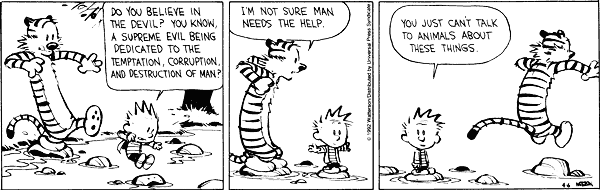
Calvin and Hobbes discuss evil

MacArthur seems to imbue evil spirits with a great deal of power on the surface, but then he says, “These fortresses are speculations, ideas, psychologies, and religions. Spiritual warfare is not about running off demons, but battling for the mind.”

So really then, “spiritual warfare” isn’t actually battling in a supernatural realm, but dealing with our own thoughts and feelings as well as the stuff that goes on around us in the world every day like cults, new age philosophies, and other institutions. OK, I get that you can’t trust politicians or Scientology. Of course, since he mentioned it, MacArthur’s track record dealing with psychology is pretty sketchy from my point of view.

He is also an advocate of Nouthetic Counseling, which stresses the Bible as a sufficient tool for counseling people with mental illnesses such as depression and anxiety. MacArthur does not reject all forms of psychological theories and techniques, though he considers some psychology and psychiatry as contrary to the Bible.

MacArthur has argued that “True psychology (i.e. “the study of the soul”) can be done only by Christians, since only Christians have the resources for understanding and transforming the soul. The secular discipline of psychology is based on godless assumptions and evolutionary foundations and is capable of dealing with people only superficially and only on the temporal level… Psychology is no more a science than the atheistic evolutionary theory upon which it is based. Like theistic evolution, Christian psychology is an attempt to harmonize two inherently contradictory systems of thought. Modern psychology and the Bible cannot be blended without serious compromise to or utter abandonment of the principle of Scripture’s sufficiency….

Wikipedia on MacArthur

By the way, that point of view of mine comes from a Bachelor’s degree in Psychology, a Master’s degree in Counseling Psychology, and fifteen years of post-graduate practice, so it’s not like I don’t have a basis for my opinion. I don’t think counseling psychological disorders absolutely requires that the therapist be a Christian or that the counseling techniques be strictly based on the Bible.

CounselingSure, MacArthur isn’t specifically referencing Nouthetic counseling but since he brought the topic up, I think the it becomes relevant to the current discussion.

But I do believe that people more often than not, create their own problems. They don’t need to look to a supernatural cause right away. When any of us have some sort of difficulty in our lives, the first person we should consider is the one we see in the bathroom mirror every morning.

The architect of it all is Satan, the arch-deceiver.

On the other hand, MacArthur is saying that all of these human caused problems have a supernatural source.

And his solution?

What is our responsibility as Christians? It is to smash these ideologies, to crush these fortifications, and to take every thought captive to the obedience of Christ. Once again, we need to remember that we are engaged in a battle for how people think. (emph. mine)

Sorry. Got caught up in the martial language there for a minute.

I’m OK with “obedience to Christ,” but I’m a little worried about “a battle for how people think.” Who is supposed to control my thinking, the Jesus of the Bible, or a particular movement in Christianity? I would prefer the former and turn myself over to God than to man, but that may not mean I’ll always agree with MacArthur or others like him on everything. If I don’t, would he think I was being influenced by Satan? I don’t know. I’ve recently called myself a Christian who studies Messianic Judaism, so I imagine he’d have an opinion on that.

When the Great Awakening broke out, there was much debate about what was and what was not a true work of the Spirit. Jonathan Edwards went to 1 John 4 and MacArthur closely followed Edwards’ The Distinguishing Marks of a Work of the Spirit of God…

We are all responsible to assess anything and everything that is claimed to be a work of the Holy Spirit. These are timeless tests for all movements, all preaching, and all preachers. What is truly of the Holy Spirit will conform to these marks.

MacArthur lost me at the Great Awakening. My primary orientation when trying to understand God is the Bible. I’ve recently been chastised by a good friend for not knowing Christian history, but how much authority should I insert into particular events in the history of Christianity vs. the Bible in trying to understand the work of the Holy Spirit?

This is one of those times when my not being a “typical Christian” doesn’t work out so well.

The context for this passage is the work of the Spirit (see 3:24). While the working of the Holy Spirit is invisible, the manifestations of his work are visible. We know Christ abides in us because the Spirit he has given is manifested in us. What is the Spirit doing in us? MacArthur provided a long list. The Spirit creates a desire for repentance, a hatred of sin, a belief in the gospel, a love for Christ, a desire to be a slave of Christ, a delight in Scripture, a longing for obedience, joy in trials, love of other believers, desire for fellowship, illumination of Scripture, a heart of praise, worship as a way of life, increasing Christ-likeness and much more besides.

I’m reassured a bit since MacArthur does believe that the Holy Spirit does have an influence and a tangible impact on our day-to-day lives, prompting us to repentance, inspiring love of Messiah, supporting us in our trials, and so forth.

His major critique of the charismatic movement is that it focuses undue attention on the Holy Spirit and does so at the expense of Christ. Any true preacher will be Christ-dominated and present him in an accurate and exalting way. It is a matter of sound theology and also a matter of preeminence. Where you see any deficiency in the nature and preeminence of Christ, this is not the work of the Holy Spirit. The Holy Spirit’s ministry is always to point you to Jesus Christ. Anyone who pollutes the gospel or distracts from the Son to the Spirit is not operating in the Spirit.

The devil would never want men to have more honorable thoughts of Christ and for that reason loves to draw attention away from Christ to a false image of the Holy Spirit. And all the while he pretends to draw attention to Jesus. A true work of the Spirit exalts the true Christ. If the charismatic movement was a movement of the Spirit, it would be Christ-dominated and everyone in the movement would be bowing the knee to the true Christ in belief of the true gospel.

According to leading charismatics, a distinctiveness of the charismatic movement is the preeminence of the Holy Spirit. They have a passion to experience the Spirit’s presence and power. But if the Spirit is the person sought, his work has been rejected. In this movement Christ is obscured, Scripture is depreciated, and a preoccupation with experience is elevated.

Off balanceSorry for the numerous and lengthy quotes, but there’s a lot going on here. I know time and again, I’ve been told to focus on Jesus, only Jesus. I can see that if, as a believer, I want the Holy Spirit to do this dramatic thing or that dramatic thing, or some other dramatic thing, that I’m probably caught up in a religion of sensation and that I’m way off-balance. I get that.

But when told to only, only, only focus on Jesus, I wonder where did God the Father run off to? I mean, MacArthur and a lot of other Christians talk about the Holy Spirit, and they talk lots and lots about Jesus, but where is God? I know. In a trinitarian view, all of them are God, but if that’s true, doesn’t focusing on any one aspect of the trinity make us unbalanced? If it’s possible to focus too much on the Spirit, is it also possible to focus too much on the Son?

I almost never, ever hear anything spoken among Christians about God the Father or, as He would be expressed in the Tanakh (older Jewish scriptures known in Christianity as the “Old Testament”), Hashem. But Jesus talked about Him all the time.

Therefore Jesus answered and was saying to them, “Truly, truly, I say to you, the Son can do nothing of Himself, unless it is something He sees the Father doing; for whatever the Father does, these things the Son also does in like manner.”

John 5:19 (NASB)

In that day you will not question Me about anything. Truly, truly, I say to you, if you ask the Father for anything in My name, He will give it to you.

John 16:23 (NASB)

Jesus spoke these things; and lifting up His eyes to heaven, He said, “Father, the hour has come; glorify Your Son, that the Son may glorify You…”

John 17:1 (NASB)

I’m saying all this not to be a theological pain in the neck, but to point out that Jesus always re-directed the attention of his disciples to the Father.

The charismatic movement fails this test of exalting Christ above all. MacArthur said, Show me a person obsessed with the Holy Spirit and I’ll show you a person not filled by the Spirit. Show me a person obsessed with Jesus Christ and I’ll show you a Spirit-filled person.

I learned in the Bible to always pray to God in the name of the Messiah. Am I wrong? Am I supposed to pray to Jesus? Am I supposed to be “obsessed” with Jesus so I can “prove” that I’m filled with the Spirit? MacArthur said to “exalt Jesus above all.” I can’t believe he means to exalt the Son over the Father, does he?

Coffee and BibleI agree we need to be mindful of anything we consider a supernatural experience or a “movement of the Spirit.” I’m not much of a spiritualist and I’m certainly not a mystic (although the writings of the mystics make wonderful metaphors). I like reading and I like studying. I think I’m “wired” to go in that direction. But I’m also wired to pay attention to what I read, which most certainly includes the Bible.

I know MacArthur is trying to make a point and the scope of his presentation, his conference, and his book probably don’t allow for answering more broad-based questions, but inadvertently, he brought this subject up so now I think he should have to deal with it.

The Bible doesn’t elevate Jesus above God the Father just as it doesn’t elevate the Spirit above the Father. MacArthur says that overindulging in the Spirit of God to the detriment of everything else God is leads to error, and I completely believe it. But how does MacArthur avoid the same problem when he demands that we should obsess on Jesus to the exclusion of God the Father?

A Sketch of Christian Fundamentalism

How Christian Fundamentalists are seenChristian fundamentalists, who belong in the center field of Biblical theology, find themselves grouped by the media in the same category as militant political extremists, fascists, snake handlers, and Islamic fundamentalists. It’s about time somebody called foul!

The term “fundamentalism,” as Bible-believing Christians use it, identifies a system of beliefs that are foundational, or fundamental, to the Christian faith. Coined at the turn of the twentieth century, in an era of emerging, aggressive theological error, the term still stands as a watershed between truth and apostasy.

-from the pamphlet
“Fundamentally Sound: Understanding Our Faith”
Regular Baptist Press: Building Lives by the Book

(Note: I just want to point out that when you do a Google image search on “Christian fundamentalism” or “Christian fundamentalists,” the results are never pretty).

A Challies Chronicles Interlude

I’ve been trying not to mention my Pastor and my church to any extent in my blog posts to avoid even the hint that I am being critical of either, but there’s no other way to write this “meditation.” Pastor brought to my attention that I might not quite understand the term “fundamentalism” and have even been using it in a pejorative manner. He also explained some differences relative to how Reformed theology is understood.

In an effort to be fair, and to cement this in my memory, I decided to construct a little summary of “what is Christian fundamentalism.” I won’t go into the history (though I took copious notes of Pastor’s discussion), however, after a series of annual conferences held by leading Christian thinkers from America and Canada starting in 1890 and extending to 1930, the “Fundamentals of the Faith” were established, recorded, and published. The first five were fully agreed upon and the sixth was debated and later added. Here’s the list as we have it today:

  1. The Inspiration and Authority of Scripture: God authored the entire Bible — every word of it and every part of it (2 Tim. 3:16). The Bible is God’s Truth (John 17:17). It is without error!
  2. The Deity of Jesus Christ: He is fully God as well as fully man. He has always existed as God, and He always will be God (John 1:1; 20:31; 1 Tim. 3:16).
  3. Christ’s Virgin Birth and Miracles: Jesus was born of the virgin Mary (Isa. 7:14; Matt. 1:18-25) and was sinless (Hebrews 4:15; 1 Peter 2:22). He performed miracles to authenticate His credentials as Israel’s Messiah (John 20:30, 31).
  4. Christ’s Blood Atonement for Sin: Jesus shed His blood as the payment for our sins. Without the shedding of His blood, there would be no remission of sin (Romans 3:24-26; Col. 1:13, 14; Heb. 9:14-28; Rev. 1:5).
  5. Christ’s Bodily Resurrection: Jesus arose bodily from the grave, triumphing over death and assuring believers of their future resurrection (Luke 24:1-12, 34-38; 1 Cor.15:1-20).
  6. Christ’s Personal Return: Jesus assured His disciples that He will come again (John 14:1-3). Angels announced His return (Acts 1:1), and the apostles taught that He will return (1 Thess. 4:13-17; Titus 2:13; 2 Peter 3:1-10; 1 John 3:2).

This describes the core beliefs of fundamentalist Christianity and as far as I can tell, these six points are generally accepted by most if not all Christians. In fact, if you dispute any one of these points, according to a fundamentalist point of view, you can’t really be called a Christian.

It’s funny how much the topic of apostasy has come up in the Christian, Hebrew Roots, and Messianic Jewish areas of the blogosphere lately.

I don’t doubt that many of you out there will have something to say about this list. I copied it word for word from the aforementioned pamphlet, so as far as it goes, I’m just transmitting information, not engaging in editorial commentary (that comes later).

christian-fundamentals-101It all sounds so simple on the surface, but even accepting those six points, there’s still room for a huge amount of variability beneath the overall Christian “umbrella.” As I mentioned to my Pastor last Wednesday, everyone who claims Yeshua-faith as well as religious Jews who deny Yeshua (Jesus) was/is the Messiah all state that scripture supports their positions. Even when considering the rules of Biblical interpretation, there is always the filter of interpretive tradition each religious stream in Christianity and Judaism utilizes to color understanding and meaning. No one has pure, unbiased access to the Bible.

We are all on a journey attempting to discover truth, attempting to achieve ever higher fidelity to the original, that is, the truth of God, and yet we all fall short. This isn’t to say we should all give up, and it isn’t to say that we can’t come closer to truth as we continue our efforts, but achieving the mind of God is like traveling at the speed of light. To do so would require the expenditure of infinite energy and would result in us laboring under infinite mass.

In other words, no matter how hard we try, and what technologies we use, pushing an object in space faster and faster and faster will get us (marginally) closer and closer to the light speed limit, but we will not only fail to ever achieve it, we will probably fall significantly short of our target.

But that doesn’t mean we will ever stop trying, and in fact, NASA continues to look into developing warp drive.

People of faith continue to strive to break the bonds of our humanity in an effort to touch the Divine. The moral equivalent of developing “warp drive.”

My Pastor suggested that it might be helpful for me to listen to some sermons and to gain some actual experience and perspective on Christian thought and Christian leaders. We discussed John MacArthur, R.C. Sproul, Steven J. Cole, and Chuck Swindoll.

I didn’t tell Pastor this (but since he reads my blog posts, he’s about to find out), but I gave up listening to sermons on Christian radio well over a decade ago. Even as a “young Christian,” I found some of the sermons too elementary, some too confusing, and most too critical of Judaism and Israel to be of much help. Sooner or later, the speaker would say something that would make my blood boil, and my commute home from work would be shot as would my mood when I got home.

I listen to the 1960s “oldies” station now and am much happier on my drives.

I’m a guy sitting on a fence. I go to a Christian church, but I think like a “Messianic” (however you want to define the term). More to the point, I think and enjoy Biblical lessons that focus on understanding scripture from the Judaic thought process, linguistic, social, ethnic, and yes, Rabbinic context of the times when those scriptures were authored, and from the viewpoint of the intended Jewish (in most cases) audience.

Hillel and ShammaiKnowing the original languages isn’t enough, because how we interpret what was actually being said has been stripped of most of its contextual meaning. From a Messianic viewpoint, you can’t read the teachings of Jesus without, in some cases, summoning up Hillel and Shammai, who taught a generation before Christ. They were Jewish teachers, Jesus was a Jewish teacher. In many ways, Jesus had a lot more in common with Hillel and Shammai than he has with MacArthur, Sproul, Cole, and Swindoll. I’m not trying to be mean or insulting. It’s a statement of fact. Jesus wouldn’t call himself a “Christian.” He wouldn’t say that the Law was “nailed to the cross.” He wouldn’t disdain the Shabbat, New Moons, or other Biblical festivals.

To understand Jesus, or Paul, or Peter, or James, it makes more sense to seek out sources closer to them, not only historically and linguistically, but culturally, ethnically, ethically, as well as in terms of what Jewish traditions and interpretative methods were in play in that place at that time.

I’m not sure how men like MacArthur or even the very user-friendly Chuck Swindoll would approach such a context. I don’t want to be unfair, but I do want to be realistic.

This all goes back to Boaz Michael’s book Tent of David and my recent review of who I am and what I mean within the cultural and theological context of Christianity as an institution.

So far, I see one of three outcomes of my “church experience:”

  1. I stay at church and “assimilate,” becoming a “regular Christian” and abandoning any mental, emotional, theological linkage with Messianic Judaism, Hebrew Roots, and any “Judaic” viewpoint on the Bible.
  2. I stay at church but maintain my current perspective, even expanding it though self-study and contact (real or virtual) with others who share my basic viewpoint, generally being a curiosity, a pain in the neck, or ideally, a refreshing conveyer of the Messianic perspective within the church environment.
  3. I give up on Christianity as an institution entirely, leave church, and pursue a life of faith as an independent “free-agent.”

As the end of my first year in church approaches (or has it arrived by now?), I feel like I’m crossing some sort of milestone or threshold. A year in church as resulted in me learning more about the history and institution of Christianity, but it hasn’t diminished the perspective I possessed when I went back to church a year ago. If anything, having to debate my perspective has driven me to do even more reading and studying, strengthening my belief in a Jewish Yeshua and the continuance of Jewish Torah observance for all Jews of faith, including Jews in the body of Messiah.

Every time I enter into such a brain bending set of debates and discussions, I have to get away for a while afterward and be alone with God. God may not be entirely knowable, but He isn’t confusing, either. He is a listener. He doesn’t have much to say most of the time when I pray, but it’s good to be able to tell Him how crazy religion makes me sometimes.

praying-aloneI’m glad He’s there. I’m glad I can remember that regardless of all the religious preachers and pastors and rabbis and sages rolling around human history and the current theological landscape, there is an eternal God who is the point of everything everyone is trying to do. In the end, it doesn’t matter who wins the arguments. In the end, God reigns supreme. In the end, God will stop listening and start talking. Then, if we are wise even to the slightest degree, we will stop talking and listen.

It’s in moments like these that I continue to pursue God, moments when it is dark and quiet, and the only sound is the passage of my voice to the Heavens. God listens. Being with Him is very peaceful and comforting. The chaos of human religion seems miles away.

I’ll return to my review of the Strange Fire conference soon.

In the meantime, tomorrow’s latest review of an episode of First Fruits of Zion’s television series and Wednesday’s follow up on that content continues the discussion of who I am as a believer. I said above that I was sitting on a fence. Wednesday, you will see me hopping off and I will show you on which side of the fence I land.