Tag Archives: Tent of David

Returning to the Tent of David: An Introduction

serpentThe serpent enticed Chavah by predicting beneficial outcomes. “Your eyes will be opened… The fruit will awaken a new desire and appreciation for the pleasures around you. It will be a source of intellectual benefit.”

Chavah longed for this new knowledge and exciting awakening, and she ate the forbidden fruit. She then used her persuasive powers to convince her husband to eat it as well.

Chavah’s downfall began when she expanded upon and distorted G-d’s command, which she did not personally hear.

-Chana Weisberg
“Woman and the Forbidden Fruit”
Chabad.org

Beginning the Returning to the Tent of David series

This depiction of Chavah (Eve) and her interaction with the serpent casts her in a more favorable light than we typically see her by in Christianity. Rather than being disobedient and rebellious, she is either a bold explorer of new knowledge, or an innocent dupe of the serpent who physically pushed her in to the tree of the knowledge of good and evil and after all, it’s not her fault because God did not tell Chavah directly not to touch the tree or to eat from it.

Chavah added the prohibition of touching the Tree of Knowledge. The serpent then forcibly pushed Chavah against the tree, and victoriously claimed, “See, just as death did not ensue from touching, so it will not follow from eating.”

In this way, the serpent introduced doubt into Chavah’s mind. It now became easier to dare Chavah to taste the forbidden fruit. He convinced her that G-d did not actually intend to kill her and Adam, but merely threatened them to intimidate them.

I know, I know. The Torah reading for Beresheet (Genesis) is behind us. Why do I continue to write about it now? Shouldn’t I be preparing my commentary on Noah? Be patient. There’s a reason.

That’s my ministry in a nutshell; it’s a not-so-interesting and rather Baptist-intensive story. I am eternally grateful for my family and for my Baptist heritage. God has used both to lead me to commit my life to Christ, to follow him with my life and to serve him through the church. However, the past eighteen months have opened up for me a more complete picture of who I am and where I came from. Through a series of circumstances, curiosity, and new friendships, I am being exposed to my Jewish roots. I have no doubt that all of these circumstances and friendships, and even my own curiosity that opened me up to the Jewish roots movement, are all God-ordained.

-Durwin Kicker
Senior Pastor at Marshfield First Baptist
From the Foreword (pg 10) of Boaz Michael’s book
Tent of David: Healing the Vision of the Messianic Gentile
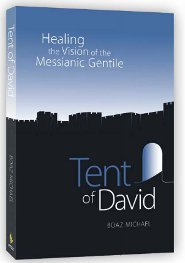
tent-of-davidYou may think it’s terrifically unfair of me to compare Chavah’s situation to Pastor Kicker’s. I’m not really, but it occurs to me that, at least in midrash, we all have something in common with the wife of the first man. When exposed to be brand-new world with seemingly endless possibilities, we want to explore. However, like Chavah, we may also have reservations, since some of the things that we are tempted to explore may not be what God wants us to investigate, even when we get a “helpful” shove.

God has used Boaz Michael and the ministry of First Fruits of Zion to impact my life in a profound way in a very short amount of time. It is my great honor and privilege to call Boaz my friend. His passion and love for Messiah and his gentle spirit have struck a chord in our church family which has served to open many of our people to our Jewish roots, God’s everlasting covenants with his people, and our place as Gentiles in God’s family through our Jewish Messiah.

Boaz’s desire is that this kind of loving impact will be repeated over and over again in church after church. I join with Boaz in saying, the church needs you! The church is good, yet the church needs to change. Each individual who comes to know our Jewish Messiah in his Jewish context can play a part in lovingly and patiently helping brothers and sisters in Messiah come to know him in this way as well.

-Kicker, pg 12

I reviewed Boaz’s book about nine months ago in several blog posts, the two most notable being Return of the Christian and Returning to Faith. I had read an advanced copy of the book months previously, and it was instrumental in overcoming my inertia and inspiring my own return to a local church.

And now it’s been nearly a year later. The progression through the Jewish holiday season and the beginning of a new Torah cycle seem a very good time to review my own “Tent of David” experience and to see how things actually have ended up (not that anything has really ended yet).

Pastor Kicker seems enthusiastic about pursuing the vision of the “Messianic Gentile” in the church by way of his friendship with Boaz but of course, he’s been in the church for quite some time and as Pastor, he is a fully integrated unit within that cultural, social, and theological construct. In other words, he “fits.” Boaz’s book speaks of “Healing the Vision of the Messianic Gentile.” For me as a recent “returnee,” what has been healed, if anything?

My perception of Boaz’s book (I can’t speak directly to his intent, nor would I ever try…this is my own opinion) is that there are two kinds of healing going on, at least in theory.

There’s the healing of the “Messianic Gentile,” the Christian (non-Jewish disciple of Jesus Christ) who often has left the church because of some emotional or spiritual injury or hurt (real or perceived) caused somehow by the Christian church or some of its members. Many people in Hebrew or Jewish roots congregations believe they have sought refuge in a “safe place” outside of “the Church” and continue to view church and people who identify as Christians as adversaries. Finding a mechanism to have the Hebrew/Jewish roots Gentile return to church in a safe manner and to share who they are with their fellow Christians certainly opens the avenue for healing between the parties involved.

Then there’s the more historic healing between the traditional church of Jesus Christ and the historic and Biblical Jewish Jesus and the Jewish and Gentile body of Messiah. A great deal of damage has been done to Jewish and Christian hearts, and that has sustained the separate trajectories believing Gentiles and the Jewish community (including Messianic Jews) have been traveling for twenty centuries.

church-and-crossA non-Jewish believer possessing a Hebraic view and even a passion for the “Jewishness” of Jesus, and one willing to communicate that with his or her Christian counterparts in a church community could facilitate a great deal of healing, ultimately between Christianity and Judaism. Certainly, great strides have already been made in this area between some churches and various expressions of Messianic Judaism, although a lot of work still needs to be done.

But what about me and what I’m doing in the small church I attend? I’d like to completely re-read Boaz’s book before venturing to answer that question in full, but I did want to keep my promise and at least introduce the journey I’m taking in returning to the Tent of David and Boaz’s vision of the healing of Christian and Jewish communities. His book speaks on a larger scope by necessity, but nearly a year down the road,  how has Boaz’s vision worked “on the ground,” so to speak. I can only lend my own single, small voice and my individual experience. As this series progresses, I’ll share my insights with you. Perhaps you will return the favor.
On Being a Good Christian

churchesAfter they had preached the gospel to that city and had made many disciples…

Acts 14:21a (NASB)

Last Sunday, Pastor Randy preached on Acts 14:21-28 in a sermon he called, “What Makes a Good Missionary (Part 3)?” In many ways, the title could be expressed as “What Makes a Good Christian” since it is Pastor’s opinion that all believers are responsible for preaching the Good News of Jesus Christ, whether we’re formally called missionaries or not. Pastor spent most of his adult life as a missionary and his parents were missionaries, so it’s completely understandable why his perspective would be as it is.

When he was teaching about what a disciple is, he used several different phrases to describe them/us. I want to focus on one of those phrases:

A good Christian is a person who places himself/herself under a local church authority as a member.

Whoa!

Yeah, I even wrote “whoa” in my notes during the sermon. A member?

Pastor listed a number or reasons for this including giving the person a sense of accountability, opportunities for service, both to the other members of the church and to the larger world, and displaying commitment to the body of believers.

I know what you’re thinking? Aren’t we all as believers, part of the body of Christ anyway, what Pastor called “the universal church?”

Yes, but he used Paul’s model of “planting churches” (I can’t imagine Paul actually used that term) to emphasize how we can’t really function effectively in the body unless we join with a local church and display a commitment to that body as one of the operational parts. The sense of community would also contribute to the individual growing in “Christ-likeness” and, as I said before, providing a platform to allow the individual to minister to God’s people.

I’ve been campaigning to completely redesign the church’s website, which currently looks like a throwback to the ancient web of the 1990s. I’ve gotten some traction, but there’s a bottleneck in the process and until that bottleneck is cleared (which I’m told will be soon), I can’t actively begin my redesign project. Most of the information on the current site is obsolete, however, I did manage to pull this from the “Beliefs” page:

Because the Bible is the complete, true and sufficient Word of God, holding absolute authority for the church and the individual, we believe and teach the following:

  • Jesus Christ as the one and only begotten Son of God, is fully Jehovah God (the second person of the trinity) (John 1:1-14). In Mary’s womb, He joined to His divine nature, a human nature and was virgin born, thus becoming ‘God-man’ (Philippians 2:5-7 / Hebrews 10:5-10).
  • Jesus was tempted by Satan but remained sinless because He was and is God, and it is impossible for God to sin (Deuteronomy 32:3-4). Still, the temptations were both valid and real to the God-man. Oh, how he can sympathize with us (Hebrews 4:15-16).
  • Christ was literally crucified on the cross, His blood becoming the sufficient cleansing for our sins. He died and was buried. Then on the third day, He physically arose in victory over sin and death (1st Corinthians 1-5). He who truly believes that Jesus is the Christ, the Son of God is rescued from eternity in hell and given eternal life (Salvation – John 20:31).
  • The next prophetic event will be the taking up into heaven of all believers, ‘The Rapture,’ (1st Thessalonians 4:15-17). Then following the tribulation, Christ will return to the earth with us, His glorified saints, to establish His literal rule over all the earth for 1,000 years (The Millennial Kingdom), and we will rule with Him (Jude 14-15). This is our destiny as Sons of God (Romans 8).
  • Saving faith is by grace alone and not by works of merit that we can do (Ephesians 2:8-9).

churchmembershipI object to the use of “Jehovah” as if that were the actual pronunciation of the Tetragrammaton, and I’m not crazy about the “rapture” doctrine. Becoming an actual church member means taking some classes and then signing on the dotted line that you buy all of their doctrine, dogma, and theology hook, line, and sinker.

I’ve had enough conversations with my Pastor to realize our points of disagreement and, if being a member of my church or some other local church is a requirement for being a “good Christian,” then I have a problem.

Sunday afternoon, I had coffee with my good friend Tom. Tom’s been a Christian for over forty years and he and I have both been through the Hebrew Roots “wringer” as well. We have a good many attitudes in common, but he agrees with my Pastor that I will never be truly effective in my community until I formally become a member. Tom’s been a member of his church for about three years now. I asked him what he does about the bits and pieces of church doctrine with which he disagrees. He’s discussed it with his Pastor and his Pastor’s response is, “We’ll work on that.”

I’d interpret that statement to mean that Tom’s Pastor will try to convince Tom of the correctness of whatever Tom currently has issues with. I guess that situation is a work in progress.

But what about me? Frankly, I don’t think any church has their understanding 100% correct. How am I supposed to pretend that the church I attend does? I’m already anticipating a major disagreement next week in Sunday school class over the “symbolic” meaning of the moadim.

By the way, I took a closer look at the study notes for next week’s class and my blood ran cold. I’m actually kind of nervous about this. The notes mainly describe how the primary purpose of all of the Festivals just point to the reality of Jesus Christ. In other words, they had no value of their own to draw the Israelites closer to God (never mind that the word “sacrifice” in Hebrew is “korban” which gives the meaning of “drawing closer to” God). Dispensationalism isn’t supposed to be inherently supersessionistic but this part of it is getting close.

But anyway…

Since Pastor is anachronistically applying the “missionary journeys” of Paul to modern Christian missionary work anyway, let’s apply that process to “church membership.” When Paul “planted churches,” and appointed leaders, how did Gentiles join the community? Besides professing faith in Messiah, was there some additional process of agreeing to the specific conditions and rules of that community in order to join? Maybe, but remember, there weren’t “church denominations” in those days. Yes, there were different streams of Judaism, and “the Way” was the Jewish stream that contained the Jewish and Gentile disciples of Messiah. However, within the Way, were there different and competing variations? Did you have to choose one and forsake all others or could you just be a “generic” Jewish or Gentile disciple of the Jewish Messiah?

Actually, it looks like there were some divisions:

Now I exhort you, brethren, by the name of our Lord Jesus Christ, that you all agree and that there be no divisions among you, but that you be made complete in the same mind and in the same judgment. For I have been informed concerning you, my brethren, by Chloe’s people, that there are quarrels among you. Now I mean this, that each one of you is saying, “I am of Paul,” and “I of Apollos,” and “I of Cephas,” and “I of Christ.” Has Christ been divided? Paul was not crucified for you, was he? Or were you baptized in the name of Paul? I thank God that I baptized none of you except Crispus and Gaius, so that no one would say you were baptized in my name. Now I did baptize also the household of Stephanas; beyond that, I do not know whether I baptized any other. For Christ did not send me to baptize, but to preach the gospel, not in cleverness of speech, so that the cross of Christ would not be made void.

1 Corinthians 1:10-17 (NASB)

broken-crossOn the other hand, it looks like Paul took a dim view of these divisions and urged unity in Messiah, not in the name of some “leader” or “teacher” (or “denomination”).

I know, I know. I can’t anachronistically apply conditions as they existed in Paul’s day to the modern “church” because after all, the “church” isn’t a unified entity, at least at the level of human organizational meaning. Times have changed significantly in the past twenty centuries or so, and being a “good Christian” now means different things to different streams of Christianity.

I currently attend a small, Baptist church in Southwestern Idaho. They have definite standards and a formal process of baptism and education leading to entry into membership. I suppose I could attend and worship there forever as unaffiliated, but then, I wouldn’t meet the qualifications of a “good Christian.”

It’s not that I object to being committed to a community, having affiliation, accountability, and opportunity for service, but it’s the albatross being hung around my neck of all the specific doctrine and dogma to which I object (and if taking Calvinism on board is a requirement, then it’s an absolute “showstopper”). I can’t lie about believing stuff when I don’t believe it, so how can I ever join any church anywhere? How can I, as Pastor puts it, be a “good Christian?”

Oh, and apparently Pastor isn’t alone in his opinion about joining a church. Another collision between the principals outlined in Boaz Michael’s book Tent of David and the reality of “going to church.”

A Christian Brings a Tanakh to Sunday School

jerusalem_templeSome people believe the 4 spring holidays (Passover, Unleavened Bread, Firstfruits, and Feast of Weeks/Pentacost) were fulfilled in Messiah’s 1st coming and that the 3 autumn holidays (Feast of Trumpets, Day of Atonement, and Feast of Booths/Tabernacles) will be fulfilled at his 2nd coming.

-from Sunday School study notes
for August 4th, “Leviticus 23, Feasts of Israel: God’s Picture of Things to Come”

Help.

I knew Pastor Randy was going to start giving a series of sermons on the Festivals to better educate folks about their past and future (and hopefully their present) meaning. I forgot that meant my Sunday School class would be teaching on them too, since my class “mirrors” the Pastor’s sermons.

I like my Sunday School teacher but in many ways he has a very “basic” approach to the Bible, that is to say, very basically Christian. I’ve had to bite my tongue on a few occasions during a study rather than open a can of worms that would not easily be closed again.

To his credit, the teacher came up to me before the start of class today and said he expected I’d have a lot to say about next week’s lesson. That’s something of an understatement. I plan to really do my homework this weekend, come prepared with a lot of notes, and bring my Stone Edition Tanakh for good measure.

What’s kind of scary is that the Festivals won’t be approached based on their own merit, but on their “symbolic meaning” relative to Jesus and all that “fulfilling” stuff.

Really, Passover has been “fulfilled?” I’m not sure what that’s even supposed to mean. Does that mean it’s over. No more Pesach seders? Then why did Jesus say “do this in remembrance of Me” (Luke 22:19)? Oh. Am I supposed to believe that the sacrament of communion replaced Passover? What happens when the Temple is rebuilt? Will there be no Pesach sacrifices because Jesus “fulfilled” Passover?

Actually, I told my teacher that I do sometimes keep my mouth shut and my opinions to myself in his class on various occasions. Our conversation was light-hearted but I know I’m going to have concerns over the next two months. I won’t be as quiet as I have been in the past. I can’t be.

Actually, in preaching on Acts 14:21-28, I encountered my Pastor’s opinion on Shabbat as applied to Christians. This section of Acts addresses the end of Paul’s “first missionary trip” and his return to Syrian Antioch. Although the text doesn’t actually say Paul and his team rested, it’s assumed that once they returned to their “home church,” they may have taken it easy for a bit.

Both Pastor and my Sunday School teacher emphasized the importance of taking a break from our duties to recharge our “spiritual batteries,” so to speak. Pastor went so far as to mention the Shabbat, “but not in a legalistic sense” (Oy). He did say that he felt it was important to take one day out of the week as a day of total rest. That day can’t be Sunday for him since it’s his busiest day, but every Monday, he and his wife spend the day at their cabin. No phone and no Internet. Just taking it easy and pursuing some personal activities and projects.

From the way he’s described it to me, it doesn’t sound like a “Jewish” Shabbat as such, but it is a day of rest. However, Pastor says we can choose whatever day we want. I don’t see that in the Bible, but then, he’s not going to be preaching a Saturday Shabbat to his congregation, either.

levites-aaronic-blessingAs an aside, in ancient times, the Kohenim (Levitical Priesthood) also worked on Shabbat and yet were held blameless (Matthew 12:5). I wonder when they rested? Of course, in the days of Jesus, the Priests worked on a rotational basis, so maybe it wasn’t as bad as all that. However, what about Rabbis working on Shabbat? But I digress.

I wonder if Pastor or anyone else at church would consider actually observing a Saturday Shabbat as “legalistic,” particularly if observed from sunset Friday to sunset Saturday and abstaining from some form of the Melachot or the thirty-nine types of work traditionally forbidden on Shabbos? Would it be legalistic to observe Shabbat because it honors God as the Creator rather than just because we need a rest?

Christianity didn’t switch Shabbat from Saturday to Sunday, they eliminated it altogether. Few Christians treat Sunday the way a religious Jew observes Shabbat, not even close. I think the church surrendering the Sabbath and its traditional observance was like Christianity shooting itself in the foot. Could you imagine the enormous relief and freedom we could experience if we didn’t choose to treat Sunday pretty much like any other day of the week?

That’s pretty much what I’m going to be addressing at church for the next two months. I’m actually kind of excited to hear what Pastor is going to say about the Festivals, but I’m also kind of dreading how it’s going to play in Sunday School. I’m going to go. In some ways, I really want to go. And I’m going to give input. People have become aware of my basic leanings and seem to be OK with it, but this will be the real test.

People are going to find out that in my own small way, I do observe the Festivals. My wife and kids being Jewish, we have a family seder each spring and I build a sukkah in our backyard each fall. I eat matzah instead of leavened products for the eight days of unleavened bread. And although I don’t always fast on Yom Kippur, I have done so periodically in solidarity with the Jewish people.

Too bad this didn’t come up before Tisha B’Av.

I’m sure I’ll have more to say after next Sunday’s message and Bible school study. This is where my real life experience and the mission illustrated in Boaz Michael’s book Tent of David intersect, hopefully not to forcefully, though.


Behaalotecha: The Journey of Grass

desert-islandThen Moses said to Hobab, son of Reuel the Midianite, Moses’ father-in-law, “We are journeying to the place about which the L‑rd said, ‘I will give it to you.’ Go with us, and we will be good to you.”

Numbers 10:29

Note that Moses said that the Israelites would journey to Israel, whereas Jethro was invited to go to Israel. The difference between “going” and “journeying” is that going can mean to travel physically but remain emotionally unwilling. The body moves along, but the heart remains in place. Journeying means to go physically and mentally—the entire person journeys to the destination.

It is possible to go without journeying. One can board a plane and travel with reluctance. Your heart and spirit are with your family, but you have no choice, because circumstances force you to make the trip.

As we read these lines, we can reflect on our own lives. Those of us privileged to be born into Judaism are in possession of a gem we don’t fully value. It is incumbent on us to learn from righteous proselytes (The same applies to those holy souls who do teshuvah midstream in life and adapt to a whole new lifestyle) how to value the privilege of Judaism.

-Rabbi Lazer Gurkow
“Live Every Moment”
Commentary on Torah Portion Behaalotecha
Chabad.org

Last week I was in the middle of a journey, at least I hope it was a journey. To tell the truth, I always think of myself as in the middle of a journey, but last week at this time, as you read my Friday missive, I was also far from home. Specifically, I was attending the First Fruits of Zion (FFOZ) Shavuot conference at Beth Immanuel Sabbath Fellowship in Hudson, Wisconsin.

Although I had made my airline reservations months in advance and on some level was looking forward to attending the conference, part of me wanted to cancel everything and just stay at home. It’s more comfortable at home, more predictable…it’s safer. I suppose I was “going” to the conference but not “journeying,” to borrow Rabbi Gurkow’s metaphor. But then again, I was forgetting something.

Now the Lord said to Abram, “Go forth from your country, And from your relatives, And from your father’s house, To the land which I will show you…

Genesis 12:1

That’s how the verse is translated in the NASB version of the Bible. Now let’s look at how the Aish Ask the Rabbi writer translates the same verse and then read his brief commentary.

God appears to Abraham and commands him: “Go to yourself” (“Lech Lecha”) – away from your country, your relatives, and your father’s house.” God is telling Abraham that in order to become truly great, he must “cut the umbilical cord,” and embark on a journey of growth and self-discovery – away from the familiar routine.

In commanding Abraham to go away from his country, his family, everything he ever knew, God is also commanding him to “go to himself.” We can understand this as going to the Land of Promise, to Canaan, to the Land that would one day be known as Israel. This was the core of everything God intended Abraham to be as the Father of Judaism and the spiritual father of all of those who turn to the God of Abraham through faith in Messiah.

Go to yourself.

In some sense, that’s what I discovered (or rediscovered) in returning to Hudson last week. I expressed some misgivings about going to the conference right before my trip and it turns out, on that first Tuesday night as I sat in services and listening to the teachers, I was right to feel that way. Instead of everything feeling comfortable and familiar, I felt like a literal “stranger in a strange land.”

boaz-michael-beth-immanuelEven as Boaz Michael was welcoming all of the attendees that first night, encouraging those who were completely unfamiliar with synagogue worship to engage in the process on whatever level they felt they could, it was as if I was standing on the outside looking in through a dirty window. I realized that I was at the intersection, or some might say, the point of collision, between the Shavuot conference and my Tent of David experience.

Seven months ago or so, I started attending church again. In spite of the discomfort I felt on multiple levels, I eventually settled into a sort of “rhythm” in my church attendance, in my fellowship with other Christians, in my weekly conversations with Pastor Randy, and everything has gradually become “normal.”

But in sitting in the pew at Beth Immanuel on the first night of the conference, I was struck by how familiar and unfamiliar everything was. Even as I moved through the subsequent days of the conference and gradually re-acquainted myself with Jewish worship, eventually drawing a sense of comfort and even enjoyment in the Jewish expression of encountering God, I realized what it was really like to stand between two worlds. In some ways, the typical Sunday worship service at church couldn’t hold a candle to the Jewish prayer and Torah services, the depth they generated in me, and the complex pattern that davening in a synagogue weaves in my personal fabric.

But while I realized that the synagogue wasn’t my world, it reminded me that the church really isn’t my world either. I started wondering about the consequences of Calvinism and perhaps I was one of those consequences. What happens when a person who God doesn’t choose for salvation ends up on the House of God anyway? What happens when he wants to love an encounter with God but feels completely foreign to the attempt?

Was this God’s way of telling me that I didn’t belong? Were others called to “journey” but I was merely “going” along for the ride?

Go to yourself? But exactly where does “myself” reside?

I declare to you today, that you shall surely perish. You shall not live long in the land that you are going over the Jordan to enter and possess. I call heaven and earth to witness against you today, that I have set before you life and death, blessing and curse. Therefore choose life, that you and your offspring may live, loving the Lord your God, obeying his voice and holding fast to him, for he is your life and length of days, that you may dwell in the land that the Lord swore to your fathers, to Abraham, to Isaac, and to Jacob, to give them.”

Deuteronomy 30:18-20

Tree of LifeIf Calvin is right, then how dare God tell the Children of Israel as a corporate body to “choose life” knowing that He had deliberately programmed some of them to not choose life? Talk about setting people up for destruction. Was that what God did to me? Did he program me for destruction and then allow me to find myself among the people of God? If that was so, then my sitting in Beth Immanuel listening to the prayers, listening to the Torah being read, listening to the Spirit of God speaking to the hearts of everyone around me except me was a cruel and horrible jest.

Behold, the LORD’s hand is not shortened, that it cannot save, or his ear dull, that it cannot hear…

Isaiah 59:1

No, the arm of the Lord is not too short that it cannot save, if God actually chooses to save. Was God choosing to save me or condemn me as I sat among those at Beth Immanuel on the first night of the conference?

Either Calvin was having a hardy laugh from Heaven (or from the grave…whatever) or I was being kicked in the gut by bilateral, bicultural ecclesiology.

I realized looking around me at Beth Immanuel, how vitally important it is to create and preserve a fully religious, cultural, and halachic Jewish experience within the context of Jewish disciples of Messiah. This must feel like “home” to the Messianic Jews (and not a few Gentiles) in attendance, both those who had traveled far to be there, and those who attend every week.

But as I cruised into the synagogue at a pretty good clip emotionally, I suddenly hit a major cultural wall and dropped from warp speed down to sublight down to a full, complete, and abrupt stop. It was like being dropped from an airplane down, down into the ocean. Splash! I was underwater and I couldn’t breathe. Which way was up? Would I drown?

I eventually found the surface and oriented myself. Eventually things got better. While I didn’t always understand everything that was happening around me, it was the people who made me feel at home.

“One who romanticizes over Judaism and loses focus of the kingdom of Heaven can be compared to a carpenter who is infatuated with the hammer, rather than the house it was meant to build.”

Troy Mitchell

Troy was kind enough to let me know the actual words of his midrash, which Boaz was quoting from memory at the conference.

It was the teachings at the conference that helped me focus on what’s truly important, which is building the Kingdom of God. I’ve already blogged on what that means and will continue to do so from different perspectives and through the eyes of different teachers as I keep writing into next week. When we proceed forward under our own effort or feel as if we’re being dragged along for the sake of social or moral obligation, we are merely “going.” To actually, willingly follow the Spirit on the path of God, it is then we are on a “journey.”

The goal of humankind is to reach beyond the state of Adam and Eve in the Garden—to a state where any sense of ego is meaningless. A place called Eden, which is beyond the Garden, the place of Essential Being from where all delights flow . . .

“And a river went out from Eden to water the Garden.”

And now you know the secret of why such a tree was created.

-Rabbi Tzvi Freeman
“Beyond”
Based on letters and talks of the Rebbe, Rabbi M. M. Schneerson
Chabad.org

Over every single blade of grass, there is a heavenly force that whispers to it and commands, “Grow!”

-Bereishis Rabbah 10:7

Hands of the GardenerAccording to Rabbi Abraham J. Twerski, midrash says that human beings must struggle against two forces as we strive for spiritual growth, inertia, which affects all things, and the yetzer hara, which is unique to people.

While Christianity sees our “sin nature” wholly as an impediment to be done away with, Jewish thought considers both inertia and the yetzer hara as motivators, urging us on, pushing us to achieve more, to climb higher, to plumb ever greater spiritual depths, to strive toward the sun, the light, the air…to overcome who we are in order to become who we were meant to be.

That’s what I found at the intersection, or even the terrific, horrific collision of this year’s Shavuot conference and my Tent of David experience in the church. Rabbi Twerski’s commentary puts the finishing touches on my journey like this:

If a lowly blade of grass has both a tendency towards inertia and a spiritual “mentor” which demands that it fulfill itself, we human beings, with two adversaries, certainly have even more powerful forces urging us to achieve our full potential. We should be aware of what can hamper our achievement and make the effort to overcome it.

Today I shall…

…bear in mind that there are numerous obstacles to spiritual growth, and that I must try to triumph over them.

May it be so by the will of God.

Good Shabbos.

124 days.

Introduction to Messianic Judaism: The Last and Greatest King

messiah-prayerThe Messiah precedes creation, precedes the nations, precedes the election of Israel, precedes the historical reality of the Jewish people. Apart from the Messiah these other realities would not be. They are because the Messiah first is, and because the Father wills them to be through the Messiah. The Messiah who is himself the gospel is before all. When he is born in the flesh as Jesus of Nazareth, and is “apocalypsed” in Israel, he comes to “his own” people (John 1:11). Before he belongs to this people, they belong to him. Because the messianic gospel is prior to all, the apostle Paul can declare that this gospel was announced beforehand (proeuengelisato) to Abraham (Gal 3:8) and that its content — blessing to the nations and resurrection from the dead (Rom 4) — was the same in the time of Abraham as it is in the time after the Messiah’s historical arrival, for the Messiah himself is that content.

-Douglas Harink
“Chapter 26: Jewish Priority, Election, and the Gospel” (pp 273-4)
Introduction to Messianic Judaism: Its Ecclesial Context and Biblical Foundations

Like yesterday’s morning meditation, I’m not sure I’m receiving this essay in the way the author intended. For much of the past week in the comments section of my blog posts, I’ve been trying to defend the primacy of the Messiah, of Jesus, above all things. If not for the coming of Jesus and his presence both in our world and in the Court of Heaven at the Father’s right hand, we non-Jewish believers would have no relationship with God at all, and certainly no avenue to salvation and the life of the world to come. We would still be “alienated from the commonwealth of Israel and strangers to the covenants of promise, having no hope and without God in the world. But now in Christ Jesus you who once were far off have been brought near by the blood of Christ. For he himself is our peace… (Ephesians 2:12-13)

In debating Messiah with my friends and associates in the Hebrew Roots movement, we have been debating the avenues by which Gentiles are brought near to God. In the ancient days of Moses, a Gentile could become a resident alien among Israel but not a tribal member. They were aliens and foreigners, with no more rights than the widow or orphan. Only by intermarrying with a tribal member and having offspring would the third generation of their union be considered “Israel.”

But then, the Gentile distinctiveness of their line would vanish, fully assimilated and absorbed into Israel.

If that was the fullness of God’s plan, then all Gentiles who desired to join in the blessings of the covenants God made with Israel would have to join with Israel in the way of the Ger and their family line as people from the nations would cease to exist. There would be no way for the people of the nations to come and worship God and remain as people from among the nations. Only Israel would have the privilege. The rest of the world would be shut out.

But that was not God’s plan.

…hear in heaven your dwelling place and do according to all for which the foreigner calls to you, in order that all the peoples of the earth may know your name and fear you, as do your people Israel, and that they may know that this house that I have built is called by your name.

1 Kings 8:43

…and many nations shall come, and say: “Come, let us go up to the mountain of the LORD, to the house of the God of Jacob, that he may teach us his ways and that we may walk in his paths.” For out of Zion shall go forth the law, and the word of the LORD from Jerusalem.

Micah 4:2

“Thus says the Lord of hosts: Peoples shall yet come, even the inhabitants of many cities. The inhabitants of one city shall go to another, saying, ‘Let us go at once to entreat the favor of the Lord and to seek the Lord of hosts; I myself am going.’ Many peoples and strong nations shall come to seek the Lord of hosts in Jerusalem and to entreat the favor of the Lord. Thus says the Lord of hosts: In those days ten men from the nations of every tongue shall take hold of the robe of a Jew, saying, ‘Let us go with you, for we have heard that God is with you.’”

Zechariah 8:20-23

I know you’ve read all that before and quite recently, but it bears repeating, if only to drive the point home that God has always had a plan for the Gentile to bow to Him and worship Him without becoming a citizen of national Israel.

The problem is, in Hebrew Roots, the Torah tends to precede the dominance and Kingship of Messiah. For many in Hebrew Roots, the Torah has become so central, so important, so vital in their practice, particularly the ceremonial portions of Torah, (wearing tzitzit, laying tefillin, keeping kosher, observing Shabbos), that Messiah has become eclipsed and overshadowed.
Simchat TorahTorah is the foundation of scripture to be sure, but is it greater than the living Word? In Jewish mysticism, the Torah was at creation and was required for creation, but we know, as Dr. Harink wrote, that Messiah preceded everything and is over everything including the Torah.

The priority of the gospel — that is, the priority of the Messiah — is also declared in the New Testament in respect to Israel’s Torah. In the Gospels Jesus displays an authority over the Torah that is noticed by all those who see his deeds and hear his words. That authority is nowhere more evident than in the familiar section of the Sermon on the Mount (Matt 5:21-48) where Jesus says, “You have heard that it was said…but I tell you…” The point here, as Jesus himself makes crystal clear, is not that his authority cancels (katalusai) the Torah and the Prophets; rather, Jesus by his own authority fulfills (plerosai) the Torah and Prophets (Matt 5:17). By his authority he authorizes their ongoing authority in Israel until “all is accomplished” (Matt 5:18), that is, until the messianic age arrives in fullness. But it is just as clear in the Gospels that the authority of the torah and the Prophets is subordinate to and dependent upon the authority of the Messiah as the Lord, and that their authority consists in their being read in the light of, and as witness to, the singular, normative messianity that is enacted by Jesus of Nazareth in his life, death, and resurrection.

-Harick, pg 274

When I was in the Hebrew Roots movement, I was taught that the Torah was the written Word while the Messiah was the living Word. They were interchangeable and basically equal to one another. The human life of Messiah was the personification of Torah in the flesh.

However, as we see from Harick, the Messiah must be in harmony with the Torah but ultimately, the Messiah must be King over all, including the Torah. We must worship Messiah, not Torah. We must bow to the King, not his scrolls.

This is not to say that the Torah becomes meaningless for Israel. Quite the contrary.

To observe Torah, then, is not primarily or essentially to “obey the rules”; it is, rather, to participate through concrete bodily practices in the very goodness and order and beauty of creation brought about by God through preexistent Wisdom and revealed to Israel in Torah.

-ibid, pg 275

We all observe Torah and participate in goodness, order, and beauty, Jew and Gentile believers alike, however, we do so in ways that illuminate and distinguish the Israel of God and the people of the nations who are called by God’s Name. Really, only a tiny fraction of the mitzvot are reserved to Israel alone. In most circumstances, Jewish and Gentile believers share equal responsibilities to feed the hungry, clothe the naked, comfort the widow, and to honor God in worship and prayer.

Woman in the darkBut above all the mitzvot is the one who is greater than the mitzvot, that is, King Messiah, Son of David. If he had not come and done a new thing in the world, we among the nations would be left out in the dark, locked out of the Kingdom, gnashing our teeth, shivering in the cold, and awaiting certain destruction.

We elevate Torah over the King at our own peril and we all should know that the Torah has never been greater than Messiah, for only faith in Messiah can save. Only the Messiah can reunify what has been separated, and only he can bring final peace in the world.

His messianic mission to the nations is for the sake of Israel; his solidarity with Israel is for the sake of the nations (Rom 11:11-12). The mystery of the gospel is messianic peace between Israel and the nations, a peace that is even now, in the single messianic “day” that reaches from the Messiah’s arrival in suffering to his arrival in glory…

…Jews and Gentiles together in the messianic theopolitical reality called the ekkesia — where Jews as Jews practice Torah, the telos of which is given in the Messiah, and Gentiles as Gentiles work out their own salvation in fear and trembling in the Messiah…

-ibid, pg 279

I suppose it’s only fitting that I end the last review at the end of the David Rudolph and Joel Willitts book with the conclusion written by Joel Willitts. We saw how David Rudolph began the book with is personal story and an exercise in wholeness, as I called it.

Willitts describes himself as an “outsider” to the Messianic Jewish movement while also maintaining close ties to this community, especially through his close friendship with David Rudolph, forged in their days as doctorate students at Cambridge.

It is because of our friendship and my continued interest in the Jewish context of the New Testament that the present book has emerged. It’s two parts neatly paralleled my relationship with David and his community on the one hand, and my passion for reading the New Testament and its message in more thoroughly Jewish ways on the other.

-Joel Willitts
“Conclusion” (pg 316)

Christians typically have no problem keeping Christ as the head of everything, the King above all Kings, and conversely subordinating the Torah way too far below where it needs to be and Israel along with it. In some ways, it’s Gentile Christians like Dr. Willitts who are the bridge between two worlds. As Messianic Judaism is the linkage between Messiah and the larger Jewish community, Gentile Christians with a passion for the “Jewish New Testament” connect that passion back into the church.

Mark is an intelligent guy without formal theological training. He is a mature Christian and intellectually curious. Mark asked me what I was writing and I mentioned this book. He had heard of Messianic Judaism before, but like most Gentile Christians he knew nothing about it. So I began to describe what the book was about. After giving Mark the big picture, he asked the million-dollar question, “So what is its significance to our church?” Mark’s “our church” is my church; it is a larger seeker-sensitive suburban Chicago upper-middle-class church full of Gentile Christians…What a great question.

-ibid, pg 317

It is a great question. It’s a terrific question.

unityAs I imagined Willitts and his friend Mark talking about “Introduction to Messianic Judaism” at their church and discussing what it all means to their church, I thought back to my weekly conversations with Pastor Randy in his office and the significance of those talks to our church. I also thought back to Boaz Michael’s book Tent of David, and I saw that the latter part of the Rudolph/Willitts book (part 1, Chapters 1-12, was written largely by Jewish authors and Part 2, chapters 13 through the end, was written by mostly Christian scholars) and the focus of Michael’s TOD book were virtually the same.

“So what is its significance to our church?”

I don’t want to simply replicate all of the answers Willitts provides, but as you might imagine, the purpose of Introduction for Christians is to do what it has done for me. It informs its Christian audience of what Messianic Judaism looks like on the inside, letting us hear the voices of Messianic Jews tell their story and how they understand the Bible.

It also opens the doorway to a post-supersessionist church, a topic near and dear to my heart, whereby Christians can see and enter into a world of believing Jews and Gentiles who work together, worship together, and love God together, without either side having to surrender the specialness and unique calling God has provided for each branch within the ekklesia of Messiah.

Willitts also discusses the reimaging of church planting and missions using an Israel-centered interpretation of the New Testament, reminds Gentile Christians that we are the branch, not the root, and makes us aware of our responsibilities to the individual and communal requirements of the needy, the poor, the sick and injured among Messiah’s people Israel, and particularly among those who are disciples of Christ.

Willitts ends the book with his personal translation of Galatians 6:16:

Peace on them, and mercy also on the Israel of God.

I hope this series of reviews of David Rudolph’s and Joel Willitts’ book “Introduction to Messianic Judaism” has spoken to you on some level, whether you are Jewish or Gentile. I hope that you can see their intent was to build a bridge between our different worlds. For nearly two thousand years, the Jewish people and Gentile Christianity have traced divergent trajectories across the plane of human history, but God has always planned to bring all people to Him through Messiah Yeshua, Christ Jesus.

This can and will be done without requiring the Jewish people to surrender their Torah, their Talmud, their lifestyles and their shalom as Jews. This can and will be done without requiring all of the people from all of the other nations of the earth to acquire a lifestyle, a culture, a language that is Jewish, without converting to Judaism, and without being told that not being Jewish and not living the lifestyle and observing the mitzvot of the Jewish people somehow makes them…makes us second-class citizens in the Kingdom of God and in the world to come.

We can all be exactly who God created us to be and we can all be delighted that God made us the way He did. The Jewish person is no more loved by God than the Gentile Christian and the Gentile Christian is no more loved by God than the Jewish person. We are all one in Messiah, two unique streams of people within a single Messianic body, bringing infinite diversity in infinite combinations to the “feast with Abraham, Isaac and Jacob in the kingdom of heaven” (Matt 8:11) with the King of Israel as the King over all.

Deeper than the wisdom to create is the wisdom to repair. And so, G‑d built failure into His world, so that He could give Man His deepest wisdom: The wisdom to repair.

-Rabbi Tzvi Freeman
“Repair”
Based on letters and talks of the Rebbe, Rabbi M. M. Schneerson
Chabad.org

Blessings.

149 days.

Easterphobia or Why Do You Have to Throw Christians Under a Bus?

i-hate-easterYour newfoumd (sic) respect for a holiday named after a goddess is coupled with a newfound (sic) contempt for Hebrew Roots.

While you say your new book is about respecting others, I notice in your blog posts, comments, and writings, the Hebrew Roots whom your organization once seved (sic) is referred to almost exclusively in the negative light. Your above comment is no exception.

Judah Gabriel Himango
from a comment on the blog post
God Fearers: Easter Ham or Passover Lamb?

If you’ve been reading my blog over the past few days, you’ve seen how my own recent Easter experience went as well as my own inability to make a connection to the observance. Nevertheless, I don’t think Easter is evil, wrong, bad, or pagan, whatever the origin of the name of the observance. I suppose my Pastor used terms such as “Resurrection Day” and “The Lord’s Day” last Sunday to get around that little problem, but since there were absolutely no bunnies or eggs present (well, eggs were probably served for brunch, but most likely they were scrambled), I didn’t see any obvious idolatry involved.

I didn’t want to write on the conflicts between some minority expressions of Hebrew Roots Christianity and the more traditional Christian churches, but when I read some of the comments on Toby’s blog post, including the one I quoted above, I couldn’t let it lie (and I didn’t want to start something again with Judah because I actually like the guy). My personal struggles are what they are, but I get a little tired of Hebrew Roots people playing the “superiority” card and saying that Christians in churches are terrible people because they won’t embrace some of the Hebrew Roots priorities. Frankly, such bigotry against Christians by these groups is ill-befitting of anyone who claims to be a disciple of Christ (or Messiah if that’s your preference).

I was just talking about this issue a couple of weeks ago when discussing the problem with religious people. If a religious person, particularly in a minority variant of Christianity which sees itself as above or superior to the majority of Christians, encounters other believers who hold different views, sooner or later, there’s going to be a “spitting match” in the blogosphere. I have tried avoiding blog posts such as this one because I didn’t want to participate in such a match, but where do I draw the line when I see unjust comments being made against believers by other believers?

I suppose I could have ignored this poorly considered jab against Christians who celebrate Easter and that would have ended it, at least from my point of view, but it was included in a collection of remarks that were direct responses to something I’d said on Toby’s blog. Yes, I still should have ignored it.

But I chose not to.

Boaz Michael, author of the book Tent of David, which I mentioned on Toby’s blog, corrected something I said:

TOD addresses Easter, “Another area of difficulty involves the observance of Christian holidays. Some churches heartily embrace some of the pagan-derived aspects of Easter and Christmas. Understandably, this makes many Messianic Gentiles uncomfortable. The simple solution is not to go during that time of year. It should not have too significant an impact on your relationships there to miss church for one or two weeks; in fact, it’s quite common for people to be out of town during holidays.”

tent-of-davidLate last year, I deliberately didn’t go to church for Christmas services for more or less the reasons Boaz stated, but to my way of thinking, Easter is the “higher” tradition as far as the church is concerned. The crucifixion and resurrection of the Master is at the center of all things and without these events, there would be no salvation for all of mankind. That the church should ignore something so vitally important seems ridiculous and while I believe the Passover Seder could have much meaning for Christians, it doesn’t always cover the full, expansive intent and glory of the risen King.

So I chose to attend Easter Sunday services at my church and did not consider such services optional. As I mentioned above, it wasn’t a spiritual “power surge” and I ended up feeling more disconnected from the community because of my lack of emotional attachment, but that has more to do with me than the importance of fellowship and the beauty of watching a new day dawning and knowing that the tomb is empty.

One of the other comments Boaz made addresses this point very well:

Actually, the consequence of Tent of David is not necessarily the celebration of Easter but rather a respect for those that do honor the resurrection of the Messiah. It is about learning to see the good in others, appreciating and valuing people’s attempts to connect with God. It is about learning to manage things Easter with love and care of the individual that is sincere in their intentions and efforts. It is about building relationships that will create bridges of dialog.

At the end of the day TOD is about respecting others, not assuming evil intentions, and a mission of transformation.

He said, It is about learning to see the good in others.” Isn’t that what we’re supposed to be doing?

Nevertheless, I’ll probably get “slam dunked” by my critics and my friends alike for how I’m wording all this, but what I’m writing at least has the benefit of sincerity and transparency. If you disagree with how different churches do things, then don’t go to those churches. If you have a problem with church in general, you don’t have to go to church. I don’t complain about where you go to worship. Why do you (whoever you are, since I’m addressing more than one disgruntled person at this point) have to complain about where I choose to worship?

I know Judah was complaining more to Boaz about TOD than he was to me, and I don’t think Judah intentionally disdains all people who go to church and call themselves “Christian” instead of “Messianic,” but the Boaz has a point. Even if we struggle with some of the practices in the church, we cannot dismiss her or her service to Christ. We must, since we also call ourselves disciples of Messiah, learn to see the best in others. After all, Christ died, even for those believers we may not like or don’t agree with. If Jesus thought his sacrifice, even for “those people,” was worth it, who are we to say he was wrong?