Tag Archives: Toby Janicki

FFOZ TV Review: Ingathering of Israel

tv_ffoz7_1

Episode 07: The shofar (ram’s horn) is probably the most intriguing and accessible of all Jewish ritual elements. Episode seven will show viewers that it is this great trumpet that will sound when Jesus finally returns to earth. The ram’s horn call will announce the ingathering of Israel, the return of the Jewish people back to their land. But this event, the ingathering of exiles, has significance not only for the Jewish people but for all non-Jewish believers in Messiah as well. We will all be raptured to Jerusalem.

-from the Introduction to FFOZ TV: The Promise of What is to Come
Episode 7: Ingathering of Israel

The Lesson: The Mystery of the Ingathering of the Elect

This episode looks at two related events: the second coming of Messiah and the ingathering of Israel. The episode is too short to really do justice to this topic. Whole books have been written on the second coming and all that it means. Thus, episode seven focuses on just a few key ideas within this vast area of information about the end times.

The first topic is the idea that a trumpet will be blown to herald the return of Messiah.

Then the sign of the son of man will appear in heaven, and all the families of the earth will mourn, and they will see the son of man coming with the clouds of heaven in power and great glory. He will send forth his angels with the sound of the shofar; they will gather his chosen ones from the four winds, and from one end of heaven to the other.

Matthew 24:30-31 (DHE Gospels)

FFOZ teacher Toby Janicki originally read these verses from the ESV Bible and in choosing to use the Delitzsch Hebrew Gospels, I’m tipping his hand a bit, but not too much.

In those verses, Toby tells us that Jesus actually was stringing together a number of different Old Testament (Tanakh) prophesies, which was a common way of teaching in the late Second Temple period. For the purposes of this episode, Toby focuses on verse 31, though I hope future episodes flesh out the other prophesies mentioned:

And he will send out his angels with a loud trumpet call, and they will gather his elect from the four winds, from one end of heaven to the other. (emph. mine)

Matthew 24:31 (ESV Bible)

Since these episodes are dedicated to viewing New Testament concepts through a Jewish lens and the original Jewish context of the Biblical prophecies, we focus on the trumpet as something that many Christians may not understand. Pursuing the first clue, Toby takes us to 1 Thessalonians 4:16:

For the Lord Himself will descend from heaven with a shout, with the voice of the archangel and with the trumpet of God, and the dead in Christ will rise first.

Again, this trumpet is mentioned, but what is the trumpet and where did Jesus and Paul get the idea that a trumpet would be blown at the second coming of Messiah? Did they just make it up? Was it a new revelation?

Not at all.

It will come about also in that day that a great trumpet will be blown, and those who were perishing in the land of Assyria and who were scattered in the land of Egypt will come and worship the Lord in the holy mountain at Jerusalem.

Isaiah 27:13 (NASB)

Here we have the trumpet again, The prophet Isaiah is associating its being sounded with the coming of Messiah and the ingathering of those who were scattered in the land of Egypt. And this provides our first clue.

Clue 1: Jesus’s words about a trumpet blast and gathering of the elect are from Old Testament prophecies.

For our next clue and to discover more about the trumpet, the scene shifts to Israel and FFOZ teacher and translator Aaron Eby. Aaron shows the audience a shofar or a ram’s horn, which today, is a common item that is sold in many tourist shops in Israel. Most Christians are at least somewhat familiar with the shofar, but for those who aren’t, Aaron describes its origins.

tv_ffoz7_aaronHowever, it’s not a horn in the classic sense. It’s used for signaling, not music. The ram and ram’s horn first appear in Genesis 22 at the Akedah or the Binding of Issac. Aaron tells us that we also see it (or hear it) in Exodus 19:16 during the giving of Torah at Sinai, in Leviticus 22:24 when describing the holiday of Rosh Hashanah, which is a “holiday of remembering” and a “time of (shofar) blasting,” and in Leviticus 25 in recounting the details of the Jubilee Year.

The shofar is used on special occasions to signal fasting and repentance, to sound a warning, to indicate that an extremely important event is about to take place. In Exodus, Israel heard the sound of a loud shofar as the Divine Presence descended on Sinai in fire and great power. We see both in 1 Corinthians 15:51 and 1 Thessalonians 4:16 that the shofar will also be sounded at the return of Messiah, and will signal the raising of those who died in Christ.

We return to Toby now and the second clue.

Clue 2: The great trumpet is the shofar used in the Bible to announce important events.

From here, we move on to the second topic of interest: the identity of the exiles and the elect who will be ingathered. Who are they? Are they Christians? Jews? Both? Most believers think that it is anyone who is a Christian, and that we’ll all fly up to meet Jesus in the air, and then be raptured into Heaven.

But let’s look at what the Bible has to say:

“Ho there! Flee from the land of the north,” declares the Lord, “for I have dispersed you as the four winds of the heavens,” declares the Lord. “Ho, Zion! Escape, you who are living with the daughter of Babylon.” For thus says the Lord of hosts, “After glory He has sent me against the nations which plunder you, for he who touches you, touches the apple of His eye. For behold, I will wave My hand over them so that they will be plunder for their slaves. Then you will know that the Lord of hosts has sent Me. Sing for joy and be glad, O daughter of Zion; for behold I am coming and I will dwell in your midst,” declares the Lord.

Zechariah 2:6-10 (NASB)

The identity of the exiles and the elect is in verse ten, “Sing for joy and be glad, O daughter of Zion…” This can only be the Jewish people. The four winds of the heavens, according to Toby, is a poetic way of saying “from the four corners of the Earth,” indicating that the exiled Jewish people will return to Israel from all the places on the planet to which they had been exiled. This will be accomplished by angels, according to the prophecy, so when Messiah returns, he sends out his messengers to finish the return of the exiles to their Land, the return of all the Jewish people everywhere to Israel.

I think Toby’s right when he says that the first fruits of the ingathering began with modern Zionism and the creation of the modern state of Israel. For over sixty years, Jews from every nation on Earth have been making aliyah and returning to their rightful homeland. However, the return of the exiles will not be complete until all the Jewish people are returned to Israel to live in peace.

Since this television show is produced primarily for a Christian audience, Toby asks the question most viewers will be asking themselves at this point: What about us? What about the Christians?

“Many nations will join themselves to the Lord in that day and will become My people. Then I will dwell in your midst, and you will know that the Lord of hosts has sent Me to you. The Lord will possess Judah as His portion in the holy land, and will again choose Jerusalem.”

Zechariah 2:11-12 (NASB)

So along with the Jewish people, the faithful Christian Gentiles will also have a role in the ingathering. Toby said something like “we’ll be along for the ride,” and described how we will all be caught up in the air with Messiah and that we, along with all who had died in Messiah and the Jewish people, will be raptured to…Israel.

ffoz_7_toby1No, not to Heaven at all, but to the Land of Israel, where we’ll celebrate the Return of our King.

I’m sure this part of the program will raise more than a few eyebrows of the many Christian viewers since it gives quite a different interpretation of a popular Christian teaching. The idea is that when Jesus returns, we get to escape the worst of the bad times by going to Heaven, leaving behind those who are unsaved.

Toby doesn’t address this at all, and the absence of any mention of not being raptured to Heaven makes me believe that more on the second coming and the end times will be covered in future episodes of this series. When this episode first aired, I can only imagine that FFOZ received many emails, letters, and phone calls asking why they are teaching about the rapture this way.

And we have the third and final clue:

Clue 3: The elect are the Jewish people and Gentile believers will also be gathered to Jerusalem by Messiah.

What Did I Learn?

I’ve never been comfortable with the modern Christian doctrine of the rapture, so episode seven provided me with an alternate explanation that frankly, sounds a lot more reasonable than taking the escape hatch to Heaven while letting the rest of humanity suffer. Of course people who are very interested in the end times and the rapture are bound to have a lot of questions about all this, and as I mentioned before, the Christian audience is likely to be surprised and maybe even dismayed by Toby’s interpretation of events. For me, I’d rather be partying in Jerusalem with the King.

But I also wonder exactly what role the Gentile Christians will play in returning the Jewish exiles to Israel. To me, it’s clear that all the Jewish people will live in the Land and regularly make pilgrimages to Jerusalem to pay homage to the King. But after the initial celebration is over, where do the Gentiles go? Back to our homes in the lands where we live? That seems reasonable, but then, why are we “raptured” to Jerusalem in the first place?

I’ll review the next episode very soon.
FFOZ TV Review: Exile and Redemption

tv_ffoz6_oneEpisode 06: Exile and redemption are two of the most significant Biblical concepts and in episode six viewers will learn that these two concepts play a major role in the job description of Messiah. It was the job of Messiah to bring redemption to Israel by ending their exile and gather them back to the land of Israel. While Messiah did bring a spiritual redemption at his first coming, he has some unfinished business to take care of upon his second return in the way of bringing a physical redemption to not only Israel but the entire world.

-from the Introduction to FFOZ TV: The Promise of What is to Come
episode 6: Exile and Redemption

The Lesson: What Does It Mean To Be Redeemed?

This lesson summoned a lot of material I recently read about and described in this blog. Toby Janicki explores what he called “The Mystery of Redemption”, which is far more than just what Scot McKnight in his book The King Jesus Gospel called “a plan for salvation.”

Toby, who was raised as a Christian, describes his own early understanding of terms such as “being saved” and “being redeemed.” Traditionally in the church, we are taught that Jesus died for our sins and that we have been redeemed by the blood of the lamb. But redeemed from what exactly? Typically, the answer is that we are saved or redeemed from the power of sin and any punishment in the afterlife.

But as McKnight says in his book, which I reviewed last month, and as Founder and President of First Fruits of Zion (FFOZ) Boaz Michael stated in his presentation “Moses in Matthew,” there’s a lot more going on in the gospel message of redemption than we get in the common Christian viewpoint. The gospel message is a message directed at the Jewish people, and only through the redemption of national Israel and the return of the Jews from exile to their Land, will be people of the nations who are called by His Name, that is, we Christians, also be fully redeemed.

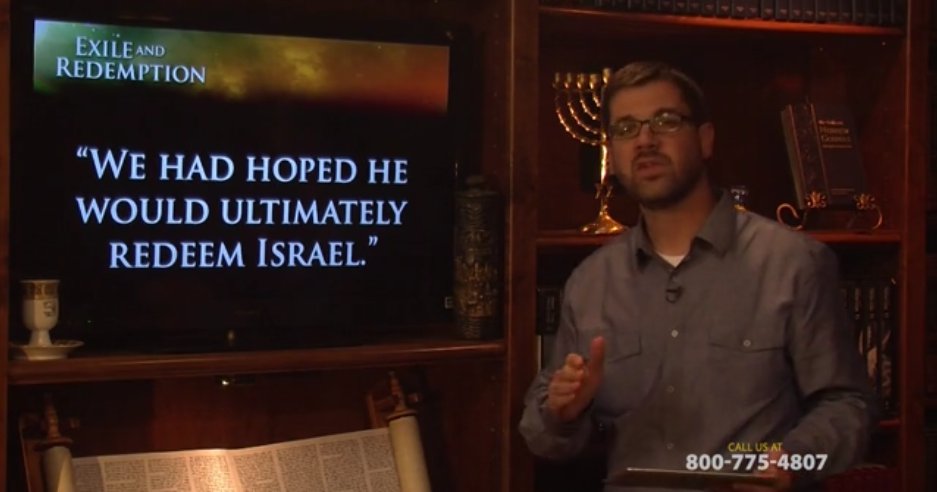
One of them whos name was Kleyofas answered. He said to him, “Are you the only one residing in Yerusalayim that does not know what has happened within it in these days?” He said to them, “What is it?” They told him, the incident of Yeshua the Notzri, who was a prophet mighty in works and in speech before God and before all the people. “But our high priests and elders arrested him for a death sentence and crucified him. We had hoped that he would ultimately redeem Yisrael, but today it has been three days since these things happened.”

Luke 24:18-21 (DHE Gospels)

Here we see two Jewish men who were disciples of Yeshua (Jesus) and whose hopes of redemption for Israel had been dashed to the ground. They believed Yeshua was the Messiah, but the fact that he died and was buried meant for them that he couldn’t be, because he had not lived to redeem the nation of Israel. I should note here that most Jewish people today deny that Jesus could be the Messiah for exactly the same reasons. These are people who deny the resurrection, the ascension, and that one day, Jesus will return to finish the Messianic mission.

But I’m getting ahead of myself or rather the program. Toby teaches that this scripture gives us our first clue in solving today’s mystery:

Clue 1: Messiah will redeem Israel from exile.

This is not only what Jewish people believed in the late Second Temple period but what religious Jews believe today. Messiah must come to redeem the Jewish people and to restore Israel. But exactly what does that mean? Most Christians don’t know, which is the importance of this TV episode. Where did the Jewish people get the idea that Messiah as redeemer was more than just about redemption from personal sin and what will that teach Christians in the church?

Say to them, ‘Thus says the Lord God, “Behold, I will take the sons of Israel from among the nations where they have gone, and I will gather them from every side and bring them into their own land; and I will make them one nation in the land, on the mountains of Israel; and one king will be king for all of them; and they will no longer be two nations and no longer be divided into two kingdoms.

“I will make a covenant of peace with them; it will be an everlasting covenant with them. And I will place them and multiply them, and will set My sanctuary in their midst forever.”‘

Ezekiel 37:21-22, 26 (NASB)

The prophet Ezekiel is speaking of King Messiah who will return all of the Jewish people in exile to their Land, the Land of Israel. In addition, God will make a covenant of peace with Israel, which will last forever, and God will establish His sanctuary, the Temple, among the Jewish people in their nation forever.

This last part threw me a bit. Revelation 21:22 describes New Jerusalem as having no Temple in the sense of a structure, since God and the Lamb are the Temple. I suppose there’s another mystery we could explore here, but it’s not contained in this television episode, so it’ll have to wait for another time.

tv_ffoz6_threeWe know that God exiled the Jewish people and Israel at the end of the Second Temple period. Jewish sages believe this was because of the sin of baseless hatred among the Jewish people. But religious Jews also believe that God will one day redeem them by sending Messiah.

But there is a modern state of Israel. Jews can make aliyah at any time. Isn’t the exile over? Not according to Toby’s teaching. Israel may exist nationally but the restoration is not complete. There is no Davidic King on the Throne, there is no Sanhedrin court system, and there certainly is no Temple in Holy Jerusalem. The state of Israel has not been set right again and established as the head of the nations. The Temple is to be a house of prayer for all nations (Isaiah 56:7), but not one stone of the Temple stands upon another, so there is no “house of prayer” for anyone right now.

Shocking as this may seem to many Christians, Messiah’s work was not finished at the cross, not by a long shot.

Toby uses 1 Peter 1:17-19 to illustrate that not only are the Jewish people in exile, but as long as our King, Jesus the Messiah, is not sitting on his throne is Jerusalem, all of his disciples, Jewish and Gentile, are also in exile. In effect, Messiah himself went into exile when Jerusalem was destroyed nearly two-thousand years ago, much as God went down into Egypt and ultimately into slavery with Jacob and the seventy members of his family (Genesis 46:3-4).

Although Toby didn’t mention this at all, I should say that as long as the current Israeli government negotiates with the Arab “Palestinian” people to carve up Israel including Jerusalem, and give it away in exchange for the Arabs ceasing all acts of terrorism, then Israel can hardly be said to be “redeemed” and even Jews in the Land may as well consider themselves in exile. In fact, Israel itself is still in a sort of exile. I imagine the Jewish people trying desperately to hold onto their homes in the so-called “territories” feel that way, too.

Toby also didn’t say this explicitly, but we must consider it to be the drive and desire of all Christians everywhere to see King Messiah restored to his throne in Jerusalem because until this happens, redemption is not complete. Yes, we are still “saved” from sin and condemnation, but being personally “saved” is only the beginning. The greatest works of Messiah are yet to come.

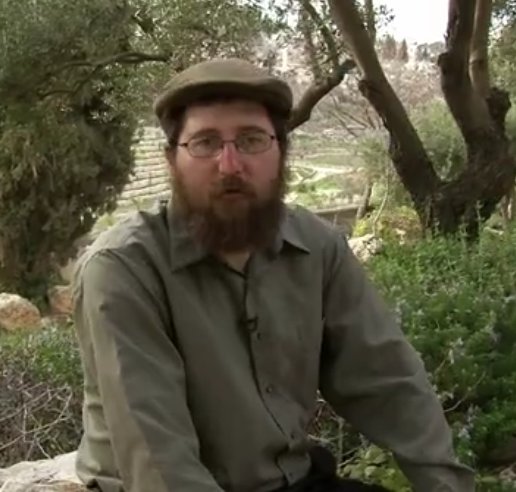
The scene shifts to Israel and to teacher and translator Aaron Eby who discusses what the word “redeemer” means in Hebrew and what it means to “redeem” a person or property.

Thus for every piece of your property, you are to provide for the redemption of the land.

‘If a fellow countryman of yours becomes so poor he has to sell part of his property, then his nearest kinsman is to come and buy back what his relative has sold.’

Leviticus 25:24-25

This portion of the Torah explains that the concept of redemption is a buying back or re-acquiring of property or even a person who has been a slave. The principle and meaning of ancestral property is well-defined in the Torah and if it is lost, there is a strong expectation that the original owner or his heirs will buy it back; will redeem it.

tv_ffoz6_aaron2Aaron brought up a question (sort of) I have recently explored. What if the owner dies and has no heirs? The answer lies in the concept of the leverite marriage. Aaron draws examples from scripture including Ruth and Boaz. Ruth the Moabitess was married to a Jewish man who died. Boaz was a relative, a kinsman redeemer, and by marrying Boaz and having a son with him, she restored her former husband’s lost family line.

Aaron also says that, when God liberated the Israelites from slavery in Egypt, He was acting as a redeemer and indeed, as God’s agent in this matter, Moses was also a redeemer. But another redeemer is to come after Moses.

Returning to Toby, we reach our second clue:

Clue 2: Redemption means buying back, re-acquiring, and setting things right.

That’s the function of Messiah in terms of the Jewish people, the nation of Israel, and through redeeming them, he also redeems the rest of us who continue to have faith. Toby cites Paul in Romans 6:17-18 where Paul metaphorically uses the laws related to redeeming slaves in describing how believers in Jesus are redeemed from slavery to sin, which is also part of the Messianic mission.

Toby referred to another scripture as a way to get to the third clue, a passage that I also commented on less than a week ago.

The Lord your God will raise up for you a prophet like me from among you, from your countrymen, you shall listen to him.

Deuteronomy 18:15

Toby identifies Jesus as “the prophet” and directs his viewers to Peter in Acts 3 and Stephen in Acts 7 as evidence that the Jewish believers also saw Jesus as “the prophet” spoken of by Moses. Thus we have the third clue.

Clue 3: Prophesy says that Messiah will be the prophet like Moses. Moses was the first redeemer and Messiah will be the ultimate redeemer.

Part of this third clue is dependent on another portion of scripture and I’ll get to that momentarily.

What Did I Learn?

Actually, some interesting stuff.

“Therefore behold, days are coming,” declares the Lord, “when it will no longer be said, ‘As the Lord lives, who brought up the sons of Israel out of the land of Egypt,’ but, ‘As the Lord lives, who brought up the sons of Israel from the land of the north and from all the countries where He had banished them.’ For I will restore them to their own land which I gave to their fathers.

Jeremiah 16:14-15 (NASB)

passover-artIt never occurred to me to consider the return of the Jewish people to their Land from the current exile as a sort of second Exodus, one that makes the first Exodus from Egypt pale by comparison. I started to think, especially in light of how most Christians have to see Jesus in all of the moedim as their only application, if a new meaning will be assigned to Passover in the Messianic Age, one that reminds the Jewish people not only of their redemption from Egypt, but their ultimate redemption from exile and the restoration of Israel as a united people and a sovereign nation. If the absence of our King on his throne means that even the Gentile disciples are in exile, along with the Jewish people, and along with Israel itself, then we should be crying out to Heaven, “How long, God? How long?”

The other thing I learned, and I’m not sure what to make of it, is that when Jerusalem is redeemed by Messiah taking up his throne, that Jews and Christians will see Jerusalem as their (our) city. Of course, Jerusalem is the Jewish city, the City of David, but how can we Christians lay claim to it in any sense?

I suppose because our King will be sitting on the Throne and the Temple in Jerusalem will finally be a house of prayer for all peoples. I don’t think that means we Gentiles get to live there, but if God is willing, may I see Messiah on his throne in Holy Jerusalem in those days, and may my sacrifices and burnt offerings be a sweet aroma to him.

I’ll review the next episode very soon.
FFOZ TV Review: Son of David

ffoz_tv5_1Episode 05: In Jewish thought one of the most important titles for Messiah is “Son of David.” Episode five will explore the title “Son of David” in depth. Viewers will learn that the term “Son of David” is a title for the promised messiah, the anointed king, who will come from the house of David. Jesus needed to be of the line of David because if he was not, he could not qualify to be Messiah. By the Scriptures referring to Jesus as the Son of David it solidifies that he is the promised messiah.

-from the Introduction to FFOZ TV: The Promise of What is to Come
episode 5: Son of David

The Lesson: What Does the Title “Son of David” Mean?

As you might expect if you’ve read my previous reviews of the earlier episodes of this series, Episode 5 builds on the material that came before it. Today, Toby explores the Mystery of the “Son of David,” investigating the meaning of this title.

Jesus was called by a wide variety of names and titles, but none more commonly than “Son of David.” People from Prophets to the demon-possessed referred to Jesus this way. But why? What does it mean? Why is it significant to understand?

In ancient and even sometimes in modern Judaism, a male is known by his father’s name. A Jewish man named Jacob who had a father named Abraham, would be known as “Yaakov ben Avraham.” This name would be commonly used when calling Jacob up for a Torah reading in synagogue on Shabbat. Otherwise, he might be known as “Jacob Silverstein” or “Jacob some other last name”. However in the days of Jesus, men were commonly referred to by their given name and then by their father’s name.

But Jesus would have been known by the name Yeshua ben Yosef, since most people would commonly believe Joseph was his biological as well as legal father. Why call him Yeshua ben David? Interestingly enough, Joseph was also known as Yosef ben David, even though his father was actually named Jacob. Why would this be? The answer comes later in the program with Aaron Eby’s portion.

Toby begins by addressing the genealogy of Jesus starting in Matthew 1:1 as read from the DHE Gospels:

The book of the toledot of Yeshua the Mashiach, son of David, son of Avraham.

If the Hebrew words threw you, here’s the same verse from the NASB translation (when Toby isn’t reading from the DHE Gospels, he uses the ESV Bible):

The record of the genealogy of Jesus the Messiah, the son of David, the son of Abraham.

The mention of Jesus as the Son of Abraham summons the connection between the Messiah and a promise God made to Abraham as part of the covenant between them.

And I will bless those who bless you, And the one who curses you I will curse. And in you all the families of the earth will be blessed.

Genesis 12:3 (NASB)

Hopefully, that part is obvious. Messiah is Abraham’s “seed” through which the nations are blessed. But why “Son of David?”

ffoz_tv5_aaronThe question introduces the “mystery” that Toby presents the audience and of course, we now proceed to seeking “clues.”

Toby introduces a problem with the genealogies of Jesus, particularly comparing Matthew 1:6 and Luke 3:31. While Jesus’s family line is traced back to David, Matthew traces it through Solomon and Luke traces it through Nathan. How can both be right?

There are a number of theories about what is happening here. Toby presents an explanation I’ve heard before but repeatedly forget. I’ll offer a clue to the answer to you at the end of my review (to find out the complete solution, you’ll have to watch the episode), but it’s an important piece of information, because without being able to accurately show that Jesus is from the Davidic line, we cannot establish him as Messiah.

Clue 1: Yeshua was a direct descendent of King David.

The lineage of Jesus to David is connected to the title “Son of David,” but as we have seen, even though Jesus is described as the Son of God, his human legal father was Joseph. How can Jesus be Son of David?

The answer lies in part with Aaron Eby in Jerusalem.

He describes the complexities involved in the Hebrew word for son which is “Ben”. I won’t describe everything he said, but the key part is that “Ben” doesn’t just mean “Son of” your immediate biological father, but it describes the connection to any of your male ancestors. My father’s father’s name was Jesse, so even though my father’s name is James, I could also be known as James, son of Jesse. If I had a male ancestor hundreds or even thousands of years removed, let’s say his name was Samuel, I could also be known as “James, son of Samuel.” The person doesn’t have to literally be my Dad as long as he’s one of my male ancestors from whom I am directly descended.

But so what if Jesus is descended from the line of David?

Blessed be the Lord God of Israel, For He has visited us and accomplished redemption for His people, And has raised up a horn of salvation for us in the house of David His servant—As He spoke by the mouth of His holy prophets from of old…

Luke 1:68-70 (NASB)

Zechariah, the father of John the Baptist, is talking about the Messiah being equivalent to the Son of David.

And that’s the next clue:

Clue 2: Son of David is a title for Messiah.

But Zechariah also gives us the final clue with which we can solve the mystery.

Clue 3: It was prophesied that the Messiah would come from the line of David.

It’s like I said before, if we can’t establish that Jesus is a legitimate heir of the line of David, it’s impossible for him to be the Messiah.

ffoz_tv5_geneologyToby reads from a list of various prophesies establishing that the Messiah must come from the tribe of Judah and the family of David including Genesis 49:10, 2 Samuel 7:14-16, and Jeremiah 33:22. However he shows the viewers where we hit a bit of a snag in scripture and in history. Samuel speaks of there always being a descendent of David on Israel’s throne forever, but Jeremiah is prophesying at a time when there was no Davidic King on the throne. Israel had been exiled to Babylon, and although the Davidic line continued, Israel had no King. Was Samuel wrong? How could he be wrong?

The answer is found in Isaiah 11:1-2, and 11:10 in the phrase “stump of Jesse.” Out of that cut off stump, a Davidic King would one day rise who would be Messiah, a King who would rule not just over Israel, but over the entire world. Messiah would be Israel’s King forever.

But although Messiah has come, his physical reign is yet to begin. That is the promise of what is to come.

What Did I Learn?

It’s more what did I remember? I had heard the explanation about Yeshua’s lineage through two different sons of David but I don’t always retain the details. This time, I’ve got access to a video recording of the explanation to help cement it in my brain, or at least a place to go when I need a reminder. However, none of us would have even that if, as Toby said, we didn’t have access to an oral history from Yeshua’s family in the Galilee which explains it to us.

This is important information, as I said, because by linking Jesus to his “father” David, we see he is eligible to be Messiah. This is an answer not only for Christians but for any critics who deny that Jesus could possibly be the Messiah because of a poorly understood meaning of scripture. Jesus is Messiah and is worthy to rule and reign is King of Israel and King of the World. May be come soon and in our day.

I’ll review the next episode very soon.
Addendum: I found a question that directly relates to Toby and Aaron’s teaching about the “Son of David”: Can Jesus Inherit Lineage from his Adoptive Father Joseph?

Re’eh: Seeing to Learn

gerizim_ebalSee, this day I set before you blessing and curse: blessing, if you obey the commandments of the Lord your God that I enjoin upon you this day; and curse, if you do not obey the commandments of the Lord your God, but turn away from the path that I enjoin upon you this day and follow other gods, whom you have not experienced. When the Lord your God brings you into the land that you are about to enter and possess, you shall pronounce the blessing at Mount Gerizim and the curse at Mount Ebal.

Deuteronomy 11:26-29 (JPS Tanakh)

These words are spoken to the entire Nation of Israel, at the very end of a forty-year term in the desert. Two distinct mountains were on open display. Mount Grizim is plush, rich, and flowering with the promise of life. Mount Eivil in stark contrast is conspicuously barren and empty. This visual aid is employed to etch into the psyche of the assembled the lesson of remaining loyal to the task and mission of Torah and Mitzvos. In the recording of the event Moshe refers to that day as- “today”. What’s so special about that day? Every day he spoke was also a “today”. Why was that day worthy of a title for all time “today”?

The Ohr HaChaim answers that that day they were capable of understanding his lesson based on the statement of the sages, “A person does not stand on (truly grasp) the knowledge- opinion of his teacher until after forty years” (Avodah Zara 5B).

That means that now after forty years they can begin to truly comprehend what Moshe had told them back then. Why does it take forty years? Were these not brilliant people?

-Rabbi Label Lam
“See What Can Be Seen”
Commentary on Torah Portion Re’eh
Torah.org

Nearly a year and a half ago, I reviewed Toby Janicki’s article “The Gentile Believer’s Obligation to the Torah of Moses,” published in Messiah Journal #109/Winter 2012. I remember at the time being a little surprised at even the title, since my understanding back then was Messianic Judaism was striving for pretty much total isolation between Messianic Jewish and Christian/Messianic Gentile religious practice, at least publicly.

I happened to recall my review the other day when I noticed in the analytics for this blog that someone had viewed it.

I went through the original review and realized that my perspectives have changed in the last eighteen months or so. My fuzzy understanding of the Torah of Moses and its connection to the Gentile believers in Messiah is a little bit clearer. This isn’t to say I have everything “dialed,” so to speak, about the Bible and how it works, but I think it’s fair to say that I’m capable of learning and growing intellectually and spiritually.

While the quote from the Ohr HaChaim speaks to the necessity of the passage of time for learning, I’m not going to take it too literally (in forty years, I’ll either be nearly 100 years old or dead). But I am inspired to re-read Toby’s article and to re-review it as processed through the brain I have now vs. the one I had at the beginning of 2012 (I can only imagine that Toby will chuckle because I continue to wrestle with something he understands so clearly).

There has been a tremendous struggle between Messianic Judaism and Hebrew Roots relative to who “owns” the Torah. That’s an overly simplistic statement, of course, but the surface perception is that the Jews in Messiah get to keep the Torah for themselves while the Hebrew Roots people want them to share. On top of that, traditional Christianity says that we don’t need the Torah at all, just the grace of Jesus Christ.

Like I said, I’m being overly simplistic, so don’t take what I’ve just said too literally.

simhat-torahThe truth of the matter is that we all need the Torah. Even before the Christian Era, I believe that the Jewish people saw themselves as a “light to the nations” (Isaiah 49:6) and that we would all learn from the Torah as “the Law went forth from Zion.” (Isaiah 2:3). How does one learn the ethical, moral, and holiness standards of God apart from the Torah, the teachings of God? We don’t.

However, that concept has been misunderstood to mean (at least in certain circles), that we Christians must learn and observe every single mitzvot in the Torah (or at least the ones that can be observed without the existence of the Temple, the Priesthood, and the Sanhedrin) in exactly the same way as the Jewish people.

Acts 15 shoots that concept down in flames (I know this is debatable but then again, everything is) as I painstakingly chronicled in my review of D. Thomas Lancaster’s commentary on the matter, but Toby Janicki picks out of the ashes, the “phoenix” of Torah that applies to the non-Jewish believers.

And it’s a lot.

I don’t think we ever got a chance to really see the results of the Jerusalem Letter in action. We don’t see a detailed report in the New Testament of how those declarations were understood and practiced in early Christian congregations, the ones that would have existed during Paul’s lifetime and soon after. More’s the pity, because a document providing such details would answer a lot of questions and solve a lot of problems.

Once you rocket through history much past Paul’s death, the wedge between believing Jews and Gentiles was already being pounded into place, and by the time we get to the third and fourth centuries CE, we’ve been split apart and any recognizable form of “Torah practice” among non-Jewish believers had gone the way of the Dodo bird (I’m not quite sure how much help the Didache would be since it’s dated to the late first or early second centuries, but I guess I could buy a copy and find out).

What all this means is that you can expect my review of Toby’s 2012 article sometime next week. If anyone can suggest which copy of the Didache I should purchase from the list presented at the above-link, that would help, too.

In a way, I don’t really blame Hebrew Roots folks for finding the Torah beautiful, praiseworthy, and desirable in study and practice. I’m attracted to it as well. I really don’t understand Christian aversion to “the Law” as something horrible, and awful, and too terrible to even consider but then again, that’s what most churches teach. It isn’t that I think Christians should don tallitot and lay tefillin and try to look like Jews, far from it. But we should admit that we need the Torah for two basic reasons: The first is that it defines our relationship with Jesus and with God the Father through the Abrahamic covenant. The second is that every ethical, moral, and spiritual principle that we live by as Christians is found in the Torah. The Torah was taught by Jesus. Without an understanding of the Torah and the Prophets (and this should be huge in Christianity), we have no hope of understanding anything Jesus ever taught!

torah-what-isThat’s actually true of Paul and any of the other Apostles, so in my opinion, the first class that any newbie Christian should ever attend is Torah 101. Starting new Christians in the Gospels and the Epistles sounds nice but it’s almost next to useless. It’s like trying to teach a four-year old Calculus before they’ve even learned how to count to ten. It’s why I think First Fruits of Zion’s (FFOZ) Torah Club volumes are tremendously important. Not only do they teach Torah, but in a way that is very “Christian friendly.”

From all those who have taught me I have gained wisdom.

Psalms 119:99

The Psalmist is telling us that he learned from everyone, that everyone was his teacher. From some, he learned what to do; from others, what not to do.

If we learn from others’ mistakes, we need not make our own.

Just as we can learn from every person, we can learn from every event. Positive experiences are obvious sources of learning, because each positive act we do adds to our character and prepares us to better face the next challenge in life. Negative experiences can be valuable, too, but only if we are sufficiently alert to learn from them.

The list of lessons that we have learned the hard way may be long, but each one has taught us what not to do and thereby it becomes a positive experience. Indeed, the Talmud states that when people sincerely regret their mistakes and change themselves for the better, the wrongs that they did become actual merits (Yoma 86b). Only when we fail to learn from our mistakes and, rationalizing and justifying, obstinately insist that we were right, do our misdeeds remain deficits.

We have the capacity to make life itself a tremendous learning and growth experience.

Today I shall…

…try to look for lessons from everyone and everything, whether my teacher is positive or negative.

-Rabbi Abraham J. Twerski
“Growing Each Day, Kislev 17”
Aish.com

I don’t think the problem is dealing with positive vs. negative teachers but just with “unanticipated” teachers. For traditional Christians, I think Jewish teachers or teachers very familiar with the Jewish (especially Messianic) perspective on Torah and Messiah are important. Jewish teachers aren’t necessarily a problem for Hebrew Roots people, but often, Christian teachers are. Many people in Hebrew Roots no longer see themselves as affiliated with anything called “Christianity” and sometimes they even define themselves by a completely new religious identity in order to separate themselves from the “crimes of the church,” real and imagined. “The church” is something they’ve “come out of,” like a Jew might have escaped the Soviet Union in the 1960s or one “comes out of pagan Babylon,” a den of iniquity and sin.

Oy.

I’m hardly what you would call a traditional Christian, but I must say that I’ve learned a tremendous amount in my conversations with my Pastor. For Hebrew Roots folks, at least some of you, it might not hurt to find a Christian to connect to and even “embrace” on some level if, for no other reason, than to overcome what for davening_morningsome people I’ve personally met, is a phobic response to Christians and Christianity. Really, we’re not all that bad and in my time in church (in spite of my meditation of yesterday morning), I’ve met a few very kind, gentile, and Holy people.

Remember what Rabbi Twerski said about everyone being a teacher? That means Everyone, not just the people you are attracted to as teachers.

Whether you call yourself a Christian, a Hebrew Roots person, or something else, you…we all have a blessing and a curse set before us as well. We can accept the blessing and choose to learn the Torah as it was intended for us and to take upon ourselves teachers we never thought we’d share a classroom or corner of the blogosphere with, or we can choose to isolate ourselves in our own comfortable little silos, and learn only what we want to learn, which means in that case, very little and nothing new and illuminating.

It may take some time before it all begins to sink in. Like me, you might have to wait awhile and then rediscover something that didn’t quite make sense before but comes into crystal clarity now. That’s OK, too. Just as long as you’re willing to open your eyes and see what God has set before you this day.

Good Shabbos.

54 days.

FFOZ TV Review: Jewish Prophecies

ffoz_tv4aEpisode 04: The land of Israel is a hot topic of debate not just amongst secular news but even in churches. It is key that Christians realize Israel is not just important because of what happened there in the past but also because of what is to take place in the future. In episode four viewers will learn that not only did the ancient Jewish prophets predict the coming of Messiah but they also predicted his second coming and the ingathering of the Jewish people back to their land. Israel thus becomes the stage on which the final redemption will happen.

-From the Intro to the episode Jewish Prophecies
FFOZ TV: The Promise of What is to Come

The Lesson: What Does Jewish Prophecy Say About Israel and the Jewish People?

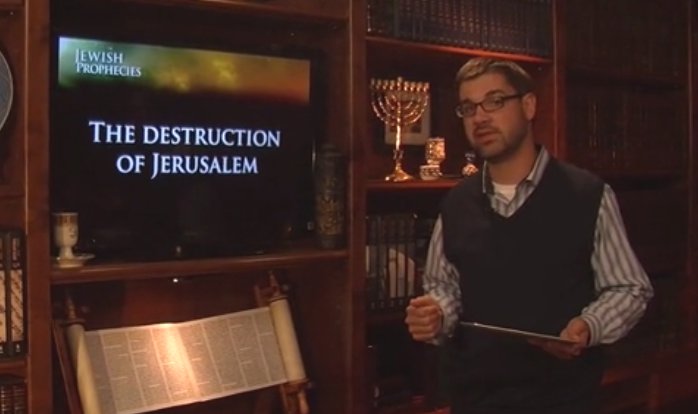
The beginning of this episode, Jewish Prophecies seems to depart from the theme of the first three programs, which defined the basic concept of the gospels, the meaning of the word “Christ,” and the meaning of the name “Jesus” from a Messianic Jewish viewpoint. However, the focus, which is the specific Jewish prophecies that relate to the work of the Messiah and the gospel message, tie in very well, especially with the episode addressing The Good News.

This show is also different in that teacher Toby Janicki begins the program by discussing the modern nation of Israel within a political, social, and news media context (my review is timely given the current Israeli/Palestinian “peace talks”). However, he explains, we cannot really understand why the modern world is so focused on the tiny nation of Israel unless we look at it from a Spiritual and Biblical perspective.

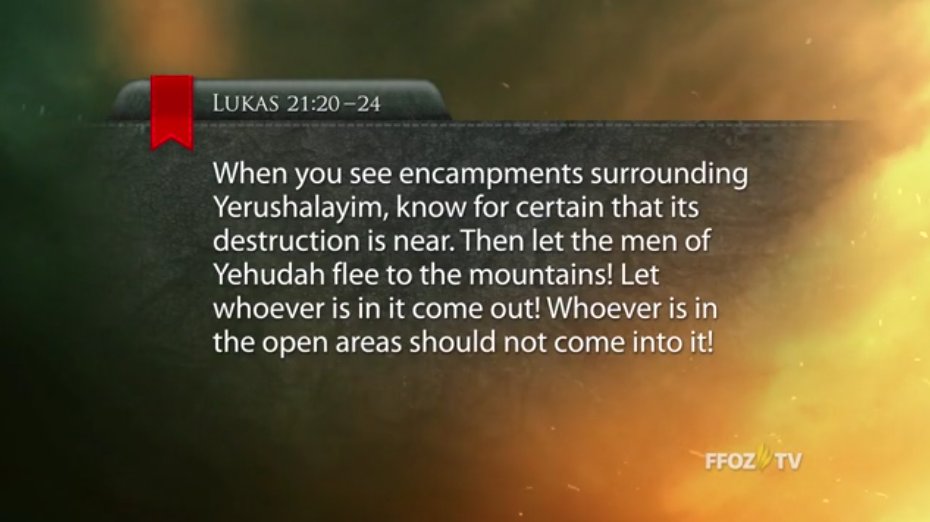
When you see encampments surrounding Yerushalayim, know for certain that its destruction is near. Then let the men of Yehudah flee to the mountains! Let whoever is in it come out! Whoever is in the open areas should not come into it! For they are days of vengeance to fulfill all of what is written. How terrible for those who are pregnant and for nursing mothers in those days! For there will be great distress in the land and wrath upon this people. They will fall by the sword and be exiled to all the nations. Yerushalayim will be a treading place for the Gentiles until the times of the Gentiles are fulfilled.

Luke 21:20-24 (DHE Gospels)

This is Messiah speaking of the destruction of Jerusalem by the Romans, which would occur several decades after his earthly ministry had ended. And yet, it’s the very last sentence that tells us of today’s topic. When will the times of the Gentiles be fulfilled and what will happen next?

Jesus is a Jewish prophet talking to Jewish people. He is also, as Toby states in this episode, presenting The Mystery of the Jewish People and their Return to the Land of Israel. This mystery is directly associated with the Messiah and the gospel message and is illustrated for us in the ancient Jewish prophecies as well as in the prophecies of Messiah.

And then they will see the Son of Man coming in a cloud with power and great glory.

Luke 21:27 (ESV)

ffoz_tv4bAnd what will Messiah do upon his return. According to Jewish prophesy, as described later in the episode, he will redeem Israel by gathering the Jewish people back to their Land. This leads to the first clue.

Clue 1: The Good News is the restoration of the Jewish people back to the Land of Israel.

The gospel message is to the Jews first and foremost. Prophecies in Isaiah 11:11-12 and Isaiah 61:1-4 teach us that the Root of Jesse, that is Messiah, will gather the Jewish people and return them to their Land, back to Israel. He will also show favor to Zion by rebuilding and restoring Jerusalem and the rest of Israel.

The gospel isn’t about the church, it’s about Jewish national restoration to Israel.

But what’s interesting is that this work has been going on for quite sometime. Depending on your point of view, it began with the modern Zionist movement in the 19th century. You could also consider it starting, or at least really getting off the ground, in 1948 with the establishment of the modern state of Israel.

The Jews have been returning to their Land in droves. But that begs the question, What is a Jew?

For the answer, the scene shifts to Israel and to teacher and translator Aaron Eby.

Simply said, the word “Jew” is derived from the word “Judah,” which is one of the twelve tribes of Israel. Judah was also one of the sons of Jacob. But what about all of the other Israelites? How come we call all Israelite descendents “Jews” today?

According to Aaron, in the time of King Solomon, the twelve tribes were united in a single nation, the Kingdom of Israel. After that time, ten of the twelve tribes separated from Judah and Benjamin. They were the Kingdom of Israel while Judah and Benjamin had control of the Kingdom of Judah, which included Jerusalem.

ffoz_tv4cThe Assyrians conquered the Kingdom of Israel and the majority of its inhabitants went into exile. Those who were left of the inhabitants of Israel moved to the Kingdom of Judah, and along with whatever members of the ten tribes were able to eventually return to the Land, they all were subsequently assimilated and absorbed into Judah. In a literal, physical sense, Judah…the Jews, are the descendents of all twelve tribes in our modern-day world (This process is described in more detail in Boaz Michael’s book, Twelve Gates: Where Do the Nations Enter?).

This takes us back to Toby and the second clue:

Clue 2: The Jewish People are the descendents of Abraham, Isaac, and Jacob.

This would seem to be an “oh duh,” but it’s actually an important point. Both traditional Christianity and some branches of the Hebrew Roots movement have been attempting to lay claim to the Land of Israel as well (in fact, just about the entire Arab word is laying claim to Israel as “Palestine,” so you can see this is a popular activity). It’s vital for the church to understand who the Jewish people are and that Biblical prophecy clearly states that Messiah’s mission is to restore the Jewish people to their Land, the Land of Israel, and he is to restore and rebuild it.

The Jews and their nation Israel don’t go away…ever.

Thus says the Lord, Who gives the sun for light by day And the fixed order of the moon and the stars for light by night, Who stirs up the sea so that its waves roar; The Lord of hosts is His name: “If this fixed order departs From before Me,” declares the Lord, “Then the offspring of Israel also will cease From being a nation before Me forever.”

Jeremiah 31:35-36 (NASB)

The offspring of Israel, that is, the Jewish people, will always be a nation before God forever as a nation, as Israel. Linking the verse from Jeremiah with Matthew 5:17-19, we plainly see that the Jewish people, national Israel, and the Torah will all continue to exist as long as the Earth and the “fixed order” of the Sun, the Moon, and the stars continue to exist. They are all tied together beyond any untying as declared by Messiah, by Jesus.

Really, the message doesn’t get any plainer than that. There are only two major themes in Jewish prophecy: Exile and Redemption. The story of the good news of Messiah is all about the redemption of the Jewish people to the Land of Israel and the restoration of Jerusalem.

But where does that leave the Gentiles? What about us?

Then in that day The nations will resort to the root of Jesse, Who will stand as a signal for the peoples; And His resting place will be glorious. Then it will happen on that day that the Lord Will again recover the second time with His hand The remnant of His people, who will remain, From Assyria, Egypt, Pathros, Cush, Elam, Shinar, Hamath, And from the islands of the sea. And He will lift up a standard for the nations And assemble the banished ones of Israel, And will gather the dispersed of Judah From the four corners of the earth.

Isaiah 11:10-12 (NASB)

ffoz_tv4dYou can see that as part of the plan for restoring the Jewish people to Israel, there will be another effect. When the Gentiles see what Messiah is doing, we will “resort to the root of Jesse,” that is, we will be drawn to him. Messiah will “lift up a standard for the nations” and he will redeem us, too.

This is the final clue:

Clue 3: The Ingathering of Israel will have an international effect.

According to Zechariah 9:9-10, Messiah will not just rule over and bring peace to national Israel, but to all the nations of the world. Messiah’s Kingdom will be over all the earth.

What Did I Learn?

It’s actually taken me over a year to really grasp the meaning of redemption and restoration as a Jewish story focused on national Israel. When I first heard of it at the 2012 First Fruits of Zion Shavuot conference, I couldn’t make the Biblical connections. Now it seems so obvious.

I learned today that we might consider the Messiah already working “behind the scenes” somewhat, since the nation of Israel has been re-established and the Jewish people are being gathered back in. I don’t mean to say that Messiah has returned, that is yet to come. But the Messianic mission is definitely moving forward through the Spirit of God.

Toby and Aaron made other important points in this television episode (I left a clue in the last screen capture I posted above), so I hope that you’ll take the time to view this thirty minute program and be illuminated.

I’ll review the next episode very soon.

FFOZ TV Review: Call His Name Yeshua

ffoz_tv1Episode 03: It may be shocking to learn, but the fact is that many people were named Jesus in first century Israel. So how is it then that his name is the name above all names? In episode three the name of Jesus is explored in depth in order to gain a better understanding of the significance of not only Christ’s name but his mission. The name Jesus means “salvation” and it was preordained in the prophecies of the Hebrew Scriptures that the messiah would bring salvation not only to Israel but to all mankind.

From the intro to the episode: Call His Name Yeshua
FFOZ TV: The Promise of What is to Come

The Lesson: What does the Name “Jesus” Mean?

I know I’m a little late with this one, two weeks late actually, but my weekend viewing of FFOZ TV has been short circuited by weekend yard projects. I was finally able to carve out some free time to view Episode 3: Call His Name Yeshua.

This episode builds on the basics learned in Episode 1: The Good News and Episode 2: Messiah. Both of those shows focused on presenting a definition of a very basic concept in the Bible, except that in each case, the traditionally Christian audience discovered that the concepts weren’t quite so basic.

Episode 3 focuses on the meaning of the name “Jesus.” I suppose there are Christians in the world who actually believe that “Jesus” was the original name used by the Messiah, that his disciples, his friends, his mother called him “Jesus.” This isn’t possible when we consider that they would all be speaking in Hebrew or Aramaic and in those languages, it’s impossible to make a hard “J” sound.

As always, teacher Toby Janicki offers up the lesson as a mystery that must be solved using three clues. Today’s mystery is “The Mystery of the Name Jesus.” The first verse that leads into the first clue is this one.

But as he considered these things, behold, an angel of the Lord appeared to him in a dream, saying, “Joseph, son of David, do not fear to take Mary as your wife, for that which is conceived in her is from the Holy Spirit. She will bear a son, and you shall call his name Jesus, for he will save his people from their sins.”

Matthew 1:20-21 (ESV)

After using a translation with which most Christians would be familiar, Toby read the same verses again using the Delitzsch Hebrew Gospels:

He was thinking this way, but then an angel of HaShem appeared to him in a dream, saying, “Yosef son of David! Do not be afraid to take Miryam, your wife, for what has been formed within her is from the Holy Spirit. She is giving birth to a son, and you are to name him Yeshua, because he will save his people from their sins.”

As Toby pointed out, many Christians are fond of a hymn called “Jesus, Name Above All Names.” Have they gotten it wrong all these years? Is the true name of Messiah “Yeshua?” Is he offended when we call him “Jesus?” For that matter, how do we know “Yeshua” was/is his original name?

We’ll get to all that in a minute. Toby points to the first clue:

Messiah is named Jesus by direct command of God.

There’s something else. There seems to be a connection between the name Yeshua and what the angel said about him saving his people from their sins.

aaron-ebyThe scene shifts to Aaron Eby in Israel who provides the episode’s language lesson. As it turns out, we get the name “Jesus” from the Latin and Greek translations of the Hebrew word Yeshua. In Latin, his name is translated as “Iesus” and from the Greek, it’s “Ἰησοῦς”. Aaron says that we know Messiah’s name was Yeshua because it was actually a common name for Jewish men at that point in history in Israel. It’s actually a shortened version of Yehoshua which we translate into English as “Joshua.” Yehoshua means “The Lord is Salvation.”

Also, the name Yeshua, when it occurred in the Old Testament, was translated in the Septuagint as we see it also translated in the New Testament, so we can confidently say that Yeshua is the Hebrew name of Jesus.

And from what Aaron presented in his portion of this episode, the definition of the longer version of Yeshua’s name seems to be the connection in the angel’s words to Joseph. Name him “Jesus” (salvation) because he will bring salvation to his people.

Going back to Toby, we hit the second clue:

Jesus means salvation.

Since Jesus was such a common name at the time, it was important to differentiate the Messiah from all of the other Jewish boys and men called Yeshua, so he was referred to as “Yeshua of Nazareth.”

But we need one more clue and it comes from the Old Testament (Tanakh). Actually there are a lot of prophesies in the Old Testament that speak of the Messiah bringing salvation to Israel. Probably one of the oldest is in Genesis 49 when Jacob, before he dies, blesses his sons.

For Your salvation do I long, O Hashem!

Genesis 49:18 (Stone Edition Tanakh)

Toby says that according to the Jewish sages, right before Jacob uttered this exclamation, he had a vision of the end times and was longing for the coming of Messiah and his salvation.

Toby quoted from a number of prophesies, and you can find out what they are by viewing the episode, but he also spent some time using word substitution to illustrate his point: salvation = Yeshua and salvation = Jesus. Here’s a couple of examples. First, the original verse in the NASB translation:

Behold, the Lord has proclaimed to the end of the earth, Say to the daughter of Zion, “Lo, your salvation comes; Behold His reward is with Him, and His recompense before Him.”

Isaiah 62:11

Now with the first word substitution:

Behold, the Lord has proclaimed to the end of the earth, Say to the daughter of Zion, “Lo, your Yeshua comes; Behold His reward is with Him, and His recompense before Him.”

…and then the second:

Behold, the Lord has proclaimed to the end of the earth, Say to the daughter of Zion, “Lo, your Jesus comes; Behold His reward is with Him, and His recompense before Him.”

I know this program is written for a traditional Christian audience, so these verses are designed to make the greatest impact on them, but if there are any traditional (non-Messianic) Jewish viewers, they might have a hard time with the name “Jesus” being directly inserted into the Tanakh as an equivalent term for God’s salvation.

But the prophesies that Toby quotes also lead to the third and final clue:

The Prophets predicted that Messiah would bring salvation.

The lesson in this episode is as simple as that. The name “Jesus” is an English translation of the Greek and Latin translations of Messiah’s name from Hebrew, which is “Yeshua.” Yeshua relates to the Hebrew word for “salvation” and basically means that Messiah brings salvation. This was prophesied many times by many Old Testament prophets, so his name would have meaning to the Jewish people when linked with his Messianic mission.

What Did I Learn?

DaveningI learned that there is a liturgical prayer said by devout Jews three times a day that includes the phrase, …”whose horn will be raised with your salvation.”

Interestingly enough, we find something like it directly referring to Yeshua:

Blessed is HaShem, God of Yisrael, for he has taken note of his people and sent them redemption. He will cause a horn of salvation to sprout for us in the house of David his servant…

Luke 1:68-69 (DHE Gospels)

This is the blessing said over the infant Yeshua by Zecharyah the prophet at the Temple. As Toby points out, this isn’t Zecharyah asking for God to provide salvation for Israel, it’s the prophet thanking Hashem for having sent salvation in the form of the new-born Messiah Yeshua. Messiah and salvation had come.

I hadn’t made the connection between these verses and the daily prayers of Jews all over the world, all of whom are asking for one who has already arrived and who will come again: Yeshua of Nazareth, the Messiah and King of Israel.

I hope to review the next episode very soon.