Tag Archives: Torah Portion

Genesis: Searching for the Self-Evident God

Simchat Torah

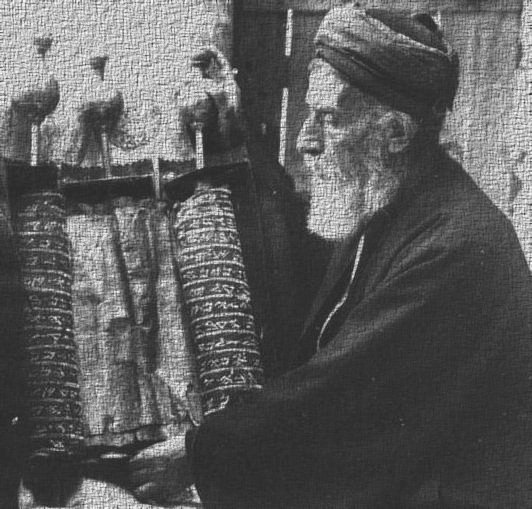
By contrast, on Simchat Torah we do not celebrate our national receiving of the Torah; we celebrate our personal one. God gave us the Second Tablets because He deemed us worthy of receiving them. He had just forgiven us on Yom Kippur and decided to take us anew. And we celebrate by each of us holding close that Torah God entrusted us with and dancing with it. And likewise every single member of the synagogue is called up to the Torah for the reading of a section.
-Rabbi Dovid Rosenfeld
“Simchat Torah: Just You and Me”
Aish.com

As you read this, it is Simchat Torah, the celebration of the end of one Torah cycle and the beginning of another. Yesterday was Shemini Atzeret which is considered the last day of Sukkot but in fact is a separate festival, the eighth day of assembly. Of course, sundown tonight begins the weekly Shabbat, and tomorrow in synagogues all over the world, the very first words of Genesis will be read again.

A lot is going on and almost all of it exclusively has to do with the Jewish people. Let me explain.

The seven days of Sukkot have a great deal of meaning, not the least of which is an invitation for guests to join a Jewish family in their sukkah. Some synagogues have congregational sukkot (plural of sukkah) and will invite in anyone who desires to enter. Especially the Chabad will invite non-religious Jews in order to reacquaint them with the Torah and Jewish religious practice, but it’s not unheard of for non-Jews to also join in on the fun.

But that’s for seven days. While Shemini Atzeret is considered an eighth day of Sukkot, it is not the same as the other days of the festival. I once heard a commentary stating that while guests are invited on the seven days of Sukkot and that everyone is engaged with each other and with God, the eighth day is more intimate, more of a personal encounter, a private exchange between the Jewish people and their loving Father. It’s like having a houseful of family and friends in your home for a seven-day party, but on the eighth day, the guests all go back to their homes, and the family spends one special day of closeness with their Father.

Doesn’t sound very flattering if you’re a guest but we understand that family is special and they need the time to be together as family.

But what if you’re a Christian? Aren’t you family? In terms of traditional Judaism, no (for the most part, Messianic Judaism would have a different take). It’s not that God isn’t the Creator of Jews and Gentiles, but Shemini Atzeret commemorates the unique relationship God has with the Jewish people and, as Rabbi Rosenfeld suggests relative to Simchat Torah, God commemorates His relationship on this day with each, individual Jew.
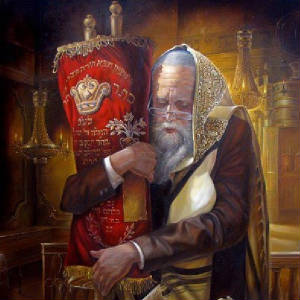
clinging_to_torahSimchat Torah celebrates the special relationship of the Jewish people and the Torah. While Shavuot (Pentecost) observes the anniversary of the giving of the Torah to the Jewish people at Sinai, Simchat Torah is the celebration of the unbroken joy of ending one cycle of readings and beginning another, dancing with the Torah and with God on the very final day of the holiday season, for tomorrow the Torah readings begin again.

And there’s something else.

“He stared at me for a moment seeming very moved by the idea that this Torah would help people come closer to Judaism. All of a sudden, he started crying — I mean really crying with tears streaming down his face. I was trying to get him to talk, but he literally couldn’t get any words out. Finally, he explained. He had drifted away from Judaism and married a Buddhist woman. This Torah scroll was his only connection, and at this point, he felt so cut off that he thought he might as well sell it. But when he found out that this Torah would help reconnect people to Judaism, he wanted to give it to me as a gift. In this way, he felt he would perhaps have the merit to be reconnected too and find his way home at last.

“I didn’t know what to say, but I certainly appreciated his incredible gift. I realized that this was a Torah that had been basically homeless for the past 50 years. There was no one to read it, hold it or keep it properly, and now God gave the Torah a home, and would hopefully bring this lonely Jew back in the near future as well.

“Now, what about an ark? That’s a story of its own. I found an online ad for an old Jewish artifact, a Jewish chest. The sellers weren’t Jewish, but they had bought it from a priest who told them it was of Jewish origin.

“When I opened the online pictures of the chest, I saw before me what seemed to be a beautifully crafted ark. It was small, so it wouldn’t be able to hold a regular sized Torah, but would be perfect for the Torah we had. But when I viewed a picture of the top of the ark, I almost fainted. There was a large cross attached to it.”

-Rabbi Binyomin Pruzansky
“The Lost Torah Scroll: Bringing Torah Home”
Aish.com

simhat-torahI’ve read Rabbi Pruzansky’s story in years past, and it’s a good one. He relates how he habitually held Shabbos meals in his home for 30 or 40 young Jewish people, Jews who for one reason or another, don’t feel comfortable entering a synagogue. In a more home-like setting, the Rabbi wanted to give these young Jews the opportunity to eat a kosher meal and even to have an aliyah, to be called up to read the Torah from a kosher scroll.

As you read, he had some difficulties acquiring a proper scroll for a reasonable cost and an authentic Jewish ark for the scroll. In different ways, the scroll and the ark had “strayed from the path,” so to speak, with the scroll all but neglected and the ark having been in possession of a Christian Priest.

“My dear friends, look at what we have here. A Torah that was neglected for so many years was finally given a home in an ark that had been used by a priest. Yet the message was clear that God would never give up on them. He had not forgotten about this lost ark and Torah scroll, and finally the two of them were brought together and can now be used to bring young men and woman back to their Father in Heaven as well.

“This Torah has not been danced with for over 50 years, and now we have the chance to welcome it home. Let’s give it the welcome it deserves.”

I know Gentile followers of Jesus who steadfastly maintain that the Torah belongs to both Jewish people and Gentile believers in exactly the same way, but I consider this not only to be untrue, but to be incredibly insensitive to the connection between the Jewish people and God. It’s not that I don’t believe God loves those of us from the nations who are called by His Name (Amos 9:11-12), but I do draw a distinction between the nature and character of God’s relationship with and purpose for the Jewish people and how God relates to the rest of us (yes, even the rest of us who are in Christ).

Yes, I firmly believe Christians have a special role and purpose that God has assigned us and that only we can accomplish and fulfill. Yes, I do believe that God loves us as much as He loves the Jewish people and that we are not second class citizens in the Kingdom of Heaven. But I also believe that the Jewish people are unique to God and have a place that is especially near to His heart. They are His treasured splendorous people (Exodus 19:5). I can hardly begrudge God and the Jewish people special times in which they meet just between the two of them to acknowledge, celebrate, and experience what is uniquely between God and the Jews.
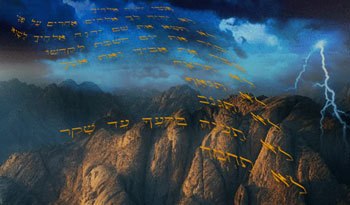
Torah at SinaiWe need to acknowledge the complexity of human relationships with God, what makes the connection especially precious regarding the Jewish people, and what we all can share together as human beings who live in a universe authored by the Creator.

“In the beginning of God’s creating the heavens and the earth” “… God blessed the seventh day and sanctified it because on it He abstained from all His work which God created to make”.

Genesis 1:1, 2:3

These two verses encompass all of Creation. The opening three words end in the Hebrew letters taf, aleph, mem which comprise “emet” (truth), and the closing three words end in aleph, mem, taf which spells “emet”. Reb Simcha Bunim of P’shis’che cites the Talmudic statement, “The seal of God is emet” and comments, “It is customary for an author to place his name in the opening of his book. God placed His Name, emet, in the opening chapter of the Torah. Emet thus envelops all of creation, a testimony to God as the Creator.”

Divrei Shaul notes that all traits can be a matter of degree. There can be greater beauty and lesser beauty, greater wisdom and lesser wisdom, greater strength and lesser strength. Only one trait cannot be more or less: truth. Something is either true or it is not true.

God is identified with truth. Just as truth can never be altered, because altered truth is no longer truth, there can be no change in God (Malachi 2:6).

The Talmud says that emet is broad-based, consisting of the first letter of the alphabet, aleph, the middle letter, mem and the last letter, taf (Shabbos 55a). Truth, therefore, has stability and durability. Falsehood, on the other hand is the Hebrew word sheker, consisting of three letters near the end of the alphabet. Sheker is top-heavy and cannot endure.

To the extent that a person lives with truth is the extent one identifies with God. Any falsehood distances a person from God.

Dvar Torah for Beresheet
Based on Twerski on Chumash by Rabbi Abraham J. Twerski
as quoted by Rabbi Kalman Packouz
“Shabbat Shalom Weekly: V’Zot HaBracha-Bereishit”
Aish.com

seek-truthOne of the things we all have in common if we have any sort of relationship with God at all is that we are all truth seekers. If we can see God’s “signature” on His Creation and know that it is truth, then we will seek out that truth. We will discover God’s truth, and in order to foster closeness between us and God, we will increase the truth in us and remove the falsehood.

All truth passes through three stages. First, it is ridiculed. Second, it is violently opposed. Third, it is accepted as being self-evident.

-Arthur Schopenhauer, German philosopher (1788 – 1860)

Once we accept the truth, God’s love and grace will be self-evident in all of our lives, Jewish and Gentile alike.

“I do not ask on behalf of these alone, but for those also who believe in Me through their word; that they may all be one; even as You, Father, are in Me and I in You, that they also may be in Us, so that the world may believe that You sent Me. The glory which You have given Me I have given to them, that they may be one, just as We are one; I in them and You in Me, that they may be perfected in unity, so that the world may know that You sent Me, and loved them, even as You have loved Me.”

John 17:20-23 (NASB)

Good Shabbos.
Ha’azinu: Rain On Me

rain2Give ear, O heavens, let me speak; Let the earth hear the words I utter! May my discourse come down as the rain, my speech distill as the dew, like showers on young growth, like droplets on the grass.

Deuteronomy 32:1-2 (JPS Tanakh)

God’s word is like rain in a dry land. It brings life. It makes things grow. There is much we can do of our own accord: we can plough the earth and plant the seeds. But in the end our success depends on something beyond our control. If no rain falls, there will be no harvest, whatever preparations we make. So it is with Israel. It must never be tempted into the hubris of saying: “My power and the strength of my hands have produced this wealth for me” (Deut. 8: 17).

There is only one Torah, yet it has multiple effects. It gives rise to different kinds of teaching, different sorts of virtue. Torah is sometimes seen by its critics as overly prescriptive, as if it sought to make everyone the same. The midrash argues otherwise. The Torah is compared to rain precisely to emphasize that its most important effect is to make each of us grow into what we could become. We are not all the same, nor does Torah seek uniformity. As a famous Mishnah puts it:

When a human being makes many coins from the same mint, they are all the same. God makes everyone in the same image – His image – yet none is the same as another. (Mishnah Sanhedrin 4:5)

-Chief Rabbi Lord Sacks
“Ha’azinu: Let My Teaching Fall Like Rain”
Commentary on Torah Portion Ha’azinu
Aish.com

Torah is a lot of things including its teachings being like rain and dew. It’s nourishing and helps living things grow. Without it, all life dies. I suppose it’s even possible to immerse in Torah and drown.

But although it is highly variable in purpose and use, it is for everyone.

Question: Why do the Jewish people needs a covenant/Brit with G-d. Why do we have to be commanded to follow his Mitzvos? Why is the commitment necessary? Please let me know if you have any suggestions on further readings as well.

Answer: The Talmud asks your question, in a way. First, note that the Torah gives commandments to Gentiles as well, so evidently it is the Torah view that all humans need these. In fact, Adam, the 1st man, was commanded.

Second, you have to define Mitzvah. What is a Mitzvah? You say it’s a “commandment.” I say that’s a fine 2nd-grade answer. An adult definition is “an opportunity to create a spiritual connection to God.”

So you ask, why do I need specific Mitzvot rather than just to create my own? Answers the Talmud: it gives you a greater connection when you are told what to do than if you create your own. This is due to human nature. It is human nature to resist instructions. If I have to overcome that resistance, the spiritual connection is greater.

-Rabbi Seinfeld
“Commandments and Covenants”
JewishAnswers.com

rain_on_meNo, I’m not saying that the Torah is applied to Gentiles in the exact same way as to Jewish people. Chief Rabbi Lord Sacks says we’re not all the same, and Rabbi Seinfeld says that we all need Torah to create a spiritual connection to God, but the Torah isn’t the same for everyone.

Rabbi Seinfeld admits that even we Gentiles need Torah. But in what way? Chief Rabbi Lord Sacks replies:

On this, Rashi comments:

Why is this expression (“God of the spirits of all mankind”) used? [Moses] said to him: Lord of the universe, You know each person’s character, and that no two people are alike. Therefore, appoint a leader for them who will bear with each person according to his disposition.

One of the fundamental requirements of a leader in Judaism is that he or she is able to respect the differences between human beings.

And the prophet Joel says:

It will come about after this that I will pour out My Spirit on all mankind…

Joel 2:28 (NASB)

The Apostle Peter quotes the Prophet in Acts 2:17 to describe the giving of the Spirit to the twelve who had been waiting. We also know that “all mankind” wasn’t limited to Jewish apostles and disciples:

While Peter was still speaking these words, the Holy Spirit fell upon all those who were listening to the message. All the circumcised believers who came with Peter were amazed, because the gift of the Holy Spirit had been poured out on the Gentiles also.

Acts 10:44-45 (NASB)

But while Jews and Gentiles can equally receive the Holy Spirit of God, can we apply Rashi’s comments and the Torah in the same way? Chief Rabbi Lord Sacks states:

According to Maharsha, there are 600,000 interpretations of Torah. Each individual is theoretically capable of a unique insight into its meaning. The French philosopher Emmanuel Levinas commented:

The Revelation has a particular way of producing meaning, which lies in its calling upon the unique within me. It is as if a multiplicity of persons … were the condition for the plenitude of “absolute truth”, as if each person, by virtue of his own uniqueness, were able to guarantee the revelation of one unique aspect of the truth, so that some of its facets would never have been revealed if certain people had been absent from mankind.

Judaism, in short, emphasizes the other side of the maxim E pluribus unum (“Out of the many, one”). It says: “Out of the One, many”.

The miracle of creation is that unity in Heaven produces diversity on earth. Torah is the rain that feeds this diversity, allowing each of us to become what only we can be.

RainOf course, that explanation may not be entirely satisfying to non-Jewish people in traditional Christianity, Hebrew Roots, Messianic Judaism, and all their variant streams. There’s a tendency, especially here in America, to strive to make everyone exactly the same. Equality means homogenization and cookie cutter duplication, with no variations allowed. It’s hard to contrast this with a society that says it also values diversity.

The Master said that the rain falls on the just and the unjust alike (Matthew 5:45), but he didn’t say that the rain always means the same thing to each person upon whom it falls. We are all grafted into the same root and fed by the same sap, but that doesn’t mean the branches from the wild tree (Gentiles) transmutate into branches identical to the civilized tree (Jews). Children from different nations, races, and ethnicities could be fed by the milk of a single mother, but that doesn’t mean all of the children would become identical in national, racial, and ethnic origin to the mother.

What it does mean is that God all loves us with impartiality, even the unjust, for he feeds and waters them as well. If God did not love them, then there would be no hope for any of us, as no person ever came to God clean and unsullied by sin. In this season of repentance and renewal, we should not complain because we are different, but rejoice because we are all equally loved by our Father Who is in Heaven.

Only love,
Can make it rain,
The way the beach is kissed by the sea.
Only love,
Can make it rain,
Like the sweat of lovers laying in the fields.

Love, Reign o’er me.
Love, Reign o’er me, Rain on me.

-Peter Townshend
“Love Reign O’er Me” (1973)
from The Who’s “Quadrophenia” album

When Messiah returns, he will be able to treat us all with love and to respect us as Jews and Gentiles, and as human beings all created in God’s image, and yet with no two of those “images” being exactly alike.

One of the fundamental requirements of a leader in Judaism is that he or she is able to respect the differences between human beings.

Wishing you a good and sweet new year.

19 Days.

Nitzvaim-Vayelech: The Torah of Paul

Moses at NeboSurely, this Instruction which I enjoin upon you this day is not too baffling for you, nor is it beyond reach. It is not in the heavens, that you should say, “Who among us can go up to the heavens and get it for us and impart it to us, that we may observe it?” Neither is it beyond the sea, that you should say, “Who among us can cross to the other side of the sea and get it for us and impart it to us, that we may observe it?” No, the thing is very close to you, in your mouth and in your heart, to observe it.

Deuteronomy 30:11-14 (JPS Tanakh)

On the day of Moshe’s death he assembles the whole Jewish people and creates a Covenant confirming the Jewish people as the Almighty’s Chosen People (chosen for responsibility to be a light to the nations) for all future generations. Moshe makes clear the consequences of rejecting God and His Torah as well as the possibility of repentance. He reiterates that Torah is readily available to everyone.

-Rabbi Kalman Packouz
“Shabbat Shalom Weekly”
Commentary on Torah Portion NitzavimVayelech
Aish.com

Certainly, this is difficult for most Christians to understand. After all, how can Moses say that the Law (Torah) is not too baffling, that it is not beyond reach, and that He expects the Children of Israel to obey it fully, when traditional Christian doctrine teaches that the Law (Torah) only existed to bring wrath (Romans 4:15), death (Romans 7:10), was only a guardian until Christ came (Galatians 3:24), and that if you break even one small mitzvah, you’ve broken the entire Law (James 2:10)?

That’s a tough one. It certainly seems as if the Tanakh (Old Testament) and the Apostolic Scriptures (New Testament) are not in agreement, even a little.

But Paul also wrote that the Law (Torah) “is holy, and the commandment is holy and righteous and good,” (Romans 7:12). He additionally wrote:

Therefore did that which is good become a cause of death for me? May it never be! Rather it was sin, in order that it might be shown to be sin by effecting my death through that which is good, so that through the commandment sin would become utterly sinful.

Romans 7:13 (NASB)

How can Paul say that the Law brings death and then say, virtually in the same breath, that the Law, which is good, doesn’t bring death?

I recently came across a short article written by Ariel Berkowitz called “A Torah-Positive Summary of Sha’ul’s Letter to the Galatians” at MessianicPublications.com. The fine folks at this website and I don’t always see eye to eye, but in this case, the view Berkowitz presents in his missive come very close to my own.

One of the issues that stands between my Pastor and me is the purpose of Torah for the Jewish believers, both in New Testament times and beyond, to our present age. Although we had previously agreed that the Torah has multiple purposes depending on the context, it still is a sticking point in our conversations on Galatians and D. Thomas Lancaster’s book The Holy Epistle to the Galatians.

Referring to Berkowitz, let’s see what he says the Torah isn’t according to Galatians 2:15-16:

In what way specifically was the gospel being perverted? We read in 2:15–16 that some people in that congregation were turning away from the principle that justification is by grace through faith in Yeshua alone. Sha’ul writes, “We…know that a man is not justified by observing the Torah, but by faith in Yeshua the Messiah. So we, too, have put our faith in Messiah Yeshua that we may be justified by faith in Messiah and not by observing the Torah, because by observing the Torah no one will be justified.”

This should be a no-brainer for just about everyone. The mechanical observance of the Torah mitzvot, in and of itself, does not justify anyone to God. Only faith in Messiah justifies.

No one is arguing against that. If a Christian uses that argument as an evidence that the Law (Torah) is no longer a valid means for a Jewish believer to obey God, it’s a straw man argument (although, to be fair, it’s been an argument against Torah in the church for so long, that I sincerely believe those using it are unaware of its “straw man” nature). It’s an easy argument to “win” but it means nothing. Let me repeat, obedience of the Torah mitzvot in and of itself does not justify anyone before God.

Berkowitz continues:

Some people in the congregation were teaching a gospel of works, that one might be justified by what he does. If this was not bad enough, they were using God’s Torah and making a law out of it. They were trying to use God’s revelation to His people through Moshe as a means of works salvation, hoping to gain their justification by doing the Torah.

paul-editedSome people, scholars have differing opinions on who they were, tried to convince the Galatian churches that only obedience to Torah would justify one before God. This completely removes the requirement of faith. The message to the the Jewish church members was that faith in Yeshua (Jesus) was insufficient for justification. Their performance of Torah as Jews would be the primary (only) means of salvation. The message to the Gentile church members was that only by converting to Judaism (being circumcised) and full Torah observance would they be justified. Faith in Jesus wasn’t going to be enough.

I think we all know that Paul vehemently disagreed with this position, but does that mean Paul vehemently disagreed with anyone observing the mitzvot for any reason whatsoever?

We can see from the beginning, therefore, that in truth, Sha’ul had nothing against the Torah. Nor did he have anything against the Torah as a lifestyle for believers, as is evident from his own life. However, he was against anyone misusing the Torah. God never gave the Torah so that people could attempt to earn their salvation / justification from God by performing it. That philosophy is called “legalism.” Legalism is fatal! The Torah was never given by God to be a legalistic document. Some of the Galatians were attempting to do just that!

Here, Berkowitz and I come to a bit of a disagreement. He seems to suggest (though I may be wrong) that there is a rationale for all believers, Jewish and Gentile, to observe “Torah as a lifestyle.” This implies that both Jewish and Gentile believers would/should observe the mitzvot identically and that this was appropriate and expected as long as their obedience wasn’t for the purposes of justification/salvation. My opinion is that the specifics of obedience to God differed or overlapped, depending on whether the believer was Jewish or Gentile, based on the halakhic ruling of James and the Council of Apostles recorded by Luke in Acts 15 and affirmed in Acts 21.

Be that as it may, Berkowitz and I agree that the Torah does not justify people before God.

He did say that we have to examine the life of Paul, as depicted in the Book of Acts, to really understand the Galatians missive and his other epistles. I agree. You can’t take Galatians out of the context of the larger body of Pauline letters and certainly, you can’t dismiss Acts as the overarching narrative of the life of Paul. If elements of those different scriptures disagree and if some of those elements disagree with the Torah, the Prophets, and the Gospels, then either something is wrong with the Bible or something is wrong with our interpretation.

But Berkowitz tells us something important about the misuse of Torah. If we depend on only Torah observance to justify us before God, then the Torah really does bring death (Romans 7:10). This also seems to confirm James 2:10, since if a person depends on only Torah observance for justification, then they must observe all of the Law in order for that to work. Breaking even the least of the mitzvot would break the entire Torah and thus, the person would stand condemned before God.

But all of those negative statements against Torah observance depend on a person using Torah obedience as their sole method of justification, and we know that, based on Abraham we are only justified by faith (Genesis 15:6, Romans 4:22). However, if one depends on faith for justification before God, and in the case of the Jewish person, observance of Torah was (and is) in response to the commandments for obedience once one is justified, then what is the argument against a Jew living a lifestyle in accordance with the Law of Moses?

Applying Berkowitz’s opinion to the Jewish believers, we find:

Where does the Covenant of Torah fit in? Sha’ul says that it is an entirely different kind of covenant. While the Covenant of Abraham is, on the one hand, a covenant of promise and faith in those promises, the Covenant of Torah, on the other hand, is a covenant of obedience. In the Covenant of Torah, the ones who received God’s promises by faith would enjoy and bear fruit in those promises by their obedience. Accordingly, Sha’ul writes in Galatians 3:12, “The Torah is not based on faith…” This is Sha’ul’s way of stating what we have declared above, that the purpose of Torah was not for salvation. If the Covenant of Abraham pictures salvation, then the Covenant of Torah would picture life as a redeemed person in Yeshua.

Sha’ul says that anyone who relies on observing the Torah for his/her justification is under a curse, for it is written: “Cursed is everyone who does not continue to do everything written in the Book of the Torah” (Galatians 3:10–12). The key word here is not “observing,” but “relies on.” The one who is relying on doing the Torah to earn, merit, or keep their justification/salvation is not saved or justified. Justification is only by grace through faith.

ancient-torahThat seems rather straightforward to me as a description of Jewish believers redeemed by God through faith. Trusting in what you do, that is, performance of the mitzvot, to save you is a dead-end street. It only works if you’re perfect at it, and no one is. In that case, the Torah is a curse and it does bring death, but that’s because you’re too blockheaded to see that it’s faith that justifies. However, Paul, who did live by faith, also observed the mitzvot as a Jewish man obeying God and as such, the Torah was a blessing.

I mentioned before that I thought the Torah has multiple purposes depending on history, location, persons involved, and other contextual factors. Let’s take a look at one of those purposes which is particularly used to denigrate Jewish observance of the Law.

Christ redeemed us from the curse of the Law, having become a curse for us — for it is written, “Cursed is everyone who hangs on a tree” — in order that in Christ Jesus the blessing of Abraham might come to the Gentiles, so that we would receive the promise of the Spirit through faith.

But before faith came, we were kept in custody under the law, being shut up to the faith which was later to be revealed. Therefore the Law has become our tutor to lead us to Christ, so that we may be justified by faith. But now that faith has come, we are no longer under a tutor. For you are all sons of God through faith in Christ Jesus. For all of you who were baptized into Christ have clothed yourselves with Christ. There is neither Jew nor Greek, there is neither slave nor free man, there is neither male nor female; for you are all one in Christ Jesus. And if you belong to Christ, then you are Abraham’s descendants, heirs according to promise.

Galatians 3:13-14, 23-29 (NASB)

A plain reading of the text, and especially as filtered through traditional Christian doctrine, seems to indicate that the Law’s only purpose was to act like a tutor or a “child-conductor” to guide people to Christ and, once that was done, so was the Torah. Christ then frees the person under the Law from the curse of the Law and they walk away from Torah and are free in Christ.

Except we’ve already seen that the “works of the Law” weren’t obeying the Law in and of itself, but it was obeying the Law specifically for the purposes of justification; obeying the Law in the absence of faith. The curse was the consequence of faithless performance of Torah in order to achieve justification.

If anything, the coming of Christ freed the Gentile of the obligation of converting to Judaism as the only means of entering into a covenant relationship with God. They did not have to convert and thus observe the mitzvot but rather, thanks to the promises made to Abraham and realized in the Messiah, the non-Jewish believers could come to God by faith and be justified before him. The Jewish believer could also access God by faith and not the false belief (which may have been a popular opinion among some Jewish groups in the late Second Temple period) that only through observing the mitzvot (before faith came) could a Jew (or anyone else) be saved. After all, God can make Sons of Abraham from stones (Matthew 3:9) so being Jewish does not automatically make one justified.

Berkowitz emphasizes this point thus:

To help make his point, Sha’ul draws upon a well-known Roman and Greek custom in his day. Well-to-do people often sent their children to a hired teacher for their education. To guide them along the way and to make sure that they arrive to their instructor, they of ten employed a protector. The Greek text refers to this “protector” as a paidagogos, (π αιδαγωγός). The paidagogos was not the teacher, but he was merely the protector and the one who guided the student to the teacher. For those who are not yet justified by God’s grace, the Torah can function in the same way. Sha’ul states in Galatians 3:24–25, “So the Torah was put in charge to lead us to Messiah, that we might be justified by faith.”

In other words, if you are laboring under the false assumption that only observance of the mitzvot can save you, one of the functions of the Law is to guide you to the one who can truly save you by faith: Messiah.

Jesus also believed that Torah functioned to point to him:

Do not think that I will accuse you before the Father; the one who accuses you is Moses, in whom you have set your hope. For if you believed Moses, you would believe Me, for he wrote about Me. But if you do not believe his writings, how will you believe My words?”

John 5:45-47 (NASB)

Was it not necessary for the Christ to suffer these things and to enter into His glory?” Then beginning with Moses and with all the prophets, He explained to them the things concerning Himself in all the Scriptures.

Luke 24:26-27 (NASB)

messiah-prayerYes, the Torah pointed and still points to Jesus for the Jewish people and frankly, for any Gentile who believes that converting to Judaism or having to obey all of the Torah mitzvot in a manner identical to observant Jews, is the only way to be reconciled with the Father. In terms of justification, faith in Christ is better than observing the Law if your goal is to be saved. However, realizing that faith in Messiah is the means of justification does not invalidate in the slightest, a Jewish believer’s duty to obey God subsequent to salvation by observing the mitzvot. Thankfully, that observance doesn’t have to be perfect, it just has to rest on the firm foundation of faith, otherwise, justification by the Law only is like trying to live in a paper house in the middle of a forest fire. Gentile Christians don’t obey God perfectly either (Christians, please remember that when you see a religious Jewish person being less than “Torah-perfect”), and fortunately our salvation isn’t endangered by that fact.

There’s more I could say on the Torah and Galatians based on the Berkowitz paper, but I think I’ll save that for another time. I believe we can see from the Torah as well as the Gospels and Epistles, that Jewish observance of Torah was not finished at the cross. I believe we can read Galatians, not as Paul’s “anti-law” letter, but as Paul’s correct interpretation of the relationship between Jewish Torah observance and justification. He was trying to tell his Gentile audience that they didn’t have to convert to Judaism and start keeping Torah in the Jewish manner in order to be saved. He was telling his Jewish audience that they had no reason to boast of being Jewish or Torah observance, because it was faith like Abraham’s that provided justification. Their observance of Torah was a valid consequence of being Jewish and being obedient, but their faith is the “sacrifice” of a “broken and a contrite heart,” (Psalm 51:17) that God truly desires.

But as David so eloquently wrote:

For You do not delight in sacrifice, otherwise I would give it; you are not pleased with burnt offering. The sacrifices of God are a broken spirit; a broken and a contrite heart, O God, You will not despise.

By Your favor do good to Zion; build the walls of Jerusalem. Then You will delight in righteous sacrifices, in burnt offering and whole burnt offering; then young bulls will be offered on Your altar.

Psalm 51:16-19 (NASB)

Faith and then obedience.

Good Shabbos.

26 days.

Ki Tavo: Chosen

jewish-davening-by-waterAnd the Lord has affirmed this day that you are, as He promised you, His treasured people who shall observe all His commandments, and that He will set you, in fame and renown and glory, high above all the nations that He has made; and that you shall be, as He promised, a holy people to the Lord your God.

Deuteronomy 26:18-19 (JPS Tanakh)

What does it mean to be the Chosen People? To many Jews it is a source of embarrassment and consternation. To many Christians it is a source of awe and admiration — and to some Christians, jealousy. And to our Muslim cousins — hatred?

Why is the concept of Chosen People an embarrassment and consternation to some Jews? The great concepts of equality and liberty flow from our Torah. That we should think of ourselves as “chosen” rubs against the grain that all people are created in the image of God. Also, if our Chosen-ness makes others jealous, who needs to give more justifications for crusades, pogroms and holocausts? Some Jews think that we have suffered because the Almighty calls us His Chosen People. And even if our suffering is not because of the appellation, then what good does it do for us to be called the Chosen People?

-Rabbi Kalman Packouz
“Shabbat Shalom Weekly”
Commentary for Torah Portion Ki Tavo
Aish.com

That’s a good question. Especially in America where we have the principles of equality and fair play, and especially in the modern, progressive age where it seems almost offensive to many if one group is given a special status, having a “chosen people” seems anachronistic, elitist, and even racist. How dare the Jewish people be chosen? What could God have been thinking? Who are the rest of us, chopped liver?

An additional wrinkle is that many Christians believe that they have taken over that “chosen” position and replaced the Jews and Israel in the covenant promises of God. Thomas Schreiner’s book 40 Questions About Christians and Biblical Law is a perfect example of this kind of thinking in the church. Fortunately, this perspective is slowly evolving beyond such a state, but we have a long way to go.

Rabbi Packouz cites the above quoted portion of Deuteronomy, from this week’s Torah reading, along with Exodus 19:5-6, Deuteronomy 7:6, and Deuteronomy 14:1-3 to illustrate Israel’s chosen status and specialness in the eyes of God.

The Rabbi further states:

While the concept of Chosen People does not mean a superior people, it does imply a special closeness of the Jewish people to the Almighty. Why is there that special closeness, that special relationship?

The concept of Chosen People means both chosen and choosing. Chosen for the responsibility to be a light unto the nations, to be a moral signpost for the nations of the world. Choosing means that the Jewish people accepted on Mt. Sinai to fulfill this mandate and to do the will of God. We are not chosen for special benefits; we are chosen for extra responsibility.

In my recent review of the FFOZ TV episode Ingathering of Israel, I mentioned that in the Biblical prophecies describing the ingathering of the elect at the second coming of Christ, the elect are clearly Israel, the Jewish people:

“Ho there! Flee from the land of the north,” declares the Lord, “for I have dispersed you as the four winds of the heavens,” declares the Lord. “Ho, Zion! Escape, you who are living with the daughter of Babylon.” For thus says the Lord of hosts, “After glory He has sent me against the nations which plunder you, for he who touches you, touches the apple of His eye. For behold, I will wave My hand over them so that they will be plunder for their slaves. Then you will know that the Lord of hosts has sent Me. Sing for joy and be glad, O daughter of Zion; for behold I am coming and I will dwell in your midst,” declares the Lord.

Zechariah 2:6-10 (NASB)

jewish-christianIt is true that the non-Jewish disciples of the Jewish Messiah also have a role to play, a very important role, but we must never lose sight of what the Bible says about the Jewish people, especially not in order to elevate ourselves as Gentile Christians above the status God gave to us as “people of the nations who are called by His Name.”

In considering the phrase “one new man” from Ephesians 2:15 (and it’s not like I haven’t written about Ephesians a time or two), Christianity has spun a web that captures all people in Christ as being the same and eliminating the “chosenness” from the Jewish people, replacing it with the “chosenness” of Christianity. If Jews wish to have a “chosen” status, they must now convert to (Gentile) Christianity, abandoning Jewishness, Judaism, and especially Torah observance.

The flip side, and this is a minority view among Gentile believers, is that the almost the opposite happens. “One new man” describes all believers, Jewish and Gentile, adopting and embracing Jewish identity, Judaism, and especially Torah observance, but without Gentile conversion to Judaism.

No matter which way you slice it though, Jewish people and Israel lose being chosen the minute they enter any sort of Gentile Christian religious space, Hebrew Roots included.

Elhanan Ben-Avraham, in his article “Replacing Replacement”, written for the Summer 2013 issue of Messiah Magazine, defends the Jewish people against the traditional Christian theology of supersessionism.

Adherents of replacement theology claim that God has rejected his rebellious firstborn son and adopted a new son in his place. Part of their perspective includes the viewpoint that Jews must now become part of that church in order to be saved. Throughout the ages this has forced Jewish people to reject living as Jews and to accept Christianity instead with all its forms, rituals, symbols, practices and theologies.

It’s like a loving father choosing to kick out his first-born son and adopt a different son to replace him. I know a few adoptive families and I also know it’s quite possible to adopt a child without first removing the other children in the home. And yet, this traditional doctrine of the church seems to deny that fact and also, to deny that God’s first-born son, the Jewish people, could possibly retain any specialness in God’s view after the coming of Jesus, who after all, is God’s first-born son as an individual, and the living embodiment of everything it is to be Jewish and to embrace a life of Torah observance.

In his Torah commentary, Rabbi Packouz concludes:

Because of our voluntary acceptance, the Almighty made an eternal covenant with us that we will be His people and He will be our God. Any individual can come close to the Almighty, but the ultimate relationship comes through entering the covenant of Abraham and fulfilling the Torah. This special relationship is open to any member of humanity who wishes to enter the covenant irrespective of race, religion or ethnic origin.

Every nation, every people, every religion thinks that it is better than any other nation, people or religion. The Jewish people know that the issue is not whether we are better than anyone else, but whether we fulfill our part of the covenant with the Almighty to hold high the values of the Torah and to do the Almighty’s will.

abraham-covenant-starsThat Messiah came and opened the door, though one of the conditions of the Abrahamic covenant for the people of the nations to also enter into a relationship with God, does not delete any other covenants God made with the nation of Israel and the Jewish people. They remain chosen. We Gentiles who voluntarily accepted Yeshua as Lord, also are considered chosen or elect, but not with an identical set of responsibilities as the Jewish people. This is the confusing part.

This is why most Christians believe that the Torah was done away with, so that Jews and Gentiles can be identical. This is why some folks in the Hebrew Roots movement believe that Jesus applied the Torah to all people equally upon coming to faith in Messiah. The splitting of status and responsibility and the Jewish people retaining “chosenness” unique to themselves, even among Gentiles who follow the God of Israel, is an extraordinarily difficult thing to grasp, let alone to embrace, for everyone (or almost everyone) who isn’t Jewish.

And yet to deny this is to deny all of the promises of God to Israel and indeed, to deny God’s authority to choose Israel and have them remain chosen.

Thus says the Lord, Who gives the sun for light by day And the fixed order of the moon and the stars for light by night, Who stirs up the sea so that its waves roar; The Lord of hosts is His name: “If this fixed order departs From before Me,” declares the Lord, “Then the offspring of Israel also will cease From being a nation before Me forever.”

Jeremiah 31:35-36 (NASB)

How can any non-Jewish religious movement or group demand that Jews cease to be unique, chosen, and set apart from the people of the nations, even the believing people of the nations, unless they set God’s Word aside in order to gratify the Gentile need to be “equal?”

As Rabbi Packouz said, being chosen isn’t easy. Being God’s elect has many difficult responsibilities attached. Pogroms, inquisitions, torture, maiming, blood libel, and murder have always followed the Jewish people because of their status. When the nations could not destroy them using those methods, they switched to assimilation, conversion, identity theft, and inclusion, and they are also very effective weapons.

And yet after thousands upon thousands of years, the Jewish people have not disappeared. God’s promises of return and restoration of the people to their Land, to Israel, remain intact. Only a fool would oppose God.

Good Shabbos.

33 days.

Ki Teitzei: Fulfilling Gratitude

waiting-for-mannaThere is an old joke illustrating the difference between a believer and an atheist:

The believer wakes up, looks up to heaven, and with heartfelt devotion and true gratitude exclaims, “Good morning, G‑d!”

The atheist, by contrast, rolls over one last time, yawns and stretches, strolls over to the window, looks outside and declares, “My G‑d, what a morning!”

-Rabbi Elisha Greenbaum
“Keep the Faith”
Commentary on Torah Portion Ki Teitzei
Chabad.org

The very first blog I posted here is called Abundant is Your Faithfulness. When I originally created my “meditations” blog, I based it on something written by Rabbi Tzvi Freeman:

When you get up in the morning, let the world wait. Defy it a little. First learn something to inspire you. Take a few moments to meditate upon it. And then you may plunge ahead into the darkness, full of light with which to illuminate it.

I wanted my writing to be something people could read in the morning shortly after waking up and then ponder on throughout the day. I’ll admit to a little “mission drift” in the over two-and-a-half years this blog has been in existence, but this has always been my intent.

But you don’t have to wait until you get out of bed and make it to your computer to find something inspiring. As Rabbi Greenbaum says in his commentary, observant Jews start meditating on God even before they get up by reciting the Modeh Ani:

“I gratefully thank You, living and existing King for restoring my soul to me with compassion. Abundant is your faithfulness.”

I mentioned to a friend just recently that the wedding vow is the only vow Christians take before God anymore. Most people, including most Christians, probably don’t realize it, but when you say “for better and for worse, for richer and for poorer, til death do us part,” we are actually taking a solemn vow in the presence of God that these words we will keep with our actions.

And yet the divorce rate in the church is virtually the same as in the secular world. As human beings, we do a lousy job of keeping our vows to God…we can’t even keep the one left that we’re supposed to take seriously. I guess that’s why Jesus said this:

“Again, you have heard that the ancients were told, ‘You shall not make false vows, but shall fulfill your vows to the Lord.’ But I say to you, make no oath at all, either by heaven, for it is the throne of God, or by the earth, for it is the footstool of His feet, or by Jerusalem, for it is the city of the great King. Nor shall you make an oath by your head, for you cannot make one hair white or black. But let your statement be, ‘Yes, yes’ or ‘No, no’; anything beyond these is of evil.”

Matthew 5:33-37 (NASB)

But apart from vows, just how seriously do we take what we say to God? Are we too casual in our “conversations” with Him? Does it matter that we’re addressing not only a King, but literally the Creator of everything?

Referring to the Modeh Ani, Rabbi Greenbaum says:

We acknowledge our Creator and thank Him for the gift of a new day. By starting off the day full of humility and gratitude, we pledge to live up to G‑d’s vision for the world.

But, I ask you: once you’ve rolled off the bed and rubbed the sleep from your eyes, how much of the Modeh Ani do you take with you? So you spent eight seconds admitting that you owe your life to G‑d. Does that really affect the rest of the day?

Modeh-AniI recite the Modeh Ani when I wake up each morning, but I must admit, Rabbi Greenbaum gave me something new to think about. Just how much of my “thankfulness” do I carry forward into each day? How many Monday’s have I complained about when my alarm goes off, rousing me out of that last moment of “the weekend?” I can hardly add to what Rabbi Greenbaum reveals to his audience, including me, so I’ll let him finish his commentary:

The Torah advises us to “fulfill the utterances of our lips.” (Deuteronomy 23:24) Ostensibly an injunction to pay up our pledges to charity and to live up to our vows, the verse can be homiletically rendered as a directive to listen and learn from the words said while praying. It is too easy to just go through the motions, letting the familiar words roll off the tongue and into oblivion; however, G‑d wants prayer to be more than mere lip service.

The words we say must mean something. Prayer is not just dead time spent mindlessly repeating a monotonous mantra, but a unique opportunity to communicate with the divine. When we train our children to say the Modeh Ani first thing after rising, it is in the hope that the feelings and emotions encapsulated in the prayer will permeate the days of their life.

G‑d demands that we fulfill our pledges and live up to our promises. Each morning we acknowledge our Creator as King, and thank Him for gifting us with our soul again. We approach the rest of the day with the enthusiasm and knowledge that we are following the route suggested in G‑d’s guidebook. We will fulfill the oaths we made to Him, and live by our promises, for now and forever.

As Rabbi Abraham J. Twerski might say in one of his Growing Each Day commentaries…

Today I shall…

…seek to fill full all of the words I speak to God with sincerity and to carry them forward with me in each day, from morning until evening, with thanksgiving and gratitude.

Good Shabbos.

40 days.

Shoftim: The Messianic Prophet and King

king-priest-torahNOTE: I wrote this commentary a few days before my recent blog post, Can Jesus Inherit Lineage from his Adoptive Father Joseph?.

If, after you have entered the land that the Lord your God has assigned to you, and taken possession of it and settled in it, you decide, “I will set a king over me, as do all the nations about me,” you shall be free to set a king over yourself, one chosen by the Lord your God. Be sure to set as king over yourself one of your own people; you must not set a foreigner over you, one who is not your kinsman. Moreover, he shall not keep many horses or send people back to Egypt to add to his horses, since the Lord has warned you, “You must not go back that way again.” And he shall not have many wives, lest his heart go astray; nor shall he amass silver and gold to excess.

When he is seated on his royal throne, he shall have a copy of this Teaching written for him on a scroll by the levitical priests. Let it remain with him and let him read in it all his life, so that he may learn to revere the Lord his God, to observe faithfully every word of this Teaching as well as these laws. Thus he will not act haughtily toward his fellows or deviate from the Instruction to the right or to the left, to the end that he and his descendants may reign long in the midst of Israel.

Deuteronomy 17:14-20 (JPS Tanakh)

Of course, this instruction was incumbant upon all of Israel’s Kings beginning with Saul, but we know that subsequently Saul was removed from the Throne by God and David set in his place. Further, we know that God made a covenant with David that a descendent of his would always sit upon the Throne of Israel (2 Samuel 7:11-17), and the ultimate Davidic King is Messiah (John 1:49).

But if Messiah is a legitimate King of Israel, he should be subject to what we see in this week’s Torah Portion Shoftim, as quoted above.

The parsha goes further: the king is commanded to write two copies of the Torah, to keep the Torah with him, and should read from it “all the days of his life.” Thus the king was to acquire and maintain fear of Heaven, and to observe the Torah and perform its Commandments. A Jewish king recognizes that in actuality, he is merely a servant of a Higher authority. The Torah commands that he do all this “so that his heart does not lift itself over his brothers.” The intent is the same: he remains one of the people, and he is responsible for them and their spiritual well-being. Unlike monarchies in other nations, the Jewish king must remain part of the people, and care for them.

-Rabbi Yaakov Menken
Commentary on Shoftim
Torah.org

Perhaps Messiah was responding to this requirement when he said and did this:

So when He had washed their feet, and taken His garments and reclined at the table again, He said to them, “Do you know what I have done to you? You call Me Teacher and Lord; and you are right, for so I am. If I then, the Lord and the Teacher, washed your feet, you also ought to wash one another’s feet. For I gave you an example that you also should do as I did to you. Truly, truly, I say to you, a slave is not greater than his master, nor is one who is sent greater than the one who sent him. If you know these things, you are blessed if you do them.

John 13:12-17 (NASB)

But Jesus called them to Himself and said, “You know that the rulers of the Gentiles lord it over them, and their great men exercise authority over them. It is not this way among you, but whoever wishes to become great among you shall be your servant, and whoever wishes to be first among you shall be your slave; just as the Son of Man did not come to be served, but to serve, and to give His life a ransom for many.”

Matthew 20:25-28 (NASB)

And Jesus cried out again with a loud voice, and yielded up His spirit.

Matthew 27:50 (NASB)

We often think of Kings as rulers and especially in the case of David, as warriors, leading armies to defeat enemies, but what about the servant King who so identified with his subjects that he would give his life so they would live?

Although we don’t typically think of Moses as a King, we see that he possessed the same qualities:

Then Moses returned to the Lord, and said, “Alas, this people has committed a great sin, and they have made a god of gold for themselves. But now, if You will, forgive their sin—and if not, please blot me out from Your book which You have written!”

Exodus 32:31-32 (NASB)

moshiach-ben-yosefWe don’t think of Jesus as becoming a King until he returns, but even as Yeshua ben Yosef, the suffering servant, he was everything we could ever hope from a King, especially in his humility and his willingness to give his life for those he loves.

The Lord your God will raise up for you a prophet from among your own people, like myself; him you shall heed. This is just what you asked of the Lord your God at Horeb, on the day of the Assembly, saying, “Let me not hear the voice of the Lord my God any longer or see this wondrous fire any more, lest I die.” Whereupon the Lord said to me, “They have done well in speaking thus. I will raise up a prophet for them from among their own people, like yourself: I will put My words in his mouth and he will speak to them all that I command him; and if anybody fails to heed the words he speaks in My name, I myself will call him to account.

Deuteronomy 18:15-19 (JPS Tanakh)

Then a voice came out of the cloud, saying, “This is My Son, My Chosen One; listen to Him!”

John 9:35 (NASB)

But while it may not be obvious that Jesus was, in some sense, King upon his first coming, he certainly was a prophet, the prophet foretold in this week’s Torah portion.

Now when Jesus came into the district of Caesarea Philippi, He was asking His disciples, “Who do people say that the Son of Man is?” And they said, “Some say John the Baptist; and others, Elijah; but still others, Jeremiah, or one of the prophets.” He said to them, “But who do you say that I am?” Simon Peter answered, “You are the Christ, the Son of the living God.”

Matthew 16:13-16 (NASB)

When Moses was speaking of God raising a prophet like him, in one sense, he was speaking of all the prophets who came after him. The text immediately after the prophesy describes how to determine if one is a valid prophet or not.

Moses would not be the last of the prophets. He would have successors. Historically this was so. From the days of Samuel to the Second Temple period, each generation gave rise to men – and sometimes women – who spoke G‑d’s word with immense courage, unafraid to censure kings, criticize priests, or rebuke an entire generation for its lack of faith and moral integrity.

-Chief Rabbi Lord Jonathan Sacks
Chief Rabbi of the United Hebrew Congregations of the Commonwealth
“Testing Prophecy”
Chabad.org

Of course, this test should be applied to all who claim to be prophets and most importantly to one who claims to be Messiah, for if his prophesies are not true, then not only is he not a prophet, but he cannot be Moshiach.

There was, however, an obvious question: How does one tell a true prophet from a false one? Unlike kings or priests, prophets did not derive authority from formal office. Their authority lay in their personality, their ability to give voice to the word of G‑d, their self-evident inspiration. But precisely because a prophet has privileged access to the word others cannot hear, the visions others cannot see, the real possibility existed of false prophets – like those of Baal in the days of King Ahab. Charismatic authority is inherently destabilizing. What was there to prevent a fraudulent, or even a sincere but mistaken, figure, able to perform signs and wonders and move the people by the power of his words, from taking the nation in a wrong direction, misleading others and perhaps even himself?

-Lord Rabbi Sacks

the-prophetI’m sure this is how at least some Jewish people see Jesus if they acknowledge his ability to do signs and wonders as well as the power of his words of teaching. We know from the Biblical record that this is how some Jewish people even in the days Jesus walked in Israel thought of him. Christian apologetics tend to defend Jesus based on Jewish prophesy, but can they, can we defend him based on his own prophecies?

Unfortunately, while there is just tons and tons of information about the prophesies referring to Messiah, but I can’t immediately find anything available about the prophesies spoken by Jesus. Do we call these his prophesies?

From that time Jesus began to show His disciples that He must go to Jerusalem, and suffer many things from the elders and chief priests and scribes, and be killed, and be raised up on the third day.

Matthew 16:21

“But when the Son of Man comes in His glory, and all the angels with Him, then He will sit on His glorious throne. All the nations will be gathered before Him; and He will separate them from one another, as the shepherd separates the sheep from the goats; and He will put the sheep on His right, and the goats on the left. “Then the King will say to those on His right, ‘Come, you who are blessed of My Father, inherit the kingdom prepared for you from the foundation of the world.'”

Matthew 25:31-34

Jesus said to him, “You have said it yourself; nevertheless I tell you, hereafter you will see the Son of Man sitting at the right hand of Power, and coming on the clouds of heaven.”

Matthew 26:64

As He was going out of the temple, one of His disciples *said to Him, “Teacher, behold what wonderful stones and what wonderful buildings!” And Jesus said to him, “Do you see these great buildings? Not one stone will be left upon another which will not be torn down.”

Mark 13:1-2

“But when you see Jerusalem surrounded by armies, then recognize that her desolation is near. Then those who are in Judea must flee to the mountains, and those who are in the midst of the city must leave, and those who are in the country must not enter the city; because these are days of vengeance, so that all things which are written will be fulfilled. Woe to those who are pregnant and to those who are nursing babies in those days; for there will be great distress upon the land and wrath to this people; and they will fall by the edge of the sword, and will be led captive into all the nations; and Jerusalem will be trampled under foot by the Gentiles until the times of the Gentiles are fulfilled.

Luke 21:20-24

Now on the last day, the great day of the feast, Jesus stood and cried out, saying, “If anyone is thirsty, let him come to Me and drink. He who believes in Me, as the Scripture said, ‘From his innermost being will flow rivers of living water.’” But this He spoke of the Spirit, whom those who believed in Him were to receive; for the Spirit was not yet given, because Jesus was not yet glorified. Some of the people therefore, when they heard these words, were saying, “This certainly is the Prophet.”

John 7:37-40

rambamCertainly the prophesies where Jesus foretold his own death were accurate, as were the words he spoke of the destruction of Jerusalem and the Temple. But he hasn’t returned in power yet to restore Israel, return the exiles, and rebuild the Temple. It is these prophesies modern Jews point to and say, “he didn’t fulfill these,” thus declaring that Jesus can’t have been the Messiah.

There are other prophesies in the Bible that just “hang out there” in the air awaiting fulfillment. It is only faith that allows us to wait for them, just as observant Jews faithfully await the coming of Messiah, as Rabbi Mosheh ben Maimon, also known as Maimonides or Rambam said in the twelfth of his Thirteen Principles of Faith:

I believe with a complete faith in the coming of the Messiah, and even though he may delay, nevertheless, every day I anticipate that he will come.

There is much evidence in scripture that Jesus (Yeshua) is the awaited Messiah, that he came and will return, but there is not absolute proof. We are expected to also exercise faith. One of the criticisms of the “two comings model” of Messiah is that it’s been nearly two-thousand years since his death, resurrection, and ascent. Why does he delay? What’s he waiting for? Isn’t the world screwed up enough yet? Aren’t we long overdue for a Savior?

Jesus said he would return “soon” (Revelation 22:20), but apparently that isn’t “soon” by human standards. On the other hand, the prophet Jonah declared that in forty days, the great city Ninevah would be overthrown (Jonah 4:4) but the King, the city, and even the animals repented (Jonah 4:5-9) and as a result, God relented and did not destroy Ninevah (Jonah 4:10), which made Jonah pretty unhappy.

But since Jonah made a prophesy and it didn’t come true (because God apparently overrode the prophesy), does that make Jonah a false prophet? It doesn’t appear so. Then what happened?

Of course, Ninevah was eventually destroyed, so their repentance wasn’t what you would call “permanent.” But that’s not good enough. Jonah said that Ninevah would be destroyed in forty days, not eventually.

Rabbi Sacks has, what for Christians, is an uncomfortable answer.

Fundamental conclusions follow from this. A prophet is not an oracle: a prophecy is not a prediction. Precisely because Judaism believes in free will, the human future can never be unfailingly predicted. People are capable of change. G‑d forgives. As we say in our prayers on the High Holy Days: “Prayer, penitence and charity avert the evil decree.” There is no decree that cannot be revoked. A prophet does not foretell. He warns. A prophet does not speak to predict future catastrophe but rather to avert it. If a prediction comes true it has succeeded. If a prophecy comes true it has failed.

This only applies to what Rabbi Sacks calls a “negative prophecy,” one that foretells some dire event or punishment. If it comes true, then God kept His word. If it does not come true (in the case of Ninevah), it meant that the people repented and God relented of His punishment. They heeded God’s warning and He was merciful.

But what of Messiah’s prophesies of his return as King? First, no specific time frame was set except “soon.” In fact, we are told that he will come as a thief in the night (1 Thessalonians 5:2), and that no one, not even the angels in Heaven, know the time of Messiah’s return (Mark 13:32). However, let’s assume that (here’s the problematic part) human beings have some sort of impact on the timing of Messiah. There are many opinions in Judaism about this timing. Some say that only when Israel is completely faithless will he return, others say only when Israel is completely faithful. However, there is an enduring idea that in some way our behavior or our worthiness or lack of worthiness all affect exactly when Messiah will come.

tallit-prayerHuman free will doesn’t override God’s plan, but in Judaism, free will has an “interactive” relationship with that plan, making some adjustments on it. It’s like God’s plan is a mighty river. The river cannot be stopped, but the various objects and structures in the river might affect its flow one way or the other. It will still wind its way to the delta and meet the ocean, so the end is a foregone conclusion, but the little details potentially are adjustable.

That’s one way of looking at the return of the King. It probably won’t be palatable to Christians, but then, we tend not to want to think in those directions, anyway.

So what do we have? We have a Jesus who we know was a prophet in his first coming and who less obviously also was a King, at least in his service to Israel up to and including his sacrificial death. As prophet, the events he prophesied that have already come to pass can be verified (his death and resurrection, the destruction of the Temple and Jerusalem). But the prophesies of his return cannot be verified for they have yet to arrive.

It is faith that helps us believe that the prophesies will be fulfilled, and that we will see the return of the Messiah King.

Addendum: Rabbi Joshua Brumbach wrote an excellent commentary on this week’s Torah Portion that also addresses Messiah as a Prophet like Moses, but from a Jewish perspective: Why Do We Need Yeshua? I encourage you to read it.

Good Shabbos.

47 days.