Tag Archives: Torah

The Gentile Believer’s Obligation to the Torah of Moses Revisited

Apostle-Paul-PreachesAt the same time, believers sometimes assume that HaShem’s Torah applies only to Jews and not to Gentile disciples at all. Nothing could be further from the truth. Despite the fact that the apostles “loosed” the Gentiles from these sign commandments, for the most part they are bound to the rest of the Torah’s mitzvot. It should be emphasized that Gentiles in Messiah have a status in the people of God and a responsibility to the Torah that far exceeds that of the God-fearer of the ancient synagogue and that of the modern-day Noachide (Son of Noah). Through Yeshua, believing Gentiles have been grafted in to the people of God and become members of the commonwealth of Israel. While membership has its privileges, it also has its obligations.

-by Toby Janicki
“The Gentile Believer’s Obligation to the Torah of Moses”
Messiah Journal
Issue 109/Winter 2012, pg 45
First Fruits of Zion (FFOZ)

That’s how I started my previous review of Toby’s article eighteen months ago. I mentioned on Friday that I would be “re-reviewing” Toby’s write-up on non-Jewish obligation to the Torah. This is also something of a consequence of my review of Boaz Michael’s “Moses in Matthew” seminar (I didn’t attend the 2011 event, but I did listen to an audio recording on CD). Boaz very aptly presented the Bible, specifically the Gospel of Matthew, as a densely packed document that contains far more information than what a surface reading of the text would suggest.

That’s how I feel about the entire Bible including the Torah, and specifically that’s how I feel about this:

“Since we have heard that some of our number to whom we gave no instruction have disturbed you with their words, unsettling your souls, it seemed good to us, having become of one mind, to select men to send to you with our beloved Barnabas and Paul, men who have risked their lives for the name of our Lord Jesus Christ. “Therefore we have sent Judas and Silas, who themselves will also report the same things by word of mouth. “For it seemed good to the Holy Spirit and to us to lay upon you no greater burden than these essentials: that you abstain from things sacrificed to idols and from blood and from things strangled and from fornication; if you keep yourselves free from such things, you will do well. Farewell.”

Acts 15:24-29 (NASB)

This is generally known as the “Jerusalem Letter” which contains what we call “the Four Prohibitions:”

  1. Things Contaminated by Idols
  2. Sexual Immorality
  3. Things Strangled
  4. Blood

Seems like a pretty anemic list. I won’t go into the whole process of James and the Apostolic Council issuing the halakhic ruling regarding the admission of Gentiles in to the Jewish movement of “the Way.” I already covered that in some detail in my six-part series Return to Jerusalem. I do want to communicate why I think studying the Torah is as vital to Christians as it is to Jewish people.

For Moses from ancient generations has in every city those who preach him, since he is read in the synagogues every Sabbath.”

Acts 15:21 (NASB)

This is probably one of the most deeply misunderstood sentences in the entire Bible, especially by those in the Hebrew/Jewish Roots movement. Even I used to believe that this single string of words provided not only permission but the commandment for Gentile believers to learn and observe the Torah of Moses in a manner identical to the Jewish people (nevermind that even observant Jews don’t always agree with each other about how to observe the mitzvot).

Actually, the sentence doesn’t directly say that Gentiles must attend synagogue and learn Torah but it’s heavily implied. Here’s Toby’s explanation for this.

At first glance it appears that the Gentiles have very few commandments to deal with, but upon closer examination each of these four prohibitions becomes, in a sense, an overarching category which contains many sub-category commandments. This may be one of the reasons the Apostle James adds the phrase about Moses being read in the Synagogue every Sabbath. The new Gentile believer would need to attend the local synagogue to learn how each of these four prohibitions plays out practically in everyday life.

-Janicki, pg 46

jews-and-gentilesActually, those Gentiles we call “God-fearers” were already attending the synagogue and were indeed learning Torah. We see an example of such a synagogue of born-Jews, righteous converts, and God-fearing Gentiles in Pisidian Antioch as recorded by Luke in Acts 13:16-52. However, as the Messianic gospel message continued to reverberate outward from Jerusalem and into the furthest corners of the diaspora, an increasing number of pagan Gentiles would hear the message and turn to the Messiah. These pagans, like the men and women we read about in Acts 14:8-18, would have no knowledge of Torah, Judaism, or ethical monotheism, and the message of the good news that makes so much sense to modern Christians (though most get only a truncated version) would likely be completely misunderstood without a basic knowledge of the teachings of Torah to provide context. New Gentile believers, having just recently been worshiping in pagan temples, would not only miss the meaning of the lessons of Jesus, but they would have no idea how to lead a Holy life or why they should even do so.

As far as the Four Prohibitions are concerned, many have suggested that these are just starting points for new Gentile believers, designed to facilitate “table fellowship” with Jews until the Gentiles learned the full extent of the mitzvot and how to become completely observant. Except that describes a Gentile on the fast track to converting to Judaism, not a God-fearer or (recently) former pagan transitioning into becoming a Gentile disciple of the Jewish Messiah.

The “unpacking” of the Four Prohibitions can be compared to the “unpacking” of what is known as the Seven Noahide Laws. These laws, as we understand them today, didn’t exist in Paul’s day (though it is debatable if some version or versions were being circulated even then) but they are derived from Genesis 9 and the covenant God made with Noah:

Every moving thing that is alive shall be food for you; I give all to you, as I gave the green plant. Only you shall not eat flesh with its life, that is, its blood. Surely I will require your lifeblood; from every beast I will require it. And from every man, from every man’s brother I will require the life of man.

“Whoever sheds man’s blood,
By man his blood shall be shed,
For in the image of God
He made man.

“As for you, be fruitful and multiply;
Populate the earth abundantly and multiply in it.”
Then God spoke to Noah and to his sons with him, saying, “Now behold, I Myself do establish My covenant with you, and with your descendants after you; and with every living creature that is with you, the birds, the cattle, and every beast of the earth with you; of all that comes out of the ark, even every beast of the earth. I establish My covenant with you; and all flesh shall never again be cut off by the water of the flood, neither shall there again be a flood to destroy the earth.”

Genesis 9:3-11 (NASB)

Only seven laws were extracted from the text but again, that number is deceptively small. The link I provided above from auburn.edu/ actually extracts a longer list of laws from each individual prohibition. A total of sixty-seven laws are presented at this particular source and I’ve heard of other sources that have created even longer lists based on the so-called “seven laws.”

The website AskNoah.org is dedicated to providing information and services to modern “Noahides” who worship alongside observant Jews in Orthodox synagogues.
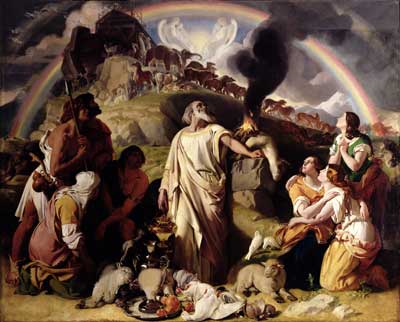
noah-rainbowI don’t say all this to directly compare Noahides with non-Jewish disciples of Messiah. Far from it. I only bring this up to say that, just as the Seven Noahide Laws actually make up a much longer and more complex list of mitzvot, so too, do the Four Prohibitions of Acts 15. That’s Toby’s whole point. He wrote fifteen heavily footnoted pages in a magazine format to just scratch the surface of the meaning of the Jerusalem Letter and to unpack its contents so we could understand that who we are as Christians is so much more than a four bullet point list of “Torah” directives and tons and tons of “grace.”

In January of 2012, I was caught off guard by the article and started wondering if some change in philosophy had come over FFOZ. Boaz graciously commented on my original review to say that nothing had changed in their intent.

On the contrary, from the outset (Messiah Journal 101), we made it clear that the “invitation” and non-obligatory type of language applies only to the specific sign-commandments and markers of Jewish identity: “specifically to aspects of the Torah which comprise Jewish identity: circumcision, dietary standards, festivals, calendar, Sabbath, etc.”

Toby’s article simply continues the process of fleshing out and defining the apostolic position regarding Gentiles and Torah. The only new material here involves the logical application of Acts 15 which is where we have been pointing people all along. Toby already presented some of this material in HaYesod.

A lot of this was just starting to gel after I attended FFOZ’s 2012 Shavuot Conference in Hudson, Wisconsin and it’s been steadily percolating within me for the past fifteen months or so. I realize that just as Boaz said his ministry has progressively been “fleshing out and defining the apostolic position regarding Gentiles and Torah,” this type of steady progression is what I’ve been going through as well, within my thoughts, spiritual development, and self-study.

I’m not writing this to re-review the actual content of Toby’s article, but rather how I am receiving its meaning, comparing the person I was a year-and-a-half ago to who I am now. As I said nearly two weeks ago, I’m Not Who I Was. Hopefully, none of us are. Hopefully, we are all striving to move forward, to learn, to experience, to draw nearer to God by the study of His Word.

Bible scholarship is always moving forward. Like any other type of academic endeavour, research and investigation never stops. Theologians, linguists, historians, archaeologists, and other professionals in their fields continually produce new insights into our understanding of God’s Word and how it is to be applied in our lives. As believers, we have a responsibility to also continue to study, to learn, to strive for a more refined understanding of the available information as guided by the Holy Spirit.

Luke only gives us a summary of the Acts of the Apostles, so while the Bible may be sufficient, that doesn’t mean it’s exquisitely complete. We can’t simply read Acts 15 once and say we understand it. We can’t read our favorite interpretation of the meaning of Acts 15 a month ago, a year ago, or a decade ago, and say we are sticking with that understanding, ignoring newer information that might modify our comprehension in important ways. The original text is unchanging, but how we read and understand it isn’t.

Who am IWho are we in Christ? What was the original intent and impact of the letter sent out to the believing Gentiles by James and the Council of the Apostles? How does that affect our lives as Christians today? What is a Gentile believer’s obligation to Torah? What does “Torah” even mean in our modern lives?

I can’t definitively answer all of those questions for you, but if you start by downloading and reading Toby’s article and continuing to unpack and unfold the text and your understanding of it, I’m hoping and praying you’ll find out. I pray we all discover who we really are in the pages of God’s Word and then live out the lives God intends for us.

Re’eh: Seeing to Learn

gerizim_ebalSee, this day I set before you blessing and curse: blessing, if you obey the commandments of the Lord your God that I enjoin upon you this day; and curse, if you do not obey the commandments of the Lord your God, but turn away from the path that I enjoin upon you this day and follow other gods, whom you have not experienced. When the Lord your God brings you into the land that you are about to enter and possess, you shall pronounce the blessing at Mount Gerizim and the curse at Mount Ebal.

Deuteronomy 11:26-29 (JPS Tanakh)

These words are spoken to the entire Nation of Israel, at the very end of a forty-year term in the desert. Two distinct mountains were on open display. Mount Grizim is plush, rich, and flowering with the promise of life. Mount Eivil in stark contrast is conspicuously barren and empty. This visual aid is employed to etch into the psyche of the assembled the lesson of remaining loyal to the task and mission of Torah and Mitzvos. In the recording of the event Moshe refers to that day as- “today”. What’s so special about that day? Every day he spoke was also a “today”. Why was that day worthy of a title for all time “today”?

The Ohr HaChaim answers that that day they were capable of understanding his lesson based on the statement of the sages, “A person does not stand on (truly grasp) the knowledge- opinion of his teacher until after forty years” (Avodah Zara 5B).

That means that now after forty years they can begin to truly comprehend what Moshe had told them back then. Why does it take forty years? Were these not brilliant people?

-Rabbi Label Lam
“See What Can Be Seen”
Commentary on Torah Portion Re’eh
Torah.org

Nearly a year and a half ago, I reviewed Toby Janicki’s article “The Gentile Believer’s Obligation to the Torah of Moses,” published in Messiah Journal #109/Winter 2012. I remember at the time being a little surprised at even the title, since my understanding back then was Messianic Judaism was striving for pretty much total isolation between Messianic Jewish and Christian/Messianic Gentile religious practice, at least publicly.

I happened to recall my review the other day when I noticed in the analytics for this blog that someone had viewed it.

I went through the original review and realized that my perspectives have changed in the last eighteen months or so. My fuzzy understanding of the Torah of Moses and its connection to the Gentile believers in Messiah is a little bit clearer. This isn’t to say I have everything “dialed,” so to speak, about the Bible and how it works, but I think it’s fair to say that I’m capable of learning and growing intellectually and spiritually.

While the quote from the Ohr HaChaim speaks to the necessity of the passage of time for learning, I’m not going to take it too literally (in forty years, I’ll either be nearly 100 years old or dead). But I am inspired to re-read Toby’s article and to re-review it as processed through the brain I have now vs. the one I had at the beginning of 2012 (I can only imagine that Toby will chuckle because I continue to wrestle with something he understands so clearly).

There has been a tremendous struggle between Messianic Judaism and Hebrew Roots relative to who “owns” the Torah. That’s an overly simplistic statement, of course, but the surface perception is that the Jews in Messiah get to keep the Torah for themselves while the Hebrew Roots people want them to share. On top of that, traditional Christianity says that we don’t need the Torah at all, just the grace of Jesus Christ.

Like I said, I’m being overly simplistic, so don’t take what I’ve just said too literally.

simhat-torahThe truth of the matter is that we all need the Torah. Even before the Christian Era, I believe that the Jewish people saw themselves as a “light to the nations” (Isaiah 49:6) and that we would all learn from the Torah as “the Law went forth from Zion.” (Isaiah 2:3). How does one learn the ethical, moral, and holiness standards of God apart from the Torah, the teachings of God? We don’t.

However, that concept has been misunderstood to mean (at least in certain circles), that we Christians must learn and observe every single mitzvot in the Torah (or at least the ones that can be observed without the existence of the Temple, the Priesthood, and the Sanhedrin) in exactly the same way as the Jewish people.

Acts 15 shoots that concept down in flames (I know this is debatable but then again, everything is) as I painstakingly chronicled in my review of D. Thomas Lancaster’s commentary on the matter, but Toby Janicki picks out of the ashes, the “phoenix” of Torah that applies to the non-Jewish believers.

And it’s a lot.

I don’t think we ever got a chance to really see the results of the Jerusalem Letter in action. We don’t see a detailed report in the New Testament of how those declarations were understood and practiced in early Christian congregations, the ones that would have existed during Paul’s lifetime and soon after. More’s the pity, because a document providing such details would answer a lot of questions and solve a lot of problems.

Once you rocket through history much past Paul’s death, the wedge between believing Jews and Gentiles was already being pounded into place, and by the time we get to the third and fourth centuries CE, we’ve been split apart and any recognizable form of “Torah practice” among non-Jewish believers had gone the way of the Dodo bird (I’m not quite sure how much help the Didache would be since it’s dated to the late first or early second centuries, but I guess I could buy a copy and find out).

What all this means is that you can expect my review of Toby’s 2012 article sometime next week. If anyone can suggest which copy of the Didache I should purchase from the list presented at the above-link, that would help, too.

In a way, I don’t really blame Hebrew Roots folks for finding the Torah beautiful, praiseworthy, and desirable in study and practice. I’m attracted to it as well. I really don’t understand Christian aversion to “the Law” as something horrible, and awful, and too terrible to even consider but then again, that’s what most churches teach. It isn’t that I think Christians should don tallitot and lay tefillin and try to look like Jews, far from it. But we should admit that we need the Torah for two basic reasons: The first is that it defines our relationship with Jesus and with God the Father through the Abrahamic covenant. The second is that every ethical, moral, and spiritual principle that we live by as Christians is found in the Torah. The Torah was taught by Jesus. Without an understanding of the Torah and the Prophets (and this should be huge in Christianity), we have no hope of understanding anything Jesus ever taught!

torah-what-isThat’s actually true of Paul and any of the other Apostles, so in my opinion, the first class that any newbie Christian should ever attend is Torah 101. Starting new Christians in the Gospels and the Epistles sounds nice but it’s almost next to useless. It’s like trying to teach a four-year old Calculus before they’ve even learned how to count to ten. It’s why I think First Fruits of Zion’s (FFOZ) Torah Club volumes are tremendously important. Not only do they teach Torah, but in a way that is very “Christian friendly.”

From all those who have taught me I have gained wisdom.

Psalms 119:99

The Psalmist is telling us that he learned from everyone, that everyone was his teacher. From some, he learned what to do; from others, what not to do.

If we learn from others’ mistakes, we need not make our own.

Just as we can learn from every person, we can learn from every event. Positive experiences are obvious sources of learning, because each positive act we do adds to our character and prepares us to better face the next challenge in life. Negative experiences can be valuable, too, but only if we are sufficiently alert to learn from them.

The list of lessons that we have learned the hard way may be long, but each one has taught us what not to do and thereby it becomes a positive experience. Indeed, the Talmud states that when people sincerely regret their mistakes and change themselves for the better, the wrongs that they did become actual merits (Yoma 86b). Only when we fail to learn from our mistakes and, rationalizing and justifying, obstinately insist that we were right, do our misdeeds remain deficits.

We have the capacity to make life itself a tremendous learning and growth experience.

Today I shall…

…try to look for lessons from everyone and everything, whether my teacher is positive or negative.

-Rabbi Abraham J. Twerski
“Growing Each Day, Kislev 17”
Aish.com

I don’t think the problem is dealing with positive vs. negative teachers but just with “unanticipated” teachers. For traditional Christians, I think Jewish teachers or teachers very familiar with the Jewish (especially Messianic) perspective on Torah and Messiah are important. Jewish teachers aren’t necessarily a problem for Hebrew Roots people, but often, Christian teachers are. Many people in Hebrew Roots no longer see themselves as affiliated with anything called “Christianity” and sometimes they even define themselves by a completely new religious identity in order to separate themselves from the “crimes of the church,” real and imagined. “The church” is something they’ve “come out of,” like a Jew might have escaped the Soviet Union in the 1960s or one “comes out of pagan Babylon,” a den of iniquity and sin.

Oy.

I’m hardly what you would call a traditional Christian, but I must say that I’ve learned a tremendous amount in my conversations with my Pastor. For Hebrew Roots folks, at least some of you, it might not hurt to find a Christian to connect to and even “embrace” on some level if, for no other reason, than to overcome what for davening_morningsome people I’ve personally met, is a phobic response to Christians and Christianity. Really, we’re not all that bad and in my time in church (in spite of my meditation of yesterday morning), I’ve met a few very kind, gentile, and Holy people.

Remember what Rabbi Twerski said about everyone being a teacher? That means Everyone, not just the people you are attracted to as teachers.

Whether you call yourself a Christian, a Hebrew Roots person, or something else, you…we all have a blessing and a curse set before us as well. We can accept the blessing and choose to learn the Torah as it was intended for us and to take upon ourselves teachers we never thought we’d share a classroom or corner of the blogosphere with, or we can choose to isolate ourselves in our own comfortable little silos, and learn only what we want to learn, which means in that case, very little and nothing new and illuminating.

It may take some time before it all begins to sink in. Like me, you might have to wait awhile and then rediscover something that didn’t quite make sense before but comes into crystal clarity now. That’s OK, too. Just as long as you’re willing to open your eyes and see what God has set before you this day.

Good Shabbos.

54 days.

Wednesday Night in My Pastor’s Office

iron-sharpens-iron-hotWhat then? Are we better than they? Not at all; for we have already charged that both Jews and Greeks are all under sin; as it is written, “There is none righteous, not even one; There is none who understands, There is none who seeks for God…”

Romans 3:9-11 (NASB)

There is no person on earth so righteous, who does only good and does not sin.

Ecclesiastes 7:20

Reading the suggestions for ridding oneself of character defects, someone might say, “These are all very helpful for someone who has character defects, but I do not see anything about myself that is defective.”

In the above-cited verse, Solomon states what we should all know: no one is perfect. People who cannot easily find imperfections within themselves must have a perception so grossly distorted that they may not even be aware of major defects. By analogy, if a person cannot hear anything, it is not that the whole world has become absolutely silent, but that he or she has lost all sense of hearing and may thus not be able to hear even the loudest thunder.

In his monumental work, Duties of the Heart, Rabbeinu Bachaye quotes a wise man who told his disciples, “If you do not find defects within yourself, I am afraid you have the greatest defect of all: vanity.” In other words, people who see everything from an “I am great/right” perspective will of course believe that they do no wrong.

When people can see no faults in themselves, it is generally because they feel so inadequate that the awareness of any personal defects would be devastating. Ironically, vanity is a defense against low self-esteem. If we accept ourselves as fallible human beings and also have a sense of self-worth, we can become even better than we are.

Today I shall…

…be aware that if I do not find things within myself to correct, it may be because I am threatened by such discoveries.

-Rabbi Abraham J. Twersky
“Growing Each Day, Av 25”
Aish.com

Iron sharpens iron, So one man sharpens another.

Proverbs 27:17 (NASB)

Last night I met with Pastor Randy for the first time in several weeks. He has been away in Southern California as part of his Ph.D program and just returned late last week. Prior to our meeting, he sent me two PDFs as email attachments, one was a chart he had drawn as a graphic representation all the covenants, and the other was a text description of the covenants. I have to admit, I was intimidated. He was responding to something I had blogged earlier in the week. I wasn’t sure what to expect.

In response and to prepare for the meeting, I sent him a link to my blog post Abraham, Jews, and Christians, since I suspected we’d be discussing the differences between how Jews and Christians are connected by covenant to God and specifically why I believe that the Torah, the conditions pertaining to the Sinai covenant, still apply to the Jewish people today.

AbrahamI hadn’t slept well the night before, so I was running on three hours rest and as much chutzpah as I could summon. All I wanted to do was to go to bed (our meeting was scheduled for 6:30 p.m., so as you can imagine, I must have been really tired), but I wanted to have this meeting, too. Armed with my hardcopy printouts and my Bible, I went to church.

Actually, it was a blast. I had a great time. When we started talking, I forgot completely about being tired. Pastor gifted me with Thomas Schreiner’s book 40 Questions About Christians and Biblical Law, which I’ll start as soon as I finish the Septuagint book. I suspect Schreiner’s book is going to be a “challenge” to me, but that’s almost always a good way to learn. During our conversation, he suggested half a dozen other books for me, which I’m not going to reference here, so I suspect my reading list has been reserved for the next few months.

We actually agreed on most of the details of the covenant connection Christians have through Abraham and why that results in the Gentile church “bypassing” the Sinai covenant, but following a series of links from Abraham, to the New Covenant, to the “Last Supper,” to Paul’s commentary on Abraham in Galatians 3:16. The only link we Christians have through the Abrahamic covenant is stated in Genesis 12:1-3 which is the Messianic blessing on all the peoples of the earth. This was stated before the portion of the covenant requiring circumcision (which links the rest of the Abrahamic covenant directly through Isaac, through Jacob, and then to Jacob’s sons, the Patriarchs, and then the twelve tribes of Israel, and ultimately the Jewish people).

Where we disagreed was familiar territory: the duration of the Sinai covenant. Pastor believes that it should have ended at the cross with a “transitionary period” lasting until the close of the Biblical canon. My opinion is that it extends much further, well past our current age and through the Messianic Era, finally terminating at what we could consider “the end of time” as we understand it.

I saw no temple in it, for the Lord God the Almighty and the Lamb are its temple. And the city has no need of the sun or of the moon to shine on it, for the glory of God has illumined it, and its lamp is the Lamb. The nations will walk by its light, and the kings of the earth will bring their glory into it. In the daytime (for there will be no night there) its gates will never be closed; and they will bring the glory and the honor of the nations into it; and nothing unclean, and no one who practices abomination and lying, shall ever come into it, but only those whose names are written in the Lamb’s book of life.

Revelation 21:22-27 (NASB)

temple-prayersAs long as there’s a Temple in Jerusalem or the promise that it will be rebuilt (which we have in the promise of Messiah’s return), then the Torah cannot pass away from existence and neither can Israel and the Jewish people (Jeremiah 31:35-36, Matthew 5:17-19). The best one can say is that certain portions (the Laws pertaining to the Temple, the Priesthood, the Sanhedrin, and certain other ordinances regarding the Land of Israel itself) go into abeyance, a state of being temporarily set aside. When Hebrews 8:13 talks about the “Old Covenant” passing away, it describes the process of currently passing away, not having already passed away. I just happen to think that “passing away” process doesn’t end until the coming of New Jerusalem (Revelation 21:10).

We also agreed on one thing that will make a lot of Christians a little nervous. We agreed that the New Covenant isn’t yet a “done deal.” In other words, not all the work was finished “on the cross.”

“But this is the covenant which I will make with the house of Israel after those days,” declares the Lord, “I will put My law within them and on their heart I will write it; and I will be their God, and they shall be My people. They will not teach again, each man his neighbor and each man his brother, saying, ‘Know the Lord,’ for they will all know Me, from the least of them to the greatest of them,” declares the Lord, “for I will forgive their iniquity, and their sin I will remember no more.”

Jeremiah 31:33-34 (NASB)

Pastor used another term, but the way I see it, God’s finger is still in the process of writing the Law within us and on our hearts. If He had already finished it with the first coming of Messiah, we would all “Know the Lord” and we don’t yet. The moving finger has not yet “writ” and thus has yet to move on. Link the still writing finger of Jeremiah 31 with the slowly passing away of the Old Covenant in Hebrews 8:13 and I think you’ll see the Torah as it currently exists will be with us for quite some time.

We still went ’round a bit on the purpose and reason for the Law and finally agreed that how it is applied is largely situational (which I mentioned a few days ago). Pastor again tried to tell me that the Torah was given to show the Israelites that it was too hard for anyone to obey His Law and that they needed Messiah. I pointed to Deuteronomy 30, and he replied, Romans 4. I pointed out that one part of the Bible doesn’t cancel another and that only certain parts of Torah have been temporarily set aside as I mentioned above. I also referred back to Psalm 19 and Psalm 119 to illustrate that the Israelites didn’t experience Torah as a burden or a hardship but instead, their foremost joy.

Reading_TorahHe says the Torah does not provide salvation. I know that and I agree. It never did. When Israel violated the conditions of Torah they were ultimately exiled. And they were ultimately called back to God and restored to their Land. Why? Because of God’s love and grace. He never let them go. In that, we Christians are no different, though the nations are not corporately linked to God as is Israel. When we are disobedient, we are not abandoned but instead disciplined. When we become humbled and cry out, God brings us back, even as He has Israel. The Torah doesn’t save. It works as a specific set of conditions indicating the Jewish people are set aside for God, and the conditions apply to them alone on top of the obligations Torah applies to we Gentile believers.

Like I said in the quotes above, no one is righteous, no not even one. The Torah doesn’t confer righteousness, only our faith and God’s grace does that.

I don’t think he’s convinced, but I did the best I could to illuminate my end of the conversation. Part of the problem is Pastor’s perception of “Rabbinic Judaism,” but right then, I was only trying to show that during New Testament times, Torah continued to apply and the Torah moves forward across history. I didn’t want to even comment about the post-Biblical Rabbinic period until I created a bridge that started at Sinai and moved past the crucifixion, burial, resurrection, and ascendance, with the Torah moving across that bridge and forward, spanning the history of the Jewish people. Jesus didn’t just observe the Law because he was born on the “wrong side of the cross,” he did so because that’s the obligation and the joy for all Jews under covenant. His death didn’t change that.

Boaz Michael puts things is proper perspective, I think:

This may sound counterintuitive to many, but the gospel—the story of Jesus’ first coming, his earthly life, his death and resurrection—is not the fulfillment or even the climax of Israel’s story. It does not complete or resolve the narrative that begins with the call of Abraham in Genesis 12. It does not fulfill God’s promises to David in the books of the early prophets. It does not fulfill the promises of the later prophets concerning Israel’s final destiny. It does not even fulfill the Torah itself, in which God promises certain things to his people Israel after their return from exile.

The completion or resolution of Israel’s story does not and will not occur until she is redeemed from her exile, planted firmly in the land God has promised to her, and returned to a state of loving obedience to the Torah under the leadership of the Son of David, Yeshua the Messiah.

I mentioned the example of 19th century Rabbi Isaac Lichtenstein who came to faith in Yeshua past the age of sixty; a person who was wholly Jewish before and after coming to Messianic faith who found that Torah was illuminated, expanded, and possessed of great joy by the Messiah. When Messiah “fulfills” the Torah, it doesn’t end, but it is shown to be truly perfect in Moshiach! Observance goes on for the Jewish believers, but it is Torah observance with much greater meaning, something that as a Gentile Christian, I can hardly even imagine.

Pastor surprised me a bit. My opinion has been that the population of Jews in Messiah dwindled more or less steadily past the Biblical period and finally extinguished completely sometime between the fourth and seventh centuries CE, and then finding a slow resurgence in the past several centuries.

Pastor contradicted me and said he believes that across the past two-thousand years, there has always been a remnant of Messianic Jews. I’d love to believe that but I need to see some evidence. He pointed me to a book called Our Jewish Friends by Louis Goldberg, which I’ll certainly have to read to see the validity of such a claim and how it could possibly be substantiated. Does Goldberg mean Jewish converts to Christianity? To me that’s not the same thing as people who live fully Jewish lives realized in Messiah. Now that would be a thrill to discover.

first-baptist-churchIn many ways, last night’s talk was one of our most productive conversations, at least for me. We won’t be able to meet again for another couple of weeks, but I’m looking forward to it. I mentioned to Pastor that the following day’s “meditation” would be called On Being a Good Christian and was based on his sermon from last Sunday. That led to my angst on ever being able to officially join a local church and the dilemma of “denominationalism” for me. We know that Paul frowned on such divisions in the church (1 Corinthians 1:10-17) but he told me (surprising me again) that we can’t anachronistically apply Paul to our modern church.

We agreed that at the heart of all disciples in Messiah, we must all contain a set of core beliefs, without which, we cannot call ourselves “Christians” (which in this case, would include “Messianics”). Beyond that, denominations provide additional dimensions based on social, cultural, and sometimes even ethnic similarities. I had a brief epiphany and said that denominations were not unlike the evolution of the different streams of ancient and modern Judaism including the addition of elements of culture and tradition. I don’t think Pastor expected that comparison and hopefully it will be food for thought in subsequent conversations.

But since I opened the door, our next conversation in two weeks will be on the differences in Christian denominations. I actually need this since my grasp on the topic is extremely weak. I don’t know if I’m learning to be a better Christian, but I hope I’m growing and learning to be a better child of God.

Blessings on my Pastor for his patience, his intelligence, his passion, and his friendship.


Seeking Korach’s Peace, Part 2

homogenizedKorach apparently desired to bring “peace” by homogenizing all of the Levites with the Kohenim (Priests). However there were two things wrong with that plan. The first is that God did not desire to remove the distinctions between the Kohenim and the Levites. The second was the Korach’s motives were less than pure, both according to Midrash and by how God “reacted” to Korach and the other rebels.

This is the second part of this two-part series. If you haven’t done so already, please read Part 1 and then continue here.

Rabbi Yanki Tauber and Rabbinic commentary states that Korach and his co-conspirators objected to mattanot kehunah, or the “gifts to the Kohanim,” the giving to the Priests of a portion of each Israelite’s crop or the “first shearings” of his flock, as well as the other gifts. Korach felt that all the Levites should be included, and attempted to elevate himself and the rest of the Levites to a level that was never intended for them. While it is noble for anyone to desire to be elevated spiritually, we must do so within the plan of God for our lives. God determined that certain of the mitzvot, the wearing of tzitzit and tefillin, were signs for the Jewish people, so my performing those mitzvot as a non-Jewish Christian, even out of the desire to draw closer to God, won’t do me any good. In fact, if I do so out of ego and the desire to exalt myself before others, I am opposing the plan of God.

Rabbi Tauber continues:

Korach was right: our involvement with the material can be no less G-dly an endeavor than the most transcendent flights of spirit. Indeed, our sages consider man’s sanctification of material life the ultimate objective of creation. “G-d desired a dwelling in the lowly realms,” states the Midrash; “This,” writes Rabbi Schneur Zalman of Liadi in his Tanya, “is what man is all about; [this is] the purpose of his creation, and the creation of all worlds, supernal and terrestrial.” But Korach erred in his understanding of the nature of this “dwelling in the lowly realms” that G-d desires, and the manner in which man can indeed fashion a divine home out of his material self and world.

unworthyKorach’s underlying motivation was a feeling of inferiority and his response to that experience was to lead a “bloodless coup” (though eventually his own blood would be shed) against the Kohenim and against Moses (and against God) by artificially raising himself and the two-hundred and fifty rebels to a level they did not merit. But is it a bad thing to be “lowly?” In Jewish mystic thought, God actually desires to dwell among the lowly. There is no one so insignificant and so humble that God does not desire to dwell with them.

And the Master also taught humility:

“When you are invited by someone to a wedding feast, do not take the place of honor, for someone more distinguished than you may have been invited by him, and he who invited you both will come and say to you, ‘Give your place to this man,’ and then in disgrace you proceed to occupy the last place. But when you are invited, go and recline at the last place, so that when the one who has invited you comes, he may say to you, ‘Friend, move up higher’; then you will have honor in the sight of all who are at the table with you. For everyone who exalts himself will be humbled, and he who humbles himself will be exalted.”

Luke 14:8-11 (NASB)

Imagine if I, as a Christian, attempted to adopt a role that God had never designed for me. How humiliating it would be for me to be chastised by the Master of the banquet, Messiah himself, and be told to take a lesser seat. Better that I should seek the most humble and unassuming place at the table and if he so desires, the King can invite me to a better place.

And it’s not like the King was not willing to humble himself. Messiah humbled himself in becoming an ordinary human being.

Do nothing from selfishness or empty conceit, but with humility of mind regard one another as more important than yourselves; do not merely look out for your own personal interests, but also for the interests of others. Have this attitude in yourselves which was also in Christ Jesus, who, although He existed in the form of God, did not regard equality with God a thing to be grasped, but emptied Himself, taking the form of a bond-servant, and being made in the likeness of men.

Philippians 2:3-7 (NASB)

For even the Son of Man did not come to be served, but to serve, and to give His life a ransom for many.”

Mark 10:45 (NASB)

servingThe King came to serve his subjects, even to the point of death. He left Heaven and became a poor human being, wearing flesh and blood rather than his rightful Divinity, even as the Divine Presence descended from Heaven to occupy an “ordinary” tent of earthly materials. It is said that even the Torah is Divine and must wear “garments” in order to become accessible to human beings.

Rabbi Tauber’s commentary says that, unlike modern progressive and inclusionist thought, spirituality within the human population and within the individual human being does take the form of a hierarchy of sorts. The Kohen Gadol (High Priest) does have duties that place him in closer proximity with the Holy, closer than the other members of the tribe of Levi or the rest of the Jewish people. So it is between the Jewish disciples of Messiah and the Gentile followers. No, it doesn’t mean that Jewish people are “better” or “more loved” by God than Gentile Christians, just that their “duties” are such that they have unique opportunities to perform Holiness by certain of the mitzvot that are not offered to the people of the nations who are called by Messiah’s name.

Conversely, as commentary has previously stated, God desires to dwell in the “lowly realm” and thus among the lowest levels of Creation. In that act, God descends to us, and in that very act, God allows us to ascend toward Him, particularly without requiring that we usurp mitzvot that are not our own.

Korach attempted to reverse the order by elevating himself first, imagining that such an act would “force” the Almighty to descend to him. The opposite happened and God “lowered” Korach quite literally into the earth, burying him alive. Whatever peace Korach had hoped to achieve by his defiance was a pipe dream, and whatever peace he had already been granted by God was buried with him.

Ironically, Korach, as a Levite, already possessed a special and “vertical” role as ordained by God, but that wasn’t good enough for him. Christians too have a special and ordained role but we must be diligent to fulfill that role, lest we also lose everything God has given us. If we can’t take care of even a little, how will we be granted greater blessings. Indeed, we’ll lose even what we’ve got.

“And the one also who had received the one talent came up and said, ‘Master, I knew you to be a hard man, reaping where you did not sow and gathering where you scattered no seed. And I was afraid, and went away and hid your talent in the ground. See, you have what is yours.’

“But his master answered and said to him, ‘You wicked, lazy slave, you knew that I reap where I did not sow and gather where I scattered no seed. Then you ought to have put my money in the bank, and on my arrival I would have received my money back with interest. Therefore take away the talent from him, and give it to the one who has the ten talents.’

“For to everyone who has, more shall be given, and he will have an abundance; but from the one who does not have, even what he does have shall be taken away. Throw out the worthless slave into the outer darkness; in that place there will be weeping and gnashing of teeth.

Matthew 25:24-30 (NASB)

I’ve written on numerous occasions, including in Provoking Zealousness, about the special role we Christians have in relation to the Jewish people, to Israel, and to God. A role that no one else can fulfill. A role that is different from the Jewish believers, but one vital to them and to us. Rather than, like Korach, demanding a role that is not ours, we must give it back, take up our own “cross,” and follow the Master of our lives.

returning-the-torahWhen a Christian demands that a believing Jew give up a Jewish lifestyle, give up the Torah of Moses, and give up the mitzvot, it is as if Korach demanded that Moses and Aaron surrender their roles as Prophet and High Priest and join the other Levites or the other Jewish people in the “mundane”. When a Hebrew Roots person demands that they take possession of the specific “sign” mitzvot that uniquely identify the Jewish people as distinct from the rest of the nations, it is as if Korach demanded to become Prophet and High Priest, elevating himself to a level not given to him by God.

In either case, they are violating the purpose of Torah that provides for harmony between different and distinct groups of people while maintaining distinctions.

I know that the Pirkei Avot, the body of Midrash, and the Tayna are not likely to be viewed as having any authority in relation to the lives of Christians and Christian Hebrew Roots followers, but these sources illustrate important principles. We all travel on trails of spiritual enlightenment, following a path carved out for us by God, striving to become better today than we were the day before. This is praiseworthy and desirable, but we must remember that it is God who creates and defines the universe and everything in it, not us. We work in partnership with God but we are definitely junior partners. When we decide to elevate ourselves outside the plan of the Almighty, not only are we trying to become more important than other human beings, but to take the role of God as well.

Nor does Torah endeavor to create a uniform world society: its detailed laws delineate the many different roles (man and woman, Jew and non-Jew, Israelite, Levite and Kohen, full-time Torah scholar and layman, etc.) to comprise the overall mission of humanity.

-Rabbi Yanki Tauber

We are commanded to love the Lord our God with everything we’ve got and to love our neighbor as ourselves. To obey that Torah, we must be humble and servile to our fellows and particularly to our Creator. Everyone who seeks to exalt himself will be lowered, like Korach, and the most humble, like Moses, will be elevated.

Seeking Korach’s Peace, Part 1

korahs-rebellionWhich is a dispute that is not for the sake of Heaven? The dispute of Korach and all his company.

-Ethics of the Fathers, 5:17

But the Torah did not come to blur the distinction between the heaven and earth. In fact, its self-proclaimed task is “To differentiate between the holy and the mundane, between the pure and the impure” (Leviticus 10:10). Nor does Torah endeavor to create a uniform world society: its detailed laws delineate the many different roles (man and woman, Jew and non-Jew, Israelite, Levite and Kohen, full-time Torah scholar and layman, etc.) to comprise the overall mission of humanity.

Indeed, a uniform world could no more represent a harmonious state than a single-hued painting or a symphony composed entirely of identical notes could be said to be a harmonious creation. Like the third day’s “work of the waters” that harmonizes the divisiveness of the second day by means of further delineation, the Torah makes peace in the world — peace between the conflicting drives within the heart of man, peace between individuals, peace between peoples, and peace between the creation and its Creator — by defining and differentiating, rather than by blending and homogenizing.

-Rabbi Yanki Tauber
“Who Was Korach?”
Based on the teachings of the Lubavitcher Rebbe
Chabad.org

I continue to be reminded of several things based on my studies, my transactions on the Internet, and my conversations with my Pastor. The question of the purpose of Torah stands out because it has no simple answer. The Bible is a multi-layered, densely packed container of the wisdom of God as expressed in partnership with human beings. It functions on many levels, most of which are not obvious by a casual reading and often, not even by repeated readings.

For instance, one function of the Torah, according to Rabbi Tauber’s commentary, is to create harmony and peace between those things that are not alike in our world. As stated above, this includes:

…peace between the conflicting drives within the heart of man, peace between individuals, peace between peoples, and peace between the creation and its Creator — by defining and differentiating, rather than by blending and homogenizing.

This takes me to a blog post of Derek Leman’s which I’ve mentioned before: Torah and Non-Jews: A Practical Primer. I’ve already commented on this, but when studying a commentary on Pirkei Avot (Ethics of the Fathers) Chapter 5, the issue of the purpose of Torah for Jewish and non-Jewish believers came up again, and rather forcefully. It would seem that the commentary on the Korach Rebellion (see Numbers 16) is a prime example of one of the purposes of Torah.

I’m a rather unusual Christian, which you know if you’ve been reading my blog for any length of time. I don’t believe that the Torah was done away with for Jews after Jesus and I do believe that Torah applies to Christians, but only in a specific sense, not in the manner it applies to the Jewish people. In my beliefs, I’m standing between to opposing opinions. Christianity believes (in general, there are exceptions) that the grace of Jesus Christ replaced the Law and that all believers in Jesus, Jews and Gentiles alike, are uniform in grace and no one is required to keep the commandments of the Law. Hebrew Roots believes that the Torah was never replaced by the grace of Messiah and that all disciples of the Master, Jews and Gentiles alike, are uniform in the Torah and everyone is required to keep the commandments of the Law in an identical manner (there are numerous variations to Hebrew Roots beliefs and what I am saying here is meant to be the most generalized expression).

I believe, as Rabbi Tauber states, that the Torah supports the promotion of peace between divergent people groups. In my case, it is intended to develop peace between Jewish and non-Jewish disciples of Messiah Yeshua (Christ Jesus) by defining and differentiating, rather than by blending and homogenizing.

communityIn the “philosophy” of the United States of America, the principle of everyone having equal access to opportunities has been morphed into “equal achievement and acquisition.” That is, everyone should have all of the same stuff and live identical lives at the top of the economic and social status pile, so to speak, regardless of who you are, what you do, how hard you work, and so on.

That’s not realistic.

Neither is it realistic, or in my opinion, Biblical, to expect Jewish and non-Jewish believers in Christ to hop into a metaphorical mixing bowl and have a Sunbeam 12-speed mixmaster applied to their bodies and their identities so that once the mixing is done, everyone is the same, bloody, smooth, creamy consistency. Jews and Gentiles were differentiated by God and we are meant to stay differentiated.

Rabbi Tauber says:

What is peace?

Our Sages have said: “Just as their faces are not alike, so, too, their minds and characters are not alike.” Such is the nature of the human race: individuals and peoples differ from each other in outlook, personality, talents, and the many other distinctions, great and small, which set them apart from each other.

It is only natural to expect these differences to give rise to animosity and conflict. And yet, at the core of the human soul is the yearning for peace. We intuitively sense that despite the tremendous (and apparently inherent) differences between us, a state of universal harmony is both desirable and attainable.

But what exactly is peace? Is peace the obliteration of the differences between individuals and nations? Is it the creation of a “separate but equal” society in which differences are preserved but without any distinctions of “superior” and “inferior”? Or is it neither of the above?

It’s neither. We don’t blend and blur Gentile and Jew and we don’t create individual silos of “separate but equal”. But then what do we have left? Rabbi Tauber leverages the Creation story (another recent favorite of mine) to explain the answer.

This is why, explain the Chassidic masters, the Torah is associated with the third day and the third millennium. The number “1”, connoting a single entity or collection of identical entities, can spell unanimity but not peace. If “1” represents singularity and “2” represents divisiveness, then “3” expresses the concept of peace: the existence of two different or even polar entities, but with the addition of a third, unifying element that embraces and pervades them both, bringing them in harmony with each other by defining their common essence and goal, but also their respective roles in the actualization of this essence and the attainment of this goal — and thus their relationship with each other.

So the “third day” does not undo the divisions of the second. Rather, it introduces a “third” all-transcendent element which these divisions serve. And it is this dynamic of harmony by diversity that “completes” their differences and renders them “good.”

In the Genesis account, God ends a “day” by saying “it was good” … except on the second day? Why the second day?

Because on that day divisiveness was created; as it is written `it shall divide between water and water.'” However, the Midrash then goes on to point out that on the third day the Torah says, “it was good” twice, because then “the work of the waters,” begun on the second day, was completed. In other words, the division effected on the second day was a less than desirable phenomenon, but only because it was not yet complete; on the third day, this divisiveness itself is deemed “good.”

creation2On the second day, God introduced disharmony and divisiveness and then on the third day, he inserted a new element which then created an overarching unity that embraces and pervades the two diverse roles bringing them into harmony without homogenizing them. They remain distinct, and they are bought into peace. And that is good.

Rabbi Tauber likens all this to Korach and the two-hundred and fifty leaders in Israel who rebelled against the authority of Moses.

They combined against Moses and Aaron and said to them, “You have gone too far! For all the community are holy, all of them, and the Lord is in their midst. Why then do you raise yourselves above the Lord’s congregation?”

Numbers 16:3 (JPS Tanakh)

Korach apparently desired to bring “peace” by homogenizing all of the Levites with the Kohenim (Priests). However there were two things wrong with that plan. The first was that God did not desire to remove the distinctions between the Kohenim and the Levites. The second was the Korach’s motives were less than pure, both according to Midrash and according to the Torah record.

According to Midrash:

What exactly did Korach want? His arguments against Moses and Aaron seem fraught with contradiction. On the one hand, he seems to challenge the very institution of the priesthood (kehunah), maintaining that “as the entire community is holy, and G d is within them, why do you raise yourselves over the congregation of G d?” But from Moses’ response we see that Korach actually desired the office of the Kohen Gadol for himself!

And according to Scripture:

And Moses said, “By this you shall know that it was the Lord who sent me to do all these things; that they are not of my own devising: if these men die as all men do, if their lot be the common fate of all mankind, it was not the Lord who sent me. But if the Lord brings about something unheard-of, so that the ground opens its mouth and swallows them up with all that belongs to them, and they go down alive into Sheol, you shall know that these men have spurned the Lord.” Scarcely had he finished speaking all these words when the ground under them burst asunder, and the earth opened its mouth and swallowed them up with their households, all Korah’s people and all their possessions. They went down alive into Sheol, with all that belonged to them; the earth closed over them and they vanished from the midst of the congregation.

Numbers 16:28-33 (JPS Tanakh)

I wrote this commentary as a single blog post but it exceeded 3300 words, so I decided to break it in half. Part 2 will be published in tomorrow’s “morning meditation.”

Ekev: Christians Clinging to Torah

clinging_to_torahAnd if you do obey these rules and observe them carefully, the Lord your God will maintain faithfully for you the covenant that He made on oath with your fathers: He will favor you and bless you and multiply you; He will bless the issue of your womb and the produce of your soil, your new grain and wine and oil, the calving of your herd and the lambing of your flock, in the land that He swore to your fathers to assign to you. You shall be blessed above all other peoples…

Deuteronomy 7:12-14 (JPS Tanakh)

If, then, you faithfully keep all this Instruction that I command you, loving the Lord your God, walking in all His ways, and holding fast to Him…

Deuteronomy 11:22 (JPS Tanakh)

God made great promises to the Children of Israel in the Torah which were contingent upon the Israelites obeying “these rules”, “loving the Lord your God, walking in all His ways.” But it can become very confusing about how or if that has any sort of impact on Christians or what it even means for Jewish people today? What does it mean to “hold fast” or to “cleave” to God, and what does that have to do with Torah?

What does it mean “to cleave to the Almighty”? The Almighty has no body or corporeality to hold on to.

Rabbi Meir Simcha HaCohen comments that this verse is the commandment to trust in the Almighty. Cleaving, clinging to the Almighty means that we trust in him like a king’s son who relies on his father. His father loves him and, being a king, has the ability to supply him with all his needs. This is our relationship with the Almighty. He is our King and our Father. We must make our efforts, but understand that success is ultimately a gift from the Almighty.

Cleaving to the Almighty means living with this awareness. The immediate benefit to a person who internalizes this attribute is an inner feeling of peace and serenity.

Dvar Torah for Torah Portion Ekev
Based on Growth Through Torah by Rabbi Zelig Pliskin
as adapted by Rabbi Kalman Packouz
Aish.com

According to the commentary by Rabbi Shlomo Katz at Torah.org, it would be impossible to literally cling to God, who is an all-consuming fire. The sages say one “clings” to the Almighty through Torah study and performance of the mitzvot. In the Siddur, the phrase “You who cling to HaShem, your G-d, you are all alive today” is part of the Torah service, thus clinging to God and the reading, studying and performance of Torah are associated if not equivalent acts.

This could sound very attractive to some Christians. After all, why wouldn’t we want to “cling” to God? What do we have to do? Read, study, and observe the Torah? Cool? How do we do that?

Several days ago on his blog, Derek Leman wrote an article called Torah and Non-Jews: A Practical Primer. It might have better been called “What Does Torah Mean to Jews and What Should Christians Do About It”. I’ve long since set aside my illusions that I have to look and act “pseudo-Jewish” in order to obey God’s will for my life, but over the past several months, I have been attempting to defend Jewish Torah observance, especially among Messianic Jews, in conversations with my Pastor. However, one of the sticking points is trying to define just what “Torah” is.

Of course I wrote a blog series on the purpose of Torah for Messianic Jews, but it never quite satisfied me as a unified and complete answer to Pastor’s query.

In Leman’s response to some Christian questions about the Torah, he disassembled the Torah commandments in what I thought was a useful way:

There are a lot of differences and categories we could note in the commandments in the Torah. First, there are positive (“remember the Sabbath,” “you shall love”) and negative (“you may not eat,” “you shall not”) commands. Second, since Torah is an actual constitution for people living in the Iron Age in the ancient Middle East, it has criminal and societal laws which cannot be applied directly. It assumes a theocracy with the actual Presence of God guiding the king and priests. Do not think that stoning people is part of Torah practice now! Third, it permits some things from ancient culture which are no longer permitted (owning a slave, taking a war bride, practicing blood vengeance). Fourth, it contains some things which are the highest expressions of love, justice, and faithfulness. The concern in Torah for the defenseless and needy, the insistence on truth in justice for the powerful and powerless, the provisions of generosity, these things are the height of Torah. This list is not as detailed as it could be, but the point is, Torah requires long, habitual, careful study.

torah-what-isThat isn’t exactly an “in a nutshell” lesson on Torah, but it does communicate the level of complexity for someone approaching Torah with the intension of becoming “Torah-compliant” or “Torah-observant” or “Torah-submissive.” However, the upshot of Leman’s article is that it takes a lifetime of study to approach and refine one’s understanding and observance of Torah. It is true that, for practical purposes, observant Jews operate in a set daily pattern relative to their responsibilities to the mitzvot, but it’s also true that with continuing study and understanding, that observance evolves and deepens, not only on the level of behavior and cognition, but particularly (ideally) in devotion to God. Remember, we are discussing the relationship between Torah and “cleaving” to God.

Most people would comprehend why an observant Jewish person would study the Torah in order to understand and perform the mitzvot in the appropriate manner, but Christians may not be aware that we need to study and understand Torah as well.

But, why? Even if you don’t believe that Christ’s grace replaced the Torah for the Jews, most Christians believe the Law has nothing to do with them.

Therefore it is my judgment that we do not trouble those who are turning to God from among the Gentiles, but that we write to them that they abstain from things contaminated by idols and from fornication and from what is strangled and from blood. For Moses from ancient generations has in every city those who preach him, since he is read in the synagogues every Sabbath.”

Acts 15:19-21 (NASB)

Most Christians believe that this is the pronouncement of James and the Council of Apostles replacing the Law with grace for the believers, Jewish and Gentile alike. Some believe that James and the rest of the Jewish disciples of Messiah continued to apply Torah observance to their lives but removed such obligations from the lives of the newly-minted Gentile disciples since, as Peter said, “why do you put God to the test by placing upon the neck of the disciples a yoke which neither our fathers nor we have been able to bear?”

Torah observance isn’t required for salvation for Gentile or Jew, but from a Jewish point of view, the Torah defines the identity and lifestyle of the descendants of those who stood at Sinai and “as one man” who agreed to do all that Hashem their God commanded.

But does this mean Gentile disciples (Christians) have no obligation to Torah at all? Certainly not. Leman continues:

If you are not Jewish, God was not speaking directly to you when he gave Torah. Read Exodus 19. You can learn about God, about holiness, about love and the ways of God for people to live in the Torah. But it requires translating and interpreting it from one context (Israel’s constitution) to another (how you, as a Messiah-follower, should live your life). Even for the Jewish people translation and interpretation is required from one context (Israel in the Iron Age when it was a theocracy with God present in the sanctuary) to another (Israel in the long exile without the direct Presence of God in the sanctuary). Look to Torah as a late arrival at the party. Israel is already there and you are a guest. What can you learn from God’s instructions to this people? What in these instructions and teachings apply to you as someone outside of the specific group? The truth is, most of what is here has meaning for you, but interpretation and integration of multiple ideas will be required.

torah_up_closeIn a very real way, the Torah is Israel’s story, even as the Gospel message of Messiah is the story of good news to Israel, but it doesn’t mean the rest of us aren’t involved. I wrote extensively on this topic in a multi-part series called Return to Jerusalem, which is an analysis of Acts 15 based on the commentaries of D. Thomas Lancaster in the Torah Club, Vol. 6: Chronicles of the Apostles.

For Christians, Torah study is exceptionally important because Torah does apply to us, but it doesn’t apply in a manner identical to the Jewish people. We can’t simply put on a tallit gadol, avoid bacon and shellfish, and call ourselves “Torah-submissive kosher.” If it requires a lifetime of study for a Jewish person to live out the Torah and to draw closer and to cling to God, it should require the same for Christians.

As Leman states:

There is a community that has been studying Torah for millennia. Many Torah-keeping non-Jews retain from their church life a prejudice against things Jewish. The rabbis don’t believe in Jesus, so they must not know anything! Never mind that God promised his Spirit would never depart from Israel (Isa 59:21). Never mind that God established in Israel judges and priests to know the Torah and teach it (Deut 17:8-13) and that the rabbis have come to occupy that place during the two-thousand year exile. Studying what Judaism teaches about the Torah is not easy. FFOZ (First Fruits of Zion) makes it easy through their Torah Club volumes. If you really want to know Torah and how to practice it, Torah Club Volume 5 is for you. Meanwhile, you cannot keep Torah and ignore what Jewish tradition says about it.

Torah study for Christians is Bible study, but it’s Bible study from a perspective that rejects supersessionism, anti-Judaism, and anti-Israel mindsets. As Leman says, you cannot divorce the Torah (or the Bible as a whole) from Israel and Judaism since the Bible is specifically the story of God’s involvement with Israel (with applications for the rest of us). Gentile Christians have gotten all too comfortable thinking the Gospel message is “all about us because we have Jesus,” but “Jesus” is Yeshua, the Messiah God sent to redeem first and foremost Israel and also the nations of the world. We can no longer afford to be arrogant lest Messiah humble us severely upon his return.

We also can’t afford to ignore that Jewish people including Messianic Jewish people, have a special relationship with God, even above the Gentiles who are called by His Name, and a special relationship with Torah, whereby additional commandments apply to them that don’t apply to Gentile Christians. Beyond that, studying Torah and the rest of the Bible should reveal that the Torah never “expired” for the Jewish people and indeed, it tells the story of future restoration of Israel:

“So it shall be when all of these things have come upon you, the blessing and the curse which I have set before you, and you call them to mind in all nations where the Lord your God has banished you, and you return to the Lord your God and obey Him with all your heart and soul according to all that I command you today, you and your sons, then the Lord your God will restore you from captivity, and have compassion on you, and will gather you again from all the peoples where the Lord your God has scattered you. If your outcasts are at the ends of the earth, from there the Lord your God will gather you, and from there He will bring you back. The Lord your God will bring you into the land which your fathers possessed, and you shall possess it; and He will prosper you and multiply you more than your fathers.

“Moreover the Lord your God will circumcise your heart and the heart of your descendants, to love the Lord your God with all your heart and with all your soul, so that you may live. The Lord your God will inflict all these curses on your enemies and on those who hate you, who persecuted you. And you shall again obey the Lord, and observe all His commandments which I command you today. Then the Lord your God will prosper you abundantly in all the work of your hand, in the offspring of your body and in the offspring of your cattle and in the produce of your ground, for the Lord will again rejoice over you for good, just as He rejoiced over your fathers; if you obey the Lord your God to keep His commandments and His statutes which are written in this book of the law, if you turn to the Lord your God with all your heart and soul.

“For this commandment which I command you today is not too difficult for you, nor is it out of reach. It is not in heaven, that you should say, ‘Who will go up to heaven for us to get it for us and make us hear it, that we may observe it?’ Nor is it beyond the sea, that you should say, ‘Who will cross the sea for us to get it for us and make us hear it, that we may observe it?’ But the word is very near you, in your mouth and in your heart, that you may observe it.

Deuteronomy 30:1-14 (NASB)

resources-studyI could do a study just on these verses as far as how the words of Moses apply to the restoration of future Israel, the New Covenant for Israel, and the accessibility of Torah for the Jewish people, including how God completely and honestly intended Israel to observe the commandments. He didn’t just give the Torah to Israel to prove a point about how hard it is to obey God and then pull a bait and switch, inserting Jesus and grace in its stead.

If God had annulled the Torah, then not only would He have eliminated everything that Jesus taught, but He would have destroyed any possible access to God for the Gentiles, since it is through the promises God made to Abraham about Messiah, which are contained in Torah, that the Gentiles are saved at all.

Yes, Christians. Study the Torah. Learn. Comprehend. Obey as the mitzvot apply to you. Live out the Word and Will of God. Just don’t assume that it’s easy. Please believe that it will take the rest of your life to even scratch the surface. Start one day at a time. Start now.

If you’re a Christian who is at all interested in the Torah and how it applies to a life of faith in Jesus (and believe me, a lot of it applies), you can also read Torah Study for Christians to get an introduction and find a starting point on your path.

Addendum: I know one of the complains against arguments like mine from some folks in Hebrew Roots (and for that matter, traditional Christianity) is that those of us who support a Messianic perspective don’t account for non-Jewish covenant connection with God. I used to wonder how we were connected to God through Messiah myself, but frankly, once you know where to look, it’s incredibly obvious: Abraham. Read Abraham, Jews, and Christians and Sharing with Abraham to put the covenant connection of believing Gentiles to God in proper perspective. I’ll be talking more on this subject in Sunday’s and Monday’s “morning meditation.”

Good Shabbos.

61 days.