Tag Archives: Torah

V’etchanan: What Comes From God

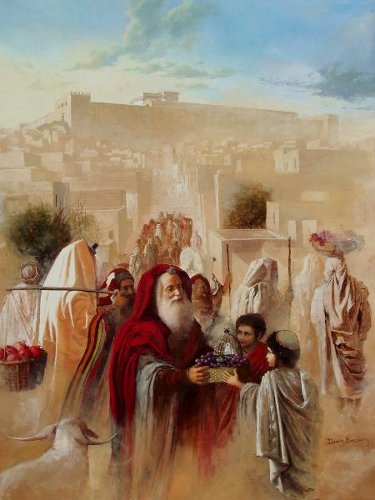
ancient_jerusalemFor what great nation is there that has a god so close at hand as is the Lord our God whenever we call upon Him?

Deuteronomy 4:7

Should one only call out for the “big things”? To think that prayer to God is only for the “big things” is a big mistake! We must turn to God for help and understanding in everything we do.

The Chazon Ish, a great rabbi, cited the Talmud which relates that Rav Huna had 400 barrels of wine that spoiled. His colleagues told him to do some soul-searching regarding the cause of this loss. Rav Huna asked, “Do you suspect me of having done anything improper?”

The Sages responded, “Do you suspect God of doing something without just cause?” They then told him that he was not giving his sharecropper the agreed upon portion of the crop.

“But, he is a thief!” Rav Huna protested. “He steals from me. I have a right to withhold from him.”

“Not so,” the Sages said. “Stealing from a thief is still theft” (Talmud Bavli, Berachos 5b).

“Suppose,” the Chazon Ish said, “that something like this would occur today. The search for the cause would be whether the temperature in the room was improper or the humidity too high or too low. Few people would search for the cause within themselves, in their ethical behavior. We should know that God regulates everything except for our free will in moral and ethical matters. As with Rav Huna, nothing happens without a cause.”

Dvar Torah for Parashat Va’ethannan
from Twerski on Chumash, by Rabbi Abraham J. Twerski
quoted by Rabbi Kalman Packouz in “Shabbat Shalom Weekly”
Aish.com

I agree that we should turn to God with all our matters, large or small, but I wonder if every single thing that happens to us was caused by God to teach us a lesson. What can we learn from the flat tire we get while driving to an important meeting and dressed in our best clothes? What should we gather from being caught in a rainstorm without an umbrella, stubbing our toe, tripping over a crack in the sidewalk, catching a cold? Does every single event that happens, even down to the tiniest detail have to be ordained in Heaven?

I don’t know. I suppose it could. On the other hand, maybe sometimes things happen and they have no meaning. If I go down to a ridiculously small level, does it matter if I choose to wear black or white socks today? Is there going to be some consequence one way or the other? Is there a moral lesson I should learn if I get the flu or did I just get the flu? If I’m in business and should have a bad year, is that the result of some moral or ethical fault of which I’m guilty, or is it the consequence of the current economy and all businesses like mine are suffering?

Regardless of the cause of our fortunes or misfortunes (and believers are taught that everything we have comes from God), it certainly wouldn’t hurt to turn to God in good times and in bad, and call to Him for He is always near, even when we don’t feel as if He’s near.

…fervent in spirit, serving the Lord; rejoicing in hope, persevering in tribulation, devoted to prayer…

Romans 12:11-12 (NASB)

Is anyone among you suffering? Then he must pray. Is anyone cheerful? He is to sing praises. Is anyone among you sick? Then he must call for the elders of the church and they are to pray over him, anointing him with oil in the name of the Lord; and the prayer offered in faith will restore the one who is sick, and the Lord will raise him up, and if he has committed sins, they will be forgiven him.

James 5:13-15 (NASB)

praying-apostleThe verses in the Bible exhorting the advantages of prayer are all but endless, so I offer only a few examples. But it doesn’t answer the question about the nature and cause of each and every circumstance we find ourselves in. When raising small children, we try to make the consequence of misbehavior happen immediately after the misbehavior, so they’ll connect the two and learn to avoid the misbehavior. It’s easy to get the idea that God does the same thing. But then again…

Because the sentence against an evil deed is not executed quickly, therefore the hearts of the sons of men among them are given fully to do evil. Although a sinner does evil a hundred times and may lengthen his life, still I know that it will be well for those who fear God, who fear Him openly. But it will not be well for the evil man and he will not lengthen his days like a shadow, because he does not fear God.

Ecclesiastes 8:11-13 (NASB)

In fact I believe that God deliberately delays providing the consequence upon the sinner, giving him or her time to repent and to change their behavior.

The Lord is not slow about His promise, as some count slowness, but is patient toward you, not wishing for any to perish but for all to come to repentance.

2 Peter 3:9 (NASB)

In some ways, it might be more merciful of God if He was to discipline and chastise us each and every time we mess up right when we mess up, kind of like swatting a dog on the nose with a rolled up newspaper when it does its business on the living room carpet. Then, like a dog or a small child, we’d see the obvious and inescapable pattern between certain of our actions and the painful things that happen right afterward.

But unlike the commentary I quoted above, God just doesn’t seem to arrange our lives that way, at least not all the time. We are left then, wondering which consequence is a moral lesson and which is only a random event.

We don’t know.

But what if we pretended that everything we experience is an immediate communication from God to us? This could be horribly misused and sometimes people blame themselves without reason because they were the victim of a tragic accident or a terrible crime. You can’t blame a five-year old boy because he was killed in a drive-by shooting while standing on a street corner with his Dad waiting for the light to change. You can’t blame a forty-four year old woman who has lived a life of impeccable health who is diagnosed with breast cancer.

But…
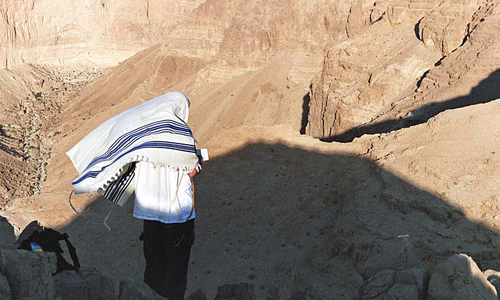
praying_at_masada…but what if regardless of whether we think an event has come from God or not, we turned to Him anyway? What if after having a productive day at work, you turned to God and thanked Him? What if after learning that the cost of repairing your car’s sudden breakdown will empty your savings account, you turned to God and begged for His help? What if, day in and day out, you turned to God, with praise and with petition, in happiness and in anguish?

What if?

Life happens. Sooner or later, something good will happen to you. Sooner or later something bad will happen to you. Sooner or later, nothing will happen to you and you’ll be really bored. You live, you laugh, you bleed, you breathe, you cry, you get angry, you get frustrated, you feel depressed, you are overjoyed, and everything else.

That’s your life. That’s from God. Talk to God about it. Ask Him Why? Ask Him How? Say “Thank you.” Say “I’m sorry.” You know your life. You know what’s happening. You know what to say. Just turn to God and say it.

And then listen.

Good Shabbos.

68 days.
What Christians See When Looking At Messianic Jews

sefer-torahFor every complex question, as H.L. Mencken once put, there is usually an answer that is “clear, simple and wrong.” His observation rings true when it comes to a question I get at least once a week. What do Jews believe about Jesus?

Jews as a group rarely agree on matters of Jewish belief. How could we agree on the essence of another? Yet, we ignore the question at our own peril.

-Rabbi Evan Moffic
“5 Rabbis Explain Jesus”
Huffington Post

An MJ friend wrote me describing the resistance he has been encountering from other Messianic Jews about Torah. He gets it. Mount Sinai is an eternal covenant between God and Jewish people.

-Derek Leman
“Do Messianic Jews Really Need to Keep Torah?”
Messianic Jewish Musings

And meanwhile, the Bible from cover to cover is about God’s-plan-through-Israel-to-the-world and yet the “through Israel” part is forgotten by most. Deuteronomy 4:6 is in the Bible. Verify this for yourself.

-Derek Leman
“Why Don’t Christians Believe Deuteronomy 4:6?”
Messianic Jewish Musings

“What is the Torah?”

I’ve been blogging and blogging and reading and reading trying to come up with an answer that will work between my Pastor and me during our usual Wednesday night discussions. Pastor Randy is away for several weeks in association with his doctorate studies, but I sent him a link to Derek Leman’s blog post Do Messianic Jews Really Need to Keep Torah, since it addresses the heart of our conversations. Pastor has no spare time for a long blog post, but he did send me a brief email saying that he believes the Abrahamic covenant is eternal, but the Mosaic covenant is not.

I suppose I should have expected that response, and it surprisingly hit me in a tender spot. So when Derek wrote Why Don’t Christians Believe Deuteronomy 4:6, it did absolutely nothing to improve my disposition.

Really, is there any hope for communication across the aisle, so to speak, or are we doomed to endless discussion and endless disagreements with no middle ground between any of us?

Do I really want to live a life of faith like this, at least communal faith?

But Rabbi Moffic said that “Jews as a group rarely agree on matters of Jewish belief.” Ever since Sinai, the Jewish people have been chosen and called out to be different from all of the other peoples and nations of the Earth, but how do they stand all of the internal dissonance? My guess is that, at some core level, no matter what other disputes and disagreements one Jew has with another, at the end of the day, a Jew is always a Jew.

iron-sharpens-iron-hotOK, I know there are problems with that statement and there are all kinds of disputes between different sectors of Judaism, but when “they” come for you because you’re a Jew, those disputes vanish like a snow cone in a blast furnace. Beyond a certain point, we can even grasp hope based on a Jewish Cantor welcoming even Messianic Jews on Tisha B’Av.

But that doesn’t translate very well if at all to differing groups of Christians.

John the Baptist described himself as “the voice of one crying in the wilderness” (John 1:23), and that worked pretty well for him up until his beheading, but I’m not sure how well it’s working for me.

Iron sharpens iron, so one man sharpens another.

Proverbs 27:17 (NASB)

OK, I get that. The constant “head-banging” is supposed to sharpen us, but it also can be painful, and frankly, I’m getting a headache.

I know, “if you can’t stand the heat…” Maybe I should get out of the kitchen.

But that’s where the food is.

For everyone who partakes only of milk is not accustomed to the word of righteousness, for he is an infant. But solid food is for the mature, who because of practice have their senses trained to discern good and evil.

Hebrews 5:13-14 (NASB)

At the end of the day, a Jew is a Jew and like it or not, all Jewish people have been bonded together since Sinai and probably before that. Does that work for Christians, though? Are we bound together so that, when adversity strikes, we’ll join with each other based on our common identity as disciples of Christ?

I’d like to think so, but I don’t know. Jews are bound not just based on belief and theology, but by 3500 years of common experience and even down to the level of DNA. Although Jews don’t think of themselves in terms of being “tribal” anymore, it’s still there beneath the surface. Tribes and clans and families are bonded beyond any unbonding, and God drew all Jewish people to Him under the chuppah of cloud and fire at Sinai and sealed the covenant with Torah.

The Birthright program exists to encourage young Jewish people who have little or no attachment to the Land and to the Torah to experience Israel. I hear there’s something about standing on the ground and breathing the air in Israel that has an effect on Jewish people (and perhaps a few Christians as well). I can’t say from experience, but for the sake of my Jewish children, I hope so.

I can only say that for Christians, a common faith in Jesus is the lynchpin that holds us together, at least in theory. But while it is presupposed that Jews will argue with Jews as an expected behavior, how am I as a Christian supposed to explain to another Christian that being Jewish and the existence of the Torah are inexorably linked and cannot be unlinked. Even an atheist Jew will one day confront the meaning of being Jewish beyond the mere ethnic and genetic identity.

jewish-davening-by-waterI recently wrote about Jews encountering themselves through the mitzvot and some Rabbis hope that encouraging a Jewish person to experience even a single mitzvah will make a difference. At the time, I applied that hope to Christians as well, but we must face the facts that Christians don’t think of themselves in the same way as Jewish think of themselves.

No wonder that we can’t get Christians to see Jews as they want to be seen.

There are days when I just want to scream to the Church, “Just let Jews be Jews! We don’t have to agree with them! They don’t need our permission!” But I suppose that wouldn’t go over very well.

Jews rarely agree with each other on matters of belief. Christians are expected to agree with each other on matters of belief. If they don’t, then it usually means some group will split off from their church to form a different church. That’s how Christians manage the dissonance of disagreement.

I have what I think of as a unique relationship with my Pastor in that we can regularly meet every week, disagree on fundamental issues, and still be friends. Pastor lived in Israel for fifteen years and is intimately acquainted with Jewish life in Israel, so on that basis, he knows what it is like to live among lots of Jewish people. And yet, every week when we meet, I still feel like I’m facing some sort of battle for the rights of Jewish people to define their own identity as Jewish based on the Torah, especially Jews who are disciples of Messiah.

I keep thinking of the venerable 19th century Rabbi Isaac Lichtenstein who became a devotee of Yeshua past the age of sixty and yet remained wholly Jewish in his practice, observance, identity, and discipleship. His life as a devout Jew and a Messianic disciple seems so open and clear. Reading The Everlasting Jew showed me how his life made so much sense the way he lived it.

I don’t see a dissonance between what R. Lichtenstein believed and how he lived and the Biblical life of Jesus, Peter, and Paul. I just wish everyone could see what I see, not because I’m so smart, but because I believe I’m seeing what God wants all Christians to see when we look at Messianic Jews.

Why is communicating that vision so hard?

The Bible Between God and Man

Moses at NeboThis week’s Torah reading begins: (Deuteronomy 1:1.) “These are the words that Moshe spoke to the entire Jewish people.”

Noting the distinction between this book and the previous four, which are all “the word of G-d,” our Sages explain (Megillah 31b.) that Moshe recited the Book of Deuteronomy “on his own initiative.”

This does not, ח׳׳ו , mean that the Book of Deuteronomy is merely a mortal invention. Our Rabbis (Tosafos, op. cit.) immediately clarify that Moshe delivered his words “inspired by the Holy Spirit.” Similarly, when the Rambam defines the category of “those who deny the Torah,” (Mishneh Torah, Hilchos Teshuvah 3:8.) he includes: “a person who says that the Torah even one verse or one word does not emanate from G-d. If one would say, ‘Moshe made these statements independently,’ he is denying the Torah.”

Not a single commentator maintains that there is a difference in this regard between the Book of Deuteronomy and the four preceding books.

-Rabbi Eli Touger
“A Mortal Mouth Speaking G-d’s Word”
Adapted from Likkutei Sichos, Vol. IV, p. 1087ff; Vol. XIX, p. 9ff
Chabad.org

Reading this commentary on last week’s Torah portion reminded me of my ongoing discussion with my Pastor about the purpose of Torah. Pastor Randy has told me his particular understanding of the function of Deuteronomy, one I’ve never heard before (and I’ll refrain from sharing that with you at this time), but it also made me think of our discussions about the “inspired” nature of the Bible.

Rabbi Touger separates Deuteronomy from the rest of the Torah by saying the first four books were recorded by Moses just as they were given to him by God, but Deuteronomy involves a “relationship” between God’s inspiration and Moshe’s personality.

For the Book of Deuteronomy are merely Moshe’s words. Moshe’s identification with G-dliness was so great that when he states: (Deuteronomy 11:13.) “I will grant the rain of your land in its season,” he speaks in the first person although the pronoun “I” clearly refers to G-d. “The Divine Presence spoke from his mouth.” (See Zohar III, p. 232a; Shmos Rabbah 3:15.)

On the other hand, it is also clear that the book involves Moshe’s own thinking process. To give an example: there is a difference of opinion among our Sages as to whether the proximity (semichus) of two subjects in the Written Torah is significant or not. (Berachos 21b; Yevamos 4a.) One opinion maintains that it is, while the other explains that although when mortals structure their thoughts, order is important, but “Since the Torah was granted by the Almighty, the order of precedence is not significant.” (Raaban [Rabbi Eleazar ben Nasan], sec. 34.)

I’m reading this as saying Deuteronomy is inspired by God so much so that sometimes Moses speaks almost with God’s voice. On the other hand, Deuteronomy involves the words and thoughts of Moses and information provided by God is organized in Moses’s mind and presented in his oratory.

We have to believe that anything coming directly from God is perfect, at least at the moment of its delivery to mankind. What we do with it on the other hand, is another story. So how does that affect the Bible? When God inspired Moses (or any of the other human Bible writers), at that instant in time, perfect information flowed from the Divine to the mundane; from God to man. Through some process we don’t understand, the relationship was developed between that information and how it was interpreted and delivered by the human beings involved.

In Deuteronomy, Moses was speaking to the entire assembly of Israel and, I suppose, either he later wrote down everything he said, or someone was taking notes while he spoke. Tradition says that Moses wrote the entire Torah by his own hand including Deuteronomy. Scholars differ in their opinions, but I’m not going to get into that right now.

Is the Bible perfect?

Well, yes and no.

The Death of the MasterWe have to believe it contains the entire inspired Word of God, otherwise, the Bible is just another book, no different from any of the other supposedly holy books in other religious or philosophical traditions. On the other hand, the Bible does contain internal inconsistencies that we can’t resolve or “smooth out,” although both Jewish and Christian translators and theologians have tried over the long centuries.

I didn’t used to believe this until I was challenged to make the different gospel versions of the crucifixion map to each other. What day of the week exactly was Jesus executed? Don’t automatically say it was Friday, because that’s not a for sure thing. You have to understand that Passover was a special shabbat and that the Saturday shabbat was also observed. I won’t go into a lengthy explanation, but if you put the different gospel versions side by side, they do not match up. You can’t tell which day it was when Jesus died. It’s not the same day in all gospel versions.

Did God goof? God can’t goof. So did the various gospel writers goof?

Well, yes and no.

Yes, if you want to read the Bible like a newspaper or a legal document (though some portions are a legal document). No, if you realize that certain portions of the Bible are written like Chasidic tales, stories based on fact, but crafted for a specific audience, drawing from other, older Biblical and extra-Biblical texts, in order to communicate a particular message to the target audience.

If you read the Bible like Joe Friday would have wanted it (“The facts ma’am, just the facts”), it doesn’t work.

The explanation of the above concepts depends on the appreciation of the relationship between the Torah and our world. Our Sages state: “The Torah preceded the world.” Here, the concept of precedence is not chronological, for time like space is a creation, relevant only after G-d brought existence into being. Rather the intent is that the Torah is on a level of spiritual truth which transcends our material frame of reference. Although the Torah “descends” and “enclothes itself” in our world, speaking of seemingly ordinary matters such as agricultural laws, codes for fair business practice, and the proper structure for marriage and family relations, this is not its essence. The essence of the Torah is “G-d’s will and His wisdom,” united with Him in perfect unity. (See Tanya, ch. 4.)

This concept has always fascinated me. Even my Pastor believes that in God’s Heavenly Court, there exists a “perfect” Bible…God’s Word as it was given to humanity unaffected by the human mind, imagination, interpretation, or anything else. By inspiring people to write various portions of His Word, God, in effect, is “clothing” the Bible in humanity so that human beings can consume it.

Surely, this commandment that I am commanding you today is not too hard for you, nor is it too far away. It is not in heaven, that you should say, “Who will go up to heaven for us, and get it for us so that we may hear it and observe it?” Neither is it beyond the sea, that you should say, “Who will cross to the other side of the sea for us, and get it for us so that we may hear it and observe it?” No, the word is very near to you; it is in your mouth and in your heart for you to observe.

Deuteronomy 30:11-14 (NRSV)

This is the part of Torah I point to whenever Christians say that the Law was only given to Jews so that they’d realize the Law of God was too hard to keep and that they needed Jesus instead. It’s also a good scripture to bring out when I meet with Christians. The Torah, and in fact, the Bible as a whole, is a multi-dimensional, multi-layered, intertwining, interactive document that is more than a document, that was given to human beings to enact, ponder, study, discuss, argue over, and experience in awe.

The Bible was written by human beings in supernatural partnership with God and it digs as much into the living human psyche as it does into the Divine realm.

rabbi_child_and_sefer_torahI disagree (respectfully) with Rabbi Touger when he says that human beings as intermediaries and Bible writers are either derech ma’avir or “funnels” channeling God’s words and intent without altering them at all, or derech hislabshus in which the human intermediary puts what is given from God into his own words. I think that every word written by every Biblical writer was in some sense affected, transformed, or colored by the human writers, the derech hislabshus. Otherwise, God could have just written the whole thing with his “finger” as He did with the first tablets Moses took up to Sinai, the ones Moses smashed during the incident of the Golden Calf (and notice that God had Moses do the writing on the replacement tablets).

If there is a perfect Word of God, it resides with God. It is spiritual perfection, absolute wisdom, pure joy, intelligence, and love. But how could people understand any of it if it weren’t written in a human language and filtered through a human personality, vocabulary, cultural context, individual style, and so forth?

Enclothing the Torah in mortal intellect does not merely grant man the opportunity for advancement, it also introduces a higher quality to the Torah itself, as it were. For clothing limitless spirituality in the confines of mortal intellect represents a fusion of opposites that is possible only through the influence of G-d’s essence. Because His essence transcends both finiteness and infinity, it can weld the two together, bringing the spiritual truth of the Torah within the grasp of mortals.

My personal opinion is that the esteemed Rabbi Touger might be overstating his point just a bit. I’d prefer to say that the Bible acts as a sort of bridge between Heaven and Earth, between the existence of God and the existence of people. The split instant perfection entered our world, it became imperfect, hard to interpret, difficult to understand, internally inconsistent, all because human beings were allowed to affect what God provided. But this was allowed by design, otherwise man would have no part in God or His Word.

It is said that there are two revelations of God, the first being all of creation, hence no man has an excuse for not seeking God (Romans 1:20), and the Bible, God’s written revelation. Both are complementary. The universe and everything in it provides one set of information about God and the Bible a different but complementary data set.

But if our bridge is imperfect because we are imperfect, there is yet another revelation that has and will put everything in order.

And the Word became flesh and lived among us, and we have seen his glory, the glory as of a father’s only son, full of grace and truth.

John 1:14 (NRSV)

Jesus taught the Torah to his people Israel correctly and he interpreted many things, most of the time using parables. It is said in certain corners of Judaism that when Messiah comes (returns), he will teach Torah perfectly and we will all know. More than that, it will be written on our hearts so that we will all know.

No longer shall they teach one another, or say to each other, “Know the Lord,” for they shall all know me, from the least of them to the greatest, says the Lord; for I will forgive their iniquity, and remember their sin no more.

Jeremiah 31:34 (NRSV)

But that’s then, not now. Now we struggle, bicker, and argue about the purpose of Torah, the meaning of the Bible, how it should be interpreted, what we’re supposed to do with it, and how it’s supposed to guide our lives. As Paul said:

For now we see in a mirror, dimly, but then we will see face to face. Now I know only in part; then I will know fully, even as I have been fully known.

1 Corinthians 13:12 (NRSV)

Of course, it is both Christianity and Judaism that struggles to peer through Paul’s metaphorical “glass darkly” and to understand who we are and who God is:

Jews as a group rarely agree on matters of Jewish belief. How could we agree on the essence of another?

Rabbi Evan Moffic

aleph.jpgMoses spoke Deuteronomy to the entire assembly of Israel on the banks of the Jordan river as they were about to cross over and enter the Land. We too are on a similar journey, hearing the Word of God as filtered through human beings and waiting to “cross over,” so to speak, not with Joshua but with Messiah, into his Kingdom. This is the gospel message or the good news. Messiah will come as King and restore what was broken and lost, he will gather in his exiled children and restore Israel, Jerusalem, and the Temple. He will also gather in those among the nations who are called by his name.

But we must never forget today that God is not aloof and apart. The Word was given to man from Heaven and it is not far off. True, it’s not well comprehended, but it was meant to be understood, at least to the best of human ability, and to be lived out.

And though we only seem him dimly now, as through a darkened or dirty window, someday we’ll see him face to face.

And we will rejoice.

Devarim: Lessons in Teshuvah

devout_jewish_prayerThe Torah portion begins with the words:

“These are the things which Moses spoke to all of Israel” (Deut. 1:1).

The Torah then enumerates what is seemingly a list of places the Jewish people had traveled. The Siphre elucidates that out of respect for the Jewish people, Moses alluded to their transgressions by the name of each place, without being explicit. What can we learn from this?

Rabbi Yehuda Leib Chasman of the famed Hebron Yeshiva comments that a person who is sincerely interested in self-improvement and growth only needs a slight hint that he has done something wrong in order to realize that he needs to improve. Such a person looks for opportunities to make positive changes in himself and uses his own ability to think to fill in the details when someone gives him a hint that he has made a mistake. The Jewish people only needed a hint.

The goal of life is to improve and to be the best that you can be. Just like a person interested in becoming rich will use any tip if he thinks it will be of financial benefit, so should we look for messages which will help us improve. Rabbi Yisroel Salanter once asked a shoemaker why he was working so late and with an almost extinguished candle. Replied the shoemaker, “As long as the candle is still burning it is possible to accomplish and mend.” From this Rabbi Salanter understood that “as long as the light of the soul is still going, we must make every effort to accomplish and to mend.”

-Rabbi Kalman Packouz
Dvar Torah based on Growth Through Torah by Rabbi Zelig Pliskin
Commentary on Torah Portion Devarim
Aish.com

Easier said than done.

On the other hand, it seems to be God’s expectation that we should all strive to improve, to make amends, to become better.

When describing Tisha B’Av, Rabbi Packouz says:

Tisha B’Av is a fast day (like Yom Kippur, from sunset one evening until the stars come out the next evening) which culminates a three week mourning period by the Jewish people. One is forbidden to eat or drink, bathe, use moisturizing creams or oils, wear leather shoes or have marital relations. The idea is to minimize pleasure and to let the body feel the distress the soul should feel over these tragedies. Like all fast days, the object is introspection, making a spiritual accounting and correcting our ways — what in Hebrew is called Teshuva — returning to the path of good and righteousness, to the ways of the Torah.

Teshuva is a four part process: 1) We must recognize what we have done wrong and regret it 2) We must stop doing the transgression and correct whatever damage that we can, including asking forgiveness from those whom we have hurt — and making restitution, if due 3) We must accept upon ourselves not to do it again 4) We must verbally ask the Almighty to forgive us.

despairThat sounds a lot more complicated than how most Christians just shoot a quick “forgive me” prayer up to God before continuing on with their business. OK, maybe that was really cynical, but I wonder if a lot of Christians have a concept of repentance the way we see described above.

I hope so. It’s not easy. Maybe if we appreciated from the start how much work it is to repent, how much strife and anguish our mistakes make, the enormous effort that goes into a repair of damaged relationships and of damaged people that will never quite be enough, maybe we’d put more effort into not sinning in the first place.

The goal of life is to improve and to be the best that you can be.

That may be true. But there’s a long, hard distance between the goal and where most of us are on the journey.

According to Rabbi Packouz:

Learning Torah is the heart, soul and lifeblood of the Jewish people. It is the secret of our survival. Learning leads to understanding and understanding leads to doing. One cannot love what he does not know. Learning Torah gives a great joy of understanding life. On Tisha B’Av we are forbidden to learn Torah except those parts dealing with the calamities which the Jewish people have suffered. We must stop, reflect and make changes. Only then will we be able to improve ourselves and make a better world.

In an ideal sense, this is how Jewish people are to approach and immerse themselves in the experience of Tisha B’Av. It is said that the Temple was destroyed because of the lack of love the Jewish people had for one another. This is part of the reason why there is such intense mourning in Jewish communities at this time of year. This is why there is such an emphasis toward teshuvah.

Only when true repentance has been made can the Jewish person move forward and begin the process of self-improvement.

What should the rest of us learn from this? Is our candle still burning?

For a different perspective on this portion of the Sidra, visit Rabbi Yitzchak Ginsburgh’s blog.

Good Shabbos.

75 days.

What Else Could We Possibly Need?

the-teacher2The unique quality of Mashiach is that he will be humble. Though he will be the ultimate in greatness, for he will teach Torah to the Patriarchs and to Moshe Rabeinu (alav hashalom), still he will be the ultimate in humility and self-nullification, for he will also teach simple folk.

“Today’s Day”
Monday, Menachem Av 1, Rosh Chodesh, 5703
Compiled by the Lubavitcher Rebbe; Translated by Yitschak Meir Kagan
Chabad.org

I agree that through the Abrahamic Covenant we are to understand that the New Covenant is also a way of understanding God’s relations with Gentiles in the coming age. Though not stated directly, when Israel is living the New Covenant promises the nations will be part of expanded Israel (Ephesians 2 language) and the parts of Torah that are for everyone will be the ways the nations follow.

from Derek Leman’s comment to me in his blog post
The New Testament is Not the New Covenant (Updated)

This is about the closest I’ve ever gotten to reblogging someone else’s blog post. I generally prefer to be inspired by the work of others and to add my own commentary, but I couldn’t think of anything to add to what Derek already wrote. He’s offered his audience a nice, neat, concise description of the role the New Testament writings play in the lives of believers and why the written Apostolic Scriptures are not equivalent to the New Covenant as mentioned in Jeremiah 31 (please click the link I’ve provided above to read Derek’s excellent article, including the comments section where Derek responds to Scot McKnight and 2 Corinthians 3:14-18).

This has important implications for Christianity and particularly churches that still cling to the old, outmoded doctrine of supersessionism, which is also sometimes known as replacement theology or fulfillment theology. If Christianity is supposed to replace Judaism in the covenant promises, we need something with which to replace the Law…and it’s not in the NT documentation.

I know what you’re going to say. Grace replaced the Law. Except that isn’t true. Grace is all over the Tanakh (Old Testament) starting with Adam and Eve in Eden and beyond. It was faith and grace that brought Abraham near to God. It was grace that followed Jacob and his children on their journeys and down into Egypt. It was grace that brought Moses close to God and grace that sent Moses down into Egypt to bring up the Children of Israel.

And in spite of all of their failures, it was grace that constantly brought Israel back to God when she strayed after other “lovers” like an unfaithful mate.

It was grace that brought the Messiah down to us from Heaven, the Divine in the form of flesh and blood, to announce the good news of redemption and salvation for Israel and through Israel, even for the people of the nations.

So grace didn’t “replace” the Law. In terms of its function in the life of humanity, it likely preceded the Law, at least in the form of a document, but at Sinai grace and Torah co-existed; two sides to the same coin. In fact, I’ll make a case that the Torah was one of God’s greatest gifts of grace to Israel rather than a puzzle that was always too hard for the Israelites to solve.

The law of the Lord is perfect, restoring the soul;
The testimony of the Lord is sure, making wise the simple.
The precepts of the Lord are right, rejoicing the heart;
The commandment of the Lord is pure, enlightening the eyes.
The fear of the Lord is clean, enduring forever;
The judgments of the Lord are true; they are righteous altogether.
They are more desirable than gold, yes, than much fine gold;
Sweeter also than honey and the drippings of the honeycomb.
Moreover, by them Your servant is warned;
In keeping them there is great reward.

Psalm 19:7-11 (NASB)

Many Christians think God only gave the Law to illustrate how tough it was to keep and to show, by comparison, how easy the yoke of Messiah was to uphold.

But again, that implies replacement, and we don’t see the Messiah bringing a different and better gift. Everything he taught and the entire way he lived was all built on what happened at Sinai. However, if Messiah is the culmination of the promises, what Torah always points to as the model of Holiness for Israel before the Father, then where do the Gentiles come in?

lifting-torahI’ve already answered that question. If you put that together with Derek’s commentary on the Old and New Covenants, you get a fairly complete picture of the history of how God works with human beings and the nature of salvation and redemption. You need only make the Jewish Gospel (part 1) and (part 2) more explicit, and you pretty much have the whole enchilada, so to speak.

How Christians have been taught to read and understand the Bible has missed some very important points and as a result, the church has felt well justified in walking all over Judaism and the Jewish people for many centuries. We are just now coming out of a very dark period and beginning to learn to take seriously the words of Messiah when he said “salvation comes from the Jews” (John 4:22). Gentile believers have not replaced the Jews in the covenant promises nor have we taken them over so that we too must look and act “Jewish” thereby eliminating the Jewish people as distinct and chosen.

It is human nature to want what you don’t have. We always want to acquire more.

A person is both wise and wealthy when you master the art of appreciating what you already have. View all that you have as a personal gift to you from our Father, our King, Creator and Sustainer of the universe. The outcome of mastering this is that you will live a joyous life. (Guaranteed!)

-Rabbi Zelig Pliskin
“Daily Lift #874”
Aish.com

We who were once far away have been brought near by grace through faith, just as Abraham was brought close. As Paul shows us (Galatians 3:16), it is through his “seed,” that is, Messiah, that we non-Jewish disciples of Christ are brought into a relationship with God alongside the Jewish people, the inheritors of Sinai. It is through Israel’s Messiah that we Gentiles are also gathered by God, all of us who believe and are willing.

With such good and gracious gifts of God being given to mankind, what else could we ask for? What else could we possibly need? If we think we’re missing something, as the Chabad commentary about Mashiach states at the beginning of today’s “meditation,” a wise and humble Messiah will teach us all Torah as it applies to our roles and our lives, and the finger of God will complete the job of writing that Torah upon our hearts.

Matot-Massei: Crossing the Street

bsa_cross_street1And Nobah went and captured Kenath and its dependencies, renaming it Nobah after himself.

Numbers 32:42 (JPS Tanakh)

Why did the Almighty include this verse in the Torah?

Rabbi Samson Raphael Hirsch elucidates: Throughout the world powerful leaders have wanted to leave monuments to themselves through statues and buildings named after them. Kings and conquerors have even named large cities after themselves. However, names can very easily be changed and then nothing is left, as happened to Novach. (Neither Novach nor the city he named after himself are remembered to history.) The good deeds of a person and his spiritual attainments are the only true everlasting monuments.

When you view the good that you do as your eternal monument, you will feel greater motivation to accomplish as much as you can. A life of spiritual attainments is everlasting. Feel joy in every positive act you do, for it gives greater splendor to your monument!

Dvar Torah for MatotMassei
based on Growth Through Torah by Rabbi Zelig Pliskin
as quoted by Rabbi Kalman Packouz in “Shabbat Shalom Weekly”
Aish.com

Rabbi Packouz also tells a story about the consequences of doing good.

It reminds me of the story of the father asking his son, the Boy Scout, if he did his good deed for the day. The boy says, “Sure, I helped an old lady cross the street. It took 12 of us.” “Why did it take 12 boys to help her across the street?” asks the father. Answers the son, “Because she didn’t want to cross!”

Every act of kindness has the possibility of a personal benefit. We must work to divest ourselves from our personal interest and to do kindness just to help someone.

Often, we choose to do the good deed or act of kindness that we want done for us or that we define as “good.” This is like the small boy who chooses to buy a toy he’s always wanted for a Mother’s Day gift. It would certainly seem like a kindness if he received the toy, but his mother might have other ideas about what she wants.

Forcing a “kindness” on someone who doesn’t want it is not only failing in your attempt to do good to another person, but it’s actually causing them harm. Imagine how the poor elderly woman felt in Rabbi Packouz’s story, when she found herself forced by twelve well-meaning but misguided boys, across the street. She is now where she didn’t want to be and, if she has difficulty crossing the street unaided, may not be able to easily get back home or to some place safe. And what if, in attempting to re-cross the street (without the aid of twelve “helpful” Boy Scouts this time), she is hit and injured by a car? Is that kindness?

I sometimes feel this way about sharing the gospel or the “good news” of Jesus, particularly with people who haven’t asked for such “news”. I remember the conversation that eventually led me to accept that Jesus is Messiah and Savior. I’d heard the same spiel many times before, and each time it was unwelcome and uncomfortable. I never wanted to be rude, but I also didn’t want to have to listen to someone tell me that I needed to be saved from my sins.

Fortunately, it wasn’t the spiel all by itself that resulted in my decision. A series of highly unlikely “coincidences” occurred over a period of six or more months finally resulted in getting me inside a church and then it took months and months more before I felt uncontrollably drawn (dragged kicking and screaming, metaphorically speaking) toward a life of faith and across the threshold into that life.

Almost immediately afterward, my life fell apart in more ways than I want to describe. Then, every time I thought I was starting to get a handle on what I was doing and why, another roadblock or explosion occurred. In more recent days, I tend to experience fewer explosions and more detours and frustrations on my journey.

intermarriageWhen my wife and I first married, neither one of us were religious, so her being Jewish and me being a Gentile didn’t make it seem like we were “intermarried.” There really weren’t any Jewish members of her family on our side of the country, so I never experienced Jewish in-laws. Faith and religion wasn’t an issue then as it is today.

I’ve been a believer for over fifteen years now, and if I could find the youth pastor who first shared the “good news” of Jesus Christ with me and started this ball rolling, I don’t know if I’d shake his hand or hit him.

No, I wouldn’t hit him and I don’t regret my decision.

But if I were a secular Gentile instead of a Christian, who I am wouldn’t be such an issue for my wife as a religious Jew. There are plenty of intermarried couples who freely attend the local synagogues in my community. Certainly the Reform shul doesn’t have difficulties with intermarried Jewish members. There are even non-Jews on the synagogue’s board. And the Chabad’s mission is to bring secular or assimilated Jews back to the Torah. As part of that effort, their non-Jewish spouses are welcome within their walls.

I once told my Pastor that one of the reasons I stopped any sort of overt “Messianic” worship or lifestyle was that my wife found it embarrassing. He asked something like, “She isn’t embarrassed about you being a church-going Christian?”

Actually, I strongly suspect she is. She doesn’t invite Jewish friends over to our house. She doesn’t go to shul anymore. She hasn’t even volunteered at either synagogue in a quite a while. She and my daughter used to spend a lot of time helping the Chabad Rebbitzin with various projects.

Was it a kindness to my wife that I became a Christian? Does that seem like a good deed to her? Is it what she asked for in a husband, or is it the moral equivalent of twelve overly zealous Boy Scouts forcing a helpless old lady across a busy city street?

Someone recently said to me that love does not see religion but people do. Another person has said to me not to seek any religion but to seek an encounter with God.

I trust I speak in charity, but the lack in our pulpits is real. Milton’s terrible sentence applies to our day as accurately as it did to his: “The hungry sheep look up, and are not fed.” It is a solemn thing, and no small scandal in the Kingdom, to see God’s children starving while actually seated at the Father’s table.

from the Preface of A.W. Tozer’s book
The Pursuit of God

I would hope one thing my wife and I have in common is the pursuit of God. Our paths are quite different, but perhaps not as different as you might imagine. While I would not abandon my faith in Jesus as Messiah, I would enter into her world in a heartbeat. As awkward as it might be for me (I don’t know Hebrew and the liturgical service would present quite a learning curve), I know now that I would strive to be a good and productive member of her community for her sake. But she’s told me that she would never, ever enter mine and, for the life of her, she can’t imagine why I would want to enter hers.

So would it be a kindness to try to introduce her to my world? She wouldn’t experience it that way and in fact, quite the opposite. She would feel like I was trying to drag her kicking and screaming into a place she never wanted to go. And whenever I’ve tried to enter her world, she’s always seen me as an intruder.

Rabbi Isaac Lichtenstein and many other Jewish people like him were not dragged kicking and screaming into faith in Yeshua as Messiah. They each followed the paths Hashem placed before them and by faith, they walked those paths, though it was always difficult and hazardous.

Rabbi-Isaac-LichtensteinNone of those Rabbis became Christians and none of them believed in “Jesus Christ.” They simply examined the Hebrew scriptures and what the church calls “the New Testament” and discovered the clues to the truth of Moshiach in their pages. If some missionary had tried to “convert” them, maybe some would have become “Christians” but Judaism would have lost great leaders and Messiah would have lost devoted Jewish disciples.

I don’t know that it is a kindness to cause a Jewish person to convert to Christianity. No, let me change that. I know it’s not a kindness. It’s not a kindness to destroy someone’s identity and purpose, especially if that identity and purpose was given to them directly by God. It is a kindness to help them on the next step on their journey, but they have to want to go. If they don’t want to start that part of the journey, you can’t force them to, even if you think it’s the best thing in the world for them. All you can do is open the door.

If they don’t go in, that doesn’t mean you’ve failed. If they don’t go in, that doesn’t mean you stop loving them. Kindness, compassion, and love, like all other things, are expressed by you and by me, but they are always from God.

God sets the course, He provides the path, He charts the journey. He does all this in love and compassion and kindness.

We can ask the elderly woman if she wants to cross the street and if she says, “no,” then we must let the answer be “no.” If the answer is “yes,” then it is a kindness to help her. If she wants to cross the street and asks for our help, we have a responsibility to be available, receptive, and then to escort her.

Kindness consists of loving people more than they deserve

-Jacqueline Schiff

God creates the street, but it is up to each person to ask for help crossing it. Then we can start walking and continue our journey.

Good Shabbos.

82 days.