Tag Archives: Torah

Island Under Heaven

Under heavenThere is no security this side of the grave.Harlan Ellison

Very little is needed to make a happy life; it is all within yourself, in your way of thinking.Marcus Aurelius

Joy is an overflowing, an explosion. Something enters a person’s life for which he could never be prepared and his previously tidy self erupts in song, dance and joy. Approach the Divine with a calculated mind and there is no window for joy. Embrace the infinite beyond mind and let joy surprise you.

-Rabbi Tzvi Freeman
“Explosive Joy”
Meditations on Happiness
Based on letters and talks of the Rebbe
Rabbi M. M. Schneerson
Chabad.org

I know in one sense, God does not require us to live happy or satisfied lives and certainly, many of His servants, the Prophets and the Apostles, did not live happy lives. In fact, most of them died under less than optimal circumstances. Nevertheless, Paul did say:

I know what it is to be in need, and I know what it is to have plenty. I have learned the secret of being content in any and every situation, whether well fed or hungry, whether living in plenty or in want. I can do all this through him who gives me strength. –Philippians 4:12-13

This tells me that our circumstances don’t have to dictate our perception of life or of ourselves as long as we rely on God as the source of our strength. Of course, in verse 14, Paul went on to say, “Yet it was good of you to share in my troubles”, so for Paul, having a community to share his experiences with was not out of the question.

I’ve been considering matters of community and connection along with learning and growing closer to God. For some time, I have desired to study and worship with my wife and, since she’s Jewish and doing so is not an option in a Christian format, I have sought to meet her where she is and to honor God in a synagogue setting. Also, and this should be obvious to anyone who has been following my blog posts, I find Jewish theology, philosophy, and mysticism fascinating and indeed, a window into the soul of the Messiah, so deepening my understanding within a Jewish context is also something I desire.

But there’s a difference between wanting and having and there’s a difference between ideals and human beings. While I find a great deal of meaning in many of the writings produced by Rabbi Tzvi Freeman and the Chabad as well as religious Judaism in general, I am also aware that there are real people with real lives behind what I read and study. No religion or group of religious people is perfect and if we are human, we are flawed. Those flaws can get in the way of reaching community, fellowship, and purpose and sometimes desiring community with people can be confused with desiring union with God.

In yesterday’s blog, I discussed the roadblocks preventing me from achieving my stated goals, but maybe I’m confusing the ideal of what I want with the reality what I’m encountering. I may also be confusing how God sees and judges me with how human beings see and judge me. I am aware that many of the traditional values held by Christianity are incompatible with Judaism, especially based on how both religions have evolved over the past 2,000 years or so. Yesterday, I quoted a Jewish person who brought this to light, at least on the Christian side of the equation.

“Christianity has to realize its error in deviating from what the original sect taught and practices before that connection can be made, before that door can be entered through. Only then will hope be found.” –said by S

Night trainI think part of what I’ve been looking for is both the Biblical and Rabbinic ideal in how God is understood and taught, but what I have been encountering is the problematic relationship between Christians and Jews in the real world. It’s also easy to get caught up in the idea that feeling like I’m being pushed aside or pushed away means that I’m not good enough for that group. At least that’s how I see it sometimes.

Given all this, some Christians reading this might wonder why, besides the fact that I am married to a Jew, I pursue the Jews as the keepers of the Bible and the gateway to its understanding?  Why won’t I abandon this particular path and pursue a more normative Christian journey? Rabbi Abraham Joshua Heschel in his book God in Search of Man quotes A. Jeremias, Juedische Froemmigkeit, p. 57 with the answer:

Christian..Gellert, when asked by Frederick the Great: “Herr Professor, give me a proof of the Bible, but briefly, for I have little time,” answered: “Majesty, the Jews.” (Heschel p. 246)

Heschel (p. 255) also quotes from Seder Eliahu Rabba, IX, ed. M. Friedman, Wein, 1902, p. 48 when he declares that the revelation of the Bible is not for the Jew alone.

There is a grain of the prophet in the recesses of every human existence. “I call heaven and earth for witnesses that every man, whether gentile or Jew, whether man or woman, whether man-servant or maidservant, according to the measure of his good deeds, the spirit of holiness rests upon him.”

How like the words of Paul in Galatians 3:28. Heschel further demonstrates why I look east to Jerusalem with my questions about God and punctuates my dilemma in wondering how I will ever get an answer.

Never before and never since has such a claim been expressed. And who will doubt that the claim proved to be true? Has not the word spoken to the people of Israel, penetrated to all corners of the world and been accepted as the message of God in a thousand languages? (p. 243)

Our problem, then, is how to share the certainty of Israel that the Bible contains that which God wants us to know and to hearken to; how to attain a collective sense for the presence of God in the Biblical words. In this problem lies the dilemma of our fate, and in the answer lies the dawn or the doom. (p. 246)

I know ideally (there’s that word again) that I should seek to please God and not people (Acts 5:29; Galatians 1:10), but as Paul pointed out in Philippians 4:14, it would be good to share myself with others. However, reality, whether “dawn” or “doom”, is what it is and given my particular theological preferences and the nature of a perfect world vs. a real one, I may have to accept that although drawn to the gates of Judaism, I am not always welcome in Jewish communities because of my faith. In that I must also realize I am still “good enough” as the person I am, even though I must stand apart from those people and from my goal. That part about being “good enough” is hard for me to understand though, in light of the value of continual self-improvement and especially knowing that no one is righteous (Ecclesiastes 7:20; Romans 3:10).

RainIt’s rather premature to declare my experiment a failure, but I may end up having to accept truncated results. While human beings have limits and construct barriers, God does not inhibit us from approaching Him with an open and contrite heart. Even in Judaism, it is acknowledged that God has not rejected the Gentiles (although how they believe God sees Christians is another story) and of course, the very heart of Christianity opens the door for the nations to have access to God, specifically through the person of Jesus Christ.

In the end, community or isolation, acceptance or non-acceptance, I can still pray, I can still read, I can still study, and I can still write and share who I am and what I am learning during these “morning meditations”. If anyone deems them of value, I am certainly grateful, but more than people, I must share who I am with God, not that He doesn’t know me already, but because part of a relationship is to share yourself with the other. Being a writer, this is how I best share and communicate what I experience when I immerse myself into the pools of God’s perfect wisdom. Again, Heschel has something to say on this point.

The Bible is holiness in words. (p. 244)

If God is alive, then the Bible is His voice. (p. 245)

Almost 400 years ago, John Donne wrote that “no man is an island”. I suppose in general, that’s true. At other times though, I can see myself as a single, tiny bit of flotsam floating on an infinite sea waiting for God to toss me a line and bring me to His shores. A better metaphor, given the approach of Sukkot, is to say that I’m that imperfect and incomplete booth or tent, empty of guests and exposed to the harsh elements, who also is sheltered by the roof of Heaven.

A voice says, “Cry out.”
And I said, “What shall I cry?”
“All people are like grass,
and all their faithfulness is like the flowers of the field.
The grass withers and the flowers fall,
because the breath of the LORD blows on them.
Surely the people are grass.
The grass withers and the flowers fall,
but the word of our God endures forever.” –Isaiah 40:6-8

Journey of the Ger Toshav: First Step

JourneyTosafos discusses how to understand how Eliezer, the trusted and faithful servant of Avraham Avinu, conducted himself in a questionable manner by letting an omen determine such a critical matter. The Gemara seems to say that he was in violation of the Torah’s law not to rely upon omens (Vayikra 19:26). Tosafos answers that according to one opinion, Eliezer was a Noachide, who was not commanded to avoid this type of conduct. And, according to the view that he was commanded to abide by it, we must say that he actually asked Rivka about her family before making any decisions.

Daf Yomi Digest
Distinctive Insight
“Relying on omens and signs which portend the future”
Chullin 95

And the 126th prohibition is that we are forbidden from feed­ing meat from the Pesach offering to [any non-Jew, even] a ger toshav.

Translated by Rabbi Berel Bell
Sefer Hamitzvot
“A Gentile Eating of the Paschal Offering”
Negative Commandment 126
Chabad.org

I’ve been trying to understand the relationship between Jews and Gentiles and how we are connected to God (and perhaps even to each other). This has been a recurring theme in my blogs for well over a year and I suspect I’ll never come to a final conclusion, but something in me refuses to let it go.

Between Christianity and Judaism, we like to think we have our roles all figured out. The Jews have Moses and the Christians have Jesus. Everybody else, well…they’re everybody else. The Jews believe that any non-Jew who adheres to the Seven Laws of Noah (see Genesis 9 for the source) is a “righteous Gentile” or Ger Toshav and merits a place in the world to come. This may well be true of the Gentile, regardless of what other traditions or religious practices the Ger Toshav follows. Christianity believes that a person must become a Christian in order to be saved and that there are no other alternatives (John 14:6).

While the Jewish perspective does not discount a Christian being a righteous Gentile (although worship of Jesus as God may rule that out, since it amounts to idol worship and polytheism), a Christian will absolutely not believe that anyone can come to God the Father except by accepting the Lordship of Jesus Christ. Period.

What surprises me is that, if the Old Testament record clearly points to Jesus as the Messiah, why does Judaism just “miss it?” Israel was the keeper of the Holy Scriptures and the only nation on Earth to worship the One and Unique God thousands of years before the concept of Christianity came into being. While Moses and the Children of Israel were standing before God at Sinai and accepting Him as their God, the ancestors of every Christian on Earth were worshiping pagan idols of wood and stone, and some were passing their own children through the flames of their false gods in (supposed) exchange for a good harvest.

There’s another wrinkle.

While traditional Christianity and Judaism have a more or less clear idea of who they are and what their roles are in relation to God and the Bible, there is a third group, rather small by comparison, but growing, which is called Messianic Judaism (MJ). Even within this group, there are a number of factions which have different and sometimes contradictory beliefs. I won’t go into a lot of detail, but the two primary groups are (for lack of better terms) One Law (OL) and Bilateral Ecclesiology (BE).

(Please keep in mind that these aren’t particularly formal groups, but in order to understand the concepts and positions, I need to assign some sort of labels to said-positions).

One Law is a movement within MJ that is made up primarily of non-Jewish Christians and Jews who come from a Christian background. This group states that Jesus never did away with the Law and that, when Gentiles are grafted into the root of Israel (Romans 11), they too become obligated to the exact same 613 commandments (as opposed to the 7 Noahide Laws) as the Jewish people. A major caveat in OL, is that this “Jewish” lifestyle is minus any directives from the Talmud, which they see as without authority and merely the opinions of men.

Bilateral Ecclesiology, a term coined in Mark Kinzer’s book Postmissionary Messianic Judaism: Redefining Christian Engagement with the Jewish People, posits that there are clear boundaries between the obligations and responsibilities of Christian Gentiles and Jews, even those Jews who have come to faith in Jesus (“Yeshua” is used as the preferred Hebrew name of Christ by both groups). BE supporters consider that a non-Jew insisting upon being “obligated” to all of the Torah commandments is blurring if not disintegrating the line between Jews and Gentiles and making meaningless what it is to be a Jew. From their perspective. OL effectively makes Messianic Jews and Christians one indistinct “blob”, where you can’t tell where a Jew leaves off and where a Christian begins.

The debate between the two groups can get rather heated on occasion, as you can see in the comments at Judah Himango’s blog, for example (please note that I’m just using this as an example. I like Judah and this is not a criticism of him or his blog). Here’s a sample of one of the comment’s in question (I like the commenter, too and am quoting him just to illustrate the point, not to be critical):

Where Scriptures makes distinction between men and women, priests, etc. There is no mentions whatsoever for Jew and Gentile distinctions as far as keeping Torah is concerned. Even your beloved “scholars at FFOZ only come up with one, only one verse where they have to twist it in order to sustain their agenda, and you drink the kool-aid….

One Law bases its assumption upon the following:

The same law applies to the native-born and to the alien living among you. –Exodus 12:49

You are to have the same law for the alien and the native-born. I am the LORD your God. –Leviticus 24:22

One and the same law applies to everyone who sins unintentionally, whether he is a native-born Israelite or an alien. –Numbers 15:29

Mount SinaiMy opinion is that these scriptures are completely irrelevant to the One Law position since the “aliens” being referred to in these verses are non-Jews who attached themselves to the God of Israel, joined with the Israelites as a people, and eventually were absorbed into that population. They started out as Ger Toshav and their ancestors did not retain their non-Jewish identity but essentially “converted” to Judaism. It would be impossible to apply this set of examples to a group of non-Jewish “Messianic” believers today who want to be as equally obligated to the Torah as the Jewish people but all the while, retaining their Gentile identity and only living a partial Jewish lifestyle (one that disregards Talmudic interpretation of the written Torah).

Groups that hold to a “Bilateral Ecclesiology” framework (I don’t think Kinzer ever intended to make a theology out of BE), while maintaining a rather large Gentile Christian following, are led by a core group of Jewish Rabbis (Rabbi as defined within their own context) who support Messianic Judaism for Jews, including a completely Jewish religious lifestyle (Talmud included). They see the Acts 15 letter as the defining pronouncement by James and the Jerusalem Council, those Jews who held the mantle of authority over the “Messianic” movement after the ascension of Christ. The letter clearly defines limits upon the obligation of the Gentile believers in relation to the Torah of Moses. The letter doesn’t completely illustrate those limits, since Jesus taught outside their scope, but nothing in the teachings of Christ specifically commands that Gentiles become wholly absorbed into the Jewish nation.

Further, Paul, in the book of Galatians, goes to great efforts to discourage the Gentile Christians from converting to Judaism, for in converting, the Gentile Christian would then become fully obligated to obey all of the Torah (Galatians 5:3). That would be a crazy statement to make if the Gentile Christians were already fully obligated, as OL suggests. (D. Thomas Lancaster recently wrote The Holy Epistle to the Galatians, in which he illustrates how to understand Paul’s letter as teaching this distinction.)

To recap, traditional Judaism and Christianity both see their roles as very clear within their own groups and in relation to each other. Jews believe the Torah is only for the Jews and Gentiles, including Christians, are not obligated to it and are, in many cases, forbidden to adhere to its instructions. Non-Jews may only come before God when accepting the obligation of the Seven Noahide Laws and becoming Ger Toshav, and there is no need to convert to Judaism. Christians believe that the Law was wholly replaced by the Grace of Christ (for Jews and Gentiles) and that anyone, even a Jew, must convert to Christianity to have right standing before God. The Christian covenant completely replaces the Abrahamic and Mosaic covenants in their eyes.

In other words, Jews aren’t trying to co-opt Christians and Christians aren’t trying to co-opt Jews. They are separate communities with few if any bridges across the gap.

Messianic Judaism muddies the waters of that gap considerably and is still trying to define who they are and who Jews and Gentile Christians are in relation to each other, to the Torah, and to God.

But what about the Ger Toshav? I previously addressed the differences between the Noahide and the Christian in a pair of blog posts: The Sons of Noah and Children of God. Nevertheless, I believe that the clues to how Messianic Jews and Gentile Christians are supposed to relate to each other, to the Torah, and to God may be found in the more traditional understanding by Judaism of the Ger Toshav (and I’m deliberately sacrificing sure footing for the sake to my journey in pursuing the Ger Toshav).

What started this line of thinking for me was Rabbi Bell’s translated statement, “…is that we are forbidden from feeding meat from the Pesach offering to [any non-Jew, even] a ger toshav“. It never occurred to me that a Noahide would have had a special status in relation to Passover and the other festivals in the ancient community of Israel, but that was a logical outcome of the “one law for the native and the alien” statements during the forty years of wandering.

Going to GodIn Messianic Judaism, One Law accuses Bilateral Ecclesiology of denying Gentile Messianics (Christians) access to the same benefits of Torah living as the Jews and, by inference, treating Christians as if they/we were any other Gentile group. BE states that Gentile faith in the Jewish Messiah does make a difference, but that difference is largely in the areas of moral and spiritual behavior and does not include Jewish identity markers (wearing tzitzit, laying tefillin, keeping Kosher, observing the Shabbat). Traditional Judaism, while not recognizing a special status among Christian Gentiles relative to other non-Jews, does believe there is a difference in expectation between the general population of the world and those Gentiles who accept the mantle of Ger Toshav.

(Just to be clear, traditional Judaism sees all factions of Messianic Judaism as Christians; “Jews for Jesus”. Traditional Christianity sees Messianic Judaism as a group of Judaizers who are “under the law”. Like I said, the waters are muddy)

Eliezer was considered a Noahide, a righteous Gentile, a Ger Toshav and the most trusted of the household of Abraham. He was empowered to select a bride for Isaac, the son of the promise, who would father Jacob and continue a line that would lead to the patriarchs, the twelve tribes of Israel, and ultimately, the Messiah himself. Yet Maimonides considered even a Ger Toshav as forbidden from eating of the Passover sacrifice. Who is the Ger Toshav and can we take any understanding away from who he is and who we are in Christ, especially as we attempt to relate to our Messianic Jewish brothers?

What does it all mean and can any conclusions be drawn from this rather confused mess? That’s what I’m going to try to find out in my next blog.

For now, I remain a Christian at the gates of the Temple of God.

Part two of this series is The Ger Toshav at Worship.

The Garden of Ha’azinu

Hands of the GardenerAt every moment, your Creator must decide, “Should I put up once again with this little creature’s imperfections and blunders, or is it time to measure things by the scale?”

Then He looks at the scale you use to measure others. And with that same measure, He measures you.

-Rabbi Tzvi Freeman
“Reciprocal Tolerance”
Based on letters and talks of the Rebbe
Rabbi M. M. Schneerson
Chabad.org

What, after all, is Apollos? And what is Paul? Only servants, through whom you came to believe—as the Lord has assigned to each his task. I planted the seed, Apollos watered it, but God has been making it grow. So neither the one who plants nor the one who waters is anything, but only God, who makes things grow. The one who plants and the one who waters have one purpose, and they will each be rewarded according to their own labor. For we are co-workers in God’s service; you are God’s field, God’s building.1 Corinthians 3:5-9

The First Fruits of Zion (FFOZ) commentary on this week’s Torah Portion Ha’azinu compares the teachings of the Torah given to the Children of Israel to the acts of the Apostles spreading the Good News of Jesus Christ to the people of Corinth. Paul was the first to bring the Gospel message to the Gentiles there, but if he “planted the seed”, then he credits Apollos with “watering” it. Yet the seed, the water, and the growing of the plants all come from God.

And look what we’ve done with what He’s provided. I don’t necessarily say that as a compliment to humanity.

Rabbi Freeman shows us that perhaps God considers our lives each day and ponders about whether or not to extend our existence into tomorrow. This is based on the measure of how we show or fail to show kindness and grace to others. What a terrible way to judge us.

Rosh Hashanah begins at sundown this coming Wednesday (1 Tishrei), and it is believed in Judaism, that at the “head of the year”, God opens the Book of Life, in which are inscribed the names of those who will be extended into the coming year. From Rosh Hashanah, it is said that we have ten days until Yom Kippur to be inscribed into the Book of Life. Perhaps God does “reconsider” our existence from time to time, or at least annually.

That may not fit your view of God or your view of your continuing life, particularly if you are a Christian. In Christ, we believe that we have been redeemed once and for all, thanks to the gift of God’s grace through the atoning death of Jesus. Nevertheless, this does not mean we cannot fail the Creator and it does not mean that we can’t be better tomorrow than we are today. It also doesn’t mean that there are no further consequences for our actions, including the consequence of death.

The FFOZ commentary on Ha’azinu includes this parable:

Consider the story of a foolish gardener. In the spring he planted some seeds and watered them. He was pleased when they began to grow, and he assumed that he could simply wait for the harvest. He did not think to water the young plants again. “After all, I have already watered them,” he said to himself. The plants shriveled up and died.

If God is our gardener, then we are indeed fortunate, for God will not neglect us or fail to water and care for us. But we are self-willed “plants” and we have some control over whether or not we allow ourselves to be “watered”. Words of Torah rain on us from heaven (Deuteronomy 32:2) but do we allow our “roots” to soak up what we need for life? Even though we’ve been “saved”, and even if you believe that salvation is difficult if not impossible to forsake, can you still not forsake living the life God has given to you? Unlike the plants in a garden, God offers care but we must willingly accept it. We can say “yes” or “no” or simply ignore the provision of rain, sunshine, careful weeding, and fertilizer. Who we are in Him depends as much on us and how we choose to live, as it does the generous hand of God.

In Judaism, a new year is coming soon. It’s an opportunity to hit the “cosmic reset button” in our lives. If we have failed Him, and we most certainly have (Romans 3:10), then we too, as Christians, can take this opportunity to turn our “no” into a “yes”. The gardener is here. Let Him sow good things in us so that we can be the good fruit of His harvest.

L’shanah tovah tikatev v’taihatem. May you be inscribed and sealed for a good year.

The Words of His Image

Hebrew FirePlants live in a world of earth, water, air and sunshine. Animals live in a world of the body and its senses. Human beings live within a world of their own words.

The sages called us “the speaking being,” saying that our soul is filled with words. When our words leave us, our very being goes out within them. We conquer with them. We declare our mastery over Creation with them. Our words tell us that we exist.

For us, nothing truly exists until we find a word for it. All our thoughts of every object and every event are thoughts of words. Our world is a world not of sensations and stimuli, but of words.

Build your world with precious words. Fill your days with words that live and give life.

Memorize words of Torah and of the sages. Have them ready for any break in your day. Wherever you go, provide that place an atmosphere of those powerful words.

-Rabbi Tzvi Freeman
“Life in Words”
Based on letters and talks of the Rebbe
Rabbi M. M. Schneerson
Chabad.org

All kinds of animals, birds, reptiles and sea creatures are being tamed and have been tamed by mankind, but no human being can tame the tongue. It is a restless evil, full of deadly poison.

With the tongue we praise our Lord and Father, and with it we curse human beings, who have been made in God’s likeness. Out of the same mouth come praise and cursing. My brothers and sisters, this should not be. Can both fresh water and salt water flow from the same spring? My brothers and sisters, can a fig tree bear olives, or a grapevine bear figs? Neither can a salt spring produce fresh water.James 3:7-12

People are very careless with their words. Even the best among us tends to slip in what we say from time to time. More often than not, these “slips” are an indication of the difference between how we publicly present ourselves and what we’re really thinking and feeling inside. In that, we use our words, not to represent the person we are, but the person we want others to believe we are.

We demolish arguments and every pretension that sets itself up against the knowledge of God, and we take captive every thought to make it obedient to Christ. –2 Corinthians 10:5

Yes, we are supposed to “take captive every thought”, but that’s easier said than done. As we see from both Rabbi Freeman and James, words are extremely powerful and have tremendous impact, for good or for ill. Words of Torah, kindness, and compassion are wonderful and can change the world around us for the better. But if we use the same mouth to utter words of praise to God, yet speak curses to men, what are we telling people about our inner being and what are our words allowing to become “real” in the world?

Taming the tongue and the mind that generates our words takes a lot of discipline. But there are rewards:

If you see someone’s faults hanging out and you truly want to help—whether it be a friend, a spouse, your child, or even your nemesis—don’t say a word about what you have found wrong.

Find something wondrous about that person, perhaps something that nobody ever mentions, and talk about it—to yourself, to those who will listen and sympathize.

In very little time, you will see such a new person, you will believe you are a maker of wonders.

Indeed, we all are.

-Rabbi Freeman
“Wonder Making”
Chabad.org

For God did not appoint us to suffer wrath but to receive salvation through our Lord Jesus Christ. He died for us so that, whether we are awake or asleep, we may live together with him. Therefore encourage one another and build each other up, just as in fact you are doing. –1 Thessalonians 5:9-11

Our words create wonders and even miracles in other people, if we choose them carefully. It’s amazing to think that something as simple as a word spoken by a single human being could be so powerful. Yet if our words can possess such might, remember that with a word, God created the universe:

In the beginning God created the heavens and the earth. Now the earth was formless and empty, darkness was over the surface of the deep, and the Spirit of God was hovering over the waters. And God said, “Let there be light,” and there was light. God saw that the light was good, and he separated the light from the darkness. –Genesis 1:1-4

By the word of the LORD the heavens were made,
their starry host by the breath of his mouth.
He gathers the waters of the sea into jars;
he puts the deep into storehouses.
Let all the earth fear the LORD;
let all the people of the world revere him.
For he spoke, and it came to be;
he commanded, and it stood firm. –Psalm 33:6-9

In the beginning was the Word, and the Word was with God, and the Word was God. He was with God in the beginning. Through him all things were made; without him nothing was made that has been made. –John 1:1-3

The words of God are immense, and when they reach the hearing of man, it is no small and simple thing:

When the people saw the thunder and lightning and heard the trumpet and saw the mountain in smoke, they trembled with fear. They stayed at a distance and said to Moses, “Speak to us yourself and we will listen. But do not have God speak to us or we will die.” –Exodus 20:18-19

Torah at SinaiAnd yet when God speaks, His words are always for our benefit. God gave the words of Torah at Sinai to the Children of Israel, and the Torah detailed every aspect of the Jewish lives as a unique community. But there are so many “words”:

But why so many mitzvos? Why so many dimensions to Torah? We have positive and negative commandments. The mitzvos also include logical laws, logic-defying laws, and everything in between. We have intellectual mitzvos, emotional mitzvos, agricultural mitzvos, business mitzvos, mitzvos dealing with food, dress, housing, and family life. The Torah include every medium of teaching known to man: stories, legal codes, numerological calculations, history, philosophy, ethics, poetry, metaphorical and mystical works.

Ethics of Our Fathers commentary
“Multiplicity”
Elul 22, 5771 * September 21, 2011
Chabad.org

It is said that God made man because He desired to dwell in “the world below”, in our world. To prepare the world, He gave the Torah to the Children of Israel, His “light to the world”. However, for God to truly inhabit our realm, “then the Divine presence must permeate its every aspect.” Man must be refined by the word of God “down to his every element and component” so that the human life will “become a vehicle for the fulfillment of the Divine will.”

While the Torah as given at Sinai was not expected to be placed upon the shoulders of the rest of humanity, not even the non-Jewish disciples of the Master (see Acts 15), we are not left wanting in this regard. That said, it isn’t always clear what are the specifics of Christian obligation to God. Put another way, if the Torah is the Word of God to the Children of Israel, is there a separate “Word” for Christianity?

The “official stance” of the church is that the Law (Torah) has been wholly replaced by the Grace of Christ for everyone (Jewish and Gentile Christians) and the Law is therefore irrelevant. The “One Law” branch of Messianic Judaism declares that Jewish and Gentile believers are equally obligated in lifestyle to all of the 613 commandments that typically believe constitutes the Torah. Jews (including many Messianic Jews) see Gentiles (Christians and otherwise) as being obligated to only those “words” spoken to Noah in Genesis 9, commonly referred to as the Seven Noahide Laws (although some in the Messianic community believe this is modified for Christians by the Acts 15 letter specifically and by the teachings in the Gospels and Epistles generally). Most people settle on “the system” that works for them. Some of us continue seeking His will daily.

(I previously examined the difference between Noahides or “God-fearers” and Gentile Christians in two blog posts: The Sons of Noah and Children of God)

Both Jews and Christians spend all their lives looking at the Bible, reading, studying, and gleaning insights from inspired teachers and Rabbis. We’re trying to understand who we are and who we are supposed to be in the eyes and words of God. What are the commandments of God for our lives? How are they different from person to person? How are they different from generation to generation? How are they different between Jew and Christian? How can we teach others what we are always trying to know in ourselves?

The Word of God and the words of men are tremendously important and powerful. But while God is not careless with His Words, men most certainly are. The Word of God is wielded with great care lest disaster should strike existence. If man would utilize an equal amount of care over his words, how blessed we would be, for in speaking kindness, charity, compassion, and words of Torah, we would re-make the world in His image.

So shall it be in the days of Messiah.

Who is the King?

Lion of JudahMoshe received the Torah at Sinai and transmitted it to Joshua; Joshua to the Elders; the Elders to the Prophets; and the Prophets transmitted it to the Members of the Great Assembly (Avot 1:1). The entire body of Judaic Law, written and oral, came through Moshe, who received it directly from God. God did not give it directly to the Jews. Why not?

The Talmud relates: The Emperor told Rabbi Yehoshua ben Chananya that he wanted to see God. Rabbi Yehoshua took him outside and told him to look at the sun. “This is not possible!” exclaimed the Emperor, to which Rabbi Yehoshua answered: “If you cannot even look upon the servant of God, how can you expect to look at God Himself?!” (Chullin 59b).

-Rabbi Chaim Kramer
“Tzaddik: Leader, Teacher, Intermediary?”
Breslov.org

He who is to be a good ruler must have first been ruled. -Aristotle

Several days ago, I compared the crucifixion of Jesus at the hands of the Romans to the murder of Rabbi Abuhatzeira in the morning meditation, The Death of the Tzaddik. I was trying to re-cast Jesus in the role of tzaddik and thus into a proper Jewish context, as well as communicating that, through the lens of Jewish mysticism, how both of these deaths can be considered to atone for “evil burdens”. After reading Rabbi Kramer’s commentary on tzaddikim, this “extra” meditation pretty much created itself.

But that’s not all:

Every time you people talk about the messianic era, and “the Moshiach” (which I assume equates with “messiah”), you insist on talking about him as a king. Well, we started guillotining kings over two hundred years ago, and they haven’t really been in fashion since then. We have found liberal democracies much more adept at protecting the rights of the individuals, and working for the maximum benefit of the maximum number of people. Kings, as a whole, were pretty lousy at all that.

So how about we just call him (or her) an “enlightened spiritual leader”? The “king” title seems such an anachronism.

Question written to Rabbi Tzvi Freeman
quoted in “Who Needs a King?”
Moshiach 101
Chabad.org

The different roles that Jesus plays can be really confusing. Servant, King, Tzaddik, Savior, Messiah. Just who is Jesus and what is the relationship between who he was, who he is, and who he will become? Also, since Judaism en masse rejects the possibility of Jesus actually fulfilling the role of the Moshiach (Messiah), is there any way we can look to Jewish sources (as opposed to Christian scholarship and commentary which, after all, is biased in a certain direction) and possibly see where Jesus might actually fit in?

I believe there is.

No, my case won’t be iron clad and I can’t present it all in a simple blog. Also, I lack the educational and scholarly “chops” to be able to prove anything to anyone. Still, I see patterns in some of what I read. I saw a pattern and wrote about it in my previous blog post and I see one today.

To continue reading from Rabbi Kramer:

With this in mind, we can attempt to examine the role of the Tzaddik. In Judaism, the Tzaddik is a leader, a guiding light to his followers. In general, people have a need for leadership. The average person is for the most part unsure of his responsibility in life and how to go about fulfilling it. He must learn this from the Tzaddik. Therefore, what is needed is true leadership; truly knowledgeable people with an understanding of what someone else’s capabilities are and what is demanded and required of that individual.

Let’s compare this to what Rabbi Freeman has to say about the role of the Moshiach in the Messianic age:

If so, in such a state, who needs a king? Who needs any government at all? Let the people, so fully enlightened and aware of their Creator and their responsibility to His creation, self-organize and work things out between one another. I mean, do you really expect enlightened beings to hurt, steal, extort, or otherwise cause bodily or monetary harm to one another? So who needs government in such a world, never mind a king?

Okay, to get to that point, we may well need an outstanding individual, a great leader who could deal with the oppressors and dictators and other powerful shmendriks of the world. As Maimonides puts it, someone who will strengthen the Torah and “fight the wars of G-d” (Mishneh Torah, Laws of Kings 11:4..) — not necessarily military wars, but actions that have very powerful political and social ramifications.

But once that mission is complete and the world is at peace, buzzing with wisdom until even the leopards and wolves are behaving and the very earth itself is full of knowledge, then everything changes. What would be crucial at such a point would be not a king, but a teacher. Yes, the world is enlightened, but it is still a world emerging into enlightenment. The Moshiach, as a teacher, would guide people to see and to understand this new world into which they had entered.

Now remember the quote from Aristotle?

He who is to be a good ruler must have first been ruled.

OK, I’m probably not playing fair bringing Aristotle into the argument, so I’ll let the Master speak for himself:

An argument started among the disciples as to which of them would be the greatest. Jesus, knowing their thoughts, took a little child and had him stand beside him. Then he said to them, “Whoever welcomes this little child in my name welcomes me; and whoever welcomes me welcomes the one who sent me. For it is the one who is least among you all who is the greatest.” –Luke 9:46-48

When he had finished washing their feet, he put on his clothes and returned to his place. “Do you understand what I have done for you?” he asked them. “You call me ‘Teacher’ and ‘Lord,’ and rightly so, for that is what I am. Now that I, your Lord and Teacher, have washed your feet, you also should wash one another’s feet. I have set you an example that you should do as I have done for you. Very truly I tell you, no servant is greater than his master, nor is a messenger greater than the one who sent him. Now that you know these things, you will be blessed if you do them. –John 13:12-17

Talmudic RabbisThe Master himself set the prerequisite for being a leader and a tzaddik as being first a servant to others. Rabbi Kramer teaches that a tzaddik must be a leader and Rabbi Kramer and Rabbi Freeman tell us that a tzaddik and the Moshiach (respectively) must also be a teacher:

Torah is the instrument which conveys God’s Infinite Wisdom to man. Who among us can honestly say that he is wise enough to look at that medium and grasp what is required of him? The Talmud, Midrash and Shulchan Arukh stress the importance of receiving from a teacher, so that one’s understanding of Torah be clear. Thus, a teacher or rabbi has to have received from his teacher, and so on, back to Moshe Rabeinu. To look directly into the Torah and say “I know and understand,” is to say “I don’t know and never will, because I consider myself capable enough to glance at God by myself.” As the Talmud teaches: Even one who has studied, as long as he has not received from a Talmid Chakham, a qualified teacher, is still considered an ignoramus (Berakhot 47a). And: How foolish are those who stand up for the Torah Scroll, but do not stand up for the Sage (Makot 22b). The Torah can actually mislead a person who follows it, without the benefits of true guidance and leadership.

Using Moshe (Moses) as an example and a starting point, Rabbi Kramer shows us that one of the main functions of a tzaddik is to present the correct and proper interpretation of the Bible to his disciples (for Christians, substitute “Bible” for “Torah”). Jesus did this continually in the Gospels, with one noteworthy example being the Sermon on the Mount (see Matthew 5). This also goes back to a point I have been trying to make in various blog posts. We cannot simply read the Bible in English with our own understanding, without any training or scholarly background, and expect to always understand what God is trying to say to us. Rabbi Kramer makes this clear when he says, “Even one who has studied, as long as he has not received from a..qualified teacher, is still considered an ignoramus” (quoting Berakhot 47a). Christianity dispenses with the roles of Rebbi and tzaddik as authoritative teachers at our own peril. This model of learning is one of the reasons I am attached to Judaism as a teaching platform.

But why will King Moshiach also need to be a teacher? Here’s Rabbi Freeman’s response:

This will also be the character of the Moshiach. Yes, he will be a teacher—because that’s what those times will be all about: learning, knowing, gaining divine wisdom. But a teacher—a good teacher—limits his lesson to that for which the student is ready and can handle. The Moshiach will be a teacher, but one with a kingly character: as enlightened as they may be, he will see far beyond. And yet, as a teacher-king, he will be capable of transmitting that transcendental knowledge to all of us as well. Perhaps not cognitively, but in some form in which it can be shared.

This teacher, then, is the ultimate of teachers. For he will show us the very core essence of our souls, and how they are rooted in the Core Essence of All Being.

So from Christianity’s point of view, we see that Jesus was required to teach the “lost sheep of Israel” and, through the Gospels, teach all of the subsequent generations of Jewish and Gentile disciples throughout the ages up to the current day, and then beyond. We also see that in the Messianic Age, he will still continue to teach and be the authority for our understanding of the Word of God and how that lamp will completely illuminate our souls.

Even in the beginning, the way Christ taught was considered astonishing:

When Jesus had finished saying these things, the crowds were amazed at his teaching, because he taught as one who had authority, and not as their teachers of the law. –Matthew 7:28-29

Typically, no Rabbi taught in his own name. He taught in the name of his Master; his Rebbe, who also taught in the name of his Master, and so on. Not that there couldn’t be exceptions:

This does not mean that there are no exceptions to the rule. The Talmud speaks of those unique individuals who did succeed in Torah study, though they did not follow the prescribed approach to study outlined by our Sages (see Avodah Zarah 19a). But these singular human beings are very few and far between. One must receive at least the basics of learning from a rabbi, whose task it is to see that the material taught conveys its true meaning (Bava Batra 21a,b).

With apologies to Rabbi Kramer, Jesus would have been even more unique in having “learned” the Torah from his Father, the One God of Heaven. On the other hand, when Rabbi Kramer says, “One must receive at least the basics of learning from a rabbi”, is it such a stretch to consider Christ’s teacher and Rabbi to also be his Father?

The Tzaddik is also an intermediary. He is an agent between God and ourselves. Yet, he is not an intermediary at all. God forbid that anyone should think he needs a medium between the Almighty and himself; not from his side, and certainly not from God’s. Rather, because the Tzaddik is one who has conquered the physicality of this world and entered the spiritual realm, he serves as an agent and a catalyst for bringing spirituality to this world. Having attained the wisdom and understanding necessary for serving God in a true and proper manner, the Tzaddik serves Him by bringing His will to mankind and by getting people to recognize God in all aspects of their lives. The average person cannot perceive God’s will, and therefore has to turn to someone who can. Thus, in this sense, the Tzaddik is an intermediary.

Who is Moshiach?And so, though Rabbi Kramer wouldn’t present it this way, Jesus is an intermediary between us and God as our great High Priest in the Heavenly Court (Hebrews 4:14-16). He “serves as an agent and a catalyst for bringing spirituality to this world”. We are not alone nor are we, even though not Jews and recipients of the gift of Sinai, without one to petition the Father with our needs.

Rabbi Freeman tells us the role our teacher plays out for us today and where it will lead tomorrow:

An interesting idea, because it fits so well into the idea of what the messianic era is all about and how it fulfills the purpose of creation—as Rabbi Schneur Zalman writes, “everything depends on our work throughout the time of exile.”

Meaning that through the toil of our hard work, our struggle and persistence in the most trying times right up until that glorious era, we will draw into the world a deep light, an essence-light, such as could never have been revealed without that labor. It is that essence-light that the Moshiach will have the job of revealing to us. Something entirely transcendental, and yet, something that each of us touches; something from which each of us draws strength every time we defy the confusion and darkness of our present world to do what we know is right and beautiful.

I cannot help but see Jesus as the Messiah through the teachings of the Rabbis. In fact, I see him more clearly as I read the words of Rabbis Kramer and Freeman than I do in the books written by traditional and modern Christian scholars. I see Jesus in the words of Talmud, as interpreted by such Rabbis (again, I emphasize that these Rabbis would never have intended that I take such a meaning. This is due to Jesus being completely “re-painted” in the image of a Gentile Christian “god” by the church). How can I not? I must seek him where he is to be found.

The Moshiach is found among his people; among his Father’s chosen ones; His Am Segulah, God’s treasured, splendorous children. As servant and teacher, whose death atoned for an evil decree upon mankind, as Intermediary, Priest (Hebrews 6:20), and Messiah King, he first came for Israel but is the redeemer of all the world. We seek him and God sent him to us so that we, in seeking God, could be found by Him and return home.

The Death of the Tzaddik

Torah at SinaiRav Zalman Sorotzkin, zt”l, taught the extent of the oneness of the actions of all Jews from the prohibition of slaughtering a mother animal and her calf on the same day. “The verse states, ‘It and its progeny you shall not slaughter on the same day.’ The word for ‘slaughter’ is plural to teach that if one Jew slaughters the mother and a second Jew slaughters the child, this violates the prohibition. He explained, “We can learn a very important lesson from this.

We see that there is a very special connection between the actions of one Jew and the actions of his fellow. Our mission as a nation is to be a light unto the nations and we can only do this if we are united. Whether we know it or not, every Jew is part of one collective Jewish soul. This explains the unreasonable tendency of the non-Jewish nations to blame all Jews for heinous acts done by unworthy individuals. It is surely strange that they do not judge other nations this way. But when we consider that every Jew is part of a single whole, this begins to make a strange kind of sense, at least on a cosmic level…”

When Rav Chaim Vital, zt”l, noticed the Arizal saying a tearful heartfelt vidui during davening he wondered about this. “Why are you saying vidui? Surely you have never violated any of the heinous sins mentioned.”

The Arizal admitted that he had not violated the sins listed. He said, “Nevertheless, I must at least repent for all of them. Although I have never transgressed, what about my fellow Jews who have?

Daf Yomi Digest
Stories Off the Daf
“Parts of a Whole”
Chullin 81

I sometimes despair over the lack of unity in the body of Christ or in the larger collection of people of faith. We seem so fragmented and disorganized for a group of human beings who supposedly all worship the same God and who all long for the coming of the Messiah (for Christians that’s “second coming”). Despite the lesson we see off the Daf, it seems as if even the Jewish people are not unified in their approach to and understanding of God, the Torah, and even whether or not a Jew must believe in God to be a Jew.

Yet if we look at the Sinai event, the Torah wasn’t given to each Israelite individually but to Israel as a single body.

Moses went and repeated to the people all the commands of the Lord and all the rules; and all the people answered as one man with one heart, saying, “All the things that the Lord has commanded we will do!” –Exodus 24:3

Rashi comments that the Egyptians were pursuing the Jews “With one heart, like one person.” This comment is interesting because Rashi makes almost the same exact comment in next week’s parsha, when the Torah describes the Jewish people camping at the foot of Mt Sinai. There too, the Torah used the singular tense to describe the Jewish people, “and Israel encamped there opposite the mountain” (Exodus 19:2). On that verse, Rashi describes the powerful unity the Jews felt as they were about to receive the Torah, that they were “Like one person with one heart.”

-Rabbi Leiby Burnham
Parasha Perspectives
Torah Portion Beshalach – 5769
Partners in Torah

While modern Judaism may not function “like one person with one heart”, at least on the surface, we see that when the nation of Israel was formed and the Torah was given at Sinai, Israel accepted the Law of God “with one heart”. That was God’s intent and I believe that the Jewish people will return to complete unity under God in the days of the Messiah.

But what about Christians? We are sometimes called “the body of Christ”, implying that we are a unified group or collective, but is that really true and was it true from the beginning? Particularly in Western culture, the value of the individual is considered paramount and we tend not to respond well to being treated as a group under the authority of a Pastor, Rabbi, or other governing body. We each demand the right to determine what the Bible says for ourselves, which often results in the Bible saying many different things to many different people.

I won’t quote the various New Testament examples because there are far too many, but Paul’s mission to the Gentiles to preach the Good News of Christ was carried, by necessity, to individual Gentiles, families, or small groups. It would have been impossible to deliver the Gospel message to “the nations” as a unified whole, if only because the world is so big and Gentiles, even in the Second Temple era, were so numerous. There could be no “Sinai event” for us the way there was for the Children of Israel, and maybe that represents a fundamental difference between Jews and Christians.

Even though the various branches of religious Judaism (as well as secular Jews) don’t see eye to eye, when you take away the differences and distill the Jewish people down to their very essence, there is a very basic “Jewishness” that cannot be removed, erased, or diminished beyond a certain point. A Jew will always be a Jew. When push comes to shove, the Jews are a people as established by the will of God.

Not so a Christian.

We are not born, we are made. More accurately, we make a decision; becoming a Christian is a choice. Becoming not a Christian is also a choice. There really is no such thing as an “ex-Jew”. Even for Jews who convert to Christianity, the Jewishness is still there. That isn’t true for Gentile believers. There is a point where you can reduce the Jews down to a common denominator where they are all one (as God is One), but Christians are not “one”, we are many.

I wonder if that’s our problem?

Mount SinaiI can only imagine that, in the end, God will gather the faithful together and we will all be “one new man” (Ephesians 2:15) as, in theory, we are supposed to be right now, but we’re not there yet. In my own little corner of the world, exploring a path rarely traveled by any other Christian, I feel very much alone most of the time. That’s probably by choice as well, although I feel like there’s a bit of wiring and programming inside of me that will not let me seek a different road and will not let me blend in with the masses of the Messiah’s sheep in their Christian sheepfold.

I wonder if that’s my problem?

(Actually, I don’t feel that odd anymore. I just read an article about how Koreans, both in their native country and in the U.S., are fascinated with Talmud and its wisdom. Korean translations of Talmud and books about Talmud are common in Korean bookstores.)

Can we be one? Is Christian unity an illusion? How are we to gather together under the One God and be a unique body, set apart in holiness?

…so Christ also, having been offered once to bear the sins of many, will appear a second time for salvation without reference to sin, to those who eagerly await Him. –Hebrews 9:28

The murder of Rabbi Elazar Abuhatzeira, the “Baba Elazar,” on Thursday night saved the people of Israel from other tragedies, leading rabbis said Friday.

“Harsh punishments were decreed on the people of Israel, and he wanted to nullify them,” said the slain rabbi’s brother, Rabbi Baruch Abuhatzeira, also known as the Baba Baruch, speaking at Rabbi Abuhatzeira’s funeral.

by Maayana Miskin
“Rabbi Abuhatzeira Bore the Burden of Evil Decrees”
IsraelNationalNews.com

God is One and His Name is One. As Christians, we believe that the Son of Man came to die for the sins of many. Although Judaism traditionally does not believe that one person can die for the sins of another, the Kabbalistic perspective states otherwise:

The Bible is clear, and it is consistent. One person cannot die for the sins of another. This means that the guilt from the sins committed by one person cannot be wiped out by the punishment given to another person. First, in Exodus 32:30-35, Moses asks God to punish him for the sin of the Golden Calf, committed by the people. God tells Moses that the person who committed the sin is the person who must receive the punishment. Then, in Deuteronomy 24:16, God simply states this as a basic principle, “Every man shall be put to death for his own sins.” This concept is repeated in the Prophets, in Ezekiel 18 “The soul that sinneth, it shall die… the righteousness of the righteous shall be upon him, and the wickedness of the wicked shall be upon him.”

-Rabbi Stuart Federow
“Jews believe that one person cannot die for the sins of another person”
What Jews Believe

“… suffering and pain may be imposed on a tzaddik as an atonement for his entire generation. This tzaddik must then accept this suffering with love for the benefit of his generation, just as he accepts the suffering imposed upon him for his own sake. In doing so, he benefits his generation by atoning for it, and at the same time is himself elevated to a very great degree … In addition, there is a special, higher type of suffering that comes to a tzaddik who is even greater and more highly perfected than the ones discussed above. This suffering comes to provide the help necessary to bring about the chain of events leading to the ultimate perfection of mankind as a whole.”

Derech Hashem (The Way of God)
Rabbi Moshe Chaim Luzzatto
As translated and annotated by Aryeh Kaplan
Feldheim Publishers
Jerusalem, 1997, p. 122.
Quoted from Yashanet.com

It’s with a certain amount of irony that I find the only “reasonable” explanation for how a person, a tzaddik, can give his life to avert the “evil decrees” of an entire people (without admitting that God accepts human sacrifice), is within the confines of Jewish mysticism (you’ll find Judah Himango struggling with the issue of Leviticus 27 and human sacrifice at Kineti L’Tziyon).

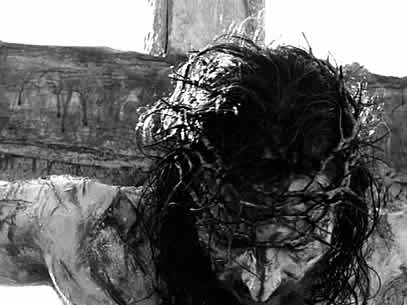
If Christianity can be said to have a “Sinai event” it is the crucifixion (or can we also include the resurrection?). Not that we were all there. In fact, the vast majority of people who were in the general vicinity were Jews, who came from every corner of Israel and the diaspora for the festival of Passover.

On the other hand, every Jew, even today, is to consider himself or herself as having stood personally at the foot of Sinai to receive the Torah. Why not (and this is just my imagination speaking) consider every Christian and every disciple of the “great Rebbe of Nazaret”, the most righteous tzaddik of all generations; why not consider us all as having stood at the foot of his execution stake personally, each of us as a witness to his bloody, sacrificial death on our behalf?

The Death of the MasterWe sometimes call Jesus our “living Torah” since he embodied the lifestyle of one who was fully human yet fully obedient to God and without sin. If the giving of the Torah at Sinai to the Jewish people unites them as one, does not the giving of the blood of the living Torah at Golgotha, the place of the skull, unite the disciples of Christ?

There’s a problem of two separate people groups under God and two separate events. Do the Jews have Moses and the Gentiles have Jesus? Are there two “Messiahs”? Not ultimately, for we all spring from a single root (Romans 11) and we are all branches on the same tree. More than that, Jesus came for the lost sheep of Israel and Paul went first to the Jew and then to the Gentile. The Jewish Moshiach came for the Jews and also came to unite all of humanity under God.

But every year, when they sound the shofar at Rosh HaShana it is revealed, a new revelation of infinite life is drawn to the world, beginning with the Land of Israel (see Tanya, pg. 239).

That is why the Torah says G-d’s eyes are on the Land of Israel from the beginning of the year to the end; it is referring to this new flow of life begun each Rosh HaShana.

And why will the Patriarchs be revived in Israel? Because as the ultimate Jews they will link and reveal the holiness of the people of Israel to the Land of Israel.

But this will only happen through our efforts to transform the entire world into holiness NOW — that is, to make Israel everywhere and prepare the world for Moshiach.

Because ONLY Moshiach will bring the Jews to Israel when the Great Shofar will be sounded by HaShem Himself.

We just have to do all we can in thought, speech, and action to bring . . .

Moshiach NOW!

-Rabbi Tuvia Bolton
Commentary on Parashat Eikev (5766)
Ohr Tmimim

Then the angel showed me the river of the water of life, as clear as crystal, flowing from the throne of God and of the Lamb down the middle of the great street of the city. On each side of the river stood the tree of life, bearing twelve crops of fruit, yielding its fruit every month. And the leaves of the tree are for the healing of the nations. No longer will there be any curse. The throne of God and of the Lamb will be in the city, and his servants will serve him. They will see his face, and his name will be on their foreheads. There will be no more night. They will not need the light of a lamp or the light of the sun, for the Lord God will give them light. And they will reign for ever and ever. –Revelation 22:1-5