A Sense of Balance Between Justice and Mercy

lady-justiceThere is a basic principle found in the writings of the Rambam (Hilchos Daos) and other classic Torah sources: “Act the way you wish to be and you will become that way.”

We are influenced by our actions. Take, for example, someone who wants to become a kinder person. By doing many acts of kindness over time, the person actually becomes an authentically kinder person.

Each day write down at least ten positive actions that you did. Write down kind words and acts, blessings that you said mindfully, and positive things that you did even though they were hard to do. Write down when you felt grateful, and when you refrained from saying something that would cause another person distress. Write down an encouraging telephone call that you made.

What will happen when you are resolved to write down ten positive actions each day? You will go out of your way to do them. This will have a cumulative effect on your self-image.

Daily Lift #992
“Act The Way You Wish To Be”
Aish.com

Where have we gone wrong? Why is the world of religion a world of struggle between religions? Why is the world of religion a struggle between the religious and the secular, between the righteous and the unrighteous, between those who are “in” and those who are “out,” however we choose to define those terms?

This “daily lift,” is a quote from Rabbi Zelig Pliskin’s book Build Your Self-Image and the Self-Image of Others (Artscroll, Chapter 11)  and says that in order to become the person we want to be, we should start behaving like that person.

We often wait to change our behavior until something internal changes, but the exact opposite is being suggested here. I’ve heard it said that we are what we think, but Rabbi Pliskin is saying that we are what we do, even if it isn’t necessarily what we also think (or feel).

If you want to be a kinder person, perform more acts of kindness. If you want to be more loving, show more acts of love. If you want to acquire any quality, behave as if you already possess that quality. Make lists of things you can do. Ponder them. Imagine yourself doing such things. Then do them. As Gandhi is supposed to have said, be the change you want to see in the world.

What is unsaid but should be obvious, is that we already are what we do. If we act with kindness, then we are a kind person. If we treat others poorly and with disdain, then we are a disdaining person. Look at anyone around you. Watch what they do particularly when they don’t think anyone is looking (everyone can “fake it” for an audience, at least for a while).

Look in the mirror. Watch yourself. Be your mirror in your mind as you go through your day, as you drive to work, as you talk to different people, as you react to a homeless person asking for money, as you talk to your spouse. How do you behave? How do you treat others? How do you speak to them? What are you thinking about them? What do you tell yourself about them? What do you tell others about them, especially in private?

That is who you are.

Who am I?

Not a perfect person, certainly. I have faults. I see them in my mirror. I strive to be more. I want to be the person God sees in me, the person He created me to be. I wonder if I’ll ever get there?

No-MercyI desire mercy because I really need it. I desire justice in our world, but I want God to temper justice with mercy. That’s because justice without mercy is merciless. Justice without mercy may still be just, but it is also cruel and as we’ve seen in a million images, it is also blind. People who are overly zealous for justice at the cost of mercy believe the ends justify the means, no matter what those means may be.

I don’t want to be merciless, cruel, or blind, but sometimes, when I show mercy, I’m accused of abandoning justice. That’s not true, at least I think it’s not true. Mercy without justice carries its own problems. Mercy without justice is permissive, lawless, amorphous, undefined, and ultimately Godless. Mercy without justice allows every type of behavior, no matter how lawless, and calls it all good. It is also blind, but to any and all faults and even to sins. Mercy without justice may sound good, and there are even some religious groups that worship mercy, permissiveness, inclusion, and progressiveness, even before God, while leaving justice in the gutter.

I solemnly charge you in the presence of God and of Christ Jesus, who is to judge the living and the dead, and by His appearing and His kingdom: preach the word; be ready in season and out of season; reprove, rebuke, exhort, with great patience and instruction. For the time will come when they will not endure sound doctrine; but wanting to have their ears tickled, they will accumulate for themselves teachers in accordance to their own desires, and will turn away their ears from the truth and will turn aside to myths.

2 Timothy 4:1-4 (NASB)

You cannot follow God unless you pursue mercy and justice together.

It is said that when God created the world, he used both the attribute of justice and the attribute of mercy. However, it is also said that He biased His creation with just slightly more mercy than justice.

If there was more justice and little mercy, the world would not survive. If there was more mercy and little justice, the world would be lawless and chaotic. If justice and mercy were equal, we would have no model to teach us how to make room in our own hearts so that even in being just, we could still show mercy to others, just as our just God shows us mercy that we don’t deserve.

But just the smallest amount of mercy must outweigh God’s vast justice for people to have law and an order of things, but to still be allowed to make mistakes and yet survive.

Justice is required to confront evil when it is popular among men to call evil things “good.” Mercy is required to allow people to make mistakes and yet to recover from God’s judgment as well as from human judgment (which is often less merciful than God’s).

We all make mistakes.

micah6-8Look at yourself in the mirror. Who are you? Are you more just than merciful? Are you more merciful than just? How are these two qualities balanced within you? Heaven help you if you are just one or the other. I’ve met both sorts of people. They can be very self-righteous and very scary.

If it is true about how God created the world, with generally a balance between justice and mercy, but with mercy edging out justice by just a tiny bit, then how should these qualities be distributed in us?

Do not take revenge nor bear grudge among your people, and you should love your neighbor as yourself, I am God.

Leviticus 19:18

This verse may well be the Torah’s most difficult demand. The Talmud gives an example of revenge: someone refuses to give you a loan; then, when he or she asks you for one, you say, “I will not lend you money because you turned me down when I was in need.” Bearing a grudge comes when you do give the person the loan, but say, “I want you to see that I am more decent than you. I am willing to lend you the money, even though you did not give me that consideration.” The Torah forbids both reactions; we must loan in silence.

R’ Moshe Chaim Luzzato says that revenge is one of the sweetest sensations a person can have, and that the Torah’s demand that we suppress this impulse is asking us to virtually be akin to angels (Path of the Just, Chap. 11). Still, the fact that we are required to do so tells us that this level of control is within our grasp. The key to this is contained in the end of the verse cited above.

The Torah wishes us to consider the other person as we would ourselves. For example, if a person stubbed his toe and felt a sharp pain, he would hardly hit his foot as punishment for having hurt him. Just as we would neither take revenge nor bear a grudge on a part of our own body, we should not do so toward another person.

Today I shall…

…try to think of other people as extensions of myself, and avoid responding with hostility when I am offended.

-Rabbi Abraham J. Twerski
“Growing Each Day, Cheshvan 30”
Aish.com

Rabbi Pliskin says that we should behave as we want to be. Rabbi Twerski says we should treat others as an extension of ourselves. Even the Master quoted Leviticus 19:18 as did Rabbi Twerski, when rendering the two greatest mitzvot (Matthew 22:37-40).

We hang in the balance between justice and mercy, between loving God and loving our neighbor. If we swing too far over to either side, we are no longer balanced. We just fall.

For more on balance including the terrible consequences of a life out of balance, please read Rabbi Yanki Tauber’s short article The Jealous Neighbor.

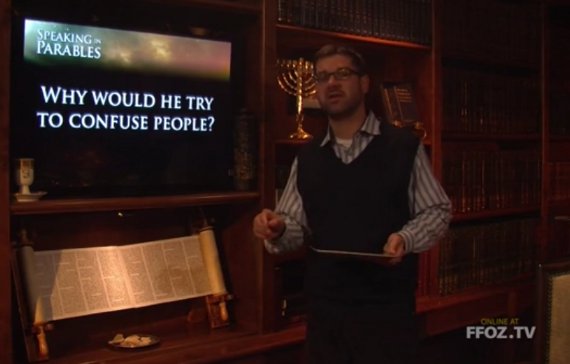
FFOZ TV Review: Speaking in Parables

ffoz_tv18_mainEpisode 18: It may be surprising to many Christians that the use of parables was not unique to Jesus but was rather a Jewish literary art form that had been developed over centuries. Viewers will learn in episode eighteen that Jesus used parables not as riddles but stories to help clarify his points. Jesus’ parables attempted to make it easier for his listeners to grasp his words. Like the other rabbis of his day, Messiah used parables to serve as simple explanations and illustrations to help us understand his message about the kingdom.

-from the Introduction to FFOZ TV: The Promise of What is to Come
Episode 18: Speaking in Parables

The Lesson: The Mystery of Speaking in Parables

This is another First Fruits of Zion (FFOZ) perspective on a common “attribute” of Jesus, in this case, how he taught using parables, that for me, revealed more about how Christians think than about the topic itself. I always assumed that the parables of Jesus were metaphors designed to communicate complex concepts and ideas in a simple manner. This is probably because in my previous career as a psychotherapist, using metaphors was a common method I employed to accomplish the same thing.

But apparently, it’s generally understood in the Church that Jesus used parables to confuse his listeners and to hide the truth from the Jewish people. He spoke in riddles in order to prevent the Jews from repenting and returning to God, which, if repentance had occurred, would have resulted in Israel entering the Messianic Age.

According to FFOZ teacher and author Toby Janicki, it’s easy to understand why modern Christians might get that idea:

His disciples approached him and said, “Why is it that you speak to them in parables?” He answered them and said, “Because to you it is given to know the secrets of the kingdom of Heaven, but to them it is not given. For to one who has, it will surely be given, and he will have extra, but for one who does not have, even what he does have will be taken away from him. That is why I speak to them in parables. For in their seeing they will not see, and in their hearing they will not hear, nor do they even understand.

In them is fulfilled the prophecy of Yeshayah that says,

‘Listen well, but you will not understand. Look closely, but you will not know. Fatten the heart of this nation, and make its ears heavy and seal its eyes, so that it will not see with its eyes or hear with its ears or understand with its heart or repent and be healed’.”

Matthew 13:10-15 (DHE Gospels)

ffoz_tv18tobyThis seems to be another case of misunderstanding what appears to be a plain message because we are not approaching the words of the Master using a historical, cultural, and Rabbinic Jewish lens. Toby used to introduce himself in earlier episodes by saying he is a Gentile who is practicing Messianic Judaism, but in the past few episodes, he has described himself as a Gentile who studies Messianic Judaism. I’m becoming increasingly convinced that such a framework is truly required by Gentile Christians if we’re ever to get past our own cultural and historic misconceptions of the Gospels and hear and understand what Jesus is actually saying to his original audience and to us. Maybe we could use a few parables to get that message through our own “thick skulls.”

Toby said the way to understand Matthew 13:10-15 is to go to the section of the Book of Isaiah from which Jesus was quoting:

He said, “Go and say to this people, ‘Surely you will hear, but you do not comprehend; and surely you see, but you fail to know. This people is fattening its heart, hardening its ears, and sealing its eyes, lest it see with its eyes, hear with its ears, and understand with its heart, so that it will repent and be healed’.”

Isaiah 6:9-10 (Stone Edition Tanakh)

Toby told his audience that the conjunction “but” as in “but you do not understand” would better be rendered as “and”. If we substituted the word “and” for “but” in the scripture from Isaiah 6, it would read more like God telling Isaiah that He wants the prophet to relate a message of repentance, but that the people are not going to listen to him.

Otherwise, it looks like God is saying, through Isaiah, that He wants the people to repent, but He also is making it impossible for them to hear the message and obey. Sort of a cosmic “bait and switch,” with God playing the role of the infinite trickster in relation to Israel. This is very reminiscent of how some Christians say God only gave the Torah (Law) to Israel to prove to them that it was impossible to obey, setting them up to understand why they needed grace and Jesus Christ in order to be saved; setting them up to realize that the Torah was never, ever meant to be a permanent lifestyle for the Jewish people, even though the Torah, Prophets, and Writings are replete with messages indicating that both the Torah and the Jewish people would forever exist before God.

Jesus quoted Isaiah 6:9-10 in order to explain that he was like Isaiah, a prophet preaching repentance to an Israel that was already spiritually blind and deaf, unable to see or hear or understand in order to repent and be healed (although in a Jewish context, being healed wasn’t just individual salvation, but the healing and restoration of the entire nation of Israel).

We have arrived at the first clue:

Clue 1: Jesus did not use parables to blind eyes or deafen ears.

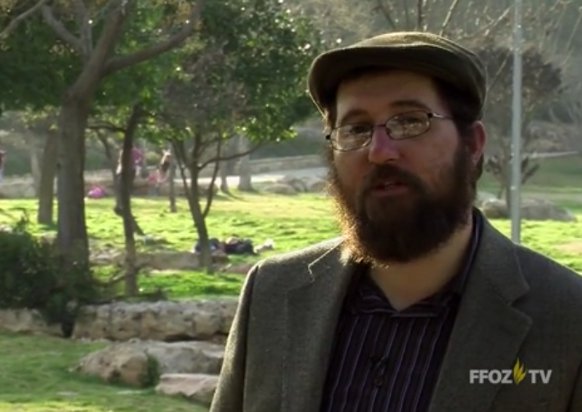
ffoz_tv18_aaronIn fact, the opposite seems true. Jesus knew his audience was already spiritually blind and deaf, and maybe he thought using simple parables instead of complex theological arguments would make the message of repentance and restoration easier to understand.

But what exactly is a parable and who typically uses it as a teaching method? For the answer to that question, the scene shifts to Israel and FFOZ teacher and translator Aaron Eby.

Aaron said that parables were used long before Jesus as a common teaching tool by prophets and even by other Rabbis who were contemporaries of the Master. Aaron quotes Ezekiel 17:12 and the parable of the eagle that plucks off a treetop (watch the episode to hear Aaron’s explanation of the parable) to make his point.

Aaron related that the word for parable in Hebrew is mashal, and that the Sages often used a mashal to explain something that was highly conceptual and difficult to understand. Aaron, like Toby, told his listeners that a mashal was designed to make something easier to understand, not take a plain idea and turn it into a riddle. In fact, in the day of Jesus, it was completely normal and expected for a Rabbi to teach using parables, so the disciples and followers of Christ expected it.

We return to Toby in the studio and come to the second clue:

Clue 2: Parables were a common teaching device used to simplify complex concepts.

Toby takes us to another Gospel scripture to further explain why Jesus taught in parables:

With many parables like these, he spoke to them the word according to what they were able to hear. Other than with a parable, he did not speak to them. But when his disciples were with him and no one else was with him, he would explain everything to them.

Mark 4:33-34 (DHE Gospels)

This still seems like Jesus is using parables to obscure the truth but explaining everything to his disciples privately, however Toby said we need to consider another perspective. One that, once I heard it, I realized I’d been taught before.

The Rabbis of that time taught using a dual teaching method. They taught the common people, the simple farmers and shepherds, using parables in order to make difficult theological issues better understood. However to the disciples who continually studied under their Rabbinic Master, the teacher would relate these same concepts in a more formal and legal manner, since they were better equipped, being the Master’s students, to understand in greater depth.

Clue 3: Jesus taught the common people as they were able to hear him.

Remember that Mark describes Christ’s use of parables as, “he spoke to them the word according to what they were able to hear.” He used parables because that’s what the people were able to hear. They wouldn’t have understood a more detailed and technical explanation in the same way the disciples understood.

What Did I Learn?

ffoz_tv18_dhe_markosI had a basic understanding that parables were metaphors in the purpose of their use, but this episode presented parables and their nature in greater detail than I had access to previously. It’s also another example (for me) that God does not desire to hide information, to trick people, to be an agent of confusion, but rather, He wants us to understand, to trust, to believe, and to realize that a Sovereign God is a just and honest God. Sovereignty doesn’t mean God will pull a “bait and switch” just because He’s entitled to as Creator of the Universe.

I also saw again how in lacking a proper Jewish contextual, legal, historical, and cultural framework when we read the Apostolic Scriptures or any other part of the Bible, we will misunderstand, sometimes tremendously misunderstand, who Yeshua is, what he taught, and why he taught it. The Messianic “good news” will be tinted an alien shade of “Gentile,” resulting in a “Goyim-friendly” New Testament that is required to remove continual Jewish Torah covenant obligation so that it can be replaced with something newer and “better.”

As I said before, when Toby introduced himself as a Gentile who studies Messianic Judaism, it revealed something about me and how I approach my faith. I really do believe and accept the FFOZ premise that Messianic Judaism is a method by which non-Jewish believers can and must study in order to comprehend God, the Messiah, the Bible, our Jewish companions in the faith (and outside the faith), and ourselves better. Otherwise, we’re missing out on a great deal of understanding and truth.

I don’t think anyone intended this part of the episode to be adapted in this way, but I wonder if when Jesus (and Isaiah before him) said that “this nation, and make its ears heavy and seal its eyes, so that it will not see with its eyes or hear with its ears or understand with its heart or repent and be healed,” they realized these words could possibly be applied to much of the Christian church today?

Oh, one more thing. The top image on each of these FFOZ TV reviews is just a screenshot, not an embedded link to the video. The link to the video is just under the italicized introduction to the review as the title of episode, such as in today’s case, Episode 18: Speaking in Parables.

The Challies Chronicles: John MacArthur and Joni Eareckson Tada

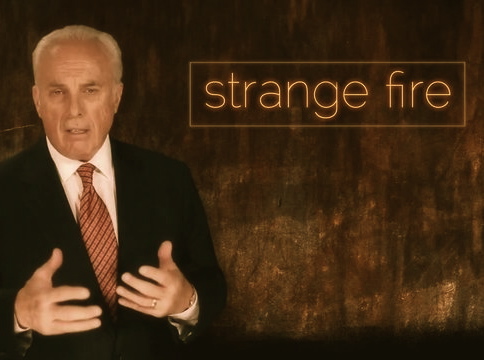
macarthur-strangefire-confJohn MacArthur opened the Strange Fire conference, and then, for the second session introduced Joni Eareckson Tada as a friend and former member of his church. She was at the conference to share her testimony of living as a quadriplegic who has prayed for, but not received, a miraculous healing. As MacArthur said in his closing comments, if anyone has the faith to be healed, it must be her. In a sweet and spontaneous moment, Joni called MacArthur to the stage and, hand-in-hand, the two sang a couple of stanzas of “O Worship the King” together. I have been to a lot of different conferences, but that will now rank as one of my all-time favorite moments.

-Pastor Tim Challies
“Strange Fire Conference: Joni Eareckson Tada,” October 16, 2013
Challies.com

This is the second part of my Challies Chronicles series, an analysis of Pastor John MacArthur’s Strange Fire conference as “live blogged” by Pastor Challies.

I’m also more or less “live blogging,” in that I’m writing as I’m reading, giving you my impressions as they occur. I want to be fair to MacArthur and I feel that, using Tim Challies as my source, someone who, as far as I know, should be sympathetic and supportive of MacArthur’s views, I am avoiding those bloggers and other pundits who tend to be “anti-MacArthur” to accomplish the purposes of this project.

All that said, being fair doesn’t mean I always have to agree with MacArthur or the other presenters at Strange Fire.

Joni Eareckson Tada

I assume that by having Ms. Tada present her testimony that MacArthur was attempting to refute faith healing in the present age. While I agree that there are just a boatload of charlatans out there who claim “the healing power of Jesus,” and who say they can cure anything from acne to brain tumors by the laying on of hands (and giving a bunch of money as a “love offering”), there seems to be more to Tada’s story:

Even today she often has well-meaning charismatics who come up to her and pray for her healing. Though she never says no, she does always ask them to pray for specific things and then highlights character issues. Will you pray for my bad attitude? Will you pray for my grumbling? She means to show them that she is far more concerned with indwelling, remaining sin than chronic pain and legs that do not work.

She went on to describe a trip to Jerusalem and going to the very place where Jesus had healed that paralyzed man so many years ago. And there, in a moment alone, she found herself praying to God to thank him for not healing her, because a “no” answer to her requests for physical healing had purged so much sin, selfishness, and bitterness. That “no” answer left her depending more on God’s grace, has given her greater compassion for others, has reduced complaining, has increased her faith, has given her greater hope of heaven, and has caused her to love the Lord so much more. She sees the joy of sharing in his suffering and would not trade it for any amount of walking.

What do we really want to be healed of, our physical problems or our spiritual problems? Do we need to be healed of cancer or given the “medical procedure” of a circumcised heart?

And they brought to Him a paralytic lying on a bed. Seeing their faith, Jesus said to the paralytic, “Take courage, son; your sins are forgiven.” And some of the scribes said to themselves, “This fellow blasphemes.” And Jesus knowing their thoughts said, “Why are you thinking evil in your hearts? Which is easier, to say, ‘Your sins are forgiven,’ or to say, ‘Get up, and walk’? But so that you may know that the Son of Man has authority on earth to forgive sins”—then He said to the paralytic, “Get up, pick up your bed and go home.” And he got up and went home. But when the crowds saw this, they were awestruck, and glorified God, who had given such authority to men.

Matthew 9:2-8 (NASB)

struggling_prayOnly God forgives sins and so I also believe only God can miraculously heal. Even if we say, as I can only believe MacArthur says, that the age of miraculous healing is done and that God does not heal anymore in a supernatural sense, I have a question. Why do we pray for people when they are hurt or sick?

Actually, I have no idea if MacArthur prays for the sick, although I certainly hope he visits them because I don’t think that type of kindness we see in the Bible was ended when New Testament canon closed.

I go to a fundamentalist Baptist church. I imagine MacArthur would be comfortable worshiping there. And yet, in the bulletin they pass out to me as I enter the doors of the church for services every Sunday morning, there is a multi-page paper containing many, many prayer requests.

At the top of the list, we are to pray for our President, our other Government representatives and so on. Then there’s a list of missionaries we should pray for. After that, there are multitudes of requests from people in the church about others in the church, family members, friends, and so on, most of whom suffer from terrible medical situations.

When I go to Sunday school after services, the teacher begins class by asking for prayer requests. Again, usually people’s medical problems are brought up, people facing surgery, people with chronic illnesses, people who are dying.

Why do we pray for them if we don’t, on some level, want God to heal them? Sure, sometimes we pray for someone’s salvation. Sometimes we pray for someone who is in a spiritual crisis of one kind or another, but most of the time, we pray for people who are sick.

I know from my own experience, that most if not all of the terminally ill people I have prayed for have died. I know that’s cruel to say, but that’s my experience. Why did I pray for them? What was the point?

I can see how the whole “faith healing” process has been hijacked and abused and I most certainly don’t advocate for frauds and hucksters who prey upon the illness and weakness of others for financial gain, but I do take exception to the idea that we aren’t supposed to pray for people who are hurt (and I’m not quite sure MacArthur would actually advocate that position). I also take exception to the idea that God can’t or won’t heal someone supernaturally.

I don’t say these healings occur regularly or we can predict when they will happen. If they happen at all, they probably do so infrequently and without any way to know when a person will or won’t be healed. And yet we hope. And yet we pray. And yet we rely on God to have mercy, and beg Him to heal, if not the loved one who we know is about to perish, but our grieving soul when we are left behind and alone.

Yes, as we read Matthew 9:2-8, above all, God desires to heal the soul, to forgive sin, to bring about redemption, to circumcise the heart of stone and give the sinner a heart of flesh.

None of that means we like to see our loved ones suffer physically. None of that means we aren’t compelled to pray for them, to ask and even to beg God to cure a four-year old little girl of leukemia or some other horrible, life-threatening ailment.

Then his servants said to him, “What is this thing that you have done? While the child was alive, you fasted and wept; but when the child died, you arose and ate food.” He said, “While the child was still alive, I fasted and wept; for I said, ‘Who knows, the Lord may be gracious to me, that the child may live.’ But now he has died; why should I fast? Can I bring him back again? I will go to him, but he will not return to me.”

2 Samuel 12:21-23 (NASB)

plead1It’s a terrible thing to think that God would cause a newborn baby to die because of the sins of his father. I’m not sure how else we can interpret the events about the child David and Bathsheba conceived together in the shadow of adultery and murder. But while the child was alive, David prayed and fasted and wept, but the child died anyway.

The Lord gave and the Lord has taken away, blessed by the name of the Lord.

Job 1:21

That has to be one of the most bitter prayers recorded in the Bible, and yet it is reflected in the grief of David and in the grief of anyone who has lost a loved one.

How can I not pray from the “brokenness” of my heart?

I think Ms Tada’s point was well made. I know that living with a long-term and severe medical problem can actually bring a person closer to God, can make the relationship stronger and more intimate. I’ve seen such a thing happen to a man I know. But it’s still a bittersweet thing. That doesn’t mean God doesn’t want to heal the injured or comfort the grieving. That doesn’t mean that sometimes, in accordance with His will, God doesn’t provide us with what we need, and even what we ask for out of His abundant grace, power, compassion, and pity.

I don’t know what MacArthur was trying to accomplish by presenting Ms. Tada on stage at his conference. What he accomplished, at least for me, is to remind me of how fragile life is and how we all rely on God to help us when our problems are so much bigger than we are. If MacArthur meant to indict the Pentecostal church for false advertising, I missed that part of the message.

The Door and the Capstone

messiah-prayerYeshua has been exalted to the Father’s right hand (to the position of supreme authority) to bring Israel to repentance and forgiveness, but repentance and forgiveness for what? This is a very important question, and one that is almost never asked or answered. Let’s do that today!

In part the answer you give to this question will be based on your presuppositions and your theological conditioning. Many people will reflexively say, “to repent for not having received him when he first came.” But is this answer satisfactory? I am afraid the answer must be, “Not at all!” That is, not if you want to be consistent and logical! Why am I saying that this reflexive answer is inadequate?

-Stuart Dauermann
“The Risen Messiah and Israel’s Return to Torah”
Interfaithfulness.org

I hope I don’t make a complete mess of the points Dr. Dauermann made in his blog post, but when I read it, a whole area of questions and (hopefully) answers opened up in my mind. One of the questions was one that some Christians ask me from time to time: “Why do Messianic Jews need Jesus?”

With all of the emphasis on Torah and Torah observance seen in the Messianic Jewish and Hebrew Roots worlds, it can look to an outside Christian viewer like Messianic Jews don’t require Jesus for personal salvation. It’s actually an interesting question, because prior to the first advent, there was a perfectly acceptable system in place for Jewish people to be reconciled to God and have their sins forgiven. That system had existed (off and on, relative to the destruction and rebuilding of different versions of the Temple) for thousands of years.

Then suddenly, Jewish and Biblical history seemed to take a sharp left-hand turn:

Jesus said to him, “I am the way, and the truth, and the life; no one comes to the Father but through Me.

John 14:6 (NASB)

All of a sudden, the system that God established many, many centuries before was no longer good enough. Faith and devotion to God (the Father) wasn’t good enough. An additional requirement was attached to the list, one that was never presupposed in the Torah and the Prophets. A very specific faith in and devotion to the Messiah, Son of David.

Progressive Revelation could probably answer that one, but I have problems with the concept. I have problems with the idea that I, as an average Christian guy with no special religious education or background, could know God more fully than a man like Abraham who was called God’s friend, or Moses, who was the greatest prophet ever known in Israel. But progressive revelation says I know stuff that those guys never had a clue about.

I don’t think the Bible could be that disjointed. If the entire Bible we have today is all “God-breathed,” then it can’t contradict itself. The Tanakh (Old Testament) mentions little or nothing about personal salvation. Any redemption, reconciliation, and restoration recorded in its pages all has to do with the redemption of Israel, the nation, the people as a body, as if they were all one man.

I know exactly why I need Jesus and what he provides me, because I had no hope of a relationship with God before Messiah. Every single Jewish person who has ever lived was born into a relationship with God, whether they choose to acknowledge that fact or not.

But what are we supposed to do about John 14:6?

His first sign fails to place the Messiah into proper perspective as the Jewish king who must remain subservient to HaShem. I know how it comes about that non-Jews in particular feel the need to focus on the Messiah as the center of their spiritual universe. I will describe it in terms of entering into a house. When one’s goal is to enter a house, one’s focus must be on the door as its key feature. Rav Yeshua identified himself as the door through which all who wish to approach the Father must enter (viz:John 14:6). But once one has entered, the door must no longer remain the primary focus of attention, because the purpose of entering the house is further inside. Continuing to focus on the door turns one back toward the outside rather than toward the original goal inside. There are reasons for doing both, but the priority is inside rather than outside. But those who remain outside, as in a regrettably real manner Christians have done for many centuries, cannot see the Father who is behind the door but can see only the door. Perhaps it might be said that their relationship with the Father inside consists solely of speaking through an only partially-opened doorway. Thus they continue to view the door itself as their central focus.

Now, I must caution everyone not to make of this analogy anything more than an illustration. It is not intended as an allegory of salvation, or the kingdom of heaven, or any other particular notion. It is not intended to deny the validity of anyone’s spiritual relationships or intentions. Its sole purpose is to challenge a too-narrow focus that misses a bigger picture. For all the splendid significance of the Messiah, and his impact on everything, he is not himself everything. The Father is where everything consists and exists, and too many fail to “grok” Him and this perspective.

Gateway to EdenI’m quoting from a Jewish person’s comment on one of Derek Leman’s blog posts. This comment drew some immediate criticism, since it seems to devalue Jesus in favor of God the Father, so the commenter followed up by saying, “One does not denigrate the door by focusing on the object for which the door exists. The door will always be the means for entering in. The question is whether one will do more than merely enter.”

I’ve provided the link above to the blog post in question so you can read the entire record of comments for additional context. However, I believe we can take an added dimension to John 14:6 out of this. It may not answer all of the questions we have about Jewish access to God pre vs. post-Jesus, but I think the metaphor gives us a better understanding of Jesus as a “door.”

Saying that the sin[s] for which Yeshua was exalted for to bring Israel to repentance and forgiveness was/were the sin[s] of not accepting Him when he first came is also inadequate when considered against the broader background of scripture. Is the Messiah connected in any manner with dealing with sin more broadly considered, and is the repentance with which He is connected specifically identified anywhere? The answer is “Yes.”

The Messiah is our sin-bearer, and it is a form of crazy circular reasoning to imagine that the sin which he bears on our behalf is our failure to receive him. While we shall see that this is part of Israel’s sin, it is NOT the aspect of Israel’s sin that is in focus here.

Now we can return to Dauermann and his perspective of the Jewish Messiah and Messiah’s role in Israel’s redemption. Is it only personal salvation, one individual at a time and nothing else? Was the sin that Israel committed that Jesus must atone for Jewish rejection of Jesus? I agree with Dauermann. That’s crazy. Did the sin that Jesus came to save the rest of us, the non-Jewish world, from the rejection of Jesus…or all of our disobedience before God?

The entire Book of Ezekiel chronicles how Israel fell away from life with God through rejection of his commandments. In this, I like to quote from biblical scholar Preston Sprinkle who demonstrates how Ezekiel clearly teaches that just as Israel’s deterioration and exile, a form of national death, was connected with her failure to walk in the statutes and judgments of Torah, so her national resurrection and renewal would necessitate a divinely engineered national return to obeying the very same statutes and judgments, the nuts and bolts of Torah living. It is not that Israel causes her return to the Land through her return to his statutes and judgments, but that Israel is restored to the land where she is restored to Torah obedience and life with God.

This is what I get out of Ezekiel as well, and it adds to the picture of Messiah and Israel’s redemption I’ve been trying to paint in one way or another for the last eighteen months. Israel’s sin historically has always been its failure to walk in God’s commandments and statutes, the Torah. God has always called Israel back to Him through Torah. Messiah’s Gospel message was always, “Repent, for the Kingdom of Heaven is at hand,” (Matthew 4:17). Repent of what sin? Failing to walk in God’s laws. Yeshua atones for Israel’s sin of failing to walk in the Torah and calls his people Israel to return to God’s statues.

Messiah’s first coming ushered in the very beginning of the New Covenant, but the enactment of the New Covenant, as described in Jeremiah 31, is a process, not an event. It won’t be completed probably until the second coming of Messiah. It is true that God never intended that only the blood of bulls and goats should be the eternal atonement for Israel. Messiah was required for a better and permanent atonement, just as the New Covenant is God’s law written on the circumcised heart, not merely on a scroll, but he doesn’t “undo” all that God previously decreed, including the Torah, the Temple service, and the primacy of national Israel.

Messiah adds to and completes the framework of Israel, the litany of prophesies, the entire collection of promises God made to the Jewish people from Abraham forward. Messiah is the culmination, the capstone, the piece to the house that, at the very top of the structure, holds everything together, allowing all of the other parts to rest against him, and he supports everything.

Capstone archIn a very real way, the capstone is also the doorway into the structure. Without the capstone, everything that was built, everything from Genesis through Revelation, would fall apart. That includes Israel, the Torah, Judaism, the Jewish people, the grafting in of Gentiles, all that there is that God has intended to accomplish. You don’t pour the foundation, let it set, build the house on it, put the final piece, the capstone, in place, and then pull the foundation out from under the house. It would collapse as if built on sand instead of cement. The capstone doesn’t take the place of any of the other pieces, but it is the key piece that ensures all of the other pieces stay solidly in exactly the positions they need to be for the structure to stand.

In that sense, you could say that everything God built before the coming of the Messiah was important and even vital to the overall structure, but it was incomplete. You can also say that even though the capstone exists and is being laid in place, it is not in its final position yet. Otherwise everything that needed to be done would be done, and we would have no need for a second coming. We would already be living in complete and eternal peace.

And a quick look at the world around us tells me that hasn’t happened yet.

Now I have a better image in my mind of the role of Messiah, both for the Jew and for the Gentile. Piece by piece, I’m putting my puzzle together and seeing what the picture that’s forming is telling me. Day by day, I’m getting a better understanding of who Messiah is and the multi-level set of roles he has played, is playing, and will play in our world and how he fulfills the need of all mankind as a doorway into the house of God and in holding together that house.

Perhaps the very universe itself would cease to exist if the capstone were to vanish. Perhaps we would all be locked outside in the cold and dark without the presence of a doorway. All we have to do is open the door and go inside. All we have to do is realize that the capstone gives us absolute assurance that we live in the strong and comforting shelter of the Rock.

The Challies Chronicles: MacArthur’s Strange Fire Keynote

elephant-in-the-living-roomIt’s the elephant in the room, isn’t it? We can’t all be right and we can’t both be right. Sooner or later we have to have a discussion about charismatic (continuationist) theology and whether or not the miraculous gifts of the Holy Spirit remain in operation in the church today (or, if you prefer, about cessationist theology and whether or not the miraculous gifts of the Holy Spirit have ceased in the church today). We have wanted to make sure New Calvinism is large enough for both, that it will not fracture along this particular line, and this has delayed the conversation. But at some point we just have to talk about it.

John MacArthur is forcing the issue with a book and a conference titled Strange Fire. The conference is still several weeks away and the book will not be widely available until a few weeks after that. However, I recently received an advance copy of the book and have read it a couple of times now. I want to begin a conversation today, and my purpose is really to get an idea of how people feel about the whole issue.

Tim Challies
“John MacArthur and Strange Fire” (September 26, 2013)
Challies.com

I want to be fair. I imagine that there are some of you out there who don’t believe me, who find me terrifically unfair because I don’t agree with you, but I really do want to be fair. That’s why I’m posting this.

Not to long ago, I aimed more than a little criticism at MacArthur, Strange Fire, and the battle to control the Christian mind on my blog. My Pastor felt I wasn’t giving MacArthur the benefit of the doubt or looking at the positive aspects of his conference. He recommended Pastor Tim Challies and his blog as a good counterpoint to MacArthur’s critics.

If found out that Challies had a lot to say about Strange Fire. As far as I can tell, I quoted from his first blog post on the topic, before the conference even took place. It helps to address this Pastor’s impressions of Strange Fire in a chronological order. I guess he attended the conference and live blogged the different speakers.

I won’t attempt to blog on everything Challies wrote, but I do want to try to get a representative sample, just to get the flavor of what was said. Of course (please forgive me), I don’t expect Challis to be entirely objective (who is?) so part of my analysis will be of Challies as well as of the conference and the presenters who offer their own “fire,” so to speak.

For me, the issue isn’t who is right and who is wrong, but whether or not MacArthur was “playing fair” for the sake of edification and education. Was he being fair or could there have been other motivations? It’s possible the “Challies chronicles” will reveal this, but I don’t know for sure.

Challies’s pre-conference intro to Strange Fire won’t reveal much except at the very end. After Challies wrote his missive, MacArthur reviewed it and asked him to append one brief statement:

Tempting as it might be for my Reformed continuationist friends to read the last chapter first, that would be a mistake. The points in that chapter might seem arbitrary to someone who has not read the preceding material. Those early chapters trace the roots of charismatic teaching; they show the biblical rationale for cessationist conviction; and they demonstrate why aberrant doctrines and practices are not minor, occasional anomalies but the inevitable fruits of charismatic presuppositions. Anyone predisposed to disagree anyway would probably find it easy to be dismissive if they skipped to the end first. The final chapter is simply the logical conclusion to the arguments set forth in all the others.

I suppose that’s also a matter of being fair to MacArthur.

John MacArthur’s Opening Keynote

john-macarthurIn reading Strange Fire Conference: John MacArthur’s Opening Address, I found out I was wrong. Challies did not attend, but listened via Strange Fire site. Unlike Challies, I don’t have time to listen to hours and hours of audio recordings, so I hope he took good notes.

When people ask MacArthur for his view on the biggest issue in the church, he always says it is the lack of discernment since, sadly, a great number of those who profess Christianity are lacking in discernment. The purpose of this conference is to be like the Bereans by looking at the work of the Holy Spirit through the lens of Scripture. He hopes to address it lovingly and compassionately, but in a straightforward way.

I can relate to that. I try to do a lot of studying and judiciously read the Bible. The interesting thing is that, even among people who all have the same intellectual and study emphasis, conclusions about what the Bible says vary, sometimes dramatically. And yet all parties say the same thing MacArthur said in his keynote. The desire to be like Bereans, using the Bible as a lens (then what lens do we use to look at the Bible?), addressing differences lovingly and compassionately…and in a straightforward way.

Why do the results of such words and intentions turn out badly so much of the time?

What is the scope of the issue? There are half a billion professed charismatics on the planet. He pointed out that we feel great freedom to confront Mormons and Mormonism, though there are merely 14 million of them. Yet we hesitate to address 500 million charismatics.

I live in Idaho and I used to live in Nevada. Both states have a large Mormon population. Even after I became a believer, I never felt drawn to confront every Mormon in my environment, which would be quite a lot. Is that what’s required?

He turned to Leviticus 10 to explain the name of the conference and the heart behind it, showing true and false worship from Leviticus 9 and 10.

The sons of Aaron had been given special privilege and were in line for the high priesthood. They seemed so godly and so secure, and yet God consumed them because they offered strange fire, worshipping in a way he did not sanction. What may have seemed like a minor matter was actually a serious and significant sin. This shows that the most serious crimes against God occur in corrupt worship.

I have to say that one thing about MacArthur that bothers me is that he seems so sure of conclusions he can’t possibly be that sure about. Look at his commentary on the sons of Aaron. Christian theologians have been trying to figure out exactly what happened with Nadab and Abihu (yes, they do have names) for ages, and Jewish sages have been studying the incident of these two sons of Aaron (he had four in all) a lot longer, but no one is sure what they did or didn’t do or what the “strange fire” was that resulted in such a dramatic and fatal response from God.

The fire they offered has been translated as “unauthorized,” “wrong kind of,” “strange,” and “unholy.” Most translations follow-up with something like, “which He had not commanded them,” indicating that whatever they did in making their offering, it was not what God asked of them…or maybe it was that they weren’t supposed to make any sort of approach at all right then. Maybe the problem was their timing was bad.

The Lord also said to Moses, “Go to the people and consecrate them today and tomorrow, and let them wash their garments; and let them be ready for the third day, for on the third day the Lord will come down on Mount Sinai in the sight of all the people. You shall set bounds for the people all around, saying, ‘Beware that you do not go up on the mountain or touch the border of it; whoever touches the mountain shall surely be put to death.

Exodus 19:10-12 (NASB)

nadab-abihu-fireThe long and the short of it is, “don’t get too close.”

I say all of this because MacArthur carefully chose the name of his conference and his book. In assessing intent, the symbolism involved and how it’s used can be revealing.

He paused to state that he is not discrediting everyone in the movement. He knows there are charismatics who desire to worship God in a true way. Yet the movement itself has brought nothing that enriches true worship.

That’s an important point. Naturally, discrediting anyone’s preferred method of worship is likely to elicit a harsh or hurt response, but that’s still preferable to naming names, so to speak.

In many places in the charismatic movement they are attributing to the Holy Spirit works that have actually been generated by Satan.

Invoking such a sentiment should be done with care because it’s only one small step from a statement such as that, to one saying anyone who is a charismatic is Satanic and even may be worshiping Satan. No, of course I don’t think MacArthur said that, but when addressing such an emotionally loaded topic, you have to pay attention, not only to what you are saying, but to how you know people will interpret (or misinterpret) your words.

I had to establish a comments policy on my blog recently in order to contain some otherwise negative statements being made. As part of my policy, I issued the following statement:

In Jewish religious tradition, Leviticus 25:17 which states “You will not wrong one another,” is interpreted as wronging someone in speech. This includes any statement that will embarrass, insult, or deceive a person or cause that person emotional pain and distress. Even statements believed to be true and factual but that cause another harm are considered wrongful speech.

You can’t hide behind, “but I’m only telling the truth” if you know that what you’re saying will directly result in injuring people. Something to keep in mind, although in both Judaism and Christianity, this mitzvah is not strictly observed for the sake of “truth.”

In the middle of recording the Keynote, Challies inserted his own commentary:

(Note: I am adding a clarifying note (3:57 PM EST). I do not take MacArthur to mean “nothing good has ever come out of the charismatic movement” but “nothing good has come out of the charismatic movement that is attributable to charismatic theology.”)

I found this part illuminating:

And despite this, Evangelicalism has thrown open its arms and welcomed this Trojan Horse, allowing an idol in the city of God. This idol has fast taken over.

MacArthur then contrasted Reformed theology with the charismatic movement and said that Reformed theology is not a haven for false teachers. It is not where false teachers reside or where greedy deceivers and liars end up.

charismatic-prayerCharismatics, Evangelicals, and Reforms all compared and contrasted in one fell swoop, with Reformed theology coming out on top. But then, anyone holding a conference is going to present their own point of view as advantageous, so I can hardly hold that against MacArthur. Although, being objective and outside of the Reformed theology framework, I wonder how MacArthur can know in absolute terms that there are no “false teachers” within his entire movement, right down to the last man? Also, what’s the difference between a “false teacher” and an erroneous one? Does he believe Reformed theology contains no teachers capable of making a mistake?

Once experience, emotion and intuition become the definition of what is true, all hell breaks loose.

In what seemed to be a brief aside, he called for the restoration of the true worship of the Holy Spirit in the church and said that it is zeal for God’s honor that consumes him here. As he sees and hears this false worship, he feels God’s own pain and wonders why the church won’t rise up to defend the Holy Spirit as it has done with the Father and the Son.

I was selected for jury duty in a drunk driving case many years ago. Part of the instructions the judge gave to the jury was to evaluate just the facts of the case without any emotional bias. And then both the prosecuting and defense attorneys did everything in their power to manipulate the emotions of the jury.

I put those two statements together in the quote just above (they don’t occur contiguously in the article) because I got the same feeling reading them as I did when I was on jury duty. Emotion can’t define truth (and I generally agree with this statement) but here, MacArthur seems to say, ” let me make an emotional appeal promoting my viewpoint by feeling ‘God’s own pain’ (I was also somewhat reminded of one of Bill Clinton’s iconic and often parodied statements) in order to evoke an emotional response from my audience.”

I’m sorry. I really didn’t intend to be this snarky and cynical when I started writing my blog post, but as I’m reading through the Challies report on MacArthur’s keynote, I’m “live blogging” my responses, which include emotional responses. I’ll try to end on an up note.

MacArthur concluded by saying we can see in Christ a picture of the perfect work of the Holy Spirit, for the Spirit has committed to do in us what he did in Christ. The Spirit was the constant companion of Jesus; Jesus was conceived by the Holy Spirit, matured by the Spirit, anointed by the Spirit at his baptism, sustained by the Spirit in his temptation, empowered by the Spirit for ministry, filled with the Spirit so he walked in perfect obedience while displaying the Spirit’s fruit, perfected by obedience wrought in the Spirit’s power, raised by the power of the Spirit, and even in his post-resurrection ministry was in the power of the Spirit. The Spirit is to us as he was to Christ. If you want to know how he works in us, look at Jesus. Ultimately, the work of the Holy Spirit is to take corrupted image bearers and to restore in them the likeness of Jesus Christ.

He ended with this challenge: “I will start believing that the truth prevails in the charismatic movement when I see the leaders looking more like Jesus Christ and I see that they really are partakers of the divine nature.”

tim_challiesKeep in mind that I’m receiving my impressions from a blogger who, as far as I can tell, should see the world in general and Christianity in particular in roughly the same way as MacArthur, so I’d expect his rendition of his experience to be positive and supportive of MacArthur.

At the same time, I keep wondering that if I found it necessary to challenge the Charismatic movement as a matter of principle and truth, and to try to prevent millions and millions of people from being swayed by what I thought was a harmful and error-filled theology, what approach would I take?

The next blog post in this series is The Challies Chronicles: John MacArthur and Joni Eareckson Tada.

The Jewish People are Us — not Them: Commentary on Dauermann in Messiah Journal 114

stuart_dauermannSecond, I will briefly outline the biblical concept of Achdut Yisra’el — the unity of the Jewish people — and explain theologically why the Jewish people are “us,” not “them.” Third, I will seek to establish the connection between Achdut Yisra’el and Ahavat Yisra’el — love for one’s fellow Jew.

-Stuart Dauermann, PhD
“The Jewish People are Us — not Them,” pg 55
Messiah Journal Issue 114/Fall 2013

I previously said this was one of the Messiah Journal (MJ) articles I wanted to address in more detail and I’ve finally been able to delve into it.

I won’t dissect the entire write up, but there was a section that especially got my attention: A Biblical and Theological Basis for the Jewish People Being “Us,” not “Them”. Critics of Messianic Judaism in general and what Haim Ben Haim called Postmissionary Messianic Judaism (PMJ) in his article (referencing Mark Kinzer’s book, Postmissionary Messianic Judaism: Redefining Christian Engagement with the Jewish People) in particular say, that Messianic Jews put their ethnicity above the Bible, the Messiah, and God. They say that Messianic Judaism places Jewish tradition and commentary above the authority of the inspired Word of God, and that the Bible is less important to them than the Mishnah.

So naturally, I was curious as to how Dr. Dauermann was going to present the Biblical basis for Messianic Jews being part and parcel of the larger Jewish world and of Israel. However, to comprehend this, we have to back up a bit in Dauermann’s article to understand more about where he’s coming from.

On page 57 of his rather ample essay, Dauermann quotes Tsvi Sadan’s paper “Keruv as Guiding Principle for Proclamation of the Good News,” presented at the Borough Park Symposium, East Elmhurst, NY, 8-10 October 2007:

I started to see the world as divided into two groups of people: the good guys — the “believers” — and the bad guys — the “non-believers.” Among the “bad guys” were, of course, the Catholics and … Protestant denominations that did not cater to my newly acquired Evangelical mindset. In this tightly knit scheme I viewed the “non-believing” Jews in the same way I viewed any other infidel, be they Muslims, Presbyterians, or Buddhists.

Dauermann comments on Sadan’s statement, also on page 57:

How tragic and shameful that a Sabra like Tsvi came to view his fellow Israeli Jews as “other,” believing that only a very narrow band of Christians, defined in a sectarian manner, deserved the status of “us.”

I read a terrible irony in Dr. Dauermann’s words because there are so many Gentile Christians in the world (including, strangely enough, those in the Hebrew Roots and Messianic Jewish movements) who look at non-believing Jews not only as “other,” but as “bad guys,” quite the contrary to what God said to Abraham:

And I will bless those who bless you, and the one who curses you I will curse.

Genesis 12:3

The term “am echad” appears four times in the Tanach, providing a cluster of insights foundational to our concept of Achdut Yisra’el.

-Dauermann, pg 57

Unity of the Jewish people. The first time in the Tanakh we see “am echad,” according to Dauermann, was in reference to the people building the Tower of Babel. In Genesis 34:16, we see the term in reference to the people of Shechem having their men circumcised and becoming “one people” with Jacob’s family.

It is crucial to see here that brit milah is not simply a covenant with HaShem. It also makes us am echad with all others in that covenant. We tend to miss this in Scripture, even though it is there. Conditioned by post-Enlightenment presuppositions, we miss the horizontal nature of the covenant that binds us together as one people…

-ibid, pg 58

Dauermann is establishing linkage that should be obvious but isn’t, relative to Yeshua-faith. Jewish people are the only population born into a covenant relationship with God and with each other. Regardless of the circumstances and beliefs of any individual Jewish person, that person can never become “unJewish,” and can never surrender their connection to other Jewish people and to God, even if they sincerely want to. And yet, for nearly two-thousand years, the Christian Church has demanded that Jewish believers in Jesus do just that if they want to join the community of faith. If God were capable of being confused, I could imagine Him being confused by watching Jewish people claim a covenant connection with him through Christ while disengaging themselves from the Mosaic covenant and from almost all there Jewish communities on earth. Paul didn’t have to do that. Why should any other believing Jew?

In this section of his argument for the Messianic Jewish people considering larger Judaism as “us,” Dauermann provides a handy bullet point list illustrating “am echad:”

  • A family
  • In covenant with God
  • In covenant with each other
  • Sharing a unique body of laws, and thus strengthened by common obedience
  • Sharing a common language, and thus strengthened by good communication
  • Sharing a homeland where they either live, or from which they are dispersed
  • Empowered by unity, weakened by division

rashiI’d have to say this is “am echad” in its ideal sense. Although the covenant blessings and responsibilities in the first two points exist, not all Jewish people, Messianic or otherwise, acknowledge these relationships. That certainly would affect the third bullet point as well. Not all Jews share Hebrew (or Yiddish) as a common language, but I will admit that when a Jew beings to engage the larger community, language is one of the first things they address. I know I’ve seen The Joys of Yiddish sitting by my wife’s chair in the living room from time to time.

The homeland exists, but many Jewish people are quite comfortable in the diaspora and both they and the Land of Israel itself will remain in exile until Messiah comes and brings all of his people, the Jewish people, back to their home.

And yes, Jewish people everywhere are weakened when lack of unity exists.

Rashi infers that at Sinai, Israel was “ke’ish echad blev echad/like one person with one heart.” By this comment, he bears witness to the centrality of unity as a core value of Jewish community, and furthermore, that this unity arises from our covenantal relationship with HaShem and therefore with each other. The ideal of Jewish life is that all Jews should live “ke’ish echad blev echad.”

-ibid, 58-9

The connection of the Jewish people to each other is tied to the connection the Jewish people have with God. The two relationships are inseparable and, if you are born Jewish, inescapable.

And He said to him, “‘You shall love the Lord your God with all your heart, and with all your soul, and with all your mind.’ This is the great and foremost commandment. The second is like it, ‘You shall love your neighbor as yourself.’ On these two commandments depend the whole Law and the Prophets.”

Matthew 22:37-40 (NASB)

The Master makes a parallel statement using the same linkage. One does not love God without loving his fellow, which in the case of the Jewish community, is your fellow Jew, “Ahavat Yisra’el.”

Adonai said, “Should I hide from Avraham what I am about to do, inasmuch as Avraham is sure to become a great and strong nation, and all the nations of the earth will be blessed by him? For I have made myself known to him, so that he will give orders to his children and to his household after him to keep the way of Adonai and to do what is right and just, so that Adonai may bring about for Avraham what he has promised him.” (emph. added)

Genesis 18:17-19 (CJB)

Dauermann inserted this quote into his article to establish another, very vital point to his argument.

Here already, in Genesis, Torah theologizes that this “am echad” will be characterized by obedience to the body of law. Furthermore, in chapter 26, HaShem tells Yitzchak (Isaac) that he will multiply his descendants and give all these lands to those descendants “because Avraham heeded what I said and did what I told him to do: he followed my mitzvot, my regulations and teachings” (Genesis 26:5 CJB). Here again we see, even in a foreshadowing of that other basis of Achdut Yisra’el, the covenant with our people at Sinai.

-Dauermann, pg 59

I know you might be thinking that Dauermann is stretching his point, since the Torah had yet to be given, but he continues:

In parashat Nitzavim (Deuteronomy 29:9-30:20), HaShem confirms the Mosaic (or Sinaitic) Covenant, stating, “But I am not making this covenant and this oath only with you. Rather, I am making it both with him who is standing here with us today before Adonai our God and also with him who is not here with us today.” (Deuteronomy 29:14-15 [13-14], CJB).

-ibid

Torah at SinaiNot only covenant belonging and covenant relationship, but covenant obedience are the “common currency” among the Jewish people, at least in the idealized expression of God’s intent for Israel.

I’ve said before that it was always God’s intent to carry the covenant forward, not just in the immediate sense of Sinai, but extending into future history, across all of the unborn generations of Jewish people down the timeline, everywhere, including every Jewish person alive today.

Dauermann continues with this thought invoking Jewish tradition which says, “All Israel is responsible for one another” — kol Yisra’el averim zeh bazeh. He goes on to say:

Because we have been brought into covenant with God, we are therefore inescapably in covenant with one another, and as such, we are each and all responsible for one another. For this reason, even if for no others, the Jewish people are “us,” and not — no, never — “them.”

-ibid

I know what you’re thinking. Well, no I don’t, but I can imagine. I can imagine someone reading this will say that they’ve read stories of terrific conflicts between secular Jews and the Ultra-Orthodox in Israel and elsewhere. Dauermann spends some time going into this, addressing even the worst of these conflicts as “family fights.” Sometimes families fight terribly, even to the point of violence, but they are still family.

But the one thing that can separate Jewish people the most is faith in Jesus:

Tsvi Sadan as well as the Hashivenu leadership group and many others have been conditioned to think of our fellow Jews as strangers, and “them,” as no longer fully our brothers and sisters. Messianic Jews are conditioned to think of other Jews as simply “unsaved Jews” who remain familiar strangers to us unless and until they accept Christ.

-ibid, pg 60

At this point, although the overriding emphasis of Dauermann’s article was on Jewish interrelationships, being Messianic notwithstanding, I started to wonder how all of this would affect the bond between Messianic Jew and believing Gentile, the bond we should also share as disciples of Moshiach and co-participants in the blessings (and there’s always the competing dynamic created between focus on Judaism and Jewish belonging vs. focus on Messiah as the very core of Jewish and Gentile faith).

Dauermann continued in his article discussing how the Jews in the Messianic community needed to return to being “ke-ish echad blev echad” — one person with one heart — with the larger Jewish community. He cited Jeremiah 32:39 in describing how God would give Israel “one heart,” and Ezekiel 36:26 in saying God would put a new spirit within Israel and give them a “heart of flesh.” Even Acts 4:32 speaks of the Jewish believers having “one heart and soul.”

Dauermann built up such a strong interconnection between and within the Jewish community, across all belief systems and lifestyles, that even I started stumbling over the following:

Therefore remember that formerly you, the Gentiles in the flesh, who are called “Uncircumcision” by the so-called “Circumcision,” which is performed in the flesh by human hands—remember that you were at that time separate from Christ, excluded from the commonwealth of Israel, and strangers to the covenants of promise, having no hope and without God in the world. But now in Christ Jesus you who formerly were far off have been brought near by the blood of Christ. For He Himself is our peace, who made both groups into one and broke down the barrier of the dividing wall, by abolishing in His flesh the enmity, which is the Law of commandments contained in ordinances, so that in Himself He might make the two into one new man, thus establishing peace, and might reconcile them both in one body to God through the cross, by it having put to death the enmity.

Ephesians 2:11-16 (NASB)

The linkage goes both directions. Yes, I believe that Jews in Messiah are still Jews, not just in terms of a string of DNA, but in terms of covenant connectedness to God and to all other Jewish people, but that doesn’t mean the body of Messiah, which contains both Jews and Gentiles, is so much chopped liver. Dauermann’s article doesn’t bring this issue up at all, probably because it is out of the scope of his topic, but ultimately, you can’t establish Jewish “Us-ness” between Messianic and all other Jews without also explaining how the body of Messiah is supposed to work.

That, I suppose, is yet to come.

At this point, although Dauermann is still writing within the “Biblical” section of his article, he seems to depart from it quite a bit, although I can see his point:

Often such a cry for being “biblical and nothing but biblical” is code language for eagerness to reject tradition. But every community has its traditions, even those that imagine themselves to be based on nothing but the Bible. And the traditions of men are not wrong except when they are used to displace or annul the commandments of God. Yeshua himself urged keeping of Jewish traditions when he urged the scribes and Pharisees as a class to remember the centrality of justice, mercy, and faith without neglecting their extra-biblical traditions (tithing mint, dill, and cumin, something never commanded in the Torah) (from Matthew 23:23).

-ibid, pp 61-2

jewish-traditionI know what my Pastor would say, but I have to agree with Dauermann. Even in Fundamentalist Christianity, there are many traditions, including those that say there are no traditions, and those that say Biblical interpretation is based on the Bible alone without an intervening historical and traditional lens being employed.

Still the path will feel “dangerous” for a lot of Christians who have had it drilled into their heads that Jewish traditions, the “traditions of men,” are bad, bad, bad.

The last, or almost the last, Biblical reference Dauermann makes is this:

“Do not think that I came to abolish the Law or the Prophets; I did not come to abolish but to fulfill. For truly I say to you, until heaven and earth pass away, not the smallest letter or stroke shall pass from the Law until all is accomplished. Whoever then annuls one of the least of these commandments, and teaches others to do the same, shall be called least in the kingdom of heaven; but whoever keeps and teaches them, he shall be called great in the kingdom of heaven.

Matthew 5:17-19 (NASB)

This is Dauermann telling us that even Messiah did not call for an end to the Torah until heaven and earth pass away. I know that many Christians, including my Pastor still can’t accept this, so I’ll point all interested parties to the First Fruits of Zion television program and specifically to the episode The Torah is Not Canceled, rather than try to include all of the article’s supporting points here.

The very last point Dauermann made was this:

If someone says, “I love God,” and hates his brother, he is a liar; for the one who does not love his brother whom he has seen, cannot love God whom he has not seen.

1 John 4:20 (NASB)

In context, a Jewish believer cannot say he loves God if he hates his fellow (non-believing) Jew. This, of course, takes us back all the way to the Torah again:

…you shall love your neighbor as yourself; I am the Lord.

Leviticus 19:18 (NASB)

Was Dr. Dauermann successful in establishing that the Jewish community is to be considered as “Us” among Messianic Jews and not “Them” as a founded in the Bible? I’m not sure. I can see the trail of Dauermann’s logic, but it doesn’t lead just through the Bible. There’s a realm you enter that encompasses all things Jewish and Judaism that leaves the existence of tangible things and becomes spiritual and metaphysical. I can’t go very far into that realm because I’m not Jewish, but even I, a Goy, can see the shimmering threads of covenant and community linking one Jew to another. Some Jews may choose to disregard those threads, but they exist anyway, even if only in the will of God rather than the vision of men.

Fundamentalists are uncomfortable with spirituality except on its most surface levels, but where, after all, does God exist? Where, after all, does “the Church” expect to be “raptured?” How can fundamentalist Christianity deny something upon which they depend so much, even if only in a dim, Messianic future.

Being Jewish (I can only imagine) is a lived, experiential existence. Certainly Jews all over the world don’t experience the same Jewish life, but that’s why it will be necessary for Messiah to gather in all the exiles, physical, emotional, intellectual, and spiritual, of Israel, give them one heart and one spirit, and remind them of who they are. Scripture even says that one of the jobs of the Gentile nations will be to convey and escort the exiled Jews back to Israel.

There’s something in Dr. Dauermann’s article that serves as a reminder for the Messianic Jewish community, to remember who they are, to remember that they are first and foremost Jews. They chose the path of Messiah, but they are still Jews and the path of Messiah is a Jewish path. Messianic Jews are just as much a Jewish people as those who have not (as yet) seen that Yeshua is indeed the Son of David and the firstborn of Israel.

But once a Jewish Messianic comes to this realization, how does he relate to Gentile believers, or does he? This is a question that remains. Maybe it’s important for modern Messianic Jews to re-capture what Paul experienced in his journey within and between Jewish and Gentile worlds. Paul was a zealous Jew, “circumcised the eighth day, of the nation of Israel, of the tribe of Benjamin, a Hebrew of Hebrews; as to the Law, a Pharisee; as to zeal, a persecutor of the church; as to the righteousness which is in the Law, found blameless” (Philippians 3:5-6).

And on his path, whether among his fellow Jews or among the Goyim, the central focus of Paul’s entire life and ministry was not on either tradition or lifestyle, but above all else, on Messiah…on Yeshua.

Once modern Messianic Jews within a Postmissionary Messianic Jewish (PMJ) framework arrive at where Paul was, maybe how Paul managed to also negotiate the world of Gentile believers while fully retaining his identity as a Jew and as Israel will become apparent.