

My family lives in Greenwood, Mississippi. Nestled in the heart of the Delta, we are proud of our small-but-vibrant shul; even when only a dozen or so folks fill the pews, time spent in our building is meaningful. However, recently we saw our sanctuary overflowing with guests for the first time in years—and we were honored to host an event that led to powerful connections and conversations with our Delta neighbors.
-Gail Goldberg
“Christians and Jews Sharing Shabbat in the Delta”
MyJewishLearning.com
Derek Leman on this blog Messianic Jewish Musings, refers to himself as:
…a rabbi, writer, and speaker at the intersection of Judaism and Christianity, Jesus and Torah, temple and atonement.
That last part about being at an intersection probably describes any Jew or Gentile who is involved in the Messianic movement in any sense, for we hold views and convictions that aren’t exactly typical in more normative Judaism or Christianity. In fact, we end up getting into plenty of arguments with just about everyone because we don’t fit into anyone’s convenient religious mold.
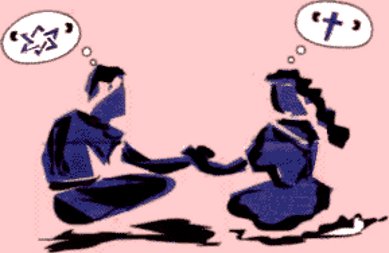
But Gail Goldberg’s article attracted my attention because it shows a portrait of Jews and Christians “doing it right,” of laying aside the ancient apprehension and animosity and for one brief evening, sharing the Shabbat in a synagogue in peace.
People came from all over to hear her speak; Christians were challenged and enriched by her teachings on Christianity, and Jewish attendees were similarly riveted by her approach to scholarship and religious studies transcending both religions. Though the program took place in a synagogue, AJ knew her audience was primarily Christian. She addressed all equally, and encouraged all to be open to challenge and new notions. As local bookstore employee and program partner Steve Iwanski noted in his wonderful blog following AJ’s presentation: “…she sought to bring light to the parts of Jewish faith that may be unfamiliar to the typical Christian.
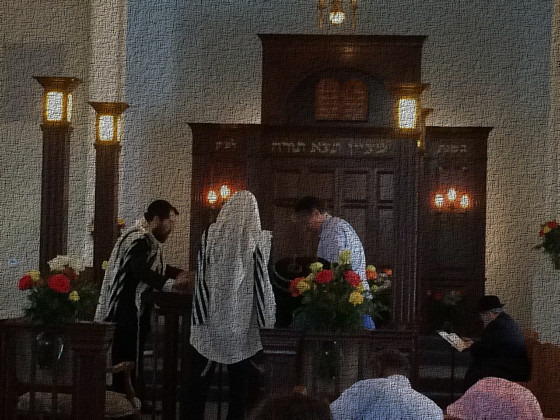
This isn’t describing a Messianic anything. These are Jews and Christians outside our little movement who nevertheless, found a bridge by which they could cross a two-thousand year old gap and find some common ground. There could be a majority of Christians amid Jewish community and no one felt threatened.
Ms. Goldberg’s article finishes with:
That night, I felt the pride of our ancestors – Ilse (Ilse Goldberg, Gail Goldberg’s 86-year-old mother-in-law) in the room, and others no longer with us. If they could have seen the full pews and felt the support and investment of our neighbors, I know how proud the previous generations of the congregation would be. I’m just honored that I could be part of such a wonderful communal experience, and grateful to see our shul stuffed to the gills with long-time supporters and first-time visitors. I hope to see our friends and neighbors joining us in fellowship many more times in the future.
The Messianic Jewish movement purports to share a common Messiah and a common God between Jewish and non-Jewish disciples of the Master, and yet we see a lot of friction and many separate ways of attempting to operationalize our “union”. Some Jews who aren’t Messianic like my friend Gene, find it necessary to point out the rather stark differences between Messianic Judaism/Christianity and Orthodox Judaism, which, whether he means to or not, continues to drive a wedge between Jew and Christian.
But as we’ve seen in the quotes above, it doesn’t have to be that way.
But this isn’t the only example:
We moved to the Czech Republic eight years ago to serve God and our new community and I had expectations of what life would be like. When I stand in the synagogue now on Friday nights, looking out at our growing group of spiritual sojourners singing and praying in Hebrew, Czech, and English, I am taken aback by what God has done. He has demolished my expectations and from the rubble built something worthy, something glorious.
My husband and I had just started being observant. We started slowly, first lighting candles on Shabbat, then observing festivals. He began to wear his kippah, I would cover my head during prayer. I started learning Hebrew and to sing the prayers in my new siddur. Each tentative step brought me closer to my heritage and closer to the way I found to truly express my love for God. As we strolled one day through the medieval alleyways of Cesky Krumlov, we stumbled upon a synagogue, hidden away off the beaten path. It was just finished being reconstructed and I felt a leap from within me. “Wouldn’t it be amazing if we could sometime light the Shabbat candles here at the synagogue?”, I whispered in my heart and ever so quietly to my husband. It was as if saying the words too loudly would damage them extinguishing the hope that had been lit..

This was written by Krista, one of Derek’s students, for his blog post A Synagogue in the Czech Republic. You can click on the link to get the whole story, but here’s what I want to show you:
Ours is an inter-faith group. All are welcome. “Isms” are left at the door. Though the service is conservative and very traditional, there is an atmosphere of family here, humanity seeking the Creator and learning how to worship together. Many who come are Christian, Baha’i, Hindu, Jewish and agnostic. We save the discussions for the café which used to be the Rabbi’s house. Ruth remembers it as it was when her dear Rabbi lived there. Now we sing and pray and talk about deep topics there over tea and cake. I invite those who might want to delve deeper to our house for once a week gatherings, Mussar and Bible Studies. As a Messianic Jew, I share my thoughts and beliefs about Messiah during these group times at our home.
I’m not saying every synagogue, Messianic or otherwise, has to be this way, but here we have two examples where in Jewish religious and community space, not everyone was Jewish and in the latter case, there was acceptance of a Messianic Jew as a Jew by non-Messianic Jews and by many other faith traditions including Christianity.
Krista also wrote:
This burgeoning community is in need. We have just filled out the paperwork to be recognized as a Jewish Community by the Ministry of the Interior.
Unfortunately, it was suggested that this Czech synagogue was pulling a “bait-and-switch” since Krista describes it as an interfaith community, but in his response to that comment, Derek said that:
Gene is wondering if a bait and switch is going on in Cesky Krumlov and I answered that: no. The people there are happy with an interfaith community and there is nothing deceptive about it.
Derek also said to Gene (sorry to keep bringing you up Gene, but I can’t avoid it in this context):
Your idea that Jews don’t like Christians or that Jews want to keep Jesus away with a ten foot pole, just isn’t true. Maybe your journey away from Jesus into Orthodox Judaism colors your perception. Most Jews are open to all sorts of things, including Bahai and Buddhism. People who insist on sharp borderlines do not represent most people in the world who take joy in learning from many streams of religion, philosophy, arts, politics, etc. If you were to approach these people and say, “This is bad, you shouldn’t do it,” I think they’d ask who the heck you think you are. Now having said that, the services in the synagogue are simply Jewish prayers and songs. The groups that meet at other times are not in the synagogue. It is called Interfaith. Some people like it. You might not be one of them.
I found that statement slightly ironic given that within Messianic Judaism, there are voices who advocate for a sharp division between Gentiles and Jews, and at times I’ve been one of those voices.
 But there’s got to be someplace where we too can build our bridge, stand together in a common place, break bread together, and find a mutual peace.
Maybe Gail Goldberg’s synagogue in Greenwood, Mississippi, and Krista’s shul in Cesky Krumlov are giving us just a tiny peek into the world of the Messianic Kingdom of peace. Maybe someday we can all learn to “do it right.” Someday, we can put aside our differences and while being distinct, also as one bow our knee to One God.




 Morning Meditations