All posts by James Pyles

James Pyles is a published Science Fiction, Fantasy, and Horror author as well as the Technical Writer for a large, diversified business in the Northwest. He currently has over 30 short stories published in various anthologies and periodicals and has just sold his first novella. He won the 2021 Helicon Short Story Award for his science fiction tale "The Three Billion Year Love" which appears in the Tuscany Bay Press Planetary Anthology "Mars."

The Last Reading of the Chronicles of the Apostles

study-in-the-darkIn the two decades following the Bar Kochba revolt, three major personalities came to represent three different types of second-century Christianity. A philosopher named Justin Martyr championed the dominant, orthodox Christianity that would soon become the normative expression of Christian faith. A bishop named Marcion of Sinope brought anti-Jewish, Gnostic Christianity from obscurity to the mainstream where it became a serious threat to true faith. The bishop Polycarp of Smyrna continued to defend and represent the old-fashioned, Jewish, apostolic Christianity he had inherited from the disciple John. As a short epilogue to our studies, the Chronicles of the Apostles concludes with a brief look at each.

-D. Thomas Lancaster
“End of the Chronicle,” pp 1407-8
Study read with Vezot Ha’Bracha
Torah Club Volume 6, Chronicles of the Apostles

This is the last reading in my year-long study of the “Chronicles of the Apostles.” It began with Acts 1:1 and proceeded through an adventure of learning and re-learning about the life of Paul and well beyond, as recorded in scripture, historical texts, and even myth. My Torah Club readings have been a fixture of my Shabbat studies and I will miss them. It seems fitting as one Torah cycle closes and another opens, that I offer a brief review and commentary of the last Chronicle of the Apostles of D. Thomas Lancaster.

For the Law that came from Mount Horeb is now old, and it belongs to yourselves alone, but [the Law of the New Covenant] is for everyone. Law against law has abrogated the one that came before it, and a covenant which comes later cancels the previous one. (Justin Martyr, Dialogue with Trypho 11)

-quoted by Lancaster, pg 1410

Justin Martyr doesn’t sound all that different from modern Protestants, at least in some churches. Martyr was a lot closer to the original writings of the New Testament but even he seems to have forgotten something. Perhaps he didn’t have access to Paul’s letter to the churches in Galatia, written a mere century before:

What I am saying is this: the Law, which came four hundred and thirty years later, does not invalidate a covenant previously ratified by God, so as to nullify the promise.

Galatians 2:17 (NASB)

To extend Paul’s words, can we say that the New Covenant, which isn’t even fully enacted as yet, invalidates “a covenant previously ratified by God?” Justin Martyr seems to think so. So do a lot of Christians today.

In Justin Martyr’s dialogue with Trypho, they even addressed a topic on which I often write:

Trypho pressed the question further. He asked, “Are there some Christians who believe that Jewish believers will not be saved if they keep the Torah?”

Justin replied, “There are such people, Trypho. And these [Christians] refuse to have any dialogue with or to extend any hospitality to such persons, but I do not agree with them.” In other words, Justin Martyr admitted that his own opinion on the question of whether or not a Torah-observant Jewish believer could be saved represented the more liberal, broad-minded view. Other Christians in his day refused to have any interaction whatsoever with Jewish believers who still observed the Torah. Justin’s final statement on Jewish believers who still observed the Torah refers to them as “weak-minded” but probably not damned…

-Lancaster, pg 1411

Things haven’t changed very much in the past almost twenty centuries. Justin Martyr’s thoughts and opinions still seem well represented in the church today. But we can hardly say that he was completely anti-Judaic, at least not compared to Marcion the Heretic:

Marcion taught a radical dichotomy between the Jewish Scriptures and the gospels. Like other Gnostics, he believed that the Old Testament God of the Jews was a corrupt and inferior being who had marred His creation with His own imperfections. The physical matter, which He created, possessed intrinsically evil qualities. Marcion taught that the Jewish God’s own scriptures revealed His complete ignorance and incompetence.

-ibid, pg 1413
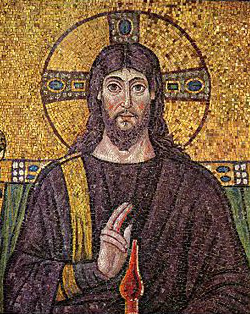
Christus_Ravenna_MosaicI suppose today, we’d call Marcion a “nut” or a “cult leader” for espousing such “fringy” beliefs, but as we know, nuts and cult leaders are able to gather followings, sometimes really large ones.

Lancaster records how Marcion created his own version of the apostolic scriptures, leaning heavily on only one gospel and ten of Paul’s epistles. He even edited out any references to anything from the Old Testament, thus building his theological house on shifting and unstable sand.

However, saying that…

Marcion’s New Testament collection spread quickly, and Marcionite churches began to flourish. Marcion’s form of Christianity was easier to understand and naturally appealed to people. It removed the inherent contradictions between Christian theology and Judaism that conventional Christians like Ignatius and Justin Martyr attempted to retain and gloss over. It seemed more logical. Marcionite Christianity assessed Judaism as the religion of legalism, laws, and concerns with the corrupt world of physical matter. According to Marcion, Judaism stood in antithesis to Christianity’s teachings about grace, love for one’s neighbor, and spiritual salvation. Marcionite Christianity instantly appealed to Gentile Christians who felt uncomfortable with their relationship with Judaism and the hated Jews who had persecuted Christ and Christians.

-ibid, pg 1414

Although the “nuts and bolts” of Marcion’s theology may no longer be with us, the “echo” of it seems to be thoroughly woven into the fabric of Christianity (if you’ll forgive the mixed metaphor), at least in terms of the dichotomy many Christians believe exists between the Torah of Moses and the Grace of Christ, as if these are two mutually exclusive concepts, wholly divorced from one another. Many Christians give intellectual assent to the idea of our faith having Jewish origins, but in the same breath, they will say that there is no valid Jewish context for Christianity. The legacy of the heretic Marcion in the twenty-first century Church.

All this while, Polycarp, the bishop of Smyrna and the last living disciple of the last living disciple of the Master, continued steadfast in the ways of the apostles. Like his teacher John, Polycarp lived to an advanced age. The Christians in Smyrna considered him to be a prophet. They said, “For every word that went out of his mouth either has been or shall yet be accomplished.”

-ibid, pg 1415

Of any of the three people presented in Lancaster’s last chronicle, this is the one I’d like to meet. If any of these three individuals had a clue as to the true intent of Messiah in how we all should live and relate to each other and to God, it was Polycarp of Smyrna.

In 154 CE, the new bishop of Rome, a man named Anicetus, attempted to force the Christians of Asia Minor to abandon their observance of Passover. Roman Christians commemorated the Master’s death by fasting from the Friday that falls during the seven days of Passover until midnight on the subsequent Saturday. They broke the fast by taking the Eucharist together in celebration of the Master’s resurrection.

Anicetus tried to force Christians everywhere to adopt the Roman custom. The Christians who refused to adopt the Roman custom were called “fourteeners” (quartodecimans) because they insisted on keeping Passover on the fourteenth of Nisan. They kept the Passover “on the fourteenth day of the month at evening” (Exodus 12:18), more precisely speaking, at the beginning of the fifteenth day.

-ibid

Polycarp’s followers seem to have adhered to more of the “Jewish” practices, but we have no clear picture of exactly how this was accomplished in a wider range of behaviors. If we understood more about Polycarp and his stream of Christianity, we might get a better idea of the nature of the relationship of Gentile and Jewish believers, especially in terms of identity and religious practice.

Here ends the Chronicles of the Apostles — men of whom the world was not worthy. I have collected these things after they had almost faded away due to the passage of time. So too, may our Master Yeshua the Messiah gather me along with His chosen ones into His kingdom.

-ibid, pg 1419

reading-torahThe last paragraph of the last page of the last teaching of the last Torah Club volume. As you read this, it is Shemini Atzeret and tomorrow is Simchat Torah. We read the final words at the end of Deuteronomy soon and immediately begin again with the reading of the first words in Genesis. My Pastor says this is a reminder that we are never done with reading the Bible. I see it as part of the lifecycle of people of faith, even as we mark the cycles of our lives each year in birthday celebrations.

But although the Torah is timeless, not so the years of man. I’m not quite the same person I was a year ago when I began this study. I’d like to think I’ve gained a bit in my studies but as with aging, there are a few things I’ve lost as well. It’s nearly time to pack up the sukkah for another year. In synagogues all over the world, it will soon be time to re-roll the Torah scrolls for another year. Many things are endless and many more are not. The future is shrouded in fog and mystery. What will the coming year bring? What will begin once again…and what will end?

Christianity Today and Why Paul is Not Anti-Judaism

paul-on-the-road-to-damascusThe misconception about Paul with the longest historical pedigree is that he was anti-Jewish. Many imagine that after his Damascus Road experience, Paul immediately rejected Judaism and embraced Christianity. They assume that in the first century these were two clearly distinguishable religions. Before his encounter with Christ, the thinking goes, Paul was wrapped up in a legalistic pursuit of salvation and was teaching others a similar philosophy. So great was his passion that he persecuted the Christians who taught salvation by grace through faith. After his conversion, everything changed. He embraced God’s gracious salvation by faith in Christ and rejected the system of dead rituals bound up in Judaism. Paul left Judaism, therefore, and turned to Christianity.

-Timothy Gombis
“The Paul We Think We Know” (originally published 7-22-2011)
Christianity Today

Someone posted this on Facebook today and as I was reading it, I wanted to jump up out of my chair and scream YES! YES! Someone finally GETS IT!

OK, I’m not really that emphatic in my behavior but it does excite me that someone writing for a traditional Christian publication understands what I understand and what I’ve been trying to communicate in the church I attend for nearly a year.

Let’s cut to the chase. What does Gombis really think about Paul and more importantly, Paul’s struggle to integrate non-Jewish disciples into a Jewish religious stream?

The problem in the early church, therefore, was not the temptation toward legalistic works righteousness. They faced the communal challenge of incorporating non-Jewish converts into the historically Jewish people of God. First-century Judaism didn’t have a legalism problem; it had an ethnocentrism problem. The first followers of Jesus were all Jewish, and had difficulty imagining that the God of Israel who sent Jesus Christ as their Savior could possibly save non-Jews without requiring them to convert to Judaism. This is the issue in Acts 15, when Christian Jews from Judea urged the Gentiles in Antioch, “Unless you are circumcised, according to the custom taught by Moses, you cannot be saved” (Acts 15:1).

While the early church leaders decided in theory that non-Jewish believers in Jesus were not required to become Jews (Acts 15:13-21), many churches struggled with the practical challenges of becoming healthy multiethnic communities. Paul, as pastor and theologian, addresses these challenges by claiming that “no one will be declared righteous in God’s sight by the works of the law” (Rom. 3:20). This is not a condemnation of Judaism as inherently legalistic, but an affirmation that God does not justify a person merely because he is ethnically Jewish. Jews and non-Jews approach God on equal terms when it comes to salvation (emph. mine). All have sinned and all stand in need of God’s redeeming grace in Christ (Rom. 3:23-24). Therefore all who are in Christ are equal siblings in God’s new family (Gal. 3:26-28).

The “in theory” comment seems to relate to the ongoing struggle to integrate, with anything approaching seamlessness, Jewish and Gentile disciples within a single religious and social framework, but I’ll return to that issue in a moment. The main point here is that Paul did not reject Judaism for Christianity, supported continued Judaism and Torah observance for Jews, and identified the primary problem among Jewish believers and their difficulty in accepting Gentle disciples not as legalism but ethnocentrism. Many of the believing and non-believing Jews could not accept Gentiles as equal participants of a Jewish religious branch without requiring that they convert to Judaism. After all, whoever heard of Jews and Goyim being equal in the sight of God? Gombis already quoted this verse, but it should be repeated.

Some men came down from Judea and began teaching the brethren, “Unless you are circumcised according to the custom of Moses, you cannot be saved.”

Acts 15:1 (NASB)

PaulThis was the core problem Paul faced in his mission to the Gentiles and it would always haunt him. It was the cause of most of his major problems with the various Jewish communities in Israel and the diaspora. He would never see a day when this conflict was ultimately resolved and the echo of his struggle still rings in our ears. That is, if we’ll actually let ourselves listen.

But what about Paul, Judaism, and his relationship with Jewish disciples?

A second reason why we cannot envision Paul as anti-Jewish is that even after his conversion, Paul remained a Jew. He did not imagine that he was inventing a new religion, nor did he leave Judaism to join the Christian church. At the end of his third missionary journey, Paul arrived in Jerusalem and, at the suggestion of James, went through purification rituals at the temple (Acts 21:23-26). Paul saw no contradiction at all between his commitment to Christ and his faithful participation in Jewish practices. Explaining his ministry before a variety of audiences, Paul emphasized his Jewish identity and claimed to be acting in faithfulness to the God of Israel. Before the Jewish Council in Jerusalem, he declared, “My brothers, I am a Pharisee, descended from Pharisees. I stand on trial because of the hope of the resurrection of the dead!” (Acts 23:6, emphasis added). And to King Agrippa, he again claims to be a Pharisee whose hope is in the promises of God to Israel (Acts 26:4-6).

Third, Paul never calls upon Jews to reject Judaism. Instead, he exhorts them to recognize Jesus as their Messiah and welcome his non-Jewish followers as siblings in God’s new family. We get a glimpse of his preaching to Jews in Acts 17:1-3: “When Paul and his companions had passed through Amphipolis and Apollonia, they came to Thessalonica, where there was a Jewish synagogue. As was his custom, Paul went into the synagogue, and on three Sabbath days he reasoned with them from the Scriptures, explaining and proving that the Messiah had to suffer and rise from the dead. ‘This Jesus I am proclaiming to you is the Messiah,’ he said.”

The Paul of the New Testament, therefore, is not anti-Jewish. He was faithful both to the Scriptures and to his Jewish heritage. He preached Jesus as the promised Messiah of Israel, but was insistent that salvation in Christ was not limited to ethnic Jews. According to his gospel, all Jews needed to receive Jesus as Messiah, and all followers of Jesus—Jewish and non-Jewish—needed to embrace one another as siblings in God’s global family in Christ.

I’m stunned that this is being published in an online Christian venue. I’m absolutely shocked. I’m pleased beyond wonder. Paul never stopped being a Jew, never stopped Jewish observances, and absolutely never, ever encouraged any Jew to abandon Jewish practice, lifestyle, and faith. Turning to Messiah is a completely Jewish act and does not require the slightest deviation from Jewish Torah observance.

But what about “in theory?”

Gombis isn’t suggesting that in theory, the Gentiles became Jews either by formal conversation (which Paul opposed) or in action but not name by observing the mitzvot in a manner identical to the Jewish disciples. The author is only acknowledging what I have been saying all along: that in principle, the requirement was to unite Jewish and Gentile disciples of the Master within a multiethnic, multinational framework where all could share in the grace and salvation of God without anyone being compelled to surrender their unique and individual national and ethnic identity.  In practice, this was never accomplished and ultimately, both populations pursued wildly different trajectories. Their struggles are what we see in the Messianic Jewish and Hebrew Roots movements today.

walking_discipleEarlier, I posted my review of the First Fruits of Zion television series episode Raising Disciples. This is particularly relevant to today’s “extra meditation” because we encounter the topic of disciples as imitators. What did Paul say to the Gentile disciples he was raising up about imitating their Master?

In 1 Corinthians 11:1, he told them to “be imitators of me, just as I also am of Christ.” but we don’t know what they are supposed to imitate. My suggestion is that the manner of Jewish and Gentile imitation is not identical across the board, since it would obliterate Jewish and Gentile distinction in the body of disciples and thus eliminate the problem of Gentile integration. If Jewish and Gentile disciples were identical and homogenous, the basis for schism would have been severely blunted if not done away with entirely.

However, it was a given that Jewish disciples were intended to continue Jewish practice according to Gombis and the legal decision rendered by James and the Council was that the Gentiles had no identical obligation. By common association, the Gentile disciples might have acted very similarly to their Jewish counterparts, at least to an outside observer, but there remained a difference in obligation between the Jewish and non-Jewish disciples within the body of Messiah.

That probably isn’t a very satisfying answer, but I’m still thrilled that a Christian online magazine is promoting a view of Paul that is so close to my own. Now if I could just send this link to every church Pastor in the country with a note saying “READ THIS!” and if they’d keep an open mind while doing so, I’d consider it a step forward.

Interestingly enough, today is Hoshana Rabbah, the traditional day of judgment for the nations of the world. How will God and Israel judge us if we do not learn to see Paul and the Messiah in the manner Timothy Gombis suggests?

FFOZ TV Review: Raising Disciples

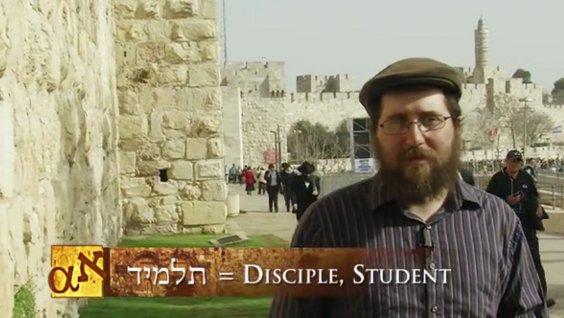
ffoz_tv12_startEpisode 12: Everyone knows that Jesus had twelve disciples but many would be surprised to find out that the institution of discipleship existed centuries before the time of the apostles. In episode twelve viewers will gain a better understanding of what it means to be a disciple from the understanding of Judaism in the days of Messiah. Jesus tells us that “Every disciple fully trained will become like his teacher.” Indeed, to be a Christian means to be a disciple of Jesus, a student responsible for learning and becoming like one’s rabbi.

-from the Introduction to FFOZ TV: The Promise of What is to Come
Episode 12: Raising Disciples

The Lesson: The Mystery of the Meaning of Discipleship

Whenever we consider being disciples of Christ, most of us in the church probably think that means being believers in Jesus. However, according to First Fruits of Zion (FFOZ) teacher and author Toby Janicki, it’s really much more. But how much more? What does it really mean to be a disciple of Jesus?

Toby first spends a lot of time in this episode showing the audience what discipleship meant in Judaism in the late Second Temple period; during the earthly lifetime of Jesus:

The disciples of Yochanan and the disciples of the Prushim would often fast, and they came and said to him, “Why do the disciples of Yochanan and the disciples of the Prushim fast, but your disciples do not fast?”

Mark 2:18 (DHE Gospels)

Here we see that not only did Jesus have disciples but that John the Baptist and the Pharisees had disciples. In fact, all of the teachers or Rabbis in all of the streams of Judaism in that day had disciples. But we still need to understand what it is to be a disciple in general and a disciple of Jesus of Nazareth in particular.

To me, a lot of the information presented about discipleship wasn’t a great revelation since I’ve been exposed to it before, but it may be that some Christians believe only Jesus had disciples and that he only had twelve of them. This, of course, is not correct:

After this the Lord appointed seventy-two others and sent them on ahead of him, two by two, into every town and place where he himself was about to go.

Luke 1:10 (ESV)

While some translations say that seventy were sent out and others say seventy-two, Toby says that from the context in the rest of this chapter, those sent out were also disciples of Jesus. This illustrates how common disciples were in that day and age. He also cites Acts 9:36 to illustrate that women were disciples, Acts 6:1 and 6:7 to illustrate how there were many, many disciples, and Acts 11:26 to show that there were both Jewish and Gentile disciples of Jesus.

ffoz_tv12_tobyAccording to Toby, the word “Christian” is used only three times in the Bible, but the words “disciple” and “disciples” relating to followers and students of Jesus were used many times. Perhaps it’s more accurate to call ourselves disciples of Christ rather than Christians. But then again, that would depend on the meaning of disciples and discipleship. Which brings us to our first clue:

Clue 1: All early believers of Jesus were called disciples.

But going back to the question I just asked and the question Toby repeatedly asks, we need to understand how Christ’s original Jewish audience and the first Jewish readers of the Gospels would have understood discipleship. To get the answer, we turn to FFOZ teacher and translator Aaron Eby in Israel.

Aaron provides a great deal of background information on early Jewish discipleship including the fact that discipleship predates Jesus by quite a bit. Discipleship was considered the primary method of higher Jewish education, but it wasn’t just a matter of going to school and studying different subjects. A disciple was a student but specifically, a student of a Torah teacher. In the days of Jesus and before, when a young man thought he wanted a life of Torah learning, he would apprentice himself to a Torah master, however, this apprenticeship might not be what you imagine.

A disciple was to be a learner/imitator. He would memorize all of his Master’s teachings, learn to imitate his Master’s style of dress, mannerisms, inflections of speech. The disciple in some ways considered himself a servant or even a slave to his Rabbi, his “great one.” In some ways, he thought of himself as a son to a Father, but the Rabbi was considered greater than the disciple’s biological Father. Disciples were tremendously devoted to their Masters, more so than to their own families or even their own lives. And so it was with the disciples of Jesus, their Master and ours.

Back in the studio, Toby describes the concept of discipleship as a job description.

A pupil is not above his teacher; but everyone, after he has been fully trained, will be like his teacher.

Luke 6:40 (NASB)

That the disciples of Jesus were imitators of their Master and memorized his teachings is the reason why we have the Gospels today.

Be imitators of me, just as I also am of Christ.

1 Corinthians 11:1 (NASB)

Here we see that Paul considered himself a disciple of Christ as his imitator, and he suggests to the readers of his letter that they should imitate Paul. Were they then Paul’s disciples? I’ll answer that in a bit, but we have arrived at our second clue:

Clue 2: The primary job of a disciple was to be like his teacher.

Even the Pirkei Avot or “Ethics of our Fathers,” a set of Jewish teachings that predated Jesus says, “Raise many disciples.”

ffoz_tv12_aaronA Rabbi’s job was to create a new generation of disciples who would learn everything from the Rabbi and about the Rabbi and then, when they were fully trained, the disciples would become Rabbi’s themselves, raising up their own generation of disciples in order to preserve the Torah teaching and wisdom of their own Master. This process would be repeated from one generation to the next with the goal of creating an unbroken line of discipleship, generation by generation, that would preserve the teachings of Torah for each Teacher, often by establishing great schools such as the Houses of Study of Shammai and Hillel. This maps well to Matthew 28:19-20 where Rabbi Yeshua instructed his Jewish disciples to raise up a generation of disciples from the people of the nations, which the Church often refers to as “the great commission.” However, as we’ve seen, the idea of “the great commission” hardly does justice to what Jesus was actually commanding.

Now we have arrived at the third and final clue:

Clue 3: The job of a disciple was to raise up more disciples.

But here Toby introduces a strong caveat:

But do not be called Rabbi; for One is your Teacher, and you are all brothers. Do not call anyone on earth your father; for One is your Father, He who is in heaven. Do not be called leaders; for One is your Leader, that is, Christ. But the greatest among you shall be your servant. Whoever exalts himself shall be humbled; and whoever humbles himself shall be exalted.

Matthew 23:8-12 (NASB)

This set of verses has often been misunderstood or just not understood at all. Does this mean we shouldn’t have respect for our Bible teachers and Pastors? Here’s where having a Jewish perspective on the New Testament comes in especially handy. According to Toby, this is Jesus defining the difference between the relationship of Jewish disciples to the Sages and disciples of Jesus, our Master, to himself.

Remember, the purpose of discipleship was to learn all there was to learn from your Master and then to establish your own House of Study in your name passing on what you originally learned. Your disciples would be taught in your name, not in the name of your own Master, and your disciples would teach in their own names, not in yours (actually it was more like, “I teach you in the name of my Master, who taught in the name of his Master,” and so on).

Jesus said his disciples would be different. Each Torah Master would eventually age and die, but his teachings would be preserved in his disciples and in each generation of disciples that followed. Jesus is alive! We hear this enthusiastically declared every Easter or Resurrection Day in Church. James, Peter, and Paul were not to set up their own houses of study and teach in their own names by making their own disciples (in spite of what we saw relative to Paul in 1 Corinthians 11:1). They were not to raise up disciples for themselves but instead, they were and we are to raise up disciples for our Master, our one and only Master, Jesus the Messiah, Yeshua HaMashiach.

What Did I Learn?

I learned the meaning behind Matthew 23:8-12 which I tended to ignore in the past because I couldn’t figure it out. It makes a lot of sense now. I used to think that we inherited a broken system of discipleship since the teachings of Jesus were never transmitted generation to generation in the manner we have seen described in this FFOZ TV episode. Now I realize that it was by design, since we were never intended to be the students of any Master except Jesus. He is our only teacher, our only Torah Master. This does not mean we shouldn’t respect any Bible teacher or Pastor in our Church, but we must always remember that none of them take the place of Jesus. If we see a group of believers who esteem their Pastor or spiritual leader as anything approaching our true Master, then there is something wrong (and sadly, such situations make an appearance the news media from time to time, usually as scandals involving some highly public and popular religious leader).

ffoz_tv12_extra2I also thought of some questions as I was watching this episode and in fact, I was reminded of some of the narratives of Toby from other episodes that involve how he commonly introduces himself. He says that he isn’t Jewish but rather a Gentile who practices Messianic Judaism. It isn’t always apparent, but he usually wears a kippah while on camera (A kippah is a head covering typically worn by religious Jews either just in synagogue or during their waking hours, depending on their level of observance).

What is the difference between being a Gentile who practices Messianic Judaism and a Gentile who practices Christianity? More importantly, how do these two “states” relate to being a disciple of Christ, our Master? Since this television show was created to present the Gospels and Jesus Christ to a more traditional Christian audience by introducing a more Jewish perspective and interpretation, what does that say about the level of discipleship and imitation of our Master relative to “Messianic Gentiles” and Christians?

This question is especially important to me, since it factors into how I think of myself as a disciple of the Master by calling myself a Christian and attending Church. One of the motivations for me to return to Church after an absence of many years was the book Tent of David: Healing the Vision of the Messianic Gentile written by FFOZ president and founder Boaz Michael. Have I become a better imitator of my Master by following this template of church attendance and Christian affiliation or a worse one? At some point in the near future, as the one year anniversary of my returning to Church comes near, I plan to write one or more “meditations” on the application of Boaz’s Tent of David in my life and the results I see so far.

Closely related to this situation, Toby also didn’t drill down into something that I think it’s vital to know. When we say that a disciple of Christ is an imitator or Christ, just exactly what are we imitating? This isn’t an idle question. Many in the Hebrew Roots movement insist that discipleship means imitating the Jewish Jesus in every aspect of his Judaism, including wearing kippot (plural of kippah) and tallitot (plural of tallit) and to otherwise look and act in a manner identical to modern religious Jews (in spite of the fact that Jesus isn’t a “modern religious Jew,” but rather, he was an ancient Jewish Rabbi and he is the Jewish Messiah King).

The clue that may lead to an answer was provided at the end of this episode by Boaz Michael who appeared on camera and said that next week (episode 13), the topic would be how the Torah is the foundation of Messiah Yeshua’s instructions to his disciples. How can the Torah be applied to both the Jewish and Gentile disciples of our Master?

I’m hoping my review next week will help answer these questions.

Today is Hoshana Raba, the last day of Sukkot. Lord, please abundantly save us. Candle lighting for Shmini Atzeret is tonight at sundown. God, continue to be with us.

Day Zero.


The Obscured Messiah in the Bible

tallit-prayer“My servant David will be king over them, and they will all have one shepherd; and they will walk in My ordinances and keep My statutes and observe them. They will live on the land that I gave to Jacob My servant, in which your fathers lived; and they will live on it, they, and their sons and their sons’ sons, forever; and David My servant will be their prince forever. I will make a covenant of peace with them; it will be an everlasting covenant with them. And I will place them and multiply them, and will set My sanctuary in their midst forever. My dwelling place also will be with them; and I will be their God, and they will be My people. And the nations will know that I am the Lord who sanctifies Israel, when My sanctuary is in their midst forever.”’”

Ezekiel 37:24-28 (NASB)

Tales of the Messianic Era series

I think most Christians and Jews would agree that this passage of scripture is referring to the Messianic age when David, King Messiah, will rule as Israel’s “prince” forever. Jews believe this text also confirms that Messiah will build the Temple in Holy Jerusalem, while some Christians believe the Temple is only a spiritual manifestation rather than a physical structure.

In the past several weeks, I’ve been challenged by a Jewish friend of mine to see if I can (or can’t) find Jesus in the Old Testament (Tanakh). Like most Christians, it’s difficult for me not to see Jesus in the Torah and the Prophets, but I want to be honest and actually make as much of an unbiased examination as I can. Interestingly enough, it was in last Sunday’s Bible study at church where some serious questions about Christian hermeneutics came up for me. I listened to my teacher explain some of the Jewish texts in a way that didn’t make sense. On the other hand, he had to interpret the scriptures in this manner if he was to locate Jesus there.

‘Behold, days are coming,’ declares the Lord, ‘when I will fulfill the good word which I have spoken concerning the house of Israel and the house of Judah. In those days and at that time I will cause a righteous Branch of David to spring forth; and He shall execute justice and righteousness on the earth. In those days Judah will be saved and Jerusalem will dwell in safety; and this is the name by which she will be called: the Lord is our righteousness.’ For thus says the Lord, ‘David shall never lack a man to sit on the throne of the house of Israel; and the Levitical priests shall never lack a man before Me to offer burnt offerings, to burn grain offerings and to prepare sacrifices continually.’”

The word of the Lord came to Jeremiah, saying, “Thus says the Lord, ‘If you can break My covenant for the day and My covenant for the night, so that day and night will not be at their appointed time, then My covenant may also be broken with David My servant so that he will not have a son to reign on his throne, and with the Levitical priests, My ministers. As the host of heaven cannot be counted and the sand of the sea cannot be measured, so I will multiply the descendants of David My servant and the Levites who minister to Me.’”

Jeremiah 33:14-22 (NASB)

This passage from Jeremiah 33 says several important things:

  1. In the Messianic Kingdom, God will fulfill the good news he has announced to Israel and Judah, in other words, the Jewish people.
  2. Messiah, a descendent of David, will be raised up as a “righteous branch.”
  3. Peace will be established for Israel and there will be safety in Jerusalem.
  4. Messiah, a descendant of David, will sit on the throne of Israel forever and the Levitical priests will once again offer sacrifices in the rebuilt Temple.
  5. The descendants of David and the Levitical priests will be multiplied to a number that cannot be counted.

temple-prayersSome Christians believe there will be a Temple and that sacrifices will be offered, but they believe Jesus, the Messiah, will be offering those sacrifices as a memorial (as opposed to an actual, functioning, sacrificial system). And yet, we see it is the Levites who will be sacrificing, not Messiah as a King-Priest. It’s understandable that the Priests would have families, children, and grandchildren across the future years but is this saying that Messiah also marries and has children (descendants)? Interesting, but I suppose you could also say that’s metaphorical and “David’s descendants” are the Jewish people.

“In the first month, on the fourteenth day of the month, you shall have the Passover, a feast of seven days; unleavened bread shall be eaten. On that day the prince shall provide for himself and all the people of the land a bull for a sin offering.”

Ezekiel 45:21-22 (NASB)

Waitaminute? What? Who makes an offering for his sins and the sins of the people? The prince? Who’s the prince? It can’t be Jesus because Jesus never sins.

My Bible teacher says that the prince is David not Christ. Matthew Henry’s Concise Commentary treats this concept a little differently:

In the period here foretold, the worship and the ministers of God will be provided for; the princes will rule with justice, as holding their power under Christ; the people will live in peace, ease, and godliness. These things seem to be represented in language taken from the customs of the times in which the prophet wrote. Christ is our Passover that is sacrificed for us: we celebrate the memorial of that sacrifice, and feast upon it, triumphing in our deliverance out of the Egyptian slavery of sin, and our preservation from the destroying sword of Divine justice, in the Lord’s supper, which is our passover feast; as the whole Christian life is, and must be, the feast of the unleavened bread of sincerity and truth.

My teacher didn’t see these verses the same way and used the following to establish that the prince must be literally David:

“Then I will set over them one shepherd, My servant David, and he will feed them; he will feed them himself and be their shepherd. And I, the Lord, will be their God, and My servant David will be prince among them; I the Lord have spoken.

Ezekiel 34:23-24

“My servant David will be king over them, and they will all have one shepherd; and they will walk in My ordinances and keep My statutes and observe them. They will live on the land that I gave to Jacob My servant, in which your fathers lived; and they will live on it, they, and their sons and their sons’ sons, forever; and David My servant will be their prince forever. I will make a covenant of peace with them; it will be an everlasting covenant with them. And I will place them and multiply them, and will set My sanctuary in their midst forever. My dwelling place also will be with them; and I will be their God, and they will be My people. And the nations will know that I am the Lord who sanctifies Israel, when My sanctuary is in their midst forever.”’”

Ezekiel 37:24-28

messiah-prayerBut we are presented with a problem. The term “David” in Messianic prophesy, almost assuredly refers to Messiah, not literally David. Also, Ezekiel 37:24 refers to David as “king” and “one shepherd” which must certainly be Messiah. It also describes this figure as walking in God’s “ordinances and statues to observe them,” which can’t mean anything else other than Torah, which means for the Jewish Messiah and the Jewish people, the Torah of Sinai will still be in effect in the Messianic era and apply to all Israel.

If we believe that the “prince” is the Davidic Messiah, that is to say, Christ, then Christians have a serious problem. How can a future Jesus Christ as King of Israel offer sacrifices for sin? Christians have to assign the identity of the “prince” either to another individual such as David or to a set of generic princes (who do sin), then it would be more appropriate for them to offer such sacrifices. But given what I said above, the prince can be none other than Messiah, at least if my teacher’s “proof texts” are really proof.

Additionally, we have the matter of whether or not this is a “real” sin offering or simply a memorial, harkening back to days of old, and reminding us that Christ made the offering for sin once and for all with his body on the cross.

Going back to some more traditional interpretations, we find that Jeremiah 23:3-6 also describes a righteous branch rising up, but we find something interesting in Zechariah 6:11-13:

Take silver and gold, make an ornate crown and set it on the head of Joshua the son of Jehozadak, the high priest. Then say to him, ‘Thus says the Lord of hosts, “Behold, a man whose name is Branch, for He will branch out from where He is; and He will build the temple of the Lord. Yes, it is He who will build the temple of the Lord, and He who will bear the honor and sit and rule on His throne. Thus, He will be a priest on His throne, and the counsel of peace will be between the two offices.”’

If “Branch” is a name for the Messiah, then we seem to see him sitting on the throne as both King and Priest. Since Messiah is of the house of David and the tribe of Judah, where does this leave the Levitical Priests? Or does the Priesthood of Melchizedek (Hebrews 7) trump the Levitical priests both in the Heavenly Court and on earth?

Ezekiel 43:2-7 was used by my teacher to describe the Divine Presence inhabiting the Temple in the future Messianic age but that creates an interesting situation for Christians. If the Divine Presence is God and Jesus is God and they’re both in the Temple how are we to understand this? How do they co-exist as two, separate physical entities within a single structure (the Temple)?

These are just the examples that came to mind and that I took notes on during my Sunday school class (no, I didn’t breathe a word to anyone about what I was thinking). But can we prove, just from the Old Testament scriptures, that Jesus is Messiah and God? I’m not sure we can without factoring in the New Testament record and lots and lots of Christian theology and doctrine.

No, I’m not going to throw my faith out the window, but try to look at all of this from a religious Jewish person’s point of view. In order to establish Jesus as Messiah King, we need to seriously morph the original meaning of the ancient scriptures that point to Messiah, the Temple, and the Priesthood. I don’t know that Occam’s Razor is the best hermeneutic tool to use, but if we accept that the most succinct and straightforward explanation in the bunch is probably the correct one, then Christians are obviously jumping through a few extra hoops to get Jesus to fit in all of the Messianic prophesies, at least Jesus as he’s understood in the modern Protestant church.

up_to_jerusalem

The Tanakh doesn’t speak of the sacrifices in the Messianic era as being memorials, but indicate they are the sacrifices that would have been familiar to any Israelite in the days of the Tabernacle or Solomon’s Temple. Also, the same ancient Israelites wouldn’t have had a problem with King Messiah offering sacrifices for his own sins, since they would have believed any descendant of David would be as human as David and would thus have sin. Even the greatest tzaddik who ever lived wouldn’t be completely sinless, but given that Jesus is sinless, how are we to reconcile these differences?

Obviously I’m playing, you should pardon the expression, “devil’s advocate” in this situation, but as I said before, I want to give this challenge an honest examination. I believe there are answers to all these questions, but I don’t think we can always rely on traditional Christian thought to provide those answers.

One of the messages presented by the First Fruits of Zion (FFOZ) television series, A Promise of What is to Come, is that the Bible and especially what we read about the coming Messianic age, the Kingdom of Heaven, seems to make a lot more sense when we look at the information from a more Jewish perspective. That’s the whole point of the television show.

I will probably get some pushback from my Christian readers, but one of the reasons I can’t simply walk away from Messianic Judaism is that nearly twenty centuries of Christian reinvention of the Jewish Messiah and Jewish history has obscured much of the original interpretation and meaning to the Biblical text, both in the Tanakh and the Apostolic Scriptures.

I will be honest and say that I have learned much from my Sunday school classes, but I’ve also been exposed to material that is hardly sustainable (if it’s sustainable at all) based on my reading of the Bible. I know we can’t always get the full meaning of what the Word is saying by relying on just the plain meaning, but how many knots do we have to tie in the string, and how many twists do we bend the pretzel in, before we divorce the Word of God from the “lips” of God?

The next part of this series is: Trouble Breaking into Church with Messianic Prophesy.

That Square Peg in a World of Round Holes Feeling

Worker Hammering Square Peg into Round HoleAccording to Ezekiel chapters 40-48, the millennial age will feature a magnificent temple (much larger than any historic temple of Israel) that will serve as the center for the priestly rituals and offerings. In attempting to explain the sacrifices of this temple, the thought is not that the death of Christ is insufficient but rather that the sacrifices are a memorial of Christ’s sacrifice on Calvary, much as those in the Old Testament looked forward to the fulfillment in Christ’s death. (emph. mine)

-John F. Walvoord from his book
Major Bible Prophecies
as quoted in my Sunday School class notes for Sept. 22nd

I’ve got material in my head for three, maybe four blog posts, but I’ve only got time to write one. So which one shall I write?

In going over my notes of Pastor’s sermon on Sukkot, I could make a blog post out of it, but I really think Pastor did a very good job on this topic. Nothing he said particularly surprised me and I don’t have hardly anything to disagree with him on (except maybe to say that while the future of Sukkot is the “meat” on his plate, we don’t have as much linkage into the future of “the feast” without a present, lived experience).

I have somethings I want to say about reading the last entry in the First Fruits of Zion (FFOZ) Torah Club and ending my year-long study of Volume 6, Chronicles of the Apostles, but I think I’ll save that for another later this week.

Especially as the Torah cycle is ending and about to begin again, which marks the approach of the first anniversary of my return to church, I want to write an update to my review of Boaz Michael’s book Tent of David, describing my own experience, but I’ll need more time to re-acquaint myself with the book’s material and view it through fresh eyes.

But I do want to comment on my experience in the Christian church through the lens of today’s Sunday school class. Notice in the above quoted passage from Walvoord’s book, I emphasized text that threw me for a loop. Am I reading this wrong, or is Walvoord (and by inference, my Sunday school teacher), saying that the Israelites of old while making offerings to God realized that somehow this was all deficient and they looked forward to their fulfillment in Christ’s death? Of course, after reading the sentence a few dozen times, I realize Walvoord may not have meant that the ancient Israelites thought this way, but that the Temple sacrifices “looked forward” to a time when they would be fulfilled (ended) by the crucifixion.

Either way though, the anachronism is blatant.

jerusalem_templeFrom the context of the Israelites at the time of the Tabernacle, and later, Solomon’s Temple, the sacrifices were korban, a way of drawing closer to God, by removing barriers and obeying the God who gave them the Torah through Moses at Sinai. I seriously doubt that most of them considered a future time when the Temple would not exist and certainly they never would have imagined that Messiah, hung on a tree to die, would kill the sacrificial system. Sure, from a traditional Christian perspective, we’ve been taught to believe such things, but that means we become incapable of putting ourselves in the shoes of a Jewish person of old and comprehending his or her lived experience and how wonderful they thought the Torah mitzvot were (and modern religious Jews continue to see the Torah as a joy). Read Psalm 19 and Psalm 119 for examples of what I mean.

How about this?

Then it will come about that any who are left of all the nations that went against Jerusalem will go up from year to year to worship the King, the Lord of hosts, and to celebrate the Feast of Booths.

Zechariah 14:16 (NASB)

It shall be that all who are left over from all the nations who had invaded Jerusalem will come up every year to worship the King Hashem, Master of Legions, and to celebrate the festival of Succos.

Zechariah 14:16 (Stone Edition Tanakh)

Now, here’s one of the questions in my Sunday school notes regarding this verse:

In verse 16, what will the unsaved Gentiles in the Millennium be required to do each year? (emph. mine)

Excuse me? Unsaved Gentiles? Where does it say that in the verse? Actually, the answer has to do with my teacher’s perspective on “the end times” and the “Millennial reign of Christ” based on very traditionally Christian sources. I actually challenged him, saying that the term “saved” was being anachronistically inserted into the Jewish text. It just says that each of the nations that went to war against Israel will be responsible for sending representatives to Jerusalem at Sukkot to pay homage to the Jewish Messiah King and to celebrate the festival. There’s no implication regarding their spiritual state.

(For an alternate commentary on this passage, see Toby Janicki’s blog post God-Fearers: Zechariah 14, Sukkot, and Anti-Semitism.)

churchesBut then I realized that he believes (or could believe) that all of the “saved Gentiles” were living with the “saved Jews” in Israel and only “unsaved Gentiles” lived in the other nations of the world. Of course, that implies that somehow we believing Gentiles are given a portion of the Land, of Israel, during Messiah’s reign. I’m not sure how or if that sort of thing works out and I’m inclined to believe it doesn’t.

Pastor preached on this when he said that once the Church is “raptured” (in his view, up to Heaven) with Christ, they (we) will return to Earth with him with special jobs to do, especially during Sukkot. This is very confusing because it seems as if there aren’t very many believing Gentiles and Jews around if we can all fit in a country about the size of New Jersey. It’s also rather strange if only we believers live in Israel and the rest of the world are “Goyishe sinners” living in all of the other countries on the planet…and yet somehow, they acknowledge that they are ruled by the Jewish King from the Jewish Kingdom of Israel.

I guess the idea is all of those “unsaved Gentiles” will use the time and opportunity to become “saved,” but then, as my Sunday school teacher asked, will they receive “glorified bodies” instantly or will only their children get those? My question is, when a Gentile is “saved” during the “Millennial reign,” do they immediately “make aliyah” to Israel?

I’m putting a lot of words and phrases in quotes because most of them are Christian anachronisms and theological concepts being forced into the Jewish text (and let’s keep in mind that the New Testament is also a Jewish text). I think I’m getting a headache.

Here’s something else from my class notes. I’m not sure if it’s from Walvoord since the citation seems a little confused:

Note: The battle of God and Magog here (after the Millennium) is totally different from that in Ezekiel chapters 38 & 39 (during the Tribulation) -Walvoord. There, Israel is attacked (while her “friends” watch) by a coalition of Russian and Muslim nations from the north at a time when Israel is at peace. (emph. mine)

Not that it couldn’t happen this way, but how can the author possibly know with such certainty exactly which nations/powers are involved? Couldn’t some European (or other) nations also be attackers (and the way the EU and especially the French have been treating Israel lately, I wouldn’t be surprised)?

In discussing Revelation 20:11-15, the class notes ask the question, When they face Jesus Christ as their Judge (II Tim. 4:1, Phil. 2:9-11), what 66 “books” will He open to judge “their works”? In class, the teacher said he supposed other books could be involved besides the Bible, but even putting such a detail in these notes assumes quite a bit about what we think we know.

The last such “interesting” bit of wording I’ll insert comes from the notes for next Sunday’s class on Acts 15:1-21 (one of my favorite themes):

In Acts 15:1-2 and 15:24, Now with what Satanically inspired and dogmatic false teaching did these “certain men from Judaea” try to infect the church at Antioch, and why according to Galatians 2:4-5? (emph. mine)

Apostle-Paul-Preaches“Satanically inspired” teaching? Since when is discussing opposing theological viewpoints considered Satanic. Most Wednesday evenings, I meet with my Pastor to discuss similar topics and we don’t always agree with each other. Is that disagreement “Satanic?” Am I being “Satanic” when I disagree with my Pastor, since he represents a more mainstream Christian theological perspective?

I know it seems I’m really bashing my Sunday school teacher. Actually, he’s a great guy and I like him. He teaches a lot of the retired guys in the church on Wednesday mornings, which I consider a mitzvah. He obviously loves his wife and she loves him. He has a heart for Christ and is enthusiastic about the Master’s return and the restoration of Israel and the world.

But there are just some times I get that “square peg in a world of round holes” feeling, particularly in Sunday school.

Addendum: See an extension to this “meditation” by reading The Obscured Messiah in the Bible.

The Boy in the Sukkah

Sukkah in the rainIn a sense, Sukkos itself is about getting our priorities straight. Here we just finished with the Days of Judgement, hopefully with Hashem’s blessings for a year of prosperity and success. Yet the first thing we do with our new-found blessings is to leave our comfortable homes for the temporary shade of the Sukkah. We thereby acknowledge that there can be no greater “success” in life that to do what Hashem really desires, even when it’s not what’s most comfortable. Sometimes we shake with the Esrog and sometimes we shake with the horse – the main thing is to strive to understand what Hashem wants of us in a given situation, not what we want or what makes us feel good. As the pasuk says (Mishlei/Proverbs 3:6), “In all your ways know Him; He will straighten your paths.”

-Rabbi Eliyahu Hoffman
“Sukkos: Shaking Up Our Priorities”
Torah.org

My four-and-a-half year old grandson keeps calling me from my Sukkah. Actually, he keeps phoning me from my Sukkah, calling me at work. OK, he’s only done it twice, and he had Bubbe’s (my wife’s) help doing it.

The first time was actually a day or so before the festival began. He and Bubbe were lunching in the Sukkah and he called me to invite me over. Unfortunately, I couldn’t leave my job right then, but agreed to join him later that afternoon. The second time was a few days later, still at the same time of day. He wanted to know why “Uncle Mikey” (one of my sons) wasn’t answering his phone. I explained that “Uncle Mikey” was probably in school (university) and couldn’t answer the phone.

The kid really wants more company in my Sukkah. And that’s a good thing.

This is the season of joy for Jewish people. The days of judgment have passed and there is great celebration in or rather outside many Jewish homes, eating, and singing, and dancing, all for the sake of the Torah and Hashem.

As I write this (on Friday before Shabbos), I have yet to take a meal in my own Sukkah (Note: On Shabbos I started taking my meals in the Sukkah). I almost did last night, but my wife and I had a conversation on a serious subject while making dinner and, both being distracted, we sat down at the kitchen table for our meal and were eating before I realized we’d missed eating in the Sukkah together.

I thought about breakfast or at least coffee this morning in the Sukkah, but it was still dark outside and after coming back from the gym, my son (in this case, David) and I were in a rush to get ready for work.

As Rabbi Hoffman suggests, I need to get my priorities straight. Obviously, my grandson already has his up to snuff, since he’s eating every day in the Sukkah and trying to invite others to do the same.

landonAnd I’m pretty sure that at his age, he doesn’t really grasp Sukkot yet.

But who knows?

It’s Friday before Shabbos, but you won’t read this until Monday morning (or later). I’m hoping I can get all the kids over on Sunday for a meal. Everyone has different schedules so it isn’t easy to gather together in our home regularly. But just once this week, it would be nice to eat with the family in the Sukkah (Note: As it turned out, everyone had plans away from our home on Sunday, including my wife…ah, maybe next year).

It is said in Machzor of Succos, “I welcome to my table the saintly guests, Abraham, Isaac, Jacob, Moses, Aaron, Joseph, and David.” It is said in the Siddur, “I am hereby ready and prepared to fulfill the positive commandment…” It is said in Isaiah 11:6 “And a little boy will lead them.”

And so, we should follow.