All posts by James Pyles

James Pyles is a published Science Fiction, Fantasy, and Horror author as well as the Technical Writer for a large, diversified business in the Northwest. He currently has over 30 short stories published in various anthologies and periodicals and has just sold his first novella. He won the 2021 Helicon Short Story Award for his science fiction tale "The Three Billion Year Love" which appears in the Tuscany Bay Press Planetary Anthology "Mars."

Did Canon Close for Christians and Jews?

Talmud Study by LamplightWhen we asked Major General Farkash why Israel’s military is so antihierarchical and open to questioning, he told us it was not just the military but Israel’s entire society and history. “Our religion is an open book,” he said, in a subtle European accent that traces back to his early years in Transylvania. The “open book” he was referring to was the Talmud — a dense recording of centuries of rabbinic debates over how to interpret the Bible and obey its laws — and the corresponding attitude of questioning is built into Jewish religion, as well as into the national ethos of Israel

As Israeli author Amos Oz has said, Judaism and Israel have always cultivated “a culture of doubt and argument, an open-ended game of interpretations, counter-interpretations, reinterpretations, opposing interpretations. From the very beginning of the existence of the Jewish civilization, it was recognized by its argumentativeness.

-Dan Senor and Saul Singer
“Chapter 2: Battlefield Entrepreneurs,” pg 51
Start-up Nation: The Story of Israel’s Economic Miracle

Less widely appreciated, though, is the paradox that in Judaism the canon remained fluid even as it became fixed. The word of God, unlike the language of humans, was deemed to bear an infinity of meanings with the result that canon spawned commentary. Of all literary genres, commentary is the least appealing to the modern temperament with its penchant for speed, novelty, and self-expression. Yet it is the key to Judaism’s singular achievement: a canon without closure. Revelation proved to be expansive rather than restrictive. The right, indeed the obligation, of every Jew is to plumb the Bible for meaning kept the text open, pliant, and relevant in a conversation that spanned the ages.

-Ismar Schorsch
“Introduction,” pp xv-xvi
Canon Without Closure: Torah Commentaries

This is probably one of the fundamental differences between Christianity and Judaism: the belief that it is “normal” to not agree about religion and what the Bible says. Add to this, the belief that Biblical canon is not immutably fixed across time and in fact, that interpretations of the Bible must change across time in order to remain relevant, and you have a tremendous barrier between Christianity and Judaism as religious entities.

Well, sort of.

I’m talking about the various branches of Judaism vs. fundamentalism in Christianity. If you shift to the other end of the spectrum, the view becomes different.

Simply put, the desire for an original source document is one that we’ll likely never overcome because we’ve been taught that a “source” must always exist. We assume that in order for the written word to be valid, it must be verifiable, because we were raised in the era of book reports and footnotes. The Bible, however, is a not a term paper written to appease a persnickety professor. Rather, the Bible is a written collection of generations-old, evolving oral stories as they existed at the time they were written down. Someone chose to record a tiny piece of the evolving oral tales in writing, capturing one solitary moment in the life of the story. Even in cases where the works were copied from other documents, it is probably not proper to wonder where the “source” document is, because the source was the spoken word.

From what I’ve gleaned in the essay written by Fowler and other writers, we erroneously believe that the preservation of God’s Word is the same as preserving each string of words. We also erroneously equate preserving God’s Word with preserving an interpretation of the Word. We spend a lot of time chopping scripture into sound bytes and mining tiny details of our stories, but this is not how ancient storytellers and hearers engaged these stories… We differ in approach because our high level of literacy has made us letter-focused, rather than spirit-focused, when a more faithful use of the text would be to focus on the power of story to bring people together.

-Crystal St. Marie Lewis
“Our Literary Bias: What it is and How it Affects our Perception of Scripture”
CrystalStMarieLewis.com

BibleStorytellingThe blog author is commenting on an essay written by Robert M. Fowler called “Why Everything We Know About the Bible is Wrong.” I’d love to be able to read this essay myself. I commented on Ms. St. Marie Lewis’s blog asking for the source and she was gracious enough to supply the relevant link.

According to her brief bio, Ms. St. Marie Lewis says that she “writes from the perspective of a progressive Christian about religion and how it relates to the world around us,” which should tell you that she’s unlikely to reflect a fundamentalist Christian viewpoint. However, it’s her progressive perspective that is more likely to fold into, at least to some degree, the Jewish idea that canon is not rigidly fixed.

The church I attend is Baptist and generally supports a dispensationalist point of view:

Dispensationalism is an evangelical, futurist, Biblical interpretation that understands God to have related to human beings in different ways under different Biblical covenants in a series of “dispensations,” or periods in history.

One of the most important underlying theological concepts for dispensationalism is progressive revelation. While some non-dispensationalists start with progressive revelation in the New Testament and refer this revelation back into the Old Testament, dispensationalists begin with progressive revelation in the Old Testament and read forward in a historical sense. Therefore there is an emphasis on a gradually developed unity as seen in the entirety of Scripture. Biblical covenants are intricately tied to the dispensations. When these Biblical covenants are compared and contrasted, the result is a historical ordering of different dispensations. Also with regard to the different Biblical covenant promises, dispensationalism emphasises to whom these promises were written, the original recipients. This has led to certain fundamental dispensational beliefs, such as a distinction between Israel and the Church.

History_of_Dispensationalism_Darby_IIIDispensationalist don’t see themselves as reinterpreting the Bible from a human standpoint to adjust to the requirements of different generations, but nevertheless, they do take the text and view it as becoming more densely packed with information as it progresses from past to future, making “the Church” the ultimate receiver of the highest and most “evolved” revelations of God, somewhat in contradiction to the level of intimacy that someone like Moses would have experienced at having spoken with God “face to face” (the level of intimacy implied here is that of a husband and wife) as it were.

If dispensationalists believe that God progressively revealed Himself up to the end of the Biblical period and then stopped, that’s one thing, but what if they believe that God’s progressive revelation progressed after the end of the Biblical canon and for many centuries to follow?

John Nelson Darby is recognized as the father of dispensationalism,[1]:10, 293 later made popular in the United States by Cyrus Scofield’s Scofield Reference Bible. Charles Henry Mackintosh, 1820–96, with his popular style spread Darby’s teachings to humbler elements in society and may be regarded as the journalist of the Brethren Movement. Mackintosh popularized Darby more than any other Brethren author.

As there was no Christian teaching of a “rapture” before Darby began preaching about it in the 1830s, he is sometimes credited with originating the “secret rapture” theory wherein Christ will suddenly remove his bride, the Church, from this world before the judgments of the tribulation. Dispensationalist beliefs about the fate of the Jews and the re-establishment of the Kingdom of Israel put dispensationalists at the forefront of Christian Zionism, because “God is able to graft them in again”, and they believe that in his grace he will do so according to their understanding of Old Testament prophecy. They believe that, while the methodologies of God may change, his purposes to bless Israel will never be forgotten, just as he has shown unmerited favour to the Church, he will do so to a remnant of Israel to fulfill all the promises made to the genetic seed of Abraham.

Um…whoa! As it says at Wikipedia, it seems as if progressive revelation continued to progress well past the Biblical period and into modern times. How else do you get doctrines such as progressive revelation, the rapture, and Calvinism that didn’t exist in Biblical times and were created closer to the 21st century than to the 1st century? Why did God “reveal” these concepts to Christians so much later in history (and after the Christian Biblical canon was theoretically closed) and how does all this compare to the basic viewpoint of Rabbinic Judaism?

The feature that distinguishes Rabbinic Judaism is the belief in the Oral Law or Oral Torah. The authority for that position has been the tradition taught by the Rabbis that the oral law was transmitted to Moses at Mount Sinai at the same time as the Written Law and that the Oral Law has been transmitted from generation to generation since. The Talmud is said to be a codification of the Oral Law, and is thereby just as binding as the Torah itself. To demonstrate this position some point to the Exodus 18 and Numbers 11 of the Bible are cited to show that Moses appointed elders to govern with him and to judge disputes, imparting to them details and guidance of how to interpret the revelations from God while carrying out their duties. Additionally, all the laws in the Written Torah are recorded only as part of a narrative describing God telling these law to Moses and commanding him to transmit them orally to the Jewish nation. None of the laws in the Written Law are presented as instructions to the reader.

The oral law was subsequently codified in the Mishnah and Gemara, and is interpreted in Rabbinic literature detailing subsequent rabbinic decisions and writings. Rabbinic Jewish literature is predicated on the belief that the Torah cannot be properly understood without recourse to the Oral Law. Indeed, it states that many commandments and stipulations contained in the Torah would be difficult, if not impossible, to keep without the Oral Law to define them — for example, the prohibition to do any “creative work” (“melakha”) on the Sabbath, which is given no definition in the Torah, and only given practical meaning by the definition of what constitutes ‘Melacha’ provided by the Oral Law and passed down orally through the ages. Numerous examples exist of this general prohibitive language in the Torah (such as, “don’t steal”, without defining what is considered theft, or ownership and property laws), requiring — according to Rabbinic thought — a subsequent crystallization and definition through the Oral Law. Thus Rabbinic Judaism claims that almost all directives, both positive and negative, in the Torah are non-specific in nature and would therefore require the existence of either an Oral Law tradition to explain them, or some other method of defining their detail.
bible_read_meI know that Christian progressive revelation in the post-Biblical period and the development of Rabbinic Judaism in the post-Second Temple period don’t seem particularly related, but look at the core of what they both accomplish. They both state that the various authorities in each of these religions take the Bible as the base source material and interpret it (either via the Holy Spirit in Christian understanding or under the authority God gave the Rabbinic sages) across time in order to meet the requirements of each generation. Although Christianity likes to believe it has closed the canon at the end of the book of Revelation, the fact that many doctrines have been created in post-Biblical times that would have been alien to Jesus, Peter, and Paul attest to the opposite.

Judaism, if anything, is more upfront with what it has been doing. The Bible may be a fixed document, but it’s how we interpret it at any given point in history that gives it a lived meaning in the Christian and Jewish worlds. Are any of us truly living “Biblical lives” or are we actually living “Doctrinal lives” as interpreted by our different denominations, sects, and movements?
A Plea Against the Custom of Kapparot

kapparotRabbi Yonah Bookstein, an Orthodox Rabbi in Los Angeles, pleads with the Jewish community to stop using chickens for the kapparot ritual. He says using chickens for kapparot violates four different Torah laws: tzaar ba’alei hayyim, creating nevailah, ba’al tashchit, and dina d’malchuta dina.

I know I’m probably going to offend some people, probably Jewish people, but when I saw this, I felt it necessary to make the information public on my blog. I generally support the right of the Jewish community to define and practice their own traditions, but as Rabbi Bookstein points out, not only does this practice directly contradict the Torah, but it is obviously cruel to the animals and has no hope of atoning for sins or benefiting the community in any way.

I had this conversation with my Pastor last week. He lived in Israel for fifteen years, so he’s witnessed this practice many times.

But if you are a Christian or are otherwise not familiar with this practice, you may be asking what Kapparot is and what’s the big deal. Jewish Virtual Library is just one place that provides the answer:

Kapparot is a custom in which the sins of a person are symbolically transferred to a fowl. It is practiced by some Jews shortly before Yom Kippur. First, selections from Isaiah 11:9, Psalms 107:10, 14, and 17-21, and Job 33:23-24 are recited; then a rooster (for a male) or a hen (for a female) is held above the person’s head and swung in a circle three times, while the following is spoken: “This is my exchange, my substitute, my atonement; this rooster (or hen) shall go to its death, but I shall go to a good, long life, and to peace.” The hope is that the fowl, which is then donated to the poor for food, will take on any misfortune that might otherwise occur to the one who has taken part in the ritual, in punishment for his or her sins.

You can click on the link and read more of the details, and it’s to the credit of the creators of this content on Jewish Virtual Library that they list the significant objections to this Yom Kippur tradition, which does not appear in either the Torah or the Talmud.

The following video is about four minutes long and I think Rabbi Yonah Bookstein makes his case well. Be warned that some of the images in the video are graphic.

Addendum: September 11, 2013: According to VirtualJerusalem.com, there is a small but growing movement among Orthodox Rabbis and others in the Jewish community protesting this practice:

Last week, the recently elected Ashkenazi chief rabbi of Israel, David Lau, warned kapparot organizers that the failure to treat animals decently is a violation of religious law.

And a number of other prominent rabbis have expressed concern that the ritual, in which chickens are hauled into dense urban centers by the truckload, makes it virtually impossible to adhere to the principle of “tzaar baalei chayim,” which prohibits inflicting suffering on animals.

Given that there are other appropriate methods of satisfying the kapparot requirement, such as waving money instead of chickens, it seems more reasonable and more in keeping with Jewish tradition to finally set aside the practice of using poultry.

Forgivable

Yom-KippurThese were the days before Yom Kippur. I was lonely and couldn’t figure out why. The loneliness had been there for months.

Things were good with my wife and kids. I’d been on the phone with my sisters and in close contact with my friends.

So, what was the source of this loneliness?

I was missing G-d.

-Jay Litvin
“Forgiveness”
Commentary on Yom Kippur
Chabad.org

We all miss God sometimes, if we choose to have an awareness of God at all. We’re all afraid of God sometimes, if we choose to be aware that God is a righteous judge. For many religious Jewish people at this special time of year, emotions can run high. Minds and hearts are turned toward God in a way that doesn’t have any sort of comparison in the Christian world.

Most Christians have little regard for Yom Kippur or the Day of Atonement. We’ve been taught that Jesus Christ atoned for our sins and we are free from sin and death through his grace.

Does that mean Christians never get lonely and miss God? Does that means Christians can’t get angry at God?

As Yom Kippur drew close, I continued to wonder what was taking place between G-d and me. I worried that this day of prayer and fasting would be void of the usual connection that Yom Kippur brings.

And then in a flash I realized that I was angry at G-d. And had been for some time. I was angry about my disease and I was angry that I was not yet healed. I was angry about my pain. And I was angry at the disruption to my life, the fear, the worry and anxiety that my disease was causing my family and those who loved and cared about me. I was angry about the whole thing, and He, being the boss of everything that happens in the world, was responsible and to blame.

And so, I entered Yom Kippur angry at G-d.

Actually, Jay Litvin had a lot of reasons, at least from a human perspective, to be angry at God. I won’t reveal more until the end of this missive, but think about it. Have you ever been angry at God? Have you ever thought God treated you unfairly?

Nevermind that you know God is perfect, and righteous, and without sin, and cannot make a mistake, and cannot be unfair. Even the best of Fathers sometimes seems unfair to his children. So it is between us and God.

I once knew an elderly Jewish gentleman who was angry at God. He blamed God for the Holocaust. He blamed God for the execution of six-million Jews and the incredible torture of so many more who had survived. He was already in his 90s when I knew him and he said that when he died, he was going to confront God and give God a piece of his mind.

I know. It sounds ridiculous. But it also sounds very human. If you felt as if God had done you some wrong, could you learn to forgive God?

Forgive God?

I prayed for G-d’s forgiveness, and in my prayer book I read the words that promised His forgiveness. He would forgive me, I read, because that was His nature. He is a forgiver. He loves me. He wants me to be close to Him. And so He forgives me not for any reason, not because I deserve it, but simply because that is who He is. He is merciful and forgives and wipes the slate clean so that we — He and I — can be close again for the coming year.

I read these words, nice words, yet my anger remained.

Then I again remembered the email. In his cynicism, my friend had hit the mark: I needed to forgive G-d. I needed to rid myself of my anger and blame for the sickness He had given me. I needed to wipe the slate clean so that He and I could be close once again.

But how? On what basis should I forgive Him? If He was human, I could forgive Him for His imperfections, His fallibility, His pettiness, His upbringing, His fragility and vulnerability. I could try to put myself in His shoes, to understand His position. But He is G-d, perfect and complete! Acting with wisdom and intention. How could I forgive Him?!

ForgivenessBut wouldn’t it be an affront to God to even consider that He needed our forgiveness, regardless of the circumstances of our lives, regardless of our hardships, regardless of how we have suffered and how those we love have suffered? Isn’t God, regardless of what has ever happened to us, immune from being forgiven because He is perfect and His will is perfect?

But maybe none of that really matters to those of us “on the ground,” so to speak. God certainly understands how faulty we are and how screwed up our thoughts and feelings can be, especially when we’re under a lot of stress, a lot of pain, a lot of anguish, and a lot of grief.

In the ten days between Rosh Hashanah and Yom Kippur, it is expected that Jewish people will pay tremendous attention to how they’ve lived during the past year, recount any incident where they may have injured or offended someone, and then make every effort to make amends to those people, if at all possible.

Sometimes the human need in us to forgive means when we feel hurt and there’s no one else to be angry at, we get angry at God, and in that anger, we need to forgive Him. Even though God doesn’t really need our forgiveness. Even though on a cosmic scale, we understand that He hasn’t done anything wrong and, being God, that He can’t do anything wrong.

It helps us to forgive. It helps us to heal inside. It helps to heal our relationship with God. And out of that, our relationships with everyone else heal, too.

And in the last minutes of Yom Kippur, out of my unbearable loneliness and separation from G-d, I found my ability to forgive. I forgave simply so that we — G-d and I — could be close again. So that we would return to the unity that is meant to be between us. Out my love for Him, my need of Him, my inability to carry on without Him I found the capacity somewhere in me. I reached out to Him in forgiveness and in that moment the pain and blame began to recede.

For me, Yom Kippur has not ended. This forgiveness business is not so easy as to be learned and actualized in a day. My anger and resentment, frustration and intolerance still flare, still cause damage. On my bad days it is hard for me to accept all that is happening, changing, challenging my life. But some new dynamic has entered the process. A softening. An acceptance. A letting go. A…. forgiveness.

For, you see, the last thing I want during the fragility of this time in my life is to be separate from G-d or from those whom I love or from the rising sun or a star-filled night.

Yom Kippur is a gift. It’s God giving us the opportunity to repair the gaps in our lives that stand between us and the people we love. Through forgiveness and asking for forgiveness, we can repair what we have broken in the past year (or anytime in the past). We don’t have to be alone. If we feel alone, much of the time, no one is to blame except us. If we feel the absence of God, it is definitely because we have separated ourselves from Him.

candleGod gave Jay Litvin the gift of forgiveness on Yom Kippur. He forgave God and he repaired the rift between them. God came close to Jay again. Love makes people unforgettable. Love makes God unforgettable. But until we forgive, we remember not the love, but its absence and the pain it causes. Yom Kippur is a reminder. We can forgive at any time. We can stop the loneliness and isolation at any time.

Thankfully, G-d has provided me with the capacity to forgive and, now, in these days since Yom Kippur, he has provided me with the opportunity to reveal that forgiveness. He knows that both He and I, and all those that He and I love, will eventually, continuously do unforgivable things to each other. And despite the pain we will cause each other, we will need to forgive each other.

To not forgive would be an unbearable breach of the unity of creation.

Jay’s article, like Yom Kippur, is a gift. I didn’t realize how dear and precious a gift until I read the very end.

Jay Litvin was born in Chicago in 1944. He moved to Israel in 1993 to serve as medical liaison for Chabad’s Children of Chernobyl program, and took a leading role in airlifting children from the areas contaminated by the Chernobyl nuclear disaster; he also founded and directed Chabad’s Terror Victims program in Israel. Jay passed away in April of 2004 after a valiant four-year battle with non-Hodgkin’s lymphoma, and is survived by his wife, Sharon, and their seven children.

This year, Yom Kippur begins at sundown on Friday, September the 13th, and ends at sundown on Saturday the 14th. As the sun descends toward the western horizon late Saturday evening, will you know that you have been forgiven and that you have forgiven all others, especially God, with all your heart?

Ha’azinu: Rain On Me

rain2Give ear, O heavens, let me speak; Let the earth hear the words I utter! May my discourse come down as the rain, my speech distill as the dew, like showers on young growth, like droplets on the grass.

Deuteronomy 32:1-2 (JPS Tanakh)

God’s word is like rain in a dry land. It brings life. It makes things grow. There is much we can do of our own accord: we can plough the earth and plant the seeds. But in the end our success depends on something beyond our control. If no rain falls, there will be no harvest, whatever preparations we make. So it is with Israel. It must never be tempted into the hubris of saying: “My power and the strength of my hands have produced this wealth for me” (Deut. 8: 17).

There is only one Torah, yet it has multiple effects. It gives rise to different kinds of teaching, different sorts of virtue. Torah is sometimes seen by its critics as overly prescriptive, as if it sought to make everyone the same. The midrash argues otherwise. The Torah is compared to rain precisely to emphasize that its most important effect is to make each of us grow into what we could become. We are not all the same, nor does Torah seek uniformity. As a famous Mishnah puts it:

When a human being makes many coins from the same mint, they are all the same. God makes everyone in the same image – His image – yet none is the same as another. (Mishnah Sanhedrin 4:5)

-Chief Rabbi Lord Sacks
“Ha’azinu: Let My Teaching Fall Like Rain”
Commentary on Torah Portion Ha’azinu
Aish.com

Torah is a lot of things including its teachings being like rain and dew. It’s nourishing and helps living things grow. Without it, all life dies. I suppose it’s even possible to immerse in Torah and drown.

But although it is highly variable in purpose and use, it is for everyone.

Question: Why do the Jewish people needs a covenant/Brit with G-d. Why do we have to be commanded to follow his Mitzvos? Why is the commitment necessary? Please let me know if you have any suggestions on further readings as well.

Answer: The Talmud asks your question, in a way. First, note that the Torah gives commandments to Gentiles as well, so evidently it is the Torah view that all humans need these. In fact, Adam, the 1st man, was commanded.

Second, you have to define Mitzvah. What is a Mitzvah? You say it’s a “commandment.” I say that’s a fine 2nd-grade answer. An adult definition is “an opportunity to create a spiritual connection to God.”

So you ask, why do I need specific Mitzvot rather than just to create my own? Answers the Talmud: it gives you a greater connection when you are told what to do than if you create your own. This is due to human nature. It is human nature to resist instructions. If I have to overcome that resistance, the spiritual connection is greater.

-Rabbi Seinfeld
“Commandments and Covenants”
JewishAnswers.com

rain_on_meNo, I’m not saying that the Torah is applied to Gentiles in the exact same way as to Jewish people. Chief Rabbi Lord Sacks says we’re not all the same, and Rabbi Seinfeld says that we all need Torah to create a spiritual connection to God, but the Torah isn’t the same for everyone.

Rabbi Seinfeld admits that even we Gentiles need Torah. But in what way? Chief Rabbi Lord Sacks replies:

On this, Rashi comments:

Why is this expression (“God of the spirits of all mankind”) used? [Moses] said to him: Lord of the universe, You know each person’s character, and that no two people are alike. Therefore, appoint a leader for them who will bear with each person according to his disposition.

One of the fundamental requirements of a leader in Judaism is that he or she is able to respect the differences between human beings.

And the prophet Joel says:

It will come about after this that I will pour out My Spirit on all mankind…

Joel 2:28 (NASB)

The Apostle Peter quotes the Prophet in Acts 2:17 to describe the giving of the Spirit to the twelve who had been waiting. We also know that “all mankind” wasn’t limited to Jewish apostles and disciples:

While Peter was still speaking these words, the Holy Spirit fell upon all those who were listening to the message. All the circumcised believers who came with Peter were amazed, because the gift of the Holy Spirit had been poured out on the Gentiles also.

Acts 10:44-45 (NASB)

But while Jews and Gentiles can equally receive the Holy Spirit of God, can we apply Rashi’s comments and the Torah in the same way? Chief Rabbi Lord Sacks states:

According to Maharsha, there are 600,000 interpretations of Torah. Each individual is theoretically capable of a unique insight into its meaning. The French philosopher Emmanuel Levinas commented:

The Revelation has a particular way of producing meaning, which lies in its calling upon the unique within me. It is as if a multiplicity of persons … were the condition for the plenitude of “absolute truth”, as if each person, by virtue of his own uniqueness, were able to guarantee the revelation of one unique aspect of the truth, so that some of its facets would never have been revealed if certain people had been absent from mankind.

Judaism, in short, emphasizes the other side of the maxim E pluribus unum (“Out of the many, one”). It says: “Out of the One, many”.

The miracle of creation is that unity in Heaven produces diversity on earth. Torah is the rain that feeds this diversity, allowing each of us to become what only we can be.

RainOf course, that explanation may not be entirely satisfying to non-Jewish people in traditional Christianity, Hebrew Roots, Messianic Judaism, and all their variant streams. There’s a tendency, especially here in America, to strive to make everyone exactly the same. Equality means homogenization and cookie cutter duplication, with no variations allowed. It’s hard to contrast this with a society that says it also values diversity.

The Master said that the rain falls on the just and the unjust alike (Matthew 5:45), but he didn’t say that the rain always means the same thing to each person upon whom it falls. We are all grafted into the same root and fed by the same sap, but that doesn’t mean the branches from the wild tree (Gentiles) transmutate into branches identical to the civilized tree (Jews). Children from different nations, races, and ethnicities could be fed by the milk of a single mother, but that doesn’t mean all of the children would become identical in national, racial, and ethnic origin to the mother.

What it does mean is that God all loves us with impartiality, even the unjust, for he feeds and waters them as well. If God did not love them, then there would be no hope for any of us, as no person ever came to God clean and unsullied by sin. In this season of repentance and renewal, we should not complain because we are different, but rejoice because we are all equally loved by our Father Who is in Heaven.

Only love,
Can make it rain,
The way the beach is kissed by the sea.
Only love,
Can make it rain,
Like the sweat of lovers laying in the fields.

Love, Reign o’er me.
Love, Reign o’er me, Rain on me.

-Peter Townshend
“Love Reign O’er Me” (1973)
from The Who’s “Quadrophenia” album

When Messiah returns, he will be able to treat us all with love and to respect us as Jews and Gentiles, and as human beings all created in God’s image, and yet with no two of those “images” being exactly alike.

One of the fundamental requirements of a leader in Judaism is that he or she is able to respect the differences between human beings.

Wishing you a good and sweet new year.

19 Days.

The Candles of Rosh Hashanah

Shabbat candlesWhen I got home last night after my meeting with my Pastor, the Shabbos candles were lit. I was pleasantly surprised. For the past week or so, my wife has been at the Chabad helping the Rebbitzen prepare for Rosh Hashanah. My wife didn’t stay for services, which somewhat disappointed me, but the fact that she lit the candles when she got home was heartwarming (and hearth warming).

Unfortunately, there’s a limit to what I can say to her about it without crossing barriers, so I have to keep my feelings to myself (don’t worry, I’m pretty sure she never reads my blog).

As I said, I visited my Pastor last night, basically to discuss Chapter Eight of D. Thomas Lancaster’s book, The Holy Epistle to the Galatians: Sermons on a Messianic Jewish Approach. We actually started on topic but managed to drift into the definition and purpose of “the Church,” the collective body of Jewish and Gentile disciples of Jesus, the Messiah. Pastor’s opinion is that the New Covenant creates an entirely new entity, the church, and that Jews who become part of that New Covenant join a new entity and leave the older covenant, Sinai, behind.

But if newer covenants cancel older ones, then what about Abraham?

What I am saying is this: the Law, which came four hundred and thirty years later, does not invalidate a covenant previously ratified by God, so as to nullify the promise. For if the inheritance is based on law, it is no longer based on a promise; but God has granted it to Abraham by means of a promise.

Galatians 3:17-18 (NASB)

Nope. Newer covenants do not invalidate older ones.

Pastor kept trying to make his point about the New Covenant from Ephesians 2, but we were missing what it says in Jeremiah 31 and Ezekiel 36, which is the only way to understand the Biblical “core” of the New Covenant:

“Behold, days are coming,” declares the Lord, “when I will make a new covenant with the house of Israel and with the house of Judah, not like the covenant which I made with their fathers in the day I took them by the hand to bring them out of the land of Egypt, My covenant which they broke, although I was a husband to them,” declares the Lord. “But this is the covenant which I will make with the house of Israel after those days,” declares the Lord, “I will put My law within them and on their heart I will write it; and I will be their God, and they shall be My people. They will not teach again, each man his neighbor and each man his brother, saying, ‘Know the Lord,’ for they will all know Me, from the least of them to the greatest of them,” declares the Lord, “for I will forgive their iniquity, and their sin I will remember no more.”

Jeremiah 31:31-34 (NASB)

“Therefore say to the house of Israel, ‘Thus says the Lord God, “It is not for your sake, O house of Israel, that I am about to act, but for My holy name, which you have profaned among the nations where you went. I will vindicate the holiness of My great name which has been profaned among the nations, which you have profaned in their midst. Then the nations will know that I am the Lord,” declares the Lord God, “when I prove Myself holy among you in their sight. For I will take you from the nations, gather you from all the lands and bring you into your own land.”

Ezekiel 36:22-24 (NASB)

abraham-covenant-starsI wrote a multi-part series starting here that charted the massively complicated course of the New Covenant in terms of what it does and doesn’t say about Jews and Gentiles. This is a very good example of not being able to adequately “prove” the particulars of the New Covenant using only the Apostolic Scriptures (New Testament, which by the way, does not mean the same thing as “New Covenant”).

First of all, look at the object of the New Covenant. Jeremiah 31:31 says it’s “the house of Israel and the house of Judah,” so basically, the Jewish people. But what is the New Covenant and how does it differ from the old, according to Jeremiah? Verse 33 says “I will put My law within them and on their heart I will write it; and I will be their God and they shall be My people.”

I have no reason to believe that when God says “My law” that He means anything other than Torah. The difference is that instead of the Torah being externally recorded, it will be part of the internal Jewish motivation. Verse 34 says that they (the Jewish people) “will not teach again, each man and his neighbor and each man his brother, saying, ‘Know the Lord,’ for they all will know Me…”

Today, Jewish people, and in fact all of us, “know God” because of the Bible, an external document that gives us the details of God’s holy standards for the Jews and the Gentiles who are called by His Name. True, the Holy Spirit was given to all believers, but we still have our internal, human nature that struggles against both the Spirit and against conforming our lives to Biblical standards. “After those days,” the Messianic Era, those who are part of the New Covenant, Israel and Judah, the Jewish people, and those of us who are grafted into the root through our faith in Messiah, will have that law, as it applies to each of us, written on our hearts, so that it will be “natural” for us to be obedient to God.

What I don’t see is that the content of the law or the differing roles of believing Jews and Gentiles will change in the slightest. It doesn’t say that in the text.

To support this, Ezekiel 36 says that because of God’s great name, which has been profaned among the nations (verse 23), God will renew Israel, so that the nations (the rest of the world) will know that God is God. Verse 24 continues saying God will take the Jewish people from the nations and return them to Israel. This too is part of the New Covenant, the redemption of national Israel.

So what do we know about the New Covenant. God will write His Torah, not on a scroll or on stone tablet, but on the hearts of the Jewish people, so that they will more perfectly obey His Torah. He will also redeem the Jewish people from their long exile and return them to their Land, to Israel. This is the New Covenant.

Quite a shift from what Pastor was talking about.

I’ve already written about how Gentiles become part of the New Covenant through Abraham, so don’t worry…we’re there, too. I tried to pull it all together in a final (or almost final) blog post called Building My Model which I think you’ll find is a pretty good summary of how the whole New Covenant develops.

the-divine-torahEphesians 3 is part of that description, but because my Pastor mentioned Ephesians 2, I’ll include links to my own interpretation of that chapter as well as an illuminating online conversation on Ephesians 2 and why it does not describe the swan song of the Torah. In fact, I recently said that it is impossible for the Jewish people to repent and to be redeemed by God without turning back to God and obedience of His Holy will through Torah observance.

But what does this have to do with Rosh Hashanah?

During the ten days between Rosh Hashanah and Yom Kippur, religious Jews take the opportunity to hit the reset button on their lives, to take stock of the previous year and to repair any damage they may have done in their relationship with other people and with God. In the long history of enmity between Christianity and Judaism, we in the church have demanded that Jews distance themselves from the Torah (and thus from God) by burning Torah scrolls, volumes of Talmud, numerous synagogues, and sometimes Jewish people.

If the New Covenant includes and intensifies the older covenants rather than replacing them, then we Christians have some “making up” to do with the Jewish people. In our mistaken attempt to reconcile them with Christ by destroying Jewish observance, Jewish lifestyle, and Jewish people, we’ve been opposing rather than obeying God. If we Christians are serious about being part of the New Covenant, then we cannot inhibit the Jewish people from also being included. In fact, if they aren’t included, then we have no direct linkage, since Abraham is the father of all.

Last night, while I was out of the house, my wife lit the candles to commemorate the start of Rosh Hashanah. As a “good Christian husband,” what is my duty to my Jewish wife, given all I’ve just said? Part of my duty is to be delighted that the warmth and glow of the Shabbos candles once again grace the interior of our home.

L’Shana Tova Tikatevu. May you all be inscribed in the Book of Life and enjoy a wonderful new year.

Acts 15 and the Didache: A Brief Exploration

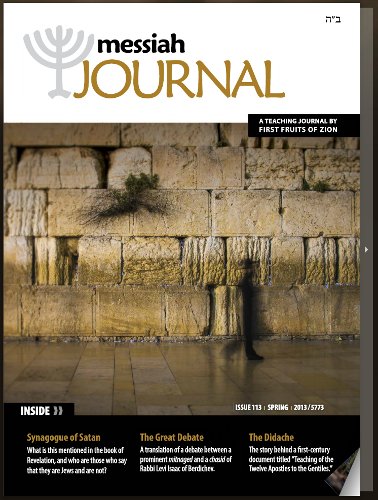
messiah-journal-113Tony Jones aptly calls the Didache “the most important book you’ve never heard of.” It offers an unparalleled look into the day-to-day community of the earliest disciples of Rabbi Yeshua. It is therefore an invaluable document for all students of the Jewish background of Christianity.

The title Didache means “teaching” and is taken from the first word of the book. The work is also known by the longer title, “Teaching of the Twelve Apostles” or the still longer “Teaching of the Lord to the Gentiles by the Twelve Apostles” which is the complete first line of the book.

-Toby Janicki
“The Didache: An Introduction”
from Messiah Journal issue 113, pg 42

I keep meaning to read the Didache, but there are so many other books around that it’s hard to find the bandwidth. Then I received an audio CD in the mail from First Fruits of Zion (FFOZ) that contained a recording of Toby reading his Didache article, published last spring in issue 113 of Messiah Journal.

My son, who is normally my commuting companion five days a week, took some time off of work, so one morning last week, I popped the CD into the player in my car and listened to Toby as I drove to my job. The recording was just the right length so that I could listen to everything Toby had to say from home to work. Then I discovered on the packaging that the content could also be found in text format in Messiah Journal. So here I am.

Most scholars generally agree that the Didache was written either in the location of Egypt, Syria, or Israel sometime between the late first to early second century. Some speculate it may have been written as early as 50 CE. This would mean that the Didache is actually older than the canonical Gospels and was written during the generation after the Master’s death.

-Janicki, pg 44

Admittedly, there’s a lot of guess-work about the Didache, who wrote it, when it was written, but generally it’s agreed that the intended audience was the newly-minted Gentile disciples of the Jewish Messiah, of Jesus. Toby paints a portrait of the Didache as a sort of “learner’s primer” presented to new Gentile disciples who needed some guidance into their day-to-day practices and responsibilities. Toby also makes a point that the style and simplicity of the text seems markedly Jewish and represents early Jewish religious instruction common in the late 1st century period.

The longest title of the Didache, “Teaching of the Lord to the Gentiles by the Twelve Apostles” would have us believe that the Didache contains instructions that were transmitted by the apostles through the halachic authority that was invested to them by the Master himself. While scholars debate which if any of these titles were originally used when the Didache was composed, this raises the question then of whether or not the Didache actually dates back to the original twelve apostles. Did the teaching of the Didache actually emerge from the oral halachah of the Jerusalem Council? The suggested early date of the compositions, coupled with their contents, makes this a high probability. Jonathan Draper writes, “The earlier the date for this text is pushed, the more likely it was associated from the beginning with, or even originated from, the twelve apostles in Jerusalem, as its title states.” As we will see, the Didache becomes a natural outgrowth of the Jerusalem Council’s rulings in Acts 15.

-ibid, pg 45

I’ve written a great deal on the impact of Acts 15 on Gentile believers in the late Second Temple period and beyond in my Return to Jerusalem series and other blog posts such as The Evidence of Acts 15. One of the criticisms leveled against the “Four Prohibitions” recorded by Luke in that chapter, is that they are woefully insufficient instructions for new Gentile disciples, especially relative to the vast compilation of mitzvot collected in the Torah of Moses and required for the Jewish people. It’s a common argument in parts of the Hebrew Roots movement supporting their belief that the full length of Torah commandments were intended to be observed by both Jewish and Gentile believers.

But what if…just what if the Didache represented the oral halachah that was to accompany the Jerusalem Letter to the Gentile disciples and that it “fleshed out” the letter’s contents.

So when they were sent away, they went down to Antioch; and having gathered the congregation together, they delivered the letter. When they had read it, they rejoiced because of its encouragement. Judas and Silas, also being prophets themselves, encouraged and strengthened the brethren with a lengthy message (emph. mine).

Acts 15:30-32 (NASB)

the-didacheIt’s very likely that there was a rather long and involved explanation about the contents of the letter delivered to the different communities of Gentile believers. Luke only hit the high points, so to speak, and didn’t write down literally everything Paul and the other Jewish apostles and disciples had to say by way of instruction to the Gentiles. What if the Didache was the written version of those instructions, at least to some degree?

No, I can’t say that it is or it isn’t. There’s a lot of mystery shrouding the Didache, and no one is able to make many definitive statements about it. However, Toby writes that it nearly was made Biblical canon and for various reasons, fell out of favor. Still, it is acknowledged that the Didache is an important written work in early Christianity, albeit obviously coming from a strong Jewish source.

Once I get the opportunity to read and study the Didache, I’ll revisit my suggestions and see if they at all seem credible. If they do, that still doesn’t mean Christians today should follow their instructions to the letter, but it may mean we already have a more complete set of documents advising us of the intent of the Apostolic Council in terms of the requirements for Gentile disciples in the body of Messiah. And remember, the Acts 15 letter wasn’t just the idea of human beings.

“Therefore we have sent Judas and Silas, who themselves will also report the same things by word of mouth. “For it seemed good to the Holy Spirit and to us to lay upon you no greater burden than these essentials… (emph mine)”

Acts 15:27-28 (NASB)

I can’t claim Divine inspiration for the Didache the way I can for canonized scripture, but it may represent an important and long absent link between the Acts 15 letter and how it was supposed to be lived out “on the ground,” so to speak, by the earliest Gentile disciples.

This may, in the end, also tell us something about who we are in Christ today.