All posts by James Pyles

James Pyles is a published Science Fiction, Fantasy, and Horror author as well as the Technical Writer for a large, diversified business in the Northwest. He currently has over 30 short stories published in various anthologies and periodicals and has just sold his first novella. He won the 2021 Helicon Short Story Award for his science fiction tale "The Three Billion Year Love" which appears in the Tuscany Bay Press Planetary Anthology "Mars."

The Divine Arsonist: A Book Review

divine-a“Thank God for David and for the creek. They said the cold water probably saved your life. David called in a Lifeflight helicopter and covered you with a blanket. He stayed with you the whole time. They got you down here to St. Luke’s but you were in a coma by then. That was four months ago. Four months. The doctors are shocked that you made it at all. You were a mess. The whole left side of your body was shattered, ribs, arm, pelvis. The burns were bad but they were more worried about the skull fracture. They kept testing you for brain wave activity and every time they were amazed by the results. Even though you were deep in a coma, they said it was like you were living a parallel life somewhere else.”

-Jacob Nordby from the Epilogue of his book
The Divine Arsonist: A Tale of Awakening

This isn’t the sort of book I normally read but somehow Jacob Nordby ended up being my “friend” on Facebook, and his book “Divine Arsonist” keeps coming up in my Facebook updates. I don’t really know how we got to be “friends” on Facebook (I’ve never met him) except that we both live near Boise and we’re both published authors.

I’m generally skeptical of self-help books or texts that purport to show some sort of inner truth or secret meaning to life, but in the back of my brain, every time “Divine Arsonist” appeared in my web browser, I couldn’t shake a twinge of curiosity. Also, I remember part of a transaction I had with Nordby on Facebook. I don’t remember the conversation specifically, but I do remember him gently chiding me about the “path” I’m on, referring to my faith. So I was curious about his particular path.

And I review books.

I normally receive complementary copies of the books I review from the publisher but this time I purchased a kindle edition, which was very inexpensive. I thought I’d shoot through the text rather effortlessly, but I had to really make myself read his book, and I found myself fighting the temptation to abandon it about halfway through.

I don’t want to be unfair. If this book is the result of Nordby being the victim of a hit-and-run car accident in which he was terribly hurt, and if he has suffered all of the misfortunes the Epilogue of his book records, then I have nothing but compassion for him and his family, and I do not want to make light of his experiences. And yet, so much of his book of spiritual allegory is presented as part of his lived experience, I don’t know where his actual life stops and all the fiction begins.

So what did I think of his book?

The Divine Arsonist is the story of a businessman who worked hard to climb the ladder of success only to have something whisper to him that perhaps there was something more to discover. This is his journey of discovery told in a blend of the personal story and fiction. It immediately spoke to me of the question: When do we start dreaming a new dream for ourselves and our world? The old ways are burning us out. That’s where Jacob is at the beginning of his journey. There are so many elements of a shamanic journey, vision quest or hero’s journey from old mythology: meeting spiritual guides, being challenged to endure rites of passage, time in the wilderness, facing the shadow and opening to all the levels of reality beyond our day-to-day “get it done” consciousness. The writing is luscious, descriptive and an easy read. I could have easily read it in one sitting but I forced myself to turn off the light at night and savor it over the course of several bedtime reading sessions. There are beautiful teachings that you want to grab the highlighter to remember.

Jacob’s journey toward finding his light is an invitation or challenge to go on your own journey, to claim your own light. It is a tale that reminds us that life is short and that we are choosing the world we live in right now with each thought and each action we take. It is a story that reminds us that sometimes we have to let go of everything that we think we know to become the person we came to earth to be. Even though I’ve had my own awakening moments, Jacob’s writing made me want to commit to living them on an even deeper level. Isn’t that what we want a spiritual book to do?

Amazon review by Carol Woodliff

I don’t normally look at the other reviews of a book I intend on reviewing, but after finishing Nordby’s book, I thought I must be missing something. Woodliff’s review is typical of the overwhelming amount of praise “Divine Arsonist” has received, at least on Amazon. So why aren’t I “wowed” too?

“So, back to your book. Emerson said ‘make your own Bible. Select and collect all the words and sentences that in all your reading have been to you like the blast of triumph out of Shakespeare, Seneca, Moses, John and Paul.'”

-Nordby, Chapter Ten

Those few sentences really tell you everything you need to know about the philosophy that Nordby relates in “Divine Arsonist.” The essence is to not rely on any single truth such as, for example, Christianity or Taoism, but to derive truths from whatever seems to touch you as a truth. While Nordby’s story relies on external “guides” such as Lucius and Jack to assist the author on his spiritual journey, the truths that seem to come out in the end are truths that matter most to Nordby…or presumably anyone on a similar path. It’s what you would expect of a person taking different elements from a wide variety of world religions and philosophies and weaving them into what looks, sounds, and feels right to that individual…a completely, subjectively constructed set of truths.

CASTANEDA_kraftensgjerningerAlthough Nordby only mentions the works of Carlos Castaneda in passing, the experiences he relates reminds me of how Castaneda’s “Don Juan” series has been described to me (I’ve been meaning to read Castaneda for years but never got around to it). I guess that’s what impresses me the most, or fails to impress me, about “Divine Arsonist.” It seems all too derivative, all too “borrowed” from other religions to be truly insightful, let alone remarkable.

I swam through a field of unconditional love to explore the Great All-Nothing. Without effort, I was there, face to face with what could only be the Mystery of Mysteries, Yahweh, Baha, Wakan, Tanakh, Allah, Krishna, God the Father-Mother, Rah.

I have to assume that some parts of the book accurately describe Nordby’s past, and if so, then Christianity, or the part he experienced, was extremely…extreme, and restrictive, and joyless. Nordby did manage to salvage some portions of the Christian writings, but a much larger part of his philosophy is founded on nature-based religions such as different Native American beliefs. There was also a fair amount of mysticism involved and I’ve spent enough time reading Kabbalah and Chassidic Tales to recognize some symbols from those sources (I should say that I doubt Nordby has actually read from Jewish mystic texts, but many mystic themes seem to travel across different disciplines).

Here’s a short sample:

Masters and ancient ones have appeared to bring the light. In earlier days men were more simple, natural. They lived with the Earth and were guided by the Great Mother’s voice.

A dual male/female god isn’t unusual, even in Judaism. In mystic thought, the Ein Sof is the powerful, creative, male force God while the Divine Presence, which descended upon the Tabernacle in the desert (see the end of the Book of Exodus) is considered feminine and nurturing.

There also seemed to be some of the eastern philosophies influencing Nordby, “surrendering the ego” and such, and though I doubt it was intentional, I caught a few references that could have been from The Matrix (1999) and even the cave scene from The Empire Strikes Back (1980), though the connections were only superficial.

“Divine Arsonist” seems to be the sort of book that would appeal to someone who is on a spiritual journey (and aren’t we all) but who doesn’t want to choose one of the pre-conceived paths. Well, not exactly, anyway. If a person isn’t attracted to a pre-existing religion or philosophical discipline, then “Divine Arsonist” offers the alternative of borrowing as much or as little from any or all of the traditions human beings have created for themselves over time. It’s actually quite appealing when seen from that light.

I don’t want to minimize the impact of all this, particular in Nordby’s life, since it is obviously quite significant.

However, as you know if you’ve been reading this blog for any length of time, I travel a somewhat different path, and while it isn’t entirely traditional, it is truthful to say that I rely on what I consider to be an objective and external God, the God of Abraham, Isaac, and Jacob, and a book or repository of truth and wisdom that has existed in one form or another for thousands of years. The difference for me in writing my own Bible vs. exploring the one I believe was given to us by God, is that in the former, I’m investigating merely myself and my own symbols in relation to my environment and how I perceive it, even in the spiritual realms. In the latter, I’m delving into not only my relationship with my environment but my relationship with the One, Radical, Creative, Unified, God and how He desires to relate to me.

seeking_the_sunTruth isn’t just what I decide it will be, even below the conscious level (although most humans sometimes attempt to manipulate “truth” to their own advantage), but it’s what God has decided it will be. My task is to search for truth where ever it may be found, uncover it, and let the sparks fly upward back to their source (and you’ll forgive me if I momentarily borrow from the imagery of Chassidic mysticism).

God has created a trail for each of us and in partnership with Him, we walk the trail together, not because God needs us as a companion, but because God wants unity with human beings and He desires to teach us about a relationship with Him. The problem with internally generated symbolism and meaning is that ultimately, you can never surprise yourself or learn something new. Oh I don’t doubt that it can be very beneficial in many ways.

But it’s not God.

However, Nordby did remind me that I always did intend to read Carlos Castaneda, so after I finish the next book in my pipeline, I’ll finally get to The Teachings of Don Juan.

After everything I just said about Nordby’s book, why would I read another book (or book series) that promises to reveal yet another “alternative” spirituality? Curiosity? Yes. But I also want to pursue the history and the mythos that Castaneda’s work contains. After all, Castaneda’s books are considered classics in their genre and not derivatives of previous works (as far as I know).

There is value in unfolding another’s symbolism and following the thread woven into their tapestry…just as long as you remain grounded upon a firmer foundation.

The Problem with Religious People

rob-bellThe former pastor and founder of Mars Hill Bible Church in Grandville, Mich., made the comment during a guest appearance this past Sunday at The Forum at Grace Cathedral in San Francisco to discuss his new book, What We Talk About When We Talk About God.

Grace Cathedral is the Episcopal Cathedral of the Diocese of California and describes itself as “an iconic house of prayer for all” and is home to an “inclusive congregation.” The congregation’s dean, the Very Rev. Dr. Jane Shaw, moderated The Forum discussion before a live audience.

When asked by Shaw if he was in favor of “marriage equality,” the politically-charged term used by some who want “marriage” redefined, Bell said:

“Yes, I am for marriage. I am for fidelity. I am for love, whether it’s a man and a woman, a woman and a woman, a man and a man. I think the ship has sailed and I think that the church needs to just … this is the world that we are living in and we need to affirm people wherever they are.”

-Nichola Menzie
“Rob Bell Supports Same-Sex Marriage, Says He Is for ‘Fidelity and Love'”
March 18, 2013 | 2:42 pm
ChristianPost.com

As for Acts 15, this is not a set of different instructions for Gentiles. But salvation is by faith, for Jew and Gentile alike. We believe they will be saved the same way we will be saved. The Torah is not the yoke that we nor our fathers have been able to bear, but rather, specifically, the Torah “according the custom of Moshe.” So it is that Paul recalls his words to Peter in Galatians, that Peter did not live “like a Jew.” The followers of Messiah Yeshua inherently cannot submit to all of the traditions of Judaism. To do so would be to disobey the Master and the Commandment of God. In separating himself from the Gentiles, Peter was submitting to Jewish halachic rulings that are not in step with the gospel, and requiring Gentiles to do likewise. Gentiles should start with the four prohibitions in Acts 15—which people are cut off from Israel for breaking—so that they can join the assembly and learn the Commandment of God, which is read in every city every Sabbath. They do not need to become Jewish and submit to the Oral Torah, they simply need to have faith in God and His Mashiach and let obedience to the Commandment working through love be the expression of that faith.

-Charles commenting on my blog post
Moshiach Rabbeinu

Why is everyone trying to change my mind?

I saw the news item about Rob Bell a few days ago. The link was posted by a Facebook “friend” (I put “friend” in quotes since I’ve never met the individual and know him solely through Facebook). It wasn’t directed specifically at me, though I did comment about it a few times on Facebook and then dropped the issue.

But Charles came to me or more accurately, to my blog to comment on his views and to disagree with mine. He seems like a nice guy. I don’t doubt that he’s sincere. But in reading my blog, he should have known from the start that we were coming from two different points of view.

Don’t get me wrong, I don’t expect to be universally accepted, agreed with, or liked. Especially in the world of religion, it’s almost a given that if you’re outspoken at all, people are going to “hunt you down like a duck” (to quote Buford Tanner from the third Back to the Future movie) from the four corners of the earth just to tell you that you’re not only wrong, but a total blockhead (with apologies to Charlie Brown, who’s been called a blockhead more times than I can count).

But it occurred to me to ask, and especially in the context of Charles and people like him, people who don’t know me or have any particular reason to read, let alone comment on my blog, why do they care what I think, say, and believe?

I mean, the Internet is full of bloggers. According to dazeinfo.com, by the end of 2011, there were 181 million blogs on the Internet. That was well over a year ago, and I’m sure there must be even more by now (jeffbullas.com has some interesting info on the nature of the blogosphere in 2012, but nothing relevant to the religious blog space).

So why me? Do I comment on your blogs? No, and in fact, I’ve deliberately stopped commenting on blogs where I know my opinions will cause a small and virtual riot just because I’m sick and tired of all the arguments. Discussions? OK. But why charge down my throat just because you know you can?

And it’s not just the blogosphere anymore.

a-j-jacobsMy Pastor recently loaned me a copy of A.J. Jacobs’ book The Year of Living Biblically. I’ve just started reading it and so far, find it entertaining and humorous. Jacobs is Jewish and not religious in the slightest, but he was determined, for the sake of writing a book, to live as close to a literally Biblical life as possible for an entire year.

I might have taken some sort of offense to his approach, but apparently this is the type of book Jacobs writes. He immerses himself in a subject for a significant period of time in order to learn, often with amusing results, records his experiences, and then turns all that into a book.

But then I had a thought. Is it possible that Pastor gave me this book to read for a specific reason, one particularly related to whether or not the Torah is possible to observe by Jews in today’s world? I’ll have to ask him, but I don’t see him until tonight.

I can understand why Pastor would want to instruct me, enlighten me, edify me, since we have a one-on-one, face-to-face relationship and I attend his church, but why does the Internet care?

Even the people I agree with theologically have some sort of interest in maintaining my current belief system which dovetails into their’s. I’ve made a paradigm shift before. What if I do so again? Who will be affected? How will they react? How much of other people’s emotions and interests are tied to what should be a single individual’s personal understanding of God and faith?

And then there’s political correctness to consider. Atheists and the socially and politically liberal religious individuals and movements are interested in convincing me (well, maybe not me personally, but everyone like me) that not only “gay is good” but that being gay is biblical and that I should not only adopt that belief as a matter of religion but as a matter of politics, carrying it all the way to the ballot box.

Does my personal opinion about how “marriage equality” factors into my understanding of the Bible have anything to do with anybody else? It’s not like I’m protesting at gay weddings or writing letters to the editor. I’m not even vocal about the issue except when my hand is forced. I live in a nation of laws and when (I don’t doubt that it will happen, it’s just a matter of time) marriage between same-sex couples becomes legal nationally, I won’t say “boo” about it. Actually, it’s not a law I could break, even if I wanted to, since I’m in no position to affect such a law one way or another.

But some people want or need me to agree with them anyway. Go figure.

After finishing Jacobs’ book, I plan to start reading Carlos Castaneda’s The Teachings of Don Juan: A Yaqui Way of Knowledge. No, I don’t plan to adopt it as my model for a personal spiritual journey, but Castaneda’s books are considered classics in their genre and I’ve been meaning to read at least a few of them for the past thirty years or so. I just never got around to it before.

I’m beginning to get disgusted again with all the little games that people play in the religious blogosphere. I’m really getting tired of all of the “I’m right and you’re wrong” pettiness that is going on out there. If it stayed “out there” it would be easy to ignore, but it’s invading my space. I’m not here to be a target. I want to be free of your chains. But it seems the only way to do that is to abandon contact with religious people and pursue God independently. Yes, that’s full of pitfalls and I returned to church just because of those pitfalls.

But I’m having second thoughts. If God wants me, He’s got me, but that doesn’t mean I have to join your particular club just because it makes you feel better to drag in more members, be ye “One Law,” Two House,” “Hebrew Roots” or any other “label” that comes with a dogma on a leash.

burning-the-sacredI can sort of see why Jacob Nordby wrote his book (which I’ll review shortly) The Divine Arsonist, since it’s the latest in a long line of attempts by people to reinvent God and religion in our own personal image. I can understand why concepts such as free range humans are coming to the surface. People want control of their lives and they’re tired of the environment defining the parameters by which we must live. That includes the parameters by which we must believe and have faith.

Christians like to say “God is in control” but when it comes to faith, it’s more like the religions and the people occupying their favorite religions that want to take control…of me.

OK, I’m exaggerating. I’m not that important to anyone, at least to anyone on the web. I could disappear tomorrow and probably not inspire so much as a raised eyebrow. Which makes it all the more mysterious to me why people want to control what I say, think, and believe.

If I don’t believe the same things as you and through my beliefs, I’m not harming you (I don’t visit you, yell at you, try to change your life, picket your weddings and funerals, pollute your holy water, or otherwise interfere in your life and the practice of whatever faith to which you’re attached), then why do you care about my religious convictions? Honestly, if I believe that God really doesn’t expect me to wear a tallit gadol when praying, doesn’t expect me to not mow the lawn on Saturday morning, doesn’t expect me to not eat a cheeseburger, how does that impact you even slightly?

Yes, I’m ranting. It’s my blogspot and I’m entitled to rant here. Tomorrow, I may wake up and feel better but right now, I’m a little tired of “religion” (and please, don’t drop by and tell me that Christianity “is a relationship, not a religion,” trust me, it’s a religion).

If you want to ask me a question, fine. If you want to deliver a polite and civil comment, fine. Even if you disagree with me and want to tell me why you do what you do, fine. Just don’t feel like you can tell me what I can, should, must do just because you’ve made those decisions for you.

When I refrain from eating bacon or sausage for breakfast, I’m not doing it because I think God will fry me in pork fat if I do. I’m making a personal decision based on my own convictions. Please feel free to enjoy a good pork chop or a steaming hot bowl of shrimp scampi. I won’t mind. If you’re a gay guy and want to marry your partner, fine. If you’re a through and through Gentile without a drop of Jewish blood in your veins and you feel you must pray in Hebrew facing toward Jerusalem and calling Abraham, Isaac, and Jacob your “fathers,” go for it.

But I’m not going to pretend they’re my fathers just because you want me to. My relationship with God is my relationship with God. I blog about it. So what? Deal with it. If you don’t like what I say, don’t come to my blog. I promise, I’ll never come to your blogs and I absolutely promise I’ll never comment on any of them.

I write because that’s what I do. I’m a writer. I write for my job. I write to process information. I write for fun. Maybe someday you’ll succeed in chasing me out of the blogosphere, but I don’t know what would compel me to shut up. On the other hand, there are days like today when I could happily pull the plug and just read and study by myself, no other human beings required.

Got it?

Four Questions, Part 4

tallit_templeThis is a continuation on the topic I started discussing in Lancaster’s Galatians: Introduction, Audience, and What Happened to the Torah? and continued in Broad Strokes. I asked the first three of these four questions in Part 1, Part 2, and Part 3 of this series. Part 4 presents the fourth and final question. Hopefully, the answer will be illuminating.

Just a reminder, all quotes from scripture will be from the ESV Bible unless otherwise stated.

Belief in the coming of the Messiah has always been a fundamental part of both Judaism and Christianity. The Hebrew word for Messiah, Mashiach or Moshiach, means anointed, as does the Greek word, christos. Thus in Christianity, Christ is just another word for the Messiah. Much has been written about Jesus as the Messiah within the Christian realm, but little information has been publicized to the uninformed Jewish community concerning the coming of a Messiah, whom all we know about is that he will be a direct descendant of king David. Although Jesus has been proposed by Christianity to be such a descendant, Judaism does not accept Christ as their savior or king. Because the Messiah cannot be separated from God’s Third Temple and because God’s Third Temple is destined for all people…

“Coming of the Messiah”
ThirdTempleInfo.org

“For thus says the Lord: David shall never lack a man to sit on the throne of the house of Israel, and the Levitical priests shall never lack a man in my presence to offer burnt offerings, to burn grain offerings, and to make sacrifices forever.”

Jeremiah 33:17-18

I’ve written about the Messiah and the Third Temple before, but this is a slightly different approach because of the fourth and last question.

What is the Future of the Torah and the Temple?

Pastor Randy and I both agree that there will be another Temple built in Jerusalem, and if the Jewish understandings of the prophesies about Messiah are accurate, then we know that Messiah will build the Temple.

Here’s a brief refresher about the Messianic prophesies courtesy of Judaism 101:

The mashiach will bring about the political and spiritual redemption of the Jewish people by bringing us back to Israel and restoring Jerusalem (Isaiah 11:11-12; Jeremiah 23:8; 30:3; Hosea 3:4-5). He will establish a government in Israel that will be the center of all world government, both for Jews and gentiles (Isaiah 2:2-4; 11:10; 42:1). He will rebuild the Temple and re-establish its worship (Jeremiah 33:18). He will restore the religious court system of Israel and establish Jewish law as the law of the land (Jeremiah 33:15).

The idea of a Third Temple gets a bad rap from a lot of Christians because it begs the question about future sacrifices. If the sacrificial system only existed to point to Jesus and Jesus has come, gone, and will come again, why would Jesus, upon his return, build another Temple and (supposedly) restart the sacrificial system? Weren’t our sins already paid for once and for all by Christ’s death on the cross?

What makes you think that the only sacrifices made in the Temple were for sin? Also, what makes you think that only Jews made sacrifices in the Jerusalem Temple of the past or that Gentiles won’t make sacrifices in the Third Temple?

That Gentiles as well as Jews brought sacrifices to the Temple is implied in the prayer of Solomon when he dedicated the Temple (I Kings 8:41-3) and in the declaration by the prophet that the Temple will be a house of prayer for all peoples (Isaiah 56:7).

-Rabbi Louis Jacobs
“Sacrifice”
MyJewishLearning.com

Within the Books of the Prophets, we find that in the past, Gentiles were welcomed to the First and Second Temples, and that they will participate even more at the Third Temple.

In his commentary on the Torah section beginning with Gen. 12:1, Ramban (Nachmanides) wrote:

“Even in the time of Joshua, … the Gentiles knew that this place was the most august of all, that it was at the center of the inhabited world; and Tradition had taught them that it corresponds in this world to the celestial Temple where Divine Majesty, called (righteousness), resides.”

When the First Temple was inaugurated by King Solomon, he beseeched G-d with an eloquent prayer that included the following words (Kings I, 8:41-43) (which show that in the past, Gentiles were welcomed to the First and Second Temples, and that they will participate even more in the Third Temple):

“If a foreigner who is not of Your people Israel comes from a distant land for the sake of Your name – for they shall hear about Your great name and Your mighty hand and Your outstretched arm – when he comes to pray toward this House, oh, hear in Your heavenly abode and grant all [!] that the foreigner asks You for. Thus all the peoples of the earth will know Your name and revere You, as does Your people Israel; and they will recognize that Your name is attached to this House that I have built.”

Torah Law holds that Gentiles are allowed to bring burnt offerings to G-d in the Temple when it is standing in Jerusalem. There is a specific commandment to let us know that an animal (sheep, goat or bullock) offered in the Temple by a Gentile must be unblemished, to the same degree as the offering of a Jew. (Leviticus 22:25)

-from “Will Gentiles be permitted to worship at the Third Temple in Jerusalem?”
AskNoah.org

messiah-prayerI know I’m borrowing heavily from my previous blog post and you may be wondering why I just didn’t reblog it as the answer to this fourth question. But here’s the new thought.

If there indeed will be a Third Temple that Messiah will build and if part, most, or all of the sacrificial system will be reinstated, then what is the role of the Torah in Messianic Days?

Pastor Randy and I talk a lot about what the role of Torah was in the days before the destruction of Jerusalem in 70 CE and what the role of Torah is now. He believes, using Orthodox Jewish halachah as a guide, that the Torah is too difficult to keep and has always been too difficult to keep. I’m pretty sure I spelled a lot of that out in my blog post about my last conversation with him a week ago.

“For this commandment that I command you today is not too hard for you, neither is it far off. It is not in heaven, that you should say, ‘Who will ascend to heaven for us and bring it to us, that we may hear it and do it?’ Neither is it beyond the sea, that you should say, ‘Who will go over the sea for us and bring it to us, that we may hear it and do it?’ But the word is very near you. It is in your mouth and in your heart, so that you can do it.”

Deuteronomy 30:11-14

Doesn’t sound like Moses (or God) intended the Torah to be too difficult to obey or too hard to access.

Here’s another reason why the Torah has a future in the days of Messiah.

Then everyone who survives of all the nations that have come against Jerusalem shall go up year after year to worship the King, the Lord of hosts, and to keep the Feast of Booths. And if any of the families of the earth do not go up to Jerusalem to worship the King, the Lord of hosts, there will be no rain on them. And if the family of Egypt does not go up and present themselves, then on them there shall be no rain; there shall be the plague with which the Lord afflicts the nations that do not go up to keep the Feast of Booths. This shall be the punishment to Egypt and the punishment to all the nations that do not go up to keep the Feast of Booths.

Zechariah 14:16-19

I could draw from more scriptural quotes but chances are you know them all and they’re referenced above anyway. If a Third Temple will be built by Messiah, and if sacrifices and festivals that require sacrifices will be reinstated, and if Gentiles will not only be allowed to worship at the Temple and make sacrifices but in some cases, required to do so, then how will all that be possible if the Torah is not observed, at least as far as the Temple is concerned?

It seems clear that the Torah had a vital role in the existence of the Jews of ancient Israel and it will have a vital role in future, Messianic Israel. But what happens to Torah in the meantime? Does it just vanish temporarily from existence, put in cold storage until it’s needed, and then brought out, thawed out, and then be put back into service when Messiah starts his construction work?

Well, no. First of all, religious Jews observe the Torah every day. For that matter, Christians observe substantial portions of the Torah (ideally) every day. Every time a Christian performs any act of kindness in the name of Jesus, he or she is observing one of the mitzvot. They (we) just don’t call it that. Every time a Christian donates money, food, or some other good or service to the poor, they are observing a mitzvah (probably more than one). Every time a Christian comforts a person who is grief-stricken at the loss of a loved one, performs an act of kindness that assists the successful wedding of a bride, visits a sick person in the hospital, visits someone in jail, shovels snow off of a neighbor’s driveway and sidewalk unasked…they are performing Torah mitzvot.

The Torah is hardly obsolete. The Law isn’t dead. In fact, if Christians and Christianity are functioning properly, the Torah is alive and well and being performed in churches around the world and in the lives of Christians and their neighbors every day. The Torah is also alive and well and being performed in synagogues around the world and in the lives of Jews and their neighbors every day. No, not all Christians and not all Jews are doing what God expects of them (us), but some are. Not everything that some Christians think of as “the Word of God” and not everything that some Jews think of as “Torah” is really God’s Word and Torah.

Some Christians have some pretty funny ideas about how they’re supposed to judge people who don’t comply with their personal political and social agenda, and some Jews have some pretty funny ideas about how far to take all of the massive compilation of halachah that has become attached to Torah. I suspect when Messiah returns, he’s going to help us all out by teaching us what God’s expectations are really all about and what the Torah is supposed to mean as applied to Gentile Christians and as applied to Jews.

But be that as it may, the Torah has a past, a present, and a future. It has to, otherwise what even traditional Christians understand about the Bible doesn’t make sense, and many specific passages of scripture don’t make sense.

I have no idea exactly how we are to apply the Torah in the lives of Jews or Christians today except in a general, common sense way. As I’ve said numerous times before, based on Acts 15, Acts 21 and various other scriptures, I don’t believe that Gentile, God-fearing believers in Messiah are expected to observe the mitzvot in the manner of the Jews. I do believe we are to observe it as taught by Messiah, and what he taught focused on the acts of kindness and charity I mentioned above. I also believe that Jewish people, believers in Messiah Yeshua and otherwise, remain under all of the covenants that God made with Israel. The New Covenant extends the part of the Abrahamic covenant that allows the Messiah to bless the nations to the rest of us, providing salvation and relationship to God for the Gentiles who are called by Messiah’s name, and providing reaffirmation of all of the previous covenants to the Jewish people.

renewalWhat’s New about the New Covenant, as I was recently reminded, is that it will be written on our hearts. The actual content of the writing won’t change but how we will perceive it and live it out will be different. I say “will be” as opposed to “is” because if the “writing” were a done deal, we all would be leading very different lives, rising above sin, rising above the cares of the world, all “knowing God” in a way that currently escapes us.

Messiah opened the door and he holds all the keys, but he’s not done yet and until he is, the finger of God is still in motion, slowly inscribing “Torah” on the hearts of Christians and Jews everywhere.

But that Torah is and will be about the Temple, Sukkot, Pesach, Shavuot, and many more things most Christians don’t consider important anymore. That Torah will be a pure product, freed from our biases, our interpretations, our confusion, and our controversies.

But there was a Torah. There is a Torah. And there will be a Torah. Our current understanding is not very good, and like Paul said, we are seeing the Bible and the things of God as through a mirror dimly (1 Corinthians 13:12). We’re all still going to mess up a “free lunch” until Messiah returns. Until then, we still have to eat that lunch, so to speak, even if we do so poorly. At least we’re mindful of God and His will and His Word.

For truly, I say to you, until heaven and earth pass away, not an iota, not a dot, will pass from the Law until all is accomplished.

Matthew 5:18

Do we then overthrow the law by this faith? By no means! On the contrary, we uphold the law.

Romans 3:31

I hope you enjoyed going over these four questions with me. As you read this, it is Wednesday morning, and tonight, I’ll have another conversation with Pastor on Lancaster’s “Galatians” book. May I continue to be inspired and illuminated by my relationship with Pastor Randy and may God grant both of us the eyes to see and the ears to hear what our Master is teaching us all.

Addendum, March 21: My wife emailed me a link to Rabbi Shlomo Yaffe’s article The Dynamic of Sacrifices. Rabbi Yaffe tells a wonderful story about the meaning of the Olah offering, the fire from God, and how the sacrifices in the Third Temple, built by Messiah, will provide the means for a unity between all people.

“I will bring them to My holy mount, and I will cause them to rejoice in My house of prayer; their burnt offerings and their sacrifices shall be acceptable upon My altar, for My house shall be called a house of prayer for all peoples.”

Isaiah 56:7

Amen and may it come soon and in our days.

Moshiach Rabbeinu

rabbeinu1Believe it or not, this week’s message was not inspired by the fact that the Catholic Church has chosen a new Pope; it just offers a convenient contrast. As you probably know, there is, in their beliefs, a doctrine of papal infallibility. When the Pope teaches the rules, he is always right.

It is natural to assume that Judaism has something similar. This is especially true, given the Torah’s demand that we listen to the Rabbis and Judges, and not deviate “right or left” [Deut. 17:11] from what they say.

-Rabbi Yaakov Menken
“Everyone Makes Mistakes”
Commentary on Torah Portion Vayikra
Project Genesis

I’ve been hesitating about writing this particular “meditation” because it has the potential to be rather controversial. As part of my conversations with Pastor Randy, we’ve been discussing what is Torah? That’s an amazingly difficult question to answer. It’s not just the Five Books of Moses, and I believe that it should be at least the entire Tanakh (Old Testament). I believe a great deal of the New Testament and certainly the epistles of Paul should be considered midrash on Torah, specifically in relation to the teachings of Messiah.

As I’ve said before (and will say again when I publish “Four Questions, Part 4” tomorrow), Pastor Randy believes that the Torah is too difficult to observe perfectly and in fact, has always been too difficult to observe. This is pretty much what most of Christianity believes, and along with that, the church sees the primary purpose of Torah as always pointing to Jesus. Once Jesus came, the purpose of Torah expired and grace was substituted.

I don’t happen to believe this, and my understanding is that Jewish people, including those who are disciples of the Master, remain obligated to the Torah of Moses.

But I’m not here to talk about the Torah as such (I’ll do that tomorrow), but rather how it is applied through Rabbinic interpretation and authority. This is the really touchy part. As Rabbi Menken writes, there’s a tendency to view the sages in a manner similar to how Catholics view the Pope, as infallible and that all Rabbinic rulings are automatically correct. But is that really true? Rabbi Menken continues.

We see from this week’s reading, though, that this is definitely not the case. The Torah prescribes special atonement for when the High Priest, the King, or the Sanhedrin [Lev. 4: 13-21], the High Rabbinical Court, makes a mistake. In other words, the Torah highlights for us that it is possible for the Sanhedrin to be mistaken.

This is not about a small matter, either. The commentaries say that the mistake described here is one in which the Sanhedrin teaches that it is permitted to do something, and the Sanhedrin later realizes that the behavior is prohibited — so much so that a person committing the act deliberately would suffer the punishment of Kares, spiritual excision [the exact definition of this is disputed, but severe]. Even in matters of religious law, where the Sanhedrin’s supreme authority is undisputed — even there, they could make a mistake.

So why, then, does the Torah tell us to listen to them? They could, after all, be leading us in the wrong direction!

That is an extraordinarily good question. It’s also the question that comes to the minds of just about all Christians, including many people in the Hebrew Roots movement who believe that the Bible contains everything necessary for a Jew to observe Torah without relying on external interpretation or additional instructions.

Based upon a proof from a Baraisa, the Gemara had concluded that a lechi post is not valid if it is not recognizable from the inside, although it is visible from the outside. Yet, the Gemara proceeds to inform us that the halachah is that such a lechi is valid. Immediately, the Gemara asks, “We have disproven the validity of such a lechi, and yet the halachah rules that it is valid?!”

The Gemara continues to resolve this halachic conclusion, based upon yet another Baraisa which validates such a lechi.

This give and take, where the Gemara proves one point of view, and then immediately concludes the halachah according to the opposite opinion is relatively uncommon. A computer check reveals that it appears only five times in Shas (here, Kesuvos 41b-twice, Bava Kamma 15b-twice, Bava Metzia 22b).

Daf Yomi Digest
Distinctive Insight
“It is disproved – but yet it is the Halachah!”
Eruvin 10

That didn’t help. I admit, the complexities of Talmud escape me most of the time and yet religious Judaism in all of its variants, depends on these rulings, laws, and judgments for so very much.

My question is basic. Is literally every single ruling, judgment, halachah, and word of every sage everywhere across time valid and binding in religious Judiasm, or is it possible that at some point, the sages have gone too far?

Kapparot is a custom in which the sins of a person are symbolically transferred to a fowl. It is practiced by some Jews shortly before Yom Kippur. First, selections from Isaiah 11:9, Psalms 107:10, 14, and 17-21, and Job 33:23-24 are recited; then a rooster (for a male) or a hen (for a female) is held above the person’s head and swung in a circle three times, while the following is spoken: “This is my exchange, my substitute, my atonement; this rooster (or hen) shall go to its death, but I shall go to a good, long life, and to peace.” The hope is that the fowl, which is then donated to the poor for food, will take on any misfortune that might otherwise occur to the one who has taken part in the ritual, in punishment for his or her sins.

-Richard Schwartz, Ph.D.
“The Custom of Kapparot in the Jewish Tradition”
JewishVirtualLibrary.org

Solomons-TempleThe Torah, particularly the book of Leviticus, provides an extremely detailed description of the various sacrifices to be given at the Temple in Holy Jerusalem, and under what circumstances a Jew must present said-sacrifices. To the best of my knowledge, none of them involve the use of a chicken as described by the modern rite of kapparot. Dr. Schwartz details some of the Jewish objections to this practice.

Some Jewish leaders felt that people would misunderstand the significance of the ritual. The belief that the ceremony of kapparot can transfer a person’s sins to a bird, and that his or her sins would then be completely eradicated, is contrary to Jewish teachings. For, if the ritual could remove a person’s sins, what would be the need for Yom Kippur, the Day of Atonement?

The Mishneh Brurah, an eminent contemporary commentary on Rabbi Joseph Caro’s classical codification of Jewish law, explains the significance of the ritual. Judaism stresses that a person can’t obtain purity from sin, and thus obtain higher levels of perfection, without repenting. Through God’s mercy, we are given the Divine gift of repentance, so that we might abandon our corrupt ways, thereby being spared from the death that we deserve for our violation of the Divine law. By substituting the death of a fowl, one will (hopefully) appreciate G-d’s mercy and be stirred to repentance. By no means, however, does the ritual and the slaughter of the bird eradicate one’s misdeeds, even though the bird is donated to the poor.

If a Jewish person is a disciple of the Master and has studied and accepted the teachings in the Apostolic Scriptures, he or she understands that this particular ritual is not meaningful or necessary. The sins of anyone, Jew or Gentile, who has accepted Jesus (Hebrew: Yeshua) as Savior, Lord, and Messiah, have been forgiven. He died, paying the price for our sin as the ultimate atonement, and when we repent (and we must repent) of our own sins, turning away from them, and turning to God, we are forgiven once and for all without the need for further sacrifices.

So how are we to reconcile the rulings of the sages in relation to the kapparot involving chickens during Yom Kippur and the reality of the Messiah? The better question is, how are Messianic Jews to reconcile this along with any other Jewish practices that seem to contradict the teachings and life of the Master?

The Messianic Jewish Rabbinical Council has established official halachah for its member synagogues and individual members, but that’s hardly a universal standard. On the other hand, how halachah is applied across the rest of the religious Jewish landscape is not entirely consistent either. For example, we can point to the radically extreme differences between how the Haridim vs. Reform Judaism live out Jewish lives they believe are consistent with observing Torah.

It’s obvious that Messianic Judaism has to make a few “adjustments” to how some of the Rabbinic rulings are applied, but even given that, are we to understand that all of the remaining body of Mishnah is fully correct and fully valid? If we accept that the Torah doesn’t change (and there are those who debate even that), can we accept that Jewish interpretation is adaptive and evolutionary across time and culture? I had a recent Facebook conversation that included the following:

There are enduring realities in the Torah…the Shema is one…The pursuit of Justice is another…however there are changes in the way Torah is embraced…David recognizes that G-d wants a contrite and broken heart, not burnt offerings (Psalm 51) Micah gives the same notion (Micah 6)…so there is an evolutionary understanding of the nature and character of G-d that takes place…

David is specific…”burnt offerings you do not desire”…but a contrite broken heart….quite removed from the harsh Levitical code of bloody sacrifices…and those scriptures reflect evolving understanding of the nature and character of G-d…Jesus in the John 8 narrative lays aside the penalty that the Torah prescribes and challenges the lack of personal holiness/integrity of the woman’s accusers…

Part of the problem is that we can “interpret” the Bible to mean just about anything. If we give the Rabbinic sages (or anyone) carte blanche to establish binding interpretations and halachah for their specific streams of Judaism, are they always consistent with God’s intent for the Jewish observance of Torah?

There’s no way to know for sure. Well, there’s one.

Then Jesus said to the crowds and to his disciples, “The scribes and the Pharisees sit on Moses’ seat, so do and observe whatever they tell you, but not the works they do. For they preach, but do not practice. They tie up heavy burdens, hard to bear, and lay them on people’s shoulders, but they themselves are not willing to move them with their finger.

Matthew 23:1-4 (ESV)

phariseesEven as Jesus confirmed that the scribes and Pharisees did indeed have the authority to create binding halachah upon the Jewish people of his day (see the paper Matthew 23:2–4: Does Jesus Recognize the Authority of the Pharisses and Does He Endorse their Halakhah? (PDF) by Noel S. Rabbinowitz, JETS 46/3 (September 2003) 423-47 for details), he also criticized them for failing to follow their own rules. However, he didn’t agree with each and every one of their rulings.

Again he entered the synagogue, and a man was there with a withered hand. And they watched Jesus, to see whether he would heal him on the Sabbath, so that they might accuse him. And he said to the man with the withered hand, “Come here.” And he said to them, “Is it lawful on the Sabbath to do good or to do harm, to save life or to kill?” But they were silent. And he looked around at them with anger, grieved at their hardness of heart, and said to the man, “Stretch out your hand.” He stretched it out, and his hand was restored.

Mark 3:1-5 (ESV)

Now when the Pharisees gathered to him, with some of the scribes who had come from Jerusalem, they saw that some of his disciples ate with hands that were defiled, that is, unwashed. (For the Pharisees and all the Jews do not eat unless they wash their hands properly, holding to the tradition of the elders, and when they come from the marketplace, they do not eat unless they wash. And there are many other traditions that they observe, such as the washing of cups and pots and copper vessels and dining couches.) And the Pharisees and the scribes asked him, “Why do your disciples not walk according to the tradition of the elders, but eat with defiled hands?” And he said to them, “Well did Isaiah prophesy of you hypocrites, as it is written,

“‘This people honors me with their lips,
but their heart is far from me;
in vain do they worship me,
teaching as doctrines the commandments of men.’

You leave the commandment of God and hold to the tradition of men.”

Mark 7:1-8 (ESV)

So what does all this mean?

  • There are some modern Jewish rituals and customs that contradict the reality of the risen Messiah.
  • Jewish ritual and tradition is not applied with universal consistency across all religious Jewish communities and across time.
  • Historically, Jesus affirmed the right of the ancient Pharisees and scribes to establish binding halachah for Jews.
  • Historically, Jesus refuted some of the halakhic rulings by the Pharisees and scribes and offered correction and criticism when necessary.
  • At least one modern Messianic Jewish body has offered an adaptation to Jewish halachah that is more consistent with the reality of the risen Messiah.

Oh. We know one more thing:

The nations will send their emissaries to the King Messiah, and the King Messiah will teach the world how to live in peace, and how to want to live in peace. Then, everyone in the world will enjoy eternal peace, for as long as this world will last. The great Rabbi, Rav Shlomoh Freifeld, of blessed memory, said in a talk he once gave that I attended that the Messiah will be a great teacher.

-from “What is the Messiah Supposed to Do”
BeingJewish.com

He will restore the religious court system of Israel and establish Jewish law as the law of the land (Jeremiah 33:15).

-from “Mashiach: The Messiah”
Judaism 101

It is my understanding that one of the things many Jewish people believe the Messiah will do is to teach Torah, to teach the correct interpretation of Torah and how it is to be lived out. According to BeingJewish.com, as we saw above, he will even teach the Gentiles peace.

So what am I getting at?

This is Rabbi Menken’s solution to understanding the puzzle.

One answer has to do with the power of unity. Different customs and practices are wonderful, but there has to be underlying agreement on “the basics.” One of the problems with calling different Chassidic groups “sects” is that a sect is “a dissenting or schismatic religious body.” Chassidic groups may be led by different Rebbes, but they don’t rewrite the rules. The disagreements of today are disagreements about shapes of branches on individual trees within a massive, unified forest.

And there is another answer, which requires still more humility. It is all well and good to say that everyone is fallible — but who is more likely to be making a mistake? The Torah gives leadership to people who dedicate themselves completely to Torah study, to learning the Torah’s “way of thinking.” Such people are inherently less biased by the latest news reports and the wise opinions of the chattering class, as we are. We recognize that it is much less likely that they will make a mistake, and that is why we trust their guidance.

torah-tree-of-lifeIs there a “unified forest” of Torah? I think there must be, otherwise there is nothing for Jews to observe except traditions (the shapes of branches on the individual trees); there is no root, no foundation, no sense of an absolute God who has core standards that are as unchanging as He is. Beyond a certain point, we can’t simply re-invent the Bible to fit our modern sensibilities so that they agree with whatever “politically correct” causes that may be popular this week, this month, or this year. If we did, our faith (and our God) would be no more consistent or eternal than the shifting viewpoints of a political party or social agenda.

Rabbi Maurice Lamm says in “What is Torah” published at Aish.com:

In fact, far from being enslaved by the law, Jews were enamored of it. We cannot take our leave of the subject of Torah without expressing this most characteristic sentiment of Jewish literature – the love of Torah.

You may ask: can a people “love” a law? Yet, that is the exquisite paradox inherent in the concept of Torah – it is respected and studied and feared, while it is loved and embraced and kissed. All at once. There is no good in this world – no ideal, no blessing, no perfection, no glory – unless it is associated with the law.

To Jews, the Torah is “light”; it is the “glory of the sons of man”; it is the energizing sap of life for “the dry bones” (Ezekiel 37:4) which symbolize the “people in whom there is not the sap of the commandment.”

To Jews, the law is mayim chayim, refreshing, life-restoring, living waters to Jews; the sweetness of honey and milk, the joy and strength of wine, and the healing power of oil. It is an “elixir of life” that brings healing to all.

In Acts 15, Peter called the Law a burden but in Acts 21, Paul defended his observance of the Law. We also see in that same chapter that many of the Jews in Messiah were zealous for the Law.

And God, through Moses, said this about the Torah.

“For this commandment that I command you today is not too hard for you, neither is it far off. It is not in heaven, that you should say, ‘Who will ascend to heaven for us and bring it to us, that we may hear it and do it?’ Neither is it beyond the sea, that you should say, ‘Who will go over the sea for us and bring it to us, that we may hear it and do it?’ But the word is very near you. It is in your mouth and in your heart, so that you can do it.”

Deuteronomy 30:11-14

I think that for the Jewish people, there is an “ideal” Torah, a Torah that God intends for His people Israel. As we’ve seen in the record of the Bible, all things being equal, human beings will mess up a free lunch. We take everything God gives us and turn it on its side, we fold, spindle, or mutilate it, drag it through the mud, drag it through our biases, prejudices, and personalities, drag it through our theologies, our doctrines, our translations, and eventually on the other side, we come out with some approximation of what God wants us to say, do, and be.

How close are all of our approximations to the desires of God, how near is our fidelity to the original? Opinions vary widely. It’s not that we are dishonest and it’s not that we don’t want to do His will as opposed to our will (most of the time, anyway), but we are human beings. Everything we are as flawed, mortal beings gets in the way of everything He is as a perfect, immortal God.

That’s where Messiah comes in. Being human and divine, he can provide (and has provided) the correct “interface” for us. He is a teacher. When he comes, whatever we’ve gotten wrong, he’ll help us understand correctly.

If there’s an answer to how the Law is infinitely accessible, and a delight, and a light, and to be loved by those who have received it from Him, that answer comes on the clouds with Messiah. God is a teacher.

Four Questions, Part 3

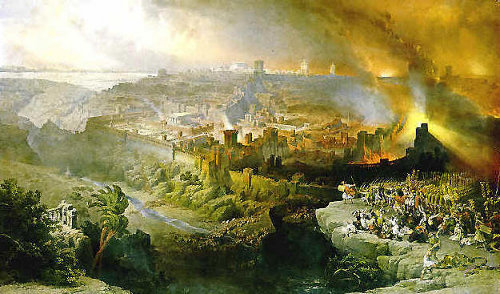
fall-of-jerusalemThis is a continuation on the topic I started discussing in Lancaster’s Galatians: Introduction, Audience, and What Happened to the Torah? and continued in Broad Strokes. I asked the first two of these four questions in Part 1 and Part 2 of this series. Part 3 presents the third question. Hopefully, the answer will be illuminating.

Just a reminder, all quotes from scripture will be from the ESV Bible unless otherwise stated.

Were the Jewish Apostles of Jesus Supposed to Remain in Jerusalem During the Fall?

History records that the Romans destroyed Herod’s Temple and exiled the Jews from Israel in the year 70 of the Common Era (CE). Israel was renamed “Palestine” by the Romans as in insult to the Jews. We also know that there was always a small remnant of Jewish people in “Palestine” from that time until the formation of the modern state of Israel in 1948. But of those who remained in Jerusalem and in the Land during and just after the destruction of the Temple, how many were disciples of the Master?

The destruction of the Second Temple in 70 CE and the subsequent expulsion of the majority of Jews from what would be called Palestine marked a disastrous shift in the Jewish authority over the Messianic community. Up until that time, the head of the Jerusalem leadership of the Messianic community, otherwise referred to as “the bishop of the church”, had always been Jewish. Once the Jews were expelled from Jerusalem by Hadrian, for the first time a Gentile had to be elected into the role. As events moved forward from that point in time, the Gentile presence in the Messianic community grew dramatically while the Jewish leaders and worshipers of Yeshua struggled under the heartbreak of the loss of the Temple and the ejection from their land.

-James Pyles
“Origins of Supersessionism in the Church”
Part one in a four-part series
published in Messiah Journal
Issue 109/Winter 2012

I bring all this up because one of the topics Pastor Randy and I discussed was whether or not the Jewish disciples of the Way “abandoned ship,” so to speak, when the rest of the Jews were expelled from Israel at this point in history. It’s Pastor’s opinion that they did and that it was definitely the wrong thing for them to do. In his opinion, they should have stayed.

Should they have fought the Romans like the zealots? Should they have died like the Jews at Masada?

I don’t know if Pastor is suggesting such a thing. Dying, down to the last man as martyrs, may have been a dramatic move and even a faithful one, but it would not have allowed the apostles to survive and to spread the word of Moshiach to the Jews and Gentiles of the diaspora.

I remember when Pastor was delivering a sermon on the death of Stephen (see Acts 7:54-60) and the consequences that followed his demise.

And there arose on that day a great persecution against the church in Jerusalem, and they were all scattered throughout the regions of Judea and Samaria, except the apostles.

Acts 8:1

According to Pastor, one of the effects of the scattering of devout Jewish believers away from Jerusalem was to allow the spreading of the gospel message throughout Judea and Samaria. This is how I see one of the results of the destruction of Jerusalem and the great exile of the Jews to the diaspora. Not that Paul had been unsuccessful in taking the message of the Messiah to much of the then civilized world, but this “allowed” (though it was a terrible thing) all or most of the believing Jews in the Land to take who they were and extend that into the galut to other Jewish and probably Gentile communities.

That’s one thought, anyway.

Did Jesus ask or require the believing Jews to stay in Jerusalem during this time of great tragedy?

“But when you see Jerusalem surrounded by armies, then know that its desolation has come near. Then let those who are in Judea flee to the mountains, and let those who are inside the city depart, and let not those who are out in the country enter it, for these are days of vengeance, to fulfill all that is written. Alas for women who are pregnant and for those who are nursing infants in those days! For there will be great distress upon the earth and wrath against this people. They will fall by the edge of the sword and be led captive among all nations, and Jerusalem will be trampled underfoot by the Gentiles, until the times of the Gentiles are fulfilled.

Luke 21:20-24

It seems clear that Jesus was telling those who are in Judea to flee to the mountains. Also, those who are inside the city depart, and let not those who are out in the country enter it. He knew that many [would] fall by the edge of the sword and be led captive among all nations. Nowhere in that short narrative do I hear the Master telling anyone to stay and die. In fact, it was necessary for Jerusalem to be trampled underfoot by the Gentiles, until the times of the Gentiles [were] fulfilled.

I don’t know if the times of the Gentiles are fulfilled yet, but the modern nation of Israel has been in existence for over sixty years now, so if our time isn’t yet up, it soon will be.

I mentioned before, in quoting from my “supersessionism” article, that up until the destruction of Jerusalem, every leader of the Council of Apostles had been Jewish. When the Jews were expelled, the first “bishop of the church” had to be a non-Jew since at that time, they were “flying below the radar” of the Romans, so to speak. It’s not unlike the situation with Lydia and the devout God-fearing women in Philippi.

So, setting sail from Troas, we made a direct voyage to Samothrace, and the following day to Neapolis, and from there to Philippi, which is a leading city of the district of Macedonia and a Roman colony. We remained in this city some days. And on the Sabbath day we went outside the gate to the riverside, where we supposed there was a place of prayer, and we sat down and spoke to the women who had come together. One who heard us was a woman named Lydia, from the city of Thyatira, a seller of purple goods, who was a worshiper of God. The Lord opened her heart to pay attention to what was said by Paul. And after she was baptized, and her household as well, she urged us, saying, “If you have judged me to be faithful to the Lord, come to my house and stay.” And she prevailed upon us.

Acts 16:11-15

jerusalem-at-nightThe Jewish population in that area had been expelled at some earlier point, but the God-fearing Gentiles were “under the radar,” and not included in the exile from Philippi because they had not been counted as Jews, even through they had been worshipping in the synagogue with Jews, praying with Jews, discussing Torah with Jews, and otherwise having fellowship with Jews. When Paul and his party came upon Lydia and her companions by the river, he must have understood that these Gentile women were all who were left of those devoted to Hashem to keep the worship of the God of Israel alive in that community. Perhaps the same can be said of the Gentile believers in Jerusalem after 70 CE, but it’s hard to tell.

There has always been a Jewish remnant in Israel for the past 2,000 years. When the Temple was utterly destroyed, when the golden menorah melted and flowed like water, when Jerusalem herself moaned in agony like a woman in hard labor, after all these things, who is to say if, among the Jewish remnant, there were followers of Yeshua HaMashiach or not. There’s no way to know.

I don’t think the Messianic Jews had a specific mandate to stay and endure the incredible suffering of Israel’s downfall under the Romans. If some did stay, so much the better, but I believe what happened was supposed to happen. I think God knew. I think the words of Jesus tell us that he expected it and expected those who listened to him to flee. The time of the Gentiles was upon them.

But that time is running out fast.

Only one more question left. Be here for Part 4 in the conclusion of this series in tomorrow’s “morning meditation.

Losing Your Chains

breaking-chains“The Web is a place for unlimited exchange of ideas. But according to an NPR report, researchers have found that rude comments on articles can change the way we interpret the news. ‘It’s a little bit like the Wild West. The trolls are winning,’ says Dominique Brossard, co-author of the study on the so-called ‘Nasty Effect.’ Researchers worked with a science writer to construct a balanced news story on the pros and cons of nanotechnology, a topic chosen so that readers would have to make sense of a complicated issue with low familiarity. They then asked 1,183 subjects to review the blog post from a Canadian newspaper that discussed the water contamination risks of nanosilver particles and the antibacterial benefits. Half saw the story with polite comments, and the other half saw rude comments, like: ‘If you don’t see the benefits of using nanotechnology in these products, you’re an idiot.’

People that were exposed to the polite comments didn’t change their views really about the issue covering the story, while the people that did see the rude comments became polarized — they became more against the technology that was covered in the story. Brossard says we need to have an anchor to make sense of complicated issues. ‘And it seems that rudeness and incivility is used as a mental shortcut to make sense of those complicated issues.’ Brossard says there’s no quick fix for this issue (PDF), and while she thinks it’s important to foster conversation through comments sections, every media organization has to figure out where to draw the line when comments get out of control. ‘It’s possible that the social norms in this brave new domain will change once more — with users shunning meanspirited attacks from posters hiding behind pseudonyms and cultivating civil debate instead,’ writes Brossard. ‘Until then, beware the nasty effect.'”

-Hugh Pickens
“Why Trolls Win With Toxic Comments”
slashdot.org

No, I haven’t been “nastied” by a troll for a bit now (not for at least a week) but in reviewing the recommended posts at Slashdot today, I came across this little gem which seems to scientifically substantiate what most of us in the blogosphere already know: nasty blog posters and commenters know how to ruin a “free lunch.”

If it were just this one article, I’d probably never have written today’s “extra meditation,” but the guest speaker who lectured at my church yesterday morning preached on James 3. That’s right. The “taming the tongue” chapter in James’ missive.

How great a forest is set ablaze by such a small fire! And the tongue is a fire, a world of unrighteousness. The tongue is set among our members, staining the whole body, setting on fire the entire course of life, and set on fire by hell. For every kind of beast and bird, of reptile and sea creature, can be tamed and has been tamed by mankind, but no human being can tame the tongue. It is a restless evil, full of deadly poison. With it we bless our Lord and Father, and with it we curse people who are made in the likeness of God. From the same mouth come blessing and cursing. My brothers, these things ought not to be so. Does a spring pour forth from the same opening both fresh and salt water? Can a fig tree, my brothers, bear olives, or a grapevine produce figs? Neither can a salt pond yield fresh water.

Who is wise and understanding among you? By his good conduct let him show his works in the meekness of wisdom. But if you have bitter jealousy and selfish ambition in your hearts, do not boast and be false to the truth. This is not the wisdom that comes down from above, but is earthly, unspiritual, demonic. For where jealousy and selfish ambition exist, there will be disorder and every vile practice. But the wisdom from above is first pure, then peaceable, gentle, open to reason, full of mercy and good fruits, impartial and sincere. And a harvest of righteousness is sown in peace by those who make peace.

James 3:5-18 (ESV)

I know some atheists like to bask in the idea that science and religion are mutually exclusive concepts, with all of the “brains” being held on the atheist/science side of the equation, but here we see a scientific study and words of scripture complementing and confirming each other, at least to a degree. Not only do harsh comments on a news story negatively influence people who read the story and the comments, but harsh comments are just plain bad for people, according to James. Harsh comments, as James says, do not show wisdom but bitterness and jealousy and are “unspiritual” and even “demonic.”

troll-face-high-resolutionOK, that may not be exactly true of 100% of all Internet trolls, and there may be other things that motivate a troll to be a troll, but so far, no one has said that there’s any benefit to being a troll on the web or that trolls do anything good for any human being, not even themselves.

The guest speaker at my church last Sunday characterized James’ letter as containing practical pieces of advice rather than being some sort of masterful, theological tome. Frankly, practical advice is probably what we need more of in the online religious space rather than a collection of bloggers pontificating all over the web on various arcane (and sometimes self-serving) topics. I’m not targeting any particular group of people or blogs in this statement, and I’ll be the first to admit that I’ve been guilty of asking for trouble on multiple occasions. Hopefully, I’m getting smarter but time will tell.

At the age of thirteen, one becomes obligated to perform “the mitzvos.”

-Ethics of the Fathers 5:25

Jewish law does not recognize any such entity as adolescence. A child is a minor until the age of legal majority, which is the twelfth birthday for a girl and the thirteenth for a boy. One moment prior to the sunset of the eleventh or twelfth year, the person is a minor; the next moment, she or he is an adult. Parents and teachers still must provide guidance of course, but the “child” is no longer a child, and must assume responsibility for him or herself.

Parents take responsibility for their children’s behavior, but once those children reach the age of majority, they are accountable for their actions. A Jew never has a single moment of diminished responsibility; he or she always advances.

In the general culture, however, adolescence constitutes a “no man’s land,” a period of diminished responsibility. Adolescents are too old for their behavior to be dismissed as childish, yet too young to be held accountable for their actions.

The problem is that once youths experience a period of diminished responsibility, they may never advance to a sense of full responsibility. Similarly, Western legal systems abound with legal factors that diminish individuals’ culpability for misbehavior. It stands to reason, therefore, that once people have a window of lessened responsibility, they have even less reason to take full responsibility for themselves. This may be one factor in Western civilization’s worsening problem of individuals and groups blaming others for their problems and shortcomings.

Today I shall…

…hold myself accountable and responsible for everything I do or have done.

-Rabbi Abraham J. Twerski
“Growing Each Day, Nissan 5”
Aish.com

No, as I’ve said before, this doesn’t mean we can never disagree with one another. It does mean however, that we must take personal responsibility for every word we speak or type. It does mean that during disagreements, we must take great care to speak or type in a manner that is only edifying, illuminating, and uplifting. Not always easy to do on the Internet.

If you read a really “juicy argument” in the religious blogosphere, the hostile comments really do create an atmosphere of polarization, of people “taking sides,” of people who sincerely believe they are disciples of the Master and servants of the Most High God violating everything James, the brother of the Master, was trying to say to us. No one who behaves this way can possibly be happy with themselves or secure in their own identity, and every time we argue (me included), we expose our personal faults to anyone who has Internet access, which is a whole lot of folks.

Do we really want to do that?

One of the greatest Sages of the 20th century, the Chafetz Chaim, writes: “Torah prohibits us from endangering our health. We must be more stringent in these matters than other prohibitions.” (see Mishnah Berurah 472:11)

Lack of happiness is dangerous to one’s health. A wide range of psychosomatic diseases are caused by emotions like sadness, worry, envy, anger, and anxiety. The connection between our emotional and physical health is an idea that is gaining in popularity. The Torah has known this for centuries. As Rabbeinu Yonah (17th century) says in his commentary to Proverbs 17:22: “Happiness will heal a person from illness.”

Don’t wait to become ill. Increase your level of joy TODAY!

-Rabbi Zelig Pliskin
“Daily Lift #762, Happiness is Healthier”
Aish.com

Sometimes it may appear that there is a place where, according to all considerations, G‑dliness can’t come. An obstacle that prevents you from accomplishing something beneficial. A friend who cannot be approached to help do a favor. A gathering of people that seems meaningless.

-Rabbi Tzvi Freeman
“Not If, but How”
Based on letters and talks of the Rebbe
Rabbi M. M. Schneerson
Chabad.org

girl-dancing-rainThe point of this blog post isn’t to ask people to be “nicer” when commenting on my blog. I’m not pleading for myself, I’m pleading for you, my brothers and sisters in Messiah. You can’t live a life that’s completely consistent with your faith if you have to blog or respond to blogs out of hostility, anger, or malice. You cannot live the life that God designed for you or even preserve your mental and possibly physical health if your general attitude is one of a “troll.”

People don’t become happier and healthier or inspire that in others by repeatedly saying and writing negatively and harshly. We become more like what we think and say, whatever that happens to be. If we lift up others, we will be lifted up. If we show kindness and compassion, we will experience kindness and compassion in return. Maybe that’s why we should treat our neighbors as ourselves, because how we treat our neighbors is how we do treat ourselves and will be treated by others. Even the newest Pope recently kissed a long time adversary.

A person constantly goes from one level to the next. If you’re not going up, you’re going down. It is impossible to remain on one level.

In what ways can you go up today?

-Rabbi Pliskin, “Grow Ever Higher”
Aish.com

If you need to beat someone up on the Internet, no matter how justified you feel in the action, maybe it’s because on some level, you feel beaten up, too. It’s time to let go. You have nothing to lose but your chains.