All posts by James Pyles

James Pyles is a published Science Fiction, Fantasy, and Horror author as well as the Technical Writer for a large, diversified business in the Northwest. He currently has over 30 short stories published in various anthologies and periodicals and has just sold his first novella. He won the 2021 Helicon Short Story Award for his science fiction tale "The Three Billion Year Love" which appears in the Tuscany Bay Press Planetary Anthology "Mars."

The Price of Admission

Most of all though, I’ve outgrown something that simply no longer feels like love, something I no longer see much of Jesus in.

If religion it is to be worth holding on to, it should be the place were [sic] the marginalized feel the most visible, where the hurting receive the most tender care, where the outsiders find the safest refuge.

It should be the place where diversity is fiercely pursued and equality loudly championed; where all of humanity finds a permanent home and where justice runs the show.

John Pavlovitz
“My Emancipation From American Christianity”
John Pavlovitz: Stuff That Needs To Be Said

I’ve never heard of this guy before today, but apparently he’s a big deal. Not only is he a blogger, but he’s a blogger with 16,759 followers (as of this writing), one who’s been featured on WordPress’s Freshly Pressed, and just the one missive I quoted from above has garnered (as of this writing) 211 responses (that’s up from 209 when I initially completed reading his blog post).

I don’t know if that’s a good or a bad thing. On the one hand, if you’re an “18-year ministry veteran” and “proudly serve at North Raleigh Community Church” pastoring “people in the Raleigh area and throughout the world,” I suppose having such a large audience attending to your content is a good thing.

On the other hand, even with my very modest experiences in religious blogging, I know that what most often attracts attention in the blogosphere is “blood in the water,” so to speak. In other words, people love to “debate” (argue about) controversy.

helping the poorYou can click the link I provided above to see Pavlovitz’s full write-up. You’ll quickly see, even if you just read the quote at the top of my blog post, that this author has something to say that’s likely to upset more than a few Christians.

However, we should consider…

He entered Jericho and was passing through. And there was a man called by the name of Zaccheus; he was a chief tax collector and he was rich. Zaccheus was trying to see who Jesus was, and was unable because of the crowd, for he was small in stature. So he ran on ahead and climbed up into a sycamore tree in order to see Him, for He was about to pass through that way. When Jesus came to the place, He looked up and said to him, “Zaccheus, hurry and come down, for today I must stay at your house.” And he hurried and came down and received Him gladly. When they saw it, they all began to grumble, saying, “He has gone to be the guest of a man who is a sinner.” Zaccheus stopped and said to the Lord, “Behold, Lord, half of my possessions I will give to the poor, and if I have defrauded anyone of anything, I will give back four times as much.” And Jesus said to him, “Today salvation has come to this house, because he, too, is a son of Abraham. For the Son of Man has come to seek and to save that which was lost.”

Luke 19:1-10 (NASB)

And Jesus answered him, “Simon, I have something to say to you.” And he replied, “Say it, Teacher.” “A moneylender had two debtors: one owed five hundred denarii, and the other fifty. When they were unable to repay, he graciously forgave them both. So which of them will love him more?” Simon answered and said, “I suppose the one whom he forgave more.” And He said to him, “You have judged correctly.” Turning toward the woman, He said to Simon, “Do you see this woman? I entered your house; you gave Me no water for My feet, but she has wet My feet with her tears and wiped them with her hair. You gave Me no kiss; but she, since the time I came in, has not ceased to kiss My feet. You did not anoint My head with oil, but she anointed My feet with perfume. For this reason I say to you, her sins, which are many, have been forgiven, for she loved much; but he who is forgiven little, loves little.” Then He said to her, “Your sins have been forgiven.” Those who were reclining at the table with Him began to say to themselves, “Who is this man who even forgives sins?” And He said to the woman, “Your faith has saved you; go in peace.”

Luke 7:36-50

prostitutes
Photo: krauserpua.com

Jesus said to them, “Truly I say to you that the tax collectors and prostitutes will get into the kingdom of God before you. For John came to you in the way of righteousness and you did not believe him; but the tax collectors and prostitutes did believe him; and you, seeing this, did not even feel remorse afterward so as to believe him.”

Matthew 21:31-32

As He passed by, He saw Levi the son of Alphaeus sitting in the tax booth, and He said to him, “Follow Me!” And he got up and followed Him.

And it happened that He was reclining at the table in his house, and many tax collectors and sinners were dining with Jesus and His disciples; for there were many of them, and they were following Him. When the scribes of the Pharisees saw that He was eating with the sinners and tax collectors, they said to His disciples, “Why is He eating and drinking with tax collectors and sinners?” And hearing this, Jesus said to them, “It is not those who are healthy who need a physician, but those who are sick; I did not come to call the righteous, but sinners.”

Mark 2:14-17

As it turns out, Rav Yeshua (Jesus) really did hang out with marginalized, victimized outsiders. He associated with what was considered the dregs of society in that place at that time. Tax collectors, prostitutes, and sinners. He was bitterly criticized for it by at least some of the Pharisees.
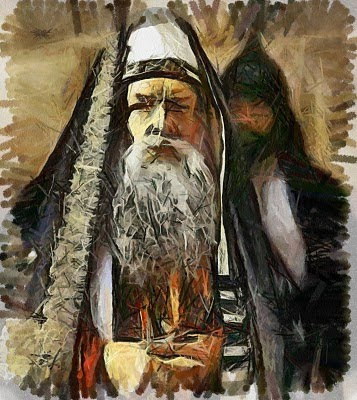
PhariseesGranted, it was part of the job of the Pharisees to test the many itinerant Rabbis wandering throughout Judah and the Galilee, questioning their teachings and their understanding of the Torah and traditions. But our Rav never faltered in his convictions. How could he? Yes, as fully human, he could have failed.

But if it was impossible for him to fail, why was he tested?

So we can hardly fault Pavlovitz for wanting to emulate Jesus in also ministering to those who have been rejected by our society, and especially to distance himself from the modern-day equivalents of some of the Pharisees, those whose religion requires they always condemn people who we consider latter-day “tax collectors,” prostitutes, and sinners. People who are gay, transsexuals, drug addicts, HIV positive or who suffer from AIDS. Anyone who is not “us”.

Yeshua didn’t isolate himself from these people and often, he called the religious elite of his day to repent of their sins. But I’m not quite sure Pavlovitz is on the same page as the Rav. Maybe he’s just exchanged one form of religious elitism for another.

And He also told this parable to some people who trusted in themselves that they were righteous, and viewed others with contempt: “Two men went up into the temple to pray, one a Pharisee and the other a tax collector. The Pharisee stood and was praying this to himself: ‘God, I thank You that I am not like other people: swindlers, unjust, adulterers, or even like this tax collector. I fast twice a week; I pay tithes of all that I get.’ But the tax collector, standing some distance away, was even unwilling to lift up his eyes to heaven, but was beating his breast, saying, ‘God, be merciful to me, the sinner!’ I tell you, this man went to his house justified rather than the other; for everyone who exalts himself will be humbled, but he who humbles himself will be exalted.”

Luke 18:9-14

Granted, this is a parable, meaning it’s a metaphorical story that probably isn’t a literal, factual rendition of an event. Nevertheless, it’s intended to teach us a moral and ethical truth. What is that truth?

Which of these two men, after praying, went back down to his house justified? The sinner who sincerely repented, not the one who thought he was already righteous.

From that time Jesus began to preach and say, “Repent, for the kingdom of heaven is at hand.”

Matthew 4:17

jewish-repentanceThis is the central message of Rav Yeshua’s ministry. Repent. Without repentance, you cannot enter the Kingdom of Heaven, alternately known as the Kingdom of God (which doesn’t mean going to Heaven to be with Jesus when you die, but entering the earthly Kingdom of Messiah when he establishes his throne in Jerusalem).

Heck, I agree with Pavlovitz about “American Christianity”. God isn’t a Republican or Democrat, He doesn’t prefer either Fox News or MSNBC. He loves humanity, all of us, not just those of a certain political or social bias.

But I think that Pavlovitz may have missed that even though God doesn’t use some American political yardstick in order to judge, He does have standards and we are all accountable to them.

He’d probably think I’m a heretic or something, because, going one step further, I don’t think the Church will inherit the Earth and then rule and reign with Jesus, I think that Israel was, is, and always will be the center of Messiah’s Kingdom.

All of those tax collectors, prostitutes, and sinners didn’t keep on doing business as before when they followed their Rav. They repented and kept repenting. The prostitutes stopped prostituting. The tax collectors stopped extorting money, paid it all back, plus an amount over and above what they took (which was a requirement of thieves in the Torah).

And “sinners…?”

But the man who was healed did not know who it was, for Jesus had slipped away while there was a crowd in that place. Afterward Jesus found him in the temple and said to him, “Behold, you have become well; do not sin anymore, so that nothing worse happens to you.”

John 5:13-14

changeAnyone who Jesus helped, anyone he healed and comforted was expected to repent and stop sinning.

I don’t know how Pavlovitz sees his marginalized and outsider populations. I don’t know what he considers sin. It’s possible to be an outcast even after you’ve repented, made a big U-turn, and ceased sinning, so maybe these are the people he means. If so, then more power to him.

I hope that’s what he means. There are quite a number of churches and synagogues in the U.S. and elsewhere that have conformed, not to they hyper-conservative politics of many Evangelical churches, but the more progressive societal norms we see associated with secularism, emphasizing love far, far above obedience to the requirements of God.

I think it’s possible for what’s been referred to as Progressive Christianity to be just as elitist and just as self-righteous as they consider what Pavlovitz calls American Christianity. In responding to one of his critics, Pavlovitz wrote:

Brad, I’ve outgrown responding angrily to those who don’t understand, or wish to attack me from a distance. Take care.

If he’s outgrown so many things, does he believe he’s somehow more righteous than his detractors? Consider the parable of the Pharisee and the Tax Collector again. Who shall we apply the Pharisee role to? I don’t know. I can’t read Pavlovitz’s mind.

I’ve said on more than one occasion that each one of us as people of faith have our hands full taking care of our own behavior, our own battles with sin, our own faults and imperfections to have time (if we’re willing to be honest) to judge others.

I’m just as guilty as the next person of hopping on Facebook or twitter and slamming some politician, social media pundit, or, most recently, matters of safe places and microaggressions we see plastered all over the news.

I admit it.

I also admit, having once again confronted my own personal brand of self-righteousness, that I can’t go back down to my home justified until I leave all that behind and repent, begging God’s forgiveness because I’m a sinner, too.

I really hate admitting that, but it would be far worse for me if I didn’t.

faithI do believe that we, as believers, are better people when we stop looking at others as “types” and start looking at and treating them as human beings, just as human and flawed and loved by God as we are. That doesn’t mean we shouldn’t pass on the message of repentance of our Rav to those around us, though. But it does mean we should do our repentance first before asking anyone else to do so.

Jesus loves…but his love isn’t blind. The price of admission into the Kingdom of God always has been repentance. Keep practicing repentance.


Living With God Everyday

What we are talking about here is developing Messianic Jewish Household Spirituality. At Intefaithfulness we are doing this through an initiative called HaB’er (“The Well”). As resources of time, finances, and personnel allow, we will be providing materials, instruction and encouragement to Jewish and Intermarried households who recognize the priority of developing “The Three-Stranded Cord” of ever-deepening engagement with Jewish life, Yeshua-faith, and with God’s Presence. Our mission statement is “Living well at home in Jewish life with the Messiah.”

-Rabbi Stuart Dauermann
“Toward a New Solution to Current Problems in the Messianic Jewish Religious World”
Interfaithfulness.org

In Christianity, the main location for worship and prayer is the Church. In Judaism, it’s the home. Rabbi Dauermann points out in his article that, for Yeshua-believing Jews, whether they are in the Church or in the Messianic Jewish synagogue, they were “shaped” by American evangelicalism and thus, tend to be institution-oriented rather than home-oriented as are other religious Jews.

I’m not writing to comment on Jewish religious praxis, whether in the Messianic arena or otherwise. I’m here to write about the rest of us.

Actually, I can’t count myself as one of the Gentiles I want to discuss since, for a lot of reasons, the “practice” of my faith in the home is affected by the presence of my Jewish wife and children, none of whom are “Messianic”.

But I think the points Rabbi Dauermann brings up about the Messianic Jewish movement could be adapted to Jesus-following non-Jews, whether we call ourselves Christians, believers, “Messianic Gentiles,” or anything else.

churchFor a lot of us, our faith consists of going to church on Sunday, which includes the worship service, the sermon, and Sunday school. Then, if we’re really ambitious, there are programs, usually offered on Wednesday evening, in which we can participate.

But what about the rest of the time? What about our day-to-day lives?

In this, I think particularly an Orthodox or perhaps Conservative Jew might have an advantage.

Oh, Christians wouldn’t consider it such. I recall being in a Sunday school class a few years ago and hearing the teacher remark how we are so fortunate not to be “under the law” anymore (not that we ever were), and having been freed by the grace of Jesus Christ.

But free to do what? Play a few holes of golf after leaving church services and going out to lunch? How many Christians even say grace before eating if they’re in a public place?

Jewish practice may seem cumbersome to many non-Jews, but it has the advantage of continually reminding the Jewish person that God is always present. If you wear a kippah in acknowledgement of God being above you, your awareness is a persistent as your apparel.

Add to this all of the blessings to be said on a wide variety of occasions. If you were raised in an observant Jewish home, you started learning this practice in childhood, but for a Jew who was raised secular and became religious as an adult, there is probably something of a learning curve. Nevertheless, the message seems to be that a Jew is always obligated to acknowledge God in everything.

An observant Jewish life doesn’t occur just on certain days of the week or only between the hours of such and thus, it occurs from the moment you wake up until you go to bed at night.

Modeh AniAbout the only thing I’ve allowed myself to carry over from my past is reciting the Modeh Ani (in English) when I discover I’m awake in the morning and about to get out of bed. It’s a basic confirmation that I owe each day of my life to God.

The day-to-day religious practice of a Christian or otherwise religious non-Jew is not well-defined. We don’t have the rich history of tradition of the Jewish people to draw upon. Sure, some non-Jews have chosen to adapt bits and pieces of those traditions in their lives, but we don’t share Jewish history and, in most cases, Jewish community, so it seems at least a bit out-of-place.

I should say at this point that I’ve met Christians who have fully-realized and completely integrated lives of faith. Every thought and action is directed to the service of Christ and to people around them. However, I wouldn’t consider this a very common practice, more’s the pity.

But returning to practical praxis, among the very first non-Jewish Yeshua-followers who had learned from Jewish mentors, such as the Apostle Paul, their day-by-day behavior probably looked pretty “Jewish,” since it was the only model they had available, but nearly twenty centuries have passed and that connection has long since been lost.

Some congregations and other collections of Jews and Gentiles who are devoted to Yeshua as Messiah are attempting to reinvent that relationship, but it’s pretty inconsistent. I think I recently mentioned how fragmented the body of Messiah happens to be, and I don’t see it becoming any more unified in the near future.

But regardless of our religious orientation and our access to community of any kind, we still, as individuals, have a responsibility to not only maintain our awareness of the God above our heads day-by-day, hour-by-hour, but to act out of that awareness. For the non-Jewish believer, as I’ve already said, there isn’t a well-defined set of behaviors and traditions for us to draw upon. Nevertheless, we can do something. We just need to be more deliberate and maybe more creative about it.

followIf we are walking in the dust of the footsteps of our Rav, so to speak, what should we do?

“Then the King will say to those on His right, ‘Come, you who are blessed of My Father, inherit the kingdom prepared for you from the foundation of the world. For I was hungry, and you gave Me something to eat; I was thirsty, and you gave Me something to drink; I was a stranger, and you invited Me in; naked, and you clothed Me; I was sick, and you visited Me; I was in prison, and you came to Me.’ Then the righteous will answer Him, ‘Lord, when did we see You hungry, and feed You, or thirsty, and give You something to drink? And when did we see You a stranger, and invite You in, or naked, and clothe You? When did we see You sick, or in prison, and come to You?’ The King will answer and say to them, ‘Truly I say to you, to the extent that you did it to one of these brothers of Mine, even the least of them, you did it to Me.’”

Matthew 25:34-40 (NASB)

Do kindness everyday. No, you don’t have to save the world every hour on the hour, but you can take advantage of your opportunities, even in very tiny ways. Pick up a bit of litter and throw it in the trash. Hold the door open for someone. At this time of year, there are plenty of people ringing bells in front of stores taking in donations. Drop your loose change into the bucket. The next time someone cuts you off in traffic, instead of getting mad at them or competing with them on the road, let them have their way. Maybe they have a really good reason for being in a hurry.

A few days ago, I came across a news story about a homeless Jesus statue that is being erected in numerous communities. The concept and application are controversial, and while I agree that $40,000 per statue could be better spent actually sheltering the homeless, feeding them, and clothing them, the symbolism invoked, for me, the quote from Matthew 25.

homeless Jesus
Photo: Kelly Wilkinson / The Star

Jesus is already homeless, and poor, and hungry, and needy. He is because we have homeless, poor, hungry, and needy people in our communities. If we wish to serve our Rav and to “do what Jesus would do,” then the Bible makes it abundantly clear how to respond.

But what about this?

If the world of Messianic Jewish believers is to be established, sustained, renewed and passed on from generation to generation, the efforts of religious school, seminary and congregation will fail unless we begin at the center: the home. It is for this reason that Jewish religious discourse terms the home a Mikdash M’at, a little holy sanctuary. This is the center. This is the microcosm from which blessing proceeds to the macrocosm of life, and socially, this is the seed from which the Kingdom of God will grow in the Messianic Jewish context, or not. Similarly, we find in Scripture that it is at the center, the Holy of Holies, where holiness is most concentrated and from which it radiates out into the community of the people of God and to the wider world. Think of the design of the tabernacle in the wilderness and each of the First and Second Temples, each termed a “Beit Mikdash.” In Jewish life the home, the mikdash m’at, is the Holy of Holies from which spiritual identity and vitality radiates out into the world and daily life. Apart from this center, all is empty religious noise and clamor, gongs and cymbals, and too often, as we will admit if we are honest, smoke and mirrors.

This is how Rabbi Dauermann ended his essay, with a plea to re-establish Messianic Jewish homes as Jewish homes, making them the “Holy of Holies.”

I’m not sure how this is done in non-Jewish homes. I’ve known a few Christians who make a little “altar” in their homes, putting a cross, a Bible, and other religious objects on a table to be the center of family prayer.

I’m not particularly keen on building “altars,” but the idea of family prayer and family Bible study time seems to be a good start.

Moon and StarsI don’t have any practical suggestions beyond what I just mentioned, and as I’ve already said, this isn’t an option for me personally, but if somehow it were possible to treat our own homes as sacred places, to realize that God dwells among us as we eat dinner, watch TV, help our kids with their homework, read our Bibles, read anything else, surf the web, answer text messages, then maybe, just maybe we’d act differently in our own homes…and everyplace else.

A little bit of light pushes away a lot of darkness.

-Jewish proverb

The Illusion of the Unified Body of Messiah

In the article, I tackled the now-familiar “trajectories” model of early Christian developments proposed influentially by James Robinson and Helmut Koester, showing examples of how it has involved dubious results. The trajectories model does reflect the sense of diversity in early Christianity, but I contend that it is inadequate as a model in allowing for the complexity of that diversity. For it seems to me that all our evidence points to a rich and vibrant interaction of the various early Christian groups.

Sometimes this was of a hostile nature, as in the well-known conflict of Paul and certain other Jewish Christians whom Paul refers to as “false brothers,” and even agents of Satan. Sometimes, however, perhaps more typically, this interaction was of a more positive nature, as reflected in the appropriation of “Q material” in the Gospels of Matthew and Luke, or the implicit affirmation of Peter in John 21.

-Dr. Larry Hurtado
discussing the presentation of his paper,
Interactive Diversity: A Proposed Model of Christian Origins,” Journal of Theological Studies 64 (2013): 445-62
on his blog post “Interactive Diversity SBL Session”
Larry Hurtado’s Blog

I suppose it would be naive to consider that there was a single, uniform expression of Christianity in the mid-to-late first century CE. As Dr. Hurtado points out, both on this blog and in his paper, there are multiple different theories to describe these varying expressions including the “trajectories model.”

However, in his paper, Dr. Hurtado suggests a different viewpoint he calls “Interactive-Diversity”.

As early as the Jerusalem church, there was linguistic diversity, as likely reflected in the Acts depiction of ‘Hebrews’ and ‘Hellenists,’ terms which probably designate respectively those Jews in the Jerusalem church whose first language was Aramaic and those whose first/primary language was Greek. Also, Paul’s deployment of the little ‘Marana tha’ formula in 1 Corinthians 16:22 is commonly taken as reflecting his acquaintance with Aramaic-speaking circles of Jewish believers, as distinguished from the Greek-speaking (gentile) congregations to whom he wrote.

I should note that regardless of believers being Jewish or Gentile, Dr. Hurtado refers to them as Christians.

In this first example, the diversity is linguistic and between Greek speaking and Aramaoic speaking Jewish disciples of Rav Yeshua (Jesus), as well as distinguishing them from the Greek speaking Gentiles.

However…

Moreover, remarkably early there was also a trans-local diversity. In Acts we have reports of the young Christian movement quickly spreading from Jerusalem and other sites in Jewish Palestine, to Damascus, Antioch and Samaria, and through the activities of Paul and others (often anonymous) spreading through various locations in Asia Minor, Greece, Rome and elsewhere. Though the historicity of some features of
Acts has been challenged, it is commonly accepted that there was an early and rapid trans-local spread of the young Christian movement to locations such as these. It is to
be expected that this remarkably rapid spread of the Christian movement would have been accompanied by diversity, Christian circles taking on something of the character of
the various locales, and also the varying ethnic groups and social classes from which converts came.

Larry Hurtado
Larry Hurtado

There was, as we might expect, also diversity among the Gentiles based on “trans-local diversity,” or distinctions of geography, nationality, ethnicity, and custom.

All this seems to suggest that there were different interpretive traditions of not only the Jewish scriptures (remember, at this time there was no such thing as the “New Testament”) but how these differing groups understood the letters of Paul as well.

The different attitudes toward ‘food sacrificed to idols’ (8:1-13) comprised another potentially serious difference in Corinth that may well have reflected different social groups. Likewise, Paul’s exhortations in Romans 14:1—15:6 are widely thought to address differences that likely reflect a diversity of a social or ethnic nature.

But along with the evident diversity, a well-attested ‘networking’ was another feature of early Christianity. This involved various activities, among them the sending
and exchange of texts, believers travelling for trans-local promotion of their views (as, e.g., the ‘men from James’ in Gal 2:11, or Apollos’ travels to Corinth in 1 Cor 1:12; 3:5-
9; 16:12), representatives sent for conferral with believers elsewhere (as depicted, e.g., Acts 15:1-35), or sent to express solidarity with other circles of believers (as, e.g., those accompanying the Jerusalem offering in 1 Cor 16:3-4).

For that matter, Paul wasn’t the only one establishing “churches” in the diaspora. There were others, most or all of whom were anonymous, who were also “planting” faith communities and apparently establishing differences in teaching and praxis.

However, it wasn’t because these communities were isolated from each other geographically that allowed the rise of diversity. In fact, according to Hurtado’s paper, they were quite interactive, sometimes uncomfortably so.

On the other hand, there are also indications of far more adversarial interactions as well, and at a very early date. Paul’s letter to the Galatians will serve to illustrate this. Exegetes are agreed that this epistle reflects Paul’s exasperation over unidentified other Christians (probably Jewish) who have visited the Galatian churches calling into question the adequacy of Paul’s gospel and urging his gentile converts to complete their conversion by circumcision and a commitment to Torah-observance. Paul represents these people as proclaiming ‘a different gospel . . . confusing you and seeking to pervert the gospel of Christ’ (Gal 1:6-7), and he thunders an anathema on anyone who proclaims a gospel contrary to that which he preached (1:9).

And…

This is rather clearly an example of early Christian diversity of a more hostile variety! But it is also indication of the interaction that I emphasize here, with non-Pauline teachers visiting Corinth (with intent!) and Paul reacting with an uncompromising vigour.

It can result in some exchange and adaptation or in a hardening of previous positions. But my point is that early Christian diversity was often (even typically?) of a highly interactive nature.

Apostle Paul preachingDoesn’t sound terrifically different than how different Christian denominations “get along” in the 21st century CE.

You can read the full 16 page document as a PDF to get all of Dr. Hurtado’s message on this topic. My point in bringing all this out on my own blog is somewhat similar to what I pointed out in one of my reviews of the Nanos and Zetterholm volume Paul within Judaism: Restoring the First-Century Context to the Apostle.

Various articles within “Paul within Judaism” put forth the idea that Jews and Gentiles “in Christ” not only did not share a single, uniform identity and role within the faith, but that the identity and role of the Gentile within the first century Jewish movement of “the Way,” was ill defined and incomplete.

Paul and others may not have thought this was a problem if they believed that the Messiah’s return was imminent. If Messiah was coming back in a year or two, or a decade or two, he would straighten things out as he completed establishing his Kingdom.

That may also be one way to view the diversity between various diaspora congregations and their differences in interpretation, doctrine, and praxis. While it’s compelling to imagine that in the beginning of the Yeshua movement within Judaism, and as it was being exported to the diaspora Gentiles, the conditions operating within the overall movement and trickling down to specific “churches” were uniform, representing a single, complete unity, perspectives such as “Interactive-Diversity” paint a much different portrait.

What we think of may never have been unified, at least not since Rav Yeshua lead his small inner circle of apostles and disciples through the Galilee or taught from Solomon’s Portico at the Holy Temple in Jerusalem. His teachings wouldn’t be documented and widely disseminated for decades, and even then, they would likely have been interpreted differently by the numerous congregations and house fellowships of Jews and Gentiles in both Israel and the diaspora nations.

I remember during my early days in the Hebrew Roots movement (some fifteen years ago or more) I thought what I was experiencing in my local, little “One Law” group was something akin to what the Gentiles experienced in their congregations in the days of Paul.

I was really inexperienced and unstudied.

I’m not exactly a genius now, but as time has passed and I’ve accessed a wider variety of information sources, I’ve come to realize that we aren’t particularly certain of what was normative practice for Gentiles in Messiah while Paul was on his journeys and writing his letters. Here we see that there probably was no one normative practice, but that not only were the teachings and praxis of the different groups of Gentiles highly variable and even competitive, but that their very identities and roles as disciples of our Rav were probably indistinct and variable as well.

Granted, I’m drawing a great deal out of a few small examples, but it does possibly mean we do have one thing in common with the earliest non-Jewish followers of Yeshua. Our variability or interpretation and practice and even the competition and (sometimes) hostility between differing factions within both the Hebrew Roots and Messianic Jewish movements is normal.

Like Paul, we too may have to wait until Messiah comes so he can sort everything out.

Christian CoffeeAlmost a week ago, I had coffee with a friend, and we were discussing this topic. He believes that as the time of Messiah’s return draws near, the variability between all the denominations of Christianity, let alone those of us who, at least in name, don’t call ourselves “Christians” (well, we do and don’t…long story), will begin to erode and a clearer vision and more stable platform will emerge for Messiah’s disciples.

I disagree.

In fact, I think the opposite will happen. I think we’ll all become increasingly fragmented and confused. Sure, there will be a remnant that will maintain a stable perception of God, Messiah, Israel, and the Bible consistent with God’s redemptive plan for His Jewish nation, and through them, the people of the nations, but a lot of “nutsiness” will emerge and thrive as well.

I even think there will be scores of churches that will reject the resurrected Messiah and ascended King because he’s too Jewish, because he rebuilds the Temple in Jerusalem, because he rules from Jerusalem instead of Heaven, and because the “raptured” will join him in Jerusalem instead of Heaven…

…and because Israel will rule the nations of the world with King Messiah instead of “the Church”.

I’m not saying we should just sit on our laurels and wait around for Messiah to come back. I’m not saying we shouldn’t continue to study the scriptures, to teach, to go to teachings, to seek out greater truth, to improve our walk, or any of that.

I’m saying it’s expected if we don’t know everything right now. It’s normal not to get everything right. We should accept that, when Messiah does come and when he teaches, that he will point out where we made mistakes, even as we were (and are) sincerely seeking him and searching out the face of God.

Fortunately, Hashem is patient. He understands us, even though we don’t always understand Him or what He’s trying to tell us. We may have the Spirit of God, but that doesn’t mean we always listen to the Spirit either, no matter how much we think we want to.

We aren’t one candle, but many, yet all burning for our God.

Paul and Israel: This Year’s SBL Meeting Session

I rarely reblog what another blogger has written. It’s more typical for me to take source material and craft a commentary on my own blogspot. But in this case, I find what Dr. Hurtado has authored very much in keeping with the interests of those to regularly read what I craft here. Enjoy.

larryhurtado's avatarLarry Hurtado's Blog

In this year’s Society of Biblical Literature annual meeting I took part in a session focused on the question of whether Paul believed that fellow Jews should put faith in Jesus.  Three scholars gave three quite different views of the matter, and I was the designated respondent to their presentations.  The textual focus was obviously Paul’s epistle to the Romans, chapters 9-11.

John Marshall (University of Toronto) contended that Paul’s promotion of faith-in-Jesus was solely intended for non-Jews (“Gentiles”).  So he took Romans 10:9-13, where Paul urges confession of Jesus as “Lord” and faith that God has raised him from death, as having to do with Gentiles making these steps.  Noting that Romans seems to have Gentile Jesus-followers (“Christians”) as the addressees (or at least the primary/main addressees), Marshall contended that this should dispose us to read such passages as really about Gentile believers.  In Marshall’s view, Paul’s anxiety about…

View original post 898 more words

Minor Convergence

I just returned from the Society of Biblical Literature conference in Atlanta and was flipping through a new book by James Dunn when I noticed the below discussion of Messianic Jews and footnote. Little by little, our little community is being recognized and appreciated.

-David Rudolph on Facebook

dunn rudolph

Although it’s more or less common for people writing from within the Messianic Jewish and Hebrew Roots movements to cite Christian scholarly sources, you don’t often find those sources acknowledging the existence, let alone referencing Messianic Judaism, and scholarly volumes written and edited by Messianic Jews. On the other hand, James D. G. Dunn has written on The New Perspective on Paul, so I would expect some overlap on viewpoint.

Today’s missive is intended to be brief. I just wanted to share this small mention of the Rudolph and Willitts volume in Dunn’s latest book, a volume which I reviewed in-depth (just search this blog for “Introduction to Messianic Judaism” to find all of my review articles).

Messianic Judaism is gaining some credibility, if not within the “average church,” then at least from one Christian scholar and researcher.

Can Messianic Judaism Directly Reach Out To Atheists?

An atheist cannot find God for the same reason a thief cannot find a policeman.

-Anonymous

Before anyone becomes upset, I am not saying that atheists are thieves. The quote simply means that an atheist cannot find God, not only because he/she isn’t looking for Him, but also because they are actively avoiding Him, just like a thief would avoid a law enforcement officer.

But it’s an interesting comparison, because if a cop did find a thief in the act of committing a crime, the thief would be “busted.” Once the thief saw the police officer and knew he/she couldn’t get away, they’d be facing the consequences for their actions.

arrestWhat happens when God “catches” an atheist? Well, this is where the metaphor starts to break down, because while God is aware of all human actions, we humans (and this is certainly true of atheists) aren’t always aware of God. Thus, although God sees our “crimes” (and any human action that opposes the will of God is the short definition of “sin,” which is analogous to “crime” in this example), we don’t see him “catching” us.

Rabbi Kalman Packouz posted the above-quoted sentence on this week’s Shabbat Shalom Weekly online column. He also said this:

Recently a friend of mine asked me, “Do you really believe in God?” When I answered “for sure” his response was “really?” Personally, I don’t find it particularly hard to believe that a rabbi believes in God. However, he seemed to be amazed that anyone believes in God.

In our experience at Aish HaTorah (a major international Jewish educational outreach organization), if you ask the young people who come through the doors of our world center in Jerusalem if they believe in God, four out of five will say “no.” What’s fascinating is that if you don’t ask the question directly, it’s possible to demonstrate to them that they do believe in God. Why? They are influenced by the society, the educational system and their friends to think that they don’t believe in God.

Do you want to demonstrate to someone that deep down they not only believe in God, but that they believe that God loves them? Here are the questions to ask…

I highly encourage you to click the link I provided above and read all of Rabbi Packouz’s discussion on how to illuminate anyone (or at least any secular Jew) to investigate their lack of belief in God. It’s really quite interesting (an equally enthralling question is if R. Packouz’s “method” were applied to non-Jews, would they become Noahides?). I’m not sure how it would play out for the rest of us, but on the surface, his arguments are compelling.

He finishes up his column with the following:

How can one intelligently deal with the question of the existence of God? Start on Aish.com and search the articles on “God” and “Evidence of God”. Go to AishAudio.com (search “evidence”) and listen to the four lectures “Evidence of God’s Existence” by Rav Noah Weinberg (the founder and head of Aish HaTorah and my teacher). Also, I highly recommend Permission to Believe by Lawrence Kelemen available at your local Jewish bookstore, at JudaicaEnterprises.com or by calling toll-free to 877-758-3242.

chabad
Credit: jewishvenice.org

I’m actually considering buying the Kelemen book (I’ve checked and it’s not available through my local library system), since it would be interesting to see how religious Jews reach out to secular Jews (besides the methods employed by Chabad).

It occurs to me that there’s a vacuum of this sort of information relative to Messianic Judaism.

Oh sure, Christianity’s efforts to evangelize the world are quite well known. If a traditional Christian wanted to know how to reach out to secular people in his/her community, all that person would have to do is approach their Pastor. I’m sure churches give classes on this sort of thing, and I know churches periodically organize their parishioners to canvas their local neighborhoods, knocking on doors, and handing out pamphlets.

But what does Messianic Judaism (and I’m using the term in the widest possible way) do to attract new members and to share their perspective on the “good news of Messiah?”

Just about anyone I’ve ever encountered, either within a Messianic Jewish (MJ) or Hebrew Roots (HR) environment, came to those venues by way of the Christian church. That is, whether they were Jew or Gentile, they first became a Christian and attended one or more churches before something happened to take them away from a particularly Christian viewpoint, and shifting them to a more Judaicly-aware perspective.

Oh, there may have been one or two exceptions, but I feel pretty confident, even based on anecdotal evidence, that most people, Jew and Gentile alike, come to a Judaic interpretation of all of the Bible, including the Apostolic Scriptures, only after converting to Christianity. I’m not saying that to be insulting. It just seems to best reflect the reality of how people come to the MJ or HR movements.

Of all of the resources available online and in brick-and-mortar stores, I can’t think of even one single book, audio, or video that teaches people like me how to share the message of Rav Yeshua (Jesus Christ) specifically from a Messianic Jewish perspective.

You may be wondering why some slight adaptation of traditional Christian evangelical methods couldn’t be used. However, Christians and religious Jews see the Bible, God, and faith in fundamentally different ways (Christians tend to be internally based, with their faith hinging on personal beliefs, while Jews tend to be externally based, with their faith being acted out through performance of the mitzvot). Messianic Judaism isn’t just Christianity wearing a kippah. It’s a Judaism that acknowledges the revelation of the Messiah as illustrated in the Apostolic Scriptures, and one that has an unusually liberal policy on Gentile admission.

With all that said, is it even possible to share a Messianic Jewish view of our Rav and what the Bible is saying about him and redemption directly with an atheist, or must Christianity and the Church always be the first step?

encounterActually some time ago, I thought I’d found one such resource. It was either a book or a lecture (or lecture series) on audio CD, but a Google search does nothing to find it. Maybe I was mistaken, or maybe whatever it was has leaked out of my memory for good.

Christians have a well-honed machine for evangelizing as many people as it can reach, and at least some corners of Orthodox Judaism understand how to communicate their faith to secular Jews, but what does Messianic Judaism bring to the table? Instead of appealing to Christians in churches to take a Messianic look at the Bible, at their faith, at their Christ, can they reach out to people who do not have faith at all?

Christians can (which is how I came to faith in the first place). Jews can (and I know of more than one religious Jew who started out as a secular adult, and then became religious). What about Messianic Judaism?