All posts by James Pyles

James Pyles is a published Science Fiction, Fantasy, and Horror author as well as the Technical Writer for a large, diversified business in the Northwest. He currently has over 30 short stories published in various anthologies and periodicals and has just sold his first novella. He won the 2021 Helicon Short Story Award for his science fiction tale "The Three Billion Year Love" which appears in the Tuscany Bay Press Planetary Anthology "Mars."

In the Merit of Jewish Torah Observance Revisited

Rabbi Chayim Shmuelevitz used to comment on this that just as those who support Torah study financially have the merit of the Torah study of those they support, so too anyone who influences another person to study Torah shares in the merit of that person…

…Parents who influence and enable their children to study Torah have this merit, as do wives who enable their husbands to study Torah.

-Rabbi Zelig Pliskin
“Influence others to study Torah,” p. 309
Commentary on Torah Portion Bamidbar
Growth Through Torah

NOTE: It was brought to my attention that the previous incarnation of this blog post contained erroneous information. I have re-edited the text, images, and links to remove those errors.

Yes, I know this is midrash. I have an interesting relationship with midrash. I think of it as not so much literal fact or even a hidden spiritual truth, but rather as metaphor, a way to communicate something about people and their relationship to each other and to God.

As I write this, it’s Sunday morning and the first full day of Shavuot. Yesterday, my wife went to synagogue for Shabbat services and last night she returned for a study on the Book of Ruth, which is a traditional study for Jews on Shavuot. Not long from now, she’s leaving for shul again to help with the food preparations for the Shavuot gathering (all this will be over by the time you read these words).

As I mentioned a few days ago as well as on other occasions including this one, it is not only important to me as a general principle to encourage Jewish return to Torah study and observance, it’s important to me personally as a husband.

Rabbi Pliskin, citing Rabbi Shmuelevitz, commented that parents who encourage their children to study Torah, and wives who encourage their husbands to study Torah receive the merit of studying Torah themselves, even if they never actually do so in any regard.
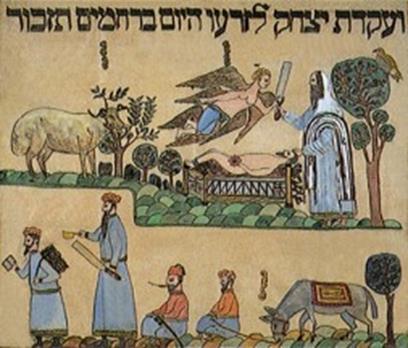
in the merit of our forefathersYes, that’s midrash. We don’t really know through Biblical exegesis (at least those of us who lack a traditional religious Jewish education) how God views these “merits,” or if they represent some objective reality. However, I prefer to take this metaphor as an encouragement.

Of course, Rabbi Pliskin is writing to a Jewish audience and is not presupposing a non-Jewish husband married to a Jewish wife, but I believe there is some merit, even if it only exists inside my heart, in me encouraging and supporting my wife in Torah study and observance, even in the smallest degree. No, it’s not that God expects or requires me to observe Torah in the manner of the Jewish people, but I do think He expects and requires all non-Jewish disciples of the Master to recognize that we only receive the blessings of the New Covenant, such as the indwelling of the Holy Spirit and the promise of the resurrection, through the merit of Israel. After all, the New Covenant was made only with Israel and it is only through the mercy of God and the faithfulness of Messiah that we Gentiles can receive any of those blessings at all.

In return, what shall we do? Claim the Torah for ourselves as if we too stood at Sinai (which we didn’t)? Only the Jewish people can make that assertion. However, we can do the next best thing. We can encourage, support, and promote the Jewish return to Torah study and observance since it is the Jewish heritage and inheritance.

For nearly twenty centuries, Christianity has made a concerted effort to separate Jews from Torah, Talmud, and synagogue. Today, even the most enlightened churches continue to believe that the only way to “save” a Jew (or anyone else) is to have them exit Judaism and surrender any vestige of Torah study and observance, and instead to take on the traditions of the Gentile Christian Church.

But the Biblical record is clear that God has repeatedly urged the Jewish people, from Moses to Paul and beyond, to observe and obey His Torah, and when they don’t, the consequence is exile or worse.

burning talmudMistakenly, for the past two-thousand years, the Church has promoted and encouraged the Jewish people to disobey God, further exacerbating Jewish exile. By God’s grace, He has overridden our futile efforts to further damage the Jewish people and Judaism by re-establishing national Israel and beginning to return His people to their Land, all in preparation for the time of the Messiah and the completion of the New Covenant promises.

He has also drawn some few of we Gentiles to a greater knowledge of the Torah and specifically our esteemed and valued role as supporters of the Jewish people and their return to the mitzvot.

Hashem said to Moses, “Go to the people and sanctify them today and tomorrow, and they shall wash their clothing. Let them be prepared for the third day, for on the third day Hashem shall descend in the sight of the entire people on Mount Sinai.”

Shemos (Exodus) 19:10-11 (The Kestenbaum Edition Tikkun)

As Moses obeyed Hashem in directing the nation of Israel to be sanctified before God in preparation to receive the Torah, we Gentiles can take our cue from this lesson and, not direct, but rather clear the path for Jewish return to the Torah.

I’m in a rather unique position as a Yeshua-believing Gentile husband being married to a non-believing Jewish wife. I have a built-in opportunity to support her involvement in Jewish community and in Torah study and observance. Many of you don’t have that specific opportunity, but I believe many of you have others of which you can take advantage.
One of these things is not like the othersI believe that individual Christians and the Church as a whole has the opportunity to change its narrative from being anti-Torah and anti-Judaism to just the opposite. No, I’m not encouraging Gentile believers to take up the Torah as such, but they/you/we can start preaching and teaching the extreme value of Jewish Torah observance in God’s plan of global redemption. We’ve tried to take God’s gift of the Torah away from the Jewish people for untold centuries. It’s time we repented of this sin and made amends. It’s time we got out of Judaism’s way, including Messianic Judaism.

Without the Jewish Messiah King and without a Torah observant Israel, there are no blessings to radiate out to the nations. Ironically and tragically, by Christianity’s efforts to separate the Jewish people from Torah, we have been cutting ourselves off from the Savior of the World, the Church’s beloved Jesus.

According to Rabbi Yirmiyahu Ullman, it was on the festival of Sukkot each year when seventy oxen were sacrificed for the sake of the seventy nations of the world, that is, the global population of non-Jews:

Thus our Sages taught, “You find that during the Festival [Succot], Israel offers seventy oxen for the seventy nations. Israel says: Master of the Universe, behold we offer You seventy oxen in their behalf, and they should have loved us. Instead, in the place of my love, they hate me (Psalms 109).” Further, they remarked: “If the nations of the world would have known the value of the Temple for them, they would have surrounded it with a fortress in order to protect it. For it was of greater value to them than for Israel [instead, they destroyed it]” (Bamidbar Rabba 1).

If it is true that the ancient Roman armies, in destroying the Temple, were destroying Israel’s ability to offer atonement for the Gentiles before God, how much more so has the Christian Church, in striving to separate the Jewish people from Torah, been destroying the New Covenant salvation offered to us by Messiah, by Christ?

We can change this. There’s still time. Do what I do for I believe what I’m doing is right. If nothing else, at least get out of the way of Jewish people, both those in Messiah and otherwise, in returning to the Torah. If you have Jews in your church, encourage them to light the Shabbos candles, listen to podcasts on Torah study, read fine commentaries on Torah such as those published by Rabbi Pliskin. Encourage them to become more observant as Jews.

sefer torahMost importantly, if they are willing, encourage them in learning of how Jewish Torah observance and devotion to Messiah not only go hand in hand, but are absolutely necessary to fulfill and complete the redemptive plan of God for all Israel, and through Israel, the entire world. Then we Gentiles may be able to say that we have earned, however metaphorically, the merit of Torah study and observance, not by doing so ourselves, but by being part of the Messianic plan to return the Jewish people to their Torah and their Land.

Book Review of Paul Within Judaism, The Question of Identity: Gentiles as Gentiles–but also Not–in Pauline Communities

I have long puzzled over how to understand the gentiles in Paul, both from his perspective and their own perspective. I operate under the assumption that he is writing primarily to them and his goal is to articulate and manage just how they are connected to Israel through Christ. In the process, as I have discussed elsewhere, both he and they undergo various transformations in identity, changes that, I maintain, never separate him from Judaism and that affiliate gentiles with Israel but not as full members. They are not Jews and, in my view, they are not Christians…

-Caroline Johnson Hodge
Mark D. Nanos and Magnus Zetterholm, Editors
“The Question of Identity: Gentiles as Gentiles–but also Not–in Pauline Communities”
Paul within Judaism: Restoring the First-Century Context to the Apostle (Kindle Edition)

More than the previous essays I’ve reviewed from this volume, this one speaks in detail not only to the identity issues involved in being a “Gentile in Christ” in the time of the Apostle Paul, but also to those of us who call ourselves “Messianic Gentiles” today.

For the vast majority of mainstream Christians in churches, this identity conundrum does not exist. Being “Christians” is self-defining and self-explanatory and perhaps anachronistically, they believe they have direct one-to-one connectedness of identity with Paul’s own Gentiles. According to Hodge, nothing could be further from the truth, or at least further from the facts.

Many scholars use the term “Christian” for these gentile believers, even though there is fairly widespread agreement that it is anachronistic. There are good reasons not to use it: Paul does not use it himself…

At the scholarly level, it may well be agreed that Paul did not consider the Gentile disciples “Christians” nor that there is much, if any, comparison between the ancient ekklesia and the modern Church. Nevertheless, at the level of the local church and the local Pastor, I have heard it preached, specifically to Acts 20, that there are close comparisons that can be made between ancient believers and today’s Christian in the pew.

This is another case of the lag between academic discourse and what most Christians hear preached from the pulpit. It’s not so much because these Pastors are unaware of new research, but that such information does not make a good fit, either with the Pastors’ theology and doctrine or what would be accepted by their parishioners.

According to Hodge, Paul calls his Gentile disciples “beloved, holy ones, faithful ones, brothers and sisters, and a new creation,” but if they weren’t “Christians,” who were they?

She argues that defining their identity remains somewhat elusive and that these “gentiles occupy an in-between space, hovering around the borders of identities that they are not quite.”

ChurchThat’s not particularly satisfying but I know exactly how that “hovering” feels in my personal and congregational experience in various Messianic communities, or at least those few I’ve had the opportunity to visit.

Hodge’s line of pursuit in attempting to examine this “identity problem” is to trace how Paul “draws upon Jewish conceptions of gentiles, especially where they approach the boundaries of Jewish identity.”

Is it possible that there’s more than one kind of Gentile? According to Hodge, in the late Second Temple period when Paul was operating, there were two broad categories.

There’s the Jewish concept of the “generic” Gentile, that is, anyone who isn’t Jewish is a Gentile, regardless of how differentiated people from one culture or nation may be from another.

Then there are Gentiles in Christ, the disciples made by Paul and others.

And in Paul’s usage, this term has a doubleness to it in that there are two kinds of gentiles. First, there are the audiences of his letters, whom he addresses explicitly as gentiles in a number of places (Rom. 1:5-6, 13; 11:13; 15:6). Second, there are all the other gentiles who are not in Christ, the sort of gentiles that believers used to be.

That narrows things down but only a little. This believing group of Gentiles used to be, but no longer are, like the generic not-in-Christ Gentiles that populate the world. They used to be them but now they’re something else, occupying “a kind of liminal space between being those kinds of gentiles and now these kind of gentiles.”

Some of the characteristics of “these kinds of gentiles” in Christ include rejecting “idolatry and sexual immorality and [to] practice self mastery in holiness and honor.'”

Further:

Elsewhere Paul describes this as the life of the spirit, which they receive at baptism, so that, Paul says, “the just requirement of the Law might be fulfilled in us” (Rom. 8:4). But he is adamant that they not keep Jewish Law, especially with respect to circumcision for male gentiles. Indeed, gentiles-in-Christ are not quite gentiles and not quite Jews.

This level of ambiguity may have ultimately been unsustainable and resulted in the eventual schism between the Christ-believing Gentiles and the Messiah-believing Jews, although Hodge doesn’t address this point in her essay.

Who am IShe does say that while remaining gentiles, these non-Jewish believers did participate in Jewish community and Jewish practices, behaving “Jewishly” but not being Jewish, as Mark Nanos has previously stated.

In fact, there may have been “a sliding scale of gentile participation in Judaism” such that there was no one fixed standard for the behavior of non-Jews in Jewish community and worship space.

I hope I’m not being anachronistic in applying this to those modern “Messianic Gentiles” who operate within Jewish spaces such as Beth Immanuel (although arguably, Beth Immanuel could be recognized as a Gentile space that behaves very “Jewishly”) and Tikvat Israel. From personal observation, I’ve seen a wide degree of variability in just how “Jewish” many non-Jews behave within these communities and elsewhere.

Perhaps this isn’t a matter of a lack of accepted standards for Gentiles, but a reflection of the necessity of process for non-Jews in community with Jews.

Hodge approaches her investigation from two avenues: one that uses the logic of lineage and the other one that uses the logic of purity.

Seed of Abraham

Hodge cites Ezra, particularly Ezra 9, and Jubilees chapter 30 to illustrate how purity of lineage was used to create a strong distinction between the Jewish people and the rest of the world, effectively excluding Gentiles from community with Israel. Not just the priests, but each individual Jew was defined as “holy unto the Lord,” set apart, unique, special, particularly from the goyim.

Furthermore, Jubilees uses the holy seed idea to distinguish between gentiles and Jews. Although gentiles number among Abraham’s seed…

…they are not part of the holy seed that belongs with God…

And that holy seed that belongs with God” began with the progeny of Abraham’s son Isaac. It is of this holy lineage which Jubilees refers to as a “kingdom of priests.”

Paul uses the same argument, only leveraging it for Gentile inclusion rather than exclusion. His rather unique interpretation states that in the promise that Abraham will be the father to many nations, and that this promise was made before the giving of the Torah, the Gentiles-in-Christ inherit the role of “Abraham’s seed” due to the faithfulness of Messiah.

As I have discussed at length elsewhere, baptism in Paul is a ritual adoption, creating a kinship relationship between gentiles and Abraham (Gal. 3; Rom. 4)…

Indeed, one of these promises, foretold by Scripture to Abraham long ago, is that, “All the gentiles (ethnê) will be blessed in you” (Gal. 3:8; Gen. 12:3; 18:18).

Paul’s own creative interpretation of Scripture allows him to claim that these ethnê mentioned in Genesis are those gentiles who have been baptized into Christ. We should not be surprised at their inclusion in God’s plan; they were present in Abraham’s body at the time of the blessing.

puritySo, according to how I’m reading Hodge, Paul was employing not so much a literal interpretation of scripture, but using widely sweeping metaphors, his own personal midrash, to make linkages between Abraham and the Christ-believing Gentiles. Once having undergone baptism as a symbolic rite of adoption, a new kinship was formed between the faithful Gentiles and the Jews in Messiah.

However, the term “adoption” should not be assumed to be the same as the legal process in modern American courts whereby a child who is not biologically produced by two married people becomes legally indistinguishable from any children born to the marital couple.

Although the “Messianic Gentiles” who are “adopted” through the rite of baptism are equally “in Christ” with their Jewish counterparts, equally apprehending the blessings of the New Covenant, such as the Holy Spirit and promise of the resurrection, Hodge emphasized repeatedly that this “adoption” did not make the gentiles Jewish nor did it in any sense obligate them to observe the Torah mitzvot in the manner of the Jews.

Paul’s rather complex metaphorical language in his epistles was necessary to articulate a concept that even today is not well understood. Just how are Gentiles included in any of the blessings of a covenant God made exclusively with Israel? The “Abraham connection” is the key, but even then, as we continue to discover through Hodge’s article, exactly who and what we Gentiles are in Christ remains a puzzle, at least in the details.

Holy Bodies

The second tact Hodges employes is the sense of the Gentiles being set apart in Christ, being holy and in need of protection.

Paul does not develop a concept of a holy seed, but he does develop the idea of holy bodies for gentile believers. In 1 Corinthians 6, Paul offers a “before and after” assessment of the Corinthians…

Earlier in this review, I mentioned two types of gentiles in Paul’s day, believing vs. non-believing gentiles:

Here Paul seems to refer to their baptism with the term “washed,” implying that he understands it as a purifying rite that brings the gentiles into right relationship with God. In this passage and in others that similarly mark the baptized gentiles as now holy…

And…

As priestly bodies are “holy to the Lord,” Corinthian bodies “belong to the Lord” and not to porneia (1 Cor. 6:13, 19-20).

…so Corinthians are “members of Christ” (6:15) and must protect this holy body.

fragmented-bodyFrom Hodge’s perspective, the believing Gentiles in Corinth underwent “a material transformation that makes them into the Jewish body of Israel’s messiah.” Citing Benny Liew, she further states, “…on this multiethnic mixture, ‘Paul is engineering here nothing less than an inter-racial/ethnic bodily substitution….The Corinthian body…is, in other words, built on and through a racial/ethic other…'”

That’s a little difficult for me to get my brain around and it doesn’t seem to clear up who we “Messianic Gentiles” are supposed to be except that we are neither fish nor fowl, so to speak. The bottom line of this section of Hodge’s essay is that Gentiles in Messiah have a “holy, mixed identity.”

Gentiles as a Part of Israel’s Story

According to Hodge, the “seed of Abraham” argument and the “purity” discourse serve two separate rhetorical purposes. The Galatians “seed” commentary was focused primarily on explaining why Gentiles are not required to observe the Torah mitzvot as do the Jews. This is because their/our identity as “gentiles-in-Christ” and how we become part of Israel’s story is through Abraham and before Moses and the Sinai event. We are recipients of the promise to be Abraham’s children from the nations who can only fulfill that promise by remaining Gentiles.

While the Jews have a very specific set of responsibilities defining their identity, it’s not so clear what the obligations of the believing Gentiles are except:

In 1 Corinthians, Paul responds to competing ideas about how to live this new life in Christ. Throughout his letter he tries to control gentile bodies, urging harmony, cooperation, and self control. These persuasive aims are responsible at least in part for the ways Paul portrays gentile identity in each.

That’s bound to be a little disappointing to modern Messianic Gentiles who are hoping for something a little more codified. Nevertheless, we do have the general guidepost of separating ourselves from other, non-believing Gentiles and from our former lives, in order to live a life in Messiah that is pure, decent, and sanctified, being inhabited by the “pneuma” of Christ. We are called to worship the God of Israel as Gentiles and not as Israel. This was non-negotiable for Paul.

…when Christ returns to establish God’s kingdom, it is necessary for Israel and the gentiles to worship God not as one people, but as separate peoples–now worshipping together, as expected in the awaited age. Paul is clear in Romans 9-11, where he lays out this larger plan, that Jews and gentiles remain separate.

Rethinking the Question

maskSo, what is the real question?

If my analysis has shown that Paul’s portrayal of gentiles as mixed or ambiguous makes some sense in Jewish context of eschatological expectation, it simultaneously raises some important cautions about the concepts of identity. My initial question–who are the gentiles?–itself assumes that there is an answer…

But what if there isn’t an answer? What does that mean for Yeshua-believing Gentiles in Jewish communities today?

Hodge raises two problems. The first is that any assumption about the answer presumes an identity that is overly simplistic. While a nice, neatly wrapped gift of well-defined Gentile identity might be satisfying, it could also sell who we are in Messiah short, denying the complexity of our role and function in the Messianic ekklesia.

The other problem is that such an assumption confuses the strategies of the speaker, that is Paul, with a description of reality.

Remember, I called Paul’s letters an exercise in metaphorical or midrashic writing. Such commentaries are not meant to be taken in an overly literal manner, and yet much of Christian exegetical tradition does just that. If we’re attempting to build a literal model out of metaphorical material, no wonder we have chronically misunderstood Paul in the Church.

Hodge states:

…his [Paul’s] rhetoric is prescriptive, not descriptive, and his goal is to coax the gentiles to think and behave in certain ways.

Citing Brubaker, Hodge writes:

…that ethnic identity should be viewed as a process, a perspective on the world, rather than a thing that exists independent of human arguments.

I read that as Messianic Gentiles not having a fixed, static identity in Jewish space but rather, we are in the process of becoming, not just being. Also, that identity likely flexes depending on our specific circumstances and our relationship to Jewish community.

In the ancient world, there were “myriad social formations” that contributed to identity and I don’t think anything has changed relative to Gentile identity in Jewish space. While Galatians 3:28 defines both Jew and Gentile as “one in Christ,” that “oneness” does not imply identical identity in any manner. It does define a place where Jew and Gentile meet and whereby we take on a shift in identity from who we Gentiles were without God to who we are now with God.

But God is a God of Israel as well as the world and when a Jew comes to faith in Messiah, he/she changes less than does the Gentile.

The Jewish PaulThe Jew already has an identity with God as defined through the covenants. Faith in Messiah is the next step in the revelation of God to Israel, a continuation along the same, straight line. For the Gentile, the change in identity is radical to the extreme. Everything we were before as individuals and as people groups undergoes transformation. In ancient days, a lot of that transformation borrowed from Jewish praxis simply because no other model was available.

But now, as it existed then, Gentiles in Jewish community remain Gentiles and behave “Jewishly” on a sliding scale of behavior depending on role and circumstances, but still only vaguely defined. Being a Messianic Gentile is a continual journey of discovery, not a destination where we can hope to arrive, at least anytime soon.

I’ve found Hodge’s article thoroughly enjoyable and hopefully you will find it equally illuminating. Being Gentiles-in-Messiah isn’t about who we are but who we are becoming. Each day is new and we are new with the coming dawn.

Judaism is not all or nothing; it is a journey where every step counts, to be pursued according to one’s own pace and interest.

-from the Ask the Rabbi column
Aish.com

The Convert and the Disciple: A Shavuot Lesson

Question:

I attended synagogue services on the holiday of Shavuot morning, and we spent a half-hour reading the Book of Ruth. Is there any special connection between Ruth and Shavuot?

The Aish Rabbi Replies:

The Torah and prophetic reading on Yom Tov always relate to a deeper theme of the day.

In this case, Ruth is the ancestor of King David, who was born on Shavuot, and died on Shavuot.

Another reason is because Ruth is the quintessential Jewish convert, and on the very first Shavuot – when the Torah was given at Mount Sinai – each Israelite essentially became a “Jew by Choice.” That’s why the Talmud and Code of Jewish Law use the Sinai experience as a basis for determining the requirements of all future converts:

1) Mikveh – All converts must immerse in a Mikveh (ritual bath), as the Israelites did at Mount Sinai (Exodus 19:14, 24:8).

2) Milah – Male converts must undergo circumcision, as the Israelites did before leaving Egypt (Exodus 12:48 and Joshua 5:5).

3) Mitzvot – All converts must accept to observe all 613 mitzvot of the Torah, as the Israelites did at Mount Sinai (Exodus 24:3).

Interestingly, the Torah intimates that the souls of eventual converts were also present at Sinai, as the verse says: “I am making [the covenant] both with those here today before the Lord our God, and also with those not here today.” (Deut. 29:13)

From “Ruth and Shavuot”
the Aish Ask the Rabbi column
Aish.com

In my recent review of the Mark Nanos essay “The Question of Conceptualization: Qualifying Paul’s Position on Circumcision in Dialogue with Josephus’s Advisors to King Izates” as found in the book Paul within Judaism: Restoring the First-Century Context to the Apostle (Kindle Edition), citing Nanos, I commented that the Apostle Paul was very much against the non-Jewish disciples of Yeshua (Jesus) converting to Judaism, frankly, because it was unnecessary. In Messiah, Gentiles have an equal communal status with the Jewish disciples, the same indwelling of the Holy Spirit, and the same promise of the resurrection.

mikvahThe other major reason that Paul discouraged Gentiles from converting is that it would undermine God’s promise to Abraham that he would be the father to many nations. If we all converted to Judaism as a means of accessing a covenant relationship with God, then God’s promise that not just the Jewish people but all peoples would bow to Him, would be null and void. And as I hope you realize, it’s impossible to thwart the plans and promises of Hashem, God of Israel.

So is there any good reason for a Gentile in Messiah to convert to Judaism? There must be, because some few such converts exist (I have no statistics as to exactly how many there are or where they can be found and only personally know of one such person).

I also know that some critics of Messianic Judaism in the Hebrew Roots space believe that the practice of conversion is not presupposed in the Torah and thus is unbiblical, not to be recognized by those Gentiles who believe the Torah applies equally to all, Jew and Gentile alike.

However, as we see above, the Jewish people certainly do believe there is a precedent in the Torah that allows for ritual conversion of Gentiles, bringing them into Israel as (Jewish) children of Abraham.

Neither Christianity nor any branch of Judaism believes that Gentiles must convert to Judaism and indeed, Christianity sees converting non-believers to themselves is the desirable outcome, not becoming a member of the tribes, so to speak.

I also mentioned before that both in the late Second Temple period and today, those of us, that is, non-Jews who have some sort of connection with Judaism in general and Messianic Judaism in particular, often suffer from an identity crisis. More than once, the dissonance of who I’m supposed to be and what I’m supposed to do given my rather unique outlook on the Bible, has stirred a great desire in me to “throw in the towel” and stop associating with religious people altogether, both face-to-face and over the web.

It’s not an easy life.

Orthodox JewsSome non-Jews entering Messianic community have shot out the other end, so to speak, and converted to (usually Orthodox) Judaism as a way to end that dissonance and secure a religiously and socially acceptable identity within Judaism. To do so however, they had to surrender all fealty to Yeshua as Messiah and King, thus, from Christianity’s point of view, becoming apostates.

I believe, both in ancient and modern times, that God gave the Jewish people the ability to be “gatekeepers” into their realm. Nanos spoke of a “chronometrical gospel”, that is, a time-related good news event or set of events, a good news that entered our world heralding the advent of the New Covenant promises with the birth, life, death, resurrection, and ascension of the Master, the Messiah.

Prior to Yeshua, there was a mechanism in place whereby Gentiles who were drawn to the God of Israel could undergo a ritual allowing them to join Israel and thereafter be considered indistinguishable from the born Israelite. It was the only real option for such Gentiles, apart from the status of God-Fearers who had no covenant status relative to God (unless you count the Noahide covenant).

The process of conversion seemed to morph over time and was likely different in some manner to the process we see Ruth undergoing to convert to Judaism and become the eventual ancestor to King David and ultimately, Yeshua.

No one should question the authenticity of David’s let alone Yeshua’s Judaism because a convert was their ancestor.

But as I said before, if converting to Judaism were the only way for Gentiles to apprehend the blessings of the New Covenant (let alone Sinai), then as I said above, God’s promise to Abraham would fail.

two pathsSo through Messiah, another avenue was created, one that does not require we convert and become Israel. We are permitted now to come alongside Israel, not being them but being at the same table with them, partaking in the same blessings without being responsible for the same obligations. This makes it possible for the whole world to come to God, to be blessed by God, to attain the companionship of the Holy Spirit of God, and to receive the promise of a life in the world to come, all without conversion and all while remaining fully Gentile citizens of the nations.

In another Aish Ask the Rabbi column, the Rabbi states in part:

Being culturally Jewish, without belief in God, is compared to a cut flower. While it still retains much of its vitality, the flower has been cut off from its source of nutrition, and within a short time will wither and die. The ideals which have kept the Jewish people alive and thriving over the millennia – despite all odds – can only be transmitted with the framework that the Torah provides.

I’ve mentioned in this blog post and several others including this one, that we “Messianic Gentiles” actually have a very specific duty, that of encouraging and supporting Jews in Messiah (any Jew we may encounter, actually) to return to Torah and to more fully observe the mitzvot.

Without Jewish devotion to Torah, as the Aish Rabbi states, what God has preserved in the Jewish people will eventually fade…and without Israel, we Gentiles have no hope, because 100% of the promised blessings we receive God made with Israel, not us!

That’s why Yeshua is the King to the Jews first and only after, the King of the nations of the world. Whether the realization is comfortable or not, Israel is the gatekeeper, it guards all the doors, it holds all the keys, all through God’s covenants with Israel, and all through the person of Israel’s King, King Messiah, Son of David.

There may well be some valid reasons for Gentiles converting to Judaism, but they are all minimized within the Messianic Jewish realm simply because, as Paul pointed out repeatedly, it’s not necessary in order for a Gentile to have an authentic relationship with God. Particularly for the Gentile but also for the Jewish people, the cornerstone, the lynchpin to that relationship is Messiah. He opened the door that let the Gentiles into a full relationship with God, and he brought the very beginnings of what will someday be the completion of God’s New Covenant promises to Israel, and only through Israel, to the world.

aloneWe non-Jews should not dismiss or denigrate converts to Judaism, regardless of which branch they convert into, but we should rest assured that it is not a requirement either. This may be confusing relative to Gentile identity in Messianic community (which is why I suspect such Gentiles either covert to Judaism, return to the Gentile Church, or just give up on religion completely), but what Jews and Gentiles don’t yet understand about the non-Jew’s role and function among Israel, is well understood by God.

If I, as a non-Jew who studies within a Messianic Jewish framework, am never accepted as who I am, either by Gentiles or Jews, I can take comfort that in the privacy of my prayers and studies, I am still accepted by God. I can be a disciple and a Goy. I can be who I am. I don’t have to become someone else or pretend to possess another’s responsibilities to stand in the presence of the Almighty.

Chag Shavuot Sameach!

Book Review of Paul within Judaism, “The Question of Conceptualization: Qualifying Paul’s Position on Circumcision in Dialogue with Josephus’s Advisors to King Izates”

Jews practicing Judaism in the first century observed the rite of circumcision, so it may seem natural enough to conclude that Paul’s arguments depreciating, when not opposing, circumcision undermine the very idea that Paul should be interpreted as a representative of Judaism. But Paul’s position is much more nuanced than the readings on which the interpretive tradition’s conclusions depend; so too is the practice of the right within Judaism.

-Mark D. Nanos
from the beginning of his essay:
“The Question of Conceptualization: Qualifying Paul’s Position on Circumcision in Dialogue with Josephus’s Advisors to King Izates”
Paul within Judaism: Restoring the First-Century Context to the Apostle (Kindle Edition)

So begins this rather lengthy article of Dr. Nanos’ on why, contrary to what is typically believed within Christianity today, Paul actually was a very good representative of the Judaism of his day, and why, again contrary to Christian tradition, Paul did support ritual circumcision of Jewish boys on the eighth day of life, though this was not required of non-Jewish boys, even among those families who were devoted disciples of Yeshua (Jesus).

Even if I were just to quote those passages in Nanos’ paper I highlighted as significant, this blog post might become almost as long as the original article. I will try to be brief and also to capture the essential points being made in this fourth submission to the “Paul Within Judaism” book (and yes, I realize it’s been quite some time since I’ve offered a review of this material).

Paul within JudaismIn real estate, the predominant credo is “location, location, location.” In Biblical exegesis, it’s “context, context, context”. Our traditional view of Paul relative to Judaism and circumcision (and most other things) tends to disregard that context, that is, the first century Jewish context in which the Apostle wrote, taught, and lived.

According to Nanos, viewed and read within that context, alongside “similarly qualified statements made by other Jews,” Paul always remained properly observant to the Torah of Moses and upheld circumcision of Jewish males as a continued sign of the Abrahamic covenant between the Jewish people and God.

If Paul opposed circumcision, it was specifically regarding the proselyte ritual to convert a non-Jew to Judaism, as was the tradition of his day (and ours).

I should make clear that, as Nanos writes, Paul did not object to non-Jewish practicing Judaism alongside ethnic Jews and converts, or at least he didn’t object to them behaving “Jewishly” within a Jewish social and community context. This did not require these Gentile disciples to become obligated to the Torah mitzvot in the manner of the Jewish people. Rather, for the sake of social discourse with their Jewish mentors as well as elevating the non-Jews’ spirituality and moral/ethical behavior to the level Hashem expects of those who were created in His Image, they behaved, as I have just said, “Jewishly,” or in a way that an outside observer might believe is “Jewish”.

Nanos slowly builds his arguments (which are too long to cite in detail here) regarding how we can read Paul and how the Apostle uses the term “circumcision,” “circumcised” (for a Jew), and “foreskinned” (for Gentiles including Gentile Yeshua disciples) to show that Paul supported (male) Jewish disciples being circumcised but not so the Gentile believers. Paul only was against circumcising Gentile Yeshua-disciples and fully supported the circumcision only of Jewish Yeshua disciples along with all other Jewish males.

The gospel’s chronometrical claim creates the basis for Paul’s resistance to circumcision of Christ-following non-Jews. He believes that now they must represent those from the other nations turning to the One God of Israel, and thus, that they must not become Israelites…

Nanos turns to a story related by Josephus, the narrative about the circumcision of the non-Jew Izates, King of Adiabene. Rather than attempt to familiarize you with that story from Nanos’s full rendition, you can find a summary of the life and significant experiences of Izates, specifically his familiarity with and eventual conversion to Judaism, at Wikipedia (not the best of sources, but it will get you started…feel free to Google Izates for more).

In short, Izates, who was a contemporary of Paul, encountered a Jewish advisor named Ananias, who familiarized the young King with Judaism, so much so, that even without converting, Izates took on a number of “Jewish” behaviors and, to a casual observer, could have been mistaken for acting “Jewishly” if not being “Jewish”.

Ancient Rabbi teachingAnother advisor, Eleazar, told Izates that it was improper for him to study Torah without converting. Izates greatly desired to convert, but Ananias believed the King’s subjects would not accept the rule of a Jewish King (how ironic, since one day, the whole world will be ruled by a Jewish King, King Messiah).

Even uncircumcised, that is, as a Gentile, Izates (as well as his mother) were practicing a form of Judaism without being Jewish. And while the advice of Eleazar won out and the King did indeed convert, Nanos makes the point that both Paul and Ananias held quite similar points of view, that it was unnecessary for a non-Jew to convert in order to worship “[sebein; literally , ‘honor,’ ‘respect,’ or ‘fear’] God without circumcision…”

Here’s an important point Nanos made:

…Izates had not yet given up his desire to become circumcised: thus Eleazar “urged him [Izates] to accomplish ‘the work’ [or ‘the rite,’ ton ergon].” Eleazar is a Jew from the Galilee, and likely a Pharisee…

Terms such as “the act,” “deed,” or “work” as we find in Paul’s writings on “the works of the law” (see Galatians 3:2 for example) specifically refer to the Apostle’s disapproval of Gentiles undergoing ritual circumcision for the purpose of conversion in order to be justified before God. Again, Paul’s “works of the law” had nothing to do with forbidding Jewish Yeshua-disciples from being circumcised nor was Paul preaching against Torah observance for the Jewish followers of Messiah.

Nanos quotes Josephus (quoting Eleazar) as outright stating that one must be a Jew in order to be obligated to the commandments of the Torah of Moses. In Eleazar’s case, the only way to resolve the conflict of a non-Jew even voluntarily observing some of the mitzvot was for him to “complete the act,” “rite,” “work” of conversion through circumcision.

Ananias, on the other hand, like Paul, saw devotion to God and observing a life of moral and ethical excellence as a Gentile was Izates’ proper response “apart from becoming a Jew, and thus, apart from becoming under Torah on the same terms as a Jew (a distinction that people of his [Itazes] kingdom are represented as grasping…).”

Nanos dovetails off of Josephus to re-engage Paul, stating:

Moreover, this raises interesting comparisons with Paul’s insistence that faith(fullness) for Christ-following non-Jews requires abstaining from becoming Jews through circumcision, while at the same time insisting that they turn away from cults associated with familial and civic gods, which would be expected to apply to themselves in most Jewish groups…

synagogueSo Paul expected that Gentiles as Gentiles behave “Jewishly” but not become Jewish. However behaving “Jewishly” does not mean they became Jews without a bris and were in any manner obligated to the 613 commandments as were/are the Jewish people, either born or converted.

Further:

Such unorthodox behavior creates for them [Yeshua-believing Gentiles] an anomalous identity leading to sociopolitical marginalization, both from Jews, who do not share their chronometrical gospel claim to be neither guests nor proselytes but full members alongside of Jews, and, for different reasons, from their non-Jewish families and neighbors. If even those who become proselytes may be regarded with suspicion as atheists and traitors, then likely all the more threatening would be those who remained non-Jews if they simultaneously claimed the right to abstain from honoring their fellow non-Jewish people’s gods and lords.

I suppose a brief explanation of the term “chronometrical gospel” is in order. As I understand it, the term refers to a time-based event in the overarching salvational plan of God for Israel and the nations, whereby with the first advent of Messiah ben Joseph, Gentiles were granted, for the first time in human history, the opportunity to be equal partakers in the blessings of the New Covenant (Jer. 31, Ezek. 36) without becoming Gerim as was required in the time of Moses, and having the third generation of their offspring being accepted as an Israelites (thus partaking in the Sinai covenant), or in first century (and later) times by undergoing the rite of the proselyte and converting to Judaism.

From the life, death, resurrection, and ascension onward, non-Jews were provided a new and better path by which we can swear fealty to God through the faithfulness of the Jewish Messiah King.

We also see from the above-quoted passage, that Yeshua-believing Gentiles were accepted as social equals and sharers of the New Covenant blessings of the Holy Spirit and the promise of the resurrection, not only without being required to first convert, but without the identical obligation to perform the Torah mitzvot, an obligation that remains exclusive to born-Jews and proselytes.

Nanos brings up something especially relevant to the role of the “Messianic Gentile” today, the matter of identity ambiguity. Just like our first century counterparts, we modern Gentiles in Messiah, when within (Messianic) Jewish communal space, are not Jews but are also not allied with our former identities as non-believers. We are expected to take the moral high road, so to speak, and particularly in Jewish space, we say Jewish prayers (although our prayers are sometimes adapted due to us not being Israel), attend prayer services with Jews, attend the Torah service with Jews, eat kosher food when we dine with Jews, cover our heads when davening with Jews, and committing many other acts that look pretty “Jewish,” even though we are not Jews.

identityIn many ways, we are neither fish nor fowl, and the question of just what Messianic Gentile behavior actually is supposed to look like is often a matter of spirited debate.

Changing the discourse about Paul by adding a contextual tag to virtually every statement made about his standing on Jewish matters, such as the circumcision of non-Jews, is a good place to begin for those who are attempting to conceptualize Paul within Judaism…

It would be nice if our Bibles contained such “tags” to make Paul appear more within his own context to those of us reading him thousands of years later in a religious, cultural, and conceptual environment definitely outside of his original context.

Sadly, no such Bible exists (to the best of my knowledge), but Nanos does attempt to give us examples:

In the shortest sense, this could consist of no more than adding the phrase “…for Christ-following non-Jews” to statements made about them in order to avoid universalizing the matter under discussion.

And…

…such as, “for non-Christ-following Jews”

And again…

…by adding “for Christ-following non-Jews who are participating in Jewish communal life”

Or even…

“…who practice Judaism according to the teachings of Paul”

Or even better…

policy changes toward these non-Jews, hence… “for Christ-following non-Jews who practice Judaism according to the chronometrical claim of the gospel proclaimed by Paul and the other apostolic leaders of this Judaism.”

messianic judaism for the nationsYou get the idea. What would have been understood as a matter of course by the original readers of Paul’s epistles almost completely eludes lay-person, clergy, and Christian scholar (or most of them) twenty centuries later in our American churches, seminaries, and universities.

Getting back to the role of the ancient Messianic Gentile who was not expected to observe many/most of the mitzvot in the manner of the Jews, what God did (and does) expect of them (us)…?

…and Paul regarding what signifies faith(fulness) alone for non-Jews is striking…

Or in more detail:

This reasoning parallels Paul’s argument about Abraham’s becoming circumcised as a “sign” of his faithfulness (based upon Gen. 17:11); yet Abraham for Paul illustrates why faith(fulness) for Christ-following non-Jews is shown [specifically] by their [our] not becoming circumcised (Rom. 3:27-4:25; Gal. 3:1-4:7; passim). Paul insists that these non-Jews represent the children promised to Abraham from the other nations before he was circumcised…

…they [we] must remain non-Jews, that is, must not become members of Israel.

That, in a nutshell, so to speak, is the particular path of the ancient and modern Messianic Gentile. The evidence of our faith is to deliberately not become circumcised, that is, to avoid converting to Judaism, within the Messianic community or otherwise, and to fulfill our destiny as the children from the nations called by His Name, thus fulfilling the promise God made to Abraham about his gaining (faithful) children from the nations…that is, us.

By either converting, or unjustly claiming full obligation to the Torah as if we were converts without a bris, we are making a mockery of God’s promise to Abraham, and denying our own role as non-Jews in Messiah, further throwing God’s prophetic word back in His Face (as it were).

In contrast, Paul argues for faith(fulness) alone exclusive of circumcision as the decisive action for the Christ-following non-Jews he addressed, even though it came at the price of marginalization.

In other words, if you’re a Messianic Gentile and you at least sometimes feel marginalized, both in the Messianic Jewish world and in the Church among more traditional Christians (and I know what that feels like), that’s normal.

The Jewish PaulBut Nanos believes Paul was not seeking to bifurcate faith for the Gentile vs. actions/deeds for the Jews. Both Jews and Gentiles are saved by faith(fulness), but what is required by the faithfulness of the Gentiles does not include an identity transformation by becoming Jews and/or Israel. That identity is reserved and the faithful Jews are assigned obligations and duties not incumbent upon the Gentiles in Messiah.

Or as Nanos puts it…

Paul appeals to principle, not expedience. He defines the principle as faith(fulness) according to what is appropriate for them as non-Jews, which can be different in specific ways from that faith(fulness) might consist of for those who are Jews.

Bingo.

Hopefully, I’ve captured the essence of Nanos’ arguments. He tends to approach his core points from numerous different directions, and adding a great deal of detail that sometimes defies my ability to succinctly review him. Nevertheless, there are two major takeaways from this essay as I see it:

  1. Any statements made by Paul that appear to devalue or require the elimination of Torah observance and circumcision by all Yeshua-believers, when read within Paul’s original first century Jewish context, only apply to his non-Jewish audience, the Yeshua-believing non-Jews in the Messianic ekkelsia.
  2. Any statements made by Paul that appear to require full observance of the Torah commandments and circumcision by all Yeshua-believers, when read within Paul’s original first century Jewish context, only apply to his Jewish audience, the Yeshua believing Jews in the Messianic ekkelsia (although they would also apply to Jews who were not Yeshua-believers since all Jews have Jewish identity, being Israel, and obligation to the Torah of Moses at the core of their being Jews).

I’ll continue with my reviews as time allows.

Note: Edited at Portland International Airport using PDX’s free wifi and free electrical power in their business courtesy room.

A Schlub Contemplating Intrinsic Greatness

A person is obligated to say:

“The world was created for me” (Talmud – Sanhedrin 37a), and
“When will my deeds reach the level of Abraham, Isaac, and Jacob?”

The Torah attitude is that we are obligated to be aware of our greatness. Feel proud that you are created in the image of the Almighty. Pride in the elevation of your soul is not only proper, but is actually an obligation to recognize your virtues and to live with this awareness.

(Toras Avraham, p.49; Gateway to Happiness, p.119)

-Rabbi Zelig Pliskin
“Recognize Your Greatness”
Aish.com

I sometimes wonder when reading quotes from Orthodox Jewish sources if the author meant for a Gentile to take any of that advice. After all, I can only assume that the primary audience of Aish.com are Jews. Did Rabbi Pliskin mean “greatness as a Jew” when he wrote “greatness as a human being?”

Then again, Rabbi Pliskin is a noted psychologist as well as a Rabbi, author, and lecturer, so perhaps he really does mean that all human beings have the capacity of being great because we were all created in the image of Hashem.

Along the same lines, Rabbi Pliskin also wrote:

Rabbi Shlomo of Karlin used to say:

“The worst fault a person can have is to forget his intrinsic greatness as a human being.”

(Dor Daiah, vol. 1, p.172; Rabbi Pliskin’s Gateway to Happiness, p.131)

AbrahamI’m used to thinking that certain people are great and the rest of us are “Okay”. Abraham was great. Moses was great as well as exceeding humble (Numbers 12:3). Given the Biblical record as well as the long chronicle of human history, it’s difficult to imagine that the majority of the people across time possess “intrinsic greatness”. Frankly, it’s easier to imagine that most people have a talent for being an “intrinsic pain-in-the-neck”, myself included.

But then again, some people are more optimistic than others:

Be not afraid of life. Believe that life is worth living, and your belief will help create the fact.

–William James

Believe you can and you’re halfway there.

–Theodore Roosevelt

Of course, William James, Theodore Roosevelt, or even Rabbi Pliskin aren’t quoting directly from scripture, so perhaps they aren’t seeing human beings the way God sees us.

Or maybe I’m being cynical. I can see, at least in theory, that God most likely wants us all to live up to our highest potential, to be the very best people we can be, the people He created us to be. It’s just that none of us seem to live up to our very highest potential, at least most of the time.

Someone wrote to the Aish Ask the Rabbi column asking about certain Orthodox Rabbis who are caught committing illegal and immoral acts, such as bribing public officials. The Aish Rabbi responded in part:

First things first: The Torah is the guidebook for ethical perfection. All the values that the Western world takes for granted – education, equal rights, sanctity of life – are from the Torah. That is an inarguable fact of history.

Being orthodox does not guarantee that a person has succeeded in internalizing what he has been taught.

I would say that all Jews – religious and not – do not follow the Torah 100%. Everyone does the best he can, some making more of an effort than others. But no one is perfect.

But I would also say that almost without exception, an individual will be more kind, charitable and moral because he learns Torah and follows it.

The question is not: Why do some religious Jews behave badly? The better question – and this is what I ask myself whenever I see an Orthodox person doing something wrong – is: Would the same individual behave worse, or behave better, if he was not religious?

Talmud StudyThis feels a little bit like a “dodge” to me. It sounds like the Rabbi is saying that as bad as some religious Jewish people may be in terms of how they behave immorally and unethically, if they didn’t have their training in Torah, they would be so much worse.

Would they? I don’t know.

I do agree that, although we Gentile believers are not called upon Biblically to replicate a Jew’s observance of the mitzvot, we do have our own Torah for the nations which assigns all humanity with valuing the underlying principles, the very foundation of Torah.

We are all called upon to do good and, as the Aish Rabbi says (I’ll extrapolate his sentence beyond its context and apply it to all humanity), no one obeys the Torah principles and mitzvot as they/we are called to obey with anywhere near 100% fidelity.

The Aish Rabbi says that because one Orthodox Rabbi committed immoral acts does not mean that the Torah failed, just that one human being has failed. Rather than throwing the Torah and a religious life out the window because people don’t and can’t live up to God’s standards perfectly, we should strive to be better tomorrow than we are today. Obedience is a journey, not a mountain top where you sit sagely because you are always right.

On the other hand, the journey of obedience isn’t a pit or a cave where you are trapped forever because you are always wrong and can never succeed either.

Or so intimates the Aish Rabbi.

The Rabbi finishes his answer by saying:

I would also argue that if you are looking for a role model of righteousness, you are far more likely to find it in a great religious person than in the secular world. The act of purifying oneself through prayer, study, mitzvah performance, and devotion to helping others to reach the heights of Godliness.

True, the observant community does not exist in a hermetically-sealed bubble protected from all negative influences. But given a choice of one or the other, I think the choice is clear.

I suppose if we could receive an unfiltered and unedited view of the life of any person we might think of as a “role model of righteousness,” we’d be disappointed in them, at least in some sense. If no one is perfect, then all people have failed; they’ve failed other people, and they’ve failed God.

I once was at an event where a highly esteemed gentleman had just finished speaking to an audience, and many members of that audience heaped praises upon him. I was a little surprised at what I perceived as his lack of humility. I got the opportunity to speak to him about it, and he responded, “People need heroes.”

schlub
Chris Pratt as Andy Dwyer on the TV show “Parks and Recreation.” The guy’s a definite schlub.

I think I understand what he was saying, but it still bothers me a little. I know Moses had this one down pat, but how can you connect to your “intrinsic greatness” while also knowing what a schlub you are inside?

I don’t mean “you” or any other specific human being. I don’t have an unfiltered, unedited view into anyone else’s life except my own. That’s why this whole concept of “greatness” is difficult for me to understand.

I almost said that if I could talk to Moses for five minutes (assuming we had a common language), he could explain it to me, but our lives are absolutely incomparable. After all, who can live up to a man like Moses, who talked with God “face-to-face” as it were? Not me.

Even Moses had his faults, some of them as large as the life of greatness he led. But that being said, where does that leave the rest of us?

How Can Any Gentile Survive Without the Sabbath?

Speak to the Children of Israel and say to them: The appointed times of Hashem, that you are to designate as holy convocations; these are My appointed times.

Vayikra (Leviticus) 23:2

The Sabbath is a special, Divine gift, given to us so we elevate ourselves above the physicality of the days of the workweek. Indeed, the fact that it comes every week is part of its special nature: Who among us has not wondered how the non-Jews can survive without the Sabbath! We must strive to treat the Sabbath with the same delight and anticipation that we do any of the festivals. (emph. mine)

-from “A Mussar Thought for the Day,” p.140
Tuesday’s commentary for Parashas Emor
A Daily Dose of Torah

That is the $64,000 question, isn’t it. There certainly isn’t one, straightforward reply. The author of the above quoted mussar proposes the question but not the answer. Apparently, there is no Rabbinic response to God’s provision for the Goyim (or lack thereof) relative to Shabbat or any sort of occasion whereby a non-Jew can elevate him or herself and draw nearer to God. Perhaps it’s one of the many reasons why the ancient Gentile disciples of Messiah divorced themselves from the Jewish communities originally created by Paul and founded their (our) own Gentile-based religion called “Christianity”.

Actually, the “Mussar Thought for the Day” does have a response to Gentiles and the Sabbath:

A non-Jew is forbidden to observe the Sabbath; the Torah describes the Sabbath as: “…between Me and the Children of Israel it is a sign forever (Shemos 31:17).”

-ibid, p.141

The Church solved this problem by creating their own weekly Holy Day on Sunday, and until relatively recently in history, treated Sunday in a manner similar to how Jews observe a Saturday Sabbath.

However, the past 50 years or so has seen, particularly in the Western nations, a diluting of Sunday “Sabbath” observance whereby Christians go to church Sunday morning and then go out to lunch just prior to playing a few rounds of golf. The day is only special for the few hours they are in church, and even then, social encounters and conversations can largely be made up of secular material.

I’m not saying there aren’t a lot of Jewish people who only marginally observe a Shabbat or observe it not at all. My daughter goes to work on Saturday and my wife, while she does attend shul in the mornings and into the early afternoon, will resume her regular weekday behaviors upon returning home.

I’m not speaking ill of my spouse, of any other Jew, or for that matter, any Christian. It’s just that how we see the Sabbath and our relation to this day as well as to God is highly variable.

Derek Leman
Derek Leman

Is the answer to how a Gentile should, at least in an ideal sense, respond to the Jewish Shabbat to be found in Messianic Judaism? What makes you think that among the various “Messianic Judaisms” currently in existence, there is a unified response?

In his blog post Reading the Bible Realistically, or rather, in the blog post’s comments section, Derek made a few relevant statements when responding to one of his readers:

Your view that God is supremely upset about which day people choose to worship on is very un-Jewish. Shabbat is about rest and is not a prescribed day of worship. This is an error lying at the root of your entire theory. It is also an erroneous view of God, as if one of the great sins has to do with which day of the week people hold worship services on. I strongly encourage you to reexamine your views which come up short in terms of biblical interpretation and which sound a lot more like they are influenced by Ellen G. White than Torah and Gospel.

-from 05/05/2015 at 9:26 am

And…

non-Jews were never commanded to observe Shabbat (Exod 31:13, it is between Israel and God and Romans 10 agrees). And the majority of Christians keep no Sabbath (Sunday is not a Sabbath for most).

-from 05/05/2015 at 9:57 am

As well as…

I do not think any of the Ten Commandments were addressed to non-Jews.

05/05/2015 at 2:56 pm

So although Derek is the Rabbi of a Messianic Jewish congregation which presumably has a significant number of non-Jewish attendees, and also that he has spoken at many Christian churches and similar non-Jewish venues on topics related to Messianic Judaism and its relationship to believing Gentiles, he also seems to hold a point of view quite similar to the Orthodox Jewish authorities. He doesn’t say that Gentiles are forbidden to observe Shabbat, just that, as a Torah commandment, it doesn’t apply to us in the slightest.

Now let’s contrast that with the following:

It is not uncommon to hear people refer to the appointed times as the Jewish festivals. This is true in that God gave His appointed times to the people of Israel. He told the Israelites, “The LORD’s appointed times which you shall proclaim as holy convocations—My appointed times are these” (Leviticus 23:2). The Jewish people are the wardens of God’s calendar.

However, God does not refer to them as Jewish festivals. He refers to them as “my appointed times.” They are God’s holy days. Paul asks, “Is God the God of Jews only? Is He not the God of Gentiles also? Yes, of Gentiles also” (Romans 3:29). The Bible never offered Gentile Christians any alternative festival days. To say that Gentile believers are not expected to keep God’s appointed times is the same thing as saying that Gentile believers are not supposed to have any holy days or days of worship. Neither the Gospels nor the Epistles grant the Gentile believers their own special festivals.

In the days of the Apostles, both Jewish and Gentile believers observed God’s appointed times together. They met in the synagogues and in the Temple on the Sabbath and festival days to celebrate and observe God’s holy days. When Gentile Christianity left the cradle of Judaism, the Gentile Christians began to neglect the appointed times. The Sabbath day was replaced with Sunday observance. The timing of Passover was changed. The other festivals fell into disuse. Is this what God intended for believers?

-from “The LORD’s Appointed Times”
Commentary on Torah Portion Emor
First Fruits of Zion (FFOZ)

D. Thomas Lancaster
D. Thomas Lancaster

Since this is taken from the Torah Club subdomain of FFOZ, I have to assume it was written (though I could be wrong) by D. Thomas Lancaster, the spiritual leader at Beth Immanuel Sabbath Fellowship which touts itself as “Messianic Judaism for the Nations.” Mr. Lancaster is also the primary contributor to FFOZ’s Torah Club content.

I’ve written a fair amount on Gentiles (and particularly me) and their (our/my) relationship with Shabbat, such as in The Shabbat Project for the Gentiles, Messianic Jewish Shabbat Observance and the Gentile, My Shabbat that Wasn’t, and The Shabbat that Was.

The last three blog posts were not only part of my review of Aaron Eby’s book/siddur First Steps in Messianic Jewish Prayer (also an FFOZ publication) which was written by Eby specifically for a non-Jewish Messianic and Christian audience, but my chronicle outlining my own efforts to truly (or as truly as is possible for me) observe Shabbos using Eby’s book as a guide.

I can’t say I did a very good job of it, but part of that has to do with a lack of practice. One properly observes Shabbat by having many months or years (or a lifetime) of practice observing Shabbat, ideally in the company of people who know what they’re doing.

So we have the Orthodox Jewish perspective that Gentiles are actually forbidden from observing the Shabbat accompanied by astonishment in how we Gentiles manage to survive without it.

Then we have Rabbi Leman’s viewpoint that the Shabbat simply isn’t relevant to non-Jews, even those within the Messianic community, and further, that “Shabbat is about rest and is not a prescribed day of worship.”

We also have FFOZ’s opinion that God is not just a God of the Jews but of the nations as well, and that at least Gentiles are allowed to observe the Moadim, presumably including the Shabbat.

The previously quoted FFOZ blog post ends with:

It is true that the Apostles never commanded the Gentile believers to keep the appointed times, but neither did they tell them not to. They were silent on the matter. In those days, the idea of not keeping the appointed times simply had not occurred to anyone.

pathsPerhaps if there had been no schism between the Jews and Gentiles nearly twenty centuries ago, the issue would be moot. Halachah would have been developed regarding “Messianic Gentile” observance of Shabbat, the Appointed Festivals, and a great many other things we call “Jewish,” and then the halachah would have been refined over the centuries so that today’s expressions of Messianic Judaism would each have their own traditions and practices defined for Gentile members.

But such is not the case.

However, maybe the issue isn’t all that important, at least on a global scale. The churches have their answer to “The Lord’s Day,” and each Messianic community that includes Gentile members or attendees has their official policies regarding non-Jews and Sabbath.

Ultimately, lacking a clear Biblical directive, each of us has to negotiate his or her relationship with God, and each non-Jew has to decide how he or she (or if he or she) should address the puzzling issue of a Shabbat for the Nations.

I wrote quite recently that if it came down to a choice, it’s more important for Jews to observe Shabbos than for Gentiles. In the microcosm of my family, that’s how it works today (however imperfectly).

Of course there are those who want to have their cake and eat it too, but I’m not convinced you can solve knotty problems such as these by saying “the (Torah) rules are all the same for everyone, end of story,” and this narrative can appear a little unusual from time to time (I like comic books too, but this comparison caught me by surprise).

Even setting aside larger, normative Christianity’s opinion on the matter, authorities within Messianic Judaism let alone the wider realm of Jewish thought differ in how or if Shabbat applies to the Gentile, whether a disciple of the Master or not.

I decided to write this “meditation,” even though it may seem that I’m beating a well and truly dead horse, because of the simple statement I quoted at the top of this blog post:

Who among us has not wondered how the non-Jews can survive without the Sabbath!

So, given all of the benefits of Shabbat observance for the Jewish people, how do the rest of us survive?

Each Sabbath refreshes anew the special bond that Hashem has with His people, and affords every Jew the chance to turn away from the weekday world and bask in the radiance of the Shechinah. Thus, every Sabbath is a festival; but rather than commemorating a single event, it serves to strengthen and nurture the connection between the Jews and their Father in Heaven.

-from “A Mussar Thought for the Day,” p.141

Oh, as far as the Shabbat being primarily about rest rather than worship:

It is all too easy to fall into the trap of regarding the Sabbath simply as a day of rest, and to use it only as a chance to catch one’s breath before heading back into the grind of the following week. The folly of this approach, too, is highlighted by the location of the Sabbath among the festivals. Nobody makes the mistake of looking at Pesach or Succos as times of rest! These festivals are clearly identified as times to celebrate the closeness and special care that Hashem has demonstrated toward His people.

-ibid

shabbaton
Aaron Eby

So if we accept Derek’s assertion that Shabbat is not specifically a day of worship, we can also say that, at least in Orthodox Judaism, it’s not primarily just a rest day either. Like the Appointed Festivals, it’s a time of celebration, a day to rejoice in drawing nearer to God, at least for the Jewish people.

But among the varying and madding opinions of the relevant pundits, how do we non-Jews survive without a Sabbath or, like our First Century counterparts, the Gentile disciples Paul made in the diaspora, can we too somehow join Jewish community and simply enjoy the blessings of their Shabbat observance even if, as a matter of covenant, it is not also ours?

I know someone is going to bring up Isaiah 56 as “proof” that everyone everywhere is commanded to keep the Shabbat in the current age, but are we to behave like partisans, freedom fighters representing a (sort of) “King in Exile,” obeying the laws he will establish once he returns as if they are already in effect? Remember, in Messianic Days, King Messiah will not only rule over Israel, but the Gentile countries as well, as we will be vassal nations under the authority and protection of Israel’s Monarch. In those days, the will of the Master will be unequivocal.

Today however, Biblical hermeneutics being what it is, there is room for doubt and multiple conflicting learned opinions, and as I said above, that leaves it up to each of us, our conscience, and our relationship with God, to decide how to navigate the rather murky waters of Gentiles and Shabbat. How can we presume to observe it? How can we survive without it?