All posts by James Pyles

James Pyles is a published Science Fiction, Fantasy, and Horror author as well as the Technical Writer for a large, diversified business in the Northwest. He currently has over 30 short stories published in various anthologies and periodicals and has just sold his first novella. He won the 2021 Helicon Short Story Award for his science fiction tale "The Three Billion Year Love" which appears in the Tuscany Bay Press Planetary Anthology "Mars."

Sermon Review of the Holy Epistle to the Hebrews: The Eternal Judgment

Therefore leaving the elementary teaching about the Christ, let us press on to maturity, not laying again a foundation of repentance from dead works and of faith toward God, of instruction about washings and laying on of hands, and the resurrection of the dead and eternal judgment.

Hebrews 6:1-2 (NASB)

As I mentioned in last week’s review of D. Thomas Lancaster’s sermon The Resurrection of the Dead from his Holy Epistle to the Hebrews lectures, the following message “The Eternal Judgment” wasn’t recorded, thus I cannot listen to it and write my review.

However, that material was included in Lancaster’s book Elementary Principles: Six Foundational Principles of Ancient Jewish Christianity, so I’ll review the chapter (Chapter 10) instead.

But some days later Felix arrived with Drusilla, his wife who was a Jewess, and sent for Paul and heard him speak about faith in Christ Jesus. But as he was discussing righteousness, self-control and the judgment to come, Felix became frightened and said, “Go away for the present, and when I find time I will summon you.”

Acts 24:24-25 (NASB)

Lancaster introduces his chapter by describing the marriage of Felix, the Roman governor over Judea, to the Jewish princess Drusilla, youngest daughter of King Herod Agrippa the first. Supposedly, Felix hired a sorcerer to use occult means to get Drusilla to abandon her husband and marry him. Felix wasn’t a very nice man.

In today’s world, intermarriage between a Jew and a Gentile, at least in Orthodox Judaism, is highly discouraged. How much more embarrassing was it for a Jewish princess to marry, not just any Roman, but the occupying governor over Judea?

But then, although it was (according to Lancaster) Drusilla’s idea to have a private discussion with Paul, it was Felix’s response that was the point of this story. And while resurrection of the dead might seem like a great deal, what about “the judgment to come?”

It is appointed for man to die once, and after that comes judgment.

Hebrews 9:27

Associating concepts like “righteousness” and “resurrection” with “self-control” and “judgment” would probably not be comfortable to hear, assuming Felix took Paul seriously, since Felix could hardly be considered a pious individual, even by Roman standards. In fact, if we really gave it some thought and realized that the resurrection and final judgment are in our future as well, how comfortable would we feel about who we are and what we’ve done (or are doing)?

Throw out the worthless slave into the outer darkness; in that place there will be weeping and gnashing of teeth. But when the Son of Man comes in His glory, and all the angels with Him, then He will sit on His glorious throne. All the nations will be gathered before Him; and He will separate them from one another, as the shepherd separates the sheep from the goats; and He will put the sheep on His right, and the goats on the left.

Matthew 25:30-33 (NASB)

Judge NotI won’t quote all of the scriptures Lancaster lists to illustrate Jesus and the final judgment, but he does make a convincing case that if God does not exact justice for human wrongdoing in this life, He most certainly will in the next.

In Messianic Judaism, we rehearse for the final judgment every year in the high holiday of Rosh HaShanah and Yom Kippur (Festival of Trumpets and Day of Atonement). Judaism treats high holidays as an annual dress rehearsal for the final eternal judgment. In anticipation of the holidays, we repent, confess sins, mend relationships, apologize, and try to make peace with both men and God.

-Lancaster, pg 127

This may sound somewhat familiar since I associated the topic of forgiveness with the high holidays in a recent blog post reviewing a chapter in Brad H. Young’s book The Parables: Jewish Tradition and Christian Interpretation. In my review Young’s book, I said that most Christians wouldn’t (but should) automatically associate making amends with another person with how we will be forgiven (or not) by God at the final judgment.

Now Lancaster seems to be saying that the period between Rosh Hashanah and Yom Kippur on the Jewish religious calendar has applications for Christians as well, since it is in the apostolic scriptures where we see a final judgment staring at us square in the face.

Except that since we’re “saved by the blood of Jesus,” we (that is, Christians) aren’t particularly worried about being judged. Jesus paid the price for our sins so we’ve got our “fire insurance” covered. No need to “rehearse” anything since we’ve already won, God is on our side, and everything is hunky dory.

Boy, that sounds arrogant.

While Rosh Hashanah, when the books are opened before the Heavenly court, and Yom Kippur, when the final verdicts are issued and the books are closed again, are not the actual final judgment, they prefigure this awesome and august event, and perhaps we shouldn’t play fast and loose with a living and infinite God. God can indeed issue decrees in the present age and in our lives in response to your actions and mine, but there will come that final day, even if we push it off into the back of our minds, when we will all be expected to stand in judgment.

As I looked, thrones were placed, and the Ancient of Days took his seat; his clothing was white as snow, and the hair on his head like pure wool; his throne was fiery flames; its wheels were burning fire. A stream of fire issued and came out from before him; a thousand thousands served him, and ten thousand times ten thousand stood before him; the court sat in judgment, and the books were opened.

Daniel 7:9-10

yom kippurLancaster goes on to describe “one like a son of man” stepping forward in this vision of the final judgment, to deliver the sentencing. He quoted from the apocryphal book Enoch (1 Enoch 69:27-29) and the following to illustrate the judgment seat of Messiah:

For we must all appear before the judgment seat of Christ, so that each one may receive what is due for what he has done in the body, whether good or evil. Therefore, knowing the fear of the Lord, we persuade others.

2 Corinthians 5:10-11

In these words, Paul expressed his motive for evangelism…Paul knew the fear of the LORD. To fear God is to believe that he exists, rewards, and punishes. Paul knew that eventually God will judge the wicked and reward the righteous. He taught that we must all stand before Messiah in the final judgment.

-Lancaster, pg 131

All of us? Won’t Christians just be there to pick up our rewards? We won’t have to give account for everything we’ve done wrong in our lives after becoming believers, will we?

What if we do?

We think that final judgment just means going to Heaven or Hell, but what if it also means we have to have our human lives stripped naked before us and relive everything we’ve done, both good and bad?

Yuck. Kind of makes you want to be more careful about all of those casual thoughts, words, and gestures you’re sure God is going to forgive because you’ve been saved and go to church every Sunday.

But it gets worse.

Generally speaking, the doctrine of the eternal judgment has fallen into disfavor. Perhaps this shift in emphasis from everlasting punishment to a blissful afterlife occurred as a natural swing of the theological pendulum. The medieval and Reformation-era church had an unhealthy fascination with the torments of hell. Evangelicals later demonstrated the same fixation, predicating their appeal for the gospel on the basis of avoiding damnation. The church framed Christianity primarily as an avenue of escape from everlasting fiery tortures and the pitchfork of Satan. We substituted the foundational doctrine of eternal judgment for the doctrine of eternal damnation.

-ibid, pg 132

justiceIt seems to be a mistake to trust in any extreme, either a fascination with damnation or an obsession with bliss. The former focuses on God’s judgment as if it were a terrible trap and the later on His mercy as if it is all-encompassing…no matter what we’ve actually done.

The eternal judgment is so basic and fundamental to our faith that the writer of the book of Hebrews considers it to be the milk. It is pretty simple. We believe that every human life has eternal significance — so much so that the deeds committed in this body will have ramifications that completely transcend time. That makes every moment of this life precious. It makes every opportunity to perform a good work (mitzvah) precious. It makes every sin utterly abhorrent. Every righteous deed merits eternal reward, and every sin earns eternal punishment. Ironically, the doctrine of the eternal judgment makes life in this temporary world all the more significant.

-ibid, pg 133

We can only imagine that what terrified (according to Lancaster) Felix so much was being resurrected into a world where an absolutely just God would judge him for all the acts of his life…and condemn him. Not a pleasant thought to be sure. We all want our pleasures and want to skip out (as much as we can get away with) on our responsibilities. Anyone who struggles with the “battle of the bulge” and against all reason and logic still can’t give up their Big Macs and Whoppers knows that self-disciple isn’t easy…even in the face of dire consequences.

What Did I Learn?

Are our names already written in the Book of Life or the Book of Death? Did God makes these decisions, who was to be commended and who was to be damned, before He ever manufactured our universe?

From God’s point of view, His timeless experience, things like “before,” “during,” and “after” most likely have no meaning. The creation of Adam from dust and opening the Book of Life at the final judgment exist in the same micro-second to Him. Who is and isn’t in the Book has been there for all time and won’t be written until the pages are opened at the very end of time. I hope you like paradox, because that’s all I have to offer as far as the mystic visions of final judgment are concerned.

DespairBut one thing seems clear. Paul taught that there is a final judgment. So did Jesus. And all humanity stands within it for life or for death.

It isn’t just that one “decision for Christ” that you made once upon a time by answering an altar call or raising your hand at a camp meeting. It’s everything you’ve done since then.

No, you can’t buy your way into Heaven but you can throw it all away. Even the best of the best of us is utterly corrupt when compared to a completely and absolutely Holy God. Who are we to compare?

Rabbi Eleazer taught his disciples to repent every day (See b. Shabb. 153a). The later rabbinic teachings regarding the ten days of awe and the day of Atonement mention three categories of people,the completely righteous, the completely wicked, and the “in-betweens” (See b. Rosh Hash. 16b). The rabbis obviously believed that most people fall into the “in-between” category and need to repent. The house of Shammai taught, “There will be three groups at the Day of Judgment — one thoroughly righteous, and one thoroughly wicked, and of the intermediate” (See b. ibid 16b-17a). Therefore Bailey may be correct when he notes, “Christ’s subtle humor shows through in this verse. The ‘righteous’ who ‘need no repentance’ do not exist” (Kenneth E. Bailey, The Cross and the Prodigal). Most people need to repent and maintain a living relationship with God in their cultivation of personal spirituality.

-Brad H. Young
“Chapter 10: The Search: The Parables of the Lost Sheep and Lost Coin,” pg 195
The Parables: Jewish Tradition and Christian Interpretation

If we believe Christ died for us then we should live like it. We should all live like people who’ve been given a second chance, living on borrowed time or rather time purchased for us when we didn’t deserve it.

If you think you are saved, don’t expect that you can sit on your laurels and gather your rewards before judgment. You, I, and everyone else will be judged on what we have done, what we are doing, and what we haven’t even thought of doing yet.

Since all these things are to be destroyed in this way, what sort of people ought you to be in holy conduct and godliness, looking for and hastening the coming of the day of God, because of which the heavens will be destroyed by burning, and the elements will melt with intense heat! But according to His promise we are looking for new heavens and a new earth, in which righteousness dwells. Therefore, beloved, since you look for these things, be diligent to be found by Him in peace, spotless and blameless, and regard the patience of our Lord as salvation…

2 Peter 3:11-15 (NASB)

Yom Kippur prayersMaybe observing the high holidays wouldn’t be such a bad idea for Christians. Many of us are so unused to facing the idea of judgment let alone responding to it with fasting, with prayer, with repentance, with fear and trembling, with begging for the forgiveness of those we have harmed, of begging God for mercy, though we are all like grass. At least if you’re an observant Jew, you know you are accountable and that God expects you to take that seriously with your intention and your behavior.

If you see something that is broken, fix it.

If you cannot fix all of it, fix some of it.

But do not say there is nothing you can do. Because, if that were true, why would this broken thing have come into your world?

-Rabbi Tzvi Freeman
“If It’s Broken”
Based on letters and talks of the Rebbe, Rabbi M. M. Schneerson
Chabad.org

Addendum: I found out (thanks, Alfredo) after I wrote this review that Lancaster re-recorded the content for this topic on audio available on the web: The Final Judgment.

The Cost of Serving the King: Lessons in Discipleship

For which one of you, when he wants to build a tower, does not first sit down and calculate the cost to see if he has enough to complete it? Otherwise, when he has laid a foundation and is not able to finish, all who observe it begin to ridicule him, saying, ‘This man began to build and was not able to finish.’ Or what king, when he sets out to meet another king in battle, will not first sit down and consider whether he is strong enough with ten thousand men to encounter the one coming against him with twenty thousand? Or else, while the other is still far away, he sends a delegation and asks for terms of peace. So then, none of you can be My disciple who does not give up all his own possessions.

Luke 14:28-33 (NASB)

The twin parables of the Tower Builder and the King Going to War (Luke 14:28-33) focus on the self-examination necessary to make a decision for surrendering to the call of Jesus. The ultimate commitment is demanded of every disciple. No one should make such a decision rashly. Just as cost estimation is needed to build a tower in a field and intense strategic planning is required to wage war, the one considering discipleship must weigh the cost. To complete the task successfully, one must consider each demand in Jesus’ teachings concerning the kingdom of heaven. Only after intensive self-testing should the decision be made to follow Jesus in his call to radical discipleship.

-Brad H. Young
“Chapter 12: The Decision: The Tower Builder and the King Going to War,” pg 222
The Parables: Jewish Tradition and Christian Interpretation

I can’t believe the day after I published this blog post discussing, in part, what it is to truly surrender our lives to Messiah and acknowledge him as Lord, that I should read the opening words of this chapter which address the same thing.

Many Evangelicals consider their work done when they inspire a person to accept Jesus as Savior and Lord by making some sort of initial statement. That person is “saved.” Move on to the next poor, lost soul.

Except I think the process of “salvation” may be more than a point event. I think it’s a process, sometimes a long process, before anyone actually arrives at the place where they recognize the very real cost of becoming a disciple of the Master and what it will really take to “surrender all” and to follow him. We are told to count the cost of becoming a disciple, making what, for all intents and purposes, is an irrevocable vow, and then binding ourselves in servitude to him, following our Master in all he desires from us.

D. Thomas Lancaster in his Holy Epistle to the Hebrews sermon series, addressed the ancient practice of teaching initiates into Messianic discipleship in two messages: Instructions About Washings and The Initiation. By comparison, what do we do today in the Christian Church to prepare those we have brought to the beginning knowledge of Christ to count the cost, leave their former lives behind them, pick up their cross and to follow him?

Not darn much, for the most part.

No disciple should begin training in the kingdom of God unless he or she has recognized fully the insistent demands of total commitment and has determined to shoulder the responsibilities with unrelenting resolve.

-ibid

How many of us, as believers, possess “unrelenting resolve,” especially in America where we are pretty much fat and happy? And if we are not prepared for the challenges of being a disciple, will be face the same consequences as one who starts building a tower and cannot finish or a King who goes into war and has his army smashed?

An ignominious defeat will ruin a king, destroy his kingdom, and cost him everything. The disciple’s defeat can be just as devastating.

-ibid, pg 223

FallingIn response to a “leap-before-you-look” kind of religious zeal that leads many people to “accept Christ” before knowing anything about him and what he requires, Rabbi Zelig Pliskin, in his book Growth Through Torah (pg 358) responds with this advice:

“A Torah scholar should be consulted whenever questions arise.”

In the case of Christianity, the very people who are out evangelizing should be the ones urging each potential initiate to be cautious. Do not be premature. Learn. Study. Discover who this Jesus Christ is and what you must truly pay in order to follow him on his path.

For Luke these parables form a complex of teachings focusing on radical discipleship. Hating one’s parents or dying for one’s beliefs are concepts that perplex and challenge.

-Young, pg 223

Unfortunately, potential disciples are not told the truth of Messiah upfront. Often they (we) take months, years, or even decades to discover (if we are fortunate ever to do so) the cost of following the King of the Jews.

For Christianity, the cross has become more a symbol of salvation than a call to radical discipleship.

-ibid, pg 224

We tell people about salvation, forgiveness of sins as a free gift of Christ, an eternal life of bliss up in Heaven with Jesus, and all the really attractive stuff. We never tell them what they have to do once they “sign on the dotted line.”

But the danger of diluting Jesus’ radical call to action by spiritualizing his practical teachings is never very far removed from the preaching of salvation through the cross. In the teachings of Jesus, in contrast, the image of the cross was a call to radical discipleship. One must hear and obey. The stress was not on salvation but on obedience. The fear of God is rooted in the wisdom obtained through Torah learning and active involvement in fulfilling wisdom’s teaching.

-ibid

By wisdom a house is built,
And by understanding it is established;
And by knowledge the rooms are filled
With all precious and pleasant riches.
A wise man is strong,
And a man of knowledge increases power.
For by wise guidance you will wage war,
And in abundance of counselors there is victory.

Proverbs 24:3-6 (NASB)

Knowledge and wisdom are absolute requirements before beginning to design and build a structure, whether it be a tower or a house. If you go in blind, depending on taking someone else’s word that everything will work out fine if you just “accept Jesus into your heart,” the walls could end up falling down around your ears.

Young ponders whether or not Jesus had Proverbs 24 in mind as he crafted his parables and believes it is likely. I suppose it’s possible Paul also was thinking in that direction:

Brethren, my heart’s desire and my prayer to God for them is for their salvation. For I testify about them that they have a zeal for God, but not in accordance with knowledge.

Romans 10:1-2 (NASB)

In my previous commentary on these verses, I mentioned that information was not lacking among the Jewish devout, but specific knowledge about how Jesus was and is the goal, the aim, the focusing crystal and makes the meaning of the Torah so much more clear was lacking in some, just as the basic, elemental principles of Christian faith are often lacking, not just in new converts to the faith today, but people who have been in the Church for years.

It is true that works without faith is dead, but what about an uninformed faith? Can you consent to give your life to something you don’t understand? Are you held accountable to words you cannot fathom? Actually, I believe you can.

“Not everyone who says to Me, ‘Lord, Lord,’ will enter the kingdom of heaven, but he who does the will of My Father who is in heaven will enter. Many will say to Me on that day, ‘Lord, Lord, did we not prophesy in Your name, and in Your name cast out demons, and in Your name perform many miracles?’ And then I will declare to them, ‘I never knew you; depart from Me, you who practice lawlessness.’

Matthew 7:21-23 (NASB)

awareness-of-godJesus connects lawlessness with those who bear no fruit, that is, they do not lead lives transformed by their faith, and there is no evidence of the Spirit in their daily lives and no obedience to God. How can this be unless they have not actually, truly surrendered all of who they are (we are) to the demands of a very demanding King and Master. If Jesus is the Lord of our lives, then he may command anything and we must obey.

For I also am a man placed under authority, with soldiers under me; and I say to this one, ‘Go!’ and he goes, and to another, ‘Come!’ and he comes, and to my slave, ‘Do this!’ and he does it.”

Luke 7:8 (NASB)

The Roman Centurion “got it,” but that’s what we can expect of a man who served in a brutal military hierarchy under the reign of an unrelenting Emperor.

Like I said, in America, in the church as well as anywhere else, we’re too “fat and happy”. We think discipline is going to the gym three or four days a week.

R. Samuel bar Nahman said in the name of R. Jonathan: By what parable may the verse just above be explained? By that of a king who lived in a certain principality. When the people of the principality provoked him, the king was angered [and would not abide in their midst]. He removed himself some ten miles from the city before he stopped. A man who saw him went to the people in the city and said: Know that the king is angry at you and may well send legions against the city to destroy it. Go out and appease him before he removes himself still further away from you. Thereupon a wise man who was standing by said to the people: Fools, while he was in your midst, you did not seek him. Now, before he moves further away, seek him out. He may receive you. Hence it is said “Seek ye the Lord while He may be found” (Isa. 55:6)…

See Pesik. Rab Kab., suppl. 7:3 (Pesikta Derav Kahana, ed. Mandelbaum, 2:472; English trans., Braude and Kapstein, Kahana, 491). Cf. the discussion of McArthur and Johnson, Parables, 194, as quoted by Young pg 227

But it is also said:

How then will they call on Him in whom they have not believed? How will they believe in Him whom they have not heard? And how will they hear without a preacher? How will they preach unless they are sent?

Romans 10:14-15 (NASB)

And yet in verse 13, Paul states, “Whoever will call on the name of the Lord will be saved.”

But you can’t call on someone you do not know. And you cannot know someone unless you learn of them, spend time with them, discover the desire of their heart. You cannot commit unless you are willing. You cannot commit unless you understand and agree to the price of commitment. We’re all taught about the “free gift of salvation” but never about the “real cost of discipleship.”

Joshua the son of Perachia and Nitai the Arbelite received from them. Joshua the son of Perachia would say: Assume for yourself a teacher…

-Pirkei Avot 1:6

It’s ironic that in considering the cost, some might believe it is too high and then choose not to follow. However in the end, the cost of refusing to become indentured servants of the great King is higher still.

Seeking Treasure and Pearls

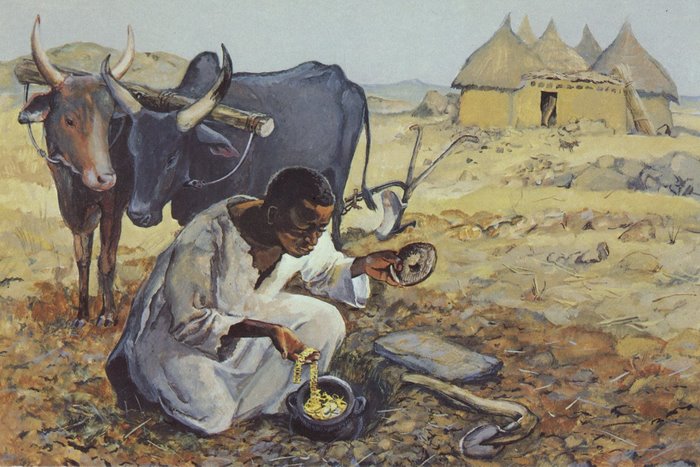
“The kingdom of heaven is like a treasure hidden in the field, which a man found and hid again; and from joy over it he goes and sells all that he has and buys that field. Again, the kingdom of heaven is like a merchant seeking fine pearls, and upon finding one pearl of great value, he went and sold all that he had and bought it.”

Matthew 13:44-46 (NASB)

Are the parables concerned about the cost of discipleship or the cost of the kingdom? This is one of the most complex and difficult questions of Gospel scholarship. It is a crucial issue that must be resolved in order to understand the teachings of Jesus.

-Brad H. Young
“Chapter 11: The Find,” pp 220-1
The Parables: Jewish Tradition and Christian Interpretation

I didn’t want to review Young’s book piece by piece, but taking each of the parables in turn, something new keeps turning up in my perception of the Master’s teachings and I feel compelled to share.

The scripture from which I quoted above is actually considered two separate but related parables: The Parable of the Hidden Treasure and the Parable of the Pearl of Great Price. Christian commentators, theologians, clergy, and the average “believer in the pews” believe they have this one figured out.

Christian interpretations of the parables of the Hidden Treasure and the Pearl of Great Price show a strong christological interest. Irenaeus taught that the treasure is Christ. Such an allegorical approach has been rejected, however, by the consensus of modern scholars.

To imagine that the historical Jesus told a parable in which he himself appears as the great treasure accidentally discovered…is nonsense. Even though Matthew suggests that these parables were taught to the disciples in private, the Jesus of history did not ordinarily speak about his person in such a way…

Origen, too, understood the treasure and the pearl as referring to Christ, but took the allegorical method one step further when he discussed the meaning of the field in light of salvation history. The field represents the Scriptures and the treasure is Christ. The Jews rejected him, hence the treasure has been passed on to the Christians.

-Young, pp 200-1

Frankly, that all sounds horrible. I know from a 21st century church perspective, it may seem “obvious” and easy to come to such conclusions, but when you fit these words back into their original context, coming out of the Master’s mouth, and that his audience was his Jewish inner-circle of disciples, then it seems ridiculous to believe he was teaching such supersessionism.

Young goes on:

As a kingdom parable, its message is closely tied to other teachings of Jesus in the Gospels. For instance, Flusser properly understands “selling all” as an allusion to “seeking first the Kingdom,” which means that these illustrations are connected to Jesus’ teachings concerning the reign of God (Flusser, “Gleichmisse,” 129-33).

-ibid, pg 202

treasureNow, at least for me, things are starting to make sense. If the “hidden treasure” and the “costly pearl” represent the coming Kingdom of God, then “seeking first the kingdom” can be linked to searching for that “treasure” and selling all we own, that is, making all of our other priorities and concerns subordinate to the Kingdom.

However, Young also compares the treasure and the pearl to the cost of being a disciple, although, as we see, he believes we must make a choice between the two interpretations:

The cost of discipleship is actually a secondary theme supporting the theme of overriding passion for God’s reign. Jesus is consumed with a passion to see God’s rule realized. The kingdom is above all.

-ibid, pg 221

As a brief aside, I should mention that in Young’s opinion, it is the Kingdom, not the Church that is Christ’s “overriding passion” and the Kingdom is inexorably tied to the primacy of Israel in the redemptive and salvational plan of God.

So we must choose an interpretation for these parables: the value of the Kingdom or the cost of discipleship. Young has come to his conclusion but in the immortal words of Yogi Berra, “When you come to a fork in the road, take it.” In other words, is it too much to ask for both?

Yes, I’m suggesting (though not demanding) that Jesus could have inserted more than one meaning into his parables. However, based on other material Young included in his chapter, there may be even more going on in these parables.

The parables of the Hidden Treasure and the Pearl of Great Price have a rich background in Jewish tradition when viewed in the context of Torah learning. Accepting the kingdom meant entering into obedience to God and searching the deeper meaning of his revelation in Torah. The Gospels portray Jesus as a dynamic teacher; who raises up his disciples for total commitment in the kingdom of heaven. In Jewish thought, the recital of the Shema was the acceptance of the yoke of the kingdom, because one was making a declaration that one has chosen the LORD to the exclusion of all other gods, and God’s way of living life. Praying the Shema opened up communion with the one true God. Such devotion to God and God’s revelation in Torah was not without sacrifices.

-ibid, pg 206

ShemaThis paragraph is pregnant with possibilities. The plain meaning, as I take it, is that we can find both the value in Torah study as a means of learning obedience to God’s commandments and by performing them, gain entry into the kingdom, and the cost of discipleship and Torah study relative to the sacrifices one makes as a student of the Master and a servant of God.

In this regard, the story of R. Johanan is of interest, even though it first appears in sources from the Amoraic period. Rabbi Johanan and R. Chaya bar Abba were traveling from Tiberias to Sepphoris. As they passed through some of the most fertile land in the entire country, R. Johanan began to recall how he sold certain plots of land in order to finance his studies. The talmudic legend stresses R. Johanan’s sacrifice for Torah. Rabbi Chaya bar Abba is concerned that his friend will not have the resources necessary for his old age. But R. Johanan is filled with joy because he learned Torah. The exchange was well worth the sacrifice.

-ibid, pg 208

Rabbinic commentary is replete with examples of self-sacrifice for Torah study, with revered sages being depicted as living frugally if not in abject poverty, all for the sake of studying Torah. But these tales tend to give the impression, at least to the outsider, that Torah study was for its own sake rather than for the higher purpose of performing the mitzvot which would be pleasing to God. After all, if all one did was study without putting their knowledge into practice, is a person complete?

While I think we can reasonably infer that Jesus, as a teacher, expected his students to study and learn his teachings within the larger context of the Torah, he also expected them to go and do, spreading knowledge of the Kingdom of God among the lost sheep of Israel and afterward, the nations of the world (Matthew 28:19-20).

I know this once again brings up the question of Gentile disciples and the Torah. Certainly we are not forbidden study of the Torah nor even obligation to the mitzvot, but it is an obligation that has its own distinctive nature and indeed, we Gentiles in the ekklesia of Messiah have a distinct role that we must not abandon if the purposes of God are to be fulfilled through us.

I recently read an article that stated in part, “My friend Aaron just called “Messianic”, Messi-Antics. When I have said Messianic in the past, I mean someone that (sic) believes the Torah is God’s way of sanctifying His elect unto Himself, whether Jew or Gentile,” implying that there is only a single method of obedience to God through the Torah, and that Jew and Gentile were offered the self-same behavioral path of sanctification.

But it’s not performance of the mitzvot that makes us holy, especially mitzvot that are not apportioned to us. Above all else, if we don’t consider ourselves as separated from the values of the world by our faith, our repentance, our turning to God with a pure heart, our steadfast walk in continually desiring an encounter with God in prayer, then donning a tallit and laying tefillin won’t make much of a difference, even for a Jew. Nor will it matter if we call ourselves a “Messianic,” a “Christian,” or anything else. What we value isn’t a name, a label, or a brand, but rather sanctifying the Name of God.

Helping the HomelessYes, obedience, as I said above, is part and parcel with that sanctification of God’s Name and seeking first His kingdom, but obedience isn’t complicated. Most of the  time, it’s not even specific to role:

As a person who wants for nothing, it hit me pretty hard this morning to hear Homeless Shelter’s (name changed for privacy) plea for donations to help the homeless beat the heat. The Shelter believes that every person has a right to safe and adequate shelter and they’ve been sheltering, supporting, and advocating for homeless adults and children since 2005.

Donations are down this time of year because people think, “Hey, it’s warm out. They’re fine.” But as you know, triple-digit temperatures cause many problems. That is especially true for homeless adults and children. And it’s not just discomfort, but heat exhaustion and other serious illnesses.

So because we are a responsible company who likes to give back to our community, we’re collecting donations to help the Sanctuary help those in need.

By next Friday, July 18, please leave with the receptionist any of these much-needed supplies that we may take for granted.

I received that in a company email at my “day job” yesterday as a request for donations to a local homeless shelter. The person who wrote it wasn’t a manager but a regular employee who approached the charitable contributions committee where I work and asked if they would help her in fulfilling what she felt was a personal commitment to help the homeless. Fortunately, my employer is very community minded and thus, we’ve all been prompted to make various donations in cash or goods for the sake of people who have far less than we.

For when Gentiles who do not have the Law do instinctively the things of the Law, these, not having the Law, are a law to themselves, in that they show the work of the Law written in their hearts…

Romans 2:14-15 (NASB)

What is of value to God? Don’t we in some ways already know what to do to please Him, to obey Him?

This isn’t to negate Torah (Bible) study, since it is by study that our “instincts” to do good are refined and honed and we can not only feel but know what is right to do.

jewsSo far, all of the “different” interpretations of the parables in question seem to fit together. If the overarching commitment is to seek first the kingdom, that hidden treasure, that pearl of great price, then the means to do so is to study the Bible, to enter into discipleship, to subordinate all of our wants and needs to those goals, to perform acts of lovingkindness and mercy to our fellow human beings, even as God has been abundantly gracious and merciful to us. I’m less concerned about “looking Jewish” or having the wrong “religious label” than I am with buying a case of bottled water and various sun protection products and donating them to my local homeless shelter.

But beyond all of that, there is still another treasure to consider.

Clearly, these two parables (See Mekilta Derabbi Yishmael on Exod. 14:5) have a different reality behind their word-pictures than the Gospel parables of the Hidden Treasure and the Pearl of Great Price. Nevertheless, the images used in the colorful dramas as well as the action of the plot in each story are quite similar. The rabbinic parables illustrate the undiscovered treasure of the people of Israel, while the Gospel texts portray the intrinsic value of the kingdom and the cost associated with obtaining it.

The people of Israel became the precious treasure of God while the pharaoh of Egypt failed to comprehend the intrinsic value of the great nation he had released. By the same token, the disciple should recognize the intrinsic worth of the incomparable kingdom of God as he or she surrenders all to obtain it.

-Young, pp 212-13

Young compares the more traditional rabbinic parable of the treasure as the people/nation of Israel to the value of the kingdom of God and the cost of discipleship, but I want to take that comparison a step further. I want to say that we can bind these interpretations of value together, seeking first the kingdom, study of Torah, the cost of discipleship, and the preciousness of Israel. I think they’re interdependent. I don’t think you can separate them out into self-sustaining components.

For if you toss even one of those elements onto the trash heap, the rest will go with it.

Consider the recent abandonment of Israel by Evangelicals. Consider what I wrote about Yom Hashoah in the church. There is more than just human compassion in praying for the peace of Jerusalem. Even the Master said, “Salvation comes from the Jews” (John 4:22).

How can we seek first the kingdom? How can we search out the hidden treasure and then sell all we own to possess the pearl of great price? The kingdom isn’t just Torah study, nor is it just performance of the mitzvot (however we choose to interpret what “performance” means). It is also loving your fellow human beings and particularly loving and supporting your Jewish fellow human beings and the Jewish nation of Israel. That is the physical seat of the Throne of David and the center of Messiah’s Kingdom.

In order to assert that value, we “join the army,” so to speak, by making a commitment to Messiah as his disciples. We are students who learn by studying and by doing. We apply what we have learned by showing to others the mercy and kindness God has shown to us. Above all other nations, God has chosen to love Israel, so in that too, we must emulate the Almighty.

We are partisans or freedom fighters, declaring fealty to our Lord, holding our ground, defending his Land as he even now is on the journey to return and to re-claim that which is his own.

hopeAll of this constitutes the hidden treasure, the costly pearl. Am I saying in absolute terms that Jesus meant to imbue his two parables with the meaning I am assigning to them? No, of course not. How could I?

I am saying that a parable can contain more than one literal meaning. I am also saying that parables can be inspirational. Interpreting a parable is like interpreting a poem or an artistic painting. The reader or observer can often extract meaning from these works that the writer or painter never meant to convey. But the meaning is just as real and, in this case, I think, just as Biblical.

It’s what I hope to do with these “meditations” I write. I’m not just out to make some sort of theological point. I want what I write to inspire someone to do what they might not have done before, to entertain a thought that had never occurred to them before.

It’s quite possible that the Bible contains far more than we’ve given it credit for. I don’t mean to manufacture false interpretations or to add my own words to the Bible. However, I believe that the Spirit is with us when we read the parables of Jesus and the inspiration we feel when we consume his teachings goes far beyond just a series of words printed on paper, which is what they are without the Spirit.

Seek first the kingdom by seeking first the treasure beyond which all other treasures pale by comparison. Seek first God. His Spirit will provide all the wealth we will ever need.

Pray for the peace of Jerusalem and learn the true origins of the current (and historic) conflict between Jewish Israel and the Palestinian Arabs.

Sermon Review of the Holy Epistle to the Hebrews: The Resurrection of the Dead

Therefore leaving the elementary teaching about the Christ, let us press on to maturity, not laying again a foundation of repentance from dead works and of faith toward God, of instruction about washings and laying on of hands, the resurrection of the dead, and eternal judgment. And this we will do if God permits.

Hebrews 6:1-3 (ESV)

According to Hebrews 6:1-2, the resurrection of the dead is one of the six basic doctrines of Messianic faith. In this teaching, D. Thomas Lancaster takes a look at the apostolic hope in the resurrection, distinguishing between the resurrection of the righteous and the general resurrection.

This is teaching number 25 in the Hebrews series and number 10 in special series on the elementary teachings of the Messiah. Unfortunately, due to technical problems, teaching 26 and the conclusion to the special series on the elementary teachings, titled “The Eternal Judgment,” was not recorded.

-D. Thomas Lancaster
Sermon Twenty-five: The Resurrection of the Dead
Originally presented on August 8, 2013
from the Holy Epistle to the Hebrews sermon series

This sermon is closely tied to the previous one which I reviewed last week and continues to discuss a literal, physical resurrection of the dead.

It all starts with that empty tomb of Yeshua’s (Jesus). Why was it empty? Had Jesus risen into Heaven? No. He was physically, bodily resurrected. The same body that died, rose. He even had the same wounds.

Lancaster talked about resuscitation vs. resurrection. We have modern examples of resuscitation when a person is declared dead but then, through modern technology, resuscitated and is again alive, but that person was dead temporarily and the resuscitation is temporary. Eventually, that person will die again.

We see examples of resuscitation in the Bible such as Jesus raising Lazarus (see John 11:38-46). Jesus resuscitated Lazarus but didn’t resurrect him, otherwise Lazarus would have been immortal. At some point, he died again and, like the rest who are dead in Messiah, awaits the resurrection.

…knowing that Christ, having been raised from the dead, is never to die again; death no longer is master over Him.

Romans 6:9

That’s what it means to be resurrected. That’s why Jesus is the first fruits of the dead (1 Corinthians 15:20). He was resurrected to prove a point. The point is that all of God’s promises to Israel are real and literal. When God speaks of the resurrection of Israel, He’s being literal and Jesus is the proof. If we believe God proved He will fulfill the resurrection, then we can believe in all of His promises.

In the day of Jesus, the Pharisees believed in a literal resurrection but the Sadducees did not. To settle the point in Judaism once and for all (ideally), Jesus died and was resurrected. For all those who were witnesses and all those who believe through faith in the literal resurrection, that is our hope that death isn’t the end and that a just God will punish evil and reward good.

Rambam (Moses Maimonides) established believing in the resurrection as one of the thirteen principles of faith. In order to be a religious Jew, you have to believe in the resurrection, according to Maimonides.

According to the writer of the Epistle to the Hebrews, belief in the resurrection is one of the six principles of the Messianic faith.

Lancaster said that a belief in a literal, earthly resurrection has largely been rejected by the mainstream Protestant church. That’s kind of a surprise to me, but I guess if it’s common for Christians to believe they go to Heaven (and stay in Heaven forever) when they die as some sort of spirits, then a physical resurrection and a life with Jesus on Earth kind of kills the deal (no pun intended).

Lancaster goes so far as to say a Christianity that doesn’t believe in a literal resurrection is no longer Christianity, it no longer follows the Biblical faith of the Apostles.

But if there is no resurrection of the dead, not even Christ has been raised; and if Christ has not been raised, then our preaching is vain, your faith also is vain.

1 Corinthians 15:13-14

If we don’t believe Jesus was literally raised from the dead in the same body he originally had, and we don’t believe that we too will be raised in the same manner as Jesus, then, according to the Apostle Paul, he, and all of the apostles and disciples who had been preaching Jesus, were preaching in vain. Not only that, but our Christian faith is also in vain if we don’t believe in the resurrection.

aliveThat’s pretty strong stuff. If you believe you’re going to Heaven as a “floaty ghost” (Lancaster’s words), then your body is dead and stays dead. You have some sort of spiritual existence in Heaven but you will never have a physical existence again. If this is what you believe, then you deny the resurrection, making Paul’s preaching and your Christian faith vain and worthless.

That’s pretty horrible. There goes your hope. Poof. Up in a (spiritual) puff of smoke.

Jesus is the definitive proof of a resurrection, if you’re willing to believe. If you believe, you have hope. If not…poof.

Not only will there be a resurrection, there will be two of them. The first is what is called the resurrection of the righteous which includes the exiles from Israel (i.e. the Jewish people) and all those in Messiah (that is, the Gentiles who are in the faith). We will be gathered to the Messiah and taken to the Kingdom. That happens at the beginning of the Messianic age.

The second resurrection, also called the general resurrection, happens at the end of the Messianic age and at that time everyone will be resurrected from the dead…to be judged.

Jesus even taught about it.

Truly, truly, I say to you, an hour is coming and now is, when the dead will hear the voice of the Son of God, and those who hear will live. For just as the Father has life in Himself, even so He gave to the Son also to have life in Himself; and He gave Him authority to execute judgment, because He is the Son of Man. Do not marvel at this; for an hour is coming, in which all who are in the tombs will hear His voice, and will come forth; those who did the good deeds to a resurrection of life, those who committed the evil deeds to a resurrection of judgment.

“I can do nothing on My own initiative. As I hear, I judge; and My judgment is just, because I do not seek My own will, but the will of Him who sent Me.

“If I alone testify about Myself, My testimony is not true. There is another who testifies of Me, and I know that the testimony which He gives about Me is true.

John 5:25-32

Those of us who hear the voice of the Master will be among the first resurrection because we are in him. However, not all of humanity is or will be in Messiah and those who are not in him won’t hear his voice. However, even those who are not in Messiah will hear him at the second resurrection and they will be judged by the will of God.

But we do not want you to be uninformed, brethren, about those who are asleep, so that you will not grieve as do the rest who have no hope. For if we believe that Jesus died and rose again, even so God will bring with Him those who have fallen asleep in Jesus. For this we say to you by the word of the Lord, that we who are alive and remain until the coming of the Lord, will not precede those who have fallen asleep. For the Lord Himself will descend from heaven with a shout, with the voice of the archangel and with the trumpet of God, and the dead in Christ will rise first. Then we who are alive and remain will be caught up together with them in the clouds to meet the Lord in the air, and so we shall always be with the Lord. Therefore comfort one another with these words.

1 Thessalonians 4:13-18

RestorationA word about going up into the air. We don’t stay there, according to Lancaster. This isn’t the ride to Heaven most Christians believe in. We won’t be raptured to Heaven but rather to where the presence of the King of Israel will be…to Jerusalem.

That may be disappointing or even startling to some of you reading my words. Actually, after spending so much time hearing about the rapture, it’s still a little jarring to me. What? No Heaven with Jesus? Christians I know believe that “the Church” will be raptured to Heaven for the remainder of the tribulation, and then return to Earth with Jesus to conquer the enemies of the Church and take over the world.

But that’s not what Jesus taught or Paul wrote about.

… knowing that He who raised the Lord Jesus will raise us also with Jesus and will present us with you.

2 Corinthians 4:14

The King will be in his Kingdom. His presence will be in Israel.

But how will we be raised. What will it be like?

But someone will say, “How are the dead raised? And with what kind of body do they come?” You fool! That which you sow does not come to life unless it dies; and that which you sow, you do not sow the body which is to be, but a bare grain, perhaps of wheat or of something else. But God gives it a body just as He wished, and to each of the seeds a body of its own. All flesh is not the same flesh, but there is one flesh of men, and another flesh of beasts, and another flesh of birds, and another of fish. There are also heavenly bodies and earthly bodies, but the glory of the heavenly is one, and the glory of the earthly is another. There is one glory of the sun, and another glory of the moon, and another glory of the stars; for star differs from star in glory.

1 Corinthians 15:35-41

Orthodox Jews don’t cremate their dead, they always bury them. In fact, how one prepares the dead for burial and the rituals around treating the body of the dead all are built on the belief in the resurrection. A dead body is treated with great respect because it is a body that will come alive again.

jewish burialBut what about people who were cremated or suffered some fatal accident which destroyed the body? According to Paul, the body doesn’t absolutely have to be whole and intact. By using the “seed” metaphor, he suggests that all that’s required is some small, perhaps very tiny fragment of the original body. God will not be stopped in accomplishing the promise of the resurrection.

So also is the resurrection of the dead. It is sown a perishable body, it is raised an imperishable body; it is sown in dishonor, it is raised in glory; it is sown in weakness, it is raised in power; it is sown a natural body, it is raised a spiritual body. If there is a natural body, there is also a spiritual body. So also it is written, “The first man, Adam, became a living soul.” The last Adam became a life-giving spirit. However, the spiritual is not first, but the natural; then the spiritual. The first man is from the earth, [n]earthy; the second man is from heaven. As is the earthy, so also are those who are earthy; and as is the heavenly, so also are those who are heavenly. Just as we have borne the image of the earthly, we will also bear the image of the heavenly.

1 Corinthians 15:42-49

According to Lancaster’s understanding of scripture, we will be resurrected in our original bodies, warts, wounds, disabilities and all, God will heal our infirmities, and through a process we don’t understand, a process Jesus went through after his resurrection, our bodies will be transformed into immortal and indestructible bodies. In fact, all of Creation will be transformed, resurrected, so to speak, and death will be no more.

So although we mourn our loved ones who have died, it is not as if they died without hope, for in Messiah, we shall all be raised again.

My God, the soul that you placed in me is pure. You created it, you formed it, you breathed it into me, and you guard it within me, and you will ultimately lift it away from me, only to return it to me in the future to come. For the entire time that my soul is within me, I give thanks to you, O LORD, my God and God of my fathers, Great One over all works, Master of all souls. Blessed are you, O LORD, who returns souls to dead bodies.

-Siddur

What Did I Learn?

As I said last week, the idea of a physical, bodily, earthly resurrection is not new to me, so no curve balls there. I did have a question of whether or not Lancaster believes that all Jewish people will be in the first resurrection or only those in Messiah, but from what I could tell on the recording, that was left somewhat ambiguous.

I’ve mentioned before in these reviews and in my reviews of Lancaster’s lecture series What About the New Covenant that it seems as if God intends to forgive the sins of all of Israel, so one way to interpret that is all Jewish people will be forgiven, redeemed, and be made righteous, and thus they will all be part of the first resurrection.

WaitingThat has problems when compared with much of Paul’s commentary about being resurrected in Messiah so I’ll reserve judgment on that issue. I don’t want to create the impression of a dual path to salvation.

Lancaster did say something interesting about how we should treat our bodies in the present age. He said we should treat them with respect and honor, doing only healthy things to our bodies. Of course, we will age or even possibly die in accidents that will be very damaging to our bodies, but the idea is that we don’t get new ones. We get the same old ones, even though they will be transformed, healed, and made immortal and indestructible.

God made our bodies as well as our spirits and even though at death, they are temporarily separated, one day they will be brought together again.

And He who sits on the throne said, “Behold, I am making all things new.”

Revelation 21:5

When you go to sleep in the dust, you will also rise, just as you are, only better. You will be gathered with your King in the air and travel with him in triumph and glory to Jerusalem, City of David, as he is enthroned bodily in Israel as her King, as our King.

That last part, as I mentioned above, may throw some of you. I’ve heard this before. I’ll probably get some angry comments about it. But think about it. Would it be so bad to stay here with Jesus on Earth? Do we really have to go to Heaven first?

Oh, don’t worry about the next lecture, “The Eternal Judgment” not having been recorded. It’s covered in Lancaster’s book Elementary Principles, so I’ll just review that chapter for next week.

Pray for the Peace of Jerusalem

BTW, considering the subject of the kingdom of heaven and the establishment of the physical messianic kingdom on earth in Israel, at present and during the past couple of hours a large area of southern Israel has been under heavy bombardment by missiles fired from Gaza. I’ve spent a portion of that time in my home’s concrete-reinforced shelter room. So far, all but a few of these missiles have been intercepted and destroyed by the Iron Dome defense system (Baruch HaShem!). The few that landed have not injured anyone or caused serious damage. They have reached, however, as far as the northern suburbs of Jerusalem, as well as to Tel-Aviv, and the alert sirens have blared from BeerSheva to Tel-Aviv and Jerusalem. Hamas claims to have fired toward Haifa, but I have not yet seen any reports confirming that their missiles can actually reach that far. Nonetheless, this is a time for intensive prayer for the continued protection of Israeli citizens, and success for the IDF efforts to destroy Hamas’ capabilities to continue waging war against civilian populations in this or any manner.

-ProclaimLiberty
July 8, 2014 at 3:12 p.m.

It all seemed to start with the kidnapping and subsequent murder of three Jewish teenagers, Gilad Shaer, Naftali Fraenkel, and Eyal Yifrah, perpetrated by Hamas terrorists. This horrible and tragic event brought Israeli Jews and Jews in the diaspora together in a way that hasn’t happened for a long time. While the IDF made a concerted effort to find the perpetrators, the military and public response was remarkably restrained. Believe me, as a father and grandfather, if one of mine were brutally murdered in what we call in the United States, “a hate crime,” I’d have wanted blood.

But I’m not as noble as the families of the victims.

Apparently in revenge for the killings, a 16-year-old Palestinian named Mohammed Abu Khdeir was kidnapped and found burned to death. Although there were early allegations that Abu Khdeir, supposedly gay, had been murdered by other Palestinians in an “honor killing” and then blame shifted to Jewish Israelis, the latest report is that six Jewish suspects were arrested. It is still highly disputed in some circles that the suspects are the actual killers and that police are covering up for Arab perpetrators, perhaps to stop or at least inhibit the Palestinian rioting that has broken out since Mohammed’s burnt body was discovered.

I heard that one of the mothers of the Jewish victims reached out to Mohammed’s mother, but I can’t find that story online just now (speaking of people more noble than I am), but I do know that Mohammed’s parents refused a visit by President Shimon Peres. In fact, unlike the mothers of the Jewish boys, Mohammed’s mother called for violent revenge against Jews.

Women from Mohammed Abu Khdeir's family hold pictures of the killed Palestinian teenager
Women from Mohammed Abu Khdeir’s family hold pictures of the killed Palestinian teenager

If you’ve been reading my blog for very long, you know where my bias lies in all this, but I’m not writing my “meditation” to bash Palestinians, but rather, to try to put all of this together.

Rabbi Kalman Packouz was recently taken to task by one of the readers of his column at Aish.com for condemning the murders of Gilad, Naftali, and Eyal, but not Mohammed’s.

I received the following email from Judith R. in response to my recent Shabbat Shalom Weekly:
“And no word condemning the despicable murder of Muhammad Abu Khdeir, and referring to him by his name??? What kind of Rabbi are you? Wasn’t he also created in God’s image?”

Of course she is right.

The juxtaposition of attitudes is startling.

But “attitudes” aren’t all people are worrying about in Israel just now.

Some 120 rockets from Gaza were fired at Israel on Tuesday, the first day of the IDF’s Operation Protective Edge.

IDF Spokesperson Peter Lerner told the AFP news agency that 23 of the rockets were intercepted by the Iron Dome missile defense system, with most of the rest exploding on open ground causing no damage or casualties.

Hamas upped the ante on Tuesday and extended the range of the rockets.

-Elad Benari
“120 Rockets Fired at Israel During Day 1 of Operation”
First published 7/9/2014, 1:15 a.m.
Arutz Sheva

Hamas has vowed revenge after an attempt to use Palestinian civilians as human shields resulted in several fatalities, as Israeli Air Force planes targeted the home of a Hamas commander.

Gazan emergency services claim Israeli strikes on Gaza killed 15 people on Tuesday and wounded 80 others, as the military began an aerial campaign against terrorists in the Strip and prepares for a potential ground offensive.

-Ari Soffer, Dalit Halevi, and AFP
“Hamas Vows Revenge After Use of Human Shields Goes Awry”
First published 7/8/2014, 5:29 p.m.
Arutz Sheva

Struggling to maintain the banner of ‘resistance’, the Gazan terror group is firing at Israel in the hope Ramallah and Cairo will hear its plea for help.

-Elhanan Miller
“Hamas decides to go for broke”
Published 7/8/2014, 4:02 p.m.
Times of Israel

Smoke rises from Gaza airport

And America’s response to all of this?

Hamas terrorists kidnapped and killed three Israeli teenagers, one of whom was a U.S. citizen.

These jihadist terrorists murdered kids. Yet, the reaction of the Obama Administration has been an absolute disgrace.

Remember, a U.S. citizen was just murdered (along two other Israeli teens) by Palestinian terrorists – known brutal terrorist who routinely fire rockets at Israeli civilians – and the Obama Administration responded by urging restraint.

In fact, President Obama actually urged “all parties to refrain from steps that could further destabilize the situation.”

Destabilize? Hamas terrorists killed an American teen and all this Administration is concerned about is that things may destabilize?

-Matthew Clark
“President Obama Responds to Hamas Terrorists’ Murder of American Teen with “Strongest Possible” Meaningless Words”
July 1, 2014, 12:47 p.m.
ACLJ.org

OK, that last story is over a week old, but to the best of my information, America hasn’t become more involved diplomatically or in any other way since Hamas started firing hundreds of rockets at Israeli civilians in an all out attempt to provoke other Arab forces to join the violence against Israel.

I do know that although the American press was exceptionally silent about the death of the three Jewish teens, it prominently posted stories regarding Mohammed:

Several Israeli Jewish suspects were arrested Sunday in connection with the killing of a Palestinian teen, Israeli police said.

“Investigation continuing, strong indication a nationalistic incident,” Israeli police spokesman Micky Rosenfeld tweeted about the death of Mohammed Abu Khedair.

Rosenfeld told CNN that those arrested were Israeli Jews.

-Kareem Khadder, Ben Wedeman, and Steve Almasy CNN
“Israel arrests several suspects in killing of Palestinian teen”
updated 11:21 a.m., Monday, 7/7/2014
CNN.com

New arrivals at Ben Gurion airport

If I can be said to have a bias in this situation, so can the American news media…and perhaps the American President.

Amazingly, even in the midst of a war zone, life goes on in Israel:

Making Aliyah is never an easy task, and leaving family, friends and memories behind is enough of a challenge for any new oleh.

But imagine making Aliyah under fire.

That is precisely what 26-year-old Becky Kupchan – one of the 64 new olim who arrived today from the USA – is doing. She is moving from Chicago straight to the southern Israeli city of Be’er Sheva, despite the fact that the city, like other Negev communities, is currently being rocked by waves of rocket-fire from Gaza.

-Ari Soffer
“Making Aliyah Under Fire”
First published 7/8/2014, 8:06 p.m.
Arutz Sheva

Where am I going with all this? By the time you read this tomorrow (Wednesday) morning, everything I’ve written will be old news. Things could get better or things could get worse. Or things could get much, much worse.

I think of my friends in Israel. I won’t embarrass anyone by naming names. But I’m not limited to my personal feelings for friends and acquaintances. If Israel is under attack, then so are all Jews everywhere. My wife is Jewish. So are my two sons and my daughter. At different times, my wife and my daughter have visited Israel. What if they were visiting there now?

But as I said, Jews are under attack all over the world. If Arab Muslims are firing rockets at Jews in Israel, they are at war with all Jews. The rest of the world, if they/we don’t stand up against terrorism and against this rabid series of rocket launches, are offering tacit approval of this war.

And what’s going to happen when Israel seriously strikes back as the operation continues? If this were happening in America, how long would even the person we have now in the White House stand by and let innocent people be endangered before firing back with all the might in our arsenals, eliminating the hostile forces and everything (everyone) else in the way?

Most of you reading this blog post have never been under fire unless you have served in the military or in law enforcement. How would you like to hear a siren in the middle of the night and have fifteen seconds to get to shelter because after that, it becomes distinctly possible you could be killed in a missile explosion?

Such things don’t happen in America, in Canada, in most or all western nations. They are happening right now in Israel.

pray for the idfIt started (this time) with an act of terrorism and cold-blooded murder that took the lives of three innocent Jewish teenage boys. It escalated with what appears to be a completely misguided revenge killing of another innocent teenager, a Palestinian. And then all hell broke loose.

I can only record how this began, I can’t tell you how it will end. Well, I can tell you that it will end, ultimately end.

“A song of ascents. Of David. Had it not been for Hashem Who was with us, let Israel declare now. Had it not been for Hashem Who was with us when men rose up against us, then they would have swallowed us raw when their anger was kindled against us. Then the waters would have washed us away; illness would have passed over our soul. Then the wicked waters would have passed over our soul. Blessed is Hashem, Who did not give us as prey for their teeth. Our soul escaped like a bird from the hunters’ snare; the snare broke, and we escaped. Our help is in the name of Hashem, Who made heaven and earth.”

Psalm 124

Pray for the peace of Jerusalem; they shall prosper that love thee.

Psalm 122:6

The Morality of Israel…Yes, You Can Depend On It.

What I Learned in Church Today: Christianity is Jewish

Get past the title. Get past the title. Just keep reading.

Is Christianity a Judaism? I think most Christians and most Jews would say “no,” but last Sunday morning in church, Pastor Randy said it was. In fact, it was the second Sunday he’s said such a thing.

Christianity is a Judaism?

I was kind of surprised that he said that. He also said that when Jesus returns, it will be as a Jewish King, the Messiah and he will still be Jewish.

You might be thinking “oh duh, of course he’ll be Jewish,” but there are a lot of Christians out there who believe his being Jewish died on the cross with him and that Jesus was resurrected as someone more “generic” in terms of ethnicity.

The last few times when Pastor has spoken with me at church, practically the first words out of his mouth as we’re shaking hands is, “I’ve been reading your blog.” He hasn’t said much else to me lately, so I’ve tended to take that as a message meaning he’s not really happy about what I’ve been writing. But now I wonder.

I’ve certainly been hammering away at the Jewishness of the ekklesia of the Messiah and how the Christian Church, as it exists today, won’t be what the ekklesia will be like in Messianic days.

As I was quickly taking notes on the sermon (Acts 25:23-26:32), I continued to reflect on the implications of Pastor’s words. Although I have no problem with any of the statements he made, I wondered how the rest of the congregation was taking it. No one mentioned it in Sunday school, although we were studying Ephesians 4 rather than Pastor’s message, so there wasn’t a natural opportunity to bring up the subject.

In speaking on Acts 26:4-18, Pastor referred to it as “A Conversion Story” but oddly enough, he defined “conversion” as making a “u-turn,” turning away from darkness and turning to light, to God.

That sounds more like teshuvah than conversion and in any event, as Dr. Larry Hurtado mentioned in a comment to me on his blog:

In any case, Paul didn’t undergo a “conversion” to “Christianity.” He refers to his experience as a prophet-like “calling” (e.g., Gal. 1:13-15), and there was no “Christianity” (as a separate religion) to which he could “convert” as a Jew. We could describe the former “pagans” (gentiles) that formed his churches as “converting” from the worship of their various ancestral deities to the God of the Bible/Israel.

paul-on-the-road-to-damascusSo Dr. Hurtado would call it “A Prophet-Like Calling Story” while using Pastor’s own definition, I could call the Acts 9 event “A Teshuvah Story”.

No, Paul wasn’t repenting of being Jewish or of practicing Judaism. Far from it. However, we could say that he had to make teshuvah relative to his disbelief in Yeshua as the Messiah and opposing God’s plan of using the ekklesia of “the Way” to bring Jews and Gentiles to Hashem and inaugurate the New Covenant in our world.

“So then, all Jews know my manner of life from my youth up, which from the beginning was spent among my own nation and at Jerusalem; since they have known about me for a long time, if they are willing to testify, that I lived as a Pharisee according to the strictest sect of our religion. And now I am standing trial for the hope of the promise made by God to our fathers; the promise to which our twelve tribes hope to attain, as they earnestly serve God night and day. And for this hope, O King, I am being accused by Jews. Why is it considered incredible among you people if God does raise the dead?”

Acts 26:4-8 (NASB)

I’m pulling a lot of my interpretation of this section of scripture, not only from D. Thomas Lancaster’s lectures on the New Covenant, but his sermon series The Holy Epistle to the Hebrews.

Paul continues to identify himself as a Pharisee, living in the strictest sense of that stream of Judaism, and that he has the “hope of the promise made by God to” his “fathers”, the hope of the resurrection, of life from the dead. He even asks his Roman audience as well as King Agrippa why they should find it so difficult to believe that the God who created the universe could also raise the dead back to life, thus extending the promise beyond just the Jewish people and making it a hope for all human beings.

Apostle Paul preachingIt may have seemed that Paul was the prisoner, but he appears to have made a captive audience of his jailers and accusers in delivering the message of the Good News.

I did have the opportunity to discuss part of Pastor’s sermon with one young fellow in Sunday school. After class let out, he had some questions about a part of Ephesians he’d been studying and thought for some reason I could help answer his queries.

In the course of our conversation, I realized part of the problem many late second temple period Jewish groups had with accepting Yeshua (Jesus) as the Messiah.

So when they had come together, they were asking Him, saying, “Lord, is it at this time You are restoring the kingdom to Israel?” He said to them, “It is not for you to know times or epochs which the Father has fixed by His own authority; but you will receive power when the Holy Spirit has come upon you; and you shall be My witnesses both in Jerusalem, and in all Judea and Samaria, and even to the remotest part of the earth.”

Acts 1:6-8 (NASB)

Even Yeshua’s disciples believed that the Messiah would first raise Israel as the head of all the nations, defeat her enemies, and ascend the Throne of David, and only afterward reconcile the Gentiles to God. Saying that the Messiah died, was resurrected, and ascended into Heaven to sit at the Father’s right hand and that before he returned to take the throne, the Gentiles would be brought alongside Israel in the worship of Hashem was reversing the expected order of things.

For a lot of Jews, it must have seemed pretty bogus to say that Gentiles could be brought into the ekkelsia, into a Jewish community and worship space, as equal co-participants while the Messiah was not yet physically ruling as King over Israel and over the rest of the world.

Paul knew the truth but he had a special insight. He had received two visions of the Messiah (Acts 9:3-8, Acts 22:17-22) and was caught up to the third heaven (2 Corinthians 12:2-4) and taught inexpressible words that he was not permitted to speak. For those Jews and Gentiles who believed, they did so from a profound sense of faith, since even though Paul could be persuasive, his words were not always convincing to every one who listened.

King Agrippa, do you believe the Prophets? I know that you do.” Agrippa replied to Paul, “In a short time you will persuade me to become a Christian.” And Paul said, “I would wish to God, that whether in a short or long time, not only you, but also all who hear me this day, might become such as I am, except for these chains.”

Acts 26:27-29 (NASB)

When Agrippa said “become a Christian,” the term “Christian” was not used in the same sense as we understand it today, because, as I’ve mentioned on numerous previous occasions, faith in Messiah Yeshua was not a religious stream distinct from Judaism at that point in history. Agrippa might have just as well said “make me a disciple of the Way”. And it was well-known that Agrippa was hardly devout and pious though he doubtless had some education in the traditions of his fathers (for Paul knew Agrippa believed the Prophets).

The Jewish PaulDoes that bring us back to thinking of Christianity as a Judaism, or am I the one getting things reversed?

During his lifetime, Paul obviously considered faith in Yeshua as Messiah King to be the next, natural, logical extension in the development of God’s plan for Israel. Yeshua was and is the beginning of God’s starting to fulfill the New Covenant promises to Israel, but those promises include bringing the Gentiles into worship of Hashem by coming along side Israel and becoming attached to her. Messiah was the doorway for the Gentiles to enter that forward-progressing stream of God’s plan for Israel, not by making Gentiles into Jews through the proselyte rite, but allowing them (us) to remain of the nations and yet, as was prophesied, enjoying the blessings of the spirit and the hope of the resurrection into the age of peace and tranquility.

I’d like to believe that some of the things I’ve written lately have been positively received by Pastor Randy, but that’s probably arrogant presumption on my part. However, his sermon last Sunday did seem to speak to many of the themes I write about on my blog. I not only found myself in general agreement with Pastor’s sermon but found myself learning some things I hadn’t noticed before in my reading of this part of Luke’s “Acts”.

Is Christianity a Judaism? In its current form, we can say that it owes a great deal to its Hebrew or Jewish roots, but there’s a lot about that “Judaism” the Church as left by the wayside. But as Pastor said, the return of Jesus is the return of the Jewish Messiah King to the Throne of David in the City of David.

With Jewish devotees cheering and Gentile disciples alongside them crying out in joyous approval, Messiah will raise Israel up as the most exalted of all nations, rebuild the Temple, return the Jewish exiles to their Land, rule the world with a rod of iron, and bring peace to all peoples.

What will the ekklesia be then? It will be Jewish, but it should be remembered that “every knee shall bow” (Isaiah 45:23, Romans 14:11), not just of the Jews but of everyone, the whole world.