Category Archives: Uncategorized

FFOZ TV Review: The Gospel Message

tv_ffoz8_1Episode 08: The gospel message of Jesus is often simplified down to believe in Christ and your sins will be forgiven and you will go to heaven when you die. In episode eight this common misconception will be challenged. Viewers will discover that the main message of the gospel is one of repentance and entering into the kingdom of heaven. The kingdom of heaven is not the place we go to when we die but rather God’s kingdom coming down here on earth. The gospel message is about preparation for the Messianic Age.

-from the Introduction to FFOZ TV: The Promise of What is to Come
Episode 8: The Gospel Message

The Lesson: The Mystery of the Gospel

This episode seemed to cover a lot of previous material, not in the details, but in the theme. It is most closely related with Episode 1: The Good News since gospel means good news. There’s also a close link to Episode 7: Exile and Redemption and Episode 8: Ingathering of Israel. The television series now seems to be stringing individual episodes together to paint a much larger panoramic picture of the prophecies about and the coming of the Messianic Era.

Of course, probably all Christians think they know what the good news or the gospel message is: Jesus died for our sins and if we believe in him, we go to Heaven when we die. And while that’s good news, as previous episodes have told us, that’s not the extent of the gospel message. In fact, most Christians have been given a truncated gospel or an incomplete idea of that the good news really means. To get the whole picture, you have to look at what the gospel message means through a Jewish lens.

The definition of the gospel message of Jesus is actually really easy to find:

After Yochanan was arrested, Yeshua came to the Galil and proclaimed the good news of the kingdom of God. He said, “The time is fulfilled, and the kingdom of God has drawn near. Repent and believe the good news.”

Mark 1:14-15 (DHE Gospels)

FFOZ Author and Teacher Toby Janicki tells us that Jesus was just beginning his ministry at this point and that these verses provide us with the first clue in solving the Mystery of the Gospel:

Clue 1: The Gospel Message means we should repent for the kingdom of Heaven is at hand.

But what does that mean exactly? What is the “Kingdom of Heaven” and what is “at hand?” The phrase “at hand” is sometimes also translated as “near”. Jesus was saying to his listeners that they should repent because the Kingdom of God or the Kingdom of Heaven was really close and about to happen or occur.

Jewish people in the late Second Temple period, particularly because their nation was occupied by the Roman Empire, were especially waiting for the Kingdom of Heaven to arrive and to their ears, it certainly was good news or the gospel message that Jesus was preaching. It was a message that we find repeatedly in the Gospels.

Now in those days John the Baptist came, preaching in the wilderness of Judea, saying, “Repent, for the kingdom of heaven is at hand.”

Matthew 3:1-2 (NASB)

We also find examples of this message in Matthew 4:17 and Matthew 10:7. But we also find that the good news is sometimes referred to as the “Kingdom of God” while other times, it’s the “Kingdom of Heaven.” Toby tells us that the term “Kingdom of Heaven” is closer to the correct phrase in Hebrew. The word translated as “Heaven” is the Hebrew word “Shamayim.” Does that mean that Jesus was talking about Heaven, where God is and where we’re going to go when we die?

Not according to the Jewish understanding. That’s not how Jesus’s disciples and listeners would have interpreted his message.

The scene shifts to FFOZ Teacher and Translator Aaron Eby in Israel for a better understanding of “Kingdom of Heaven” or in Hebrew, “Malkut Shamayim.”

“Shamayim” can mean just “sky” in Hebrew, but that’s not how it’s understood in the phrase “Malkut Shamayim.” Aaron explains the concept of circumlocution, or avoiding using the Tetragrammaton, the most Holy and personal name for God, the name God revealed to Moses at the burning bush. Jewish people use many other names for God to avoid the offense of taking His most holy name lightly. Names such as “Hashem,” “Holy One,” “Creator,” or “Our Father.”

Another circumlocution for God’s most holy name is “Shamayim” or “Heaven.” You see it often in Talmudic writings, but it’s even in the Bible.

And in that it was commanded to leave the stump with the roots of the tree, your kingdom will be assured to you after you recognize that it is Heaven that rules (emph. mine).

Daniel 4:26 (NASB)

Daniel, using the Aramaic equivalent of “Shamayim,” is not saying that literally Heaven, a place, rules, but that God rules. He was merely using a circumlocution for God’s most holy name.
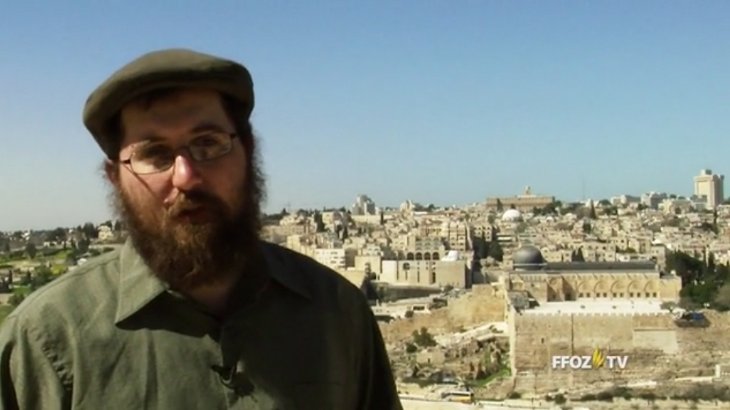
tv_ffoz8_aaronAaron tells us that the phrase “Kingdom of Heaven” isn’t God’s Kingdom that is located in a place called Heaven, but it actually means the rule and dominion of God on Earth.

Why do we then sometimes see this phrase rendered “Kingdom of God?” In the thoughts of the gospel writers in Hebrew, they would have used “Malkut Shamayim,” but then translating that phrase into Greek, what words should they have used? Matthew, who was writing primarily to a Hebrew speaking Jewish audience, chose to translate the Hebrew phrase literally as “Kingdom of Heaven.” However, Mark and Luke, who were writing primarily for Greek speaking Jews and non-Jews, translated the phrase idiomatically as “Kingdom of God.” Either way, they were saying the same thing.

Back to Toby and the studio, we have our second clue.

Clue 2: Kingdom of Heaven is not Heaven in the sky but God’s rule and reign on Earth.

Look up the Lord’s prayer and you’ll even find it in how Jesus taught his disciples to pray.

What is God’s rule on Earth? The Messianic Era. The time when Jesus will return and establish his rule as King in Jerusalem, establishing an age of peace, not just in Israel but in the entire world.

Toby solved most of the mystery, but one more clue is needed to answer a final question. Why is the Messianic Era good news?

Isaiah 11:1-4 tells of the prophesy that King Messiah will indeed rule Israel and the world from his throne in Jerusalem. Isaiah 11:6-8, 10 further tells us that Messiah’s reign will be one of complete and total peace. The portrait of such peaceful animals is poetic language describing such a peace. Complete tranquility and bliss, such as was experienced in Eden, long before there was any such thing as war and strife among human beings.

And when such peace comes upon all the earth from Israel, the Gentiles in the nations of the world will see and they will repent and turn to God, inaugurating an age of total, worldwide revival.

But it won’t be totally peaceful:

Then it will happen on that day that the Lord will again recover the second time with His hand the remnant of His people, who will remain, from Assyria, Egypt, Pathros, Cush, Elam, Shinar, Hamath, and from the islands of the sea. And He will lift up a standard for the nations and assemble the banished ones of Israel, and will gather the dispersed of Judah from the four corners of the earth.

They will swoop down on the slopes of the Philistines on the west; together they will plunder the sons of the east; they will possess Edom and Moab, and the sons of Ammon will be subject to them.

Isaiah 11:11-12, 14 (NASB)

We see that Messiah ingathers the exiles of the Jewish people from all the nations of the world and returns them to live in complete peace in their Land, in Israel. God Himself delivers justice to all the nations who have been enemies of Israel, vanquishing them, thus insuring Israel’s continual peace.

Now we have the final clue:

Clue 3: Kingdom of Heaven is about Messiah’s reign on Earth.

Toby recaps the lesson, summing up the three clues and solving the mystery. He describes a time when the Jewish people will live under their King in peace and return to the Torah, the law of God. I can only hope that future episodes will flesh out how this actually works relative to both Jewish and non-Jewish people, but that wasn’t the point of the episode.

What Did I Learn?

As I mentioned before, a lot of this material was addressed from other perspectives in previous episodes and I’ve learned about it from other sources as well. What Toby didn’t mention was that, by Jesus teaching that he was the fulfillment of Messianic prophecy and calling the Jewish people to repentance as preparation for the soon to arrive Kingdom of Heaven, it explains why the apostles and his disciples were so incredibly devastated when he was crucified. All of them were expecting that he was going to overthrow the Romans at any minute and assume the Throne of Israel as the promised Messianic King.
tv_ffoz8_tobyWhen he died, it must have seemed as if they were completely mistaken about him, that he couldn’t have been the Messiah, that he must have been just another of a long line of pretenders to the throne who came before him. It’s how most Jews see Jesus today, another would-be Messiah among the many who have since come and gone in Jewish history.

But then, when he was resurrected, so was hope, only there’s a problem of sorts:

So when they had come together, they were asking Him, saying, “Lord, is it at this time You are restoring the kingdom to Israel?” He said to them, “It is not for you to know times or epochs which the Father has fixed by His own authority; but you will receive power when the Holy Spirit has come upon you; and you shall be My witnesses both in Jerusalem, and in all Judea and Samaria, and even to the remotest part of the earth.”

Acts 1:6-8 (NASB)

Given that Jesus had said, “The Kingdom of Heaven is at hand” or “near,” once he was resurrected, it made perfect sense to his disciples that he was now ready to ascend the throne. Except he didn’t. He left instead and the disciples waited.

“Truly I say to you, there are some of those who are standing here who will not taste death until they see the Son of Man coming in His kingdom.”

Matthew 16:28 (NASB)

Many believed, based on these words of the Master, that although Jesus wasn’t going to immediately establish his kingdom, it would be within a human lifetime, just a matter of decades. But when the last apostle, John, died of extreme old age, sometime in the last years of the first century CE, the disciples must have felt a keen disappointment again. Messiah had not come to restore his kingdom. Where is he? How long, O’ Lord, how long?

I generally don’t mention this in my reviews, but at the very end of each episode FFOZ President and Founder, Boaz Michael appears on camera to give the audience a brief peek at the next episode. At the end of this episode, Boaz explained that the next episode would pick up the same theme and describe more in detail the process of repenting to prepare for the kingdom and to believe. But Jesus didn’t say “believe in me” he said “believe in the gospel.” What does that mean?

It’s the mystery for next week.

Encouraging a Jewish Wife

apples-oranges-interfaithNo matter what the content, the fact that there are classes for Intermarried couples is a progress , because it is a doorway to observance and making a Jewish home, and even conversions. Sometimes it is the non-Jewish spouse who brings the Jewish partner back to Judaism so they need to be given a chance. This is different from being lenient about intermarriage. Since a lot of Jewish observance is done at home eg. Shabbat , people can be introduced to it and be encouraged because of the wonderful effect it has on family life, would be a good place to start with.

-Anonymous
Comment found on “What to Do about Intermarriage”
Aish.com

A lot of Jewish articles about intermarriage are difficult for me to read because many sound like “The goyim are bad for marrying Jewish men and women and causing them to assimilate.” Harold Berman’s article was much more refreshing, but Anonymous’s comment really hit home.

Sometimes it is the non-Jewish spouse who brings the Jewish partner back to Judaism so they need to be given a chance.

My daughter just returned from Israel a few days ago after spending nearly two weeks in the Land participating in the Birthright Israel program. While she was gone, one Friday afternoon, my wife got out the Shabbos candlesticks (sans actual candles). She didn’t light the candles, but she didn’t want me to put them away after Shabbos, either. They’re still sitting on our counter waiting and have been for two Friday evenings now, after gathering dust in our bookshelf for months.

Through casual conversation, I found out that my wife took our grandson for a visit to the home of the Chabad Rabbi and Rabbitzin. It came up when we were talking about a new Lego toy my wife bought our grandson, which was the result of him playing with the Rabbi’s children (I guess they’re heavily into Legos). Yesterday afternoon, my wife wasn’t home, but since she didn’t have to watch our grandson that day, I thought she was off doing errands and visiting friends. I was right, but not in the specifics. She’s spent the afternoon helping the Chabad Rabbitzin do some cooking. There was a hint that she might be planning on helping with some of the food preparation for the High Holidays as well.

birthright_taglitI couldn’t be happier. Well, yes I could. I’m delighted that the missus is becoming more involved with the Chabad community again. Actually, for all I know, she never stopped, but she stopped talking about it. I’m glad that part of her life is becoming more overt again. I keep wondering if she’s simply wishing that I would quit church and become more interested in Judaism.

It’s not like I didn’t try. After leaving my previous congregation, I suggested and hinted and finally asked about the two of us participating together in the Jewish community. Eventually it came out that it would be too embarrassing to have her “Messianic” husband meet with her Jewish friends. I guess a Christian husband is equally humiliating for her.

Welcoming is critical. But it’s not enough. And the question “how can we be welcoming” is the wrong starting point. Instead of asking how we can welcome interfaith families, we would serve them better by asking how we can help them transform themselves through Jewish life. Welcoming, without more, is simply a technique to get people in the door. But Jewish transformation goes to the heart of our passion and purpose as a people.

Helping intermarried families feel comfortable may encourage them to enter our doors. But it won’t help them grow. And it may not even convince them to stay. To be sure, being welcoming and effecting Jewish transformation is hardly an either/or equation, and notable examples of doing both well can be found. But the communal starting point is nearly always one of welcoming, hardly ever one of transformation, and in the meantime, the majority of intermarried families are either unengaged or under-engaged in Jewish life.

I’ve met intermarried couples who joined a synagogue because they were made to feel comfortable.

But I’ve never met an intermarried couple (or in-married, for that matter) who got excited about Jewish life, who gave their kids a rich Jewish education, who chose to become a Jewish family, simply because they felt comfortable. In virtually every case, they encountered a gifted Jewish teacher, had a meaningful experience in a service, or found that Judaism spoke profoundly to their worldview.

intermarriageNotice the first paragraph I’m quoting from Mr. Berman’s article says “interfaith” families, not just “intermarried.” Intermarried simply means that one member of the couple is Jewish and the other is Gentile but not necessarily religious (particularly Christian). Interfaith implies that the Jewish member is religiously Jewish on some level and the Gentile member is affiliated with another religion (probably Christianity).

The direction in which the article travels leads to not just welcoming interfaith/intermarried couples in the synagogue, but the drive to help them transform into Jewish families.

Another person commenting on the article said:

One cannot simultaneously believe that the Messiah has come & believe Ani Ma’anim with perfect faith in the coming of Moshiach. Raising children with nothing is nothing. Make a choice, give your child roots (whatever they are) so she IY”H can have wings.

Here we start moving into potentially hazardous territory. What happens to the Christian member of the marriage if the goal of welcoming interfaith/intermarried couples into Jewish life is to create Jewish families?

I know from a Messianic Jewish point of view what the answer could be but that doesn’t play if the Jewish person in the marriage does not have faith in Jesus as the Jewish Messiah.

My wife would never ask me to abandon my faith. I’ve considered saying I could cease all outward signs of my faith if it would help her to return to the synagogue and become more involved in Jewish community (I stop short of offering to abandon all internal signs of my faith), but first of all, I know she would decline, and second of all, it’s still a dangerous step for me to take.

And we’re not raising children. My youngest is twenty-five so as adults, my children are all responsible for their relationship with God and who they are (or aren’t) as Jews. The window of opportunity my wife and I had to instill a strong Jewish identity in our children has long since slammed shut.

woman_torahI want my wife and children to become as involved with the Jewish community, with the Torah, with the mitzvot as they want to be and in fact, as involved as God wants them to be. I would be more than happy to “go along for the ride,” so to speak, though as I said before, my presence would make my wife highly uncomfortable. I always come up against the same walls when I face being intermarried and I don’t know how to get over, around, or through them. No one in my church could understand and they’d probably be offended that I’m praying for my family to be more Jewish rather than for them to convert to Christianity.

But to the rest I say, not the Lord, that if any brother has a wife who is an unbeliever, and she consents to live with him, he must not divorce her. And a woman who has an unbelieving husband, and he consents to live with her, she must not send her husband away. For the unbelieving husband is sanctified through his wife, and the unbelieving wife is sanctified through her believing husband; for otherwise your children are unclean, but now they are holy. Yet if the unbelieving one leaves, let him leave; the brother or the sister is not under bondage in such cases, but God has called us to peace. For how do you know, O wife, whether you will save your husband? Or how do you know, O husband, whether you will save your wife?

1 Corinthians 7:12-16 (NASB)

I wonder if there’s an adaptation of Paul’s midrash on “intermarriage” that says the Christian husband can save the Jewish wife by leading her to be more Jewish? Probably not, but it’s a nice thought.

There’s an emphasis in certain corners of Messianic Judaism in general and in the First Fruits of Zion (FFOZ) ministry in specific that believes strongly that we Gentile Christians exist to provoke the Jewish people to zealousness in the mitzvot and a return to the Torah. I’ve come to believe this as well.

I just need to know how…or maybe the only answer is just for me to stay out of my wife’s way and let her do what she’s going to do. Maybe it’s just a matter letting go and trusting that God knows what He’s doing.

It’s Time To Let Go

finding-nemo-let-goMARLIN: “Dory!”

DORY: “He says, “It’s time to let go!”. Everything’s going to be all right.”

MARLIN: “How do you know, how do you know something bad isn’t gonna happen?”

DORY: “I don’t!”

-dialog from the film Finding Nemo (2003)

You’ve probably seen this film at one point or another and if you have kids, you’ve probably seen it a lot. Marlin (voiced by Albert Brooks) and Dory (voiced by Ellen DeGeneres), after having gone through many adventures, have been swallowed by a whale. The forgetful Dory, who apparently can speak whale, was asking the sea mammal for directions to Sydney, Australia when the creature gulped down her and Marlin with a chaser of krill. We all know that this was the whale’s best effort to give Dory and Marlin a free ride to their destination, but the ever pessimistic Marlin just feels like today’s hot lunch special.

Dory has another point of view made of optimism and trust (and short-term memory loss). When the water inside the whale recedes and Dory and Marlin are about to fall down the whale’s throat, Marlin grabs onto something and clutches it and Dory for dear life. The whale tells Dory (in whale talk) to let go and Dory translates for Marlin. That’s where we pick up the dialog above.

MARLIN: “How do you know, how do you know something bad isn’t gonna happen?”

DORY: “I don’t!”

You won’t read this until Tuesday, but I’m writing it on Sunday afternoon. Three times at church this morning, I must have heard someone say to humbly trust God for everything and not our own efforts.

Trust in the Lord with all your heart and do not lean on your own understanding.

Proverbs 3:5 (NASB)

Yeah, I’m pretty sure that’s the basis for such a thing in the Bible.

I’m not always happy with the sorts of religious systems we develop just to try to understand what God is saying to us in the Bible. It’s sometimes amazing to me that so many different and contradictory meanings can be squeezed out of the scriptures. Really, if God caused the Bible to be written in human language so that human beings could understand what He’s saying (and since He’s God, what He’s saying to us must be pretty important), then why is the Bible so incredibly difficult to comprehend in a unified fashion?

But then sometimes, suddenly the Bible can be very clear.

‘You shall also count for yourselves from the day after the sabbath, from the day when you brought in the sheaf of the wave offering; there shall be seven complete sabbaths. You shall count fifty days to the day after the seventh sabbath; then you shall present a new grain offering to the Lord. You shall bring in from your dwelling places two loaves of bread for a wave offering, made of two-tenths of an ephah; they shall be of a fine flour, baked with leaven as first fruits to the Lord.’

Leviticus 23:15-17 (NASB)

In his sermon, Pastor said this was the command for the people of Israel to acknowledge God’s provision to them on Shavuot. Last week, we talked about offering God the firstfruits, the very best of the barley crop before anyone else could “sample the goods.”

God gives us everything. He needs nothing from us in return. And yet, He directed the Children of Israel to give back to Him by these festivals so that the Israelites could realize where everything comes from and acknowledge God’s goodness and generosity.

You open Your hand And satisfy the desire of every living thing.

Psalm 145:16 (NASB)

I have been young, and now am old, yet I have not seen the righteous forsaken or his children begging for bread.

Psalm 37:25 (ESV)

birkat-hamazonBoth of those scriptures are incorporated in the Birkat Hamazon or “Grace After Meals,” a blessing typically said by observant Jews after a meal. In my previous congregation, on Shabbat, we would recite it after our oneg meal and before the teaching began. It’s a wonderful reminder of God’s provision for all humanity and that everything we have truly comes from Him.

In my struggles with “religious systems” and trying to integrate within traditional Christianity, I haven’t really been relying on God. Oh, it’s not as if God hasn’t been involved and has been absent when I needed help, I just haven’t been asking Him, at least very regularly. If I have to rely only on the brain I have inside my skull, I’m not going to get very far. Maybe that’s why I haven’t gotten very far. Then again, I’m not sure how far God wants me to go, or in what direction.

I know I still want to write about things like the comparison between Christian Dispensationalism and Rabbinic Judaism and how they both seem to rely on a post-Biblical evolution of their religious design structures in order to adapt to changes in environment and history (and this is a comparison that wouldn’t find much traction in the church). I also have to decide to finally follow Dory’s advice and let go.

It’s not up to just me to fight, let alone win any battles. Sure, I have to show up and be prepared, but I’m hardly the star attraction. I’m not the general. I’m not leading the army. The spotlight isn’t centered on me, nor to I want it to be.

Well, sometimes, maybe a little, but that’s my error.

I’ve been trying too hard to hang on because I was afraid something bad might happen…well, not exactly, but close enough. I’ve been fighting too hard and worrying too much about getting my point across when I know it’s not my point. It’s God’s. And if it’s God’s point, it’ll get across. Who can resist God? If I’m not speaking about God’s point, then no one will listen anyway.

So in the present case, I say to you, stay away from these men and let them alone, for if this plan or action is of men, it will be overthrown; but if it is of God, you will not be able to overthrow them; or else you may even be found fighting against God.”

Acts 5:38-39 (NASB)

I probably have been resisting God. Most of us do, though we are loath to admit it.

I still need to do what I believe God wants me to do, but I also need to let God take the lead, so to speak, and not think that it’s all my effort. I also need to better realize that whatever I have is from God and not find it so difficult to give back. If I really trust God, then it’ll all work out by His will.

Let me hear your kindness at dawn, for in You have I placed my trust; let me know the way I should walk, for to You have I lifted my soul.

Psalm 143:8 (Stone Edition Tanakh)

It’s time to let go.

Introduction to Messianic Judaism: The Non-Climax of Covenant

sprout-root-of-jesseBeginning with the call of Abraham, the history of redemption is the history of God’s election of his chosen people from among the nations. As Paul argues in Romans 15:7-13, God’s commitment to Israel for the sake of the nations forms the bedrock of the Church’s hope. Viewed from this perspective, Messianic Judaism reminds us not only of God’s faithfulness demonstrated in Israel’s history, and of his grace, now magnified in the Messiah, but also of his promises for the future of his people, to be fulfilled in the final redemption of Jews and Gentiles.

-Scott J. Hafemann
“Chapter 19: The Redemption of Israel for the Sake of the Gentiles,” pg 206
Introduction to Messianic Judaism: Its Ecclesial Context and Biblical Foundations
David J Rudolph and Joel Willitts, editors

I reviewed most but not all of the chapters in the Rudolph and Willitts book and I probably skipped this one. I tried to be thorough, but all together I wrote eleven separate reviews of different portions of this book. It’s really worthy of that kind of attention, and I’m grateful to the book’s publisher, Zondervan, for including links to my reviews in an email they sent to their academic readers.

I bring up the Hafemann chapter because last Wednesday, my Pastor, who’s been reading this book, mentioned that he had just read it and really enjoyed what Hafemann had to say. I have to admit that I read this book only once and that was months ago, so I didn’t immediately recall the content. I decided to re-read Hafemann’s article to see what Pastor Randy might have liked about it. I was curious, since we don’t always agree on the nature and character of Messianic Judaism.

Before continuing, I should say that I’ve written blog after blog on how we non-Jewish believers in the Jewish Messiah are dependent upon the covenant relationship God established with the Jewish people and Israel for our own redemption and salvation and, without Israel, we would have no link to the God of Heaven at all. As Hafemann says:

Given the development of this Jew-Gentile theme throughout Romans, it is not surprising, though often overlooked, that it is precisely the relationship between Jews and Gentiles, both in history and within the church, that forms “the climax of the epistle…”

-ibid, pp 206-7

Most Christians probably wouldn’t get this, since historically, supersessionist theology has taught that the church replaced Jews and Judaism in the promises of God. Most non-Jewish believers don’t recognize any sort of relationship with, let alone a dependence upon, the Jewish people by the Gentile Christian Church. More’s the pity.

However, Hafemann’s focus is not just on the past or even the present, but on the future of this relationship and what it means for us all.

We must be cautious at (Romans) 15:7, however. Redemptive history is not over for Jews and Gentiles as Jews and Gentiles. Paul’s careful use of the Scriptures in Romans 15:9-12 makes it clear that the present church, made up of a small remnant of Jews and Gentiles, is not the final fulfillment of Israel’s hope for restoration, as if God’s covenant promises “climaxed” with the first coming of the Messiah.

-ibid, pg 207

Given my recent conversations with Pastor, I’m a little puzzled at his enthusiasm over statements like this one, or perhaps we simply are reading this material differently. What I read is a couple of things. First, within the body of Messiah (i.e. “church”), Jews remain Jews and Gentiles remain Gentiles. The distinctions continue to exist, which for me, means that distinctions based on separate or overlapping responsibilities to God, relative to Torah, continue to exist in the present. The Second point is that the first coming of Messiah did not “finish the job,” so to speak, and that Christ’s work of restoring (notice Hafemann said “restoration,” not “salvation” … there’s a difference) Israel will not be addressed and completed until his return.

LichtensteinPastor and I go ’round and ’round about what “fulfilled” means, and he says a lot of Jewish identity and the Torah is “fulfilled” as in no longer active except in pointing to Messiah. To me, “fulfilled” is to “fill full,” as in, the Messiah is the perfect example of what it is to be a Torah observant Jewish person, and the example and role model to be emulated by all Jewish believers everywhere. The Torah goes forward in time and as 19th century Rabbi Isaac Lichtenstein observed, Jesus as Messiah gives the fullness of meaning and holiness to the performance of the mitzvot for an observant Jew.

I don’t think the above-quoted paragraph of Hafemann’s can be true unless Rabbi Lichtenstein’s life experience as an observant Jewish believer is true.

My Pastor is a great believer in the future of Jewish Israel in eschatology, which is what Hafemann is discussing a well. Israel has a future role in the plan of God and the rest of us are dependent on Israel meeting and fulfilling that role for the sake of humanity.

My Pastor tells a story that illustrates how rare Hafemann’s and Pastor’s perspectives are. Pastor was at a conference on one occasion some years ago when, by chance, he was seated next to a rather well-known and published Christian author and theologian (Pastor mentioned his name, but I didn’t recognize it and, in any event, it would be poor form on my part to use it here). The conversation turned to Revelation and eschatology, and the topic of the 144,000 (see Revelation 7:4-8) came up. Pastor believes that they are literally the twelve tribes of Israel, 12,000 per tribe, while this renowned Christian writer and preacher said that the 144,000 represented the church in allegory.

Pastor said that if their conversation had ended at that point, they probably would have parted amicably, but Pastor added one more sentence. He said something like (I’m paraphrasing, of course), “I suppose one tribe would be the Baptists, and the next tribe would be the Presbyterians, and the next tribe would be…”

Our highly esteemed Christian theologian pointedly shifted around in his chair to show Pastor as much of his back as possible in a very obvious snub.

Interestingly enough, Pastor and I were both trying to make a point based in this sort of behavior, but we were making different points.

His point is that no matter who in Christianity has such beliefs and attempts to delete Jews and the Jewish tribes from future redemptive history, their opinions don’t matter because they aren’t speaking from Scripture. My point was that Christianity is still dominated by such poor attitudes of future Judaism and that most of the believers sitting in the pews, and particularly those who read this gentleman’s books, are going to swallow his story hook, line, and sinker and believe that it’s all “gospel.”

The conclusion to Hafemann’s chapter tells the story that the Gentile Christian church should read and take to heart.

Our passage thus gives no ground for seeing Israel’s identity and eschatological hopes reconfigured into Christ and/or the present Church, having been transformed by Paul into exclusively present realities. Redemptive history does not become abstracted into the “Christ-event” or personalized into an eschatological “community,” but continues on after Christ’s coming and establishment of the Church just as concretely and historically as it did before. The “climax of the covenant” remains Israel’s future restoration for the sake of the nations. Moreover, it is precisely this climax to the covenant that secures the believer’s salvific hope in the return of Christ. In light of God’s promises to the patriarchs (Romans 15:8), the Messiah, as the servant to the circumcision, must come again to judge the nations in order to restore Israel and save the Gentiles (15:12; cf. 11:29). Messianic Judaism puts flesh on the (Ezekiel-)bones of this crucial conviction.

-ibid, pp 212-13

ancient_jerusalem(As an aside, I’m just a tad uncomfortable with Hafemann’s referring to the united Jewish-Gentile body of Messiah as “Church,” since the word implies removing the Jewishness from the Jewish members, but I think I know where he’s coming from.)

I can’t read the above-quoted paragraph any other way but to say that there is no “climax of the covenant” at the cross and in fact, this “climax” will not occur until the return of Messiah and all that must be done is finally completed. In fact, the covenant can’t climax, according to Hafemann, until Messiah returns, restores Israel for the sake of the nations, and judges the nations for the sake of Israel.

The logical implication of Hafemann (and no, he didn’t say so explicitly) is that if God’s covenant relationship with Israel didn’t climax at the cross, and must not climax until after the second coming and the progression of all the events subsequently required by prophesy, then Jewish covenant identity and responsibility to God has not been reduced, eliminated, and certainly is not “fulfilled” at the cross and is not done in the present age (with the understanding that many of the mitzvot are held in abeyance since the Temple, the functional Priesthood, and the Sanhedrin currently do not exist).

Jewish people remain distinctly Jewish people in the covenant, which includes all of their covenant responsibilities, the Torah mitzvot, to God.

My understanding of this small chapter probably is different than my Pastor’s, at least on this point, but again, I can’t see any other way of reading Hafemann. The Torah didn’t “climax” at the end of the Gospels and indeed, the covenant remains for the Jewish people, including and especially the Jewish believers in Yeshua, until his return and for some time afterward.

Systems

broken-crossThe eye sees, and the heart desires.

-Rashi, Numbers 15:39

People cannot help when an improper impulse comes to mind, but they certainly can stop themselves from harboring the thought and allowing it to dominate their thinking. Yet, sometimes one may be responsible even for the impulse itself.

While some impulses are completely spontaneous, others arise out of stimulation. If a person reads, hears, or sees things which can provoke improper thoughts and feelings, he or she is then responsible for the impulses that are the consequences of that reading, listening, or observing.

This concept is especially important in our era, when not even a semblance of a code of decency exists as to what may or may not be publicly displayed. All varieties of media exploit our basest biological drives.

Given the interpretation of the right of free speech under which such provocative displays occur, the government has no way to restrain them. However, each person has not only a right, but also an obligation to be his or her own censor. No one has to look at everything that is displayed nor hear everything that is broadcast. Those who fail to exert their own personal censorship are tacitly stimulating immoral impulses, and for that alone they are liable.

Today I shall…

…try to avoid looking, hearing, and reading things which can have a degenerating effect.

-Rabbi Abraham J. Twerski
“Growing Each Day, Elul 16”
Aish.com

I know that Rabbi Twerski was thinking of something else entirely, but when I consider trying to avoid exposing myself to things that have a “degenerating effect,” I have to include the world around me, including the world of “religion.” Well, “degenerating” isn’t the right term. “Discouraging” is.

Although you won’t read this until Sunday morning, I’m writing this on Thursday in response to my Wednesday night meeting with my Pastor. We were supposed to be discussing Chapter 8 in D. Thomas Lancaster’s book The Holy Epistle to the Galatians, but we got sidetracked on a few things.

I bring up the book because of my Pastor’s response to it. He told me that he was having difficulty accepting some of Lancaster’s assertions early on in the book out of concern that if he assented, he would end up traveling down a trail he didn’t agree with. That’s how I felt last night as Pastor and I talked about salvation, Jewish people, and the future of Judaism and Torah. I felt like I was being led to agree with doctrines that I wasn’t comfortable with but didn’t know how to refute. In going over the little pamphlet about Baptist Distinctives (that is, what makes the Baptist church different from all other churches), I could feel myself being tugged down the “garden path,” so to speak.

I ended our meeting by stepping out of the bowl of alphabet soup, all the letters and words of denominational doctrine and distinctives, and exploring actual experiences and relationships.

Well, sort of.

I’ve often imagined what it would have been like to live in the late Second Temple period in Jerusalem. What would it have been like to go into the Court of the Gentiles at the Temple. How many people would be there? Who would I see? What would the air smell like? Then, I’d humbly kneel and pray to Hashem. This close to the actual “house of prayer for all peoples,” would I feel the tangible presence of the God of Israel? Would I hear the songs of the priests ministering in the inner court?

0 RI’ve often imagined what it would have been like to be one of the non-Hebrew shepherds tending the flocks of Abraham in Canaan. In the heat of the day, I watch him in the distance, studying his mannerisms and appearance, knowing that this is a man, among all human beings, who has spoken to God “face to face.” In the evenings after a meal, around the fire, would he teach us of his God? What would he tell us about a relationship with Him? How does one pray to the God of Abraham as a humble shepherd? In blessing Abraham, would I be blessing God and also myself? What a hard and yet simple life, living close to a prophet and to the One God.

We read “Bible stories” about “Bible characters” as if reading morality fables or fairy tales. We “know” that they’re real, but do we? It’s just words on a page. Does “Biblical inerrancy” result in forgetting that Abraham was and is a real human being? Do we discount the moments of his life we don’t find in the Bible but nevertheless, moments that must have occurred? When, in reading the Bible and praying, do we allow Abraham to stop being a work of “fiction” and become a living, breathing, talking, experiencing human being?

Religion is all about systems, and Christianity, in all of its flavors, is just another series of systems. The systems exist to tell us what the Bible means and how we are supposed to live our lives. The systems tell us what is right and what is wrong, who is right and who is wrong, and what, if anything, we’re supposed to do about it.

But the systems totally ignore awe, majesty, terror, magnificence, and everything else everyone from Abraham in Canaan to a lowly, nameless goy in the Court of the Gentiles would experience in a living, breathing, bleeding, authentic, moment-by-moment encounter with God; the sights, sounds, smells, touches, tastes, thoughts, feelings, and dreams of actually being there instead of just reading the Bible and especially instead of filtering the Bible and everything else through religious systems that so very much remove us from authenticity and the jarring, electrifying, naked connection to our Creator.

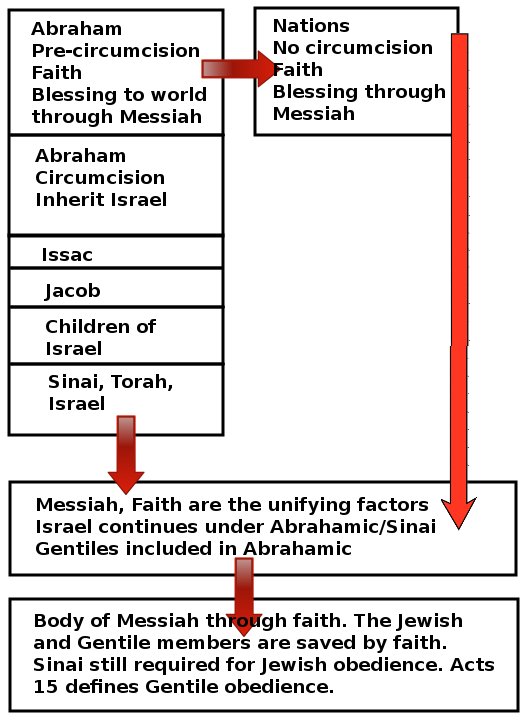
I tried to explain how I thought that Jews and Gentiles both are a part of the unified body of Christ and yet the Jewish connection to the Sinai covenant and its conditions, the Torah, are not undone by that unity. I drew a diagram, which I’ve reproduced below, to explain my thoughts. “But the Jewish people haven’t accepted Christ, so they can’t be saved,” he says (I’m paraphrasing). “Not just faith in ‘a Messiah’ but ‘The Messiah,’ in Jesus,” he says (I’m paraphrasing again).

Something’s wrong. I’m agreeing to things I’m not sure about. My Pastor is so sure of so many things that I think we can only see through “a glass darkly,” and that exist as much in the realm of God as they do in the material world. I don’t know how to explain it, so it’s difficult to know what to say.

covenant_chart1And there are so many other people who seem so sure about unsure things. I suppose it shouldn’t have surprised me that U.S. Army PFC Bradley Manning, just one day after being sentenced to 35 years in Federal Prison for releasing 700,000 secret military documents to Wikileaks, should come out as transsexual and declare that he wants to live the rest of his life as a woman, obviously changing how prison will be “applied” to Manning.

Religious systems. We craft them saying that we see their foundations in the Bible. But we craft them to say whatever we believe is important to us, and thus they reflect the political and social agendas and imperatives of the occupants of these systems. Extracting religious systems from the Bible is supposed to be guided by the Holy Spirit, but because human beings are involved, they end up dramatically contradicting each other, sometimes (often?) based on generational changes in attitudes.

I’ve mentioned before that I don’t think I’d make a good Baptist, not because I have anything against Baptists per se, but because I don’t think any denomination or modern religious stream, old school or new, holds all the keys and unlocks all the doors.

I know they think they do. They all think they do. But being an outsider, I can see a different perspective. I can see lots of perspectives, and none of them make a lot of sense. Pastor pretty much agrees with what he reads in Thomas Schreiner’s book 40 Questions About Christians and Biblical Law and I can barely stand a single thing Schreiner wrote.

Pastor is also reading Rudolph’s and Willitts’s book Introduction to Messianic Judaism: Its Ecclesial Context and Biblical Foundations. He’s just finished the chapter written by Scott J. Hafemann, “The Redemption of Israel for the Sake of the Gentiles” and he likes it very much. I’m going to re-read it to refresh my memory of the text. What did the Pastor see in this chapter that we can agree upon?

Can there be a peace? Or is the only peace in the presence of God and to heck with the systems?

It Isn’t Done

first-fruits-barleyThen the Lord spoke to Moses, saying, “Speak to the sons of Israel and say to them, ‘When you enter the land which I am going to give to you and reap its harvest, then you shall bring in the sheaf of the first fruits of your harvest to the priest. He shall wave the sheaf before the Lord for you to be accepted; on the day after the sabbath the priest shall wave it. Now on the day when you wave the sheaf, you shall offer a male lamb one year old without defect for a burnt offering to the Lord. Its grain offering shall then be two-tenths of an ephah of fine flour mixed with oil, an offering by fire to the Lord for a soothing aroma, with its drink offering, a fourth of a hin of wine. Until this same day, until you have brought in the offering of your God, you shall eat neither bread nor roasted grain nor new growth. It is to be a perpetual statute throughout your generations in all your dwelling places.

Leviticus 23:9-14 (NASB)

I don’t have my notes from last Sunday’s sermon so I’m pretty much winging it, but Pastor, in describing the Festival of First Fruits, said an interesting thing. He said that God gave the Children of Israel and their descendants, the Jewish people, the Land of Israel in perpetuity, that is, forever. He said that this giving of the Land to the Jews goes well beyond the Messianic Age and even to the end of our understanding of time as presented in the Bible. He said that should settle all of the political wrangling we see in current times, and the various attempts to persuade or coerce the Jewish people to surrendering some (all) of their Land to the Arab people living among them, in exchange for the Arabs not committing various acts of terrorism.

The Land of Israel was given to the Jewish people by God for all time through the Almighty’s promises to Abraham, and to Isaac, and to Jacob.

Now let’s look at one of the functions of Torah. Torah, as it was given at Sinai and recorded by Moses throughout the forty years in the desert, was to operate as the national constitution of the nation of Israel. It described all of the civil and criminal laws, as well as social customs and mores, as well as what we think of as “religion” today, though Torah doesn’t specifically categorize these distinctions. This is just how the Jewish people, as citizens of Israel, were to behave in all the various details of their lives, with God as their King.

We know that verse 14 in the above-quoted passage indicates that the Festival of First Fruits was “to be a perpetual statute throughout your generations in all your (the Jewish people’s) dwelling places.” Perpetual. Forever.

But according to Pastor, the only thing left of this particular festival in modern Judaism is the Counting of the Omer. Actually, Leviticus 23:15-16 says to count the days, not the Omer.

When Torah was given, it was tailored to an agrarian society, one where the primary economy is based on agriculture. So the sacrificial system involves the products of such a society, the religious calendar is geared to the timing of the harvests.

But how can God give the Israelites a commandment that says the Festival of First Fruits is perpetual when there is no Temple? How can this be a perpetual command when there have been times when the Jewish people have been exiled from their Land and arguably, continue to remain in exile until the return of Messiah?

If you believe that the Jewish people were given perpetual possession of the Land of Israel by God, and you believe that the Torah is the national constitution of the Land of Israel when ruled either by God directly or a King appointed by God, and you believe that at least the Festival of First Fruits (and possibly the other festivals…certainly Sukkot) is to be a perpetual festival before the Lord, and you believe that Messiah will restore Israel completely to the Jewish people, rebuilding Jerusalem, and rebuilding the Temple, then how can you believe that the Torah is no longer valid and will never again be valid?

I know, I know. It depends on what you call Torah. That gets pretty complicated, at least from a Christian point of view. If everything I said in the paragraph above is true, then Torah must include all of the commandments related to the perpetual festivals and if that’s true, then the commandments related to the Temple and the Priesthood must all continue to be valid, although currently held in abeyance.

Consider the Babylonian exile. Consider the Israelites either scattered or held captive in a foreign country, with only a tiny remnant remaining in the Land. Consider the destruction of Solomon’s Temple. Did that cancel the Torah? Were the Laws of Moses removed? Were the Jewish people deleted from any significance in the course of history?

temple-prayersNo, of course not. Then why should the destruction of Herod’s Temple mean the cancellation of Torah and the “dejudizing” of the Jewish people? Oh, because of Jesus and the cross? Why should that make a difference? Because of Paul? Why does Paul get to re-write God’s law for the Jewish people? Why does the Christian viewpoint of the Jewish Messiah exist in such opposition to everything else we see in the Bible?

You’d think Messiah would exist in harmony with the Word of God. You’d think Messiah would be the pinnacle, the culmination, the very height of the commandments of God. In Torah, it is said that the King must possess a personal copy of the Torah and study it daily, so he does not place himself above his people, but that he functions as King among his people, the perfect example of obedience to God as a Jewish man and ruler.

As the perfect and final King, shouldn’t that also be the role of Messiah, of Jesus?

On the cross, Jesus said, “It is finished,” (John 19:30) and this is interpreted to mean that Judaism and the Torah are finished and that finally grace reigns in their stead. But then what was actually finished if we have this?

And He who sits on the throne said, “Behold, I am making all things new.” And He said, “Write, for these words are faithful and true.” Then He said to me, “It is done (emph. mine). I am the Alpha and the Omega, the beginning and the end. I will give to the one who thirsts from the spring of the water of life without cost. He who overcomes will inherit these things, and I will be his God and he will be My son.

Revelation 21:5-7 (NASB)

I’ve said before that I don’t think all of the work of Messiah was finished at the cross. How could it be? If it were, why would he need to return or for that matter, why did he leave? What was finished at the cross was his suffering and he was brought to the point of death. The forgiveness of sins for all the people of the earth was established through Messiah and the beginning of the process of the New Covenant, which also is not yet finished, for we do not all yet know God.

But God said, “It is done,” right before the coming of New Jerusalem, right before the final time, right before the end of all things as we understand them.

Revelation 21:22 says that the New Jerusalem has no Temple in it because God and the Lamb are the Temple, but that doesn’t occur until everything else we are waiting for as prophesied in the Bible is finally completed. We are no where near that point in human history.

What men like Thomas Schreiner describes in books like 40 Questions About Christians and Biblical Law can’t possibly be correct because such a viewpoint denies God’s promises to the Jewish people about the Land, the Temple, the Torah, and particularly the Messiah. Christian theological blinders inhibit a view of the “big picture” of the Bible. It’s a fascination with a piece of bark on one tree while ignoring the panorama of the forest. It’s like focusing on every detail of a freeway rest stop when you need to be planning a major road trip that includes all of the miles between Los Angeles and New York.

In the span of one Sunday church sermon, my Pastor inserted enough information that confirms and supports the continuation of the Torah of Moses…the Torah of God in the lives of the Jewish people, both in the present and especially in the future.