Category Archives: Uncategorized

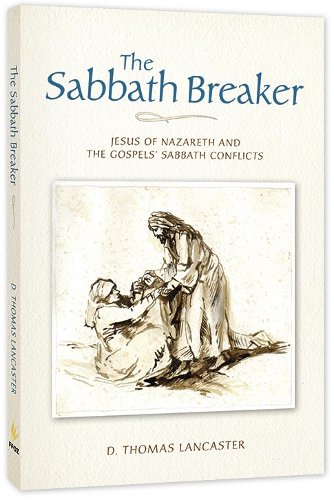
The Sabbath Breaker: A Book Review

Teaching of the TzadikimOnce it happened that the Master and his disciples walked in the holy city of Jerusalem on the Sabbath day when they encountered a man blind from birth. Our Master spat on the ground, made clay of the spittle, and applied the clay to the man’s eyes. Then he told the man, “Go, wash in the pool of Siloam.” The man went and immersed, and miraculously, he could see.

To heal the man, Jesus spat on the ground and made clay of the spittle. Mixing two substances to form a third is a form of work that Jewish law prohibits on the Sabbath day. Jesus smeared the mud on the man’s eyes. Applying a salve or medicine by means of smearing is also considered a form of work prohibited on the Sabbath day. It is a violation of the Sabbath. He sent the man to immerse himself. At least by conventional definition in traditional, Jewish interpretation, immersions are not done on the Sabbath. This single healing incident from the Gospels potentially involves three Sabbath violations.

The Pharisees claimed, “This man is not from God, for he does not keep the Sabbath” (John 9:16). Vocal critics of the Master insisted, “He is a Sabbath breaker.”

Do we appreciate the gravity of this allegation?

-D. Thomas Lancaster
from “Introduction: This Man Breaks the Sabbath” (pg 7)
The Sabbath Breaker: Jesus of Nazareth and The Gospels’ Sabbath Conflicts

This is Lancaster’s latest book published by First Fruits of Zion (FFOZ) and, like a number of Lancaster’s books, leverages material previously published in volumes of the Torah Club and issues of Messiah Journal. A great deal of valuable information on topics of intense interest to Christians both in the church and within the Messianic community, is “buried” within much larger documents. In order to make this information more readily accessible, FFOZ is taking material on specific subjects from these “tomes” and refactoring it into several smaller, self-contained books. Lancaster’s The Sabbath Breaker is one such book.

The focus of Lancaster’s book is rather narrow, so don’t imagine it will answer questions such as “Was Sabbath changed from Saturday to Sunday,” “Should Gentile Christians keep the ‘Jewish’ Sabbath and if so, how,” or “Should Messianic Jews keep the Sabbath in the same way as non-Messianic Jews.” The book’s entire focus is to address whether or not Jesus broke the Sabbath and if he didn’t, then how can we explain why he was criticized by the Jewish religious authorities for healing on Shabbat, gleaning with his disciples on Shabbat, and telling other people who were not his disciples to carry and to immerse on Shabbat?

Christianity tends to believe that Jesus did break the Shabbat in order to show us that he had cancelled all of the Shabbat restrictions and Shabbat itself, as part of his “nailing the Law to the cross,” setting us free from the Law and putting us under the Law of Grace.

As you might imagine, Lancaster dismisses the traditional Christian interpretation out of hand and frankly, so do I. But then how can this be explained? Was Jesus “cancelling” the halachah of the Pharisees? Was it indeed permissible Biblically to glean on Shabbat, to heal on Shabbat, to carry on Shabbat, and to immerse on Shabbat? Were the Pharisees adding unreasonable man-made burdens and was Jesus correcting them and rebuking the Pharisees? Or was it more a matter that the Pharisees thought they were upholding the Biblical way to keep Shabbat (and after all, they wanted to kill Jesus for healing on Shabbat, so they were obviously sincere), and Jesus was just interpreting the Bible better?

How about none of the above:

For many Bible readers, this distinction may be too obscure, but if missed, the reader also misses the message of all the Sabbath stories in the Gospels. The essential message is not that Jesus has cancelled the Sabbath or that the rabbinic interpretation of Sabbath is illegitimate. The Sabbath-conflict stories instead communicate that acts of compassion and mercy performed to alleviate human suffering take precedence over the ritual taboo. The miraculous power by which Jesus performs the healings only serves to add God’s endorsement to Jesus’ halachic, legal rationale.

Did Jesus’ disciples break the Sabbath in the grain fields? Yes. But they were justified in doing so because their need took precedence over the Temple service, and the Temple service took precedence over the Sabbath. Therefore Jesus declared them guiltless and told the Pharisees, “If you had known what this means, ‘I desire mercy, and not sacrifice,’ you would not have condemned the guiltless” (Matthew 12:7).

Did the Master break the Sabbath when he healed on the Sabbath day? Yes. Would fixing a car break the Sabbath? Of course it would, and by the same standard so does fixing a human body. Nevertheless, the Master justified doing so because compassion for his fellow man took precedence over the Sabbath.

-Lancaster, pg 61
“Chapter Seven: At Dinner with the Sages”

blind2That’s a more or less “in a nutshell” explanation of how Jesus did break the Sabbath, but at the same time, each event of Sabbath breaking was justified because of a higher halachic standard.

That’s not the full description of course, and you’ll have to read Lancaster’s book to get all the answers. Not including the footnotes, the book is about 135 pages long, so you should be able to get through it pretty quickly.

The book is divided into three sections:

  1. Sabbath Conflicts in the Synoptic Gospels
  2. Sabbath Conflicts in the Gospel of John
  3. The Thirty-Nine Prohibited Forms of Work

The first two sections focus on different explanations (or the lack thereof in the case of John’s Gospel) for Jesus’s apparent “Sabbath breaking” activities. The quote from Lancaster above is a nice summary of the first section. The second one presents some problems, which Lancaster readily admits, such as Jesus telling the man he healed in John 5 to “take up your bed and walk.” (John 5:8). While the content of the book up to this point (pg 65) confirms that Jesus did break the Sabbath by healing but that chesed (lovingkindness or compassion) takes precedence over Shabbat (it’s more involved than that, but you’ll have to read the book to get all the details), carrying is considered a form of Melachah, or a type of work that involves creation and mastery over our environment (a concept that has to be understood to grasp Lancaster’s major points in his book), and this is forbidden on Shabbat, at least in modern times in Orthodox Judaism.

That brings up the issue of whether or not the Thirty-Nine Prohibited Forms of Work can reasonably be applied to First-Century normative forms of Judaism, and that’s a big if. Lancaster addresses this question in his book and seems convinced that an earlier, less formalized version of this halachah was in existence in the day of Jesus’s ministry on earth. The reader will have to decide if this is credible from their own understanding, but capable arguments can be made either way.

Part two which reviews the healings of Jesus in the Gospel of John departs from the legal and even mechanical explanation of his Sabbath breaking activities and the fact that he told a man to do something that also breaks the Sabbath remains a mystery. It is interesting though that after initially criticizing the man for carrying on Shabbat, once they find out that a healing was done on Shabbat also, the Pharisees lose all interest in the man carrying and seek out the healer instead.

Part three is Lancaster’s description, in some detail, of the thirty-nine melachot or types of work that are forbidden on Shabbat. This may be the part of the book most readers will blow past as irrelevant, even if they are Messianic Jews or non-Jews who observe some form of Shabbat, but I think that would be a mistake.

Protestant Christianity does not consider Sabbath a concept worth consideration or if they do, they simply believe that going to church on Sunday fulfills the fourth commandment out of the ten. Grace makes all things permitted on the “Sabbath” so no one has to struggle to confine their behavior, separating the mundane from the sacred on one day of the week.

Christians who are Sabbatarians including those who are involved in the Hebrew Roots or Messianic Jewish movements, for the most part, tend to create their own “halachah” or methods of Shabbat observance, either as individuals or as individual congregations. I would be willing to wager that there are few if any standards for Sabbath observance that encompass large collections of congregations, unless those groups adhere to a set of halachot established by an umbrella group that has adopted Shabbat observance behaviors from another, normative form of Judaism.
sabbath-breaker-lancasterWe all want to believe that Jesus can be our guide to correct Shabbat observance (assuming we value Shabbat observance) and that God has an objective set of standards for how Shabbat is to be kept (and like Lancaster, I’m not going to get into who should keep Shabbat). However the Melachot were derived from Torah (Lancaster’s book provides those specifics as well) so they weren’t just dreamed up out of someone’s imagination. If you believe in an objectively established Sabbath and (again, assuming you believe you are either required to keep the Sabbath or voluntarily choose to do so out of personal conviction or for other reasons) that there are objective standards for keeping Sabbath, then the third part of Lancaster’s book, if you can believe it is reasonably connected back to the first two parts, may actually be your roadmap for how a Jesus-following Sabbath keeper should keep Sabbath.

In The Sabbath Breaker, Lancaster takes a decidedly different approach to looking at Jesus and his “sabbath breaking” behaviors, acknowledging that he did break the Sabbath, not to cancel it, but to uphold it and to illustrate that there are circumstances wherein it is permissible to break the Sabbath for a higher purpose. Jesus himself, according to Lancaster, is not the higher purpose: human beings are. After all, “Sabbath was made for man, not man for the Sabbath” (Mark 2:27).

146 days.

In the Midst of the Flaming God

in-the-midst-of-fireQuestion: The writings of Kabbalah and Chassidism speak of four worlds—Atzilut, Beriah, Yetzirah and Asiyah. Where are these “worlds”? Why haven’t any of them been discovered yet?

Response: When I try to relate to these worlds, I picture each of them as another lens through which we can view reality. The higher the world, the sharper and clearer the lens—so that everything in that world is a harmonious expression of G‑d’s simple oneness. The lower the world, the more it feels otherness—as though it never had a creator to begin with. Things become fragmented, discordant, even downright ugly, as that sublime oneness is lost.

We live in the bottom-level, physical world of Asiyah—meaning “actuality”—a reality in which G‑dliness is completely hidden. Our lenses allow us to see nothing more than the end-product of all the processes that came before it. We see a table—not the divine energy that keeps it in existence. We marvel over a sunset—as though it were just another natural phenomenon, rather than a masterpiece of a Master Artist. We attribute financial success to smart business tactics—not to the blessings of G‑d. It’s no coincidence that the word for “world” in Hebrew, olam, shares the same root as he’elem, meaning “hidden.” Everything but the most outer façade is hidden from our view.

What keeps our prescription so low?

-Rabbi Yisroel Cotlar
“Where Are All the ‘Worlds’?”
Chabad.org

I know Kabbalah isn’t for everyone and mysticism gives most Christians the nervous “shakes,” but for me, it explores the answers to certain questions that we otherwise must avoid completely. It also allows me to put into perspective the things in this world (and the next) that drive me crazy.

We live in the bottom-level, physical world…in which G‑dliness is completely hidden.

Exactly. And yet often we behave as if our “bargain basement world” has all the answers we’ll ever need to understand God and who we are in Him. I’m not suggesting that we all start taking “mystic trips” into the upper regions of reality and attempt to experience God in His own realm, but we should consider that we don’t know as much as we think we know.

I don’t think that the Bible has all the answers, either. I do think, however, that it has sufficient answers for us. If it had all the answers, humanity (or at least Christianity and Judaism) wouldn’t have such a thing as a mystic tradition.

Some would say that the “worlds” Rabbi Cotlar is discussing have an objective reality on other planes of existence, and others, most others probably, believe that these “worlds” are just mental abstractions we use to discuss what otherwise couldn’t be discussed because we have no language and no conceptualization of what it is to exist beyond what our five senses can detect.

I know I’ll be criticized for even mentioning the “K” (Kabbalah) word, but think about it. If you are a religious Jew or Christian, by definition, you’ve taken on board certain beliefs about the spiritual and supernatural worlds. You believe in angels, and archangels, and (if you’re Christian) God being able to manifest Himself in human form (though that is not His totality according to Derek Leman).

We attribute financial success to smart business tactics—not to the blessings of G‑d.

I bet you never thought that was a “mystic” statement, did you? Most of us, even those of us who are “religious,” tend to pat ourselves on the back when we do well in business, get a raise, start and run a successful business, or pump up the number of “zeros” in our annual income. And yet, every morsel of food we consume, every breath we take, every beat of our heart, every day that dawns, would never occur apart from the will of our Father.

How can we not believe in other realms beyond our own?

But then again, it isn’t the belief in other mystic realms that’s the problem, but the thought that any human being should know anything about them, aside from what we read in the Bible. That’s typically what hangs most people up.

The basics of the teachings of the kabbalah – upon which all these texts expound and elaborate – were not invented by the human mind. They are teachings that were orally passed down through the generations, from teacher to disciple, dating back to Moses himself.

And Moses did go there and back. He spent months on Mount Sinai wandering through the various spiritual worlds and then communicated his findings back to us. That which he didn’t personally experience was revealed to him by the Creator of all these spiritual worlds—together with the rest of the Written and Oral Torah. Even after he descended the mountain, he continued to learn directly from G‑d for the next forty years.

-Rabbi Menachem Posner
“How can any human claim to know of ‘other worlds’?”
Chabad.org

That won’t be very convincing to most Christians not to mention a lot of Jews. But how about this?

Moses entered the cloud and went up on the mountain. And Moses was on the mountain forty days and forty nights.

Exodus 24:18

So he was there with the Lord forty days and forty nights. He neither ate bread nor drank water. And he wrote on the tablets the words of the covenant, the Ten Commandments.

Exodus 34:28

lost-in-the-fogThat might not be convincing either if you just think Moses and God sat together for forty days and forty nights around a really big campfire on the top of a mountain. But did God come down or Moses go up…or something in between? Whatever it was, Moses entered into the presence of the living God, His Divine Presence, and was not consumed by fire and could live in God’s presence and not die, and could do without either food or water for well over a month.

If you believe that actually happened and isn’t just some metaphor or fable, then you believe in the spiritual, the supernatural, the mystic encounter of man with God.

In the thirtieth year, in the fourth month, on the fifth day of the month, as I was among the exiles by the Chebar canal, the heavens were opened, and I saw visions of God.

Ezekiel 1:1

Daniel declared, “I saw in my vision by night, and behold, the four winds of heaven were stirring up the great sea. And four great beasts came up out of the sea, different from one another.

Daniel 7:2-3

I know a man in Christ who fourteen years ago was caught up to the third heaven—whether in the body or out of the body I do not know, God knows. And I know that this man was caught up into paradise—whether in the body or out of the body I do not know, God knows—and he heard things that cannot be told, which man may not utter.

2 Corinthians 12:2-4

I, John, your brother and partner in the tribulation and the kingdom and the patient endurance that are in Jesus, was on the island called Patmos on account of the word of God and the testimony of Jesus. I was in the Spirit on the Lord’s day, and I heard behind me a loud voice like a trumpet…Then I turned to see the voice that was speaking to me…and in the midst of the lampstands one like a son of man, clothed with a long robe and with a golden sash around his chest. The hairs of his head were white, like white wool, like snow. His eyes were like a flame of fire, his feet were like burnished bronze, refined in a furnace, and his voice was like the roar of many waters. In his right hand he held seven stars, from his mouth came a sharp two-edged sword, and his face was like the sun shining in full strength.

When I saw him, I fell at his feet as though dead.

Revelation 1:9-10, 12, 13-17

Each of these experiences stretches, pushes, pulls, and distorts the experience of “reality” of each of the human beings involved beyond what we would consider “normal.” Moses, Ezekiel, Paul, and John each had their own mystic encounters with the realm of Heaven in ways that could not be fully explained to the rest of us who have (presumably) not shared such experiences.

If such is recorded in the Bible we know (as well as we can know the Bible, that is), what mystic experiences have human beings encountered that have not been recorded or that have been recorded in what we consider less than reliable texts?

Who knows?

My point is not to sell you on mysticism. I’m hardly a mystic. I make no claim to otherworldly journeys. I’m only suggesting that no matter what you have learned, no matter how well you are educated, no matter how much you pat yourself on the back for your erudite understanding of the Scriptures, and no matter what sort of “Holy Spirit high” you believe you are on, you really don’t know as much as you think you do. I know I don’t.

sky-above-you-god1To reduce God down to what we can read in the Bible, even if we believe that the Holy Spirit is giving us personal instruction and whispering little “secrets” of interpretation in our ears, is arrogant in the extreme.

It’s understandable that in feeling small before God and probably in the midst of other people, we should want to exalt ourselves. But this reductionist thinking also makes God small, like we are, and all but eliminates any sense of awe, wonder, and majesty at even the contemplation of the awesome, wonderful, infinite, exalted, measureless, Ein Sof, Radically One, creative God.

The Ancient of Days is above all things and beyond human sight and comprehension. But the One like a Son of Man shares his nature fully, being One with him. The Ancient of Days sends the Son of Man into created things to rule from within. The Ancient of Days is transcendent completely but the Son of Man is immanent and is with us. The unity of the Father and Son is absolute, so we cannot say the Son is “part of God,” for God has no parts.

-Derek Leman

Trying to discuss the Divinity of Jesus “is like trying to hit a bullet with a smaller bullet whilst wearing a blindfold, riding a horse,” to quote a certain Scottish engineer from the twenty-third century. In other words, it’s at least extremely difficult if not darn near impossible.

And yet, how can we not try to talk about and even to comprehend that which surrounds us, penetrates us, and binds us together with Him?

Now about eight days after these sayings he took with him Peter and John and James and went up on the mountain to pray. And as he was praying, the appearance of his face was altered, and his clothing became dazzling white. And behold, two men were talking with him, Moses and Elijah, who appeared in glory and spoke of his departure, which he was about to accomplish at Jerusalem. Now Peter and those who were with him were heavy with sleep, but when they became fully awake they saw his glory and the two men who stood with him. And as the men were parting from him, Peter said to Jesus, “Master, it is good that we are here. Let us make three tents, one for you and one for Moses and one for Elijah”—not knowing what he said. As he was saying these things, a cloud came and overshadowed them, and they were afraid as they entered the cloud. And a voice came out of the cloud, saying, “This is my Son, my Chosen One; listen to him!” And when the voice had spoken, Jesus was found alone. And they kept silent and told no one in those days anything of what they had seen.

Luke 9:28-36

What do you do, as a simple fisherman who is learning from a rural, itinerant teacher, when your teacher suddenly starts glowing bright white and mysteriously is joined by the two greatest Prophets in the history of your people (and you have no idea how you recognize these two men who lived many centuries before you were born…and there are no photos or paintings of them anywhere), and these two great men start speaking to your teacher in a close and intimate manner….and then a voice from Heaven tells you that your teacher is the Son of God and commands you to listen to him?

What do you do when your reality experiences a direct intersection with the mystic realm of God?

I don’t know. But one thing I do know. If you have any sort of sense at all, you realize just how small you are and that, in fact, you don’t know anything close to what you thought you did.

I don’t either.

When’s the last time you were sitting in the midst of the flaming God on a mountain?

147 days.

Zondervan Academic Update: My “Introduction to Messianic Judaism” Reviews

Greetings from Zondervan Academic! This month, we’re also posting a roundup of reviews and book mentions around the Internet. Enjoy!

Introduction to Messianic Judaism, edited by David Rudolph and Joel Willitts. This new post series explores several of the book’s chapters. View the posts.

zondervan_update

I know this probably comes under the heading of “shameless self promotion,” but someone sent me an email showing that my collection of reviews on the different chapters in Rudolph’s and Willitts’ book Introduction to Messianic Judaism: Its Ecclesial Context and Biblical Foundations is being promoted in the Zondervan Academic Update email for April (click the link I provided above the image to see summaries and links to all eleven reviews in one place).

I have to say that I’m absolutely thrilled that my little missives have received this bit of attention and I’d like to thank Zondervan Academic (should they happen to read this blog post) and the person who let me know about it (who I agreed shall remain nameless) for this sort of promotion of my weblog.

But what I think is actually important is that the message of Messianic Judaism and what it means is being noticed outside our own little corner of the world. I’m creating this “extra meditation” to communicate just how important this message is and to show who else is paying attention. I have a rather diverse audience (my awareness of who reads my blog is based on not only the comments people make publicly, but on the emails I receive that are not viewable to anyone else besides me), and I’d like all of my readers to know that what I’ve been writing about (and what Rudolph, Willitts, and the other contributors to their book have written about) isn’t just some “niche doctrine,” but rather, a topic of wide interest in scholarly and popular interest realms.

The relationship between Jewish and Gentile believers in Messiah and at the intersection of the two worlds to which we belong, is not only important but is vital, and will become critical as we progress forward seeking an encounter with God and anticipating the arrival of Messiah.

“We’re here to bring Mashiach, we will settle for nothing less.”

Rabbi Yitzchak Ginsburgh

Blessings and thank you.

148 days.

Addendum: May 9, 2013: Jacob Fronczak just wrote a very good review for the First Fruits of Zion (FFOZ) blog. I highly recommend reading it to get further insight into the book with an “in-a-nutshell” presentation.

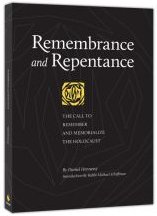
Remembrance and Repentance: A Book Review

shoahBone wet
I watch
as Council members
under rifle
dig obediently
and the earth opens up
to swallow my rabbi
and his sons.

Mach schnell! I hear in my nightmare…

and as I turn to leave,
I notice that the earth still moves
where they buried my heart.

-Lois E. Olena from her poem “Behind the Monastery”
quoted from The New Anti-Semitism

Daniel Hennessy’s new book Remembrance and Repentance: The Call to Remember and Memorialize the Holocaust is generously sprinkled with such “Holocaust poetry.” This one particularly spoke to me as I imagined the love of the Rabbi and his sons buried and still moving within Olena’s heart as their dead bodies were roughly interned in a shallow grave.

Hennessy’s book is written to speak to all of our hearts, especially the Christian heart. His book begins by juxtaposing the betrayal and murder of Jesus with Christian indifference to and even tacit approval of the death of millions of Jews at Nazi hands.

In the Gospel account, we hear the good news of redemption that Jesus rose according to the Scriptures. In the book of Acts, we see Peter — who at the moment of his betrayal was no doubt one of the most miserable human beings on earth — eventually lifted up out of the grip of despair, rising to become an apostle and dynamic leader, a fisher of men used powerfully by God at the very onset of the Messianic movement.

As for the indifferent Christian European world that stood outside the circle of doom, eyes to the ground, during the Holocaust era, it is as if Jesus alive and seated at the right hand of the Father, is looking straight into our eyes today, grieved by the ongoing Silence and indifference associated with the twentieth-century betrayal of his people. Unlike Peter, we as Christians have not yet been restored to fullest spiritual character.

-Hennessy, pp 16-17

That’s a most scathing indictment of today’s Christian church and Hennessy doesn’t let up on the comparison between the ancient betrayal of Jesus and the modern betrayal of his people Israel by Gentile Christianity. According to Hennessy, Peter stood outside the “circle of light” (pg 17) of the fire he warmed himself by as he wept bitterly, and so do we in the church who are beginning to forget the Holocaust and our part in it. As the last aging Jewish victims of the Nazi Holocaust fade and die, so does our own remembrance and even our own conscience.

Perhaps the circle is light, the light in our hearts, is what is diminishing in our world and when it finally grows dark and cold, what horrors will spring forth from the blackest night?

There’s hope, but only if we choose to remember and act righteously in the cause of justice.

This year, Yom HaShoah or Holocaust Memorial Day was on Sunday, April 7th, so you may be wondering why I’m reviewing this book now. On a practical level, it was because I didn’t receive this book until last week. On a more important level, perhaps the most important level, it is because we do not dare to reserve our remembrance to a single day. When we limit our memory and our caring to just one twenty-four hour period, once it’s over, we can safely tuck away our guilt and our desire to see justice done back in its dusty, cardboard box, and shove it back on the top shelf of some forgotten closet or on a rack in our garage until next year, just like our Christmas ornaments.

But if we choose to read, to experience, to remember Shoah each and every day, then each and every day, we can allow the fire of righteous indignation to burn within us, we can ignite the flames of justice, and burn on the pyre of our own responsibility, lest we ever let ourselves and especially our children, forget.

R-and-RDan does an excellent job in this short book (less than 100 pages) of reminding Christianity that it was not just the Nazis who were guilty of atrocities. They were only the outgrowth of anti-Jewish history. It was our own nearly two-thousand years of church supersessionism that formed the massive foundation upon which rested Hitler, his camps, his ovens, and his bloody legacy.

And if there are Christians who do not feel responsible for the past and perhaps the future persecution, torture, and execution of Jewish people and of Israel, lest we forget, we have a High Priest in the Heavenly Court, a King sitting at the right hand of the Father, who watches and waits and who will judge and the Earth. He will also judge us for what have done and what we failed to do.

And the Lord turned and looked at Peter. And Peter remembered the saying of the Lord, how he had said to him, “Before the rooster crows today, you will deny me three times.” And he went out and wept bitterly.

Luke 22:61-62

Jesus watches still. He looks into our eyes. And at his gaze, we also should remember the Lord, and remember his people, and remember Israel, and we should weep for the dead and their children and grandchildren. We in the church can either say “Never again” and cradle the children, the descendents of those who were once herded into cattle cars and driven into ovens, or we can use our own hands to do the herding and the pushing of these Jewish children into some future Shoah.

That is, until Messiah returns to judge us for who we are and what good or horrible things we have done.

I believe with complete faith in the coming of the Messiah, and even though he may delay, every day I eagerly anticipate that he will come.

-The twelfth of Rambam’s Thirteen Principles of Faith

Moshiach is coming. Let him move in your heart.

148 days.

Introduction to Messianic Judaism: The Last and Greatest King

messiah-prayerThe Messiah precedes creation, precedes the nations, precedes the election of Israel, precedes the historical reality of the Jewish people. Apart from the Messiah these other realities would not be. They are because the Messiah first is, and because the Father wills them to be through the Messiah. The Messiah who is himself the gospel is before all. When he is born in the flesh as Jesus of Nazareth, and is “apocalypsed” in Israel, he comes to “his own” people (John 1:11). Before he belongs to this people, they belong to him. Because the messianic gospel is prior to all, the apostle Paul can declare that this gospel was announced beforehand (proeuengelisato) to Abraham (Gal 3:8) and that its content — blessing to the nations and resurrection from the dead (Rom 4) — was the same in the time of Abraham as it is in the time after the Messiah’s historical arrival, for the Messiah himself is that content.

-Douglas Harink
“Chapter 26: Jewish Priority, Election, and the Gospel” (pp 273-4)
Introduction to Messianic Judaism: Its Ecclesial Context and Biblical Foundations

Like yesterday’s morning meditation, I’m not sure I’m receiving this essay in the way the author intended. For much of the past week in the comments section of my blog posts, I’ve been trying to defend the primacy of the Messiah, of Jesus, above all things. If not for the coming of Jesus and his presence both in our world and in the Court of Heaven at the Father’s right hand, we non-Jewish believers would have no relationship with God at all, and certainly no avenue to salvation and the life of the world to come. We would still be “alienated from the commonwealth of Israel and strangers to the covenants of promise, having no hope and without God in the world. But now in Christ Jesus you who once were far off have been brought near by the blood of Christ. For he himself is our peace… (Ephesians 2:12-13)

In debating Messiah with my friends and associates in the Hebrew Roots movement, we have been debating the avenues by which Gentiles are brought near to God. In the ancient days of Moses, a Gentile could become a resident alien among Israel but not a tribal member. They were aliens and foreigners, with no more rights than the widow or orphan. Only by intermarrying with a tribal member and having offspring would the third generation of their union be considered “Israel.”

But then, the Gentile distinctiveness of their line would vanish, fully assimilated and absorbed into Israel.

If that was the fullness of God’s plan, then all Gentiles who desired to join in the blessings of the covenants God made with Israel would have to join with Israel in the way of the Ger and their family line as people from the nations would cease to exist. There would be no way for the people of the nations to come and worship God and remain as people from among the nations. Only Israel would have the privilege. The rest of the world would be shut out.

But that was not God’s plan.

…hear in heaven your dwelling place and do according to all for which the foreigner calls to you, in order that all the peoples of the earth may know your name and fear you, as do your people Israel, and that they may know that this house that I have built is called by your name.

1 Kings 8:43

…and many nations shall come, and say: “Come, let us go up to the mountain of the LORD, to the house of the God of Jacob, that he may teach us his ways and that we may walk in his paths.” For out of Zion shall go forth the law, and the word of the LORD from Jerusalem.

Micah 4:2

“Thus says the Lord of hosts: Peoples shall yet come, even the inhabitants of many cities. The inhabitants of one city shall go to another, saying, ‘Let us go at once to entreat the favor of the Lord and to seek the Lord of hosts; I myself am going.’ Many peoples and strong nations shall come to seek the Lord of hosts in Jerusalem and to entreat the favor of the Lord. Thus says the Lord of hosts: In those days ten men from the nations of every tongue shall take hold of the robe of a Jew, saying, ‘Let us go with you, for we have heard that God is with you.’”

Zechariah 8:20-23

I know you’ve read all that before and quite recently, but it bears repeating, if only to drive the point home that God has always had a plan for the Gentile to bow to Him and worship Him without becoming a citizen of national Israel.

The problem is, in Hebrew Roots, the Torah tends to precede the dominance and Kingship of Messiah. For many in Hebrew Roots, the Torah has become so central, so important, so vital in their practice, particularly the ceremonial portions of Torah, (wearing tzitzit, laying tefillin, keeping kosher, observing Shabbos), that Messiah has become eclipsed and overshadowed.
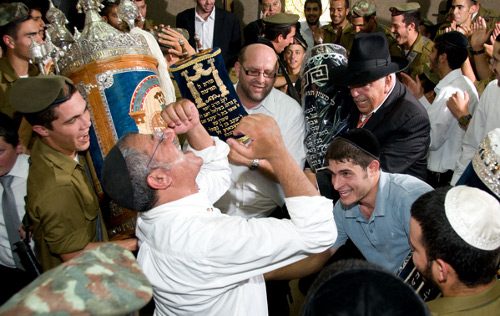
Simchat TorahTorah is the foundation of scripture to be sure, but is it greater than the living Word? In Jewish mysticism, the Torah was at creation and was required for creation, but we know, as Dr. Harink wrote, that Messiah preceded everything and is over everything including the Torah.

The priority of the gospel — that is, the priority of the Messiah — is also declared in the New Testament in respect to Israel’s Torah. In the Gospels Jesus displays an authority over the Torah that is noticed by all those who see his deeds and hear his words. That authority is nowhere more evident than in the familiar section of the Sermon on the Mount (Matt 5:21-48) where Jesus says, “You have heard that it was said…but I tell you…” The point here, as Jesus himself makes crystal clear, is not that his authority cancels (katalusai) the Torah and the Prophets; rather, Jesus by his own authority fulfills (plerosai) the Torah and Prophets (Matt 5:17). By his authority he authorizes their ongoing authority in Israel until “all is accomplished” (Matt 5:18), that is, until the messianic age arrives in fullness. But it is just as clear in the Gospels that the authority of the torah and the Prophets is subordinate to and dependent upon the authority of the Messiah as the Lord, and that their authority consists in their being read in the light of, and as witness to, the singular, normative messianity that is enacted by Jesus of Nazareth in his life, death, and resurrection.

-Harick, pg 274

When I was in the Hebrew Roots movement, I was taught that the Torah was the written Word while the Messiah was the living Word. They were interchangeable and basically equal to one another. The human life of Messiah was the personification of Torah in the flesh.

However, as we see from Harick, the Messiah must be in harmony with the Torah but ultimately, the Messiah must be King over all, including the Torah. We must worship Messiah, not Torah. We must bow to the King, not his scrolls.

This is not to say that the Torah becomes meaningless for Israel. Quite the contrary.

To observe Torah, then, is not primarily or essentially to “obey the rules”; it is, rather, to participate through concrete bodily practices in the very goodness and order and beauty of creation brought about by God through preexistent Wisdom and revealed to Israel in Torah.

-ibid, pg 275

We all observe Torah and participate in goodness, order, and beauty, Jew and Gentile believers alike, however, we do so in ways that illuminate and distinguish the Israel of God and the people of the nations who are called by God’s Name. Really, only a tiny fraction of the mitzvot are reserved to Israel alone. In most circumstances, Jewish and Gentile believers share equal responsibilities to feed the hungry, clothe the naked, comfort the widow, and to honor God in worship and prayer.

Woman in the darkBut above all the mitzvot is the one who is greater than the mitzvot, that is, King Messiah, Son of David. If he had not come and done a new thing in the world, we among the nations would be left out in the dark, locked out of the Kingdom, gnashing our teeth, shivering in the cold, and awaiting certain destruction.

We elevate Torah over the King at our own peril and we all should know that the Torah has never been greater than Messiah, for only faith in Messiah can save. Only the Messiah can reunify what has been separated, and only he can bring final peace in the world.

His messianic mission to the nations is for the sake of Israel; his solidarity with Israel is for the sake of the nations (Rom 11:11-12). The mystery of the gospel is messianic peace between Israel and the nations, a peace that is even now, in the single messianic “day” that reaches from the Messiah’s arrival in suffering to his arrival in glory…

…Jews and Gentiles together in the messianic theopolitical reality called the ekkesia — where Jews as Jews practice Torah, the telos of which is given in the Messiah, and Gentiles as Gentiles work out their own salvation in fear and trembling in the Messiah…

-ibid, pg 279

I suppose it’s only fitting that I end the last review at the end of the David Rudolph and Joel Willitts book with the conclusion written by Joel Willitts. We saw how David Rudolph began the book with is personal story and an exercise in wholeness, as I called it.

Willitts describes himself as an “outsider” to the Messianic Jewish movement while also maintaining close ties to this community, especially through his close friendship with David Rudolph, forged in their days as doctorate students at Cambridge.

It is because of our friendship and my continued interest in the Jewish context of the New Testament that the present book has emerged. It’s two parts neatly paralleled my relationship with David and his community on the one hand, and my passion for reading the New Testament and its message in more thoroughly Jewish ways on the other.

-Joel Willitts
“Conclusion” (pg 316)

Christians typically have no problem keeping Christ as the head of everything, the King above all Kings, and conversely subordinating the Torah way too far below where it needs to be and Israel along with it. In some ways, it’s Gentile Christians like Dr. Willitts who are the bridge between two worlds. As Messianic Judaism is the linkage between Messiah and the larger Jewish community, Gentile Christians with a passion for the “Jewish New Testament” connect that passion back into the church.

Mark is an intelligent guy without formal theological training. He is a mature Christian and intellectually curious. Mark asked me what I was writing and I mentioned this book. He had heard of Messianic Judaism before, but like most Gentile Christians he knew nothing about it. So I began to describe what the book was about. After giving Mark the big picture, he asked the million-dollar question, “So what is its significance to our church?” Mark’s “our church” is my church; it is a larger seeker-sensitive suburban Chicago upper-middle-class church full of Gentile Christians…What a great question.

-ibid, pg 317

It is a great question. It’s a terrific question.

unityAs I imagined Willitts and his friend Mark talking about “Introduction to Messianic Judaism” at their church and discussing what it all means to their church, I thought back to my weekly conversations with Pastor Randy in his office and the significance of those talks to our church. I also thought back to Boaz Michael’s book Tent of David, and I saw that the latter part of the Rudolph/Willitts book (part 1, Chapters 1-12, was written largely by Jewish authors and Part 2, chapters 13 through the end, was written by mostly Christian scholars) and the focus of Michael’s TOD book were virtually the same.

“So what is its significance to our church?”

I don’t want to simply replicate all of the answers Willitts provides, but as you might imagine, the purpose of Introduction for Christians is to do what it has done for me. It informs its Christian audience of what Messianic Judaism looks like on the inside, letting us hear the voices of Messianic Jews tell their story and how they understand the Bible.

It also opens the doorway to a post-supersessionist church, a topic near and dear to my heart, whereby Christians can see and enter into a world of believing Jews and Gentiles who work together, worship together, and love God together, without either side having to surrender the specialness and unique calling God has provided for each branch within the ekklesia of Messiah.

Willitts also discusses the reimaging of church planting and missions using an Israel-centered interpretation of the New Testament, reminds Gentile Christians that we are the branch, not the root, and makes us aware of our responsibilities to the individual and communal requirements of the needy, the poor, the sick and injured among Messiah’s people Israel, and particularly among those who are disciples of Christ.

Willitts ends the book with his personal translation of Galatians 6:16:

Peace on them, and mercy also on the Israel of God.

I hope this series of reviews of David Rudolph’s and Joel Willitts’ book “Introduction to Messianic Judaism” has spoken to you on some level, whether you are Jewish or Gentile. I hope that you can see their intent was to build a bridge between our different worlds. For nearly two thousand years, the Jewish people and Gentile Christianity have traced divergent trajectories across the plane of human history, but God has always planned to bring all people to Him through Messiah Yeshua, Christ Jesus.

This can and will be done without requiring the Jewish people to surrender their Torah, their Talmud, their lifestyles and their shalom as Jews. This can and will be done without requiring all of the people from all of the other nations of the earth to acquire a lifestyle, a culture, a language that is Jewish, without converting to Judaism, and without being told that not being Jewish and not living the lifestyle and observing the mitzvot of the Jewish people somehow makes them…makes us second-class citizens in the Kingdom of God and in the world to come.

We can all be exactly who God created us to be and we can all be delighted that God made us the way He did. The Jewish person is no more loved by God than the Gentile Christian and the Gentile Christian is no more loved by God than the Jewish person. We are all one in Messiah, two unique streams of people within a single Messianic body, bringing infinite diversity in infinite combinations to the “feast with Abraham, Isaac and Jacob in the kingdom of heaven” (Matt 8:11) with the King of Israel as the King over all.

Deeper than the wisdom to create is the wisdom to repair. And so, G‑d built failure into His world, so that He could give Man His deepest wisdom: The wisdom to repair.

-Rabbi Tzvi Freeman
“Repair”
Based on letters and talks of the Rebbe, Rabbi M. M. Schneerson
Chabad.org

Blessings.

149 days.

Pop!

balloon-poppingAuthor’s note: I started writing this on very little sleep, which means that my internal filter, normally thinner than most bloggers, is approaching full transparency. I’m sure when I wake up tomorrow, things will look better, but right now, my “culture clash” with church life is experiencing a power surge.

Pop! That’s the sound of my balloon popping. I suppose I could have titled this “WHAM!” and said it was the sound of my crash dummy hitting a steel wall at 60 mph, but that might be a bit much. Let me explain.

But when Cephas came to Antioch, I opposed him to his face, because he stood condemned. For before certain men came from James, he was eating with the Gentiles; but when they came he drew back and separated himself, fearing the circumcision party. And the rest of the Jews acted hypocritically along with him, so that even Barnabas was led astray by their hypocrisy. But when I saw that their conduct was not in step with the truth of the gospel, I said to Cephas before them all, “If you, though a Jew, live like a Gentile and not like a Jew, how can you force the Gentiles to live like Jews?”

Galatians 2:11-14

Pastor Randy (he’s back from Brazil…yay!) was preaching on Acts 11 today, specifically on verses 19-30, and saying what a great guy (v 24) Barnabas and outlining all of Barnabas’ good qualities and why he was a terrific choice to send to Antioch. Of course, as Pastor rightly says, no one is perfect. Pastor mentioned the above-quoted verses from Galatians 2 and said something like (I can’t quote him word for word, so this is an approximation):

Paul criticized Peter because Peter had slipped back into some practices of Judaism and pulled Barnabas down with him…

Like I said, it’s not an exact quote but it gets the point across. Galatians 2 is coming up on the list of things Pastor and I will be talking about during our upcoming Wednesday night discussions. You see, I don’t think Peter’s problem was that he “slipped back into Judaism.” I think he was intimidated by “certain men” sent from James who weren’t on board with Jewish/Gentile table fellowship and he made the mistake of backing off. Maybe he started listening to the old and mistaken halachah that said “Gentiles were unclean,” but it’s not like Peter “came out of” Judaism and then slipped back into it, as if Judaism and being a disciple of the Jewish Messiah are mutually exclusive terms.

I flashed back to last week’s hollow man experience, and even though I subsequently regained some balance, my experiences during today’s service and in Sunday school afterward reminded me of the gulf of culture between me and normative Protestant Christianity.

It’s the feeling I get when one of the Pastors leads the congregation in an “old-time” hymn that “everyone knows,” except I don’t know it. It’s the feeling I get when people in Sunday school start using “Christian-isms” in their speech, and even if I understand what they’re talking about, it still sounds like a foreign language. Ironically, the person I’m thinking of used the “Christian-ism” term “baby Christians” when describing how more mature members of the faith can erect barriers at a number of different levels that inhibit very new Christians. Without realizing it, she was exhibiting the very behavior she knew put off “baby Christians.”. While I suppose I’m not a new believer, I’m fairly new to normative Christian culture. This re-entry thing has lots of trapdoors.

Another way I felt pretty strange today was noticing how, in our discussion about the events of Acts 11, modern Christian missionary concepts were dropped with complete anachronistic abandon into the synagogue (“church”) at Syrian Antioch. I don’t think that the Jewish Hellenists who fled Jerusalem after Stephen’s death were witnessing to the Greek-speaking Gentile pagans on the street. In fact, I don’t think that full on idol worshiping Gentiles were even “witnessed to” by Jewish disciples until Paul’s encounter recorded in Acts 14:8-18. The world of religious Judaism would have been exceptionally difficult to describe to pagan Gentiles. It’s far more likely that God-fearing Gentiles in the synagogues were the first non-Jewish audience (outside of the Samaritans) of “Jewish evangelists.”

tape-over-mouthBut I kept my mouth shut. As I’ve already said, I didn’t sleep well last night and got up at 4 a.m., so I was (and still am) pretty tired. It was wiser for me to be silent than to open my mouth and inject everything that was going through my head into the middle of the Sunday school class conversation. It’s not like anyone was saying anything wrong, but the perspective from which they were looking at the Acts 11 material was completely off to one side of how I see it. It’s not that I must have my way, but it just seemed like the story of the ancient Jewish and Gentile believers in Messiah had been stripped of its religious and cultural Jewish context and had been remade out of wholly Gentile Christian cloth…from the twenty-first century.

In presenting Acts 11:27-30 the study notes for today’s Sunday school lesson read:

How did this church respond, and what is there about Christians that gives them such joy in giving away what the world worships?

Paul and Barnabas were charged with taking a donation to the Jewish population in Judea when a famine is prophesied as relief for the suffering. The donations were given with abundance and joy but is this a “Christian” quality and one that had never been seen before in Israel?

And he sat down opposite the treasury and watched the people putting money into the offering box. Many rich people put in large sums. And a poor widow came and put in two small copper coins, which make a penny. And he called his disciples to him and said to them, “Truly, I say to you, this poor widow has put in more than all those who are contributing to the offering box. For they all contributed out of their abundance, but she out of her poverty has put in everything she had, all she had to live on.”

Mark 12:41-44

I suppose I could have mentioned that tzedakah was Jewish value long before there were such people as “Christians,” but it didn’t seem worth it to drop a bomb in the middle of the room. I figured this was just another indicator of the cultural and perceptual rift between me and the rest of the class.

Then I thought of another one. As I listen to people talk, in the foyer before services, in the sanctuary before (sometimes during) and after services, in the hallways between services and Sunday school, during and after Sunday school, I realize that these people have known each other for quite a while. I can’t believe they’ve developed these relationship seeing each other just once or twice a week at church. They probably associate with each other outside of church, go to lunch, go to barbecues at each other’s homes, and that sort of thing.

I remember when my wife and I were invited to a Christian’s home a few years back. My wife said it was OK if I went but she wasn’t interested. She doesn’t invite her Jewish friends to our house. She sometimes is involved in social activities at the synagogues here in town, but she doesn’t feel comfortable in primarily “Christian” environments and she doesn’t feel comfortable taking me to primarily “Jewish” environments. I kind of doubt I’ll be inviting people from church over to our home for a Sunday dinner any time soon.

This is quite an interesting effect of a “bilateral” life. It doesn’t affect anything else in what you would consider normal, family life, but my family life, defined as it is, will never intersect with my religious life.

If I can separate my experience from my emotions for a minute, this could actually be a useful study of the impact of the propositions put forth in Boaz Michael’s book Tent of David. One thing I am hoping Boaz will do eventually is to collect the stories of people who have actually followed his pattern of returning to churches to find out the real results in people’s lives and in the church environment.

I’m atypical in that my wife and I are not only intermarried, but I’m a believer and she isn’t (in the Messianic world, there are many intermarried Jewish/Gentile Christian couples, but they share faith in Jesus as Messiah). I know I’m only one voice, but if Boaz can bring together enough voices, we can all see the outcome of returning to the church for those folks like me who think so differently about God, the Bible, Messiah, and everything.

My day at church wasn’t a complete loss, though. I usually don’t care much about the music at church. It’s more something I tolerate than enjoy, but occasionally a little gem will be sprinkled in among the usual fare.

Don’t seek Judaism and don’t seek Christianity. Seek hope in God.

149 days.