Category Archives: Uncategorized

Introduction to Messianic Judaism: Waiting for Salvation

phariseesMartin Goodman, professor of Jewish Studies at Oxford University, has argued that the proselytizing mission we observe in early Christianity, and in Paul in particular, was “a shocking novelty in the ancient world.” In his important book Mission and Conversion he strongly denied that Jews before AD 100 had any interest in seeking converts. A similar conclusion has been reached by Christian scholars Scot McKnight and Eckhard Schnabel; Schnabel concludes, “There was no missionary activity by Jews in the centuries before and in the first centuries after Jesus’ and his followers ministry.”

-John Dickson
“Chapter 24: Mission-Commitment in Second Temple Judaism and the New Testament” (pg 255)
Introduction to Messianic Judaism: Its Ecclesial Context and Biblical Foundations

Dickson’s chapter is meant to redefine our understanding of Jewish efforts to convert Gentiles to Judaism during and prior to Jesus, and citing author and researcher Michael L. Bird, Dickson states that some Jews did engage in some proselytizing of non-Jews,” but that’s not what captured me about the chapter. I found myself reading Dickson’s points for Jewish efforts to convert Gentiles to Judaism as something else.

It is also found in numerous postbiblical Jewish texts, including the pre-Maccabean Tobit, in which we read, “A bright light will shine to all the ends of the earth; many nations will come to you from far away, the inhabitants of the remotest parts of the earth to your holy name, bearing gifts in their hands for the King of heaven” (Tob 13:11).

-Dickson, pp 256-7

Of course, we don’t have to stray outside the pages of the Bible to find a similar portrait of the Messianic future.

…and many nations shall come, and say: “Come, let us go up to the mountain of the LORD, to the house of the God of Jacob, that he may teach us his ways and that we may walk in his paths.” For out of Zion shall go forth the law, and the word of the LORD from Jerusalem.

Micah 4:2

There are numerous other prophesies that echo such a sentiment, but relative to Dickson’s chapter, do they presuppose Gentile conversion to Judaism? That is likely how some ancient (or even some modern) Jews read these texts, although in much of today’s Jewish world, the role of the Noahide would fulfill these words of scripture.

According to the unknown author of this text (T. Levi 14:1-4), Jewish disobedience threatens one of other purposes of the Law: to bring light to “every man,” which in context must include Gentiles.

-ibid pg 257

It has long been known that the Gentile nations would come to God through Israel and the Jewish people, even in the days of Solomon if not before.

…hear in heaven your dwelling place and do according to all for which the foreigner calls to you, in order that all the peoples of the earth may know your name and fear you, as do your people Israel, and that they may know that this house that I have built is called by your name.

1 Kings 8:43

Declare his glory among the nations, his marvelous works among all the peoples!
For great is the Lord, and greatly to be praised; he is to be feared above all gods.
For all the gods of the peoples are worthless idols, but the Lord made the heavens.
Splendor and majesty are before him; strength and beauty are in his sanctuary.
Ascribe to the Lord, O families of the peoples, ascribe to the Lord glory and strength!
Ascribe to the Lord the glory due his name; bring an offering, and come into his courts!

Psalm 96:3-8

But something was missing that would make all the difference in the world…some light.

Again Jesus spoke to them, saying, “I am the light of the world. Whoever follows me will not walk in darkness, but will have the light of life.”

John 8:12

“You are the light of the world. A city set on a hill cannot be hidden. Nor do people light a lamp and put it under a basket, but on a stand, and it gives light to all in the house. In the same way, let your light shine before others, so that they may see your good works and give glory to your Father who is in heaven.

Matthew 5:14-16

up_to_jerusalemIt’s easy to imagine that Israel, as the light to the nations, traditionally saw Gentile conversion to Judaism as the way to bring Gentiles to knowledge of the God of the Jews, and the influx of Gentile God-fearers during and after the time of Jesus on earth, to some degree, must have seemed to confirm this. How else could such a thing be accomplished? But as I said, something was missing. The light of the world had not yet arrived. As the “first son of Israel,” Jesus was uniquely the embodiment of the nation and the people and his purpose was not only to save the lost sheep of Israel, but to pass on his light to his Jewish disciples so that they could “Let their light shine upon others,” the Gentiles, bringing them to God through Messiah.

In reading Dickson, I quite forgot about the matter of conversion of Gentiles to Judaism and was caught up in the vision of streams and streams of Gentiles flowing to Israel, seeking out the Jewish people and their King, seeking Messiah, seeking God. No one was worried about converting to Judaism and perhaps the Torah never even occurred to them as a formal set of mitzvot, since for most Gentiles, it would be a barrier standing between them and worshiping at the House of God.

As a good friend of mine has wisely taught me, “do not seek Christianity and do not seek Judaism, seek an encounter with God.”

At the founding of the temple King Solomon beseeches the Lord: “that all peoples of the earth may know your name and fear you, as do your own people Israel (1 Kgs 8:43). The words “as do your own people Israel” suggest that the “knowing” and “fearing” of these foreigners refers not to enforced submission but to covenant relationship.

-ibid, pp 258-9

I have to disagree with Dickson on one point. Without faith in Jesus, we Gentiles could not be saved and come close to Israel and be grafted in to the Kingdom of Heaven. We could not be considered the (adopted) sons and daughters of the Most High God. Everything hinges on an active, caring, faithful, obedient Messiah. Converting to Judaism in order to become Israel and be justified as members of the covenants God made with Israel undoes the faith of Abraham and our faith in his seed (singular) Messiah. The words of Solomon for me summon the vision of the people from the nations to come to know and fear God “as do your own people Israel.” We do not have to convert and in order to be blessed by Messiah and Israel as people from the nations called by God’s Name.

This is who we are. Not Israel, but knowing and fearing God as does Israel, coming to them, being blessed by them, taking the fringes of their garments (Zechariah 8:23), seeking God and His ways, and desiring to follow Messiah in his paths.

light_from_withinThis isn’t a picture of mass conversions of Gentiles to Judaism or some form of “Jewish-like” life that closely mirrors Israel as if conversion happened in all but name (and a snip of flesh). As the people of the nations we aren’t waiting to be converted to Judaism, we’re waiting for the light of the world, Messiah, so that we can bow our knees to him, so we can acknowledge the King of Israel also as the King of the nations.

“Before God we are all equally wise and equally foolish.”

-Albert Einstein

Israel waits for her Messiah and we among the nations who are called by God’s Holy Name await the lamp of His Salvation.

For the conductor with the neginos, a psalm, a song. May God favor us and bless us, may He illuminate His countenance with us, Selah. To make known Your way on earth, among all the nations Your Salvation. The peoples will acknowledge You, O God; the peoples will acknowledge You — all of them. Regimes will be glad and sing for joy, because You will judge the peoples fairly and guide with fairness the regimes on earth, Selah. The peoples will acknowledge You, O God; the peoples will acknowledge You — all of them. The earth will then have yielded its produce; may God, our God bless us. May God bless us, and may all the ends of the earth fear Him.

Psalm 67 (Stone Edition Tanakh)

To get along with other people, it is essential to be able to see things from their point of view — even if you disagree with them.

Realize that no two people view things exactly the same way. For example, Rabbi Yisrael Salanter said that taking away a broken box from a child is equivalent to sinking the boat of an adult.

Being aware of how someone else perceives a matter will decrease the chances of a quarrel — even though you might disagree.

Rabbi Zelig Pliskin

150 days.

Emor: Being Your Slave What Should I Do?

onfire.jpgAnd G-d said to Moses: … [a Kohen] shall not contaminate himself [through contact with] the dead of his people. Except for his closest kin–his mother, father, son, daughter or brother. Or for his virgin sister… who has not married a man–for her, he should contaminate himself…

But the Kohen Gadol, the greater of his brethren… may not come in contact with any dead; [even] for his father or mother, he may not contaminate himself.

Leviticus 21:1-11

A heretic once asked Rabbi Avahu: “Your G-d is a Kohen; so in what did He immerse Himself after He buried Moses?” Replied Rabbi Avahu: “He immersed in fire.”

-Talmud, Sanhedrin 39a

But one thing remains unresolved: surely G-d is no ordinary Kohen, but a Kohen Gadol, whose greater holiness proscribes any exposure to impurity, even for the sake of his closest relatives. How, then, could G-d “contaminate” Himself, even for His “children” or His “sister”?

Put another way: if, in His relationship with us, G-d assumes the role of an ordinary Kohen, whose lesser holiness allows him contact with impurity for the sake of “Israel, His kin,” G-d certainly transcends this role, possessing also the inviolable sanctity of the Kohen Gadol.

“A Pool of Fire”
-Adapted by Rabbi Yanki Tauber
Based on the teachings of the Lubavitcher Rebbe, Rabbi Menachem Mendel Schneerson
Commentary on Torah Portion Emor
Chabad.org

I couldn’t help but think, not only of the crucifixion and death of Jesus, but of his role as High Priest in the Court of Heaven. One role seems inconsistent with the other, because how can the High Priest cleanse himself when he has not only touched the dead, but has been the dead person? It’s a mystery I choose not to pursue because, in all likelihood, it cannot be pursued from the mortal realm, but then again, Rabbi Tauber also said this of God as the High Priest:

As “Kohen Gadol,” G-d effects all without being affected, pervading the lowliest tiers of His creation without being tainted by their deficiencies. Yet G-d chooses to also assume the more vulnerable holiness of the divine “ordinary Kohen” (which translates, on the human level, into the ordinary Kohen’s permission to contaminate himself in certain circumstances): to contaminate Himself by His burial of Moses, to suffer along with His people, to bloody Himself in the process of extracting them from exile. He wants us to know that He is not only there with us wherever we are, but that He also subjects Himself to everything that we are subject to.

At the same time, He is also there with us as “Kohen Gadol”: transcending it all, and empowering us to also attain something of His inviolable sanctity.

I know that I’m reading far more into this than Rabbi Tauber would ever have intended, but again, we see Jesus as both mortal man and Divine High Priest of Heaven. As “Kohen Gadol,” the Messiah transcends our world in inviolable sanctity, but as the teacher who walked among his people Israel, he pervaded “the lowliest tiers of His creation without being tainted by their deficiencies.”

For our sake he made him to be sin who knew no sin, so that in him we might become the righteousness of God.

2 Corinthians 5:21

For we do not have a high priest who is unable to sympathize with our weaknesses, but one who in every respect has been tempted as we are, yet without sin.

Hebrews 4:15

He committed no sin, neither was deceit found in his mouth.

1 Peter 2:22

Rabbi Tauber also says this, as was quoted above.

…transcending it all, and empowering us to also attain something of His inviolable sanctity.

Jesus lived among human flesh as human flesh and yet did not sin. And he died and was resurrected and in glory, sits at the right hand of the Father. And he is our High Priest in the Heavenly Sanctuary who never sinned and yet who can sympathize with our human weaknesses.

Shechinah-Above-The-TownAnd if I can borrow from Rabbi Tauber, by Messiah’s holiness and his example to us, we can aspire to become better than who we are, as he has empowered us to “also attain something of His inviolable sanctity.” How like Paul’s comment from 2 Corinthians 5:21 that “we might become the righteousness of God” is the commentary from the Rabbi?

Although “all have sinned and fall short of the glory of God,” (Romans 3:23), it is also said, “but as he who called you is holy, you also be holy in all your conduct, since it is written, ‘You shall be holy, for I am holy'” (1 Peter 1:15-16). Thus holiness is something to be acquired by man, not purely through our own efforts but through faith, and yet not only through faith, but through our efforts.

Then the King will say to those on his right, ‘Come, you who are blessed by my Father, inherit the kingdom prepared for you from the foundation of the world. For I was hungry and you gave me food, I was thirsty and you gave me drink, I was a stranger and you welcomed me, I was naked and you clothed me, I was sick and you visited me, I was in prison and you came to me.’ Then the righteous will answer him, saying, ‘Lord, when did we see you hungry and feed you, or thirsty and give you drink? And when did we see you a stranger and welcome you, or naked and clothe you? And when did we see you sick or in prison and visit you?’ And the King will answer them, ‘Truly, I say to you, as you did it to one of the least of these my brothers, you did it to me.’

Matthew 25:34-40

Jesus the man. Jesus the Messiah. Jesus the Priest. Jesus the Divine. It’s hard to know how to relate to him. Most Christians prefer to address Jesus as a close friend and companion, a “bosom buddy,” even a cuddly comforter. Yet in Revelation 1:17 when John, who had walked with Jesus in this world, saw him in the Heavenly realm, he ” fell at his feet as though dead.”

God is at once Almighty in the ultimate, cosmic, radically One sense, and also close to His people, acting tenderly toward us, as a Father, as a husband, as a brother:

It would therefore follow that G-d, who ascribes to Himself the Halachic status of a Kohen (see Talmud, Sanhedrin 39a) is precluded by Torah law from “contaminating” Himself through contact with the impurities of mortality. Yet the Torah tells us that G-d Himself buried Moses, and the Talmud discusses how He subsquently purified Himself in a “pool of fire.” Our sages explain: The people of Israel are “G-d’s children”; Moses is thus one of G-d’s “closest kin,” for whom a Kohen is permitted–indeed obligated–to become tameh.

-Tauber

Rabbi Tauber comments from a Talmudic and mystic sense, so we probably can’t directly apply his words to our discussion on Jesus, but his imagery is so wonderfully kind, gentle, and intimate, that it’s difficult to resist such an “inappropriate” application.

For we too have been dead in our sins and yet Jesus cared enough to bury us with him, so to speak, so that we could come alive in the resurrected Christ.

And you were dead in the trespasses and sins in which you once walked, following the course of this world, following the prince of the power of the air, the spirit that is now at work in the sons of disobedience—among whom we all once lived in the passions of our flesh, carrying out the desires of the body and the mind, and were by nature children of wrath, like the rest of mankind. But God, being rich in mercy, because of the great love with which he loved us, even when we were dead in our trespasses, made us alive together with Christ—by grace you have been saved—and raised us up with him and seated us with him in the heavenly places in Christ Jesus…

Ephesians 2:1-6

rabbi_wasserman_funeralMetaphorically then, as our Kohen, he “is permitted–indeed obligated–to become tameh” for the sake of his beloved ones.

I know that for the past couple of weeks, I’ve been commenting on the various articles in David Rudolph’s and Joel Willitts’ book Introduction to Messianic Judaism: Its Ecclesial Context and Biblical Foundations. Messianic Judaism stresses a significant distinction between Jewish and Gentile believers in the Ekklesia of Messiah, but for today’s commentary, I chose to focus on what we have in common. Although Israel was chosen and remains the “apple of God’s eye,” so to speak, I can’t believe that we Gentiles are the proverbial “left-handed, red-headed foster children” of God, and that He merely tolerates us and only truly loves Israel. For the promises of Messiah to be true, we have to be his beloved children as well, so that Jesus was willing, even obligated, to become “tameh” for us as well.

What would I do for the High Priest who considered me as a close member of his family, and who attended to my “body” while I was “dead in sin?” What wouldn’t I do?

I would be willing to take the lowest position in the Kingdom, the moral equivalent of the guy who cleans the toilets or takes the trash out to the dumpster while everyone else is seeking glory, seats at the head of the banquet table, and partying with the Prince in the palace, just so I could be the least of his servants.

Being your slave what should I do but tend
Upon the hours, and times of your desire?
I have no precious time at all to spend;
Nor services to do, till you require.

-William Shakespeare
Sonnet 57

Good Shabbos.

152 days.

Introduction to Messianic Judaism: Struggling with the Nemesis

Traffic ConesThe fact that experienced readers of the New Testament come away with diametrically opposed interpretations of the same text is today perhaps one of the few universally recognized results of modern historical critical scholarship.

-Joel Willitts
“Chapter 23: The Bride of Messiah and the Israel-ness of the New Heavens and New Earth” (pg 245)
Introduction to Messianic Judaism: Its Ecclesial Context and Biblical Foundations

Brother, you said a mouthful.

I was pretty frustrated when I went to bed last night (as I write this on Tuesday morning). I had a rather busy day on several of my blog posts with various comments, usually related to something I said about the Rudolph/Willitts book. But as I was reading the above referenced chapter in bed, a number of thoughts came to me that weren’t particularly connected to the material I was perusing. I kept going back to what I said a month ago about the problem with religious people. They always think they’re right, they always think their interpretation of the Bible is the only interpretation of the Bible, and they always think that everyone they talk to and disagree with should immediately see the devastating logic of their arguments and then completely roll over to their point of view.

And when you don’t, they get a little cranky.

So when I read the opening sentence in Willitts’ chapter, it was wonderfully confirming.

But there’s still a problem.

Furthermore, softening the logical link between 5:18a and 5:18b lessens the rhetorical force of the statement. What was likely intended to be a ringing affirmation of the Spirit’s ability to release one from being under law (cf. 5:16) comes out sounding, at least practically speaking, more like a piece of encouraging advice to dispense with the need for law observance. Yet this construal is necessary for the viability of the reading proposed by the majority of Galatians commentators, who must assume the mutual compatibility of the leading of the Spirit and existence “under law”; otherwise the point of Paul’s statement would be altogether lost. For this reading to succeed, then, one must downplay both the implicit logic and the rhetorical force of 5:18.

-Todd A. Wilson
“Chapter 22: The Supersession and Superfluity of the Law? Another Look at Galatians” (pg 239)
Introduction to Messianic Judaism

Ah Galatians, my old nemesis. How I have missed thee…not.

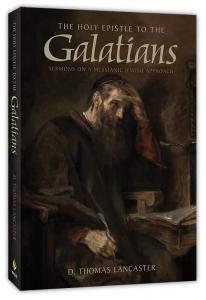
Pastor Randy has been away in Brazil for most of the month of April so naturally, we’ve had to suspend our Wednesday evening meetings until his return. He returned on Tuesday (today, as I write this) but didn’t want to “push it” by trying to return to our regular meetings the day after he got back. He’s got a lot of catch up work to do, so I’ll see him next week, and we’ll pick up where we left off with our discussions on D. Thomas Lancaster’s Galatians book.

I enjoy my conversations with Pastor Randy, but I sometimes anticipate them with some degree of “dread.” As I was trying to puzzle my way through Wilson’s brief analysis of that same epistle with an eye on the Messianic Jewish perspective, I became totally lost. I also became kind of skeptical as a result of being lost. If I can’t understand this and it doesn’t make sense to me, does it make sense at all? Is Wilson trying to push the text too far into a particular viewpoint or interpretive model? Is he pushing Paul into an area where Paul never intended to go? And how can I tell?

One thing Pastor Randy has said to me on numerous occasions is that when studying the Bible, the best place to start is with the literal meaning of the text in its original language and context. In reading Wilson and phrases such as “softening the logical link between 5:18a and 5:18b,” I started wondering what Paul would make of all this and how he would see Wilson’s treatment of his letter.

Galatians by D.T. LancasterOf course, you can’t take Galatians in isolation. You have to look at it within the larger context of Paul’s other writings and the events of the New Testament times in general (not to mention the rest of the Bible). You also have to look at the chronology of these writings, with Galatians being one of Paul’s earlier letters, written even before the events we’ve read in Acts 15.

Justin Hardin’s Chapter 21: Equality in the Church,” was easier to digest, but he took a much smaller portion of Galatians to examine (specifically Galatians 3:28) and was more successful at relating how Paul was not attempting to “support a collapse of ethnicity any more than [he] supports the collapse of the male and female genders.” (pp 224-5). On page 226, Hardin tries to explain that the tutor (pedagogue) function of the Law we find in Galatians 3:23-24 is indeed only one of a number of functions of the Torah for the Jewish people. Only that function went away when Messiah came to show us the perfect model of “Torah living,” but that didn’t eliminate the Jewish requirement to observe Torah for other reasons (national identity, covenant obedience, eschatological linkage to the Messianic age, and so forth).

But how am I supposed to gain an understanding of Galatians that comes anywhere near to Hardin’s or Wilson’s, or even Lancaster’s when I meet Pastor Randy again? I can’t keep these fellows in my pocket and bring them out to present their wares at a critical moment in our dialog, but since Galatians is obviously far more complex than meets the eye, how can I defend a position on this puzzling epistle that I don’t fully understand? (And by the way, like Lancaster, Hardin believes Paul wrote the Galatians letter only to the Gentile population of the churches in that region, not to their Jewish counterparts.)

Like most of the chapters in this book, Willitts’ essay and analysis of “the Bride” imagery (in the aforementioned Chapter 23) in Revelation 19 and 21 is dense with footnotes and scholarly references. In order to present a respectable argument regarding Galatians (or anything else from the Bible), I’d have to be far better read than I am and then somehow have the ability to recall all of that information at a moment’s notice at it is required for a certain topic brought up in my Pastor Randy Galatians discussions.

I need a bigger brain.

With the Scripture as a background, we can now clarify John’s use of the bride imagery in Revelation 19-22. First, since for John the Lamb is divine, it presents little problem for him to correlate Israel’s God with the Lamb — what was attributed to the God of Israel in Isaiah is now associated with the Lamb. Thus, what was once God’s bride is now the bride of Messiah.

The Lamb’s bride is the New Jerusalem, both the people of Israel and the place where God will dwell. Israel, who was unfaithful, now is not. At the end of the age, the Lamb will remarry his bride; he will fulfill his promise. The divine Messiah will redeem his people from captivity and clothe them with righteous deeds because they will be “taught by the Lord” (Isa. 54:13).

-Willitts, pp 252-3

That quote will no doubt shock most Christians and probably more than a few Jewish believers. In the church, I was always taught that “the church” was the bride of Christ, which usually means Gentile Christians. Here, Willitts completely reverses identities, saying that both Israel as a place and as a people/nation are the Divine Messiah’s bride. What I didn’t quote was how Willitts states that the nations (believing Gentile Christians) are the wedding guests! We’re not the bride at all but we are on hand to celebrate at the “wedding reception,” so to speak.

That’s going to ruffle a few feathers.

But…

filtered…but Willitts isn’t presenting the conclusions in his brief article as if they were absolute fact or as if they were the only possible interpretation of the text. He deliberately is framing his interpretation within a Messianic Jewish context in order to show an alternate point of view, a different perspective for his readers, probably to make us think and to help us question our assumptions. I can relate to that, since I often write from that perspective myself.

Now look at this comment made on one of my blog posts in response to my question about whether the commentor thinks Christians sin by not observing the Torah in the same manner as the Jews:

Some Jews may be accepting of Christian Torah observances that make them look Jewish, but in my experience, it can’t be that many. And have you told other Christians you associate with about them being obligated (rather than them having a choice) to Torah observance to a level that will make them look Jewish too?

Yes, I have, I argue for covenant obligation, are you in covenant with God, then you have an obligation

“Zion” is well-meaning and a decent human being, but we often come to loggerheads because he believes that Gentiles in Messiah are directly linked into the covenants rather than receiving them through Israel, and as such, we covenant members are “grafted in” to the full 613 Torah mitzvot and are required to observe them, not in the manner of modern “Rabbinic Jews,” but from a Biblical model (nevermind that we have no idea how to observe the Torah without Rabbinic interpretation).

I disagree and believe we Gentile disciples of the Messiah receive certain blessings from the covenants God made with Israel thanks to the linkage between Abraham’s faith and our faith in Messiah, but that doesn’t include turning us into “Israelites,” nor does it mean we have an identical Torah obligation with the Jewish people.

So we have a difference of opinion. That brings us back to the Willitts quote I inserted at the top of this blog post.

I don’t mind disagreements. I really don’t. I do mind being backed into a corner by folks who believe that it’s their way or the highway. My point of view is one point of view. There are aspects of the Bible I don’t understand. Galatians is a frustrating mystery to me. Even when someone tries to explain it, such as Wilson, the explanation is a frustrating mystery to me. There are days when I want to pack it in and give up on religion. I don’t fit. I don’t understand. I am really annoyed with the dissonance between different Bible interpretations, and I am really, really annoyed with people who think that they and only they (or their group) are the sole possessors of God’s truth about the Bible.

To me, being a believer and studying the Bible is like being an explorer. As a person of faith, I’m on a journey of discovery. Such journeys are rarely straightforward and often involve going in the wrong direction, backtracking, retracing steps, and sometimes using a machete to hack through thick underbrush, like an adventurer-archaeologist on his way to the next big find. But as Dr. Henry Jones Jr. once said, “seventy percent of all archaeology is done in the library.” It requires painstaking, laborious study, not dramatic arguments by people who are all too sure of themselves. Archaeology is also a science of patience. At a dig, you must be slow and deliberate in attempting anything. It might be today, tomorrow, ten years from now, or never, before you uncover anything of even the remotest significance at all.

walking-side-by-sideJesus is like a companion on a long journey who helps to guide us but who will not override our decisions, even if we should take the wrong path. He’ll advise us, prod us, give us hints, and occasionally berate us as we find we’ve stepped into a pool of quicksand, but he won’t just lead us by the hand so we can passively follow where he has gone before us.

I’m nearly done reading the articles in Rudolph’s and Willitts’ book. I’m hoping to get through all of them and finish taking my notes before I have to return the book to the library. But once I have, I’ll move on to another book. While I’ve found Introduction to Messianic Judaism to be an excellent survey of the perspectives on different aspects of theology and doctrine from a Messianic Jewish perspective, it’s still only one book. To the degree that the twenty-six contributors reference countless other sources, then countless other sources are required to help understand the Bible and thus a life of faith.

I can’t stop now, though one day, I may completely withdraw from the public realm and conduct my search privately, but a life of encountering God requires a lifetime. I can’t simply accept one religious person’s statement that they’re “right” and blindly consume their declarations.

I’ve got to keep going. Will I ever arrive at a destination? Probably not this side of paradise.

153 days.

Introduction to Messianic Judaism: Interdependence or Collapse

communityPaul’s letter to the Romans offers us a vision and model for Jewish-Gentile reconciliation. This is because Paul deals with the division between Jesus-believing Jews and Gentiles in his own day. Though Gentile believers were probably a majority in the church in Rome, they were theologically marginalized. For most of history that situation has been reversed, yet part of Romans addresses in advance even that problem.

-Craig Keener
“Chapter 17: Interdependence and Mutual Blessing in the Church” (pg 187)
Introduction to Messianic Judaism: Its Ecclesial Context and Biblical Foundations

In some ways, the problem briefly defined by Dr. Keener is one that hovers around the fringes of the Christian Hebrew Roots movement today. For the better part of two weeks, I’ve been writing a series of “mini-reviews” on the different chapters of Rudolph’s and Willitts’ book which address interrelated themes within larger Messianic Judaism. They have been received positively and even enthusiastically by most of my vocal readers but a few have perceived the information in a negative light. Accusations of inequality and even racism between Jews and Gentiles have been raised periodically, and I believe part of the underlying problem is a covert or even unconscious fear among these Gentile disciples of Jesus that Messianic Judaism seeks to “theologically marginalize” non-Jewish participants in the Messianic Jewish movement, which spills over into Hebrew Roots, since many of those who are involved also identify themselves as “Messianic Judaism.”

Is the Messianic Jewish movement seeking to marginalize and even to eliminate the Gentile Christian (Hebrew Roots) believers from their ranks and from coveted access to the Torah mitzvot? A casual observer (or one with a specific bias) might say “yes,” but let’s consider what we can learn from different analyses of Paul’s letter to the Romans.

In addition to Keener, Dr. William Campbell and Dr. Scott Hafemann also present their viewpoints on Romans to support the concept of interdependence between believing Jews and Gentiles. The ekklesia doesn’t function correctly and perhaps doesn’t even exist at all without the co-inhabitance and cooperation of both Jews and Gentiles in the body of Messiah. Perhaps that’s why, over the past two-thousand years or so, we haven’t been doing so well in certain areas, because Christianity historically has marginalized Jews theologically (and in just about every other way). It’s time to restore the balance.

Campbell, in “Chapter 18: The Relationship between Israel and the Church”, believes that Paul addressed his Roman letter only to the Gentiles and was speaking about Jews but not to Jews, which seems to be a minority opinion. Keener, on the other hand, presents the main focus of Paul’s letter as being on both Jews and Gentiles:

Although scholars have offered other reasonable proposals, the most widely accepted background for Paul’s letter to believers in Rome involves disagreement between Jesus-believing Jews and Gentiles regarding Jewish customs.

-Keener, pg 187

Apparently, when the Jewish population in the Messianic community in Rome began to dwindle, thanks to the emperor Claudius expelling some or most of the Jews (Acts 18:2), Gentiles began neglecting some or all of the Jewish religious customs they had been taught in relation to the worship of the God of Israel. This rather begs the question of just how much Torah did the Gentiles keep in those days, but does confirm that, for the most part, Gentiles weren’t very driven to Torah observance in the manner of their Jewish mentors (Acts 15:30-31).

For Keener, the primary message of Paul to the Jews and Gentiles in Rome was unity:

Unity was a frequent topic of exhortation in antiquity, and it is central to Paul’s plea for Jewish-Gentile reconciliation in Romans. This is clear and not least because he climaxes his larger argument by inviting unity (Romans 15:5-6) and inviting believers to welcome each other (Romans 15:7). He underscores this point by showing from Scripture that God’s plan includes faithful Gentiles (Romans 15:8-12). The letter’s final exhortation includes a warning against those who sow division (Romans 16:17).

-ibid, pg 188

PaulPaul issues warnings specifically to the Gentiles against fomenting division between them and the Jews and expresses his dismay that the Gentiles have neglected his warnings.

Relative to interdependence, Keener stresses that the Gentiles have a special role to play in relation to Israel to “provoke jealousy” because of the temporary state of Israel’s non-acceptance of the Gospels.

In Romans 11, however, we learn another divine strategy in Paul’s mission to the Gentiles. Gentiles received mercy through Israel’s failure to embrace the gospel; now Gentiles would become a divine vehicle of bringing Jewish people to Christ. What did this reversal involve? Scripture promised that God would restore and exalt his people in the time of their ultimate repentance (e.g., Amos 9:7-15; Hosea 14:4-7).

They (Gentiles) would in turn help the Jewish people by provoking repentance.

-ibid, pp 190-1

Keener also emphasizes what he is not saying:

I am also not urging all Gentile Christians to join Messianic Jewish congregations. First, they would numerically overwhelm those congregations and their cultural identity. Second, Paul is clear that while Gentile believers in Jesus are spiritual proselytes to Judaism, they are responsible only for the moral heart of the law and not for Israel-distinctive elements.

-ibid, pg 191

(It should be noted that, at least in the United States, all of the Messianic Jewish congregations of which I’m aware, do have a majority membership of Gentiles, but are still designed and administrated as a Jewish religious and community space)

There’s a sort of balancing act involved in Gentiles pursuing their (our) mission of provoking Jewish people to repentance and not overly involving ourselves in Jewish communities to the point of overwriting Jewish identity. Also, Keener says that by over-emphasizing Gentile presence within the Messianic Jewish community for the sake of Jewish repentance, we would likely inhibit part of the Messianic Jewish mission, which is to act as a bridge into the larger Jewish world community.

Messianic Jews, in Keener’s view, depend on their Gentile counterparts to provide resources for the support of the Messianic Jewish community. This isn’t always by sending donations, as Paul did by taking up a collection among the Gentiles to carry to Jerusalem (although it can be), but to, in a larger sense, continue to acknowledge our kinship to our Jewish brothers in Messiah, and even humble ourselves by remembering that salvation comes from the Jews (John 4:22) and that “the people whose heritage we share and from whom our faith springs (Romans 9:4-5), may help us surmount the past barriers of Gentile Christian anti-Semitism.” (idid, pg 193)

But while Keener addressed primarily how the Jews depend on the Gentile believers, Campbell, in Chapter 18, takes a different approach.

Their gentile arrogance is based on mistaken assumptions, and Paul gives no allowance to such misunderstandings of God’s purpose according to election (Romans 9:11). It is no accident that in Romans Paul stresses the order of priority, “to the Jew first, and also to the Gentile” (Romans 2:10 KJV; cf. 1:16). This points to the identity of gentile Christ-followers not as an independent entity, but as interdependent on the call and identity of Israel, to whom as Ephesians 2:13 asserts they “have been brought near.” As Ian Rock asserts, “to affirm the lordship of Christ is to simultaneously recognize the preference of Israel. But to recognize the primacy of Israel is also to accept the importance of the Jews.

Campbell, pp 202-3

jewish-prayer_daveningThe flow of dependence is reversed. In addition to Jews depending on Gentiles to support their repentance and uphold their identity, it is the Gentiles who, without the Jews, are also without the promises, and thus have no independent connection to salvation or covenant with God. The covenants are through Israel and we Gentiles are able to enjoy the blessings only because of Israel.

They (Gentiles) could not really share if they had taken over Israel’s inheritance, as they would then be the sole inheritors. So Paul reminds the gentile Christ-followers, “Do not boast over the branches…remember it is not you that support the root, but the root that supports you” (Romans 11:18 RSV).

-ibid, pg 203

Campbell concludes his chapter with an illuminating chronological construction of Romans 15:9b-13 which seems to say it all.

Because David’s past vindication establishes God’s promise to David’s seed (v.9b), therefore the Gentiles should not give up hope, but learn from the experience of disobedient Israel to rejoice in God alone (in the midst of the false security that comes from the nations’ current reign in the world) (v. 10);

specifically, the Gentiles should not give up hope, but learn from the experience of the faithful remnant to praise God for his truthfulness and mercy (in the midst of the adversity that comes from being part of God’s elect in the world) (v. 11),

because the future vindication of David’s seed in fulfillment of God’s promise is the hope of the nations (v. 12).

-ibid, pg 212

In “Chapter 19: The Redemption of Israel for the Sake of the Gentiles,” Dr. Hafemann returns to the Gentile’s dependence on Jewish Israel.

As Paul argues in Romans 15:7-13, God’s commitment to Israel for the sake of the nations forms the bedrock of the Church’s hope. Viewed from this perspective, Messianic Judaism reminds us not only of God’s faithfulness, demonstrated in Israel’s history, and of his grace, now magnified in the Messiah, but also of his promises for the future of his people, to be fulfilled in the final redemption of Jews and Gentiles.

-Hafemann, pg 206

So we see that God has been historically faithful to Israel for her own sake, but also for the sake of the Gentiles who will be saved through His promises to Israel. Again, we see that without Israel, the Gentile believers have no leg to stand on, so to speak, and that any covenant connection we have with God through Messiah vanishes like a morning mist under the summer sun if we dispense with Israel and the Jewish people. Not only must Israel continue but it must continue as the head of the nations as a wholly Jewish nation, unique and distinct from the people of the nations, we Gentiles, who need them for our hope in salvation.

The linkage is through Abraham, as I’m sure you realize by now:

Since God is the God of both Jews and Gentiles, both the “circumcised” and the “uncircumcised” will be justified “through [the] same faith” (3:29-30), the faith of Abraham, for “he is the father of us all” (4:16).

-ibid

By Gentiles desiring to supersede the Jews in the promises or to fuse our identity with theirs, creating a single Israel and eliminating our identity as the people of the nations called by God’s Name, we are disconnecting ourselves from the very salvation that we desire to claim only for ourselves. There is a wonderful eschatological promise for the Christian church, but only if there is a wonderful eschatological promise for the future of Israel as well.

Hafemann continues:

Paul’s chain of Scripture will therefore focus on the purpose of Israel’s redemptive history with regard to the Gentiles, rather than referring merely in a general sense to the inclusion of Jews and Gentiles within the church. The Gentiles are to glorify God for what he has promised to do for Israel (Romans 15:9a) since the future redemption of the nations, including the resurrection from the dead and redemption of the world (cf. Romans 5:17; 8:19-22, 31-39), is tied to the rescue of Israel (Romans 5:18; cf. 11:15). The current experience of Jews and Gentiles as distinct but equal identities within the Church therefore takes on significance precisely because it is a foretaste of the consummation yet to come for both Israel and the nations.

-ibid, pp 207-8

destruction_of_the_templeThis is something that Boaz Michael of First Fruits of Zion (FFOZ) was trying to say during last year’s Sukkot conference. I wrote about it in a series of blog posts, including Redeeming the Heart of Israel, Part 1 and Part 2, but I was never clear on how this interdependence was rooted in scripture until this time. I see now, more clearly than ever, that any form of supersessionism damages not only Israel, but the hope of the nations for salvation and redemption, since our hope only comes from the Jews.

When the Church tries to replace Israel in the covenant promises or mistakenly chooses to believe they (we) are Israel, it is like a man who decides to cut off his legs in order to stand taller and straighter. Instead, he only causes great pain and permanently cripples himself.

It is said that in ancient days during Sukkot, Israel offered sacrifices at the Temple for the sake of the nations to atone for their (our) sins. When the Romans destroyed the Temple in 70 CE, they also stopped those sacrifices and thus the atonement Israel provided for the nations of the world. Basically, the Romans cut off their own legs when they destroyed the Temple, ravaged Jerusalem, and scattered the vast majority of the Jewish people to the four corners of the earth.

As Christians, when we dismiss Israel from the covenants and in one way or another, try to take their place, we are doing exactly the same thing. As it takes two healthy legs to support the body of a man, so the ekklesia requires the one “leg” of Messianic Judaism and the other “leg” of Gentile Christians. If we cut off the Jewish leg or if we try to fuse the Gentile leg and the Jewish leg into a single mutilated limb, the best the body can do is to hop around impotently. More likely, the ekklesia will just fall down and break apart.

We depend on each other, but we can only support the body of Christ by being two limbs of the body standing side by side, walking together.

154 days.

Introduction to Messianic Judaism: Fulfilling the Prophesy of Amos, Part 2

Receiving the Spirit

When this group of Gentiles believed in Jesus, they immediately received the Holy Spirit in so evident a way that Peter could only conclude that God had extended salvation to them as Gentiles, not requiring that they first become Jews. He therefore baptised them, admitting them to the messianic people of God without expecting them to be circumcised or to observe any more of the Torah than they already did (as God-fearers who worshiped the God of Israel and lived by the moral principles of the Torah).
-Richard Bauckham
“Chapter 16: James and the Jerusalem Council Decision” (pg 178)
Introduction to Messianic Judaism: Its Ecclesial Context and Biblical Foundations

This is Part 2 of a two-part blog post. If you haven’t done so already, read Part 1 before proceeding here.

Bauckham seems to be making a few assumptions about what Peter expected, but they are reasonable assumptions, since we have no record that Cornelius (or any other Gentile disciples of the Master) was ever circumcised or ever assumed a greater obligation or duty to Torah as time progressed, at least as an expection of or obligation to God. Bauckham states that “these Gentiles received the same blessing of eschatological salvation that Peter and other Jewish believers in Jesus had received at Pentecost.” The Jewish and Gentile believers were two bodies within a single ekklesia, sharing the hope of the resurrection and the promise of the life in the world to come as co-heirs of Messiah.

But so far, this is confined to Peter’s observation of Cornelius and his household. What about the other Gentiles? What about James and the Council of Apostles (who Peter had to give an accounting to in Acts 11)?

Peter’s testimony before the council (Acts 15:9) indicated that he understood that God made no distinction between Jew and Gentile, specifically in relation to “cleansing their hearts by faith.” Whatever “impurity” that the Jewish believers saw, even in the Gentile God-fearers, was set aside (which was the point of Peter’s vision in Acts 10) as a result of the Spirit being received even by the Gentiles “through the grace of Jesus Christ” (Acts 15:11). The “distinction” that was eliminated between Jewish Israel and the believing Gentiles was the distinction between the “holy” and the “profane” with the Gentiles also receiving access to holiness through faith in Messiah.

It became possible to envisage the messianic people of God as a community of both Jews and Gentiles, the former observing Torah, the latter not. Of course, neither Peter nor any of the Jerusalem leaders entertained the idea that Jewish believers in Jesus should give up observing Torah. But Torah observance no longer constituted a barrier between Jews and Gentiles, since their fellowship was not based on Torah, but on faith in Jesus the Messiah and experience of the transformative power of the Spirit.

-ibid pg 180

Bauckham doesn’t reference Ephesians 2, but his statement seems to evoke “abolishing the law of commandments expressed in ordinances” in this case, by making Torah a “non-issue” between Jewish and Gentile believers, since it is faith in Messiah that binds them, not Torah obedience.

Bauckham’s statement will be difficult to accept for almost anyone in Christianity, both in mainstream Protestantism and the numerous variant worship platforms. However it does line up with content written by FFOZ’s Lancaster and numerous other contributors and cited sources in the Rudolph/Willitts book. In the church, we have gotten so used to the idea that we have permanently altered if not replaced Jews, Judaism, and Jewish Torah observance, that it never occurs to us to ask why Judaism should have had to change in order to accomodate the entry of Gentile disciples. We were (and are) the ones who need to change, since Israel and her King were totally foreign to any one except Israel. Faith in Yeshua HaMashiach is a perfectly expected developmental progression in Israel’s history. The really dramatic event is that the nations, Gentile Christianity, were allowed entry into the Jewish religious branch “the Way.”

apostles_james_acts15In Acts 11:1-8, Peter already convinced the Council that the Gentiles could receive the Spirit as part of God’s plan for the nations, and they praised God for His graciousness to the Gentiles. In Acts 15, Peter reminds the Council of these events, and James, in deliberating the matter, offers Amos 9:11-12 (part of last week’s Haftarah portion) as the proof text supporting what Peter had observed and in support of Paul’s position to admit Gentiles without requiring they be circumcised. In using the words “all the nations over whom my name has been invoked”, according to Bauckham, James is stating that God has declared “ownership” over “all the nations” (Amos 9:12) just as He had declared ownership over Israel as His own people (e.g., Deut 28:10; 2 Chr 7:14; Jer 14:9; Dan 9:19).

It shows that in the messianic age, Gentiles, precisely as Gentiles, will no longer be “profane” but will join the Jews in belonging to God’s holy people…

-ibid, pg 182

Now I suppose you’re going to ask about the four prohibitions James laid upon the Gentiles, otherwise known at the “apostolic decree.”

The reason these four are selected from the commandments of the Torah as alone applicable to Gentile members of the messianic people of God is exegetical. They are specifically designed as obliging “the alien who sojourns in your/their midst” as well as Israelites. Applied to the situation of the messianic people of God, this phrase could be seen as referring to Gentiles included in the community along with Jews. But the point is made more precisely by the use of this same phrase in two of the prophecies about the conversion of the Gentiles in the messianic age: Jeremiah 12:16 (“they shall be built in the midst of my people”) and Zechariah 2:11 (LXX: “they shall dwell in your midst”). In light of these exegetical links, the Torah itself can be seen to make specific provision for these Gentile converts, who are not obligated, like Jews, by the commandments of Torah in general, but obligated by these specific commandments.

-ibid, pg 183

I can certainly see many of the points D. Thomas Lancaster made about Acts 15 in his Torah Club essays (which I recorded in my Return to Jerusalem series) may have had their origin in the research and documentation of Bauckham and other scholars. Boaz Michael, First Fruits of Zion’s (FFOZ’s) Founder and President, also made similar points in his book Tent of David: Healing the Vision of the Messianic Gentile.

We see in Bauckham’s analysis, that he not only answers the Protestant Christian question about whether the Jews should continue to observe the Torah, but also the Hebrew Roots Christian question about Gentile Torah obligation. I know that neither population of Gentile believers, for the most part, will accept this position, even though it’s based on good biblical research and scholarship, but we must begin to challenge our thinking and our traditions which lead both platforms of Gentile faith in Jesus to misunderstand the plan of God for the Jews and Gentiles within the ekklesia.

Although we know that not all Jewish believers in the days of James, Peter, and Paul could accept Gentile inclusion into Jewish religious worship of Messiah, especially by allowing the Gentiles to remain as Gentiles, the alternative was to deny the words of the Prophet and the plan of God, that not only the Jews but the Gentile nations would be called by His Name, and that the nations would also belong to Him.

“In that day I will raise up the fallen booth of David,
And wall up its breaches;
I will also raise up its ruins
And rebuild it as in the days of old;
That they may possess the remnant of Edom
And all the nations who are called by My name,”
Declares the Lord who does this.

Amos 9:11-12 (NASB)

We can hardly fulfill our role in prophesy if we believe we must convert to Judaism as a requirement of Messianic disicpleship or forcably take on the full Jewish obligation to Torah observance (becoming “pseudo-Jewish”) in direct defiance of the ruling of the Council of Apostles. If we believers from the nations, insist that we too are “Israel,” then all believing humanity is “Israel” and thus, the prophesy of Amos is either a lie or it will remain forever unfulfilled.

155 days.

Introduction to Messianic Judaism: Fulfilling the Prophesy of Amos, Part 1

conference2The most momentous decision the early Christian movement had to make was on the status of Gentiles who wished to join it. That Gentiles should join the movement was not in itself problematic, since there was a widespread Jewish expectation, based on biblical prophecies, that in the last days the restoration of God’s own people Israel would be accompanied by the conversion of the other nations to the worship of the God of Israel. Since the early Christians believed that the messianic restoration of Israel was now under way in the form of their own community, it would not have been difficult for them to recognize that the time for the conversion of the nations was also arriving. What was much less clear, however, was whether Gentiles who came to faith in Jesus the Messiah should become Jews, getting circumcised (in the case of men) and adopting the full yoke of Torah, or whether they could remain Gentiles while enjoying the same blessings of eschatological salvation that Jewish believers in Jesus did.

-Richard Bauckham
“Chapter 16: James and the Jerusalem Council Decision” (pg 178)
Introduction to Messianic Judaism: Its Ecclesial Context and Biblical Foundations

This should be a familiar theme to those of you who regularly read my blog. I spent a considerable amount of time and effort reviewing Luke’s Acts, thanks largely to D. Thomas Lancaster’s Torah Club series Chronicles of the Apostles, published by First Fruits of Zion (FFOZ). I was pleased to find that several of the articles in Rudolph’s and Willitts’ book addressed the same issues. But let’s back up a step.

Darrell Bock, in “Chapter 15: The Restoration of Israel in Luke-Acts” sets the stage for the drama of Gentile inclusion into a branch of normative Judaism by deconstructing the traditional Christian view of these books of scripture.

Burge argues for a landless and nationless theology in which the equality of Jew and Gentile in Christ is the key ecclesiological reality. In this view, Jesus as Temple or as forming a new universal Temple community becomes the locus for holy space. Israel is absorbed into the church and hope in the land is spiritualized to refer to a restored earth.

This chapter seeks to redress the balance. When I speak of Israel in this essay it is the Jewish people I have in mind as opposed to new Israel.

-Bock, pg 168

It is true that Luke-Acts is really all about the Gentiles. According to Bock…

Luke-Acts was written between CE 60 and 80 in part to legitimate the inclusion of Gentiles in an originally Jewish movement according to God’s plan. Theopolis (Luke 1:3; Acts 1:1) is a Jesus-believing Gentile who needs assurance. Luke-Acts presents Jesus as God’s exalted and vindicated bearer of kingdom promise, forgiveness, and life for all who believe, Jew and Gentile. The bestowal of God’s Spirit marks the new era’s arrival…This message completes the promises made to Abraham and Israel centuries ago.

-ibid, pp 168-9

The Messiah movement was a wholly owned and operated franchise of Judaism (if you’ll forgive the slight levity here). It’s only natural to imagine that Gentiles hearing that they too could join might have been skeptical about the reality of this promise and the status that they would (or wouldn’t) be granted. Luke means to reassure them that they will be equal sharers in the blessings made to Israel, but make no mistake, there is another side to Luke’s narrative.

Luke argues that the church roots its message in ancient promises, a story in continuity with Israel’s promised hope found in God’s covenantal promises to her. The entire saga involves Israel’s restoration. For all that Gentile inclusion and equality in the new community brings, we never lose sight of the fact that it is Israel’s story and Israel’s hope that brings blessing to the world, just as Genesis 12:3 promised.

-ibid

Nothing Luke, let alone Bock, writes allows Gentile inclusion to delegitimize the Jewish people as God’s people and nation Israel. Messiah is depicted as “the light to the Gentiles and the glory of Israel” (pg 171). We among the nations receive blessings because of Israel, not because we become Israel. Bock also states:

Thus, redemption involves both political and spiritual elements, nationalistic themes (Luke 1:71, 74) and the offer of forgiveness (1:77-78).

-ibid, pg 171

Redemption for Israel is not just spiritual, it’s national and physical. If Israel is obedient to God, Messiah will place Israel at the head of the nations and take up his Throne in Jerusalem. However, there is a problem. Bock does not cast the Gentiles as the primary roadblock to God’s restoration of Israel, but instead declares:

The warning to the nation is that if she rejects God’s message, then blessing may not come to her but may go to the Gentiles. Israel’s story has an obstacle, her own rejecting heart. The question is whether that obstacle is permanent or not.

-ibid, pg 172, citing Luke 4:16-30

the-prophetTraditional Christian supersessionism would say that the obstacle was permanent and the blessings forever left Israel and were transferred to the (Gentile) church. However, since the blessings promised to Abraham only come to the nations by way of Israel, if Israel were permanently eliminated what would happen to us? By definition, any roadblock confronting Israel can only be temporary, just as the Old Testament (Tanakh) record presents how God only turned away from his people Israel “momentarily,” turning immediately back when they humbled their hearts and turned to their God.

Luke 21:24 pictures a turnaround in Israel’s fate. Near the end of the eschatological discourse, Luke describes Jerusalem being trodden down for a time and refers to this period as “the times of the Gentiles.” It refers to a period of Gentile domination, while alluding to a subsequent hope for Israel.

…this view of Israel’s judgment now but vindication later suggests what Paul also contents in Romans 11:25-26: Israel has a future, grafted back in when the fullness of the Gentiles leads her to respond. These chapters certainly have ethnic Israel in view, not any concept of a spiritual Israel. Romans 9-11 develops the temporary period of judgment noted in Luke 13:34-35.

-ibid, pg 173

I should say at this point that Bock extensively cites scripture to support his statements. To restrict the length of this blog post (and I’ve already had to split it into two parts), I am editing out most of his references, so I encourage you to read his chapter in full to get all of the corroborating details.

In covering Acts, Bock deliberately omits Acts 15 and presents several other key areas. Using Acts 1:4-7, Bock establishes the “promise of the Father” which leads the disciples of Jesus to anticipate that the kingdom of Heaven is at hand and that Messiah, prior to (or instead of) the ascension, will restore Israel nationally and spiritually. He does no such thing, but not because the desire is inappropriate. It simply isn’t time yet. However in Acts 3:18-21, Bock shows us that Peter is completely aware that the “times of refreshing” refer to future “refreshment”, which promises the messianic age of salvation as foretold by the Prophets.

But what’s important for we Gentiles to note, is his treatment of Acts 10-11:

In the two passages involving Cornelius in Acts 10-11, the Spirit’s coming shows that Gentiles are equal to Jews in blessing, so that circumcision is not required of Gentiles. The Spirit occupying uncircumcised Gentiles shows they are already cleansed and sacred. The new era’s sign comes to Gentiles as Gentiles. There is no need for them to become Jews. Israel’s story has finally come to bless the nations.

-ibid, pp 175-6

Notice that the nations (Gentiles) did not have to actually become Israel, either by replacing them or joining them as Jews (or pseudo-Jews). We are blessed within one ekklesia made up of Israel (Jews) and the nations (Gentile believers).

As I mentioned before, Bock omits the most critical part of Acts for Gentile inclusion. Bauckham picks that theme up in the following chapter, which you’ll read, along with how we Gentile Christians fulfill the words of the Prophet Amos, in Part 2 of this meditation.

156 days