Category Archives: Uncategorized

The Jewish Girl Who Saved Her Children

intermarriageSome of my friends began dating non-Jews. I stopped socializing with them in silent protest, after a more outspoken effort had failed. I self-righteously concluded that we had nothing in common, since they were prepared to give their Jewish identity the backseat. I was sitting firmly in the driver’s seat with mine, so much so that I became the leader of a Zionist youth movement, and started to mix with an idealistic new crowd.

In Ethics of Our Fathers, Rabbi Hillel warns us that we should be careful not to judge another person until we have stood in their place. And I was going places…

I don’t remember making conversation, but apparently I must have mumbled something, since the next morning the host of the party told me that Mr. Attractive had inquired after me. As I was catching my breath, she casually mentioned, “Oh, I told him you don’t date non-Jews, and he’s fine with that. He just wants to meet you. He really liked you.”

This was a delicate situation, to say the least. Here I was, being pursued by a bona fide heartthrob with absolutely no strings attached. He was an advertising executive. Flutter. He had a motorbike. Swoon. And, if that wasn’t enough for my ego, he was a commercial pilot.

Help!

-Jennifer Cooper
“My Non-Jewish Boyfriend”
Aish.com

You’ll never realize how many blog posts I don’t write just because I don’t have time. I’ll read something or hear a snippet of conversation, and my mind pursues it and I begin to internally construct a short essay on the topic between 1500 and 3000 words. I never mean to write as much as I do, which includes this story about the girl who would never intermarry. It just happens.

In Christianity, this is yet another thing about Judaism that simply doesn’t register with us. What’s the big deal exactly? OK, among many Christians, there’s the idea that it’s not a good thing to be “unequally yoked” and I suppose the equivalent quandary would involve a young Christian woman dating a handsome, talented, and very romantic atheist guy. Look out. Danger up ahead.

But there’s something more operating here. There’s a lot more operating here.

I’ve written many times before about intermarriage and part of this blog’s mission is to address the challenges and dynamics of Christians and Jews being married. You can see the angst and the ecstasy expressed in missives such as Opting Out of Yiddishkeit and Cherishing Her Yiddisher Neshamah. If my wife had been observant when we met or even if she had been raised in a secular Jewish home, we might never have gotten married since I am a goy (we were both atheists when we met and her parents were also intermarried).

I’ve been spending some blog time lately struggling to define why it’s important for believing Jews to continue to live as halalaic Jews. If Jesus saves, what difference does it make if a Jewish person lives a Jewish life or not?

Plenty, as Cooper’s story reminds me.

The next day I found myself in the car with my father. We parked in the driveway. There we sat for a good few minutes, lost in our separate worlds. I, in my bubble of optimistic self-gratification, and my father – mourning the potential loss of future generations. Finally, I broke the heavy silence.

“Dad, why is it so important that Jews marry Jews?”

“Because it’s important that we preserve our unique heritage.” he replied, surprised by this basic question coming from me.

I wasn’t buying it.

“Yes, but what’s so special about our heritage, I mean, why is it SO important that there be Jews in the world?” I challenged.

“Because we are supposed to be a light among the nations,” he stressed, wondering where this was going. I pressed on, going for the jugular.

“So, Dad, if our heritage is so special, and we have to be a light among the nations, and my entire future depends on it, why do I eat McDonalds, and why on earth don’t we keep Shabbat?!”

More silence. This time, it was my father that spoke. “I don’t know. I guess I never thought that far,” he admitted, somewhat ashamed.

For the first time ever, I had stumped my brilliant lawyer father. But he still had one last trick up his sleeve.

broken-marriageI’ve heard it said you can’t choose who you fall in love with, but Jennifer had a problem. Without intending to, she had fallen in love with a non-Jew and all of her determination to never “marry out” was fast evaporating. Her parents were culturally but not religiously Jewish, but you can’t dismiss the importance of Jewish identity based on lack of religious observance. Something deeper was in operation here and it was enough to turn Jennifer and her father into emotional pretzels, turned and twisted and trying to straighten out again.

My heart was heavy with respect for my parents and the desire to please them. I felt the weight of my Jewish identity on my fragile shoulders. What exactly was I trying to preserve and protect? After all, I was not religious. Why had it been so fundamentally clear to me that I would marry a Jew? And what had happened to that clarity?

I had been taking my Jewishness for granted. Jewish day school, Jewish friends, a traditional Jewish home. There had been no challenge, no threat, no temptation. No chance to think or look outside the box. But now my exclusive Jewish education and traditional upbringing was on trial. Was it enough to save me?

I took the witness stand. For the first time in my life, I consciously thought about, and decided, who I was, what I wanted to be, and what was truly important. I was first and foremost a Jew. My heritage mattered. I wanted it to continue to be a part of my life. And it was vitally important that my future husband feel the same.

The Verdict: A strong Jewish identity saves Jews.

It wasn’t so difficult after that. A short, tense phone call ended what would have been the mistake of a lifetime. I never saw or spoke to him again, although I cried for days. I don’t really know why, but I think it had something to do with my soul.

There’s something more to being Jewish than just a string of DNA or whether or not you eat McRibs at McDonalds. It’s not just the cultural aspects of Judaism because films like My Big Fat Greek Wedding (2002) have shown us that cultural differences can be bridged (Nia Vardalos wrote and starred in the film and in real life, she is a Greek woman married to a non-Greek man…Ian Gomez, who plays “Mike” in the film).

No, there’s more than just genetics, religion, and culture going on with Jennifer and with Jewish people in general, but you have to go back to Abraham, Issac, and Jacob to find it. You have to go back to Moses and Sinai to find it. You have to look into a pillar of cloud by day and a column of flame by night and deep inside you’ll see the God who molded, formed, fashioned, and defined the Jewish people to be a unique and special people before Him for all time.

And every intermarriage, particularly where the intermarried Jew does not maintain their identity and pass that identity along to the next generation removes not just one more Jew from eternity, but that Jew and all of his or her descendents. Yes, if Jennifer had married her handsome, charming goyishe suitor, her children would have been halachically Jewish, but how would they have been raised and how strongly would they cherish their own Jewish identity?

Memories and regrets are part of what it is to being human, and if I had it all to do over again, I would still have married my wife and had our children, but I would have fought tooth and nail to instill a strong Jewish identity in all of them.

But that ship has sailed and here I am standing at the dock watching it slip over the horizon and into the distance and darkness beyond.

We want our children to care about the meaning of being Jewish. We need to nurture their Jewish identity to the point that it becomes innate. Our homes are where we nurture, and where our children learn to care. Our homes are where we show our children what it is important to care about.

A lot of people feel that they need to make a great sacrifice to live out their Jewishness. It is an even greater sacrifice not to. We can’t be complacent for lack of funding, knowledge, the right address or social circle. The good news is, caring is not a sacrifice. It’s fun, and it’s far-reaching.

How do we put a little Yiddishkeit into our homes? If you ask anyone that grew up with it, they will tell you the same thing: it’s the simple rituals that have the greatest impact. Lighting Shabbat candles, decorating a sukkah or eating matzah on Passover, putting up mezuzahs on every doorway, laying some Jewish books proudly out on the coffee table, saying Shema Yisrael with our children, hanging out an Israeli flag on Israel’s Independence Day. These are the definitive moments that can carve a caring Jew out of the stoniest backdrop of threatened assimilation.

Our Torah and Jewish calendar are filled with a veritable treasure trove of tradition and meaningful ritual, enabling us to live uniquely enhanced lives filled with memorable moments of celebration and wisdom, all with that inimitable Jewish flavor.

These are the moments that kept me in the fold. They can impact you and your children, too.
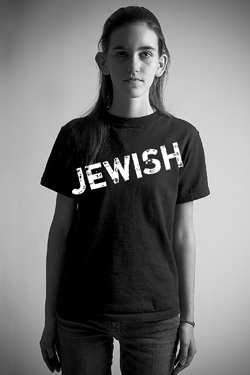
jewish-t-shirtI can’t change the past, but I can tell you that I will not be responsible for separating even one more Jewish person from his or her God-given identity. I can’t change the past but I can learn from it, and more than that, I can teach from it. I can pass my knowledge on to whoever cares to read these words and explain that this is why it is not only important but absolutely vital that Jews who are Messianic must establish and maintain a strong Jewish identity, must observe the mitzvot, must walk in the footsteps of their Fathers and actively live out the wisdom of their sages.

I can’t tell you the right and wrong of every single mitzvot and the amazingly intricate details of each little item of halachah within each of the Judaisms in our world today, but I can tell you that without them, without all of the behaviors and the activities that define a person as a Jew, not only are the Jewish people in danger of disappearing from the face of the earth (although I believe God would never allow this), but that Jews who come to Jesus will vanish into the mass of Gentile Christians in the church, never to be seen or heard from again. Only God will know that Jews ever stood among the disciples of the Jewish Messiah in these latter days of history.

But it all starts with one Jewish person who realizes that his or her identity as a Jew is more important than almost anything because that identity comes directly from God. And we in the church must also learn to cherish Jewish uniqueness, to support it, to uphold it, to esteem it, for our Master said that “salvation comes from the Jews.” (John 4:22)

The story Jennifer Cooper relates occurred almost twenty years ago, but the heartbreaking actions of one young Jewish girl saved not only her, but her children, and future generations of children who would not otherwise be Jewish or value who God made them all to be. The Good Shepherd will come and seek out all of his sheep…those of the Gentile pen, but also those who know his voice from the sheep of Israel. God forbid that when he returns, he discovers that none of them survived.

Love and Commentary

praying_jewFrom where do we learn from the Torah that changing one’s clothes is a sign of respect?

-Shabbos 114a

The verse from Yeshaya 58:13 was already expounded to teach, among other things, that one’s Shabbos clothes should not be like one’s weekday garments (113a). Nevertheless, Rabbi Yochanan is quoted trying to show that this concept is indicated not only from a verse in the prophets, but that it is also rooted in the Torah. Ben Ish Chai explains that based upon this verse from the Torah, there is a practical difference which can be derived regarding the need to wear special clothing on Shabbos.

Daf Yomi Digest
Distinctive Insight
“Suiting up for Shabbos”
Commentary on Shabbos 114a

I’ve been pondering a few things lately regarding Judaism and particularly the Messianic sect of Judaism which recognizes Yeshua (Jesus) as the Moshiach (Christ). There are many things about Judaism that I find beautiful and I find myself sometimes drawn to those traditions. In the days when I used to worship on Shabbos and pray while wearing a tallit gadol, there was a “specialness” about it I can’t articulate. Weekday mornings when I would pray shacharit while wearing a tallit and laying tefillin had a texture and a quality about them that I can’t describe. The blessings I recited from the Siddur (which are taken from Hosea 2:21-22 in the Tanakh or verses 19-20 in Christian Bibles) when donning the arm tallit, invoked a particular unity between me and my God that I think Christians miss some of the time.

I will betroth you to Me forever; and I will betroth you to Me with righteousness, with justice, with kindness, and with mercy; and I will betroth you to Me with fidelity, and you will know Hashem.

–Hosea 2:21-22 (Stone Edition Tanakh)

Christians sometimes criticize Jews for all their “man-made traditions” but there is a certain beauty in how observant Jews even prepare themselves for encountering God in prayer. After all, if you were summoned to appear before an earthly ruler, such as a King or President, you would certainly prepare yourself, including dressing for the occasion. Why shouldn’t the same be true if we are summoned to appear before the Ultimate King: God? And after all, Jews are indeed commanded to wear tzitzit (Deuteronomy 22:12) and to, in some sense, wear the Torah (Deuteronomy 6:8).

Hear, O Israel! The Lord is our God, the Lord alone. You shall love the Lord your God with all your heart and with all your soul and with all your might. Take to heart these instructions with which I charge you this day. Impress them upon your children. Recite them when you stay at home and when you are away, when you lie down and when you get up. Bind them as a sign on your hand and let them serve as a symbol on your forehead; inscribe them on the doorposts of your house and on your gates.

–Deuteronomy 6:4-8 (JPS Tanakh)

But as my conversation with Pastor Randy reminded me the other day, there are also commandments and rulings that are beyond my comprehension.

All holy writings may be saved from a fire.

-Shabbos 115a

Perek teaches the laws of saving items from being burned in a fire on Shabbos. On the one hand, our sages realized that if a person is given an unlimited license to save everything he can possibly grab, the person would invariably be driven to try to extinguish the flames, which is a Torah violation… This is why the halachah put a finite limit on what a person is allowed to salvage from a fire. Once this quota of clothing and food is met, the person may not remove anything more from the burning building, even if the particular situation allows the time and conditions to retrieve more.

On the other hand, our sages were lenient to allow saving holy scrolls from a burning building. It is permitted to remove a Torah scroll, for example, to a domain which is normally rabbinically restricted. This is the topic which the first Mishnah discusses.

It is interesting to note that the sages put limits on a person regarding his property pulled from a fire in a building, whereas in other cases we find the opposite. If a person is traveling up to the last minute before Shabbos, and he fails to make it to the city, what should he do with the valuables he is carrying? The Gemara (153a) rules that a Jew in this predicament may instruct a gentile who may be traveling with him to bring the items into the city for him. This is normally a violation of “amira l’nochri – telling a non-Jew to do a melachah for a Jew on Shabbos”, but in this case our sages allowed it, being that they felt that if the Jew would have no recourse, he
might carry the items into the city himself. The Rishonim deal with this apparent inconsistent approach of the halachah to a Jewish person who is faced with a risk to his property. In the case of a fire we limit him although he is not doing any melachah, but when carrying into the city as Shabbos begins, we are lenient.

PogromFor a Christian, the problems being posed here and their solutions do not appear on our “radar screens,” so to speak. It’s as if a difficulty was made up for the sake of proposing a solution. Yes, the Jewish people are commanded to observe the Shabbat and to keep it Holy (see Exodus 20:8, Exodus 31:15-17, and Deuteronomy 5:12), but all of the Rabbinic rulings that go along with these commandments are enormously complex, at least to me. How can one even begin to observe Shabbos and remember each and every condition and circumstance that could possibly apply in a flawless manner?

But then again, I don’t live in the Orthodox Jewish space, so what do I know?

(I should say at this point that being married to a Jewish wife does give me an insight that a Christian who is not intermarried lacks, but on the other hand, my wife is the first one to say that she’s hardly Orthodox)

I can only imagine that there are many, many Jews who are Shomer Shabbos. I know that after the local Chabad Rebbetzin gave birth to her youngest child on a Friday night, her husband, the Rabbi, walked from the hospital to the synagogue in the middle of the night (since it was Shabbos and he was forbidden to drive or to even accept a ride from another) so that he could be at shul to lead Shabbat services Saturday morning.

I can’t imagine a Pastor ever being in a similar situation and from a Christian’s point of view, even if we had such a restriction, it is very likely that we would depend on the grace of Jesus and under unusual circumstances, overlook the commandment by allowing ourselves to drive or, in the case of a fire, retrieve any of our property we could lay our hands on before the fire could get to it (or to even put out the fire if we could).

Do we admire such dedication to the commandments of God as they are understood in religious Judaism or do we consider observant Jewish people to be bound and gagged by the letter of the Law and also by the commentary on the letter of the Law?

That’s a tough one. Even if we in the church disagree with how Jews choose to obey God, it’s their choice, not ours.

But if those Jews are also Messianic, should we look at the mitzvot any differently? Should we allow ourselves to judge others because they are Jewish and they choose to live a religious Jewish lifestyle?

I’m in no position to do any such thing, but it does bring forth interesting questions. There is not always a single tradition in religious Judaism as to how to perform the mitzvot because there isn’t a single Judaism. Further, there isn’t always agreement between the ancient or modern sages as to how to perform certain of the mitzvot, and so one much choose which tradition to follow, usually based on which Judaism you are operating within.

But those are human choices not necessarily the will of God, unless we want to consider that God is “OK” with all of the variants on Rabbinic teachings, and that is a big “if.”

Setting that aside for a moment, another problem presents itself, but it too is a man-made problem.

I was recently criticized on another person’s blog about the questions I was bringing up as a result of last Wednesday evening’s conversation with Pastor Randy, but the criticism wasn’t coming from anyone Jewish. There is a certain corner of Christianity that believes we Christians are identical to the Jewish people once we come to faith in the Jewish Messiah, at least as far as the mitzvot are concerned…well, sort of. It’s complicated, but the core of their argument is that there is such a thing as a perfect Christianity/Judaism that can be divined solely from the Bible, and that it is possible to practice this very particular form of religion without any (or any excessive) human-created interpretation and set of attendant traditions, and using more than a little theological sleight of hand to “prove” their position.

What’s really interesting is that my critic and his friends who have commented on the matter, didn’t seem to actually read what I’d written. I was asking questions, not making pronouncements, and yet they were actively condemning my “conclusions.” The one thing I can say with certainty though, is that I see no directive for modern Christians to mimic modern Jewish religious behavior in an attempt to worship as if we are in one of Paul’s first century churches or synagogues.

I’m not here to criticize Jewish people or Jewish religious observance. I don’t have the right or the necessary qualifications to render a definitive commentary, only the drive to share my questions and thoughts on the matter, such as they are. I’m not even really criticizing how other Christians choose to view their religious obligations to God, except to the degree that they attempt to impose their personal viewpoints on other Christians and on observant Jews.

To the best of my understanding (and I’m attempting to improve my understanding all of the time), no human being has the ability to perfectly obey God in every single detail, regardless of the religious tradition to which they belong. This was probably as true in the days of Moses, Solomon, and Elijah, as it was true in the days of Jesus and Paul, as indeed, it is true today.

studying_tanakh_messiahPastor Randy suggested a very straightforward method of studying the Bible based on the three steps of observation, interpretation, and application. That requires some fluency in Biblical Hebrew and Greek, and lacking much ability in that linguistic arena, I’m already handicapped. This is why I speak with teachers who I respect to discuss and debate them on their insights. This is why I have so many questions.

But in the end, the advice of another friend of mine must be at the heart of every question and lay the foundation for every answer. In the end, and in the beginning, we should not seek out Judaism or Christianity, but only an encounter with God. This is something that not only are we all capable of, regardless of who we are, but in fact, it is something that we are all commanded to do, because it is God’s greatest desire.

“What you dislike, do not do to your friend. That is the basis of the Torah. The rest is commentary; go and learn!”

-Shabbos 31a

Yeshua answered him, the first of all the mitzvot is: “Hear, O Yisra’el! HaShem is our God; HaShem is one. Love HaShem, your God, with all of your heart, with all of your soul, with all of your knowledge, and with all of your strength.” This is the first mitzvah. Now the second is similar to it: “Love your fellow as yourself.” There is no mitzvah greater than these.

–Mark 12:29-31 (DHE Gospels)

Love God and seek Him and, if you do love God, seek out your fellows and love them, too.

The Divine Path to Taking Out the Garbage

shhhhOne who degrades another person is a fool, and a man of understanding will make himself deaf to his words.

–Proverbs 11:12

When people feel good about themselves, they have no need to enhance their self-evaluation by berating others. Those who do so are exposing their own poor self-worth and to what extremes they will go in order to achieve any feeling of worth.

-Rabbi Abraham J. Twerski
“Growing Each Day, Shevet 13”
Aish.com

I don’t mind people disagreeing with me, but it’s when they do so behind my back that I take a certain amount of offense. When I read Rabbi Twerski’s commentary from which I just quoted, I had an ugly feeling I’d need it in a day or so. Although he is giving a lesson on gossip (lashon hara), I find that it applies to those who choose to call others out by name and denigrate them just because they can.

Rabbi Twerski is correct in saying that when someone employs such tactics, it reveals more about them than the person they’re attempting to malign. Nevertheless, I feel we are not to respond by using the same tactics (and so my critic will remain anonymous) and we must even do our best to forgive the victim.

In another article, Rabbi Twersky quotes Ecclesiastes 7:9 in support of his dedication to…

…try to avoid erupting in anger when I feel offended and at least delay an angry response until I have more thoroughly evaluated the situation.

That’s not easy, since we are all human and, when slapped in the face, our first response is to want to slap back. I can understand that my critic may take this particular blog post as my taking a “shot at him,” but consider this.

May no person be made to suffer on my account.

-Siddur, Prayer on Retiring

Although the Torah does not require people to love their enemies, it does demand restraint, in the sense of not seeking revenge (Leviticus 19:18). The Talmud extends this concept to forbid not only the act of revenge, but even a prayer that God should punish our enemies. “If someone is punished on account of another person, the latter is not admitted to the Divine Presence, for as Solomon says in Proverbs (17:16), ‘For the righteous, too, punishment is not good’ “(Shabbos 149b).

When Rabbi Levi Yitzchok of Berdichev’s adversaries expelled his family from town during his absence, his colleagues asked Rabbi Wolf of Zhitomir to invoke the Divine wrath upon them for their heinous deed. “I cannot do anything,” Rabbi Wolf said, “because Rabbi Levi Yitzchok has anticipated us and is now standing before the open Ark, praying fervently that no harm come to them.”

Actions like this incident may appear to be the ultimate of magnanimity, but it is not necessarily so. To the contrary, they can also be understood as helping one’s own interests. If we pray that another person be punished for his or her misdeeds, we become vulnerable ourselves (see 3 Kislev), for the Divine sense of justice may then bring our own actions under greater scrutiny. After all, is it not reasonable to expect a high standard of personal conduct in someone who invokes harsh treatment of his neighbors?

Consequently, it is wiser to seek forgiveness for others and thereby merit forgiveness for ourselves than to pray for absolute justice and stern punishment for others’ misdeeds and thereby expose ourselves to be similarly judged.

Today I shall…

…try to avoid wishing harm to anyone, even to those who have greviously offended me.

-Rabbi Abraham J. Twerski
“Growing Each Day, Shevet 17”
Aish.com

Kind of reminds me of some lessons taught by other wise Jewish sages.

And Jesus said, “Father, forgive them, for they know not what they do.”

–Luke 23:34 (ESV)

Beloved, never avenge yourselves, but leave it to the wrath of God, for it is written, “Vengeance is mine, I will repay, says the Lord.” To the contrary, “if your enemy is hungry, feed him; if he is thirsty, give him something to drink; for by so doing you will heap burning coals on his head.” Do not be overcome by evil, but overcome evil with good.

–Romans 12:19-21 (ESV)

ForgivenessI suppose Paul, in quoting from Proverbs 25:22, might be the more appropriate scripture, since Jesus is asking God to forgive his executioners, and not just a few people (who in this case are a blogger and a few of his friends who cheer him on) who have “badmouthed” him. Nevertheless, we have a clear principle to not retaliate against someone, whether they’re another believer or not (though it’s sad when a believer should actually create such a situation in the first place).

I just read a blog post written by Rabbi Dr. Stuart Dauermann called Stumbling Towards Shalom. In part, this article says:

I remember years ago helping at a wedding of a friend. This bride, at her rehearsal, was standing on the platform when her bad knee (with an untended to bad ligament) went out of its socket. I still remember seeing that. It meant she had to hobble in order to meet her bridegroom.

Will the same be true for all of us, as we prepare to meet our Bridegroom? Will we be stumbling and falling because of matters untended to?

How are we doing? And what are the prospects for our movement if we do not do better than we are? The author of the letter to the Hebrews leaves us with a final word about our ligament of peace and how we are walking. . . or not walking well together:

Therefore lift your drooping hands and strengthen your weak knees, and make straight paths for your feet, so that what is lame may not be put out of joint but rather be healed. Strive for peace with everyone, and for the holiness without which no one will see the Lord (Hebrews 12:12-14).

While Rabbi Dr. Dauermann is specifically addressing division and unity within the Messianic Jewish movement, I believe it is appropriate to apply his words to the wider context of Christianity and the body of both Jewish and Gentile believers.

The body of Messiah will never achieve its goals while we continue to take pot shots and cheap shots at each other in an attempt to add supports to our own flagging egos. The cause of Christ is not our cause or something we invented out of our own righteousness, it’s God’s. We can either choose to sanctify the Name or desecrate it with our words and deeds.

I used to think that all forgiveness first required repentance, and in terms of our relationship with God, I believe that’s true. And yet I want you to notice something.

Now as he went on his way, he approached Damascus, and suddenly a light from heaven shone around him. And falling to the ground he heard a voice saying to him, “Saul, Saul, why are you persecuting me?” And he said, “Who are you, Lord?” And he said, “I am Jesus, whom you are persecuting. But rise and enter the city, and you will be told what you are to do.” The men who were traveling with him stood speechless, hearing the voice but seeing no one. Saul rose from the ground, and although his eyes were opened, he saw nothing. So they led him by the hand and brought him into Damascus. And for three days he was without sight, and neither ate nor drank.

–Acts 9:3-9 (ESV)

In his conversation with Ananias (see Acts 9:15), the Lord calls Saul “a chosen instrument of mine,” and yet in the encounter between Messiah and Saul, at no time do we see that Saul ever repented or asked for forgiveness. Of course Luke may have simply omitted these overt statements assuming his readers would understand that such actions are implied. After all, Saul’s life does dramatically change almost immediately as he turns away from his former persecution of the Master and his servants and turns toward God. But there’s still a lesson here for me to learn.

clean-upI have no choice but to respond with a forgiving heart, even though it’s not in my human desire to do so. I have prayed for my adversary when he has asked it (in a general request on his blog and not to me specifically). I will continue to do so, for I desire no harm should come to any critic of mine or to their families. I recently said that we will all have to give an accounting to God as to how we lived our lives. I’m not suggesting that I am focused on my critic’s encounter with God but rather my own. If I don’t forgive, if I allow anger or the desire for retribution to rule me, when I am facing my God, what will I have to say about it?

Everyone has his share of “not good.” It’s impossible that a physical being should be devoid of faults. The point is not to flee or hide from them. Nor is it to resign yourself to it all. It is to face up to the fact that they are there, and to systematically chase them away.

Recognizing who you are and gradually cleaning up your act—it may look ugly, but it is a divine path.

-Rabbi Tzvi Freeman
“Cleaning Up”
Based on letters and talks of the Rebbe
Rabbi M. M. Schneerson
Chabad.org

It is better to forgive others, to let go of grudges and hurts and allow God to take care of such matters, than to have to explain to God why you bore a vengeful heart and intent toward someone He loves as much as He does you…and me. I admit by even writing this blog post that it still “smarts” to be taken to task, particularly when I am being honest, forthright, and transparent, but as Rabbi Freeman says, I’m striving to recognize the “ugly” in me and to take the “divine path” toward cleaning up my garbage.

I hope to meet the others I have contended with on that path as well someday.

“In youth we learn; in age we understand.”

-Marie von Ebner-Eschenbach, Austrian writer

Struggling to Touch the Essence

Talmud StudyDuring the centuries following the completion of the Mishnah, the chain of transmission of the Oral law was further weakened by a number of factors: Economic hardship and increased persecution of the Jewish community in Israel caused many Jews, including many rabbis, to flee the country. Many of these rabbis emigrated to Babylon in the Persian Empire. The role of the rabbis of Israel as the sole central authority of the Jewish people was coming to an end.

This decentralization of Torah authority and lack of consensus among the rabbis led to further weakening of the transmission process. It became clear to the sages of this period that the Mishnah alone was no longer clear enough to fully explain the Oral Law. It was written in shorthand fashion and in places was cryptic. This is because it was very concise, written on the assumption that the person reading it was already well-acquainted with the subject matter.

So they began to have discussions about it and to write down the substance of these discussions…

…When you look at the page of the Babylonian Talmud today, you will find the Hebrew text of the Mishnah is featured in the middle of the page. Interspersed between the Hebrew of the Mishnah are explanations in both Hebrew and Aramaic which are called the Gemara.

The Aramaic word Gemara means “tradition.” In Hebrew, the word Gemara means “completion.” Indeed, the Gemara is a compilation of the various rabbinic discussions on the Mishnah, and as such completes the understanding of the Mishnah.

The texts of the Mishnah and Gemara are then surrounded by other layers of text and commentaries from a later period.

-Rabbi Ken Spiro
“History Crash Course #39: The Talmud”
Aish.com

My conversations with Pastor Randy are always very rewarding. We’ve taken to meeting somewhat regularly to discuss matters of mutual interest and specifically the world of believing Jews called “Messianic Judaism.” He lived in Israel for fifteen years and has many Israeli Jewish friends. He is well-versed in Biblical Hebrew and Greek, and his mind and heart are very open to Israel and the Jewish people.

But in our talks, it’s difficult to address how or if modern Messianic Jews are obligated to Torah, what exactly is meant by “Torah,” and the role of Talmud (Mishnah and Gemara) in the life of an observant Messianic Jew. For a Jew, including one in Messiah, is it even possible to comprehend a passage in Torah without Talmud?

I admit, I have few answers.

But since we both have questions, I thought this was the perfect topic to expose to the blogosphere and to present to my readership (and anyone else my readership wants to share a link to this blog post with minus a few “nudniks”). If the bottom line is the Word of God and the revealed Messiah, how can we say that the word of the Sages go beyond them? I disagree that history was frozen after the destruction of Herod’s Temple and I know that Judaism and Christianity continued to move forward and develop. If I may be allowed a conceit, I believe errors entered both Judaism and Christianity in the past 2,000 years that caused both (although Christianity began as a wholly Jewish sect known as “the Way”) religious traditions to “stray” from the intent of God and the footsteps of the Messiah to some degree (probably a really large degree).

And yet, we cannot recapture first century Christianity as Paul understood it and how it was expressed and lived within both Jewish and Gentile cultural contexts. We can only look at where we’re at now and attempt to return to the scriptures to “observe, interpret, and then apply” what we discover there (to quote Pastor Randy).

ruins
But if the Bible is the final word, what do we do with 2,000 years of Jewish history, law, discussion, and interpretation…just wad it up and toss it in the nearest (very large) trash can?  Do we have a right to take everything that it means to be a Jew and to lay it to waste, leaving behind only ruins?

Absolutely not! I don’t believe Messiah will do this upon his return (although, of course, this is just my opinion). Do we say that Jesus will wholeheartedly accept each and every judgement and ruling made by the sages without question? I don’t know if that’s true either, if for no other reason than because the discussion between the ancient sages that spans the centuries, does not come to a final agreement on many practical and legal matters.

And not all Jews and not all Jewish traditions follow the same interpretations. Which one do you choose, and having made a choice, do you realize that it is a human decision and not God’s decision? How can we reconcile this?

My wife told me something interesting just the other day. She told me that the local Chabad Rabbi and the local Reform Rabbi study Talmud together. That’s kind of surprising, and in a community with a large Jewish population, that wouldn’t happen. Chabad (Orthodox) and Reform Rabbis view the traditions and Talmud from very different perspectives. But in this little corner of Idaho, there just aren’t that many Jews and there are even fewer Jewish Rabbis. That fact acts as a bridge for these two gentlemen to meet and share what they have in common as well as their differences.

However, a much greater bridge is required to link a Messianic Jew to any other observant Jew, particularly an Orthodox scholar, although this too has recently occurred. But what is the relationship between a Messianic Jew “keeping Torah,” a state of righteousness before God, and faith in Yeshua (Jesus) as the Jewish Messiah King? Can a Messianic Jew choose how to keep Torah within a particular traditional framework of halachah? Upon making such a choice, whose choice is it, the person’s or God’s?

Torah is not to be regarded, however, as an academic field of study. It is meant to be applied to all aspects of our everyday life – speech, food, prayer, etc. Over the centuries great rabbis have compiled summaries of practical law from the Talmud. Landmark works include: “Mishneh Torah” by Maimonides (12th century Egypt); “Shulchan Aruch” by Rabbi Yosef Karo (16th century Israel); “Mishnah Berurah” by the Chafetz Chaim (20th century Poland).

“Torah versus Talmud?”
-from “Ask the Rabbi”
Aish.com

Torah is meant to be applied, but how it is applied in the life of an observant Jew is very much dependent on that person’s tradition and the branch of Judaism to which they are attached. I heard a story of a Reform Rabbi who made aliyah. According to the storyteller, when a religious Jew makes aliyah and enters the Land, they either become more religious or become secular. In this case, the Rabbi began studying to become an Orthodox Rabbi.

The differences in halachah between a Reform and Orthodox lifestyle must be enormous. I say this because the Rabbi once had a conversation with the storyteller expressing his frustration at attempting to live out the Torah according to Orthodox halachah. He cried out that he sometimes gets so confused that he doesn’t know which foot to step out of bed with in the morning as a proper way of getting up.

I don’t have a lived Jewish experience to which to compare that statement, especially within the Orthodox, so I don’t know how to respond. I don’t know how to respond when applying all that to the words of James, the brother of the Master:

For whoever keeps the whole law but fails in one point has become accountable for all of it.

–James 2:10 (ESV)

Granted, breaking one of the mitzvot does not invalidate the entire Torah nor does it make a Torah lifestyle futile and meaningless, but then what does it mean? A traditional Christian interpretation won’t be revealing here. Is the Jewish person guilty? If he or she is Messianic, what is the role of grace? For that matter, if he or she isn’t Messianic, what is the role of grace?

I know of no Messianic Jew who believes they are made righteous and “saved by the Law.” Messiah is the “way, the truth, and the life” (John 14:6). It isn’t enough for Messianic Jews to say “we have the Torah and the Gentile believers don’t” (and that is a gross oversimplification to be sure). Messiah is the bridge that not only links the Messianic Jew to his Jewish brothers and sisters but to the Gentile believers as well. As Boaz Michael once said, “Yeshua is the boss.” If Messiah isn’t the center of all things, the focal point, the goal of Torah and of the will of God for the redemption of the world, then what do we have?

These are the questions that my conversation with my Pastor brought into view last night. We spoke until there was no one left in the church but us. All the lights were out except for those in the Pastor’s office. All the doors were locked. If we had allowed it, our talk could easily have taken us into the middle of the night as we explored not only these questions, but everything else.

touch-the-essenceI don’t know what the answers are. I don’t know that there is any one answer. There really isn’t any one “Messianic Judaism” even as there isn’t any one “Christianity,” where a single set of interpretations and applications defines the entire group. But I believe the questions are important. I believe that discussion between all of the relevant parties is important, not because Christian Gentiles should have anything to do with defining Judaism, but for the sake of our mutual faith in Messiah.

Who is the Christian and the Messianic Jew when they each stand apart and who are we when we stand side-by-side? How are we to understand one another and in the light of scripture, how are we to understand ourselves?

The Master once said, “for where two or three are gathered in my name, there am I among them.” (Matthew 18:20) Granted, his audience at that moment was a Jewish audience, but I don’t discount the possibility that he will also be among two or three Gentile Christians when we gather in our Bible studies and in prayer. I long for the day when two or three (or more…many more) Jewish and Gentile believers in Messiah gather together (Matthew 8:11) and we can talk about all these things. I long for the presence of Messiah among us, that he may teach wisdom and reveal understanding.

The angels are jealous of the one who struggles in darkness. They have light, but we touch the Essence.

-Rabbi Tzvi Freeman
“Jealous Angels”
Based on letters and talks of the Rebbe
Rabbi M. M. Schneerson
Chabad.org

I struggle in darkness to touch the Essence of Light.

Doing Love

unworthyAaron was ashamed [and was reluctant to assume the position of High Priest] because of his role in the Golden Calf episode, and Moses said, “This is why you were selected.”

-Rashi, Leviticus 9:7

I was once asked to see a student nurse who was beside herself because she had made an error in medication. While this particular error was harmless, she felt that she lacked the competency to be a nurse, because she saw that she was capable of making even more serious errors.

I told the young woman that I did not know of anyone who can go through life without making any errors. Perfection belongs to God alone. If all nurses who became so upset because of a medication error would leave the field, the only ones who would remain would be those indifferent to making errors, and that would be the worst disservice to mankind.

We must try to do our very best at everything we do, particularly when it concerns others’ welfare. We must not be lax, negligent, nor reckless. We should of course be reasonably upset upon making a mistake and learn from such experiences how we might avoid repeating them. However, if in spite of our best efforts we commit errors as a result of our human fallibility, we should not give up. Allowing a mistake to totally shatter us would result in our not doing anything in order to avoid mistakes. This non-action would constitute the greatest mistake of all.

Today I shall…

…try to realize that the distress I feel upon making a mistake is a constructive feeling that can help me improve myself.

-Rabbi Abraham J Twerski
“Growing Each Day, Shevat 12”
Aish.com

No one wants to make a mistake. Certainly we all want to “get it right” the first time, whatever “it” happens to be. And when you are a person of faith, you particularly want to get moral and ethical stuff right all of the time.

It’s rather humbling when we do not. More than that, the rest of the world, both religious and non-religious people, seems to be just waiting for us to slip up so they can criticize us.

I suppose religious people are used to being put down by atheists because we’re “superstitious” or “irrational” or we’re “non-inclusive bigots” or something. However, some people of faith are no better, and tend to jump on other believers who have opinions and convictions that don’t line up with their own. You see this most often within Christianity from “Evangelical Fundamentalists” or whatever label is appropriate to use here…people who are uncompromising on matters of abortion or gay marriage (for example) and who only see the black-and-white of the issues and not the human beings involved. Christians say “love the sinner but hate the sin,” but truth be told, some Christian human beings often don’t know how to tell the difference so they hate them both.

If only we realized that we are just as capable of making mistakes as anyone else. It’s worse for us though, since we know that we are accountable to God for every word and deed we commit in our lives. One day, we’ll have to make an accounting. One day, we’ll have to face God! What the heck is wrong with us? Don’t we get it?

Rabbi Eliezer said: “Repent one day before your death.” His disciples asked him, “Does then one know on what day he will die?” “All the more reason he should repent today, lest he die tomorrow.”

-Shabbat 153a

But what is it to repent?

“It is told that once there was a wicked man who committed all kinds of sins. One day he asked a wise man to teach him an easy way to repent, and the latter said to him: ‘Refrain from telling lies.’ He went forth happily, thinking that he could follow the wise man’s advice, and still go on as before. When he decided to steal, as had been his custom, he reflected: ‘What will I do in case somebody asks me, “Where are you going?” If I tell the truth, “To steal,” I shall be arrested. If I tell a lie, I shall be violating the command of this wise man.’ In the same manner he reflected on all other sins, until he repented with a perfect repentance.”

-Rabbi Judah ben Asher, fourteenth century

love-in-lightsIs making a mistake the same as sinning? Sometimes I suppose, but as we saw in the example of the student nurse above, sometimes we just make mistakes. Even when someone gets hurt, it’s still a mistake and not a sin. But mistakes and sins have a few things in common. If we are morally adequate people, they both make us feel guilty and they both show us that we need to improve and change our ways.

Sin and repentance have been written about endlessly by people far wiser and more worthy than I, so what’s the point of me putting in my two cents? Nothing, I suppose, except for timing. There are times when we need to say such things and times when we need to hear them as well. We may not realize that it’s time and we may not seek out the information which would then inspire us to be convicted and (hopefully) to then transform. So I offer this to you just in case it’s your time. And if we are, as Rabbi Eliezer suggests, to repent today (lest we die tomorrow), then every day is our time.

There are parallel guidelines which are set to direct us in our life goals. On the one hand, we are encouraged and even obligated to state, “When will my actions be as those of our patriarchs?” In this regard we should feel that we can achieve the same levels as our ancestors. On the other hand, we must recognize that we are worlds apart from the lofty levels of our forefathers. In fact, it would be highly presumptuous to even think that we have the ability to match their accomplishments, as our Gemara reports. Even the greatest among us must acknowledge that compared to the personalities of the Torah, who were giants in character and sainted servants of Hashem, we are as mere humans as compared to angels. How are we to balance the approach we are to take in setting our goals and aspirations?

Daf Yomi Digest
Gemara Gem
“Great Asperations”
from the Commentary on Shabbos 112

We may never achieve a state of spirituality and holiness like those people we see in the Bible or those people of faith who we admire, but we can continue to seek God, and to seek His will, and to live the life he created us to live. At a very basic level, it’s really quite simple.

To love is to sigh at another’s sorrow, to rejoice at another’s good fortune. To love is the deepest of all pleasures.

-Rabbi Tzvi Freeman
“To Love”
Based on letters and talks of the Rebbe
Rabbi M. M. Schneerson
Chabad.org

Sometimes after a mistake or failure, the first person we need to learn to love is ourselves. That isn’t easy but we do have someone who can teach us. He’s the lover of our souls, and if anyone can see something inside of each of us that is worthy of love, it’s Him.

Go do like He does. Love who you are, then go love others for who they are.

On the 40th Anniversary of Roe vs. Wade

unborn-babyI was still an atheist and a liberal when my wife became pregnant with our twin sons (now 26 years old). That’s when I started questioning my assumptions about abortion. From the start, my wife and I started relating emotionally to our child (we didn’t know she was having twins until about twenty weeks gestation) as a personality. I started bonding and loving long, long before they were born. I just couldn’t imagine in my wildest dreams ending their lives at any stage, including before birth. How could I do that?

I know that, in theory, the pro-abortion advocates are supporting “pro-choice.” That is, when a woman becomes pregnant, she can choose to go through being pregnant and give birth, or she can choose to have her unborn child medically “terminated.” But let’s look at this. My guess is that most people who are pro-choice are either parents or will be parents someday. They don’t hate children and they don’t hate people who love their own children. They see their position as one where they want to have control of when they become parents.

But let’s say that the first time a woman becomes pregnant, for whatever reason, she doesn’t want to have the child (financial difficulties, under-age, unmarried…) and has an abortion. In order to be able to successfully have an abortion, she cannot relate to her unborn child as a child. She has to relate to it as a “thing.” Otherwise, how could she go through with it?

So she has the abortion. A few years later, she purposefully becomes pregnant and begins bonding with her child from the first moment she discovers she’s pregnant, probably within just a few weeks of conception. How can she decide to love one child from the very beginning but totally emotionally and physically disregard the other child? The abortion industry has been very successful in selling this strange dichotomy and mindset, but to me, it is so completely alien.

What’s the difference between a precious unborn baby and a fetus (a term which is used as a synonym for “thing”)? The only difference is that the first is wanted and the second is not. No quality the unborn child possesses makes it more or less worthy of life in the mother’s eyes or in any pro-choice advocate’s eyes. More’s the pity.

I wrote the above commentary on Facebook after reading a New York Times blog post on the topic. In consulting the blog again, I ran across this comment:

We fought and (thought we had) won the war against compulsory childbearing decades ago, so that our daughters would have agency over their own bodies and the ability to make decisions about their health care without government interference. Just as we fought for our daughters’ right to apply to medical school, and law school, and to compete fairly for jobs in any number of professions. We fought for our own and our daughters’ right to own real estate, to buy and own stocks and have bank accounts and credit in their own name, to be free of groping and sexual demands on the job, or to keep a job.

These battles were won within my adult lifetime. And our daughters don’t know a time when they couldn’t not open a bank account, buy a home, attend the medical school of their choice, be a bartender or carpenter or police officer as well as a barmaid.

I think we who fought the battles got complacent, or just plain tired. Maybe the neanderthal right has done us a favor this past election season, reminding us and our daughters and granddaughters that freedom and liberty must be constantly nurtured and protected like a perfect rose.

The phrase “compulsory childbearing” in the above empassioned declaration caught my attention, as if people or organizations outside of the woman’s control were somehow forcing them to engage in sex, become pregnant, and have children against their will. I could go on and I know this is a complex subject, so I won’t say too much more. Some believers treat all this as black-and-white without seeing the anguish many women go through when facing the decision of whether or not to abort their children. A woman having an abortion isn’t a terrible or bad person, she’s someone facing a very difficult choice, and one that is not as simple and clear cut as either the pro-abortion or the pro-life movements make it out to be.

I used to work at a Suicide Prevention hotline in Berkeley in the late 1970s and early 1980s. I typically worked midnight until 8 a.m., so I spoke with many people who felt all alone in the night. Sometimes, I would end up talking to a woman who would be crying inconsolably (there were more than just a few of them) because she had just done the unthinkable sometime yesterday…killed her unborn child.

Nat'l Organization For Women Marks Roe V. Wade Anniversary At Supreme CourtThis is the side of Roe vs. Wade that the media, the abortion industry, and the “pro-choice” political advocates never talk about. What it does to a woman after the abortion is over. What is it like when you have exercised what you’ve been told are your “reproductive rights,” taken control of your own body and your own destiny, done what fifty plus years of modern feminism have told you that you must do when you are pregnant and you don’t want to be, and had an abortion? What is it like after it’s all over, the “medical procedure” was successfully performed, you’ve gone back to your home, and you have time to realize what just happened? You’re alone now. It’s the middle of the night, but you can’t sleep. You always imagined having children someday and you know someday you will. But there is one little cry in the night you’ll never hear, one voice you’ll never respond to, one baby you will never feed and comfort. There is one child you’ll never nurture, support, love, hug, kiss, cherish, and help grow and thrive.

What about him? What about her? Your baby wasn’t an “it.” Your baby was a little boy or a little girl. What would you have named him? What would you have called her?

“Happy Anniversary,” Roe vs. Wade. In forty years, how many mother’s hearts have you broken? How many babies never took their first breath because of you and because of the illusion that you’ve drawn over the eyes of all their mothers? How many? Why is this a good thing?

Why?

Addendum: The Woman Behind “Roe” and why she has dedicated her life to overturning Roe vs. Wade.