Category Archives: Uncategorized

The Jesus Covenant, Part 9: The Mysterious 2 Corinthians 3

Are we beginning to commend ourselves again? Or do we need, as some do, letters of recommendation to you, or from you? You yourselves are our letter of recommendation, written on our hearts, to be known and read by all. And you show that you are a letter from Christ delivered by us, written not with ink but with the Spirit of the living God, not on tablets of stone but on tablets of human hearts.

Such is the confidence that we have through Christ toward God. Not that we are sufficient in ourselves to claim anything as coming from us, but our sufficiency is from God, who has made us sufficient to be ministers of a new covenant, not of the letter but of the Spirit. For the letter kills, but the Spirit gives life.

Now if the ministry of death, carved in letters on stone, came with such glory that the Israelites could not gaze at Moses’ face because of its glory, which was being brought to an end, will not the ministry of the Spirit have even more glory? For if there was glory in the ministry of condemnation, the ministry of righteousness must far exceed it in glory. Indeed, in this case, what once had glory has come to have no glory at all, because of the glory that surpasses it. For if what was being brought to an end came with glory, much more will what is permanent have glory.

Since we have such a hope, we are very bold, not like Moses, who would put a veil over his face so that the Israelites might not gaze at the outcome of what was being brought to an end. But their minds were hardened. For to this day, when they read the old covenant, that same veil remains unlifted, because only through Christ is it taken away. Yes, to this day whenever Moses is read a veil lies over their hearts. But when one turns to the Lord, the veil is removed. Now the Lord is the Spirit, and where the Spirit of the Lord is, there is freedom. And we all, with unveiled face, beholding the glory of the Lord, are being transformed into the same image from one degree of glory to another. For this comes from the Lord who is the Spirit.

2 Corinthians 3 (ESV)

After my brief detour into Ephesians 2 back in Part 7 of this series, and a deeper look at the Abrahamic covenant as it applies to the nations we saw in Part 8, I’m ready to continue pursuing my look at the New Testament scriptures that refer to the New Covenant.

But first, a brief review.

We see Jesus referring to “the covenant” (the word “new” is added in some later texts) in the Last Supper narratives:

  • Matthew 26:26-29
  • Mark 14:22-24
  • Luke 22:19-20

But there are a number of passages in the New Testament letters that specifically refer to the New Covenant. We’ve already examined the following:

Today, we’ll take a look at the above-quoted 2 Corinthians 3, keeping in mind that we still have to address:

  • Hebrews 8:6-7
  • Hebrews 9:15-22

Before continuing, I just want to point something out. Based on the last part of this series, it seems that the primary gateway for the Christian to enter into a covenant relationship with God is through the Abrahamic covenant and specifically, the portion that describes the blessings of the nations through Abraham’s offspring (singular), which we interpret as meaning the Jewish Messiah, Jesus Christ. If the New Covenant (see Jeremiah 31 and Ezekiel 36) is a confirmation, validation, and expansion upon the previous covenants God made with the Children of Israel, then for our purposes, the New Covenant confirms, validates, and expands upon the blessings we receive for the nations that come from God, through Abraham and our faith in Jesus.

OK, here we go with 2 Corinthians 3.

On the surface, this chapter in Paul’s letter tends to confirm the traditional interpretation of the church, that the Law or Torah “was being brought to an end,” supposedly to be replaced by the New Covenant of grace through Christ. I found the following commentary at BibleGateway.com:

What to do when old ways die hard? Paul’s overall approach is not to denigrate the Mosaic covenant but rather to demonstrate the superiority of the new covenant over the old. To do this he uses a Jewish form of argumentation called qal wahwmer, or what today we would label an a fortiori argument (from lesser to greater). His line of reasoning is that if the glory of the old covenant was transient yet came with such overpowering splendor that the Israelites could not look steadily at the face of its minister as he descended from Mount Sinai with the tablets of the law, how much greater must the new covenant be, whose splendor is permanent and whose glory does not fade. The implication is that though the Mosaic covenant can impart an initial glory and credibility to its ministers and adherents, because of its transitory character it has no lasting effect. Therefore for these visiting preachers to link themselves with a covenant that is fast becoming obsolete is to suggest that their competency is fading and their credentials are of no lasting importance. It is only the new covenant with its enduring splendor that can impart a permanent and lasting credibility to its ministers.

Paul’s evaluation of the Mosaic ministry is even more to the point. Far from being the key to the victorious Christian life, it is in reality a ministry that brings nothing but death (v. 7) and condemnation (v. 9) to those of God’s people who strive to live by it. To be a minister of the old covenant is therefore to be an instrument of death and destruction. The new covenant ministry, on the other hand, brings the Spirit (v. 8) and righteousness (v. 9). So to be a minister of this covenant is to be an instrument of life and salvation.

I know, the commentary seems pretty hard on the Mosaic covenant and its conditions, the Torah, but then, who is Paul’s audience. Is he addressing a group of Jewish disciples? It seems unlikely. This commentary might make more sense if he’s talking to a group of Gentile disciples of the Jewish Messiah who have been listening to other Jewish teachers emphasize that the Gentile must “obey Torah” and even convert to Judaism.

I have problems with the references to the Mosaic law “going away” but then again, should the Gentile disciples be listening to teachings that say they are to rely only on Torah obedience for the purposes of justification before God? Doesn’t the Abrahamic covenant emphasize faith?

The clue may be in another part of the commentary:

Paul’s emphasis in particular on the greater glory of the new covenant suggests that his opponents associated themselves in some fashion with Moses and the law–but not with its legalistic side, since there is no mention of circumcision or obedience to the law.
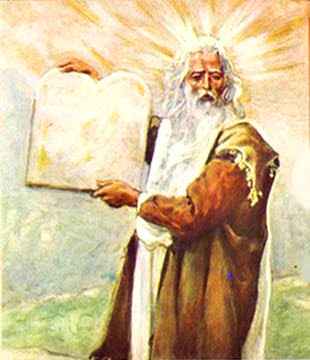
Paul’s Gentile audience may have been tempted to take on board the full yoke of Torah (and perhaps even to convert to Judaism) in order to achieve salvation. Is that why Paul refers to the Torah as “the ministry of death” in verse 7? Paul, in Galatians, was very harsh toward the Gentiles who were considering conversion to Judaism, even going so far as to say that if they did so, the sacrifice of Christ on the cross would become meaningless to them. (see Galatians 5:2)

Still, the content of this letter is puzzling, particularly in light of what we read in the Christian commentary:

To speak of the Mosaic covenant as a ministry that dispenses death would have sounded blasphemous to Jewish ears. It was the uniform opinion of the rabbis that what Moses gave the people of Israel were “words of life,” not words of death (as in Exodus Rabbah 29.9).

The BibleGateway.com commentary is quite correct in asserting this, but then how can they follow-up with this statement?

In verses 10-11 Paul takes his argument one final step and advances the idea that the splendor of the old covenant is not only dwindling but also completely eclipsed by the surpassing glory of the new covenant. This is because the Mosaic ministry is temporary, while the new covenant ministry is permanent.

It doesn’t sound like he’s saying that the Law is for the Jews and faith and grace is for the Gentiles, but that indeed, the Law is fading away and has disappeared altogether and has been replaced by the “new covenant.” But how can this be if the New Covenant merely confirms and expands upon all of the previously established covenants including the Abrahamic and Mosaic?

Seeking an alternate interpretation, I found one at torahtimes.org (Note: I know nothing of this ministry and so cannot vouch for their accuracy or legitimacy. I merely report an alternate way of looking at these verses):

It is the nature of a drash דרש to combine texts that on the literal level have little to do with one another in order to make a point. Paul is not trying to tell us that the ten commandments are the ministry of death. The common element in his quotations is the ministry of death, or the ministry that makes rebels guilty. This is what unites the drash. When the text “engraved … in stones” comes together with the text about the veil on Moses face, we must not assume that Paul is saying the two tablets of the ten commandments that Moses had at the time. That’s not how one interprets a drash. You have to find the homiletical theme of the two quotations and not assume that the use of the two texts mean anything other than what they are used for. The ministry of death in the stones were the curses inscribed upon Mt. Ebal when Israel came into the land. It’s mention next to Moses face is not Paul’s intent to confuse the literal facts but to give a homily on the ministry of death” (torahtimes.org, DLC).
Because I don’t like posting content from a source I am unsure of, I tried to find out something about the commentary’s author Daniel Gregg. I discovered something about him on Derek Leman’s blog. You can read the content there and make whatever evaluation of Mr. Gregg’s legitimacy as a Biblical interpreter you see fit.

That said, Gregg’s interpretation does point out that we may be missing something by trying to understand Paul’s letter in terms of modern Christian thought. Paul’s entire world view was as a Jew and a teacher, and his commentaries on the older scriptures were most likely to be a halalach interpretation that operates outside of traditional Christian thinking. In that sense, we may not easily grasp the meaning behind how Paul (apparently) speaks against the Law or defines it as being ended or fading away, Gentile audience notwithstanding.

My last source, the Rosh Pina Project has a viewpoint that seems to dovetail with Gregg’s (please click the link and read the entire commentary for the full context):

If the Ten Commandments are the ministry of death and condemnation, there is no way we can find life in them. The Ten Commandments are the ministry of death and condemnation, and not because they themselves are unrighteous. They are the ministry of death and condemnation because they show us to be unrighteous, and they show how utterly incapable we are of obeying God’s commandments.

From my own point of view, my reach may have exceeded my grasp. I don’t know what to make out of 2 Corinthians 3. If I maintain my basic assumption that the New Covenant cannot undo or replace the older covenants God made with Israel, then the surface meaning of Paul’s words and the traditional Christian interpretation of this chapter cannot be correct. The closest interpretation that fits my paradigm is the aforementioned Rosh Pina Project, and in this case, they say the Torah is only inadequate because we are inadequate.

Our incapability to serve or honour God through the commands which he decreed should force us to our knees, to cry out for mercy, and to place our trust in the atoning death and triumphant resurrection of Moshiach, without whom all our ‘righteous acts’ are like filthy rags before the Holy One.

I don’t know if I find that a completely satisfying explanation for everything Paul writes in this chapter, but I think it points in the right direction. Your opinions may provide more illumination in uncovering the mystery. Then we’ll proceed to Part 10 and Hebrews.

Life Under Repair

Question: I’ve been enjoying the philosophy articles on Aish.com. The approach to life resonates with me much more than the Western style of consumerism and media hype. Regarding the obligatory nature of mitzvot, however, I think sometimes humans have to disregard the boundary and be disobedient against the command. It might be painful, but I believe you come away with a higher appreciation that God and His commands are ultimately correct. Do you agree with this thinking?

The Aish Rabbi Replies: You have touched on a deep truth, but ultimately your principle is mistaken. The Talmud states: “In a place where a reformed sinner stands, even a righteous tzaddik does not stand.” The idea is that after having erred, you can analyze your negative acts, learn from them, and use that knowledge as a foundation to motivate you further.

While all this seems to imply that it is better to make mistakes and then correct them, rather than never have made the mistake in the first place, that is not true.

Let’s take the mundane example of the rule: “Always look both ways before crossing the street.” There are two ways to learn this lesson: 1) Listen to the advice of teachers and parents to look both ways before crossing, or 2) cross recklessly, get hit by a car, and then while lying in the hospital acknowledge a lesson well-learned.

The problem in choosing the second path is that there is always a residual effect from our mistakes. A teenager who experiments with drugs may grow up to realize the dangers, but a lot of brain cells have been killed in the meantime.

“Intentional Mistakes”
from the “Ask the Rabbi” series
Aish.com

(I almost didn’t post the first picture that appears in today’s “meditation” because of its provocative elements, but of all the similar images I found, this one came closest to communicating what I wanted to say.)

In a comment on Gene Shlomovich’s recent blog post How Jesus may have viewed conversion to Judaism, I mentioned how I corrected one of my mistakes:

To be fair, many non-Jewish “Messianics” were taught for years or even decades that there was “One Law for the native-born and the alien” and that information is well ingrained into their psyche and identity. Now that “the movement” has evolved and more accurate information is available relative to how the Bible defines the roles of “Messianic” Gentiles and Jews, it is very hard for some to surrender a status or role that they’ve become quite used to.

I remember when FFOZ (First Fruits of Zion) first announced that they had been wrong in supporting the One Law position and that they were correcting their teachings and organizational stance. I felt angry and betrayed and shot off a very pointed comment or two on Facebook in response. It was like being given an important and valuable gift and becoming comfortable with it, then having it suddenly ripped away.

I suppose I could have become one of those angry “deniers” and continued to “demand my right” to “Torah obligation,” but I started to think. FFOZ had financially just shot themselves in the foot. A large number of their constituents simply abandoned them, abruptly and significantly reducing their income. Why would they do that when in any practical sense, even if privately they’d come to the conclusion that One Law was unsustainable Biblically and theologically, they should have publicly maintained their OL position in order to make sure they survived as a ministry? Their decision only made sense if moral and spiritual honesty were more important to them than an income.

I became curious and started investigating. At about the same time, I started looking at my wife’s pursuit of her Jewish identity as an individual and as a member of the Jewish community through different eyes. Long story short, I realized that I had been wrong in my One Law assumptions and shifted my perceptual and theological paradigm accordingly.

But to say that it was difficult is a gross understatement. A lot of people aren’t capable of that kind of change. I even recently wrote about how difficult it is to “share Abraham” so to speak, and accept that only certain blessings are passed down to the nations (Christians) through Israel. Exchanging self-entitlement for a more mature reality is very hard and not everyone is going to accept it.

Frankly, and not to necessarily contradict the Aish rabbi from whom I quoted above, I don’t see how some mistakes can be avoided. I mean, we all make mistakes. Some are actually part of the human developmental learning process. Take walking for example. When a small child is first learning how to stand and walk, the child falls a lot. Falling isn’t a mistake at this stage of development, it’s a requirement and it’s perfectly normal and expected. No small child has ever (to the best of my knowledge) spontaneously stood and walked with absolute precision on the very first try, and never fell back to the floor. Everybody falls the first time, or the first dozen times, or the first few hundred times.

I think trying to understand God and trying to understand who we are in God is like learning how to stand and walk. We get a lot of things wrong at first, but that’s to be expected. Just conceptualizing the existence of God is tremendously difficult, and integrating faith, trust, hope, and spirituality into a daily lifestyle can escape even some of the best of us. I would hardly expect anyone to become “good at it” right off the bat. In fact, most of us never get really “good at it.” We continue to struggle, to learn, and we periodically fall flat on our faces.

That’s how I’d characterize my own spiritual development, anyway. I suspect that if we were all honest with ourselves and everyone else, every person of faith would admit to the same thing. Only pride keeps us from doing so. We’re afraid of looking foolish. We’re afraid of what other people will say. We’re afraid of just letting go of all that and, like a little child, accepting what God has given us from His abundant store of gifts.

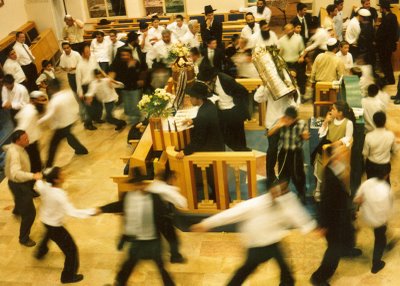
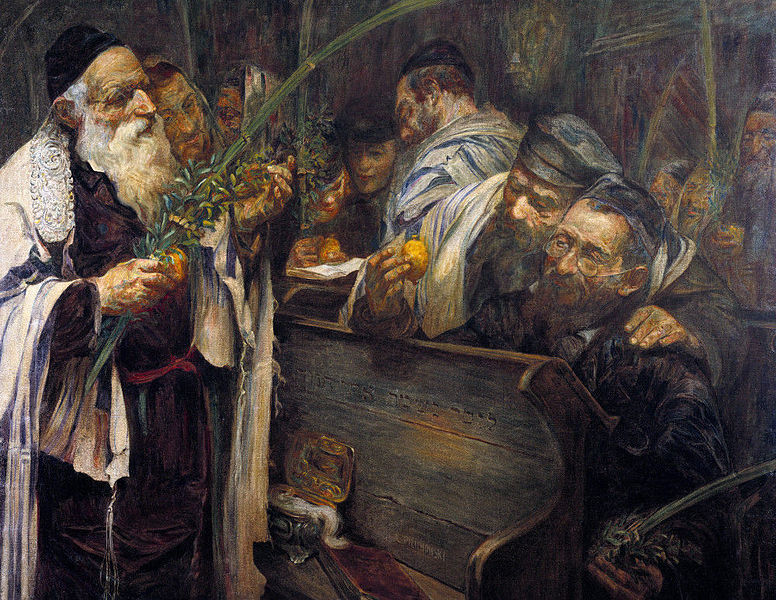
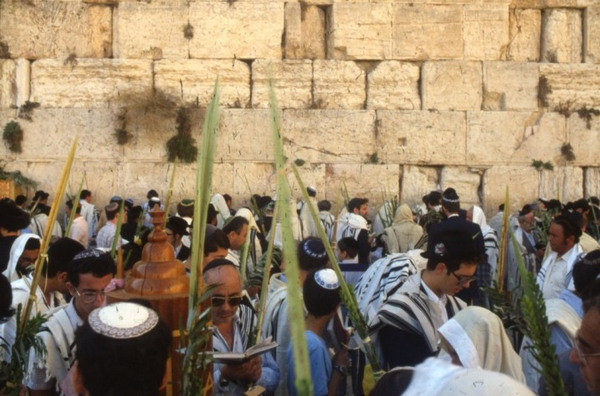
For seven days of Sukkot, Jews walk around in circles, carrying an assortment of green and yellow flora. Then, on Simchat Torah, they dance in circles carrying Hebrew scrolls, working up to a frenzy.

Did I say dance? Well, it’s more like marching, your hands over the next guy’s shoulders, singing and stomping as you march to . . . the same place you started from. Repeat until you plotz. (Yiddish: collapse)

Now for my confession…

When I was first invited, cajoled and nudniked to join the circular festivities, I was more than hesitant. I attempted to explain that I didn’t see the point of walking in such a way that you don’t get any further than where you started. Needless to say, the argument was ignored, and I was swept into the circle whether I liked it or not.

And I felt stupid. For about the first 40,000 circuits. After that, I forgot about myself and how I felt and what I was doing and why I was doing it and whether I was stupid and that I was there at all. And that’s when the circle became good. Very good.

It was good exactly due to that which I had subliminally feared. Because as I stand here, I am I. In the circle, that I dissolves into we. And in that very act of transcendence, that loss of self, there is unbounded joy.

-Rabbi Tzvi Freeman
“Why Jews Dance in Circles”
Commentary on Sukkot and Simchat Torah
Chabad.org

While being embarrassed and feeling foolish (and avoiding joy) aren’t exactly mistakes, these are experiences that, if we allow them to, will prevent us from correcting mistakes and lead us into a lifestyle based on error and fear. In fact, many people try so hard to avoid embarrassment, foolishness, and the tremendous effort that change requires once it’s discovered, that they live in self-denial, never even permitting themselves to realize that what they are living is a mistake. That is why so many people (and I know atheists must think this about religious people) can “stand their ground” and “stand up for their rights” with total conviction of purpose, and still be dead wrong.

But remember, even in the lesson we learned from the Aish Rabbi, it’s only a mitzvah if we realize we made a mistake and corrected it. And, remember as well that it would have been better to never have made the mistake in the first place.

We can’t avoid making a mistake. We fall so that we can learn to pick ourselves up. Although mistakes are regrettable, they are also part and parcel of the human experience. Falling down is an obvious mistake when our intention was to walk. Many human mistakes are far more subtle and even when we want to be honest, it can be difficult to see past our own assumptions, prejudices, and pride.

To conquer even our unintentional and unconscious errors, we must learn to question everything about ourselves. Why do I believe in such-and-thus? Is it because I grew up believing this? Did someone teach me this belief when I was cognitively or spiritually immature? Examining the same information now that I am more educated, more mature, and more stable, will I reach the same conclusions that I did before?

These are all very dangerous questions and they can make us feel extremely insecure in areas that are absolutely the foundation of our existence. You don’t have to question your faith in God, but you do have to question what that faith means and how it is to be expressed. While people can change, most people don’t once they arrive at a certain comfortable plateau. The trick is never to completely rest on that plateau. It’s not your destination. Keep climbing, even if you feel uncomfortable, even if you feel nervous or foolish. The truth is always one level higher than you’ve ascended so far.

Or like Rabbi Freeman, after dancing in pointless circles the first 40,000 times or so, eventually, you’ll see that pursuing the joy of God is more important than how you feel or what you look like to others. Fixing mistakes and repairing your life is a mitzvah. So is longing for God. The two go hand in hand.

Climb. Dance.


God is in Jerusalem

It shall be on that day that God comes against the soil of Israel – the word of the Lord Hashem/Elohim – My raging anger will flare up; for in My vengefulness, in the fire of My fury, I have spoken: [I swear] that on that day a great earthquake will take place upon the soil of Israel. They will quake before Me – the fish of the sea, the bird of the heavens, the beast of the field, every creeping thing that creeps on the ground and every human being that is on the face of the earth; the mountains will be broken apart and the cliffs will topple, and every wall will topple to the ground. I will summon the sword against him to all My mountains – the Word of Lord Hashem/Elohim – each man’s sword will be against his brother. I will punish him with pestilence and with blood; torrential rain and hailstones, fire and sulfur will I rain down upon him and upon his cohorts and upon the many peoples who are with him. I will be exalted and I will be sanctified, and I will make Myself known before the eyes of many nations; then they will know that I am Hashem.

I will make My holy Name known among My people Israel, and I will not desecrate My holy Name any longer; then the nations will know that I am Hashem, the Holy One in Israel.

Ezekiel 38:18-23, 39:7 (The Kestenbaun Edition Tikkun)

This is part of the Haftarah reading for Sukkot Shabbat Chol Hamoed which was read yesterday in synagogues all over the world. Although I attend no synagogue or other congregation where the Torah is read on Shabbat, I privately read and study each week’s Torah portion, including the Prophets, Psalms, and if applicable, the writings of the Apostles.

Although I rarely (if ever) write or teach from the Haftarah portion, I was rather struck by the words of the prophet Ezekiel and by the choice of this passage for the Shabbat that occurs during Sukkot. The words of the prophet seem rather harsh for this season of joy, relating the events of the war of Gog and Magog at the end of time, according to the commentary I found in the Tikkun. And yet there is an important reminder to attend to in this lesson.

God speaks of making His holy Name known, both among the nations and in Israel, and that His holy Name will not be desecrated any longer. In fact, He says, through the prophet, two rather interesting things:

I will not desecrate My holy Name any longer.

Then the nations will know that I am Hashem, the Holy One in Israel.

I quoted from the passage above generally to illustrate that both in most of modern Israel and in most of the rest of the world, the holy Name of God is not recognized, acknowledged, esteemed, or given any honor at all. Most of humanity does not know that “God is Hashem” (Heb. literally, “the Name”). I even mentioned recently that among many religious people, the Name of God is desecrated and not sanctified due to their (our) rude and hostile attitudes when we’re communicating with each other online. Relative to the population of our planet, only a tiny fraction of humanity currently cares about God and His Name at all.

But what peculiar things did God say in the passage from Ezekiel? He said that He will no longer desecrate His own Name. Really? I thought that we human beings were doing the desecrating, not God. The commentary for Ezekiel 39:7 in the Stone Edition Tanakh says that God will no longer desecrate His own Name by “allowing” His “people to be subjugated and humiliated.” That is very interesting because it points to the thought that by subjugating and humiliating the Jewish people (and within the context of this verse, there can be no other people group being addressed), we among the nations (including Christians) are desecrating the holy Name of God.

That’s a rather interesting thought. It goes along with this:

I will bless those who bless you, and him who curses you I will curse; and all the families of the earth shall bless themselves by you.

Genesis 12:3 (Stone Edition Chumash)

To bless Israel is to be blessed and to curse Israel is to be cursed. Furthermore, all of the families, the nations of the earth will bless themselves by you, by Israel.

This tells us something I’ve said on numerous occasions in other blog posts, that we Christians are only connected to God and we only receive the blessings of God through Israel, and specifically through Israel’s “firstborn son,” the Messiah, the King, Jesus Christ.

Every time we throw a Jew under a bus, so to speak, or insult, denigrate, or attack Israel in any way, we are causing God to curse us and canceling our ability to bless ourselves by Israel.

How could we be so blind?

It has been said that during the festival of Sukkot, during the days of the Holy Temple in Jerusalem, that the priests would sacrifice seventy bulls, representing the nations of the earth, in order to atone for our sins. It is also said that if the Romans, representing the nations of the earth, had realized the importance of the Temple in atoning for them, for us, they (we) would never have leveled the Temple (which to this day, has not been rebuilt) and sent the vast majority of the Jews out from their land for nearly 2,000 years.

That leads us to the second rather compelling thing God said through Ezekiel: “Then the nations will know that I am Hashem, the Holy One in Israel.”

Read that last part again. “…the Holy One in Israel,” not the Holy One of Israel. This paints a picture not of possession but of belonging and of unity. God is not just the God of the Jewish people, but He resides in Israel. He has belonging in Israel. He is united with Israel.

Particularly during this time of year, the statement of God in Israel is punctuated by the following:

It shall be that all who are left over from all the nations who had invaded Jerusalem will come up every year to worship the King Hashem, Master of Legions, and to celebrate the festival of Succos. And it shall be that whichever of the families of the land does not go up to Jerusalem to bow down before the King, Hashem, Master of Legions, there will be no rain upon them. But if it is the family of Egypt that does not go up and does not come [to Jerusalem], there will be no [water] for them; the same plague will come to pass with which Hashem will strike the nations that do not go up to celebrate the festival of Succos. This will be the punishment of the Egyptians and the punishment of all the nations that will not go up to celebrate the festival of Succos.

Zechariah 14:16-19 (Stone Edition Tanakh)

In other words, after the end of all things, when God once more establishes His rule over all the world from Israel and in Holy Jerusalem, if the rest of us, all of us, want to go and properly worship the God of Israel, we will need to go and worship our God in Israel.

Really everyone, I’m not making this stuff up. It’s not some arcane and esoteric commentary from the medieval Jewish sages. It’s right there in your Bibles. Look it up if you don’t believe me. As Christians, we may not be commanded to celebrate Sukkot or any of the other festivals, either in our own lands or in Jerusalem, but the day is coming when we will be compelled to send representatives from every nation, people, and tongue, to go up to Jerusalem and pay homage to the King, and to celebrate the festival of booths with our brothers and our mentors, the Jewish people.

But after all, that’s rather appropriate I think, given what was said by James, the brother of the Master:

After they finished speaking, James replied, “Brothers, listen to me. Simeon has related how God first visited the Gentiles, to take from them a people for his name. And with this the words of the prophets agree, just as it is written,

“‘After this I will return,
and I will rebuild the tent of David that has fallen;
I will rebuild its ruins,
and I will restore it,
that the remnant of mankind may seek the Lord,
and all the Gentiles who are called by my name,
says the Lord, who makes these things known from of old.’”

Acts 15:13-18 (ESV)

James is quoting the prophet Amos (Amos 9:11-12) in regards to “David’s fallen booth,” which we might render as “sukkah,” when describing how the Gentiles will also come to worship the God of Israel. Boaz Michael, President and Founder of the educational ministry First Fruits of Zion (FFOZ) referred specifically to this teaching in the Introduction of an early manuscript of his forthcoming book (of which I’ve read an advanced copy), Tent of David: Healing the Vision of the Messianic Gentile:

The Tent of David is a reference to the Davidic kingdom, which Amos envisions will encompass even the Gentiles, non-Jews who attach themselves to Israel and to Israel’s Messiah. James reckoned that the believing Gentiles of his day were the first fruits of the fulfillment of Amos’ prophecy.

The concept of the Tent of David, central as it is to the identity of the church and the Messianic Gentile, is seriously underappreciated. The prophets envisioned a kingdom that brought myriads of Gentiles to the knowledge of the Messiah and submission to his rule. Isaiah (2:2) prophesied that people from all nations—Gentiles—would flow to Jerusalem and worship there. Later in Isaiah (11:10–12), Messiah is said to inspire Gentiles to come to him as well as regather the scattered Jewish people. Isaiah 49:6; Micah 4:2; and Zechariah 8:22–23 contain similar prophecies.

The Lord’s brother saw the potential and the prophetic necessity for Yeshua-believing Gentiles and Jews to partner in making the prophets’ vision a reality. The Messiah had come and Gentiles were coming to him in droves. Paul’s ministry was devoted to making the “obedience of faith” a reality in the Gentile community, connecting his Gentile believers to Israel and teaching them how to properly submit to the rule of King Messiah. (Mark Nanos, The Mystery of Romans (Minneapolis: Fortress, 1996), 166–238.)

Not only must we cease to desecrate God’s holy Name by desecrating His holy people, the Jewish people, we must bless them in order to receive the blessings that God has reserved for us. Part of those blessings is a commandment to worship God in Jerusalem once the Messianic reign of Jesus is fully established. Part of our role as recipients of those blessings is to support Israel so that David’s “fallen booth” can once more be built up. Boaz Michael says it this way:

Gentile believers had a unique and vital role, using their numbers and resources to empower and bless the Jewish community and spread the message of the kingdom in their own culture.

I believe that remains our role in the world and in relation to the Jewish community. We must bless them and build them up, support them in returning to Torah and in re-claiming the Messiah as their own. This is what it is to rebuild the fallen sukkah of David, so that one day, Jews, Christians, and all of the world will gather together in Jerusalem and worship under the shelter of God.

What is Messianic Judaism?

Every society has that which bonds it: A common ancestry and a system of patriarchal lineage. Or a common language or common borders or governing body. Usually, it is a combination of several factors that mold a mass of people into a single whole.

The Jewish people are unique in that they have only a single nucleus—and it is none of the above.

All that bonds us is Torah. Nothing else has proven capable of holding us together for more than a generation or two. Nothing else, other than the same Torah that first forged us as a nation.

-Rabbi Tzvi Freeman
“Jewish Nucleus”
Based on letters and talks of the Rebbe
Rabbi M. M. Schneerson
Chabad.org

When I became a follower of Yeshua, it was not a rejection of the God of Israel, but, on the contrary, a belief that Yeshua was a fulfillment of God’s promise to Israel. I did not stop being a Jew, and did not stop living as a Jew. On the contrary, believing Yeshua to be the Messiah made me want to be more observant of the Torah than before. Believing in Yeshua enhanced my Jewishness rather than lessen it.

Whatever my experience is, it is not a conversion to Christianity. I do not criticize Christian practice, but simply state the fact, that their practices are not my practices, their form of worship is not mine. Whenever I have visited a church, I have felt out of place, like I was in someone else’s living room. Their culture was not my culture, their practices were not my practices. Their understanding of Scripture is not mine. The only conclusion is that their religion is not my religion.

I feel at home in the synagogue, any synagogue. Their practices and beliefs are familiar to me. Their understanding of God and of His love for our people resonate with mine. While traditional synagogues don’t acknowledge Yeshua, nevertheless, He is there. For me, He is the Messiah of Israel.

-Rabbi Dr. Michael Schiffman
“Messianic Judaism and Christianity: Two Religions With The Same Messiah”
Drschiffman’s Blog

What is Messianic Judaism? Who is a Messianic Jew? These are questions I’m probably not qualified to ask let alone answer, but I have a special interest in the topic for a number of reasons. One important reason is that I’m a Christian husband married to a Jewish wife, so I am keenly aware of the intersection between our two outlooks on faith, the Messiah, and God as it expresses itself in our family life (I also have three Jewish children to add to the mix).

On top of that, most of my “Christian” religious life has been spent worshiping within the context of a One Law congregation (which isn’t really “Messianic Judaism” but I’ll explain that by the by). Within that venue, I gained an appreciation of (if not an actual proficiency in) Jewish religious thought and practice. I find not only many of the mitzvot quite beautiful and meaningful, but the symbolism and conceptualization behind the mitzvot, as the Rabbinic sages have expressed it, to be illuminating of God and oddly enough, my own Christianity.

Additionally, I have enough friends and acquaintances who are Jewish and Messianic and I desire to understand them and their unique experience better. That understanding I believe, will be critical for the Christian church as a whole (if the church can be said to represent a whole) to grasp as the days of the Messiah draw near and he calls His people Israel to return to him along with the nations of the world (“first to the Jew,” however). Without a firm foundation in the “Jewishness of Jesus” and how our world will one day be ruled by a Jewish King descended from the Throne of David, the traditional Christian will become lost and unable to connect to who and what Jesus truly is and what it actually means to be a Gentile disciple of the Messiah.

In addition to the Rabbis I’ve quoted from above, this “meditation” was inspired by a series my friend Judah Gabriel Himango has just started on his own blog called The State of the Messianic Movement. He intends to examine the three overarching groups that exist under the “Messianic” umbrella: Jewish Christianity, Messianic Judaism, and Hebrew Roots. This should require a definition of each of these terms and what (and who) they represent.

For myself, I’ve found that my understanding of what “Messianic Judaism” is has morphed over time. I used to think the term was a big “bucket” that contained what I thought of as Messianic Judaism proper, or groups of primarily Jewish people who worship Jesus as Messiah, One Law, which are groups of primarily non-Jews who believe that the Sinai covenant and its conditional statements, the Torah, are applied with perfect equality between Gentile and Jewish believers, and Two-House, which is made up of groups of primarily non-Jews who believe that their attraction to Torah and Judaism means they are “hidden” Jews who are descended from the “Lost Tribes of Israel.” (By necessity, these definitions are brief and do not contain all of the details and nuances to completely describe each group)

It would take too long to explain how and why I changed my paradigm for understanding Messianism, but a large part of the process was watching my wife rediscover her own Jewish identity during the last several years, moving from atheism, to traditional Christianity, to One Law, and then entering the community of Jews locally, first in our combined Reform-Conservative shul, and then finally becoming involved with the Chabad. I can say all that in a single sentence, but the reality of the experience is extremely complex and involved and having lived through my wife’s journey as her Christian husband (often observing but not significantly able to participate), it has been a remarkable and life-changing progression.

The missus and I were sitting at the kitchen table taking about subjects related to this and we landed on the “hot topic” of whether or not she thought Messianic Jews were Jews. Her answer surprised me just a little. She said that non-Jews who converted to Judaism but who did not renounce other religions (including or perhaps especially Christianity) were not Jews. During the last part of the conversion process, the almost-convert is asked if they voluntarily surrender any and all affiliations to any other religions or faith traditions. If they expect to complete the conversion and enter the mikvah, they always answer “yes”. If they answered “yes” but retained a faith in Yeshua (Jesus), then they lied and their conversion is null, as far as she’s concerned. If, for some reason (and I’ve heard unsubstantiated rumors of this occurring occasionally), the officiating Rabbi fails to ask the question and the convert continues to silently harbor a faith in Yeshua, then again, as far as my wife is concerned, the conversion isn’t valid. A non-valid conversion means the person entered and exited the mikvah as a Christian. End of story.

On the other hand, if a halalaic Jew in any way shape or form, came to faith in Jesus and worshiped him as Messiah, as mistaken as my wife thinks that person is, they are still a Jew. It would be like a Jew who practiced Buddhism or some other religious tradition. They’d still be Jewish. Her brother, for instance, is a born-again Christian and as far as I know, he continues to deny that his mother (and my wife’s mother) was Jewish (my mother-in-law passed away many years ago). To look at him, his wife, and his children, they are the perfect picture of a traditional Christian family. The idea of being Jewish just doesn’t compute within him and I’m sure he doesn’t understand why my wife and children consider themselves Jews. Nevertheless, if he should walk into our local Chabad synagogue on any given morning, and the Rabbi was aware of his status, he could still join the minyan for Shacharit prayers.

I’ve said everything above by way of introducing my humble definition of Messianic Judaism.

First of all, as Dr. Schiffman said on his blog, Messianic Judaism isn’t Christianity. Oh, it shares a number of common elements, not the least of which is the same Messiah. Jesus the Christ is the same guy (forgive me if that seems irreverent) as Yeshua HaMashiach. He is the Lord, the Savior, the Jewish Messiah King, who came once to redeem the world and who will come again, in power to redeem and restore Israel and to rule all of humanity.

However, who we are as disciples of the Messiah makes a huge difference. Regardless of how the movement of “Jesus worshipers” was started, first among the Jews and then among the Gentiles, 2,000 years later, Jews and Christians represent two wildly differing cultures and practices. As Dr. Schiffman said, he doesn’t feel comfortable in a church. He doesn’t belong there. His “spiritual home,” if you will, is the synagogue, any synagogue, Messianic or otherwise. I know of at least one other Jewish person who is Messianic and yet attends an Orthodox synagogue. I suspect there are others who quietly worship in their Jewish communities and yet who nurture a deep faith in Yeshua.

What is Messianic Judaism given all of this? In my opinion, it is a Judaism in the same manner as Orthodox Judaism, Conservative Judaism, Reform Judaism, and so on. It is an expression of religious and halalaic faith and devotion of Jewish people as they relate to the Torah and God. It is the lifestyle, cultural, ethnic, religious, and halalaic context within which each Jew is Jewish. Most, if not all of the other modern Judaisms will certainly disagree with my opinion as will most Christians and the vast majority of non-Jews who are attached to the Hebrew Roots movement in some manner or fashion. So they’ll disagree.

My definition of a Messianic Jew is a person who is halachically Jewish and who practices a form of religious Judaism which includes acknowledging the person of Jesus (Yeshua) as the Jewish Messiah King, and who acknowledges the legitimacy of the Gospels, the Letters, and the Apocrypha in what most people call “the New Testament” as valid for “teaching, for reproof, for correction, and for training in righteousness, that the man of God may be complete, equipped for every good work.” (2 Timothy 3:16-17 ESV) This person’s ethnic, cultural, religious, and lifestyle practice should be virtually indistinguishable from any other religious Jew (it would be interesting to find out if various Messianic Jews pattern their halakhah after different sects, such as Orthodox or Reform, but I lack information here). As Dr. Schiffman said, a Messianic Jew practicing Messianic Judaism (sorry if this sounds redundant, but it’s important to be clear on this point) should look and act the same as any other religious Jew from the viewpoint of an outside observer.

The twist is that there aren’t (probably) that many Messianic Jews practicing Messianic Judaism as I’ve just defined those terms. Even in synagogues that are strictly Messianic Jewish, that is, shuls that are governed by a halachically, ethnically, religiously, and culturally Jewish board, Rabbi, Cantor, and so on, the majority of attendees will still be non-Jewish. The type of synagogue practice should again, be indistinguishable from any other synagogue apart from portions of prayers and services that acknowledge Yeshua as the Messiah and the heir to the Davidic throne. Synagogues like this are most likely very rare in the western world. I’ve only attended one in over ten years of being aware of Messianic Judaism, and I only visited there last spring.

So, while it’s understood, from my perspective, that Messianic Jews practice Messianic Judaism, do the non-Jewish attendees also practice Messianic Judaism alongside the attending Jews? The answer to that question is probably the same as asking if I practiced Judaism when (this was years ago) I attended our local Reform-Conservative synagogue with my Jewish wife and our children.

In other words, “no”. I certainly worshiped the God of Abraham, Isaac, and Jacob, and privately in my own heart, acknowledged my Lord and the King of the Jews during the prayers, but I was a Gentile among Jews in a completely Jewish context. From their point of view, the best they probably thought of me was as a righteous Gentile, and it’s not unusual for Noahides to worship alongside Jews (where else would they go?). In fact, I know of many Christians who periodically or (for a few) regularly worship in one of the local synagogues, either because they’re intermarried like me, or they have some other affinity for the Jewish people and for Judaism.

In a sense, whether you worship in a church or a synagogue (assuming you are a believer in Jesus as the Jewish Messiah) depends largely on your sense of personal identity and in which culture you feel more comfortable. This isn’t really unusual. Some Jews feel more comfortable in an Orthodox synagogue than those of the other Jewish sects, and some Christians feel more comfortable in a Lutheran or Baptist church than in a Methodist or Episcopal church. Some of that is theological, but a lot of it is cultural and believe me, different Christian denominations have their own cultures. So why not different Judaisms?

I’m sure my descriptions and definitions are far from complete, but trying to define Judaism in any sense, let alone Messianic Judaism, is a very difficult and involved task. This is really more of an introduction than anything, but as I said, some of the material I’ve been reading lately has been tugging at me and I needed to respond. As always, many people will disagree and many people will become upset, troubled, and even incensed and outraged. I’ve talked recently about how poorly some people tend to respond when another person disagrees with them online.

It’s OK if we don’t agree. Please try not to take it personally. As I live with Jewish people every day, I’m kind of in tune with how they are like me and how they are not like me. I’m just extending that personal awareness into a public arena. Your mileage may vary.

Attack Dogs

Jennifer Bristol recently lost one of her oldest friends—thanks to a Facebook fight about pit bulls.

The trouble started when she posted a newspaper article asserting that pit bulls were the most dangerous type of dog in New York City last year. “Please share thoughts… 833 incidents with pitties,” wrote Ms. Bristol, a 40-year-old publicist and animal-welfare advocate in Manhattan.

Her friends, many of whom also work in the animal-welfare world, quickly weighed in. One noted that “pit bull” isn’t a single official breed; another said “irresponsible ownership” is often involved when dogs turn violent. Black Labs may actually bite more, someone else offered.

Then a childhood pal of Ms. Bristol piped up with this: “Take it from an ER doctor… In 15 years of doing this I have yet to see a golden retriever bite that had to go to the operating room or killed its target.”

That unleashed a torrent…

“It was ridiculous,” says Ms. Bristol, who stayed out of the fight. Her old buddy, the ER doctor, unfriended her the next morning. That was eight months ago. She hasn’t heard from him since.

-Elizabeth Bernstein
“Why We Are So Rude Online (October 1, 2012)
The Wall Street Journal

People can have diverse opinions. They can have different personalities. They can have different goals and objectives. Even so, they can choose to interact in peaceful ways, and discuss their differences with mutual respect. At times they will work out solutions to their mutual satisfaction, and at times they will not. Nevertheless, they can be calm, and think clearly about the wisest course to take.

-Rabbi Zelig Pliskin
“Disagree Respectfully”
Today’s Daily Lift, #586
Aish.com

I recently posted a meditation about this very topic, and having to take the extreme action of banning someone from commenting on my blog. While I suppose I could assign the “blame” for the whole difficult experience to the person in question, in fact, the subject of Elizabeth Bernstein’s news article deserves some “credit.”

Why are people so rude online? People will say all kinds of things to other people online that they’d never dream of saying (most of the time) in person. Part of me is amazed that this tendency spills over into the religious blogosphere, but then, I find religious people possess just as wide a variety of character traits (and flaws) as the general population, rudeness included.

One of the reasons for online rudeness cited in Bernstein’s story is anonymity. When you can hide behind a fake screen name and avatar, there’s no sense of personal accountability because your statements aren’t easily traced back to your actual identity (nevermind that we’re not as anonymous as we think online, particularly on Facebook, or to someone with sufficient technical skills). There’s even a suggestion that the effect of being online reduces our inhibitions in the same way as alcohol.

Most of us present an enhanced image of ourselves on Facebook. This positive image—and the encouragement we get, in the form of “likes”—boosts our self-esteem. And when we have an inflated sense of self, we tend to exhibit poor self-control.

“Think of it as a licensing effect: You feel good about yourself so you feel a sense of entitlement,” says Keith Wilcox, assistant professor of marketing at Columbia Business School and co-author of the study. “And you want to protect that enhanced view, which might be why people are lashing out so strongly at others who don’t share their opinions.” These types of behavior—poor self control, inflated sense of self—”are often displayed by people impaired by alcohol,” he adds.

A sense of entitlement, boosting poor self-esteem, reducing self-control, I don’t think this just happens to people who use Facebook.

The Bernstein article also states that, according to Sherry Turkle, psychologist and Massachusetts Institute of Technology professor of the social studies of science and technology, our inhibitions are lowered because we can’t see the reactions of the people we’re addressing with our comments. Because we can’t “see and focus on what we have in common, we tend to dehumanize each other,” Dr. Turkle states.

I’ve heard there are two topics that can guarantee you will immediately become involved in an enraged conversation, both online and in-person: politics and religion. Here’s an example of both happening at the same time:

Over the past few months, Mr. Bolcik lost two real-life friends because of online political spats. The first friend got mad at him after he posted a status update asking people to debate whether Mormons are Christians. (“You are so off base you don’t know what you are talking about,” she wrote on his page, followed later by: “You’re an idiot.”) Mr. Bolcik blocked her from his page. “I will allow free discussion until you irritate me,” he says. Sometimes, he erases entire conversation threads.

Cause, effect, and consequence all rolled up into a single paragraph. Post something controversial on your blog, or on Facebook, twitter, or some other social networking platform. Someone will invariably react rudely or even in a (verbally) violent matter. Then, as Mr. Bolcik stated, “I will allow free discussion until you irritate me.” And I’ve also seen people eliminate entire conversations on Facebook before.

Sometimes a “battle” will start between two people and then others will be dragged into it, sort of like calling up reinforcements:

…he says—he privately messages one of his “attack dog” friends and suggests he or she join the discussion. “I will say, ‘Gee, this discussion doesn’t seem right to me, what do you think?’ ” he says. “Then they will go on there and berate the person who is upsetting me, and I will look like the good guy.”

Taken to an extreme, this could be sort of like a miniaturized version of a flash mob, at least if you have a popular blog and a lot of online friends with similar points of view and an equal capacity for responding aggressively.

Most of us don’t have really popular blogs (I mean thousands or even tens of thousands of regular readers) or very large numbers of online associates who are willing to fly into a rage at a moment’s notice, but we can marshal what resources we have to be, if not a menace, then at least a nudnik.

What can be done about this unfortunate tendency to lose our sense of compassion and courtesy once we sit down in front of a keyboard (or when we are on our mobile) and start browsing various social networking venues? It’s no secret and I suppose the answer is what we euphemistically refer to as “common sense.”

Stop being rude. Exercise self-control. Speak with humility. Most importantly, if you are a religious person, behave consistently with your stated values.

Learn to disagree without creating an unpleasant argument.

A mature disagreement is when two people both listen carefully to the other’s position in order to understand the position and why the person feels that way.

The Torah obligates us to treat each person with respect – even if you disagree.

I’m not sure Rabbi Pliskin is basing his commentary on Internet conversations, but I certainly hope so. It would mean that there’s hope for those of us in the religious online space, and that we are not condemned by our human nature or the dynamics of web communications to behave like a group of jackasses.

Religious people present themselves, their faith, and their God online and, especially Christians, say stuff like, “Jesus is the answer.” Then when someone disagrees, the religious person proceeds to call their opponent every name in the book except a “child of God.”

“There was a time when I used to say: that man’s a Turk, or a Bulgar, or a Greek. I’ve done things for my country that would make your hair stand on end, boss. I’ve cut people’s throats, burned villages, robbed and raped women, wiped out entire families. Why? Because they were Bulgars, or Turks. ‘Bah! To hell with you, you swine!’ I say to myself sometimes. ‘To hell with you right away, you ass.’ Nowadays I say this man is a good fellow, that one’s a bastard. They can be Greeks or Bulgars or Turks, it doesn’t matter. Is he good? Or his he bad? That’s the only thing I ask nowadays. As I grow older – I’d swear this on the last crust I eat – I feel I shan’t even go on asking that! Whether a man’s good or bad, I’m sorry for him, for all of ’em. The sight of a man just rends my insides, even if I act as though I don’t care a damn! There he is, poor devil, I think; he also eats and drinks and makes love and is frightened, whoever he is: he has his God and his devil just the same, and he’ll peg out and lie as stiff as a board beneath the ground and be food for worms, just the same. Poor devil! We’re all brothers! All worm meat.”

-Nikos Kazantzakis from his novel
“Zorba the Greek”

We can do this better. We need to do this better. Angry religious people are not just discrediting themselves, they are dragging God’s Name and reputation through the mud along with them. We can either sanctify the Name of the Holy One or desecrate it. It’s your choice. It’s my choice. What will you do next time you read something on Facebook, twitter, or on someone’s blog (or a comment on your own blog) and then feel the anger rise within you like an enraged, blazing Phoenix boiling and then vaporizing the calm, cool waters of your spirit?


Sharing with Abraham

The Land of Israel is central to Judaism. It is an intrinsic part of the covenant that God promised to Abraham and his descendants (Genesis 12), and most events recorded in the Bible took place in Israel.

The mitzvah to live in Israel is based on the verse, “You shall possess the Land and dwell in it” (Numbers 33:53). The Talmud states that “every 4 amot (about 7 feet) that a person walks in Israel is another mitzvah.”

The question, however, is whether this mitzvah is compulsory in our times when the Holy Temple is not standing. This is the basis of a dispute between two great Talmudic commentators, Maimonides and Nachmanides. A leading 20th century sage, Rabbi Moshe Feinstein, concludes that living in Israel is a “mitzvah kiyuma” – while it is a great mitzvah, there is no absolute obligation to do so.

from Ask the Rabbi
“Mitzvah to Live in Israel”
Aish.com

I used to want to live in Israel. I gathered together various reading materials related to making aliyah. I often imagined what it would be like to permanently move to the Holy Land. It was a rather romantic notion and it wasn’t beyond the realm of possibility. I’m not Jewish, but my wife is. If she made aliyah, it’s not like the state of Israel would deny her just because she was married to a goy. I’d “go along for the ride,” so to speak.

As the years passed, my passion cooled and reality settled in for the long haul. I realized that my wife had no desire to actually live in Israel (though she and my daughter have visited). According to the Ask the Rabbi quote from above, there’s not an absolute obligation for a Jew to live in the Land, so I guess Jews can still choose to live where ever it pleases them.

But reading the article about the mitzvah of living in Israel reminded me of what I wrote yesterday about Abraham, Jews, and Christians. (I decided not to make this blog post part of The Jesus Covenant series since it’s more of a “side note” on the covenant than a direct investigation, however the relationship between this and the “covenant” series is obvious) The giving of the Land of Israel to the Jewish people in perpetuity is part and parcel of the Abrahamic covenant (see Genesis 12). As I outlined in my previous blog post, while one of the conditions of said-covenant provides a blessing to the nations through Abraham’s seed; through the Messiah, that is the only condition of the covenant that applies to Christianity.

In other words, the Land is promised to Israel through the Abrahamic covenant, but that doesn’t translate into Israel also “belonging” to Christians. My wife, as a Jew, has the perfect right to request and receive legal citizenship in Israel while I, a non-Jew, do not, even if I really, really want to live there.

This is sort of a metaphor for a larger set of obligations and permissions vs. human desires that I experience in my little corner of the blogosphere. As much as I may have wanted to live in the Land of Israel at one point in time, that would only have been accomplished in my case, if I accompanied my Jewish wife when she made aliyah. If she never makes aliyah, then I’m staying in the good ol’ U.S. of A. with her. She has the right to make aliyah to Israel. I can only live in Israel because of her being Jewish.

That covers so many other things. We Christians may see the many advantages the Jews have (see Romans 3:1-2) and we tend to want them for ourselves. That’s probably the desire that is at the heart of supersessionism in Christianity. We’ve been taught that every promise God made to the Jewish people has been taken from them and transferred to us, so when we see the beauty of the various aspects of Judaism, the lighting of the shabbos candles, praying the Shema, reading from the Torah scroll in the synagogue (another form of aliyah), we, or at least some of us, want them, too.

Nevermind that a “want” is not a “deserve,” we still want, much like a child in pre-school sees a playmate who has a cool toy, we want it for ourselves. It doesn’t matter if that toy belongs to our playmate. At that age, kids don’t have a terrific understanding of empathy, boundaries, and distinctions. They are very egocentric. If they want something, they take it. It doesn’t matter that the toy belongs to someone else. That’s why pre-school age children need adults to remind them that they can’t have everything they want, even when they see other kids playing with a really cool toy.

When you’re a small child, you think and feel like a small child and there are many things that you don’t understand. We adults are tolerant of this in our children and grandchildren because we know this behavior is a normal stage of development. We gently provide correction and eventually, the child grows and learns. The problem is when people grow up and they don’t learn, and they still keep thinking like children.

When I was a child, I spoke like a child, I thought like a child, I reasoned like a child. When I became a man, I gave up childish ways.

1 Corinthians 13:11 (ESV)

If we don’t develop properly and we cling to childish ideas, we grow up continually mistaking wants for needs and privileges for rights. In the western nations, we are taught to stand up for our rights, and then we believe that everything is a right. Our Constitution guarantees the right to pursue happiness but that’s no promise that we’ll actually attain it. There are a million things in the world we can have and a million things we can’t. It’s no fun facing that fact, but that is the reality of our existence. Some Christians may want all of the advantages of being a Jew, but it is not our right to take them. Taking something that doesn’t belong to you is called stealing.

The Land of Promise was given to the direct, physical descendents of Abraham, Isaac, and Jacob. Jacob was the father of the twelve tribes of Israel and those tribes eventually became the Jewish people. The promises were handed down like a baton in a relay race, from older to younger, down, down across the long generations and to this present day. But each of those runners is a Jew, not a Christian.

That does not mean, in an ultimate sense, that if a Christian finds beauty in Judaism, they are barred from any of the Jewish practices. Many Christians visit their local synagogues and respectfully worship with the Jewish congregation. Many classes are available at those synagogues and anyone, Jew or Gentile, is allowed to attend. No one will object if you choose to light the Shabbos candles on Friday night, or construct a small sukkah in your backyard at this time of year.

It’s like the two metaphorical pre-school children I was talking about before. We can’t just reach out and take what belongs to the other child and pretend that it is ours by right. But we can say something like, “Cool toy. Can I play with it for a little bit?” There is much beauty and joy in the mitzvot of the Jews that can also belong to us. We can feed the hungry, give a thirsty person a drink of water, visit the sick and the prisoner, give to worthy charitable causes, stand out of respect when an elderly person enters the room, and many other things. For those things that belong only to the Jews, some would be ridiculous for a Christian to perform, such as referring to ourselves as “Israel” while davening with a siddur. But there are many others that, even if they don’t belong to us, we can politely ask to share.

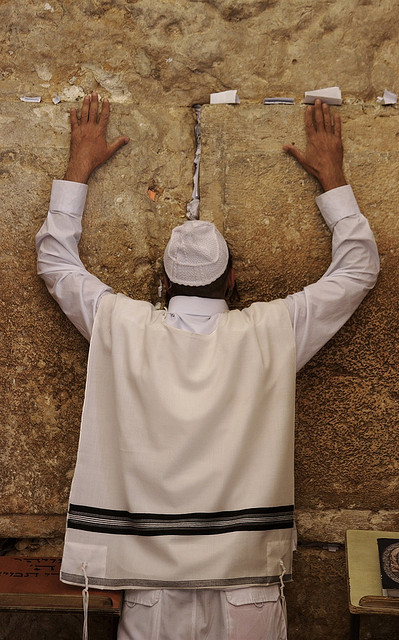
I will never live in Israel as a citizen, but someday before I die, I hope to visit and perhaps share in the experience of praying at the Kotel.