I rarely reblog what another blogger has written. It’s more typical for me to take source material and craft a commentary on my own blogspot. But in this case, I find what Dr. Hurtado has authored very much in keeping with the interests of those to regularly read what I craft here. Enjoy.
In this year’s Society of Biblical Literature annual meeting I took part in a session focused on the question of whether Paul believed that fellow Jews should put faith in Jesus. Three scholars gave three quite different views of the matter, and I was the designated respondent to their presentations. The textual focus was obviously Paul’s epistle to the Romans, chapters 9-11.
John Marshall (University of Toronto) contended that Paul’s promotion of faith-in-Jesus was solely intended for non-Jews (“Gentiles”). So he took Romans 10:9-13, where Paul urges confession of Jesus as “Lord” and faith that God has raised him from death, as having to do with Gentiles making these steps. Noting that Romans seems to have Gentile Jesus-followers (“Christians”) as the addressees (or at least the primary/main addressees), Marshall contended that this should dispose us to read such passages as really about Gentile believers. In Marshall’s view, Paul’s anxiety about…
I just returned from the Society of Biblical Literature conference in Atlanta and was flipping through a new book by James Dunn when I noticed the below discussion of Messianic Jews and footnote. Little by little, our little community is being recognized and appreciated.
-David Rudolph on Facebook
Although it’s more or less common for people writing from within the Messianic Jewish and Hebrew Roots movements to cite Christian scholarly sources, you don’t often find those sources acknowledging the existence, let alone referencing Messianic Judaism, and scholarly volumes written and edited by Messianic Jews. On the other hand, James D. G. Dunn has written on The New Perspective on Paul, so I would expect some overlap on viewpoint.
Today’s missive is intended to be brief. I just wanted to share this small mention of the Rudolph and Willitts volume in Dunn’s latest book, a volume which I reviewed in-depth (just search this blog for “Introduction to Messianic Judaism” to find all of my review articles).
Messianic Judaism is gaining some credibility, if not within the “average church,” then at least from one Christian scholar and researcher.
An atheist cannot find God for the same reason a thief cannot find a policeman.
-Anonymous
Before anyone becomes upset, I am not saying that atheists are thieves. The quote simply means that an atheist cannot find God, not only because he/she isn’t looking for Him, but also because they are actively avoiding Him, just like a thief would avoid a law enforcement officer.
But it’s an interesting comparison, because if a cop did find a thief in the act of committing a crime, the thief would be “busted.” Once the thief saw the police officer and knew he/she couldn’t get away, they’d be facing the consequences for their actions.
What happens when God “catches” an atheist? Well, this is where the metaphor starts to break down, because while God is aware of all human actions, we humans (and this is certainly true of atheists) aren’t always aware of God. Thus, although God sees our “crimes” (and any human action that opposes the will of God is the short definition of “sin,” which is analogous to “crime” in this example), we don’t see him “catching” us.
Rabbi Kalman Packouz posted the above-quoted sentence on this week’s Shabbat Shalom Weekly online column. He also said this:
Recently a friend of mine asked me, “Do you really believe in God?” When I answered “for sure” his response was “really?” Personally, I don’t find it particularly hard to believe that a rabbi believes in God. However, he seemed to be amazed that anyone believes in God.
In our experience at Aish HaTorah (a major international Jewish educational outreach organization), if you ask the young people who come through the doors of our world center in Jerusalem if they believe in God, four out of five will say “no.” What’s fascinating is that if you don’t ask the question directly, it’s possible to demonstrate to them that they do believe in God. Why? They are influenced by the society, the educational system and their friends to think that they don’t believe in God.
Do you want to demonstrate to someone that deep down they not only believe in God, but that they believe that God loves them? Here are the questions to ask…
I highly encourage you to click the link I provided above and read all of Rabbi Packouz’s discussion on how to illuminate anyone (or at least any secular Jew) to investigate their lack of belief in God. It’s really quite interesting (an equally enthralling question is if R. Packouz’s “method” were applied to non-Jews, would they become Noahides?). I’m not sure how it would play out for the rest of us, but on the surface, his arguments are compelling.
He finishes up his column with the following:
How can one intelligently deal with the question of the existence of God? Start on Aish.com and search the articles on “God” and “Evidence of God”. Go to AishAudio.com (search “evidence”) and listen to the four lectures “Evidence of God’s Existence” by Rav Noah Weinberg (the founder and head of Aish HaTorah and my teacher). Also, I highly recommend Permission to Believe by Lawrence Kelemen available at your local Jewish bookstore, at JudaicaEnterprises.com or by calling toll-free to 877-758-3242.
Credit: jewishvenice.org
I’m actually considering buying the Kelemen book (I’ve checked and it’s not available through my local library system), since it would be interesting to see how religious Jews reach out to secular Jews (besides the methods employed by Chabad).
It occurs to me that there’s a vacuum of this sort of information relative to Messianic Judaism.
Oh sure, Christianity’s efforts to evangelize the world are quite well known. If a traditional Christian wanted to know how to reach out to secular people in his/her community, all that person would have to do is approach their Pastor. I’m sure churches give classes on this sort of thing, and I know churches periodically organize their parishioners to canvas their local neighborhoods, knocking on doors, and handing out pamphlets.
But what does Messianic Judaism (and I’m using the term in the widest possible way) do to attract new members and to share their perspective on the “good news of Messiah?”
Just about anyone I’ve ever encountered, either within a Messianic Jewish (MJ) or Hebrew Roots (HR) environment, came to those venues by way of the Christian church. That is, whether they were Jew or Gentile, they first became a Christian and attended one or more churches before something happened to take them away from a particularly Christian viewpoint, and shifting them to a more Judaicly-aware perspective.
Oh, there may have been one or two exceptions, but I feel pretty confident, even based on anecdotal evidence, that most people, Jew and Gentile alike, come to a Judaic interpretation of all of the Bible, including the Apostolic Scriptures, only after converting to Christianity. I’m not saying that to be insulting. It just seems to best reflect the reality of how people come to the MJ or HR movements.
Of all of the resources available online and in brick-and-mortar stores, I can’t think of even one single book, audio, or video that teaches people like me how to share the message of Rav Yeshua (Jesus Christ) specifically from a Messianic Jewish perspective.
You may be wondering why some slight adaptation of traditional Christian evangelical methods couldn’t be used. However, Christians and religious Jews see the Bible, God, and faith in fundamentally different ways (Christians tend to be internally based, with their faith hinging on personal beliefs, while Jews tend to be externally based, with their faith being acted out through performance of the mitzvot). Messianic Judaism isn’t just Christianity wearing a kippah. It’s a Judaism that acknowledges the revelation of the Messiah as illustrated in the Apostolic Scriptures, and one that has an unusually liberal policy on Gentile admission.
With all that said, is it even possible to share a Messianic Jewish view of our Rav and what the Bible is saying about him and redemption directly with an atheist, or must Christianity and the Church always be the first step?
Actually some time ago, I thought I’d found one such resource. It was either a book or a lecture (or lecture series) on audio CD, but a Google search does nothing to find it. Maybe I was mistaken, or maybe whatever it was has leaked out of my memory for good.
Christians have a well-honed machine for evangelizing as many people as it can reach, and at least some corners of Orthodox Judaism understand how to communicate their faith to secular Jews, but what does Messianic Judaism bring to the table? Instead of appealing to Christians in churches to take a Messianic look at the Bible, at their faith, at their Christ, can they reach out to people who do not have faith at all?
Christians can (which is how I came to faith in the first place). Jews can (and I know of more than one religious Jew who started out as a secular adult, and then became religious). What about Messianic Judaism?
“When you awake in the morning, learn something to inspire you and mediate upon it, then plunge forward full of light with which to illuminate the darkness.”
-Rabbi Tzvi Freeman
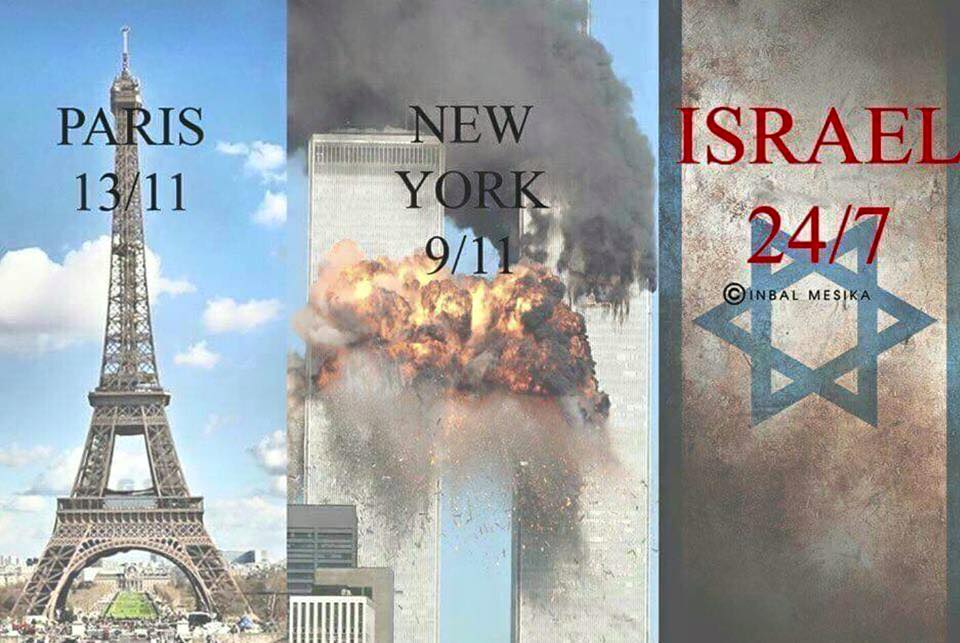
In the wake of the devastating Islamic terrorist attack on the city of Paris, I really wish I could “illuminate the darkness,” as Rabbi Freeman suggests. But all I can see is the encroachment of that darkness on our world, the coming of destruction, the advent of great evil.
Yesterday, I cried out how long, Moshiach…how long until you come? I know he heard. I know he will come. But how many more must suffer and die, how often must evil believe it has won because it stands unopposed, until Hashem has said it is enough, and the final war begins?
Insanity, from frivolity to massacre, rule our planet, and if I had to depend on the news media for my global view, I would believe there were no sane human beings left and that our world was already doomed.
And yet, these are the times when our faith is tested, when we have to face the question of whether God has abandoned us, or worse, that there is no God and we live in a universe where morality is always relative, and that one person’s terrorist is another person’s freedom fighter. Or can we believe that this too indicates the birth pangs of the Messiah must become ever more severe before the time of his return?
If we can sustain our faith, we will believe the latter.
I want to illuminate the darkness, to sweep away despair, to shine like a light on a hilltop, but frankly, I’m not that heroic. All I can do is keep slogging away, moving forward, hip deep in mud, doggedly determined, and hope and pray I can keep going until the great and terrible day of the Lord.
I pray that for us all. I pray that for Paris, for those who continue to suffer in the aftermath of September 11th, for those who suffer everyday in Israel at the hands of terrorists…at the hands of evil.
In a statement attributed to Edmund Burke, Charles F. Aked, and others, “the only thing necessary for the triumph of evil is that good men do nothing.”
I want to get political and say that the “good men” of our government habitually “do nothing,” but this war won’t be won by nations and political parties because it’s not a war of nationalities, but rather, of light vs. darkness, good vs. evil.
However, this isn’t to say we have no participation and that we must watch silently as this all plays out in the spiritual world. No, we are very much involved. People are dying. Our enemies are gloating. We must respond.
Credit: BBC News
But how?
Pray?
Yes, but as a meme I saw recently on the web stated, we must also be prepared for violence, and even for some of us, to do violence. Soldiers will fight in very human wars as they always have, and many more will die.
I don’t know what to do except what I am doing…writing. Pray for Paris, pray for the defeat of ISIS, but most of all, pray for the peace of Jerusalem. It’s not that God doesn’t weep for the people slain in France last Friday night, but we must admit that Israel, of all the nations, is at the center of His mind and heart and spirit. It is through the redemption of Israel that the rest of the nations will be redeemed.
It is in the war to defend Israel that Hashem, Master of Legions, will defeat all evil forever.
However horrible the terrorist attack against Paris is, it’s just another skirmish. The war is coming. We must be ready. We must be ready to give battle. We must be ready to be the light of the world. We must be the light of the world now, so the world, if it wills, will draw near the light of Moshiach, our master, our King.
He will prevail and in him, we will prevail as well. Indeed. We have already prevailed if we don’t wait for the peace of our Rav to come in the future but to seek it and embrace it now, even in the face of great adversity.
Rejoice in the Lord always; again I will say, rejoice! Let your gentle spirit be known to all men. The Lord is near. Be anxious for nothing, but in everything by prayer and supplication with thanksgiving let your requests be made known to God. And the peace of God, which surpasses all comprehension, will guard your hearts and your minds in Christ Jesus.
How could it possibly happen, that I, a regular shulgoer in the Orthodox world, would find myself behind the mechitza at a Shabbat service?
I was invited to the bat mitzvah of the daughter of a friend — but it was a bat mitzvah with a twist: the event, to be held in an Orthodox synagogue, was to feature a Shabbat morning women’s service. Nine men, period, were invited to participate (were there 10 men in the room, the service would, in accordance with the Orthodox rite, become the regular service, of men), and nine there were, including me.
-Jerome A. Chanes
“I Was Behind the Mechitza”
Special to The Jewish Week
A mechitza (Hebrew: מחיצה, partition or division, pl.: מחיצות, mechitzot) in Jewish Halakha is a partition, particularly one that is used to separate men and women. The rationale for a partition dividing men and women is given in the Babylonian Talmud (Sukkah 51b, 52a).
This article won’t make a lot of people happy and may even draw some ire from a few folks, but the question just popped into my head while I was reading Chanes’ article. You can click the links I’ve provided to find out more about the mechitza in general and why Chanes was behind the mechitza at an Orthodox synagogue in particular. In fact, I encourage you to do so.
Men and women are separated during services in Orthodox synagogues as a matter of modesty. A person commenting anonymously on Chanes’ article explained it this way:
Why deny men the right not to be distracted by women when they are praying? Hashem will not accept prayer from a man who is distracted by a woman.
The mechitza preserves the purity and sincerity of prayer to save us from our foes generation after generation. Also, the men are also separated from the women by the mechitza – it is 50/50.
Someone commenting on Facebook described it this way:
The idea of mechitza is not about denigrating women, it’s about separation. The synagogue is a place where we need to focus in G-d. Men and women sitting together is a distraction. There is also the Halacha of Kol Isha which would prohibit men from hearing women sing/lead services. Regarding the issue if women being called to the Torah, there is more a halachic reason to allow this than anything else the author brought up.
The reason women are not called up is because there was a time when it was denigrating to men if a woman was literate and able to say the brachot and a man was illiterate. In today’s world (IMHO) there’s more of a reason to allow women to the Torah than getting rid if the mechitza.
Then the justification for separating men and women is so they don’t distract one another during their prayers.
Many of you may disagree with this, but that’s the halachah in an Orthodox shul. It should be noted that not everyone likes this practice. For instance, one woman commenting on the article said:
The notion that if you care about prayer, the mechitza is a positive is absurd. I care about prayer and find it distracting to be behind the mechitza where my view is obstructed of the shaliach tzibur and in some cases, I have limited hearing of the prayers. The notion the idea that I am distracting some man from praying, so I need to be treated as a second-class citizen is patronizing. If some man can’t concentrate because there is a woman nearby than he needs to grow-up. Obviously, you have never had the ‘joy’ of being behind a mechitza where you can barely see and hear what is occurring.
However, another man commented:
Two years ago, I attended a similar service. As one of those nine men, I was also behind the mechitza and was shuffled in and out of the service to allow other men to participate, not allowing us to form a traditional minyan. It was certainly a different experience, but unlike the author, I left with a greater respect for the mechitza and had no issue whatsoever. I do not believe the Bat Mitzvah service would have been as meaningful for young woman and her guests with men intermingled. That would have been a “normal” Shabbat davening. This was truly unique and I was able to be happy for the family – from the back of the room with eight other men behind a partition.
I can only assume that under such circumstances in a synagogue, if a non-Jewish man was present, he would sit with the Jewish men and if a non-Jewish woman were present, she would sit with the Jewish women.
Credit: Lilith.org
But what about when large numbers of non-Jews are present in a Messianic Jewish synagogue that is styled on Orthodox praxis? Messianic Judaism tends to be egalitarian but not absolutely so. And in an effort to create a more us not them relationship between Messianic Judaism and the normative Judaisms, including the Orthodox, I can see some justification for at least a few Messianic Jewish synagogues following the halachah of mechitza.
But it also occurs to me that, given the differences in status and role between Jews and Gentiles in a Jewish communal and worship space, would there be some justification from putting non-Jews behind their/our own mechitza too (I told you that you wouldn’t like this)? I suppose for this to work, there’s really have to be four separated areas:
Jewish men
Jewish women
Gentile men
Gentile women
That’s a complicated pattern of division for a single room and I’m not sure how it could be accomplished. It doesn’t seem very practical.
There’s no indication one way or the other to say that Gentiles were or weren’t separated from Jews during worship in the congregations Paul created. In fact we do know that Paul publicly opposed Peter for refusing to eat with Gentiles (see Galatians 2:11-14), so this could suggest that the Apostle to the Goyim expected mixed worship as well.
In his article, Chanes states that there is no mention of the use of a mechitza to separate men and women in Biblical and early Rabbinic literature, so it’s possible that Jewish men and women prayed and worshiped together in ancient (Biblical) times. This perhaps could bolster the idea that when non-Jews were admitted into ancient (Messianic) Jewish space, they also “mixed in” or at least took the last three (or so) rows of seats in the back of the synagogue, but not behind a barrier.
Then again, in the days of Herod’s Temple, there was a court for the (Jewish) women and a court of the Gentiles, and non-Jews were forbidden to go beyond the Soreg.
But those barriers were put in place to preserve the sanctity of the Temple and to ensure ritual purity. Those practices may not, at least back then, have been also transferred to the synagogue.
But that was then and this is now. Twenty centuries or so of halachah have been developed and we have a very different Jewish praxis today, especially relative to different branches of Judaism (and even Messianic Judaism has numerous different expressions within it). We can’t really ignore that body of history or practice, and I think it behooves us to at least consider it’s impact on the praxis of the Messianic Jewish community, one that is “Orthodox” and also accepts non-Jews as associate members.
I realize that I’m making a much bigger deal of this than it actually is. To the best of my knowledge, no synagogue or congregation that calls itself Messianic practices separation of Jew and Gentile. I’m not even sure that there are any Messianic shuls that make use of the mechitza and separate men and women, though, of course, my knowledge of such communities is very limited.
Credit: pardes.org
I’m throwing this out there more as food for thought and I’m not representing any definite position about the use or non-use of the mechitza as applied to women or to non-Jews.
However, if Messianic Judaism’s practice and halachah continues to transition more toward normative, 21st century Judaism, we have to consider how such practices and traditions will be applied in a form of Judaism which (potentially) has rather liberal policies regarding Gentile admission.
Oh, just for context, I thought I’d include a link to a small satirical article called Open orthodox Shul allows frummies to sit behind second taller mechitza. As you’ll see when you read it, there’s quite a bit of variance to be found in how the mechitza should be applied, depending on who you are.
"When you awake in the morning, learn something to inspire you and mediate upon it, then plunge forward full of light with which to illuminate the darkness." -Rabbi Tzvi Freeman