

“They didn’t want to talk about it.”
“They said there’s really no point in meeting to discuss it.”
“I guess it’s best if we just move on.”
-Pastor Chris Jackson
from Chapter 9: Your Pastor
Loving God When You Don’t Love the Church: Opening the Door to Healing (Kindle Edition)
Continued from Part Four of this review.
Pastor Jackson attributes the above quoted statements to “hurting church members who failed in their attempts to discuss their grievances with the church’s leadership.” Jackson further states that people typically don’t experience conflict with other church members but “with the leadership of the church.”
I suppose that’s what happened to me. My relationship with the church’s head Pastor reached a tipping point when, in a sermon, he discounted the foundations of my understanding of the Bible, calling it a “misuse of the Law.” He also laid that at the feet of more normative Judaism as well as Seventh Day Adventists, so it wasn’t solely aimed at me.
As far as airing my grievances, I did that. I made the mistake of doing so on my blog instead of phoning or meeting with the Pastor, and that just made a difficult situation even worse. I left the church not because I had been kicked out, and not because I was so offended, I left in a huff, but because I was incompatible with church and particularly with the church leadership. I don’t think anyone was sorry to see me go.
The next highlight I have in this chapter is Jackson citing the film adaptation of C.S. Lewis’s The Lion, the Witch and the Wardrobe in which the fox says of Aslan:
“He’s everything we hoped he would be.”
Jackson continues:
Unfortunately, the opposite of this sentiment is sometimes true in church.
We all have expectations of those around us. If people were truly unpredictable, our lives would be chaos. We couldn’t make plans with anyone. We have to have some sort of grasp of how our families and friends and the leaders and people in our houses of worship will react under certain circumstances.
I think a Pastor and church leadership have a certain expectation of what a person believes and stands for if they voluntarily attend their church week after week. If we choose a church or other sort of congregation, we probably do so because we expect that the leaders and members of the church think, believe, teach, and act in a certain way. It would be tough to drop a Messianic Gentile like me in the midst of a Fundamentalist Baptist church in Southwestern Idaho.
Oops.
But since this is a chapter on Pastors, let me be quick to say that none of my leaving church was the leadership’s fault. They were behaving and teaching as was expected by the vast majority of the people attending that church. I was the square peg vainly attempting to fit into a round hole, or conversely, trying to convince the round pegs to at least consider the benefits of thinking and studying like square pegs.
Ah, this next point is important:
What do good spiritual leaders look like? Spiritual leaders are very important for our spiritual growth and maturity so it’s important for us to know what to look for in one. I’m very selective and protective about the people I let speak to my wife…
 What I’m about to say wasn’t exactly Jackson’s point, but it relates. One of a Pastor’s jobs is to protect the flock from wolves. In spite of the fact that Randy spent nearly two years meeting with me individually and attempting to convince me of the correctness of his “sound doctrine,” in the end, I was a rogue wolf in the fold.
After a number of discussions with a young man in the Sunday school class we attended, I suggested he borrow my audio CDs of D. Thomas Lancaster’s sermon series What About the New Covenant. He did. He listened to them. He seemed at least confused if not shocked. He asked to keep them a while longer so he could listen to the lessons again.
And when the Pastor found out about it, he was pretty unhappy with me. Based on our reading and discussing Lancaster’s book The Holy Epistle to the Galatians together, Pastor came to the realization that he disagreed with Lancaster on just about everything. So my lending one of his flock CDs containing Lancaster’s teachings (even though Pastor had never listened to those sermons) exposed that particular “sheep” to “danger.”
As much as I disagree with his opinions on Lancaster, Pastor’s doing his job. He’s protecting the flock.
Jackson, in describing the ideal Pastor says, “First of all, he loves you.” Yes, the Pastor loves his flock and out of that love (just as Jackson loves his wife), he’s protective and will defend them.
Jackson’s point in mentioning this love is that it’s healing. A hurting believer having the Pastor notice and love them will help heal that hurt. But going back to what I said earlier, the basic theology and doctrine of Pastor and church goer must be what the other expects and desires.
Jackson also describes the ideal Pastor as transparent. He must be approachable and human rather than someone who dwells on high in an ivory tower dispensing holy decrees. Yes, Pastor was approachable and probably as transparent as a human being can be and still have healthy boundaries. I wouldn’t say he was nonjudgmental, as Jackson would have us believe of ideal Pastors. Not that he beat people over the head with his Bible, but he definitely had a firm sense of right and wrong doctrine, and he stuck to his guns.
An ideal Pastor, according to Jackson, “sees the greatness in you.” I think Pastor saw potential in me, but doing anything about it was contingent upon being convinced of his “sound doctrine” so that I’d be safe within the fold. So although Jackson says the ideal Pastor is not controlling, it’s tough to exercise your role as protective shepherd without maintaining control of who has access to them and under what conditions.
This next statement I thought was a bit over the top:
When he speaks, it is as if God Himself was speaking to you.
I think Jackson means the ideal Pastor is “Christ-like” in his love, compassion, and understanding of the people in his flock, not that he’s all-seeing, all-knowing, and commands one hundred percent of everyone’s respect and obedience.
That said:
…there is no human leader who can fully provide all that we need as growing disciples of Jesus. We need Him.
“Him,” in this context, is God.
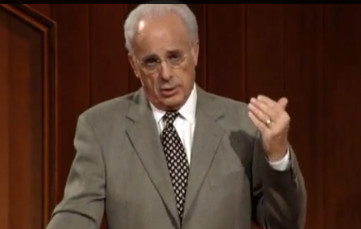
And so Jackson urges his readers to realize that Pastors are also human, what he calls “tools of destiny,” and he wants us to know that someday, some of us may be in church leadership, which will further help us understand the responsibilities faced by our Pastors. Jackson also said that, given this, he urges reconciliation with church leaders when there’s a problem, and outlines the steps for his readers. Ultimately, it’s a call to forgive leaders who may have hurt us. Just for giggles, I included a photo of John MacArthur because to me, he exemplifies the sort of Pastor who generates a lot of “hurt” among people. But that’s just my opinion. What do you do when a well-known and influential Pastor has the ability to potentially hurt thousands?
The only end of chapter question I have highlighted is:
Are you looking for them (church leaders) to provide something that can only come from Jesus?
At this stage in the game, I don’t think I’m looking for a church Pastor to provide anything at all. How can they when my presence in almost any church (at least if I opened my mouth) would be a monkey wrench in the machinery?
In Chapter 11: The Cup of Misunderstanding (sounds like a little-known additional cup at a Passover seder), Jackson speaks of this metaphorical cup containing something that tastes bitter, tastes like injustice, and “those who drink it must do so alone.” He also says that this cup is usually received by “innocent people,” and is particularly harsh when “delivered to you by a brother or sister in Christ.”
Jackson compares being misunderstood and judged by someone in the church to the pain of betrayal suffered by Christ at the crucifixion.
I felt the comparison was a bit much. After all, human misunderstandings aren’t confined to the church, they happen in every human corporate venue, from the family to the workplace.
Jackson says this pain is intensified if the person you are trying to reconcile with makes it abundantly clear they have no intention of mending fences.
Someone once said, “You must embrace the cross if you would carry it with dignity.” The same is true of this cup.
I think what Jackson is saying is that being misunderstood, judged, and cut loose requires the Christian to be “Christ-like,” to bear the burden and the pain as Jesus did on the cross. Sounds pretty dramatic, but then, human conflict can elicit a lot of drama.
One of the end of chapter questions is:
Do you have a friend who can stand with you in your struggle?
In spite of my friend’s concerns about me and the issues Jackson addresses in his book, I don’t know that I’m really struggling, at least in relation to community or my lack thereof.
Jackson asks: “Are you passing the test? As you do, you’ll begin to look more like Him.” If the test is forgiving the Pastor, first of all, I doubt he thinks he needs my forgiveness. Nevertheless, I have forgiven him. After all, he’s only doing what he believes is right, and within his church’s context, it is the right thing to do.
In Chapter 12: Death by Religion, Jackson discusses watching an infomercial for Chuck Norris’s Total Gym product. The bottom line is that in spite of the seemingly fantastic claims made in the marketing of this all-in-one piece of exercise equipment, Jackson says if used as indicated, and if you eat a proper diet, the claims are all true.
Please forgive this sacrilegious comment, but I’ve noticed that in some ways, the Church is a lot like that infomercial–we’re touting a product that really works.
And by that he means:
A life devoted to His service is the only way to ensure our eternal salvation and to experience the life we were created to live.
 But while a very fit Chuck Norris and Christie Brinkley sell their product on TV, Jackson says, by comparison, those Christians promoting a better life through Jesus are more like “a flabby, middle-aged guy who thinks he looks good in spandex.”
In other words, many believers promoting a better life through Christ don’t look or act like they’re participating in that life. They look like they’re participating in a marathon dining session at McDonald’s.
We’re selling relationship, but what they see is religion…and religion is killing our sales pitch.
I’ve mentioned this artificial split between these concepts in a previous blog post. It’s really the traditional Christian rant against their misconception of Judaism:
Religion breeds death because it is limited to man’s ability to comply with its codes and regulations.
If Jackson had my understanding of the New Covenant, he’d (hopefully) understand why his opinion is completely out of the ball park.
But I don’t have time or space to go into all that again in this rather lengthy series of book reviews.
Religion is easier to control than a relationship.
You may have noticed that Jackson has shifted his emphasis from the individual’s relationship with other Christians in church or their relationship with the Pastor and church leadership, and is now focusing on the person’s relationship with Christ.
…after all, we’re all under grace and God doesn’t get ticked if we skip a day of devotions.
I’m not sure what God does or doesn’t think about an individual being hit and miss on living a life of holiness, not that any one of us is perfect at it.
Jackson then proceeds to bash the Pharisees, even though (he probably doesn’t see this) Jesus lived a life consistent with the basic tenets of Pharisaism, and as a matter of fact, so did Paul.
In describing “religious systems,” he says they operate like “spiritual frat houses”. They have their secret handshakes, inside jokes, matching jackets, and the like. Yes, I’ve experienced cliques in church. People who were ‘in’ and people who were ‘out’, though to be fair, I didn’t experience them at the last church I attended (at least for the most part).
However, Jackson could have been describing how some people experience certain individuals and congregations involved in the Hebrew Roots and the Messianic Jewish movements.
I’ve mentioned before Derek Leman’s blog post Gentiles Who Feel Left Out which addresses this matter. If you feel you are “in”, then being in contributes to your sense of identity, according to Jackson. You may, again, as Jackson says, experience a sense of being among the elite by being in.
This next point is important:
Spiritual fraternities do not welcome different opinions or viewpoints.
I’ve experienced that in spades, but I think that a lot of religious communities are like this, based on a mutually accepted sense of “rightness” of their doctrine. Anything that contradicts their doctrine is automatically wrong. These congregations state, using Jackson’s words:
We want your input and opinions–as long as they agree with ours.
This goes back to what I said before about expectations within the group. Jackson also says such “frat houses” are full of cliques, difficult to fit into (again, I know what that’s like), and Jackson says the only way to combat this is to “make sure that our hearts are free from religion.”
And yet, I could probably speak to Jackson for less than an hour and elicit a very protective and “religious” (as he defines it) response from him, just by disagreeing with how he interprets the Bible’s message of the good news. Actually, all he’d have to do is read my reviews of his book.
Only two of the end of chapter questions seemed relevant:
Are you managing a religion or living in a relationship?
Has your religious experience become a duty or a delight?
 Convincing Jackson of the beauty of the mitzvot, particularly with Passover and the family seder coming up in a few days, all the preparations, all of the ceremony, and the retelling of the Exodus, would be a lost cause if I were to make the attempt. I suspect all he’d see is “religion,” missing how the seder brings a Jewish family closer to God.
Of course, I wonder how he’s managing the “relationship” of the upcoming Easter Sunday service at his church, which usually involves a multi-media presentation and tons and tons of preparation and ceremony?
So far, having reviewed about half of Jackson’s book in a fair amount detail, I have two preliminary conclusions. The first is that I don’t think he’s speaking to my situation. The second is that my opinion of my being incompatible with “church” is being re-enforced. I find it impossible to review his book as related to my current status of being apart from “community” without being critical of his theology and doctrine.
I just can’t seem to put our obvious differences aside and simply listen to what he has to say on a human level. This is my fault. I have a friend who tells me I need to be more patient and to speak out less.
Probably true.
One last story.
I had coffee with my friend last Sunday. On the drive home, he mentioned that his congregation had a guest speaker from Africa on the previous Shabbat. Among other things, this speaker talked about lions and how they hunt only the sick, the weak, the old, and those who wander off and are alone.
Not-so-subtle point received, my friend. *grin*



















 Morning Meditations