Category Archives: Uncategorized

Questioning Paul

Read today’s article, where you, in part, again defend Paul. Obviously, I have to come to read him very differently and would like to run something by you. Can you give me your thoughts on the following words of Paul, namely in Galatians 4:21-26 (and a bit beyond, in Galatians 5-1)?

“21 Tell me, you who want to be under law, do you not listen to the law? 22 For it is written that Abraham had two sons, one by the bondwoman and one by the free woman. 23 But the son by the bondwoman was born according to the flesh, and the son by the free woman through the promise. 24 This is allegorically speaking, for these women are two covenantsone proceeding from Mount Sinai bearing children WHO ARE TO BE SLAVES; she is Hagar. 25 Now this Hagar is Mount Sinai in Arabia and corresponds to the present Jerusalem, for she is in slavery with her children26 But the Jerusalem above is free; she is our mother. “

“It was for freedom that Christ set us free; therefore keep standing firm and do not be subject again to a yoke of slavery.” (Galatians 5-1)

Here Paul, although supposedly speaking figuratively, plainly says that the covenant on Mount Sinai produced slaves (even though the opposite actually happened there – Jews were freed from slavery there, becoming servants of G-d). According to Paul, Jews who are still bound by Torah and the Mosaic covenant are not the spiritual children, but the children of the flesh and are born not of Sarah, but of Hagar. Christians (primarily his Gentile audience), however, are Sarah’s true children, who are free. Following Torah as given on Mount Sinai, according to Paul, is a yoke of slavery from which Christ came to set humanity free (Galatians 5-1).

Would love to hear what you thought of the above. May be the billions of Christians over the many centuries didn’t misread Paul after all but received much of their view of Judaism from him?

-from a private email discussion

There’s a lot more to this conversation. For a little background, the person asking the above-quoted questions is a Jewish friend of mine who believes that Paul was anti-Torah and anti-Judaism.  He very gently but firmly is questioning my faith and our exchange, from my point of view, has reached something of an impasse. Not being a theologian or a historian, especially within the context of Messianic Judaism, I don’t always have all the convenient answers at my fingertips.

A “normative” (i.e. not Messianic) Jewish person has a wide variety of resources to draw from, such as Jews for Judaism, in questioning the validity of the “Christian texts,” while in response, all I’ve got is me.

For obvious reasons (obvious to my regular readership), I can’t really rely on traditional, Evangelical Christian apologetics, since I’m often a critic of Evangelical Christian theology.

To add a bit of dimension, where I “stalled” in the conversation, my friend questioned whether one could look at Paul’s letters in the same fashion as the writings of Moses. Moses received direct revelation from God while Paul was writing letters. Can his letters be elevated to the point of scripture inspired by the Holy Spirit? Moses knew he was recording the thoughts of God. Could Paul have imagined that his letters would also be included in canon?

In the body of believers, we tend to see deep theological meaning in Paul’s letters. Further, we (or at least I) believe that there are messages “encoded” within said-letters that are difficult to understand without a “Rabbinic” comprehension of the text. Scholars such as Mark Nanos and Roy Blizzard have written erudite works unpackaging the “hidden” meanings within Paul’s writing. But the Sages in more normative Judaism across the long centuries and into the modern era, reading the letters of Paul from a Rabbinic perspective, see nothing but a condemnation of Jewish people and Judaism in Paul’s writings. If Paul’s letters are so “Jewish” that most Christians don’t “get” Paul, why don’t most Jewish sages “get” Paul the way we do when peering through a Messianic Jewish lens?

The Jewish PaulIn line with the above, I’ve attempted to answer the “Hagar and Sarah” question with my own commentary based on Ariel Berkowitz’s paper A Torah-Positive Summary of Sha’ul’s Letter to the Galatians. However my explanation of more hidden meanings doesn’t seem to pass the “pshat test,” whereby the plain meaning of the text is still the primary meaning, even if there are other more hidden and even mystic meanings contained within.

Finally, many if not most of Paul’s letters were written to a primarily Gentile audience, with many or most of them having limited literacy (according to my source) and for those fresh out of paganism, virtually no apprehension of Judaism, Jewish thought, Hebrew idiom and word play, and Jewish symbolism. If Paul were writing to a bunch of Rabbis or other learned Jews, we could understand Paul crafting letters with great amounts of complicated theological detail, but wasn’t he trying to get his ideas across to mostly common Greek-speaking people?

It’s possible that no one can answer these questions or at least that no one will be willing to answer these questions on my blog, so I may continue to be stuck until subsequent investigation (which experience tells me could be months or years) helps me to understand where the answers lie (or, Heaven forbid, that there are no answers to give to my Jewish friend). I should say that my primary goal isn’t to “convert” him or otherwise convince him to become “Messianic.” My goal is to show why any intelligent and reasonable person could accept the writings in what the Church calls “the New Testament” as scripture at all and why we would go jumping through all of the hoops we have been in order to refactor Paul as pro-Torah and pro-Judaism after nearly two-thousand years of Church doctrine has been teaching the exact opposite?

I plan to put links to this blog post in the relevant groups in both Facebook and Google+. I’d like to encourage the readers there to post your responses here so my friend (and any other interested parties) can read them. If they’re “trapped” in closed groups on either of those social networking platforms, then they will not be available for my audience here.

Thank you.

Hurtado, Wright, and the Significance of Israel

In this posting I query another of Tom Wright’s major emphases in his mammoth new work, Paul and the Faithfulness of God. This concerns his emphatic view that in Paul’s view ”Israel” becomes effectively the church, or more specifically becomes simply all those who put faith in Jesus.

-Larry Hurtado
“‘Israel’ and the People of God: Wright & Response”
from Larry Hurtado’s Blog

For those of you who don’t know, Larry Hurtado is a scholar of the New Testament and Christian origins with quite a number of published works to his name. I follow his blog because I find his research and insights into the early church to be interesting and informative.

How Hurtado started commenting on Wright’s latest book is as follows:

Late in 2013 I was asked by the journal, “Theology,” to review N.T. (Tom) Wright’s then-forthcoming book on Paul. As I am committed to preparing an essay on Paul for a conference in Rome in June this year, I agreed. A few days later a huge parcel arrived for me, and upon opening it I found that I had agreed to read/review a work of two volumes comprising over 1600 pages! I’ve sent off the review now, and it’s been accepted for publication in due course. But, even with the special generosity of the editors, I had to confine the review to 1800 words, which required brevity and a selection of things to mention. I have more to say about the work, however, and so in this and subsequent postings will give some further observations and thoughts beyond what I was able to include in the “Theology” review.

Hurtado has written a small series of blog posts thus far, reviewing different aspects of Wright’s tome (and at 1600 pages, it can correctly be referred to as a tome).

This morning, Derek Leman wrote a brief blog post regarding “Hurtado’s critique of Wright’s low view of the Jewish people,” but I felt there were a few more things that could be said.

The first is that N.T. Wright is a well-known and read scholar and author, and I find his perpetuating Christian supersessionism (also known as “replacement theology” or “fulfillment theology”) by replacing Israel with “the Church” to be at least disturbing if not completely offensive. Not that Wright is trying to be offensive. He’s being honest within the context of his understanding and convictions. I just happen to believe he’s wrong and I’m gratified that a scholar of Hurtado’s stature is willing to challenge Wright’s low view of Judaism on his blog.

But Hurtado said something else in last Sunday’s blog post:

But (as I see it) Paul did continue to see the family of Abraham, the full company of the redeemed, as comprised of believing Jews (such as himself) who remained Jews, and gentiles who remained gentiles. To be sure, their respective identities were to have no negative impact upon accepting one another, for they were all “one in Christ Jesus” (Gal. 3:28). But along with that oneness there remained (for Paul) the significance of “Israel” as fellow Jews, who were (as he saw it) heirs of divine promises (Rom 9:4-5). Although at present, most of his fellow Jews were “enemies” (so far as concerns the gospel), they were, nevertheless, “beloved” by God, whose gifts and calling were irrevocable (11:28-29).

I hope you read that quote carefully. In the realm of Messianic Judaism in its various expressions, it is generally affirmed that Jews and Gentiles in Messiah are united and yet remain distinct identities, each possessing unique (though somewhat overlapping) responsibilities to God. Jews in Messiah are still Jews and Gentiles in Messiah are still Gentiles, though all are “one” in God’s love, in the promises of salvation, and participation in the Messianic Kingdom.

Larry Hurtado
Larry Hurtado

Larry Hurtado is a Christian scholar of early Christianity, not a “Messianic”. And yet we see him stating something that is quite familiar to those of us who are affiliated with or otherwise “friends” of the Messianic Jewish movement. And this isn’t the first time. I’ve mentioned before, primarily in Larry Hurtado on ‘A Muslim Reads Galatians’ and Jewish Identity in the Way, that Hurtado is associated with supporting the continuation of Jewish identity and Torah observance among the early Jewish disciples of Jesus.

Today, the typical “Christian on the street” (so to speak) takes it completely for granted that when Jews came to Christ, they stopped being Jewish (or at least stopped behaving “Jewish”) and converted to Christianity. I don’t doubt that the vast majority of Evangelicals truly believe Paul preached a “Law-free” gospel of Christ and that the Jewish believers were no longer “under the Law.”

But the Christian on the street, that is, the average man or women in a church pew on Sunday morning, most likely doesn’t keep up with current Christian scholarship, nor are they aware that there are bodies of Christian scholars who disagree with each other and strongly debate key principles of Christian theology and doctrine. It is more comforting for traditional church goers to believe that everything is settled and has been for many centuries. Christianity is what it is. All the questions have long since been answered. There are no mysteries. Sunday school is merely to discuss what everybody already knows (except perhaps the “baby Christian” who has just come to faith). Even seasoned Pastors tend to believe that, though their knowledge base is usually much broader than that possessed by their flocks.

The implication of Hurtado’s statements upon Messianic Judaism is interesting and encouraging. In Messianic Judaism and the somewhat related movement of Hebrew Roots, we talk to ourselves all of the time about the Torah not being “dead” or “nailed to the cross” with Jesus. We talk (and sometimes argue) about Jewish distinctiveness and uniqueness of obligation within the wider Messianic body.

But having a conversation with yourself isn’t very illuminating and that dialogue most often stays within our particular silos, rarely escaping into normative Christianity (or Judaism), at least in a form that can be heard or accepted by those groups.

So when a Christian and not Messianic scholar and author such as Hurtado can independently study the Bible and arrive at a conclusion which states “Jews who remained Jews, and gentiles who remained gentiles” and yet “they were all ‘one in Christ Jesus'”, it is remarkable. The significance of Israel as Israel remained in the Apostolic Era, and even unbelieving Jews were considered beloved by God and possessing gifts and a calling that are irrevocable.

One Caveat to consider is that Hurtado is defining Paul’s perspective not necessarily his own. But if this is indeed how Paul saw things (and I think it likely), then Paul, the author of much of what we think of as early Christian theology and doctrine, was setting the pattern for how we Christian (Gentile) believers should understand ourselves in relation to the Jewish people and Israel.

It’s pretty hard to ignore Paul and still call yourself a Christian.

Review of “What About the New Covenant,” Part 1

“I will make a new covenant with the house of Israel and with the house of Judah.”

Jeremiah 31:31

Does the New Covenant really replace the Old Covenant? Christian replacement theology is solidly based on a misunderstanding of the meaning of the new covenant. The church teaches that the new covenant cancels the Torah and God’s covenant with the Jewish people.

Messianic Judaism teaches that Yeshua did not abolish the Torah, but if that’s true, what about the new covenant? Doesn’t the new covenant of grace and faith replace the old covenant of works and law? In five engaging lectures, Torah Club author D. Thomas Lancaster digs into the Bible’s prophecies to dispel many of the common myths and misunderstandings about the new covenant.

-from the First Fruits of Zion (FFOZ) webpage for the
What About the New Covenant sermon series

Introduction to the Series

About eighteen months ago, I began my personal investigation of the covenants in an attempt to understand how Gentiles (including me) were able to have a covenantal relationship with God without converting to Judaism. This investigation resulted in an eleven (twelve, really) part blog series I euphemistically called “The Jesus Covenant” which I started here. It took over six months of study and anguish, but I finally arrived at a place where I could be at peace about where I fit in the New Covenant as a Gentile.

When I received the five-part audio CD lecture series called “What About the New Covenant” from FFOZ in the mail several days ago, I was interested in how my discoveries and conclusions map to those of theologian and teacher D. Thomas Lancaster. Was I completely off base or would Lancaster confirm that I am standing on solid, Biblical ground as far as my understanding of the covenants, and especially the New Covenant?

The material on this set of audio discs is repurposed from several sources, including parts of Lancaster’s Holy Epistle to the Hebrews sermon series, FFOZ’s Torah Club Volume 5: Depths of the Torah, and Lesson 3 from FFOZ’s HaYesod Program.

That said, organization and presentation of this information is completely new, and these teachings, once “trapped” within much larger tomes and recordings, have been “freed” so we can access specifically what Messianic Judaism teaches about the New Covenant. One caveat: this is Messianic Judaism as First Fruits of Zion sees, understands, and practices it. I should emphasize like any other Judaism or any other Christianity for that matter, Messianic Judaism isn’t a single, monolithic entity and opinions among the various groups may differ somewhat.

Session One: The Covenant Maker

The first session is nearly fifty minutes long and as you might imagine, is pregnant with both amount and depth of information. Here, Lancaster takes his listeners on a grand tour of all of the covenants God made with humanity and Israel (all of the covenants except the Noahide covenant were made with Israel) and attempts to answer the all important question, “What is a Covenant?”

A good question has a long afterlife.

-Ismar Schorsch
“What Do I Look at When I Pray?” (pg 382)
Commentary on Torah Portion Shemini
from his book Canon Without Closure: Torah Commentaries

It’s true, we don’t really understand what “covenant” means in our world today. The only covenant we have left in modern times is the marriage covenant, and even that one has been nearly destroyed by our lack of understanding of the binding nature of covenants. If we did understand, divorce wouldn’t be such an epidemic, at least among the faithful.

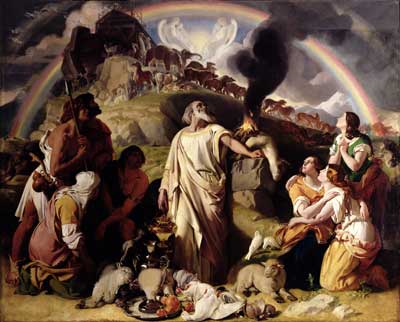
noah-rainbowI mentioned the Noahide covenant that God made with all life, including all of humanity. God created a set of obligations for humanity and in exchange for obedience, God promised not to destroy the world again by flood. The sign of this covenant is the rainbow we periodically see in the sky (see Genesis 9 for details).

But it’s not until Lancaster begins talking about the covenant God made with Abraham and all of Abraham’s descendants through Isaac and Jacob, the Jewish people, that we begin to understand the nature of this covenant and all the covenants to follow.

The first big point to get is that all subsequent covenants build on prior covenants rather than replacing them. In fact, this is really important for ancient and modern Israel because whenever Israel violated the covenant made with God at Sinai (such as the incident of the Golden Calf recorded in Exodus 32), it was God’s promises made in the Abrahamic covenant that allowed Him to repeatedly redeem Israel. You might want to review God’s promises to Abraham and his descendants by looking at Gen. 12:1-3, 7, and 22:18. You’ll also see this covenant being inherited by Abraham’s son Isaac in Gen. 22:18.

Interestingly enough, although it is commonly believed that Abraham had no obligations he had to fulfill apart from participating in the sign of this covenant, which was circumcision for himself and all the male members of his household, this is not actually true. Abraham was required to have a lived-out faith that God periodically tested. And the results of those tests really, really mattered.

The angel of the Lord called to Abraham a second time from heaven, and said, “By myself I have sworn, says the Lord: Because you have done this, and have not withheld your son, your only son, I will indeed bless you, and I will make your offspring as numerous as the stars of heaven and as the sand that is on the seashore. And your offspring shall possess the gate of their enemies, and by your offspring shall all the nations of the earth gain blessing for themselves, because you have obeyed my voice.”

Genesis 22:15-18 (NRSV)

Abraham and the starsGod said “Because you have done this…I will indeed bless you, and I will make your offspring as numerous as the stars of heaven.” These are conditions. You did this and in response, I will do that. Abraham had to demonstrate perpetual fidelity to God by faith, trust, and obedience, and doing so, God responded by fulfilling the covenant promises He made to Abraham and his descendants.

It is the same for us as James, the brother of the Master famously wrote in James 2:14-26. Lancaster says we are justified by faith and works, which is a rather radical thought in traditional Christianity, but as you’ll discover, his presentation of covenants including the New Covenant, is also not the “norm” from an Evangelical perspective.

As a side note relevant to justification and deeds, see Derek Leman’s blog post Our Deeds are Not Filthy Rags.

As far as the “duration” of the Abrahamic covenant, according to the Apostle Paul:

Brothers and sisters, I give an example from daily life: once a person’s will has been ratified, no one adds to it or annuls it. Now the promises were made to Abraham and to his offspring; it does not say, “And to offsprings,” as of many; but it says, “And to your offspring,” that is, to one person, who is Christ. My point is this: the law, which came four hundred thirty years later, does not annul a covenant previously ratified by God, so as to nullify the promise.

Galatians 3:15-17 (NRSV)

In other words, later covenants do not get rid of, annul, cancel, or make obsolete earlier covenants. In addressing the covenant God made with Abraham, Paul says it’s forever. A later covenant can only ratify an earlier one, not abolish it.

Lancaster spends some time on the Mosaic covenant, the covenant God made with the Children of Israel, that is, Abraham’s, Isaac’s, and Jacob’s descendants, at Sinai. One important point he makes is that this later covenant builds on the earlier one and in fact, the making of this covenant actually fulfills sections of the earlier, Abrahamic covenant. One example is the continuation of the promises that Abraham’s descendents would possess the Land of Israel, cementing this promise by establishing the laws specific to the Jewish people living in that Land.

Another important issue Lancaster brought up is the difference between the covenant and the Law. The Torah is not the Sinai covenant, it represents the conditions of the covenant, defining the responsibilities of each party: God and the Children of Israel. It also defines the sign of the covenant which is the Shabbat.

This sign is unique in that it is not a manifestation in nature, such as the rainbow, or a physical condition or procedure, such as circumcision. Shabbat is an “island in time” or, as Lancaster quotes Abraham Joshua Heschel, “a sanctuary in time.”

Therefore the Israelites shall keep the sabbath, observing the sabbath throughout their generations, as a perpetual covenant. It is a sign forever… (emph. mine)

Exodus 31:16-17 (NRSV)

Notice that the Sinai covenant and its sign are forever and perpetual. No exchanges or replacements allowed.

As I mention above, whenever Israel disobeyed the conditions of the Sinai covenant, according to those conditions, God punished Israel. There is no provision in the covenant for its annulment. All covenants God made with Israel are forever. Is that clear?

King DavidLancaster moved on to describe the Aaronic covenant, which is the promise that Aaron’s descendants will always be High Priests, and the Davidic covenant that states David’s descendants will be Kings over Israel. The conditions state that should a King disobey, he would be disciplined, but God would not remove his love from the Davidic dynasty (see 2 Samuel 7). The Davidic covenant is also the hope of the Messiah, for a sinless King must rule one day over Israel, that is, King Messiah.

So far, all of these covenants are built one on top of the other. Each later covenant expands upon the previous covenant in some way. But what about the New Covenant?

First, let me, thanks to Lancaster (though I knew this already), relieve you of a burden. The New Testament, that is the collection of scriptures from Matthew through Revelation, does not equal the New Covenant. I heard a highly intelligent, well-educated, and abundantly accomplished Pastor tell me once that the New Testament is the same thing as the New Covenant and I almost fell out of my chair.

According to Lancaster (and I agree with him), the New Testament is a collection of scriptures that record how Yeshua (Jesus) initiated some of the conditions of the New Covenant, but it is not the covenant itself. Lancaster (and again, I agree) says that the New Testament would be better named “The Apostolic Writings” or “The Apostolic Scriptures”. Just as the Torah is not the Sinai (or “Old”) Covenant, neither is the “New Testament” the New Covenant.

So where do we find the New Covenant? It’s all over the Torah, the Prophets, and the Writings, but as you hopefully already know, the key scriptures are these:

The days are surely coming, says the Lord, when I will make a new covenant with the house of Israel and the house of Judah. It will not be like the covenant that I made with their ancestors when I took them by the hand to bring them out of the land of Egypt—a covenant that they broke, though I was their husband, says the Lord. But this is the covenant that I will make with the house of Israel after those days, says the Lord: I will put my law within them, and I will write it on their hearts; and I will be their God, and they shall be my people. No longer shall they teach one another, or say to each other, “Know the Lord,” for they shall all know me, from the least of them to the greatest, says the Lord; for I will forgive their iniquity, and remember their sin no more.

Jeremiah 31:31-34 (NRSV)

I will take you from the nations, and gather you from all the countries, and bring you into your own land. I will sprinkle clean water upon you, and you shall be clean from all your uncleannesses, and from all your idols I will cleanse you. A new heart I will give you, and a new spirit I will put within you; and I will remove from your body the heart of stone and give you a heart of flesh. I will put my spirit within you, and make you follow my statutes and be careful to observe my ordinances. Then you shall live in the land that I gave to your ancestors; and you shall be my people, and I will be your God.

Ezekiel 36:24-28 (NRSV)

Taking all this together, first notice that the New Covenant is made only with Judah and Israel. No mention is made of the Gentiles and particularly “the Church” at all. It seems that outside of the Jewish people, God has no covenant relationship with humanity and never will. Also notice that nothing in this language whatsoever changes, annuls, cancels, or abolishes anything in any of the previous covenants God made with Israel. That means, among other things, that the Torah is perpetual and that Jesus didn’t lie:

“Do not think that I have come to abolish the law or the prophets; I have come not to abolish but to fulfill. For truly I tell you, until heaven and earth pass away, not one letter, not one stroke of a letter, will pass from the law until all is accomplished.”

Matthew 5:17-18 (NRSV)

CreationJesus never intended to come and abolish what God established in relationship with Israel, and the Torah will not change at all until Heaven and Earth pass away and until all is accomplished.

Well, Heaven and Earth are still here as far as I can tell. But what needs to be accomplished? I mean, didn’t Jesus say “It is finished” on the cross right before he died? (John 19:30) (Hint: If he said “It is finished” and then died, it’s very likely that what was finished was his suffering).

I said before, echoing Lancaster, that Jesus initiated the New Covenant by his death and resurrection. Jesus himself said that the bread and wine the Apostles ate at the last meal with the Master (and Lancaster taught that after a covenant was made in the ancient Near East, a meal was always eaten together by the participants of the covenant) were the New covenant in his body and blood (Luke 22:19-20), so the New Covenant started at that point. Jesus got the ball rolling. But what happened to the covenant after that?

Look at the passages from Jeremiah 31 and Ezekiel 36 again. Do you see all that happening? How can the Word of God be written on our hearts if we as believers still sin? How can the New Covenant be initiated but not completed?

For in him every one of God’s promises is a “Yes.” For this reason it is through him that we say the “Amen,” to the glory of God.

2 Corinthians 1:20 (NRSV)

He who has prepared us for this very thing is God, who has given us the Spirit as a guarantee.

2 Corinthians 5:5 (NRSV)

What is this promise and guarantee? It’s the sign of the New Covenant. Lancaster says that the New Covenant encompasses all of the previous signs (Shabbat, for instance) but also has its own sign. It’s also unique in that the sign functions as sort of a down-payment or promissory note that Messiah will return to complete what he started, that is to deliver on the rest of God’s promises outlined in the New Covenant language.

That’s why we as believers have the Holy Spirit but still don’t see evidence of the full arrival of the Messianic Kingdom, the Kingdom promised by the New Covenant. It is a promise of what is yet to come.

I said before that the New Covenant doesn’t annul or change any of the previous covenants but then why is it “New?” Look again at Jeremiah and Ezekiel. Judah and Israel are still obligated to obey God’s Torah but the big difference, the only real difference, is that this time, God will make it possible for man to obey.

Many Christians say that God gave Israel the Law to prove that they were incapable of obedience to God’s standards and, once He made that point, He replaced the Law (Torah) with the Grace of Jesus Christ, which doesn’t rely on man having to do anything, including, if you’re a Calvinist, exercising enough free will to accept that free gift of salvation. Lancaster says that God didn’t change His expectations of obedience, there has always been grace, and that knowing man cannot obey God consistently out of his own will, God places His Spirit in man and God writes His Torah on man’s heart, circumcising that heart, so that man will “naturally” obey God’s desires. That’s the “New” in “New Covenant.”

This is a beautiful way to dispense with the requirement in the Church that we retrofit modern Christian theology into the Old Testament and invent new interpretations to explain Christian doctrinal dissonance in trying to make the older and newer scriptures fit together. Lancaster creates a seemless progression across all scripture that doesn’t make it necessary for us to “jump the tracks” at Acts 2 and invent a never prophesied entity known as “the Church”.

But I mentioned before that the New Covenant, like all of the prior covenants except the one made with Noah, were made with Israel, that is the descendants of Abraham, Isaac, and Jacob. This is really good news, the gospel message to the Jewish people, but what about the Gentiles? Have we been left out in the cold after all? Where is the gospel for us?

In him you also, when you had heard the word of truth, the gospel of your salvation, and had believed in him, were marked with the seal of the promised Holy Spirit; this is the pledge of our inheritance toward redemption as God’s own people, to the praise of his glory.

Ephesians 1:13-14 (NRSV)

New CovenantThe Apostle Paul (Romans 11:11-24) said that the God-fearing Gentiles are grafted into the Commonwealth of Israel through fidelity to the Jewish Messiah King, that is, to Jesus, and that by swearing such allegiance and in obedience to our King (which I speak of in this blog post), we are added in to that commonwealth alongside the born citizens of Israel, the Jewish people.

Lancaster was quick to point out that such “grafting in” does not make Gentile believers (i.e. Christians) Jewish nor does it obligate us to the Torah in the same manner as the Jews. Yes, we Gentile believers are obligated to some of the conditions in the Torah, but that obligation is unique to us as Gentiles, and many other conditions are only applied to Jewish people, whether believers or not.

Again, this does not mean there is one, identical application of the Torah mitzvot for both Jews and Christians, and it absolutely doesn’t mean that the Church, under the New Covenant, has replaced Israel and the Jewish people or anything in the Old(er) Covenant made at Sinai…or any of the other of God’s covenants.

…remember that you were at that time without Christ, being aliens from the commonwealth of Israel, and strangers to the covenants of promise, having no hope and without God in the world. But now in Christ Jesus you who once were far off have been brought near by the blood of Christ.

Ephesians 2:12-13 (NRSV)

This particular doctrine on the New Covenant is certainly a lot easier to make sense of and follows the flow of the entire Bible much better than the traditional Christian understanding outlined, for instance, by gentlemen such as Dr. Thomas Schreiner in his book 40 Questions About Christians and Biblical Law which I reviewed a time or two.

I’m grateful to Lancaster and the other fine folks at First Fruits of Zion for producing this teaching and making it available to people like me. It certainly is a breath of fresh air and illuminates the Bible in a manner that we’ve gotten far away from in Christianity over the long centuries. It’s time to take back the lessons taught by the Apostles and to lead a new “reformation” of our own in the Church.

I strongly suggest that you acquire this audio series for yourself. I didn’t include everything Lancaster taught on disc one (though you must imagine I did given the length of this blog post) and he presents further information that solidifies his argument regarding the New Covenant.

I look forward to writing reviews on the rest of the series and having Lancaster show me just “how deep the rabbit hole goes” (with apologies to Morpheus, played by Laurence Fishburne).

Reviewing the Meaning of Midrash: Part 5

We’ve explained why midrash and aggadah are so vital to our Torah diet. We’ve explained that these stories speak to us from a higher plane of reality. And we’ve also demonstrated that even if you don’t get it, you still do get it—meaning that you’ve still got truth even if you’re clueless to the meaning inside.

We’ve also provided some guidelines to determine whether a story is an anecdote or a parable. Now, let’s take a test case. Let’s look at a story of the Talmud and see what’s meant literally, what’s meant to point to something deeper, and how it could be true for everyone on their level.

-Tzvi Freeman and Yehuda Shurpin
Death by Secrets
Part 5 of “Is Midrash For Real?”
Chabad.org

That’s a really nice summary of the past four articles compressed into just a couple of paragraphs. Now’s the test. Run an actual story through the matrix and see if it makes sense. This last commentary by R. Freeman and R. Shurpin is quite a bit shorter than their previous missives. I could probably copy and paste the whole thing here and then comment on it, but I don’t think I’ll do that. You have the link above to see all of the contents.

So what’s the story they want to test?

Rabbah taught, “A man is obligated to get drunk on Purim until he cannot distinguish between ‘cursed is Haman’ and ‘blessed is Mordechai.’”

Rabbah and Rabbi Zeira held their Purim feast together. They became drunk. Rabbah got up and slaughtered Rabbi Zeira. The next day, Rabbah pleaded for divine mercy, and brought Rabbi Zeira back to life. A year passed, and Rabbah said to Rabbi Zeira, “Come, let us hold the Purim feast together!” Rabbi Zeira replied, “Miracles don’t happen every day.”

I’ve heard this one before. This story circulates every Purim (and as I write this, it is still before Purim). The commentary from Chabad tells us something useful right away.

In this case, I guarantee this is not meant to be taken at face value.

In other words, even if these two esteemed Ravs got drunk on Purim, it wasn’t to the degree that Rabbah murdered and then resurrected Rabbi Zeira. But then what does it mean and more importantly, how does this story ”speak to us from a higher plane of reality?”

Here’s where the title “Death by Secrets” comes in.

What we appear to be dealing with in this case is a real-life anecdote told in figurative terms. Rabbah and Rabbi Zeira were drunk, but not from the wine; and Rabbah slaughtered Rabbi Zeira, but not with a slaughtering knife. Everything was good, very good—to the point that Rabbah was ready to go it again. Just not something that us amateurs should attempt without clinical supervision.

Leon ZernitzkyWhat? OK, I was fine with ”a real-life anecdote told in figurative terms,” but what does it mean that Rabbi Zeira was “slaughtered but not with a knife” and “everything was very good and Rabbah was ready to go again?” Go at what?

”When wine enters,” the Talmud tells us, “secrets come out.” Rabbi Isaiah Horowitz, in his classic Shnei Luchot ha-Brit, describes how great sages and holy men would consume much wine and celebrate—and the channels of their mind would open so that the deepest secrets of the Torah would flow out of their mouths.

Interrupting the narrative for a moment. Sounds like something Carlos Castaneda was trying to do; apprehend Yaqui Indian sorcery through the use of mind-altering drugs. But to continue…

He cites stories of the Talmud to this effect. Rabbi Chaim ibn Attar, in his commentary to the Torah, Ohr ha-Chaim, describes how it was these secrets that emerged through the drinking of wine that carried Nadav and Avihu, the two sons of Aaron, to death as their souls departed from their bodies in ecstatic divine love.

Now, Rabbah was able to imbibe these secrets and remain alive, as his name implies: rab means “great.” But Rabbi Zeira could not contain such intense light: ze’ir means “small.” So Rabbah’s sharing of mystical secrets created such a great thirst for divine union in Rabbi Zeira’s soul that it departed, and his body was left dead.  The next day is no longer Purim—no longer a day for escaping all bounds and limitations, but a day for fulfilling your purpose down here on earth inside a physical body—so Rabbah dutifully resurrects his colleague.

The next year, Rabbah had no regrets, and was ready to perform the same clinical procedure on Rabbi Zeira once again—take him for a ride up to heaven and back again the next morning. Or perhaps he figured Rabbi Zeira had enough time to also attain a higher level, and would be able to hang in there.

So we aren’t to believe that Rabbah literally murdered Rabbi Zeira but we are expected to believe that under the influence of alcohol, Rabbah’s “secrets” were spilled out, and he took Rabbi Zeira on an unexpected ride to heaven and then back to earth the next day.

Uh-huh.

Rabbi Zeira decided he didn’t want a second trip to heaven the following year, not because it would drive him to the point of insanity and even kill him, but because of his great humility.

Uh-huh.

But then Freeman and Shurpin give a more down-to-earth answer:

Whatever the case, the lesson remains the same: Don’t get carried away with your wine, no matter its substance. Keep your feet on the ground. If you know you’re the type to be easily carried away when drinking, avoid it altogether.

Purim in JerusalemSo it all depends on what kind of person you become when you get drunk. That’s the moral of the story and it seems to be the most useful lesson being taught, especially when imbibing at a celebration where others are present.

To be honest, I’m a little disappointed. That’s quite a build up to a conclusion that seems so pedestrian. I mentioned in last week’s review that based on Yann Martel’s novel Life of Pi, it’s not the more believable story that’s “real” but the most interesting tale.

Here we have three selections:

  1. The literal meaning: Rabbah and Rabbi Zeira got drunk on Purim to the degree that Rabbah murdered Rabbi Zeira and, when he sobered up the next day, begged for divine mercy and resurrected Rabbi Zeira. The next year, Rabbi Zeira turned down Rabbah’s invitation to celebrate again because he couldn’t count on a second miracle should he die again.
  2. The higher or mystic meaning: Rabbah and Rabbi Zeira got drunk on Purim, and Rabbah’s mystic secrets poured forth to the degree that he escorted Rabbi Zeira on an “unscheduled” trip to the heavenly realms (which rendered such ecstatic joy it killed him) and returned him to earth the next day (bringing him back to life). The following year, Rabbi Zeira turned down Rabbah’s invitation to a second trip because of his great humility.
  3. The underlying truth: Rabbah and Rabbi Zeira probably did get drunk together on one Purim but because of his host’s behavior or perhaps his own (some people are less pleasant or controlled when drunk), Rabbi Zeira declined a subsequent invitation, being concerned about a repeat of previous events.

The moral of all three stories is, if you know you get too excited or carried away while drunk, avoid social situations that require alcohol consumption.

As far as which story you want to apply to the moral, I guess it depends on which one you find the most interesting or, if “interesting” isn’t what you want from your morality tales, which one seems the most plausible.

What Did I Learn?

I learned what I already knew, to take mystic and midrashic tales with a grain of salt. Don’t get me wrong. I love a good metaphor and a fantastic saga. I believe they can contain great truths about the reality of our lives. I just don’t think that contained within these stories are a higher mystic reality and must be objectively real. I don’t believe Rabbi killed Rabbi Zeirg with a knife because they were exceedingly drunk and then resurrected him the next day. Nor do I believe that under the influence of wine, the two of them took a trip to heaven in massive, mind-blowing joy and then returns the next day, anymore than I believe that any of Carlos Castenada’s adventures under the influence of hallucinogens were anymore than what a person experiences in a chemically induced, mind-altering state.

Hasidic New WaveI’m sorry, I just don’t. I believe that, however these tales came about, they result in lessons of ethical and moral behavior that are designed to illuminate the communities in which the revered Talmudic sages resided. I wish I could say they were more than that. I really do like reading them and I do learn from each one. I guess I make a pretty lousy Jewish mystic. However, if you’re interested in reading more examples of Chasidic Tales, go to the Chabad webpage Stories from the Midrash.

The Necessity of Messianic Jewish Community

Orthodox Judaism is the approach to religious Judaism which adheres to the interpretation and application of the laws and ethics of the Torah as legislated in the Talmudic texts by the Tanaim and Amoraim and subsequently developed and applied by the later authorities known as the Gaonim, Rishonim, and Acharonim.

-from the Wikipedia page on Orthodox Judaism

Orthodox Judaism is not a unified movement with a single governing body, but many different movements adhering to common principles. All of the Orthodox movements are very similar in their observance and beliefs, differing only in the details that are emphasized. They also differ in their attitudes toward modern culture and the state of Israel. They all share one key feature: a dedication to Torah, both Written and Oral.

-from Jewish Virtual Library

Note that the image above and all other images of Jewish people in this blog post are not specifically Messianic Jews. I say this so there will be no mistaken attributions assumed.

There have been some conversations going in the discussion sections of a number of my blog posts. They’re too numerous to reference here, but the general themes have to do with Messianic Jewish community, the role of Gentiles within a Messianic Jewish community space, Bilateral Ecclesiology, and just how “Jewish” Messianic Judaism should be.

Opinions span a broad spectrum as the Messianic Judaism and Hebrew Roots movements do themselves, but this morning, I read a rather interesting article that got my attention:

The Orthodox Jewish community has a certain mystique.

Whether it’s because we look, act or believe differently, people are intrigued by stories about the Orthodox Jewish community. Media outlets often oblige but whenever I read these stories, they don’t quite resonate with me. They don’t look like the Orthodox community I know. So I’d like to share a few things that happened to me over the last year that give a more accurate insight into the real Orthodox Jewish community.

My wife and I have experienced fertility problems. We thankfully had been blessed with two children but as they grew older we had been trying for some time to have another child to no avail. One day I was speaking with my rabbi about our situation and I conveyed to him that my wife and I wanted to pursue fertility treatments but because of the steep cost, we were having second thoughts. A few days later my rabbi said that he spoke with an anonymous individual with means in the Jewish community who had agreed to sponsor fertility treatment for young Jewish couples if they could not afford it. He would not know who we were and we would not know who he was. He was motivated purely out of a sense of loyalty to the continuity of the Jewish People.

That’s the Orthodox community I know.

-Shimon Rosenberg
“The Orthodox Community I Know”
Aish.com

As I read through Mr. Rosenberg’s story about “the Orthodox Community I know,” I was struck by how different this would probably seem to most people who aren’t part of this community, and especially to Christians. Even those Christians who are supportive of the Jewish people and of Israel, don’t always understand (how could they?) Orthodox Judaism in general and the devotion of individual people in Orthodox Judaism to their community, lifestyle, and commitments in specific. And even most Jewish people who are not Orthodox don’t always understand the Orthodox.

Seven years ago, had I encountered the woman I am today, I would have pitied her: long sleeves and an ankle-length skirt in the middle of summer; no driving, writing, talking on the phone or cooking from sundown Friday until sundown Saturday; recently married to a man she’d never touched — not so much as a peck on the cheek — until after the wedding. I’d have cringed and dismissed this woman as a Repressed Religious Nut. Now my pity — or at least a patient smile — is for that self-certain Southern California girl I was at 25.

-Andrea Kahn
“What’s a Nice Cosmo Girl Like You Doing With An Orthodox Husband?”
Aish.com

See what I mean?

Christians especially see Orthodox Jews as rule-bound, rigid, odd (to say the least), and on a path that will certainly lead them to Hell. After all, no one can be made righteous through their own acts as we see here:

For all of us have become like one who is unclean, And all our righteous deeds are like a filthy garment; And all of us wither like a leaf, And our iniquities, like the wind, take us away.

Isaiah 64:6 (NASB)

Derek Leman
Derek Leman

On that point, Derek Leman recently wrote a blog post called Our Deeds Are Not Filthy Rags which illuminates this matter and adds quite a wrinkle to the traditional Christian interpretation of the Isaiah verse. Also, Jacob Fronczak’s article “Sola Fide” in the latest issue of Messiah Journal deepens the exploration into this important topic.

I’m not trying to create a commentary on the nature of “salvation” and the differences between Christianity and Judaism, I’m just saying that we can’t automatically dismiss how Orthodox Jewish people (or any Jewish community) see their own relationship with God.

My friend Gene Shlomovich made a similar observation today on his blog:

So, the reason G-d chose Israel is because He already loved them and has promised their forefathers that He will take care of them. Does it make Jews somehow better than any other people? Not at all and it’s not the reason behind G-d’s love for Israel. After all, one parent’s child is not inherently better than a child of another parent. Your child is no more deserving of love than someone else’ – she is just yours. G-d loves Israel not because He has some grand plan and purpose for Israel (even though He does) or because Israel will proclaim her G-d and His Torah to all nations (which she certainly will). Neither did G-d set His affections on Israel because, as Christianity claims, “Israel was chosen to give birth to Jesus” and “to give nations the Gospel”, a useful tool that can be discarded once the chief purpose has been accomplished. No, these are all conditional reasons. G-d didn’t set His love on Israel because Israel was somehow capable of earning G-d’s love by her performance. Instead, G-d loves Israel because He loves Israel – that’s all there’s to it.

Depending on which denomination of Christianity you belong to or to which Christian doctrine concerning the Jewish people and Israel you adhere, you may actually believe that God still loves Israel and has future plans for her, but it’s really all about “the Church.” God may still use Israel, but their relationship isn’t what it once was, and God really loves the Church best.

I’m oversimplifying that viewpoint of course. I don’t have time to go into all of the details and you don’t want to read a ten-thousand word blog post.

But look at this:

Nine months later we gave birth to a beautiful baby girl.

The excitement began early Friday morning and as the day progressed I started thinking about Shabbat. What would we eat? How would I recite Kiddush? Light candles? I remembered hearing about an organization called Bikkur Cholim which means “visiting the sick.” It’s a volunteer-driven charity that looks after the needs of people in hospital. I called them and within a couple of hours someone came to our hospital room with literally bags of food, grape juice for Kiddush, electric candles to serve as Shabbat candles, even spices for havdallah. The food is free and the person delivering it is a volunteer. In the few moments I had to speak with him I learned that he was just a regular guy — an accountant — who takes off Fridays from work to volunteer for Bikkur Cholim. I asked him why he does it and he replied simply that it’s what God wants of us.

That’s the Orthodox community I know.

-Rosenberg

I’m talking about not just God’s love for Israel, but within the Orthodox Jewish community, one Jew’s love for another as well as the community’s love for one Jewish family.

I asked him why he does it and he replied simply that it’s what God wants of us.

Jewish Man PrayingThat’s the Orthodox Jewish community most of us, particularly in the Church, don’t see.

No, I’m not saying Orthodox Judaism as a practice or a community is perfect. The fact that it contains human beings means it will, by definition, be imperfect, just as any other form of Judaism will be imperfect, just as any of the estimated 41,000 Christian denominations and their members will be imperfect, just as any human community anywhere across time and space was, is, and will be imperfect.

Jews don’t need to be perfect for G-d to be on their side – G-d already loves them as His own people and nothing can ever change it. No doubt, He has disciplined us when we sinned, and He did that many times. However, at the same time, He’s very merciful. He promised that He will not be angry with us forever (Isaiah 57:16). As that Deuteronomy prophecy promised us G-d Himself will “circumcise” the hearts of all Israel after He brings them to the Land. When He does, all Jews will be Torah-observant, to the last one.

-Shlomovich

The statement that Jews don’t need to be perfect for God to love them, particularly in Orthodox Judaism, might take some Christians by surprise. It is generally thought by some of the Christians I know that Jews believe they have to perform the mitzvot perfectly in order to please God.

Again, I’m steering clear of the whole “salvation” issue, and I’m instead talking about love. Please don’t try to “bust my chops” about Christians being saved and Jewish people not being saved. It’s not what I’m writing about and I won’t approve any comments on the topic.

But what does all this have to do with Messianic Judaism?

It has been argued by many non-Jews affiliated in one way or another with Messianic Judaism or Hebrew Roots, that the “Jewishness” of Messianic Judaism should be toned down a bit. Those Jewish people in the Messianic movement who advocate for wholly Jewish communities for disciples of Yeshua as Messiah are putting Judaism first and Messiah second. I myself have quoted Troy Mitchell of Beth Immanuel Sabbath Fellowship as saying:

“One who romanticizes over Judaism and loses focus of the kingdom of Heaven can be compared to a carpenter who is infatuated with the hammer, rather than the house it was meant to build.”

Of course, I usually aim that quote at non-Jews who are so enamored with Jewish practices that they leave faith in Jesus entirely and convert to Judaism, usually Orthodox Judaism. You’d think, given that, I wouldn’t be trying to paint such a rosy picture of Orthodox Judaism here.

But, on the outside looking in, we often criticize things we don’t understand. It’s easy for Christians or just about anyone else to be critical of Orthodox Judaism because we are outsiders. We aren’t like them. We’ve been taught that we should never be like them, and if we tried (by converting or otherwise affiliating with the Jewish community), we would lose our salvation and God’s love.

From an Orthodox Jewish point of view (not that I have that point of view, I just quote articles), God loves Orthodox Jews and, referencing Shimon Rosenberg, Orthodox Jews love each other.

Applied to the Jewish people within the various circles of Messianic Judaism, they are also loved by God and they are also Jews who love each other, both within their specific Jewish communities, and identifying with larger and even worldwide Jewry. That doesn’t mean Yeshua plays second-fiddle to Messianic Judaism anymore than Hashem plays second-fiddle to Orthodox Judaism. From an outsider’s point of view, it seems like an Orthodox Jew’s devotion is to the “rules” first and the will of God second, but as I quoted above:

I asked him why he does it and he replied simply that it’s what God wants of us.

The mitzvot, especially those that are performed for the well-being of other people, are done because ”it’s what God wants of us.”

JewishMost non-Jews in Messianic Judaism and Hebrew Roots, and probably not a few Jewish people in those groups believe that it’s unBiblical, racist, and just plain wrong for Jews in Messianic Judaism to desire a community that is primarily or exclusively Jewish. The fact that Gentiles are “grafted-in” to the Jewish community, once called “the Way” and are considered equal co-participants in God’s love make it almost unthinkable that God would still reserve a “specialness” for the Jewish people and that God would not only tolerate but expect that Jews feel a “specialness” for each other.

Gentiles feel excluded by this sentiment among believing Jews. They (we) feel like we are rejected, inferior, second-class citizens, and “back of the bus” riders traveling on the road to the Kingdom.

To counter this, I can see at some point, a Messianic Jewish writer composing and publishing a small article called ”The Messianic Jewish Community I Know,” describing why it is important to have such a Jewish community for Messianic Jews. Granted, the uniqueness of Messianic Judaism when compared to the other Judaisms in our day (or historically), makes it more difficult to operationalize Jewish community within the larger community of disciples of Messiah, and I think we’re still working that out.

But the consequences of failing to support Jewish community within Messianic Judaism can be (and have been) disastrous.

Now I am speaking to you Gentiles. Inasmuch then as I am an apostle to the Gentiles, I glorify my ministry in order to make my own people jealous, and thus save some of them. For if their rejection is the reconciliation of the world, what will their acceptance be but life from the dead! If the part of the dough offered as first fruits is holy, then the whole batch is holy; and if the root is holy, then the branches also are holy.

Romans 11:13-16 (NRSV)

According to Mark Nanos in his classic text The Mystery of Romans, the problem Paul was addressing in his letter were Gentiles who were flaunting their “freedom” (not being obligated to Torah observance to the level of the Jews) to the Messianic and non-Messianic Jewish populations of local synagogues in Rome, acting as a “stumbling block,” especially for the non-believing Jews who, because of Gentile arrogance, were inhibited from considering, let alone accepting, faith in Yeshua.

While the Nanos view would be considered controversial by many Christians, it does explain Paul’s rather harsh rebuke or even threat (Romans 11:21) to the “grafted in” branches. Paul was passionate for his people, the Jewish people, even his opponents, and Paul said he would surrender his own salvation if it would save some of them (Romans 9:3).

The Jewish PaulPaul never abandoned his people and God never abandoned Israel. We, as non-Jews, may not understand Jewish “choseness” but it exists. We, as non-Jews may not understand the need for Jewish people to have community specifically within a wholly Jewish context, but it exists. I live it out. I live with a Jewish wife. She needs to be a part of our local Jewish community and even though it is sometimes uncomfortable for me, she needs for me to not be a part of that community.

Admittedly, other intermarried couples share synagogue life, even within Orthodox Judaism (look at Chabad), but given my background in Hebrew Roots and my current relationships within different aspects of Messianic Judaism and normative Christianity (and the fact that our little corner of Idaho makes it difficult to be anonymous), it’s best for her that we have a clean line separating me from that part of her life.

I think it’s because I can see that line on a highly personal level and that I’ve gone through the struggle of making it OK for that line to exist and even to be necessary for my Jewish wife, that I can see the necessity for an exclusively Jewish community within the body of Messiah, too.

Humanity, when completely unbound by G-d’s Laws, when unrestrained by fear of Him, when viewing their fellow human beings not as created in G-d’s image but as an unprofitable animals to be destroyed is at its absolute worst. Unshackled from the divine, humanity is driven to satisfy the desires of its lower, animalistic nature. In such a state, human beings have the capacity to do much evil in their rebellion against the Almighty. Since there’s nothing they can do to G-d Himself, evil people can only resort to rejecting, despising and destroying everything that G-d loves and holds dear. This is why, I believe, Jews have suffered so much during the Holocaust and have been an object of hatred everywhere they went and to this very day. Their identification as the people loved and chosen by G-d has made them the perennial target for the worst humanity has to offer.

-Shlomovich

Gene wrote that in response to the question, ”If G-d is with Jews, why did the Holocaust happen?” Maybe I’m being extreme applying it to the current context, but I believe just because we don’t always understand the relationship God has with the Jewish people and that the Jewish people have with each other, we shouldn’t discount it, either. And as Christians, we absolutely should do nothing to destroy Jewish people and Jewish community. We have been warned.

In Jeremiah 31:3, God said to Israel ”I have loved you with an everlasting love,” and in John 13:34, Jesus gave his Jewish disciples a new commandment to love one another as he loved them. Christians generally apply that “new” commandment to themselves (ourselves), the commandment of self-sacrificial love, but I don’t want to set aside the immediate context in which Jesus uttered these words. He was talking to Jewish disciples within his Jewish community. He knew each and every one of them would suffer and all but John would die in excruciating ways for the sake of Heaven. That’s the kind of love the Jewish Messiah and Rabbi from Nazareth wanted each member of his Jewish community to have for all the other Jewish members.

Again, that doesn’t mean this commandment doesn’t have wider implications, but even Paul, the emissary to the Gentiles went ”first to the Jew” (Romans 1:16 for instance), because the Gospel message, the “good news” of the Kingdom of God, belongs first to the Jew and then also to the rest of the world.

In a comment on one of Derek Leman’s blog posts, I said:

That gets back to the one statement you made among your list of questions: “Maybe what they were impassioned about was the hereafter, the blessed age to come, not so much the Messiah.” In my opinion, the focus really wasn’t so much about the afterlife or eternity, but the restoration of Israel under the Messianic King, who would return the exiles, rebuild the Temple, teach Torah, and bring peace to all the nations of the world, with Israel as the head.

That’s something to be impassioned about in my humble opinion.

Christian and JewishIt’s not comfortable to belong to a group where certain members are more special than you are, especially if their being special has to do with an inborn trait such as, in this case, being Jewish. There’s no way to acquire being Jewish except through conversion, so we can never attain that particular position of being special. We can never fully belong to that group in a way that is identical to what the members of that group have between each other.

We Christians balk at that, in part, because anyone can become a Christian and Jewish Christians in the church (as opposed to Jews in Messianic Judaism) are just like everyone else, identical in role, function, and identity. That’s actually not a good thing, and I have had more than one Jewish person tell me that Jewish conversion to Christianity is just finishing the Holocaust that Hitler started.

Which is a really good reason why Messianic Jewish communities for Messianic Jews is so important and so necessary.

I have no desire to participate in any attempt to remove Jewish people as a distinctive people and community from the face of the Earth. That would be like wanting to remove the Jewish identities and specialness of my wife and three children, and frankly, I wish they were more observant and more mindful of their distinctiveness as Jews. This isn’t to say that I don’t want them to also embrace Messiah, but that’s out of my hands for lots and lots of reasons. I must trust in God that He loves my wife and children, not just because He loves human beings, but because He loves Jews.

Paul said “all Israel will be saved” (Romans 11:26). He also said ”If the part of the dough offered as first fruits is holy, then the whole batch is holy; and if the root is holy, then the branches also are holy” (Romans 11:16), meaning (I believe) if the first fruits, that is, the first Jews to come to faith in Yeshua are holy, all Jewish people, all the branches, are holy. While the Church struggles with the plain meaning of that text, I find it gives me some strength and assurance that God won’t throw the Jewish people in general and my Jewish family in specific under some cosmic bus just for giggles. I trust the Apostle Paul that he was using those words to caution arrogant Gentile believers in the Jewish synagogues in Rome that the calluses on the Jewish heart for Messiah will one day be made smooth and they will be healed.

In the end, all I have is my faith in God that, for the sake of the Jewish people, my Jewish people, my family, they will also be healed and saved.

In the meantime, I accept that there are some places my wife must go that I cannot and should not follow. And as objectionable and offensive as some members of my readership (and beyond) find the term “bilateral ecclesiology” and the concepts behind it, I ask that you try to see Jewish people and Jewish community requirements from my point of view, even if you can’t see it from theirs.

Sermon Review of the Holy Epistle to the Hebrews: The Family of God

Hebrews 3:1-6 contrasts and compares the respective stations of Moses and Messiah in the household of God in this sermon about our obligations to one another within the body of Messiah.

-D. Thomas Lancaster
Sermon Nine: The Family of God
Originally presented on March 2, 2013
from the Holy Epistle to the Hebrews sermon series

Lancaster launched into this week’s sermon referencing the Bill Gaither Trio chart The Family of God. I don’t think Lancaster is actually a fan of country gospel music (and I know I’m not), but it must have been about the best way he could think of to introduce his topic.

Let me take a more conventional approach:

Therefore, holy brethren, partakers of a heavenly calling, consider Jesus, the Apostle and High Priest of our confession; He was faithful to Him who appointed Him, as Moses also was in all His house. For He has been counted worthy of more glory than Moses, by just so much as the builder of the house has more honor than the house. For every house is built by someone, but the builder of all things is God. Now Moses was faithful in all His house as a servant, for a testimony of those things which were to be spoken later; but Christ was faithful as a Son over His house—whose house we are, if we hold fast our confidence and the boast of our hope firm until the end.

Hebrews 3:1-6 (NASB)

As always, Lancaster managed to unpack these six small verses, revealing a broad spectrum of hidden meaning.

The “family” part is first addressed in the writer of Hebrews’ use of the term “brethren” or “brothers” to address his audience, but that’s only scratching the surface.

Next, Lancaster takes on “Jesus the Apostle.” We don’t usually think of Jesus as an Apostle but this only means “sent out one” which in Hebrew is “Shalach”, a messenger representing the sender such that he possesses the same authority and identity as the sender. If Jesus were the Shalach of God, then Jesus could perform acts not only in the name of God, but acts that would normally only be performed by God.

Now Abraham was old, advanced in age; and the Lord had blessed Abraham in every way. Abraham said to his servant, the oldest of his household, who had charge of all that he owned, “Please place your hand under my thigh, and I will make you swear by the Lord, the God of heaven and the God of earth, that you shall not take a wife for my son from the daughters of the Canaanites, among whom I live, but you will go to my country and to my relatives, and take a wife for my son Isaac.”

Genesis 24:1-4 (NASB)

The High PriestYou can read the rest of chapter 24 to get the details, but the servant of Abraham was Abraham’s Shalach, his sent out one. It was as if Abraham himself had returned to his homeland, to the city of Nahor, to seek a bride for Isaac.

Also we see Jesus the High Priest which, according to Lancaster, links to Moses. We don’t usually think of Moses as the High Priest. That’s who Aaron was. But before Aaron was inaugurated as Priest, Moses functioned in that role: both Prophet and High Priest.

Try to keep up because all of these details are important and they are interrelated.

He was faithful to Him who appointed Him, as Moses also was in all His house.

Hebrews 3:2 (NASB)

Now we return to the theme of “family”. The term “house” can have two meanings: “household” such as the family members and the household servants or slaves, and “house,” meaning the physical structure.

Moreover, I tell you that the Lord will build a house for you. When your days are fulfilled that you must go to be with your fathers, that I will set up one of your descendants after you, who will be of your sons; and I will establish his kingdom. He shall build for Me a house, and I will establish his throne forever. I will be his father and he shall be My son; and I will not take My lovingkindness away from him, as I took it from him who was before you. But I will settle him in My house and in My kingdom forever, and his throne shall be established forever.

1 Chronicles 17:10-14 (NASB)

This is God addressing David through the prophet Nathan. King David wanted to build God a house, a physical structure, the Temple, but God responded by telling David that He, God, would build a house for David, a household, a Davidic dynasty, and it would be the Son of David, Solomon, who would build God’s house, and God would be a Father to Solomon and Solomon would be a Son to God.

This is just packed with information, and I bet you didn’t think David would be entering the picture here.

Another scripture is necessary to flesh this out.

Not so, with My servant Moses, he is faithful in all My household…

Numbers 12:7 (NASB)

Apprehending most of the rest of the verses I originally quoted from Hebrews 3 above, We see the passage from 1 Chronicles 17 also containing a double meaning of Son of David as Solomon and as Messiah. God not only builds the House of David through Solomon as the Davidic Kingship leading to Messiah, but the Messiah, Son of David will build a household for God…the body of Messiah, for that body is also the Temple of God.

TempleIt’s important to note right here that the household, that is the people living in the structure, don’t actually replace the structure. That would be insane. It would be like a family coming to their house one evening, leveling the entire building, and then trying to go to sleep that night in the hole left behind. So too does the “family of God” built by Messiah not replace the actual physical house of God, and remember, from Lancaster’s point of view, the Epistle to the Hebrews was composed while Herod’s Temple was still standing.

Now, why must Messiah be established as superior to Moses? The standard Christian interpretation is supersessionistic. The grace of Jesus is greater than the Torah of Moses and thus replaces the Torah. That’s what we’ve all been taught. But as Lancaster says, that’s not what the writer is trying to say.

We have yet again another Kal VaChomer or light to heavy argument. It’s as if the writer is saying, if Abraham, Moses, and the Angels are all highly exalted and esteemed in holiness, how much more so is the Messiah highly exalted and esteemed in holiness?

Moses is the faithful servant of the household but the servant isn’t the heir.

Sinai is tall and exceedingly awesome but Messiah is taller than Sinai. How can Messiah in the form of a man be taller than Sinai? Sounds like Midrash, doesn’t it? The answer is that Messiah is standing on summit of Sinai. All that Messiah is, if you will, is built on Sinai, built on the Torah, the culmination of Torah, the perfection of Torah. Jesus is the capstone, the stone placed at the top juncture of the structure of Torah, holding it all together and yet also being the pinnacle.

Jesus doesn’t complete Torah by replacing it but by perfecting it, by living a perfected life through Torah.

Recall earlier sermons that said the intent of this letter was to warn the Jewish audience who were in danger of losing access to the Temple in Jerusalem that they were not to let that distract them from what is greater than the Temple, Messiah. The letter’s audience were also the household, the Temple of God built by Messiah, gathered together, as family, as brothers and sisters, as sons and daughters.

Again, the household does not replace the house but what good is there in an empty house? The house needs a household. They go together. And even when the physical Temple doesn’t exist, the family is still together, but the structure, if the household didn’t exist, is just an empty shell.

What Did I Learn?

Lancaster’s sermon reminded me somewhat of what I wrote about recently in Fellowship: What I Learned in Church. Part of who we are in Messiah is united, we’re family, even when we fuss and feud with each other, we defend each other when threatened by those outside the family. That’s what fellowship means. It’s more than having friends at church, it is our family in Messiah, we are brothers and sisters through our faith.

UnityI always thought Christians calling each other “Brother Fred” or “Sister Sally” sounded kind of dumb, but it’s an expression of what Lancaster is trying to say, and what I believe the writer of Hebrews was trying to say to his audience. Family members encourage each other when there are hard times, and the Hellenistic Jews in and around Jerusalem were going through hard times in the years just before the Temple’s destruction.

Lancaster said that being a disciple of the Master was like getting married. You may become a believer because of who the Messiah is, kind of like falling in love, and in this way it’s just like a man and woman getting married. But you don’t just marry the person, you marry their family. Anyone who’s been married for more than a few weeks or a few months (and I’ve been married for almost thirty-two years) knows what I mean. Even if you love your spouse, if they have “problem” family members, you can’t just treat those people like strangers or acquaintances. They’re family whether you want them to be or not.

That’s probably one of the most difficult things about church for some people, loving God and worshiping Jesus at church (the structure) but having to put up with some pretty pesky “family members” in church (the household).

The second of the two greatest commandments of the Master (Matthew 22:39 citing Leviticus 19:18) is to love your neighbor as yourself. According to the Parable of the Good Samaritan (Luke 10:25-37), just about anyone is your “neighbor,” so we are called upon to love everyone.

But there is another love the Master mentions and even commands:

A new commandment I give to you, that you love one another, even as I have loved you, that you also love one another.

John 13:34 (NASB)

How did Jesus love his disciples? How did Jesus love the world? By giving his life for them. It is this heightened commandment to love that we are to have for each other as believers, as disciples, and as brothers and sisters.

That’s a tall order for people who sometimes don’t even like each other.

A little over four months ago, I wrote on the topic of apostasy, particularly criticizing those in our little corner of the blogosphere who feel perfectly free to rake anyone over the coals publicly who have dared to leave the faith for any reason whatsoever.

Lancaster mentioned in the closing moments of his sermon that when family leaves us or is taken from us…if we lose a brother or a sister, it’s incredibly painful. If you have a brother or a sister in your actual family, imagine if that person died. How would you feel losing a member of your own family, someone you grew up with, someone you fought with, someone who, in spite of everything, was part of you and you were part of them?

The brideHow would you feel if they got fed up with the family and left, or they became incredibly discouraged by the family and left? Would you be hurt? Would you be angry? Would you be insulted?

I think that’s part of what inspired the tremendous backlash I witnessed a few months ago when a brother left the family. Sure, he had reasons, probably very good reasons. He’s found or rediscovered a family and I’m not writing to debate his decision.

The writer of Hebrews was addressing what Lancaster believes to be a profoundly discouraged group of Jewish believers in Jerusalem who were at severe risk of leaving the faith of Messiah. From their point of view, they probably had good reasons for moving in that direction as well, but the letter’s writer was begging them not to.

“Consider Jesus, the Apostle and High Priest of our confession,” he said. Consider Jesus. Consider who he is and who you are in him. Sure, times are tough. You love the Temple and it is being taken from you by those who do not love our Master. But consider Jesus. Don’t give up. Don’t give in. Persevere for the sake of he who is greater than Abraham, greater than Moses, greater than even the Angels through whom the Torah was delivered to the Israelites and ultimately to mankind.

Moses was the faithful servant in God’s House, and Messiah is the faithful Son over God’s House. They both gave their lives for the sake of God’s household, God’s people, God’s family. Though we are not exalted to the level of the Master nor to the level of Moses, yet are we not also asked to give all that we have for the sake of our Father in Heaven and for each other as family? Are we not the Bride of Christ?