Category Archives: Uncategorized

What I Learned in Church Today: Fellowship

In Him, you also, after listening to the message of truth, the gospel of your salvation—having also believed, you were sealed in Him with the Holy Spirit of promise, who is given as a pledge of our inheritance, with a view to the redemption of God’s own possession, to the praise of His glory.

Ephesians 1:13-14 (NASB)

What was from the beginning, what we have heard, what we have seen with our eyes, what we have looked at and touched with our hands, concerning the Word of Life—-and the life was manifested, and we have seen and testify and proclaim to you the eternal life, which was with the Father and was manifested to us—-what we have seen and heard we proclaim to you also, so that you too may have fellowship with us; and indeed our fellowship is with the Father, and with His Son Jesus Christ.

1 John 1:1-3 (NASB)

As I write this, it is Sunday afternoon. Pastor Dave gave a sermon on Christian fellowship based on 1 John 1 and 2 (Pastor Randy had been out-of-town all week at a conference and wasn’t able to prepare a sermon for today). Pastor Dave doesn’t give sermons very often but I think he did a really good job at this one. I found that he was touching on many Jewish concepts, probably without realizing it. He spoke of walking in darkness or light 1 John 1:6-7 which I associated with halachah or the way to properly “walk” in lived obedience to God. He also talked about how God as light doesn’t mean like a light bulb, but as something that reveals what was once hidden, which brought me back to D. Thomas Lancaster’s commentary on Purim, which I reviewed yesterday.

Further, he talked about how Christian fellowship should be more than just liking each other and getting along. It should be more than just getting together over football and beer (my words, not Dave’s). It should be fellowship surrounding a core of our common faith and identity as Christians. That, to me, is really Jewish:

Rabbi Shimon would say: Three who eat at one table and do not speak words of Torah, it is as if they have eaten of idolatrous sacrifices; as is stated, “Indeed, all tables are filled with vomit and filth, devoid of the Omnipresent” (Isaiah 28:8). But three who eat at one table and speak words of Torah, it is as if they have eaten at G-d’s table, as is stated, “And he said to me: This is the table that is before G-d” (Ezekiel 41:22).

Pirkei Avot (Ethics of Our Fathers) 3:3

But he also spoke of the heart and from the heart about fellowship. Just being in church with fellow believers doesn’t mean you have fellowship or at least, it doesn’t mean that you’ll always feel like you have fellowship.
Man aloneThat point really spoke to me because I don’t have a lot of what I consider true fellowship in church…and it’s probably my fault.

Everyone is friendly and approachable, but I know if I let myself off my chain and really start talking about what I think and believe relative to the Bible, a lot of those people won’t want fellowship with me, or they will think I’m deluded or a heretic or something that would make fellowship impossible. He even said the very words I sometimes think:

“I don’t have any real friends at church.”

That’s not exactly true. I do have one, Pastor Randy. I’m friendly with many others, but outside of Sunday services, for the most part, we never see each other. If I had left church after the sermon, I probably would have been depressed.

But I went to Sunday school where, for this week, we departed from studying Acts and focused on Ephesians 1. I recently learned that if I have any serious questions about the lesson, mentioning them to the teacher before class begins is really helpful. He has more time to respond and I don’t think he feels so much “under the gun” since it’s just him and me.

I was having a tough time with his notes trying to figure out what his point was. It wasn’t until he started class that I realized it had a lot to do with what I’m learning from D. Thomas Lancaster’s sermon series Holy Epistle to the Hebrews and especially a concept I’m going to explore in tomorrow’s review. How Jesus could have all authority over literally everything granted to him at the ascension when he sat down at the right hand of the Father, and yet we barely see a glimmer of that reality in the day-to-day world around us.

His lesson worked over various bits and verses of scripture, but I was taking the entire chapter and to some degree the entire letter as a single unit, trying to summarize in my head why Paul even wrote the epistle and what his overarching message might be to Ephesus.

How can we have all spiritual blessings now and have authority to rule with Jesus and at the same time be mere mortal creatures struggling just to survive and discover some sort of meaning for our existence here and now?

Adult Sunday SchoolAnd then, when one of the people in class asked me a question in response to something I’d said, the answer hit me, but visually. I quickly asked permission to use the whiteboard, hopped up, and drawing a few pictures, gave a sixty second lesson on God’s perspective vs. ours and how I saw Ephesians 1 being some sort of bridge between the two.

I think I made the teacher nervous for a moment because he asked how long I was going to take. I told him “less than a minute,” which calmed him down, and afterward, he jokingly said that he might have to put me to work doing some teaching.

I know he was kidding and I also know that Pastor Randy would never sanction me to do any teaching in the church, since he knows what we agree and especially what we disagree on, but it felt good to “teach” again, even if it was just for a few seconds. I also felt that momentarily, I was part of the flow of transaction in the class. After class ended, I stopped to talk with the teacher and another fellow for about fifteen minutes, including sharing just a little about how “Jewish” some of the concepts Pastor Dave presented in his sermon. Every once in a while, I get the opportunity to drop a little pebble in the pond with the hope that the ripples it makes will be productive.

As I was leaving, I was able to chat with Pastor Randy for a bit, mainly over further suggestions I have for the church’s website (which I built to replace their previous and archaic web presence). He had to rush off to a Deacon’s meeting, but as I left church today, I felt a little lighter, a little brighter than on other such occasions.

I have to admit that I’ve been afraid of fellowship at the church, of becoming really involved, because of what I thought the impact would be on me and particularly how my wife would see it, not that she’d complain. Naturally, I have no problem at all with her involvement with our local Jewish community and it’s right for her, as a Jew, to be involved with other Jews. But letting the door swing both ways, I worry that she’ll be put off by being Jewish and yet having not only a husband who’s a Goy, but a Christian…one of those.

If I invest in fellowship in the church, what does it do to my wife’s feelings? We live in a fairly small community. Word gets around. How many of her Jewish friends already know I go to a church and what do they think? Not that I’m overly concerned about what people think, but I am concerned about how who I am affects her relationship with other Jewish people, especially if that affect is “damaging” in some way.

But if I don’t invest in fellowship in the church, then what am I doing at church? How will I be able to make a significant and positive contribution if I don’t develop relationships and interactions that go beyond merely attending services and Sunday school? Pastor Dave called fellowship vital not optional.

He also asked a funny question that has a serious answer, which is at the heart of my fears. Apparently Pastor Dave is a naturally friendly guy and he can’t imagine not getting along with someone or someone not getting along with him. He asked why we sometimes fail to allow ourselves to be vulnerable in our relationships at church. The following quote, I have no idea where it came from originally, popped into my head:

The church is the only army that shoots its own wounded.

In spite of Stephen McAlpine’s rebuttal, there are plenty of people who can say they’ve been “burned” by church. Given my own theological bent, I can expect to be rejected if I dropped too much information to too many people about my understanding of the Bible vs. what is typically taught by Evangelicals.

Good SamaritanBut there’s another answer I could give to Pastor Dave, and it’s another cliché of a sort, but I think it’s a useful one. Sometimes atheists will say that “religion is just a crutch” to which the cliché response is “but everyone is limping, or beaten, or bleeding.”

But it’s not religion that’s a crutch in the functional sense, but fellowship. One of the functions of fellowship, of friendship, of family, is when you’ve been knocked to the ground, and you’re having trouble getting back up, someone is there to help you. Fellowship in Christ is walking the path the Master set before us when he said this:

A new commandment I give to you, that you love one another, even as I have loved you, that you also love one another. By this all men will know that you are My disciples, if you have love for one another.”

John 13:34-35 (NASB)

So fellowship in Christ not only helps us support one another when we are “limping,” but it is a direct public witness that we are Christians obeying the command of our Master by being loving.

It’s risky. Any participation in a community of people is risky. But Christian fellowship is supposed to be worth a few risks and may be the only way, or one of the only ways to encounter God as part of the body of Messiah.

Joseph was a stranger in a strange land, even as he held royal power and authority in Egypt. Moses was raised in Egypt and was a stranger in Midian, where he found a wife and raised two sons. The Torah admonishes the Israelites in how they treat strangers because they too were once strangers and aliens in Egypt.

In many ways, I’m also a stranger in a strange land, a Christian who doesn’t fit very well into a Christian church, someone who finds Adon Olam in a siddur more familiar than anything in a hymnal.

But it’s my fault. If I am to accept the challenge of fellowship, then I have to take risks, well, more risks than I’ve already taken. I just don’t know where the path will lead, the price not only I, but my family will have to pay, and how to do my best to not hurt anyone and to avoid the obvious trapdoors and pitfalls involved in “mixing” theologies, relationships, and identities.

What I learned in church today.
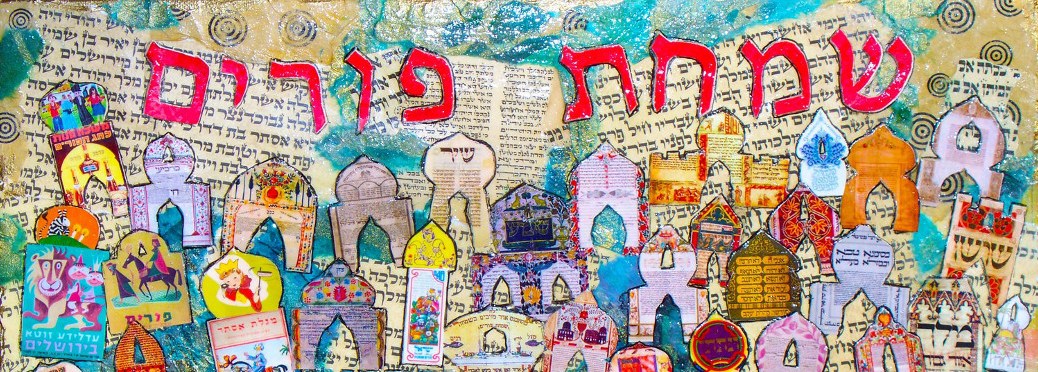
The Meaning of Purim for the Christian Church

Super girlI haven’t thought much about Purim in awhile. It’s not something we observe in our home and I tend to think of Purim as being primarily for children, dressing in costume, playing games, telling jokes, that sort of thing. Back in the day, the congregation I used to attend observed Purim with a children’s play, which often took on some sort of Star Wars or other fantasy theme. But those days are gone, my children are grown, and my grandson isn’t even aware of Purim.

I received an audio CD from First Fruits of Zion (FFOZ) a number of days ago, but I didn’t get a chance to listen to it until I was weeding the backyard over the weekend. It’s interesting trying to pull weeds out of muddy plant beds, listening to D. Thomas Lancaster lecture about Purim to the congregation at Beth Immanuel Sabbath Fellowship, and periodically grab my pen and notebook to quickly jot down an important note or two. Fortunately, the sermon was just under thirty minutes, but it was frustrating not being able to actually start writing my commentary until after I finished getting rid of those pesky weeds (which took significantly longer than thirty minutes).

The sermon was originally delivered in 2008 but I can say that everything I heard was news to me.

As you most likely know, Purim is a holiday taken from the Megillah (Scroll) of Esther. To quote from MyJewishLearning.com:

Though Purim is a joy-filled holiday, its story might appear somber at first glance: It tells of the near-destruction of the Jewish people as decreed by Haman, an advisor to the Persian King Ahashuerus.

However, Ahashuerus’ newly crowned queen, Esther–who replaced Vashti when she was thrown out of the kingdom–is secretly a Jew. Due to her courage and her eventual role in saving the Jews, the story of Purim is known as “Megillat Esther,” or the Scroll of Esther.

Lancaster, in his sermon called “Purim 1946,” stated what most of us know, that it is the one book in Biblical canon that doesn’t mention God at all, and yet the mercy of God is quite evident. He also said what most traditional Jews and Christians agree upon, that this is a uniquely Jewish celebration. What the heck are Gentiles at Beth Immanuel or anywhere else, particularly Christians, doing celebrating Purim?

I’ll get to that.

The terrible events we read in the Book of Esther have been applied across all of Jewish history, for the evil that Haman did was perhaps the first recorded act of anti-Semitism, particularly with the goal of Jewish genocide. Across all the inquisitions, pogroms, persecutions, Talmud burnings, and even mass murder, we find the “Spirit of Haman” repeatedly returning to finish the job he started those many thousands of years ago. This “Spirit” is likened by Lancaster to a demonic force, and even the great dragon we find in Revelation 12.

The most obvious expression of this Spirit in recent history is in the person of Adolf Hitler and his bloody Holocaust, and I don’t think we’ve seen the last of such evil, especially with the rise in anti-Semitism we see in the world today, particularly in Muslim nations.

But the Scroll of Esther contains a secret, something hidden, as the presence of God was hidden in the text of the story.

But I will surely have concealed My face on that day because of all the evil that it did, for it had turned to gods of others.

Deuteronomy 31:18 (Stone Edition Tanakh)

Lancaster points out that the Hebrew word for “concealed” or “hidden” uses the same letters as the name “Esther,” so he believes there is a connection.

This won’t be obvious in Christian Bibles but you would see it in an actual Scroll of Esther and it’s even evident in my Tanakh.

In Esther 9:6-10 a list of the names of the ten sons of Haman appears, but in the actual scrolls which are read on Purim in synagogues, the names are listed in columns with the name of a son on one side, and the word “and” on the opposite side of the page or portion of the scroll. The significance of this isn’t in the arrangement of the names in the list, but that in the actual scroll and in my Tanakh, there are three Hebrew letters that are printed smaller than the rest: TAV, SHIN, ZAYAN. However, they don’t seem to spell any word in ancient Hebrew.

Hold onto that thought. I’ll return to it.

Lancaster points out a rather odd detail I’ve never noticed before. The names of Haman’s sons are listed as I explained above, indicating that they were among those who were killed by the Jewish people, and yet, just a few verses later, Esther makes the following request of King Ahasuerus, a second request after she asked that the Jewish people be allowed to defend themselves:

Esther replied, “If it pleases the king, let tomorrow also be given to the Jews who are in Shushan to act as they did today, and let Haman’s ten sons be hanged on the gallows.”

Esther 9:13 (Stone Edition Tanakh)

Purim MegillahWait a minute. The ten sons of Haman are already dead. What’s the point of hanging their dead bodies on the gallows? The answer is simple and rather gruesome. The ancient “gallows” isn’t the same thing we think about when we see a hanging in some film about the old American West. She wanted the dead bodies of Haman’s sons to be impaled on stakes and displayed, probably as a warning against anyone who would dare to rise up against the Jewish people.

This request is why Purim is celebrated by Jewish people for two days if they live in a walled city. But there’s a midrash about Esther’s use of the word “tomorrow.” The midrash says that there are two kinds of “tomorrow,” the tomorrow that is now, that is, the literal day that comes after today, and a tomorrow that is in the future, which is at some far but perhaps unknown point in the future.

Now we return to the three Hebrew letters that appear smaller than the rest in Jewish texts of Esther. You can’t read them as a word, but you can read them as a date, since each Hebrew letter has a numeric value. In this case the date is the year 5707. Remember that Hebrew years aren’t counted the way we do in the modern era. The New Year on the Hebrew Calendar is on the Festival of Rosh Hashanah, literally “head of the year,” which most recently was observed from September 4th to September 6th in 2013. The current year on the Jewish calendar is 5774. Do the math. The Jewish year 5707 is 1946 on modern calendars.

What’s so significant about 1946? The Nuremberg Trials:

The Nuremberg Trials were a series of military tribunals, held by the Allied forces after World War II, most notable for the prosecution of prominent members of the political, military, and economic leadership of Nazi Germany. The trials were held in the city of Nuremberg. The first, and best known of these trials, described as “the greatest trial in history” by Norman Birkett, one of the British judges who presided over it, was the trial of the major war criminals before the International Military Tribunal (IMT). Held between 20 November 1945 and 1 October 1946, the Tribunal was given the task of trying 23 of the most important political and military leaders of the Third Reich.

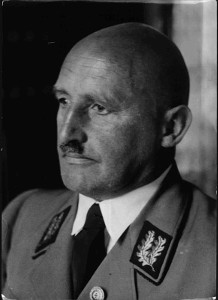
On October 1st, the first verdicts were handed down, the death sentences of twelve Nazi war criminals, including a man named Julius Streicher:

[He] was a prominent Nazi prior to World War II. He was the founder and publisher of Der Stürmer newspaper, which became a central element of the Nazi propaganda machine. His publishing firm also released three anti-Semitic books for children, including the 1938 Der Giftpilz (“The Toadstool” or “The Poison-Mushroom”), one of the most widespread pieces of propaganda, which purported to warn about insidious dangers Jews posed by using the metaphor of an attractive yet deadly mushroom.

Of the twelve men sentenced to death, one of them was not present during the verdict and through a legal circumstance, was not executed. Another man committed suicide the night before the hangings (the Tribunal deemed these men unworthy of being extinguished by firing squad as would have been the case in a traditional military execution).

Julius Streicher
Julius Streicher

The hangings took place on October 16th, 1946. Streicher was defiant to the end and seconds before he was hung, Streicher venomously cried out, “Purimfest 1946!”

It was nowhere near the festival of Purim, which is usually in late winter or early spring, but it was Hoshanna Rabbah, the seventh day of Sukkot, which is also called “The Great Salvation.”

But of the twelve men sentenced to die on the gallows, only ten of the most vile and hateful Nazis, including the great anti-Semite Julius Streicher, died as did the ten sons of Haman so many thousands of years before. There are indeed two tomorrows, if you’ll accept it. There is a tomorrow that is now and a tomorrow that is in the future. The tomorrow Esther spoke of was the next day, but based on the Hebrew letters written smaller than the others in the list of Haman’s sons (and I have no idea how the tradition began), the tomorrow of the future was October 16th 1946.

I wonder if this is the last time though that we’ll face such heinous persecution of the Jews with the result of more “sons of Haman” dying on the gallows as payment for their crimes?

A date hidden in the Scroll of Esther with a prophetic message, much as the face of God is hidden in the Megillah. But according to Lancaster, that’s not the only hidden prophesy:

Mordechai left the king’s presence clad in royal apparel of turquoise and white with a large gold crown and a robe of fine linen and purple; then the city of Shushan was cheerful and glad. The Jews had light and gladness and joy and honor. And in every province, and in every city, every place where the king’s word and his decree reached, the Jews had gladness and joy, a feast and a holiday. Moreover, many from among the people of the land professed themselves Jews, for fear of the Jews had fallen upon them.

Esther 9:15-17 (Stone Edition Tanakh)

Read literally, we see the victory of the Jews in that ancient land we know today as Iran, where Mordechai, the uncle of Esther (her Hebrew name was Hadassah) was elevated very high and made very great in the Kingdom, and the Jewish people, at that point in history, knew peace, gladness, and joy, and they had light and honor in every province under the rule of the King.

But…

But if you expand the scope of these verses to contain the Messianic Age, if the King is King Messiah, and the Jews are not just the Jews in King Ahasuerus’ kingdom, but the Jews from all over the world, who have been returned, all of them, from exile to their land, the Land of Israel, then you see a perfect picture of the Messianic Kingdom and described in numerous other prophesies in the Tanakh.

Except for one thing. What about the latter part of verse 17?

Moreover, many from among the people of the land professed themselves Jews, for fear of the Jews had fallen upon them.

I’ve heard this verse interpreted to mean that many Gentiles in the land converted to Judaism. Others have said they only pretended to be Jews for fear of retribution. Still, another way of looking at this sentence is that many people threw in their lot with the Jewish people, not taking on Jewish identity as such, but being overtly supportive of the Jewish people and Jewish practices.

But if this too is a prophesy as Lancaster suggests, what does it mean for believing Gentiles today? For Lancaster personally, it means pursuing the worship of Hashem, God of the Hebrews, through the study and practice of Messianic Judaism. Remember, the Bible says that in the last days, many nations will rise up against Israel, and the Holy Nation will almost be defeated, that is, until God comes to defend Israel and the Jewish people.

Once again, and for the final time, Israel will almost be wiped out and in the last moments, when all hope seems lost, God will once again save His people and destroy their enemies. And just as in ancient Persia, those people who are not Jewish will likely fear being taken also as the enemies of the Jews. What better way to be known to be a friend of the Jewish nation and an ally of Israel than to come alongside them right now, before the trouble starts or at least before the last war starts? That is what Lancaster seems to be doing right now.

PogromI’m not saying that we all have to join Messianic Judaism, but consider this. Lancaster didn’t touch on this topic, but how many “sons of Haman” in the last nearly two-thousand years have been part of the Church of Jesus Christ? How many pogroms, persecutions, maimings, and murders have been engineered by people calling themselves “Christians”. You can justify it by saying they weren’t really “Christians” but the fact remains that normative Christianity in a variety of forms has been deeply involved in harassing the Jewish people and attempting to eradicate Judaism by destroying volumes Talmud, scores of Torah scrolls, and innumerable synagogues.

The darkest moments of the history of the Church are just as stained with the blood of Jews as was the soul of Julius Streicher, or the Spirit of Haman.

Just a few short years ago, Evangelical Christianity was a great supporter of Jewish Zionism, the belief that the nation of Israel is a Jewish nation. But recent stories in The Blaze, Charisma News and other Christian media outlets seems to show that Evangelicals are distancing themselves from supporting Israel. This is also true of Palestinian Evangelicals, and some of these groups seem to be instead backing those who could be the modern-day equivalents of the sons of Haman.

I can see I’ve made a mistake in thinking of Purim as primarily a children’s holiday. This year, Purim is observed from sundown on Saturday, March 15th until sundown on the following day. Listening to Lancaster’s sermon and realizing the implications as I was on my hands and knees pulling weeds out of the mud, I saw Purim as warning and cautionary tale. We in the Christian church, in its many denominations and expressions, cannot afford to take the prophesies Lancaster says are in the Scroll of Esther for granted.

I don’t believe October 16th, 1946 is the last time we’ll see “sons of Haman” publicly executed for crimes against humanity and especially the Jewish people. I believe there will come a day when God will fight for His people, the Jewish people, and Israel will be victorious, and the survivors of the nations who were enemies of the Jews will be very, very afraid, and they will be ordered by God to send representatives to Jerusalem to observe Sukkot each year, and to give glory and honor to Israel’s ruler, King Messiah (Zechariah 14:16).

We in the Church need to decide which side of Biblical prophesy we want to be on. Do we want to be for the Jews or against them? Will we come alongside the Jewish people in the final war, or will we learn to fear them because we pulled away from Israel?

I’ve already declared myself as a Gentile who studies Messianic Judaism, but Lancaster’s sermon gave me more reasons to believe that this decision is the correct one. No, I’m not telling everyone in all your local churches that you have to be like me. But then again, I’m a Gentile who studies Messianic Judaism and who attends a Baptist church. Maybe the proper response to Purim this year for Christians is to study the Scroll of Esther, consider the prophesies it contains, and make a choice about which side you’re on, Mordechai’s or Haman’s. I believe my church supports Israel and the Jewish people to the best of their ability and understanding, but we can be better. It wouldn’t hurt as you practice Christianity in the church and in your lives to maybe study from a Messianic Jewish perspective…just a little bit.

You can go to the Beth Immanuel audio page to listen to Purim 1946. I strongly recommend it. Purim is coming soon. So is the Messiah.

He who testifies to these things says, “Yes, I am coming quickly.” Amen. Come, Lord Jesus.

Revelation 22:20 (NASB)

The Church When Jesus Returns

Members of one of the largest congregations in the Presbyterian Church (USA) have voted to leave the denomination, despite facing an $8.89 million cost for leaving.

“Surprisingly, there are many PC(USA)-ordained pastors who do not believe, for example, in the deity of Christ or in salvation through faith in Christ,” the rationale states, citing a 2011 PCUSA survey that suggested 41 percent agreed with the statement, “Only followers of Jesus Christ can be saved.”

-by Sarah Pulliam Bailey
“Citing Doctrinal Error, Presbyterian Megachurch Leaves Denomination” (3/6/2014)
CharismaNews.com

Lately, I’ve been pretty vocal about what I see as the enduring mistakes that have been made by “the Church” and perpetuated over the long centuries of Christian history. I’ve struggled with our religious arguments even while continuing to try to understand the nature of fundamentalism in Christianity.

I attend a small Baptist church in Meridian, Idaho and so my current experience with Christianity as a whole is strongly filtered through that lens. My only real previous experience in church as an adult (my parents took me to a Lutheran church when I was a child) was a rather large Nazarene church in Boise, however there was a gap of many years between these two events. I worshipped at the Nazarene church when I first became a Christian and I’m at a Baptist church now. For the many years in-between, I was exploring, learning, and worshiping within various aspects of Hebrew Roots and to some degree, a Messianic Judaism context.

So as you can see, my experiences with “Christianity” are rather limited. When I write about “the Church,” I’m really writing about my personal understanding of what I think Christianity is and what it means. Pastor Randy, the head Pastor at the church I attend, has spent no little time showing me how each of the denominations relate to one another and why he believes Fundamentalism is the most Biblically based and thus the most accurate and true way to worship God, spread the Gospel message, and obey the commands of Jesus.

But if you click on the link associated with the quote at the top of today’s “meditation,” you’ll see, as I did, a different side to what “Christianity” can mean. It never occurred to me that someone could be a Christian and not believe that salvation is through Jesus Christ.

Interesting. Whenever I hear someone say, “Jews believe”….or, “don’t believe….,” – last time I looked the Jewish people didn’t have a Pope.

-chaya1957
“In Its Time I Will Hasten Him”
Endtime Chaverim

While the Catholic church may have a Pope and other denominations of Christianity may have their heads or ruling bodies, I forget that “the Church” as an overarching, world-wide body has no central leadership. There is no Apostolic Council of Elders as in the days of James, Peter, and Paul, and “the Church,” unattached to a central head on earth, turns to Jesus Christ as Savior and King. After all, we’re called “Christians” as a reflection of who we follow.

But wait!

We are also called “Baptists,” or “Presbyterians,” or “Methodists,” or “Pentecostals,” or even “Hebrew Roots,” or followers of “Messianic Judaism.” We define ourselves as members of some subset of the believing whole and those subsets represent sometimes dramatic differences in who and what we think we are in Christ. And yet, at the core, part of what we’re also saying is that we are disciples of Jesus (or Yeshua if you prefer) as Lord and Savior, all of us.

Except that according to the above-quoted article, the Presbyterian Church (USA) (PCUSA), or at least some of its affiliate churches, may not believe in the deity of Christ, which is a rather startling point of separation for most Christians.

Church denominationsIt’s mind-boggling how “Christianity” or “the Church” can contain such wide variations of belief and yet still hold onto those labels or titles. Of course, Judaism, as Chaya1957 pointed out, has no central authority either, save for Hashem (individual branches of Judaism may follow the teachings of a Rebbe), and thus we find a great degree of variation in what constitutes a “Judaism” as well. This has given rise to the question about whether or not Messianic Judaism is a Judaism. A number of folks with whom I regularly communicate say that “yes,” Messianic Judaism is a Judaism first and foremost, which makes the people I know in Hebrew Roots and in “the Church” (as I experience it) kind of disturbed. From the latter group’s perspective, if one believes in Jesus (Yeshua) as Messiah, one is Christian or Messianic first, and Judaism must at least take a back seat if not actually get booted off the bus.

It gets a little dicey between Hebrew Roots and Christianity since the former adopts halakhic Jewish practices to one degree or another as a way of observing the mitzvot, while the Christians I currently associate with, by and large, believe that Judaism died as a valid expression of Messiah worship somewhere in Acts 2, to be replaced by “the Church” (big “C”) forever more.

Although Pastor Randy has accused me of disagreeing with just about everything he believes in, I find that my current church experience and my previous associations in Hebrew Roots have left me adhering closer to the Bible as the Word of God than I would say is true of PCUSA.

But I guess that depends on how you interpret the Bible, and thereby hangs a tale.

I’m particularly happy to embrace this label. Because, for me, “theologically shaky” means that we see the Bible not as an inerrant book that serves as a “text book” of the Christian faith, but rather as an amazingly diverse, complex, nuanced text that cannot interpret itself, but rather must be interpreted through a particular lens. For me, that lens is Christ as I have come to know him and understand him within my own relationship with God. The theologian James Alison (a Catholic!) points out that we always, ALWAYS read the Bible through a particular lens. And if we think we don’t, then we simply are failing to see the lens that we are using.

-Rev. Matthew Dutton-Gillett
Rector of Trinity Church in Menlo Park
from “Why I’m Fine Being ‘Ultra Liberal’ & ‘Theologically Shaky'”
Below the Surface

I agree with the good Reverend that we all read the Bible through a particular interpretive lens and that no one has direct, raw access to one-hundred percent of the information God is trying to transmit to humanity through the Bible. That said, and I agree with Pastor Randy on this, we have to establish some “ground rules,” so to speak, about what we can all agree the Bible is saying.

In response to that challenge, I committed myself to being a Gentile who studies the Bible through a Messianic Jewish lens.

That probably makes me an odder duck in my local Baptist church than even the most liberal Presbyterian, but I find that perspective brings into focus the Bible as a whole and unified document, rather than splitting the meaning of God’s Word and especially His intent toward Israel between the “Old” and “New Testaments”.

Did the practice of Jews and Gentiles becoming disciples of Jesus as the Messiah really start out as a single thing?

Now Saul, still breathing threats and murder against the disciples of the Lord, went to the high priest, and asked for letters from him to the synagogues at Damascus, so that if he found any belonging to the Way, both men and women, he might bring them bound to Jerusalem. (emph. mine)

Acts 9:1-2 (NASB)

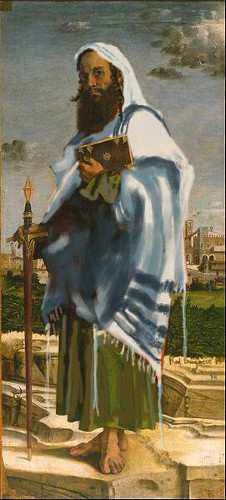
The Jewish PaulThis is the first place I can find in the Bible that gives the organized body of Yeshua-followers a distinctive name. At that time, the movement was still fairly new and Jewish people still were the majority population. That would begin to change in the years that followed Paul’s “conversion” and then scores of non-Jews would rush in, occupying Jewish religious and community space and ultimately displacing both the Jewish people and Judaism (that covers a lot of history which I imagine most of my readers know about).

How did we get from there to here?

That covers an even larger section of history, really, it’s the history of the Church, and that history has resulted in “the Way” going from being a single entity administered (on earth) by a body of Jewish Apostolic Elders with James the Just, the brother of the Master, at its head, to there being “approximately 41,000 Christian denominations and organizations in the world,” according to Christianity Today. From one to 41,000!

To further quote from that source:

This statistic takes into consideration cultural distinctions of denominations in different countries, so there is overlapping of many denominations.

I wonder when the first “denomination,” that is, the first variant expression of the original “faith” of “the Way” occurred? Was it when the first group, assembly, or “church” was composed mostly or exclusively of non-Jews? Was it when information was flying about willy-nilly in the days of Paul’s ministry and there were different “Christian” communities operating with different bits and pieces of theology, generating varying forms of doctrine?

Now a Jew named Apollos, an Alexandrian by birth, an eloquent man, came to Ephesus; and he was mighty in the Scriptures. This man had been instructed in the way of the Lord; and being fervent in spirit, he was speaking and teaching accurately the things concerning Jesus, being acquainted only with the baptism of John; and he began to speak out boldly in the synagogue. But when Priscilla and Aquila heard him, they took him aside and explained to him the way of God more accurately. And when he wanted to go across to Achaia, the brethren encouraged him and wrote to the disciples to welcome him; and when he had arrived, he greatly helped those who had believed through grace, for he powerfully refuted the Jews in public, demonstrating by the Scriptures that Jesus was the Christ.

Acts 18:24-28 (NASB)

John MacArthur
John MacArthur

Pastor John MacArthur gave Apollos (and subsequently, the Apostle Paul) a really hard time in one of his sermons for something I think could not have been Apollos’ fault. We can only know what we are taught and it’s obvious Apollos learned only those things about Jesus that were available to him. Trouble is, that describes a lot of us as well. I’m constantly in a state of learning, although I suppose we could say that Apollos didn’t even know some of the basics of the “Christian faith” (not that it was particularly “Christian” as we understand the term today…it was a Judaism).

In the Apostolic Era, at least in the beginning, we see Jews affiliated with the Way practicing Judaism and being accepted as Jews in Judaism, rather than Jews converting to some strange, alien religion (a “strange fire” one might say). Even when Gentiles began to enter, they were entering a Judaism as Gentile participants, and today, we have many disagreements on the Internet about what that really looked like and how that impacts Christian Gentiles in Hebrew Roots and Messianic Judaism (or for that matter, in traditional streams of Christianity) today.

But at that time, you had Jews and Gentiles as disciples of Jesus operating within a normative stream of Judaism. As I’ve said before, the ancient Jews were not jealous of Paul because he was preaching the saving grace of Jesus Christ and promoting a Torah-free life for all Jewish people, they were jealous because he was advocating for a more Torah-observant lifestyle for Jews and supporting the presence of Gentiles in Jewish communities who would not be mere God-fearers or even Proselytes, but equal co-participants. Gentiles coming alongside Jews in honor of Moshiach and to worship the One God of Israel.

It was too much for many of the synagogue leaders and members in the diaspora to understand or endure and thus began all of Paul’s problems with many of his own people, not that he ever stopped loving them and desiring their well-being in all things, including that they hear and accept the good news heralding the Messiah.

I am telling the truth in Christ, I am not lying, my conscience testifies with me in the Holy Spirit, that I have great sorrow and unceasing grief in my heart. For I could wish that I myself were accursed, separated from Christ for the sake of my brethren, my kinsmen according to the flesh, who are Israelites, to whom belongs the adoption as sons, and the glory and the covenants and the giving of the Law and the temple service and the promises, whose are the fathers, and from whom is the Christ according to the flesh, who is over all, God blessed forever. Amen.

Romans 9:1-5 (NASB)

Paul never intended to replace the Jewish people with Gentiles in the Way, nor did he intend on replacing Judaism with a completely new religion called “Christianity” since the Way was a fully formed stream of first-century Judaism.

But once you take a brick and throw it as hard as you can at a big, shiny, beautiful pane of glass, the glass shatters into about a billion pieces and, like the proverbial “humpty-dumpty, it never gets super-glued or duct taped back together again.

Or does it?

No, not right now. Right now, we’re a mess. We’re spewed and splattered all over the landscape, millions and millions of tiny, little theologies all running around like ants who think we’re mastodons, all screaming, “We’re right and everyone else is wrong.” Oh, we also scream, “…and I can prove it in the Bible.”

As my long-suffering wife might say, “Oy vey!”

But there’s hope. I believe in hope. I have to. Without it, I’d become terribly depressed at the state of the world and the state of my faith (not my personal faith, the “organized” Church kind).

My hope is in Messiah. That he will come. That in his return, the Messianic Age will reach fruition. That what he started nearly two-thousand years ago will become completed, that what began as the indwelling of the Holy Spirit for all believers will culminate in the Spirit being poured out on all flesh (Joel 2:28, Acts 2:17), and no one will teach his neighbor or brother to “Know the Lord” since we will all know Him (Jeremiah 31:34, Hebrews 8:11). In other words, the Messianic Era will see humanity united by Messiah under God in a way no one ever thought possible.

RestorationAll of our little denominations will have to “go away” and be replaced by the truth delivered to us directly by the Master, the King. That should make us all at least a little nervous if we truly grasp the implications. I realize that every denomination thinks Jesus will run things exactly the way that denomination runs them. He will believe everything they believe, he will understand and interpret the Bible exactly the way they understand and interpret it, and he will teach people to say, think, and do all the stuff that they say, think, and do.

But if there is only one Way, “the Way,” then all the other “ways” go away. What makes you so exceedingly sure that your way is the right one? Here’s another question to bake your noodle. What makes you so sure that any of the ways we do “religion” in the worship of the God of Israel is exactly “the Way?” Maybe we got a few (or more than a few) things wrong.

I’ll be generous and say that all of the 41,000 Christian denominations (plus everything that operates under the umbrella of Hebrew Roots, all the variations of Messianic Judaism, and all the branches of more normative Judaism), all running around saying “we’re right and everyone else is wrong” are really doing the very best they can to do what the Bible says to do to worship God and take care of human beings, albeit by reading the Bible through 41,000+ lenses.

But doing our best and believing that we are on the right track doesn’t actually make us right. Look at Apollos. He did the very best he could with what he had, and he did a very good job at it. But he still didn’t have the complete picture. To his credit, once he was “clued in,” he didn’t dig in his heels and say “I’m right and everyone else is wrong.” He took correction from a gentile, knowledgable, and authoritative source and integrated what he learned into his faith and teaching. When the time comes and the King arrives, will we display such grace when he teaches correction to us?

What will the Church look like after Jesus returns and reigns as King, or will it be a “church” at all?

I believe with complete faith in the coming of the Messiah, and even though he may delay, nevertheless I anticipate every day that he will come.

-Mosheh ben Maimon (Maimonides)
from the twelfth of the Thirteen Principles of Faith

I’ve written a sort of “sequel” to this blog post called When Jesus Returns Will We Go To Church? It takes the ideas I’ve presented here one step further, but it’s a big step. I hope if you’ve enjoyed this “meditation,” you’ll click the link to the next one.

Reviewing the Meaning of Midrash: Part 3

We’re used to considering the precise measurements of our world as the final arbiter of all truth. It might help to jump to an event in Mezhibuzh, Ukraine, a century or two after Maharal:

…One of the homeowners of Mezhibuzh was involved in a nasty dispute with another resident of the town. It happened that while in the Baal Shem Tov’s presence, in his shul, he yelled that he was going to rip the other guy apart like a fish.

The Baal Shem Tov told his pupils to hold one another’s hand, and to stand near him with their eyes tightly closed.

He then placed his holy hands on the shoulders of the two disciples next to him. Suddenly the disciples began shouting in great terror: They had seen how that fellow had actually ripped his disputant apart like a fish…

Now, what if I ask you, “Did a resident of Mezhibuzh tear apart his disputant like a fish?”

You might answer, “Well, not really.” Problem is, I have witnesses. Very reliable ones. And they all saw exactly the same thing.

But can the perpetrator be charged in court for bodily harm? Problem is, his disputant is still walking around without a scratch.

So, which world is real?

-Tzvi Freeman and Yehuda Shurpin
“Midrash and Reality:
Part 3 of ‘Is Midrash For Real?'”
Chabad.org

This one made my head hurt. In this article, the authors and their sources tell me that I’m not supposed to take midrash, even those telling fantastic and impossible tales, as if they are mere metaphors. They are also true and while fiction can contain truths, they are also real in a mystical sense.

Rabbi Yehuda Loewe of Prague (known as the “Maharal of Prague”) was adamant: Torah is not fiction. Jews consider the words of their sages that have been recorded in the Talmud and Midrash to be Torah, no less divine than the Five Books of Moses. Once they were accepted by the general community of observant Jews as works to be studied and revered as Torah, they attain a status of G‑d’s own thoughts, arguments He has with Himself and stories He tells Himself. And if the Creator of the universe is telling it, it’s real.

And further:

On the one hand, you have to know that every story told and recorded by the rabbis of the Talmud is true. They are Torah, just as much as a verse from scripture or a halachah kept by all Jews is Torah.

MidrashThis is the part that makes my head hurt. Titus destroys the Temple and God assigns a gnat to eat his brain so that seven years later, upon the death of Titus, it is discovered that the gnat with metal claws reduced the size of the man’s brain to that of a year-old pigeon’s brain.

Moses is ten cubits tall (about fifteen feet) but no where in the Torah, which I mean as the five books of Moses, is this noted nor does anyone, Pharaoh,  Moshe’s wife, his father-in-law, his brother, seem to notice.

And yet these things are not only “Torah” but they are real?

Now, reading the chronicles of Roman historians, you won’t find anything about this gnat. Titus, they tell you, died of a fever. At any rate, metal claws on a big bug is a tad outrageous.

So, one scholarly Italian Jew named Azariah dei Rossi explained, “This is just aggadah.” It didn’t really happen. It’s just that the sages wanted to impress on people that G‑d can always find a way to punish the wicked, so they told this story.

So this really is a metaphorical tale to illustrate a moral point. It contains a truth but it is not objectively real.

So, Maharal tells us that the real Moses truly was fifteen feet tall. Not the one that Pharaoh saw, or that the fleeing shepherds saw. They saw only the physical shell of Moses, as he is invested in a body within our physical world—a world that for several reasons can’t manage a ten-cubit human form. But Moses is a complete person, and ten is the number of completeness. He should have been ten cubits tall—would the physical world be capable of such a thing. Certainly, writes Maharal, whatever could be reflected in the physical world was reflected, and Moses was likely taller than the average human being. But not as tall as he really was.

Am I supposed to believe that in some supernal realm, the person of Moses is really fifteen feet tall, but that he only appeared to be of a normal human height in our world because that was not the “real” Moses, and our physical world could not contain all the Moses was and is?

That’s a lot to swallow. As I keep saying, I can accept the metaphorical nature of the midrashic stories, but I have a tough time making the conceptual leap into the world the Rabbi’s suggest I accept. Maybe, harkening back to last week’s review, I am a “bigger fool.” It’s not that I don’t “get” what Freeman and Shurpin are saying, I just don’t believe in the literal reality of these “deeper meanings” as having a truth and a life of their own in an objective sense.

Maharal takes the same approach to the gnat in Titus’ brain. The sages are not concerned with telling us a story for the medical annals. Their concern is to present to us the real Titus and his true destiny. Did a physical gnat enter his brain? Perhaps not, writes the Maharal. But the story is still true, because the gnat got in there anyways. Every living creature has its essential quality that makes it uniquely what it is—and the essential quality of the gnat made its way in. This essential quality, if it could be seen, would appear in its most intense state with a mouth of bronze and iron claws.

hidden-keeperUnless evidence to the contrary appears, I’m not inclined to believe on any level, essential or otherwise,  that a gnat with bronze or iron claws was involved in the death of Titus. I can believe that God metes out justice upon the wicked, though not always in this life.

But the view of midrash I’m asked to accept isn’t one in which the Rabbis parse out words of wisdom in mythical or fanciful form to illustrate a “truth” alluded to by the plain text of a story, either in the Bible our outside of it.

Maharal sums up his approach in one simple line: “The sages do not speak of the physical at all; they speak of a world stripped of physicality.” Every midrashic teaching is a peek behind the veil, dressing deep truths in language that is meant to reveal an inner world. If that language seems foolish to us, it is only because we have not yet cracked the code. We are grabbing the clothes, the words, as though they themselves were their own meaning.

This is an attractive way to think about the universe, with hidden corners, metaphysical alleyways, mystical portals through which the sages are able to peer and then relate what they’ve seen to the rest of us. I wish I could believe it. I know in some manner the sages were granted the ability to issue rulings equal to what we have in the inspired Bible. I know that in Judaism, canon is never quite closed and there is always another revelation concealed in the Bible’s “code.”

But I’m not going for it. I’m not jumping headlong into believing that the sages, wise and learned though they may be, actually see into a non-physical reality beyond our mortal plane and what they relate in their teachings and writings represents a divine truth equal to the Word of God.

It is true that Ezekiel, the apostle John, and even Paul, the letter writer, each had their own mystic experiences, either physically or through visions, where they literally saw and heard things that do not exist in our own universe, but to attribute this same ability, or some shadowy version of it, to each and every sage to has told a midrashic tale ultimately recorded in Talmud is too far for me to go.

Now a systematic approach to midrash had been laid out clearly by Maimonides and Maharal. But that raises a new question, perhaps a more difficult one: If the point of midrash is not the story itself, but that which it contains, not the foreground but the background, and if anyone who understands these stories literally is a fool—then how is it that we tell these stories to children and simple folk, who certainly take them at face value? Are we to hide all of these tales from them? Have we been doing things wrong all these centuries?

I still believe it’s important for Christians to have at least a slightly passing knowledge of midrash considering that this interpretative method may well have been in use during the Apostolic era. This understanding may help us pierce the veil traditional Christian exegesis has cast over the Bible for the past nearly two-thousand years, blinding ourselves to the way the New Testament scriptures were written and intended to be read.

But that’s still a far cry from the “reality” of Midrash as opposed to the metaphorical truths midrashic tales can contain. I guess I wouldn’t make a very good mystic or even a very good Jewish person.

I did take way something quite positive from this week’s article however:

Adult Pi Patel (Irrfan Khan): So which story do you prefer?
Writer (Rafe Spall): The one with the tiger. That’s the better story.
Adult Pi Patel: Thank you. And so it goes with God.
Writer: [smiles] It’s an amazing story.

-from the film Life of Pi (2012)

dimuI’ve never seen the film but I have read the book (which I highly recommend, by the way), and this bit of dialog is the key to understanding the author’s message. The book and the film speak of a fantastic tale of survival at sea of both a boy named Pi and an adult Bengal tiger named Richard Parker who share a small lifeboat together.

Toward the end of the story, after many adventures, Pi and Richard Parker, the only survivors of a shipwreck seven months before, land on the shores of Mexico. The tiger disappears into the jungle forever, and Pi is rescued and eventually tells his story. Although the story of Pi and the tiger commands most of the book, he does tell a much more believable if horrible story of murder, starvation, cannibalism, and near-insanity that could also account for Pi’s survival.

But Pi asks the writer who is chronicling his early life, “So which story do you prefer?” It’s as if the sages are asking the same question about midrash. We accept “truth” if not “fact” from the more interesting story. That’s what midrash means, at least to me.

Or maybe midrash is God telling “the better story.” And so it goes.

Sermon Review of the Holy Epistle to the Hebrews: Spoken by Angels

The writer of the book of Hebrews indicates that the Torah was “spoken by angels.” In this teaching, D. Thomas Lancaster takes a look at first-century angelology to understand the apostolic concept of the Torah being delivered by angels and what role that concept plays in the argument in Hebrews 2.

-D. Thomas Lancaster
Sermon Seven: Spoken by Angels
Originally presented on February 9, 2013
from the Holy Epistle to the Hebrews sermon series

In last week’s sermon which I reviewed, we learned that Yeshua (Jesus) was greater than even the angels. What we didn’t learn is why that was important to the addressees of the letter to the Hebrews and why that should be important to us.

Today, we’re going to find out.

For this reason we must pay much closer attention to what we have heard, so that we do not drift away from it. For if the word spoken through angels proved unalterable, and every transgression and disobedience received a just penalty, how will we escape if we neglect so great a salvation? After it was at the first spoken through the Lord, it was confirmed to us by those who heard, God also testifying with them, both by signs and wonders and by various miracles and by gifts of the Holy Spirit according to His own will.

Hebrews 2:1-4 (NASB)

Here, we see another Kal va-chomer argument, from the light to the heavy. Look at this.

For if the word spoken through angels proved unalterable, and every transgression and disobedience received a just penalty, how will we escape if we neglect so great a salvation?

In other words, if the word spoken by angels…what word is that? The Torah which was delivered by angels at Sinai. If the Torah proved “unalterable, and every transgression and disobedience (of Torah) received just penalty, then how” must less “will we escape if we neglect so great a salvation?”

This is the cornerstone of Lancaster’s sermon and we need to pay attention. I said in my first review of this series about the Kal Va-chomer argument, that if the first and lighter portion of the argument was not valid, then neither is the second, and the entire argument disintegrates.

The first part of the argument states that the Torah is “unalterable, and every transgression and disobedience received a just penalty.” In other words, the writer of Hebrews is telling his Jewish audience that the Torah remains valid and unalterable in their lives. The Jewish audience must have continued to be Torah observant Jews who did not question the validity of Torah. After all, if they considered the Torah alterable or invalid or obsolete as most Christians believe the writer of Hebrews is saying, then according to the argument, the heavier aspect of the statement must also be invalid or obsolete: Jesus and salvation. That doesn’t make much sense.

TorahPut in just a slightly different way, if the Torah remains valid and unalterable, how much more is the salvation of Jesus valid and unalterable. The second element in the argument does not undo or invalidate the first but rather rests upon and depends on the first element. If it doesn’t, the argument falls apart.

Christianity’s understanding of the purpose of the Book of Hebrews in general and this portion of the epistle in specific is what becomes invalid based on what the text is actually saying!

However, as Lancaster solves one problem, he introduces another.

For if the word spoken through angels…

Hebrews 2:2 (NASB)

Not only in this verse, but Acts 7:53, the words spoken by Stephen, and Galatians 3:19, which was written by Paul, both speak of the Torah being delivered by angels.

But wasn’t the Torah spoken directly by God to Moses?

Then the Lord said to Moses, “Thus you shall say to the sons of Israel, ‘You yourselves have seen that I have spoken to you from heaven.’

Exodus 20:22 (NASB)

This is just one of a multitude of examples of God (seemingly) speaking directly to Moses words of Torah rather than having Torah delivered by angels. In fact, where do we ever see angels delivering words of Torah or tablets of Torah to Moses? Apparently no where.

Lancaster goes through a list of the various types of angelic beings, which aren’t important to present here, but he does mention one particular type of angel we need to pay attention to: the angel of the Lord.

In Genesis 18 we see three men visit Abraham at his camp. We know that these three men are really three angels. Two of them go on to Sodom but one stays behind and this is God. But how can it be God if God is infinite and a consuming fire? Just look at what He did to the top of Mount Sinai! Who or what is the angel of the Lord?

According to Lancaster, this is an angel, a created being, through which God speaks. The angel speaks the Words of God in the first person singular as God Himself, but is not God Himself, but rather a representation or extension of God, as if God were talking into a microphone and the angel were a speaker on the other end of a cable.

“Behold, I am going to send an angel before you to guard you along the way and to bring you into the place which I have prepared. Be on your guard before him and obey his voice; do not be rebellious toward him, for he will not pardon your transgression, since My name is in him. (emph. mine)

Exodus 23:20-21 (NASB)

In other words, when Jacob wrestles with an opponent in Genesis 32, we don’t have to drive ourselves crazy wondering if it is an angel or if it is literally God. Lancaster says, it’s the angel of the Lord, God’s created representation in our world.

And it is not and never has been a “pre-incarnate Jesus.”

WrestlingActually I find that a relief. I always suspected that at least some angels had such a function rather than an infinite, all-powerful, all-encompassing God literally intersecting with our world, He would send a representative being, like an amplified ambassador able to speak as if he were God present among us. It also is a nice response to certain Hebrew Roots commentators who turn exegesis in the Tanakh into “I-see-Jesus” whenever the angel of the Lord appears.

Lancaster provides numerous other proof texts to support his commentary, and you can listen to the full recording to get all of his references.

I will say that Lancaster also mentions that the concept of the angels giving the Torah was very popular in the first century, as evidenced by how well read the Book of Jubilees, which supported the angelic giving of Torah, was among Jews of that period.

All this may sound strange and even alien to us, but Lancaster says it made perfect sense to a first-century Greek-speaking Jewish audience. We can’t judge these things by the context of 21st-century English-speaking Christians living in the United States of America. We have to get into the heads and comprehension of the original audience. Otherwise, we’ll come up with some pretty goofy conclusions.

But what does this have to do with the Messiah being superior to the angels? It seems applied to our Kal va-chomer argument. If Messiah is superior to the angels and the angels gave the Torah, then what the Messiah gives must be superior as well. No, I didn’t say what the Messiah gave replaced the Torah, just that it held much more weight, and to extend the metaphor, the message of Messiah rests on the foundation of the Torah.

Think of it this way.

At Sinai, Moses went up the mountain. He acquired the Torah in the realm of angels, descended and gave the Torah to human beings.

Messiah went up into the Heavenly Court, the realm of angels, at the ascension. When he descends, he delivers the Messianic Era of peace and complete knowledge of God to human beings.

“Behold, days are coming,” declares the Lord, “when I will make a new covenant with the house of Israel and with the house of Judah, not like the covenant which I made with their fathers in the day I took them by the hand to bring them out of the land of Egypt, My covenant which they broke, although I was a husband to them,” declares the Lord. “But this is the covenant which I will make with the house of Israel after those days,” declares the Lord, “I will put My law within them and on their heart I will write it; and I will be their God, and they shall be My people. They will not teach again, each man his neighbor and each man his brother, saying, ‘Know the Lord,’ for they will all know Me, from the least of them to the greatest of them,” declares the Lord, “for I will forgive their iniquity, and their sin I will remember no more.”

Jeremiah 31:31-34 (NASB)

Lancaster didn’t use this scripture in his sermon but I think it makes sense. The New Covenant doesn’t undo any of the older covenants or “unwrite” any of the specific content. It actually amplifies the older covenants, reaffirms them, and makes it more possible for Judah and Israel (and the people of the nations who are grafted in through faith in Messiah) to “know God” in a more fulfilling way than even the great prophets knew God, and the law, the Torah will be written on all their hearts.

Lion of JudahThat’s the Messianic Era. We have just barely tasted the first fruits of that New Covenant. Most of those promises have yet to be fulfilled. Messiah’s work is not finished, otherwise why return and why is the gospel message all about the coming of the Kingdom rather than just a plan of personal, individual salvation for specific human beings?

The New Covenant is wholly dependent upon the older covenants. If any of the older covenants cease to exist, the fabric of the New Covenant unravels and falls to dust and Judah, Israel, and the people of the nations who cleave to the God of Israel have no hope.

But if the Torah is true and valid and reliable, how much more true and valid and reliable are the Messianic promises and the coming of Moshiach?

What Did I Learn?

I did hit something of a wall or contradiction. Probably just a misunderstanding on my part (and I’ve made mistakes before in this review series). If the argument is that Messiah is greater than the angels who delivered the Torah, but was specifically the angel of the Lord, God’s personal angelic representation, if you will, who delivered the Torah to Moses, then does that mean the Messiah is greater than the angel of the Lord?

I don’t know if the question even makes sense, depending on how you view Trinitarianism, but it’s what popped into my head as I was listening to the sermon, so I thought I’d share it with you.

I didn’t read through each and every transaction Moses had with Hashem in the Torah, but I suspect that we may encounter some difficulties in determining on some occasions exactly who is addressing Moses. Is it the angel of the Lord, or the Lord? Does God never speak directly to Moses? Is it always an angel? I don’t know. The suggestion offered by Lancaster seem to bear further scrutiny, however.

What I Learned in Church Today: Knowledge vs. Wisdom

Even a fool will be considered wise if he is silent; when he seals his lips [he will be considered] understanding.

Proverbs 17:28 (Stone Edition Tanakh)

There are instances when it takes courage to remain silent. It would be easier to speak up, but the right thing to do is to be silent.

Someone insults you. You can easily say something in return that would be the equivalent of a devastating knockout punch. You don’t say a word. Your silence is an expression of courage.

-Rabbi Zelig Pliskin
Daily Lift #463 “Courageous Silence”
Aish.com

After a short absence, Pastor Randy picked up his sermons on the Book of Acts today and Sunday School resumed its usual schedule. The sermon and topic in Sunday School was on Acts 19:23-41. You wouldn’t think a riot in Ephesus (the featured image above is supposed to be a riot) over the teachings of Paul and his associates on “the Way” and how the result of those teachings were cutting into the prophets of the idol-making silversmiths would provide me with much theological or doctrinal angst. Really, it should all be pretty straightforward stuff.

But there’s always something.

I provided the quotes above to illustrate how often I choose being silent rather than actually speaking my mind in Sunday School, because I might end up starting a small riot of my own. Not that I really want to, but because my opinions are so at odds sometimes with the people around me in church.

There was actually quite a lot I agreed with in how Pastor Randy framed his sermon. I think people of faith are at their best when the society around them/us challenges us, and we are often at our worst in a culture or nation that completely accepts us (we tend to get lazy and assimilate into the politically correct realm). Christians aren’t really persecuted in the United States. Try being a Christian in an African nation dominated by Muslims and then you’ll see what persecution is really like. Just because someone disagrees with you and calls you names doesn’t mean you’re being persecuted. That’s the limit of “persecution” most Christians in America experience today.

But then as Pastor was speaking and later on in Sunday School, I got to thinking about who I am in the midst of the local church. Pastor Randy and I had lunch about a week and a half ago, and in the course of discussing my recent blog posts, he asked me how I can call him “my Pastor” when I disagree with just about everything he says.

Actually, I’d been thinking about that, too. I don’t really disagree with 100% of what he says and I really do learn a lot, especially about Christian history, in what he says and teaches. But it is true that even my understanding of the core of the gospel message isn’t exactly the same as how it is taught by most Pastors, including Randy (To learn more, see my review of FFOZ TV’s episode The Gospel Message, as well as what I have to say about Scot McKnight’s book The King Jesus Gospel: The Original Good News Revisited).

ChurchOf course, during a sermon, one keeps quiet by definition but in Sunday School, I have to work on it. I know I’m risking being seen as a fool (and who knows, maybe I am) by even writing this when I should just keep my hands off the keyboard, but I don’t know if anyone else like me is recording their own Tent of David experience, and I figure someone should. So here I am.

There were a lot of good things that came out of both the sermon and the Sunday School teaching. But I did catch the Sunday School teacher engaging in what I might call “Christian Midrash” by his applying the phrase “the way” as recorded in Genesis 3:24 and Psalm 1:6 to how it’s used to formally describe the community of disciples of the Master in Acts 19:23. After all, the term “the Way” used to describe followers of Christ didn’t appear in the Bible until Acts 9:2. I spoke to the teacher before class to ask about his method of constructing his lessons and he gave me permission to bring the matter up during class. Not really sure it was worthwhile, but if we are to be critical of people in Messianic Judaism inserting meaning on one part of scripture based on earlier texts where it might not really fit, shouldn’t we extend the same “courtesy” inside the local church?

But the really big deal was the discussion on idolatry. Of course there would be tension between the ever-growing body of believers in and around Ephesus and the community that was supported by the worship of the goddess Artemus (Diana), and of course it makes sense to apply this topic to modern times and discuss the idols (anything we have in our lives that is more important than God) that we let rule our lives, but having just finished reading and reviewing Dr. Roy Blizzard’s book Mishnah and the Words of Jesus, I naturally thought of the following quote which I’ve previously cited:

Jesus has become an idol, if you will, our focus of attention, our focus of worship, and it seems that very few think of God anymore. Seldom do we hear anyone speak of the glory of God, his grandeur and mercy, the holiness of God, and the other many attributes and characteristics of God.

But remember, Blizzard also said this:

Please understand that I am not trying to lessen the importance of Jesus. What I am trying to do is emphasize that, in all the teachings of Jesus recorded for us in the gospels, his focus is not upon himself, what he is, what he is doing, or what he is to become. Additionally, Jesus has very little to say about God and, in particular, the Worship of God.

My point is that, in the teachings of Jesus, there is not all that much emphasis upward.

It seems in the process of promoting devotion to God through the Messiah, we’ve focused our entire attention on the Messiah, the doorway (“no one comes to the Father but through Me,” from John 14:6) and forgotten that the object was to “come to the Father.”

However, can we really say there are any other “idols” in the church? That seems like an odd question to ask. I suppose you might think of the Catholic Church or the Greek Orthodox Church, both of which use iconic symbols in their worship, but as Pastor Randy pointed out, anything that we put ahead of God in our lives can be considered an idol. Can Jesus be considered an idol if we focus exclusively on him and ignore God the Father? I don’t know. Some Christian songs that focus only on Jesus kind of bother me. The exclusive focus of some churches on the gospel as a plan of personal salvation without any thought to what else the gospel message says about what you are supposed to do with a “saved” life (the focus on Dr. Blizzard’s book relative to tzedakah) or the roles of Jewish and Gentile believers in preparing the world for the coming Messianic Age (often taught by the ministry First Fruits of Zion)…can any of that be considered an “idol?” Could “getting saved” and “getting other people saved” as our sole purpose in life actually result in our missing out of serving God in the other ways He actually intends?

The church I’m at right now is very study and very service oriented, but a lot of other churches aren’t. Am I supposed to bring stuff like that up in Sunday School? If I chose to introduce Blizzard’s or McKnight’s or Boaz Michael’s perspectives (as I understand them) to the discussion at hand, what would actually happen? Probably nothing good. And so, I keep silent, except in the one place I can claim any sort of ownership over which is this blog.

One of the questions in today’s Sunday School study notes asked:

How can God’s Word have a similar irritating effect on you or me, when the Holy Spirit uses it to affect us materially, or in our religious beliefs, or our pride?

The intended answer is “when the Holy Spirit uses the scriptures to convict us of our sins,” but my immediate response (which I never uttered) was, “when we find out the Bible says something different about God and people that church doctrine never teaches.”

No, I won’t be giving that answer. I only write about it here.

SilenceBut doesn’t that defeat the entire purpose of having a Tent of David experience? Probably, but offending people isn’t going to be very helpful in convincing people of an alternative point of view, so I suppose keeping quiet is the better part of valor. Pastor Randy reads my blogs so he’s quite familiar with my beliefs. I don’t doubt that I frustrate him terribly. I’m not trying to go out of my way to do so, but am I supposed to surrender my personal convictions on what I believe the Bible is saying or at least never write about them in a public forum such as the blogosphere?

I admit not knowing what to do. This form of communication helps me process the stuff that’s going through my head. I did allow myself to make one minor comment on exegesis and eisegesis in Sunday School (not calling it that, of course) and otherwise kept my mouth shut for the majority of class.

My opinion is that Pastor Randy is frustrated with me, in part, because he believes I’m an intelligent person but that I still don’t agree with how he teaches what the Bible is saying on a number of important subjects.

I’m sorry, I really am. I’m not trying to be a troublemaker. That’s why I have to remind myself of what the Proverbs say about silence and wisdom and how that’s reinforced in the comments of Rabbi Pliskin. I also have to remind myself that being considered intelligent by someone is a far cry from being considered wise. It might be better to practice silence in order to learn wisdom (a lesson I desperately need to apprehend). It would be ironic if that were my sole purpose in the local church, but then who knows what really goes on in the mind of God when He directs His attention to your life or mine?