That Square Peg in a World of Round Holes Feeling

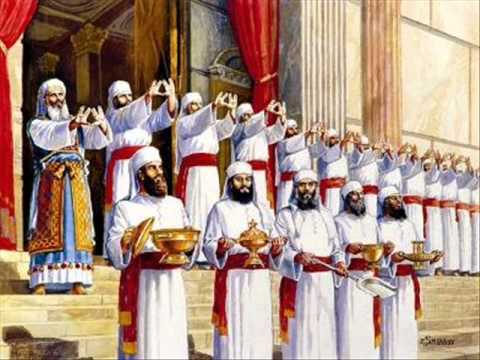
Worker Hammering Square Peg into Round HoleAccording to Ezekiel chapters 40-48, the millennial age will feature a magnificent temple (much larger than any historic temple of Israel) that will serve as the center for the priestly rituals and offerings. In attempting to explain the sacrifices of this temple, the thought is not that the death of Christ is insufficient but rather that the sacrifices are a memorial of Christ’s sacrifice on Calvary, much as those in the Old Testament looked forward to the fulfillment in Christ’s death. (emph. mine)

-John F. Walvoord from his book
Major Bible Prophecies
as quoted in my Sunday School class notes for Sept. 22nd

I’ve got material in my head for three, maybe four blog posts, but I’ve only got time to write one. So which one shall I write?

In going over my notes of Pastor’s sermon on Sukkot, I could make a blog post out of it, but I really think Pastor did a very good job on this topic. Nothing he said particularly surprised me and I don’t have hardly anything to disagree with him on (except maybe to say that while the future of Sukkot is the “meat” on his plate, we don’t have as much linkage into the future of “the feast” without a present, lived experience).

I have somethings I want to say about reading the last entry in the First Fruits of Zion (FFOZ) Torah Club and ending my year-long study of Volume 6, Chronicles of the Apostles, but I think I’ll save that for another later this week.

Especially as the Torah cycle is ending and about to begin again, which marks the approach of the first anniversary of my return to church, I want to write an update to my review of Boaz Michael’s book Tent of David, describing my own experience, but I’ll need more time to re-acquaint myself with the book’s material and view it through fresh eyes.

But I do want to comment on my experience in the Christian church through the lens of today’s Sunday school class. Notice in the above quoted passage from Walvoord’s book, I emphasized text that threw me for a loop. Am I reading this wrong, or is Walvoord (and by inference, my Sunday school teacher), saying that the Israelites of old while making offerings to God realized that somehow this was all deficient and they looked forward to their fulfillment in Christ’s death? Of course, after reading the sentence a few dozen times, I realize Walvoord may not have meant that the ancient Israelites thought this way, but that the Temple sacrifices “looked forward” to a time when they would be fulfilled (ended) by the crucifixion.

Either way though, the anachronism is blatant.

jerusalem_templeFrom the context of the Israelites at the time of the Tabernacle, and later, Solomon’s Temple, the sacrifices were korban, a way of drawing closer to God, by removing barriers and obeying the God who gave them the Torah through Moses at Sinai. I seriously doubt that most of them considered a future time when the Temple would not exist and certainly they never would have imagined that Messiah, hung on a tree to die, would kill the sacrificial system. Sure, from a traditional Christian perspective, we’ve been taught to believe such things, but that means we become incapable of putting ourselves in the shoes of a Jewish person of old and comprehending his or her lived experience and how wonderful they thought the Torah mitzvot were (and modern religious Jews continue to see the Torah as a joy). Read Psalm 19 and Psalm 119 for examples of what I mean.

How about this?

Then it will come about that any who are left of all the nations that went against Jerusalem will go up from year to year to worship the King, the Lord of hosts, and to celebrate the Feast of Booths.

–Zechariah 14:16 (NASB)

It shall be that all who are left over from all the nations who had invaded Jerusalem will come up every year to worship the King Hashem, Master of Legions, and to celebrate the festival of Succos.

–Zechariah 14:16 (Stone Edition Tanakh)

Now, here’s one of the questions in my Sunday school notes regarding this verse:

In verse 16, what will the unsaved Gentiles in the Millennium be required to do each year? (emph. mine)

Excuse me? Unsaved Gentiles? Where does it say that in the verse? Actually, the answer has to do with my teacher’s perspective on “the end times” and the “Millennial reign of Christ” based on very traditionally Christian sources. I actually challenged him, saying that the term “saved” was being anachronistically inserted into the Jewish text. It just says that each of the nations that went to war against Israel will be responsible for sending representatives to Jerusalem at Sukkot to pay homage to the Jewish Messiah King and to celebrate the festival. There’s no implication regarding their spiritual state.

(For an alternate commentary on this passage, see Toby Janicki’s blog post God-Fearers: Zechariah 14, Sukkot, and Anti-Semitism.)
churchesBut then I realized that he believes (or could believe) that all of the “saved Gentiles” were living with the “saved Jews” in Israel and only “unsaved Gentiles” lived in the other nations of the world. Of course, that implies that somehow we believing Gentiles are given a portion of the Land, of Israel, during Messiah’s reign. I’m not sure how or if that sort of thing works out and I’m inclined to believe it doesn’t.

Pastor preached on this when he said that once the Church is “raptured” (in his view, up to Heaven) with Christ, they (we) will return to Earth with him with special jobs to do, especially during Sukkot. This is very confusing because it seems as if there aren’t very many believing Gentiles and Jews around if we can all fit in a country about the size of New Jersey. It’s also rather strange if only we believers live in Israel and the rest of the world are “Goyishe sinners” living in all of the other countries on the planet…and yet somehow, they acknowledge that they are ruled by the Jewish King from the Jewish Kingdom of Israel.

I guess the idea is all of those “unsaved Gentiles” will use the time and opportunity to become “saved,” but then, as my Sunday school teacher asked, will they receive “glorified bodies” instantly or will only their children get those? My question is, when a Gentile is “saved” during the “Millennial reign,” do they immediately “make aliyah” to Israel?

I’m putting a lot of words and phrases in quotes because most of them are Christian anachronisms and theological concepts being forced into the Jewish text (and let’s keep in mind that the New Testament is also a Jewish text). I think I’m getting a headache.

Here’s something else from my class notes. I’m not sure if it’s from Walvoord since the citation seems a little confused:

Note: The battle of God and Magog here (after the Millennium) is totally different from that in Ezekiel chapters 38 & 39 (during the Tribulation) -Walvoord. There, Israel is attacked (while her “friends” watch) by a coalition of Russian and Muslim nations from the north at a time when Israel is at peace. (emph. mine)

Not that it couldn’t happen this way, but how can the author possibly know with such certainty exactly which nations/powers are involved? Couldn’t some European (or other) nations also be attackers (and the way the EU and especially the French have been treating Israel lately, I wouldn’t be surprised)?

In discussing Revelation 20:11-15, the class notes ask the question, When they face Jesus Christ as their Judge (II Tim. 4:1, Phil. 2:9-11), what 66 “books” will He open to judge “their works”? In class, the teacher said he supposed other books could be involved besides the Bible, but even putting such a detail in these notes assumes quite a bit about what we think we know.

The last such “interesting” bit of wording I’ll insert comes from the notes for next Sunday’s class on Acts 15:1-21 (one of my favorite themes):

In Acts 15:1-2 and 15:24, Now with what Satanically inspired and dogmatic false teaching did these “certain men from Judaea” try to infect the church at Antioch, and why according to Galatians 2:4-5? (emph. mine)
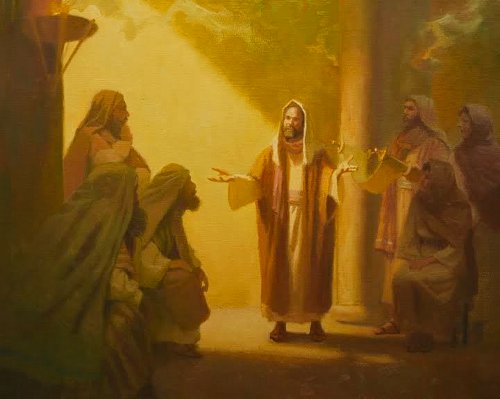
Apostle-Paul-Preaches“Satanically inspired” teaching? Since when is discussing opposing theological viewpoints considered Satanic. Most Wednesday evenings, I meet with my Pastor to discuss similar topics and we don’t always agree with each other. Is that disagreement “Satanic?” Am I being “Satanic” when I disagree with my Pastor, since he represents a more mainstream Christian theological perspective?

I know it seems I’m really bashing my Sunday school teacher. Actually, he’s a great guy and I like him. He teaches a lot of the retired guys in the church on Wednesday mornings, which I consider a mitzvah. He obviously loves his wife and she loves him. He has a heart for Christ and is enthusiastic about the Master’s return and the restoration of Israel and the world.

But there are just some times I get that “square peg in a world of round holes” feeling, particularly in Sunday school.

Addendum: See an extension to this “meditation” by reading The Obscured Messiah in the Bible.

The Boy in the Sukkah

Sukkah in the rainIn a sense, Sukkos itself is about getting our priorities straight. Here we just finished with the Days of Judgement, hopefully with Hashem’s blessings for a year of prosperity and success. Yet the first thing we do with our new-found blessings is to leave our comfortable homes for the temporary shade of the Sukkah. We thereby acknowledge that there can be no greater “success” in life that to do what Hashem really desires, even when it’s not what’s most comfortable. Sometimes we shake with the Esrog and sometimes we shake with the horse – the main thing is to strive to understand what Hashem wants of us in a given situation, not what we want or what makes us feel good. As the pasuk says (Mishlei/Proverbs 3:6), “In all your ways know Him; He will straighten your paths.”

-Rabbi Eliyahu Hoffman
“Sukkos: Shaking Up Our Priorities”
Torah.org

My four-and-a-half year old grandson keeps calling me from my Sukkah. Actually, he keeps phoning me from my Sukkah, calling me at work. OK, he’s only done it twice, and he had Bubbe’s (my wife’s) help doing it.

The first time was actually a day or so before the festival began. He and Bubbe were lunching in the Sukkah and he called me to invite me over. Unfortunately, I couldn’t leave my job right then, but agreed to join him later that afternoon. The second time was a few days later, still at the same time of day. He wanted to know why “Uncle Mikey” (one of my sons) wasn’t answering his phone. I explained that “Uncle Mikey” was probably in school (university) and couldn’t answer the phone.

The kid really wants more company in my Sukkah. And that’s a good thing.

This is the season of joy for Jewish people. The days of judgment have passed and there is great celebration in or rather outside many Jewish homes, eating, and singing, and dancing, all for the sake of the Torah and Hashem.

As I write this (on Friday before Shabbos), I have yet to take a meal in my own Sukkah (Note: On Shabbos I started taking my meals in the Sukkah). I almost did last night, but my wife and I had a conversation on a serious subject while making dinner and, both being distracted, we sat down at the kitchen table for our meal and were eating before I realized we’d missed eating in the Sukkah together.

I thought about breakfast or at least coffee this morning in the Sukkah, but it was still dark outside and after coming back from the gym, my son (in this case, David) and I were in a rush to get ready for work.

As Rabbi Hoffman suggests, I need to get my priorities straight. Obviously, my grandson already has his up to snuff, since he’s eating every day in the Sukkah and trying to invite others to do the same.

landonAnd I’m pretty sure that at his age, he doesn’t really grasp Sukkot yet.

But who knows?

It’s Friday before Shabbos, but you won’t read this until Monday morning (or later). I’m hoping I can get all the kids over on Sunday for a meal. Everyone has different schedules so it isn’t easy to gather together in our home regularly. But just once this week, it would be nice to eat with the family in the Sukkah (Note: As it turned out, everyone had plans away from our home on Sunday, including my wife…ah, maybe next year).

It is said in Machzor of Succos, “I welcome to my table the saintly guests, Abraham, Isaac, Jacob, Moses, Aaron, Joseph, and David.” It is said in the Siddur, “I am hereby ready and prepared to fulfill the positive commandment…” It is said in Isaiah 11:6 “And a little boy will lead them.”

And so, we should follow.

The Sukkot Season of Joy

have-sukkah-will-travelSeven days shall you dwell in booths (Leviticus 23:42) … and you shall only be rejoicing (Deuteronomy 16:15).

Succos is the festival designated as the season of our gladness. Yet the commentaries state that one of the symbolisms of the succah, a temporary hut, is that we dwell in it for seven days to symbolize man’s temporary sojourn on earth for his average life span of seven decades (Psalms 90:10).

Human mortality is a rather sobering thought; it is hardly conducive to rejoicing. Most often we do not think about our mortality, and when circumstances force us to face it, we quickly dismiss it from our minds and go on acting as though we will live forever.

How different Torah values are from secular values! The Torah teaches us that there is an eternal life, a wholly spiritual life, whose bliss is far greater than the human mind can imagine. We are placed on this planet for our ephemeral earthly existence only to give us an opportunity to prepare for the eternal life.

The Torah teaches us to enjoy life, and if it restricts some pleasures, it is because we should enjoy life in a manner that befits a human being. Furthermore, our joy of living should not be diminished by the awareness of our mortality, nor need we deny it. The succah – the symbol of our temporary stay on earth – is beautifully decorated, and we enjoy our festive meals therein. Even our temporary existence can be beautiful and happy, and our faith in the eternal life should enhance that happiness.

Today I shall …

… try to enjoy life as befits a spiritual person, knowing that the true life of man is not the fleeting one, but that of eternity.

-Rabbi Abraham J. Twerski
“Growing Each Day, Tishrei 15”
Aish.com

I have to admit that at this time of year, sometimes I envy Jewish people. The traditions surrounding the celebration of Sukkot are so rich and full of life. Sure, I can build a sukkah and I can observe, to some degree, the same traditions, but I wonder what it must be like to have a life-long experience of such celebrations. What memories do Jewish people have of childhood, eating in a sukkah each year, “partying” with relatives and friends, singing, dancing, rejoicing?

I’ve come to the party far too late and worse, I was too late to bring my children. If I had been more timely, perhaps, my son would build a sukkah for his wife and child each year. Face it, in terms of traditions and spiritual depth, Sukkot has got Christmas beat all hollow.

I recently came across a Facebook page called Jewish People Around the World. The stories and photos of Sukkot observance are just fabulous. Certainly if, as Rabbi Twerski says, the Torah teaches us to enjoy life, then Sukkot is one of the crowning jewels of that Torah sentiment.

Rabbi Twerski also said this:

God wants us to enjoy worldly goods, but to do so in a manner that befits a spiritual people, a kingdom of priests and a holy nation.

Sukkot_Priestly_BlessingSukkot, for all its focus on being a “season of joy” does not focus on just the individual seeking his or her own joy as another of Rabbi Twerski’s commentaries notes:

Rabbi Mordechai of Nesh’chiz looked forward all year to the mitzvah of the Four Species on Succos. Since a fine esrog was costly and Rabbi Mordechai was hardly a man of means, he would accumulate small coins all year round, even depriving himself of food, in order to be able to afford an esrog.

A few days before Succos, Rabbi Mordechai joyfully took the money he had saved, and in high spirits, went off to buy the coveted esrog. On the way, he encountered a man sitting at the side of the road, weeping bitterly. He inquired as to the reason for the man’s grief, and the latter told him, “Woe is to me! I earn my living with my horse and wagon, and this morning my nag died. How am I to feed my wife and children?”

“How much do you need to buy another horse?” Rabbi Mordechai asked.

The sum that the man specified was exactly the amount that Rabbi Mordechai had laboriously saved all year long for the esrog. Without giving it another thought, he gave his purse to the man. “Here, my dear man. Go buy yourself a horse’

After the man joyfully left with the money, Rabbi Mordechai said, “Oh well. All of Israel will be fulfilling the mitzvah of the Four Species with an esrog, but I will do so with a horse.”

Rabbi Mordechai’s sacrifice of his personal comfort all year round teaches us how precious is the mitzvah of the Four Species, but his final act teaches us that the mitzvah of tzedakah (charity) is even greater.

Today I shall…

… try to realize the greatness of the commandment of charity, to make certain that another person has the means to survive.

I mentioned Christmas before, which I suppose is the closest thing in Christian tradition to Sukkot (apart from Thanksgiving, which strictly speaking, isn’t a “Christian” holiday). I think for some Christians, teaching charity and giving is the focus of that holiday, but for most people, including most Christians, all attention is drawn on buying and consuming material goods for their own sake and for ours, not for the sake of other people.

Also, as we read in the first quote from Rabbi Twerski, Sukkot teaches us the difference between temporal, material values and those for the sake of Heaven, and yet even eternal values are celebrated with the joys of our material world. Our mortal life is much like living in a sukkah, while what is beyond can be compared to basking in the glory of God on His Throne.

If it comes down to experiencing our own joy and providing joy to others in material ways that summon the eternal, I say, is it too much to ask for both?

A Question of the Division of Abijah

levites-aaronic-blessingIn the days of Herod, king of Judea, there was a priest named Zacharias, of the division of Abijah; and he had a wife from the daughters of Aaron, and her name was Elizabeth.

–Luke 1:5 (NASB)

I very recently wrote a blog post called Was He Born in a Sukkah and, based on a teaching by First Fruits of Zion (FFOZ) theologian and teacher D. Thomas Lancaster, I suggested that Jesus was not born either on Christmas or on Sukkot. I received some pushback as a result and some readers provided further evidence on how the Master was very probably born on Sukkot.

My original source was an article in Messiah Journal 111 (Fall 2012 issue) called “The Birth of Yeshua at Sukkot: Evidence from an Old Source” but I later listened to an audio CD of Lancaster teaching the same material. The audio contained more information that expanded upon Lancaster’s reasons as to why we can’t really know if Jesus was or wasn’t born on Sukkot.

I just found Lancaster’s sermon online at the Beth Immanuel Sabbath Fellowship website. If you click that link, you’ll be taken to the Audio page specific to the material. To listen to the relevant recording, scroll down until you locate “Birth of Yeshua at Sukkot.” At about 8:29 on the audio, Lancaster introduces the information about Zacharias (father of John the Baptist) that I’m also going to summarize here.

The strongest evidence anyone has presented me about Yeshua (Jesus) being born on Sukkot has to do with the timing of Zacharias’ service in the Temple. But let’s take a step backward:

Now in the sixth month the angel Gabriel was sent from God to a city in Galilee called Nazareth, to a virgin engaged to a man whose name was Joseph, of the descendants of David; and the virgin’s name was Mary. And coming in, he said to her, “Greetings, favored one! The Lord is with you.” But she was very perplexed at this statement, and kept pondering what kind of salutation this was. The angel said to her, “Do not be afraid, Mary; for you have found favor with God. And behold, you will conceive in your womb and bear a son, and you shall name Him Jesus. He will be great and will be called the Son of the Most High; and the Lord God will give Him the throne of His father David; and He will reign over the house of Jacob forever, and His kingdom will have no end.” Mary said to the angel, “How can this be, since I am a virgin?” The angel answered and said to her, “The Holy Spirit will come upon you, and the power of the Most High will overshadow you; and for that reason the holy Child shall be called the Son of God. And behold, even your relative Elizabeth has also conceived a son in her old age; and she who was called barren is now in her sixth month.

–Luke 1:26-36 (NASB)

Here we see the angel Gabriel announcing to Miriam (Mary) that she has been chosen to be the mother of Jesus, and popular opinion states that at this time Mary was already pregnant or would become pregnant very soon afterward. We also see that her cousin Elizabeth was six-months pregnant with her child, John the Baptist. The Priest Zacharias is John’s father.

Remember, Zacharias is a Priest in the division of Abijah and we know, based on 1 Chronicles 24, the order of the service of the Priestly divisions. We know that the division of Abijah, like the other divisions, served twice a year for a full week each time. If we could figure out when the course of Abijah was, we could figure out when Elizabeth became pregnant (since she became pregnant immediately after the end of Zacharias’ service in the Temple), count ahead six months and then nine months, and then figure out the birthdate of Jesus.

But Lancaster says it’s not that easy.

First of all, there were 24 courses which meant that each division cycled through the year twice making 48 week-long courses in a year. But in the solar calendar, there are 52 weeks in a year, so unless there was some way to compensate, each course would drift across the calendar making it very difficult to determine when a particular division was serving at any given year.

D.T. LancasterThe assumption though is that the Abijah division was serving in the spring or the fall. But Luke doesn’t tell us what season it was when describing Zacharias’ service, so we have no way of knowing if it was during springtime or autumn.

On top of that, one out of every three years in the Jewish religious calendar contains 13 months. Rabbinic sources don’t tell us how or if the priesthood compensated for an extra four weeks in their calendar every three years. We assume that they must have, but without knowing the exact method they used, we’re stuck as far as calculating the timing of the service of divisions.

And after all that, the entire priesthood was called to serve during each of the three pilgrim festivals: Pesach, Shavuot, and Sukkot, and Lancaster says we can’t rule out that it was during one of the festivals that Zacharias was serving.

The icing on the cake, so to speak, is that experts don’t agree on whether the priestly rotation began on Nisan 1 or Tishrei 1.

Add all this up, and it becomes impossible to calculate when Zacharias served in the Temple in the Luke 1 text, and thus the entire basis for calculating the birth of Messiah disintegrates like wet tissue paper.

Since this is just a summary, I encourage you to click on the link I provided above and listen to the entire recording for yourself. I can’t speak for Lancaster, but unless some additional data comes to light that modifies everything I just said, the information about Zacharias and the Abijah division of priests is a dead-end in terms of discovering the birthdate of the Master.

V’Zot HaBerachah: Hanging on a Peg

Sukkot In The Synagogue. Leopold Pilichowski (1869-1933). Oil On Canvas.“And this is to Yehudah, and he (Moshe) said, ‘Listen Almighty to the voice of Yehudah”

–Deuteronomy 33:7

What does this verse refer to?

Rashi teaches us that Moshe is referring to the prayers of the kings of Yehudah: David, Asa, Yehoshofot and Chizkiyah.

The Midrash elaborates: There were four kings and each one asked the Almighty for different things. King David asked that he should be able to pursue his enemies and vanquish them. King Asa said, “I don’t have the ability to kill my enemies. Rather, I will pursue them and You Almighty should vanquish them.” King Yehoshofot stood up and said, “I don’t have the ability to vanquish my enemies or even to pursue them. Rather, I will pray and You Almighty should vanquish them.” Chizkiyah stood up and said, “I do not have the ability to vanquish, to pursue or to pray. Rather, I will stay home and sleep and You Almighty should vanquish my enemies.”

What is the meaning of not being able to pursue or pray? Why should anyone find this difficult since the Almighty will be involved? Rabbi Chaim Mordechai Katz used to explain: Regardless of what we ourselves do to be successful in any area, we must be aware that ultimately it is the Almighty Who causes the victory. Everything is dependent on His will, but we must do our share.

Dvar Torah based on Growth Through Torah by Rabbi Zelig Pliskin
“Shabbat Shalom Weekly”
Commentary on Shabbat Chol HaMoed Sukkot and Torah Portion V’Zot HaBerachah
Aish.com

But our share of what? In the above midrash, we are taught that regardless of how much or how little we are able to do in our lives, it is actually God who is the source of everything. There are some people who don’t like that idea, especially well accomplished people who have worked very hard to achieve a measure of success. Imagine a renowned classical pianist being told, “God was so good to you to have given you such talent,” and then hearing the pianist reply something like, “God, nothing. Where was God when I spent endless hours over the past forty years practicing and learning? Thanking God for my talent totally invalidates all of the hard work I did to achieve my current musical skill.”

From an atheist’s point of view, I can see how a Christian saying such a thing would be very insulting. It’s difficult to see the interplay between God’s sovereignty and His expectation of our participation. On the other hand, there’s also a very real danger that by giving God all the glory and then some (not that we shouldn’t give all the glory), we believe we have no responsibility to produce any of the effort God expects of us.

But as I said before, what effort is expected of us? Well, that depends.

… in order that his (the king’s) should not be lifted above his brethren, and that he should not deviate from the commandment to the right or to the left.

–Deuteronomy 17:20

The Torah requires that even one who is in a position of leadership and prominence must retain his humility. Moses and David are outstanding examples of leaders who were extremely humble.

How can one remain humble when one exercises great authority and is the recipient of homage and adulation? “Simple,” said Rabbi Moshe of Kobrin. “If a king hangs his crown on a peg in the wall, would the peg boast that its extreme beauty drew the king’s attention to it?”

While an organized society needs leaders, and in Judaism there is a need for Kohanim and Levites who have special functions, an intelligent person should never allow a particular status to turn his head and make him think that he is better than others. Nor should men consider themselves superior to women because they have certain mitzvos from which women are exempt, and women should not think that they must attain equality by rejecting these exemptions and performing these mitzvos. There is no need to attain something that one already has. Men and women, Kohanim and Levites, leaders and kings – we are all “pegs in the wall” which the King uses for His purposes as He sees fit.

True, we should always strive for that which is above us, but this means striving for greater wisdom and spirituality, and not for positions of superiority. The latter are not at all “above” us; one peg may be higher on the wall than another, but that does not make it a better peg.

Today I shall…

…try to realize that I, like all other people in the world, am but an instrument of God, wherewith He wishes to achieve the Divine will.

-Rabbi Abraham J. Twerski
“Growing Each Day, Tishrei 13”
Aish.com

hat-on-a-pegOur share or what is expected of us depends on which peg we are. No one, not even the King or the Kohen Gadol (the High Priest) is more important than anyone else, but they still have special functions. The local village water carrier could not step in and fulfill the functions of either. For instance, in the days of the Temple, you wouldn’t see the King entering the Holy of Holies on Yom Kippur to offer atonement for the nation. Only the Kohen Gadol could do that. Not that the Priest was more important or more exalted than the King, only that his function was highly specialized.

What we do as servants of God’s Divine will depend on who we are. No one person is more important than another but that doesn’t mean they’re all the same, either.

Which brings me to this:

It is not with us, it is with Israel, and by accepting Israel’s Messiah we get to partake in Israel’s blessings. As an example, if my husband receives a family inheritance, then as his wife I would obviously partake in it too. However, it isn’t “MY” inheritance, and my receiving any benefit from HIS inheritance requires connection to him.

I don’t see God covenanting with Gentiles in the Bible, rather, we receive blessings of Israel as we draw near to them.

That was a comment made on one of my recent blog posts.

That revelation is actually very humbling. It hardly contributes to the feeling of significance of a Christian (or any non-Jewish believer) in relation to God. I have written on multiple occasions about how it is only through Israel that we have a doorway at all into any blessings from God. Without the covenant relationship that Israel, the Jewish people, have with God, we people of the nations who are called by His Name (Amos 9:11-12), cannot be called by His Name. In fact, only three verses in the Bible create the link that allows anyone but the physical descendants of Abraham and Isaac and Jacob to have a covenant relationship with God at all:

Now the Lord said to Abram,

“Go forth from your country,
And from your relatives
And from your father’s house,
To the land which I will show you;
And I will make you a great nation,
And I will bless you,
And make your name great;
And so you shall be a blessing;
And I will bless those who bless you,
And the one who curses you I will curse.
And in you all the families of the earth will be blessed.”

–Genesis 12:1-3 (NASB)

Not to put too fine a point on it, but only that last sentence at the end of verse 3 creates the link. Paul’s commentary on this part of God’s covenant with Abraham brings forth some illumination:

Now the promises were spoken to Abraham and to his seed. He does not say, “And to seeds,” as referring to many, but rather to one, “And to your seed,” that is, Christ.

–Galatians 3:16 (NASB)

You have to read that whole chapter in Galatians and then interpret it carefully to realize that Paul was not invalidating the Torah (Law) for Jewish people, but then again, he wasn’t applying the Abrahamic covenant (or any other covenant God made with Israel) as a total unit to his Gentile audience either. He was only applying the blessing from a single condition of the Abrahamic covenant to the non-Jewish believers, as recorded in a tiny slice of Genesis 12:1-3. Misinterpretation of this part of Paul’s letter to the churches in Galatia has led to generations of Christians believing that they would physically have an inheritance in the Land of Israel, either replacing or at least crowding out the Jewish people.

Square Peg in a Round HoleOther misinterpretations have led many people in recent years to believe they inherit not only all of the blessings that result from God’s covenant with Abraham, but all of the covenants (and their blessings) God made with Abraham, Isaac, Jacob, and the Children of Israel, effectively deleting any distinction between Gentile believers and Jewish people everywhere.

Just because the Jewish pegs aren’t more important or better loved by God than the Gentile pegs doesn’t mean that just anyone can take the crown from the King’s peg and put it on their own head. Only the King is King. Only the High Priest is the High Priest. Only the Jewish people are Jewish and bear the Jewish responsibilities assigned to them by God. Only the people of the nations who are called by God’s Name are who we are and only we have the special responsibility to encourage, support, and nurture Jewish return to God and to Torah in order to facilitate the return of Messiah.

I know that by just saying such a thing, I’ve become a square peg in the world of round holes. I don’t fit in either the Christian church by having such an opinion, nor do I reasonably fit in any traditionally Jewish realm. Even Messianic Judaism doesn’t know what to do with me because I go to church, and Hebrew Roots can’t tolerate me because of the idea of not being equal sharers in, or owners of, all blessings and all covenants across the board (but isn’t equal access to God’s love, mercy, grace, and salvation enough?).

Equality but not homogeneity is an extremely difficult concept to grasp, and it’s even more difficult to live out. Believe me, I know. I strive to live it out every day. There’s a horrible temptation to see myself not only as not equal to other believers (Jewish or Gentile), but not even significant to God.

But it becomes easier when I realize that it’s not human relationships, human priorities, or human judgments that are the key, but a relationship with God.

It is better to take refuge in the LORD Than to trust in man.

–Psalm 118:8

Do not trust in princes,
In mortal man, in whom there is no salvation.
His spirit departs, he returns to the earth;
In that very day his thoughts perish.
How blessed is he whose help is the God of Jacob,
Whose hope is in the Lord his God,
Who made heaven and earth,
The sea and all that is in them;
Who keeps faith forever;
Who executes justice for the oppressed;
Who gives food to the hungry.
The Lord sets the prisoners free.

–Psalm 146:3-7

Stop regarding man, whose breath of life is in his nostrils; For why should he be esteemed?

–Isaiah 2:22

That said, there are people I admire and esteem for their holiness and their knowledge, but it is hardly wise to base one’s relationship with God on what some other human being says you should or shouldn’t do. Not that there aren’t good teachers and good books to help along the way. But the buck does not stop with such good teachers and good books, and it most assuredly doesn’t stop with most of the silliness we find in most of the religious blogosphere.

Recently, Rabbi Carl Kinbar said to me:

You asked, “But if God is our teacher and perhaps ultimately, our only teacher, where can we go to learn from Him without having to endure endless layers of human filters?” Our Teacher has placed us in complex relationships with these “human filters” who sometimes have to be “endured” (as they have to endure us) but at other times inspire us (as we hope to inspire them. Not to mention our traditions, which are also marked by joy and pain.

Hopefully, we also experience those very rare moments of utter love and holiness with God himself – moments of simplicity that do not transcend life but help direct us in the midst of its complexities and uncertainties.

love-in-lights…those very rare moments of utter love and holiness with God himself… As Rabbi Kinbar said, we have been placed as pegs among many other pegs to sometimes “endure” each other, but also, we pegs have been placed among each other to inspire each other. True, we also sometimes discourage each other, which is often the place from which I write. That is why, as much as we pegs need to be with each other, whether I am a square peg or a round one, it is not only important, but it is vital that I seek out, that we all seek out, those very rare moments of utter love and holiness with God himself – moments of simplicity that do not transcend life but help direct us in the midst of its complexities and uncertainties.

Everything is dependent on His will, but we must do our share. Even understanding who we are and what “share” we must do can be terribly complex. For some people it may be easy, but for many others, it only seems that way, because uncertainty and dissonance is extremely uncomfortable. Saying, “God wants me to do this” (whether He really does or not) is a lot easier than saying (and feeling) “I’m not sure what God wants so I turn to Him in my uncertainty and let His will guide me, not my own.”

I’m glad we are in the days of Sukkot. What better place to be than sitting in my sukkah, looking dimly up at the sky and the clouds, listening to the fabric of the sukkah fluttering in the breeze, seeking a very rare moment of utter love and holiness with God himself.

Good Shabbos.

5 days.

Was He Born in a Sukkah?

born_in_sukkahWhen was Yeshua born? The Gospel writers either did not know when the event happened or they did not feel the information was important enough to pass along. We can only speculate.

Two centuries after it happened, Clement of Alexandria discussed the dating of the Master’s birth, but he did not mention December 25 or January 6 at all. Instead, Clement reported one tradition corresponding to April 20 on our civil calendar and another tradition corresponding to May 20. By the middle of the fourth century, however, the Roman church had begun to honor December 25 while churches in the East, Asia Minor, and Egypt observed Jesus’ birth on January 6. Both are late developments and unsupported by early tradition or biblical evidence. No trace of a tradition from the early Jewish believers connects the birth of the Messiah with December 25 or January 6.

-D. Thomas Lancaster
“The Birth of Yeshua at Sukkot: Evidence from an Old Source,” pg 21
Messiah Journal, issue 111 (Fall 2012)
Published by First Fruits of Zion (FFOZ)

This is normally the sort of conversation you have in December when the vast majority of the Christian world prepares to celebrate the birth of Christ. One thing we can be certain of is that Jesus was born nowhere near December 25th. But it has been suggested that he might have been born on or near the festival of Sukkot. Could this be true?

I recently had a private request for any information I knew about this possibility. Alas, it’s not something I’ve written on before (although I’ve heard some commentaries on the topic). Fortunately, D. Thomas Lancaster has written on this in the above quoted article in Messiah Journal 111, which was published last year. Does Lancaster conclude that the Master was born during this season and if so, what is his evidence?

Other Sukkot-theory proponents claim, “Yeshua was born in a sukkah because the word ‘stable’ is sukkah in Hebrew.” These arguments are not at all convincing and fall apart under scrutiny. Is there any legitimate evidence of a Sukkot birth, or is the birth of Yeshua at Sukkot just more Hebrew roots movement apocrypha?

-Lancaster, pg 22

That doesn’t sound too encouraging. As much as the symbolism may attract us and fit into the theories and emotional dynamics of certain individuals and groups, is there any real evidence to establish the idea that Jesus was born during Sukkot? What line of reasoning and investigation could we use to support or refute this viewpoint?

Lancaster suggests that we could compare the birth narrative of John the Baptist to that of Jesus. We know, based on Luke 1:26 and 1:36 that the conception of Jesus came about six months after the conception of John, thus we can assume that Jesus was born about six months after John was. If we could determine when John was conceived and/or born, we could reasonably deduce when Jesus was born.

And now you will be silent and not able to speak until the day this happens, because you did not believe my words, which will come true at their appointed time.”

–Luke 1:20 (NIV)

And now you will be dumb and unable to speak until the day when this has taken place; because you did not believe my words–words which will be fulfilled at their appointed time.”

–Luke 1:20 (Weymouth New Testament)

zechariahThese are the only two translations of the New Testament where it specifically mentions “appointed time,” which is important because of the following:

“Is anything too difficult for the LORD? At the appointed time I will return to you, at this time next year, and Sarah will have a son.”

–Genesis 18:14 (NASB)

But what’s “appointed time” got to do with it? Doesn’t it just mean some random date God selected for the birth of John the Baptist and Isaac, the son of Abraham and Sarah?

In the Torah, the biblical festivals are called “appointed times.” According to one Jewish interpretation, “the appointed time” at which Sarah gave birth to Isaac was the first day of Passover:

And how do we know that Isaac was born at Passover? Because it is written, “At the appointed time I will return to you […and Sarah will have a son].” (b.Rosh Hashanah 11a)

In the Gospels, John the Immerser comes in the role and spirit of Elijah. Jewish tradition maintains that Elijah will appear at Passover to announce the coming of Messiah. For that reason, we read Malachi’s prophecy about the coming of the Messiah on the Sabbath before Passover, and Jewish homes set a place at the Passover Seder table for Elijah.

-Lancaster, ibid

Lancaster covers two other traditions. One involving the Biblical record of Joseph and Mary traveling (supposedly) to Jerusalem to attend the festival of Sukkot, and they happened to be near Bethlehem when Mary went into labor. If Bethlehem were on the pilgrim trail to Jerusalem, the multitude of travelers going up to Jerusalem for the festival could account for all the “no vacancy” signs at the inns.

The other tradition has to do with assigning a double meaning to the phrase “the Eighth Day.” Of course, all Jewish boys were to be circumcised on the eighth day after birth, but the last day of Sukkot, which is actually a separate festival, Shemini Atzeret, is also referred to as the “Eighth Day.” This would mean Jesus would have been born on the first day of Sukkot and circumcised on the eighth day of the festival. Pretty neat timing.

Admittedly, this is all speculative. The Gospels do not actually indicate that John was born on the first day of Passover, that Yeshua was born on the first day of Sukkot, or that he was circumcised on the eighth day of Sukkot.

-ibid, pg 23

Lancaster’s article goes on for another page or so where he quotes from a “medieval collection of anti-Christian Jewish folklore titled The story about Shim’on Kefa (Aggadta DeShim’on Kefa),” which may offer certain hints suggesting that the early Jewish believers could have commemorated the Master’s birth at Sukkot, but all in all, support for this perspective is very thin.

Sukkah in the rainI’m not saying it couldn’t work out this way and I suppose it would be very symbolic if it did work out that Jesus was born on Sukkot, but in fact, we just don’t know. Evidence from the Gospels and from various Christian and Jewish sources simply do not provide enough light on this matter to bring it to any sort of resolution. Thus, for Christians and other Gentile believers involved in the Hebrew Roots and Messianic Jewish movements, we must find other reasons to celebrate Sukkot. Don’t worry, we have reasons enough, as one person said on my blog recently.

It is appropriate, not only that you have built the family sukkah, but also that you should participate in its celebration, as an anticipation of the prophetic fulfillment in the Messianic Era when the nations will come up to Jerusalem to celebrate this feast (or suffer drought), as described by Zacharyah. Indeed, Jewish tradition perceives reflections of a sort of Yom Kippur repentance and redemption for the non-Jewish nations in the Sukkot celebration.

As for Messiah, he temporarily lived among people once in the fragile shelter of a human body. Some day, he will return and be with us forever.

I’ve been reviewing some of my past Sukkot related blog posts and thought you’d find these interesting:

Sukkot: Drawing Water from Siloam.

Plain Clothes Sukkah.

May you drink from springs of living water. Chag Sameach Sukkot!

Addendum: This conversation is continued in A Question of the Division of Abijah.

"When you awake in the morning, learn something to inspire you and mediate upon it, then plunge forward full of light with which to illuminate the darkness." -Rabbi Tzvi Freeman