Should Our Children Imitate Us?

passover_seder_table_settingPesach is coming! Monday night, March 25th is the first Seder. What kind of Seder will you have for your family and friends? Will it be “Let’s hurry up and get to the food” — or something more meaningful, uplifting, impactful? There are 3 types of people: Those who make things happen, those who watch things happen … and those who ask, “What happened?” The kind of Seder you have is up to you and depends on what you do starting NOW! Make it more than — “They wanted to kill us. We won. Let’s eat.”

The Seder should help your children to feel positively about being Jewish. You cannot transfer feelings, but you can create the atmosphere and the experience which will engender positive feelings. Many people who love being Jewish, fondly reminisced about their Zaideh (grandfather) presiding over the Shabbat table and the Seder or their Bubbie (grandmother) lighting Shabbat candles … and their Seder! You are a link in that chain!

-Rabbi Kalman Packouz
“Shabbat Shalom Weekly”
Aish.com

All in all, this year’s Passover seder in my home was pretty lousy. There are a lot of reasons for this, most of which I am not at liberty to discuss. It’s wasn’t anyone’s fault. No one burned the roast, or behaved poorly, or arrived abysmally late to the event. But it certainly wasn’t the joyous occasion of freedom that I usually anticipate…at least not on the surface.

But I was disappointed and sundown at the end of Shabbat and the first full day of Passover was a sad relief. At least it was over.

-Me from my blog post
The Uninspired Passover Seder

Easter and Passover are coming and I’m dreading them both. I’m dreading Easter because I haven’t observed it in a very long time. But now that I’m going to church, I am faced with a sunrise Easter service followed by brunch (I can only imagine what’s on the menu), and then a more traditional service afterward. Don’t get me wrong. I have no problem with celebrating the resurrection of the Master, but the event seems so disconnected from the way I think and feel about God, Messiah, and the Bible. But then again, that’s how I felt about church before I let myself return.

I’m dreading Passover because of what happened last year. I recall that my wife and I decided on having a seder at home at the last possible second and everything came off just as we planned…that is, we had no plan. Everything was rushed. Everything was disorganized. I felt like I’d never even seen a haggadah before let alone held one in my hand and read from it. It was miserable and I blame myself for pushing it through. I should have left well enough alone.

But I have another reason for dreading these events as they are rapidly approaching. I’ve been complaining lately about the fussing, fighting, and turf wars in the Messianic and Hebrew/Jewish Roots movements and I know the whole “Easter is pagan” stuff is about to be spewed all over the blogosphere. It’s really a war about what’s more important to us, the death of Messiah or the resurrection of Christ. It’s really a war about the cultural context to which we prefer to be adhered. It’s really an opportunity to complain and kvetch about which religious expression is “better” and how we are all trying to justify our choices for worship and identification.

Face it. All of you. It all has very little to do with God and celebrating the Messiah. Why even bother?

Remember that the Seder is for the kids, to transmit our history and understanding of life. You’ve got to make it interesting and intrigue them to ask questions. If a person asks a question, he’ll be inclined to hear the answer! The only way to transmit your love and feeling for Judaism is through shared, positive experiences. You need to be excited about the Seder!
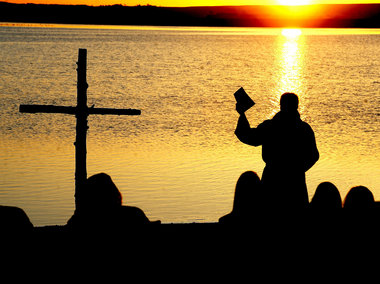
sunrise-easter-serviceIf I was a traditional Christian traveling along the usual Christian path, Easter would be one of the most important times of year for me. But if I strip away the cultural history and context that has built up over the long centuries, in celebrating the resurrection of Messiah, we’re celebrating the entrance of hope into the world for all of humanity. Watching the sun come up on Easter Sunday while praying and singing hymns and praising God for His Son must be like watching the dawn of an era of grace and illumination, the promise of peace to all mankind through our Lord Jesus Christ.

If I was a traditional religious Jewish person, Passover would be a time to be very excited. It’s yet another wonderful opportunity on our calendars to celebrate our liberation, our identity, our journey to the Torah, and the platform upon which we can pass what it is to be a Jew down to the next generation, participating in the continued survival and existence of the Jewish people, illustrating that against all odds, God cares about us and He is with us, and He is sufficient for us.

But I’m neither of those things. In spite of all my efforts, I’m still a person journeying between different worlds. My “traditions” aren’t set in concrete like those of most other Christians or Jewish believers. I exist in a molten plastic universe where I’m exploring concepts, ideas, realities, and existences. I can see the Shabbat from a direction of devotion and a rest in Messiah for human beings, and also from a direction where it appears exclusively Jewish. I can see the vital importance of Christians celebrating Passover as a connection to the seder of the Messiah, and I can also see it as a wholly Jewish experience.

And I’m still getting really, really tired of all of the bitching about who owns what and who is obligated to what and the perpetuation of the split between believing Gentiles and Jews that was already in progress, even as Paul was still preaching in the synagogues to the born Jews, the converts, and the God-fearing Gentiles at the beginning of his “missionary journeys.”

I’m convinced that if Jewish and Gentile believers in Messiah historically ever formed any sort of unified community, it must have been one that Paul didn’t write about, and the event probably lasted about forty-five seconds until someone found a reason to argue about whether or not Gentiles should be circumcised or if a Gentile should or shouldn’t be wearing tzitzit.

You shall converse in the words of Torah and not in other things.

-Yoma 19b

The Talmud explains “other things” as referring to idle, meaning less things.

The Hebrew language has words that mean rest, play, relaxation, and pleasant activities, while it has no word for “fun.” A “fun” activity has no goal, as is implied in the colloquial expression, “just for the fun of it.” In other words, the goal of the activity is within itself, and fun does not lead to or result in anything else.

This concept is alien to Judaism. Every human being is created with a mission in life. This mission is the ultimate goal toward which everything must in one way or another be directed. Seemingly mundane activities can become goal directed; we eat and sleep so that we can function, and we function in order to achieve our ultimate goal. Even relaxation and judicious enjoyable activities, if they contribute to sound health, can be considered goal directed if they enhance our functioning. However, fun as an activity in which people indulge just to “kill time” is proscribed. Time is precious, and we must constructively utilize every moment of life.

Furthermore, since people conceptualize their self-worth in terms of their activities, doing things “just for the fun of it” may in fact harm their self-esteem.

Today I shall…

…try to direct all my activities, even rest and relaxation, to the ultimate purpose of my life.

-Rabbi Abraham J. Twerski
“Growing Each Day, Adar 23”
Aish.com

rothschild-jewish-libraryThere are days when I think the perfect life of devotion would involve the destruction of the Internet and me with my nose buried in book after book in some vast library containing all of the great Jewish and Christian wisdom of the sages and tzaddikim. It would be an old-fashioned library where people would have to be quiet. I would have my little corner with my table and chair, my reading lamp and my stack of books. I could pray uninterrupted. I could even dream of the day of Messiah’s return when he would bring peace and abolish discord.

But that doesn’t work, because faith was never intended to exist in isolation which is why, in spite of the enormous risks of mixing with foreigners, Israel was meant to be a light to the nations.

More’s the pity.

What will my seder look like this year? I don’t know that I’m going to have one. If my wife expresses the desire, then of course, we shall have one and invite as many guests as want to attend. If my wife and daughter choose to attend the public seder at one of the local synagogues, then I hope they have a marvelous time. If we are invited to someone else’s home for a seder, assuming my wife wants to go and it’s appropriate for me to go with her, we’ll go and I presume it will be a wonderful time.

I can attend a sunrise Easter service. I feel that I somehow have to as part of my commitment to my church and my renewed “Christian walk,” though I still travel a rather unusual path. I just need to pull my head out of the computer and remember that despite all of the problematic people and problematic conflicts I encounter on the web, God is not on the web nor is he confined to someone’s pet theology, doctrine, or dogma. God is God and I am grateful each day that He is so far above all of the mucking around we mire ourselves in.

If there is a perfect seder or a flawless Easter, that is yet to come…perhaps at the feast of Abraham, Isaac, and Jacob.

I tell you, many will come from east and west and recline at table with Abraham, Isaac, and Jacob in the kingdom of heaven…

–Matthew 8:11 (ESV)

I don’t desire that anyone be thrown into the outer darkness but rather that we all learn what is really important in the Kingdom of Heaven, and then we all choose to participate in that effort. Jesus said to the Roman centurion who had been pleading for his suffering servant, “let it be done for you as you have believed.” Remember, what we believe and how we act will also be done for us, for good or for ill.

Your future is whatever you make it. So make it a good one.

-Doc (played by Christopher Lloyd)
Back to the Future III (1990)

Children have never been very good at listening to their elders, but they have never failed to imitate them.

-James Baldwin

Remember, all of this isn’t just for us but for our children. Our children are watching us. Heaven help them if they should decide to imitate us.

Where Do We Go From Here?

jewish-family-lifeQuestion: I need a good book on Judaism. My wife is Jewish and I recently found out that I am, too! We want to raise our kids Jewish. I have read extensively on the subjects of philosophy, religion and psychology. I need something with some real meat, not a yawn intro book.

The Aish Rabbi Replies: The first place to start, of course, is with the all-time bestseller, the Bible. It is not a yawn! I recommend the “Stone Chumash” (artscroll.com), because it will give you a proper Jewish translation plus extensive commentary.

Jewish life is based largely around the calendar year. “The Book of Our Heritage” by Rabbi Eliyahu Kitov (feldheim.com) is a classic work, featuring a lively and scholarly explanation of all the laws and customs of the Jewish holidays.

An understanding of history is also integral. Rabbi Ken Spiro has written an excellent book filled with facts and anecdotes – “Crash Course in Jewish History” explores the 4,000 years of Jewish existence from Abraham to Zionism, while answering the great questions: Why have the Jewish people been so unique, so impactful, yet so hated and so relentlessly persecuted?

Finally, I suggest you start in earnest by attending a Discovery seminar. It provides an excellent overview of Jewish history, philosophy, and literature. The seminar is given in hundreds of cities throughout the world. For a current schedule, visit http://www.aish.com/dis/

May the Almighty guide you and your family on the path to Jewish fulfillment.

“Home Study”
From the “Ask the Rabbi” archives
Aish.com

Seems pretty straightforward, necessary, and praiseworthy. A gentleman who has recently discovered he is halachically Jewish and who is married to a Jewish wife wants to establish a Jewish family life. While the person in question wasn’t raised in a Jewish household and apparently spent most of his life believing he wasn’t Jewish, the fact that he married a Jewish woman and then recently discovered he is a Jew has had a profound affect on him. He desires to integrate himself into Judaism and ultimately the Jewish community. What could be wrong with that?

Problem (no, not with the guy who wrote “Ask the Rabbi”):

More than a few non-Jewish Christians also express more than a passing curiosity about Judaism and their (our) faith’s “Jewish roots.”

Why is this a problem? Because once you’re drawn to Jewish practices, Jewish philosophy, and Jewish literature, what do you do with that knowledge and those desires?

There are numerous answers, some relatively benign and some highly controversial. I didn’t want this morning’s “meditation” to be controversial but either God or the defective wiring in my brain had other ideas.

Those non-Jews who began in 1960s America to seek the roots of the faith that trusts Rav Yeshua for the redemption of mankind were attracted to the budding MJ movement precisely because it seemed to be seeking the same thing. I sometimes suspect that the resulting fusion between Evangelicalism and MJ has produced the kind of Christian-Jewish religious result they were seeking, though it is currently mislabelled as MJ (while the real essence of MJ has been inhibited because it must pursue more authentic halakhic Jewish praxis that is not suited to non-Jews and is not always appreciated by assimilated American Jews who have lost touch with comprehensive genuine Jewis praxis and perspective). If we could effect the necessary separation that sets MJ free to become itself (i.e., a truly and thoroughly Jewish messianism), while the Jewish Roots of Christianity folks satisfy themselves with the semi-Jewish style of religious praxis developed together with MJs so far, perhaps we would end with a pair of related religions resembling the first-century vision. And if we do it now, maybe we’ll be better prepared for the physical establishment of the messianic kingdom in Jerusalem ‘ere long.

–ProclaimLiberty
Comment on Shammai, Peter, and Cornelius

two-roads-joinThat’s a very generous and informed perspective from a Jewish point of view, although I don’t doubt that a number of people will disagree with this statement. It necessitates two separate religious paths or conduits in the worship of the God of Israel through the Messiah, one for Jews in the Messiah and one for Christians. Coming alongside does not require any overlap and I know more than a few Jewish believers who would prefer that non-Jewish Christians (or “Messianic Gentiles” as the case may be) not “overlap” into their world at all.

My personal belief is that at some point, most likely in the Messianic age, non-Jews will enter into some parts of a space that was previously reserved for Jewish people in terms of the Shabbat, perhaps some manner of keeping kosher (if for no other reason than to maintain table fellowship with Jews), visiting Jerusalem at least once for Sukkot, and generally attempting to reconcile with Judaism after Christianity’s long separation from its “root faith.”

This isn’t to say that I support Christians attempting to mimic the totality of Jewish identity and lifestyle under the mistaken belief that Paul or James commanded them to, but if what we see in many of Paul’s epistles is any example, the very early Gentile believers (and I’ve said this more than once before) had lived experiences that were far more “Jewish” than what Christians are accustomed to today.

Can we use something of what we see in the apostolic scriptures as a sort of “model” for “trying on” a variant method of worship and observance on a voluntary basis?

Maybe not.

Derek said: If you are not Jewish, but keep Sabbath with the Jewish people, don’t forget you are doing it with Israel, not in place of Israel.

But one day, all will keep Sabbath in the interim age and in the final age, all will be Sabbath. Jews who keep Sabbath now are forerunners, proclaiming by our peculiarity that God is Lord of Time, the bringer of the Time to Come.

James said: I’m sure someone’s going to mention Isaiah 56:1-8 to you at some point, so it might as well be me. I don’t really have a problem with what you’re saying since you aren’t taking that stand that non-Jewish believers are wholly forbidden to observe some sort of Shabbat rest. Certainly those of us who are intermarried would have a tough time avoiding Shabbat if our spouse chose to observe it (or other mitzvot such as kosher food in the home).

It seems clear that in the Messianic age, everyone will be keeping Shabbat and I don’t see why, given the parameters you’ve presented, Gentiles who choose to do so shouldn’t get a head start.

Derek said: Isaiah 56. Two interpretations. (1) This is the Age to Come and reflects what the law for the nations will be then. Many believe this. I prefer: (2) This was about the Persian period (539-334 BCE) when Isaiah 56 was written and was about the situation of Gentiles in Jerusalem at that time.

As to the idea, “Since Sabbath will be universal in the Age to Come, therefore why not keep it now?” let me say a few things. This is a valid choice, not obligation. Those who make this choice are not holier than those who don’t. And the best reason Messianic Gentiles have for doing this is to join with Israel in foreshadowing the Age to Come. It is not to replace Israel’s calling as the forerunners. Gentiles are not commanded to be forerunners in this matter. To choose to do so should go along with a right understanding of Israel’s priestly calling.

James said: I never said I was claiming obligation, Derek.

Derek said: James, I know that because I know you and what you believe. I was giving my perspective on your question for the benefit of all readers. Many would see your words “I don’t see why . . . Gentiles who choose to do so shouldn’t get a head start” as an argument for “I must keep Sabbath as a headstart” or “it is better to keep it now even if we don’t have to.” There are many worthy callings in the world and foreshadowing the world to come by resting in the seventh day is only one of them. Differing ways of holiness are lesser or greater based on deeds of lovingkindness and not based on ritual holiness statutes.

From Derek Leman’s blog post
The Sabbath is Between God and the Jewish People

Shabbat-Made-Easy-paintingSorry for that rather lengthy copy and paste of our conversation, but I wanted to illustrate that even between two people who hold relatively the same perspective on Shabbat, there can still be room for a “dynamic” exchange of viewpoints.

I resigned from the vast, vast majority of anything “Messianic” nearly two years ago when I launched this “morning meditations” blog. I made that decision for a wide variety of reasons that are too lengthy to recount here. However, one such reason was to become part of the solution by ceasing to be part of the problem. If the issue is an objection to Gentile Christians assuming Jewish identity, even superficially, my response was to stop assuming any aspect of Jewish identity. It’s easier to talk with people if they don’t perceive you as a threat.

It’s also why I started publicly identifying myself as a Christian, in order to make my “voice” available to a wider audience. Messianic Jewish and Hebrew Roots writers and teachers tend to end up speaking to a rather limited audience in most cases. However, some of what we talk about is really important and I believe should be consumed by a wider audience. If I can talk to more people and a broader spectrum of populations, maybe the dialog can be expanded and maybe it will actually do some good for a change.

Anyway, I can hope.

But on mornings like this one, I wonder if hope is enough. All of these religious factions and their variants continually butt heads against one another and periodically, I get tired of fighting the turf wars. If you want something, take it. If you think I’m “playing with your toys” and you want them back, here they are. If you want me out of your yard, I’ll go home.

But then, one of the imperatives of some areas of Messianic Judaism is to carry a unique message back into the church. That’s kind of hard to do if there is no dialog between Jewish and non-Jewish believing communities and no overlap in perspectives and practices. I can’t always say what you say without also doing what you do, at least in some minimalist fashion.

Did Paul kick all the God-fearing Gentiles out of the synagogues because they were associating with Jews in a Jewish space on the Jewish Shabbat? Did Peter refuse to enter the home of Cornelius because he was a God-fearing Gentile and Jews were forbidden to enter into Gentile homes? Did James and the Council of Apostles rule that the Gentiles had no share in the Messiah or the world to come and that they should return to their pagan practices rather than turning to God (or did he say that the Gentiles should turn to God, but by way of inventing a totally new religious system totally divorced from Judaism)? For that matter, and to play the other side of the coin, Did James, Paul, or any other apostle absolutely demand that the Gentiles must conform  to the Torah and even (eventually) to become circumcised?

I can see why some Christians might become so exhausted by all of this wrangling that they’d (we’d) just finish the job, retreat into church, and never look at anything Jewish or Hebrew Roots again. You guys all want your various turfs? They’re yours. Have fun.

I know that’s not what the vast majority of believing Jews are saying, but in Messianic Jews defining their exclusive space, is there a space for interaction with Christians? There is going to be another Shavuot conference given by First Fruits of Zion (FFOZ) and hosted at Beth Immanuel Sabbath Fellowship in Hudson, Wisconsin in a few months. There will be Jews and Christians in attendance. There will be some overlap of practice between the two populations. Jews and Christians will be having (kosher) meals together, praying together, listening to teachers together. They’ll be breathing the same air together.

I know that given the real and perceived threats (and some of them are pretty darn real) to Jewish identity specifically within the Messianic Jewish realm, it’s important to make sure there are firm definitions for what is exclusively Jewish about Messianic Judaism as one of the Judaisms in our world, but just once it would be nice to see someone go out of their way and say what believing Jews and Gentiles have in common and on what platform we can both stand.

where-do-we-go-from-hereI believe my basic perspective and the direction from which I’m coming has merit and value. Not that I can’t be wrong and not that I haven’t made mistakes (and I’m sure I’ll make them again), but I think that part of what the Messiah will do when he returns is find a way to bring peace between Jews and Gentiles who are in him. I believe it’s possible to be different and still to co-exist and even to be friends. I believe that when you have something special, you can share it, even though it still belongs to you.

I don’t want to be Jewish. God made the person He wants me to be and I have no right to change that. If I did want to be Jewish, then I’d convert (though that would be problematic since I’d have to surrender my faith in Messiah in the process, which is completely unacceptable). But being married to a Jewish wife, having three Jewish children, and having something of a passion for reading Jewish literature, philosophy, and theological studies, I find myself drawn in a certain direction. If I have violated your “keep off the grass” sign, I’m sorry.

Two-thousand years ago or so, the Gentile believers decided to walk away from their Jewish neighbors. We left their house and taking a few of the “toys” with us, moved in next door and set up a completely different place to live, with a Messiah who didn’t look even remotely Jewish. Now a few of us realize that was a big “oops.” The problem is, even trying to repair the damage that was done is enormously difficult. The rift is huge, the pain runs deep, and the blood still pours out like a river.

I don’t know what to do about it. I don’t want to be an antagonist and I certainly don’t want to claim an identity that I have no right to, but the Jewish pain at the presence of Gentile Christians (including Hebrew Roots) may just be too great for any extension of olive branches to cover. But I keep getting these mixed messages that say “approach,” “retreat,” “approach,” “retreat.”

Where do we go from here? I’ll continue discussing this theme from a different direction in tomorrow’s morning meditation.

The Loving Nazirite

john-the-naziriteAfter this, Paul stayed many days longer and then took leave of the brothers and set sail for Syria, and with him Priscilla and Aquila. At Cenchreae he had cut his hair, for he was under a vow.

–Acts 18:18-19 (ESV)

In the days of the Temple, if a man or woman desired to take a special vow of separation to the LORD, he or she could take a Nazirite vow. The Torah lays out the specifications in Numbers 6. People undertook Nazirite vows for a variety of reasons, including healing, safe return, prayer for another, and simply to observe a time of sanctification. Rabbinic literature attests to the popularity of the vow in the late Second Temple period. The Mishnah dedicates an entire tractate to the subject. Nazirites were not uncommon among the disciples of Yeshua. John the Immerser and James the brother of the Master were lifelong Nazirites. Later in the book of Acts, Paul completes a second Nazirite vow along with four other disciples.

-D. Thomas Lancaster
Ki Tisa (“When you take”)
Commentary on Acts 18:11-23, pg 539
Torah Club Volume 6
First Fruits of Zion (FFOZ)

I know that over the years, there have been many commentaries written about the meaning of Paul’s vow and whether or not it was a Nazirite vow. Lancaster seems to think so and he has plenty of company. But why should you care and why am I writing about this now?

A lot of Christians are invested in de-coupling Paul and the early Jewish apostles from Judaism and Jewish practices. I think it’s important to “re-couple” the first century Jews in the Messiah with their Judaism and Jewish practices and then ask ourselves why would the next generation of “Messianic Jews” give up being Jews? The answer is, they wouldn’t. Why should they? Although Paul was accused of preaching against the Torah of Moses (Acts 21:28), it was a total lie. Paul never did such a thing (contrary to some theologies running around out there) and he certainly never admitted to doing so. We also don’t find Paul saying that his Jewish contemporaries were to keep Torah but their children and grandchildren would give it up.

But then again, we have this:

In speaking of a new covenant, he makes the first one obsolete. And what is becoming obsolete and growing old is ready to vanish away.

–Hebrews 8:13 (ESV)

You could certainly spin that into saying the Jews were in the process of giving up their “obsolete” practices and replacing them with ones based on the New Covenant. The problem is, the New Covenant primarily reaffirms and expands upon all of the previous covenants God made with the Jews, including the Sinai covenant. If anything, the New Covenant should have strengthened Torah observance among the Jews, not deleted it.

So why does Christianity fight that interpretation and fight the idea that Paul could have possibly taken a Nazirite vow?

Many writers argue against Paul taking a Nazirite vow on the basis that the vow required the Nazirite to make animal sacrifices. These teachers are reluctant to think about Paul bringing a lamb, a ewe, and a ram as burnt offerings, sin offerings, and peace offerings. Contrary to that objection, James the brother of the Master later encourages Paul to complete his own Nazirite vow and pay the expenses of four other disciples in order to demonstrate that he walked “orderly, keeping the Torah” (Acts 21:24).

-Lancaster, pp 539-40

Sounds pretty Jewish to me.

Of course, post-Temple, there is no way to take a Nazirite vow or to perform the sacrifices, so many of the Torah mitzvot are unable to be observed by Jews today. We know that the Torah was originally given as a sort of “national constitution” of ancient Israel, defining all of the laws, social mores, and traditions of the Israelites in the Land. We know that when Messiah returns and builds the next Temple, that at least some of the Torah commandments related to the Temple sacrifices will be restored.

But what is the purpose of the Torah in Judaism in the meantime?

That’s like asking, what’s the purpose of a marriage license between a couple when the couple have to endure a lengthy physical separation say because of military service. Just because they can’t be together for a period of months or even years doesn’t mean they aren’t still married. It doesn’t mean that their marital obligations are completely done away with, even though some aspects of the relationship cannot be performed while they’re apart. The relationship endures between one period of togetherness and the next. Both husband and wife continue to wear their wedding rings. They both still refer to the other as “husband” and “wife.” They both stay faithful and do not enter into intimate relationships with other people.

Yes, I’m describing a pretty ideal situation relative to a separated married couple, but let’s look at the analogy. If a married couple who are forced to be apart, even for an extended period of time, are expected to remain faithful to one another and to practice specific behaviors based on their marital faithfulness, how much more should the Jewish people continue to remain faithful to God and to practice specific behaviors, the Torah mitzvot that can be performed in this day and age, based on their faithfulness to God?

The surest way to lose a skill or a relationship is to not practice it. The surest way for a Jew to lose faithfulness to God is to not practice the mitzvot, even though they can only practice a limited set of mitzvot due to “temporary separation.”

one-of-ten-virgins-oilBut the “couple” are getting closer again. Since 1948, there has been a Jewish homeland, Israel, in existence. Jews can make aliyah. They can return home. Yes, the Temple isn’t there yet. The Priesthood isn’t there yet. But then again, the bridegroom hasn’t returned home yet. When he does, he’ll rebuild the house, and the couple will move back in. But under certain provisions of the Abrahamic covenant that have been enhanced by the New Covenant, the “bride” won’t be only the Jewish people.

The analogy gets pretty hard to maintain at this point, but there’s a reason that the body of unified believers is called “the bride of Christ.” There’s a reason why the Gospels are full of “Jesus as bridegroom” imagery. Some of the details are still a little fuzzy, but we know that the bride and groom, who have been apart for so very long, are coming back together again.

The Jewish bride and the Jewish bridegroom will once again take up housekeeping. They have been faithful in their vows and faithful in performing all of the acts related to their marriage that were possible to keep while the house has lain in ruins. When the house is rebuilt, when David’s fallen sukkah, the Temple, is reconstructed by Messiah on the Holy Temple Mount in Jerusalem, the world will see just how vital the Torah of Moses is in the lives of the Jewish people, and the Torah will be perfect as taught and practiced by the perfect Messiah.

But until then, the Jewish bride does what she can to faithfully keep the mitzvot and to show her Jewish husband that she loves him with all her heart.

Shammai, Peter, and Cornelius

hillel_shammaiShammai’s school of thought became known as the House of Shammai (Hebrew: Beth Shammai‎), as Hillel’s was known as the House of Hillel (Beit Hillel). After Menahem the Essene had resigned the office of Av Beit Din (or vice-president) of the Sanhedrin, Shammai was elected to it, Hillel being at the time president. After Hillel died, circa 20 CE, Shammai took his place as president but no vice-president from the minority was elected so that the school of Shammai attained complete ascendancy, during which Shammai passed “18 ordinances” in conformity with his ideas. The Talmud states that when he passed one of the ordinances, contrary to the opinion of Hillel, the day “was as grievous to Israel as the day when the [golden] calf was made” (Shabbat, 17a). The exact content of the ordinances is not known, but they seem to have been designed to strengthen Jewish identity by insisting on stringent separation between Jews and gentiles, an approach that was regarded as divisive and misanthropic by Shammai’s opponents.

–Wikipedia

And he said to them, “You yourselves know how unlawful it is for a Jew to associate with or to visit anyone of another nation, but God has shown me that I should not call any person common or unclean.”

–Acts 10:28 (ESV)

I suppose I could have called this blog post, “Things I Learned in Church Today,” but then, I’d have a lot of blog posts with the same title. I recently came across a “statistic” on a blog (it’s not based on any real data) that said the vast majority of Christianity, something like “99.99999999999%” is “anti-Judaic.” I’ll agree that the church has a rather poor track record relative to Jews, Judaism, and Israel, but that’s changing. I know because the church I attend is very pro Jews, Judaism, and Israel. It’s not just the Pastoral staff but the regular members, too. In my Sunday school class, the teacher, who by trade is an electrical contractor, opined on how much we Christians owe the Jewish people at the very start of class.

But what did I learn in church about Jews, Judaism, and Acts 10? I learned about something called the “18 measures.” Apparently, this was something debated between Hillel and Shammai and while the specifics of these “measures” crafted by Shammai are no longer known, two of them were said to be “anti-Gentile.” Pastor Randy came to speak with me right before services began and shared what he had found out during his research. He said that one of the measures of Shammai stated that it was “unlawful” for a Jew to enter a Gentile’s home because it would be possible for a corpse to be present without the Jew’s knowledge (resulting in ritual defilement: see Num. 19:11-16). This could include a dead person buried under the house, since it seems it was the custom in some households to bury the family patriarch under the structure.

Or was Shammai looking for excuses to keep Jews and Gentiles apart? After all, Israel was occupied by Gentile forces and the Romans never went out of their way to be friendly or courteous to the Jewish population. Quite the opposite in fact. The Jews had good reason to want to avoid Gentiles and particularly Roman soldiers.

Was this part of what Peter was thinking of when he was confronted by God with the news that he was to visit the household of a Roman Centurion? In the above-quoted passage from Acts 10, the greek word translated as “unlawful” as in “how unlawful it is for a Jew to associate…” isn’t the word for “Law,” but the word for “tradition.” Basically, Peter was telling Cornelius that it was against halakhah for a Jew to enter the home of a Gentile because the Jew might well become ritualistically “unclean.” God showed Peter the contradiction (in this case) between the prevailing halakhah of his day and the teachings of God that no human being is “unclean.”

I don’t know if Peter was specifically thinking of Shammai during this whole transaction, but it’s certainly within the realm of possibility.

But am I being too hard on Shammai?

Shammai is a much misunderstood character and you malign him with your words…. according to the Mishnah in Treatise Avot, one of Shammai’s favourite sayings was “Always receive all men with a cheerful expression on your face!” (Avot, chapter 1, para. 15)

-ProfBenTziyyon, 18 Jan 09
http://messiahtruth.yuku.com

I’m not trying to be hard on Shammai or for that matter, on Peter. I did think this was an interesting detail that works to “flesh out” the humanity and the lived context for Peter as he was faced with doing a very hard thing. About fifteen years earlier, Jesus gave his Jewish disciples the “commission” to make disciples out of the Gentiles, but as far as we know, that command received no attention until the Master spurred Peter into action using a vision (Acts 10:9-16).

In this case however, if Peter has responded to halakhah rather than God, the good news of Christ would never have come to Cornelius and his household and arguably the rest of us would have suffered the same fate. Or God would have chosen a different messenger, but He chose Peter. It was Peter who had to grow beyond his prejudices and perhaps only a Jewish apostle could deliver the Gospel to the Gentiles. I mean, the angel (Acts 10:3-6) could have told Cornelius everything he needed to know, but it was more than just information that needed to be delivered, it was the forging of new connections and relationships. While Cornelius, a Roman Centurion, was a “God-fearing man, who is well spoken of by the whole Jewish nation,” God had a far better destiny for him as one of first Gentiles to ever receive the Holy Spirit and be reconciled to God. Peter, for his part, and his Jewish companions needed to be witnesses and to see for themselves that “God shows no partiality, but in every nation anyone who fears him and does what is right is acceptable to him.” They needed to see that even the Gentiles could receive the Spirit and be saved, even as the Jews had done.

This, as much as anything else in the Bible, was an incredible miracle, because God so loved the world.

What biases and prejudices prevent you and me from doing the will of God?

The Fragmented Body

fragmented-bodyPaul’s two epistles to the Corinthians grant us an up-close and personal portrait of the Corinthian community he was leaving behind. They were a diverse community of Jewish believers, God-fearing Gentiles, and recently converted pagans. They were not perfect people.

They struggled to maintain cohesion after Paul left. They often differed in their opinions and practices regarding such matters as gender roles, sexuality, use of spiritual gifts, and the doctrine of the resurrection. Some found it difficult to adapt to Judaism’s strict standards of modesty in dress and conduct. Sexual immorality was a problem. The Corinthian leadership struggled with censuring members who were engaged in immorality. A lack of qualified leaders to serve as judges in civil suits encouraged the community to use secular courts. The Corinthian believers misused ecstatic utterances and allowed charismatic antics to disrupt worship services. Philosophical monotheists among the Corinthians chafed at the prohibition on things sacrificed to idols and struggled with the concept of a literal resurrection of the dead. Visits from other apostles led to factionalism. Some among the Corinthians began to question Paul’s authority and apostleship. In his letters, Paul addresses these issues and several other problems with genuine pastoral concern.

-D. Thomas Lancaster
Ki Tisa (“When you take”)
Commentary on Acts 18:11-23, pg 538
Torah Club Volume 6
First Fruits of Zion (FFOZ)

Sound familiar? No? Consider a recent discussion in the comments section of Derek Leman’s blog. Although the topics and themes aren’t really the same (no apparent problem of sexual immorality, for example) the dynamics and the diversity of populations and opinions on all things spiritual and philosophical is very much in evidence. You have the same mix of Jewish and non-Jewish believers with a few converts tossed into the mix. That brings in a diversity of background, education, perspective, and identity into a single container which, in both ancient and modern examples, is the community of the Messiah; the body of Christ.

And after 2,000 years, we still are having a tough time getting along.

Not that the Corinthian “church” was completely representative of all believing first century communities, but whenever you involve dissimilar populations in a common group, especially a religious group, you are asking for a few “strongly worded” debates. And that’s what we experience today on the blogosphere when we come together (virtually) to have some of the same interactions that the ancient Corinthians did in the days of Paul.

Actually, there’s quite a time gap between the ancient mixed Jewish/Gentile “church” and the modern one. After the schism between Judaism and Christianity, each religion, for they became separate religions, went their own way, only getting together for a pogrom or an inquisition every now and again. The problems of the Corinthian religious congregation faded away into history…until quite recently.

Now that we’re trying to put our theological humpty dumpty back together again, we’re finding out that it would be easier to take an omelet and put it back into the broken egg-shell than it is getting different factions of Messianic Judaism, Hebrew Roots Christianity (and it’s variants), and more traditional Christianity (or Christianities) to come to any sort of agreement.

I know I’ve written about this before and used Lancaster’s Torah Club commentaries to do it, but in reading this past week’s Torah club chapter right on the heels of Derek’s blog post, the similarities jumped out at me again.

Doesn’t anyone else out there see it?

Was there ever a peace between the Jewish and the Gentile believers? We see strife looming largely in the Messianic world right there around 50-53 CE when Paul was the most active in his “missionary travels.” In Acts 18:1-17, Paul experiences a “split” in the synagogue at Corinth and half the Jewish membership follows Messiah right out of the synagogue and into a building next door. There were actually two competing synagogues, one Messianic and the other not, strongly contending with each other. There wasn’t unity over the Messiah in the local Jewish community let alone between Jews and Gentiles.

But then again, not all Jewish communities experienced the message of Messiah the same way.

And they came to Ephesus, and he left them there, but he himself went into the synagogue and reasoned with the Jews. When they asked him to stay for a longer period, he declined. But on taking leave of them he said, “I will return to you if God wills,” and he set sail from Ephesus.

–Acts 18:19-21 (ESV)

FallingApartIt seems the synagogue in Ephesus was much more unified in its reception of Paul’s teaching on the Messiah and I’m sure he would have rather spent more time in this particular setting, but he wanted to get to Jerusalem in time for Sukkot.

I won’t pull any quotes from Derek’s blog (you can click the link and read through the comments yourself) but it seems as if the same old debates are being continually recycled. Things haven’t changed a whole lot in twenty centuries. Human nature after all, is human nature. I guess that’s why the Bible is still relevant after the passage of so much time. We’re still the same old creatures we’ve always been, stirring up the pot and making a mess out of the message of the good news.

The Messiah came and then he left. And after he left, his apostles and disciples struggled to keep the new Jewish sect of “the Way” afloat while integrating a large Gentile population in the diaspora along with whoever among the Jews would accept that Yeshua (Jesus) was Moshiach. In the end, it fell apart and all of the broken pieces have been shattered and scattered across the landscape for almost 2,000 years. Recently, we’ve been trying to put them back together again with limited success. We’re encountering pretty much the same barriers that Paul did in his “mixed population churches.” Maybe the “bilateral ecclesiology” people are on to something after all. No mix, no mixed up community.

But I don’t think that’s how it’s supposed to work out, at least not in an extreme and absolute segregationist sense. Paul didn’t seem to demand that the Gentiles form their own churches, although that’s how things ended up. Here we are, trying to forge new or renewed relationships to pave the way for Messiah’s return. But it seems that it will take the Messiah to teach us to get along, share our toys, and play well together.

We live in a broken world. There are religious Jews who cry out, “Moshiach now!” Given the sorry state of affairs in his “Messianic community,” maybe we should be shouting the same thing. Nothing else we are doing seems to be working out.

The Jesus Covenant, Part 11: Building My Model

building-my-modelFor this reason I, Paul, a prisoner for Christ Jesus on behalf of you Gentiles—assuming that you have heard of the stewardship of God’s grace that was given to me for you, how the mystery was made known to me by revelation, as I have written briefly. When you read this, you can perceive my insight into the mystery of Christ, which was not made known to the sons of men in other generations as it has now been revealed to his holy apostles and prophets by the Spirit. This mystery is that the Gentiles are fellow heirs, members of the same body, and partakers of the promise in Christ Jesus through the gospel.

Of this gospel I was made a minister according to the gift of God’s grace, which was given me by the working of his power. To me, though I am the very least of all the saints, this grace was given, to preach to the Gentiles the unsearchable riches of Christ, and to bring to light for everyone what is the plan of the mystery hidden for ages in God who created all things, so that through the church the manifold wisdom of God might now be made known to the rulers and authorities in the heavenly places. This was according to the eternal purpose that he has realized in Christ Jesus our Lord, in whom we have boldness and access with confidence through our faith in him. So I ask you not to lose heart over what I am suffering for you, which is your glory.

–Ephesians 3:1-13 (ESV)

Why is Paul doing this to me? No, he’s not doing this to me, but why did he say, “this grace was given (to Paul), to preach to the Gentiles the unsearchable riches of Christ…”

But why is he bothering to preach the unsearchable riches of Messiah to the Gentiles? I mean, why go through all the trouble?

Oh yeah. There’s this:

Now there was a disciple at Damascus named Ananias. The Lord said to him in a vision, “Ananias.” And he said, “Here I am, Lord.” And the Lord said to him, “Rise and go to the street called Straight, and at the house of Judas look for a man of Tarsus named Saul, for behold, he is praying, and he has seen in a vision a man named Ananias come in and lay his hands on him so that he might regain his sight.” But Ananias answered, “Lord, I have heard from many about this man, how much evil he has done to your saints at Jerusalem. And here he has authority from the chief priests to bind all who call on your name.” But the Lord said to him, “Go, for he is a chosen instrument of mine to carry my name before the Gentiles and kings and the children of Israel.

–Acts 9:10-15 (ESV)

Jesus declared Saul (Paul) to be his “chosen instrument…to carry my name before the Gentiles…” So Jesus had this in mind all along.

Go therefore and make disciples of all nations, baptizing them in the name of the Father and of the Son and of the Holy Spirit, teaching them to observe all that I have commanded you. And behold, I am with you always, to the end of the age.”

–Matthew 28:19-20 (ESV)

I’m indebted to Marc’s comment on Derek Leman’s blog for making me think of Ephesians 3 in relationship to the “mystery” of the New Covenant for Christians and to Proclaim Liberty’s comment on my own blog for attempting to take my investigation of the “New Covenant connection” one step further. film-noir-mystery

It seems clear that Messiah intended the Gentiles to be made into his disciples and that through him, we would be saved. He specifically commissioned Paul to be the emissary to the Gentiles and to preach the Gospel to us. Those facts are indisputable as we see them presented in the scriptures, but the “mechanics” of how we enter into any sort of covenant at all with God through Messiah remains a “riddle wrapped in a mystery inside an enigma,” to paraphrase Winston Churchill. I’ve been forced to reduce it down to a simple formula just to keep from going crazy. It is obvious to me from my reading of the Abrahamic covenant that the nations were always intended to benefit in connection to the Messiah.

Now the Lord said to Abram, “Go from your country and your kindred and your father’s house to the land that I will show you. And I will make of you a great nation, and I will bless you and make your name great, so that you will be a blessing. I will bless those who bless you, and him who dishonors you I will curse, and in you all the families of the earth shall be blessed.”

–Genesis 12:1-3 (ESV)

To give a human example, brothers: even with a man-made covenant, no one annuls it or adds to it once it has been ratified. Now the promises were made to Abraham and to his offspring. It does not say, “And to offsprings,” referring to many, but referring to one, “And to your offspring,” who is Christ.

–Galatians 3:15-16 (ESV)

I created a detailed breakdown of the covenant God made with Abraham to illustrate that of all the provisions God created in the Abrahamic covenant, only one of them (see Genesis 12:1-3) has anything to do with the nations being blessed by Messiah. That provision is the starting point for my understanding of my connection to God through Christ. My simple formula for understanding “the Jesus covenant” is this:

  1. God creates a provision in his covenant with Abraham that allows the Gentiles to be blessed through Messiah (Abraham 12:1-3).
  2. The New Covenant (Jer. 31, Ezek. 36) renews, affirms, and amplifies all of the previous covenants God made with the people of Israel and the people of Judah which, by definition, includes the Abrahamic covenant.
  3. Messiah alludes that the (new) covenant is poured out in his blood (death), (see Mark 14:22-24, Luke 22:19-20) for all people.
  4. Paul interprets the Abrahamic covenant provision referring to Gentiles as Messiah being our connection to God (see Galatians 3:15-16).
  5. Paul describes the process of Gentiles being made co-heirs to the Messianic promises through Messiah as a mystery (Ephesians 3:1-13).

Somehow in all of that is enough of a connection from the days of Abraham to the apostolic era (and forward in time to us) for me to be able to say that I really am attached to God in a (more or less) demonstrable way through Messiah Yeshua; through Christ Jesus. And as Proclaim Liberty states:

I can point to Zechariah and the Sukkot celebrations incumbent upon non-Jews in the messianic era. Remember that their participation was a requirement for rain upon their lands. Midrashically, there is a lot of significance to be derived from the concept “rain”. In fact, all manner of benefits upon non-Jews specifically can be derived from it. Combine this with Is.56 and Yehezkel 31 & 36 references, and one begins to see the formulation of a special vision for non-Jews — much better than mere “crumbs off the floor” (and, by the way, “dogs under the table” generally eat offerings from the childrens’ willing hands rather than from the floor).

There’s a lot I’ve left out such as the prophesy of Amos (Amos 9:11-12) referring to the “Gentiles who are called by My Name,” and of course, “my house shall be called a house of prayer for all peoples…” (Isaiah 56:7), but you get the idea.

Somehow, in some way, God has made a lasting provision for the people of the earth to be able to become attached to Him through the Messiah. Messiah directed the Jewish apostles to make Gentile disciples. Peter witnessed the Gentile Cornelius receiving the Holy Spirit and thus salvation without having to convert to Judaism. Paul was specifically commissioned by the Master to be his emissary to the nations and to preach the gospel of Christ to the goyim. Putting it all together should present us with a path for the Gentile to God. path-to-godIt’s there. It’s all there. It’s just hard to nail down the specifics.

My commentary on Brother Yun and Pastor Saeed Abedini shows us that being a faithful Gentile servant of God is more about faith, heart, devotion, and drive than the little bits and details we find in the Bible that make us (me) crazy, or the petty bickering we often find ourselves embroiled in on the Internet.

What is the purpose of the Torah in the lives of Jews today? When Messiah rebuilds the Temple in Holy Jerusalem, what role will the sacrifices play in the Messianic age? These are vitally important questions and they cannot be left in the mud waiting for the Messiah to come and pull them out, clean them off, and present them to us in pretty wrapping paper and tied up in a bow. But especially for the “Gentiles who are called by His Name,” it’s equally important to answer the basic questions, “Who am I?” Where do I belong?” “Does God care about me?” “What is my role in the Kingdom of Heaven?”

Then the King will say to those on his right, ‘Come, you who are blessed by my Father, inherit the kingdom prepared for you from the foundation of the world. For I was hungry and you gave me food, I was thirsty and you gave me drink, I was a stranger and you welcomed me, I was naked and you clothed me, I was sick and you visited me, I was in prison and you came to me.’ Then the righteous will answer him, saying, ‘Lord, when did we see you hungry and feed you, or thirsty and give you drink? And when did we see you a stranger and welcome you, or naked and clothe you? And when did we see you sick or in prison and visit you?’ And the King will answer them, ‘Truly, I say to you, as you did it to one of the least of these my brothers, you did it to me.’

–Matthew 25:34-40 (ESV)

If we Christians are searching for our “Torah,” I can think of no other teaching that we need to start out with than those words of the Master. If we are searching for covenant, we have it in Messiah. Having a relationship with God is like being married. While the marriage certificate is important, it isn’t worth the paper it’s printed on unless we actually live out the relationship in love and devotion. As time passes, the “marriage” grows, matures, and finally realizes its own magnificent potential, which was created by God for us through Messiah.

Addendum: One more valuable piece to this puzzle can be found by reading Gifts of the Spirit Poured Out on all Flesh.

"When you awake in the morning, learn something to inspire you and mediate upon it, then plunge forward full of light with which to illuminate the darkness." -Rabbi Tzvi Freeman