The Meaning of Purim and Easter

Our people have survived for the past 3,500 years … and not by accident. We did it against all odds — Crusades, Inquisition, Pogroms, Holocaust … There are perhaps 12 million Jews in the world today where by conservative demographic projections, there should be 400 million. However, they were lost to murder and assimilation. Why are we still Jews and how can we ensure our grandchildren will be Jewish?

There are questions all of us must ask ourselves: How important is it to me to be Jewish? What does it mean? Am I willing to die to remain a Jew? If I am willing to die as a Jew, am I willing to live as a Jew?

-Rabbi Kalman Packouz
-from “Shabbat Shalom Weekly” commentary
Aish.com

Somewhere between 90 to 96 of the present era, after the death of the last Apostle, John, we have a head-on collision as the Hebrew words of the Bible are assigned new meanings by the gentile church leaders who are products of the Greek/Roman culture. The leadership of the Church shifted from Jerusalem to Antioch and finally, Rome. By 311 CE when Constantine, the Emperor of Rome, issued the Edict of Toleration, the spiritual situation was already critical. Just think of it, Constantine, head of the greatest empire on the face of the earth at that time, became a Christian. Anything that was good enough for the Emperor was good enough for the subjects, so, Constantine began to award medals, prizes, and money to those who converted to Christianity. Would it surprise you to know that most who converted did so for the medals, prizes, and money?

-Dr. Roy Blizzard
“What Has Happened to the Church? Is it Pagan or Hebrew?”
BibleScholars.org

purim
Purim Parade in Hebron

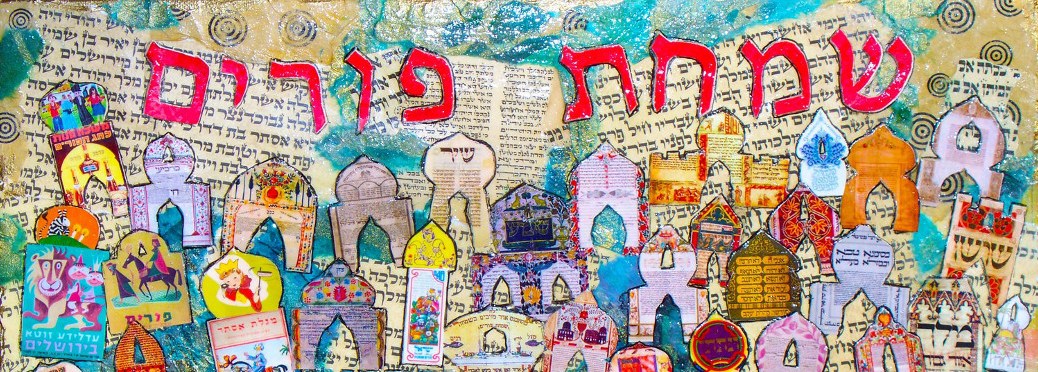
Given that Purim begins this Wednesday (tomorrow) evening at sundown and concludes a little over 24 hours later, and Easter is this coming Sunday, the 27th, I thought their close proximity on the calendar this year justified some juxtaposition between Judaism and Christianity.

From Rabbi Packouz’s point of view, Jewish survival of a nearly endless stream of “Purim-like” genocidal events is due, not only to the love and mercy Hashem has for His covenant people, but because Jewish people throughout history have remained steadfast to community, Torah, and Talmud. It’s their dedication continuing generation after generation, to preserving Jewish life and traditions, to raising children and grandchildren to, not just be ethnically or DNA Jewish, but to have a lived Jewish experience through the mitzvot.

From Dr. Roy Blizzard’s perspective, the once united Church of Christ splintered very early in history, within less than 100 years of its inception, and since that time, has continued to fragment again and again until today we have 400+ denominations of Christianity, all vying for the right to say, “Lo, here’s Christ.”

OK, I’m being kind of negative where the Church is concerned, and I must admit that Judaism as a religious stream has also fragmented across the last two thousand years, and today is represented by multiple, competing communities. However, unlike Christianity (and to make matters worse), there are also an unnumbered population of secular and assimilated Jews who have no seeming connection to the God of their Fathers at all (obviously, a secular Christian is a contradiction in terms).

Where these two parallel trajectories across history meet, where Christianity and Judaism collide, is at the aforementioned (by Rabbi Packouz) “Crusades, Inquisition, Pogroms, Holocaust” as well as “murder and assimilation.”

You don’t see too many Christian Crusades against the Jewish people these days (unless you count evangelizing the Jews as a “crusade”), but you do see a great deal of assimilation. My Jewish wife’s siblings were all assimilated, and two of them are avowed Evangelical Christians.

Is that such a bad thing? Not according to this article at the Rosh Pina Project. However, if a Jew has to come to the Jewish Messiah King by renouncing Jewish religious and lifestyle praxis and assimilate into the churches of their historic adversaries and conquerors, then I must disagree that it’s a good thing, particularly given Dr. Blizzard’s assessment of the rather poor spiritual state of the Church today.

Rabbi Kalman Packouz

The way R. Packouz sees it, if Jewish families want to support not only the observance of the mitzvot and Jewish religious praxis, but the continuation of the Jewish people as a population, this is what must happen:

If parents want their children and grandchildren to be Jewish, the parents must be a role model for living Jewishly. Any person I met who has positive feelings about being Jewish has told me it’s because he remembers his father making Kiddush, his mother lighting Shabbat candles, the Passover Seder. Memories, emotions and values only transfer through actions; philosophy does not pass to the next generation — unless it’s lived. Remember, a parent only owes his child three things: example, example, example!

Do you want your grandchildren to be Jewish? Then today go and buy To Be a Jew by Rabbi Hayim Donin. Read it. Make your decision. And then institute a gradual program of change that will lead to your living a fuller Jewish life. Then your children will have something that they value and want for themselves and for their children!

We actually have a copy of that book in our home and I know my wife has read it, and frankly, I wish she were more observant…much more observant.

As far as Dr. Blizzard goes, he believes that the restoration of the Church into what the Apostle Paul (Rav Shaul) envisioned so many centuries ago, is possible in this manner:

I want to emphasize something before you misunderstand what I am talking about. Restoration is never going to be accomplished on a denominational level. It can only happen on an individual basis. If you are in the Baptist, Methodist, Presbyterian, Church of Christ, or whatever denomination, restoration can happen. It will happen as there is an increased hunger and desire on the part of God’s people for true factual information. It will happen as individuals begin to ask questions about their religious beliefs and test them against linguistic, cultural, and historical facts. The good news is that it is probably already happening to you.

I also think this is beginning to happen as small groups within their churches are becoming aware of a more Hebraic interpretation of their Bibles. Some remain in their church communities and become lone voices of restoration among their peers and the Pastoral staff, while others leave the Church altogether and either seek out like-minded souls, or lacking that, go on a solitary journey of discovery in the company of the Holy Spirit.

ChurchI wrote the blog post Standing on the Jewish Foundation of the Bible in November 2013 when I was attending a small, local Baptist church. I was having weekly private meetings with the head Pastor to discuss our relative points of view on the Bible, with him trying to turn me into a good Baptist, and me trying to enlighten him with the radically Jewish nature of the Messiah and his laser-like focus, not on the Church, but on the restoration of Israel.

Neither one of us were successful, in large part because of my conviction that the Church as it exists today, for all the wonderful things she has done, still represents a Two-Thousand Year old Mistake.

When the early non-Jewish disciples of Rav Yeshua (Jesus Christ) and their Jewish mentors and teachers each demanded an ugly divorce, the Gentile Christian Church rose out of the seeming ashes of its Jewish origins and began describing a drunken course through history much as Dr. Blizzard has described.

On the flip side of the coin, the number of Jews who retained fidelity to Rav Yeshua dwindled over the decades and centuries until Jewish devotion to Yeshua as the revealed Moshiach was extinguished.

This is what made it possible for the various incarnations of the Church to persecute the Jewish people, burn synagogues, burn volumes of Talmud, burn Torah scrolls, and burn the Jewish subjects of the Jewish King, all in the”Gentile-ized” name of that King; in the name of Jesus Christ.

But the Jewish people and lived Judaism have continued to survive, in spite of the persistent spirit of Haman which has followed them across the pages of history, attempting time and again to finish what he started as we read in the Scroll of Esther (see your Bible for details).

In a tiny handful of hours, Jews all over the world will be gathering together and celebrating Jewish survival from historical and modern genocide (represented today in part by ISIS, Iran, the PLO, Hamas, CNN, Barack Obama) by the observance of Purim. And on Sunday, in sunrise services around the world, Christians will be gathering together to celebrate the meaning of a risen Christ.

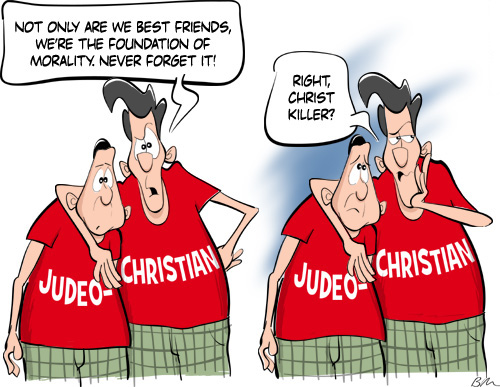
Unfortunately, a nasty side effect of Easter, again, at least historically, is that “after every passion play, there’s a pogrom.” In other words, while Easter is supposed to be a celebration of life, particularly eternal life in the Kingdom of God, the crucifixion of Christ, memorialized on Good Friday (and with supreme irony, Purim ends the evening before Good Friday this year) has been expressed in harassment of the Jews because “they killed Jesus.”

judeo-christianI used to believe that way of thinking had gone the way of the Dodo bird, until I read of an incident that happened earlier this year:

When Catholic Memorial School, an all-boys high school in Boston’s Roxbury neighborhood, played Newton North High School in a closely-fought basketball game last Friday, tensions were running high among the crowd.

Fans of Newton North High, which serves the suburb of Newton, a leafy suburb known for its high academic performance and its sizeable Jewish population, teased the Catholic Memorial School for its all-boy makeup, chanting, “Where are your girls?”

As the crowd got rowdy, a group of between 50 and 75 supporters of Catholic Memorial started a chant of their own. “You killed Jesus!” they yelled at Newton’s team and supporters, repeating the slur over and over through the gym.

The Newton students fell silent, shocked and upset.

This happened within the past few months, not the past few decades. These Catholic sports fans wouldn’t have known to taunt the Jewish basketball players and their families with such an insult if they hadn’t learned it somewhere.

Perhaps there are certain corners of the Christian Church that haven’t put their houses in order yet.

Dr. Blizzard believes that the restoration of the “Hebrew” Church is happening one individual at a time, and in the present age, I believe that’s true. I also believe that there’s a war coming; a terrible war.

I believe every nation on Earth is going to turn against Israel in an attempt to finally accomplish Haman’s mission and wipe every single Jew from the face of our planet. I believe the western nations, particularly the United States, will be among those standing against Israel. I expect my neighbors, co-workers, and people I’ve worshiped with in church will be among those supporting such a war (though I hope there will also be those who will join me in opposing it).

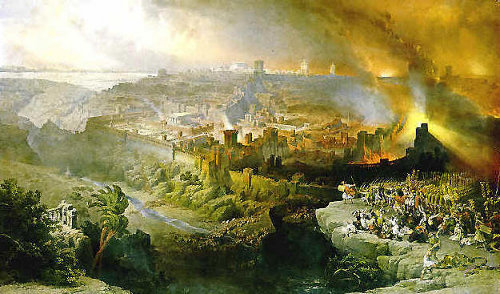
fall of jerusalemHowever, the Bible tells us that when all seems lost and Israel is about to be buried for the last time, Hashem Himself will fight for her and He will win. Messiah will restore Jerusalem, rebuild the Temple, return all of the Jewish exiles to their Land, and…

Then it will come about that any who are left of all the nations that went against Jerusalem will go up from year to year to worship the King, the Lord of hosts, and to celebrate the Feast of Booths. And it will be that whichever of the families of the earth does not go up to Jerusalem to worship the King, the Lord of hosts, there will be no rain on them. If the family of Egypt does not go up or enter, then no rain will fall on them; it will be the plague with which the Lord smites the nations who do not go up to celebrate the Feast of Booths. This will be the punishment of Egypt, and the punishment of all the nations who do not go up to celebrate the Feast of Booths.

Zechariah 14:16-19 (NASB)

As such, I don’t think there will be a Church, at least as we understand the concept today, when King Messiah rules from his throne in Jerusalem. I believe there will be an ekklesia, a world-wide multi-national community of those devoted to the God of Israel, who are the disciples and servants of the Jewish Messiah King, made up of two basic people groups, Jewish Israel, and everybody else.

From Wednesday night to Thursday night, Jews around the world will celebrate continued Jewish survival in a way that looks like a cross between Halloween and April Fools Day. And without really understanding the significance from a Jewish point of view, on the very the next day, on Good Friday, Christians will commemorate the crucifixion of Christ, which has historically (and as we’ve seen, also in the current era) been used as an excuse to attempt to deprive some Jews of continued survival.

The Bible tells us the story of Purim and the meaning behind it throughout Jewish history, and in the end, Israel wins, and finally, all of Israel’s enemies, including us, will be made subservient to the nation we have forever attempted to destroy. Does this mean Purim wins over Easter, too? Well, sort of. But not actually.

Ironically, although this will elude a traditional Christian viewpoint, the resurrection of Rav Yeshua was originally supposed to be understood as the beginning of the restoration of Israel, the Jewish people, and the lived experience of Judaism through the Torah mitzvot. Only after all of that, will the rest of the world, we devoted ones from among the nations, be restored as well. Zechariah 14 paints this picture for us very clearly.

Fortunately for us, God is infinitely merciful, trustworthy, and kind. Although He could have assigned us inferior roles in the Kingdom of Messiah as a consequence of being from among the nations who declared (will declare) themselves as enemies of God’s Holy Nation of Israel, He did (and will do) this instead:

“Also the foreigners who join themselves to the Lord,
To minister to Him, and to love the name of the Lord,
To be His servants, every one who keeps from profaning the sabbath
And holds fast My covenant;
Even those I will bring to My holy mountain
And make them joyful in My house of prayer.
Their burnt offerings and their sacrifices will be acceptable on My altar;
For My house will be called a house of prayer for all the peoples.”

Isaiah 56:6-7

For you are all sons of God through faith in Christ Jesus.

Galatians 3:26

“And I will be a father to you, and you shall be sons and daughters to Me,” says the Lord Almighty.

2 Corinthians 6:18

We will join ourselves to the Lord, minister to Him, love His Name, be His servants, be taken to His Holy Mountain (the Temple), be made joyful in His House of Prayer (the aforementioned Temple), our burnt offerings will be accepted, and we will all be privileged to call ourselves the sons and daughters of the Lord Almighty.

Up to JerusalemOur takeaway from both Purim and the Resurrection (though not necessarily the modern expression of Easter), is that we serve our Rav by celebrating the risen King Messiah who is the mediator of the New Covenant promises to provide for the continued survival of the Jewish people and the restoration of the Jewish nation as the head of all the nations (Jeremiah 31:7).

This year and every year, we non-Jewish disciples of our Rav (i.e. Christians everywhere) should celebrate Jewish survival and the Jewish state as signs of our risen King, who upon his return to us, will destroy the spirit of Haman once and for all and establish lasting peace not only for Israel, but for our contentious and weary planet. And in the end, we will finally be healed.

Then he showed me a river of the water of life, clear as crystal, coming from the throne of God and of the Lamb, in the middle of its street. On either side of the river was the tree of life, bearing twelve kinds of fruit, yielding its fruit every month; and the leaves of the tree were for the healing of the nations.

Revelation 22:1-2

Are We Naaman or Ruth?

This may sound like a really stupid question (Are there still Jews and Greeks in Christ?), but I cannot tell you how many people over the years have cited to me one particular text from the only surviving correspondence of the first century Pharisee, Saul Paul. This text relates to the believers in Galatia, who thought that, since they now followed the Jewish Christ, it stood to reason that they should not simply be a part of the Jewish coalition (sojourners with Israel), but they should also adopt all the ancestral customs of the Jews (This is what was meant to convert to Judaism back then). It is to them, in this nuanced and commonly misunderstood letter that the beloved Apostle wrote: “There is neither Jew nor Greek… in Christ Jesus.” (Gal. 3:28)

-Dr. Eli Lizorkin-Eyzenberg
“Are there still Jews and Greeks in Jesus Christ?”
Jewish Studies Blog

I found a link to this article on a closed Facebook page a few days ago and have just gotten around to reading it. It’s short, easily consumable by most folks, and has a very interesting and, to me, relevant perspective.

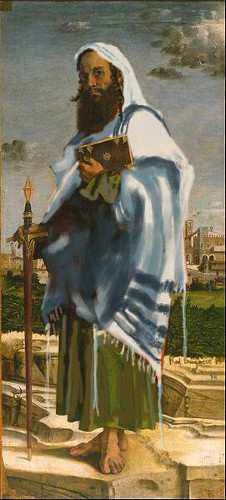
The Jewish PaulAccording to Dr. Lizorkin-Eyzenberg (who I hear of from time to time, but don’t know a lot about), what we think of as converting to another religion, such as Judaism, today, wasn’t how it worked back when the Apostle Paul (Rav Shaul) was actively proclaiming the good news of Rav Yeshua (Jesus Christ) among the Goyim (Gentiles).

Conversions were widely attested in the ancient times. However conversions as they were practiced then, have little in common with conversions as we understand them today. Unlike in ancient times, “religion” today is seen as a category of its own – so someone can be Irish and Jewish, American and Jewish, Russian and Jewish, and so on. Ancient people, however, did not speak of conversion in terms of simply accepting another religion, while staying culturally the same. To them conversion to Judaism meant joining the people of Israel (especially its southern branch, “Judeans”, and hence “Judaism”) and adopting a set of ancestral customs which permeated every area of life. In other words, conversion to Judaism was a ‘package deal’. If one converted, he or she was expected to cut ties with their previous culture in every respect – not just accept a new divinity, but the entire package (God and people).

So in the minds of the Gentile Galatians, to follow the teachings of Rav Yeshua and to worship the God of Israel meant to not only become part if Israel in name, but to totally adopt all of the practices of born-Jews, being observant in every conceivable way. They would stop being citizens of their respective nations, and become Israelites.

ruth
Ruth the Moabitess

This has significant relevance to my previous blog post, The Non-Covenant Relationship with God, and particularly the discussion which (as I write this) is still going on in the comments section beneath. If we non-Jews are not Israel, who are we in terms of our faith and national citizenship, especially to Hashem?

As it turns out, Paul’s letter to the Galatians was intended to correct their mistaken belief that in order to be disciples of Rav Yeshua and devoted servants to the God of Israel, they had to become part of Israel and become Torah observant in exactly the same manner as the Jews.

However, this was only one paradigm of legitimate Gentile dedication to Israel’s God. There was another – I call this the “Naaman” paradigm, to distinguish it from the “Ruth” paradigm.

Notably, he did not say or do as Ruth did. He returned to his country and his own people and continued to worship Israel’s God there. In contrast to Ruth the Moabite, Naaman’s approach was more along the lines of: “Your God will be my God, but my people will still be my people”. Interestingly, in the end he receives from the prophet of God the greatest blessing of all – the blessing of Shalom (2 Kings 5:18-19).

You’re going to have to click the link I provided above to read all of Dr. Lizorkin-Eyzenberg’s article, but he poses the question of whether or not we non-Jewish disciples of Rav Yeshua (and all Christians) are more like Ruth or Naaman. Ruth underwent what we would think of as conversation, not only adopting the ‘religion’ of Judaism, but citizenship in Israel. Remember, in ancient times, one’s religion wasn’t a separate entity from one’s national affiliation or any other aspect of your life.

However, Ruth’s choice wasn’t Naaman’s choice. He acknowledged that only the God of Israel was God, and devoted the rest of his life to honoring Hashem, but he went back to his Land and he did not change his citizenship nor his cultural identity.

Apostolic DecreeFrom Dr. Lizorkin-Eyzenberg’s point of view, the First Century apostles and elders of the Jerusalem Council saw the Gentile disciples of Rav Yeshua joining their ranks as Naaman, not Ruth. There was never an expectation that they would obliterate their own nationality and cultural affiliation to become Israel, nor that they would take on a Jew’s obligation of Torah. That’s the whole point of the Jerusalem letter.

…so the apostles decided not to lay upon them any further burden. It seems from Acts 15:21, that it was assumed that Gentile believers would be attending synagogues wherever they lived, and hearing Moses read and presumably also hearing what Judaism taught about living a generally righteous life. In practical terms, observing these 4 laws would potentially enable Gentile believers to fellowship with Jews without offending them and being ostracized by them.

Acts 16:4-5 tells us that Apostle Saul Paul fully endorsed the decision of the “Jerusalem Council” and proclaimed its message with great joy as he traveled from congregation to congregation. Full Torah observance (proselyte conversion to Judaism) was unnecessary for any Gentile who joined the Jewish coalition by following the Jewish Christ. They too (as the Nations) were now first class-citizens in the Kingdom of God.

Look at that. “…now first class-citizens in the Kingdom of God.” First class, not second class.

And finally:

What Apostle Saul Paul meant by the phrase “there is neither Jew nor Greek” had to do, not with cessation of difference, but with cessation of discrimination. There is no discrimination with regard to race, culture, rank, or gender, for all are one in the Jewish Christ. Gentiles will no longer be discriminated against in the Kingdom of Israel’s God. They now will play an equally important rule in God’s redemptive plan. Their faith in the Jewish Christ alone qualifies and justifies them (just as it does the Jews) in every way to be first-class citizens in God’s Kingdom, without relinquishing their important identity as the “Nations of the World”.

kindnessWe don’t need to worry that because our people have no direct covenant relationship with Hashem, we or our nations are illegitimate. We are also important in God’s redemptive plan for the world just as people of our respective nations. Our closeness and “oneness” with Israel is a matter of reconciliation between Israel and the nations, not a fusing of national and covenant identities. As Dr. Lizorkin-Eyzenberg points out in Acts 16:4-5, the Gentile disciples received this news with great joy, not confusion or jealousy. Becoming a disciple of Rav Yeshua, worship of the God of Israel, and citizenship in the Kingdom of Heaven were and are available to everyone, making this branch of Judaism the most inclusive of all without the requirement to convert, adopt Israeli citizenship, and full obligation to the Torah of Moses.

Something has become terribly twisted that today we cannot experience that same joy, but must either declare ourselves as replacing the Jews in God’s promises and love, or claiming the Torah for our very own, complaining and fretting when others disagree with these very non-Biblical viewpoints.

I don’t know what else Dr. Lizorkin-Eyzenberg has written or what he teaches in general, but I have to agree with his conclusion that we Gentiles in Messiah are Naaman, not Ruth.

The Non-Covenant Relationship with God

One of the difficulties…that Christian theologies have not really grasped, is that Rav Yeshua’s gentile disciples don’t actually participate in any covenant whatsoever. Perhaps that is why they invent fictitious covenants. What they have instead of a covenant is an individually-based responsibility to rely on HaShem’s unchanging character and graciousness. They must trust HaShem Who wishes all humanity to be saved and come to the knowledge of the truth, as Rav Shaul wrote to Timothy in 1 Tim. 2:3-4. They, and their children, and their children’s children, each must approach HaShem as trusting individuals. They may pass to their children a heritage of knowledge about how to trust HaShem, but each must choose to embrace and employ that knowledge afresh in their own lives. They may form collective communities of faith-filled individuals, and they may covenant with each other to serve HaShem, but they do not possess a collective responsibility under a covenant with HaShem in which HaShem has bound Himself by His Oath.

-ProclaimLiberty
from one of his recent comments

I’ve written about the “connection” (or lack thereof) between Gentile believers and the New Covenant many times before, and I agree with ProclaimLiberty (PL) that we non-Jewish disciples of Rav Yeshua (Jesus Christ) are not named participants in the New Covenant (see Jer. 31, Ezek. 36), and thus we have no stake in those covenant promises.

That might come as a shock to some of you.

MessiahBut through Hashem’s grace and mercy for the human race, He has allowed any of us who attach ourselves to Israel through our Rav to benefit from some of the blessings of that covenant.

We know that Hashem wants all human beings, not just Israel, to come to a knowledge of Him, to become His servants, to worship Him alone as the God of Israel:

That to Me every knee will bow, every tongue will swear allegiance.

Isaiah 45:23 (NASB)

For it is written, “As I live, says the Lord, every knee shall bow to me, and every tongue shall give praise to God.”

Romans 14:11

This is good and acceptable in the sight of God our Savior, who desires all men to be saved and to come to the knowledge of the truth.

1 Timothy 2:3-4

These are just a few scriptural examples illustrating God’s desire for all people, both Israel and the nations, to be devoted to Him.

But what PL wrote made me think. The Jewish people are collectively Israel, and the covenants apply to all Israel. Yes, each individual Jew has his or her own responsibilities to fulfill under covenant, but ultimately, God doesn’t covenant with each individual Jew, but with all of them, past, present, and future.

A Jew is the only person to be born into a covenant relationship with God whether he or she wants to.

Not so with the rest of us.

NoahExcept for the Noahide covenant, which Hashem made with all living things, we are born into no relationship with God at all. If we want a relationship with Him, we have to choose that for ourselves and then act on it (not that the Spirit of God can’t send us certain “prompts”).

Good thing we have free will to make that choice.

But then I thought about the “Church,” which is something of an artificial construct, so I dug back into the concept of the “ekklesia”.

Nearly two years ago, in a fit of insomnia, I started exploring the meaning of ekklesia:

noun, plural ec·cle·si·ae [ih-klee-zhee-ee, -zee-ee] Show IPA .

1. an assembly, especially the popular assembly of ancient Athens.

2. a congregation; church.

Origin: 1570–80; < Latin < Greek ekklēsía assembly, equivalent to ékklēt ( os ) summoned ( ek- ec- + klē-, variant of kal-, stem of kaleîn to call, + -tos past participle suffix) + -ia -ia

Also:

— n , pl -siae
1. (in formal Church usage) a congregation
2. the assembly of citizens of an ancient Greek state

[C16: from Medieval Latin, from Late Greek ekklēsia assembly, from ekklētos called, from ekkalein to call out, from kalein to call]

the crowdI tend to think of the ekklesia in its broadest sense, as that world-wide body of people, Jews and Gentiles, who have answered the call of Rav Yeshua to follow his teachings and draw nearer to Hashem. For Jews, this is the next “evolutionary” step or the next logical extension of their covenant relationship with Hashem, since Rav Yeshua is the mediator of the New Covenant.

For non-Jews, we are allowed to draw near to Israel and be “grafted in” (and being grafted in to the promises doesn’t make us Israel) to stand alongside Israel within the body of the ekklesia so that we can benefit from many of the blessings of the New Covenant.

Here’s where things get blurry.

PL describes we non-Jews as coming to Hashem through Rav Yeshua individually. It is true that in the Church it’s said that “God doesn’t have grandchildren.” This means that even if you are a Yeshua-disciple, your kids may not be. They don’t inherit a relationship with God  just because you have one.

This is the exact reverse of a Jew’s covenant relationship with Hashem. When Jewish parents have a child, that child does inherit a covenant relationship with Hashem by virtue of the fact that he or she has Jewish parents (or a Jewish mother in the case of my children).

As non-Jews, one-by-one, we come to faith and trust in Rav Yeshua and it is our custom to gather together with other individual non-Jewish believers in a congregation to worship and fellowship. In and of itself, a “church” is an expression of part of the world-wide ekklesia, the larger body of Jewish and Gentile believers.

PL said of we non-Jewish disciples:

They may form collective communities of faith-filled individuals, and they may covenant with each other to serve HaShem, but they do not possess a collective responsibility under a covenant with HaShem in which HaShem has bound Himself by His Oath.

synagogueI believe this is true, but it’s still difficult to reconcile with emotionally. Reading this statement, makes me feel disconnected and unattached.

I know my attachment is symbolic and metaphorical, even though it has real, tangible results, but it draws a sharp distinction of what happens when Jews gather together in a synagogue on Shabbos, and what happens when Christians come together in church on Sunday.

The former are bound not only to each other but to Hashem by covenant, a formal, specified, and direct relationship between Israel and their God. We “Christians” voluntarily covenant with each other and are beneficiaries of the kindness of the God of Israel, though we have no formal relationship with Him.

It made me realize just how fragile that relationship is.

Behold then the kindness and severity of God; to those who fell, severity, but to you, God’s kindness, if you continue in His kindness; otherwise you also will be cut off. And they also, if they do not continue in their unbelief, will be grafted in, for God is able to graft them in again. For if you were cut off from what is by nature a wild olive tree, and were grafted contrary to nature into a cultivated olive tree, how much more will these who are the natural branches be grafted into their own olive tree?

Romans 11:22-24

I believe being born into a covenant relationship with Hashem has a cost. If you are Jewish and choose to disregard the covenants and your responsibilities relative to them (Shabbat, kosher, davening, tzedakah, and so on), I believe that at the judgment, there will be consequences. None of my children are even slightly religious and my wife’s observance is “so-so” and I worry about that.

As far as being “natural branches,” I don’t know their state at present. But I do know that even as they are, they are still members of the covenants simply because they’re Jewish.

ShabbatI’ve heard it said that Judaism isn’t an all or nothing religion, so every time my wife does go to shul, davens, lights the Shabbos candles, or observes other mitzvot, I’m pleased. But there’s always more to do.

Even a secular Jew is a Jew, and even being non-observant, has a relationship with Hashem (even if they’re totally unaware of it).

We non-Jews, on the other hand, though we don’t have a formal relationship with Hashem, also don’t have as many rights and responsibilities. We get a lot of the same benefits (the Holy Spirit, the promise of the resurrection in the world to come, the love of Hashem, prayer) without the obligations shouldered by collective Israel (and there’s no other way to think of Israel except “collective”).

But our “attachment” to that metaphorical olive tree isn’t as secure as is Israel’s. The covenants are a lock. They don’t go away just because Israel as a whole or any individual Jew is not observant. The only thing that changes are the consequences, one set for obedience, and another set for disobedience.

For the rest of us, we need to watch our “Ps and Qs” so to speak. As Rav Shaul (the Apostle Paul) wrote (Romans 11:18), if we are arrogant and put “the Church” ahead of Israel, we can easily be knocked off the root. The root (and I believe one way to look at the root is as Israel’s covenant relationship with God) supports us, not the other way around.

The root belongs to Israel by covenant right, and we Gentiles are merely “resident aliens” among Israel (metaphorically speaking). We have no rights. We are granted guest status just because God’s a “nice guy,” so to speak. Not that God would do it, but if any one of us gets out of line, God could blow us off the root with a (metaphorical) sneeze.

That should make you feel a little insecure. I feel a little insecure.

But that’s not the end of it. PL finished his comment this way:

Curiously enough, because HaShem is faithful to those who place their trust in Him, and because He values the voluntary commitment of people who cling to His precepts without the demands of a covenant (as described of the foreigners in Is. 56), gentile disciples may benefit practically in a manner that is very similar to the benefits promised to Jews under the covenant. The advantages possessed by Jews, which Rav Shaul described to the Romans in the third chapter of his letter, are still very much valid and effective, and “grafted-in” wild gentile olive branches have no reason to boast of their position relative to native acculturated Jewish branches on his metaphorical olive tree of faith, but the wild branches are no longer merely fodder to be fed into a fire. One does not require a covenant to accept HaShem’s benefits, but one should not be jealous merely because someone else (namely the Jewish people) does have one. In fact, one may be grateful that HaShem’s covenantal faithfulness toward Jews demonstrates that He may be trusted even without a covenant. And this enables gentile disciples also to pursue faithfulness in response to HaShem’s gracious provision of all manner of blessings.

interfaith prayerWe non-Jewish disciples are living proof that God can be trusted beyond the covenant promises to Israel. Covenants are highly formal and specific agreements between two parties, but every word the comes from the mouth of the living God is trustworthy, carved in stone, immutable, unchangeable, and utterly reliable.

We may only come to God one-by-one as non-Jews outside of the covenants, but we are more than just individuals. We are part of something greater. We voluntarily come to Hashem, and we may voluntarily covenant with each other when we gather together, but we are more than just a group of individuals. We are members of the ekklesia and we make up a huge portion of the ekklesia alongside of Israel. We are different from the sum of our parts because the grace of God has made us children and family of the Most High.

If You Think Being a Messianic Gentile Is Tough, Try Being a Messianic Jew

Jewish Israelis are deeply divided societally, religiously and politically, and are to a large extent tightly stratified within their particular societal sector a new report by the Pew Research Center has shown.

The survey showed that there is very little inter-marriage between haredi, religious-Zionist, traditional and secular Jews, and little societal interaction between the different sectors as well.

The deep division in Israeli society was highlighted by findings that show that Israeli Jews in general are about as uncomfortable for their children to marry a Muslim as secular Jews are for their child to marry a haredi person and vice versa.

-by Jeremy Sharon | March 8, 2016
“Pew poll: 48 percent of Israeli Jews support transfer or expulsion of Arab Israelis”
The Jerusalem Post

israeli jews
DEMONSTRATORS GATHER in Sakhnin, October 13, 2015. (photo credit:JOINT ARAB LIST)

I came across this news article in my Facebook feed, and it reminded me of my recent blog post Attached and Yet Unattached which mentions a group of Messianic Jews in Israel who desire to become an integral part of normative (Orthodox) Jewish synagogue life.

The article and Pew poll highlights just how isolated the different parts of Jewish society in Israel are.

Secular Israelis comprise the largest sector, totalling 40% of Israel’s total, population, traditional Israelis are 23%, religious-Zionists 10%, and haredim were 8%, while 14% of the population is Muslim, 2% Christian, and 2% Druze. In total, the Israeli population is 81% Jewish, 19% non-Jewish.

According to the study, 95% of Haredi Jews and 93% of secular Jews have a spouse from the same subgroup, while 85% of religious-Zionist Jews have religious-Zionist spouse.

Traditional Israelis were the only sector to have a somewhat higher rate of intermarriage with other Jewish groups, with approximately 33% of traditional Israelis marrying a religious-Zionist or secular Jew, and 64% of this group marrying within their sector.

In other words, Jews tend to stay socially within their own particular population and rarely have friends or marry outside their groups.

Messianic Judaism isn’t mentioned as a Jewish population group in the article, but I did wonder about that 2% Christian group. Of course, there are normative, non-Jewish Christians in Israel, but, from any other Jewish groups’ perspective, would Jews who are known to be “Messianic” be considered Christian?

My guess is “yes,” and if so, I’m sure that causes dismay among those Messianic Jews to no end.

Stuart Dauermann
Rabbi Stuart Dauermann

Which brings us back to the idea of Messianic Jews integrating into Orthodox synagogues and communities as an effort to become living examples to wider Jewish community in Israel (and any place else)  that they are us, not them.

But the Jerusalem Post article, if it is at all accurate in representing Israeli Jewish society as it truly is, indicates that this is easier said than done.

Of course, even though these sub-groups of Jewish Israel differ widely from one another and barely associate with one another, on some level, they consider each other Jewish…I think.

It’s difficult for me to tell as an outsider not only to Judaism but to life in Israel.

But I do know that Israel’s Chief Rabbis and the Rabbi of the Kotel oppose any government decision to formally recognize Reform Judaism, so it’s possible that Orthodox Jews in the Land (and elsewhere) may not consider Reform Jews as Jews, or at least consider them on the same plane as secular Jews.

And all this might be what’s fueling some Messianic Jewish groups in Israel to breach social barriers, so to speak, by associating and folding into Orthodox Jewish community, to be “us,” not “them.”

I wonder how (or if) that’s going to work. On the one hand, if these Messianic Jews are “undercover” and do not reveal their devotion to Rav Yeshua (Jesus Christ) and their revelation of him as Messiah, and assuming they are observant to the same degree and manner as the communities they join, then they will likely succeed in becoming part of larger religious Judaism.

On the other hand, they will not have a regular relationship with a community that recognizes our Rav and acknowledges the revelation of Yeshua returning as King Messiah to fulfill all of Hashem’s promises to Israel.

When I made the decision (which I’ve done a few times over the past several years) to live without community, I received many kind emails and other communications telling me that it was a risky business standing apart from a Yeshua-believing congregation.

I know after leaving Hebrew Roots some years ago, my “plan A” was to attend Chabad services and/or classes with my Jewish wife.

However, she wasn’t anxious to include her Christian husband in her Jewish religious and social life, and ultimately, that plan went down in flames.

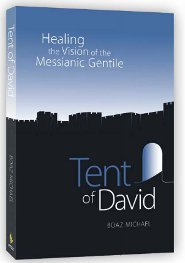
Tent of DavidMy “plan B,” after much consideration, was to do a sort of Tent of David integration into a small, local Baptist church, even after being warned by a good friend of mine that the effort was doomed to failure as well.

I stayed with the church for two years until the Pastor, frustrated with me “digging in my heels” as he put it, and remaining steadfastly devoted to my perspectives on the Bible, Israel, Messiah, and Hashem as a Messianic Gentile, gave a sermon on misuse of Torah, which included the belief that the Sinai covenant was still fully enforced upon the Jewish people.

That felt like a very personal and public rebuke.

I blogged my disagreement, which came with consequences, and ultimately decided it was in Pastor’s, the church’s, and my best interest for me to apologize and then exit Christian community entirely.

But Christian community isn’t Jewish community. Jews belong with other Jews. I don’t know how Messianic Jews are going to fully meld into Orthodox Jewish community in Israel, but I guess they’ll find out. It just seems that if the boundaries between the different sub-groups of Israeli Jews are so rigid, that penetration of said-boundaries is going to be rather difficult.

In theory, I could walk into any church in my community and be immediately welcomed. As long as I kept my big mouth shut or only mouthed the “party line” supported by that particular church as “sound doctrine,” I’d be OK.

Of course, the obvious barriers, besides me keeping my flap shut and not blogging on each and every church experience that rubbed me the wrong way, are not being able to invite people from church over to my house because it would make my wife uncomfortable, attending church at all because (she would never stop me or breathe a word of dissent about me attending) the very act of my going to a church would emphasize that she’s “sleeping with the enemy,” so to speak, and my attending Christmas and especially Easter services, would totally devastate her.

But outside of my home life and my highly specific theology, there are (or should be) no barriers to me attending church and being accepted, at least in my own little corner of Idaho.

jerusalem at nightFor Messianic Jews in Israel, it seems as if they have an especially tough row to hoe, so to speak, again, at least according to the Jerusalem Post news story.

I’ve written plenty about the struggle for we “Messianic Gentiles” in establishing our own roles and responsibilities relative to Messianic Judaism as well as to each other, but we need to be mindful that Messianic Jews also face a very similar challenge in relation to larger Judaism, especially in Israel, but also everywhere else.

Why should devotion to Israel and to Rav Yeshua be mutually exclusive for a Jew? It shouldn’t be, except that nearly twenty centuries of enmity between Christianity and Judaism has made it so.

Attached and Yet Unattached

As a centrist movement, Conservative/Masorti Judaism strives to reconcile ancient ideas with modern understandings. Utilizing this approach, twenty years ago, a group of Temple Emunah members, led by Barbara Palant, began to consider how we could become a more welcoming community—one that embraces interfaith families while still adhering to our time-honored traditions.

Following the Rabbinical Assembly’s practice, Temple Emunah has adopted the phrase “K’rovei Yisrael” to refer to those individuals who are part of our community and part of a Jewish home, though they are not personally Jewish. The term literally means “those who are close to [the people of] Israel.” K’rovei comes from the word “karov,” meaning “close;” krovim means “relatives.” K’rovei Yisrael are distinct from non-Jewish friends and extended family members who might visit our community or our congregation for a Bar Mitzvah or for some other reason. K’rovei Yisrael are also different from non-Jewish relatives of Temple Emunah members who choose not to be involved in our synagogue community.

-Rabbi David Lerner
Welcoming K’rovei Yisrael at Temple Emunah Today
TempleEmunah.org

I saw a link to this webpage posted in a closed Facebook group for “Messianic Gentiles”. I don’t recall the actual context involved, but if you look at the content of Temple Emunah’s webpage for “K’rovei Yisrael,” you can see they have rather liberal social and religious tastes, and in this particular instance, are outlining the roles and responsibilities of intermarried non-Jews who are part of their synagogue “family”.

intermarriageI can see why this would be appealing to a group of Messianic Gentiles, but this only works under certain circumstances, the circumstances outlined in Rabbi Lerner’s brief missive. It only works if you are not only regularly attending a (Messianic) synagogue that is primarily a Jewish space that permits Gentile involvement, but also, that you are married to a Jew.

Of course that second qualification could be adapted such that you are a regular attendee and while not intermarried, have nevertheless bound yourself to Israel through devotion to Rav Yeshua (Jesus Christ) as the coming Moshiach, and to Hashem, God of Israel.

Rabbi Lerner’s welcome to K’rovei Yisrael is very enthusiastic and encouraging, offering many opportunities for synagogue participation by non-Jewish “family members,” but I wanted to focus on the limitations he presented:

Out of respect for our traditions, K’rovei Yisrael should not participate in rituals with the Torah including:

  • Aliyot, opening/closing ark, and performing hagbah or gelilah (lifting or rolling/dressing the Torah).
  • Wear tefillin. If K’rovei Yisrael want to learn more about tefillin for educational purposes, they are invited to speak with me.
  • Recite any prayer that fulfills the ritual obligation of another person; for example, reciting Kiddush over the wine or another blessing for the community.
  • Recite b’rakhot, sign the ketubah as a witness, or read the ketubah as part of the ceremony at a Jewish wedding.
  • Hold committee chairmanship or board member positions, or vote at congregational meetings (per policies of the United Synagogue of Conservative Judaism).

To me, this makes perfect sense. Rabbi Lerner may be offering an extraordinarily generous opportunity for intermarried non-Jews to be part of synagogue community, but at the end of the day, even if you live in a Jewish home as a non-Jew, you’re not Jewish, which means, even if you share devotion to Rav Yeshua with the Jews in your community, there are just certain things that belong to the Jewish people because of their covenant standing with Hashem.

Here’s a little more from R. Lerner’s article:

The areas that become challenging are those where K’rovei Yisrael are symbolically enacting a ritual that signifies their commitment to our tradition, which would not be accurate. For example, when Jews take an Aliyah to the Torah, they are not merely standing at the Torah; they are acting out a drama that reflects their relationship to the Torah. First, they are called up with their Hebrew name, something that K’rovei Yisrael do not have. Second, an Aliyah is ascending to the Torah, accepting the Torah as the binding force for living your life.

chabad
Credit: jewishvenice.org

R. Lerner speaks more about Jewish tradition, but for me, what he’s describing is the covenant relationship with God that a Jew possesses over the non-Jew.

I’ve written at length about particularly how the New Covenant was made specifically with the House of Judah and the House of Israel, and if we non-Jewish Yeshua-disciples are able to reap some of the blessings from that covenant, it’s not because we are named parties, it is only because Hashem has grace and mercy toward us.

Most of us (non-Jews) who are intermarrieds, if we found ourselves in such a synagogue, out of respect for the Rabbi, out of respect for the Jewish synagogue community, and particularly out of respect for our Jewish spouses, we would be more than happy to accept the limitations along with the opportunities being offered.

However, as Yeshua-believers, if we find ourselves in a Jewish community of Yeshua-believers, somehow we think that doesn’t matter anymore and we have been elevated to equal covenant status with the Jews. So we want to be called up for an Aliyah, we want to wear a tallit gadol, we want to lay tefillin, we want to be counted as part of a minyan.

It seems that at least some groups believe Yeshua-faith is a license to abrogate the unique and exclusive covenant relationship that Israel and the Jewish people have with Hashem. Is this what our Rav, the once and future King (so to speak), Moshiach, the Jewish Messiah wanted when he called upon Rav Shaul (the Apostle Paul) to become the special emissary to the Gentiles?

It hardly seems likely, for it represents a gross betrayal of everything God did for Israel by covenant.

Ironically, in some ways, this is exactly the sort of betrayal that both normative Judaism and normative Christianity believe Paul is guilty of. Except, Christians don’t look of it as guilt or betrayal, just replacement, inclusiveness, or whatever you want to call it.

I also recently read another article called How Jewish Christians Became Christians, which is a short summary from Lawrence H. Schiffman’s book From Text to Tradition, A History of Second Temple and Rabbinic Judaism .

The split between Judaism and Christianity did not come about simply or quickly. It was a complex process which took some one hundred years, starting from the crucifixion [of Jesus], and which had different causes and effects depending on whether it is looked at from the point of view of Judaism or Christianity. Further, the question of legal status as seen through Roman eyes also had some relationship to the issue.

Apostle Paul preachingThe article is relatively kind to early “Christianity” as a Jewish movement with an unusually liberal policy regarding Gentile admission. However, it does describe the Christian view of what caused the schism to the massive influx of non-Jews who did not see themselves as part of Jewish community. So…

…the New Testament redactors had clearly decided that they were no longer part of the Jewish people. Therefore, they described Jesus as disputing with all the Jews, not just some, as would be appropriate to an internal Jewish dispute. Once Christians saw Jews as the “other,” it was but a short step to the notion that all Jews were responsible for the rejection of Jesus and, hence, for the failure of his messianic mission to be fulfilled.

This perspective has echoed through nearly twenty-centuries of Church history and fuels much of how Christianity interprets Rav Yeshua’s relationship to his fellow Jews today. And yet, even a casual reading of the Gospels by someone who is not inculcated in Christian exegetical tradition will illustrate…

In the earliest Gospel texts, which picture Jesus as debating issues of Jewish law with the Pharisees, no hostility is observed. The crucifixion is said to have been carried out by the Romans with the support of some (apparently Hellenized) priests.

In other words, the Gospels we have with us today show Rav Yeshua having what Jews would consider perfectly normal and acceptable debates with fellow Jews on matters of halachah. This remains perfectly normal and acceptable behavior within religious Judaism today. It’s a matter of the Jewish “us” arguing with the Jewish “us”, not “us against them”.

Even for we Gentiles who accept that Christian theology and doctrine is based more on traditions that were originally created by those early non-Jewish “Church fathers” who sought to separate their newly created religion from the Jewish scriptural understanding, the Jewish people, and Judaism, it can sometimes be difficult to escape our past. We still sometimes tend to give in to the old habits and attitudes we were taught in our churches.

We still have a tough time understanding that “neither Jew nor Greek” (Galatians 3:28) means that we are all equal in God’s love, in receiving the Holy Spirit, in having a place in the world to come, without it also meaning that there are absolutely no covenant distinctions between the two groups.

However, all of this only becomes a problem at the intersection of Jews and non-Jews in (Messianic) Jewish religious community.

It’s a moot point for those of us not in community, Jewish or otherwise. Also, as I briefly explored in another recent blog post, there seems to be a movement of sorts among Messianic Jews in Israel to become participants in more normative Jewish synagogue life with the goal of being integral members of those communities (to paraphrase PL’s comment on the matter).

synagogueWhile this strengthens the ties between Messianic Jews and the larger Jewish community in the Land, by necessity, Gentiles will not be involved, so again, the points I brought up regarding the aforementioned “intersection” become moot.

And as Rabbi Lerner wrote in his article to K’rovei Yisrael:

The blessings themselves indicate how integral the Torah is in our lives and that we have been given a unique destiny as Jews to live by its ideals, bringing them fully into the world.

I know that many of us, when we became involved in Hebrew Roots or Messianic Judaism, or whatever opened your eyes to the more “Hebraic” nature, not only of the Tanakh (Old Testament), but especially the Apostolic Scriptures (New Testament), we became attached and even enamoured with Jewish community, such that we actually had access to, as well as Jewish praxis, ritual, and tradition.

There are a lot of non-Jewish people who were dismayed, discouraged, and even insulted when various Jewish and Gentile pundits in Messianic Jewish space (including little ol’ me) basically said, “Back off…some Jewish stuff just doesn’t belong to you.”

If the movement in Israel for Messianic Jews to integrate into normative (Orthodox) Jewish community takes hold, and especially if it becomes the model for Messianic Jewish practice in other nations, including the U.S., then opportunities for non-Jewish participation in Messianic Jewish community dwindle.

This doesn’t particularly affect me. I’ve accepted it in my life, but for others, it may come as quite a blow. Of course, all this is just speculation and at least in the U.S., authentically Jewish Messianic synagogues which service a majority Jewish population are not especially plentiful.

But for me, it again emphasizes that Judaism as such isn’t the primary interface by which we non-Jewish disciples access our Rav or access the God of Israel (though I’m still fond of my “Jewish lens”). This is probably what the early non-Jewish disciples in the Apostle Paul’s day and soon after experienced. You have a religious structure that is uniquely by and for Israel and that affords Israel a covenantal relationship with God, as well as a rich lifestyle of Torah practice, but so much of it doesn’t include the rest of us. How could Judaism possibly be an anchor for us?

ChurchThe answer, almost two-thousand years ago, was for the Gentiles to leave en masse and to develop a brand new Gentile-focused religion: Christianity. But now, for whatever reasons, many Christians are leaving the Church in pursuit of some aspect of Judaism as they understand it, whether it’s formal conversion, becoming a Noahide, Hebrew Roots, or Messianic Judaism.

But that puts us right back where we came from, so to speak. Christianity, as it has turned out to be, doesn’t accurately understand why the centrality of Israel is so important in God’s redemptive plan for the world, and those of us who have figured it out, leave the Church because of that. But increasingly, there’s less and less room for non-Jews who are attracted to Israel, and who want to attach themselves to Israel and thus to Israel’s God to find a place among Israel, even as “resident aliens,” at least as far as I can tell from my little corner of Idaho.

It would be easier for me, as a Gentile husband to a Jewish wife, to find a role in Jewish community in Rabbi Lerner’s synagogue (assuming my wife attended and desired my participation) than it would be for me to have a role in Messianic Judaism, at least if the goal is for Messianic Judaism to become an increasingly integral part of larger (Orthodox) Judaism and Israel.

On the one hand, that’s where Jews need to be, among other Jews in Jewish community. That’s why I’m delighted that my wife does that, both in our local Reform/Conservative group and with the Chabad. But on the other hand, we Gentiles in Rav Yeshua are facing the same dilemma that we faced in the First Century C.E.

My personal answer is to give up the identity crisis and to develop my relationship with my Rav in isolation (with the help of the Internet, of course). What I say, think, do, and believe in private affects no one, except to the degree that I write about it on this blog. And even then, you can choose to read or not read what I produce. Your decision.

But my answer isn’t everybody’s answer.

I get that Messianic Jews are Jews and I understand, having my wife as a living example, what that means. I also get why some Messianic Gentiles are looking to Noahides as a model for how to define themselves. For both Christianity and Judaism, community is extremely important and it provides a lot of support and encouragement.

But I also understand that the natural consequence of all this is that we non-Jewish Yeshua disciples who will never fit in at a church and who possess this peculiar “Judaically-aware” perspective on the meaning of the Bible, the meaning of Messiah, and the meaning of Hashem’s overarching plan of redemption for Israel, and through Israel, the world, are left with the option of either somehow forming our own communities of “Gentile-focused Messianics” or go it alone.

MessiahI’m sure God has an answer to all this, and I don’t doubt that when Messiah physically rules Israel and the nations from his throne in Jerusalem, that he will enact laws and practices to address these questions, but in the present, in order to preserve (Messianic) Jewish identity, community, and unity, the rest of us have to figure out how to do something else by going somewhere else.

I wrote Why Worshiping Alone Matters and Why We Are Never Alone as possible responses to this issue. I hope they can be an answer for you, too.

I don’t know if the following applies, but I’ll include it anyway, just in case:

“Also the foreigners who join themselves to the Lord,
To minister to Him, and to love the name of the Lord,
To be His servants, every one who keeps from profaning the sabbath
And holds fast My covenant;

Even those I will bring to My holy mountain
And make them joyful in My house of prayer.
Their burnt offerings and their sacrifices will be acceptable on My altar;
For My house will be called a house of prayer for all the peoples.”

The Lord God, who gathers the dispersed of Israel, declares,
“Yet others I will gather to them, to those already gathered.”

Isaiah 56:6-8 (NASB)

What Does “Torah” Mean To You?

For clarification, by the word “Torah,” I do not just mean the Torah, as in the Five Books of Moses, but to all Jewish religious texts such the Hebrew Bible, rabbinic and halakhic texts, and kabbalistic and hasidic texts.

-Rabbi Joel E. Hoffman
“Why I Learn Torah Daily”
Aish.com

This somewhat dovetails with what I wrote in The Torah Without Judaism, and particularly the brief exchange I had in the comments section of that blog post with reader ProclaimLiberty.

The question for the Messianic and particularly the “Messianic Gentile” or “Talmid Yeshua” is what the word “Torah” means to us.

There’s probably no one answer, since depending on the given disciple, Jewish or Gentile, the perspective is going to vary.

What do I mean by “Torah?”

This is just my personal opinion. I’m not trying to tell anyone what to do. But I think it’s a helpful question we should all ask ourselves periodically, rather than just assume that our answer is “the answer.”

From my point of view, “Torah” includes the whole Bible, and by that I mean the Five Books of Moses, the Prophets, the Writings, and the Apostolic Scriptures. However, I also habitually read articles and commentaries found at Aish.com and Chabad.org, mainly to get a Jewish viewpoint on what I’m studying.

Granted, I am doing a lot of mental editing when I read content from those resources, since those sites and their information are written by and for Jews, not Gentiles, particularly not for Christians, and absolutely not for anyone with my unique conceptualization of scripture, Messiah, and Hashem.

christian books
Photo: sharonglasgow.com

I don’t typically read traditional Christian resources, even though they are far more Yeshua (Jesus) focused, because, frankly, I just don’t relate to them. I’ve always had a problem with “Christianese,” even when I first became a believer about twenty years ago.

I do read the occasional Christian-oriented book here and there, but either I don’t get very much out of them, or I actively criticize their content.

There have been other resources I have heavily consumed in the past, and they still guide the majority of my thinking and beliefs, but for a variety of reasons, I’ve chosen not to pursue them further, at least to any significant degree.

I have become aware that a debate somewhat like the one I previously mentioned is occurring at a Hebrew Roots blogspot, and the discussion there is very contentious.

However, the blog owner did provide a link to a brief review of a book by Rabbi Chaim Clorfene called The World of the Ger. You can learn more about it at the blog Soul Mazal.

I know that there are some “Messianic Gentiles” who at least suggest the path of the Noahide is an appropriate journey for them/us as well, and I’ve written on this before.

I think there are some things we might take from that example, but it’s also filled with trap doors and land mines. It’s far too easy for some of us to confuse our faith in Hashem and devotion to our Rav with the practice of Judaism or Noahidism. Hence the fact that we see some non-Jews in our communities as well as in churches leave Yeshua-faith and either join the ranks of the Noahide or convert to (Orthodox) Judaism.

It would almost be better for believing Gentiles to stay in their churches rather than take such a risk.

But then, in my opinion, their perspectives regarding what the Bible really says about Israel, the Jewish people, the redemption of the world, and yes, about Judaism, would remain limited if not misguided.

studyAs with many other questions I bring up, I don’t have a hard and fast answer for you. Interestingly enough, this brings us back to Rabbi Hoffman’s brief essay:

I learn Torah every day because it gives me a cohesive set of answers to all of the ultimate questions.

I suppose, from Rabbi Hoffman’s perspective, it does, but it doesn’t work that way for me. I still have far more questions than I do “ultimate” answers.

But here’s another wrinkle R. Hoffman introduces:

I learn Torah every day because it connects me with the millions of other Jews worldwide who also learn Torah every day.

That works if you are a religious Jew, but not so much for we non-Jews, even Noahides, I suspect. After all, how Torah applies to the Ger is remarkably different from how it applies to the Jew, at least in the details, although keep in mind that I also previously mentioned a private Jewish school in Utah that teaches Jewish values to a student body made up of 75% non-Jews.

And that’s one of the reasons, maybe one of my top reasons, for studying the Torah as I understand it. To seek a common ground where I as a non-Jew can stand and learn who God is and who I am to Him through a Jewish lens.

But I craft that “lens” to fit more my particular “eyesight” requirements, since I’m not a Jew and I consider myself more than a Noahide.

The one advantage I have is that I stand outside of actual, face-to-face Jewish or Christian community. Neither one can have too strong a pull on me, although the Pastor at the church I attended for two years certainly tried as hard as he could to turn me into a good Baptist.

But since, as I’ve admitted, I find Jewish thought more appealing, I suppose if I were constantly exposed to Jewish community of the non-Messianic variety, I’d be putting myself at risk of being influenced to the point of challenging my faith. I don’t know if it would go that far, but why take the chance?

That may be why so many of us are unaffiliated, although there are plenty of other reasons.

Laying TefillinIf I study Torah as I understand it and don’t adopt the praxis of Judaism, I can’t be as strongly influenced to confuse Judaism with my identity and role as God created them for me. I also can’t be accused (as sometimes occurs) of misappropriating the things unique to the covenant relationship between Hashem and the Jewish people, such as Shabbat, Kosher, the prayers, donning a tallit gadol, or laying tefillin.

If you’re Jewish, then I say what’s yours is yours.

If I’m not Jewish and I don’t identify as a traditional Christian, all that’s left, assuming I retain my Yeshua-faith, is a journey to discover who I am uniquely in my relationship with my Rav.

If you confuse that with either Judaism or Christianity, you might already have lost your way.

"When you awake in the morning, learn something to inspire you and mediate upon it, then plunge forward full of light with which to illuminate the darkness." -Rabbi Tzvi Freeman