Do Christians Really Have 1050 New Testament Commandments?

There are 1,050 commands in the New Testament for Christians to obey. Due to repetitions we can classify them under 69 headings. They cover every phase of man’s life in his relationship to God and his fellowmen, now and hereafter. If obeyed, they will bring rich rewards here and forever; if disobeyed, they will bring condemnation and eternal punishment.

-from the Christian Assemblies International website

Jesus commanded us in the second half of the Great Commission to teach others to observe ALL that He has commanded us. We first need to know the commands ourselves well enough so that we can teach others to observe them.

-from the Biblical Research Reports website

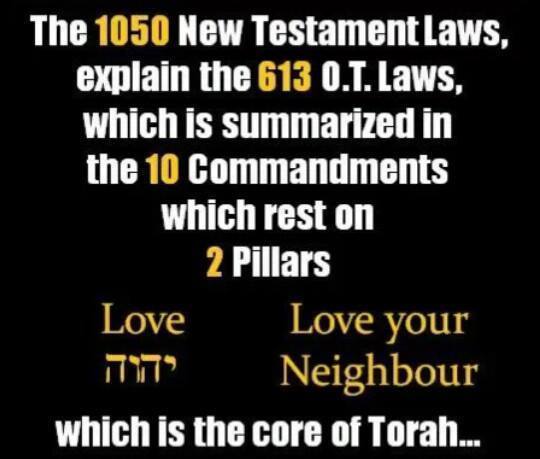
1050Really, is this a thing? I first saw a reference to “1050 New Testament Laws” on Facebook (someone had shared this meme in my timeline) and I was really surprised. So naturally, I “Googled” it so see what else I could find.

Besides the two above-quoted websites, a number of other dodgy online “resources” showed up including discussion groups at City-Data.com, ChristianForums.com, and RedHotPawn.com. I didn’t examine any of these sites in-depth and I haven’t read each and every one of the 1050 “commandments” (if they are commandments), but at first blush, I suspect that the list consists of a combination of teachings found in the Torah (and as such, they aren’t unique to the Apostolic Scriptures) and individual exhortations of Paul’s offered to specific populations concerning unique situations (as opposed of 1050 eternal, universal commandments that are either added on to the Torah mitzvot or that are supposed to replace them).

I did, more or less, accidentally find one flaw at Christian Assemblies International. Under the category “Seven Things to Avoid,” item three says “False Science” and references 1 Timothy 6:20, which they quote as saying:

Oh Timothy, keep that which is committed to thy trust, avoiding profane and vain babblings, and oppositions of science falsely so called.

“…oppositions of science?” I don’t remember that.

Ah, but that’s the King James Bible translation. My preferred translation, the NASB, states:

O Timothy, guard what has been entrusted to you, avoiding worldly and empty chatter and the opposing arguments of what is falsely called “knowledge” …

Sorry. “knowledge” and “science” aren’t the same thing, so no sale KJV. In fact, the vast majority of other versions of the Bible translate the word referred to by the KJV as “science” as “knowledge”.

I suspect these so-called “New Testament Laws” are all equally bent, twisted, and mutilated to say what the Bible doesn’t really say.

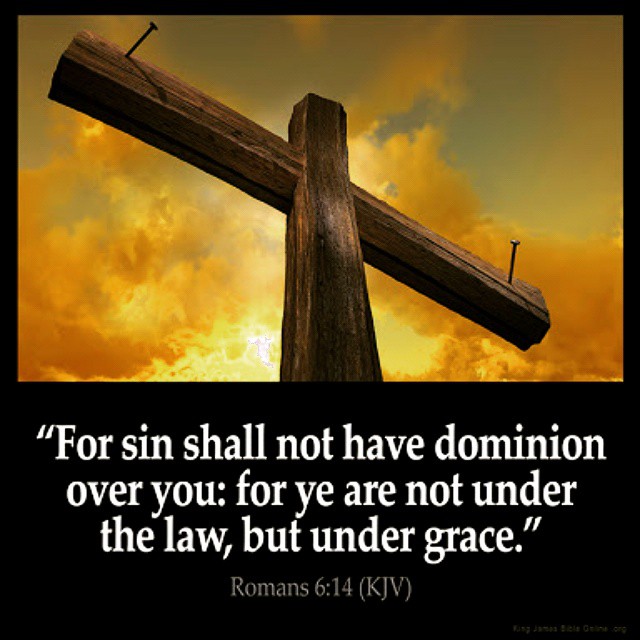
But why? Why go through all the trouble? Isn’t it enough for mainstream Christianity to say that grace replaced the Law and all you have to do is believe in Jesus and you’ll go to Heaven?

under the lawA quick Google search couldn’t tell me who originally compiled this list and why, so I don’t have a definitive answer at my fingertips.

But even a quick scan of some of the other “commandments” tells me they suffer woefully from lack of context issues. For instance, under “Alcohol” on the Bible Research Reports page:

1Thessalonians 5:8 But let us, who are of the day, be sober, putting on the breastplate of faith and love; and for an helmet [sic], the hope of salvation. (emph. mine)

Most Bible translations do say “sober,” but some translate the same word as “clearheaded” or “serious” so it doesn’t automatically have to be sober as opposed to intoxicated. This does reflect a typical Christian bias against the use of alcohol in almost any degree, which again, makes me question the validity of the so-called “New Testament Laws”.

On the same website, under “Church Service,” I loved this one:

John 2:16 And said unto them that sold doves, Take these things hence; make not my Father’s house a house of merchandise.

The Holy Temple in Jerusalem is not “church,” so I don’t find something Yeshua (Jesus) said about a very specific situation he encountered in the Temple to have a universal application to all non-Jewish Jesus worshipers (i.e. Christians) everywhere.

There was a section called “Commands — Old Testament” which listed exactly seven different passages, three from the Gospels and the rest from the Epistles. There’s no explanation accompanying this list, but I have to assume the writer/compiler intends that these are the only commandments from the Torah that survived Jesus “fulfilling the Law”.

Ironically, the list includes Matthew 5:17-19 which is the strongest evidence that Yeshua did not come to abolish (fulfill = abolish) the mitzvot but rather to illustrate living them (as a Jew) to their fullest. However, both Galatians 5:1 and James 2:12, taken out of context, seem to declare that the Torah is extinct post-crucifixion and resurrection, so they fit the traditional Christian doctrinal narrative.

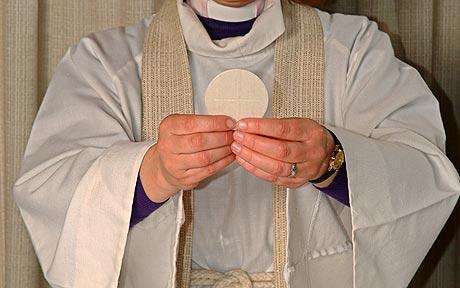
communionThere’s a category for “Communion,” which, when the Gospels and Epistles were being composed, didn’t exist, not to mention one about “Denominational Differences”. I love this:

Mark 9:38-39 And John answered him, saying, Master, we saw one casting out devils in thy name, and he followeth not us: and we forbade him, because he followeth not us. (39) But Jesus said, Forbid him not: for there is no man which shall do a miracle in my name, that can lightly speak evil of me.

Denominations, as Christianity understands the term, did not exist when the above-mentioned fellow was casting out demons in the name of our Rav, so this certainly illustrates a creative application of these verses.

As one commenter at discussion group quipped, “It is impossible to keep 1,050 commands let alone 613 O.T. ones that you can’t do!”

Of course, he’s wrong that you can’t perform any of the 613 mitzvot. There are a subset of some 200 odd mitzvot that observant Jews perform today. However, I’d tend to agree, if the general Christian position is that God gave the Torah commandments to the Jewish people just to prove no one can be righteous by the performance of good deeds because there are just too many of them (and this is a complete distortion of the focus and purpose of the Torah), then expecting “saved by grace” Christians to perform 1050 commandments is just insane.
Mitzvah
I am truly at loss as to why any corner of the Church would make this stuff up, but if any one out there is frustrated that non-Jewish Yeshua disciples don’t have commandments of their/our own, it looks like you have enough, according to the sources I’ve cited, to stuff a proverbial Christmas goose.

Personally, I’ll stick with the simplicity of a life of holiness. It provides quite enough to keep my hands full, and I’m convinced I’ll never do it very well.

Non-Jews and the Mitzvot: A Brief Commentary On One Orthodox Jewish Perspective

Moshe also does not need me to clarify for him. Nonetheless, I think his point is unexpected and worth considering, in that he is saying that many mitzvot aren’t inherently valuable, they’re only valuable as part of a particular relationship with Hashem. It’s not that he objects or is bothered by non-Jews doing them, he’s saying that in these areas, the differences between Jews and non-Jews are such that these actions are literally meaningless for them.

-Rabbi Dr. Gidon Rothstein
“Do Non-Jews Get Reward for Mitzvot?”
Torah Musings

Now before anyone flips out, I want to say that I found a link to this article on Facebook, and that “Torah Musings” is an Orthodox Jewish venue, so please take that perspective into consideration. In fact, their About states in part:

Torah Musings is a window into the Orthodox Jewish intellectual’s world, providing sophisticated but popular textual studies, important news stories and associated commentary from the perspective of an Orthodox Judaism that is intellectually open and halakhically conservative.

rothstein
Rabbi Dr. Gidon Rothstein

Further, the disclaimer at the very bottom of Rabbi Rothstein’s article says:

The opinions and facts here are presented solely by the author. Torah Musings assumes no responsibility for them. Please address religious questions to your rabbi.

Again, please keep in mind that the contents of this write-up, including the portions quoted here on my blog, are crafted within the conceptual and intellectual confines of Orthodox Judaism and are the educated opinions of R. Rothstein specifically.

So don’t lynch me or hang me in effigy just for reporting something I find interesting and, I believe, relevant.

Almost three months ago, in an effort to distance myself from some of the angst we find in certain corners of Messianic Judaism regarding Gentiles, identity, and mitzvot, I wrote and published What’s Yours is Yours. Really, if a Gentile in Jewish space is a problem, I’ll bow out.

Among other related articles, I also subsequently published Should Non-Jews Study the Torah and I concluded “yes,” with the proviso that studying Torah did not make one automatically obligated to perform each and every possible mitzvah described therein.

But having, to the best of my understanding and ability, examined the Messianic Jewish viewpoints (yes, there are more than one) as well as Hebrew Roots’ and Christianity’s opinions on the topic, how can I resist investigating how this Orthodox Jewish Rabbi answers the question he has asked?

As you can see from the above-quoted paragraph, R. Rothstein, in examining the “original responsum, Iggerot Moshe Orach Chayyim 6;2,” states that Moshe’s opinion would be that while we are not forbidden from performing the mitzvot, because many or most of them are directly linked to the (Sinai) covenant relationship Hashem has with the Jewish people, laying tefillin, wearing tzitzit, or building and living in a sukkah are simply meaningless to us relative to actually fulfilling these mitzvot, because non-Jews, even those living as Noahides, are not part of that covenant.

solomon's templeIs that the final word?

R. Rothstein reviewed the opinions of multiple authorities and they all differ somewhat in how strict they rule in this area.

1. Schepansky had noted that Rambam, in his Mishnah Commentary to Terumot 3;9, explained that even though non-Jews are not obligated in giving terumah, they still get reward for doing so, which is why the terumah they designate qualifies as actual terumah.

2. Moshe labels it one of the exceptions, donations to hekdesh (anything having to do with the Temple) and charity, examples he proves from the Talmudic assumption that Balak is rewarded for his sacrifices and Baba Batra 4a’s view that Nevuchadnezzar’s giving charity was effective. Non-Jews are also rewarded for appropriate speech, as Rashi says on Bereshit 19;39, where Lot’s younger daughter was more circumspect about her son’s paternity. Nevuchadnezzar also gets rewarded for the three steps he takes to hear the word of Hashem.

Those are all examples of non-Jews taking intuitively decent and good actions. When it comes to that which the Torah nonintuitively legislates for Jews, such as Shabbat, holidays, tefillin, tzitzit, sukkah, lulav, shofar, kosher, shatnez and anything like that, R. Moshe reverts to his view that these mitzvot only have value as a Jewish response to Hashem’s command.

This suggests that certain mitzvot might actually have meaning when performed by non-Jews, such as making an offering at or donations to the Temple (which currently does not exist), or other actions that any reasonable person would intuitively understand are morally good or right. On the other hand, those mitzvot that we would not intuitively realize are good, such and laying tefillin or donning a tallit gadol when praying, actions that are specifically associated with the Jewish people and their (Sinai) covenant relationship with Hashem, simply mean nothing to Hashem when we perform them, because we non-Jews stand outside the (Sinai) covenant.

Orthodox JewsI know pretty much who is going to object to all this, but please remember that these opinions are coming from an Orthodox Jewish source, so you can’t necessarily hang blame either on me or on any authorities existing within Messianic Judaism.

You’ll need to click the link I provided above to get the full gist of what R. Rothstein has composed, but he does cite other authorities who believe a non-Jew may receive a reward for performing mitzvot voluntarily, although this probably doesn’t include the previously mentioned observances specifically associated with Judaism. Some have even suggested that the non-Jew may receive a greater reward, but this is a minority opinion and possibly considered erroneous by the majority of authorities.

The article concludes:

In that sense, R. Moshe is actually being more lenient towards non-Jews, in that in his view they are not missing out on a good. For R. Moshe, a non-Jew who keeps the Noahides is doing all s/he should do, not just all the Torah happened to let him or her know about. It’s not that they are too benighted to know the wonders of our mitzvot, it’s that those mitzvot don’t apply to them, unless and until they decide to convert.

In other words, it is understood that Gentiles may recognize the beauty of all of the mitzvot once we study Torah and become aware of them, however that recognition goes not make us obligated unless we choose to convert to Judaism.

This is more or less what I’d expect given an Orthodox Jewish perspective, and is actually more liberal than I would have previously imagined.

Now the question is, from the viewpoint of disciples of Rav Yeshua and my understanding of our graciously being allowed to partake in some of the blessings of the New Covenant by Hashem’s mercy and through the symbolic sacrifice of our Rav, does this change anything as far as non-Jewish disciples, the mitzvot, and their significance?

That’s the $64,000 question.

And it’s one that A) I’ve answered before, and B), that I don’t intend to hash out again in this blog post.

rainbowI am writing this “mediation” and providing links to the source material because I find it fascinating that Orthodox Judaism would even pose the question for serious, scholarly debate. If it’s a question that Orthodox Jewish authorities find necessary to ask, given that they see non-Jews as subject only to the covenant Hashem made with Noah (see Genesis 9), how much more so should it be a question within Messianic Judaism, given that Hashem has allowed even the non-Jew to become a disciple of Yeshua by mercy and grace?

You can read other articles Rabbi Rothstein has written for Torah Musings as well as at the Orthodox Union (OU) and The Times of Israel to gain greater insights into his perspectives.

I know this will probably ruffle someone’s feathers, but really, I’m just publishing this as a matter of interest as to how wider Judaism considers a matter that is, from my point of view, highly relevant to non-Jews who are “Judaicly aware” and who are or have been involved in either the Messianic Jewish or Hebrew Roots communities.

“Ask a Scholar” at Bible Odyssey

The Society of Biblical Literature has mounted a new/recent web-resource for the “general public” entitled “Bible Odyssey” here. People are invited to lodge questions, and to each a relevant expert is asked by the SBL to make a response. I’ve had my own first go at doing this here, in response to a question about the origins of treating Jesus as divine.

-Dr. Larry Hurtado
“Bible Odyssey: Recent Web Site”
Larry Hurtado’s Blog

That’s a good, short description of a very interesting new resource on Biblical scholarship which has recently become available to non-scholars.

However, Bible Odyssey is more than just a place to ask a scholar a question.

You can learn how scholars view the different notable people in the Bible such as Abraham, Daniel, John the Baptist, and Jesus. The same treatment is given to specific places in the Bible like Antioch, Corinth, Jerusalem, and Rome. Have a question about a particular passage in the Bible? You can learn more about the Binding of Isaac, Jesus and the Money Changers, the New Covenant, and more.

But as Dr. Hurtado pointed out, one of the most exciting opportunities this web site offers is the ability to ask a Biblical scholar a question and receive a detailed response. Just click Ask a Scholar to get started, but keep this important proviso in mind:

Please keep in mind that this site is focused on the historical, social, literary, and cultural contexts of the Bible, rather than on theology, spirituality or personal religious beliefs. Selected questions that fall within the purview of Bible Odyssey will be forwarded to scholars.

If you just love getting into theological or doctrinal debates, that’s not going to happen here. Chances are, not all of your personal theological or spiritual beliefs are going to be supported by each and every response. I don’t know that each person listed as a contributor will be answering reader questions, but they’ve all provided content to the web site. In fact, one of my favorites (besides Dr. Hurtado) is on the list, Magnus Zetterholm.

Here’s an example of how “Ask a Scholar” works.

Someone asked a question about Jesus Worship:

When did the worship of Jesus, as God, rather than Messiah, Lord, and Savior, begin? And by whom?

This is right up Dr. Hurtado’s alley, so to speak, since he’s written extensively about the early worship of Jesus as God.

I found one portion of Hurtado’s response particularly interesting (I’ll put the relevant section in bold text below):

But I presume that you actually mean “when and where did Jesus first come to be reverenced as somehow really sharing in God’s status, or glory, and so the rightful recipient of worship along with God?” This has been a contested question for at least a century or more. Pretty much everyone is agreed that Jesus didn’t receive worship during his ministry. The key questions contested are how soon and where after Jesus’ crucifixion did it begin.

Maybe I’m reading this wrong, but it sounds as if Dr. Hurtado is drawing a distinction between God and Jesus, and that Jesus is alongside God as opposed to the embodiment of God as God’s Son.

Admittedly, the Divine nature of Jesus has always been rather mysterious to me, and I know that most Christians take it as a matter of course and don’t ask questions. Also, Hurtado isn’t answering the question about how Jesus could be God, just when did people begin giving him the same worship and devotion as God.

Dr. Hurtado finishes his response with (and again, I’ll bold what I think is the most interesting part of the text):

The Aramaic liturgical expression, “Maranatha” (= “O/our, Lord, come!” cited in 1Cor 16:22), is one of several pieces of direct evidence that Jewish, Aramaic-speaking believers invoked the risen/exalted Jesus as “Lord” in their corporate worship gatherings. The basis for this remarkable development was apparently the convictions that God had exalted Jesus as “Lord,” that Jesus now shared God’s glory, name and throne, and that God now required Jesus to be reverenced accordingly (e.g., Phil 2:9-11).

This makes it seem as if God took some sort of action that resulted in Jesus gaining exaltation as “Lord” and enabled Jesus to then share in God’s glory, name, and throne, thus requiring that his followers now revere Jesus in that light (as opposed to Jesus having eternally been God from “the beginning”).

Of course, I could be wrong in how I’m interpreting Dr. Hurtado’s response, but you’ve got to admit that this is a bit different from what you’ll hear coming from the pulpit on any given Sunday, at least it is in my experience.

And that’s the exciting part about being able to ask a Biblical scholar a question. It’s pretty rare for any current Biblical research to filter down into any particular Pastor’s sermon and thus into the church pews. From my own background, what we typically hear in sermons and Sunday school is a traditional interpretation of the Bible that’s been handed down for years, decades, or generations, filtered through specific denominational biases, and untouched by any recent or current Biblical scholarly findings.

For the person who wants to become a more serious student of the Bible but who isn’t a scholar nor likely to take a degree in Biblical studies, this is a terrific resource that is easily accessed.

A few technical problems.

The link to the page containing previous answers to “Ask a Scholar” questions is, as of this writing, broken (Addendum: the link has since been fixed). It leads to an error page. But on the error page, when you click the link to return to the Home Page, you go nowhere because there’s no .org extension after “bibleodyssey/”.

I reported the first problem, so hopefully someone will look into it. My guess is that the designer of the site still needs to do some more testing before it becomes fully operational.

All that said, I’m glad to pass along this information and hope that folks find it useful and illuminating.

Who Delivers the Consequences for Sin?

Fortunate is the person who fears God, and has a great desire for His mitzvos.

Psalms 112:1

We think of fear as a negative emotion, so we try to eliminate it. We therefore lose sight of the fact that fear can also be constructive. Fear motivates us to drive cautiously even when in a great hurry, and fear makes a diabetic adhere to his diet and take his insulin daily.

Religion has often been criticized for advocating the fear of God. This criticism may be justified if we were conditioned to think of Him as an all-powerful Being holding a huge club, ready to beat a sinner to a pulp for doing something wrong. All ethical works discourage the use of this type of fear as motivation. Rather, fear of God should be understood to mean the fear of the harmful consequences that are inherent in violating His instructions. The Psalmist says that wickedness itself destroys the wicked person (see Psalms 34:22).

“Fortunate is the person who fears God,” in the sense that “he has great desire for His mitzvos” (Psalms 112:1). It is only natural for one to desire the very best, and the realization that observing the mitzvos is indeed in one’s best interest should constitute the “fear” that should deter someone from transgressing the Divine will.

Today I shall…

…try to realize that observance of the mitzvos is in my best interest, and that I should fear transgressing the mitzvos in the same way I fear any injurious act.

-Rabbi Abraham J. Twerski
from “Growing Each Day”
Aish.com

I blame myselfI’ve been thinking about this in terms of my own shortcomings, my own fears, and my own relationship with God and with other people.

In the Church, there’s this implicit idea that God punishes sin, and if you step out of line, you will be struck down by God in some manner. Keep stepping out of line, and you’ll be sent on a one-way trip to Hell without an electric fan.

That’s a really good reason to be afraid of God.

But as Rabbi Twerski describes it, the “fear” of God should take the form of a deep respect for the Creator of the Universe and a corresponding desire to obey Him. In fact, to repeat part of the above-quoted passage:

This criticism may be justified if we were conditioned to think of Him as an all-powerful Being holding a huge club, ready to beat a sinner to a pulp for doing something wrong. All ethical works discourage the use of this type of fear as motivation. (emph. mine)

While in traditional, fundamentalist Christianity, the “fire and brimstone” approach is supposed to be our prime motivator for not sinning and walking the straight and narrow, in Judaism, it is ethically unsustainable to use fear of harm and punishment from God to drive us to proper behavior.

Instead, what we “fear” is the natural consequences of our misbehavior.

Afterward Jesus found him in the temple and said to him, “Behold, you have become well; do not sin anymore, so that nothing worse happens to you.”

John 5:14 (NASB)

It would seem that Rav Yeshua (Jesus) agrees with this perspective. How about the Apostle Paul?

In the name of our Lord Jesus, when you are assembled, and I with you in spirit, with the power of our Lord Jesus, I have decided to deliver such a one to Satan for the destruction of his flesh, so that his spirit may be saved in the day of the Lord Jesus.

1 Corinthians 5:4-5

consequences
Credit: NPR.org

So is Paul advocating for the sinner to literally be dragged to the gates of Hell and handed over to the Adversary to be physically destroyed? Probably not. This is just a guess on my part, but it sort of sounds like Paul is willing to give the sinner enough rope to hang himself with, so to speak.

It comes back to consequences. Drink enough alcohol or do enough drugs, and you’ll destroy your body. View enough “adult material,” and you’ll destroy your marriage. Spend enough money gambling or even just binge buying a bunch of stuff you don’t need and can’t afford, and you’ll destroy your family’s finances.

Or as the Psalmist said, “…wickedness itself destroys the wicked person.”

In most cases, you won’t have to wait for some sort of supernatural intervention. You’ll turn your life into a pile of doggy doo all by yourself…

…or myself.

But if you have the power to destroy your own life, you also have the power to save it.

I’ve always been mystified when I hear Christians saying things like “I turned it all over to the Lord,” or “The Lord released me from my bondage to [fill in the blank].”

How in the world did they perform an action that sounds like a symbolic or even a hypothetical concept?

I think it means that the person finally trusted God so completely that he/she was willing to endure the consequences of making teshuvah (repentance or turning away from sin and back to God), believing that those consequences, no matter how difficult in the short run, would be ultimately beneficial in the long run.

wheelbarrowI suppose “I turned it all over to the Lord” is “Christianese” for expressing an act of great trust in God that, no matter what the consequences, teshuvah will always be the better course of action than living with the consequences of sin.

So God isn’t a mean old man with a club waiting to beat us half to death the second we step out of line. He’s a Father and a Teacher, guiding us in a particular direction and letting us know the consequences of each action we take. What He won’t do is override our free will. We have to choose the right path because, right or wrong, we are responsible for the consequences.

The longer we sin, the greater the consequences, or as our Rav put it so long ago, “do not sin anymore, so that nothing worse happens to you.”

Gentile Access to the Herodian Temple: A New Opinion

Two millennia ago, the block served as one of several Do Not Enter signs in the Second Temple in Jerusalem, delineating a section of the 37-acre complex which was off-limits for the ritually impure — Jews and non-Jews alike. Written in Greek (no Latin versions have survived), they warned: “No foreigner may enter within the balustrade around the sanctuary and the enclosure. Whoever is caught, on himself shall he put blame for the death which will ensue.”

-Ilan Ben Zion
from the article “Ancient Temple Mount ‘warning’ stone is ‘closest thing we have to the Temple’”
Times of Israel

I found a link to this article on Facebook and it’s really very interesting. It suggests that Gentiles may have had more access to the Herodian Temple in Jerusalem than was previously believed. I’ll let the article speak for itself, quoting what I think are the most relevant sections, and I encourage you to click the link I provided above and read the entire story yourself.

Contrary to the recent New York Times report, which stated that Herod’s Temple was “surrounded by partition walls that were meant to separate gentiles and Jews,” the warning was meant to protect “not the whole Temple Mount, but the inner sanctuary, the inner courtyard,” Price said. The modern notion “that the entire area is somehow holy is contrary to the original purpose and status of this huge plaza of the Temple Mount.”

Gentiles were not only welcome to ascend the Temple Mount, they were also permitted, if not encouraged, to donate animals for sacrifice. Josephus recounts how Marcus Agrippa, Emperor Augustus’s right hand man, visited Jerusalem shortly after the Temple was built and offered up a hecatomb — 100 bulls — as a sacrifice on the altar. Likewise daily sacrifices paid for by the Roman state were offered up for the welfare of the emperors. Philo records in his Embassy to Gaius that on no fewer than three occasions “we did sacrifice, and we offered up entire hecatombs, the blood of which we poured in a libation upon the altar, and the flesh we did not carry to our homes to make a feast and banquet upon it, as it is the custom of some people to do, but we committed the victims entire to the sacred flame as a burnt offering.”

The article states that Herod may have engineered a more lenient policy about Gentile access to the Temple, with only most holy areas being forbidden, not just to non-Jews but to any Jew not ritually clean.

“It was not ethnic or race as much as [ritual] purity,” Price said. “Jews who were not purified or ritually impure could not pass the soreg either.” Unlike gentiles from across the Roman Empire, Jews were expected to know better than to enter the holy sanctum when impure.

And…

Herod changed that. He wanted to exhibit the grandeur of his compound, the largest temple in the ancient world, but not enrage his Jewish subjects.

“The exclusion of the gentiles, according to the inscription, is a kind of compromise between allowing them into the Temple but still excluding them from the inner temple, which is the properly holy ground,” Orian said.

“Reality necessitates compromise in different aspects of Jewish law,” he said. But “even if they were not viewed as impure, they would still be excluded from the [inner sanctum] of the Temple.”

TempleWhat Herod changed, at least according to this article’s writer and his source, Matan Orian, a PhD student at Tel Aviv University, was the perception, based on one interpretation of Numbers 18:7, that Gentiles were “intrinsically impure”. This interpretation may be the reason even Rav Yeshua’s (Jesus’) Apostles, including Peter, typically viewed and treated Gentiles as “unclean”.

And he said to them, “You yourselves know how unlawful it is for a man who is a Jew to associate with a foreigner or to visit him; and yet God has shown me that I should not call any man unholy or unclean.”

Acts 10:28 (NASB)

I’d have to guess that Peter may have been operating from the perception that all Gentiles were “intrinsically impure,” and yet, the Almighty showed Peter in a vision that the Gentiles should not be treated as “unholy or unclean.”

Of course, as the article states, this didn’t mean Gentiles, even among the Jewish Yeshua-followers of “the Way,” would have accepted in every area of the Temple, even if they were considered to be clean. There was a point on the Temple grounds where it would have been an outrage if a Gentile were to enter.

When the seven days were almost over, the Jews from Asia, upon seeing him in the temple, began to stir up all the crowd and laid hands on him, crying out, “Men of Israel, come to our aid! This is the man who preaches to all men everywhere against our people and the Law and this place; and besides he has even brought Greeks into the temple and has defiled this holy place.” For they had previously seen Trophimus the Ephesian in the city with him, and they supposed that Paul had brought him into the temple.

Acts 21:27-29

Of course, Jewish understanding of the presence and role of Gentiles on any part of the Temple grounds has changed over time.

Despite the Herodian-era status quo, in which gentiles and Jews mingled atop the Temple Mount, most rabbis today maintain the tradition that the entire complex is holy ground and Jewish entry is forbidden. That ban stems from uncertainty over where precisely the Holy of Holies stood.

JerusalemThe information in this article hints at a greater Gentile involvement in the Herodian Temple than most of us might have imagined, and further suggests that this was manipulated by Herod for political/social reasons, rather than theological insight. Nevertheless, it’s exciting to consider the possibility that in the Messianic Age, non-Jews visiting Jerusalem may also be granted, while not completely free access to the Temple, a greater measure of mobility on the Temple grounds, as well as the opportunity to offer sacrifices via the Aaronic and Levitical Priests.

I don’t have any special insights into all this. I just read the article and it sparked a thought or two. Mainly, I just wanted to share.

What Can You Do For The Land Of Israel?

I wanted to take a few minutes this morning to emphasize how important our presence is in the land to the Israelis. (By ‘our’ I mean people living outside the land – whether Jew or Gentile.) So many people I spoke with feel alone, that the world doesn’t care. And what they see the world saying is that all the trouble in Israel is their fault.

Now, I am saying we take the place of God. But aren’t we, as followers of the Messiah, called to be the hands and feet of Hashem in this world? Isn’t it part of our job to love his people and support them? Isn’t that what Paul emphasized?

-Ro Pinto
“We Must Let Them Know”
Journey to Messiah

I suppose you know by now that Israel is suffering from the latest plague of terrorist attacks against its Jewish citizens. I also suppose you aren’t surprised that the news and social media are saying (again) it’s all Israel’s fault.

Given the nature of my blog, I can only believe that most of my regular readers are pro-Israel and support the defense of the Jewish people against their aggressors. Ro, in the blog post I quoted from above, suggested that one of the things we can do in support of Israel is to visit the Land, just as she did a short time ago (and about which she blogged prolifically).

So what can we do? Most of us aren’t in a position financially or in terms of our schedules, to hop a transatlantic flight and vacation in Israel for a couple of weeks. How else can we show our support?

seven things israelI read Ro’s blog when she originally published it to the web, but didn’t consider passing along her message until today when I read an article from the Chabad with the title 7 Things You Can Do for Israel.

This list is definitely written for religious Jews, so not everything applies to the rest of us, but here it is (click the link I provided above to get the full details):

  1. Take Up a “Call to Arms”
  2. Share the Power of Light
  3. Check Your (Spiritual) Security System
  4. Pray
  5. Be Financially Supportive
  6. Nurture Your Faith
  7. Get a Letter

Some items on that list may seem pretty obscure so I’ll expand on them a bit.

The “call to arms” is to help any Jewish man or boy over age 13 put on tefillin. That’s not something we non-Jews get much of an opportunity to do, nor is it something non-Jewish males typically perform (with a few exceptions, or so I’m told).

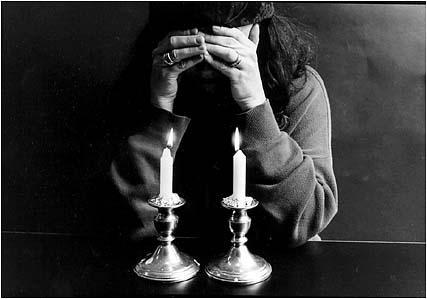
Sharing the power of light is lighting the Shabbos and holiday candles and encouraging Jewish girls and women to do so. Again, not something most non-Jewish believers tend to perform and we typically aren’t in a position to suggest to Jews that they do so.

The “Jewish security system” is the mezuzah. Because my wife is Jewish, we have a mezuzah attached to pretty much every doorway in our home (bathrooms are the exception). I’ve been told that when a Jew sells his or her home, they leave the mezuzot (plural of mezuzah) in place if another Jew is buying the home, and remove them if a non-Jew is the buyer (because it won’t be a Jewish home anymore).

prayerPraying for Israel is the first item on the list that’s freely accessible to any religious person, and we can certainly encourage others to pray for Israel and the Jewish people as well.

The Chabad article has various links to charitable organizations anyone can donate to for the benefit of Jewish victims of terrorism. You can also do your own research and determine for yourself where you want to give your tzedakah (the word translates commonly as “charity” but also means “justice”).

Nurturing your faith has to do with a Jewish person encouraging more religious observance and acts of faith with their own family and friends, specifically as it relates to a Jew’s connection to Israel.

While we non-Jews don’t have the same connection to the Holy Land, it would be inaccurate to say we don’t have a connection at all. Hashem established Israel for the Jewish people but He also commanded the Jewish people to be a light to the world. That light comes most strongly from Israel and from our Rav, Yeshua (Jesus).

Further, in His grace and mercy, Hashem has extended the promise of the resurrection, eternal life, and the Holy Spirit even to the Goyim, so how could we not be attached to Rav Yeshua, whose symbolic, sacrificial death and miraculous resurrection have opened the door to redemption for any who would repent and come to faith.

We can encourage our own family and friends to embrace their faith in our Rav by expressing clear support of Israel in any manner we have available to us. No congregation that pays homage to Yeshua, which includes any Christian church, should fail to support the nation of the Jews in any way.

torah up closeGetting a letter is unique. Special Torah scrolls are being written in Israel, and the Chabad article says that any Jewish person may purchase a letter being written in a scroll. The way the form is set up, asking for the Jewish name of the person for whom the letter is being purchased, as well as the Jewish mother’s name and so on, I don’t think a non-Jew would be permitted to do this.

On the other hand, we can certainly pass along this information to any Jewish people we know who we believe would be interested.

The article finishes up with the suggestion that we pass this along in social media or anyplace else that Jewish people might see it and act.

I’m writing all this not to make any non-Jew reading it feel discouraged by what they can’t do for Israel. After all, Chabad is in the business of drawing Jewish people to Jewish faith and observance, not Gentiles (though I suppose they’d have an opinion on what a Noahide could do).

I’m writing today to show that we do have options in supporting the Land and the Jewish people. As Ro suggested, we could visit Israel and show our financial (by purchasing goods and services during our visit), emotional, and spiritual support. If we are in a position to do so, we can find some way to support any Jewish people in our local communities who we may know, to greater levels of Jewish observance. We can certainly pray, donate to Israeli charities helping terror victims, and encourage other believers to support Israel as an act of our faith (the last being a great way to educate others at your church or congregation).

Non-Jewish disciples of Rav Yeshua call ourselves Christians, or sometimes believers, followers, or even “Messianic Gentiles.” We are who we are. We are not Jews and we are not Israel. But we can stand by Israel, even if we don’t know a single Jewish person, and do something to support a Land under attack, not just by human terrorism and world-wide public condemnation, but by ancient forces of spiritual evil.

I don’t often write about “supernatural forces” but let’s face it. Our physical world is an extension of a spiritual reality and of powers and events long foretold by the Biblical prophets. We know that bad things are coming for the Jewish people, for Israel, and ultimately for the whole world.

IsraelThis is as good a time as any to stand up and be counted on the side of good…the side of God.

Tag. You’re it. Pass this along.

This is just the short list. For more, read 54 Ways You Can Help Israel and find out which ones you can do…and then do them.

Addendum: Just saw this link on Facebook about helping victims of terrorism and thought I’d share.

The Torah viewpoint is that the Almighty constantly creates the entire world and everything in it for each individual. This concept has the potential to give a person immense pleasure. Think about it for a moment. The Almighty — Creator and Sustainer of the universe — is constantly creating for you the sun, the moon, and all the other worldly phenomena. He is constantly bestowing upon you life, and every single second He supplies you with your needs.

(see Rabbi Noson Tzvi Finkel; Tnuas Hamussar, vol.3, p.202; Gateway to Happiness, p.36)

-Rabbi Zelig Pliskin
Aish.com

"When you awake in the morning, learn something to inspire you and mediate upon it, then plunge forward full of light with which to illuminate the darkness." -Rabbi Tzvi Freeman