A Schlub Contemplating Intrinsic Greatness

A person is obligated to say:

“The world was created for me” (Talmud – Sanhedrin 37a), and
“When will my deeds reach the level of Abraham, Isaac, and Jacob?”

The Torah attitude is that we are obligated to be aware of our greatness. Feel proud that you are created in the image of the Almighty. Pride in the elevation of your soul is not only proper, but is actually an obligation to recognize your virtues and to live with this awareness.

(Toras Avraham, p.49; Gateway to Happiness, p.119)

-Rabbi Zelig Pliskin
“Recognize Your Greatness”
Aish.com

I sometimes wonder when reading quotes from Orthodox Jewish sources if the author meant for a Gentile to take any of that advice. After all, I can only assume that the primary audience of Aish.com are Jews. Did Rabbi Pliskin mean “greatness as a Jew” when he wrote “greatness as a human being?”

Then again, Rabbi Pliskin is a noted psychologist as well as a Rabbi, author, and lecturer, so perhaps he really does mean that all human beings have the capacity of being great because we were all created in the image of Hashem.

Along the same lines, Rabbi Pliskin also wrote:

Rabbi Shlomo of Karlin used to say:

“The worst fault a person can have is to forget his intrinsic greatness as a human being.”

(Dor Daiah, vol. 1, p.172; Rabbi Pliskin’s Gateway to Happiness, p.131)
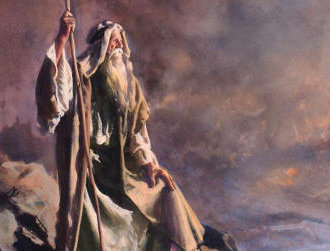
AbrahamI’m used to thinking that certain people are great and the rest of us are “Okay”. Abraham was great. Moses was great as well as exceeding humble (Numbers 12:3). Given the Biblical record as well as the long chronicle of human history, it’s difficult to imagine that the majority of the people across time possess “intrinsic greatness”. Frankly, it’s easier to imagine that most people have a talent for being an “intrinsic pain-in-the-neck”, myself included.

But then again, some people are more optimistic than others:

Be not afraid of life. Believe that life is worth living, and your belief will help create the fact.

–William James

Believe you can and you’re halfway there.

–Theodore Roosevelt

Of course, William James, Theodore Roosevelt, or even Rabbi Pliskin aren’t quoting directly from scripture, so perhaps they aren’t seeing human beings the way God sees us.

Or maybe I’m being cynical. I can see, at least in theory, that God most likely wants us all to live up to our highest potential, to be the very best people we can be, the people He created us to be. It’s just that none of us seem to live up to our very highest potential, at least most of the time.

Someone wrote to the Aish Ask the Rabbi column asking about certain Orthodox Rabbis who are caught committing illegal and immoral acts, such as bribing public officials. The Aish Rabbi responded in part:

First things first: The Torah is the guidebook for ethical perfection. All the values that the Western world takes for granted – education, equal rights, sanctity of life – are from the Torah. That is an inarguable fact of history.

Being orthodox does not guarantee that a person has succeeded in internalizing what he has been taught.

I would say that all Jews – religious and not – do not follow the Torah 100%. Everyone does the best he can, some making more of an effort than others. But no one is perfect.

But I would also say that almost without exception, an individual will be more kind, charitable and moral because he learns Torah and follows it.

The question is not: Why do some religious Jews behave badly? The better question – and this is what I ask myself whenever I see an Orthodox person doing something wrong – is: Would the same individual behave worse, or behave better, if he was not religious?
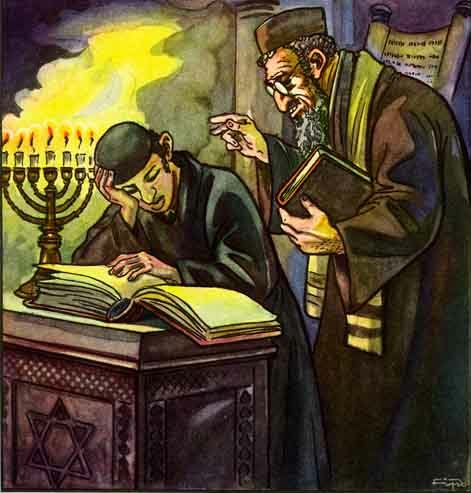
Talmud StudyThis feels a little bit like a “dodge” to me. It sounds like the Rabbi is saying that as bad as some religious Jewish people may be in terms of how they behave immorally and unethically, if they didn’t have their training in Torah, they would be so much worse.

Would they? I don’t know.

I do agree that, although we Gentile believers are not called upon Biblically to replicate a Jew’s observance of the mitzvot, we do have our own Torah for the nations which assigns all humanity with valuing the underlying principles, the very foundation of Torah.

We are all called upon to do good and, as the Aish Rabbi says (I’ll extrapolate his sentence beyond its context and apply it to all humanity), no one obeys the Torah principles and mitzvot as they/we are called to obey with anywhere near 100% fidelity.

The Aish Rabbi says that because one Orthodox Rabbi committed immoral acts does not mean that the Torah failed, just that one human being has failed. Rather than throwing the Torah and a religious life out the window because people don’t and can’t live up to God’s standards perfectly, we should strive to be better tomorrow than we are today. Obedience is a journey, not a mountain top where you sit sagely because you are always right.

On the other hand, the journey of obedience isn’t a pit or a cave where you are trapped forever because you are always wrong and can never succeed either.

Or so intimates the Aish Rabbi.

The Rabbi finishes his answer by saying:

I would also argue that if you are looking for a role model of righteousness, you are far more likely to find it in a great religious person than in the secular world. The act of purifying oneself through prayer, study, mitzvah performance, and devotion to helping others to reach the heights of Godliness.

True, the observant community does not exist in a hermetically-sealed bubble protected from all negative influences. But given a choice of one or the other, I think the choice is clear.

I suppose if we could receive an unfiltered and unedited view of the life of any person we might think of as a “role model of righteousness,” we’d be disappointed in them, at least in some sense. If no one is perfect, then all people have failed; they’ve failed other people, and they’ve failed God.

I once was at an event where a highly esteemed gentleman had just finished speaking to an audience, and many members of that audience heaped praises upon him. I was a little surprised at what I perceived as his lack of humility. I got the opportunity to speak to him about it, and he responded, “People need heroes.”

schlub
Chris Pratt as Andy Dwyer on the TV show “Parks and Recreation.” The guy’s a definite schlub.

I think I understand what he was saying, but it still bothers me a little. I know Moses had this one down pat, but how can you connect to your “intrinsic greatness” while also knowing what a schlub you are inside?

I don’t mean “you” or any other specific human being. I don’t have an unfiltered, unedited view into anyone else’s life except my own. That’s why this whole concept of “greatness” is difficult for me to understand.

I almost said that if I could talk to Moses for five minutes (assuming we had a common language), he could explain it to me, but our lives are absolutely incomparable. After all, who can live up to a man like Moses, who talked with God “face-to-face” as it were? Not me.

Even Moses had his faults, some of them as large as the life of greatness he led. But that being said, where does that leave the rest of us?
How Can Any Gentile Survive Without the Sabbath?

Speak to the Children of Israel and say to them: The appointed times of Hashem, that you are to designate as holy convocations; these are My appointed times.

Vayikra (Leviticus) 23:2

The Sabbath is a special, Divine gift, given to us so we elevate ourselves above the physicality of the days of the workweek. Indeed, the fact that it comes every week is part of its special nature: Who among us has not wondered how the non-Jews can survive without the Sabbath! We must strive to treat the Sabbath with the same delight and anticipation that we do any of the festivals. (emph. mine)

-from “A Mussar Thought for the Day,” p.140
Tuesday’s commentary for Parashas Emor
A Daily Dose of Torah

That is the $64,000 question, isn’t it. There certainly isn’t one, straightforward reply. The author of the above quoted mussar proposes the question but not the answer. Apparently, there is no Rabbinic response to God’s provision for the Goyim (or lack thereof) relative to Shabbat or any sort of occasion whereby a non-Jew can elevate him or herself and draw nearer to God. Perhaps it’s one of the many reasons why the ancient Gentile disciples of Messiah divorced themselves from the Jewish communities originally created by Paul and founded their (our) own Gentile-based religion called “Christianity”.

Actually, the “Mussar Thought for the Day” does have a response to Gentiles and the Sabbath:

A non-Jew is forbidden to observe the Sabbath; the Torah describes the Sabbath as: “…between Me and the Children of Israel it is a sign forever (Shemos 31:17).”

-ibid, p.141

The Church solved this problem by creating their own weekly Holy Day on Sunday, and until relatively recently in history, treated Sunday in a manner similar to how Jews observe a Saturday Sabbath.

However, the past 50 years or so has seen, particularly in the Western nations, a diluting of Sunday “Sabbath” observance whereby Christians go to church Sunday morning and then go out to lunch just prior to playing a few rounds of golf. The day is only special for the few hours they are in church, and even then, social encounters and conversations can largely be made up of secular material.

I’m not saying there aren’t a lot of Jewish people who only marginally observe a Shabbat or observe it not at all. My daughter goes to work on Saturday and my wife, while she does attend shul in the mornings and into the early afternoon, will resume her regular weekday behaviors upon returning home.

I’m not speaking ill of my spouse, of any other Jew, or for that matter, any Christian. It’s just that how we see the Sabbath and our relation to this day as well as to God is highly variable.

Derek Leman
Derek Leman

Is the answer to how a Gentile should, at least in an ideal sense, respond to the Jewish Shabbat to be found in Messianic Judaism? What makes you think that among the various “Messianic Judaisms” currently in existence, there is a unified response?

In his blog post Reading the Bible Realistically, or rather, in the blog post’s comments section, Derek made a few relevant statements when responding to one of his readers:

Your view that God is supremely upset about which day people choose to worship on is very un-Jewish. Shabbat is about rest and is not a prescribed day of worship. This is an error lying at the root of your entire theory. It is also an erroneous view of God, as if one of the great sins has to do with which day of the week people hold worship services on. I strongly encourage you to reexamine your views which come up short in terms of biblical interpretation and which sound a lot more like they are influenced by Ellen G. White than Torah and Gospel.

-from 05/05/2015 at 9:26 am

And…

non-Jews were never commanded to observe Shabbat (Exod 31:13, it is between Israel and God and Romans 10 agrees). And the majority of Christians keep no Sabbath (Sunday is not a Sabbath for most).

-from 05/05/2015 at 9:57 am

As well as…

I do not think any of the Ten Commandments were addressed to non-Jews.

05/05/2015 at 2:56 pm

So although Derek is the Rabbi of a Messianic Jewish congregation which presumably has a significant number of non-Jewish attendees, and also that he has spoken at many Christian churches and similar non-Jewish venues on topics related to Messianic Judaism and its relationship to believing Gentiles, he also seems to hold a point of view quite similar to the Orthodox Jewish authorities. He doesn’t say that Gentiles are forbidden to observe Shabbat, just that, as a Torah commandment, it doesn’t apply to us in the slightest.

Now let’s contrast that with the following:

It is not uncommon to hear people refer to the appointed times as the Jewish festivals. This is true in that God gave His appointed times to the people of Israel. He told the Israelites, “The LORD’s appointed times which you shall proclaim as holy convocations—My appointed times are these” (Leviticus 23:2). The Jewish people are the wardens of God’s calendar.

However, God does not refer to them as Jewish festivals. He refers to them as “my appointed times.” They are God’s holy days. Paul asks, “Is God the God of Jews only? Is He not the God of Gentiles also? Yes, of Gentiles also” (Romans 3:29). The Bible never offered Gentile Christians any alternative festival days. To say that Gentile believers are not expected to keep God’s appointed times is the same thing as saying that Gentile believers are not supposed to have any holy days or days of worship. Neither the Gospels nor the Epistles grant the Gentile believers their own special festivals.

In the days of the Apostles, both Jewish and Gentile believers observed God’s appointed times together. They met in the synagogues and in the Temple on the Sabbath and festival days to celebrate and observe God’s holy days. When Gentile Christianity left the cradle of Judaism, the Gentile Christians began to neglect the appointed times. The Sabbath day was replaced with Sunday observance. The timing of Passover was changed. The other festivals fell into disuse. Is this what God intended for believers?

-from “The LORD’s Appointed Times”
Commentary on Torah Portion Emor
First Fruits of Zion (FFOZ)

D. Thomas Lancaster
D. Thomas Lancaster

Since this is taken from the Torah Club subdomain of FFOZ, I have to assume it was written (though I could be wrong) by D. Thomas Lancaster, the spiritual leader at Beth Immanuel Sabbath Fellowship which touts itself as “Messianic Judaism for the Nations.” Mr. Lancaster is also the primary contributor to FFOZ’s Torah Club content.

I’ve written a fair amount on Gentiles (and particularly me) and their (our/my) relationship with Shabbat, such as in The Shabbat Project for the Gentiles, Messianic Jewish Shabbat Observance and the Gentile, My Shabbat that Wasn’t, and The Shabbat that Was.

The last three blog posts were not only part of my review of Aaron Eby’s book/siddur First Steps in Messianic Jewish Prayer (also an FFOZ publication) which was written by Eby specifically for a non-Jewish Messianic and Christian audience, but my chronicle outlining my own efforts to truly (or as truly as is possible for me) observe Shabbos using Eby’s book as a guide.

I can’t say I did a very good job of it, but part of that has to do with a lack of practice. One properly observes Shabbat by having many months or years (or a lifetime) of practice observing Shabbat, ideally in the company of people who know what they’re doing.

So we have the Orthodox Jewish perspective that Gentiles are actually forbidden from observing the Shabbat accompanied by astonishment in how we Gentiles manage to survive without it.

Then we have Rabbi Leman’s viewpoint that the Shabbat simply isn’t relevant to non-Jews, even those within the Messianic community, and further, that “Shabbat is about rest and is not a prescribed day of worship.”

We also have FFOZ’s opinion that God is not just a God of the Jews but of the nations as well, and that at least Gentiles are allowed to observe the Moadim, presumably including the Shabbat.

The previously quoted FFOZ blog post ends with:

It is true that the Apostles never commanded the Gentile believers to keep the appointed times, but neither did they tell them not to. They were silent on the matter. In those days, the idea of not keeping the appointed times simply had not occurred to anyone.

pathsPerhaps if there had been no schism between the Jews and Gentiles nearly twenty centuries ago, the issue would be moot. Halachah would have been developed regarding “Messianic Gentile” observance of Shabbat, the Appointed Festivals, and a great many other things we call “Jewish,” and then the halachah would have been refined over the centuries so that today’s expressions of Messianic Judaism would each have their own traditions and practices defined for Gentile members.

But such is not the case.

However, maybe the issue isn’t all that important, at least on a global scale. The churches have their answer to “The Lord’s Day,” and each Messianic community that includes Gentile members or attendees has their official policies regarding non-Jews and Sabbath.

Ultimately, lacking a clear Biblical directive, each of us has to negotiate his or her relationship with God, and each non-Jew has to decide how he or she (or if he or she) should address the puzzling issue of a Shabbat for the Nations.

I wrote quite recently that if it came down to a choice, it’s more important for Jews to observe Shabbos than for Gentiles. In the microcosm of my family, that’s how it works today (however imperfectly).

Of course there are those who want to have their cake and eat it too, but I’m not convinced you can solve knotty problems such as these by saying “the (Torah) rules are all the same for everyone, end of story,” and this narrative can appear a little unusual from time to time (I like comic books too, but this comparison caught me by surprise).

Even setting aside larger, normative Christianity’s opinion on the matter, authorities within Messianic Judaism let alone the wider realm of Jewish thought differ in how or if Shabbat applies to the Gentile, whether a disciple of the Master or not.

I decided to write this “meditation,” even though it may seem that I’m beating a well and truly dead horse, because of the simple statement I quoted at the top of this blog post:

Who among us has not wondered how the non-Jews can survive without the Sabbath!

So, given all of the benefits of Shabbat observance for the Jewish people, how do the rest of us survive?

Each Sabbath refreshes anew the special bond that Hashem has with His people, and affords every Jew the chance to turn away from the weekday world and bask in the radiance of the Shechinah. Thus, every Sabbath is a festival; but rather than commemorating a single event, it serves to strengthen and nurture the connection between the Jews and their Father in Heaven.

-from “A Mussar Thought for the Day,” p.141

Oh, as far as the Shabbat being primarily about rest rather than worship:

It is all too easy to fall into the trap of regarding the Sabbath simply as a day of rest, and to use it only as a chance to catch one’s breath before heading back into the grind of the following week. The folly of this approach, too, is highlighted by the location of the Sabbath among the festivals. Nobody makes the mistake of looking at Pesach or Succos as times of rest! These festivals are clearly identified as times to celebrate the closeness and special care that Hashem has demonstrated toward His people.

-ibid

shabbaton
Aaron Eby

So if we accept Derek’s assertion that Shabbat is not specifically a day of worship, we can also say that, at least in Orthodox Judaism, it’s not primarily just a rest day either. Like the Appointed Festivals, it’s a time of celebration, a day to rejoice in drawing nearer to God, at least for the Jewish people.

But among the varying and madding opinions of the relevant pundits, how do we non-Jews survive without a Sabbath or, like our First Century counterparts, the Gentile disciples Paul made in the diaspora, can we too somehow join Jewish community and simply enjoy the blessings of their Shabbat observance even if, as a matter of covenant, it is not also ours?

I know someone is going to bring up Isaiah 56 as “proof” that everyone everywhere is commanded to keep the Shabbat in the current age, but are we to behave like partisans, freedom fighters representing a (sort of) “King in Exile,” obeying the laws he will establish once he returns as if they are already in effect? Remember, in Messianic Days, King Messiah will not only rule over Israel, but the Gentile countries as well, as we will be vassal nations under the authority and protection of Israel’s Monarch. In those days, the will of the Master will be unequivocal.

Today however, Biblical hermeneutics being what it is, there is room for doubt and multiple conflicting learned opinions, and as I said above, that leaves it up to each of us, our conscience, and our relationship with God, to decide how to navigate the rather murky waters of Gentiles and Shabbat. How can we presume to observe it? How can we survive without it?

The Torah for the Nations of the World

Question:

Why is Judaism so intolerant of idolatry? I don’t mean massive temples with human sacrifices. What about a civilized idolater, in the privacy of his own home. With a job, a family, a mortgage, donates to the World Hunger Fund and Greenpeace — and instead of one G-d, he just happens to have two or three or even several dozen, all lined up on the dashboard of his car. Why does Judaism make a cardinal sin of it, demanding total eradication of idolatry in every corner the world? As long as it doesn’t hurt anyone else, what’s so terrible?

Answer:

There are many ways to answer this, but let’s take a historical perspective. Historians agree that our current standard of ethics stems from the Jewish ethic. Yes, the Greeks gave us the natural sciences, philosophy and art; the Romans gave us governmental structure and engineering; from the Persians we have poetry and astronomy; from the Chinese, paper, printing, gunpowder, acupuncture and more philosophy, and so on. But the historical fact is that all those cultures (and all the other unmentioned cultures) sustained and even glorified attitudes and behaviors that today we universally find abhorrent. Today, if you dispose of your unwanted infants, practice pederasty, set humans to kill each other for sport, ignore the rights of those lower than you on the social ladder and refuse to acknowledge any social responsibility to the poor and the unhealthy, and can’t wait to run to war against the nation next door, you are a barbarian. You may have made a wonderful citizen of Athens or Rome, but today, no club will take you.

Where did those values come from? There’s only one source historians can point to: Torah.

-Rabbi Tzvi Freeman
“What’s So Terrible About Idolatry?”
Commentary on Parshah Acharei-Kedoshim.
Chabad.org

Sorry to be such a “Chatty Cathy” and post two missives in one day, but when I read the paragraphs above, they seemed to spell out something a lot of non-Jewish believers operating in the Messianic Jewish and Hebrew Roots spaces have been puzzling over if not actively struggling with. Is there some sort of “universalism” to the Torah? That is, does the Torah apply to everyone and not just to the Jewish people?

The answer to that question is enormously complex, even though some people seem to believe the answer is an incredibly simple “yes.”

Toby Janicki
Toby Janicki

I’ve written on this topic at length including in my original review of Toby Janicki’s article The Gentile Believer’s Obligation to the Torah of Moses as well as my revisiting that material sometime later. I’ve also written of the Torah and Gentiles in my “in a nutshell” explanation of Torah and Christians and in Torah and the Gentile Believer. Hopefully, I’ve rendered a consistent message across those different blog posts that studying the Torah is appropriate for a non-Jewish believer for a wide variety of reasons, but stating that we share an identical obligation to observe the mitzvot with the Jewish people in a manner identical to theirs, and claiming that the Torah and being “grafted in” also makes Gentiles “Israel” is way over the top.

That’s not to say that we “Messianic Gentiles,” and arguably the mainstream Christian Church don’t have special obligations and duties. It’s just that the duty of Messianic Gentiles and Christians isn’t to observe the mitzvot but to encourage and support Jews to observe the mitzvot.

That said, I do think there is a universal aspect to the Torah, one that applies to every man, woman, and child who has lived throughout history and one that applies to all of us across the world today.

It’s spelled out in Rabbi Freeman’s answer to the question about idolatry.

We tend to think of application of Torah as an either/or sort of thing. Either it applies in exactly the same way to everyone, or it applies to no one at all. There’s no such thing in the minds of certain people as differentiation of application, or the idea that Torah is received by the Jews in one way and by the Gentiles in a different manner.

How the Torah applies to the world, even the world of people belonging to different religions or no religion at all, is in how it has shaped our world ethically and morally. American criminal and civil law, as well as many of our social mores, is based on the Torah.

This isn’t a religious application. Heck, you don’t even have to believe in God. You can be an atheist and still live in a world where the basic moral and ethical structure is based on the “blueprint” of the Torah.

Torah at SinaiRabbi Freeman in his somewhat lengthy answer says that while many peoples, nations, and civilizations have come and gone across the vast corridor of time, only the Jewish people have remained.

Why is that? For one thing, for the entire existence of the people of Israel, since Hashem gave the Torah at Sinai, the Jewish people have kept and preserved the Torah. If Israel had been wiped out by some ancient enemy and the Torah lost forever, upon what would the world have built its ethics and morals? As Freeman states, in ancient times (and maybe in modern ones), if you didn’t like the ethics of a particular “god,” you simply worshiped another one. After all, without the knowledge of a single, all-powerful, all-encompassing, creative God, morals and ethics are relative and impermanent.

The single greatest gift the Jewish people have given the world is the Torah. No, not the obligation to obey Torah on the level of the individual commandments in a way identical to the Jews, but as the broader basis of civilization. According to Freeman, what we think of as civilization wouldn’t exist without the Torah.

Today, we are witnessing the most dramatic results of Abraham’s strategy in action: Our progress in the last 500 years, to the point of the current empowerment of the consumer with technology and information, only became possible through the rise of this ethic. In a polytheistic world, this could never have occurred. It was only once the people of Europe began actually reading the Bible and discussing what it had to say to them, that the concepts of human rights, social responsibility, the value of life, and eventually the ideal of world peace took a front seat in civilization’s progress. And it is only such a world that could have developed public education and health care, old age pension, telephones, fax machines, personal computers, the Internet, environmental design and nuclear disarmament.

I’ve read other articles from Jewish sources stating that the Torah has applications for the whole world, but I never quite grasped what they meant. I guess it was because of the continuing debates we have on the web between Messianic Judaism(s) and various aspects of the Hebrew Roots movement regarding the question of how much of the mitzvot a Gentile should take upon himself or herself that blinded me to a wider perspective.

It’s about the people of the nations creating and then living in “a world that values life, world peace, individual rights, freedom of expression, literacy, knowledge and compassion for those who have less…” That’s the universal quality of the Torah. That’s the Torah for the nations.

The moral and ethical principles are identical for the Jews as they are for the rest of us. The only difference is that there are many additional instructions that only have to do with the Jewish people.

the crowdYou and I as non-Jews participate and “observe” the Torah every day, at least if we’re reasonably ethical, moral, and are law-abiding citizens. For those of us who are believers, this evidence of Torah in our lives becomes all the more apparent, but the larger reality is that untold millions of people everyday also live out the Torah just by committing acts of compassion, by sending their children to school, by obeying the highway speed laws, by upholding the rights of the disadvantaged, and in a thousand other ways.

The answer of how the Torah can be universal seems so elusive until you look at it from the perspective Rabbi Freeman brings in his online article. Once seen from that viewpoint however, everything becomes clear.

She Goes to Synagogue and He Does the Lawn Work

The Jewish people in the land of Egypt had sunk to the lowest possible level of impurity — so much so that it was nearly impossible to distinguish between Jew and gentile. And then, suddenly, Hashem pulled them out from beneath all their impurity, and they were free — ready for a new beginning and spiritual greatness.

One must remember that no matter how far he has sunk, and as hopeless as his situation may seem, he has still not descended to the level of his forefathers in Egypt. His spiritual predicament cannot be worse than theirs. He must remind himself of the Exodus and internalize its meaning. He can then look toward the time when Hashem, in His mercy and in His kindness, will simply lift him up, freeing him from his seemingly hopeless state, and allowing him to begin his spiritual ascent anew.

-from “A Closer Look at the Siddur,” p.43
Thursday’s Commentary on Parashas Acharei
A Daily Dose of Torah

I know I’ve said this before, but I really enjoy studying from the Jewish texts, at least those I’m capable of comprehending. In reading the studies contained in “A Daily Dose of Torah” I find myself again drawn toward Judaism as a method of study, a way of understanding God, and even as a lifestyle. In Judaism, there seems to be such a great richness of tradition and apprehension of faith, trust, and obedience that much of Evangelical Christianity lacks.

I live with a Jew. Actually, right now, I live with three of them, but only my wife is the least bit religious. Only she regularly worships at synagogue on Shabbat, and this is as it should be because, after all, she’s Jewish. It’s a commandment from Sinai given to Israel, and as a Jew, she is part of Israel.

I, on the other hand, have great difficulty being obedient even to those commandments I know unequivocally apply to all people of the nations as well as to the non-Jewish disciples of Yeshua. How could I ever hope to attain the level of obedience and devotion expected of a Jew?

No, it’s not that Jewish people are perfectly obedient and devoted, but any Gentile aspiring to any sort of Jewish “lifestyle” might want to take stock of how they’re doing as a Gentile first before having the chutzpah to believe he or she can voluntarily take on board the much greater responsibilities and duties God requires of the Jewish people.

A Jew is born into the covenant whether he or she wants to be or not. They’re not given a choice. Any Gentile considering conversion certainly is making a choice and, like deciding to get married, cannot possibly see the long-term results and consequences of such a monumental decision.

The same goes for Gentiles who remain Gentiles but, through one thought process or another, come to believe they can or should either voluntarily take on board some, most, or all of the Torah mitzvot, or who have decided for themselves that they are (somehow) equally obligated to the mitzvot in the manner of the Jews.

Helping the HomelessReally, are you doing so well at a lesser level of obligation and obedience that you need the additional challenge in your life? Has doing charity, feeding the hungry, comforting the grieving, abstaining from even the hint of lashon hara (evil speech, gossip, denigrating another human being through words) become so humdrum and boring that you require adopting the higher standards of Torah in order to keep your life from becoming mundane?

When I take stock of my life, day by day, I realize how limited I am and how even those requirements Hashem has placed upon the people of the nations sometimes seem far beyond my abilitites. Why do I think I’d do any better in davening three times a day with a minyan, donning tzitzit, laying tefillin, observing Shabbos, keeping glatt kosher, and many of the other mitzvot of Torah?

He explains that both Shabbos and Mikdash (the Sanctuary) represent a dimension of love between Hashem and His nation, the former in time and the latter in space. On Shabbos, Hashem, as it were, invites every Jew to spend the day in His House, to live in the holiness of Hashem’s embrace and bask in his radiance. The Mikdash, too, represents this loving relationship, as symbolized by the two Cherubim that faced each other in the Sanctuary’s innermost chamber, the kodesh hakodashim.

-from “A Mussar Thought for the Day,” p.99
Thursday’s Commentary on Parashas Kedoshim
A Daily Dose of Torah

I have to recognize that, while God loves the whole world and while the Gentile disciples of Messiah are also loved and cherished by Hashem, it is Israel who receives a special love and relationship with the Almighty, and without Israel’s “chosenness,” we Gentiles would have no hope at all. Thus, God has given His people Israel, the Jewish people, special gifts as well as special obligations, in this case, Shabbat and the Holy Temple.

It’s not that we Gentile believers won’t have a role or a place in either in future Messianic Days, it’s just that we shouldn’t forget where they came from or to whom they were given.

This date marks the death of Judah P. Benjamin (1811-1884), an American-Jewish statesman. Benjamin was the second Jew to serve in the U.S. Senate, representing Louisiana. When another senator accused him of being an “Israelite in Egyptian clothing,” Benjamin, who had married into a prominent Roman Catholic family, replied: “It is true that I am a Jew, and when my ancestors were receiving their Ten Commandments from the immediate Deity, amidst the thundering and lightnings of Mount Sinai, the ancestors of my opponent were herding swine in the forests of Great Britain.”

-from “This Day in Jewish History,” Iyar 11
Aish.com

Judah Benjamin’s reply to his fellow senator is as relevant today as when he first spoke those words.

I suppose in some sense, this is why my wife goes to shul on Shabbos and I stay home, mow the yard, and try to fix the broken sprinkler system so that I can water our lawn. It’s not that I’m necessarily forbidden from worshiping with my wife. After all, there are plenty of intermarried couples, both at the Chabad, and at our local Conservative/Reform synagogue. It’s just that it’s more important for her to observe the mitzvot associated with Shabbos than it is for me, because she is a Jew and I’m not.

ShabbatEven if I somehow believed that the Shabbat is also incumbent upon me as a Gentile, the Jewish people kept and preserved the Shabbat for thousands of years, while the ancestors of every non-Jew alive today were worshiping pagan gods, consorting with heathen temple prostitutes, and in some cases, feeding their children to sacrificial fires in obscene fertility rites.

We have no worthiness or honor of our own not did our forefathers. It is only through God’s abundant mercy and kindness that He provided any way at all for the Gentile to even approach His Throne in the most humble and penitent manner.

Let us strive to improve ourselves and to become obedient to those few things God requires of the Gentile disciples. If we can master our yetzer hara and if there are more requirements and more gifts Hashem wishes to assign to us, we will receive them from the hand of Messiah in all due time.

Dimming the Divine Light

Our teacher the Baal Shem Tov said: Every single thing one sees or hears is an instruction for his conduct in the service of G-d. This is the idea of avoda, service, to comprehend and discern in all things a way in which to serve G-d.

-Compiled by the Lubavitcher Rebbe;
Translation by Yitschak Meir Kagan
Chabad.org

If only we could keep this in mind throughout our days and nights, in the midst of our conversations, and particularly when we “talk” to each other on the Web. But it seems that each disagreement, each challenge, is an excuse to forget about how all experiences are instructions for how to serve God, even as we believe we are serving God.

I suppose I could cite the Baltimore riots since it’s all over the news and social media just now, but a sense of powerlessness, fear, rage, and violence is what has fueled this latest conflagration.

And that has little or nothing to do with us as a community and how we are to serve God.

I know that we people of faith are also just people and we often use that as an excuse for our own outbursts (though thankfully, they’re not on the same order or scale as the aforementioned-rioting). Still, when we argue and particularly, when we go out of our way to tear down a fellow disciple, then we have borne witness to how far the ekklesia of Messiah has fallen in an already fallen world.

I don’t hold myself as some sterling example. I have failed God and my comrades in the Messiah’s “body” in many ways. I simply am astonished that, on the one hand, we have such wonderful words and sentiments to use as examples, such as the quote I begin this blog post with, and on the other hand, who we are and how we actually behave as flesh and blood people attempting, however poorly, to live the life we were born to live.

Show a mighty emperor the world and ask him where he most desires to conquer. He will spin the globe to the furthest peninsula of the most far-flung land, stab his finger upon it and declare, “This! When I have this, then I shall have greatness!”

So too, the Infinite Light. In those places most finite, where the light of day barely trickles in, there is found His greatest glory.

-Rabbi Tzvi Freeman
“Conquest”
Chabad.org

As little pieces of the Divine Light, we are to conquer the world by shining our light into every corner of it, replacing darkness with illumination.

But how are we supposed to do that when we can’t even conquer the yetzer hara within ourselves?

The Consequences of Being Chosen: The Laws of Tumah

Speak to the Children of Israel and say to them: Any man who will have a discharge from his flesh, his discharge is contaminated.

Vayikra (Leviticus) 15:2

It is learned from this verse that only the Children of Israel are subject to the laws of tumah; people of other nations do not become tamei with the onset of any of the symptoms described in these laws. The severity with which the Jewish people are treated with regard to tumah is reflected in the term “speak to,” a term that implies a severe or stringent communication (see Rashi to Shemos 6:2).

A Torah Thought for the Day, p.215
Thursday’s commentary on Parashas Metzora
A Daily Dose of Torah

heal meAccording to this commentary, only the Jewish people are susceptible to what one person has called “spiritual skin disease,” not the people of the nations. We don’t have this disorder with us today to test that belief even though we know that these conditions did exist in the time of Jesus (Yeshua):

While He was on the way to Jerusalem, He was passing between Samaria and Galilee. As He entered a village, ten leprous men who stood at a distance met Him; and they raised their voices, saying, “Jesus, Master, have mercy on us!” When He saw them, He said to them, “Go and show yourselves to the priests.” And as they were going, they were cleansed. Now one of them, when he saw that he had been healed, turned back, glorifying God with a loud voice, and he fell on his face at His feet, giving thanks to Him. And he was a Samaritan. Then Jesus answered and said, “Were there not ten cleansed? But the nine—where are they? Was no one found who returned to give glory to God, except this foreigner?” And He said to him, “Stand up and go; your faith has made you well.”

Luke 17:11-19 (NASB)

Well, wait a minute. A Samaritan was among those men of Israel who were healed of tzara’at? How can this be if the commentary above states only the Children of Israel suffer from this affliction?

And this isn’t the only incident:

Now Naaman, captain of the army of the king of Aram, was a great man with his master, and highly respected, because by him the Lord had given victory to Aram. The man was also a valiant warrior, but he was a leper. Now the Arameans had gone out in bands and had taken captive a little girl from the land of Israel; and she waited on Naaman’s wife. She said to her mistress, “I wish that my master were with the prophet who is in Samaria! Then he would cure him of his leprosy.”

It happened when Elisha the man of God heard that the king of Israel had torn his clothes, that he sent word to the king, saying, “Why have you torn your clothes? Now let him come to me, and he shall know that there is a prophet in Israel.” So Naaman came with his horses and his chariots and stood at the doorway of the house of Elisha. Elisha sent a messenger to him, saying, “Go and wash in the Jordan seven times, and your flesh will be restored to you and you will be clean.” But Naaman was furious and went away and said, “Behold, I thought, ‘He will surely come out to me and stand and call on the name of the Lord his God, and wave his hand over the place and cure the leper.’ Are not Abanah and Pharpar, the rivers of Damascus, better than all the waters of Israel? Could I not wash in them and be clean?” So he turned and went away in a rage. Then his servants came near and spoke to him and said, “My father, had the prophet told you to do some great thing, would you not have done it? How much more then, when he says to you, ‘Wash, and be clean’?” So he went down and dipped himself seven times in the Jordan, according to the word of the man of God; and his flesh was restored like the flesh of a little child and he was clean.

2 Kings 5:1-4, 8-14

the leperA non-Jew, Captain of a foreign army, and a pagan was afflicted with this disease and cured by the Prophet Elisha. How can this be? Especially given the following from the same “Torah Thought for the Day:”

However the verse immediately adds [Hebrew phrase]. The root of [Hebrew word] can carry the connotation of “distinguished.” Klal Yisrael is thus told that their being subject to more tumah than others is a sign, not that they are on a lower level, but that they are being held to a higher standard. For when there is no tumah, there can be no exalted level of purity either.

As I mentioned, this condition doesn’t exist among the Jews or anyone else in the modern era, probably because the proscribed cure involved submitting one’s self to the Levitical priests, which as an organized body, are not currently present.

I can see the line of reasoning regarding only Israel being vulnerable to becoming tamei due to their special chosen status and, being given the Torah, having a much higher obligation to Hashem than the people of the nations.

But in Messianic times, upon the Temple being rebuilt and the priesthood being restored, will the laws of tumah also be re-established?

This might be the only way to test whether or not Gentile believers, disciples of the Master, Rav Yeshua, will endure such a visible indicator of their/our sins.

Of course, in the resurrection and under the New Covenant, people will possess an unparalleled apprehension of the Holy Spirit and it will become natural for them to not sin, so perhaps the whole point is moot.

The curing of Naaman by Elisha led the foreign Captain to the worship of the One true God of Israel, so his becoming tamei was ultimately for his benefit.

The Samarian who was unclean was also healed for the glory of the Almighty.

I can believe that the Jewish people are expected to exhibit a higher level of spirituality, and the consequences of failing that results in a greater level of discipline from their God than for the rest of us. However, when a Gentile comes to faith in God through the faithfulness of the Jewish Messiah, we are grafted into the blessings of the New Covenant (indwelling of the Spirit, promise of the resurrection), so who is to say that more isn’t expected of us as well, not necessarily in the manner of the Jews, but more nonetheless?

whisperIf Hashem were to reinstate this class of afflictions tomorrow, would Gentile believers be as vulnerable to them as the Jewish people and for the same reasons? Perhaps we are fortunate in never knowing for sure.

Sorry it’s taking so long to submit my next review from the Nanos and Zetterholm volume Paul within Judaism: Restoring the First-Century Context to the Apostle. I’m currently in the middle of an essay written by Mark Nanos and it’s rather verbose. Hopefully, I’ll have the article read and a review written by early next week.

"When you awake in the morning, learn something to inspire you and mediate upon it, then plunge forward full of light with which to illuminate the darkness." -Rabbi Tzvi Freeman