Tag Archives: Bible

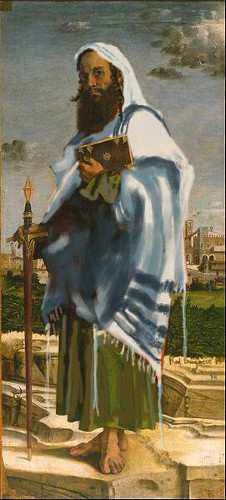
Should We Get Rid of Paul?

From Miletus he sent a message to Ephesus, asking the elders of the church to meet him. When they came to him, he said to them:

“You yourselves know how I lived among you the entire time from the first day that I set foot in Asia, serving the Lord with all humility and with tears, enduring the trials that came to me through the plots of the Jews. I did not shrink from doing anything helpful, proclaiming the message to you and teaching you publicly and from house to house, as I testified to both Jews and Greeks about repentance toward God and faith toward our Lord Jesus. And now, as a captive to the Spirit, I am on my way to Jerusalem, not knowing what will happen to me there, except that the Holy Spirit testifies to me in every city that imprisonment and persecutions are waiting for me. But I do not count my life of any value to myself, if only I may finish my course and the ministry that I received from the Lord Jesus, to testify to the good news of God’s grace.

Acts 20:17-24 (NRSV)

Pastor Randy’s sermon today (it’s Sunday afternoon as I write this) had some very nice things to say about Paul. This isn’t surprising, since we’ve been studying Paul’s life and activities as an Apostle to the Gentiles and as a role model for Christians, and especially for missionaries, in the Church today.

But Paul has been on my mind lately. This is sort of a “part 2” to my previous blog post Questioning Paul. While Paul’s teachings as we have them in Luke’s Book of Acts and in many of the Epistles are well accepted by the Church, since after all, these sources are part of our Biblical canon, not everyone sees Paul as a beneficial influence. In fact, he’s a big problem to almost everyone else outside of the normative Church who cares about his impact on Christianity, Judaism, and the world beyond.

As you recall from prior blog posts, I’d been having an email conversation with a Jewish friend of mine about Paul and how my friend believes the Epistles show Paul to be an arrogant, anti-Law Apostle, possibly a convert to Judaism, and certainly a traitor to the Jewish people, to the Torah, and to the Temple.

I posted this link to my review of the second lecture in D. T. Lancaster’s five-part series What About The New Covenant into a closed group on Google+. I got another perspective on Paul from a person who replied with the following comments (edited for context):

OK, please post supporting OT scripture or where Yeshua said this was so, not Paul’s rabbinical commentary of OT scripture. Let’s stick to the source.

I look at the writings of Paul as for (sic) what they are, they ARE commentary on what is already written. If they add to or remove from what is written in the Tanach, then they are false. They HAVE to agree, plain and simple.

In other words, Paul’s letters (and probably the Book of Acts as well as epistles written by other apostles) are mere commentary and not on the same level as the Torah, Prophets, Writings (Tanakh or Old Testament), and Gospels. We are free to disregard Paul whenever we perceive that Paul is in contradiction with the Tanakh or the teachings of Jesus in the four Gospel accounts.

So let’s review the three positions we have on Paul so far:

  • Christians accept Luke’s Book of Acts and the Epistles of Paul as Biblical canon and writings inspired by the Holy Spirit, just like the other books in the Bible.
  • Generally, Jewish people do not accept any of the writings in the part of the Christian Bible from Matthew through Revelation, and my friend suggests that I consider the Epistles more “authentic” because they are Paul’s own words and reveal him to be anti-Judaism, anti-Jewish people, and anti-Torah, thus in conflict with the Tanakh.
  • At least one representative of the Hebrew Roots “One Law” movement, accepts Paul’s letters as an authentic part of the Bible, but only at the level of Torah commentary, much like how Christians consider portions of Talmud, thus whenever Paul seems to contradict the Torah, Prophets, and Writings, the Tanakh must be right and Paul must be wrong.
hebrews_letterI haven’t spoken of this on my blog, though I have in more private conversations, but I remember, I think it was back in 2005, when a fellow named Monte Judah, who is the head of an organization called Lion and Lamb Ministries, publicly came out and said that the Book of Hebrews should not be part of Biblical canon. His article is rather lengthy, so I won’t attempt to analyze it or quote from it here, but the problem he produced then in the Hebrew Roots and Messianic Jewish worlds is the problem I seem to be experiencing: can we “adjust” Biblical canon to eliminate or minimize portions of scripture we find are a “problem?”

Of course, from my Jewish friend’s perspective (as a non-believer), there’s no issue since nothing in the New Testament is considered the Bible, thus Paul should be a “non-event.” Paul, or at least how he’s been traditionally interpreted, is only an issue to the degree that his writings have been used by the Church for nearly two-thousand years, to at best marginalize the Jewish people, and at worst to exterminate them.

This isn’t the Paul that I know, who would take any risk and suffer anything for the sake of his Jewish brothers and sisters:

I am speaking the truth in Christ—I am not lying; my conscience confirms it by the Holy Spirit—I have great sorrow and unceasing anguish in my heart. For I could wish that I myself were accursed and cut off from Christ for the sake of my own people, my kindred according to the flesh. They are Israelites, and to them belong the adoption, the glory, the covenants, the giving of the law, the worship, and the promises; to them belong the patriarchs, and from them, according to the flesh, comes the Messiah, who is over all, God blessed forever. Amen.

Romans 9:1-5 (NRSV)

But even here, the letter picking up at verse 6 seems to see Paul damning those he just praised. Paul appears to be a maddening contradiction, at once praising the Jewish people and denigrating them; at once saying how lovely the Torah is and also how it is the way of death. They can’t both be right. Either Paul was hopelessly double-minded or we’re missing something.

Mauck
John Mauck

Men like John Mauck, Mark Nanos, and Scot McKnight have been trying to interpret Paul in a way that actually makes sense and doesn’t violate God’s intent toward the Jewish people or break God’s prior covenants with them as we see in the Tanakh, but it’s an uphill battle. Both Christianity and Judaism see Paul in fundamentally the same way, a man who walked away from Judaism and, based on the teachings of Jesus, created a brand-new faith for non-Jewish people that Jews could only join by abandoning their Jewish birthright.

For at least a few in the Hebrew Roots movement, the answer to Paul is to downgrade him from scripture writer to Bible commentator whereby he “merely” is interpreting older scripture without adding to canon as such. Again, I can only assume that the other epistles and Luke’s Acts are also relegated to the status of commentary (which doesn’t make them scripture at all) and only the Gospels (and John’s Revelation?) are the real, authentic Word of God we find post-Tanakh.

Paul is a lightning rod of controversy because of the apparent contradictions in his writings and the “weirdness” of having letters included as part of our Bible. On the other hand, Revelation 2 and 3 record Messiah’s personal correspondence to seven diaspora churches, so Jesus himself creates a wrinkle in the fabric of what we consider scriptural writings.

How are we to evaluate canon? Who is qualified, competent, and has the authority (which presumably would have to come from God) to change the Bible we have today? Who has the right to subtract entire books from the Bible or even a paragraph, a sentence, a word, or a letter?

Certainly not me.

You must neither add anything to what I command you nor take away anything from it, but keep the commandments of the Lord your God with which I am charging you.

Deuteronomy 4:2 (NRSV)

But even if we or an angel from heaven should proclaim to you a gospel contrary to what we proclaimed to you, let that one be accursed! As we have said before, so now I repeat, if anyone proclaims to you a gospel contrary to what you received, let that one be accursed!

Galatians 1:8-9 (NRSV)

I warn everyone who hears the words of the prophecy of this book: if anyone adds to them, God will add to that person the plagues described in this book; if anyone takes away from the words of the book of this prophecy, God will take away that person’s share in the tree of life and in the holy city, which are described in this book.

Revelation 22:18-19 (NRSV)

Admittedly, I’m taking these verses out of context and I can’t say that they present a blanket statement that covers the entire Bible from Genesis through Revelation (though they do seem to cover the Torah, the Gospel as presented in the context of Paul’s Galatians letter, and Revelation), but they do indicate that it is a dangerous thing to play fast and loose with the contents of the Bible. I mean, we already play around a lot with the context of the Bible, with how we choose to interpret it, with how we decide what it means, but once we think we’re all big and bad enough to decide as individuals or groups, that we can put this part in the Bible and take another part out, we might as well resolve to meet our demise in the manner of Nadab and Abihu.

nadab-abihu-fireOne does not treat a consuming fire lightly.

My answer is that we have no sound basis for changing the contents of the Bible, which for better or worse, has been part of our religious canon for almost twenty centuries as far as the Apostolic Writings go, and the rest of the Bible, a good deal longer.

The Bible is what it is. We either learn to live with it and try to learn from it, or we admit defeat by either blindly trusting what leaders and experts tell us it means, or give up our faith altogether, or as much of it as is based on the Bible. If we love the Tanakh but don’t trust the Apostolic Writings, we Gentiles, by definition, must abandon Jesus and convert to Judaism (or alternately become Noahides). This could include even those who feel comfortable readjusting the level of Paul’s importance and authority as a Bible author, for once you start questioning Paul, how much “Christianity” do you have left?

As a disciple of my Master, the only reasonable choice I have is to believe that all of the Bible, from Genesis to Revelation, tells a single story about God and Israel and what that story means about the people of the nations. I have to believe, even though there seems to be different messages from and about Paul in Acts and in the Epistles, that there is an internally consistent Paul who believed one thing, was on a single mission, and who was always faithful to God, the Master, the Torah, the Temple, and the Jewish people.

Three days later he called together the local leaders of the Jews. When they had assembled, he said to them, “Brothers, though I had done nothing against our people or the customs of our ancestors, yet I was arrested in Jerusalem and handed over to the Romans. When they had examined me, the Romans wanted to release me, because there was no reason for the death penalty in my case. But when the Jews objected, I was compelled to appeal to the emperor—even though I had no charge to bring against my nation. For this reason therefore I have asked to see you and speak with you, since it is for the sake of the hope of Israel that I am bound with this chain.”

Acts 28:17-20 (NRSV)

This is only one time when Paul defends himself against the false charges of teaching Jews against following the Torah of Moses (see Acts 21:21-24, 24:10-21, 25:10, and 26:22-23 for other portions of Paul’s testimony). If Paul is telling the truth, and I believe he must be (for why would he suffer such terrible persecution including beatings, stonings, and other hardships just to lie in order to get out of punishment now) then we must be reading wrong those portions of his letters that seem to indicate that Paul had a low (or no) view of the Torah.

I know I’m probably pinning a lot of my hopes for understanding the Apostle to the Gentiles on the scholars of the New Perspective on Paul, but I really don’t think there’s another reasonable option. Given everything I’ve said up to this point, the only answer to this conundrum is that our interpretation of Paul, the Church’s traditional, historical interpretation of Paul, is faulty, due either to an early second and third century misunderstanding, or to a deliberate “massaging” of the text in an attempt to make Paul fit an anti-Jewish paradigm.

Tinkering with Biblical canon in any way isn’t an option and frankly, I think you’d have to be pretty “nervy” to even suggest it. The Bible is what it is. Now, the challenge is to discover the identity of the real, consistent, sane, Pharisee and observant Jew who we call the Apostle Paul.

Hurtado, Wright, and the Significance of Israel

In this posting I query another of Tom Wright’s major emphases in his mammoth new work, Paul and the Faithfulness of God. This concerns his emphatic view that in Paul’s view ”Israel” becomes effectively the church, or more specifically becomes simply all those who put faith in Jesus.

-Larry Hurtado
“‘Israel’ and the People of God: Wright & Response”
from Larry Hurtado’s Blog

For those of you who don’t know, Larry Hurtado is a scholar of the New Testament and Christian origins with quite a number of published works to his name. I follow his blog because I find his research and insights into the early church to be interesting and informative.

How Hurtado started commenting on Wright’s latest book is as follows:

Late in 2013 I was asked by the journal, “Theology,” to review N.T. (Tom) Wright’s then-forthcoming book on Paul. As I am committed to preparing an essay on Paul for a conference in Rome in June this year, I agreed. A few days later a huge parcel arrived for me, and upon opening it I found that I had agreed to read/review a work of two volumes comprising over 1600 pages! I’ve sent off the review now, and it’s been accepted for publication in due course. But, even with the special generosity of the editors, I had to confine the review to 1800 words, which required brevity and a selection of things to mention. I have more to say about the work, however, and so in this and subsequent postings will give some further observations and thoughts beyond what I was able to include in the “Theology” review.

Hurtado has written a small series of blog posts thus far, reviewing different aspects of Wright’s tome (and at 1600 pages, it can correctly be referred to as a tome).

This morning, Derek Leman wrote a brief blog post regarding “Hurtado’s critique of Wright’s low view of the Jewish people,” but I felt there were a few more things that could be said.

The first is that N.T. Wright is a well-known and read scholar and author, and I find his perpetuating Christian supersessionism (also known as “replacement theology” or “fulfillment theology”) by replacing Israel with “the Church” to be at least disturbing if not completely offensive. Not that Wright is trying to be offensive. He’s being honest within the context of his understanding and convictions. I just happen to believe he’s wrong and I’m gratified that a scholar of Hurtado’s stature is willing to challenge Wright’s low view of Judaism on his blog.

But Hurtado said something else in last Sunday’s blog post:

But (as I see it) Paul did continue to see the family of Abraham, the full company of the redeemed, as comprised of believing Jews (such as himself) who remained Jews, and gentiles who remained gentiles. To be sure, their respective identities were to have no negative impact upon accepting one another, for they were all “one in Christ Jesus” (Gal. 3:28). But along with that oneness there remained (for Paul) the significance of “Israel” as fellow Jews, who were (as he saw it) heirs of divine promises (Rom 9:4-5). Although at present, most of his fellow Jews were “enemies” (so far as concerns the gospel), they were, nevertheless, “beloved” by God, whose gifts and calling were irrevocable (11:28-29).

I hope you read that quote carefully. In the realm of Messianic Judaism in its various expressions, it is generally affirmed that Jews and Gentiles in Messiah are united and yet remain distinct identities, each possessing unique (though somewhat overlapping) responsibilities to God. Jews in Messiah are still Jews and Gentiles in Messiah are still Gentiles, though all are “one” in God’s love, in the promises of salvation, and participation in the Messianic Kingdom.

Larry Hurtado
Larry Hurtado

Larry Hurtado is a Christian scholar of early Christianity, not a “Messianic”. And yet we see him stating something that is quite familiar to those of us who are affiliated with or otherwise “friends” of the Messianic Jewish movement. And this isn’t the first time. I’ve mentioned before, primarily in Larry Hurtado on ‘A Muslim Reads Galatians’ and Jewish Identity in the Way, that Hurtado is associated with supporting the continuation of Jewish identity and Torah observance among the early Jewish disciples of Jesus.

Today, the typical “Christian on the street” (so to speak) takes it completely for granted that when Jews came to Christ, they stopped being Jewish (or at least stopped behaving “Jewish”) and converted to Christianity. I don’t doubt that the vast majority of Evangelicals truly believe Paul preached a “Law-free” gospel of Christ and that the Jewish believers were no longer “under the Law.”

But the Christian on the street, that is, the average man or women in a church pew on Sunday morning, most likely doesn’t keep up with current Christian scholarship, nor are they aware that there are bodies of Christian scholars who disagree with each other and strongly debate key principles of Christian theology and doctrine. It is more comforting for traditional church goers to believe that everything is settled and has been for many centuries. Christianity is what it is. All the questions have long since been answered. There are no mysteries. Sunday school is merely to discuss what everybody already knows (except perhaps the “baby Christian” who has just come to faith). Even seasoned Pastors tend to believe that, though their knowledge base is usually much broader than that possessed by their flocks.

The implication of Hurtado’s statements upon Messianic Judaism is interesting and encouraging. In Messianic Judaism and the somewhat related movement of Hebrew Roots, we talk to ourselves all of the time about the Torah not being “dead” or “nailed to the cross” with Jesus. We talk (and sometimes argue) about Jewish distinctiveness and uniqueness of obligation within the wider Messianic body.

But having a conversation with yourself isn’t very illuminating and that dialogue most often stays within our particular silos, rarely escaping into normative Christianity (or Judaism), at least in a form that can be heard or accepted by those groups.

So when a Christian and not Messianic scholar and author such as Hurtado can independently study the Bible and arrive at a conclusion which states “Jews who remained Jews, and gentiles who remained gentiles” and yet “they were all ‘one in Christ Jesus'”, it is remarkable. The significance of Israel as Israel remained in the Apostolic Era, and even unbelieving Jews were considered beloved by God and possessing gifts and a calling that are irrevocable.

One Caveat to consider is that Hurtado is defining Paul’s perspective not necessarily his own. But if this is indeed how Paul saw things (and I think it likely), then Paul, the author of much of what we think of as early Christian theology and doctrine, was setting the pattern for how we Christian (Gentile) believers should understand ourselves in relation to the Jewish people and Israel.

It’s pretty hard to ignore Paul and still call yourself a Christian.

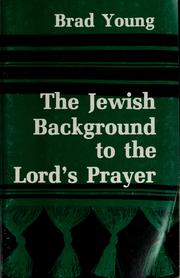
Book Review: The Jewish Background to the Lord’s Prayer

brad-young-bookThe main problem is one of approach. Too often, the importance of the Jewish background of the prayer and of the language that Jesus used has been overlooked or minimized. Jesus was a Jew, speaking Hebrew to his Jewish followers during the difficult days of the Roman occupation of Israel in the Second Temple Period. A modern Christian has a quite different understanding of prayer, Scripture, and faith than a Jewish teacher like Jesus, not to mention the great differences in language, culture, and history. One can easily miss the great depth of Jesus’ message, even while believing in him. Here we will try to rediscover something of the original Jewish atmosphere in which Jesus taught his followers how to approach God in prayer.

-Brad Young
from “Introduction: The Disciples’ Prayer,” pg 1
The Jewish Background to the Lord’s Prayer

I’ll start by profusely thanking Toby Janicki for graciously lending me his personal copy of Young’s book. Apparently it is out of print, and even used copies on Amazon are kind of pricey, especially for a forty-six page text.

As Young states, we Christians in the Church tend to almost take the Lord’s Prayer, or rather “the Disciples’ Prayer” for granted. It’s one of those things we read in the New Testament that we think we all understand correctly and completely. After all, the prayer itself is quite short. What’s there to misunderstand, right?

The answer to that question is “plenty,” and for the reasons I quoted above.

To start off, I won’t quote the Disciples Prayer here. It should be pretty familiar to most Christians, even those who don’t spend a lot of time in the Bible. For reference, there are two, parallel versions of this prayer in the Bible and they aren’t identical. You can find them in Matthew 6:9-13 and Luke 11:2-4. The differences, I suspect, have to do with the different audiences of each Gospel, with Matthew written to the Jews and Luke written to the Greeks.

Our Father Who Art In Heaven

Young suspects (pg 3) that Luke removed the “Jewish elements” of the prayer, since his version does not contain the words we read in English, “who art in heaven”. This was a familiar prayer formula in first century Judaism but would have seemed foreign to Greek readers. Picturing a “Father in Heaven” might have summoned images in Greek minds of some “god” such as Zeus sitting on an Olympian throne (pg 4). Luke may have felt it prudent to avoid such false associations by editing Jesus’ words (a Gospel writer editing the words of the Master to fit a specific audience is somewhat startling, don’t you think?).

But for a Jewish audience, the “Father in Heaven” reminded them of the love and care Hashem had and has for the Jewish people, and they would have recalled many references from scripture of the kindness of God toward Israel:

Whoever is wise let him note these things, and they will comprehend the kindnesses of Hashem.

Psalm 107:43 (Stone Edition Tanakh)

Jesus taught his disciples that God is not just a generic Father in Heaven, but He is “your” Father and “our” Father. The relationship between God and Israel isn’t just corporate, it’s personal. As Gentile disciples of the Master, we are grafted into that relationship with God, and thus we can call God “our” Father and “my” Father in Heaven.

Hallowed Be Thy Name

PrayingYoung says (pg 7) that the word we read as “Hallowed,” at least in the King James Translation, is more accurately rendered “sanctified”. He “retrotranslated” the Greek into the Hebrew word “yitkadesh” which means “be sanctified” so the phrase should read like “may Your Name be sanctified”. He also compares this to the Hebrew word “v’hitkadishti” found in Ezekiel 38:23

I will be exalted and I will be sanctified… (emph. mine)

Ezekiel 38:23 (Stone Edition Tanakh)

But as Young asks (pg 8), two-thousand years ago, what did “sanctify” mean to the Master’s Jewish disciples? Young makes comparisons to Leviticus 22:32 and Ezekiel 36:23 but he also said this:

The name of the Lord can be either sanctified or profaned by the conduct of people. In fact, because a martyr would frequently cause others to glorify God as a result of his sacrifice, the Hebrew idiom, “to sanctify the Name,” was often understood as referring to someone who would give his life for his faith.

-Young, pg 8

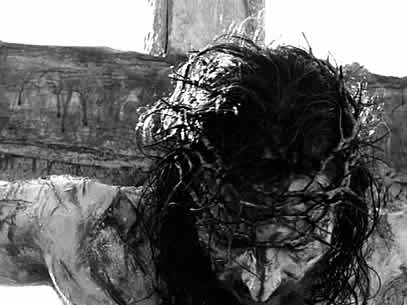
Adds some dimension to the crucifixion of Christ, doesn’t it? Perhaps as his disciples watched Jesus slowly dying on the cross, they remembered these words and what they truly meant to the Master. Perhaps they finally understood one day, that to pray this prayer was to ask that they be considered worthy to also die for the sake of Heaven.

But it’s not just how you die, but how you live, for “one sanctifies God by living a holy life.” Recall Matthew 5:16 (DHE Gospels):

So also, shine your light before sons of men, so that they may see your good deeds and praise your Father who is in heaven.

Thy Kingdom Come

Young spends a significant portion of this small book discussing the meaning of the Kingdom, and it’s somewhat reminiscent of an episode of the First Fruits of Zion television series called Thy Kingdom Come.

According to Young (pg 10), we mistakenly believe this phrase refers to Heaven or some future, Messianic Kingdom that Jesus will establish after he returns. But what did Jesus mean when he said, as he often did, “the Kingdom of Heaven?”

The Greek word “eltheto” doesn’t have an exact equivalent in English but it suggests “may it be” or “let it be”. But again, in Hebrew and to a Second Temple Era Jewish audience, what did this mean? Young (pg 11) says the phrase is quite similar to words we find in the Kaddish: “May He cause His Kingdom to reign.” Young also makes a comparison to the Hebrew words “tamlich malchutcha” or “May you continue establishing Your Kingship,” indicating a continual process rather than a point fixed in time. It is associated with the idea of a Kingdom that has already arrived, and yet is still in the process of coming.

I wrote a review last week about a portion of D. Thomas Lancaster’s Holy Epistle to the Hebrews sermon series called The Partisans that speaks to this difficult to comprehend matter.

Lancaster
D. T. Lancaster

The overarching concept of God having reigned, His currently reigning, and His reigning forever, is all over the Bible. Exodus 15:18, Psalm 93:1, and Psalm 146:10 only scratch the surface, and all of these references may well have come to the minds of the disciples as they listened to Jesus teach them how to pray.

Young states (pg 13) that, referencing Matthew 10:7, “The Kingdom of Heaven is at hand,” the phrase “at hand” or “engiken” in Greek (Heb. “karav”), is “the perfect indicative” and is better understood as an already completed action. It’s could be better said as “The Kingdom of Heaven is here.”

On the Day of Atonement, the High Priest would say the holiest name for God. When he pronounced the Tetragrammaton, the people would fall on their faces and affirm, “His honorable name is blessed and his Kingdom is forever and ever.” The Kingdom is present. God is reigning. He rules as the people recognize his Kingship. He rules when he redeems people. (emph. mine)

-Young, pg 14

This not only speaks directly to Lancaster’s point in the aforementioned sermon, but it expands the meaning of how God’s Kingdom can already be here in a completed form and still having not quite arrived. As each individual comes to faith and acknowledges the Kingship of God in the world and in their lives, the Kingdom is continuing to be established, one human being at a time, across all time, and across human history. As the Gospel message is progressively spread throughout the Earth, the Kingdom is also being spread, expanded, established, affirmed. When the time of the Gentiles (Romans 11:25) is fulfilled, Israel will be redeemed by Messiah and the Kingdom that has already arrived and yet still arriving, will become perfected in our world, and the Messiah King who is already enthroned in the Heavenly Court, will ascend to his place of honor in Jerusalem.

Blessed are the poor in spirit, for theirs is the kingdom of heaven.

Matthew 5:3 (NASB)

Young says this is a poor translation of the Greek “hoti auton estin” and does not actually imply that the poor can “own” the Kingdom of Heaven.” The “poor in spirit” (followers of Jesus) do not own the Kingdom as a possession. Young renders the same verse in Hebrew and then translates that back into English to say, “Blessed are the poor in spirit, for they make up the Kingdom of Heaven.” In other words, the followers of Jesus comprise, or are the building blocks, or are the substance of the Kingdom.

These are people who have already accepted the rule of the King and thus not only become part of the Kingdom as subjects, but are the very essence of the Kingdom of Heaven, the Messiah’s Kingdom. “May you continue establishing your Kingdom, and may your will be done” are parallel phrases in this prayer and declare that we desire more hearts turn to the Father by way of the Son, further establishing God’s rule and the Kingdom of Heaven on Earth.

Thy Will Be Done, On Earth As In Heaven

We already touched on this phrase in the section above, stating that this is an affirmation of what God is already doing. Young (pg 18) references the Greek “genathato” as “may it be,” translating it back into the Hebrew “hayah” which is “to be” or “asah” which indicates “to do”. A more literal translation, taking the Hebrew into account, would be “Let it be your will in heaven and earth” or “Let your will prevail in heaven and earth”.

The Death of the MasterYoung says (pg 19) that “to do His will” is idiomatic Hebrew indicating that it is people who do God’s will, thus is a call for obedience or a declaration of obedience to God, for one continually establishes His Kingdom by continual obedience, thus sanctifying His Name.

No finer act of sacrificial obedience to God can be found than in Jesus at Gethsemane (Matthew 26:36-46, Luke 22:39:46):

Of course, the greatest example of the battle to do the will of God is Jesus himself in Gethsemane. Jesus had already predicted his betrayal and sufferings. The brutality of Roman executions was well known, and more than a few had actually witnessed crucifixion. Jesus was keenly aware of the deeper significance of his sufferings. Still, conscious of his own crucifixion looming before him in the next hours, he prayed, “Father, if thou art willing, remove this cup from me; nevertheless, not my will, but thine, be done” (Luke 22:42). Jesus did not succumb but performed the will of God. A person overrules his own volition in order to do God’s will.

-Young, pp 20-21

Jesus has been called an Apostle (Hebrews 3:1), a “sent out one,” and he taught that no servant is greater than the one who sent him (John 13:16), thus Jesus depicted the perfect servant of God, who would obey, even to the death, as an act of love toward his disciples ( John 13:34, John 15:13) and ultimately toward humanity (John 3:16).

Young quotes from Rabbi Alexandri’s prayer (pg 21), saying, “Sovereign of the universe, it is revealed and known to You that our will is to do Your will.” We must all repent continually for it is sin that causes us to rebel against God, preventing us from making His will our will and establishing His Kingdom.

Give Us This Day Our Daily Bread

You wouldn’t think this would need interpreting. Why isn’t it plain that we are to ask God to fulfill our daily needs? Is this asking for our food today, or that our food be prepared for the following day? Young makes a connection to Proverbs 30:8 stating that Jesus may have been deliberately alluding to the scripture, “Remove me far from falsehood and lying; give me neither poverty nor riches; feed me with food that is needful for me.”

So “daily bread” may mean something more like “all of my needs”. This simple phrase in the prayer can be unpacked into a complex set of Jewish conceptualizations interconnected throughout the Bible.

Consider Exodus 16:4-10 and particularly verse 4:

Hashem said to Moses, “Behold! — I shall rain down for you food from heaven; let the people go out and pick each day’s portion on its day, so that I can test them, whether they will follow My teaching or not.”

This speaks not only to obedience but utter dependence and emphasizes not only the study of Torah, according to Rabbi Simeon ben Yochai (pg 25), but being “totally dependent upon God for…every need.”

God is the great provider and we should not even doubt that His providence will always be available (see Matthew 6:25-26, Luke 12:22-24).

And Forgive Us Our Debts, As We Also Have Forgiven Our Debtors

ForgivenessYoung cites (pg 29) Matthew 18:23-35 as a lesson in forgiveness and links how we as disciples forgive others to how we will be forgiven by God. He shows a parallel between this part of the Disciples’ Prayer and what Ben Sira (Sirach) taught (170 BCE): “Forgive your neighbor the wrong he has done, and then your sins will be pardoned when you pray.”

But is it that we impact how or if God will forgive our sins by the quality of forgiveness in our own hearts, or is an unforgiving heart inhibited in prayer, thus never reaching God…or is it a little of both?

“Rabbi, which is the greatest mitzvah in the Torah?” Yeshua said to him, “Love HaShem your God with all of your heart, with all of your soul, and with all your knowledge. This is the greatest and first mitzvah. But the second is similar to it: Love your fellow as yourself. The entire Torah and the Prophets hang on these two mitzvot.”

Matthew 22:36-40 (DHE Gospels)

There’s a slight difference in Luke’s version of the prayer. Matthew asks for forgiveness of “debts” where Luke says “sins.” Young (pg 30) says this is probably associated with the use of the Hebrew word “chayav” which can mean both guilt to which we are accountable and a debt to be paid.

If we again consider Jesus as an Apostle of God, then to the degree he forgave represented God’s forgiveness, and Jesus forgave generously, even to his enemies:

Yeshua said, “My Father, forgive them; for they do not know what they are doing.”

Luke 23:34 (DHE Gospels)

Lead Us Not Into Temptation, But Deliver Us From Evil

Young (pg 31) considers “lead us not into temptation” and “deliver us from evil” to be parallel statements. The word for “temptation” in Hebrew suggests “test” or “trial,” just as HaSatan tested the Master (Matthew 4:1-11, Mark 1:1-12, Luke 4:1-13) hoping to cause him to stumble. Please keep in mind that it wouldn’t have been much of a test if Jesus was totally incapable of sinning, of disobedience to God. He would only have been exalted by resisting the temptation to do what was evil in God’s eyes, that is, if it was possible for him to fail.

When Jesus taught his disciples this portion of the prayer, he of course knew that it was not only possible for the disciples to fall prey to testing and to sin, but that indeed, they would fail. Consider Peter’s denial of the Master after declaring that he would follow Jesus even unto death (Mark 14:66-72, Luke 22:54-62, John 18:15-27).

Young notes parallels (pg 32) not only in scripture (Psalm 119:133) but in one of the Psalm scrolls from the Dead Sea Scrolls discovered in Cave 11, “Let not Satan nor an unclean spirit rule over me” (Heb. “al tashlet bi satqan v’ruach tumah”). Also, the Testament of Levi states, “And do not let Satan rule over me to lead me astray.” Young further quotes abundantly from the Talmud where very similar wording is to be found.

Conclusion

We see here, as I’ve written in other “meditations,” that there is a great deal more information packaged into even the briefest portions of our Bible than we might imagine, even if we are seasoned students of the Bible. If we apprehend scripture from a solely Christian perspective but fail to take into account the Hebrew thought behind the Greek text, we fail not only to get the full message of Jesus, but in many cases, the correct message of Jesus. Thus even with the best intentions and a wholehearted desire to serve God, we end up traveling down many unintended and undesirable paths in relation to God, to the Jewish people, to Judaism, and to Israel.

That said:

Even though Jesus taught his disciples this prayer in Hebrew, in an entirely different setting nearly two millenniums ago, the petitions contained in this short prayer transcend time and are appropriate to the modern-day disciple. Today, perhaps more than ever before, Jesus’ followers need to be challenged again to respond to this timeless message.

-Young, pg 36

DHE Gospels
Delitzsch Hebrew Gospels

The challenge is to encounter the teachings of Jesus and his Jewish disciples on their own terms, meeting them on their own “home ground,” so to speak, rather than in the places that make us feel comfortable. Most Christians get a little nervous when a lesson about Jesus seems “too Jewish.” Oh sure, they can accept a few Hebrew words and a few Jewish thoughts, but once you start re-translating the entire concept of the Gospel message of Moshiach into a wholly Jewish context, most Gentile Christians, especially those raised in the Church and quite accustomed to the traditions associated with Biblical interpretation, will quickly lose their bearings and feeling in danger of becoming lost, will retreat to more familiar territory, even if that territory has a poorer view of the revered Savior.

Young’s small book was published thirty years ago and sadly is very expensive to acquire, but it also is part of a larger body of scholarship that is continually being added to, which holds the promise of truly illuminating the mind and heart of each and every believer, showing us the Jewish face of Yeshua behind the Gentile mask of Jesus.

Imagine if a forty-six page booklet can say so much about just a few verses in the Gospel that teach such a brief prayer, what could be learned if we approached the entire Bible from the same perspective?

What I Learned in Church Today: Fellowship

In Him, you also, after listening to the message of truth, the gospel of your salvation—having also believed, you were sealed in Him with the Holy Spirit of promise, who is given as a pledge of our inheritance, with a view to the redemption of God’s own possession, to the praise of His glory.

Ephesians 1:13-14 (NASB)

What was from the beginning, what we have heard, what we have seen with our eyes, what we have looked at and touched with our hands, concerning the Word of Life—-and the life was manifested, and we have seen and testify and proclaim to you the eternal life, which was with the Father and was manifested to us—-what we have seen and heard we proclaim to you also, so that you too may have fellowship with us; and indeed our fellowship is with the Father, and with His Son Jesus Christ.

1 John 1:1-3 (NASB)

As I write this, it is Sunday afternoon. Pastor Dave gave a sermon on Christian fellowship based on 1 John 1 and 2 (Pastor Randy had been out-of-town all week at a conference and wasn’t able to prepare a sermon for today). Pastor Dave doesn’t give sermons very often but I think he did a really good job at this one. I found that he was touching on many Jewish concepts, probably without realizing it. He spoke of walking in darkness or light 1 John 1:6-7 which I associated with halachah or the way to properly “walk” in lived obedience to God. He also talked about how God as light doesn’t mean like a light bulb, but as something that reveals what was once hidden, which brought me back to D. Thomas Lancaster’s commentary on Purim, which I reviewed yesterday.

Further, he talked about how Christian fellowship should be more than just liking each other and getting along. It should be more than just getting together over football and beer (my words, not Dave’s). It should be fellowship surrounding a core of our common faith and identity as Christians. That, to me, is really Jewish:

Rabbi Shimon would say: Three who eat at one table and do not speak words of Torah, it is as if they have eaten of idolatrous sacrifices; as is stated, “Indeed, all tables are filled with vomit and filth, devoid of the Omnipresent” (Isaiah 28:8). But three who eat at one table and speak words of Torah, it is as if they have eaten at G-d’s table, as is stated, “And he said to me: This is the table that is before G-d” (Ezekiel 41:22).

Pirkei Avot (Ethics of Our Fathers) 3:3

But he also spoke of the heart and from the heart about fellowship. Just being in church with fellow believers doesn’t mean you have fellowship or at least, it doesn’t mean that you’ll always feel like you have fellowship.

Man aloneThat point really spoke to me because I don’t have a lot of what I consider true fellowship in church…and it’s probably my fault.

Everyone is friendly and approachable, but I know if I let myself off my chain and really start talking about what I think and believe relative to the Bible, a lot of those people won’t want fellowship with me, or they will think I’m deluded or a heretic or something that would make fellowship impossible. He even said the very words I sometimes think:

“I don’t have any real friends at church.”

That’s not exactly true. I do have one, Pastor Randy. I’m friendly with many others, but outside of Sunday services, for the most part, we never see each other. If I had left church after the sermon, I probably would have been depressed.

But I went to Sunday school where, for this week, we departed from studying Acts and focused on Ephesians 1. I recently learned that if I have any serious questions about the lesson, mentioning them to the teacher before class begins is really helpful. He has more time to respond and I don’t think he feels so much “under the gun” since it’s just him and me.

I was having a tough time with his notes trying to figure out what his point was. It wasn’t until he started class that I realized it had a lot to do with what I’m learning from D. Thomas Lancaster’s sermon series Holy Epistle to the Hebrews and especially a concept I’m going to explore in tomorrow’s review. How Jesus could have all authority over literally everything granted to him at the ascension when he sat down at the right hand of the Father, and yet we barely see a glimmer of that reality in the day-to-day world around us.

His lesson worked over various bits and verses of scripture, but I was taking the entire chapter and to some degree the entire letter as a single unit, trying to summarize in my head why Paul even wrote the epistle and what his overarching message might be to Ephesus.

How can we have all spiritual blessings now and have authority to rule with Jesus and at the same time be mere mortal creatures struggling just to survive and discover some sort of meaning for our existence here and now?

Adult Sunday SchoolAnd then, when one of the people in class asked me a question in response to something I’d said, the answer hit me, but visually. I quickly asked permission to use the whiteboard, hopped up, and drawing a few pictures, gave a sixty second lesson on God’s perspective vs. ours and how I saw Ephesians 1 being some sort of bridge between the two.

I think I made the teacher nervous for a moment because he asked how long I was going to take. I told him “less than a minute,” which calmed him down, and afterward, he jokingly said that he might have to put me to work doing some teaching.

I know he was kidding and I also know that Pastor Randy would never sanction me to do any teaching in the church, since he knows what we agree and especially what we disagree on, but it felt good to “teach” again, even if it was just for a few seconds. I also felt that momentarily, I was part of the flow of transaction in the class. After class ended, I stopped to talk with the teacher and another fellow for about fifteen minutes, including sharing just a little about how “Jewish” some of the concepts Pastor Dave presented in his sermon. Every once in a while, I get the opportunity to drop a little pebble in the pond with the hope that the ripples it makes will be productive.

As I was leaving, I was able to chat with Pastor Randy for a bit, mainly over further suggestions I have for the church’s website (which I built to replace their previous and archaic web presence). He had to rush off to a Deacon’s meeting, but as I left church today, I felt a little lighter, a little brighter than on other such occasions.

I have to admit that I’ve been afraid of fellowship at the church, of becoming really involved, because of what I thought the impact would be on me and particularly how my wife would see it, not that she’d complain. Naturally, I have no problem at all with her involvement with our local Jewish community and it’s right for her, as a Jew, to be involved with other Jews. But letting the door swing both ways, I worry that she’ll be put off by being Jewish and yet having not only a husband who’s a Goy, but a Christian…one of those.

If I invest in fellowship in the church, what does it do to my wife’s feelings? We live in a fairly small community. Word gets around. How many of her Jewish friends already know I go to a church and what do they think? Not that I’m overly concerned about what people think, but I am concerned about how who I am affects her relationship with other Jewish people, especially if that affect is “damaging” in some way.

But if I don’t invest in fellowship in the church, then what am I doing at church? How will I be able to make a significant and positive contribution if I don’t develop relationships and interactions that go beyond merely attending services and Sunday school? Pastor Dave called fellowship vital not optional.

He also asked a funny question that has a serious answer, which is at the heart of my fears. Apparently Pastor Dave is a naturally friendly guy and he can’t imagine not getting along with someone or someone not getting along with him. He asked why we sometimes fail to allow ourselves to be vulnerable in our relationships at church. The following quote, I have no idea where it came from originally, popped into my head:

The church is the only army that shoots its own wounded.

In spite of Stephen McAlpine’s rebuttal, there are plenty of people who can say they’ve been “burned” by church. Given my own theological bent, I can expect to be rejected if I dropped too much information to too many people about my understanding of the Bible vs. what is typically taught by Evangelicals.

Good SamaritanBut there’s another answer I could give to Pastor Dave, and it’s another cliché of a sort, but I think it’s a useful one. Sometimes atheists will say that “religion is just a crutch” to which the cliché response is “but everyone is limping, or beaten, or bleeding.”

But it’s not religion that’s a crutch in the functional sense, but fellowship. One of the functions of fellowship, of friendship, of family, is when you’ve been knocked to the ground, and you’re having trouble getting back up, someone is there to help you. Fellowship in Christ is walking the path the Master set before us when he said this:

A new commandment I give to you, that you love one another, even as I have loved you, that you also love one another. By this all men will know that you are My disciples, if you have love for one another.”

John 13:34-35 (NASB)

So fellowship in Christ not only helps us support one another when we are “limping,” but it is a direct public witness that we are Christians obeying the command of our Master by being loving.

It’s risky. Any participation in a community of people is risky. But Christian fellowship is supposed to be worth a few risks and may be the only way, or one of the only ways to encounter God as part of the body of Messiah.

Joseph was a stranger in a strange land, even as he held royal power and authority in Egypt. Moses was raised in Egypt and was a stranger in Midian, where he found a wife and raised two sons. The Torah admonishes the Israelites in how they treat strangers because they too were once strangers and aliens in Egypt.

In many ways, I’m also a stranger in a strange land, a Christian who doesn’t fit very well into a Christian church, someone who finds Adon Olam in a siddur more familiar than anything in a hymnal.

But it’s my fault. If I am to accept the challenge of fellowship, then I have to take risks, well, more risks than I’ve already taken. I just don’t know where the path will lead, the price not only I, but my family will have to pay, and how to do my best to not hurt anyone and to avoid the obvious trapdoors and pitfalls involved in “mixing” theologies, relationships, and identities.

What I learned in church today.

Reviewing the Meaning of Midrash: Part 3

We’re used to considering the precise measurements of our world as the final arbiter of all truth. It might help to jump to an event in Mezhibuzh, Ukraine, a century or two after Maharal:

…One of the homeowners of Mezhibuzh was involved in a nasty dispute with another resident of the town. It happened that while in the Baal Shem Tov’s presence, in his shul, he yelled that he was going to rip the other guy apart like a fish.

The Baal Shem Tov told his pupils to hold one another’s hand, and to stand near him with their eyes tightly closed.

He then placed his holy hands on the shoulders of the two disciples next to him. Suddenly the disciples began shouting in great terror: They had seen how that fellow had actually ripped his disputant apart like a fish…

Now, what if I ask you, “Did a resident of Mezhibuzh tear apart his disputant like a fish?”

You might answer, “Well, not really.” Problem is, I have witnesses. Very reliable ones. And they all saw exactly the same thing.

But can the perpetrator be charged in court for bodily harm? Problem is, his disputant is still walking around without a scratch.

So, which world is real?

-Tzvi Freeman and Yehuda Shurpin
“Midrash and Reality:
Part 3 of ‘Is Midrash For Real?'”
Chabad.org

This one made my head hurt. In this article, the authors and their sources tell me that I’m not supposed to take midrash, even those telling fantastic and impossible tales, as if they are mere metaphors. They are also true and while fiction can contain truths, they are also real in a mystical sense.

Rabbi Yehuda Loewe of Prague (known as the “Maharal of Prague”) was adamant: Torah is not fiction. Jews consider the words of their sages that have been recorded in the Talmud and Midrash to be Torah, no less divine than the Five Books of Moses. Once they were accepted by the general community of observant Jews as works to be studied and revered as Torah, they attain a status of G‑d’s own thoughts, arguments He has with Himself and stories He tells Himself. And if the Creator of the universe is telling it, it’s real.

And further:

On the one hand, you have to know that every story told and recorded by the rabbis of the Talmud is true. They are Torah, just as much as a verse from scripture or a halachah kept by all Jews is Torah.

MidrashThis is the part that makes my head hurt. Titus destroys the Temple and God assigns a gnat to eat his brain so that seven years later, upon the death of Titus, it is discovered that the gnat with metal claws reduced the size of the man’s brain to that of a year-old pigeon’s brain.

Moses is ten cubits tall (about fifteen feet) but no where in the Torah, which I mean as the five books of Moses, is this noted nor does anyone, Pharaoh,  Moshe’s wife, his father-in-law, his brother, seem to notice.

And yet these things are not only “Torah” but they are real?

Now, reading the chronicles of Roman historians, you won’t find anything about this gnat. Titus, they tell you, died of a fever. At any rate, metal claws on a big bug is a tad outrageous.

So, one scholarly Italian Jew named Azariah dei Rossi explained, “This is just aggadah.” It didn’t really happen. It’s just that the sages wanted to impress on people that G‑d can always find a way to punish the wicked, so they told this story.

So this really is a metaphorical tale to illustrate a moral point. It contains a truth but it is not objectively real.

So, Maharal tells us that the real Moses truly was fifteen feet tall. Not the one that Pharaoh saw, or that the fleeing shepherds saw. They saw only the physical shell of Moses, as he is invested in a body within our physical world—a world that for several reasons can’t manage a ten-cubit human form. But Moses is a complete person, and ten is the number of completeness. He should have been ten cubits tall—would the physical world be capable of such a thing. Certainly, writes Maharal, whatever could be reflected in the physical world was reflected, and Moses was likely taller than the average human being. But not as tall as he really was.

Am I supposed to believe that in some supernal realm, the person of Moses is really fifteen feet tall, but that he only appeared to be of a normal human height in our world because that was not the “real” Moses, and our physical world could not contain all the Moses was and is?

That’s a lot to swallow. As I keep saying, I can accept the metaphorical nature of the midrashic stories, but I have a tough time making the conceptual leap into the world the Rabbi’s suggest I accept. Maybe, harkening back to last week’s review, I am a “bigger fool.” It’s not that I don’t “get” what Freeman and Shurpin are saying, I just don’t believe in the literal reality of these “deeper meanings” as having a truth and a life of their own in an objective sense.

Maharal takes the same approach to the gnat in Titus’ brain. The sages are not concerned with telling us a story for the medical annals. Their concern is to present to us the real Titus and his true destiny. Did a physical gnat enter his brain? Perhaps not, writes the Maharal. But the story is still true, because the gnat got in there anyways. Every living creature has its essential quality that makes it uniquely what it is—and the essential quality of the gnat made its way in. This essential quality, if it could be seen, would appear in its most intense state with a mouth of bronze and iron claws.

hidden-keeperUnless evidence to the contrary appears, I’m not inclined to believe on any level, essential or otherwise,  that a gnat with bronze or iron claws was involved in the death of Titus. I can believe that God metes out justice upon the wicked, though not always in this life.

But the view of midrash I’m asked to accept isn’t one in which the Rabbis parse out words of wisdom in mythical or fanciful form to illustrate a “truth” alluded to by the plain text of a story, either in the Bible our outside of it.

Maharal sums up his approach in one simple line: “The sages do not speak of the physical at all; they speak of a world stripped of physicality.” Every midrashic teaching is a peek behind the veil, dressing deep truths in language that is meant to reveal an inner world. If that language seems foolish to us, it is only because we have not yet cracked the code. We are grabbing the clothes, the words, as though they themselves were their own meaning.

This is an attractive way to think about the universe, with hidden corners, metaphysical alleyways, mystical portals through which the sages are able to peer and then relate what they’ve seen to the rest of us. I wish I could believe it. I know in some manner the sages were granted the ability to issue rulings equal to what we have in the inspired Bible. I know that in Judaism, canon is never quite closed and there is always another revelation concealed in the Bible’s “code.”

But I’m not going for it. I’m not jumping headlong into believing that the sages, wise and learned though they may be, actually see into a non-physical reality beyond our mortal plane and what they relate in their teachings and writings represents a divine truth equal to the Word of God.

It is true that Ezekiel, the apostle John, and even Paul, the letter writer, each had their own mystic experiences, either physically or through visions, where they literally saw and heard things that do not exist in our own universe, but to attribute this same ability, or some shadowy version of it, to each and every sage to has told a midrashic tale ultimately recorded in Talmud is too far for me to go.

Now a systematic approach to midrash had been laid out clearly by Maimonides and Maharal. But that raises a new question, perhaps a more difficult one: If the point of midrash is not the story itself, but that which it contains, not the foreground but the background, and if anyone who understands these stories literally is a fool—then how is it that we tell these stories to children and simple folk, who certainly take them at face value? Are we to hide all of these tales from them? Have we been doing things wrong all these centuries?

I still believe it’s important for Christians to have at least a slightly passing knowledge of midrash considering that this interpretative method may well have been in use during the Apostolic era. This understanding may help us pierce the veil traditional Christian exegesis has cast over the Bible for the past nearly two-thousand years, blinding ourselves to the way the New Testament scriptures were written and intended to be read.

But that’s still a far cry from the “reality” of Midrash as opposed to the metaphorical truths midrashic tales can contain. I guess I wouldn’t make a very good mystic or even a very good Jewish person.

I did take way something quite positive from this week’s article however:

Adult Pi Patel (Irrfan Khan): So which story do you prefer?
Writer (Rafe Spall): The one with the tiger. That’s the better story.
Adult Pi Patel: Thank you. And so it goes with God.
Writer: [smiles] It’s an amazing story.

-from the film Life of Pi (2012)

dimuI’ve never seen the film but I have read the book (which I highly recommend, by the way), and this bit of dialog is the key to understanding the author’s message. The book and the film speak of a fantastic tale of survival at sea of both a boy named Pi and an adult Bengal tiger named Richard Parker who share a small lifeboat together.

Toward the end of the story, after many adventures, Pi and Richard Parker, the only survivors of a shipwreck seven months before, land on the shores of Mexico. The tiger disappears into the jungle forever, and Pi is rescued and eventually tells his story. Although the story of Pi and the tiger commands most of the book, he does tell a much more believable if horrible story of murder, starvation, cannibalism, and near-insanity that could also account for Pi’s survival.

But Pi asks the writer who is chronicling his early life, “So which story do you prefer?” It’s as if the sages are asking the same question about midrash. We accept “truth” if not “fact” from the more interesting story. That’s what midrash means, at least to me.

Or maybe midrash is God telling “the better story.” And so it goes.

Book Review: The Irony of Galatians

The Irony of GalatiansFinally, I want to acknowledge the victims of certain interpretations of Paul’s voice, especially those who have suffered the Shoah. Their suffering cannot be separated from the prejudices resulting from those interpretations any more than it can be wholly attributed to them. To them I dedicate the effort represented in this book.

-Mark D. Nanos
from the Acknowledgments, pg ix
The Irony of Galatians: Paul’s Letter in First-Century Context

I know I also began my blog post Prologue to the Irony of Galatians with this quote, but I think it’s important to remember a little bit about where Nanos is coming from in writing “Irony”. It’s not just another scholarly book addressing an interpretation of a New Testament letter, and it’s not even just presenting a new perspective on Paul. It’s aimed at correcting a nearly two-thousand year old injustice to the Jewish people by what eventually became the Christian Church, started by the so-called Church Fathers who reinvented the Bible to say that the Jewish people and Judaism became passé if not completely evil, perpetuated by the authors of the Reformation, and culminated in the most incredible evil of the twentieth century, an evil that still sends echos into this day and this hour: the Holocaust.

I know that some hard-core Evangelicals such as John MacArthur might say that the classic Christian interpretation of Galatians is the correct one and that the Church can hardly be blamed for how it’s been used against the Jewish people over the long centuries of exile, all the pogroms, all the torture, all the forced conversions, all the assimilation, all the deaths. He might say (I’m not saying he ever breathed a word of this, I’m just “supposing”) that most Jewish people have failed to “move on” and leave the Law behind, and that they should give up the past and embrace grace and Jesus Christ instead.

But what if that’s wrong? What if Paul never wrote something that he intended to be twisted into a declaration of condemnation against his own people, against the Torah, against the Temple, and even against himself? Christian apathy and the reluctance to overcome its own inertia (in most cases) has resulted in an almost total lack of desire, let alone any activity directed at reading Paul’s letters through fresh eyes, removing the “tradition” colored glasses and donning lenses more appropriate to how a first-century Jewish scholar would have seen the Messiah in context and how he intended his audience, in this case the Gentile believers in the various synagogues in the area of Galatia, to read his “ironic rebuke” of their apparent foolishness (I’m getting to all of that).

What if we’ve got Paul all wrong? What if that results in our having to re-examine and even to re-create what it is to be a non-Jewish worshiper of the God of Israel with the Son of God, the Moshiach, Yeshua of Nazareth as the doorway?

Nanos doesn’t go that far in his book, but it’s the logical consequence of his writing if we accept his conclusions.

Let’s dive in.

Before reading/hearing Paul’s polemical assault, the influencers appeared very differently to those he now addresses in Galatia, as trusted guides, likely even friends, who had their best interests in mind. Rather, I suggest that the influencers represented Jewish communities in Galatia that were concerned about the integration of these particular Gentiles, who were, through their involvement in the (still Jewish) Jesus subgroups, an integral part of the larger Jewish communities at this time. But their appeal to traditional norms maintained in the present age apart from Christ to modify the identity expectations of Paul’s children in Christ threatened the addressees’ interests in ways that neither the influencers nor the addressees perceived accurately–according to their parent, Paul. We have only his response.

This response implies that these Gentiles declared themselves to be identified with the Jewish communities in a new and disputable way, as righteous ones apart from proselyte conversion.

-Nanos, “Conclusion: The Irony of Galatians,” pg 317

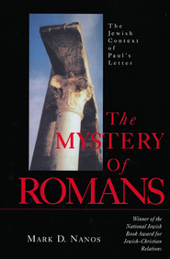
The Mystery of RomansI probably should have started with the Conclusion and then worked through the body of the book. Like Nanos’ Romans book, “Irony” is densely packed with details as Nanos first attempts to refute the traditional Christian interpretations of Paul in general and the Galatians letter in specific, and then presents his own evidence for the premise he suggests, that this letter is not Paul’s major attempt to torpedo the Torah, Judaism, and the Jewish people, but rather what he calls an “ironic rebuke” written to his Gentile disciples who frankly he believes should have known better than to listen to the Jewish (quite possibly proselytes themselves) influencers who neither had faith in Yeshua as Messiah nor believed that Gentiles could ever fully integrate and participate in Jewish worship and community life without undergoing the proselyte rite and converting to Judaism.

While reading this book, on more than one occasion, I felt I had gotten lost in the forest, unable to see the grand landscape for the trees, and there are a lot of “trees” in this book. I took an amazing number of notes that still riddle the pages of “Irony,” and could possibly form a small book themselves if bound between their own covers. However, this book is the result of Nanos’ doctoral dissertation so you can expect it to be tough reading (for most of us, anyway).

Like “Romans”, “Irony” presupposes that the Gentile believers in Galatia were involved in the local synagogues as the only likely venue for them to practice worship of Israel’s God and to learn more about the teachings of Messiah which after all, were contained in the Torah and the Prophets. Where else does one learn Torah than among Jewish teachers and students in a synagogue?

But as Nanos presents the situation, some of the Jewish people, “agents of social control” in the Jewish community, had a problem. As I stated above, how could they understand, since Nanos states these Jewish influencers were not disciples of Yeshua/Jesus, that these righteous Gentiles could be fully equal co-participants in Jewish worship and community without undergoing the proselyte rite? Apparently, these Gentiles, in the absence of Paul or any other Jewish believer and teacher, were being successfully convinced that faith in Messiah was not enough and that they must too undergo circumcision and take on the full yoke of Torah, as it applies to the Jewish people, in order to complete their devotion to God as “Messianic” disciples.

But the ideas Nanos presents in “Irony” aren’t exactly radical.

The next Sabbath nearly the whole city assembled to hear the word of the Lord. But when the Jews saw the crowds, they were filled with jealousy and began contradicting the things spoken by Paul, and were blaspheming.

Acts 13:44-45 (NASB)

Some men came down from Judea and began teaching the brethren, “Unless you are circumcised according to the custom of Moses, you cannot be saved.”

Acts 15:1 (NASB)

You may have to read all of Acts 13 for context, but as you may recall, on Paul’s first trip to the synagogue at Pisidian Antioch, his message of the good news of Messiah for all of the people present, born Jews, proselytes, and God-fearing Gentiles, met with great success. The Jewish members of the synagogue followed Paul and his companions after they left Sabbath services for the day, urging them to return the following Shabbat and to teach more. It was only when large numbers of pagan Gentiles who had heard of this good news invaded the synagogue that the synagogue leaders, threatened by their presence and the implications involved, turned against Paul and drove him out.

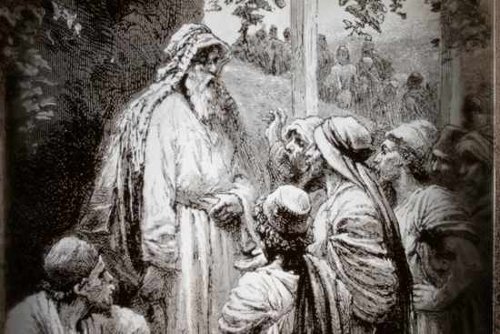
ancient-rabbi-teachingAccording to Nanos, something similar may have been operating among the influencers since how could they be sure these “righteous Gentiles” who in no way were progressing on the path to becoming proselytes, weren’t also involved in community pagan rites? The only way to be sure, would be to confirm their commitment to Hashem and the Jewish people by having them convert to Judaism.

Also, in the eyes of most Jews, the statement of Acts 15:1 seemed incredibly obvious. One does not come to Hashem except through Judaism.

Paul knew the truth, but he wrote his letter to the Galatians most likely before the Acts 15 legal decision handed down by the Council of Apostles that dictated the formal status and identity of the Gentile disciples within the Jewish community as something like “strangers living among us (Israel)”. Paul’s “gospel” was a radical idea at the time (and still is for most Jewish people today), that by faith could the Gentiles be grafted in to the community of Israel, coming to the Father by way of the Son.

As I mentioned in my previous review, according to Nanos, Paul was not a happy camper at hearing his students were defecting from their faith in Messiah and joining the more traditional path toward becoming proselytes. But rather than crafting a logical, dispassionate, and scholarly theological paper, he wrote a hopping mad “ironic rebuke,” whereby he took his Gentile followers to task for acting like inconsistent teenagers following after the “cool kids” in school rather than what they knew to be the truth.

But without understanding that Paul was being ironic, and sarcastic, and “snarky,” we could completely misunderstand what he was saying and who he was saying it to. If we believed that he was talking to Gentile and Jewish believers, and if we believed he was condemning circumcision, the Torah, and the Temple to that entire population, then we might conclude that Paul was himself “Law-free” and advocating for all Yeshua-believers, including Jewish disciples, that they become “Law-free” as well. Sounds like the exact accusations leveled against Paul in Jerusalem by Jewish people from the diaspora we find in Acts 21 (specifically from verse 17 onward), accusations that Paul steadfastly denied throughout a number of legal proceedings for the remainder of the book of Acts.

Assuming Paul wasn’t lying, then believing that Paul was against the Law, against the Temple, and against the formal practice of Pharisaic Judaism for believing Jewish people as most Christians interpret the Galatians letter just doesn’t make sense.

If approached as a theological tractate or an oration in a court of law, for example, or as a polemical attack on Jewish identity and Law observance as Galatians has often been read, then an entirely different set of expectations shapes the interpretive process than those suggested herein. But if Galatians exemplifies a letter of ironic rebuke designed to address the source they had been running when confident that their understanding of the meaning of Christ was legitimate–rightly so according to Paul’s revealed good news–then the guardians of the majority or dominant communities, who are guided in their sensibilities and responsibilities by long-standing membership and reference group norms, will no doubt consider it their rightful duty to obstruct such a course.

-Nanos, pg 319

It’s not a matter of changing a single word of the Galatians letter, but rather, shifting your perspective on what Paul was intending when he wrote it. We only have this letter to tell us what was going on with his addressees in Galatia and to suggest (Paul doesn’t tell us outright) who the influencers were. The method of interpretation makes all of the difference and as I’ve said before, Protestant Christianity has a very definite tradition about how to interpret Galatians and the rest of the Bible. The real challenge is getting the Church, from the average person sitting in a pew on Sunday morning, to the Pastoral staff, to the governing bodies of the various denominations, to the New Testament scholars and students in seminaries and universities, to set aside those traditions long enough to read what Paul is saying as a devoted disciple of Moshiach who was zealous for the Torah and never taught against the Law of Moses or the Temple of God.

Not an easy task to be sure.

The Jewish PaulBut if we read not just Galatians, but the rest of the record of Jewish and Gentile interactions in the Apostolic era with an eye on the tremendous social difficulties involved in even attempting to integrate these two populations in the synagogue under the radical notion that Gentiles did not have to adopt Jewish identities in order to be fully equal co-participants in the worship of God through Messiah, then we come up with a very different picture of the lives of the first Gentile believers and even what our lives as Christians should be today, particularly relative to the Jewish people and Judaism.

Which brings us back to Nanos’ statement about Shoah in the introduction to “Irony”.

The vast majority of the text, while it seems quite logical to me, would really require someone well-studied in New Testament scholarship to critically analyze. What Nanos writes makes sense to me primarily because it fits my own overarching view of the message of the Bible, but without traveling a similar educational path to Nanos or others like him, I don’t doubt I could miss quite a lot. But while I don’t have the ability to intimately examine each and every bit of research and evidence “Irony” presents, I can see that the final conclusion, at least generally, fits the portrait in which I have come to see the Apostle to the Gentiles, a Jewish man who was given the extraordinary task of bringing the good news of the Messiah to the pagan nations of the world; a man who centuries after his death, has been (in my opinion) falsely accused both by Christians and Jews, of being a traitor to his own people, of abandoning the Torah, abandoning the practice of his forefathers in the worship of God, and twisting the teachings of a humble itinerant Rabbi in the Galilee into a brand-new religious form that has no resemblance to the way Jesus taught the Torah of Moses to the “lost sheep of Israel.”

I’m glad I read this book but it certainly wasn’t easy. I consider myself educated but not in this field of study. However, this is a necessary book to work through for Christians because we must be shaken up and startled out of our complacency and our interpretive traditions. Even if you’re not willing to accept a view of Paul and his letter to the Galatians that exactly matches Nanos’ description, the very attempt should help convince you as it continues to convince me, that historic and modern Christianity has made a terrible mistake in how we see Paul. There’s a lot more to learn or relearn about Paul. “The Irony of Galatians” by Mark Nanos is but one step on that journey.