Tag Archives: Chanukah

Christmas is Coming! Don’t Panic!

This is the awkward time of year for Messianic believers. Many of us have opted out of Christmas, something our families and friends do not understand. It is inconceivable that anyone who professes faith in Messiah Yeshua (Jesus Christ) would not celebrate Christmas. It is inconceivable even though December 25th is most definitely not the day of Yeshua’s birth, and even though the customs observed in churches and homes have their origins in decidedly un-Christian pagan celebrations.

-from “Jesus Without Christmas”
published at The Barking Fox
Reblogged at natsab

And so it begins. The annual expression of angst at the approach of perhaps the world’s most well-known religious and secular holiday: Christmas.

I really didn’t think I was going to write about Christmas this year. Frankly, I’ve got too much else going on right now to really care and I have come to a certain peace about it all and no longer feel I have to contend with Christmas, let alone have a panic attack over it.

Yes, back when I was going to church, I’d avoid attending the Sunday services nearest to Christmas as well as all of the other Christmas programming, but that’s not because I felt I’d be tainted with “pagan influences”. After all, there’s no direct Biblical reference to Chanukah, and yet, along with many or most Jewish households, there’s a small but dedicated group of non-Jewish Christians, Messianic Gentiles, and Hebrew Roots believers who light the menorah (also not commanded in the Bible) for eight evenings in commemoration of the defeat of the Greek oppressors by the Maccabees and the rededication of the Temple, as well as to honor the “light of the world” (John 8:12).

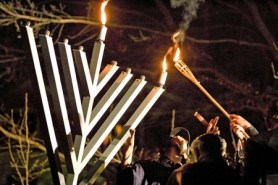
It is true that my house is the only one on my block that is mostly dark every evening, surrounded by the more festive lights of our Christmas observing neighbors. But then again, my wife is Jewish and my feelings on the matter aside, it’s perfectly expected that the only special light visible from within our home for the next week or so (as I write this) should be that of the Chanukah candles on our menorah.

But Christmas is less evil than it is a tradition. It’s a terrifically lucrative tradition for retail outlets as events such as Black Friday and Cyber Monday indicate. If I have a major objection to Christmas, it is because the holiday has become a symbol of both personal and corporate greed and gluttony, not because I think putting lights on a natural or artificial pine tree is “pagan.”

Most Christians I know are quite aware that Jesus wasn’t born anywhere near December 25th and accept that the date they celebrate the birth of Christ was established by tradition rather than empirical fact. Nevertheless, if Christians choose to become more Christ-like, more generous, giving to the poor, kinder to their neighbor, at this time of year, who am I to complain?

I mean no disrespect to the sensitivities of the author at “The Barking Fox” or Pete at “natsab,” but I really feel the traditional response of Hebrew Roots Gentiles to the advent of Christmas (pun intended) is overblown. Sure, it took my parents a few years to adjust after my wife and I announced we were no longer celebrating Christmas, but they are now perfectly content to send Chanukah cards to us and the kids. I do have some relatives, my brother for instance, who still send Christmas cards, but no one in my family (as far as I know) complains because we don’t reciprocate.

brace yourselfI’m reminded of Toby Janicki’s blog post of four years ago called The Scoop on What About Paganism, a topic he expanded upon greatly in his lecture series “What About Paganism” (available on Audio CD and in MP3 format). Toby coined the term “paganoia” in his lectures, and I think the term is fitting.

The Jewish people I know don’t really have that much of a problem with Christmas beyond having to explain to certain people that Chanukah is not the “Jewish Christmas”. In fact, in cities with a sufficiently large Jewish population, it’s something of a tradition for Jews to go out to Chinese dinner on Christmas Day. This is based on Buddhism being the primary religious expression for many Chinese immigrants which means they aren’t celebrating on December 25th either. I wish I lived in a city that had enough Jewish and Chinese people to make observing this particular tradition practical. It sounds delicious.

Christmas is a tradition. So is Chanukah. They both have their basis in events that took place around two-thousand years ago in another country. They have both been integrated into the Christian and Jewish faiths respectively. Some small number of “Messianic Gentiles” (however you want to define the term) consider themselves caught in the middle, but we aren’t really. There’s nothing wrong with traditions. They are what we make of them.

I’ll be traveling with my parents on Christmas Day, not because it’s Christmas per se, but just because it worked out that way (long story) and Christmas is a great day to be on the road. Not many people going anywhere on December 25th because most of them are already at their destination.

The uptake on all this? Christmas is coming. Don’t panic.

Oh, and my Chanukah related blog post will publish tomorrow morning.

Addendum: I just found a reposting of last year’s blog article Let’s Not Get Strange About Christmas, Shall We? by Rabbi Stuart Dauermann and thought I should add a link to it here. He does a much better job at explaining the “paganoia” around Christmas.

The Candles in My Heart

Chanukah MenorayThat the spark of G-d within us will ponder G-d, what is the surprise?

But when the animal within us lifts its eyes to the heavens, when the dark side of a human creature lets in a little light, that is truly wondrous. How can darkness know light? How can earth know heaven?

Only with the power of He who is beyond heaven and earth, and so too is neither darkness nor light.

-Rabbi Tzvi Freeman
“Dark Knowing Light”
Based on letters and talks of the Rebbe,
Rabbi M.M. Schneerson
Chabad.org

The Candles in My Heart: An Unusual Chanukah Story

I think there must be something wrong with me. I don’t know what it is exactly, except I keep getting that square peg in round hole feeling. It happened last night, the first night of Chanukah (it’s early on Thanksgiving morning as I’m writing this), when I realized that my wife had lit the first candle in the menorah and hadn’t called me in to watch. Actually, I was a little surprised.

She was supposed to be back from work by mid-afternoon Wednesday night, but didn’t make it home until nearly sunset. I thought about getting out the menorah and setting everything up, but lately, she’s gotten a tad annoyed when I’ve intervened in “Jewish” matters around the house. So I let it be. I saw that she had bought candles but wasn’t sure if she’d light the menorah on the first night since she was late.

But she did and I missed it…

…and I miss it.

That’s what I mean about being strange or out-of-place. I, a Christian, going to a Baptist church, meeting with my Pastor for private talks every week about Christianity, and I still miss seeing the menorah being lit on the first night of Chanukah.

It’s almost like I’m this person (although, of course, I’m not Jewish).

Two years ago I was in Baltimore on business, and happened to pass by the public menorah in front of Johns Hopkins University just as the first light was being lit. My eyes welled with tears. Although I was raised a secular Jew, my family has always celebrated Chanukah. To be away from my family that first night of the holiday felt cold and lonely. Now, seeing the lights of the first night’s flames of that big menorah, my heart lit up also, and I felt the warmth of my people all around me.

-Laura P. Schulman
“The Menorah That Lit Up My Life”
Chabad.org

The story goes on about how the next day, Ms. Schulman was approached by a Jewish “young man in a black hat” and asked, “Excuse me, are you Jewish?” The transaction between them, as well as the gift of a “Chanukah kit,” complete with menorah, candles, and instructions, sent Schulman on a journey to rekindle the Jewishness of her soul and the unique covenant connection she has with God.

And she’s not the only one:

We talked about friends we had or hadn’t kept in touch with from high school. “You know, I talked to Artie right before my trip,” I told him. “He says he went to Hebrew school, already knows all about Judaism, thinks you’re flipping out, thinks I’m wasting my time. But you can’t believe how much I’ve learned in the last couple of months that he has no clue about – about Jewish law, and philosophy, and the meaning of historical events, and the return to the Land, and all that. He thinks because he knows something, he knows everything – and he knows practically nothing!”

Then Jake said, “That’s what I think about you!”

-Eric Brand
“When God Sends You a Message…”
Aish.com

jewish-handsIn this article, Brand talks of reuniting with an old friend after a lengthy separation, and discovering his friend had moved to Israel and “become religious”. His friend Jake, or rather Yerachmiel now, was thought to be crazy, even by his own mother. Brand thought so too for a while, only to realize that at a critical moment in the conversation over pizza, Yerachmiel was just a messenger. God was talking and calling Eric back to Him.

I think God calls to all of us, Jewish or not, to come to Him, but for Jewish people, it’s especially unique because Israel was called out of the nations to be a treasured people to Him first. I can see it in my wife. It’s like God flipped a switch and sent a signal to a homing beacon in her soul and she had to return to Him.

Granted, it comes in stages, as it does with the rest of us, so I can only hope and pray that as time goes on, she’ll move more in the direction God wants her to go.

Sometimes, because I’m not Jewish and particularly because I am a Christian, I think I get in the way of how far she could go, the distance that people like Laura Schulman and Eric Brand have traveled.

But then, if Jesus is indeed the Jewish Messiah, then ultimately, he’s the King to both of us, as he is to everyone. Ultimately, there will be no dissonance, even though, in the present age, the disconnect is huge.

An Israeli immigration judge has ordered the deportation of a Messianic Jewish man from England who was arrested last week for taking part in an evangelistic event in southern Israel.

Barry Barnett, 50, a worker with Jews for Jesus UK, was ordered on Sunday (Nov. 24) to leave the country by Dec. 3. Barnett, who is based in England, was volunteering at the Jews for Jesus “Behold your God Israel” campaign around the city of Be’er Shiva when he was arrested Wednesday (Nov. 20) at about 4 p.m.

According to his wife, Alison Barnett, six immigration control officers took him from Be’er Shiva, 125 kilometers (78 miles) south of Jerusalem, to an immigration office in Omer, just outside of the city. He was held there for several hours without charge, then transferred to an immigration-holding unit of a prison in Ramle, near Tel Aviv. He spent four days in jail before his court hearing.

-from “Israel Orders Deportation of Jews for Jesus Missionary”
Christianity Today

The thing is, Barnett hadn’t done anything illegal. According to the article:

…the ultra-Orthodox, anti-Christian group Yad L’Achim had followed the Jews for Jesus teams to their campaign sites in Israel since the event started. Yad L’Achim has a long-standing history of links with sympathetic government officials who issue legal actions on their behalf.

In the past, I’ve written quite a lot about Christian supersessionism or the theology that “the Church” has replaced Israel in all of God’s covenant promises. This is a reprehensible artifact of Church history and I deplore its continued expression in any sense in the community of Jesus.

But there’s a flip side to all of this. It’s an understandable flip side given the history of enmity between Christianity and Judaism, but it results in such actions as Barry Barnett’s illegal arrest and detainment without charges in Israel because he represents Jews for Jesus.

I even read a comment on the blog commentary for this story published at rosh pina project where a Jewish gentleman called Barnett a “murderer.”

So I suppose, putting things into context, me being not invited to the lighting of the menorah on the first night of Chanukah in my own home isn’t so bad.

candleBut I still miss it.

I find reading “testimonials” like those written by Ms. Schulman and Mr. Brand heartwarming; Jews being called back to Judaism and to God. Why don’t I have the same sort of feelings about people being called into the Church and to Christ?

It’s not as if I’m opposed to my own faith, but the cultural context gets in the way. No, it’s not like I’m in any way “culturally Jewish.” I’m about as white-bread American non-ethnic anything as it gets.

But I’d rather spend the festival of Sukkot once a year in a place like Beth Immanuel Sabbath Fellowship than all the Sundays there are in a traditional church setting. No, I don’t disdain worshiping with other Christians in the body of believers, but the music, the patterns of worship, the traditions, the prayers, the Torah readings, all call to me in a way that Christian hymns seem to lack.

I know I sound ungrateful. I’m not, really. I appreciate the opportunity God has afforded me to be with my fellow believers, to hear my Pastor preach each Sunday morning, to participate in Bible study after services in Sunday school, to meet and speak with people far closer to God than I.

But I’ve called myself a Gentile who studies Messianic Judaism for a reason.

I don’t know why, but when God set off my own “homing signal,” it called me in an unanticipated direction and that direction continues to pull at me. No matter where I am or whoever I’m with, I cannot be diverted from that path. Even if I never see another Shabbat candle lit, never hear another Hillel in Hebrew, never am present when a Torah scroll being removed from the arc, I cannot become that which I am not.

I’m not Jewish. I’m not Israel. I completely understand that. My wife once called me a “Jewish wannabe” and although that still stings a little, I can’t completely deny the validity of that statement. I just don’t know why it’s true of me.

I also can’t be a “traditional Christian,” although I think it would make my Pastor’s life a little easier if I’d just give in and assimilate theologically and culturally into the church environment as it exists in our little corner of Southwest Idaho.

I may never be invited to see the Chanukah menorah lit in my home or even the Shabbos candles, but I am not in darkness. God lights them in my heart and it’s by their illumination that I am guided to Messiah, particularly during this season.

For how do you know, O wife, whether you will save your husband? Or how do you know, O husband, whether you will save your wife?

1 Corinthians 7:16 (NASB)

And then, last Thursday evening, amid the frenzied activity of getting Thanksgiving dinner ready (and it was a wonderful repast), everything stopped as we all gathered around the menorah and my daughter said the blessings and lit the second light of Chanukah. And we, as a family, were blessed. May the lights of Chanukah and the light of God illuminate you.

Miketz and Chanukah: The Gift of Light

Joseph of EgyptThey said to one another, “Alas, We are being punished on account of our brother, because we looked on at his anguish, yet paid no heed as he pleaded With us. That is why this distress has come upon us.”

Genesis 42:21 (JPS Tanakh)

What lesson for our lives can we learn from their statement?

Rabbi Dovid of Zeviltov comments in the commentary Otzer Chaim: If a person did something wrong and recognizes that he has done wrong, he will be forgiven. However, if a person does something wrong and denies it, there is no atonement for him. When Joseph’s brothers previously said that they were innocent, Joseph responded by calling them spies. When they said that they were guilty, Joseph was full of compassion for them and cried.

Dvar Torah for Torah Portion Miketz
Based on Growth Through Torah by Rabbi Zelig Pliskin
Related by Rabbi Kalman Packouz
Aish.com

Rabbi Packouz also states that according to Rabbi Abraham J. Twerski in his book Twerski on Chumash, “there is no coincidence that Chanukah occurs during the week that we read about the epic of Joseph and his brothers.” But what can one have to do with the other? What can we learn about ourselves?

Well, for starters:

Many people deny their faults and the things that they have done wrong because they mistakenly think that others will respect them more. In reality people admire someone with the honesty and courage to admit his mistakes. It takes a braver person to say, “Yes, I was wrong.” This kind of integrity will not only build up your positive attribute of honesty, but will also gain you the respect of others. When you apologize to someone for wronging him, he will feel more positive towards you than if you denied that you did anything wrong. This awareness will make it much easier for you to ask forgiveness from others.

The Death of the MasterYesterday was Thanksgiving, an American national holiday dedicated to giving thanks to God for His bountiful goodness to us. All that we have, whether great or small, comes from the Holy One of Israel, the gracious and compassionate Provider and Creator. Even the ability to forgive and be forgiven by God is a blessing for which we should be thankful. Without such a gift, a single sin would forever separate us from God, and condemn us to our doom.

But as Rabbi Pliskin’s Dvar Torah states, we are only forgiven and freed from guilt, slavery, and destruction if we admit to our wrongdoings and ask for forgiveness. Our “free gift,” so to speak, actually comes with a price. True, as a Christian, I believe that the death of the greatest of all tzaddikim, Yeshua of Nazareth, paid that price, but forgiveness of sins is like a package wrapped in bright shiny paper decorated with a pretty bow. It just sits there until we accept it and open it up. To do that, we have to do something else. We have to admit our sins rather than deny them. For when we too say we are guilty, then the Father will welcome us back with open arms.

And the son said to him, ‘Father, I have sinned against heaven and in your sight; I am no longer worthy to be called your son.’ But the father said to his slaves, ‘Quickly bring out the best robe and put it on him, and put a ring on his hand and sandals on his feet; and bring the fattened calf, kill it, and let us eat and celebrate; for this son of mine was dead and has come to life again; he was lost and has been found.’ And they began to celebrate.

Luke 15:21-24 (NASB)

But what does any of this have to do with Chanukah?

“Rav Avraham Pam (former Rosh Yeshiva of Yeshiva Torah Vodaas) teaches us that we see this special love of God for the Jewish people regarding the many Jews at that time who had defected to Hellenism and then returned to Torah observance with the triumph of the Macabees — regarding their relationship with the Almighty after their return to the Torah. When a couple reconciles after a separation, the relationship often becomes one of peaceful coexistence, but the quality of love that they initially had for each other is rarely restored.

“Not so when Jews do teshuvah (repentance — returning to the Almighty and to the ways of the Torah). Rambam says that although a sinful person distances himself from God, once he does teshuvah he is near, beloved and dear to God. It is not that God “tolerates” the baal teshuvah (returnee), but rather that He loves him as He would the greatest tzaddik (righteous person). As the prophet says, “I will remember for you the loving-kindness of your youth, when you followed Me into the desert, into a barren land” (Jeremiah 2:2). The love of yore is fully restored.

“This is the significance of the miracle of the oil. It teaches us that with proper teshuvah our relationship with God is restored, as if we had never sinned.”

chanukah-candle-lightingAs believers, as disciples of Messiah, Son of David, the light of the world, the doorway to the Father, we too have been granted the ability to do teshuvah with the same results. It is not as if we are “damaged goods” that, once broken and dirtied, can only approach God just so far and no further. It’s as if we never left, as if we never sinned, as if we have always lived in the Father’s household as beloved sons and daughters. If I can extend the above commentary, God loves the baal teshuvah as He does His Son, His only Son, the one who saved us and redeemed us at the cost of blood and life.

During this week, people in Jewish homes will be lighting the Chanukah candles in remembrance of the miracle of the oil and the miracle of victory over the Greeks in battle. However, the Chanukah lights and the lesson learned by the brothers of Joseph should remind us of something more. As believers, when we light the menorah, we are reminded of God’s great forgiveness in our lives, and how He literally turned darkness into light in our hearts and souls.

In John 8:12, Jesus declared himself the light of the world. In Matthew 5:14-16 we discover that as his disciples, we too are the light to the world. In Jewish tradition, once the menorah is lit, it should be placed in a window for everyone to see. We too were encouraged to allow our own light to shine into the world, as a message of hope and peace, and as evidence that God does powerful miracles.

Love, hope, and redemption are powerful miracles indeed, and a tiny light shining in the darkness is evidence in our world of an overwhelming brightness shining from the Throne of Heaven.

Happy Chanukah and Good Shabbos.

Happy Thanksgivukkah

WonderAmazement never ceases for the enlightened mind.

At every moment it views in astonishment the wonder of an entire world renewed out of the void, and asks, “How could it be that anything at all exists?”

-Rabbi Tzvi Freeman
“Wonder”
Chabad.org

As you read this, it is Thanksgiving, an American national holiday dedicated to giving thanks for the bountiful blessings we have each received from God. At least that’s how it was originally conceived. It’s also the first full day of Chanukah (spellings vary), the Jewish holiday celebrating the miracle of the meager Jewish forces defeating the mighty Greeks, and that in sanctifying the Temple, Hashem, God of Israel, allowed one day’s worth of sanctified oil to burn for eight days, thus cleansing and dedicating the Temple for holiness.

Thankfulness and miracles. And yet how often do we fail to appreciate what God gives us, especially in a land of plenty.

I’ve been pondering my conversations with my Pastor as well as the sermons of John MacArthur and the other presenters at the Strange Fire conference. In my recent investigation into the concept (as opposed to the movement) of Christian fundamentalism, I see that at its heart, it is just the attempt to render a basic definition of the essentials of what makes a Christian. It’s the minimum set of standards, so to speak, that one must uphold to be an authentic believer.

Of course, in order to create a minimum set of essential beliefs or attributes, you have to take the vast body of information in the Bible and reduce it down to its bare bones, so to speak. You have to determine what is an absolute must about the Bible, and then consider that most of the other “stuff” is good, but not a deal making or breaking requirement.

But that’s also one of the flaws in Christian fundamentalism. It’s reductionistic. It cuts out things like miracles, and wonder, and awe, and amazement in an incredible, infinite, personal, creative God!

In establishing a core, fundamentalism must eliminate or at least set to one side, thoughts, feelings, and meditations such as those expressed in the above-quoted words of Rabbi Freeman.

Is it wrong to be astonished by God? Is it an error to be thankful for not only the tangibles of the Bible, but the sheer fact that God exists and chooses to be involved in our lives just because He loves us?

For Jewish people, awareness of God goes beyond the generic thanksgiving for the blessings of Heaven. The very fact that Jews exist in our world today after so many thousands of years of effort the world has expended in trying to exterminate them, is a very great miracle.

We say every day during Chanukah in the Shemona Esrei the Al Haneesim (on the miracles), “When the wicked Greek kingdom rose up against Your people Israel to make them forget Your Torah and compel them to stray from the statutes of Your Will.” The order of the prayer mentions that first the Greeks wanted the Jews to forget Torah and secondly to stray from Hashem’s statutes.

The Greeks understood exactly how to undermine Judaism and expedite assimilation. How was this done? The Gemara in Hureous states that a father has an obligation to teach his son Torah from the moment he is old enough to speak. The first pasuk of Torah that a father teaches his child is,”Moshe commanded us with the Torah and this is the heritage of the congregation of Yaakov.” The second pasuk a father is obligated to teach his child is the Shema – “Hear, O Israel: Hashem is our G-d, Hashem, the One and Only.” – Which asserts our belief in the unity of G-d.

-Rabbi Yosef Kalatsky
“The Light of Torah: The Torah Sustains Judaism”
Commentary on Chanukah and Torah Portion Miketz
Torah.org

Tefillin with RabanI know that a lot of Christians support the existence of the Jewish people and Israel, and yet devalue the practice and observance of Judaism. A lot of prejudice has been generated in Christianity against Judaism over the long centuries, and particularly the mistaken idea that much of the Torah represents not the Word of God, but the man-made traditions of the Rabbis. Further, the general (and again, mistaken) belief in the Church that God only gave the Jewish people the Torah to prove to them that no one can attain righteousness by human effort and that they must depend on the grace of Jesus for salvation, re-enforces the idea that Torah observance and therefore Judaism is a “religion of useless works.”

It is beyond imagination to most Christians how a Jew who has faith in Yeshua as Messiah and thus is saved by grace, can still desire and even demand to continue observing the mitzvot and align with the larger, non-believing Jewish community.

But, as Rabbi Kalatsky points out, or at least as I infer from his commentary, God gave the Torah to Israel to sustain Israel, to define and preserve the Jewish people. Being Jewish isn’t just a string of DNA and it’s not just a set of ethnic practices, customs, traditions, and rules, it’s an identity, a life, and a continual experience assigned to the Jewish people by God. A Jew who doesn’t observe the mitzvot is still Jewish of course, but the full blessings and apprehension of the unique relationship between Jewish people and God can only come from a life immersed in Torah and in Judaism. And Rabbi Kalatsky is hardly the only one to make such observations.

It was Judaism that provided the refuge for my parents in the disorienting passage from one society to another. My father’s rabbinic calling transcended borders. Hebrew remained the key to eternal verities. The Jewish calendar continued to govern the rhythm of our home. I never heard my parents lament the money they were forbidden to take out of (1940s) Germany, only the shipment of books from my father’s library that never made it to America.

-Ismar Schorsch
“At-Homeness,” pg 149, December 8, 2001
Commentary on Torah Portion Vayeishev
Canon Without Closure: Torah Commentaries

As I write all this, I find it strange and even amazing that I, a Gentile Christian, can feel so passionate about supporting a Jewish life abundantly enriched by the Torah of God.

Many Christians see Judaism in more or less the same way I see some fundamentalist Christians: as a faith made up of discrete, definable, finite, quantifiable pieces. A faith that is like listening to an auto mechanic explain what each of the parts of your car’s engine does, who takes it apart, shows you each gasket, spring, and fitting, then puts it all together right before your eyes and starts it up for you. Sure, it’s incredible and amazing, but it is also fully within the grasp of human beings.

Is that all that God is? Is He nothing more?

Consider three things, and you will not approach sin. Know whence you came, whereto you are going, and before Whom you are destined to give an accounting.

-Ethics of the Fathers 3:1

If we thought about our humble origin on the one hand, and the greatness we can achieve on the other, we would come to only one logical conclusion: the potential for such greatness could not possibly reside in the microscopic germ-cell from which we originated. This capacity for greatness can reside only in the neshamah (soul), the spirit which God instills within man.

What an extraordinary stretching of the imagination it must take to think that a single cell can develop into the grandeur which a human being can achieve! People have the power to contemplate and reflect upon infinity and eternity, concepts which are totally beyond the realm of the physical world. How could something purely finite even conceive of infinity?

Our humble origins are the greatest testimony to the presence of a Divine component within man. Once we realize this truth, we are unlikely to contaminate ourselves by behavior beneath our dignity. We have an innate resistance to ruining what we recognize to be precious and beautiful. We must realize that this is indeed what we are.

Today I shall…

…try to make my behavior conform to that which I recognize to be the essence of my being: the spirit that gives me the potential for greatness.

-Rabbi Abraham J. Twersky
“Growing Each Day, Kislev 20”
Aish.com

This too is Judaism; the recognition that it is God’s Spirit that imbues us with the ability to strive to be more than who we are right now.

Hashem, what is man that You recognize him; the son of a frail human that You reckon with him? Man is a breath; his days are like a passing shadow.

Psalm 144:3-4 (Stone Edition Tanakh)

sky-above-you-god1David, a King, a man after God’s own heart, gazed up in wonder that God took any notice of human beings at all. Why don’t we do the same? Why can’t we turn our hearts away from our trivial pursuits and in thanksgiving, awe, and wonder, turn to the majesty and magnificence of the One true King of the Universe, Lord and Master of Eternity, and the lover of our very souls? For as much as the food on our tables, and our jobs, and our families, and all that God’s providence has placed in our lives, wonder too is a gift of God.

And when Thanksgiving and Hanukkah coincide we find ourselves doubly blessed. We will be able to offer thanks to God on the same day for both our spiritual and material blessings. Let us delight in this extremely rare opportunity to bless God for the food for our bodies as well as the survival of our faith that grants us spiritual sustenance for our souls.

-Rabbi Benjamin Blech
“Thanksgivukkah”
Aish.com

I’m writing this a full week before you’ll read it. Perhaps you’ll wake up early on Thanksgiving morning and read this “meditation” with your first cup of coffee, or while the turkey is baking and there’s a lull in the kitchen activity, or later, after the meal and the football games are over, as the pumpkin pie is settling in your stomach and you hold a glass of wine in your hand, but I have a hope for the day you read this. I hope that you’ll take a moment, turn away from your computer, maybe close your eyes or turn your gaze to Heaven, and know that you are in front of the Throne of God, a God who loves you, a God you provides, not only for your body, but for everything you can imagine, and for everything you can’t.

Happy Thanksgivukkah.

Separating Good from God

returning-the-torahThe campaign of the Greeks was aimed to “make them forget Your Torah and violate the decrees of Your will” (Sidur p. 59); as the Midrash (Bereishit Raba 16) puts it, (the Greeks demanded) “Write…that you have no share in the G-d of Israel.” It was a war against G-d. “Let them study Torah,” the Greeks implied. “Let them practice the justice-mitzvot and the ‘testimonial’ observances. But they must not mention that the Torah is G-d’s Torah and the mitzvot are the decrees of His will. Torah and mitzvot must be severed from G-dliness.”

“Today’s Day”
Thursday, Tevet 2, Seventh Day of Chanuka, 5703
Compiled by the Lubavitcher Rebbe
Translated by Yitschak Meir Kagan
Chabad.org

Why should any religion get the credit for people doing good, but not get the credit for people doing bad?

I think it should be consistent either way, don’t you? Either the church gets all the credit or none of it. You can’t just give it the good and ignore the bad.

-comment from NotAScientist
on my blog post
When Christians Do Good

Typically, one of the criticisms non-religious people level against Christians and other people of faith is that we need some sort of excuse to do the right thing. We use our faith and our religion as an external motivator to do good when, as human beings, we should just know how to do good and do the right thing because it’s the right thing.

This gets muddied up further when definitions about what “right” happens to be differ between religious and non-religious populations and certain social priorities and “causes” become involved. Then too, the matter of the “supernatural” vs. the “rational” is also injected into the argument, with rational, scientific atheism and secular humanism weighing in on the side of “thinking” as opposed to “believing”.

In doing a little research into “atheist advertising” for this blog post, I found a number of clever slogans that atheists use to promote their particular viewpoint. One was on the side of a New York City bus and read…

“You don’t have to believe in God to be a moral or ethical person”

The ad then provided the URL to the New York City Atheists website (see the story at The New York Times for details).

But that takes us back to the “Today’s Day” quote at the top of this blog post and interestingly enough, Chanukah.

As you’re reading this, Chanukah has just ended (at sundown Sunday night) but the lessons it teaches us are still fresh in my mind. Why would the Greeks be content to continue to allow the Jews to perform the Torah mitzvot and to do justice, as long as they divorced those moral and ethical deeds and the Torah itself from the God of Israel? If you donate food to your local food bank because you believe that helping others is the right thing to do, and I perform the same act in response to the will of God, what difference does it make? Hungry people are still fed either way, right?

atheist_christmas_adWell yes, hungry people are still fed either way. Someone can enjoy a donated meal without wondering about the motivation of the person who provided it. Their belly will be just as full and they can feel just as grateful to the person who helped them out. I can understand why an atheist would make such a statement, but why would the ancient Greeks, who had no end of gods of their own, want to say something like that about the Jews? Why separate the good deed from the ultimate author of the good deed, God?

Pinchas arose and wrought judgment, and so the plague was checked.

Psalms 106:30

The word tefillah, or “prayer,” has its origin in the word pallel, which means “to seek justice.” Prayer should therefore be an activity whereby one seeks justice. The first recorded prayer in Jewish history is that of the Patriarch Abraham. He sought justice for the people of Sodom and pleaded with God to spare them (Genesis 18:23-33). Thus, when we pray, whether for ourselves or for others, it should be with the understanding that we are seeking justice.

How, then, can we ask of God to grant our various requests? Are we deserving of this? Do we deserve them? Are they within the realm of justice?

Two answers come to mind. If, as part of our prayers, we admit the wrongs we have done, sincerely regret them, and commit ourselves not to repeat them, then we may indeed be deserving. We therefore do not make our requests on the basis of what we are, but on the basis of what we will be. Second, if we extend ourselves by forgiving people who have offended us and acting with kindness toward them, then God’s acting accordingly toward us can in itself be considered justice.

Thus, teshuvah (the process of regret and return) and gemilas chasadim (acts of kindness) are the foundations of prayer.

Today I shall…

try to do teshuvah, and to act toward others in a way that I wish God to act toward me.

-Rabbi Abraham J. Twerski
“Growing Each Day, Tevet 1”
Aish.com

I don’t have some wise commentary or a learned sage to draw from to answer the question I posed above, but there seems to be one difference between the atheist’s motivations and the reason a person of faith does good: the definer and creator of good.

If man is the final arbitrator of what is good and evil, then good and evil changes over time, changes between nations and cultures, and changes from one individual to the next. What I may consider good, another person may see as evil. What I can justify within my own conscience may be considered tremendously heinous within another’s moral structure.

But God is God. He does not change and thus what is good does not change.

And what is good?

And Jesus said to him, “Why do you call me good? No one is good except God alone.”

Mark 10:18 (ESV)

OK, it’s not that simple. I’ve mentioned before that religion and how we understand God evolves over time. Besides that, even just within Christianity, various denominations and even individuals who go to the same church can differ on a number of political and social issues in terms of what is “good” and “evil.” Should you pray for the well-being of President Obama or pray against his health and safety? You may believe the answer to that question is clear, but I promise you that no matter what your answer may be, there is a believer out there who has the opposite answer, and yet both of you believe you are in the right because of God and the Bible.

But even though we have that monkey wrench in the machine, I still believe it is better to seek out God in matters of right and wrong than to universally rely on our own judgment and feelings. I’ve been writing recently about the Sandy Hook school shootings and it is only the most recent of the many debates you will find on how to address violence in our society. What is the right thing to do? What is the ethical and moral thing to do in response to the death of 26 people, including 20 small children?

symmes_chapel_churchI don’t know.

I do know that even those of us who turn to the God of the Bible for our strength and our hope don’t always agree on the answer. How much more must a secular world with only the standard of public opinion dispute each other, disagree, and contend?

I don’t know the answer. But I am thankful that when I have to ask the question, I don’t have to ask another human being who is just as hurt, sorrowful, and angry as I am.

If my sense of right and wrong became detached from God, even if my basic behavior and my concept of what is good did not change, I would be at the mercy of the opinion of whatever group of people I chose to listen to or worse, I would have to depend upon the voice of my own personal thoughts and feelings.

I lift up my eyes to the hills. From where does my help come? My help comes from the Lord, who made heaven and earth.

Psalm 121:1-2 (ESV)

It was God who took a family and made them a people and a nation too numerous to count. If the Greeks had succeeded and caused the Jews to detach the Torah from God, Israel too would become detached and ultimately lost. It is God who redeems the soul of every living person and from whose hand we receive what each of us needs at its proper time. Without God, we too would be lost.

20 Days: Nosce te ipsum

jewish-t-shirtA convert who converted while among the gentiles.

-Shabbos 68b

Our Gemara introduces the concept of a convert who became Jewish on his own accord, without being informed of the mitzvah of Shabbos. We must understand, though, in what way can we consider this person to be a Jew, and responsible to bring a sin-offering for his unintentional violation of Shabbos, when he has no knowledge of mitzvos? How is this conversion valid?

Reb Tzadok HaKohen of Lublin points out that we see from here that one’s basic identity as a Jew comes from his being known as “a Jew”. The verse (Yeshayahu 44:5) states: “This one will say I belong to Hashem…and he will refer to himself as Yisroel”. The very connotation of being called a Jew is tantamount to being associated with belonging to Hashem.

Accordingly, Reb Tzadok notes that if one is forced to accept Islam, he must resist to the supreme degree of יהרג ואל יעבור Even though we might not consider Islam as being avoda zara, being that their basic belief is monotheistic, nevertheless the very fact that the Jew is being coerced to abandon his identity as being called a Jew is enough of a reason to resist, even if the consequences are severe (see Radva”z, Vol. 4 #92). Even in earlier generations, when a Jew would compromise his mitzvah observance, he nevertheless maintained his distinctive identity as being Jewish.

The verse (Hoshea 4:17) describes this condition, as we find, “Even as Ephraim is bound up…and he follows idols, let him alone.” From here we learn that because they remained bound up with the nation, and they did not assimilate with the surrounding nations, this saved them despite the fact that they were involved with idols.

Daf Yomi Digest
Distinctive Insight
“What is a Jew?”
Commentary on Shabbos 68b

I’m not writing this to try to answer the question “What is a Jew” but to illustrate how difficult it is to even address such a question from a Christian point of view. As I make my attempt to “assimilate” back into a more traditional Christian context, I discover that I may never understand the answer to questions like the one posed regarding Shabbos 68b. The discussion of Jewish identity involves the concept of a Jew who is Tinok SheNishbeh (Hebrew: תינוק שנשבה, literally, “captured infant”) which, according to Wikipedia, “is a Talmudical term that refers to a Jewish individual who sins inadvertently as a result of having been raised without an appreciation for the thought and practices of Judaism. Its status is widely applied in contemporary Orthodox Judaism to unaffiliated Jews today.

This naturally leads me to thinking about the Chabad and their primary mission to attract “unaffiliated Jews” and make them more familiar with Jewish thought and practices. Whatever else you may think of the Chabad (and like any other community, they have their faults, some of them significant), they are “out there,” extending themselves, reaching out to Jews who might otherwise completely assimilate and disappear into the surrounding Gentile culture and environment.

In today’s morning meditation, I addressed the issue of Christian evangelism and how the church, in spite of the many faults we may find in it, is doing all of the “heavy lifting” in terms of reaching out to the would around it and introducing that world to the teachings and grace of Jesus Christ. One of the comments I received is that “spreading the Good News” isn’t really what Jesus had in mind, but rather making disciples of the nations, which is a more involved, intricate, and in-depth process and relationship.

And I agree.

public-menorah-lightingUnfortunately, Christianity and Judaism tend to collide rather disastrously relative to these two imperatives. I liked Tsvi Sadan’s “solution” to this problem as he presented it in his article “You Have Not Obeyed Me in Proclaiming Liberty” (written for Messiah Journal) by using the concept of keruv to bring the Jewish people closer…

…to God and to one another, first and foremost through familiarity with their own religion and tradition…the Jewish people, as taught by Jesus, cannot comprehend his message apart from Moses (John 5:46)…Keruv is all about reassuring the Jewish people that Jesus came to reinforce the hope for Jews as a people under a unique covenant.”

As I learned recently, it may take me a good deal longer than I originally anticipated to make even the tiniest headway into the church. If I’m to make a go of it, I may have to dedicate myself to the “long haul” of “going to church” at the cost of just about everything else. How am I to begin to “understand church” and yet remain on my current educational trajectory relative to Jewish learning and education (such as it is since I’m pretty much self-taught)?

There’s this idea in some churches as well as within Judaism that requires one to acquire a “mentor.” I’ve previously mentioned how difficult it is just to find someone to talk to in the church beyond the simple “hi” and “bye.” Acquiring a mentor seems like an insurmountable task. And yet acquiring a mentor within a church context means necessarily setting aside any learning one might consider “Jewish.” Can I travel in two (apparently) opposite directions at the same time?

I ask that question with a certain sense of irony. Although my Jewish family is anything but strictly observant, my wife and daughter have been diligent to light the Chanukah candles, say the blessings, and to at least play some Chanukah music on each night. It reminds me of how we used to light the Shabbos candles, pray the prayers and sing songs of joy, welcoming the “Queen” into our home. It’s the most “Jewish” experience I’ve had in our house for a long, long time. Man, did that feel good.

And yet here I am, boarding a ship, and sailing the seas toward a “Christian” destination.

I know that my friend Boaz Michael has told me on more than one occasion that the Torah is taught in the church, and we can learn its lessons if only we are open to it. I guess he should know since he and his wife Tikvah attend a church in a small town in Missouri every Sunday that Boaz isn’t traveling.

And yet he and his family still keep Shabbos, keep kosher, and observe the other mitzvot.

But (as far as I know) they’re not intermarried and I’m not Jewish so I have to go somewhere and do something.

Frankly, as much as synagogue life would be alien to me at this point, I’d still rather go to shul with my wife on Shabbos than to church alone on Sunday if I felt I had a choice. But I won’t embarrass my wife by suggesting that she try to find a way to introduce me to her Jewish friends under those circumstances.

lost-in-an-angry-seaThe rationale of returning to church, at least in part, is defined by Boaz’s soon to be released book, Tent of David: Healing the Vision of the Messianic Gentile. I’ve been speaking of “mission work” for the past few days. According to Boaz and relative to his new book…

Mission is broader than theology and stronger than a personal identity. Mission allows one to stay focused on the goal while facing challenges, needing to be flexible, and always showing love. A deep and shared sense of mission and kingdom identity allows one to be shaped by their spiritual growth, gifts, desires, etc. yet stay focused on the greater goal.

I don’t know that I have a “mission” or even a purpose in going to church, particularly since at this church, the Pastor seems sufficiently aware of the Christian’s need to support the Jewish people. But here I am because I feel like I shouldn’t be alone and that I might actually have something to share belong a daily blog posting.

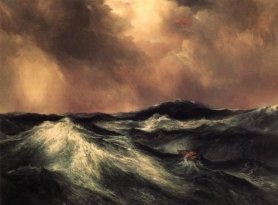
I feel like a person in a lifeboat somewhere out in the ocean. The waves lift me up and the waves dip me back down. I have higher days and lower days (today being “lower”). Do I want to invest a year just to explore the possibility that I might fit into a church and that I might have something to offer besides a few dollars in the donation plate and adding my body heat to a chair in the sanctuary?

Well, in spite of what I want, is it worthwhile? Is it what God wants? How do I know what God wants? I know what “feels” better to me and what doesn’t, but that’s hardly a litmus test that yields reliable results. 20 days and counting. The clock is ticking.