Tag Archives: children

When They Come For Your Children

wendy
California Rep. Wendy Carrillo – found at wendyforassembly.com

I used to use this blog primarily to discuss issues of faith and specifically the intersection between Gentile believers and Messianic Judaism. While I still retain a theology and doctrine based on those beliefs, I’ve distanced myself from any praxis that could be considered “Jewish.” I made this decision due to a seemingly endless bombardment of “Gentiles don’t belong in a Jewish space.” Yeah, but “buy our books and other products anyway.”

However, if you’ve been following my most recent blog posts, you’ll see I’ve been sucked into what is called “the culture wars.” I never wanted to confront these issues but it seems the world has become so crazy, that it’s not only anti-Christian and anti-Jew (I saw plenty of bigotry online against Christians and Jews during Easter and Passover, so much so that I had to block an anti-Semite on Facebook), but anti-family and dangerous to children. How can I ignore that?

This mainly addresses my commentary on how the transgender “industry” hurts kids, but also tangentially includes children’s books and the culture wars, as well as the real reason drag queens pretty much demand children watch their “shows”.

I came across the news item In California, Parents May Soon Effectively Lose Custody of Kids 12 and Older. The source is heavily biased “right,” so I sought to corroborate the data. I did.

California Legislative Information on California Assembly Bill 665 as well as AB 665’s Fast Tracking summary and The Legislative Counsel’s Digest for the bill tells the tale.

Continue reading When They Come For Your Children

The Real Reason Drag Queens Want Your Children in the Audience

drag
Photograph: Courtesy Elisabeth Fuchsia

Okay, so no one will answer me. Look. As such, I’m not against drag shows as adult entertainment. Way, way back in the day, I went to Finocchio’s in San Francisco and had a great time (admittedly, that was long before I became a Christian).

However it was deffo adult entertainment and there wasn’t a child in sight.

I’ve been trying to find out why modern progressives are pushing so hard for children to HAVE to attend drag shows or drag reading hour at public libraries. Even if the content is totally child appropriate, why is it absolutely necessary for young children to be in the presence of men dressed up as women (and some of the “dressing up” is pretty bizarre)?

So on social media, whenever I find a pro-children at drag show post or tweet, I ask that question. So far, crickets.

Continue reading The Real Reason Drag Queens Want Your Children in the Audience

Of Grandchildren, Chanukah, and Christmas

As I’m sure many of you know, I haven’t been contributing to this blog spot lately. It’s not so much because I don’t have the time, but rather because some of the “fire” or inspiration for doing so has cooled off.

I have no local community of faith and no longer have a steady stream of information coming in regarding the Messianic perspective on the Bible, the Messiah, and faith to employ as a muse.

chanukah
Chanukah 2016

I had been considering writing something about Christmas and Chanukah (besides my little science fiction Chanukah story) and dreading it at the same time since, after all, it is somewhat expected, but then these issues collided with my regularly scheduled life.

A few things.

My son David is divorced with two children, my seven-year-old grandson and my almost eighteen-month-old granddaughter.

David is currently living with us to save up some dough, and his arrangement with his ex is that he gets the kids for one week and she gets them for the next.

That’s under normal circumstances.

Because she celebrates Christmas and we don’t, we’ve had them for the past week-and-a-half, and she’ll get them starting late Friday or early Saturday, and keep them for the next two weeks.

Since Christmas and the start of Chanukah both begin on December 24th this year, the grandkids will get Christmas but miss Chanukah.

My granddaughter wouldn’t care, but my grandson loves Chanukah. With this in mind, my family decided to celebrate Chanukah a week early this year so, for us, the fourth night of Chanukah begins at sundown tonight.

Another little factoid. David is dating (I personally think it’s on the rebound, but he says “no” and what do I know anyway?) and she celebrates Christmas, too.

star christmasSo last Sunday evening after my grandson lit the candles and my wife coached him through reciting the blessings, my son and his girlfriend produced a bunch of Christmas presents and gave them to my grandchildren.

I had no idea this was going to happen, and I found myself surprised, shocked, and more than a little dismayed.

I usually silently endure the Christmas season and am grateful when January rolls around so traffic goes back to normal and I don’t have to listen to Christmas music anymore. It’s not like I’ve got a case of “paganoia” about the holiday, I just find it overly commercialized and tedious.

But it invaded my home and without even the slightest warning.

At least no one dragged a Christmas tree into the house.

Which brings me to what really inspired today’s missive. Jewish actress Natalie Portman has a Christmas Tree.

This story was published as Jewish educational site Aish.com to illustrate the potential danger of Jewish assimilation into wider secular culture (or worse, directly into normative Goyishe Christianity).

They also published a parallel article, When Christmas Meets Hanukkah touting the same message.

Is it okay to mix Christmas and Chanukah together? Can you have a Chanukah menorah in your home alongside a Christmas tree? Is this acceptable intermarriage holiday practice?

Experts and authors such as Susan Katz Miller would probably say “yes,” but I’m not so sure.

It’s a foregone conclusion that my non-Jewish grandchildren will be raised with Christmas and Easter and all of that, but thanks to their Bubbe, they’ll also experience at least Chanukah and Passover and occasionally a smidgen of Sukkot.

natalie portman christmas tree
Natalie Portman, Image: Aish.com

My wife isn’t particularly observant (I wish she were more observant) and my son even less (non-existent). If he wasn’t living with us, he probably wouldn’t light the candles, and in spite of the fact that he complained about his ex-wife celebrating Christmas when he was married, he seems perfectly fine with giving his children Christmas presents for the sake of his new girlfriend.

If my family hadn’t been such a mixed bag of evolving religious practice when my own children were growing up, and if we had specifically raised them Jewish, maybe some of it would have stuck. I’d like to think so, even though there’s a crisis of assimilation into secularism attacking the upcoming Jewish generation.

All three of my kids identify as Jewish ethnically, but that’s about where it ends. I really don’t think mixing and matching is such a great idea in families (and if my son marries yet another non-Jewish wife and has more kids, it’ll just get worse). Granted, Natalie Portman can make whatever decisions she wants for her family, but if I had it to do over again, when my sons were born thirty years ago, I would have pushed my wife to join a local synagogue and start her (and my family’s) Jewish education right then and there.

That would have changed a whole lot though, so I’m conflicted. At that time, neither of us were religious, and as her non-Jewish spouse, if I had started attending shul with her and the kids, and if I had become entrenched in that lifestyle by the time we initially encountered Christianity some seven or so years later, I might not have become a believer, and then transitioned into a Judaically aware perspective thanks to first Hebrew Roots and then later Messianic Judaism.

How could I do that, and yet, for the sake of my Jewish children, how could I not?

Each of my three adult children will have to make their own path if they want to recapture what it is to be a Jew. I’ll help if they ask, but otherwise it’s totally up to them. It’s totally up to my long-suffering wife if she wants to become more observant (and she’s the product of an intermarriage as well). I’ve told her more than once that I’ll accept whatever decision she makes in that direction.

assimilationI have almost no control at all of what happens to my grandchildren. They’re not Jewish but I have this secret hope that they’ll become curious one day and want to investigate that part of their heritage (they could always convert).

The world is bleeding out Jews thanks to the hemorrhage of intermarriage and secular assimilation (except for the Orthodox, or so I’ve been told). I can’t fix it in my family, and can only watch and shake my head when I see my grandchildren rip into Christmas wrapping as the Chanukah lights burn just a few feet away.

May the Messiah come soon and in our day to return the Jewish people not only to Israel but to themselves.

Will Our Children Have Faith?

It may seem strange to consider Judaism a missionary religion. Yet the Pharisees are described as “compass[ing] sea and land to make one proselyte.” (Matthew 23:15) Rabbinic Judaism, the product of these Pharisees, saw in Abraham and Sarah the models for those who converted non-Jews to Judaism, speaking of them as “making souls.” (Cf. Gen. 12:5)

The proselyte was viewed with special favor. Unlike the Israelites at Sinai the proselyte had come under the wings of the Divine Presence without the impetus of thunder and lightning. Conversionary activity, however, diminished as Christianity gained power and proscribed conversion to Judaism. Even so, there were notable conversions to Judaism in the medieval period.

In the modern period with the advent of “Outreach” in the Reform Jewish community, there is renewed interest in presenting Judaism as an attractive option to those outside of Judaism who might be interested.

-Leonard Kravitz and Kerry M. Olitzky
“Judaism as a Missionary Religion,” p.14
Chapter One: At Sinai Moses Received the Torah
Pirke Avot: A Modern Commentary on Jewish Ethics

This isn’t the only time in the first fourteen pages of this book that the authors quoted from the Apostolic Scriptures (favorably), which is something of a surprise in a (non-Messianic) Jewish publication. I’ve also read similar commentaries in the past on the historic and arguably modern interpretation of Judaism as “missionary.”

Of course, it’s well-known that the Chabad have a very active and even aggressive outreach process, but this is usually directed at non-observant or minimally observant Jews. They aren’t actively trying to convert Gentiles to Judaism although, on occasion, they will encourage non-Jews to observe the seven Noahide Laws.

I’ve been thinking about Messianic Judaism across multiple generations, especially as applied to non-Jewish members or adherents otherwise known as “Messianic Gentiles.” I’ve read a couple of blog posts over the past few days, both written by “Hebrew Roots Gentiles,” discussing the desire to pass their beliefs on to the next generation.

This is really difficult to do.

Even in modern Judaism and Christianity, there is no guarantee that your children will follow in your footsteps. Sure, it’s more likely in Orthodox Judaism for your children to continue in an Orthodox lifestyle, but in Reform Judaism, it’s not such a big step from there to becoming completely secular and even assimilated. There are also plenty of Christians whose children leave the faith. It can be truly said that God has no grandchildren. We each negotiate our own relationship with our Creator, regardless of who our parents are or what they believe and practice.

OK, that’s not exactly true for Jewish people. Even a secular and assimilated Jew is still a Jew. Jewish people are the only population to ever exist who are born into a covenant relationship with God, whether they want to be or not. I believe at the end of the age, each Jew who chose not to respond to the covenants will have to give an accounting to God.

Yes, the rest of us will too will have to give an account, but it won’t be the same since no non-Jew is born automatically having a specific set of obligations to God based on a set of covenants made thousands of years ago.

And in Messianic and Hebrew Roots communities, the problem is compounded.

A few years back I attended the First Fruits of Zion Shavuot Conference at Beth Immanuel in Hudson, Wisconsin. There were a number of families there, both Jewish and Gentile, who were discussing matchmaking. That is, they were concerned about who their children were going to marry.

This wasn’t idle chatter. Some of the younger generation present at the event were approaching or already at marriageable age. There were even suggestions being made as to which two young people to match up (much to the discomfort of the young people present who were being discussed).

There are just tons and tons of Christian churches and Jewish synagogues of various denominations and branches available almost everywhere on Earth. A Christian desiring to marry a Christian companion might not have any more difficult a time at finding an appropriate mate than any given atheist. For Jews it is probably the same, given access to a sufficiently large Jewish population (here in Idaho, it would definitely be more of a chore).

learning hebrewBut what about Messianic Jews and Gentiles? At least in the U.S. and Canada, there aren’t that many communities to choose a proper companion from. Do you marry a Christian and call it good? Do you marry a (non-Messianic) Jew and give up your faith in Yeshua (Jesus)?

I’ve known more than a few young adults, Jewish and Gentile, who are Messianic and who either took many years to finally find a good match or who are still waiting for him or her to come along.

Messianic Judaism is a missionary religion but with a twist. It’s main focus is or should be to spread the good news of Messiah to other Jews.

For instance, on the main page of the Tikvat Israel website, it states:

Where Jewish people and their families & friends can experience a Jewish service & community while believing Yeshua (Jesus) is Messiah.

Gentiles are hardly excluded but the outreach and call to faith is definitely directed “to the Jew first,” so to speak.

I think many “Messianic Gentiles” self-select our way of life. I’ve heard endless stories from people who used to go to church saying that what they were being taught from the pulpit just wasn’t satisfying and didn’t seem to match up with what the Bible actually says. I think we’re all attracted to a more Jewish interpretation of the scriptures for a variety of reasons. Many of us are intermarried with Jewish spouses and so are exposed to religious and cultural Judaism as a matter of course. And many “Hebrew Christians” have returned to the Torah by way of Messianic Judaism and brought their non-Jewish family members with them into the movement.

But while children don’t have much say about which church or synagogue their parents take them to, as these young people grow into adulthood, they have plenty of say over their lives.

I know in my own experience, as soon as I was old enough to tell my parents I wasn’t going to church anymore, I did, and I didn’t see the inside of a church as a worshiper for decades.

My own children went through a series of religious “encounters” starting with church, then a Hebrew Roots group, and then the local Reform/Conservative shul. They all eventually exited out of Yeshua-belief and then just about anything that resembles Jewish observance. Except for some approach to keeping Biblically (but not halachically) kosher and ethnically identifying as Jewish, they have no relationship with God as Jews.

I don’t doubt that Gentile and Jewish believers will continue to be drawn from their churches to Messianic Judaism and/or Hebrew Roots. Thus generation after generation of adults will enter these movements and learn something about some “Hebraic” method of interpreting scripture, gaining a more Jewish apprehension of the Messiah, the Gospel message, and the function of the New Covenant. But what about our children?

I don’t have a solution, but I do have a joke:

Three rabbis were talking over regular Sunday morning breakfast get-together.

Rabbi Ginsberg says, “Oy! We have such a problem with mice at our schul. The shammos set out all kinds of baited traps but them keep coming back. Do either of you learned men know how I can get rid of these vermin?”.

The second rabbi, Rabbi Cohen replied, “We have the same problem at our synagogue, we’ve spent all kinds of gelt on exterminators but the problem still persists. Any suggestions?”.

The third rabbi, Rabbi Slosberg looked at Rabbi Ginsberg and Rabbi Cohen and told the following story. “Rabbis’, we had the same problem with mice at our synagogue, we tried traps, exterminators, even prayers; nothing worked.”

three rabbis“Then one Shabbos after services were over a brilliant idea came into my mind. The next shabbos I went to the synagogue about and hour before services started. I brought big wheel of yellow cheese and placed in the center of the bima. Well, soon tens of mice appeared on the bima and headed for the cheese. While they were feasting on the cheese I Bar-mitzvahed all of them.

I never saw them in Schul again!

The reason that’s funny is because it’s tragically true. As much as you as parents try to teach your values to your children, someday, they have to make a decision as adults whether to make your values their values. Sometimes they decide “yes,” but they can also say “no” and choose their own path. The only way a person is truly drawn to God is by God.

God’s Shadow

love-in-lightsGod is your shadow at your right hand.

Psalms 121:5

The Baal Shem Tov taught that God acts toward individuals accordingly as they act toward other people. Thus, if people are willing to forgive those who have offended them, God will similarly overlook their misdeeds. If a person is very judgmental and reacts with anger to any offense, God will be equally strict. The meaning of, God is your shadow, is that a person’s shadow mimics his or her every action.

At a therapy session for family members of recovering alcoholics, one woman told the group that she had experienced frustration from many years of infertility and tremendous joy when she finally conceived. Her many expectations were shattered, however, when the child was born with Down’s syndrome.

“I came to love that child dearly,” she said, “but the greatest thing that child has done for me is to make me realize that if I can love him so in spite of his imperfections, then God can love me in spite of my many imperfections.”

If we wish to know how God will relate to us, the answer is simple: exactly in the same way we relate to others. If we demand perfection from others, He will demand it of us. If we can love others even though they do not measure up to our standards and expectations, then He will love us in spite of our shortcomings.

Today I shall…

…try to relate to people in the same manner I would wish God to relate to me.

-Rabbi Abraham J. Twerski
“Growing Each Day, Kislev 3”
Aish.com

I just reviewed the First Fruits of Zion television program episode The Golden Rule, which illustrates that principle of “do unto others” from a first century Jewish perspective.

I’ve also been reviewing a series of blog posts written by Pastor Tim Challies recording his impressions of John MacArthur’s Strange Fire conference, which is MacArthur’s commentary and warning about Pentecostalism and the Charismatic movement.

In reading the concluding summary (yes, I read ahead), it wasn’t the information or the scriptures presented by MacArthur and company that bothered me. I didn’t feel the real argument was about whether Pentecostalism was better or Reformed theology was better. For me, the issue was whether or not God would have handled the situation the same way MacArthur did.

Who knows, maybe He would have (and you may also believe that MacArthur is God’s tool to do just that).

Then I read messages like the one I quoted from Rabbi Twerski. I guess I’m just a soft and “mushy” inspirational Christian as opposed to one who sees God as perpetually wielding a club and who is ready to bludgeon us the minute we get out of line.

God knows we’re imperfect. God knows we’re messed up. God knows that, all things being equal, we’d mess up a free lunch…which is what most of us have done with the blessings and gifts He’s provided us.

“I came to love that child dearly,” she said, “but the greatest thing that child has done for me is to make me realize that if I can love him so in spite of his imperfections, then God can love me in spite of my many imperfections.”

I know the hardcore “justice” fans on the blogosphere will say that’s no excuse for not standing up to error and proceeding forward with the sword of truth to smite everyone who has drifted from the “true” path…uh, but doing it in “love,” of course.

If all you are as a person of faith is someone who has to fix the mistakes or others, the errors in theology and doctrine (or at least those things you perceive as errors), then you’re basically a mechanic who is always using a wrench and a hammer to hunt down that funny noise the car’s engine makes periodically.

Or, like the woman Rabbi Twerski talks about, we can be like a mother of a child who will always be imperfect, but not beyond improving. We don’t beat such a child, we shouldn’t beat any child, just because they’re imperfect. We influence and promote change by loving, not condemning.

Before we relate to any other human being regardless of the experience, if we could imagine how we would want God to relate to us under similar circumstances, maybe we’d be better people of faith. If we want God’s love and forgiveness, we have to be loving and forgiving. If we are harsh and judgmental, even if we’re being technically and scripturally correct, how will God judge us? How will God treat us?

Forgive us as we forgive others.

Matthew 6:12 (God’s Word Translation)

By the standard we use to treat others…that is the standard God will use on us.

Intermarriage After Thirty Years

jewish-christian-intermarriageFirstly, I must tell you how impressed I was by your honesty and sensitivity – especially, by what you wrote at the end about not wanting to convert just for him.

Here are my thoughts on the matter.

First of all, even though it is most gracious of you to agree to raise his children as Jews, there really wouldn’t be any point in it, for the children of a non-Jewish mother, (as wonderful as you may be) are not Jewish, even if the father is Jewish. This is the law of Judaism as has been handed down to us generation to generation for thousands of years.

So there is really only one of two choices.

A sincere conversion on your part, or breaking up as difficult as that may be.

From the “Ask the Rabbi” series
“Intermarriage Correspondence from a Non-Jew”
Aish.com

If you’ve been reading my blog for more than a day or two, you know that I often quote from Jewish religious or philosophical sources (and often from Aish.com) to create a foundation from which I then “dovetail” and expand upon to make some sort of daily commentary. As an intermarried Christian (my wife is Jewish), I have an attraction to Jewish thought and perspective as they apply (surprisingly enough) to my faith.

But that doesn’t mean Judaism and I don’t butt heads more than once in a while. The Rabbi’s suggestion to the (formerly) Catholic young woman about possibly marrying her Jewish boyfriend is just one of those “head butting” occasions.

But it’s a difficult discussion. I know the dangers intermarriage and assimilation pose to Jewish continuation and particularly on the children produced in such a marriage. The journey my own children have had to negotiate has not been an easy one and although they all self-identify as Jews (and are Jews according to halachah because their mother is Jewish), they are barely, if at all, observant of the mitzvot. I can’t say that my own home is observant either, through I’d like to support and encourage my spouse to live a more traditionally religious Jewish life. I can’t though, because she is “in charge” of her Jewishness, I’m not.

But when I read the “Ask the Rabbi’s” comment regarding the setting aside of a relationship between a Jewish and non-Jewish couple, I began to see red. My wife and I have been married for over thirty years and I have no intention of disrupting our relationship for the sake of a string of advice, even though it is dedicated to Jewish survival.

Hillel the Sage was able to remain patient even when someone purposely tried to provoke him. He felt no irritation whatsoever about any matter. There was no arousal of anger at all. This is what it means to be completely free from anger.

The level of Hillel is the level we should each strive for as regards to not getting angry. Of course it is not easy. But the first step is to increase your motivation and be totally resolved to conquer anger. Then feel joy with every drop of improvement!

-Rabbi Zelig Pliskin
“Daily Lift #755: Being Free From Anger”
Aish.com

It can be tough enough being intermarried and interfaith without reminders of what could have gone better and how many Jews are less than thrilled about our union. It’s not particularly apparent that we’re intermarried when we’re in public together, but I sometimes get the same feelings that an interracial couple might get when they receive stares from people who disapprove of “mixing the races” (and yes, it still happens). While I understand the perspectives of the Rabbis and realize the pitfalls of intermarriage, this is still my family and she is still my wife and all this is personal, not just some theoretical or theological puzzle to solve.

The irony is that it is because I’m intermarried that I dearly cling to my current perspective on the relationship of believing Jews and Gentiles in the body of Messiah, what we mean to each other, our roles, our understanding of Torah, and who we are in God. I’ve written whole commentaries based on our marriage such as Being Married to the Girl with the Jewish Soul and Cherishing Her Yiddisher Neshamah. Being a couple isn’t just a marital status, it is part of my very identity and woven into the fabric of my being.

julie-wienerThis isn’t to say that we don’t argue or that we have a perfect marriage. We aren’t perfect. We get on each other’s nerves and we both have our “moods,” but after over three decades of living together, sleeping together, raising three children together, playing with our grandson together, eating, cleaning, fighting, traveling, and making a home together, we’re together.

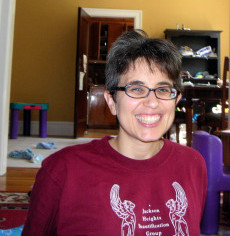
Among other resources, I follow Julie Wiener’s (her photo is on the left) In the Mix blog at The Jewish Week. Although I don’t have anything like the same intermarried experience Ms. Wiener and her husband (and children) have, it sometimes helps to realize that not only are there other intermarried couples out there, but that they’re not doing so badly either. Nearly a year ago, Wiener wrote a blog post called Shiny Happy Intermarried People.

The ending of that article goes like this:

Reminds me of when my “In the Mix” column first came out six years ago and a woman wrote to complain that it was bad enough I was writing in The Jewish Week about being intermarried, but the fact that I was happy — and actually smiling in my photo — was truly offensive.

Now, as you can imagine, I took issue with Alina using The Jewish Week as an example of media writing only negative things about intermarriage. Especially because the column she links to is Jack Wertheimer’s, which was a guest column and which I, a Jewish Week editor, responded to on The Jewish Week website, on THIS BLOG, which has as its sole focus realistically depicting intermarried life.

Not that I’m offended or anything, Alina. Just intrigued.

For any of you readers, Jewish or Christian (or anyone else) who are offended that I’m intermarried, have been intermarried for thirty years, and plan to stay intermarried to the same Jewish woman for the rest of my life, I am truly sorry. When we got married, neither one of us were religious and we didn’t give a second thought to what it would all mean ten, twenty, thirty or more years down the road. Maybe we should have, but we didn’t. Who knew?

But we are who we are and while you may complain about us, I insist that you don’t dismiss us. We’re here and we’re real. There are a lot of us and what was done cannot be undone, for good or for ill. Hopefully, we’ll have a seder in our home this year. I plan on going to Easter services at my church for the first time in many years. That may seem like a strange combination or an awful contradiction but it’s not. A Christian/Jewish intermarriage may not be the ideal circumstance and you may not want to experience it yourself. Our intermarriage has its pitfalls and trapdoors, but our marriage and our family isn’t strange or bizarre or bad. It’s just our life and its just who we are.

And God is still her God and my God and what He has brought together let no one tear apart.

Oh, and our thirty-first wedding anniversary is on Wednesday, April 3rd. Deal with it.