Tag Archives: Christianity

Dogma on a Leash

dogma-on-a-leashChristian theology is the enterprise which seeks to construct a coherent system of Christian belief and practice. This is based primarily upon the texts of the Old Testament and the New Testament as well as the historic traditions of Christians. Christian theologians use biblical exegesis, rational analysis, and argument to clarify, examine, understand, explicate, critique, defend or promote Christianity. Theology might be undertaken to help the theologian better understand Christian tenets, make comparisons between Christianity and other traditions, defend Christianity against objections and criticism, facilitate reforms in the Christian church, assist in the propagation of Christianity, draw on the resources of the Christian tradition to address some present situation or need, or for a variety of other reasons.

“Christian theology”
Wikipedia

Your pastor Randy seems to be a Calvinist. Calvinism is one of the most disturbing (and erroneous) christian theologies that I’ve come across.

I extensively addressed the issue of Calvinism on my old blog site and I found that no other topic inspired so many hostile comments:

In your article you write:

“Think about it. It’s all Adam’s and Eve’s fault. They are the only ones who ever had a choice. According to ‘Divine Election,’ “

However the Calvinist view isn’t even as “fair” as that. According to Calvin:

“God not only foresaw that Adam would fall, but also ordained that he should….I confess it is a horrible decree; yet no one can deny but God foreknew Adam’s fall, and therefore foreknew it, because he had ordained it so by his own decree” (Cal. Inst., b. 3, c. 23, sec. 7).

-Onesimus, from comments he made on the blog post
Lancaster’s Galatians: Sermon Three, Paul’s Gospel, and the Unfair Election

I had a kind of revelation this morning (as I write this) while driving to work. Christians have a strong tendency to be critical of the “man-made rulings” of the Jewish sages and rabbis that are binding to various branches of Judaism. Particularly in Orthodox Judaism, Christians see the rabbinic rulings overriding the word of God and elevating the sages to a higher standing than God’s written word.

But I think Christians do exactly the same thing. Consider the words of Onesimus I quoted above. There are all manner of Christian “sages,” such as John Calvin, who issue proclamations that are considered binding by their followers.

I’m really ignorant of all the different doctrines, creeds, and dogmas running around out there, so it’s difficult for me to compare them, let alone claim a specific path for my very own. Trying to look up a comparative list of Christian doctrines is difficult, and the best I could do was About.com. In comparing, for example, Calvinism and Arminianism relative to Divine Election, I found this:

  • Calvinism – Before the foundation of the world, God unconditionally chose some to be saved. Election has nothing to do with man’s future response.
  • Arminianism – Election is based on God’s foreknowledge of those who would believe in him through faith. In other words, God elected those who would choose him of their own free will. Conditional election is based on man’s response.

These are both perfectly acceptable Christian doctrines, but they contradict each other. They are also binding doctrines in terms of the individuals and churches who follow them. How is that different from Jews who choose to follow the dictates of Reform Judaism, vs. those who adhere to Orthodox Judaism or even the Chabad?

The first Big Issue is this: If I’m going to switch my focus to the New Testament, should I continue following all the rules of the Hebrew Bible? In other words, should I keep my beard and fringes? Or should I break out the Gillette Mach3 and order shrimp fajitas?

After asking this question to pretty much every Christian expert I meet, I’ve come to this definitive conclusion: I don’t know.

You can find a small group – a very small group – of Christians who say that every single Old Testament rule should still be followed by everyone. The ultralegalist camp.

On the other end of the spectrum are those Christians who say that Jesus overrode all rules in the Old Testament. He created a new covenant. His death was the ultimate sacrifice, so there’s no need for animal sacrifice – or, for that matter, any other Old Testament laws. Even the famous Ten Commandments are rendered unnecessary by Jesus.

-A.J. Jacobs
“Month Nine: May”, pp 254-5
The Year of Living Biblically: One Man’s Humble Quest to Follow the Bible as Literally as Possible

AJ-Jacobs-bibleI just finished this book, which Pastor Randy lent me, and Jacobs illustrates quite graphically how the Bible, and particularly Christianity, seems so strange when looked at from a complete outsider’s point of view. He had some familiarity with religious Judaism since he’s a secular liberal Jewish person and has religious relatives.

However, in his inventory of the different “Christianities” he was able to contact, he showed his readers quite dramatically how hard it would be to choose one particular path and call it the “right” one. He contacted a number of Christian scholars and pastors to act as advisors, and visited such diverse groups as Answers in Genesis, Jerry Falwell’s MegaChurch, a Gay men’s Christian Bible Study in New York, and a group of “snake handlers” in Tennessee. It doesn’t get more “mixed bag” than this.

Day 292. I’ve got a decent biblical library going now. Perhaps a hundred books or so. And I’ve divided them into sections: Moderate Jewish. Fundamentalist Jewish. Moderate Christian. Fundamentalist Christian. Atheist. Agnostic. Religious Cookbooks.

I’ve tried to keep the conservative books on the right side and the liberal ones on the left. When I started my year, I thought that nothing would go to the right of my Falwell collection. But of course, I was wrong…

-Jacobs, pg 292

Of course, Jacobs was trying to live the Bible as literally as possible, so he skewed his sampling of Judaism and Christianity to those branches that express themselves in a more literal and often, fundamentalist manner. But even restricting himself to those particular “Christianities,” it was still confusing.

There’s a phrase called “Cafeteria Christianity.” It’s a derisive term used by fundamentalist Christians to describe moderate Christians. The idea is that the moderates pick and choose the parts of the Bible they want to follow. They take a nice helping of mercy and compassion. But the ban on homosexuality? They leave that on the countertop.

Fundamentalist Jews don’t use the phrase “Cafeteria Judaism,” but they have the same critique. You must follow all of the Torah, not just the parts that are palatable.

The point is, the religious moderates are inconsistent. They’re just making the Bible conform to their own values.

The year showed me beyond a doubt that everyone practices cafeteria religion. It’s not just the moderates. Fundamentalists do it too. They can’t heap everything on their plate. Otherwise, they’d kick women out of church for saying hello (“the women should keep silence in the churches. For they are not permitted to speak…” -1 Corinthians 14:34) and boot out men for talking about the “Tennessee Titans” (“make no mention of the names of other gods…” -Exodus 23:13).

-Jacobs, pp 327-8

There’s nothing like having an outsider sincerely look at your faith to give you (or me, in this case) fresh perspective.

In reading Jacobs’ book or reviewing the websites I’ve mentioned so far, I wasn’t really satisfied that I got a good look at the different “Christianities” so I kept searching and found a chart of the differences between denominations at religionfacts.com.

It’s too long to quote from in any meaningful fashion, but if you take a look that page, you’ll see how many different ways there are to apply the different Christianities to different doctrines and topics (Trinity, Nature of Christ, Holy Spirit, Original Sin, Free Will, and on and on and on).

So when Pastor presents his point of view and backs it up with scripture, it’s not the only valid Christian point of view. If I disagree with him or even if I am aghast at something he says, it doesn’t automatically mean I have to agree with him, even if I can’t immediately come up with Bible verses that state another perspective.

I remember being told (in a seminary class) that we must choose between Armenian or Calvinist theology. I found it strange to be forced into an either/or position like that.

-Ruth on Facebook

If I were to run all this past the Apostle Paul, what would he say? Would any of this even make sense to him? Would he advise me to take a Calvinist or Armenian approach, or would he think both were equally dodgy? I don’t know. I have said that I think religion evolves over time to meet the needs of each generation, but there’s a difference between adaptation to adjust to new technologies or social situations, and totally new ways of understanding the basic nature a completely unchanging God.

rabbinThe following story is said of Moses (see Menachot 29b.) that when he was about to receive the Torah from God, he saw God attaching crowns to the letters. Moses asked why God was doing this and God answered, “There is a man who will live many generations after you and his name is Akiva, son of Yosef. He will examine every single spike of every letter and draw from them piles upon piles of halachot.”

To help Moses understand, God allowed Moses to visit a class of Rabbi Akiva. As Moses listened to the esteemed Rabbi’s teaching, he couldn’t follow any of it and “became weak with despair.” At the end of the Rabbi’s explanation, a student asked him, “Where do you learn this from,” and the Rabbi replied, “This is an oral tradition passed down from Moses.”

“By those words, Moses was set at ease.”

(see Is It Really the Torah, Or Is It Just the Rabbis for more)

This is midrash and I don’t believe God literally sent Moses forward in time to visit Rabbi Akiva in the early First Century of the common era (but what do I know?), but this tale is meant to illustrate how there can be new interpretations of our original Biblical data designed to illuminate subsequent generations. There are no doubt many matters in Judaism that Moses could not anticipate, so he wouldn’t have looked at the Torah in those ways.

No doubt, there are many issues in modern Christianity that would have escaped Paul, so he wouldn’t have written any of his letters addressing them.

Still, how far afield can Christian doctrine go before it completely escapes the bounds of the intent of the writers of the Bible and more than that, the intent of God? Does God require that we choose between Armenian or Calvinist theology or can we be servants of the Most High and disciples of our Master without doing so?

Is that like asking if a religious Jew can be a good Jew and not choose between the halachot specific to a particular branch of Judaism? If it is, then Christianity is doing almost exactly what Judaism is doing. The only substantial difference, is for Christianity the required responses are largely conceptual (what you believe), and for Judaism the required responses are largely behavioral (what you do).

Maybe we Christians should cut religious Jews some slack or stop being so dogmatic with our doctines…or both.

Easterphobia or Why Do You Have to Throw Christians Under a Bus?

i-hate-easterYour newfoumd (sic) respect for a holiday named after a goddess is coupled with a newfound (sic) contempt for Hebrew Roots.

While you say your new book is about respecting others, I notice in your blog posts, comments, and writings, the Hebrew Roots whom your organization once seved (sic) is referred to almost exclusively in the negative light. Your above comment is no exception.

Judah Gabriel Himango
from a comment on the blog post
God Fearers: Easter Ham or Passover Lamb?

If you’ve been reading my blog over the past few days, you’ve seen how my own recent Easter experience went as well as my own inability to make a connection to the observance. Nevertheless, I don’t think Easter is evil, wrong, bad, or pagan, whatever the origin of the name of the observance. I suppose my Pastor used terms such as “Resurrection Day” and “The Lord’s Day” last Sunday to get around that little problem, but since there were absolutely no bunnies or eggs present (well, eggs were probably served for brunch, but most likely they were scrambled), I didn’t see any obvious idolatry involved.

I didn’t want to write on the conflicts between some minority expressions of Hebrew Roots Christianity and the more traditional Christian churches, but when I read some of the comments on Toby’s blog post, including the one I quoted above, I couldn’t let it lie (and I didn’t want to start something again with Judah because I actually like the guy). My personal struggles are what they are, but I get a little tired of Hebrew Roots people playing the “superiority” card and saying that Christians in churches are terrible people because they won’t embrace some of the Hebrew Roots priorities. Frankly, such bigotry against Christians by these groups is ill-befitting of anyone who claims to be a disciple of Christ (or Messiah if that’s your preference).

I was just talking about this issue a couple of weeks ago when discussing the problem with religious people. If a religious person, particularly in a minority variant of Christianity which sees itself as above or superior to the majority of Christians, encounters other believers who hold different views, sooner or later, there’s going to be a “spitting match” in the blogosphere. I have tried avoiding blog posts such as this one because I didn’t want to participate in such a match, but where do I draw the line when I see unjust comments being made against believers by other believers?

I suppose I could have ignored this poorly considered jab against Christians who celebrate Easter and that would have ended it, at least from my point of view, but it was included in a collection of remarks that were direct responses to something I’d said on Toby’s blog. Yes, I still should have ignored it.

But I chose not to.

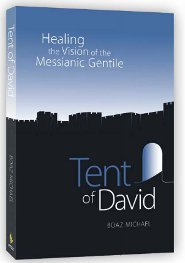
Boaz Michael, author of the book Tent of David, which I mentioned on Toby’s blog, corrected something I said:

TOD addresses Easter, “Another area of difficulty involves the observance of Christian holidays. Some churches heartily embrace some of the pagan-derived aspects of Easter and Christmas. Understandably, this makes many Messianic Gentiles uncomfortable. The simple solution is not to go during that time of year. It should not have too significant an impact on your relationships there to miss church for one or two weeks; in fact, it’s quite common for people to be out of town during holidays.”

tent-of-davidLate last year, I deliberately didn’t go to church for Christmas services for more or less the reasons Boaz stated, but to my way of thinking, Easter is the “higher” tradition as far as the church is concerned. The crucifixion and resurrection of the Master is at the center of all things and without these events, there would be no salvation for all of mankind. That the church should ignore something so vitally important seems ridiculous and while I believe the Passover Seder could have much meaning for Christians, it doesn’t always cover the full, expansive intent and glory of the risen King.

So I chose to attend Easter Sunday services at my church and did not consider such services optional. As I mentioned above, it wasn’t a spiritual “power surge” and I ended up feeling more disconnected from the community because of my lack of emotional attachment, but that has more to do with me than the importance of fellowship and the beauty of watching a new day dawning and knowing that the tomb is empty.

One of the other comments Boaz made addresses this point very well:

Actually, the consequence of Tent of David is not necessarily the celebration of Easter but rather a respect for those that do honor the resurrection of the Messiah. It is about learning to see the good in others, appreciating and valuing people’s attempts to connect with God. It is about learning to manage things Easter with love and care of the individual that is sincere in their intentions and efforts. It is about building relationships that will create bridges of dialog.

At the end of the day TOD is about respecting others, not assuming evil intentions, and a mission of transformation.

He said, It is about learning to see the good in others.” Isn’t that what we’re supposed to be doing?

Nevertheless, I’ll probably get “slam dunked” by my critics and my friends alike for how I’m wording all this, but what I’m writing at least has the benefit of sincerity and transparency. If you disagree with how different churches do things, then don’t go to those churches. If you have a problem with church in general, you don’t have to go to church. I don’t complain about where you go to worship. Why do you (whoever you are, since I’m addressing more than one disgruntled person at this point) have to complain about where I choose to worship?

I know Judah was complaining more to Boaz about TOD than he was to me, and I don’t think Judah intentionally disdains all people who go to church and call themselves “Christian” instead of “Messianic,” but the Boaz has a point. Even if we struggle with some of the practices in the church, we cannot dismiss her or her service to Christ. We must, since we also call ourselves disciples of Messiah, learn to see the best in others. After all, Christ died, even for those believers we may not like or don’t agree with. If Jesus thought his sacrifice, even for “those people,” was worth it, who are we to say he was wrong?

He Will Come

LionIn that day, the stock of Jesse that has remained standing shall become a standard to peoples — Nations shall seek his counsel and his abode shall be honored.

In that day, My Lord will apply His hand again to redeeming the other part of His people from Assyria — as also from Egypt, Pathros, Nubia, Elam, Shinar, Hamath, and the coastlands.

He will hold up a signal to the nations and assemble the banished of Israel, and gather the dispersed of Judah from the four corners of the earth.

Isaiah 11:10-12 (JPS Tanakh)

This passage from Isaiah is part of the readings for the last day of Pesach (Passover) which ends at sundown today (Tuesday). For any Christian, the imagery is immediately recognizable as describing Christ, and for a religious Jew, the Messiah is surely appearing here. We see part of the Messianic prophesy and what the King will do upon his return, such as bringing the scattered of Israel back to their nation from the four corners of the earth. He will also be a standard and a banner attracting we from the nations to seek his counsel and to honor his abode, which is the rebuilt Temple in Holy Jerusalem.

The last day of Pesach sends a message of hope to both the Jewish people and all human beings on earth that the Messiah will gather us all to him and he will be our King. Revelation 2:27 speaks of Messiah “ruling with a rod of iron,” which doesn’t sound pleasant, but it shows that King Messiah will have dominion and authority over everything and everyone. The Bible speaks at length about the Messiah and his rule.

It shall come to pass in the latter days
that the mountain of the house of the Lord
shall be established as the highest of the mountains,
and it shall be lifted up above the hills;
and peoples shall flow to it,
and many nations shall come, and say:
“Come, let us go up to the mountain of the Lord,
to the house of the God of Jacob,
that he may teach us his ways
and that we may walk in his paths.”
For out of Zion shall go forth the law,
and the word of the Lord from Jerusalem.

Micah 4:1-2

For the children of Israel shall dwell many days without king or prince, without sacrifice or pillar, without ephod or household gods. Afterward the children of Israel shall return and seek the Lord their God, and David their king, and they shall come in fear to the Lord and to his goodness in the latter days.

Hosea 3:4-5

While we in the church firmly understand and believe in the Christ, the Moshiach, in the person of Jesus; that he walked the earth once before and will dwell among us again, this has yet to be discovered by many, both Gentile and Jewish. But is can be discovered, just by watching Jesus and listening to him. Even a simple fisherman saw this.

When Jesus came to the region of Caesarea Philippi, he asked his disciples, “Who do people say the Son of Man is?”

They replied, “Some say John the Baptist; others say Elijah; and still others, Jeremiah or one of the prophets.”

“But what about you?” he asked. “Who do you say I am?”

Simon Peter answered, “You are the Messiah, the Son of the living God.”

Matthew 16:13-16

Who is Moshiach?Religious Jews all over the world desperately await Messiah, crying out to him, “How long?” In case you haven’t noticed, the world is a mess and particularly for the Jewish people, and particularly for the Jewish nation Israel, these are very hazardous times. Of course, times are always hazardous for the Jews and for Israel. It seems to be built into the very fabric of their existence that the world will always be against them. That is why it is so important for we Christians to support and uplift them. Many promises have been made about what Messiah will do for his people Israel and if the church isn’t standing for Messiah and for his nation and people Israel, then we stand against them; against Christ, very much at our own peril.

In writing about Moshiach (Messiah), the Rambam states in his Code of Law, Yad HaChazakah : “Whoever does not believe in him or does not await his coming, denies not only [the statements of] the other prophets, but also [those of] the Torah and of Moshe, our teacher, for the Torah attests to his coming, stating: ‘And the L-rd your G-d will bring back your captivity and have compassion upon you.’

-Based on the teachings of the Lubavitcher Rebbe
Rabbi Menachem M. Schneerson for Torah Portion Balak
“The Prophecies of Bilam”
Chabad.org

In honoring the week of Unleavened Bread by eating only matzoh and reading the daily readings for this season, we temporarily draw closer to Messiah and draw him closer to us. The church also celebrates Resurrection Day bringing glory to the risen King and looking to the hope of his return, even as the Jewish people look to his coming.

Our only hope is in continuing to believe that he will come, even as it says in the twelfth of Rambam’s Thirteen Principles of Faith:

I believe with complete faith in the coming of the Messiah. And even though he may delay, nevertheless, every day I anticipate that he will come.

A couple of years ago at this season, I wrote a blog post called Why Don’t Christians Count the Omer? It’s a serious question, since Jews and Christians both share Shavuot, though we in the church call it Pentecost. There’s another reason I ask the question, though. Jews and Christians also share the same desire and the same hope for Messiah, though we understand his specific identity differently. The person is the same person (most Jews will disagree with me, of course) and the hope is the same hope. Given that, why don’t we bind our anticipation together?

Could the Messiah return on Shavuot/Pentecost? There’s no way to know for sure. If he does, then counting the Omer is sort of like a “countdown” for Messiah’s appearance as we anticipate his “coming with the clouds of heaven” (Mark 14:62).

waiting-for-mannaA blogger who has asked to remain anonymous speaks of the Christian appropriation of Judaism and particularly the co-opting of the Seder for the Communion story, but while I share her desire to protect Judaism from Christian misuse, I can’t help but see the parallels. I can’t help but see my Christ and my King in the classic Jewish and Christian texts. The Messiah is there, and for those who believe, we are all waiting for him.

His “face” has been very visible and clear to me this week and I wonder, shouldn’t all Christians be celebrating Pesach, not to steal from the Jews, but to come along side them, joining our hope with theirs? Shouldn’t we also be counting the Omer, not to appear more “Jewish” but to long for the Messiah we see in the ancient Holy texts of Israel?

A bottom line requisite to bring about redemption is to eagerly “await” the Messiah with a genuine burning desire. Whether he comes in our time or, God forbid, not, we are both held accountable and credited for the quest. Nothing stands in the path of willing. We must will, long, yearn, desire, quest, beseech and pray. But as to the actualization of that long awaited promise, we must defer to the unfathomable wisdom of the Almighty.

-Rebbetzin Feige Twerski
“Bringing the Messiah”
Aish.com

Rebbetzin Twerski concludes her article by inspiring her readers to be mindful of their actions, always behaving in a manner that pursues Messiah rather than material things, to pray for others, for an end to misery in the world, and an end to the pain of God, who some Jews believe suffers right along with His Creation. And she tells us to hope, yearn, anticipate and have faith.

As it is said, “I believe with complete faith in the coming of the Messiah. And even though he may delay, nevertheless, every day I anticipate that he will come.”

Shabbat Chol HaMoed Pesach: Mercy

hosea-and-gomerSo Moses cut two tablets of stone like the first. And he rose early in the morning and went up on Mount Sinai, as the Lord had commanded him, and took in his hand two tablets of stone. The Lord descended in the cloud and stood with him there, and proclaimed the name of the Lord. The Lord passed before him and proclaimed, “The Lord, the Lord, a God merciful and gracious, slow to anger, and abounding in steadfast love and faithfulness, keeping steadfast love for thousands, forgiving iniquity and transgression and sin, but who will by no means clear the guilty, visiting the iniquity of the fathers on the children and the children’s children, to the third and the fourth generation.” And Moses quickly bowed his head toward the earth and worshiped. And he said, “If now I have found favor in your sight, O Lord, please let the Lord go in the midst of us, for it is a stiff-necked people, and pardon our iniquity and our sin, and take us for your inheritance.”

Exodus 34:4-9

Moses pleads with the Almighty not to send an angel in His place, but to accompany the Jewish people Himself through the trek in the wilderness even though they had sinned with the Golden Calf. Moses asks the Almighty to reveal how He interacts with the universe (it is a mystical interchange). Then the Almighty commands Moses to carve two stone tablets and to ascend Mt. Sinai so that He can engrave the replacement tablets for the set that Moses broke at the transgression with the Golden Calf.

The Almighty reveals his Thirteen Attributes of Mercy (Exodus 34:5) which we repeat on Yom Kippur and other times of seeking the Almighty’s mercy. Moses asks the Almighty to forgive the Jewish people. The Almighty renews the Covenant with the Jewish people commanding us not to enter into a covenant with the inhabitants of the land, not make molten gods, to observe the Festival of Matzos, laws of first born issue, to keep the Shabbat, celebrate Shavuot and Sukkot and ends with assorted laws of offerings.

-Rabbi Kalman Packouz
“Shabbat Shalom Weekly”
Commentary on Shabbat Chol HaMoed Pesach
Aish.com

Based on yesterday’s extra meditation, I’m having second thoughts about God’s attribute of mercy. I realize that I’m still caught up in the dynamic interplay between the actual nature of God and what we draw from the Bible about Him. We can’t know God fully since He’s an infinite being. We can (sort of) know the Bible, since it is a finite document, though as I repeatedly discover, it’s a tough book to know.

There is so much that is beautiful in the Bible, so much mercy, so much grandeur, so much compassion from our infinite God.

And then there are some pretty difficult things to try to understand about God, at least based on how we understand the Bible.

But I should talk.

I keep trying to convince Christians that God didn’t cancel Torah observance for the Jewish people just because of Jesus. It’s an “unfortunate truth” of the Bible (well, not unfortunate for me) for many Christians, once they see it. So why am I complaining about Pastor Randy pointing to another “unfortunate truth” about the Bible that I don’t want to face. He doesn’t want to accept that Jewish believers in Jesus still wanted to keep the Torah and were still obligated to keep the Torah, even though the Gentile disciples had no such obligation. I don’t want to accept that God chooses which people are going to be saved and which ones aren’t going to be saved from before they were born.

shattered-glassYou either draw the winning lottery ticket and get saved or you don’t draw it and well…tough luck on you.

I have to write these “morning meditations” one day early so you’ll have them when you wake up each day. That means what you are reading for Friday, I’m writing on Thursday, when I’m still stinging about the whole “Divine Election” thing. I don’t really have a plan for this blog post, I just need to have something ready for Friday and I still need to let off steam. But I’m feeling a little shattered now and I need to hear something from God.

There will come a time, very soon, when we will be shown miracles so great, they will make the Ten Plagues and the splitting of the Red Sea appear as ordinary as nature itself.

So great, no mind can begin to fathom them;
so powerful, they will transform the very fabric of our world, elevating it in a way that the wonders of the Exodus never did.

For then, our eyes will be opened and granted the power to see the greatest of miracles: Those miracles that occur to us now, beneath our very noses, every day.

-Rabbi Tzvi Freeman
“Greater Miracles”
Based on letters and talks of the Rebbe
Rabbi M. M. Schneerson
Chabad.org

Before difficulties arise, think in advance about what could go wrong, and then try to work out potential solutions. By devising a variety of solutions, you will be prepared to cope in a productive manner with whatever contingency may arise.

Today, think of one potential difficulty that might arise in your life. Brainstorm with yourself and think of five possible solutions.

-Rabbi Zelig Pliskin
“Daily Lift #772, Plan for Difficulties”
Aish.com

The problem is, I never saw this one coming. I was completely blindsided. So here I sit, munching on a bit of matzoh and cream cheese (foregoing the morning bagel) and pondering God’s “mercy.”

Or man’s.

I have to remember that doctrine is what human beings come up with when they read the Bible (or any holy book, I suppose) and codify beliefs into a body of teachings or instructions that are then meant to be consumed and absorbed by the “faithful.”

Often doctrine specifically connotes a corpus of religious dogma as it is promulgated by a church, but not necessarily: doctrine is also used to refer to a principle of law, in the common law traditions, established through a history of past decisions, such as the doctrine of self-defense, or the principle of fair use, or the more narrowly applicable first-sale doctrine. In some organizations, doctrine is simply defined as “that which is taught”, in other words the basis for institutional teaching of its personnel internal ways of doing business.

Wikipedia

A little over a week ago, I said that the problem with religious people is that they all want you to believe what they believe. I guess that’s the problem with me too, since I keep sharing my point of view on both ancient and modern Jewish disciples of the Messiah, and how I believe that a Jew having faith in Jesus is not incompatible with a life of Torah observance for that Jewish person.

Yeah, I guess I can’t complain…but I’m going to, anyway.

Passover is supposed to be the commemoration of coming out of slavery and into redemption and freedom thanks to God. For a Christian, we can see a picture of our coming out of slavery to sin and into redemption and freedom by faith through the grace of Jesus Christ. I just need that to include all human beings everywhere, not that everyone will be saved, but everyone needs to have a chance. Otherwise, why did God create 99 percent of the human race?

But do not overlook this one fact, beloved, that with the Lord one day is as a thousand years, and a thousand years as one day. The Lord is not slow to fulfill his promise as some count slowness, but is patient toward you, not wishing that any should perish, but that all should reach repentance.

2 Peter 3:8-9

HopeThis gives me some small comfort. God, according to Peter, doesn’t desire that any should perish, but that all should reach repentance.

God desires that for us, but some small part of it has to be up to us. A free gift is only a gift if it is accepted. God holds a package calls “salvation” in his hand and offers it to us. The package is wrapped in pretty paper and has an attractive bow, but we can’t see inside the box. Some of us accept it and maybe more don’t. But everyone gets the opportunity to reach out, touch the hand of God, and take the gift.

If God only offers the package to those He knows will accept it and ignores the others, what does that make God?

I need to end this on a hopeful up note, not only for your sake, but for mine. Here goes.

Therefore, beloved, since you are waiting for these, be diligent to be found by him without spot or blemish, and at peace. And count the patience of our Lord as salvation, just as our beloved brother Paul also wrote to you according to the wisdom given him, as he does in all his letters when he speaks in them of these matters. There are some things in them that are hard to understand, which the ignorant and unstable twist to their own destruction, as they do the other Scriptures. You therefore, beloved, knowing this beforehand, take care that you are not carried away with the error of lawless people and lose your own stability. But grow in the grace and knowledge of our Lord and Savior Jesus Christ. To him be the glory both now and to the day of eternity. Amen.

2 Peter 3:14-18

But then, someone commented on yesterday’s “extra meditation” with this:

Does not Scripture teach that one’s final salvation depends on the state of the soul at death? As Yeshua himself tells us, “He who endures to the end will be saved” (Matt. 24:13; cf. 25:31–46). One who dies in the state of friendship with God (the state of grace) will go to heaven. The one who dies in a state of enmity and rebellion against God (the state of sin) will go to hell.

Did not Yeshua die on the cross freely for our sins….. and has He not returned to heaven to appear before God on our behalf? Has He, Himself, not provided for our salvation? (And while that does not mean there is no process by which this is applied to us as individuals, surely, we do have assurances.) And yet, while we, like Adam and Eve, can become unreconciled with God and need to come back and be reconciled again with HIM … is that not ALWAYS an option?

Maybe I’m not crazy after all for believing that God does love everyone and is not willing for anyone to be condemned without having a fair chance to get to know Him.

God please have more mercy than we think you do.

Good Shabbos.

Lancaster’s Galatians: Sermon Three, Paul’s Gospel, and the Unfair Election

voting-ballot-electionFor I would have you know, brothers, that the gospel that was preached by me is not man’s gospel. For I did not receive it from any man, nor was I taught it, but I received it through a revelation of Jesus Christ.

Galatians 1:11-12

What did Paul mean by “man’s gospel”? He did not mean a false gospel, or a corrupt gospel, or something fleshly and worldly. He meant to differentiate the way that he became a believer from the way that people ordinarily became believers in that day, and he wanted to differentiate between his gospel message and the one the other believers ordinarily proclaimed in his day.

-D. Thomas Lancaster
“Sermon Three: Paul’s Gospel (Galatians 1:11-24)” pg 33
The Holy Epistle to the Galatians

I’m depressed. I’m hitting walls I didn’t know were there, probably because I don’t have much of a formal education in theology or Bible studies.

But let’s go back to the beginning.

Last night was my scheduled Wednesday night conversation with Pastor Randy. I arrived at his office as he was finishing his dinner salad for our discussion on Chapter Three of Lancaster’s book. We ended up talking about topics that didn’t directly relate but were nonetheless interesting (Revelation and the rapture, and the age of the universe, but those are topics for a different time).

As I said in my previous blog post, we’ve been searching for some common ground on the definition of “Torah,” and that does figure heavily into last night’s conversation and this missive.

We focused on Paul’s “my gospel.” Pastor Randy and I agreed that Paul literally wasn’t preaching a separate gospel from the one taught by the other apostles or the one that we have with us today. The differentiation, as we both understood it, was how Paul received the gospel vs. just about everybody else. Paul didn’t take lessons from James and Peter, he received his information, at least initially, directly from Jesus through supernatural means.

“As I was on my way and drew near to Damascus, about noon a great light from heaven suddenly shone around me. And I fell to the ground and heard a voice saying to me, ‘Saul, Saul, why are you persecuting me?’ And I answered, ‘Who are you, Lord?’ And he said to me, ‘I am Jesus of Nazareth, whom you are persecuting.’ Now those who were with me saw the light but did not understand the voice of the one who was speaking to me. And I said, ‘What shall I do, Lord?’ And the Lord said to me, ‘Rise, and go into Damascus, and there you will be told all that is appointed for you to do.’ And since I could not see because of the brightness of that light, I was led by the hand by those who were with me, and came into Damascus.

“When I had returned to Jerusalem and was praying in the temple, I fell into a trance and saw him saying to me, ‘Make haste and get out of Jerusalem quickly, because they will not accept your testimony about me.’ And I said, ‘Lord, they themselves know that in one synagogue after another I imprisoned and beat those who believed in you. And when the blood of Stephen your witness was being shed, I myself was standing by and approving and watching over the garments of those who killed him.’ And he said to me, ‘Go, for I will send you far away to the Gentiles.’”

Acts 22:6-11, 17-21

According to Lancaster (pg 36), the difference between man’s gospel and Paul’s gospel is that Paul’s gospel teaches:

  • Gentiles can inherit eternal life.
  • Gentiles can become part of the Kingdom of Heaven.
  • Gentiles can experience resurrection from the dead.
  • Gentiles have standing among the people of God (i.e., Israel) without becoming Jewish.

It certainly seems to me that Paul “pioneered” the idea that Gentiles could become full covenant members of “the Way” without having to convert to Judaism, but did Paul write his letter before or after Peter’s encounter with Cornelius in Acts 10? Assuming it was after, did Paul know about that encounter? And how do we know that Jesus gave Paul specific instructions relative to the Gentiles that no one else had, particularly by the time he was writing his Galatians letter?

I’m not saying it’s impossible, but Paul still had to come under the authority of the Jerusalem Council, so he couldn’t “shoot from the hip” as far as his ministry to the Gentiles was concerned. The whole point of Acts 15 was putting the status of Gentiles in the Way to the test to determine if they had to convert to Judaism or not. Even if Paul’s authority came directly from Messiah, he still had to respond to James and the Council of Apostles as the Master’s primary representatives in our world.

album-unsavedBut that’s not what worries me.

Pastor and I got around to talking about what Jesus did for the Jewish believers (what he did for the rest of us should be obvious…but apparently it isn’t). I said that he fulfilled the Messianic promises and gave hope for redemption, not only for individual Jews but for the redemption of national Israel. So what did the Jews do for salvation before Jesus? Did the sacrifices in the Temple and earlier, in the Tabernacle save?

No, of course not. Faith is what saves. That goes all the way back to Abraham. It wasn’t the sacrifices as such, but due to their faith, the Jews were saved and they fulfilled the requirement of the sacrifices out of obedience. It’s always been about faith in God, otherwise millions upon millions of Jews who had lived before the birth of Christ would have been set up for failure.

Pastor Randy agreed.

But…

And when the Gentiles heard this, they began rejoicing and glorifying the word of the Lord, and as many as were appointed to eternal life believed.

Acts 13:48

I added the emphasis above to make a point.

I’ve probably heard of the Christian Doctrine of Election before, but never in any real detail. According to Paul (Ephesians 2:8), “for by grace you have been saved through faith. And this is not your own doing; it is the gift of God.” OK, I get that. There’s nothing I can do to earn salvation. No matter how many good deeds I commit, that doesn’t add any “bonus points” to my “salvation score.” Only by the grace of God am I saved.

But what’s my part in the deal? It’s not like I just sit around watching television and God comes over and randomly “zaps” me with salvation. Don’t I do something? Well, Paul did say, “saved through faith.” That is, I have to choose to have faith in God through Christ in order to be saved.

But Pastor Randy asked if even the act of choosing to have faith a “work.” That seemed kind of a stretch to me. In order to be a part of anything, it really helps if you contribute something, even just a tiny bit, so as to have a sense of “ownership” in the process, including salvation.

Long discussion short, Pastor Randy says that God preselects individuals to have faith. Thanks to Adam and Eve, we are all born into a state of sin as our basic nature. We can’t help it. We have no say in the matter. But here’s the kicker. Supposedly, we also have no say in the matter in regard to being saved. By nature, we all would reject Christ if given a choice, because of that nature. Only God implants faith in a human being and only those human beings who God has “programmed” to be capable of faith will ever be saved.

The rest of humanity, not so much. Fires of hell for them, no matter how many times they hear the words of the gospel.

One of my favorite sections of the Bible is the sequence that describes Jacob wrestling with the Angel. From a Jewish point of view, this gives human beings a broad license to “wrestle” with God on ethical and moral issues. We can actually debate God if we think He’s advocating for a position that is unfair or unjust. After all, Abraham did it in the matter of Sodom and Gomorrah. God doesn’t seem to mind.

But am I wrestling with God or with a specific Christian doctrine? I’m definitely wrestling with Pastor Randy. It was one of those times when I was acutely aware that his education in religious matters far, far outstripped my own, and I was absolutely fighting under my weight. It was like I was Justin Bieber trying to go a couple of rounds in the boxing ring with Mike Tyson.

I was going to get slaughtered.

Saying, “Hey, that’s unfair” or “That’s not right” doesn’t cut it if I can’t support my position from the Bible. God doesn’t have to be fair. He told Job that after all the arguing had stopped. He who makes the universe makes the rules. Fairness doesn’t come into play.

But in the aforementioned debate between Abraham and God, Abraham invoked God’s attribute of justice. If God is just, can He perform an unjust act?

Abraham,God_and_two_angelsIf God is just, is it right for him to automatically condemn some and probably most of the entire human race across all of history to eternal damnation and horrible, flaming agony, while preserving only a remnant…and absolutely none of those human beings have a choice in the matter?

Think about it. It’s all Adam’s and Eve’s fault. They are the only ones who ever had a choice. According to “Divine Election,” if you’re saved, it wasn’t your choice, you just got lucky. If you’re not saved, same deal. You just have really crummy luck.

This is why atheists say Christians are crazy and even cruel. I mean, it’s one thing if Jesus offers me the free gift of eternal salvation and I throw it back in his face. Then I can see how I’d deserve condemnation. But to never even have a shot at it?

Pastor Randy, at one point, shared how incredibly grateful he is to God for choosing him for salvation. That’s good for him and maybe good for me, but what about the poor, dumb, characters out there who are among the unchosen and don’t even realize what they’re facing…and if they did, there is absolutely nothing they can do about it. No amount of repenting of sins, turning to God, professing faith in Christ will save them.

Of course, according to Pastor Randy, they wouldn’t desire to do any of that anyway, but no one is born with that desire if we are all born in original sin. What’s the difference between Pastor Randy, who came to faith early in life, and me who came to faith after the age of forty? Was my program from God somehow slightly defective that it waited so long to start to run? I’d heard about Jesus for decades before I came to faith. How come my program didn’t kick in before it did?

However, there are other perspectives. According to Richard Land in his article at ChristianPost.com:

First, we must understand that the Bible reveals two different kinds of election, and much confusion has resulted from failing to see this distinction. Abrahamic Election is substantially different from Salvation Election. Abrahamic Election (Gen. 12:1-3) explains how God chose the Jews to be His chosen people. Salvation Election pertains to God’s elective purpose in how He brings about the eternal salvation of individual human beings, both Jew and Gentile, in both the Old and New Testaments.

Abrahamic Election is corporate, is to special people status, and is not related to anything. Salvation Election is individual and is to eternal salvation. In God’s providence, He has chosen to reveal His dealings with His people more fully in the New Testament. In doing so, a third difference between Abrahamic (corporate) and Salvation (individual) Election is underscored. God revealed in the New Testament that Salvation Election is somehow intertwined with, and connected to foreknowledge in a significant way (Rom. 8:29-30; 11:2; I Pet. 1:2).

“There is no question here of predestination to Heaven or reprobation to hell; …. we are not told here, nor anywhere else, that before children are born it is God’s purpose to send one to heaven and one to hell….The passage has entirely to do with privilege here on earth.” (Ironside, Lectures on the Epistle to the Romans, p. 116)

What if the Bible is telling us in the concept of “foreknowledge” that God does not just know all things that have, or ever will happen, as if they were the present moment to Him, but that He has, and always has had, the “experience” of all things, events, and people as a punctiliar present moment?

That makes a bit more sense and satisfies my personal value of justice. We all have free choice and can choose to accept or reject Jesus. God just knows what choice we’ll make because, while history and our lives seem like a movie that he have to live through frame-by-frame, God sees everything all at once, as if it were a snapshot.

I doubt that’ll satisfy Pastor Randy, and he admits agonizing over this issue before coming to a final decision, but if I have to err, I’d prefer to err on the side of mercy and compassion.

Because if Pastor Randy is right, how does anyone know if he’s really saved?

“Not everyone who says to me, ‘Lord, Lord,’ will enter the kingdom of heaven, but the one who does the will of my Father who is in heaven. On that day many will say to me, ‘Lord, Lord, did we not prophesy in your name, and cast out demons in your name, and do many mighty works in your name?’ And then will I declare to them, ‘I never knew you; depart from me, you workers of lawlessness.’

Matthew 7:21-23

condemnedObviously, not everyone who thinks they’re saved is really saved. Mistakes will be made and errors encountered. What if someone who isn’t supposed to be saved becomes convinced and believes they have faith in Jesus. Maybe they really don’t, but they think they do. It’s not like they’ve made an internal error in thinking, they just aren’t “programmed” to be saved. It’s impossible, from a Divine Election point of view, for that person to be saved.

So on the last day, they find out, “Oops, I’m condemned” and appeal to Jesus and he blows them off, just like that.

Not that it was the person’s fault because they had no choice in the matter!

You can see why I’m depressed and a little disgusted. I think I can remain a Christian and still not have to marry the “Divine Election” theory because if that were the only option, my faith would hang in the balance.

In my last blog, I said:

No human being is a perfectly neutral, objective observer. We all tend to read the Bible, even in its original languages, in terms of what we already “know” about it; that is, what we already believe is says. We translate the ancient Greek and Hebrew text in a manner usually consistent with those beliefs and that means we generally never surprise ourselves with the outcome.

The Bible is the Bible, but doctrine is man-made. The fact that there’s more than one way to interpret how people get saved means there’s more than one way to view the Bible, and thus, God. Right now, I’m a little too upset to go into cold, dispassionate research on this matter, weighing the pros and cons. Right now, if God really is programming us like little widgets, deliberately condemning people to eternal damnation for no better reason than they were just born as human beings in a fallen world, then I am up for a good old fashion wrestling match with God.

I’ll probably lose…but so have billions of other human beings out there. They never had a chance.


The Interwoven Passover Seder

hagadaLeader: God is my strength and my song, and God has become my triumph.

Group: And we will praise our God forever.

Leader: The stone which the builders rejected has become the chief cornerstone.

A Passover Haggadah

The stone that the builders rejected has become the cornerstone.

Psalm 118:22

Jesus said to them, “Have you never read in the Scriptures: ‘The stone that the builders rejected has become the cornerstone…'”

Matthew 21:42

That kind of caught me by surprise Monday night.

But let me start at the beginning.

I went through the Haggadah several times to make sure I was familiar with the reading, using little sticky arrows to point to places I needed to skip or pay close attention to (especially where to break for the meal). Last year, I tried reading the Haggadah cold with no preparation at all and became quickly lost (where’s the part I’m supposed to read when it’s not Shabbat?). There are all kinds of songs in the Haggadah I’m not familiar with so where do I read and where do I skip and when I skip, what page do I skip to?

My son, who I commute to and from work with, had an appointment after work on Monday he forgot about, so we had to detour from the plan of getting home in plenty of time to help prepare the meal to getting home with not a lot of time to spare.

Fortunately, my other son has the week off and had spent most of the day with my wife helping her out, so when I got home, everything was under control. All I had to do was cook the chicken and pick up my daughter from work. The only hiccup I introduced was I had taken a copy of the Haggadah to work to go over it one more time before the Seder. When I showed up with it at home that evening, the missus got that “Ah ha! That’s where the other one went” look on her face, but after that, all was well.

By 7:20 that night, everything was in order. Tons and tons of food had been prepared. The formal dining room table was set. Everyone was present. We were ready.

My four-year old grandson was very patient with us. I was wondering how he’d tolerate sitting at the table for long periods of time while we were reciting from the Haggadah. Fortunately, long road trips in the van have helped him to know when and how to sit still.

And he likes matzah.

We praise You, God, Sovereign of Existence! You have called us for service from among the peoples, and have hallowed our lives with commandments. In love You have given us [Sabbaths for rest,] festivals for rejoicing, seasons for celebration,, this Festival of Matzot, the time of our freedom, a commemoration of the Exodus from Egypt. Praised are You, Lord our God, Who have us this joyful heritage and Who sanctifies [the Sabbath,] Israel, and the festivals.

-from the Haggadah

“You have called us for service from among the peoples…hallowed our lives with commandments…You have given us…the time of our freedom…Who gave us this joyful heritage and Who sanctifies [the Sabbath,] Israel…”

Remember, the family Goy is the leader of the Seder in my home and I’m the one reading all of this. I couldn’t figure out any way to read from the Haggadah and not imply that somehow I thought all this applied to me and that I was claiming to be Israel (though I’ve been acquainted with just a few Christians who call themselves “Israelites” and claim pretty much everything that’s Jewish without so much as a by your leave).

But it was more my issue than anyone else’s. I don’t think my wife or children expected me to change the text just to accommodate my “Gentile-ness.” It was really the only thing left that was bugging me about our intermarried Seder.

I decided to let it slide.

(I should say that I was feeling kind of guilty in blogging and even visiting the Internet on Tuesday morning, but I saw a significant number of Jewish believers already posting blogs and comments on Facebook, so apparently, I’m not a horrible person…in their eyes at least…for doing what I’m doing now…I guess it’s up to God to decide how He wants to respond to our online “work.”)

Then I read the quote in the Haggadah from Psalm 118 that is echoed in Matthew 21, Ephesians 2:20, and 1 Peter 2:7. I know the Haggadah wasn’t referencing any of the New Testament quotes, but remember, I said that I intended to allow the Seder to have a double meaning for me, not just addressing the traditional Passover for the Israelites, but the Messianic application as well:

And when the hour came, he reclined at table, and the apostles with him. And he said to them, “I have earnestly desired to eat this Passover with you before I suffer. For I tell you I will not eat it until it is fulfilled in the kingdom of God.” And he took a cup, and when he had given thanks he said, “Take this, and divide it among yourselves. For I tell you that from now on I will not drink of the fruit of the vine until the kingdom of God comes.” And he took bread, and when he had given thanks, he broke it and gave it to them, saying, “This is my body, which is given for you. Do this in remembrance of me.” And likewise the cup after they had eaten, saying, “This cup that is poured out for you is the new covenant in my blood.”

Luke 22:14-20

candleI admit, I didn’t have a spiritual power surge during the Seder but I had fun. I had fun in the sense of satisfaction at watching my family gather and celebrate the Seder together. I had fun watching my grandson trying to understand why Bubbe was taking him to the front door to see if someone named “Elijah” was there. I had fun watching him really, really, enjoy matzoh ball soup.

I had a feeling of warmth, like the lighting of the candles at the beginning of the reading.

I was glad to be there and participating in the “reminder” to my wife, my sons, and my daughter, that they are Jewish and that who they are and where they come from has a meaning that is unlike any other people and meaning that has ever existed or will ever exist. Even in Christianity, we are not born into a covenant. We cannot consider ourselves as having stood at the foot of Mt. Sinai to receive the Torah (although it wouldn’t hurt for us to picture ourselves standing at the foot of the cross and watching Jesus slowly die for our sins).

I did have a “light to the world” moment earlier on Monday morning at work, though. The person who sits right behind me is a very kind and gentle Catholic man. Another of the people who arrives as early to work as the two of us is a Christian woman. The subject of our conversation turned to Passover and within a few minutes, I realized that I had a captive audience, and I was explaining not only the traditional meaning of the Passover, but how I see it as a Christian, juxtaposing it against Easter.

As I’m writing this, I’m watching the “patterns” of Passover, at least in my life, weave in and out of my family, my friends, my understanding of God, taking on different colors and textures as Passover crosses from one of my worlds to the next. Passover is what it means to me as a tradition for my family. Passover is what it means to me as a Christian who acknowledges that my Lord and Savior is the Jewish Messiah King. Passover is what it means to me when, as a Christian, I share my understanding of its observance with others around me.

And in some way that is highly untraditional in the Christian and Jewish worlds, Passover is one of the bridges that crosses the gap between me and God.

So when packing my lunch this morning, among other food items, I inserted the obligatory pieces of matzah. They act, not only as nourishment, but as conversation pieces with my co-workers. They also act as reminders of the body of Christ, which was broken for me and which symbolize the Covenant that attaches me to God; a Covenant that extends directly back to Abraham.

My faith in celebrating Passover as a Christian in a Jewish family has been restored, blissfully and peacefully. Would that the upcoming Easter Sunday observance of the resurrected Messiah be as meaningful.

But that is yet to come.