Tag Archives: church

Review of Loving God When You Don’t Love the Church, Part Two

Why is it that people who have been wounded in church will still be talking about their wounds years later? Why can people forgive a betraying friend or experience a business meltdown and move on with their life, but if it is a church that fails them, it is nearly impossible to let it go? Have you ever seen this dynamic in others? Have you ever lived it yourself?

-Pastor Chris Jackson
from Chapter 3: Church Wounds
Loving God When You Don’t Love the Church: Opening the Door to Healing (Kindle Edition)

Reviewing Pastor Jackson’s book (Here’s the link to Part One) is my way of attempting to respond to what I am calling a pesky challenge to find fellowship and community (or something) with like-minded believers. I’m not sure such a thing is possible for reasons I outlined yesterday, but since a friend asked me to consider it, I suppose I should.

A couple of days ago, Derek Leman wrote the blog post Gentiles Who Feel Left Out which sort of addresses my current situation but not really.

But first things first. To answer Pastor Jackson’s question, a great many Christians who have left the Church and affiliated with Messianic Judaism and/or the Hebrew Roots movements have lived out the dynamic he describes above. And seemingly in response, Leman wrote in the aforementioned blog post:

I also say to disenfranchised non-Jews not to give up on churches. Many have not tried really looking. Some came from churches with certain labels and assume they can only return to those places. Be more open minded. There are churches, often outside of evangelicalism, whose clergy are better educated (evangelicalism is heir to revivalist Christianity and tends to squash intellectual growth).

That may well be true for some Christians and some churches. After all, I’ve read that First Fruits of Zion‘s (FFOZ) HaYesod and Torah Club materials are being taught in churches. I’ve heard that episodes of FFOZ’s television program A Promise of What is to Come are viewed and then discussed in Sunday School classes in some churches. So it’s apparent that there are some Christian churches that are open to this perspective and to “Messianic Gentile” worshipers.

But I’m reviewing Pastor Jackson’s book through the lens of my own experience, so finding “the right church” and fitting in isn’t the entire solution. In fact, it really isn’t a solution at all.

I feel like I’m participating in Pastor Jackson’s statement of talking about my “hurt” months and even years later, but again, I’m only revisiting all this because I was asked. Also, everything has been resolved between me and the church I used to attend to the extent possible. That doesn’t mean there’s going to be reconciliation and return and, relative to my home life, even if I did return, it wouldn’t be helpful.

unworthyPastor Jackson, answering his own question, says “We don’t expect to get hurt in church.” That’s true. At least in an ideal sense, we expect “church” to be a safe place, maybe the safest of places, given how many Christians see secular society as unfriendly or even dangerous to religious people.

I only perceive church as “hazardous” to the degree that, at least in my own recent experience, what I believe is incompatible with how they define “sound doctrine.” Granted, it was only one church, but I do live in a pretty conservative part of the country and religious views in many local churches are also “fundamental”.

Pastor Jackson says one of the problems is that those hurt in churches are never heard. That is, they never get the opportunity to express their side of the story. That’s not the case with me. I had abundant opportunities to be heard by the Head Pastor and he listened to me at length. Jackson asked how there can be healing without closure. I have closure. I made a very definite decision on what to do in leaving church and why I was doing it. The door is closed. It’s over.

The end of chapter questions have to do with being accepting of differences, carrying around anger, and coming to the realization that some of your hurts may be your own doing.

I don’t think I understand the last question:

Do you know that God believes you can make it?

I’m not sure if Jackson means “make it” in life or “make it” in church.

In Chapter 4: The Other Life, Jackson makes an interesting statement:

Religion has left me parched and dry and wondering if it was really what God intended for me when He drew me into the other life.

By “other life,” Jackson means a life of faith and a personal journey with Christ. I find myself closer to God when I’m reading and studying the Bible (or writing this blog), so my “other life” is lived, for the most part, outside of any immediate fellowship. Although I don’t observe a proper Shabbat, I’m usually able to carve out a few hours to study the weekly Torah portion which often is the most rewarding part of my day and week. It’s the closest I come to the “other life”.

I read this next statement of Jackson’s and realized we conceptualize prayer in different ways:

A few weeks ago, I felt like the Lord spoke to me in one of my morning prayer times. I was journaling my thoughts to the Lord and then recording what I felt He was speaking to me in response.

Is that normal? Oh, I get the part about writing my thoughts down. I do that all the time. But writing down what I imagine God is saying back to me? Isn’t that substituting my personality for God?
prayerI’ve never heard audible voices from Heaven but on those occasions when I thought God was trying to tell me something, it was usually through an unusual set of circumstances. That’s what led me to attend that little Baptist church a few miles from my house for two years. I won’t go into the story, but an unlikely set of events occurred that led me to call the Pastor of that church, set up a meeting, and then decide to go to Sunday services. It was so unusual, I just couldn’t chalk it up to coincidence. I felt as if God wanted me to go to that church as a sort of Tent of David experience.

Either I was wrong and God didn’t want me to go to that church or God did want me to go and I blew it. But I’ll never know which one it was.

The Chapter 4 end of chapter questions address hearing the “other life” speaking to you and what it said, whether or not religious life stifled or accentuated that voice, and taking the road less traveled. Nothing that really connected to my experience.

In Chapter 5: Troubled Waters, Jackson says:

A great feeling of personal satisfaction ensures when we are fulfilling the commands of God.

Jackson surely doesn’t realize what a loaded statement that is in Messianic and Hebrew Roots circles when applied to a Christian. He did connect that to “serving our fellow man” which I felt was encouraging, because much of the Biblical message has to do with loving God by serving people. Tikkun Olam or “repairing the world” after all is the Jewish mission and the Church has inherited some of that whether they realize it or not.

Jackson was raised in a Christian home and has fond memories of church:

I know it helped me. I can’t imagine what my life would be like or what temptations I might have fallen into had I not been raised in a Christian home. Church has always been the backdrop of my earliest memories.

I periodically encounter a “life long Christian,” someone who came to faith early in life and who was raised in a Christian home. When I tell them I didn’t come to faith until I was about 40 years old or so, they are almost always astonished. From their point of view, it is inconceivable that someone could live the first half of their life as a “sinner” and then come to faith. It’s funny that Yeshua and Paul never seemed to have an age limit on repentance.

One of my earliest memories was of my parents being water baptized in a swimming pool.

Just thought I’d toss that quote in there.

Jackson includes a number of other pleasant childhood memories about church involvement. He calls it “a flowing current of life that overwhelms us.”

But a few pages later he says:

It’s happening every day, you know. People are leaving the church by the thousands. They’ve tasted what church has to offer and, still dissatisfied, they are abandoning organized Christianity in droves.

quitting churchJackson attributes this mass exodus away from local churches to people being mistreated, misunderstood, or just plain bored. He wisely states:

They’re not searching for a different gospel or a different God–they just want more of Him.

“Get to know Jesus better.” That phrase was used to promote the Torah Club a few years back. I think Jackson is right. I think a lot of Christians are reading the Bible for themselves and realizing that the Bible doesn’t say what they’ve been taught it says from the pulpit or in Sunday School.

In that sense, people may not all be leaving church because they’re hurt but because they’re “hungry”. Jackson says, “Jesus didn’t come to earth to institute a religion–He came to reveal God.” True. Jesus didn’t invent Christianity, he practiced a normative Judaism of his day, specifically Pharisaism (I know a lot of Christians who would be really upset at that statement). The invention of Christianity only came later, much later.

Jesus did come as Prophet and Messiah to reveal God, first to the Jews but ultimately, to the rest of the world.

Jackson doesn’t want that message to be contingent upon what the local church does or fails to do. But he also says:

God created us to be part of a community, and from the beginning He determined that it wasn’t good for man to be alone. We need the Church!

Well, that “not good for man to be alone” addressed Adam and having a suitable “helpmate”, not religious community as such. Also, I believe in Messianic Days the Church as most Christians conceptualize it, will cease to exist and be replaced by Messiah’s ekklesia (which does not translate into “Church” in English). Messiah will define the correct sort of community/communities for his Jewish and Gentile subjects.

At the end of this chapter, Jackson asked four questions, but only the last is relevant:

Do you think this is what Jesus wanted?

If he means the Church as it exists today, I’d have to say “yes and no”. I think he wanted communities of disciples who would obey his commandments to love God and to love others, doing good, feeding the hungry, giving hope to the hopeless, visiting the lonely, making peace in the home, which many churches do, but there’s a lot that has happened in the history of the Church he definitely didn’t and doesn’t want.

He absolutely didn’t want all of the crimes Christianity has committed against the Jewish people and Judaism. How could he? The Bible speaks of the Messiah coming (returning) to defeat Israel’s enemies and to judge those who have harmed his beloved Jewish people. Imagine Jesus judging all of the resurrected Christians across the ages who were taught to hate the Jews, who were taught that the Jews killed Jesus, who participated in burning volumes of Talmud, burning Torah scrolls, burning down synagogues, who tortured, maimed, and murdered countless Jewish people whose only crime was to faithfully cleave to the God of their fathers, and who died in pain while singing the Shema.

No, that isn’t want Jesus wanted, and in the resurrection, there are going to be a lot of shocked and dismayed Christians.

MessiahI realize this wasn’t what Pastor Jackson meant but his focus and mine are different. He’s talking to Christians who have been hurt by other Christians and who have chosen to respond by leaving community. But when you ask me what Jesus wanted out of “the Church,” I have an entirely different viewpoint.

At the end of Chapter 5, I’m still not finding much of what Jackson is writing that speaks to my own experience. If anything, as good a guy as I think Jackson is, what he has recorded in his book simply emphasizes for me how differently he and I understand God, Messiah, and the Bible.

I’ll continue my review in a few days.

Review of Loving God When You Don’t Love the Church, Part One

Where is the Church that Jesus said He would build? Where can I find the abundant life that He talked about? Where can I fit in and find real, unforced relationships? Where is the living water that my soul so desperately craves? And, possibly most important of all, why do church wounds go so deep and take so long to heal?

Pastor Chris Jackson
from Chapter One: Have You Ever Been Hurt in the Church?
Loving God When You Don’t Love the Church: Opening the Door to Healing (Kindle Edition)

As I mentioned yesterday, I’m going to review Pastor Jackson’s book in stages, mainly because I haven’t finished reading it yet. Since I’m reading it on my Kindle Fire, I’m simply going to address the parts of the book I’ve highlighted, such as the quoted text above.

I rarely read Christian oriented books anymore. I tend to be drawn more to Jewish publications in book, blog, and website formats. To read Jackson’s book, I have to push past a lot of what I call “Christianese” and past a lot of traditional Church doctrine. I’m attempting to set aside the temptation to review this Pastor’s theology, and instead to focus on what he has to say about loving God but not “the Church”. I don’t think I’ve been entirely successful.

For instance, in the quote above, I have to push past the fact that Jesus (Yeshua) never talked about a Church, but instead, he spoke of an ekklesia, a grouping or community, a Kehilla (Heb. “congregation”) of disciples.

Where is his Kehilla today? Pastor Jackson asked a more profound question than I think he could have realized.

But he asked another very important question. “Where can I fit in?” This is something Derek Leman blogged about just yesterday. For me, that’s one of the $64,000 questions, and I’ve been looking for an answer. In my case, in any immediate and practical sense, the answer is probably “nowhere” or at least nowhere within driving distance.

But what about the “church wounds” he mentions? Am I “wounded” by the church? Is that why I’m avoiding going “church hunting” like a pack or rabid pit bulls?

Not exactly. Oh, I admit, it wasn’t any fun having the Pastor of the church I used to attend devote an entire sermon to refuting every single thing I understand about the Bible from the pulpit. I think I’ve made my peace with that and him, but it also convinced me that I would be an antithetical element in just about any Christian church in my area (as far as I know). In that sense, I have been left rather “gun shy”.

churchOf course, as I’ve already mentioned, even if I found a church that would accept me into community and one that wouldn’t drive me crazy, I still have my long-suffering Jewish wife to consider. My attending church every week was like hammering nails into her temples each Sunday morning (not that she’s ever complained nor has she ever discouraged me from going to church).

How can I do that to her again?

Pastor Jackson also encourages his readers to separate God from the Church, or at least any pain caused by people in the local church:

He loves you. He’s longing for you. You are the Church. You are the apple of His eye, and He is pursuing you with the passion of a desperate lover. He is not the church that hurt you!

-ibid

Strange how “apple of His eye” and “lover of your soul” are terms from the Torah and Siddur that specifically describe God’s relationship to Israel, the Jewish people. But then, Derek also recently blogged about how Christians typically read all of the Bible as if it were addressed to Gentile believers rather than the Jewish people.

But I digress (again).

Yes, losing faith in the Church (or a local church) does not mean you must lose faith in God, but how long can faith be nurtured without community to support it? I don’t think I’m avoiding community because I feel hurt. I’m avoiding community because I’m incompatible with community and even if I weren’t, my being in community would have a profound impact on my home life. Solve that, Pastor Jackson.

At the end of the first chapter, just like the subsequent chapters, Pastor Jackson added some study and application questions:

  1. What are the primary hurts you are carrying from church?
  2. Are you willing to embrace a path that leads to healing?

I think I’ve answered the first question and the answer to the second is complex. Healing, even if I’m hurt or damaged in some sense, doesn’t necessarily mean reconciliation. It doesn’t mean returning to the church I left nor attending another, if for no other reason than my Christianity is a wound my Jewish wife must bear.

chris jackson
Pastor Chris Jackson

In Chapter 2, Pastor Jackson tells story about returning to his hometown and getting together with a friend. Jackson innocently asks about a mutual acquaintance and the conversation turns tense. Apparently this mutual friend did something unforgivable, he became a “covenant breaker” and was teaching his children to become the same thing.

My friend was silent for a moment as he considered the best way to break the terrible news to me. “No,” he said slowly. “He left the church. He disagreed with the leadership about somethings and decided to move on. Now his children are being taught that it’s okay to break covenant and bail out when things don’t go their way.”

-ibid, Chapter 2: The Left Behind

Break covenant? What covenant? That is, where in the Bible does it say that we non-Jewish believers are part of a covenant that specifically requires regular church attendance? Jackson doesn’t address the answer, so the concept of Christians having a covenant to attend church must be understood by him. Too bad that I don’t. There are still many parts of Christianity that seem so mysterious to me.

But the implication is that at least some Christians would consider me a “covenant breaker” for also not going to church. After all, I disagreed with the Head Pastor of the church I used to attend on a pretty regular basis, which led to some lively conversations in his office. We kept things friendly, but we really did (and still do) conceptualize the message of the Gospel in fundamentally different ways.

Though I’d probably disagree with Pastor Jackson in many areas as well, he tends to ask good questions:

I wondered why it is that we Christians can be so quick to write people off when they make decisions with which we disagree.

-ibid

leaving churchTouché, Pastor Jackson.

I’m just as guilty of writing off the Church as some people are of writing me off.

Jackson said he wishes “that every guest who visited my church would fall in love with us and never want to leave. I wish they would experience God, make lifelong friendships, receive training in the area of their giftedness and make an impact with us for the Kingdom of God.”

There’s a lot I could address in that brief statement, but the most relevant words he wrote were “experience God.” Theological and doctrinal differences aside, that’s at the center of our faith, experiencing God and then living out that experience day by day, helping others to experience Him, too.

Another good question:

What happens after people get left behind? Where do they go? Where are they now?

-ibid

I suppose that Jackson would see me as being “left behind” by the Church. So where do the disaffected and the disenfranchised go and what do we do?

According to Jackson’s research, some just go to a different church, others, like me, stop going to any church and do something else with their Sundays. And some “are experiencing more fellowship in the local pub than they ever experienced in the local church.”

Jackson said that “the devil” didn’t take these people out, they were gunned down by “friendly fire” from within their churches.

They weren’t just interpersonal relationships that involved me — they were much bigger than me. They involved church-philosophy issues and relationships between spiritual leaders that disintegrated and, in the fallout, damaged hundreds of lives.

-ibid

That part doesn’t particularly map to my experience since the only people who were affected by my leaving church were the Pastor and me (well, and my wife indirectly). I doubt anyone else at church particularly noticed, or if they did, any concerns passed quickly. I’d become kind of a pest with my odd questions and observations in Sunday school (although occasionally someone said they appreciated something I’d said). I certainly wasn’t part of anything like the disaster Jackson described in the above-quoted block of text.

At the end of Chapter 2, his questions were:

  1. Do you still have hurts from areas where you were never heard?
  2. If so, do you need to process those hurts with someone who can help?
  3. Even if you currently feel like the wounded man in Jesus’ story, are you willing to be the Good Samaritan for someone else who has been wounded like you?

Good SamaritanPastor Jackson has a habit of taking scripture and using it allegorically to describe an unrelated situation. The Parable of the Good Samaritan (Luke 10:25-37) was Yeshua’s metaphorical story to answer a scribe’s question about who his “neighbor” was. The neighbor was the one who showed mercy to the man attacked by robbers and left for dead. Yeshua told the scribe to “go and do likewise,” that is, go and show mercy to those who need mercy.

This answers the third of the study questions. Even if we feel wounded by past church associations, we should show mercy to the wounded we encounter rather than, to extend the metaphor, pour salt into open wounds.

I don’t relate to the first question. I was heard, at least by Pastor. I just wasn’t believed. I was the elephant in a roomful of gazelles. I didn’t fit in and I refused to turn into a gazelle. I make a better elephant than a gazelle.

I did process all this with a friend who accurately predicted how it was all going to end. And as you all know, I process a great many things here on this blog.

Who can help?

I don’t know. I’m not even sure what needs help or what help would look like.

Just like my participation in church, my situation and Jackson’s book are an imperfect fit. I may find, as I continue through his book, that it’s no fit at all, again, like me and church. I guess I’ll have to wait and see.

I’m going to stop here, even though I’m much further along in the book than the first two chapters. I’d like to keep this blog post from becoming unmanageably long. I’ll have more to say next time.

The Return of the Pesky Challenge

Every other Sunday, a friend of mine and I have coffee together and talk about whatever. Some of what we discuss is religion (his beliefs are close but not exactly the same as mine), but we talk about everything else under the sun, too. So, as he reminded me, we can’t strictly define our conversations as “fellowship” in the Christian (or Messianic) sense.

And that concerns him.

Many of you know that after a two-year experiment in attending a local church, I found it necessary to leave church again. For sometime now, I’ve pondered joining some sort of virtual religious community via the Internet, but I know that virtual relationships can’t take the place of face-to-face connection and communication with human beings. It’s just not fellowship in the truly realized sense of a community of faith.

A few weeks ago, out of the blue, my wife (who is Jewish, not Messianic, and who does have community) asked if I missed having a congregation to go to (and I am pleased that she seems to be making attending services at Chabad on Shabbat a regular thing). I have no idea what brought that comment up, but I played it off like it wasn’t an issue. Most of the time it’s not, at least consciously, and I relegate the idea to some dark closet in the back of my mind. But then Sunday before last, my friend challenged me over coffee.

He really, really thinks I should be in religious community. He isn’t the only one. I receive emails occasionally from people who believe I should not set aside fellowship indefinitely. In principle, I agree, but as a matter of practicality, I have nowhere to turn for two basic reasons:

  1. I have no idea how to go “church shopping” and the very idea of randomly visiting churches in my area hoping to get lucky and find a theological match is not even slightly attractive.
  2. The effect of my going to church has on my wife.

infinite_pathsI sometimes receive what I feel are mixed signals from her. I know that she believes I should be in community too, but she’s already embarrassed by having a Christian husband, and my being in Christian community only makes it worse. I used to struggle within myself every Sunday morning as I got ready to leave for church while she was staying at home and being uncomfortable with the thought of my going (not that she’d say anything about it, of course).

And the one time I went to Easter services just about crushed her. I could see it on her face, in her eyes, as I walked out the door. I guess it would do that to any Jewish wife of a Christian husband.

I’m not doing that to her again.

Which led me to download a book (it was a special deal from Amazon so I got it for free) called Loving God When You Don’t Love The Church by Chris Jackson. Jackson is a Pastor who uses his book as a forum to talk about how damaging church experience can be to some people (including him), and damaging to the degree that people don’t (necessarily) leave the faith, but they do leave their churches in droves.

I can relate.

But I don’t relate to most of the reasons these people are leaving. I wasn’t kicked out, scorned, called a “sinner” or “demonic” or anything like that. The Pastor, who I had become friends with and who knew exactly what my doctrinal position on the Bible was (and is), directly contradicted everything I believe and called a Messianic faith a “misuse of the Law“.

He had to have known how I’d feel listening to his sermon.

(I should note at this point that I have no ill feelings for the Pastor, leadership, or members of the church I used to attend. I met many genuinely kind and caring people, all of whom were serving God and other people in their walk of faith with Christ. But in the end, I was an elephant in a roomful of gazelles. I was never going to fit in.)

I’m only about a quarter of the way through Pastor Jackson’s book, but it’s an easy read. At the end of each chapter there are study questions, so I guess the book can be used in small groups of people who have all felt alienated by their local churches (or “the Church” with a big “C”).

I guess I’m looking to see how others have responded to this situation and I’m finding that (of course) I’m not a typical Christian. It’s not just a matter of being burned by some snobby clique at one local church (although that also happened to me back when I first came to faith). If that were the case, I could just go to another church, since the theological dissonance between me and other Christians would be slight (if it existed at all since I’d be blissfully ignorant of everything I know now).

But standing on the foundation of the Jewish Bible and declaring myself a Messianic Gentile (in two parts), means that my theology and doctrine differs significantly from the vast majority of people you’ll find in most churches on any Sunday morning.

chris jackson
Pastor Chris Jackson

However, for lack of any other course of action for the reasons I specified above, I’m going to work my way through Pastor Jackson’s book and see if there’s anything he presents that I can somehow adapt. Jackson seems sincere, reasonably transparent, friendly, and approachable. But knowing myself as I do and getting a sense of who he is in his writing and on his blog, I suspect he’d drop me like a hot rock if we ever entered into conversation and I told him exactly what I believe about the New Covenant, the Bible in general, God’s promises to Israel, and the specific sort of “connectedness” we Gentiles have to all that through Messiah (Christ).

I suppose it’s not a coincidence that Derek Leman recently wrote a blog post called How to Read the Bible if You’re Not Jewish, highlighting the focus of scripture on national Israel and the Jewish people and not so much the rest of the world (that is, the goyim).

The uncomfortable truth of the Bible in general and my faith in particular is that I continue to find myself where I left off at the end of this missive. Both church and synagogue (and I would be fine with Jewish community if it could be with my wife) of any variety are out-of-bounds for me and as concerned as some people are for me because of that, I simply see no viable option.

I’m sorry to keep revisiting old ground. It’s not like I’m the only person without community. Both Gentiles and Jews find themselves in this situation as part of the consequence of being Messianic. I’ll keep reading Pastor Jackson’s book and post my thoughts about it here in the coming days, but this is as much in God’s hands as it is mine. I’m still trying to decide of He’s painting me into a corner or if I’m the one doing it.

Here’s the link to Part One of my book review.

Upon Considering a Virtual Community

Viktor Frankl, a Jewish physician who spent the years of the Second World War in the concentration camps at Auschwitz and Dachau, related, “I remember my dilemma in a concentration camp when faced with a man and a woman who were close to suicide; both had told me that they expected nothing more from life. I asked both my fellow prisoners whether the question was really what we expected from life. Was it not, rather, what life was expecting from us? I suggested that life was awaiting something from them.”

The person who feels despair and discouragement is asking the wrong question. He asks what the world is giving him. As soon as he changes his question to what is the good that he can do, he will always be able to find an answer.

(Gateway to Happiness, p.374)

-Rabbi Zelig Pliskin
“What Does Life Want From You?”
Daily Lift #260
Aish.com

Recently, blogger Judah Gabriel Himango wrote an insightful article called Stop your religious whining! (Lighten up, we live in an amazing time!) He addressed what I’d call “the petty (religious) slights of the hyper-sensitive” and his blog post encourages us to appreciate all that God has provided to us personally and in the world around us.

This got me to thinking about all the complaining I tend to do and what’s really supposed to be important.

My previous blog post Is Messianic Judaism Shrinking Because Almost All Other Judaisms Are Shrinking has received a lot of attention (almost 150 comments as I write this). It addresses an important aspect of religion: community.

Messianic Jewish community is problematic on a number of levels. One of the “problem” issues is the matter of including Gentiles in Messianic Jewish religious and community space. How many Gentiles do you allow into a Jewish space before it ceases to be Jewish? How can the Jewishness of Messianic Judaism be protected? How can Messiah remain central in the minds, hearts, and faith of the Jewish and Gentile believer and still have Messianic Judaism emphasize the centrality of Jewish identity in Jewish community?

I don’t have answers to any of those questions, and they are questions that Messianic Judaism and the various individuals and organizations involved continue to struggle with.

However, there’s another important community issue Messianic Judaism faces: isolation.

Face it, depending on how you define an authentic Messianic Jewish synagogue, such communities are few and far between. I can think of three or four off the top of my head, but at least one of them, Beth Immanuel Sabbath Fellowship, is lead primarily by non-Jews, although there are some Jews who are members (If I’ve gotten this wrong, please feel free to correct me).

One of the things it says on the Beth Immanuel website is that it provides “Messianic Judaism for the Nations”. It is a community that strongly adheres to traditional synagogue practices and halachah (to the best of my ability to assess such things) and yet is inclusive of the Gentiles in Messiah who regularly or occasionally worship there.

I’ve attended events at Beth Immanuel exactly twice, but since Hudson, Wisconsin is quite a distance from Idaho, I only rarely have the opportunity to make the trip over there.

I think the closest authentic Messianic Jewish synagogue is located in the Puget Sound area and beyond that, I know of one in Virginia and another in Massachusetts.

messianic judaism for the nationsI’ve listened to quite a few of D. Thomas Lancaster’s sermons on the Beth Immanuel audio page and one of the things said on the recordings when introducing each lesson, is for the listener to consider donating to their congregation as a “virtual member.”

What is it to be a virtual member? I don’t know that there’s anything formal about it except donating and consuming audio and video teachings streamed over the Internet. In fact, on Beth Immanuel’s Community page, it says:

Beth Immanuel is not a building, it is people. We are a community of disciples seeking to care for and nurture one another as our lives intersect on the common path of discipleship.

Because the Torah cannot be functionally lived outside of a community context, we are mutually dependent upon one another. This means learning to get along with each other even when we don’t always agree on every point. Community means working through the difficulties and acknowledging that, in the end, we really are family.

At Beth Immanuel, we are dedicated to making community happen. Several families live within walking distance of the congregation building. We regularly host one another in our homes on Friday evenings to welcome the Sabbath. On Saturdays, we share a community meal after service. We keep the building open until after sunset so that we can enjoy common fellowship, prayer and study throughout the Sabbath day.

We desire to be known as disciples of Yeshua of Nazareth by our love for one another.

That would seem to preclude even the concept of being a “virtual member,” since community is defined by the direct contact of the people involved in their congregation. Community is particularly identified as those families who live within walking distance of Beth Immanuel, and families who host each other in their homes on Erev Shabbat. That’s pretty hard to do over the Internet, even with webcams and Skype.

On their Why Do We Exist page, it states in part:

Beth Immanuel provides a venue of worship and a community of support for Jewish and Gentile believers alike. We are here for those drawn to practice Messianic Judaism–the historical mode of Christian faith. We are dedicated to teaching and living out the Jewish Roots of our faith in Messiah.

Again, that “venue of worship and a community of support” requires a physical rather than a virtual presence.

Several months ago, I was offered the opportunity to contact the Rabbi at a Messianic Jewish synagogue (located thousands of miles away) and initiate a process that would admit me as a virtual member. I was assured that it would be very interactive and beneficial and I have no reason to doubt the word of the person who kindly contacted me with this suggestion.

This occurred last year right before the High Holidays and I decided to wait until after they were over, figuring the Rabbi and his synagogue would be very busy preparing for and conducting services for the Days of Awe.

And after they were over, I waited some more, turning things over in my head and trying to figure out what my needs really are and what’s important to me.

Which leads me back to the quote from Rabbi Zelig Pliskin I placed at the top of this missive.

It occurred to me that my own sense of isolation isn’t really as important as I’ve imagined it to be. Certainly, there are many Messianic Gentiles who live great distances from any community that could adequately serve their needs. And more importantly, there are many Messianic Jews who live very far from communities which could fully serve their needs. Some live in areas of the country that have little or no Jewish community at all, let alone Messianic Jewish community.

If Messianic Jewish community exists primarily to serve Jews, who am I to complain because I, as a Gentile, live nowhere near such a shul.

My primary role as a Messianic Gentile isn’t to get my “fix” of “Jewish stuff,” but rather, to do what I can to promote Jewish observance of Torah, particularly among (but not exclusive to) Messianic Jews. I’m well pleased that my wife, who is Jewish and not at all Messianic, is taking Hebrew classes at the local Chabad synagogue and attending other Jewish community events (and she’s even studying Tanya). This is as it should be, and if I can’t participate, the least I can do is stay out of her way and let her continue to explore her own Jewish identity and practice.

hopeI’ve decided that the best thing for me to do is to open my hand and let go my “need” for community. I left church after a two-year sojourn because of the extreme dissonance between their core doctrines and mine, and I knew I couldn’t meekly sit by Sunday after Sunday, and listen to teachings that I believe are detached from what God’s true intent is for the Jewish people and national Israel, even though this church and its staff and members were doing many other fine acts of tzedakah (charity, justice).

I can’t imagine a church environment that would have me let alone serve my needs, but remember, it’s not about serving my needs, but rather, finding what good I can do in the world. I don’t have to belong to a church or synagogue to do that. It’s a mission that we all share as disciples of the Master.

We are only isolated to the degree that we isolate ourselves from God and the performance of deeds of kindness and compassion. It’s almost never about what you can get from another person or any particular community or institution. It’s about what you can give back. That’s not virtual, it’s real.

The Lone Wolf and the Elders

Just listened to a little of David Rudolph’s sermon entitled “Why Zakenim??” About 13 minutes into it, he mentions that there are some One Law interlopers at Tikvat causing trouble. What kind of trouble?

They’re talking about One Law (which is sin enough apparently) but they’re also trying to get people to sign a petition to remove David Rudolph from office.

These One Law interlopers apparently feel that there is enough grass roots support for this to occur.

Interesting.

For the record, I had nothing to do with this…but naturally I support it. The ironic thing is this: the message is about Zekenim at Tikvat. But Rudolph recently caused virtually all of the elders to leave. They’re now meeting at Grove Ave. Baptist Church on Saturday mornings. Why Grove? I have no idea except that I think it’s odd OUT OF ALL THE CHURCHES IN RICHMOND they chose the one where my family visits.

-Peter Vest
from “One Law Revolt at Tikvat Israel”
Orthodox Messianic Judaism blogspot

I periodically engage Peter, both in the comments section of his blog and in this one, about topics of mutual interest. Most of the time, we disagree, which is fine, but occasionally, he comes up with an opinion to which I must respond with a more detailed message. His commentary regarding Rabbi David Rudolph and the Tikvat Israel Synagogue is one of them.

In his blog post and subsequent comments, Peter makes it seem as if Rabbi David is running a “one-man show” as sole leader of the synagogue, and that a significant minority among the members of the synagogue are circulating a petition to have him removed because he opposes what has been called a One Law theology, which this group apparently wants to see put in place as Tikvat Israel’s official theological position.

Except that when I actually listened to Rabbi David’s sermon Why Zakenim or “Why Elders,” I got a completely different impression.

The link I just posted leads to a podcast of the sermon. It’s about twenty-five minutes long, so if you’ve got that amount of time, you might want to listen to the entire presentation for context.

This sermon is part of what Rabbi David calls the “Messianic Jewish Discipleship 101” series, which seems a compelling subject in and of itself. In this sermon, Rabbi David presents his view in support of congregational elders with passages taken primarily (but not exclusively) from the Apostolic Scriptures or what most Christians call the New Testament.

I won’t break down each and every part of the sermon for you. Like I said, you can listen to it for yourself, but in brief, R’ David presents a definition of the role of congregational elders in three parts:

  1. Shepherds to guide the flock
  2. Shepherds to guard the flock
  3. Shepherds to judge matters related to the flock

I was on the board of elders for a small congregation for several years and I can attest that we were called upon to fulfill all of those roles. When I attended a local Baptist church, the head pastor and the board of elders also fulfilled these functions. In listening to R’ David’s sermon, I discovered that he is part of a three-person board and additionally has another person acting as a Rabbi-in-training, so R’ David isn’t acting as a “one-man show,” in spite of what Peter intimated on his blog as I quoted above.

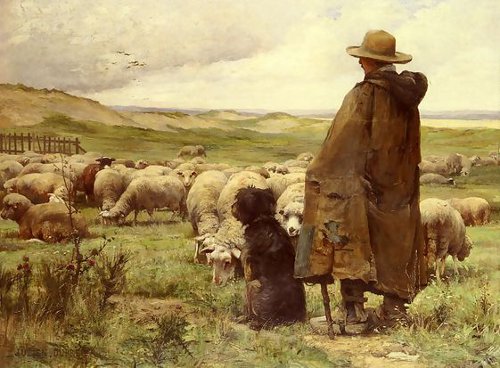
the shepherdThe portion of the sermon relevant to Peter’s blog post has to do with elders as guards (and probably as guides). It seems there were two incidents that had recently occurred at Tikvat Israel. The first had to do with a single individual who was visiting the synagogue for Shabbat services and handing out religious materials, apparently in contradiction to the official position of the congregation. R’ David was away that day, and his Rabbi-in-training, also named David, saw what was going on and gently (according to the sermon) redirected this individual to the congregation’s bookstore and some materials more in keeping with Tikvat Israel’s theology and doctrine.

The second incident had to do with another visitor who had the chutzpah to pass around a petition among the members calling for Rabbi David’s removal from leadership, apparently because R’ David does not support a “One Law” theology, and this individual wanted to see the Rabbi replaced with someone who supported One Law.

It’s important to note here that R’ David in his sermon clearly differentiated between visitors and members in the synagogue. In both of these cases, it seems that lone visitors were coming in from the outside and “disturbing” (my word, not David’s) the members of the congregation, rather than a minority group among the members calling for Rabbi David to step down.

The sermon didn’t give any details as to the reaction of synagogue members to the petition in question, but R’ David did encourage the members to speak up when they encounter someone from the outside (or apparently inside) who is making statements or actions that are in opposition to the formal standards of the congregation. R’ David was careful to say that differences in opinion aren’t really the problem. The problem is with individuals who attempt to cause division and disunity in the congregation. This is part of the function of elders in the synagogue (or church), to guard the flock from “disturbing” theologies or doctrines coming in from the outside.

If you go to the Tikvat Israel website’s About page and scroll to the bottom, you’ll see items labeled “What We Believe” and “Position Papers”, and R’ David encouraged the members listening to his sermon to redirect anyone promoting “strange doctrines” to those materials so they could become familiar with the standards upon which the congregation is based.

I had a similar experience at the small Baptist church I mentioned before, where I attended services for about two years. The Pastor and I became well acquainted and we spoke regularly about our different theological and doctrinal views. At one point, I took our differences a step too far and criticized one of his sermons on my blog. He didn’t take kindly to that, nor the fact that I had leant someone at his church my copy of D. Thomas Lancaster’s sermon series (on audio CD) What About the New Covenant.

Although, I could have remained at the church, I would have had to censor myself both in congregation and on my blog and I made a decision not to do that. I ultimately chose to leave the congregation, not because I thought poorly of anyone (quite the opposite, there are many good and kind people in that church who are authentically serving God) but because their doctrine and mine were pretty far apart in a number of key areas. I wouldn’t be serving God by remaining as a disruptive influence, regardless of my motives.

Please notice that while I admit to lending teaching material that stands in opposition to local church doctrine to one of the church’s members, I didn’t start passing around a petition to get anyone removed or otherwise oppose the head pastor or any of the church elders in authority. That would have been at least improper and at worst insane (though not in the clinical sense).

In retrospect and particularly after listening to Rabbi David’s sermon, I can see how the church’s pastoral staff and board of elders were fulfilling their function in relation to me since I represented a doctrinal position that was in conflict with their official position. If they were willing to listen to my ideas and perspectives and volunteer to consume any resources I was able to provide, that’s one thing. But if I was deemed to be an element that might contribute to disunity and discord, then the elders had a responsibility to draw my attention to that behavior and expect some changes on my part.

Which is exactly what happened.

David Rudolph
Rabbi David Rudolph

The result was that I decided to leave church and seek other avenues for community or association. Given all that, those two individuals who entered Tikvat Israel for the purpose of introducing doctrines contrary to the synagogue’s official position should expect the elders to address this issue and said-individuals could either decide to stay without trying to “rock the boat” significantly, or they could decide to do what I did and leave the congregation.

The only difference is that I attended that church for two years and, from what I got out of R’ David’s sermon, the two individuals involved were not regular attenders and certainly not formal members.

The moral of the story is that you don’t have to think exactly in the same way as the worship community you attend, but remember that the congregation has a group of elders who are responsible to guide and guard the sheep. Although I don’t see myself in such a light, I very well could have been perceived by some to be a “wolf in the fold”. If I find myself in a “fold” where I am incompatible with the rest of the “sheep,” it’s the job of the elders to inform me of that and it’s my job to decide how to respond as a person of good conscience and as a disciple of the Master.

I think the individuals cited in Rabbi David’s sermon needed to do the same.

Apologies and Farewell to Church

If the Shofar is sounded in the city, will the populace not tremble?

Amos 3:6

The blow of a Shofar is a call to arouse us from the lethargy of routine in which we have been immersed and to stimulate us to teshuvah. But what if someone hears the Shofar and is not moved by it?

A village blacksmith’s assistant once visited a large city and sought out the local smithy. He observed that the workers there used a bellows to fan the flames in the forge. The bellows were much more efficient than the exhausting manual fanning which he did back in his master’s shop. He promptly bought a bellows, returned with great enthusiasm to his master, and informed him that there was no longer any need for them to exhaust themselves fanning the flames. He then set out to demonstrate the magic of the bellows, but alas, regardless of how vigorously he pumped, no flame appeared.

“I can’t understand it,” he said. “In the city, I saw with my own eyes the huge flame produced by the bellows.”

“Did you first light a small fire?” the master asked.

“No,” the assistant replied. “I just pumped the bellows.”

“You fool!” the blacksmith said. “The bellows can only increase the size of the flame when you begin it with a spark. When you have no spark or fire, all the pumping of the bellows is of no use.”

Like the bellows, the Shofar can only arouse us if we have in us a spark of teshuvah, just a rudiment of desire. If we feel ourselves unmoved by the Shofar, we had better try to light a spark of teshuvah within ourselves.

Today I shall…

…try to begin teshuvah, so that the service of the approaching High Holidays will have the desired effect on me.

-Rabbi Abraham J. Twerski
from “Growing Each Day” for Elul 26
Aish.com

I’m writing this on Sunday instead of going to church, though you won’t be reading this until Tuesday morning. Given what I wrote in last week’s “What I Learned in Church” blog and subsequent commentaries, I’ve come to the realization that I owe Randy and everyone who reads this blog an apology. Regardless of my reasons, I took my criticism of Randy’s sermon way too far and I probably shouldn’t have written anything public about it at all.

But that’s water under the bridge and the damage is done.

I emailed Randy on Shabbat after much consideration and prayer with my personal apology and asked him for forgiveness. As I write this, I haven’t heard back, and perhaps I shouldn’t expect to. In addition to writing him though, as I said, I need to make my apology public just as I made my criticism.

preachingAlthough I don’t think religious leaders should be “criticism-proof,” so to speak, they also should command a certain amount of respect, and just because we have a difference of opinion, even about the important matters of Biblical interpretation, the fact that we disagree doesn’t mean he did anything wrong. His sermon was well within the norms of Christian Fundamentalism and it is backed up by a great deal of research on his part. He has the right and responsibility to “feed his flock” with the “spiritual food” he believes is beneficial for them, and I have no right to stand in his way, not that I could really affect anyone’s viewpoint at church about his sermons.

But realizing what I’ve done and how often I’ve risked collapsing the Tent of David (with apologies to Boaz Michael), I feel that my time at Pastor Randy’s church has come to an end. It had been my hope that I would provide added value to discussions in Sunday school, my personal discussions with Randy, and anyone else who wanted to interact with me. Two years ago as I was approaching this path back to church, I had high hopes that I could live out Boaz’s vision as chronicled in his book, but I see now that instead of being a light in the church, all I’ve done (for the most part) was act as an irritant.

Even those few people who were interested in what I had to say, particularly about the New Covenant, once they fully realized what I was communicating, acted confused and hesitant. I guess I was asking far too much of the people around me and my basic theological foundation, which makes a great deal of sense to me, is a strange and alien land for most Christians, particularly Fundamentalists.

It’s my place to be an opportunity of sorts, an option, a door to another perspective, not a hammer hitting people over the head. Over the past two years, although I tried to make a niche for myself in the humble walls of that little Baptist church in Meridian, Idaho, I never truly found a place where I fit in. I look like everyone else and I go through the motions of singing the hymns and shaking hands during services, but what I understand about the Bible might as well be light years away from the people I’ve “fellowshipped” with.

Please understand, I bear no ill will toward Randy, the other Pastors, the board members, and the people I’ve worshiped and studied with. I regard them all with the warmest of feelings. That we disagree doesn’t mean I think they are bad or even wrong. We’re just very different and I have no desire to hurt anyone or get in the way.

I suppose I could still attend the church and just keep silent, but that wouldn’t work for two reasons. The first is that my very presence is likely to continue to irritate or annoy Randy because of the aforementioned offending blog post and my general disagreement with him. The second is I seriously doubt I could rein in my verbal and written responses to the sermons and Sunday school lessons, at least for very long. I’d be unhappy at my self-imposed censorship and when I finally opened my mouth, I could possibly say something unkind or at least unwanted.

I want it to be known that the only person responsible for these events and their outcome is me. It’s my responsibility to conduct myself as a true disciple of the Master both in church and everywhere else, both in my spoken word and in what I write.

Erev Rosh Hashanah is tomorrow at sundown (as you read this) and in the spirit of repentance and renewal, I must offer my sincere public apology to Randy, his church, and you readers, and also I believe it is the best choice now to end my sojourn at church.

The Results

It may sound strange, but in being inspired to return to church, in part by Boaz Michael’s aforementioned book, I’ve thought of my return to Christian worship as something of an “experiment,” and I don’t mean that unkindly or clinically. As I said before, I had hoped to be a light and to represent a particular viewpoint as illumination. Did I fail completely? Did I just waste the last two years of my life in church?

I would say not, although I think I gained more from the experience than the people at church gained from me. What I know about “formal Christianity” including the history of the Church as been quite lacking, and Randy opened all that up to me. He has an excellent command of Christian history and for a year or more, he guided me on a personal journey on what it means to be a believer, particularly from a Fundamentalist point of view. I also learned how friendly, kind, and generous the people around me were, and how patient and tolerant they could be to an “oddball” like me, especially Randy.

No, it was hardly a waste of time. I only regret that they could have as much of a benefit from my presence as I did being among them.

I can only hope that others like me in other churches have better outcomes in terms of the impact they have on their fellow congregants.

The Future

Once again, I’ll be without a congregation. What will this mean for my faith? I may not be going to church, but I haven’t left faith in God or discipleship under the Master behind.

HaYesod ResourcesWill I try to find another church to attend? Not at present. I don’t see it working out any better in another Christian venue than it did in the one I just left, and I have no intention of adding insult to injury, so to speak. Inflicting myself on another Pastor and another congregation will just make matters worse. I’ve heard stories about how well some Messianic Gentiles find it in some churches. They are invited to teach HaYesod and other related classes and, according to reports, the information is well received.

But that requires two things: the right kind of environment and the right kind of presenter. I know that the church I’ve attended just wasn’t ever going to be receptive of such a view of the Bible and certainly the perspective was not requested nor required. I was wrong to force it on anyone without being asked.

Also, since I know Randy’s views on what he wants taught at his church, the fact that I was speaking to anyone at all about my opinions was risking the integrity of the doctrine being taught and I can only guess from Randy’s point of view, represented “wrongheadedness” and even a potential threat to anyone who listened to me and took my words seriously.

So no, I’m not going to seek out another church. Even if an appropriate Messianic congregation was available in my area, as I’ve said numerous times before, I wouldn’t attend, at least regularly, out of consideration for my wife, who is Jewish and not in the least Messianic.

I’ve been talking with a friend about starting up a Torah study between the two of us. The only thing in the way is working out the timing in our schedules. Even he and I don’t see precisely eye-to-eye, but we have more in common than I have with most Christians.

I’ll keep blogging as usual, but this will be the last time I intend to mention Pastor Randy or anything about the church he shepherds. I wish them all success, peace, and the presence and blessings of God.

Since the New Year is upon us, I suppose this is the perfect time to retool my studies and rededicate myself to my understanding of what it is to be a Messianic Gentile.

Someone said in a comment on one of my recent blog posts that if “a Christian is truly repentant then he will extricate himself from an anti-Judaic religious system (i.e. Christianity) and cease to identify as a Christian.” I disagree. There are many fine Christians and many fine churches, including the one I used to attend, and they perform many kind and generous acts of “Torah” (though they don’t call it that), such as feeding the hungry, visiting the sick, and loving each other. I’m not ending my relationship with them because they are not good and kind people, but only because I’m not a good fit for them (nor sadly, they for me) and I have no desire to continue to be an irritant in their presence.

walking outI know that some people like me there and maybe would even be surprised if they read this blog post, but most of them don’t really know me. If they did, I’m not sure what they’d think. It’s better that they don’t find out. God doesn’t love them or me any less because of our divergent perspectives. In the resurrection, if not before, He will guide us all to a better understanding of all truth in Him through Messiah.

May he come speedily and in our day.

May you all be inscribed and sealed in the book of life for a good year.

To Randy and his church, I again offer my sincere apologies, beg for forgiveness though I don’t deserve it, and offer my fondest farewell to you all.