Tag Archives: FFOZ

Reviewing FFOZ.TV: A Promise of What is to Come

ffoz-tvThe First Fruits of Zion television program delivers a high-energy, professional presentation of the prophetic aspects of the Gospel message from a Messianic Jewish perspective. Every episode opens new insights into the teaching of Jesus of Nazareth with end-times implications. Kingdom-focused and Jesus-centered, this is Messianic Jewish teaching at its best. It will encourage Christians to go deeper in their personal relationship with the Jewish Messiah.

The program tagline, “A Promise of What is to Come,” acknowledges that there is something greater taking place than just learning and understanding the bible in a new way.

We are part of a restoration and a return predicted by Moses, the prophets, Yeshua (Jesus) and the apostles. The modern state of Israel and the messianic Jewish revival we see today is only the first blossoming of the great, final redemption, which will usher in the kingdom of messiah.

-from “Welcome to FFOZ TV”
tv.ffoz.org

Messianic Jewish educational ministry First Fruits of Zion (FFOZ) launched its own television series earlier this year with an eye on reaching Christian television networks and reaching Christians. Boaz Michael and Toby Janicki were recently interviewed by God’s Learning Channel (GLC) about FFOZ.tv, and GLC is the first Christian TV network to begin broadcasting the FFOZ TV series. My understanding is that FFOZ.tv is currently targeting other Christian television venues for their program in order to “spread the word.”

But what about their program?

Boaz Michael, Founder and President of FFOZ asked me to review the program on my blog. I’ve been aware of FFOZ.tv for about a year now, having viewed an early version of the first episode at last year’s FFOZ Shavuot conference. I’ve seen a few clips of the show since then, but I’m not a big television watcher, so I didn’t go out of my way to take a look at the finished product.

Overview

For my review, I chose to sample two episodes: episode 4, Jewish Prophesies, originally aired on March 17, and episode 5, Son of David, originally aired on March 24 (the full episode list is available for those shows that have already aired and they can be viewed freely online).

Structure and Format

Each show is approximately thirty minutes long and follows a standard format. Toby Janicki is the primary host of the program, presenting the issue to be examined during the broadcast, taking the audience through the scriptures to examine the topic, say Messianic prophesies, and then breaking the information down into three major “talking points.” Mid-show, the scene shifts to FFOZ teacher Aaron Eby speaking from Israel and explaining aspects of Judaism and the Hebrew language as they apply to the subject being discussed. The scene then shifts back to Toby in the studio, where he brings the program and the topic to a conclusion. At the very end, Boaz Michael makes a brief appearance, wrapping up the broadcast and introducing the topic for next time.

Content

The show is written for a Christian audience that knows little or nothing about Messianic Judaism and Judaism in general. For those of us who are familiar with the subjects involved, the content seems elementary most of the time, though therewere “tidbits” of information I found new or at least that were clarified for me. The show is definitely designed to be “Messianic Judaism 101” and its most obvious purpose is to gently bring mainstream Christians into a beginning familiarity with the Jewishness of Jesus, the continued meaning of the Jewish people and the nation of Israel in the present world and the Kingdom of God, and how the future of Christianity must always look to Jewish redemption for the people and nation of Israel as the goal.

ffoz-teaching-teamThere are twenty-six episodes “in the can” for the first season of the FFOZ.tv series. Each episode builds upon one another, so while each individual broadcast is a self-contained show, the audience won’t gain access to the complete Gospel message being presented from a Messianic Jewish perspective unless they view all of the episodes. Presumably, if the series is successful, the first twenty-six episodes will only be the beginning.

In the two shows I viewed, Toby regularly introduces himself as a Gentile who “practices Messianic Judaism.” This appears to be included to re-enforce Toby’s connection with his Gentile Christian audience but also connect him back to Messianic Judaism as a practitioner and teacher. Aaron’s portion, by contrast, is set in Israel, with his interviews being done “on the streets” to give a definite “Jewishness” to his content.

Look and Feel

Production values for the show are high and are at or near the levels of commercial television programs. The primary studio presents a “den” or “office” setting in rich earth tones, low lighting, and with numerous Jewish artifacts in the background to communicate warmth, approachability, and of course, Judaism. The music seems a little dramatic at times and for a couple of moments (during the HaYesod ad I think…I’m getting to that), I felt like I was getting ready to blast off into space. However, I noticed the tendency toward dramatic music and imagery on GLC when I watched the introduction to the Michael/Janicki interview, so maybe it’s an expected element of Christian television.

As I mentioned, Aaron’s part of the program is always filmed “on the streets of Israel” (presumably Jerusalem) so that the background views are universally recognizable as Jewish and Israeli. Aaron’s portions seem to create a bridge between the audience and Israel, supporting the overarching message of FFOZ.tv that Christianity is Jewish and irrevocably tied to Israel and Judaism.

Marketing

FFOZ is a non-profit organization and their primary “product” is the educational materials they produce. The purpose of FFOZ is to create and disseminate specific data to both Christian and Jewish audiences (see Vine of David for a list of materials specifically designed for Jewish people). The real “product” of FFOZ then is information which is packaged in a variety of forms including books, magazines, programs such as HaYesod and Torah Club, and of course, television.

However, in order to inform potential audiences of the material that is available, you have to market it. That’s another component of FFOZ.tv. The very first scripture that Toby reads in any program (of the two I viewed, anyway), is from the Delitzsch Hebrew Gospels. The rest of the time, he uses the ESV Bible. As Toby is reading from the Delitzsch version, a phone number and website URL appear at the bottom of the screen telling the audience how to purchase a copy.

About half to three-quarters of the way through the broadcast, the program content breaks for an ad about HaYesod, featuring mostly the FFOZ teaching staff presenting information on this learning program (which seems to have evolved quite a bit since I sat in a HaYesod class a decade or so ago).

Near the end of the broadcast, another commercial came on, this time describing the FFOZ Friends program, which allows people who subscribe to donate monthly to the ministry and describes, depending on which tier they choose, which products and services they’ll receive.

On the one hand, this all seemed a little distracting to me, but on the other hand, since at my “day job,” I directly report to the Vice President of Marketing, I have a deep understanding of the necessity and purpose of marketing any product that is for public consumption. You can’t buy and learn from something if you don’t know it exists.

Conclusion

resources-studyFFOZ.tv is made to introduce Christian audiences to Messianic Judaism, Judaism, and Israel. Although the Christian faith has its origins in first century Judaism and the Jewish Messiah, we have diverged from them significantly in the past twenty centuries, until the “Jewishness of Jesus” and the Hebraic beginnings of our faith are only a dim memory. FFOZ.tv is attempting to gently guide its Christian audience in a friendly and approachable atmosphere, back to some of the key concepts that define Messianic Judaism in order to realign Christian thoughts and feelings back toward our “Jewish roots.” The television program is also a “jumping off” platform for the audience to use in acquiring and exploring other FFOZ products, which will then (ideally) re-enforce and deepen the information base of Christians on Messianic Judaism, the absolute requirement of Israel’s national redemption in the Kingdom of God, and the vital role of the church in bringing about Jewish primacy and restoring Israel to its former glory, all in anticipation of the return of King Messiah.

If one picture is worth a thousand words, then what is television? In this case, television is entrance for any believer who watches Christian television or who is most likely to accept information in a video format, to the message of the Gospels from the perspective of Messianic Judaism. It provides and easy to access and easy to absorb doorway for the Christian to begin to encounter the Jewish Messiah King and the promise of what is to come.

Please visit First Fruits of Zion: A Promise of What is to Come and view any or all of the episodes available (seven as I write this but more are coming). Watching a single episode will only take thirty minutes of your time and you can judge for yourself whether or not if FFOZ.tv has a message that is speaking to you.

The Broken Soreg

0 RBut now in Christ Jesus you who once were far off have been brought near by the blood of Christ. For he himself is our peace, who has made us both one and has broken down in his flesh the dividing wall of hostility by abolishing the law of commandments expressed in ordinances, that he might create in himself one new man in place of the two, so making peace, and might reconcile us both to God in one body through the cross, thereby killing the hostility.

Ephesians 2:13-16

Paul states that the Messiah abolished the “enmity” between Jew and Gentile. This is not the same as saying he abolished the Torah. Instead, the Messiah abolishes the requirement for Gentile believers to undertake circumcision and the covenant signs of Israel (the Law of commandments contained in ordinances) before they may be regarded as one body with the Jewish people.

-D. Thomas Lancaster
Commentary on Acts 21:15-22:30 (pg 689)
First Fruits of Zion’s Torah Club
Volume 6: Chronicles of the Apostles
Reading for Torah Portion Shemini (“Eighth”)

I’m sure most Christians will find Lancaster’s interpretation of Ephesians 2 to be very creative but not very convincing. The traditional Christian interpretation is that Jesus took down the wall by abolishing the Torah. Jews and Gentiles are identical in Christ and there are no distinctions based on Jewish observance of the Torah of Moses.

I’ve looked into Ephesians 2 before, but at the behest of someone who had the exact opposite opinion of this scripture. He said:

Ephesians 2 establishes gentiles as now part of the covenants, which I wonder how you deal with such, as I have never seen you address Ephesians.

This interpretation is probably just as startling to most Christians as Lancaster’s, since it declares that all believers, Jewish and Gentile alike, are obligated to the full observance of the Torah. In discussing the Hebrew Roots interpretation of Acts 15, Lancaster has this to say:

Hebrew Roots teachers often claim that the apostles only gave the four essentials to Gentile believers as a starting point. After that, the Gentiles were expected to learn the rest of the Torah in the synagogue every week. Eventually, they would be responsible for keeping all the laws of the Torah in the same manner as their Jewish brothers and sisters.

Acts 21:25 indicates that the apostles understood their ruling differently…Instead, the apostles viewed the four essentials as a standard for the God-fearing Gentile believers. They did not require a gradual process by which the Gentiles adopted the rest of the commandments.

-Lancaster, pg 686

I covered Acts 15 and its implications in much more detail in my multi-part Return to Jerusalem series so I’m not going to revisit that material here. I just wanted to briefly provide the different interpretations that could be applied to Ephesians 2 and where Lancaster stands on the matter of Jews vs. Gentiles and Torah observance.

But what about this “dividing wall of hostility” Paul mentions? I’m about to suggest something a little radical.

In the course of his massive remodeling of the Jerusalem Temple, Herod the Great extended the Temple Mount platform significantly by constructing a retaining wall and adding fill. A balustrade made of stone lattice work (soreg) marked off the original holy precinct. The balustrade functioned as a perimeter fence that kept Gentiles from straying into the sanctified area. The Mishnah reports the lattice work wall stood ten handbreadths (three feet) high. Josephus recalled it as slightly taller at three cubits (five feet) height. The people referred to the courtyard outside of the barrier as the Court of the Gentiles because Gentiles were allowed to congregate and worship in that courtyard, but they could not draw nearer than the balustrade. The Levitical guard posted plaques on the balustrade forbidding Gentiles from trespassing beyond that point.

-Lancaster, pg 688

middle-wall-partitionTo the best of my knowledge, there is nothing in the written Torah that mandates such a wall or a “Court of the Gentiles” on the Temple grounds, however especially during the days of Jesus and afterward, until the destruction of the Temple, there was much existing halachah that kept Jews and Gentiles apart. We see evidence of such in the vision Peter had in Acts 10 when Jesus makes clear to Peter that the halachah requiring that a Jew never enter a Gentile’s home was incorrect. God did not make the Gentiles an “unclean” people.

But the voice answered a second time from heaven, ‘What God has made clean, do not call common.’ This happened three times, and all was drawn up again into heaven. And behold, at that very moment three men arrived at the house in which we were, sent to me from Caesarea. And the Spirit told me to go with them, making no distinction.

Acts 11:9-12

Could Paul be using the idea of the soreg metaphorically in Ephesians 2?

I told you it was a radical idea. I’m not saying that this is even a valid interpretation of the text, but it is an interesting idea. In order for Paul’s mission to the Gentiles to be successful, one of the things that had to be broken down was Jewish hostility toward Gentiles. In the diaspora, by necessity, Jews had to interact, at least to a degree, with Gentiles, but in Israel and especially in Jerusalem, this was not the case (with the exception of forcibly having to “interact” with the Roman military occupation).

We see recorded in Acts 21:37-22:21, Paul apparently successfully defending himself against his Jewish accusers after the near riot he endured at the Temple when he was falsely accused of speaking against the Jewish people, the Torah, the Temple, and bringing a non-Jew past the Court of the Gentiles and into the Temple (Acts 21:28-29). It’s only when he mentioned the Gentiles, did his Jewish listeners go quite berserk:

And he said to me, ‘Go, for I will send you far away to the Gentiles.’” Up to this word they listened to him. Then they raised their voices and said, “Away with such a fellow from the earth! For he should not be allowed to live.” And as they were shouting and throwing off their cloaks and flinging dust into the air, the tribune ordered him to be brought into the barracks, saying that he should be examined by flogging, to find out why they were shouting against him like this.

Acts 22:21-24

I’d certainly call that a “wall of hostility.”

So one interpretation of having “broken down in his flesh the dividing wall of hostility by abolishing the law of commandments expressed in ordinances” is doing away with all Jewish Torah observance, which was apparently what was causing the separation and bad feelings between Jewish and Gentile believers. Except the Torah doesn’t say that. First century Jewish halachah said that and the lesson Peter learned was that such separation was incorrect halachah.

Another interpretation is that the wall being broken down was the wall that kept Gentiles out of membership in national Israel, and once broken down by their being “grafted in” (Romans 11:11-24), Gentiles gained full covenant relationship with God and Israel by essentially becoming Israel and thus, required to observe all of the Torah mitzvot. The only thing they didn’t have to do was convert to Judaism, but otherwise, they certainly looked like converts. That makes even less sense if the wall was broken down by “abolishing the law of commandments expressed in ordinances.” Nothing is abolished, the Gentiles are just added into the “law of commandments expressed in ordinances.”

Lancaster suggests that what Jesus broke down in his flesh when he was executed was how Gentiles were prevented from covenant relationship with God and the Jewish people without converting to Judaism. The legal requirement for conversion was the law that was abolished. This makes a bit more sense because it is through Messiah that we among the nations can become disciples and we are not required to convert to Judaism. But then, where does all the hostility come from that was preventing Gentiles from entering into covenant?

If what went away was a faulty interpretation and application of Torah that promoted an extreme hostility of Jews against Gentiles (which is not too hard to understand given that the Jewish nation was at that time being occupied by a harsh and cruel Gentile imperial army), Ephesians 2, especially when compared to Acts 10, begins to make more sense.

I’m sure my amateur interpretation can be criticized on a number of levels and again, I’m not saying that my little theory has much, if any, weight of evidence to support it, but I want you to think about it. I want you to consider the possibilities, especially in light of how Jewish audiences took less exception to the message of Jesus as the Messiah, and much more exception to the idea that such a message required doing away with the Torah, the Temple, and including unconverted Gentiles as equal covenant members.

infinite_pathsPaul was fighting an uphill battle and he was never entirely successful during his lifetime. In fact, after his death, the hostility between Jews and Gentiles continued to grow until Christianity was no longer a branch of religious Judaism, but instead, represented an entirely new theological discipline…one that was actually opposed to Judaism.

To the degree that Judaism and Christianity are still separate religions, with neither one wanting to have anything to do with the other for the most part (there are noteworthy exceptions), that wall of hostility still exists today. Part of why I write this blog is to offer avenues at, if not deconstructing the wall, punching a few holes in the “soreg” so we can see each other more clearly and even have a bit of a conversation.

When the Messiah returns, I believe he will finish what Paul started. I believe he will finish removing the wall we continually rebuild. I believe he will show us how to live with each other in peace. And Jews will remain a distinct people and nation as Jews. And Gentile believers will remain distinct from the rest of the world as non-Jewish disciples of the Master. And the different parts will truly act as one within a single body.

Lancaster’s Galatians: Sermon Four, Wind and Sail

wind-sky-spirit-ruachAll Scripture is breathed out by God and profitable for teaching, for reproof, for correction, and for training in righteousness…

2 Timothy 3:16 (ESV)

Is given by inspiration of God – All this is expressed in the original by one word – Θεόπνευστος Theopneustos. This word occurs nowhere else in the New Testament. It properly means, God-inspired – from Θεός Theos, “God,” and πνέω pneō, “to breathe, to breathe out.” The idea of “breathing upon, or breathing into the soul,” is that which the word naturally conveys. Thus, God breathed into the nostrils of Adam the breath of life Genesis 2:7, and thus the Saviour breathed on his disciples, and said, “receive ye the Holy Ghost;” John 20:22. The idea seems to have been, that the life was in the breath, and that an intelligent spirit was communicated with the breath. The expression was used among the Greeks, and a similar one was employed by the Romans. Plutarch ed. R. 9:p. 583. 9. τοὺς ὀνείρους τοὺς θεοπνεύστους tous oneirous tous theopneustous. Phocylid. 121. τῆς δὲ θεοπνεύστου σοφίης λόγος ἐστὶν ἄριστος tēs de theopnoustou sophiēs logos estin aristos.

Barnes’ Notes on the Bible for
2 Timothy 3:16

You may be wondering how this connects to my ongoing discussion with Pastor Randy about D. Thomas Lancaster’s book The Holy Epistle to the Galatians. The answer is, “not much.” Frankly, we started our discussion last night with trying to clarify his thoughts on Divine Election (Pastor has a paper he wants to loan me that describes all of the various positions), but then moved to how we can understand the Bible (Pastor has some reservations relative to how Lancaster derives certain conclusions in his book from the Galatians text). We addressed Sermon Four of the book eventually, but it didn’t occupy the significant portion of our time together, nor was it the most compelling topic upon which we touched.

Going back to “God-breathed,” Pastor said that the Greek word used has the implication of wind filling a sail and pushing the boat along (Correction, according to Pastor Randy’s comment below, “the phrase about ‘the wind filling a sail’ has to do with the II Peter 1:21 passage and the meaning of men being ‘carried along by the Holy Spirit’.” See the following quote). He told me he believes that as God gave His inspiration to the human writers of the Bible, the authors did not say anything, at least as originally given in their manuscripts, that contradicted what God intended.

And we have the prophetic word more fully confirmed, to which you will do well to pay attention as to a lamp shining in a dark place, until the day dawns and the morning star rises in your hearts, knowing this first of all, that no prophecy of Scripture comes from someone’s own interpretation. For no prophecy was ever produced by the will of man, but men spoke from God as they were carried along by the Holy Spirit.

2 Peter 1:19-21 (ESV)

People, that is, prophets and those people who have written the Word of God we have in our Bible, did not hear something from God and then interpret what it meant through their own intellect and emotions. God used their personalities, their vocabulary, their style of writing, their perceptions to craft His message, but the message was and is His message, not the prophets’, and the message “carried them along” as it was first given and recorded in the original documents, and the message was and is exactly what God meant to say and meant to carry us along as well.

But then we have a problem.

We don’t have the original documents…any of them.

Also, Bible reading and translation is an enormously complex task.

According to Pastor Randy, and I agree with him, we have to start with what the text literally says. We also have to apply the immediate context of the scripture, not taking it out and making it stand on its own. Beyond that, we have to consider the history, the culture, and the circumstances in which the scripture was written. On top of that, we have to connect the scripture to the larger context of the entire Bible, including other times when similar circumstances were mentioned and similar or identical wording was used. If, for instance, in describing the two greatest commandments (see Matthew 22:37-40), Jesus references Deuteronomy 6:5 and Leviticus 19:18, in understanding the Matthew 22 passage, we must also take into consideration the context, history, culture, and circumstances in which Deuteronomy 6 and Leviticus 19 take place, including the author and his personality, vocabulary, style of writing, and personal experiences. We cannot separate what Jesus was trying to say from what Moses was trying to say, however Jesus and all that was in play when he was talking may modify the original meaning, giving it a somewhat different shape, color, and texture.

paul-editedOh, and let’s not forget the intended audience. Moses may not have been aware that what he was writing was ultimately intended for the entire world, but we realize that God has a greater scope. Jesus may well have understood that his words would eventually be consumed by all of humanity across time, but his immediate audience, like Moses’ was the Jewish people or more specifically in Jesus’ case, the Pharisee he was addressing at that particular moment.

We must take all that into consideration when reading the Bible and seriously attempting to understand its message.

And we must constantly remind ourselves that it is all God-breathed.

Pastor Randy and I spent most of our time together exploring how to understand the Bible, with the promises and pitfalls built into such an effort. We discussed how we don’t necessarily have to “reinvent the wheel,” since many people have read and observed the literal meaning of the text from a variety of perspectives, and it would be irresponsible of us to disregard their work and rely only on our own. Pastor described how he approaches understanding texts looking at those who came before him. He reads a variety of expert analyses and takes into consideration what the scholars they did and didn’t take into consideration.

For instance, a particular writer may have a good grasp of the original language but not sufficiently address the history involved, or another writer may have a good handle on the historical context, but not the cultural context. Pastor said he looks at the various scholarly opinions in that manner and ultimately settles on which one he…wait for it…

…which one he likes best.

What?

Pastor Randy is a literalist, an educator, a scholar, a linguist, and is very serious about pursuing as accurate an understanding of the Bible as he can achieve, but after much discussion we agreed that even under the best of circumstances and intentions, there will always be this little, fuzzy, grey, area in the middle of our understanding where we fill in the blanks with our own personalities.

Geordi La Forge (played by Levar Burton): I don’t know, Data, my gut tells me we ought to be listening to what this guy’s trying to tell us.
Data (played by Brent Spiner): Your gut?
Geordi: It’s just a… a feeling, you know, an instinct. Intuition.
Data: But those qualities would interfere with rational judgment, would they not?
Geordi: You’re right, sometimes they do.
Data: Then… why not rely strictly on the facts?
Geordi: Because you just can’t rely on the plain and simple facts. Sometimes they lie.

-from the Star Trek: the Next Generation Episode
The Defector (original air date 30 Dec. 1989)

In the scene from which I just quoted, Data concludes that in any meaningful analysis, the observer must fill in whatever blanks there are in the facts and other available information with their personality. In Data’s case, he was in a bind because effectively, he had no personality. All he had were the facts. By the way, it turns out Geordi’s “gut” was wrong. The defector in question had been fed disinformation by his superiors to mislead the Enterprise and ultimately to provoke a war. Fortunately, Picard’s “gut” proved to be more accurate and the ruse was exposed.

All this doesn’t mean that we can never understand the Bible or that we should always equivocate on its meaning, but we should be a little less than one-hundred percent certain that we always know what everything in the Bible means all of the time.

It also means that when we realize we’ve made a mistake based on subsequent study and analysis, we should admit it.

Pastor Randy says that’s one thing he admires about Boaz Michael, President and Founder of First Fruits of Zion (FFOZ). When Boaz and the organization came to the conclusion, several years ago, that they had made a significant error in understanding what the Bible said in relation to Jewish and Gentile covenant responsibilities to God, after much prayer and soul-searching, he announced that FFOZ was making a major shift in its theological and doctrinal position. Boaz knew it would cost FFOZ much of its income and might even result in the organization collapsing completely. Thank Hashem that the latter did not occur, but many sacrifices had to be made. Sadly, to this day, Boaz and his group continue to be severely criticized and harangued by their detractors as a consequence.

That’s the price of integrity and following God where He calls you to go. That’s also part of the ongoing struggle of understanding God through His Word and maturing as people of Spirit and of faith.

ancient-sail-boatI tried to get Pastor Randy to say that you can have a room full of people with equal intelligence, equal qualifications, all people of good character, and they could still disagree with each other on what parts of the Bible mean, but he wouldn’t go for it. He said that we’re all human and we’re all capable, not just of making mistakes, but of following our own human desires. We all can and do sin.

Does that mean there is only one right person (or close-knit group of people) who understands the Bible correctly and it is because he or she is the best person morally and ethically that their understanding is right? Does that mean all of this person’s critics are liars and haters who purposely want to bring the “right” person down in order to elevate their own agendas?

I don’t think it’s that simple. I think that you can gather a group of people together who are of good will and intent who will disagree. Sure, some of the people in that room will be liars and haters, but they should be easily spotted by their lack of integrity and good character (their fruits) in how they treat others and how they walk with God. Even the best of us can allow our personal, pet theories and biases affect our judgment. We all want to be right and to be admired and respected.

But at the end of the day, the best of us (and I’m hardly saying I’m among the best) will put all that aside, suck it up, and make the hard call, even if it costs them, because that’s just what God’s true servants do. Once we realize that the evidence is solid about some piece of scripture, even if it’s not what we want it to mean, we’ll go forward and accept it and embrace it, because that’s part of who we are if we are disciples of our Master. We’ll also continue to study, to learn, and to mature, because God continually breathes in us.

For a ninety minute conversation, last night’s talk with Pastor Randy inspired a lot in me that I could write about…and maybe I will, but I won’t try to cram it all into a single “meditation” today.

But I do want to be a sail. And I do want to be available to the wind. And I do want to let my sail conform to the wind, to the shape it causes me to manifest, to the direction it drives me, toward the destination to which it guides me.

I don’t know yet what distant and alien shore God has planned for my future, but I can feel His hand on me. Do I have the integrity and courage to let Him take me where He wants me to go? I hope so. I pray to possess those qualities that I may serve Him…even in something as “simple” as reading the Bible.

Pastor will be out of the country for the rest of April so naturally, we won’t be meeting each Wednesday evening for the next several weeks. We’ll revisit Lancaster’s Galatians next month and reformulate our study plan for the book…I promise.

In the meantime, I’ll try to continue writing in the spirit of what my Pastor, and ultimately God, provokes in my mind and heart, and move forward with integrity and purpose. Unfurling my sail and setting my course for uncharted seas as the wind sends me forth.

Easterphobia or Why Do You Have to Throw Christians Under a Bus?

i-hate-easterYour newfoumd (sic) respect for a holiday named after a goddess is coupled with a newfound (sic) contempt for Hebrew Roots.

While you say your new book is about respecting others, I notice in your blog posts, comments, and writings, the Hebrew Roots whom your organization once seved (sic) is referred to almost exclusively in the negative light. Your above comment is no exception.

Judah Gabriel Himango
from a comment on the blog post
God Fearers: Easter Ham or Passover Lamb?

If you’ve been reading my blog over the past few days, you’ve seen how my own recent Easter experience went as well as my own inability to make a connection to the observance. Nevertheless, I don’t think Easter is evil, wrong, bad, or pagan, whatever the origin of the name of the observance. I suppose my Pastor used terms such as “Resurrection Day” and “The Lord’s Day” last Sunday to get around that little problem, but since there were absolutely no bunnies or eggs present (well, eggs were probably served for brunch, but most likely they were scrambled), I didn’t see any obvious idolatry involved.

I didn’t want to write on the conflicts between some minority expressions of Hebrew Roots Christianity and the more traditional Christian churches, but when I read some of the comments on Toby’s blog post, including the one I quoted above, I couldn’t let it lie (and I didn’t want to start something again with Judah because I actually like the guy). My personal struggles are what they are, but I get a little tired of Hebrew Roots people playing the “superiority” card and saying that Christians in churches are terrible people because they won’t embrace some of the Hebrew Roots priorities. Frankly, such bigotry against Christians by these groups is ill-befitting of anyone who claims to be a disciple of Christ (or Messiah if that’s your preference).

I was just talking about this issue a couple of weeks ago when discussing the problem with religious people. If a religious person, particularly in a minority variant of Christianity which sees itself as above or superior to the majority of Christians, encounters other believers who hold different views, sooner or later, there’s going to be a “spitting match” in the blogosphere. I have tried avoiding blog posts such as this one because I didn’t want to participate in such a match, but where do I draw the line when I see unjust comments being made against believers by other believers?

I suppose I could have ignored this poorly considered jab against Christians who celebrate Easter and that would have ended it, at least from my point of view, but it was included in a collection of remarks that were direct responses to something I’d said on Toby’s blog. Yes, I still should have ignored it.

But I chose not to.

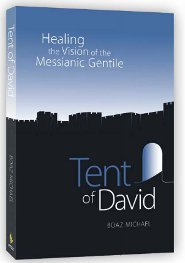
Boaz Michael, author of the book Tent of David, which I mentioned on Toby’s blog, corrected something I said:

TOD addresses Easter, “Another area of difficulty involves the observance of Christian holidays. Some churches heartily embrace some of the pagan-derived aspects of Easter and Christmas. Understandably, this makes many Messianic Gentiles uncomfortable. The simple solution is not to go during that time of year. It should not have too significant an impact on your relationships there to miss church for one or two weeks; in fact, it’s quite common for people to be out of town during holidays.”

tent-of-davidLate last year, I deliberately didn’t go to church for Christmas services for more or less the reasons Boaz stated, but to my way of thinking, Easter is the “higher” tradition as far as the church is concerned. The crucifixion and resurrection of the Master is at the center of all things and without these events, there would be no salvation for all of mankind. That the church should ignore something so vitally important seems ridiculous and while I believe the Passover Seder could have much meaning for Christians, it doesn’t always cover the full, expansive intent and glory of the risen King.

So I chose to attend Easter Sunday services at my church and did not consider such services optional. As I mentioned above, it wasn’t a spiritual “power surge” and I ended up feeling more disconnected from the community because of my lack of emotional attachment, but that has more to do with me than the importance of fellowship and the beauty of watching a new day dawning and knowing that the tomb is empty.

One of the other comments Boaz made addresses this point very well:

Actually, the consequence of Tent of David is not necessarily the celebration of Easter but rather a respect for those that do honor the resurrection of the Messiah. It is about learning to see the good in others, appreciating and valuing people’s attempts to connect with God. It is about learning to manage things Easter with love and care of the individual that is sincere in their intentions and efforts. It is about building relationships that will create bridges of dialog.

At the end of the day TOD is about respecting others, not assuming evil intentions, and a mission of transformation.

He said, It is about learning to see the good in others.” Isn’t that what we’re supposed to be doing?

Nevertheless, I’ll probably get “slam dunked” by my critics and my friends alike for how I’m wording all this, but what I’m writing at least has the benefit of sincerity and transparency. If you disagree with how different churches do things, then don’t go to those churches. If you have a problem with church in general, you don’t have to go to church. I don’t complain about where you go to worship. Why do you (whoever you are, since I’m addressing more than one disgruntled person at this point) have to complain about where I choose to worship?

I know Judah was complaining more to Boaz about TOD than he was to me, and I don’t think Judah intentionally disdains all people who go to church and call themselves “Christian” instead of “Messianic,” but the Boaz has a point. Even if we struggle with some of the practices in the church, we cannot dismiss her or her service to Christ. We must, since we also call ourselves disciples of Messiah, learn to see the best in others. After all, Christ died, even for those believers we may not like or don’t agree with. If Jesus thought his sacrifice, even for “those people,” was worth it, who are we to say he was wrong?

Four Questions, Part 2

Apostle-PaulThis is a continuation on the topic I started discussing in Lancaster’s Galatians: Introduction, Audience, and What Happened to the Torah? and continued in Broad Strokes. I asked the first of these four questions in Part 1 of this series (please read it if you haven’t yet) but quickly discovered that I’d never get all four questions and their answers in a single blog post. Hence, Part 2 presents the second question. Hopefully, the answer will be illuminating.

Why Did Many Jewish People Reject Paul and the Message of the Messiah?

Let’s face it. Paul received a tremendous amount of opposition during his journeys as he spoke of Christ, not only from the Greeks and Romans, but from many individual Jews and Jewish communities as well. This is exquisitely documented in Luke’s Book of Acts and often gives support to the traditional Christian doctrine that the Jews rejected Jesus but the Gentiles accepted him, thus Jews are now universally without salvation and a place in Heaven, and the Gentile Christians have inherited all of the covenant promises that once belonged to the Jews, replacing them as God’s chosen, splendourous people.

Did the Jews reject Jesus? We’ve already seen in Part 1 of this series (link above) that not all of them did and actually, thousands upon thousands of Jews completely accepted the Christ and were devoted disciples of the Messiah. In fact, in one of my conversations with Pastor Randy, he said he believes that the Jewish population of “the Way” very likely outnumbered, and by a substantial amount, the population of any of the other sects of Judaism, most principally, the Pharisees. This is just conjecture on my part, but as Pastor Randy mentioned this, I couldn’t help but wonder if the Pharisaic sect as well as the Essenes, Sadducees and others, saw that their power bases would erode into eventual extinction should “the Way” take over the Jewish religious landscape by sheer weight of numbers in Jewish membership.

We’ve also seen within the borders of ancient Israel that the apostles and disciples of Messiah were considered a threat to the corrupt and compromised Jewish religious leadership streams (particularly the Priesthood) that were firmly in the pocket of the occupying Romans. Herodian rule was also threatened for similar reasons. The Son of God accused them all of falsehood and usurping the rightful place of the valid Priests and Kings of Israel. These false rulers had every reason to want to silence a small but rapidly growing group who might one day soon incite the people to overthrow them.

But that doesn’t explain the immense amount of resistance Paul experienced in the Jewish synagogues of the diaspora, who were outside the flow of those political currents.

And he entered the synagogue and for three months spoke boldly, reasoning and persuading them about the kingdom of God. But when some became stubborn and continued in unbelief, speaking evil of the Way before the congregation, he withdrew from them and took the disciples with him, reasoning daily in the hall of Tyrannus.

Acts 19:8-9

After three months, opposition to Paul’s message surfaced. It may have taken that long for the Jews of Ephesus to realize that Paul’s gospel invited Gentiles into the fold.

-Lancaster, Torah Club Vol 6, pg 620

This, I think, is the key to much (but not all) of the Jewish opposition to Paul and the Way. Besides announcing the salvation from sin and the life in the world to come promised through the Messiah, the number one thing that set Paul’s sect apart from all of the other Judaisms of that day was the inclusion of Gentiles as equal covenant members without the requirement that Gentiles undergo circumcision and convert to Judaism. This was unprecedented in ancient Judaism and in my opinion, the single largest stumbling block for Jews hearing the Messianic message of Paul and the other apostles.

Remember the Jews of Pisidian Antioch who, in Acts 13:42-43 couldn’t get enough of Paul, Barnabas, and the message of Messiah, and begged them to return to their synagogue on the following Shabbat to speak more about the Kingdom and the Son of David?

The next Sabbath almost the whole city gathered to hear the word of the Lord. But when the Jews saw the crowds, they were filled with jealousy and began to contradict what was spoken by Paul, reviling him. And Paul and Barnabas spoke out boldly, saying, “It was necessary that the word of God be spoken first to you. Since you thrust it aside and judge yourselves unworthy of eternal life, behold, we are turning to the Gentiles.

Acts 13:44-46

This doesn’t mean, as we saw in Part 1 of this series, that Paul never again preached the good news to the Jews, but only on that occasion, when the Jewish leadership of the Pisidian Antioch synagogue spoke against him and reviled him. So what happened? On one Shabbat, the Jews couldn’t get enough of Paul and his teaching and exactly one week later, they can’t wait to shut him up and get rid of him. What changed?

But when the Jews saw the crowds, they were filled with jealousy…

Crowds? Crowds of who?

The Jews of Antioch were not jealous that Paul and Barnabas has such appeal or that their message was so popular. They were jealous that the message of the apostles compromised theological ethnocentrism. The message of the apostles seemed to throw the doors of Judaism wide open to the Gentile world.

This is the “jealousy” to which Paul referred in his epistle to the Romans.

-D. Thomas Lancaster’s commentary on Acts 13:1-51 read with Torah Portion Bo (“Come”) Torah Club 6: Chronicles of the Apostles, pg 394

prayer-synagogue-riga-latviaI commented extensively in a previous meditation regarding this “jealousy” that the huge influx of Gentile God-fearers and pagans elicited from the Jewish synagogue leaders in Pisidian Antioch and you are invited to click the link above and read the full analysis of that event. Lancaster supports my understanding that the thing about the Way that summoned such a passionate and even hostile response from some Jewish communities was the unfettered admittance of non-Jews into what was once a wholly Jewish religious and community space.

Here’s more.

When the seven days were almost completed, the Jews from Asia, seeing him in the temple, stirred up the whole crowd and laid hands on him, crying out, “Men of Israel, help! This is the man who is teaching everyone everywhere against the people and the law and this place. Moreover, he even brought Greeks into the temple and has defiled this holy place.” For they had previously seen Trophimus the Ephesian with him in the city, and they supposed that Paul had brought him into the temple. Then all the city was stirred up, and the people ran together. They seized Paul and dragged him out of the temple, and at once the gates were shut. And as they were seeking to kill him, word came to the tribune of the cohort that all Jerusalem was in confusion.

Acts 21:27-31

Two major points must be considered here. The first is the fear and hostility elicited at the very thought that Paul would allow admission of a non-Jew into the Temple past the court of the Gentiles. After all, such a thing was not done. True, Paul hadn’t actually taken Trophimus into the Temple, but just seeing the two of them together inspired all sorts of terrifying fantasies in many of the Jerusalem Jews. The very thought of Gentiles having full and equal membership into a Jewish religious sect without first having to convert to Judaism and being compelled to obey the complete body of Torah mitzvot and halachah was unthinkable. For many Jews, access to the God of Israel was located in a “Jews-only” zone, which is understandable, given that Israel was a nation then occupied by a brutal Gentile army. Only the apostles and disciples of Jesus understood differently and even some of them would never completely reconcile themselves to Gentile admission.

Here’s the second major speed bump.

And when they heard it, they glorified God. And they said to him, “You see, brother, how many thousands there are among the Jews of those who have believed. They are all zealous for the law, and they have been told about you that you teach all the Jews who are among the Gentiles to forsake Moses, telling them not to circumcise their children or walk according to our customs.

Acts 21:20-21

To the Jews in Jerusalem who were both devout disciples of Jesus the Messiah and zealous for the law, even the rumor that Paul was teaching the Jews in the diaspora, who were living among and worshiping with the Gentile God-fearing disciples, to forsake Moses, telling them not to circumcise their children or walk according to [their] customs was a horrible and virtually unthinkable idea. It was completely and totally against everything the Messianic Jews in the Land understood about the life and character of a devout Jew.

Again, this rumor was completely untrue. Paul totally denied ever teaching such a thing to the Jews in the diaspora, so we can believe that Paul and the other devoted Jewish disciples of Messiah fully understood that there was no contradiction between their faith in Jesus and their lives as Torah-obedient Jews. The only thing that may have given the Jerusalem Jews the idea that Paul was teaching against the Torah to diaspora Jews is this.

Thus all will know that there is nothing in what they have been told about you, but that you yourself also live in observance of the law. But as for the Gentiles who have believed, we have sent a letter with our judgment that they should abstain from what has been sacrificed to idols, and from blood, and from what has been strangled, and from sexual immorality.

Acts 21:24-25

Paul-ArrestedApparently, there was some confusion about the instructions James and the Council of Apostles issued to the believing Gentiles (see Acts 15) involving the limits of their obligation to the Torah as opposed to what Paul was and wasn’t saying to his Jewish audience. If word got back how Paul was instructing the Gentile disciples within the context of the “Jerusalem Letter,” it may have been assumed that such was Paul’s general message to everyone he encountered, including diaspora Jews (for a more complete treatment of the Council’s ruling of “Gentile halachah,” see my six-part series on Lancaster’s Acts 15 commentary, Return to Jerusalem).

I’m firmly convinced that among all the various reasons why individual Jews and Jewish communities rejected Paul’s message of Messiah, the number one “biggie” was the admission of unconverted Gentiles. Sadly, this was a problem that was never resolved and the cracks and fissures that developed between the Jewish Way and the rest of the Jewish sects eventually spawned a total split, ultimately resulting in a Gentile Christianity, and a stream of Judaisms moving forward in history that, by definition, were compelled to consider just about anyone a possible Messiah except Jesus Christ.

Rabbinic literature also reluctantly admits the reality of the miracles performed in Yeshua’s name but forbids it all the same. Some sages maligned the Master as a sorcerer, and they accused him of using a secret name of God to perform His miracles. By the second century, the sages forbade using the Master’s name for healing. They also forbade Jews from accepting the prayers of Yeshua’s disciples (b. Avodah Zarah 27b.)

-Lancaster on Acts 19:13-14, Torah Club Vol. 6, pg 623

Happily, there is a small but growing movement of Jewish people today who are rediscovering the Messiah Yeshua and who are devoted disciples of the Master within a completely Jewish worship, cultural, and lifestyle context. It is my belief that Messiah will continue to call the Jewish people who are his own back to him and back to the Gospel promise of personal salvation and national redemption of Israel.

Part 3 of this meditation will address the third question that came up as a result of my “Pastor Randy conversations” and I encourage you to return here and read the continuation of this series in tomorrow’s “morning meditation.”

Four Questions, Part 1

jerusalem_templeA song of Asaph; God, God the Lord, spoke and called to the earth, from the rising of the sun until its setting. From Zion, the finery of beauty, God appeared. Our God shall come and not be silent; fire shall devour before Him, and around Him it storms furiously. He shall call to the heavens above and to the earth to avenge His people. Gather to Me My devoted ones, who made a covenant with Me over a sacrifice. And the heavens will tell His righteousness, for He is a God Who judges forever.

Hearken, My people, and I will speak, Israel, and I will admonish you; God, even your God am I. I will not reprove you concerning your sacrifices, neither are your burnt offerings before Me constantly. I will not take from your household a bull, from your pens any goats. For all the beasts of the forest are Mine, the behemoth of the thousand mountains. I know all the fowl of the mountains, and the creeping things of the field are with Me. If I were hungry I would not tell you, for the world and its fullness are Mine. Will I eat the flesh of bulls or do I drink the blood of he-goats? Slaughter for God a confession and pay the Most High your vows. And call to Me on a day of distress; I will rescue you and you will honor Me…One who slaughters a confession sacrifice honors Me, and [I will] prepare the way; I will show him the salvation of God.

Psalm 50:1-15,23 (JPS Tanakh)

This is a continuation on the topic I started discussing in Lancaster’s Galatians: Introduction, Audience, and What Happened to the Torah? and continued in Broad Strokes. These blogs were created as a reflection of my conversation with Pastor Randy in his church office on the evening of Wednesday, March 13th as we discussed the Introduction and Sermon One of D. Thomas Lancaster’s book The Holy Epistle to the Galatians: Sermons on a Messianic Jewish Approach (First Fruits of Zion, 2011).

I mentioned in Broad Strokes that it was impossible to include the entire content of Pastor Randy’s and my conversation in a single blog post, and now I find that it has been impossible to include it in only two. However, this third “meditation” (and what has developed into a series) is also an extension of topics Pastor and I have talked about during previous Wednesday night visits, and I find that the questions and comments continue to circulate through my thoughts as I read the Bible, ponder the Acts of the Apostles, and consider the past, present, and future of Jews and Judaism in the plan of the Kingdom of God, including the nature and continuation of Torah, and the future Temple and the sacrifices.

Four questions have come up (no, not those four questions, although Passover is rapidly approaching) that encapsulate what I’ve been thinking about and hopefully and prayerfully, I think I’ve come up with four satisfactory answers. Question one:

Did All Jews Reject Paul’s Message of the Gospel and Jesus Christ?

One of the issues that has come up more than once in my conversations with Pastor Randy is how quickly and thoroughly the Jewish people rejected Jesus as the Messiah during Paul’s “missionary journeys.” It is completely true that Paul received a “mixed response” from both the Jews and Gentiles he encountered, but I sometimes get the impression that Pastor believes the Jews almost universally rejected the teachings of the risen Messiah simply because they spoke of the risen Messiah (and Easter is fast approaching, too), and that almost no Jewish people anywhere actually embraced the knowledge of and teachings of Christ and became devoted disciples of the Master.

In an effort to counterbalance this opinion, I’m going to provide a series of quotes from scripture, exclusively from Acts, that indicates how many Jewish people did indeed accept the words of hope and salvation about the Messiah who came and died, who rose, and who will one day return as King. Note that this list is not comprehensive and yes, I acknowledge that I am deliberately not including an equal number of quotes regarding how many Jewish people and synagogues also rejected Paul and faith in Messiah. All quotes, unless otherwise stated, are from the ESV Bible.

All these with one accord were devoting themselves to prayer, together with the women and Mary the mother of Jesus, and his brothers.

Acts 1:14

Let all the house of Israel therefore know for certain that God has made him both Lord and Christ, this Jesus whom you crucified.”

Now when they heard this they were cut to the heart, and said to Peter and the rest of the apostles, “Brothers, what shall we do?” And Peter said to them, “Repent and be baptized every one of you in the name of Jesus Christ for the forgiveness of your sins, and you will receive the gift of the Holy Spirit. For the promise is for you and for your children and for all who are far off, everyone whom the Lord our God calls to himself.” And with many other words he bore witness and continued to exhort them, saying, “Save yourselves from this crooked generation.” So those who received his word were baptized, and there were added that day about three thousand souls.

Acts 2:36-41

Now the full number of those who believed were of one heart and soul, and no one said that any of the things that belonged to him was his own, but they had everything in common.

Acts 4:32

Now many signs and wonders were regularly done among the people by the hands of the apostles. And they were all together in Solomon’s Portico. None of the rest dared join them, but the people held them in high esteem. And more than ever believers were added to the Lord, multitudes of both men and women, so that they even carried out the sick into the streets and laid them on cots and mats, that as Peter came by at least his shadow might fall on some of them. The people also gathered from the towns around Jerusalem, bringing the sick and those afflicted with unclean spirits, and they were all healed.

Acts 5:12-16

And he gave her his hand and raised her up. Then calling the saints and widows, he presented her alive. And it became known throughout all Joppa, and many believed in the Lord. And he stayed in Joppa for many days with one Simon, a tanner.

Acts 9:41-42

As they went out, the people begged that these things might be told them the next Sabbath. And after the meeting of the synagogue broke up, many Jews and devout converts to Judaism followed Paul and Barnabas, who, as they spoke with them, urged them to continue in the grace of God.

Acts 13:42-43

Now these Jews were more noble than those in Thessalonica; they received the word with all eagerness, examining the Scriptures daily to see if these things were so. Many of them therefore believed, with not a few Greek women of high standing as well as men.

Acts 17:11-12

And he entered the synagogue and for three months spoke boldly, reasoning and persuading them about the kingdom of God.

Acts 19:8

Apostle-Paul-PreachesAs I mentioned, this is only a partial list. You can also consider Acts 17:1-4, 18:7-8, 19:17, and 21:20. I only read up through Acts 21 in my inventory, so I imagine there are more examples of Jewish people enthusiastically accepting Paul and his message. D.Thomas Lancaster in his commentary on Acts 19:8 from Torah Club Volume 6: Chronicles of the Apostles for Torah Portion Vayikra (pp 619-20) says this:

He (Paul) spent three months in the synagogue, every Sabbath arguing persuasively about the kingdom. When Luke says Paul was “reasoning and persuading,” he refers to the standard rabbinic mode of teaching. The rabbis framed their discourses as arguments. Rabbinic argumentation does not imply acrimony or hostility toward opponents. It employs a legal discussion of proof-texts with back-and-forth dialogue, questions, counter-arguments, and logical deductions driving toward a conclusion. The mere fact that an Ephesian synagogue gave Paul a platform for his teaching for three months implies tht the congregation received his message and respected his opinions.

So did virtually all Jews everywhere who Paul came in contact with dismiss him and the Gospel message of Jesus Christ out of hand; the Jews rejecting their own Messiah so that Paul had no choice but to cut loose his own people from the words of salvation and give them only to the Gentiles? No. Of course not. A more complete reading of Acts reveals that Paul’s message almost always received a “mixed response” from both Jews and Gentiles, with some accepting it and some violently opposing it. I’ll address some of the reasons why Jewish populations may have experienced “the offense of the cross” in my next question, but I think we see that “the Jews” did not universally reject Moshiach and in fact, many came to accept and love the Messiah to the point of great suffering and death.

I foolishly thought I could “shoehorn” two questions into a single blog post but that would have made this missive well over 3,000 words long. To make these questions and answers more digestible, I’m creating this as yet another series. Thus Part 2 of this meditation will address the second question that came up as a result of my “Pastor Randy conversations,” and I encourage you to return here and read the continuation of this series in tomorrow’s “morning meditation.”