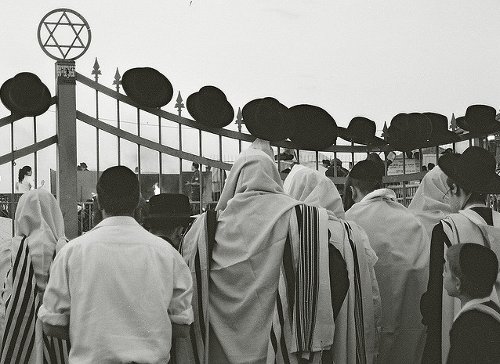
Tag Archives: FFOZ

Pondering the Puzzle

“I have to confess, I don’t really get it. If you believe in Jesus, you believe he is the King. The Lord. The Boss. Your Boss. There is no other option. It’s an integral part of his identity. The fact that some people have lost sight of that fact is evidence, to me, of how far we have come from a really Biblical idea of who Jesus is. We have forgotten that there is no such thing as a Jesus who is not our King, a Jesus we don’t have to obey.”

-Boaz Michael
President and Founder of
First Fruits of Zion (FFOZ)

I’ve mentioned most of this recently, but this is what’s available in my mind and in my blog for today’s “morning meditation.”

I keep trying to turn my rather unusual conceptualization of my Christian faith over and over in my mind, as if examining a rare piece of pottery crafted in ancient times. I’m pondering the runes and arcane markings on this archaeological object trying to tease one more clue to its nature and origin out of it; trying to discover one more secret. No, I’m not a latter-day Indiana Jones, but I am curious.

I’m curious about things I really don’t have the educational background to explore. That doesn’t stop me from wanting to explore them, but it’s like wanting to explore the deepest parts of an ocean but not knowing how to swim. The best I can do is rely on people who are expert oceanographers (who know so much more than just how to swim), their books, their findings, and the occasional special on PBS, to provide glimpses of what I want to know.

I’ll never be able to do the exploring first hand, anymore than I’ll ever be able to read and understand the runes and markings of the “faith object” I’m holding in my hands. I have to depend on someone else’s translation and hope they aren’t selling me a bill of goods, so to speak.

Now that I’ve tossed out sufficient qualifiers, here’s a few of the things I’m curious about. As I said, I may have mentioned them before.

Is the New Testament as “authoritative” as the Old Testament? That is, can we rely on the New Testament writings, including the Gospels, the Epistles, and the Apocalyptic writings to have the same authority of law as do the Torah, the Prophets, and the Writings in the Tanakh?

That’s a tough one, but here’s my opinion, for what it’s worth (and not being a theologian, I guess it’s not worth all that much).

I would say that since the Gospels relate the direct teachings of the Jewish Messiah, then they would have an impact equal to and perhaps greater than the Torah. No, they don’t particularly override Torah (although traditional Christianity will disagree with me here) but they represent the correct presentation and interpretation of God’s intent and will for the Jewish people and ultimately, for the world. If a Christian wants to take something as “law” in the New Testament, it should be teachings of the Messiah in the Gospels.

But what about the Epistles? Is literally every word of every letter Paul, Peter, and James wrote to be considered undying and unchangeable law, applicable in exactly the same manner now as they were in the lives of the different churches they were addressed to in the first century diaspora?

Another tough one. Shooting from the hip, I’d tend to say, “no.” This is where a degree in New Testament scholarship would be handy because I suspect that digging into the different layers of these letters and asking questions like, which ones are considered authentic, who actually wrote them, to whom, under what conditions, and so forth, would yield fascinating results.

What if, for instance, the majority of the material in these letters are meant not to establish new laws and traditions for the church, but to interpret and apply pre-existing Bible law to people and situations for which the law of God was not originally intended? After all, Paul only had a Jewish template by which he could comprehend service to his Creator as a Jew. How does all that work when you’re trying to build a practical worship community for a bunch of non-Jews that is centered around the Jewish Messiah?

No wonder Paul’s letters are so difficult to understand, even today, and why there is so much debate around them among New Testament scholars.

And the Apocalyptic writings? What about John’s Revelation or for that matter, portions of the Gospel of John? Mystic visions are a vast mystery that I’m not even sure how to classify. It’s not a direct teaching of the Master and it isn’t a commentary by the Apostle to the Gentiles. It’s a look behind the veil between Heaven and Earth but I’m uncertain what to make of it all.

What else do I ponder?
When the Messiah returns, what will he teach? I’ll narrow this down a bit. There’s some debate about what sort of “Judaism” Jesus will practice and promote upon his return and as he establishes his reign in Jerusalem. Most Christians probably don’t consider that he’ll practice a Judaism at all but rather a perfect form of Christianity. At best, Gentile believers would probably accept that he’d reset the Jewish calendar back to what was being practiced during his first incarnation among humanity, that is, what many folks out there would call “Biblical Judaism.”

This is opposed to what we refer to as “Rabbinic Judaism” which is generally frowned upon my most Christians as being full of man-made rules and exists as the modern inheritors of the “leaven of the Pharisees,” which is not a complement.

But wait a minute.

A careful examination of the teachings of Jesus and his interactions with the Jewish authorities and common people of his day seems to reveal that, for the most part, he was “OK” with first century normative Judaism, including all of its Halacha and traditions. While the church tends to view first century Jewish tradition as wholly inconsistent with the Bible and a harsh punishment the corrupt Jewish religious authorities set upon the shoulders of the ordinary Jewish population, it was neither invented by those authorities, nor considered bizarre or unusual by Jews.

The topic of rabbinic authority, opinions, and rulings in the time of Jesus and before is enormously complicated and beyond my meager skills to investigate, but I highly recommend Rabbi Joseph Telushkin’s book Hillel: If Not Now, When? which provides an insight into Hillel, a great Jewish teacher and leader who lived a generation before Jesus.

Let’s just say, for the sake of argument, that Jesus was perfectly fine with normative Judaism of the late second temple period, which would have differed from the Judaism of previous eras. What if…just what if when Jesus returns, he’ll be OK with normative Judaism as it exists on that day?

I have no way to back any of this up, but the assumption in Christianity and in some parts of Messianic Judaism is that Jesus will make radical changes to Jewish practice, probably tossing out most or all of what has been established in the past 2,000 years in favor of a more Bible-based model. All of the rulings, opinions, discussions and arguments of the sages would have been in vain. The scholarly teachings of the Rambam and Rashi would be dust. The Baal Shem Tov, the Chassidim, and the modern Chabad would be swept out of existence. Something more acceptable to the members of your local church would be installed in their place.

But is that necessarily true? If indeed, Jesus returns as the Jewish King, establishes his rule in Jerusalem, raises Israel as the head of all the nations of the earth, is it not also conceivable that his practice as a religious Jew might be accepting of at least some, if not most of Rabbinic Judaism?

Something to consider.

Last point. Re-read my quote of Boaz Michael from above before continuing.

One of the criticisms of Messianic Judaism is that it tends to focus more on the Torah and on Judaism than anything Messianic. That is, Jesus seems to take a backseat to Moses. Judaism is more important than Messianic.

Ironically, there are many non-Jewish practitioners in Messianic Judaism who are guilty of this, people who all but turn their back on Jesus but who will focus with great intent on how to tie their tzitzit and the correct pronunciation of their Hebrew prayers.

But what about the Messiah? Where does he fit in? Why have his teachings been subordinated to the Torah of Moses? Isn’t the Jewish King even greater than Moshe?

I think this has been a real problem in Messianic Judaism traditionally and it’s about time to start correcting it. I don’t doubt it will cause a great shake up in many congregations and reintegrating the Jewish Messiah as the center of Messianic Judaism will be quite a chore.

I have no idea how to make it work.

But figuring all this stuff out isn’t the point of today’s “meditation.” The point is just to open the box all this stuff has been stored in for so long, brush off the dust, and give them some air.

Fair wiser heads than mine are going to have to find a way to answer these questions. All I know how to do is ask them.

“If both Judaism and Christianity are correct in their definitions of redemption, then Jesus must do both what Judaism is expecting the Messiah to do, and what Christians expect him to do. This means that Jesus will do more than come back and save those who believe in him from sin and death. He will also re-gather his people Israel from exile and restore them to their land in a state of blessing and peace (Isaiah 35, 48:12-22, 52:1-12; Jeremiah 31).”

-Boaz Michael

Opting Out of Yiddishkeit?

On today’s daf we find halachos that apply to converts.

Converting is a huge sacrifice, which God values greatly—and so should we. But as is well known there is a halachah that a non-Jew who converted as a minor can recant his decision upon reaching majority. In that case, he reverts to being a non-Jew. How sad that he lost out on such a special distinction due to some passing whim!

There was a case where a family converted together; mother, father and children. When one son heard that he was allowed to opt out of Yiddishkeit, he honestly said that he wanted to let go of his conversion. “If I am obligated to be a Jew that is one thing, since God wants me to fulfill the mitzvos. But if I am able to be a non-Jew, why should I take on the obligation to do all the mitzvos? How can I know that I will fulfill them as I should? Isn’t it better for me to go the easier but more sure way?”

But when he expressed this wish, the dayan he spoke to wasn’t sure what to do. “I am not sure whether when an entire family converts one who was a minor at the time can opt out. This is a machlokes Rishonim and I am not certain how we rule.”

When this question reached the Chasam Sofer, zt”l, he ruled decisively. “We hold like the Rishonim who rule that a convert whose entire family converted with him cannot opt out of his Jewishness.”

Daf Yomi Digest
Stories Off the Daf
“The Convert’s Choice”
Niddah 49

I’ve been thinking a lot about religious observance recently. Actually, I’ve been thinking about it for a long time and wondering if I’d ever get up the nerve to actually blog about it.

So here goes.

It’s fairly common knowledge within the Messianic Jewish and Hebrew Roots communities that the status of non-Jews and their possible obligation to Jewish religious observance is a matter of some concern. Mark Kinzer’s book Postmissionary Messianic Judaism: Redefining Christian Engagement with the Jewish People is something of a blueprint of one end of the spectrum of Messianic Judaism that advocates for parallel but wholly separate conduits of Jews occupying Messianic Judaism and Gentiles occupying traditional Christianity. In theory, both groups relate to One God and to Jesus (Yeshua) as the Jewish Messiah, but their recommended approaches to religious practice are totally different, and the two groups rarely if ever, interact.

On the other side of the spectrum is the One Law group which states that there are no distinctions or differences between Jews and non-Jews in the Messianic movement. Except for a matter of DNA, Jews are no different from Gentiles in their obligation to the 613 commandments that define the modern understanding of the Torah. This brings up the uncomfortable reality that all Christians everywhere have the same obligation to the Torah, whether they realize it or not. The One Law position must come to the conclusion (though I’ve never heard them state it as such) that the vast majority of the Christian church is continually in sin because they don’t refrain from eating trief and work and play on Saturday.

The educational ministry First Fruits of Zion (FFOZ) has proposed a sort of “middle ground” in this arena with the idea of something called “divine invitation.” FFOZ has produced a number of books and other, similar materials presenting information from Jewish literary sources suggesting that historically, Gentiles were not always completely forbidden from certain Jewish observances. I won’t attempt to list the details here since they are too numerous, but the basic idea is that, while non-Jews are not obligated to fulfill the Torah mitzvot in the manner of Jews, they are, in many cases, permitted to do so.

This would no doubt fly in the face of more traditional Jewish viewpoints and certainly Orthodox Judaism would be in almost complete disagreement. Nevertheless, within the Messianic context, you will find many non-Jewish people voluntarily taking on board some of the Torah mitzvot as they feel led to do so, but with the understanding that refraining from any of the mitzvot does not constitute a sin on the part of a non-Jewish Christian.

Divine invitation is an opportunity for non-Jews in the movement who have become accustomed to keeping certain of the mitzvot to continue to do so without necessarily crossing the distinction barrier between Gentile and Jew and thus preserving Jewish distinction in Messianic Judaism.

But there’s a flip side to the coin. Divine invitation allows non-Jews in the movement or at least associated with the movement to not observe the mitzvot…at all…ever.

It’s been well over a month since I attended FFOZ’s Shavuot conference at Beth Immanuel Sabbath Fellowship in Hudson, Wisconsin. For several days, I was allowed to worship in what seemed to be the ideal Messianic Jewish religious environment. The Gentiles still outnumbered the Jews by quite a bit, but the model for worship was definitely that of the synagogue, though great accommodations were made for non-Hebrew speakers and readers.

There were a lot of non-Jews worshiping in the Jewish manner, though in that environment, they were not obligated to do so. We non-Jews were not obligated to eat the fine kosher food that was provided. We were not obligated to daven shacharit. We were not obligated to don tzitzit. And yet most of the non-Jewish worshipers did so and no one seemed to mind.

But what if we didn’t? I mean, if we’re not obligated and let’s say, we don’t feel led, so what if we didn’t worship in even a remotely Jewish manner? I suppose nothing bad would happen. But is there an expectation that even if we don’t have to keep the mitzvot, that we should, particularly if we are choosing to worship with Jews who are worshiping God as Jews in a (Messianic) Jewish synagogue?

It would be an interesting experiment in that environment to have a non-Jew observe absolutely none of the mitzvot, just to see what it would be like to decline a “divine invitation.” I suppose it would be like going to your high school senior prom and then continually refusing invitations to dance. What would be the point?

The point I suppose, is that the “prom” is where you feel you belong, where your friends and maybe your family are, and yet you feel you aren’t called to dance their dance because you believe you don’t really belong to that group of dancers.

OK, it’s a crummy metaphor, but you get the idea.

Of course, most of the time, I don’t worship with anybody. In fact, I don’t worship in a community at all. This avoids the whole problem of how I should worship, identity confusion, and the whole shooting match, but there’s a problem. I live with Jewish people. Do I do what they do?

Well, sort of.

Here’s the scary part.

The Jewish people I live with aren’t particularly observant.

There, I said it.

It’s true. At this point, my wife and daughter don’t even light the candles on Erev Shabbat. For a long time, I was the only one doing it, but it seemed absurd that I continue since I’m the only non-Jew in the house and a male and I’m the one lighting the candles. I kept asking my wife on Friday as sundown approached, “Do you want to light the Shabbos candles?” Her response was always something like, “You can if you want to.”

Like I said, it got kind of absurd. No one seemed to care if I lit the candles or not. So I stopped.

My wife hasn’t gone so far as to serve up pork chops for dinner and in fact, she’s rather studious about making sure we all continue to eat “kosher style” (see Leviticus 11), but our kitchen isn’t kosher and, strictly speaking, my wife doesn’t understand why I don’t choose to eat trief, since the kosher obligation doesn’t apply to me.

We also (gasp) work on the Shabbat. This part really bothers me, but there’s not a lot I can do about it. My daughter’s and my wife’s employers require that they work highly variable hours including the weekends, and they often work late Friday nights and on Saturday. The missus has made no bones about saying she would like me to keep my writing and editing schedules up on the weekends, though I’m able to refrain from household chores on Shabbos for the most part, deferring them to Sunday. I can’t remember the last time she went to shul, except perhaps to cook for some special occasions.

Yes, I do know that my Jewish family members are obligated to the Torah, though none of them are observant at the moment.

I suppose that makes me a bad husband and father for not compelling them to do so.

But I can’t really compel them to do anything. I have tried being supportive, but my children are all of adult age and my wife is of course, my wife, so she takes responsibility for her Jewishness and again, it seems rather absurd for a non-Jew and particularly a Christian to be telling her the business of being Jewish.

So having tried that and seeing that it didn’t work out so well, I stopped.

(I suppose at this point I should add that my wife subscribes to and reads the same (more or less) Chabad.org newsletters and tutorials that I do, which means her “morning meditations” are substantially similar to my own. I should also say that she anticipates leaving her current “slave job” at some point in the reasonably near but not clearly defined future, so what she does with her “free” Sabbaths after that is up in the air…but I can hope.)

The whole “divine invitation” and Christian identity thing means that I am not obligated to a Jewish lifestyle. I’m sure most Jews out there are relieved to hear that I’m not living like a Jew. But depending on your view of Jewishness and Jewish obligations to God, some of you may be distressed that my Jewish family members are not observant. Heck, there are members of the local Reform shul who are more observant than my family.

I can imagine that many Jews would blame me for all of this. After all, my wife and I are intermarried. Intermarriage is usually seen as the gateway for a Jew to leave Judaism and assimilate into Gentile secular culture or even into Christianity. While I can assure you that my wife has no attraction to Christianity on any level and I don’t believe she has become secularized, she doesn’t display a strong religious Jewish lifestyle.

More’s the pity.

(I’ll add here that my wife does keep up on events at the local synagogues and does have definite opinions about people at the Reform shul with a “questionable” Jewish background positioning themselves to lead services and teach [and that would never happen at the Chabad]. She’s “OK” with non-Jews and even Christians attending synagogue as long as they don’t talk about their faith, but she draws the line at “Messianics” or those who were formerly associated with the movement assuming any formal synagogue role.)

I have been trying to encourage my son David to return to the synagogue. His wife has recently rekindled her interest in attending church but I don’t think David would go with her on a regular basis. His basic internal template for religion is still Jewish and he remembers fondly some of his “debates” with the local Reform Rabbi. Actually, just last Sunday, my wife said she’d love it is David would visit the Chabad here in town, so she has her hopes as well.

The “religious identity” of my family continues to be in flux. I’m not even sure how much more my wife can tolerate my Christianity, so where I’ll end up in the months and years ahead is uncertain. I’d like my Jewish family to return to Judaism as an observant lifestyle. I hope they don’t see me as a barrier. I’m really anything but. In fact, in a recent conversation about conversion with my wife, (hence the quote at the beginning of this “meditation”) she said it would be ridiculous for a Gentile to try to convert to Judaism in Boise, (although a good friend of hers converted within the past year) since the convert wouldn’t have a strong Jewish community in which to live. So I don’t think my wife wants me to be “Torah observant” in any way, shape, or form. But what about her?

It would seem that for the sake of peace in the home, I must decline my “invitation,” and as a Christian, I would not only make a poor model of Jewish observance for my Jewish family, but I would actually be an annoyance if I tried. Thus, I cannot encourage them by my example since my example would be completely unwelcome.

I suppose if I were a Jewish husband and father, it might be different, but that’s not an option. Maybe the fears of Judaism are authentic fears and intermarriage is the path to slow death for the Jewish people. Even though it is not my intent, I certainly seem to be killing the Judaism in my home.

Across the long span of history, an untold number of Jews have suffered and died to preserve who they are as Jews. Given that realization, I wish I understood what was going on in my own home. But then, in this particular case, I don’t have a say. I only have to wait and pray that God, who has never abandoned His people Israel before, won’t abandon those who live in my household now.

My wife and children are Jewish. I want and even need them to live like Jews. May the God of mercy grant this for them and for the sake of Israel.

Balancing Flight

These days, my son David and I go to the gym together at about five every weekday morning to work out. This morning, I was on one of the aerobic machines. The last five minutes of a workout, I go into a cooldown mode trying to get my heart rate back down to something more or less reasonable. Often, I’ll close my eyes and imagine that I’m running alone on a path that’s climbing to the crest of a hill. It’s dark, but I can see the light of a new sunrise beckoning ahead of me. The light gets brighter as I near the top. It’s almost as if I can see the breath of God intermingling with my own as we approach each other. I jog toward the crest of the hill but never quite reach it before the timer on my machine gets to zero.

But in the last seconds of my fatal descent from the heavens, I manage to pull back up, avoiding a fiery disaster, and with my wings fully extended and my engines roaring with new life, I begin to climb.

-James Pyles
Climb!

I suppose it’s narcissistic for me to quote myself in order to start another blog post, but I couldn’t think of anything else that fit. OK, how about this one?

I’ve heard that there’s a kind of bird without legs that can only fly and fly, and sleep in the wind when it is tired. The bird only lands once in its life… that’s when it dies.

-Yuddy (played by Leslie Cheung)
from the film Days of Being Wild (1990)
original title, “A Fei jingjyhun”

I’ve never seen this film and probably never will, but when I Googled what I was thinking about, the above-quoted piece of dialog came up. Interestingly enough, I first heard this idea in High School. A fellow in my Creative Writing class (yeah, I was interested in writing even back then) wrote a poem (I think…it’s been forty years) about a bird without legs that was perpetually in flight. Sadly, that’s all I can remember.

But it’s enough.

I had a conversation like this with Boaz Michael at the FFOZ Shavuot Conference last month in Hudson, Wisconsin. During one of his presentations, he was talking about FFOZ being able to “land the plane,” which meant being able to get past the chaos of how various people and groups reacted to their shift away from the One Law theology. The idea was to be able to move on and focus on the primary mission and goals of FFOZ. This includes being able to reach out to the church in an effort to promote a more pro-Jewish message, and reaching out to normative Judaism to promote the Jewish Messiah.

At some point during the conference, I had several opportunities to sit down with Boaz and discuss various topics. One of the things I said is that the plane would never land because there will always be challenges.

I think that’s true of us personally in the realm of faith, too. Once we are introduced to God and realize that we must strive to approach Him, we take flight. But its only when we are in the air that we realize we can never land again. There is no turning back. There is no true sense of rest or peace.

I know that sounds strange, especially to anyone who has a bumper sticker on their vehicle that says, “No Jesus, No Peace; Know Jesus, Know Peace.” But really. You live in a world that is completely hostile to the discipline of religion in general and a Christian faith specifically (I think only Jews and, in some circles, Muslims are more reviled). Once we leave the ground, there are only two options: flight and death.

Sounds pretty grim.

When I say “death,” I don’t mean (necessarily) actually dying but if we choose to leave the faith, we die in terms of being spiritually dead. We no longer have a sense of God. Our relationship with Him is severed. We’ve gotten a divorce.

But considering flight, what a glorious thing it is. Imagine being able to fly without the aid of some sort of machine. Imagine simply extending your arms, raising your head, and realizing that your feet have left the ground. Up, up, up you go. The air is cold and crisp but you don’t feel chilled. Instead, you are invigorated, excited, thrilled. You are sharing the skies with God, seeking Him, soaring up to Him, as a bird might climb high above the clouds to seek out the Sun.

Now imagine that flying is something like running. Eventually all of that flapping will make you tired, just like running a marathon will exhaust you (not that I’ve ever run a marathon). Sooner or later you will want to land, to rest.

And you can’t.

You’re committed. It doesn’t matter how tired you get. It doesn’t matter if you’re exhausted. It doesn’t matter that your wings feel like they’re made of lead and sometimes, you feel as if you don’t care anymore. You just want to rest. Even if you fall. Even if you crash. It’s like Yuddy said:

I’ve heard that there’s a kind of bird without legs that can only fly and fly, and sleep in the wind when it is tired. The bird only lands once in its life… that’s when it dies.

So you can glide. Find a sustaining wind, a jet stream, a thermal and let them do the work. Just hold your wings out and let them catch the air and feel yourself suspended between Heaven and Earth; between life and death.

Isn’t that were we all are right now?

Bette Midler sings the Jeff Silbar and Larry Henley song Wind Beneath My Wings (no, I won’t inflict the YouTube videos on you) and the song ends with:

Fly, fly, fly high against the sky,
So high I can almost touch the sky.
Thank you, thank you,
Thank God for you, the wind beneath my wings.

That last line should probably say, “Thank God, You are the wind beneath my wings.” Without God, how could we sustain such an existence.

We all want to enter into His rest. We all long for the Messiah’s return for just that reason. The character Yuddy said cynically, “I used to think there was a kind of bird that, once born, would keep flying until death. The fact is that the bird hasn’t gone anywhere. It was dead from the beginning,” but if that were true, then faith is in vain. The atheists say that, and they say they are more alive than we are. There are more than a few believers who have been unable to find that updraft to support them, and exhausted and flightless, have collapsed back to earth like a latter-day Icarus, not because they flew too close to the Sun, but because they flew too long with leaden wings. They never found their source or they lost the will to keep seeking out that great imagination.

Now let me tell you a little secret. My wings get tired, too. It isn’t always easy to find a convenient wind to keep me aloft. Sometimes I doze and drift and wake up to find myself in a spiraling descent. I rouse my wings and push and lift and climb.

But sometimes it’s a close call.

Somewhere between Heaven and Earth are the forces that balance flight and falling. I know that God would not have called me into the sky if He only intended me to lose my ability to fly, but like that first generation of Israelites who were called out of Egypt, I sometimes doubt and complain. Like them, I sometimes feel as if God really did call me into the Heavens just to break my wings and send me plummeting back into the mud and tears. Like them, sometimes my faith is shaken. Like them, I fear defeat.

Today, if you hear his voice,
do not harden your hearts, as at Meribah,
as on the day at Massah in the wilderness,
when your fathers put me to the test
and put me to the proof, though they had seen my work.
For forty years I loathed that generation
and said, “They are a people who go astray in their heart,
and they have not known my ways.”
Therefore I swore in my wrath,
“They shall not enter my rest.” –Psalm 95:7-11 (ESV)

What a horrible thought that, after all of this effort, after tiring days and sleepless nights, no rest, no sanctuary, no oasis, constantly encountering resistance and opposition, that when it’s all over, I will not enter into His rest anyway.

So desperately terrified of a flight that never ends even after I have collapsed into shredded bone and flesh, I look around for some sign of another thermal. I try to find a way to let the wind lift me so I can rest my wings. I strive to look for the courage and strength to make it one more day in the air. I hope that God will show me, not just the ponderous effort of flying, but the glory of infinitely ascending across the skies.

Because sometimes, that’s all I have left.

Each journey the soul travels takes her higher.

There are journeys that are painful, because there is struggle. Struggle to wrestle out of one place to reach another, struggle to discern the good from the bad and put each in place, struggle to face ugliness and replace it with beauty. But in each of these, a sense of purpose overwhelms the pain and brings its own joy.

Then there are journeys that seem to have no purpose. Where nothing appears to be accomplished, all seems futile. There is no medicine to wash away the pain.

But every journey the soul travels takes her higher. It is only that in some, the destination is a place so distant, so lofty, she could never have imagined. Until she arrives.

-Rabbi Tzvi Freeman
“Unimaginable Journeys”
Based on letters and talks of the Rebbe
Rabbi M. M. Schneerson
Chabad.org

I hope, I pray, I plead that every day is a journey that takes me higher. But the destination is so far away and the effort to reach it is so great. Yet I dare not consider the possibility of falling. I must climb. I must soar. I must fly.

May God, by His grace and mercy, give me the strength. May He grant it to us all.

Asking the Right Questions: A Brief Review of Messiah Journal 110

Gateway to Eden“A river went out from Eden to water the garden.”

There is Eden, and there is the garden.

Eden is a place of delight, far beyond the garden, beyond all created things. Yet its river nurtures all that grows in that garden.

The garden is wisdom, understanding, knowing—where all of creation begins.

Adam is placed in the garden, to work with his mind, and to discover the transcendent Eden flowing within.

The objective of all man’s toil in this world is to work to reach beyond his own mind, higher than mind at all. Not to a place where the mind is ignored, but rather, to its essence, to the inner sense of beauty and wonder that guides it. To Eden.

-Rabbi Tzvi Freeman
“The River from Eden”
Based on letters and talks of the Rebbe
Rabbi M. M. Schneerson
Chabad.org

I get tired.

Yes, I know. We all get tired, but I don’t mean just that. For the past several days, my “meditations” have been anything but peaceful, reflective missives. They’ve been firestorms of controversy which have inspired debates on hotly contested subjects, such as the nature of Christian obligation to Judaism and whether or not the Jews will ever be “saved.”

I’m reminded that at the end of all things, “they shall sit every man under his vine and under his fig tree, and no one shall make them afraid, for the mouth of the Lord of hosts has spoken” (Micah 4:4).

I’m kind of looking forward to that.

I’ve been reading over the latest issue (110) of Messiah Journal (MJ) published by First Fruits of Zion (FFOZ). Normally, I select a few articles from any given issue and review them one at a time. This issue hit me differently.

It’s probably because I was at FFOZ’s recent Shavuot conference which was hosted at Beth Immanuel Sabbath Fellowship in Hudson, Wisconsin. As I was reading a number of the various articles in the magazine, I was reminded of similar content that was presented in different teachings at the conference.

For instance, Aaron Eby’s article “Exile and Redemption in Genesis” seems to be closely related to a number of things I heard Boaz Michael discuss and which I chronicled in Redeeming the Heart of Israel, Part 1 and Part 2. Aaron references the article he wrote for MJ issue 109 called “The Writing on the Wall” in which he discussed the sins that traditional Judaism believes contributed to the destruction of the Second Temple. He alludes to the idea that Christ’s teachings may have specifically been targeting the sins in Israel that resulted in the Temple’s destruction and the exile of the Jewish people, but “Exile and Redemption in Genesis” doesn’t actually go that far. This is obviously a “part 2” of a larger series and I suspect that Aaron will revisit Yeshua’s teachings in the next edition of MJ which will come out in late August or early September. Too bad, because I’d like to see this concept fleshed out a little more right now, particularly with related scriptural verses.

Toby Janicki wrote an article for MJ 110 called Rebbe Nachman on The Suffering Tzaddik.” He tells us that the concept of the death of a tzaddik (righteous one) being able to bring atonement for others, goes back to D. Thomas Lancaster’s article “Suffering Tzaddik” which came out in MJ 107. Toby focuses on the specific experiences and stories related to Rebbe Nachman as they apply to the wider Jewish concept and of course, as they apply to our own great tzaddik, Moshiach Yeshua, and how his death atoned for the sins, not just of his generation, but of all humanity.

(Last September, I wrote my own humble missive on this topic called The Death of the Tzaddik, but my limited research couldn’t possibly be compared to the scholarship of Lancaster or Janicki. Still, you might want to give it a read.)

At the end of reading Toby’s article, I wrote myself a note that said:

Can any of these writings reach Christians who will rely solely on the Bible for evidence?

I was thinking of an email I’d received from a very kind and knowledgable gentleman that morning in response to my “meditation” A Few Thoughts on a General Soul. In part, he wrote:

As you know, the “general soul” business is found in Chassidic thought. It is an extravagant claim and cries out for asmachta (scriptural support). You offer none because, IMHO, there is none to be found.

That certainly strikes home and as fond as I am of the midrashim and Chassidic writings, it is very unlikely that they can be mapped directly back to specific scriptures in the Bible. Near the climax of his article, Toby even says:

So what, if anything, can Rebbe Nachman’s teachings on tikkun and the Master of the Field teach us about the Gospels? It’s important before we answer that question that we realize that the Master and Rebbe Nachman were separated by almost 1,800 years. Much in Judaism changed during those years, and theologies that did not yet exist in the first century had had centuries to develop. Rebbe Nachman based much of his teachings on texts and ideas that were completely foreign to Yeshua.

Don’t get me wrong, I’m completely delighted with this issue of MJ and the scholarly papers presented within, but given recent experiences, I was also reminded of the limitations of said-information, particularly when presented to a crowd of  traditional Christians. It’s like facing an audience of “Joe Fridays” from the old TV show Dragnet (1951-59) with Sgt. Friday interviewing a witness and insisting, “The facts, Ma’am. Just the facts.” In the case of a Christian audience, the phrase might be something like, “The Scriptures, Jim. Just the Scriptures.”

My perspective on my faith allows me to include extra-Biblical sources into my database and I don’t believe you can wholly separate the Judaism of Jesus, Peter, and Paul, from the subsequent Judaisms that have developed across the centuries between the time of Christ and now. That sort of goes along with something else Toby wrote about in his article:

With that said, as my colleague D. Thomas Lancaster likes to point out, “even the work of a Chasidic teacher from a century ago is closer to the world of Yeshua and the disciples than church literature of the second century CE.”

I suppose I’m going to be criticized for including that quote, too.

Russ Resnik in his Messiah Journal article “‘Shema’ Living the Great Commandment: Part 2: ‘Listen’ – The First Imperative” said in part:

Note Yeshua’s emphasis again on hearing, which leads to understanding and bearing fruit. To obey the second line of the Shema and love HaShem wholeheartedly, we must obey the first line and truly “hear.”

The response I wrote in a note to myself says:

And yet, despite the fact that we all want to hear and to obey, what many of us hear seems radically different from all of the others in the body of faith in Messiah, as the comments section of my different blog posts can attest.

Conversations can get very passionate and even unfriendly at times, and yet as we push each other around in the virtual world of the religious blogosphere, we are all striving to achieve essentially the same goal: to uphold and honor God. It’s just that our understanding of what that’s supposed to mean differs greatly from one person to the next and one tradition to the next, and we are all convinced that our tradition is the best and must be defended against all others.

At the Shavuot conference, Boaz mentioned to me that groups often define themselves by their opposition to other groups and that can’t be more clearly illustrated than on the Internet. Even as I’m writing this blog post on Tuesday night, the comments in my blog are continuing to accrue and some part of me isn’t looking forward to reading them. It’s one thing to inspire spirited debate and another thing entirely to be nearly branded “public enemy number one” because I make statements that disagree with someone else’s theology and philosophy.

But in all of these arguments on topics which I really love exploring, I must admit that a number of the points I’ve addressed lately need to be researched much more thoroughly and to be examined through the lens of scripture, before we hitch our wagon to them and start driving them down the road.

On the other hand, if reading articles written by Russ Resnik, Aaron Eby, and Toby Janicki can inspire this much of a response in me, imagine what they might inspire in you. Faith isn’t just about having the answers, it’s about knowing how to ask the right questions. Joe Friday wanted answers that were facts. Another fictional police officer was rewarded for how he asked questions.

Dr. Alfred Lanning: “Good to see you again, son.”

Detective Del Spooner: “Hello, doctor.”

Dr. Alfred Lanning: “Everything that follows is a result of what you see here.”

Detective Del Spooner: “Is there something you want to tell me?”

Dr. Alfred Lanning: “I’m sorry. My responses are limited. You must ask the right questions.”

Detective Del Spooner: “Why did you call me?”

Dr. Alfred Lanning: “I trust your judgement.”

Detective Del Spooner: “Normally, these circumstances wouldn’t require a homicide detective.”

Dr. Alfred Lanning: “But then our interactions have never been entirely normal. Wouldn’t you agree?”

Detective Del Spooner: “You got that right… Is there something you want to say to me?”

Dr. Alfred Lanning: “I’m sorry. My responses are limited. You must ask the right questions.”

Detective Del Spooner: “Why would you kill yourself?”

Dr. Alfred Lanning: “That, detective, is the right question. Program terminated.”

from I, Robot (2004)

Understanding God and the mystery He’s presented us with in the Bible is not just a matter of having the right answers, but of asking the right questions. These can be questions as startling as, “Why would you kill yourself?” We can’t afraid…I can’t be afraid to raise startling questions or to broach sensitive topics of discussion. As tiring as it can be to continually respond to my critics, I have to keep asking those questions.

The questions are bread crumbs. This is where they’re supposed to lead to someday.

Then the angel showed me the river of the water of life, bright as crystal, flowing from the throne of God and of the Lamb through the middle of the street of the city; also, on either side of the river, the tree of life with its twelve kinds of fruit, yielding its fruit each month. The leaves of the tree were for the healing of the nations. No longer will there be anything accursed, but the throne of God and of the Lamb will be in it, and his servants will worship him. They will see his face, and his name will be on their foreheads. And night will be no more. They will need no light of lamp or sun, for the Lord God will be their light, and they will reign forever and ever. –Revelation 22:1-5 (ESV)

Messiah Journal: Excerpt from “Origins of Supersessionism in the Church, Part 2”

Before I launch into the second part of my series on supersessionism in the church, I want to make a point of saying that I am not hanging the full weight of replacement theology of all Christian churches everywhere. I know, especially from my comments in Part 1, that it appears as if Christianity has much to answer for in its treatment of the Jews across history, but I haven’t forgotten that the church has also done an enormous amount of good in the world as the representatives of the Messiah for nearly 2,000 years. The specific scholars and theologians I’ve selected who represent supersessionism don’t represent all of Christianity. I’m not writing this series to drive a wedge between Christians and Jews (and since I’m a Christian, I have no motivation to do so), but to point out a legacy that we have inherited from our fathers and that we need to search out and continue to correct. To any Christian who feels I have treated them unfairly in my previous article, I apologize. Unfortunately, I have to point out some uncomfortable facts, so that we can recognize them for what they are. Once we’ve done that, we can move forward as disciples of the Master and stand side-by-side with our Jewish brothers in the faith before the throne of God.

-from the introduction to
“Origins of Supersessionism in the Church, Part 2”
by James Pyles
Messiah Journal, issue 110, pg 13

I sometimes “accuse” First Fruits of Zion (FFOZ) of “stealth marketing.” Issue 110 of Messiah Journal (MJ) was on display last week at FFOZ’s product table at the Shavuot conference I attended. Several other attendees told me they had already received the current issue in the mail before the conference. By the time I got home after the conference, my copy had arrived in the mail. But on FFOZ’s most recent issues web page for MJ, Issue 109 is listed as the current issue.

I love the people at FFOZ a lot but…Oy.

As you may recall, Part 1 of my Supersessionism series covered the historical origins of supersessionism from Biblical times to the present or at least the “near-past.” Part 2 covers the theological underpinnings of supersessionism in the church as it applies to three critical areas:

  1. Salvation
  2. Eschatology
  3. Religious Festivals

I know that there’s a lot more I could have written about, but when I was discussing how best to approach this part of the series with Boaz Michael, he suggested that these three areas were the most important. Also, I have a word count limit to observe, so I have to zero in on the most informative areas of each article’s main topic.

Salvation, relative to supersessionism, addresses the mechanism by which Jews must be saved. Christianity not only requires that a Jew come to faith in the Jewish Messiah, but that he or she completely give up any Jewish lifestyle or religious observance as a condition of that salvation.

Eschatology involves what most people think of as “the end times” (cue scary thunder and lightning noises, please). First of all, will Jews even be there and second of all, what will be their role? Who are the “144,000 sealed from every tribe of the sons of Israel?” (Revelation 7:4 ESV). Many Christians aren’t convinced they are literally members of the twelve tribes but some spiritual representation of Israel held by (Gentile) Christians.

Religious Festivals has to do with what Jews celebrate vs. what the church celebrates. Why was Easter created as a Christian observance and were Christians actually barred from any observance of Passover by the early church? Were all Jewish festivals considered invalid for Christians and how does that affect church celebrations today?

How conscious are these ideas in the church today? Do people actually think about the role (or lack thereof) of Jews in their relationship with God and in terms of these three topic areas, or are these wholly assumed and therefore beneath the lived Christian awareness?

To find out the answers to these questions and more, contact First Fruits of Zion and ask to purchase a copy of issue 110 of Messiah Journal.

Oh, and by the by, I’ll be reviewing other selected articles from this same issue, so you’ll get an inside glimpse of what writers such as Russ Resnik, Aaron Eby, and Toby Janicki have to say about a number of interesting and even critical subjects in the realm of Messianic Judaism.

Stay tuned.

A Few Thoughts on a General Soul

Hasidism teaches that while not all are able to attain the highest levels of elevated spirituality, the masses can attach themselves to the Tzadik, or truly righteous one, (in Hebrew: התקשרות לצדיקים) whereby even those of lesser achievement will reap the same spiritual and material benefits. By being in the Tzadik’s presence one could achieve dveikut through that of the Tzadik. The Tzadik also serves as the intercessor between those attached to him and God, and acts as the channel through which Divine bounty is passed. To the early Rabbinic opponents of Hasidism, its distinctive doctrine of the Tzadik appeared to place an intermediary before Judaism’s direct connection with God. They saw the Hasidic enthusiasm of telling semi-prophetic or miraculous stories of its leaders as excessive. In Hasidic thought, based on earlier Kabbalistic ideas of collective souls, the Tzaddik is a general soul in which the followers are included. The Tzaddik is described as an “Intermidiary who connects” with God, rather than the heretical notion of an “Intermidiary who separates”. To the followers, the Tzaddik is not an object of prayer, as he attains his level only by being completely bittul (nullified) to God. The Hasidic followers have the custom of handing pidyon requests for blessing to the Tzaddik, or visiting the Ohel graves of earlier leaders.

from the article “Hasidic philosophy”
Wikipedia.org

I can hardly tell you how the above-quoted paragraph seems to describe how I understand the Messiah.

OK, I know that Wikipedia has less than a stellar reputation as a direct resource, but given that Chasidic and Kabbalistic philosophy can be enormously difficult to comprehend (at least to me), I selected what I thought was the most accessible information source. But why am I posting a quote about bonding with a Chasidic tzadik at all? What possible relevance can it have to a Christian, even one who is trying to view his faith through a traditional Jewish lens?

Last week, as I’ve mentioned numerous times, I attended the First Fruits of Zion (FFOZ) 2012 Shavuot conference at the Beth Immanuel Sabbath Fellowship in Hudson, Wisconsin. Among the various teachers and speakers at this event was FFOZ author and staff member Aaron Eby. He said something about the Messiah during one of his presentations that I just had to write down. This probably isn’t word-for-word, but hopefully, it’s close.

Messiah has a general soul and he cannot separate his soul from the soul of Israel.

I’m not sure if the other stuff I have written down on this little piece of paper I’m looking at was said by Aaron or just my interpretation and expansion on what he said, but here it is.

When a Gentile takes hold of the tzitzit of a Jew, he is taking hold of Messiah. He is taking hold of the tzitzit of a Jew and being led to the Temple Mount. Find God in the Jewish people.

I’m obviously referencing Zechariah 8:23 in my notes, but let’s take a look at the verse in it’s context.

“Thus says the Lord of hosts: Peoples shall yet come, even the inhabitants of many cities. The inhabitants of one city shall go to another, saying, ‘Let us go at once to entreat the favor of the Lord and to seek the Lord of hosts; I myself am going.’ Many peoples and strong nations shall come to seek the Lord of hosts in Jerusalem and to entreat the favor of the Lord. Thus says the Lord of hosts: In those days ten men from the nations of every tongue shall take hold of the robe of a Jew, saying, ‘Let us go with you, for we have heard that God is with you.’” –Zechariah 8:20-23 (ESV)

These events occur in the Messianic age, so thus far, ten men of the nations haven’t taken a hold of the tzitzit of a Jew in the manner described by the prophet. However, we know that this will happen and we know we Christians should get used to the idea that it should happen, and that it is all part of God’s plan for the Jews and for us.

A few weeks ago, I wrote on another meditation something that caused quite a stir:

This is another reason why we Christians, and indeed, the entire world, owes the Jews a debt that can never be repaid. It is their King who will finally come and bring peace for everyone, not just the nation of Israel, but the nations of the earth.

The “push back” I received about those words was that we owe God the Father and Jesus Christ such a debt, not the Jewish people. The idea is that Christians should not glorify a people group but instead, glorify God. As far as that statement goes, I agree wholeheartedly. Our worship and devotion belongs only to the God of Israel. Jesus Christ came and even said that God sent him to the lost sheep of Israel. And we know from the very often quoted John 3:16 and many other scriptures that the scope of the Messianic covenant extends far beyond Israel and indeed, to the entire world.

ShavuotBut what was that thing about a “general soul?”

When Aaron made that statement, I immediately thought of the different ways I tried to explain why we Christians do owe a debt to the Jews. In the best way I knew how, I tried to show that the Messiah as an individual, cannot be separated from his people the Jews. In essense, Messiah is Israel and is their firstborn son. Now I have another way of thinking about Messiah as having a general soul that is inseparably joined to the soul of all his people. But maybe, if we can take a different look at Zechariah 8, the door swings both ways, so to speak. We in church, when we “take hold” of Christ, are also taking hold of Israel and the Jews. But we can also “take hold,” as the prophet said, of a Jew, and by doing so, be joined to Israel and her Messiah.

I want to be very careful here and explain that I’m not talking about substituting Judaism in the place of the Messiah. So many Gentiles in the Messianic Jewish movement have fallen into this trap and abandoned Jesus altogether, choosing instead to convert to a traditional Judaism. This is not what I’m suggesting at all. What I’m saying is that we cannot separate the Messiah from Judaism. Perhaps I’m also saying that we cannot separate Judaism from Messiah. I’m not particularly scholarly in these areas, so I don’t have the means to evaluate the mystical implications of all of this, but if nothing else, I see the Messiah and his general soul as a way for us to continually realize that we cannot say we love Jesus Christ and throw the Jews, Judaism, and national Israel under a bus at the same time.

If we accept Christ as Messiah and Lord, we accept all of him, just as he is and always will be. Totally joined to Israel and to every Jew who has ever existed.

So be careful what you say and how you treat the next Jewish person you meet. You never know if someday it may be his tzitzit you will be clinging to as you cling to the soul of the Messiah.

Since the Divine activating force responsible for the existence of created things must continuously be present within them, they are completely nullified in their source. This means, as the Alter Rebbe explained in the previous chapter, that in reality they do not “exist”.

Why, then, do we nevertheless perceive created beings as enjoying a tangible “existence”? — Only because we are unable to see or comprehend the Divine utterance that is contained within each created thing and that calls it into being.

The Alter Rebbe illustrated this by considering the sun’s rays. When they are not within their source, the sun, but diffused throughout the expanse of the universe, they are perceived as having independent existence. However, when they are contained within the sun-globe they clearly have no such “existence” at all.

From “Today’s Tanya Lesson” (Listen online)
Shaar Hayichud Vehaemunah, beginning of Chapter 4
Sivan 12, 5772 · June 2, 2012
Chabad.org