Tag Archives: FFOZ

The World that Doesn’t Exist

Sukkah…these I will bring to my holy mountain
and give them joy in my house of prayer.
Their burnt offerings and sacrifices
will be accepted on my altar;
for my house will be called
a house of prayer for all nations.”
The Sovereign LORD declares—
he who gathers the exiles of Israel:
“I will gather still others to them
besides those already gathered.”
Isaiah 56:7-8

When Jesus heard this, he was amazed and said to those following him, “Truly I tell you, I have not found anyone in Israel with such great faith. I say to you that many will come from the east and the west, and will take their places at the feast with Abraham, Isaac and Jacob in the kingdom of heaven.”Matthew 8:10-11

According to the prophets, the Feast of Booths celebrates a time when all nations will ascend to Jerusalem bearing tribute to King Messiah and celebrating the festival. In that day, all nations will ascend to His throne in Jerusalem in order to celebrate the Festival of Booths (Tabernacles). Obviously, this is a very important festival for disciples of Messiah today.

The Weekly eDrash
“A Tabernacle of Glory over Jerusalem”
First Fruits of Zion commentary on Sukkot
FFOZ.org

I’ve had my doubts.

No, I don’t doubt the word of God but on the other hand, given the division between different denominations of Christians and particularly between Christians and Jews, I wonder how we will all be able to sit down at the same table together “at the feast with Abraham, Isaac and Jacob in the kingdom of heaven” and rejoice in each other and in the Messiah?

Last week I hit a speed bump in my pursuit of the Ger Toshav as a possible model for a relationship between Christians and Jews, and today I was reminded of the state of discomfort and even enmity some Jews feel toward Christians based on this “wall photo” that was shared on Facebook. Add to that some of the comments from Jewish participants about Christianity:

“Christianity has to realize its error in deviating from what the original sect taught and practices before that connection can be made, before that door can be entered through. Only then will hope be found.” –said by S

“I’m saying that Judaism shouldn’t centralize the messiah. And in my opinion when it does, it’s a mistake. Christianity and the holocaust are results of such a mistake.” –said by A

“There are 2 paths in serving Creator: 613 commandments for Jews and Noahide Laws for gentiles. Thats the ideal modality. When gentiles invent their own religions or Jews don’t follow their commandments, they keep the world from reaching perfection which is the hallmark of the Messianic Age.” –said by V

…the reason you give for Christians accept Jews is impossible. a Jew is what he is. Why should he give up to a lesser level of spirituallity?

Your reason for Jews accept Christians, isn’t exactly that, but it has a reason… a reason found in Torah. As long as a gentiles thinks that a man is God, or that there are more than 1 God, or that the Torah given BY GOD to Moshe in Sinai isn’t valid, then a Jew cannot accept it. That’s Idolatry.

I, as a Jew don’t think that gentiles are lesser human beings!!!! NOT AT ALL!!! A Jew who call himself Jew but commits lashon haRa and proclaims hate, is a lesser human being than a gentile with a good heart for humanity. –said by X

From mainstream Judaism’s point of view, it is reasonable to expect this level of response in believing that Christians have misappropriated the concept of Messiah and bent it in very non-Jewish directions. But it also precludes any possibility of a Christian entering a synagogue setting (where it is known he or she is a Christian), learning of the wisdom of the sages, and even being a tiny part of the community, when that Christian’s basic faith would be seen as an affront. Both Jews and Christians pursue God in His vast and majestic Heavens, and yet we cannot build a simple bridge between our two worlds on here on Earth.

I can truly see how Jesus could say “when the Son of Man comes, will he find faith on the earth?” (Luke 18:8)

And yet the prophet says this:

This is what the LORD Almighty says: “In those days ten people from all languages and nations will take firm hold of one Jew by the hem of his robe and say, ‘Let us go with you, because we have heard that God is with you.’” –Zechariah 8:23

The Jews rely on the promises of God that “every man will sit beneath his own vine and fig tree and none will make them afraid” (Micah 4:4) while the Christians rely on the grace of Jesus and the word of the Apostle Paul when he said, “in all these things we are more than conquerors through him who loved us. For I am convinced that neither death nor life, neither angels nor demons, neither the present nor the future, nor any powers, neither height nor depth, nor anything else in all creation, will be able to separate us from the love of God that is in Christ Jesus our Lord” (Romans 8:37-39).

But each group believes God is speaking to only them and is excluding the other (and all others).

While Sukkot is a season of hope, in the present age it is also a season of despair, for while we (or at least Jews and those few Christians who will build a sukkah this year) are supposed to generously invite all guests into our sukkah for a meal and fellowship for the sake of God, how many people and groups will not be on the “approved” list?
JonahLike Jonah, we know the word and the will of God and yet we still seek to run away because it is against our human will to fulfill that word. God turned Jonah away from his mistaken path and delivered him to the great city to complete the job God gave to him, but how will God do that with us? It could begin with a single invitation into our homes and lives of someone we would otherwise not have considered letting in. It could begin with a Christian family accepting a single Jew into fellowship and the breaking of bread. It could begin with a Jewish family inviting a single Christian into their sukkah to enjoy a meal and the prayers. The question is, can it begin now, or must we wait for the Messiah to come (for the Jews) and come again (for the Christians)?

I’m not writing this for you who are “already onboard” with seeking a unity between Christians and Jews, but to those who seek to shelter themselves within their own groups and push away the rest of the world and the rest of the people God created. Is there a delight in committing one act of friendship and graciousness; an act of pure and simple love, not for your sake or mine, but for the sake of God?

G-d has many delights:

The delight that comes from a pure and simple act of love.

Greater than that, the delight that comes from an act of beauty sparkling in the darkness.

Greater than that, the delight when a child who has run away returns with all her heart.

Delight lies at the essence of all that is.

-Rabbi Tzvi Freeman
“Delights”
Based on letters and talks of the Rebbe
Rabbi M. M. Schneerson
Chabad.org

The Rabbi describes a world of people and ideals that does not exist, at least not yet. The hope that we all have in the Messiah is that one day, we will all be able to live in this world and be at peace with God, with all our neighbors, and most of all, be at peace within our own hearts. We will see that peace someday. But we have a very long way to go until “someday” gets here.

The Garden of Ha’azinu

Hands of the GardenerAt every moment, your Creator must decide, “Should I put up once again with this little creature’s imperfections and blunders, or is it time to measure things by the scale?”

Then He looks at the scale you use to measure others. And with that same measure, He measures you.

-Rabbi Tzvi Freeman
“Reciprocal Tolerance”
Based on letters and talks of the Rebbe
Rabbi M. M. Schneerson
Chabad.org

What, after all, is Apollos? And what is Paul? Only servants, through whom you came to believe—as the Lord has assigned to each his task. I planted the seed, Apollos watered it, but God has been making it grow. So neither the one who plants nor the one who waters is anything, but only God, who makes things grow. The one who plants and the one who waters have one purpose, and they will each be rewarded according to their own labor. For we are co-workers in God’s service; you are God’s field, God’s building.1 Corinthians 3:5-9

The First Fruits of Zion (FFOZ) commentary on this week’s Torah Portion Ha’azinu compares the teachings of the Torah given to the Children of Israel to the acts of the Apostles spreading the Good News of Jesus Christ to the people of Corinth. Paul was the first to bring the Gospel message to the Gentiles there, but if he “planted the seed”, then he credits Apollos with “watering” it. Yet the seed, the water, and the growing of the plants all come from God.

And look what we’ve done with what He’s provided. I don’t necessarily say that as a compliment to humanity.

Rabbi Freeman shows us that perhaps God considers our lives each day and ponders about whether or not to extend our existence into tomorrow. This is based on the measure of how we show or fail to show kindness and grace to others. What a terrible way to judge us.

Rosh Hashanah begins at sundown this coming Wednesday (1 Tishrei), and it is believed in Judaism, that at the “head of the year”, God opens the Book of Life, in which are inscribed the names of those who will be extended into the coming year. From Rosh Hashanah, it is said that we have ten days until Yom Kippur to be inscribed into the Book of Life. Perhaps God does “reconsider” our existence from time to time, or at least annually.

That may not fit your view of God or your view of your continuing life, particularly if you are a Christian. In Christ, we believe that we have been redeemed once and for all, thanks to the gift of God’s grace through the atoning death of Jesus. Nevertheless, this does not mean we cannot fail the Creator and it does not mean that we can’t be better tomorrow than we are today. It also doesn’t mean that there are no further consequences for our actions, including the consequence of death.

The FFOZ commentary on Ha’azinu includes this parable:

Consider the story of a foolish gardener. In the spring he planted some seeds and watered them. He was pleased when they began to grow, and he assumed that he could simply wait for the harvest. He did not think to water the young plants again. “After all, I have already watered them,” he said to himself. The plants shriveled up and died.

If God is our gardener, then we are indeed fortunate, for God will not neglect us or fail to water and care for us. But we are self-willed “plants” and we have some control over whether or not we allow ourselves to be “watered”. Words of Torah rain on us from heaven (Deuteronomy 32:2) but do we allow our “roots” to soak up what we need for life? Even though we’ve been “saved”, and even if you believe that salvation is difficult if not impossible to forsake, can you still not forsake living the life God has given to you? Unlike the plants in a garden, God offers care but we must willingly accept it. We can say “yes” or “no” or simply ignore the provision of rain, sunshine, careful weeding, and fertilizer. Who we are in Him depends as much on us and how we choose to live, as it does the generous hand of God.

In Judaism, a new year is coming soon. It’s an opportunity to hit the “cosmic reset button” in our lives. If we have failed Him, and we most certainly have (Romans 3:10), then we too, as Christians, can take this opportunity to turn our “no” into a “yes”. The gardener is here. Let Him sow good things in us so that we can be the good fruit of His harvest.

L’shanah tovah tikatev v’taihatem. May you be inscribed and sealed for a good year.

Transforming Darkness with Light

Inner lightHusbands, love your wives, just as Christ loved the church and gave himself up for her to make her holy, cleansing her by the washing with water through the word, and to present her to himself as a radiant church, without stain or wrinkle or any other blemish, but holy and blameless. In this same way, husbands ought to love their wives as their own bodies. He who loves his wife loves himself. After all, no one ever hated their own body, but they feed and care for their body, just as Christ does the church – for we are members of his body. “For this reason a man will leave his father and mother and be united to his wife, and the two will become one flesh.” This is a profound mystery – but I am talking about Christ and the church. However, each one of you also must love his wife as he loves himself, and the wife must respect her husband.Ephesians 5:25-33 (NIV)

The relation of husband and wife is the way our world reflects the relationship of the Creator with His Creation. There is nothing more pivotal to the world’s ultimate fulfillment than this.

Therefore, as the world nears closer and closer to its fulfillment, the resistance grows stronger and stronger. By now, absolutely everything appears to be undermining the most crucial key of peace between man and woman.

-Rabbi Tzvi Freeman
“Peace at Home”
Based on letters and talks of the Rebbe
Rabbi M. M. Schneerson
Chabad.org

Anyone who’s ever been married knows that, even in the best of relationships, there can be strife and disagreement at times. It isn’t always easy to maintain peace in the home at every moment. The world around you may never know that you and your spouse aren’t getting along, but you know, your spouse knows…and God knows.

How much more does God know about the state of our relationship with Him, if we are on good terms or are feeling estranged. As Rabbi Freeman states, our relationship with our spouse is a reflection of our relationship with God. As the world progresses to a condition of ever greater darkness, it becomes increasingly difficult to maintain peace in the home and peace as we attempt to enter the Temple of Hashem.

In the presence of God and of Christ Jesus, who will judge the living and the dead, and in view of his appearing and his kingdom, I give you this charge: Preach the word; be prepared in season and out of season; correct, rebuke and encourage – with great patience and careful instruction. For the time will come when people will not put up with sound doctrine. Instead, to suit their own desires, they will gather around them a great number of teachers to say what their itching ears want to hear. They will turn their ears away from the truth and turn aside to myths. But you, keep your head in all situations, endure hardship, do the work of an evangelist, discharge all the duties of your ministry. –2 Timothy 4:1-5 (NIV)

Even in the community of faith, “peace is the home” is getting harder to secure. As Paul predicted, we are living in an age when “people will not put up with sound doctrine”, although it is ironic that some very shallow viewpoints on the Word of God are considered to have “deep meaning”. We also see values that once were great in the hearts of believers, visiting the sick, feeding the hungry, giving to the poor, are now considered passe’ and have been replaced by the latest fads in church “feel-good-about-yourself” programs. And yet, in any relationship, no matter the circumstances, we can still overcome the barriers as long as we keep our focus on the object of our love and faith:

Just as He clothes the naked, as it is written [in Genesis 3:21], “The LORD God made garments of skin for Adam and his wife, and clothed them,” so too should you also clothe the naked. The Holy One, blessed be He, visited the sick, as it is written [in Genesis 18:1], ‘Now the LORD appeared to him by the oaks of Mamre,’ [while he was still recovering from circumcision,] so too should you also visit the sick. The Holy One, blessed be He, comforted mourners, as it is written [in Genesis 25:11], “After the death of Abraham, that God blessed his son Isaac,” so too should you also comfort mourners. The Holy one, blessed be He, buried the dead, as it is written [in Deuteronomy 34:6], “And He buried [Moses] in the valley in the land of Moab,” so too should you also bury the dead. –b.Sotah 14a

Here we see God’s love for us and His example in how we should show love to others. We also see this in the life of the Master:

Yochanan heard in prison about the deeds of the Mashiach and sent two of his disciples. They said to him, “Are you the one who comes, or should we wait for another?” Yeshua answered and said to them,

“Go tell Yochanan what you have heard and what you have seen. The blind are seeing, the lame are walking, metzora’im are becoming pure, the deaf are hearing, the dead are rising, and the poor are receiving good news. And O, the gladness of th eman who does not stumble because of me!” –Matthew 11:2-6 (DHE Gospels)

Holding onto lightAs the time of darkness approaches, we can push it back and indeed, by our acts of trust and faithfulness to Jesus, we can actually transform the darkness into light, at least in part, and when he returns to us, he will  make everything complete and restore the world to light.

When light pushes away the darkness, eventually another darkness shall come. When the darkness itself is transformed into light, it is a light that no darkness can oppose.

-Rabbi Tzvi Freeman
“Transformation”
Based on letters and talks of the Rebbe
Rabbi M. M. Schneerson
Chabad.org

Is it any wonder we have this comparison?

Yeshua spoke to them once more saying, “I am the light of the world. Anyone who follows me will not walk in darkness, for he will have the light of life.” –John 8:12 (DHE Gospels)

You are the light of the world. A city that sits on the mountain will not be hidden, nor do people kindle a lamp just to put it under the bushel measure, but on the menorah, to illuminate all who are in the house. So also, shine your light before sons of men, so that they may see your good deeds and praise your father who is in heaven. –Matthew 5:14-16 (DHE Gospels)

Just as we see the light of our Master and strive to imitate him by also becoming light, our Master did nothing on his own:

Then Yeshua said to them, “At the time you lift up the son of man you will know that I am he and that I do not do anything of myself. But as my Father has taught me, so I speak. The one who sent me is with me; the Father has not abandoned me to be alone. For I always do what is good in his eyes.” –John 8:28-29 (DHE Gospels)

Just as he was sent in the Name of the Father, now we are sent in the name of the Son. So we should do all that is good in His eyes, that we might become one with our Father in Heaven, that there might be peace in our homes and in “the Home”, and that the darkness may be dispelled by our light, and His light.

Note: Quotes from the Gospels were taken from the Delitzsch Hebrew Gospels, Hebrew/English translation adapted and published by Vine of David from the original 1890 text, produced by Franz Delitzch and supervised of Gustav Dalman.

Quotes from Sotah 14a and John 8:28-29 were adapted from the First Fruits of Zion (FFOZ) commentary on Torah Portion Ki Tavo, Imitating God.

Dawn

Seeking the Awe of Heaven

Gates of HeavenThere are two approaches to the Bible that prevail in philosophical thinking. The first approach claims that the Bible is a naive book, it is poetry or mythology. As beautiful as it is, it must not be taken seriously, for in its thinking it is primitive and immature. How could you compare it to Hegel or Hobbes, John Locke or Shopenhauer?

The second approach claims that Moses taught the same ideas as Plato or Aristotle, that there is no serious disagreement between the teachings of the philosophers and the teachings of the prophets. Aristotle, for example, used unambiguous terms, while the prophets employed metaphors.

Abraham Joshua Heschel
God in Search of Man: A Philosophy of Judaism.
pp 24-25

Everything is within the power of Heaven except fear and awe of heaven.Berachot 33b

Although I may have left the Rohr Jewish Learning Institute’s lesson on Toward a Meaningful Life behind with yesterday’s morning meditation, the Christian search for God in the Torah, Tanakh, and Talmud still occupies me. I’m sure reading Heschel’s classic only provokes my interest.

The quote from his book which I just posted presents a more interesting dilemma than the one Heschel considered. He was presenting how Jews view God through the lens of the Torah as compared the perspective of the Greek (and later) philosophers and their “more rational” position on God. From a Jewish way of looking at the issue, it’s a matter of Jewish religion vs. non-Jewish, secular philosophy. Now let’s toss a monkey wrench into the spinning machinery.

It is said that much of how Christianity understands and interprets the Bible stems from the study and adherence to Greek philosophy. I’ve known more than one believer who has left the church because they came to realize that the Christian tradition had “Helenized” the Bible, stripping it of its original Hebraic meaning and intent. If they are right, then a Christian studying the Jewish perspectives will either discover something precious or lose something essential in their faith.

Almost two months ago, I read a blog post warning Christians that to study Judaism and Jewish writings was an invitation to apostacy and the abandonment of Christ himself. The danger was that becoming too attracted to Judaism would result in a person who would eventually lose their Christian faith and perhaps even decide to convert.

That concern doesn’ t particularly worry me. There’s something else to consider. I wonder if the Jewish Bible and the Christian Bible even speak the same language. Ponder this statement from Heschel’s book (page 25):

The central thought of Judaism is the living God.

That begs the question, “what is the central thought of Christianity?” The most obvious answer is “Jesus Christ”, but is that the same answer, a related answer, or does this represent two completely different answers? When a Jew thinks of God, he isn’t thinking of the Messiah because nothing in Judaism presupposes that the Messiah must be God. We imagine because the Jewish Bible makes up the first two-thirds of the Christian Bible, that there must be a significant overlap in how Christians and Jews think of, understand, and approach God, but that isn’t particularly true. As my (Jewish) wife keeps telling me, Jews conceptualize God, faith, and the world around them in a fundamentally different way than everyone else, particularly Christians.

But is there no common meeting ground? Don’t both Jews and Christians seek God? Doesn’t the yearning to walk in His Presence stir in both the Jewish and the Christian heart?

The Bible has several words for the act of seeking God (darash, bakkesh, shahar). In some passages these words are used in the sense of inquiring after His will and precepts (Psalm 119:45, 94, 155). Yet, in other passages these words mean more than the act of asking a question, the aim of which is to elicit information. It means addressing oneself directly to God with the aim of getting close to Him; it involves a desire for experience rather than a search for information. Seeking Him includes the fact of keeping His commandments, but it goes beyond it. “Seek ye the Lord and His strength, seek His face continually” (Psalms 105:4). Indeed, to pray does not only mean to seek help; it also means to seek Him. (Heschel page 28)

Hasid AlleywayI certainly can’t see why this couldn’t be the basis of searching for God for both the Jew and the Christian…or any person seeking the God who calls to them in their pain and their dreams.

There’s a certain irony in the fact that, while I as a Christian am seeking God through a Jewish understanding, there was once a Jew who did quite the opposite…and yet remained Jewish:

He read the Gospels in German. Then he obtained a Hebrew version and reread them. Though he was in the midst of a Gentile, Christian city where Jesus was worshiped in churches and honored in every home, Feivel felt the Gospels belonged more to him and the Chasidic world than they did to the Gentiles who revered them. He found the Gospels to be thoroughly Jewish and conceptually similar to Chasidic Judaism. He wondered how Gentile Christians could hope to comprehend Yeshua (Jesus) and His words without the benefit of a classical Jewish education or experience with the esoteric works of the Chasidim.

Taken from Jorge Quinonez:
“Paul Philip Levertoff: Pioneering Hebrew-Christian Scholar and Leader”
Mishkan 37 (2002): 21-34
as quoted from Love and the Messianic Age

Paul Philip Levertoff, born as Feivel Levertoff first encountered a page from the Gospels as a nine-year old Chasidic Jewish boy in the late 19th century. He found a scrap of paper in the snow one day written in Hebrew and assumed it was from a Jewish holy book. He took it home to his father to see what should be done, but when the man realized what was written on the paper, he threw it in the stove to burn. But while that scrap of paper was reduced to ashes, a different kind of fire was kindled in Feivel Levertoff that day and that fire never left him for the remainder of his life.

Levertoff couldn’t believe that anyone not schooled in the Zohar, the Tanya, or other mystic and Chasidic Jewish wisdom could ever understand the words such as are written in John’s Gospel. As much as anything, Levertoff’s experience lets me anticipate that someone with an essential faith in Jesus can hope to allow that faith, understanding, and worship to grow and expand when nurtured with some of the same fertile Jewish prayers and readings (see my review of Levertoff’s Love and the Messianic Age for more).

Returning to Heschel (page 31):

There are three starting points of contemplation about God; three trails that lead to Him. The first is the way of sensing the presence of God in the world in things; the second is the way of sensing His presence in the Bible; the third is the way of sensing His presence in sacred deeds.

What Heschel is describing as three starting points are what he later defines as worship, learning, and action. In my reading and subsequent review of Gershom Scholem’s Major Trends in Jewish Mysticism, I noticed that it was not recommended for each to person take the same path to God. It seems that not everyone is cut out for the “mystic approach”. Rather, some people are best suited to approaching God through deed, others mainly through study, and still others, primarily through prayer and worship. How interesting that Heschel should offer the same three options, mapped to different scriptures:

  • Worship: “Lift up your eyes on high and see, Who created these? –Isaiah 40;26
  • Learning: “I am the Lord thy God.” –Exodus 20:2
  • Action: “We shall do and we shall hear.” –Exodus 24:7

The human race is a people seeking God. Many don’t understand that His face is the one they long to see and if you ask them about it, they’ll deny it vehemently. And yet, mankind thirsts for justice, cries out for mercy, begs for forgiveness, and pleads for their wounds and sicknesses to be healed. Who are they crying out to if not God?

How much more can this be said of those of us who understand that we are seeking the face of God and yet, there seems to be more than one road to His Throne (not contradicting John 14:6). Even in narrowing these methods to worship, study, and actions, there are still so many choices to consider. I continue to make my choice in one particular direction. Hopefully, Rabbi Heschel wouldn’t have minded.

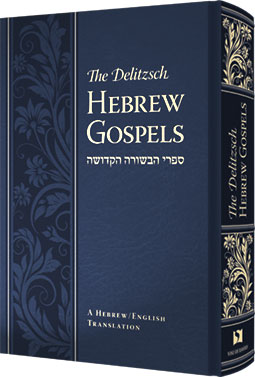
The Delitzsch Hebrew Gospels: A Review

DHEIn 1873 the British and Foreign Bible Society commissioned Franz Delitzsch to prepare a translation of the New Testament into Hebrew. Delitzsch agreed and set to work utilizing his extensive knowledge of mishnaic Hebrew and first century Judaism to create a translation and reconstruction of the Greek text back into an original Hebrew voice. His reconstructing translation was completed in 1877. After the first edition, it went through extensive review and revision for the next 13 years. The final edition was published in 1890 under the care and supervision of Gustav Dalman. Sixty thousand copies were distributed for free throughout Europe resulting in tens of thousands of Jewish people coming to know Yeshua as the Messiah of Israel.

Those Jewish believers and their influences are the very embers that have ignited this modern-day hope and revival.

This is the introduction on the Vine of David website to the Levy Hirsch Memorial Edition of the Delitzsch Hebrew Gospels. Over a century has passed since the last edition of this critical and faithful publication has been produced and Vine of David, the ministry arm of First Fruits of Zion (FFOZ) that specializes in early Messianic Judaism and the development of Messianic liturgical resources, has taken up the mission of publishing this Gospel and distributing it for free to any Jewish person, allowing Jews to explore the teachings of the Master, both in Hebrew and in English.

The Delitzsch Gospels is an elegant Bible and holding it, is like holding a bridge between Jewish believers in Yeshua (Jesus) from the 19th century to those carrying the Messianic banner today. While there are other New Testaments written in Hebrew and other Semitic languages, Delitzsch’s translation uses sources and interpretations that are the most well-known.

Although the Delitzsch Hebrew Gospels are specifically reaching out to the Jewish people, as a non-Jewish Christian, I find the resources this publication offers to be compelling. From the Translator’s Preface and Introduction to the abundance of reference materials, including maps and charts, this version of the Gospels provides history and context, not only of the Franz Delitzsch and the 19th century believing Jews, but a hint of the true Jewish origins of the Gospels and of the 1st century Gospel writers.

The heart of the Delitzsch Gospels are the Gospels themselves. Reading them reminds me  of the experience of reading the Chumash or the Tanach. Opening the Gospel to Mattei (Matthew) 1:1, the genealogy of Jesus is presented in English on the left page and in Hebrew on the right. Even with Hebrew skills far less than fluent, I can still imagine going through the opening words of the first Gospel alongside both Christian and Jewish believers, and perhaps get a small sense of what the author was thinking in his own language as he began recording his understanding of the life of the Master.

Beyond the value the Delitzsch Gospels present to Jewish believers, this modern edition also offers a unique gift to Gentile Christians who have little or no understanding of the “Jewish Jesus”. It presents those in the church with a taste of “original” Jesus, the Jewish Rabbi who walked the streets of 1st century Jerusalem and who taught his disciples in the hills of Galilee. In reading and studying from the Delitzsch Hebrew Gospels, we all can attain a clearer vision of who Jesus was and is among his people, the Jews, and his mission to save the lost sheep of Israel.

Who is Jesus of Nazareth, Son of the living God, called the Christ and the Moshiach? You may think you know. But the images invoked by reading his words and his life from the pages of Vine of David’s Delitzsch Hebrew Gospels may well introduce you to the Jewish Messiah and the Israelite Carpenter, Teacher, and King of Kings for the very first time.

To learn more, please visit the Vine of David. The blessings will be yours.

Finding Freedom

CaptureTell me, you who want to be under the law, are you not aware of what the law says? For it is written that Abraham had two sons, one by the slave woman and the other by the free woman. His son by the slave woman was born according to the flesh, but his son by the free woman was born as the result of a divine promise.

These things are being taken figuratively: The women represent two covenants. One covenant is from Mount Sinai and bears children who are to be slaves: This is Hagar. Now Hagar stands for Mount Sinai in Arabia and corresponds to the present city of Jerusalem, because she is in slavery with her children. But the Jerusalem that is above is free, and she is our mother.Galatians 4:21-26

Speak and act as those who are going to be judged by the law that gives freedom, because judgment without mercy will be shown to anyone who has not been merciful. Mercy triumphs over judgment.James 2:12-13

So what is it? Does the Law take away freedom or does the law give freedom? Are we even talking about the same Law; the Torah?

I’ve often suspected that Paul and James didn’t see eye-to-eye on many issues. Paul was operating for years at a time in the diaspora, bringing the Gentiles to faith in the Jewish Messiah and teaching them his ways and how to trust in God. There wasn’t a lot of oversight going on from the Jerusalem Counsel, so Paul could have gotten away with re-writing the Gospel message in his own image, diluting or even eliminating the law and replacing it a type of “grace” that is the antithesis of the law (though in reality, they are not mutually exclusive). It’s clear that James wouldn’t have agreed with that message.

However, if you read D. Thomas Lancaster’s new book The Holy Epistle to the Galatians, you’ll see that Paul and James were more alike than unalike (though I still suspect that they had their individual perspectives). For one thing, despite the common Christian tradition of interpreting Galatians 4:21-26 as “anti-Law” (and in the plain English text, it certainly seems that’s what Paul’s saying), the issues are more complex. Lancaster interprets them this way:

The passage contrasts two types of proselytes: the legal proselyte and the spiritual proselyte. The one becomes part of Abraham’s family by conventional conversion, the other through faith in Messiah, the promised seed of Abraham, in whom all nations find blessing. The passage does not contrast the Old Testament against the New Testament or the Old Covenant with the New Covenant. It does not equate Judaism and Torah with slavery, nor does it pit Christians against Jews.

It means that if you are a Jewish believer , you should be proud of being Jewish because you are a child of Abraham, legally, physically, and spiritually. It means that if you are a Gentile believer, you, too, are part of the people, a spiritual son of Abraham, and that is remarkable – miraculous even. You are a child of the promise that God made to Abraham so long ago.

I’ve already written a review of Lancaster’s book and I’m not going to “reinvent the wheel”, so to speak, but I’m presenting this “extra meditation” this afternoon, in response to the following:

No one can say he is free today because yesterday he was granted freedom.

Freedom is a source of endless energy.
Freedom is the power behind this entire universe.
Freedom is the force that brings existence out of the void.

You are free when you take part in that endlessness. When you never stand still. When you are forever escaping the confines of today to create a freer tomorrow.

Rabbi Tzvi Freeman
“Perpetual Freedom”
Chabad.org

As an Orthodox Jew, Rabbi Freeman isn’t considering that the Torah is somehow slavery or bondage, even for a single moment. So how are Christians to interpret his words of freedom as well as the apparent conflict between Paul and James, both observant and devout Jews, on how they view the Torah?

It is said that the world was created for the sake of Torah and that, without the Torah, the world could not have been made. The analogous teaching we have in Christianity is this:

In the beginning was the Word, and the Word was with God, and the Word was God. He was with God in the beginning. Through him all things were made; without him nothing was made that has been made. –John 1:1-3

TeshuvahHere, we see a sort of “fusion” or co-identity, in some mystic sense, between the Torah and the Messiah, Son of the living God. Christians know that Jesus gives us freedom from the slavery of sin and Jews know that the Torah is the gateway to God’s endless energy, the power behind the universe, and the limitless, eternal source that creates existence out of nothingness. Through Torah, God does not enslave, but provides the means by which men may know God and understand our relationship to Him. If the same can be said of Jesus, then we can all understand from where our freedom comes.

While non-Jewish disciples of the Jewish Messiah are not obligated to the same “yoke of Torah” as the Jewish people (see Acts 15), we nonetheless are grafted into the root of the Tree of Life and like branches on the vine, we draw our nourishment and the ability to live a life of holiness from an identical source; God.

To do so requires more than just believing and more than just learning; we must do, we must behave, we must live out the values we understand from the Torah and how they were taught to us by the “living Torah”, the Moshiach, Jesus Christ. Part of that living is understanding where we came from, who we are, and our need to separate from sin and embrace holiness and peace. To gain freedom from sin, we must recognize the depth and despair of sin, which is what the Torah aptly defines, and only upon achieving that understanding, can we truly turn away from that sin and turn toward the God of Abraham, Isaac, and Jacob:

The Ohr Hachaim HaKadosh, zt”l, writes that one can only do teshuvah if he first recognizes the gravity of his sin.

A certain person committed a sin. When Rav Mordechai Aryeh Halevi Horowitz, zt”l, gently nudged him to repent the sinner displayed his relaxed attitude towards teshuvah. “Why repent now? Soon enough it will be Elul, the season when the shofar is sounded to remind us to do teshuvah. Can’t my teshuvah wait until then?”

Rav Horowitz rejected this attitude out of hand. “As is well known, the main element in teshuvah is havdalah, separating between what is proper and what is not. It is only by determining which actions lead to darkness and which generate light that we act as is fitting. Even if a person with understanding falls to sin chas v’shalom, he knows to repent and change his ways. But many people wait until Elul to do teshuvah. After all, isn’t that when we are aroused to repentance by the shofar as the Rambam writes?

“We find in the Mishnah in Chulin 26 that whenever the Shofar is sounded we do not say havdalah. Conversely, whenever we say havdalah we do not sound the shofar. Although on a simple level this is a sign for when they would blow the shofar to signify the onset of Shabbos or Yom Tov, this statement also teaches a lesson about teshuvah. When one feels justified waiting to do teshuvah until the shofar is sounded during Elul, this shows he lacks understanding. He does not comprehend the gravity of sins since this leads to havdalah, healthy separation between what is right and what is wrong. One who has fitting discrimination between good and bad doesn’t wait to hear the shofar to repent!”

Dam Yomi Digest
Stories off the Daf
“Time for Repentance”
Chullin 26

If we claim to be without sin, we deceive ourselves and the truth is not in us. If we confess our sins, he is faithful and just and will forgive us our sins and purify us from all unrighteousness. –1 John 1:8-9

Good Shabbos