
Soon after, Minister Flores made the decision to convert to Judaism. But he struggled to find a way to tell us, as he didn’t want to tear down Christianity without being able to offer us an alternative. So he kept teaching Torah, but in a way that was as subtle as possible. He gradually peeled away the things that were wrong and got us closer to Torah. Our church started replacing Jesus’ name with Jewish, Hebrew names of God, and the songs became Hebrew songs. We began to incorporate real Jewish traditions into our festivals, and we even got a Torah scroll for the church.
At that point we resembled more of a Jews for Jesus group, in the sense that we were Christians with a lot of Jewish traditions. The difference, of course, was that we were moving in the direction toward authentic Judaism, not the other way around.
-Yosef Juarez
“The Torah in Our Church”
Aish.com
Ever since I published Nanos, Paul, and the Consequences of Jewish Identity in Messiah as well as witnessed/participated in the subsequent online discussion, I’ve spent a great deal of time pondering the idea of exactly how the early non-Jewish disciples of the Messiah entered into what was originally a wholly Jewish religious stream. Up to the time of Paul, the only way for a non-Jew to formally enter into any form of religious Judaism was to convert via the proselyte process and become “a Jew by choice,” to use the modern parlance.
In the aforementioned blog post inspired by an article written by New Testament scholar and historian Mark Nanos, one blog commenter asked (tongue-in-cheek):
Then what were gentiles converting to? Christianity?
No, of course not. Christianity, as we understand it today, did not exist when Paul walked the earth. But the Gentiles were not converting to Judaism either…well, not exactly.
Or were they?
No, I’m not suggesting that the early Gentile believers actually converted to Judaism and took on all of the obligations and identity markers of their Jewish mentors, but they did join “the Way” as fully equal co-participants in Yeshua-faith with the Jewish disciples.
But how can you convert to Judaism and not be a Jew?
It gets complicated from here on in, but that’s the mystery we struggle with twenty centuries later as we look through the lens of scripture, history, archeology, and any other tool at our disposal, and try to apprehend not only the intent of Paul and the Council of Apostles in Jerusalem, but of Messiah and God the Father.
That Gentiles were always intended to be reconciled with the Creator and to worship the One God alongside Israel is a foregone conclusion based on many of the Messianic prophesies chronicled in the Tanakh (Old Testament), but exactly how it was to happen is still somewhat hidden in the shadows of time.
Well, maybe.
The only conclusion I can come to with my present understanding of Paul is that he did “convert” non-Jews into a Jewish religious space, not by the proselyte rites, or as “guests” in the manner of the God-fearers, but into a life within Judaism specifically developed for Gentiles in Messiah, and lived out as non-Jewish co-participants, equal in the blessings of reconciliation, justification, and salvation, but not identical to Jewish participants in identity or responsibility.
Not that the Gentiles didn’t have responsibilities. We can start to see the skeleton of their (our) duties in the apostolic decrees (see Acts 15) and fleshed out just a bit more in many of Paul’s letters.
I wrote a number of detailed reviews of the Nanos book The Mystery of Romans including this one that described a sort of mutual dependency Paul characterized between the believing Gentiles and believing and non-believing Jews in Rome.
For the believing Gentiles, their duties to their Jewish hosts did not end at complying with principles designed to avoid offending Jewish sensitivities and facilitating fellowship, but also included provoking jealousy by showing themselves to be the first fruits of the prophecies of the Tanakh that speak of Gentiles “taking hold” of Jews, and going up to the House of the Lord, the House of Prayer, with the devout Jewish people in order to worship the God of Jacob.
That would mean separating from their former lifestyle, from paganism, and in most cases from family, leaving civic cult practice to honor God within the context of a Jewish worship designed for Gentile identity and legal status, but remaining non-Jews in order to clearly show themselves to be the fulfillment of prophesy rather than proselytes or some form of “pseudo-proselytes”.
 In my previous blog post, I characterized Nanos’ opinion on Paul relative to Gentile conversion to Judaism within the framework of “the Way” as being firmly against such a proselyte conversion, but subsequent reading has brought up some questions. It’s very possible Paul was convinced that the Messianic return was only decades away and as such, he felt there just wasn’t time to do anything but spread the gospel message to the rest of the known world as quickly as possible. He may have thought that issues of conversion or even marital status (1 Corinthians 7:8 for example) were of a lesser priority than the imminent return of the Moshiach, so there was no need to develop rulings that would cover the requirements of later generations of Gentile believers.
However, history as shown us that the window for Messiah’s return is a rather lengthy corridor and we still have yet to reach the end. That being said, and keeping a Jewish perspective in mind, since Judaism is adaptive and halachah is continually or at least periodically in a state of development, is the issue of Gentile conversion to Judaism within the modern Messianic Jewish movement something that is, while Paul may not have pre-supposed it, nevertheless completely valid in the present, given the requirements of Jewish and non-Jewish disciples within the context of a Jewish faith in Yeshua the Messiah some two-thousand years down the road?
That question (and it was a long one) might not make sense to Christians who state they observe the “commandments” of the New Testament as a closed canon and an unchangeable decree, but that actually isn’t the case. While Christians sometimes criticize the various modern streams of Judaism for maintaining a quasi-open canon via the Talmudic rulings of the Rabbinic sages, in reality, the Protestant church in all its incarnations, more closely follows a 16th century (and even later) set of interpretations of the New Testament, rather than the original, apostolic understandings and teachings of the people who participated in spreading the good news from Jerusalem to Judea, Samaria, and to the diaspora nations of the first century of the common era.
Both Christianity and Judaism have their own methods of keeping one foot firmly rooted in the Bible and the other one wandering up and down the passageways of time.
This idea of how Paul, James, and the apostles of the council conceptualized the role of Gentiles in their Jewish religious world has profound implications, not only on how we read and understand the New Testament, but how we view the role of the Church today, as well as modern Christian/Jewish relations.
We may have it all wrong when we think of the exact mechanism by which Gentiles entered “the Way,” and that, in a sense, they were not “converted” to Judaism or became citizens of Israel (and thus “Israelites” as opposed to “Jews”), but entered a unique legal status that at once made them equal relative to certain covenantal blessings without being identical, for the sake of fulfilling Messianic promises, to the Jewish people in identity and obligation, but still actually practicing Judaism as a way of life specifically crafted for the Gentiles by legal decree and the will of the Holy Spirit. I’ve heard it said that the short definition of a Jew is one who has rejected idolatry (obviously the long definition contains a lot more details). In that manner, while we can’t count the Gentiles in Messiah as Jews, they (we) are practicing a form of Judaism styled for them (us), at least within the ancient “Way” and in modern Messianic Judaism.
Although Christianity and Judaism (in all their various flavors) have described quite different trajectories across history, it is foolish to imagine that One God and a returning Messiah King will allow such a state to remain as we have constructed it, through it’s within the realm of possibility (considering the beginning verses of Matthew 23), that Messiah may allow a certain amount “halachah” to remain in place based on his giving the apostles the authority to make binding rulings in his name (assuming any of that trickled down to the Christian or Messianic movements of today as we imagine it has in parallel process to the modern, normative Judaisms).
Prophesy states that Messiah will return all of the Jewish exiles to their Land and their place, but it may be that he will also return the Gentile disciples to an understanding of who we are and where our duties lie in relation to the King of Israel, the nation of Israel, and the Jewish people.
I have a lot more reading to do in order to more completely explore this concept, but it’s heading in a direction I’ve been approaching for a while now.
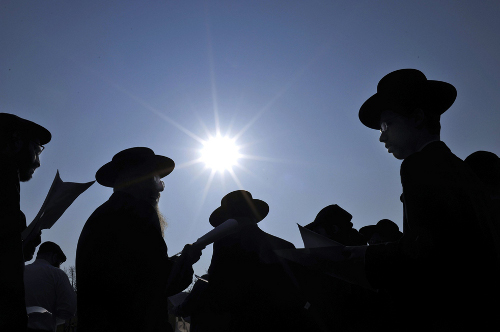 I think there are a number of Christians and Christian groups who are feeling the pull of prophesy, but in most cases, such as in the above-quoted article written by Yosef Juarez, there’s been a terrible misunderstanding. Messiah never meant for us to believe that we had to choose between him and our devotion to Jewish people and Israel, rather he desires that we arrive at a proper understanding of our role in relation to Israel and her King, where King and Country are not mutually exclusive as most people believe is true of Jesus and Israel.
While we don’t see entire church groups converting to Judaism en masse very often (as Yosef Juarez describes in his article), we do see Gentile Christians entering into Hebrew Roots congregations and attempting to fulfill their roles (mistakenly in my opinion) by apprehending Jewish identity rather than their (our) own, or even more tragically, Gentiles in Hebrew Roots and Messianic Judaism leaving Messiah Yeshua behind and converting to one of the modern Judaisms of our day.
There are few things sadder than seeing a Christian begin to develop a sincere love of Israel and the Jewish people and then to allow misunderstanding and a misguided sense of purpose to cause them to completely overshoot the target, missing the point and mistaking the background for the goal.
“One who romanticizes over Judaism and loses focus of the kingdom of Heaven can be compared to a carpenter who is infatuated with the hammer, rather than the house it was meant to build.”
It may not be entirely inappropriate to consider, under certain specific circumstances, Gentile conversion to Judaism within a Messianic Jewish venue, but again, in my opinion, this should be a rare occasion. Gentiles will never be able to take their (our) place in God’s Kingdom as the crowning jewels of the nations if we convert or quasi-convert to Judaism in significant numbers. To be “crowning jewels” we must remain among “the nations” or fail prophesy, Messiah, and God.







 Morning Meditations