Tag Archives: First Fruits of Zion

The Consequences of Gentile Identity in Messiah

Soon after, Minister Flores made the decision to convert to Judaism. But he struggled to find a way to tell us, as he didn’t want to tear down Christianity without being able to offer us an alternative. So he kept teaching Torah, but in a way that was as subtle as possible. He gradually peeled away the things that were wrong and got us closer to Torah. Our church started replacing Jesus’ name with Jewish, Hebrew names of God, and the songs became Hebrew songs. We began to incorporate real Jewish traditions into our festivals, and we even got a Torah scroll for the church.

At that point we resembled more of a Jews for Jesus group, in the sense that we were Christians with a lot of Jewish traditions. The difference, of course, was that we were moving in the direction toward authentic Judaism, not the other way around.

-Yosef Juarez
“The Torah in Our Church”
Aish.com

Ever since I published Nanos, Paul, and the Consequences of Jewish Identity in Messiah as well as witnessed/participated in the subsequent online discussion, I’ve spent a great deal of time pondering the idea of exactly how the early non-Jewish disciples of the Messiah entered into what was originally a wholly Jewish religious stream. Up to the time of Paul, the only way for a non-Jew to formally enter into any form of religious Judaism was to convert via the proselyte process and become “a Jew by choice,” to use the modern parlance.

In the aforementioned blog post inspired by an article written by New Testament scholar and historian Mark Nanos, one blog commenter asked (tongue-in-cheek):

Then what were gentiles converting to? Christianity?

No, of course not. Christianity, as we understand it today, did not exist when Paul walked the earth. But the Gentiles were not converting to Judaism either…well, not exactly.

Or were they?

No, I’m not suggesting that the early Gentile believers actually converted to Judaism and took on all of the obligations and identity markers of their Jewish mentors, but they did join “the Way” as fully equal co-participants in Yeshua-faith with the Jewish disciples.

But how can you convert to Judaism and not be a Jew?

It gets complicated from here on in, but that’s the mystery we struggle with twenty centuries later as we look through the lens of scripture, history, archeology, and any other tool at our disposal, and try to apprehend not only the intent of Paul and the Council of Apostles in Jerusalem, but of Messiah and God the Father.

That Gentiles were always intended to be reconciled with the Creator and to worship the One God alongside Israel is a foregone conclusion based on many of the Messianic prophesies chronicled in the Tanakh (Old Testament), but exactly how it was to happen is still somewhat hidden in the shadows of time.

Well, maybe.

The only conclusion I can come to with my present understanding of Paul is that he did “convert” non-Jews into a Jewish religious space, not by the proselyte rites, or as “guests” in the manner of the God-fearers, but into a life within Judaism specifically developed for Gentiles in Messiah, and lived out as non-Jewish co-participants, equal in the blessings of reconciliation, justification, and salvation, but not identical to Jewish participants in identity or responsibility.

Not that the Gentiles didn’t have responsibilities. We can start to see the skeleton of their (our) duties in the apostolic decrees (see Acts 15) and fleshed out just a bit more in many of Paul’s letters.

I wrote a number of detailed reviews of the Nanos book The Mystery of Romans including this one that described a sort of mutual dependency Paul characterized between the believing Gentiles and believing and non-believing Jews in Rome.

For the believing Gentiles, their duties to their Jewish hosts did not end at complying with principles designed to avoid offending Jewish sensitivities and facilitating fellowship, but also included provoking jealousy by showing themselves to be the first fruits of the prophecies of the Tanakh that speak of Gentiles “taking hold” of Jews, and going up to the House of the Lord, the House of Prayer, with the devout Jewish people in order to worship the God of Jacob.

That would mean separating from their former lifestyle, from paganism, and in most cases from family, leaving civic cult practice to honor God within the context of a Jewish worship designed for Gentile identity and legal status, but remaining non-Jews in order to clearly show themselves to be the fulfillment of prophesy rather than proselytes or some form of “pseudo-proselytes”.

Mark NanosIn my previous blog post, I characterized Nanos’ opinion on Paul relative to Gentile conversion to Judaism within the framework of “the Way” as being firmly against such a proselyte conversion, but subsequent reading has brought up some questions. It’s very possible Paul was convinced that the Messianic return was only decades away and as such, he felt there just wasn’t time to do anything but spread the gospel message to the rest of the known world as quickly as possible. He may have thought that issues of conversion or even marital status (1 Corinthians 7:8 for example) were of a lesser priority than the imminent return of the Moshiach, so there was no need to develop rulings that would cover the requirements of later generations of Gentile believers.

However, history as shown us that the window for Messiah’s return is a rather lengthy corridor and we still have yet to reach the end. That being said, and keeping a Jewish perspective in mind, since Judaism is adaptive and halachah is continually or at least periodically in a state of development, is the issue of Gentile conversion to Judaism within the modern Messianic Jewish movement something that is, while Paul may not have pre-supposed it, nevertheless completely valid in the present, given the requirements of Jewish and non-Jewish disciples within the context of a Jewish faith in Yeshua the Messiah some two-thousand years down the road?

That question (and it was a long one) might not make sense to Christians who state they observe the “commandments” of the New Testament as a closed canon and an unchangeable decree, but that actually isn’t the case. While Christians sometimes criticize the various modern streams of Judaism for maintaining a quasi-open canon via the Talmudic rulings of the Rabbinic sages, in reality, the Protestant church in all its incarnations, more closely follows a 16th century (and even later) set of interpretations of the New Testament, rather than the original, apostolic understandings and teachings of the people who participated in spreading the good news from Jerusalem to Judea, Samaria, and to the diaspora nations of the first century of the common era.

Both Christianity and Judaism have their own methods of keeping one foot firmly rooted in the Bible and the other one wandering up and down the passageways of time.

This idea of how Paul, James, and the apostles of the council conceptualized the role of Gentiles in their Jewish religious world has profound implications, not only on how we read and understand the New Testament, but how we view the role of the Church today, as well as modern Christian/Jewish relations.

We may have it all wrong when we think of the exact mechanism by which Gentiles entered “the Way,” and that, in a sense, they were not “converted” to Judaism or became citizens of Israel (and thus “Israelites” as opposed to “Jews”), but entered a unique legal status that at once made them equal relative to certain covenantal blessings without being identical, for the sake of fulfilling Messianic promises, to the Jewish people in identity and obligation, but still actually practicing Judaism as a way of life specifically crafted for the Gentiles by legal decree and the will of the Holy Spirit. I’ve heard it said that the short definition of a Jew is one who has rejected idolatry (obviously the long definition contains a lot more details). In that manner, while we can’t count the Gentiles in Messiah as Jews, they (we) are practicing a form of Judaism styled for them (us), at least within the ancient “Way” and in modern Messianic Judaism.

Although Christianity and Judaism (in all their various flavors) have described quite different trajectories across history, it is foolish to imagine that One God and a returning Messiah King will allow such a state to remain as we have constructed it, through it’s within the realm of possibility (considering the beginning verses of Matthew 23), that Messiah may allow a certain amount “halachah” to remain in place based on his giving the apostles the authority to make binding rulings in his name (assuming any of that trickled down to the Christian or Messianic movements of today as we imagine it has in parallel process to the modern, normative Judaisms).

Prophesy states that Messiah will return all of the Jewish exiles to their Land and their place, but it may be that he will also return the Gentile disciples to an understanding of who we are and where our duties lie in relation to the King of Israel, the nation of Israel, and the Jewish people.

I have a lot more reading to do in order to more completely explore this concept, but it’s heading in a direction I’ve been approaching for a while now.
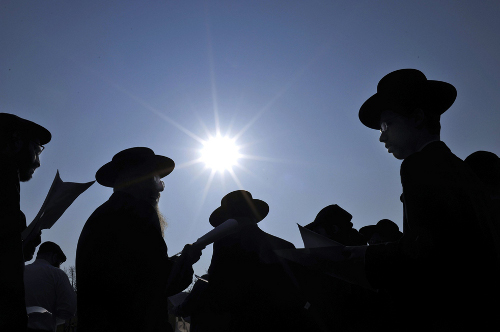
jewish-traditionI think there are a number of Christians and Christian groups who are feeling the pull of prophesy, but in most cases, such as in the above-quoted article written by Yosef Juarez, there’s been a terrible misunderstanding. Messiah never meant for us to believe that we had to choose between him and our devotion to Jewish people and Israel, rather he desires that we arrive at a proper understanding of our role in relation to Israel and her King, where King and Country are not mutually exclusive as most people believe is true of Jesus and Israel.

While we don’t see entire church groups converting to Judaism en masse very often (as Yosef Juarez describes in his article), we do see Gentile Christians entering into Hebrew Roots congregations and attempting to fulfill their roles (mistakenly in my opinion) by apprehending Jewish identity rather than their (our) own, or even more tragically, Gentiles in Hebrew Roots and Messianic Judaism leaving Messiah Yeshua behind and converting to one of the modern Judaisms of our day.

There are few things sadder than seeing a Christian begin to develop a sincere love of Israel and the Jewish people and then to allow misunderstanding and a misguided sense of purpose to cause them to completely overshoot the target, missing the point and mistaking the background for the goal.

“One who romanticizes over Judaism and loses focus of the kingdom of Heaven can be compared to a carpenter who is infatuated with the hammer, rather than the house it was meant to build.”

Troy Mitchell

It may not be entirely inappropriate to consider, under certain specific circumstances, Gentile conversion to Judaism within a Messianic Jewish venue, but again, in my opinion, this should be a rare occasion. Gentiles will never be able to take their (our) place in God’s Kingdom as the crowning jewels of the nations if we convert or quasi-convert to Judaism in significant numbers. To be “crowning jewels” we must remain among “the nations” or fail prophesy, Messiah, and God.

FFOZ TV Review: The Restoring the Kingdom

A promise of what is to comeEpisode 26: The disciples ask Jesus “Are you at this time going to restore the kingdom to Israel?” They were looking for a physical kingdom. Was the kingdom only spiritual, or were the disciples right to expect a physical, future kingdom? Episode Twenty-six will show the viewers that the kingdom of Messiah is not just spiritual. There is a literal, coming, restoration of the kingdom of Israel. Although we believers have laid hold of the kingdom and enjoy a foretaste of it, we have not entered the kingdom yet. It’s still ahead.

-from the Introduction to FFOZ TV: The Promise of What is to Come
Episode 26: Restoring the Kingdom (click this link to watch video, not the image above)

The Lesson: The Mystery of Restoring the Kingdom

In this final episode of the first season of A Promise of What is to Come, First Fruits of Zion (FFOZ) teachers Toby Janicki and Aaron Eby address the question of exactly what is the restoration of the Kingdom of God. From traditional Christianity’s point of view, the Kingdom has often been described as being Heaven, or being the Church, or being an invisible, spiritual Kingdom, the spirit that is in our hearts.

But this show uses a specifically Jewish perspective to read the Bible and understand how to interpret ancient prophesies. We can’t go only by what the words say themselves. We need to know how the original speakers and audiences in the Bible would have comprehended what was said. What did the disciples mean when they asked the following question to Jesus?

So when they had come together, they were asking Him, saying, “Lord, is it at this time You are restoring the kingdom to Israel?”

Acts 1:6 (NASB)

It was at this point that Jesus was about to ascend into Heaven to take his place at the right hand of the Father. He was leaving his disciples on Earth. They must have been puzzled that Jesus was leaving without finishing his work. Where was the Kingdom? Why hadn’t he established it? How could he depart when there was so much left for him to do?

Christian Pastors often criticize the ancient Jewish disciples for misunderstanding what Jesus taught. In the eyes of many modern believers, the Kingdom is a spiritual Kingdom, not a physical reality. But even today, devout Jews believe that one of Messiah’s major tasks is to restore the nation of Israel as a physical Kingdom on Earth, return all of the exiled Jews to their Land, and elevate Israel as the head of all the nations.

This is one of the reasons why most Jewish people don’t believe Jesus could have been the Messiah. They don’t believe he was resurrected and that he died without restoring and redeeming physical Israel. Even from a believing Jew’s point of view, Jesus as Messiah left before completing his work. That means he must come back at some point to finish the job. Otherwise, he can’t be Messiah.

Toby suggested at this point in the program, that it would be a good time to review some of the information about the Kingdom presented in previous episodes of the series. To this end, he quoted:

After Yochanan was arrested, Yeshua came to the Galil and proclaimed the good news of the kingdom of God. He said, “The time is fulfilled, and the kingdom of God has drawn near. Repent and believe the good news.”

Mark 1:14-15 (DHE Gospels)

As you may recall, the Kingdom being “drawn near” or “at hand” meant that it was something that had arrived and could be appropriated at any time. It’s like standing at a doorway of a house. All you have to do is open the door and walk inside. In this case, the message was to repent, which was what Jesus was telling national Israel to do, in order to enter the Kingdom, the restoration of Israel to be accomplished by the Messiah.

Toby JanickiThe Torah, many of the Prophets, and even the Psalms, all speak of these Messianic promises, of a nation restored, a Holy people redeemed, a Land flourishing, the world at peace, all under the rule of King Messiah, Son of David. Here Toby paints a portrait of the prophesies that are continually additive, one linking to another, and to another, and to another, through the Tanakh (Jewish Bible) and across the so-called barrier between the Old and New Testaments, describing in a single, unbroken thread in the tapestry of God’s restorative and salvational plan.

It was this Jewish and Biblical understanding that told the disciples of the Master what to expect and led to the question we read in Acts 1:6. The Church says the ancient and modern Jews are all wrong and that no physical Kingdom was ever planned by God, in spite of the overwhelming evidence otherwise stated in prophesy. But what did Jesus say?

He said to them, “It is not for you to know times or epochs which the Father has fixed by His own authority…”

Acts 1:7 (NASB)

Here, Jesus isn’t saying that they’ve misunderstood him, or that there would never be a physical restoration, or that his Kingdom is purely spiritual. He’s saying that he wasn’t going to tell them when the Kingdom would be restored, only that it would be restored at a time fixed by God’s own authority.

In other words, Jesus didn’t contradict the expectations of his disciples, he only said he wasn’t going to restore the Kingdom of Israel at that very moment and that they had to wait. He also said this:

“…but you will receive power when the Holy Spirit has come upon you; and you shall be My witnesses both in Jerusalem, and in all Judea and Samaria, and even to the remotest part of the earth.”

Acts 1:8 (NASB)

The Kingdom of Israel would be restored, but before that was going to happen, Jesus said they would receive power when the Holy Spirit came upon them, and with that power, they were to be Messiah’s witnesses in Jerusalem, Judea, Samaria, and to the four corners of all the Earth.

It’s not that Messiah won’t restore physical, literal Israel as a Kingdom; the Kingdom above all nations, it’s only a matter of when.

Clue 1: Jesus taught that the Kingdom has not yet happened.

If you were to ask a room full of Christians if Jesus had finished his work in the first coming, most of them would say “yes” based on this:

Therefore when Jesus had received the sour wine, He said, “It is finished!” And He bowed His head and gave up His spirit.

John 19:30 (NASB)

But Toby says Jesus was most likely speaking of his suffering and the atonement of sins, not his entire mission as a Messiah. I agree. If Messiah’s work was finished, then where is the world at total peace? Why don’t we all act as we should? Why is there still sin? And why is there a predicted second coming of Jesus?

Aaron EbyBoth Jews and Gentiles say today “Maranatha,” which means “O’ Lord, come.” Why do we say this if he has already finished everything he was supposed to do?

The scene shifts to Israel and FFOZ teacher and translator Aaron Eby for a brief word study of “Maranatha.” As it turns out, in the Church, we get this word from two words in Aramaic Paul inserted at the end of 1 Corinthians. Aaron said, and I learned recently, that there were no spaces between words in the Bible. For instance, if we were to translate a portion of Romans 1:32 into English but not insert spaces between the words, it would look something like:

thoughtheyknowgodsrighteousdecreethatthosewhopracticesuchthingsdeservetodie

What a mess. No wonder Biblical translation is so challenging. No wonder there is such a great difficulty in organizing the context of the Bible and how creating chapters and verses can lead to misunderstanding of the original message.

But Aaron says that even though we don’t know how the Aramaic word “Maranatha” is separated, it still means the same thing: “O’ Lord, come.” Aaron believes that Paul not only acknowledged and preached about the great accomplishments of Messiah during the first advent, but longed for the Messiah’s return and all that he would do at that future time.

Hear the word of the Lord, O nations,
And declare in the coastlands afar off,
And say, “He who scattered Israel will gather him
And keep him as a shepherd keeps his flock.”
For the Lord has ransomed Jacob.

Jeremiah 31:10-11 (NASB)

This is a key Messianic prophesy describing what Messiah will do for the Jewish people and for Israel, and describes the responsiblity of the nations to listen (and obey) the words of Israel’s King.

Aaron pointed to the miracle of modern Israel’s very existence and the restoration of the Hebrew language, which had vanished for many centuries. He used Zephaniah 3:9 as a prophesy of the restoration of Hebrew, and expressed what a miracle it is for even an Israeli child to be able to read from an ancient Torah scroll and grasp its meaning.

But as exciting as this all is, Israel is still in exile as long as even a single Jew does not live within her borders, and as long as it is still threatened by its enemies, and as long as it is still largely secular, and as long as there are still two foreign Mosques on the Temple Mount in Jerusalem, the most Holy place on Earth.

Believing and non-believing Jews all still cling to the twelfth of the Rambam’s thirteen principles of faith:

I believe with a perfect faith in the coming of the Messiah, and even though he may delay, still everyday I pray that he will come.

The modern state of Israel is a good start, but it is hardly finished. There is so much more left to do.

Back in the studio, Toby gives us the second clue:

Clue 2: Jesus had not yet fulfilled all of the Messianic prophecies.

RestorationWe may not know when the Messianic Kingdom will come, but we know what it will be like. Toby links a number of passages in scripture together including Matthew 16:27, Isaiah 40:10, and Revelation 22:12. And Jesus himself said he had much work left to do. We read in Matthew’s gospel how he described his own return:

Then the son of man will appear in heaven, and all the families of the earth will mourn, as they will see the son of man coming with the clouds of heaven in power and great glory. He will send forth his angels with the sound of the great shofar; they will gather his chosen ones from the four winds, and from one end of heaven to the other.

Matthew 24:30-31 (DHE Gospels)

Jesus was referring to this prophesy:

It shall be on that day that a great shofar will be blown, and those who are lost in the land of Assyria and those cast away in the land of Egypt will come [together], and they will prostrate themselves to Hashem on the holy mountain in Jerusalem.

Isaiah 27:13 (Stone Edition Tanakh)

Jesus was speaking of what he had yet to do beyond his first coming, and that renders the third and final clue:

Clue 3: Jesus did not think his work was finished.

Unless you think the world is as it should be and that we have peace among the nations and kindness between human beings, then you must believe his work isn’t finished either.

What Did I Learn?

In this final episode of the first season of The Promise of What is to Come series, I learned pretty much what I already knew. It seems silly to imagine that Jesus had fulfilled all that he was supposed to do in his first coming. The world is still a mess and still needs a lot of fixing. Unless you are prepared to throw out large portions of the Tanakh (Old Testament) and replace the content with how the Church understands the apostolic scriptures, you must believe that the life, death, resurrection, and ascension of Jesus does not fulfill all of the Messianic promises we see in the Bible.

This is also where I believe embracing a Jewish understanding of those scriptures is handy. It does not require that we refactor what Jews believe as a physical Kingdom of God in Israel into some sort of spiritual environment we enter when we die. Jewish and Gentile disciples of Jesus the Messiah can all believe that what God said through Isaiah and Jeremiah and how it was understood was still true in the world of Jesus, Peter, and Paul and still is true in our world of the 21st Century of the Common Era.

As I’ve said before, many of the beliefs in the modern Christian Church have their origins in the earliest expressions of anti-Semitism and supersessionism created by our so-called “Church Fathers,” and preserved by the men of the Reformation many centuries later. What was once invention and tradition created to separate a nascent Gentile Christianity from normative Judaism (that is, how the Church sees the Jewish people, modern Israel, and the ancient Messianic prophesies), is now believed to be rock solid fact. It doesn’t occur to many Christians to question any of these assumptions.

The FFOZ TV show is dedicated to thoughtfully suggesting to its Christian audience that its assumptions be questioned in the light of a Jewish interpretation of Biblical truth. The numerous other resources offered at First Fruits of Zion and her sister organization Vine of David are designed to provide that perspective and expand upon it for both traditional Christians and the Jewish people who have yet to recognize the face of the Messiah as the Jewish face of Rabbi Yeshua in the Gospels.

Modern IsraelBut even learning this does not summon the Promise of the Messiah to our world. In order to finish our own work so that he may come, we must live out those truths that have been revealed to us. Visit the sick, give charity to the poor, donate food to the hungry, act only with kindness to any person that you encounter, speak of the good news of the Messiah to a damaged and dying humanity.

Only then will we be pursuing the path of our Master by participating in tikkun olam, repairing our desperately broken world.

It is said that the Messiah will return only when all of Israel, all the Jewish people, keep the Shabbat as one. It is also said that the Messiah will return only when all of Israel and the world has reached a level of deepest depravity.

I don’t know what to think. I only know that we introduce a tiny bit of the Messianic Kingdom into our world every time we extend a helping hand to another person. If we all committed one unasked act of kindness each day, then how Messiah-like would the world begin to appear? We wait for Messiah to return to finish what he started, but in the mean time, we can all do what we can, as we have faith in the promise.

FFOZ TV Review: Resurrection

FFOZ TV Episode 25Episode 25: In Jewish thought the ultimate expression of God’s power is the resurrection of the dead, and the ultimate resurrection was that of Jesus himself. In episode twenty-five viewers will discover that Jesus’ resurrection from the dead was a foreshadow of the final resurrection of the dead that was prophesied in the Hebrew Scriptures. Messiah rising from the dead was a promise, a guarantee that one day the great redemption will come, the great resurrection of the dead will take place, and the Messianic kingdom will arrive.

-from the Introduction to FFOZ TV: The Promise of What is to Come
Episode 25: Resurrection (click this link to watch video, not the image above)

The Lesson: The Mystery of the Resurrection

One of the biggest mysteries of the Christian faith is the death and resurrection of Jesus. After all, there are no explicit prophesies in the Tanakh (Jewish Bible or Old Testament) that say the Messiah must personally die and then be resurrected three days later. In Christianity, we just take it for granted because it is a central if not the central tenet of our beliefs. But looking at the resurrection from a Jewish point of view, particularly a late Second Temple Era perspective, what did the resurrection of Messiah mean?

First Fruits of Zion (FFOZ) teacher and author Toby Janicki started answering that question by reading the following:

And he began to teach that the son of man needs to suffer greatly, and the elders, the leading priests, and the scholars would reject him, and he would be killed, but at the end of three days he would surely rise. He spoke this word in the ears of all of them, and Petros took him and began to reprimand him.

Mark 8:31-32 (DHE Gospels)

Jesus himself taught that he had to die and be resurrected three days later, but the fact that at hearing this Peter took Jesus aside and rebuked him, shows us that even Peter didn’t understand the meaning of Messiah’s death and resurrection. It must not have been an obvious belief common among Jewish people of that day (and it’s also not a belief in Judaism in our age). Peter certainly knew Jesus was the Messiah (see Matthew 16:16) so it wasn’t a matter of lack of faith or lack of knowledge. Even in the days of Jesus on earth, the death and resurrection of the Messiah was a great mystery.

A mystery we are trying to solve from a Jewish perspective today in this episode.

Jesus explained the meaning, at least partially, after he was resurrected:

These are the things that I spoke to you about while I was still with you. For every scripture about me will surely be fulfilled in the Torah of Mosheh, in the Prophets, and in the Tehillim. Then he opened their hearts to understand the Scriptures. He said to them, thus it is written and decreed that the Mashiach will be afflicted and will arise from the dead on the third day…

Luke 24:44-46 (DHE Gospels)

Toby points out that Jesus says his death and resurrection are prophesied in the Torah, the Prophets and the Psalms (Tehillim). But where? There’s nothing in these ancient writings that point-blank says the Messiah must die for the sins of humanity and be raised again three days later. What does Jesus explain to them that the Bible doesn’t explain to us? Won’t the Holy Spirit open our hearts to understand the scriptures?

Because You will not abandon my soul to Hades,
Nor allow Your Holy One to undergo decay.

Acts 2:27 (NASB)

Here, Toby tells us that Peter is quoting Psalm 16:10 as proof that the Messiah would not die permanently and that God would resurrect him. This is only one of a few cryptic “proofs” in the New Testament that the Old Testament prophesies spoke, or at least hinted at, the Messiah’s resurrection.

He will swallow up death for all time,
And the Lord God will wipe tears away from all faces,
And He will remove the reproach of His people from all the earth; For the Lord has spoken.

Isaiah 25:8 (NASB)

Your dead will live;
Their corpses will rise.
You who lie in the dust, awake and shout for joy,
For your dew is as the dew of the dawn,
And the earth will give birth to the departed spirits.

Isaiah 26:19 (NASB)

ffoz_tv25_tobyToby quotes Isaiah as well as Ezekiel 37:3-6 to show that in the future Messianic Era, there will be a great resurrection of the dead, but this doesn’t specifically speak to the resurrection of the Messiah during his first advent.

There was no question among these ancient Jewish prophets that there would be a future resurrection of all the dead once the Messiah had come, and that brings us to our first clue:

1st Clue: The resurrection from the dead is a component of the Messianic Kingdom.

Toby makes a key point by saying that Jesus felt these prophesies also explained his own resurrection. But how? Is Toby employing more than a little theological sleight of hand in making such a statement?

To learn more, the scene shifts to FFOZ teacher and translator Aaron Eby in Israel for a short language lesson about the Hebrew word for “Life.”

Life, or “Chaim” is a gift from God. Aaron references the following to illustrate:

The Lord kills and makes alive;
He brings down to Sheol and raises up.

1 Samuel 2:6 (NASB)

This is part of Hannah’s prayer to God and shows us beautifully that life and death are from God and as He brings down into death, He also raises up back to life.

Today’s Orthodox Jews believe in the resurrection of the dead once the Messiah comes, even as the Pharisees did in the day of Jesus. Many Jewish dead are buried at the Mount of Olives where it is prophesied the feet of the Messiah will first touch the earth.

Three times a day, observant Jews pray for the resurrection, and the Mishnah states that if anyone does not believe the Torah speaks of the resurrection, that person forfeits their place in the world to come.

Aaron EbyAaron points out that in Acts 23:6, when Paul has been arrested in Jerusalem and brought before the Sanhedrim, he throws the whole court, which is made up of Pharisees who believed in the resurrection and Sadducees who didn’t, into an uproar by claiming that he was on trial for his belief in the resurrection. Apparently, not all Jews two-thousand years ago believed in the resurrection of the dead, but it was obviously a “hot button” topic.

The last of the Thirteen Principles of Jewish Faith established by the Rambam, the great sage Moses Maimonides in the twelfth century is a declaration of faith in the future resurrection of the dead.

Back in the studio, Toby pulls all this together to form the second clue:

Clue 2: The future resurrection of the dead is a principle of Jewish faith.

But while all this certainly establishes that religious Jews, like Christians, believe in a future resurrection, what does it have to do with the resurrection of Jesus?

According to Toby, it goes back to the debate between the Pharisees and Sadducees about whether or not there would be a future resurrection. By God resurrecting Jesus three days after he died, it was supposed to settle the argument. Jesus, the Messiah, by being resurrected, establishes a future resurrection.

But there still one more connection to make, and it comes from the apostle Paul:

Now if Christ is preached, that He has been raised from the dead, how do some among you say that there is no resurrection of the dead?

But now Christ has been raised from the dead, the first fruits of those who are asleep. For since by a man came death, by a man also came the resurrection of the dead.

1 Corinthians 15:12, 20-21 (NASB)

In verse 12, Paul directly links the resurrection of Jesus with the future resurrection of all the dead, stating that if you don’t believe in the former, you are also denying the latter. Then in verses 20 and 21, Paul says that the resurrection of Jesus was a “first fruits of those who are asleep” (dead).

The Torah commands that all Israelite farmers are required to offer the first ripe fruit of their harvest to God. This presupposes that the larger harvest of the crops is not yet ripe. The metaphor illustrates that the resurrection of the Messiah was a first fruits or a foretaste of the resurrection and when the rest of the harvest of humanity is “ripe,” the great resurrection of the dead will come. This happens in the Messianic Era.

We have arrived at the third and final clue:

Clue 3: Jesus’ resurrection is the first fruits of the final resurrection.

In other words, by the Messiah dying and then being resurrected, he was proving that all of the older prophesies about a great resurrection of the dead in the Messianic Age were valid, accurate, and will indeed occur.

What Did I Learn?

The major point I learned was how the purpose of the resurrection of Messiah was framed by Toby and Aaron. Basically, it was a theological and probably a legal proof to all of the Jewish people of that day that indeed there would be a great resurrection in the future age.

Today’s Orthodox Jews believe in that resurrection, but I’m not sure that all religious Jews everywhere do. All Christians believe not only in the resurrection of Jesus, but in the resurrection of all the dead, who will then be judged.

I don’t struggle with these concepts, but the great struggle today for non-believing Jews, just as it probably was among many of the Jewish people in the day of the apostles, was whether or not the Messiah had to die and then rise. While the focus of this episode was on the resurrection, to get a Jewish person to this point, you first have to get them past the death of Jesus, which wasn’t touched upon in this show.

I’ve tried to write to this issue using Jewish and Christian sources in blog posts such as The Death of the Tzaddik and The Sacrifice at Golgotha.

Jews, like Christians (and just about everyone else), find the idea of making a human sacrifice to God abhorrent, and from a traditional Jewish perspective, the death of Jesus to pay for our sins looks like a human sacrifice. Christians don’t consider this an issue in our faith, but from an outsider’s point of view, it’s a huge stumbling block.

tallit_templeThere are some aspects of Jewish faith that support the idea of the death of a great tzaddik or righteous one atoning for the sins of others, up to and including the sins of an entire generation of Jews. When we people of Yeshua faith attempt to cite those sources, we are sometimes accused of misreading the ancient Jewish sages for our own ends. I can see how some Jewish people would get that impression but this also illustrates that it is Jewish to believe a human death can atone for others, therefore, it’s not completely outrageous to believe that the Messiah’s death, the death of the greatest of all tzaddikim, could atone, not just for the sins of a single generation, but for the sins of all generations across time.

But I’m going off topic. Toby and Aaron were focusing on the resurrection, not the death of Messiah, and they’re addressing primarily an audience of traditional Christians, not traditional Jews. To that end, it’s almost as if Toby and Aaron were “preaching to the choir,” since the resurrection of Jesus and the future resurrection of all the dead are a “given” in the Christian faith. However, they did establish that the resurrection is not an uniquely Christian concept, but is founded strongly in Judaism and the Old Testament. They also showed, as I said above, that the resurrection proved to the Jewish people in the apostolic era, that the prophesies of a great, future resurrection would be fulfilled.

At the end of the episode, as usual, Boaz Michael, FFOZ’s President and Founder, came to announce the next and last show of this television series, which teaches the literal, physical restoration of Israel that is yet to come. This will be my last opportunity to review this television series and I will certainly miss it.

I’m not unmindful that this blog post is being published on Christmas Day. For all of my readers who celebrate Christmas, I give you warm greetings and may the Spirit of Messiah be with you on this day, inspiring love and generosity.

May the light of Messiah continue to illuminate our paths and to open our eyes to who he is and who we are in him.

The Challies Chronicles: Conrad Mbewe and Pentecostal Witch Doctors

Conrad MbeweThe first session of the final day at the Strange Fire conference brought Conrad Mbewe back to the pulpit. Phil Johnson introduced him by sharing how others have called him the Spurgeon of Africa. Today he brought message entitled, “Are We Preachers or Witch Doctors?”

Mbewe then contrasts Paul’s exhortation in 2 Timothy with the present picture in Zambia. He shares two newspaper clippings from July concerning evangelical preachers. In the first, a clergyman impregnated 10 women before his wife came forward about the scandal. She came forward after witnessing the scourge on the children in this church and the presence of the witchcraft taking place. In the second clipping two clergy men took two women into the mountains and sexually assaulted them. They first visited their home and took prayer requests and then led them into the mountain.

Pastor Tim Challies liveblogging
Strange Fire Conference: Preachers or Witch Doctors?”
Challies.com

As Conrad Mbewe chronicles the abuses of Pastors against members of their flock in Zambia, no one could possibly disagree with having evangelical preachers who are sexually assaulting women being called out, removed from their positions of authority, and hopefully arrested and incarcerated. How could any believer of good conscience support preachers and other church leaders behaving in such a destructive manner?

But, of course, the inference is that the Pentecostal movement is driving such abuses and as a denomination, are responsible for this criminal behavior, and therefore Pentecostalism must be stopped. Can a connection between the events being reported by Mbewe and all Pentecostals everywhere be reasonably made?

Conrad asks, “How can this be happening so frequently among so called evangelical churches today?” His response: a seismic shift in how people view the pastor. What is read in 2 Timothy is not the popular view today. It is because of how the view of the “man of God” has evolved today. Pentecostalism’s visit to Africa did not primarily emphasize the preaching and teaching component of the “man of God.” Now the “man of God” is primarily seen as the deliverer. Preaching has lost emphasis. It has become motivational platitudes followed by shouting and chanting.

The same thing can be seen in America on popular TV channels, but with different colored skin and nicer buildings. There are biblical quotes tossed about followed by a demon possessed, crazy and maddened looking preacher.

Yet, the important part of any service is what happens next. The “man of God”, wrested out of the context of 2 Timothy, takes on the role equivalent to a witch doctor.

While Mbewe lays the blame for the abuses he reported above fully upon the Pentecostals and their lack of emphasis on scriptural sufficiency and preaching, others who commented on this Challies blog post didn’t agree:

There are certainly issues that need to be studied, analysed and discussed in the contemporary pentecostal movement in Africa and worldwide. We need to understand their theological and liturgical practices–their strengths, weakness, meanings and innovations. Scholars of contemporary pentecostal movement have been at it for more than two decades. It would be very helpful to dialogue with their findings and suggestions. One of their major findings is that contemporary pentecostal movements underline that their members must “make a complete break with the past,” that is, they must completely disassociate themselves with African Indigenous Religions (henceforth ATR)–contrary to Mbewe’s claims. Scholarly findings also associate its theology of prosperity, deliverance and breakthroughs with the neo-liberal economy of the globalization era. On the overall, I find Pastor Mbewe’s take on it simplistic, upsetting and misleading. Basically, he blames it all on ATR. In the process, his comparisons are misleading misrepresentations of ATR, that serves to demonize the latter. If indigenous healers were to be brought into this conversations, they would not recognize the picture that is painted about them. But since evangelicals are unlikely to want to hold such dialogue with indigenous healers, it is as that proverb warns us: until the lion tells the story, the hunter will always be the hero. The image given about Indigenous healers is of course colonial, as attested by Mbewe’s reference to indigenous healers as “witchdoctors.” Mbewe’s colonial perspective is also attested in his wish to call for the West to rescue Africa from itself. His two opening stories harp on the colonial stereotypes of Africa as sexually immoral. His reference to western medicine as conventional medicine is so telling. Since Christianity has existed side by side with ATR for more than two centuries, why is this only happening now? Why has ATR not confused the church before, until now? Both the contemporary pentecostal movement and the indigenous healers would be appalled by Mbewe potrait (sic) and interpretation of the phenomena. Mbewe’s approach is suspect and must be heard as such. Those who hear him will do well to hear him with a pinch of salt.

Musa Dube

I am a charismatic Pastor in East Africa. Sadly however, I can confirm that what is said here is quite true. Of course, I do not agree that this is a charismatic problem but rather an aberration that claims to be Christian and Charismatic but is in fact neither. It would be wrong however, to say that the problem is confined to “charismatic” churches.

This problem manifests itself in these pseudo churches as false miracles etc. etc. But in the churches more palatable to McArthur (sic) and others, it manifests itself in double lives that pay mere lip service to the theology of the church. Polygamy, tribal politics, regular visits to the witch doctor (the traditional kind rather than the Bible carrying one) all thrive in Calvinist churches across the continent of Africa. They are preached against in the pulpit of course but hey, everyone does it. In very high number of cases, even the Pastor does it because of course that is just for preaching

This is because the problem is not charismatic theology but syncretism and This is not confined to any one church as anyone who has lived in Africa knows.

We may be charismatic but we are working hard to preach against hypocrisy in all denominations. Our focus is upon the work of the cross which unites us and demands a response from us all.

Sean McIntyre

Witch huntOf course, the larger body of people commenting on the blog post expressed split opinions, but I think it’s important to understand that a simple comparison between what Mbewe reports and what all Charismatics represent cannot be made. Mbewe’s logic goes something like:

  1. Some Pentecostal-influenced preachers in Africa are sexually abusing women and practicing witchcraft.
  2. Therefore all Pentecostals, Pentecostal teachings and Pentecostal/Charismatic preachers everywhere support abusing women and practicing witchcraft.

I agree with Musa Dube to the degree that Mbewe’s presentation is rather two-dimensional and lacks sufficient depth to establish the point he’s trying to make. Also, we have a report that such abusive activities are not confined to churches with Pentecostal affiliation but are rather multi-denominational.

Again, I want to say that in no way can I or any reasonable person of faith support sexual abuse of women, whether by clergy or anyone else.

Mbewe was invited to a radio broadcast panel discussion in Zambia about miraculous healing. There was a Catholic trying to ride the fence. Then there were two charismatics invited. One could not come because he was sick. He lied. Conrad saw this man shopping in the mall with his wife directly afterward with a trolley of goods.

During the broadcast the other charismatic and Mbewe locked horns. He challenged listeners to call in if they had been healed. Like a New Testament Elijah he taunted the charismatics for an hour due to the lack of calls. Two calls came in. The first a man who attested to a girl with unequal legs being healed 8 years ago, a very stale testimony for a country that claims to have healing crusades from prophets, bishops and “the man of God” all the time. The second came from a woman who chastised Mbewe as a dead theologian. There were only two calls in a nation where miraculous gifts happen all the time. The charismatic pastor responded that the people are shy. Unfortunately a week later he suffered a stroke and died after being in a coma for a week. None of his friends came to his aid and raised him because they knew it was all a fraud and a lie.

While this is all very dramatic, and while it likely establishes that claims of a large number of miraculous healings taking place in Africa are false, it still doesn’t make the larger point in painting the entire Pentecostal church with the same broad and tainted brush.

I know Mbewe’s presentation is only one among many, and I know that “Strange Fire” is meant to be taken as an entire unit, but even putting Mbewe’s discussion in the context of the entire conference doesn’t make what he is saying any more applicable to the entire world of Pentecostal believers. I may not agree with the basic premises of Pentecostalism, but I don’t believe they are all abusive and criminal either.

OK, maybe I’m being a little harsh because Mbewe didn’t come out and indict the Pentecostal church in such a manner. He only said that any church that does not depend solely on scripture and its sufficiency in building and leading the body of Christ is ripe for an infusion of witchcraft, sexual abuse, and other demonic influences.

And speaking of demonic, I know I quoted this above, but of everything Mbewe said, it especially drew my attention:

The same thing can be seen in America on popular TV channels, but with different colored skin and nicer buildings. There are biblical quotes tossed about followed by a demon possessed, crazy and maddened looking preacher. (emph. mine)

Although Mbewe called the preacher “maddened looking” as opposed to “maddened,” he declared that the preacher in his example (I don’t know if he was thinking of any TV preacher in particular or just throwing out generalizations) was “demon possessed” as opposed to something such as “like he was demonized.” As I’ve said before, I find it interesting that cessationists can say there are no longer any “gifts of the spirit” given to human beings, but that human beings can certainly be possessed by demons and exhibit strange and even supernatural behaviors. The equation doesn’t seem to balance out and gives the impression that evil forces have more influence than God.

But that’s just my personal observation.

Don’t worry. There’s only one presentation left, MacArthur’s final appeal, then Challies writes his own summary of the lessons he learned from the conference. After that, Challies writes two additional blog posts, both on MacArthur’s answers to his critics. I’ve briefly scanned those answers and MacArthur comes across as somewhat more reasonable than I found him and the others while presenting at the conference.

I know the conference was last October and it may seem as if I’m beating a dead horse, but these issues won’t go away just because a couple of months have passed. Beyond that, there’s the influence of MacArthur’s Strange Fire book (which I’d like to review, but I’m not willing to shell out cold, hard cash for the privilege) to consider.

doveThe topic is wearing on me too, which is why, in addition to Life of Pi, I’ve just started reading Gifts of the Spirit, which is a compilation of the presentations given at the First Fruits of Zion Gifts of the Spirit Conference held last Spring during Shavuot at the Beth Immanuel Sabbath Fellowship in Hudson, Wisconsin.

I attended the conference and wrote numerous blog posts, including this one describing my experiences. However, all that was before MacArthur, “Strange Fire,” discussing MacArthur and “Strange Fire” with my Pastor, and my blogging on “Strange Fire,” so I need to even things out, so to speak, and revisit the spiritual side of the coin by reading “Gifts”.

So far in “Gifts,” I’ve learned (relearned) that a number of the presenters, including First Fruits of Zion (FFOZ) staff, previously worshipped in and even grew up in the Pentecostal church. I look forward to going back to the “Gifts of the Spirit” and comparing that conference experience with the Challies Chronicles of “Strange Fire.”

The Mystery of Romans: Apostolic Decree and the Obedience of Faith

Apostolic DecreeIt is important to note that the major tenets of the decree were practiced by the early Christian gentiles for several centuries, although this fact is not considered by most scholars to demonstrate that Paul accepted or taught it in his gentile mission. Somehow it is assumed that Paul was generally unaware of the decree, or that if he was aware of it he did not accept it. Why has Christianity so overlooked this feature of Paul’s missionary teaching?

-Mark Nanos
“Chapter 4: The Apostolic Decree and the ‘Obedience of Faith,'” pp 201-2
The Mystery of Romans: The Jewish Context of Paul’s Letters

I’m finally able to get back to my series of reviews on this landmark book of Nanos’. I’m not going to pick through the entire chapter, but the section of Chapter 4 called “The Apostolic Decree and the Message of Romans” caught my attention. I’m rather interested in the legal decision of the Council of Apostles and Elders in Jerusalem (Acts 15) that established binding halachah on the Gentile disciples of the Jewish religious stream known as “the Way.” My opinion is that Paul very much had to know about this decree and certainly, if he considered himself under the authority of the Council, an authority established by Messiah, then agree or not, Paul had to accept it and even teach it.

And how could Paul not be aware of this decree?

Some men came down from Judea and began teaching the brethren, “Unless you are circumcised according to the custom of Moses, you cannot be saved.” And when Paul and Barnabas had great dissension and debate with them, the brethren determined that Paul and Barnabas and some others of them should go up to Jerusalem to the apostles and elders concerning this issue.

Acts 15:1-2 (NASB)

So Paul, Barnabas, and their Jewish opponents traveled to Jerusalem together to seek out the Council’s authority on the matter in dispute (whether or not Gentiles had to convert to Judaism and take on the full yoke of Torah as an obligation in order to enter into the Messianic religious order), which would include giving testimony and being present for the final verdict. I have no idea how any New Testament scholar could miss so obvious a passage of scripture.

As I did previously, I’m going to review my notes and “brain dump” the data here with just a bit of polishing. Hopefully, this will carry the meaning of this section of the chapter and my impressions of the information presented.

In stark contrast to this consensus, however, I see the apostolic decree operating in the background of Paul’s bold “reminder” to Rome. In addition to his clear agenda to explain the new status of the gentile believing in Jesus Christ as equal, though governed by the principles of behavior outlined for the “righteous gentile” in the Council’s apostolic decree, several specific references suggest that his addressees share with Paul the knowledge of the decree in its original, though certainly fluid format. We have seen how central the issue of accommodating the dietary concerns of the “weak” were in order to win them to faith in Christ. Further, I find traces in the formal feature of the opening and closing of the letter, in the rhetorical structure, and in several key phrases and concepts that Romans is actually Paul’s exposition, by way of reminder, of the apostolic decree in view of his intended visit, and yet necessary delay.

-Nanos, pp 206-7

My commentary on Chapter 3 mentioned that the “reminder” was Paul to the Gentile believers in Rome, reasserting the form and function of the Gentile’s role in “the Way” in relation to the Jewish believers in specific and Jewish people in general. The “weak” were not the Jewish believers who felt they had to continue observing the Torah mitzvoth as opposed to accepting the grace of Christ, but rather the Jewish non-believers who were struggling with accepting faith in Yeshua as Messiah. A large part of the apostolic decree was designed to allow a basic relationship between the believing Gentiles and Jewish people. The so-called “strong” were over-emphasizing their “freedom” from Torah at the expense of the Jewish non-believers they associated with in the synagogue, damaging the reputation of Messiah and “the Way” as a Judaism.

King Priest TorahWe see from the general message in Galatians that Paul did not support Gentile conversion to Judaism as a requirement for justification before God, and that he stated point-blank that if the Gentiles were to allow themselves to be circumcised and convert, they would be obligated to the full yoke of the Torah, and the sacrifice of Messiah would become useless (Galatians 5:1-2). Applying that to Romans, Paul knew that the Gentiles were not obligated to the Torah in the manner of the Jews and also knew that the apostolic decree established an alternate set of behavioral constraints and requirements that defined the role of the Gentile disciple, not only in relation to God, but to the Jewish people as well.

He is responsible for the “obedience of the Gentiles” that results from his apostolic preaching of the gospel (15:18-19, 20ff.) and he will not be satisfied with the situation in Rome until he has arrived to fulfill this obligation (1:14-15)…

Within this context, Paul is expecting the “obedience of the Gentiles” to conform to the apostolic decree for the sake of the unbelieving Jews that they may not be further alienated from Messiah, but drawn nearer. It was within the power of the Gentiles in Rome to “thumb their noses” as it were to the Jewish people, but that would result in pushing Jews who were already doubtful that the crucified Rabbi from Nazareth was the Messiah into complete rejection.

The key statement in this part of Chapter 4 is this:

It is Paul’s hope that the Romans will receive him and his message of their obligations with respect to the decree in the same positive way as we find Luke describes (Acts 15:30-31) Paul’s earlier missionary reception. For the decree was not an unwelcome burden, but a powerful declaration of the inclusion of gentiles as equals, by faith and without becoming Jews, in the people of God. It was a sign of the fulfillment of the eschatological promise of the blessings for all the world in Israel’s Christ. And it was understood to be a minimal demonstration of appropriate purity behavior for association with the Jewish community (Israel, the historical people of God), on the part of the gentiles who maintained they had become equal coparticipants in the promised blessings. Indeed, it bore witness to their indebtedness to Israel for her present suffering on their behalf.

-Nanos, pg 211

The apostolic decree was the minimum set of standards required of the Gentiles to honor their indebtedness to the Jewish people and Israel as a whole for the realized blessings that resulted in Gentiles being equal coparticipants in salvation and reconciliation with God without having to be circumcised (convert) and be obligated to the full Torah.

My understanding is that the Gentiles could accept more than the minimum requirements up to and including the full “yoke of the Lord,” but this was entirely voluntary. In Paul’s letter to the Romans, we see the opposite happening. The Gentile believers in Paul’s readership were not even achieving the minimums set out in the apostolic decree and failing to acknowledge the Jewish people as the source of the blessings they were so comfortably operating within.

Gentile obedience to the decrees of the Council would result in the proper display of the relationship between non-Jewish believers and the general Jewish community, and disobedience sacrifices the “weak” among the Jews in the Roman synagogue to a failure of faith in Messiah.

I find an interesting parallel in Paul’s writing in how the Church approaches the Jewish people today. Christianity in the modern era also flaunts its “freedom” to the Jews and conversely denigrates the Torah, claiming that Jews are now “free from the Law” as if that would be some great relief to Jewish people. Gentile Christians would blithely eliminate the Torah from the lives of Jewish converts to Christianity, ignoring the destruction of Jewish identity and ultimately the Jewish people as a separated and called out nation before God.

Today, we “gentilize” the Jews as well as the modern incarnation of Jewish religion of “the Way” (i.e. “the Church) in the same manner as the Gentiles Paul was addressing in Rome. We in the Church are just as disobedient to the binding decrees of those whom Jesus assigned authority to as were the Roman Christians in Paul’s letter. Granted, much has changed since the apostolic era, and the body of Christ is totally separated from its “Jewish roots,” but that condition is not permanent.

The programmatic “obedience of faith” echoes the spirit of the Jerusalem Council’s intentions in setting forth the need for the Christian gentiles of Rome to obey the particulars outlined in the apostolic decree. Paul was concerned to remind them boldly of proper monotheistic behavior for “righteous gentiles” in their association with non-Christian Jews, and specifically halakhic matters of dietary and sexual conduct (12:1-15:3).

…Whatever grammatical construct one might prefer, the “obedience of faith” articulated Paul’s uncompromising commitment to the deeper intentions of the Shema, embracing both the election of Israel and the inclusion of gentiles equally — for God is One! The contours of Paul’s argument have been overlooked because interpreters have misunderstood his focus on gentile inclusion through faith alone, ostensibly dismissing Torah obedience as obsolete. However, if we recognize that Paul was addressing Christian gentiles tempted to consider themselves as having supplanted Israel and thus no longer obligated to obey “the teaching” of the apostolic decree (for why would they need to be concerned with the “acceptance” of the “stumbling” of Israel and their “opinions” of the proper purity behavior for “righteous gentiles”; if Israel had been cut off they are free to eat all things!), then we can readily follow Paul’s nuanced discussion of circumcision and Torah.

-Nanos, pp 237-8

going-to-church-sketchesGentiles who consider themselves as having supplanted the Jewish people in the blessings of God due to their faith in Messiah do not enhance Jewish desire to approach Messiah-faith, but inhibit it. By considering the apostolic authority to bind the Gentile disciples to a set of principles as obsolete, along with the Torah, these Roman Gentile Christians were sowing the first seeds of dissention that would eventually lead to complete restructuring of “the Way” from one Jewish religious stream among several in the late Second Temple period, to a completely separate Gentile religion in the first decades of the common era, totally divorced from its origins and its apostolic Jewish mentors.

And “the Church” hasn’t stopped being disobedient yet. In fact, we’ve compounded the problem by insisting that the only proper response to the Jewish Messiah for a Jew is to abandon the Torah, abandon Judaism, and abandon being a Jew, convert to being a Gentile, and to also thumb their noses at the eternal relationship between God and Israel.

The Children of Israel shall observe the Sabbath, to make the Sabbath an eternal covenant for their generations. Between Me and the Children of Israel it is a sign forever that in a six-day period Hashem made heaven and earth, and on the seventh day He rested and was refreshed.

Exodus 31:16-17 (Stone Edition Tanakh)

Thus says the Lord,
Who gives the sun for light by day
And the fixed order of the moon and the stars for light by night,
Who stirs up the sea so that its waves roar;
The Lord of hosts is His name:

“If this fixed order departs
From before Me,” declares the Lord,
“Then the offspring of Israel also will cease
From being a nation before Me forever.”

Thus says the Lord,

“If the heavens above can be measured
And the foundations of the earth searched out below,
Then I will also cast off all the offspring of Israel
For all that they have done,” declares the Lord

Jeremiah 31:35-37 (NASB)

No amount of exegetical “tweaking” of the Bible can delete God’s promises of an eternal relationship with Israel, the Jewish people. Reading Paul as is done traditionally in Christianity requires a great deal of “retrofitting” of the older texts to somehow make God seem to be saying the exact opposite of what we read in Exodus 31 and Jeremiah 31. Mark Nanos and other New Testament scholars like him are boldly forging ahead into territory that restores the “Judaism” back to the Jewish text of the Bible. Paul is not praising the Gentiles for their “lawlessness” and castigating the believing Jews for their continued “addiction” to the Torah. Quite the opposite.

In this chapter, we see Paul continuing to urge the Gentile believers to cleave to the “obedience of faith,” the standards established by the Council in Jerusalem, for the sake of the Jewish people, particularly those Paul was desperate to have come to faith in Messiah.

Mark NanosI can only hope that books like The Mystery of Romans and ministries such as First Fruits of Zion (FFOZ) will eventually, and by the will and grace of God, restore the balance, even as Paul was attempting to restore the balance between the Gentile believers and the Jews in Rome. Paul’s efforts ultimately failed, as I think he suspected they would, but as the time of the Messiah’s return approaches, the Spirit is helping us to get out the message of restoration and renewal as God originally planned. Much has been lost to the believers in Jesus over these last twenty centuries. I believe that the time has come for us to take it back.

I hope to continue with my review of the Nanos book soon.

Vayigash: Are You Willing to Save Someone’s Life?

joseph-and-pharaoh“Now when the news was heard in Pharaoh’s house that Joseph’s brothers had come, it pleased Pharaoh and his servants.”

Genesis 45:16

Pharaoh was delighted when he heard that Joseph’s brothers had come to Egypt. He immediately made provision to bring the entire family to Egypt so they could survive the famine in safety and comfort. He provided wagons for the move. He promised them the best of the land of Egypt.

Pharaoh’s warm welcome of Joseph’s brothers reveals an important detail about Joseph’s time in Egypt.

“What Pharaoh Heard”
Commentary on Torah Portion Vayigash
First Fruits of Zion (FFOZ)

This commentary from FFOZ comes with the following “Thought for the Week:”

When we are wronged by someone, it is natural to tell others about it. We want to tell others about how it happened to garner their sympathy and support. Somehow it makes us feel better to know that others are aware of the injustice committed against us. We seek out sympathy and commit a small act of retaliation.

It’s very human that when we feel we’ve been wronged by someone, to want to get even in some way. Usually, we get even by doing the same to them as we believe they’ve done to us (whether the damage the other person has done to us is real of just perceived makes no difference apparently).

I write periodically on something called Lashon Hara or the Jewish concept of wronging someone in speech (which can be spoken, written, or any other form of communication). I’ve even based the Comments Policy for this blog on that principle.

As the FFOZ commentator writes, what we say and how it is perceived can have hurtful and even dire consequences:

Joseph loved his brothers and his family so much that he could not bear the thought of having them defamed. He did not want Egyptians saying to one another, “Did you hear about the nasty thing that Joseph’s lowlife brothers did to him?” Joseph kept the entire episode to himself. The only thing he ever said about his past was the vague explanation, “I was in fact kidnapped from the land of the Hebrews” (Genesis 40:15). His love for his brothers compelled him to protect their reputation.

Instead of emulating Joseph, who was concerned about protecting the dignity of his loved ones, it seems we do just the opposite. A husband and wife are eating out at a restaurant when the husband drops his cup, spilling his beverage on the table. Embarrassed, the wife rolls her eyes and says to the stranger sitting at the next table, “He is such a klutz.” A man is out with his friends when they begin discussing the foils of marriage. All in good fun, the man complains to the guys about his wife’s bad habits. Everyone laughs. Why would we sell out the people we love like this? The wife shows more concern for the opinion of a stranger in a restaurant than she does for the dignity of her husband. The husband has higher regard for a few laughs from his buddies than he does for the reputation of his wife.

It’s one thing to read about a “Bible principle” and another thing entirely to behave out of that principle with unerring consistency. Reading about Joseph and his brothers makes a nice story, but most of the time, we don’t think to apply what we’ve learned to our day-to-day living. Reading the story of the wife casually defaming her husband in public brings the principle home. If anyone you’ve loved has embarrassed you in front of your friends, family, or strangers, even if what they said is true about you, then you know what I mean.

Here’s another example:

“The Torah ideal is to greet each and every person with a pleasant facial expression.” (Tomar Devorah, ch.2) When you greet someone in a friendly way, you never know what a positive effect you will have. A certain individual who greeted everyone with a smile and kind words was approached by someone and told, “You saved my life.” The person went on to tell how he’d suffered a number of serious setbacks and was contemplating suicide. He felt totally alone and depressed and felt that no one cared about him. Then this fellow greeted him with a sincere smile and a cheerful voice. This immediately lifted up his spirits and he was resolved to continue living.

-Rabbi Zelig Pliskin
Quoted from Gateway to Happiness, pg 26
Found at Aish.com

whispererI don’t know what Joseph felt about his brothers or why he didn’t “spill the beans” about their attempt to kill him to Pharaoh, King of Egypt, or anyone else in his sphere of Egyptian companions. Maybe he really did continue to have love for them in his heart, in spite of how they felt about him. Perhaps he just didn’t want the Egyptians to harbor any more disdain for the Hebrews than they already did. Regardless of the reason, even though Joseph would have been telling the truth if he revealed the terrible acts of his brothers to Pharaoh, he chose not to do it, keeping the matter to himself, and even forgiving his brothers, though they hardly deserved it.

When a spouse says something to revealing about his or her “other half,” depending on what it is, the person being spoken of can at least feel embarrassed if not ashamed or humiliated. As we see from Rabbi Pliskin’s example, how we treat another person, even if it’s simply greeting a stranger with a smile, can make a tremendous impact.

There are more than enough “moral police officers” on the web and particularly in the blogosphere who choose to point accusing fingers at others rather than greeting them (virtually speaking) with a “smile.” Especially since we cannot actually face the people we address on the Internet, we have no idea what good or evil we are doing to them and how they will respond. Most of the time, all we know is that they remain silent or they “bark back” at us if we have insulted or embarrassed them in some way.

But like the man in Rabbi Pliskin’s commentary, we don’t know how far we can push someone, especially if they are already on an emotional brink. We can knock someone over or we can pull them back, just by how we speak to them or about them.

James, the brother of the Master, said (James 3:8) that the tongue is “a restless evil and full of deadly poison'” We have been given the gift of speech (and writing, and other forms of communication) to bless and not to curse. Paul said (1 Thessalonians 5:11) that believers should “encourage one another and build up one another”, and New Testament scholar and author Mark Nanos, in his book The Mystery of Romans said Paul expressed his heartfelt desire that believing Gentiles should support and encourage even the non-believing Jews in the synagogue, rather than denigrate them for being “weak” and “stumbling” in faith.

If it is true that we have a duty to support even unbelievers so that they should come to faith, then what we say and what we do becomes incredibly important. We can not only save someone’s life in this world by how we greet them, we can be an instrument to bless or curse their souls.

The FFOZ commentary for this week’s Torah portion ends this way:

A woman was having a hard time at the Messianic synagogue she attended in the southern United States. She was involved in a heated conflict with some other members. This went on for some time. Frustrated with her congregation, she told her unbelieving friend about the problems she was having. Eventually the leadership arbitrated the situation. She made peace with the people. Some time later, she invited her unbelieving friend to attend a service. Her friend said, “Are you crazy? After the way you talked about those people and that place, I wouldn’t set foot in there.”

Joseph never told the Egyptians about the incident with his brothers because it was none of their business. By maintaining discretion, he was protecting the name and reputation of God in Egypt. Had he told his sad story to everyone, the Egyptians would have had cause to say, “If that’s how the followers of your God behave, I want nothing to do with Him or your religion.”

FallingI’ve heard it said that “you can’t unring a bell.” Once you have said or done something harsh or hurtful to another human being, you can never take it back. Just imagine all of the regret buried within you for all of the things you’ve said and done to sin against other people and against God over the years.

Fortunately, God is in the business of forgiving, but it’s not certain that all of the people you and I have hurt in our lifetimes will be willing or able to forgive us. But while we can’t change the past, we can make a new future starting right now. Have a care what you say and what you do. Greet others with a smile. Withhold a harsh criticism, even if what you could say is factual. Consider that God loves even the sinner and the apostate.

You may never know whose life you may save by either speaking a good word or withholding one that is evil. One day we will all have to give an accounting for how we’ve lived our lives and every action we have committed. What will you say to the King when it’s your turn? Will you attempt to justify hurting others, or be blessed by him for your kindness and compassion?