Tag Archives: Hebrew Roots

Upon Reading a Rant About “Messianic Jewishism”

The Rav (Abraham Kook), zt”l, spoke about Knesset Yisrael as being endowed with two covenants, the covenant of Avot, which relates to the land of Israel, and the covenant of Sinai, which relates to the people of Israel.

-Rabbi Simcha Krauss
National President, Religious Zionists of America
from the Introductory Greetings (p.ix) to
Rabbi Moshe Avigdor Amiel’s English translation of
Jews, Judaism & Genesis: Living in His Image According to the Torah

So far I’m having a blast reading Rav Amiel’s book on Genesis, but that’s not why I’m writing this missive.

I came across something on Facebook written by Rabbi Stuart Dauermann that strongly echoes (though perhaps I am actually the “echo” to Rabbi Dauermann’s “voice” in this case) a topic I’ve written on many times before: the unique role of the Jewish person in Judaism and particularly in Messianic Judaism, a role that cannot be assumed by someone who is not Jewish.

I am going to copy and paste the entire body of text authored by R. Dauermann here, since as far as I know, the only place is exists online is on Facebook and depending on the privacy settings involved, it’s possible not everyone would be able to follow a link to its source. My commentary will follow:

We pause for a rant about what I term “Messianic Jewishism.”

If we ignore Paul’s teaching in Galatians and elsewhere we can get the Bible to say what we want. But no one seems to give a damn about how the privileges God gave to Israel are just being grabbed by others on their own terms, without so much as an “Excuse me.” Paul says this for example, “They are Israelites, and to them **belong** the adoption, the glory, the covenants, the giving of the law, the worship, and the promises. To them **belong** the patriarchs, and from their race, according to the flesh, is the Christ, who is God over all, blessed forever. Amen.” (Romans 9:3-5 ESV)

The religion we see developing in some corners of the MJ movement is NOT Messianic judaism because there is NO respect for the priority of the Jewish people in His covenantal purposes for Israel. What we have is a new religion which I call Messianic Jewishism. These are congregations that practice a kind of Judaism-lite, but by design, not really a Judaism, but a community with enough Jewish religious cultural flavoring for everyone in the fellowship to embrace it, enjoy it, practice it. It’s really Protestant Christianity with a tallis, and it is not Messianic JUDAISM but rather Messianic Jewishism. Messianic Judaism requires a deeper adherence to the communal boundaries and covenantal markers *given to* and *reserved for* the Jewish people. As I said, SOME people are grabbing whatever they can on their own terms using these things as they see fit, feeling absolutely entitled on the basis of their questionable interpretations of certain Bible verses, but with NO respect for the Jewish people who have given their blood for thousands of years to protect this patrimony given them by God.

If people wanted to convert, that would be something else. There is a responsible process whereby people can take on the covenantal calling of the Jewish people irrevocably and hook line and sinker. But this does NOT involve the kind of pirating of Jewish treasures which we see all around us, and the strange distortions of Jewish life, all done with a sense of entitlement because the people in question have a BIble verse that “entitles” them. And if you say “What do you think you are doing?” you will be accused of being a bigot and anti-gentile, neither of which is true. One can be pro-Jewish without being anti-gentile.

NO ONE IS SAYING that gentiles can’t touch, handle, taste Jewish things, But there is a conspicous failure to pay due respect to the fact that such are asking to handle Jewish treasures given to the JEWS by God.

I am NOT anti-gentile, but does ANYONE understand what I am saying?

Stuart Dauermann
Rabbi Stuart Dauermann

There were a large number of responses by the time I came across these words and I didn’t have the time to read through more than a smattering, but it seemed that the people commenting generally agreed with and were supportive of R. Dauermann’s statement.

I know that a number of my regular readers (and likely some of those who happen to “surf in”) will object to what Dauermann wrote and will object to my supporting what he wrote. Doubtless, many “proof texts” could be produced in an attempt to refute the idea that Gentiles attempting to observe the entire body of Torah mitzvot in the manner of the Jews are merely engaging in what has been called Evangelical Jewish Cosplay.

I know a number of you reading this are very sincere, devoted, and dedicated disciples of the Messiah and truly, honestly believe that how you observe your faith is exactly what God not only desires, but demands of you (and by inference, all believing Jews and Gentiles everywhere). I’m sorry, because I know what R. Dauermann wrote and what I’ve written here will doubtless cause you pain as well as result in you feeling insulted and even angry. Certainly you will attempt to defend your beliefs and practices, which I completely understand.

But what if you’re wrong?

A few months back, I wrote a two-part review (which you can read in Part 1 and Part 2 of my article “Acting Jewishly But Not Jewish”) of Mark Nanos’ forthcoming paper, ‘Paul’s Non-Jews Do Not Become “Jews,” But Do They Become “Jewish”?: Reading Romans 2:25-29 Within Judaism, Alongside Josephus.’ The paper suggests that although the First Century CE Gentiles entering the Jewish religious community of “the Way,” while not actually “converting” to Judaism, nevertheless “converted” to a way of life that resulted in them acting “Jewishly”.

I received a certain amount of pushback from some Messianic Jewish people who, like R. Dauermann, sought to shield and protect the unique role and identity of Jews in Messiah. This is obviously a tender subject for many in our little corner of the religious world.

It’s apparent to me by the way Dauermann’s words are crafted (and he even said so himself) that he was “ranting,” so to speak. That is, he was speaking from the heart and quite passionately. I can almost hear a raised voice in the words, “I am NOT anti-gentile, but does ANYONE understand what I am saying?” I think he’s frustrated. I don’t blame him.

But by the same token, what am I to say for those certain numbers of Gentiles out there who choose to believe that God commanded them (you) to don a tallit, lay tefillin, and daven in Hebrew from a siddur? What am I to write about those Gentiles who say they are obligated to observe the 613 commandments of the Torah of Moses, apart from the Rabbinic interpretations and totally committed Jewish lifestyle associated with said-commandments?

The question is, if you choose just how you are supposed to observe these mitzvot, diminishing or disregarding the Jewish praxis involved as interpreted by the Rabbinic Sages over the last two-thousand years or so, is what you’re doing really a “Judaism?”

Probably not, although I suppose that conclusion rests on how you define Judaism.
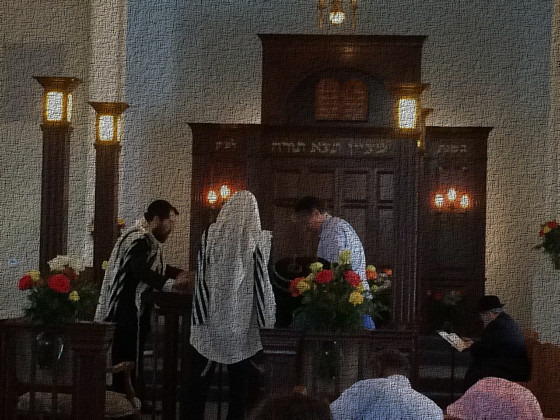
beth immanuel
Beth Immanuel Sabbath Fellowship

Even for those non-Jews who identify as Messianic Gentiles, who agree with the differentiation of roles between Jews and non-Jews in Messiah and who study and behave accordingly, it is arguable as to whether or not we are actually practicing a “Judaism,” even if we worship and fellowship alongside Messianic Jews in a Messianic Jewish synagogue (such as at Rabbi David Rudolph’s shul Tikvat Israel).

I’ve argued both sides of the issue (such as in Do Christians Practice Judaism? and Practicing Messianic What?) and the debate continues to rage.

In beginning to read Rabbi Moshe Avigdor Amiel’s book, from which I quoted above, I truly realize that he conceptualizes the Torah in general and Genesis (Beresheet) in particular, in a fundamentally different way than I do. Of course, he had the benefit of being born a Jew, being raised in a Jewish community, worshiping the God of his fathers as a Jew, being educated as a Jew, and speaking and writing fluent Hebrew (the book is actually two different versions between the covers, one in English and one in Hebrew) as a Jew.

This, and my many other explorations into various Jewish texts, show me that even though I can read them in English, they were written (at least the more scholarly ones) for Jewish people who conceptualize the Bible and associated interpretations in a very different manner than I do, and there are directions in which these texts travel that my thoughts are incapable of following. As I practice my faith, even though I study from a Messianic perspective, that hardly means I’m practicing any type of Judaism as such.

It stands to reason that I don’t consider myself Jewish or even practicing “Jewishly”.

There is, however, a necessity for me to “touch, handle, [and] taste Jewish things,” as R. Dauermann states, because of the intersection between my Messianic faith and Messianic Judaism as it exists within the overarching ekklesia of Messiah, but as I’ve said many, many times before, unity does not require uniformity. It doesn’t even always require being “separate but equal,” although I have also argued for the necessity of exclusive Messianic Jewish communities, at least for some MJ synagogues.

As Gentiles in Messiah who choose the path of studying the Bible and understanding the covenants from a Messianic point of view (and keeping in mind there probably isn’t any one single “Messianic point of view”), in my way of thinking, recognizing the covenant priority of the Jewish people in God’s redemptive plan for Israel is critical to how we not only see Jewish Messianics, but how we are to understand Gentile Messianics as well.

From a rant of my own written last February, I came down to saying don’t argue, though I realize that will always be taken as “let’s argue” by most humans, since we tend to be contrary by nature. But consider that in the long history of the Christian Church, any Jew who has come to faith in Jesus (Yeshua) as the long-awaited Messiah, has been without fail required to opt out of Yiddishkeit and effectively become a Gentile. Isn’t it understandable that Jews who enter the Messianic ekklesia would desire to rectify the insults and injuries of the past by preserving who they are as Jews?

I must admit that my own journey out of “One Law” was largely (but not exclusively) motivated by watching my Jewish wife’s involvement in Jewish community and my desire to cherish her Yiddisher Neshamah. Nothing quite teaches a Gentile about a Jew’s absolute need to be Jewish, to live Jewish, to be among Jewish community like being married to a Jewish spouse. Being married to the girl with the Jewish Soul has certain advantages that many others involved in “worshiping Jewishly” may lack in abundance.

Yesterday, I published a blog post that was highly critical of Christianity, accusing the early Church of virtually “kidnapping” the Jewish scriptures, particularly the Jewish Apostolic Scriptures, and I am sure I insulted many good Christian men and women in the process. I regret any pain I may have caused, but unfortunately, there was no other way to get my point across in the required manner.

But like it or not, the Church has committed many crimes against the Jewish people and their writings and we do so again by failing to acknowledge Jewish uniqueness in covenant connection with God, whether we call ourselves “Christian,” “Messianic,” or anything else.

I know I can’t cause even one single Gentile person to reconsider their commitment to the Torah as they see it, even as I at one time reconsidered my commitment and subsequently changed my direction. It’s possible that I’m totally unique in that regard, though the Gentiles involved in the educational ministry First Fruits of Zion must have faced a similar circumstance a number of years ago when they shifted their official position from One Law to a Differentiated model. And yet, I know it’s possible because I did it.

Orthodox Jewish manI inaugurated and celebrated that change almost three-and-a-half years ago when I wrote the first post for this blog called Abundant is Your Faithfulness.

Since that time, I’ve had many adventures, went back to church, left church…I’ve thought about giving up blogging and even “religion” a number of times, usually after encountering my own severe limitations as a human being or encountering the darker side of religious people.

We have just passed through the Days of Awe, exited Rosh Hashanah and Yom Kippur, and entered a new year. Erev Sukkot begins day after tomorrow at sundown and the year stretches out before us like a road paved in gemstones. Whatever our differences, we share one Messiah and one God. Would it really hurt we Gentiles to extend courtesy and honor to the Jewish people by recognizing that they are indeed unique and set apart by Hashem, their God and ours, as a people and a nation?

Oh, by the way, you won’t be able to engage Rabbi Dauermann by commenting on my blog since it’s quite likely he may not even read my “meditations” and certainly, he has never commented here. You can only “talk” to me.

One last thing. Although I don’t agree with everything Scot McKnight wrote in his article Does Personal Bible Reading Destroy the Church?, he does make a good point about everyone interpreting the Bible willy-nilly to come up with their own conclusions. We can’t all be right.

Addendum: Please keep in mind that there will always be rather negative influences who will read a blog post like this, draw the worst possible conclusions, and then post their opinions somewhere on the web, whether it be in my own comments section (no, not Cindy or Marleen) or on their own blog or website. I regret that I gave them more fuel to add to their “fire” but the only way I could possibly quench such “flaming” sentiments would be for me to cease to exist. Nevertheless, I apologize if my comments here have resulted in provoking anyone to slander (actually in writing, it’s libel) or otherwise making statements unbefitting a disciple of the Master and a child of God.

Reflections on Romans 9

But in all these things we overwhelmingly conquer through Him who loved us. For I am convinced that neither death, nor life, nor angels, nor principalities, nor things present, nor things to come, nor powers, nor height, nor depth, nor any other created thing, will be able to separate us from the love of God, which is in Christ Jesus our Lord.

Romans 8:37-39 (NASB)

That’s how Paul wrapped up the eighth chapter of his Holy Epistle to the Romans (as we count the chapters and verses) and as I recorded in my previous reflection on this letter. Paul is offering a note of comfort and conciliation to his Jesus-believing Gentile readers in Rome that in spite of all the adversity they face, they will never be separated from God’s love through Messiah.

But while Paul wasn’t writing letters in chapters, what we call chapter 9 does seem to start off with a major shift in topic.

I am telling the truth in Christ, I am not lying, my conscience testifies with me in the Holy Spirit, that I have great sorrow and unceasing grief in my heart. For I could wish that I myself were accursed, separated from Christ for the sake of my brethren, my kinsmen according to the flesh, who are Israelites, to whom belongs the adoption as sons, and the glory and the covenants and the giving of the Law and the temple service and the promises, whose are the fathers, and from whom is the Christ according to the flesh, who is over all, God blessed forever. Amen.

Romans 9:1-5

I’ve always wondered why Paul began this part of his letter by saying he wasn’t lying. Who would have thought, over halfway through reading the epistle, that Paul started being duplicitous or disingenuous?

Of course, there’s this:

And when they heard it they began glorifying God; and they said to him, “You see, brother, how many (tens of) thousands there are among the Jews of those who have believed, and they are all zealous for the Law; and they have been told about you, that you are teaching all the Jews who are among the Gentiles to forsake Moses, telling them not to circumcise their children nor to walk according to the customs.

Acts 21:20-21

Paul had enemies in some Jewish communities in the diaspora and they had apparently been spreading rumors that he had been teaching the Jews in the galut that they did not have to follow the Torah of Moses or the traditions of their Fathers. Perhaps some Jews and Gentiles hearing these rumors (and remember, at the point Paul is writing this letter, he’d never been to Rome before so none of the people reading this would likely have met him before) thought they were true. If indeed Paul was following the instructions for teaching the Gentiles formally adopted by the Apostolic Council’s halachic ruling as chronicled in Acts 15, he was teaching the Gentiles that they were not obligated to the yoke of Torah as were the Jewish disciples. I can see where this could have been confusing.

The Jewish PaulBut either through malice or miscommunication, the rumors existed and the Gentile (and Jewish) disciples in Rome may have believed they had good cause to doubt Paul’s affection for his fellow countrymen. So given that Paul’s about to launch into an impassioned plea for unbelieving Jews, a strong preface of “I’m not lying” may have seemed necessary. Of course, all this is guess-work on my part, but as I’ve said before, these “reflections” on Romans are just my impressions at reading the letter “cover-to-cover,” so to speak.

Paul says he’d rather be accursed and separated from Christ. The ESV translation uses “cut off” in place of “separated” which immediately brings to mind the following:

For whoever does any of these abominations, those persons who do so shall be cut off from among their people.

Leviticus 18:29

If (and it’s probably a big “if”) the Apostle to the Gentiles meant “cut off” in the sense of the Hebrew word “Karet” as described by Derek Leman, then Paul was indeed saying he was willing to undergo great suffering, complete isolation from Israel, and perhaps even death for the sake of the salvation of some of his brethren in the flesh, that is, for other Jews.

On the heels of that declaration, Paul then says that his unbelieving Jewish brothers (and indeed all Jews) are those to whom belong “adoption as sons,” “the glory and the covenants,” “the giving of the Law (Torah),” “the Temple service,” and “the promises, whose are the fathers.”

In other words, the promises God made to Israel, that is, all Jewish people, as recorded in the Torah, the Prophets, and the Writings (what Jews commonly call the Tanakh and what Christians refer to as the Old Testament), all of them, still belonged to all of Israel, to all Jews from Paul’s point of view as he was writing his letter.

Remember, Paul was writing after the crucifixion, death, resurrection, and ascension of Messiah, the Christ, who sits at the right hand of the Father and who is our High Priest in the Heavenly Tabernacle. Apparently, none of that deleted, watered down, erased, or “fulfilled” any of those aforementioned promises in order to make them go away or to transfer them from Jews to Gentiles.

So if the Jews had all those advantages, why was it so important to Paul that they accept the validity of the revelation of Yeshua as Messiah?

…whose are the fathers, and from whom is he Christ according to the flesh, who is over all, God blessed forever. Amen.

Romans 9:5

What an odd way to end that sentence. What does Christ (Messiah) have to do with everything Paul said in the previous verses?

But now He [Messiah] has obtained a more excellent ministry, by as much as He is also the mediator of a better covenant, which has been enacted on better promises.

Hebrews 9:6

D.T. LancasterYou’ll have to read my sermon reviews of D. Thomas Lancaster’s lengthy sermon series on the Holy Epistle to the Hebrews, particularly Better Promises and Glory to Glory to get the full meaning of what I’m saying here, but a big, big part of those “promises” of “the fathers” (also translated as “the patriarchs”) are the promises of the New Covenant, which Paul has been referencing heavily so far in his letter, a Covenant for which Yeshua is the mediator.

In order to access those promises fully, the next step in Jewish religious life and faith was to acknowledge the revelation of the Messiah and it was so important to Paul that Jewish people do so, that they claim their own heritage, he was willing to voluntarily surrender his part in those promises, including the final and total forgiveness of sins and the resurrection into the Messianic Kingdom.

But it is not as though the word of God has failed. For they are not all Israel who are descended from Israel; nor are they all children because they are Abraham’s descendants, but: “through Isaac your descendants will be named.” That is, it is not the children of the flesh who are children of God, but the children of the promise are regarded as descendants. For this is the word of promise: “At this time I will come, and Sarah shall have a son.” And not only this, but there was Rebekah also, when she had conceived twins by one man, our father Isaac;  for though the twins were not yet born and had not done anything good or bad, so that God’s purpose according to His choice would stand, not because of works but because of Him who calls, it was said to her, “The older will serve the younger.” Just as it is written, “Jacob I loved, but Esau I hated.”

Romans 9:6-13

This set of verses has been misused time and again by Christians including those belonging to some portion of the Hebrew Roots movement, to say that Christians are “spiritual Israel” or that Jesus-believing Gentiles actually are Israel in fact.

But hold up there, Tiger. Not so fast.

Verse 6 may say “for they are not all Israel who are descended from Israel” (and we typically think of “Israel” = “Jacob”), but look at the verses that immediately follow. I suggest that what Paul is actually saying is that not all offspring of Abraham are Israel, but only the descendants of Isaac, the child of the promise (remember, Paul was talking about promises God made to the patriarchs). God loved Jacob but hated Esau. In other words, God loved the child of promise Isaac and Isaac’s child Jacob, but He hated Isaac’s child Esau. Only one of the twins could inherit the promises and that child’s offspring became the Twelve Tribes of Israel who are now the Jewish people.

It has nothing to do with Gentile Christians and only has to do with Gentiles in the sense of the non-inheriting offspring of Abraham and Isaac since their descendants are not Israel, not Jewish.

I think this is Paul’s way of saying that all of the direct descendants of Abraham and of Isaac and of Jacob are loved because of the promises God made to each of them (see Genesis 12:1-3; 17:21; 22:15-19; 26:2-5; 28:10-17). Those promises and all the other promises God made with Israel were never rescinded, thus they all remained (and still remain to this day) in force, but only for the Israelites.

What shall we say then? There is no injustice with God, is there? May it never be! For He says to Moses, “I will have mercy on whom I have mercy, and I will have compassion on whom I have compassion.” So then it does not depend on the man who wills or the man who runs, but on God who has mercy. For the Scripture says to Pharaoh, “For this very purpose I raised you up, to demonstrate My power in you, and that My name might be proclaimed throughout the whole earth.” So then He has mercy on whom He desires, and He hardens whom He desires.

Romans 9:14-18

calvinism vs arminianismI once heard these verses used to support Calvinism or the idea that God selected only specific individuals for salvation from before the creation of the Earth and not others. Since God is sovereign over the universe, He has the right to do this, but was Paul inventing Calvinism in these scriptures?

Look at the context and especially what he wrote above. He’s been talking about how “God loved Jacob” (Israel) and “hated Esau” (the non-children of promise from Abraham and Isaac, and perhaps all pagan peoples descended from them). Is this unfair of God? According to Paul, no. God had/has the right to choose Israel from among all the nations of the Earth for special blessings, promises, and duties (and make no mistake, being the sole objects of the covenants and obligated to their conditions by performing the Torah mitzvot is indeed a challenging set of duties).

Now recall that Paul isn’t writing to the Jews in Rome but to the Gentile believers, very likely because he had heard of some strife between the Gentiles and Jews sharing community space in the Roman synagogues and that the Gentiles might have been getting a bit arrogant in their special status of equal co-participants in Jewish worship life without the obligation to undergo the proselyte rite. I’ve said in previous “reflections” that the non-believing Jews may have been pushing back by emphasizing their special chosen status as Israelites and no doubt that had the intended effect of “stinging” Gentile pride.

I think what Paul is saying here is that God had every right to choose the Israelites for whatever reason or not reason at all, and that God is not being unfair. God can have mercy on who He chooses and there’s nothing we can do to change God’s mind. Paul uses the example of Pharaoh whose heart God hardened during Moses’ numerous appeals to secure freedom for the Israelite slaves, and God did this for His own glory, even though you might think it was unfair, since this hardening ultimately lead to the deaths of many, many Egyptians.

But God is sovereign and Paul is saying because of such, God can choose Israel for special blessings and quite frankly, we Gentiles have nothing to say about it.

I didn’t fail to notice that such a position has applications in the Messianic Jewish and Hebrew Roots movements of today. Many non-Jews involved in each of these two disciplines can sometimes get that “I’m on the outside looking in” feeling when it comes to Talmud study, davening in a minyan, or even reciting the blessings of donning a tallit, that is, those mitzvot that are distinctively Jewish.

Some non-Jews attached to these movements have said it’s unfair for Messianic Jews to withhold the observance of these mitzvot to themselves and have even gone so far as to say that Messianic Jews are exclusivist and racist.

And yet we have Paul strongly stating that God has every right to give the Torah to the Jewish people and not assign the same chosen status to those of us who are not descendants of Abraham, Isaac, and Jacob. My impression of Paul is that he would have little patience with the demands of such folks.

You will say to me then, “Why does He still find fault? For who resists His will?” On the contrary, who are you, O man, who answers back to God? The thing molded will not say to the molder, “Why did you make me like this,” will it? Or does not the potter have a right over the clay, to make from the same lump one vessel for honorable use and another for common use? What if God, although willing to demonstrate His wrath and to make His power known, endured with much patience vessels of wrath prepared for destruction? And He did so to make known the riches of His glory upon vessels of mercy, which He prepared beforehand for glory, even us, whom He also called, not from among Jews only, but also from among Gentiles.

Romans 9:19-24

claySo being clay, all of us, in the hands of our molder, that is God, who are any of us to complain if He made some clay Jewish and some clay Gentile? Those He made for “honorable use” (I know this is going to sound unkind) can be compared to the Jewish people, while those made for “common use” are the Gentiles. After all, relative to the entire world population, the Jewish people have always been only a tiny number, apparently reserved for a special use while the rest of us, because we are so many, are more “common.”

I think this was Paul’s message to the Roman Gentile Jesus-believers. He sounds like he was definitely playing “hard ball” in this letter, but since he wasn’t with them in person to emphasize his points, he had to make sure there would be no way his readers could misunderstand him. Going back to that part of the chapter where Paul said he wasn’t lying, maybe he had a good reason to say things in as definite a manner as possible.

Thus the “vessels of mercy which He prepared beforehand for glory” to whom God would “make His power known” are the Jewish people, but some of that glory also extends to us, “not from among the Jews only, but also from among the Gentiles.”

This is the hook Paul uses to keep the Gentiles engaged so they wouldn’t be completely put off by everything he just said. Further:

As He says also in Hosea,

“I will call those who were not My people, ‘My people,’
And her who was not beloved, ‘beloved.’”
“And it shall be that in the place where it was said to them, ‘you are not My people,’
There they shall be called sons of the living God.”
Isaiah cries out concerning Israel, “Though the number of the sons of Israel be like the sand of the sea, it is the remnant that will be saved; for the Lord will execute His word on the earth, thoroughly and quickly.” And just as Isaiah foretold,

“Unless the Lord of Sabaoth had left to us a posterity,
We would have become like Sodom, and would have resembled Gomorrah.”

Romans 9:25-29

Now Paul flips the Prophets, so to speak, emphasizing where the Gentiles are included in the promises, showing them where they/we are involved. Paul has made his point that the Gentiles can’t assume the role and place of the Jews and now he’s showing the Gentiles where their role and place lies using the relevant scriptures.

Finally (for today’s meditation):

What shall we say then? That Gentiles, who did not pursue righteousness, attained righteousness, even the righteousness which is by faith; but Israel, pursuing a law of righteousness, did not arrive at that law. Why? Because they did not pursue it by faith, but as though it were by works. They stumbled over the stumbling stone, just as it is written,

“Behold, I lay in Zion a stone of stumbling and a rock of offense,
And he who believes in Him will not be disappointed.”

There are not two paths to justification and salvation, faith for the Gentiles and the Torah for the Jews. That the Gentiles are not obligated to “pursue righteousness” through the Law in the manner of the Jews but are saved by faith alone, does not make them better or worse than the Jews, but the Jews, having the Torah (pursuing righteousness through the mitzvot), must still walk by faith. If a Jew (as perhaps some of the Roman Jews had been thinking) believed that mitzvot observance alone justified them before God, then the Torah became a “stone of stumbling” and “a rock of offense” for them. Torah doesn’t replace faith, it is by faith that the Jewish people walk the path of Torah.

TorahIf Paul expected both Jewish and Gentile disciples of the Master to pursue righteousness by observing the same Torah statues and commandments, then he would have said the “stone of stumbling” and the “rock of offense” was for both Jews and Gentiles who lacked faith, but he didn’t. He deliberately juxtaposed the faith of the Gentiles and the Law of the Jews, for it was the Gentiles who were bragging that by faith they were saved and that they had no obligation to the mitzvot, rubbing Jewish noses in Gentile “freedom,” so to speak.

In spite of the differences in role and responsibility between the Jewish and Gentiles disciples, the common denominator, the place where God was totally impartial as far as Israel and the nations were concerned, where He broke down the dividing wall between the two groups (Ephesians 2:14), was that only the faith of Abraham justifies anyone before God. We are all justified by faith in God through the mediator of His promises, Messiah Yeshua (Christ Jesus).

What an illuminating “reflection” Romans 9 turned out to be.

Observing the Letter and the Spirit of the Torah

In one (or more) of D. Thomas Lancaster’s sermons on the Holy Epistle to the Hebrews, he talks about the difference between the “letter of the Law” and the “spirit of the Law”. In traditional Christian teaching, this usually means that “the letter kills but the Spirit gives life” (2 Corinthians 3:6). In other words, the Law is bad because it promotes a legalistic method of attempting to attain justification before God, while acting in the Spirit of God, that is, the indwelling of the Holy Spirit we receive when we confess Christ as Lord, brings life, for only faith and grace can justify, not works. But this is a complete misunderstanding of the text and what the “letter” and the “spirit” really means.

According to Lancaster, the letter is the actual wording and literal meaning of a commandment while the spirit is the principle behind that commandment. Limiting a commandment to its literal meaning not only restricts our understanding of God’s intent for us, but may lead to either abandoning large portions of the Bible as anachronistic or attempting to drag those anachronisms into the 21st century. Let me give you an example from last week’s Torah Portion:

If you build a new house, you shall make a fence for your roof, so that you will not place blood in your house if a fallen one falls from it.

Deuteronomy 22:8 (Stone Edition Chumash)

Now let’s take a look at the commentary for this verse referenced in the Chumash:

The Torah requires a Jew to erect a fence or other form of barrier around his roof. This commandment applies also to any dangerous situation, such as a swimming pool or a tall stairway (Rambam, Hil. Rotzeach 11:1-5).

This is an excellent example describing the letter and the spirit of the commandment. The literal meaning is to build a fence or barrier around the edge of your roof so that no one on the roof will fall off by accident. It’s your house and your roof, so you’re responsible. Except few of us have flat roofs on our houses (at least in the typical American suburb) that allow people to go up and stand on them, thus risking a fall. However, as the commentary suggests, the spirit, that is, the general principle behind the specific commandment, has a much wider focus. As property owners (if we own a home and the land it is on), we have a responsibility to assess any potential dangers on our property and take steps to improve safety and thus avoid household members and guests incurring injuries due to our carelessness.

The example of a swimming pool for instance, is a good one, since accidental drownings, particularly of children, are not unknown. Many years ago when my family and I lived in Southern California, we had a swimming pool. My children were quite young at the time, and we wanted to make sure they would be safe around the pool. We had a pool cover installed that ran along a motorized track. When the cover was closed, it was impossible (especially for a child) to pull back the cover since it was secured in place by the track, and the only way to remove the cover was to insert a key into a spring-loaded locking mechanism and hold the key in the “on” position as the motor retracted the cover. In this sense, it could be said that my wife and I “fulfilled” this particularly mitzvah in relation to our swimming pool.

But why should you care about all this?

As I was studying Torah Portion Ki Tetzei on Shabbat (yesterday as you read this), it occurred to me that almost all of the commandments and statues listed could be thought of in terms of the letter and the spirit of the Law.

For instance, Deuteronomy 21:10-14 describes how an ancient Israeli soldier should behave toward a beautiful woman he has captured while battling and defeating an enemy population. The history of war tells us that part of what conquerors do is to abuse and rape the women of the enemy. The Torah doesn’t forbid the capture of these women but does issue the rather strange command that one must wait a full month before actually marrying the woman and engaging in sexual relations with her as a wife. In that one month time period, the man cannot touch her, and she shall shave her head and let her nails grow and weep for her lost parents. At the end of that time, the soldier can either marry her or set her free, but he must not sell her as a slave. Critics of ancient Israel and the Bible say this is still a horribly barbaric practice, but I think I can see a hidden motive of God’s in these verses. Part of the Chumash commentary states:

According to either interpretation, the purpose of the long delay is so that the captor’s desire will evaporate in the interim and he will set her free.

despairIn other words, God anticipated human lust during a war in which a soldier would impulsively desire to sexually assault or even permanently possess a captive woman. While God does not attempt to directly forbid taking women captive, perhaps because it would have set up far too many of the Israeli soldiers to sin in the passion of the moment, He permits capture but forbids any sexual contact for one month. A month is certainly long enough for such passion to dissipate, particularly when the woman is commanded to set aside certain matters of hygiene and grooming.

In modern military forces of the West, it is illegal for soldiers to rape women in war and it would be unthinkable for a soldier to capture a woman and take her home to be a wife. Arguably, this commandment, like most of those we find in the Torah, would only apply in modern times to the Jewish people, but in the present nation of Israel, we don’t find reports of IDF soldiers capturing women in Gaza and taking them home as potential spouses. So what is the principle behind the literal commandment, or is there one anymore? After all, the practice of capturing women as sex slaves during war has become so abhorrent that it is virtually unthinkable.

Has the spirit of this law, even among non-Jewish nations, triumphed over the letter or has something else happened? Has this law become obsolete because the practice among the armies of civilized nations has become extinct (and I recognize that there are forces among uncivilized and brutal peoples where rape during war is still practiced)? That leads to a rather uncomfortable thought; the thought that there are some portions of the Torah that no longer apply and that may never apply again. Let’s take a more extreme example:

You shall not wear combined fibers, wool and linen together.

Deuteronomy 22:11 (Stone Edition Chumash)

To the best of my knowledge, only Orthodox Jews observe this commandment today. It would be a difficult commandment to observe for most of us given the nature of the clothing typically sold at retail outlets with their mixed natural and artificial fabrics. The Chumash commentary on this verse goes back to Leviticus 19:19 which says in part:

The prohibitions not to cross-breed or to wear mixtures of wool and linen are the quintessential decrees, i.e. commands of the King for which man knows no reasons (Rashi). Ramban clarifies the above point. God surely has reasons, but since man cannot know them, he cannot feel the same satisfaction in performing these decrees that he has when he performs precepts that he feels he understands.

In other words, this class of commandment is to be observed simply because “God said so,” not because (from a human standpoint) it makes any particular sense or seems at all purposeful. There is a literal meaning to this commandment but no apparent underlying principle.

Which brings me to what it is to observe the Torah commandments, particularly for those people who believe it is possible to observe only the literal, Biblical mitzvot of the Torah without any Rabbinic interpretation and binding halachah being involved. As I mentioned, fulfilling the mitzvah of not wearing clothing made of mixed fabrics is something (again, to the best of my knowledge) performed only among Orthodox Jews. And particularly for those non-Jews who feel led in some manner or fashion, to live “Torah-observant” or “Torah-complient” or “Torah-submissive” lifestyles, is it actually possible to do so?

There are three reasons why I think not. The first has to do with the differences between the letter and spirit of the commandments. Most of you, as I said before, don’t have a flat roof on your house so you cannot observe the literal, Biblical commandment. You can only observe this mitzvot if you take the Rabbinic interpretation of its underlying principle into account.

The second has to do with commandments for which we are not likely to ever have the opportunity to fulfill. This goes beyond whether or not we have a flat roof (for instance, the three-story building where I work does have a flat roof where people have access and it does have a barrier to prevent people from falling off), and goes into a realm where, for example, even if we serve in a military organization and find ourselves in battle, it would never even occur to most of us to capture a woman and particularly not to ship her home thousands of miles away with the idea of making her a wife. This may at one time have been an all too common practice during war (at least the initial rape of enemy women) but for American soldiers in the modern era, it’s no longer even on the radar, so to speak. Calvin The third has to do with commands like not wearing mixed fabrics. This is a literal command that can possibly be observed (for after all, Orthodox Jews observe it), and it is a Biblical commandment, so those non-Jews who say they only obey the written or literal Torah can (and by their own value system should) obey it, and yet I know of no one in my past experience among Hebrew Roots and One Law congregations who has ever attempted to observe this mitzvah. So what does all this mean?

As part of my studies last Shabbat, I read the commentaries for the weekly Torah Portion in Rabbi Zelig Pliskin’s book Growth Through Torah. As I was reading, it occurred to me that Rabbi Pliskin, in his commentaries, was indeed describing the principles behind each of the mitzvot he was addressing. R. Pliskin cited numerous Rabbinic teachings in relation to the beautiful woman captured in war (Deut. 21:13-14), some which commented directly on the situation, but most of which extrapolated the various principles behind the literal, Biblical meaning. The following is just one sample:

Rabbi Chayim Zaitchyk commented that we see from here that to really change a trait it takes a thirty day period of intensive work. This is the principle of the month of Elul which is a time for us to focus on our behavior and traits in order to make major improvements on ourselves. -R. Pliskin, p. 435

That particular principle probably doesn’t seem like it should reasonably be extrapolated from the plain meaning of the text, and so most of us (at least if we’re not Orthodox Jews) tend to disregard it. On the other hand, the Jewish people have been the keepers of the commandments of God, including the observance of Shabbat and the knowledge and practice of ethical monotheism, for untold centuries before the rest of the world even heard of a single God. Who is to say that God did not give the leaders and teachers among the Jews, ancient and modern, the authority to study and to derive underlying principles from the surface meaning of the commandments and to integrate those principles into the practice of daily living for their communities?

For Moses from ancient generations has in every city those who preach him, since he is read in the synagogues every Sabbath.”

Acts 15:21 (NASB)

This single verse is among the most mysterious and probably the most misunderstood in the entire Bible. For many in the Hebrew Roots movement, it is one of the justifications for believing that the Jewish Apostles intended for the Gentile disciples to not only learn the Torah but to observe the full body of the mitzvot in the manner of the Jews, even though Peter said “Now therefore why do you put God to the test by placing upon the neck of the disciples a yoke which neither our fathers nor we have been able to bear?”

I’ve often said that it is impossible to understand what Jesus taught unless you understand how he understood the Torah, Writings, and Prophets, the Bible that existed in the days of the Apostles. Sending new Gentile disciples of the Master to the synagogue to hear the Torah read and interpreted by the teachers each Shabbat was one way to help them understand the principles and even the nuances behind the literal commandments and teachings. It’s not just the words, but the context, the language, and the world view of the original intended audience. The original intended audience of Jesus were Hebrew/Aramaic speaking Jews living in Israel.

The Gentile disciples came from a number of different nations and cultures, none of which would have given them the educational background and specific mindset of the people to whom Jesus was originally teaching. The Gentiles could only gain that perspective and thus eventually learn what Jesus was really teaching by studying among Jewish teachers, probably for many months to many years, because the teachings of the Bible are heavily embedded in culture and experiential living as well as language, religion, and history.

Now take a bunch of Americans (or whoever you are) two-thousand years removed from all of that. Compared to the Gentile disciples being addressed in Acts 15, we might as well have just arrived from another planet in terms of our ability to grasp what they were asked to study, and it was a challenge even for them. I don’t believe that either then or now, non-Jewish disciples of Jesus were or are expected to emulate the Jewish disciples beyond a certain subset of observances and underlying principles, but it is those underlying principles that may capture the secret to what it is to be a (so-called) “Torah-observant Gentile.”

Going back to building fences on roofs or putting covers over swimming pools, I don’t think anyone, Jewish or Christian, would think it was a bad idea to improve safety conditions on our property and to protect our family and friends from accidental injury. It’s not just a “Jewish thing”. In fact, we have a body of penal and civil laws in the U.S. that speak to just those concerns so it can be said our local and national governments, to one degree or another, mandate or command that we behave as responsible citizens by taking proactive steps to provide a safe environment in our communities.

Ismar Schorsch
Ismar Schorsch

Thus we can say that there is more than meets the eye to the Apostolic decree in regards to the Gentile disciples we find in the Acts 15 letter but it may be more layered and nuanced than the simple assumption that there is only a single expectation for everyone everywhere that is contained in the Torah. Ismar Schorsch, in his 2005 commentary on this past week’s Torah portion, as recorded in Canon Without Closure: Torah Commentaries (p. 610) and referencing Eshet Hayil (“A Woman of Valor”) based on Proverbs 31:10-31, said:

Words carry more than their surface meanings. To fixate on their literal meanings turns a deep channel into a shallow trough.

Is it possible that some of us in believing and even attempting to practice a literal, Biblical Torah, have turned the “deep channel” of God’s intent for our lives into “a shallow trough?” The rather lengthy title for one of Rabbi Pliskin’s commentaries on Deuteronomy 22:5 which prohibits the wearing of garments meant for the opposite sex is, Each person should feel joy in fulfilling his or her unique role in life. He states (p. 438):

Targum Yonoson states that the garments of a man include tzitzis and tefilin. Rabbi Chayim Shmuelevitz commented on this that we see the principle that each person has his own mission in life. The same thing that for one person is “holy of holies,” for another person who does a similar thing, but it is not his life’s task, it is an abomination. Each person should feel joy in carrying out his life’s mission and should not try to do things that he was not meant to do.

While R. Pliskin is a Jew writing to other Jews, I think I can reasonably extrapolate an extended principle that applies to non-Jews who feel compelled to take on board a role which is not assigned to us, a Jewish role. I posted a link to a recent “meditation” called Torah and the Christian: An “In-a-Nutshell” Explanation on Google+ and a Jewish person responded:

As a Christian, saved by grace, who happens to have a Jewish heritage, I try to avoid the discussion of what Jews and Gentiles should and should not to do because it has a tendency to lead to division. However, Yeshua already provided the answer, which we would do well to remember: “For he himself is our shalom — he has made us both one and has broken down the m’chitzah which divided us by destroying in his own body the enmity occasioned by the Torah, with its commands set forth in the form of ordinances. He did this in order to create in union with himself from the two groups a single new humanity and thus make shalom, and in order to reconcile to God both in a single body by being executed on a stake as a criminal and thus in himself killing that enmity. Also, when he came, he announced as Good News shalom to you far off and shalom to those nearby, news that through him we both have access in one Spirit to the Father” (Ephesians 2:14-18 CJB).

It’s one of the expected responses from both a traditional Christian and classic Hebrew Roots perspectives, although both groups identify the practices of “one new man” quite differently. It also cites the usual issue of promoting identity specific roles as “causing division,” and my response would be to suggest that a Kohen having a specific role in the Temple did not “cause division” among the different classes of Israelites (apart from the Korach rebellion of course). We simply have our own roles assigned to us by God based, among other things, on who we are in terms of gender, nationality, and covenant connectiveness.

When writing on Deuteronomy 22:7 and 22:10, R. Pliskin crafted commentaries called Even when engaged in a mitzvah be sensitive to the feelings of others and Be careful not to cause others to envy. The underlying principles being expressed here are applicable both to Jewish people observing the mitzvot and Gentiles who think they should do so in the manner the Jews are commanded.

One of the things I must (sorry to say this) criticize J.K. McKee for was a statement he made in his book One Law for All: From the Mosaic Texts to the Work of the Holy Spirit about the issue of Jewish distinctiveness in the Messianic community of believers. I don’t recall the exact quote, but he made what I consider to be some rather snarky remarks about these Jewish people being exclusivist and even petty in desiring to have their covenant role as Jews recognized and respected.

And yet we see there’s a principle in Torah observance that recognizes distinctiveness of roles and even that a person whose role does not include the performance of particular mitzvot can actually hurt or inflict pain upon others. While we Gentiles may believe Jews are deliberately provoking us to envy because of their status before God, we, for our part, when we claim mitzvot that are not consistent with our role, are being injurious to the very people and nation we claim to love.

TorahSo what’s the answer? I don’t think there’s an easily understood one. I hope I’ve established in this short essay that the Torah is not a simple list of “Dos” and “Don’ts” but rather a highly complex and nuanced collection of lifestyle elements that define a Jew’s obedience to God as the conditions of the Mosaic Covenant. I also hope you can see that understanding how non-Jewish disciples of the Jewish Messiah fit into the covenantal landscape, in our case exclusively through the New Covenant blessings as they apply to us, is not an easy task. It wasn’t an easy task when James and the Council of Apostles and Elders issued their binding halachah upon the first Gentile disciples and it certainly isn’t now two-thousand years later.

Pastor Randy, the head Pastor at the church I attend, is in the process of presenting a sermon series on the Ten Commandments and how he believes they apply to Christians today. To do this, he has to dig into various portions of the Torah to lay his foundation, and my Sunday school teacher, who creates lessons based on Pastor’s sermons, is challenged with trying to comprehend how the underlying principles behind the Torah are “Christian”. And that’s where I think the answers for Gentile disciples lie, not in attempting to look and act “Jewish” by donning the outward apparel (tallit, tefillin, kippah) that would make people think we’re Jewish (which seems very much in line with the prohibition for a man to wear woman’s clothing as well as the reverse), but by studying and then practicing the underlying principles behind as many of the mitzvot as make sense for us to approach.

The answer, for me anyway, is not to believe I can obey God by looking like I’m Jewish, but to behave in a manner that applies the principles of the Torah within the context of who I am as a Christian and a Gentile, to live a life of faith, trust, charity, all in obedience, for there are many of us in our various roles and lifestyles, but only one God.

Judgment and Guilt

Rabbi Chayim of Tzanz once said to an evildoer, “Don’t think that because you give in to your evil inclination in some areas you therefore must be evil in all areas. Rather, in whatever ways you can, do good and overcome evil.” (Maigdolai Hachasidus: Hoadmor Maitzanz)

-Rabbi Zelig Pliskin
“No matter how far away you are from the Almighty you can always come close when you make an effort,” p. 417
Commentary on Torah Portion Re’eh
Growth Through Torah

As a flawed and imperfect human being, I find this enormously comforting but it isn’t what Christianity always teaches. It’s also a lesson that if misused, could be employed in the service of laziness or hypocrisy. As servants of God we could be tempted to believe that it is acceptable to be obedient to God in certain areas while disobedient in others. This would certainly be in error, but there’s the opposite to consider.

How often does a “religious” person bemoan their state in never being “good enough” either for God’s acceptance or more likely for the acceptance of their faith community? All churches and synagogues (and other religious traditions) have standards, both formal and informal, and violation of said-standards can elicit responses, from the casual “tongue-clicking” of gossips and judgmental people to more formal criticisms and reprimands (and sometimes there is no more legalistic and judgmental institution than the Christian Church).

Although other streams of Orthodox Judaism may not be so open, the Chabad tends to run on the belief that encouraging a Jew to observe even one mitzvah may ultimately lead to another and then another and so on. Thus, Chabad, at least in theory, accepts Jews from all walks of life and backgrounds within their synagogues, even if they have to (or choose to) drive to services on Shabbat.

The Rebbe himself (Rabbi Menachem Mendel Schneerson), although strict and demanding in issues of halachah, nevertheless embraced a certain “flexibility” (I apologize if that’s not quite the right word) in his expectation of even Orthodox Jewish practice.

In 1977 after his heart attack, the Rebbe started seeing cardiologist Dr. Ira Weiss who was an Orthodox Jew. As with most physicians, Dr. Weiss labored under the heavy demands on his time and admitted to the Rebbe that he was often late in reciting Mincha (the afternoon prayers) which caused him great guilt and distress. The Rebbe responded:

“In a case like this, where your obligations are first to your patients, and where making them wait can cause them physical or emotional harm…you are not entitled to delay them any further. You have to finish your work with them first, and God will understand the delay in your Mincha. You don’t have to make any apologies for a late Mincha.”

-Joseph Telushkin
Chapter 8: “I’m Also Tired, So What?” p. 127
Rebbe: The Life and Teachings of Menachem M. Schneerson, the Most Influential Rabbi in Modern History

Lubavitcher Rebbe, Rabbi Menachem Mendel Schneerson

The Rebbe went on to caution Dr. Weiss that when time is available and he is not in the service of his patients to not become lax or indifferent and that indeed he had a duty to pray at the appointed times, but he wanted to relieve Dr. Weiss not only of any guilt he experienced but even the idea that he had done anything wrong. The Rebbe went so far as to tell the doctor of the serious demands on his own time and circumstances that resulted in the Rebbe sometimes starting Mincha late.

I realize that for a Christian, this doesn’t seem like anything we would worry about. After all, we don’t have set times of prayer and compared to Orthodox Judaism, very light requirements from our religious calendar and traditions. However, as I said above, there are times when the Church can be quite legalistic in its own expectations, they simply do not codify their requirements in as open a manner as Orthodox Judaism. And the fact remains that regardless of our religious preferences, it is a human trait to judge others.

I recently read another Rabbinic commentary whose source escapes me (I thought it was Rabbi Pliskin’s but I can’t find it now). It tells of a poor man who was invited to a wedding. The family who invited him were quite well off and the man was embarrassed that he couldn’t afford a good suit to wear to the occasion. He finally asked a neighbor if he could borrow a suit and his neighbor generously lent the man a $1000 suit.

The day of the wedding, the man discovered that many of the people at the wedding were wearing suits not as fine as his and he began to look down upon them. This, of course, is the improper response, since this poor man could not have dressed as well as even the most casually attired wedding guest of his own resources.

And yet, as faulty as we all are in our obedience of and service to God, we can almost always find someone who is more (apparently) faulty than we are and at least within our own thoughts (though sometimes with our facial expressions and even our words) judge them.

J.K McKee in his book One Law for All: From the Mosaic Texts to the Work of the Holy Spirit opposes a Gentile (Christian) from adhering to the Torah mitzvot in the manner of the Jews as a matter of covenant obligation. Although McKee has other reasons for believing in the “One Law” for Jews and Gentiles, he states that relating to the commandments as an obligation can lead to a form of legalism and judgmentalism within One Law Christian communities.

I think McKee is simply describing human nature. I think the “cure” if there is one, is for each of us to focus on our own lives, consider where we are called to serve God, and to attend to our own “observance,” however we choose to define it.

God is the righteous judge of the world. We, as the people we are now, are to judge no one but ourselves and even then, it would be good if we didn’t judge ourselves too harshly or in too lenient a manner. Since striking the proper balance in assessing our own service to the Almighty will take a lifetime to master (regardless of how young or old you are when you take up the task), there should be little time in your life to be concerned about how well someone else is doing.

Dr. Ira Weiss wasn’t worried about any other Jew being late in reciting Mincha, only about himself. As an Orthodox Jew, he knew the standards by which his service to God was measured. The Rebbe reminded him of the higher duty the doctor had to his patients and that God was a lot more understanding of human frailty and limitations than we are as human beings.

jewish-repentanceThe Rebbe was a great believer that it was never too late to make teshuvah (repent) and to return to God. When we fail, we must remind ourselves that we too can repent and return, and that the struggle between our humanity and God’s perfection is one we will live with every day of our lives. It’s not perfection we seek in this lifetime, it’s persistence, endurance, striving to climb higher, and forgiveness when we fall. Don’t worry about the other guy. He’s got enough worries of his own without you adding to his list. God will help him even as he does you…and me.

What Brings Us Near to the Kingdom of God?

Did you ever wish you could change someone’s negative feelings toward you into positive ones? Consider the following story:

In the days of Rabbi Chaim of Volozhin, it occurred that a butcher was angry at the Rabbi of his city for rendering a decision that the meat of a cow he wanted to sell was not kosher. In his anger, he devised a scheme to murder the Rabbi. On a pretext, he had the Rabbi travel with him on a lonely road. Along the way, the butcher took out his sharp knife and wanted to kill the Rabbi.

At first the Rabbi pleaded with the butcher to have compassion on him. But this was to no avail. When the Rabbi saw that nothing he could say would make a difference, he started to mentally focus on all of the positive qualities and attributes of the butcher. Suddenly there was an amazing transformation. The butcher began to cry, kissed the Rabbi, and begged his forgiveness.

The lesson: Love others and they can’t help but to love you!

(see Rabbi Chaim Zaitchyk – Maayanai Hachaim, vol.3, p.191; Rabbi Pliskin’s “Consulting the Wise”)

-Rabbi Zelig Pliskin
“Radiate Love”
Aish.com

A heart is not judged by how much you love; but by how much you are loved by others.

-The Wizard of Oz (Frank Morgan) to the Tin Man (Jack Haley)
The Wizard of Oz (1939)

This morning, in a comment I made in response to Rabbi Carl Kinbar, I said in part:

The Internet is a very judgmental place where often the rules of civil social discourse do not apply. People are accused of all sorts of things on little or no evidence. When terms like “Bilateral Ecclesiology” start getting thrown around, people don’t see complex individuals, they just see “types”. To be fair, we make “types” out of people behind labels such as “One Law” and a lot of other names as well. Even though we are bound to disagree with each other on a number of issues in the religious blogosphere, if we tried to recognize each other as not only real people but as fellow disciples of Messiah, maybe we’d treat each other a little better. What would it be like if instead of dialoguing via the Internet, we suddenly all found ourselves in a coffee shop somewhere having this discussion over cups of hot java? I suspect the conversation would be different.

I periodically make such pleas on my blog, trying to encourage civility in the midst of disagreement. They are usually my least popular blog posts and attract little attention and fewer replies.

And yet all of our protestations and arguing make us liars if we call ourselves disciples of the Messiah or just plain “Christians”.

If anyone says, “I love God,” and hates his brother, he is a liar; for he who does not love his brother whom he has seen cannot love God whom he has not seen.

1 John 4:20 (ESV)

maskThe Bible, including the Apostolic Scriptures, is replete with passages about loving one’s brother and neighbor, and yet how much love do we see in these dialogues about our various theological perspectives? Almost none. But I would be a liar myself if I said they didn’t exist at all:

I would have to respectfully disagree. McKee’s research is precisely what we need to peel back the layers of this onion and find the original intent of the Author in His unchanging, everlasting Word. Then, we can understand what it truly means to return to the ancient paths and walk in the ways that demonstrate our love for God.

-Pete Rambo
“The ‘ger,’ the Chumash and Anachronism”
natsab.com

This is part of Pete’s rebuttal to comments I made in Part 2 of my review of J.K. McKee’s book (and boy is he getting a lot of free publicity from me) One Law for All: From the Mosaic Texts to the Work of the Holy Spirit. I’m not going to write a detailed rebuttal to Pete’s rebuttal of my review, because then he’d write a rebuttal and I’d write a rebuttal, and there’s a limit to how much time and energy I have available for a this sort of thing.

But it’s the way Pete responded that’s virtually unique to these transactions. Generally people on both sides of the aisle get pretty worked up when labels like “Bilateral Ecclesiology” or “One Law” are inserted into the mix. We tend to respond with our emotions first and our intellect second or more accurately, we respond with anger, hurt and outrage first and never consider applying compassion, empathy, and understanding to the other person’s point of view at all.

If we were the Rabbi in Rabbi Pliskin’s midrash facing an angry butcher with a sharp knife, we’d all end up sliced and diced and buried in a shallow grave in the middle of nowhere.

For a people will dwell in Zion, in Jerusalem. You will not have to weep; He will surely show you grace at the sound of your outcry, when He hears, He will answer you. The Lord will give you meager bread and scant water; your Teacher will no longer be hidden behind his garment, and your eyes will behold your Teacher.

Isaiah 30:19-20 (Stone Edition Tanakh)

Next Wednesday, my review of D. Thomas Lancaster’s sermon The Inner Torah, part of his Holy Epistle to the Hebrews series, includes this portion of scripture and something of Lancaster’s commentary about it.

It is said by some of the Jewish sages that one of the things Messiah will do when he comes (returns) is to teach Torah correctly, including the hidden things of Torah. It is also said that the Torah we have now, the actual physical object and its textual contents, is a “copy and shadow” of the heavenly, supernal Torah, the literal will and wisdom of God that resides in the Heavenly Court. The Torah we have was “clothed,” so to speak, when it was given at Sinai so it could exist in the physical realm and be understood and consumed by human beings.

They will no longer teach — each man his fellow, each man his brother — saying ‘Know Hashem!’ For all of them will know Me, from their smallest to their greatest — the word of Hashem — when I will forgive their iniquity and will no longer recall their sin.

Jeremiah 31:33 (Stone Edition Tanakh)

dear_godThe New Covenant promises that the Word of God will be written on our hearts and we will all ‘Know Hashem,’ from the least of us to the greatest, in a manner that can only be compared with the great prophets of old. There will no longer be a need for one person to teach another because our Teacher will be inside of us, no longer hiding His face; no, we shall see Him and know Him.

But not now, not yet.

Until then, we don’t know, hence we disagree, and sadly, hence we personalize conflict and get mad at people who don’t agree with us.

Disagreement isn’t the problem. Failure to love is. But if we fail to love people then we are failing to love God. How can we say we follow God and not love Him? Yes, one believer can disagree with another and yet they can love each other and they can love God. The traditional model of learning in Yeshiva is based on debate and yet it is not based on hate but love and the desire for learning.

It is said that Herod’s Temple was leveled, Jerusalem razed, and the Jewish people exiled from their Land, not because of lack of observance of the mitzvot, not because the Torah was not being studied (and certainly not because the “Jews rejected Jesus”), but because of baseless hatred of one Jew for another.

It doesn’t look like we Gentile disciples of the Master (i.e. “Christians”) have learned very much from that lesson.

Our Sages gathered these sections in an order … according to the requisite steps (Introduction to Path of the Just).

While character refinement is an important and desirable goal, we must be careful to stride toward it in a reasonable and orderly manner. Overreaching ourselves may be counterproductive.

Physical growth is a gradual process. In fact, it is not even uniform; the first two decades are a sequence of growth spurts and latency periods. Generally, the body does not adjust well to sudden changes, even when they are favorable. For instance, obese people who lose weight too rapidly may experience a variety of unpleasant symptoms. Although the weight loss is certainly in the interest of health, the body needs time to adjust to the change.

If we are convinced, as we should be, that spirituality is desirable, we might be tempted to make radical changes in our lives. We may drop everything and set out on a crash course that we think will lead to rapid attainment of the goal. This plan is most unwise, because psychologically as well as physically, our systems need time to consume new information, digest it, and prepare ourselves for the next level.

Luzzato’s monumental work on ethics, The Path of the Just, is based on a Talmudic passage which lists ten consecutive steps toward spirituality. Luzzato cautions: “A person should not desire to leap to the opposite extreme in one moment, because this will simply not succeed, but should continue bit by bit” (Chapter 15).

Today I shall…

…resolve to work on my spirituality gradually and be patient in its attainment.

-Rabbi Abraham J. Twersky
“Growing Each Day, Av 21”
Aish.com

And so it goes with us, at least ideally, slow and steady growth and gaining in understanding.

It’s not just in areas of learning and knowledge we strive to grow, but we must also nurture advancements in wisdom, compassion, spirituality, and Godliness. Without such, we can be as intelligent as Einstein and as learned as the Rambam and still know and be nothing.

If I speak with the tongues of men and of angels, but do not have love, I have become a noisy gong or a clanging cymbal. If I have the gift of prophecy, and know all mysteries and all knowledge; and if I have all faith, so as to remove mountains, but do not have love, I am nothing. And if I give all my possessions to feed the poor, and if I surrender my body to be burned, but do not have love, it profits me nothing.

Love is patient, love is kind and is not jealous; love does not brag and is not arrogant, does not act unbecomingly; it does not seek its own, is not provoked, does not take into account a wrong suffered, does not rejoice in unrighteousness, but rejoices with the truth; bears all things, believes all things, hopes all things, endures all things.

Love never fails; but if there are gifts of prophecy, they will be done away; if there are tongues, they will cease; if there is knowledge, it will be done away. For we know in part and we prophesy in part; but when the perfect comes, the partial will be done away. When I was a child, I used to speak like a child, think like a child, reason like a child; when I became a man, I did away with childish things. For now we see in a mirror dimly, but then face to face; now I know in part, but then I will know fully just as I also have been fully known. But now faith, hope, love, abide these three; but the greatest of these is love.

1 Corinthians 13:1-13 (NASB)

Standing before GodEven if you “win” the argument but you fail to love, you have won nothing. Of all of the mitzvot we strive to perform, if we fulfill them all flawlessly but we fail to love, we have failed to observe all of the Torah and we have desecrated the Name of God.

One of the scribes came and heard them arguing, and recognizing that He had answered them well, asked Him, “What commandment is the foremost of all?” Jesus answered, “The foremost is, ‘Hear, O Israel! The Lord our God is one Lord;  and you shall love the Lord your God with all your heart, and with all your soul, and with all your mind, and with all your strength.’ The second is this, ‘You shall love your neighbor as yourself.’ There is no other commandment greater than these.” The scribe said to Him, “Right, Teacher; You have truly stated that He is One, and there is no one else besides Him; and to love Him with all the heart and with all the understanding and with all the strength, and to love one’s neighbor as himself, is much more than all burnt offerings and sacrifices.” When Jesus saw that he had answered intelligently, He said to him, “You are not far from the kingdom of God.”

Mark 12:28-34 (NASB)

How near or far from the Kingdom of God are you?

Book Review of J.K. McKee’s “One Law for All,” Part 2

Much of this discussion has been focused around passages of the Torah detailing “one law” or “one statue” to be followed by the native Israelite and the sojourner (Exodus 12:48-49; Leviticus 24:22; Numbers 9:14; 15:15-16, 29-30). The majority of these passages actually pertain to specific legislation, where a uniform set of instruction needed to be followed. What these passages establish in a wider, theological and philosophical sense, has caused interpreters to draw a number of conclusions. Traditional Judaism widely interprets the “one law” passages as implying that the ger in Ancient Israel was only anticipated or expected to keep a minimum amount of Torah commandments, and this is followed by many of today’s Messianic Jews. Others in the broader Messianic community have held to the position that while the native Israelite and sojourner are not exactly the same, there are too many areas of equivalence, and that the sojourner was anticipated to keep the considerable bulk of the Torah’s commandments, which for many in ancient times would inevitably lead to circumcision and native status being granted.

-J.K. McKee
“Associated FAQs on the One Law Debate,” p. 130
One Law for All: From the Mosaic Texts to the Work of the Holy Spirit

This is the second part of my two-part review of McKee’s book (I published Part 1 yesterday). As I mentioned, his arguments regarding what he refers to as “Divine Invitation,” “Covenant Obligation,” and “Supernatural Compulsion” regarding how a non-Jewish disciples of the Jewish disciple should respond to the Torah mitzvot (at least within the community context of Messianic Judaism or Hebrew Roots) form the foundation of his book.

McKee advocates for the “Supernatural Compulsion” argument based on the New Covenant language found in Jeremiah 31 but, as I mentioned yesterday, since the Torah isn’t actually written on anyone’s heart yet and won’t be until the second advent, his stated motivation for a Gentile “keeping Torah” does not yet exist.

McKee dedicates about the first third of his book to explaining in great detail the passages in the Torah (listed above) related to “one law” and how the gerim or (Gentile) resident aliens among Israel were to be included and treated identically to the native Israelite in certain matters, usually related to ritual sacrifice. As McKee himself rightly states, all of the “one law” passages are conditional and do not describe a blanket commandment for Gentiles to simply enter ancient Israel and automatically be treated as a native in every single way.

I give “props” to McKee for his obviously detailed research and dedication to the topic of “one law” in ancient Israel but it almost doesn’t matter. Those passages cannot anachronistically be applied either to the Gentiles entering the Jewish worship stream of “the Way” in the first century C.E. or to we Gentile Christians, Messianic Gentiles, or Gentile One Law devotees today.

McKee even gives us the clue as to why:

…that the sojourner was anticipated to keep the considerable bulk of the Torah’s commandments, which for many in ancient times would inevitably lead to circumcision and native status being granted. (emph. mine)

I have long since asked and answered the question Whatever Happened to the Mixed Multitude and McKee has also just answered it. The commandments related to “one law” and the gerim (resident aliens) were originally created to deal with the “mixed multitude” of people (probably fellow slaves of various nationalities) who came with the Israelites out of Egypt. If they didn’t want to return to their own countries and desired to stay with Israel, what was to be done with them?

Eventual assimilation.

“You shall not detest an Edomite, for he is your brother; you shall not detest an Egyptian, because you were an alien in his land. The sons of the third generation who are born to them may enter the assembly of the Lord.”

Deuteronomy 23:7-8 (NASB)

ancient_jerusalemThis is why the “one law” passages in the Torah can never be used to justify Gentile “obligation” to Torah observance in the manner of the Jewish people among Christians in Messianic Judaism or Hebrew Roots today. They do not apply. This method of assimilation was designed to allow the resident alien, who would never be an Israelite, to enter a path so that their grandchildren would be admitted into the Israelite nation as a native. There was never an intention of a sustained multi-generational presence of Gentiles who remained Gentiles and yet were otherwise treated exactly like Israelites including in their observance of all of the mitzvot.

With the passage of time, the gerim were assimilated culturally and religiously. Doeg the Edomite, for instance, was a worshiper of YHWH by the time of Saul (I Sam. 21:8), as was Uriah the Hittite in the reign of David (II Sam. 11:11). Hence, the ger, in contrast to the nokhri, was required in many cases to conform to the ritual practices of the native Israelite. Thus, gerim were subject to laws dealing with ritual purification (Num. 19:2–10), incest (Lev. 18:26) and some of the food taboos (Lev. 17:10–16; but cf. Deut. 14:21). They were expected to observe the Sabbath (Ex. 20:10; Deut. 5:14), participate in the religious festivals (Deut. 16:11, 14), and fast on the Day of Atonement (Lev. 16:29). They were permitted to offer up burnt offerings (Lev. 17:8; 22:18; Num. 15:14ff.) and, if circumcised, even to sacrifice the paschal lamb (Ex. 12:48–49; Num. 9:14). Indeed, they, no less than the Israelites, were expected to be loyal to YHWH (Lev. 20:2; cf. Ezek. 14:5–8).

-from “Strangers and Gentiles”
Jewish Virtual Library

If you click on the link I provided just above, you can read a more detailed treatment of the subject from a Jewish point of view, but as we can see in the above-quoted paragraph, there is a long history of gerim entering Israel as resident aliens and as they married and had children, eventually their descendants were assimilated into Israel and their Gentile past was forgotten.

In order for any “one law” portions of the Torah to apply to Gentiles today relative to their (our) status among Jewish believers and our duty to the Torah mitzvot, there would have had to have been a sustained presence of Gentiles among Israel who continued, generation by generation, to remain Gentiles and yet to observe the commandments in the manner of the Israelites…

…and that population never existed. It’s as if McKee wasted the first third of his book making an argument that in the end doesn’t matter.

The later part of the book has a section called The Torah Will Go Forth from Zion and specifically analyzes the impact of Micah 4:1-3 and Isaiah 2:2-4 on the Messianic and One Law communities today. McKee does well in his description of these nearly identical portions of scripture up to a point. Then he tries to force Ephesians 2:11-12 and 3:6 into the picture.

Let’s have a look. I’ll use the NASB translation:

Therefore remember that formerly you, the Gentiles in the flesh, who are called “Uncircumcision” by the so-called “Circumcision,” which is performed in the flesh by human hands—remember that you were at that time separate from Christ, excluded from the commonwealth of Israel, and strangers to the covenants of promise, having no hope and without God in the world.

…to be specific, that the Gentiles are fellow heirs and fellow members of the body, and fellow partakers of the promise in Christ Jesus through the gospel…

Ephesians 2:11-12, 3:6

Now here’s part of McKee’s commentary (pp. 112-13)

Later questions posed in the Apostolic Scriptures, such as whether or not the nations of the Earth are somehow made a part of Israel’s polity by acknowledging the Messiah…

IsraelThis does and doesn’t seem to say that the rest of the nations of the Earth somehow “become” part of Israel, as if national Israel expands to encompass those nations, eliminating their former identities (America, Canada, Japan, China, and so on) and simply all becoming “planetary Israel” if you will.

McKee spends a great deal of time in this part of his book, which supposedly addresses Micah 4:1-3 and Isaiah 2:2-4, on the effort of including the nations as part of Israel rather than vassal nations serving Israel and her King in the coming Messianic Age, and his most outrageous statement is this:

…but it forms the thrust of what it truly means for born again Believers to truly make up the “one new humanity” (Ephesians 2:15, NRSV/CJB) that the Lord wants to see emerge. Nowhere in the Bible do we ever see the implication that the community of Israel is to remain an exclusively Jewish entity… (emph. mine)

-p. 122

I thought I was done having to tolerate the Christ at the Checkpoint anti-Israel diatribes for this year. This is the worst possible example of anti-Semitic, anti-Jewish Israel in Christian rhetoric. It’s doubtful McKee meant to come off that way. He sometimes tries to bend over backward to establish mutual respect of Christianity and Judaism. But the implications of his statement are both startling and dismaying. It’s like finding the spirit of Haman in the Church. Even the Koran claims that Israel belongs to the Jews.

And just so you don’t think I’m exaggerating, here’s a quote from the Christ at the Checkpoint Conference About Us page:

Any exclusive claim to land of the Bible in the name of God is not in line with the teaching of Scripture.

Do you see the parallels between the two statements?

McKee seems to be invoking the Wesleyan philosophy of “mutual submissiveness” and any theology that makes one party in the Messianic Ekklesia somehow superior to or even different (though equal) from another violates this principle. The idea is that Jews and Gentiles in Messiah are mutually dependent upon each other.

I actually agree with that part of it as far as it goes and as was stated by Rabbi David Rudolph in the first chapter of his (and Joel Willitts’) book Introduction to Messianic Judaism: Its Ecclesial Context and Biblical Foundations, but equality does not mean uniformity. I think McKee is forgetting that Jesus is coming back as a King! As his subjects, we will serve the King of Israel, he won’t be as submissive to us as we are to him. Also remember:

For thus says the LORD, “Sing aloud with gladness for Jacob, And shout among the chief of the nations; Proclaim, give praise and say, ‘O LORD, save Your people, The remnant of Israel.’ (emph. mine)

Jeremiah 31:7 (NASB)

If Israel is the “chief” or the “head of the nations,” that means two things: 1). Israel is the leader of all the nations and the other nations of the Earth are subservient to Israel, and 2). There are other nations besides Israel in the Messianic Kingdom.

politeiaEven a quick reading of Micah 4:1-3 and Isaiah 2:2-4 lets us recognize language such as “the peoples” and “many nations” in contrast to national Israel. If we all become “Israel” and “every knee shall bow” (Romans 14:11; Philippians 2:10), then there can be no other nations, only Israel with a citizenry that is multi-ethnic containing the remnant population of the entire world all as Israelis. Too many Messianic prophesies, including those cited by McKee, specifically mention Israel and the nations.

All this hinges on a single word in ancient Greek: Politeia (πολιτεία). However, I refuse to create an entire theology based on one word that’s used once in only one of Paul’s letters.

McKee’s logic is typical of the one law argument:

  1. Politeia means “citizen”
  2. Gentile believers are citizens of Israel
  3. As citizens of Israel, Gentiles must obey the same national laws as the Jews, that is, the Torah

That’s probably too simple, but you get the idea. Except that the meaning of being separated from citizenship into (or the commonwealth of) Israel is assumed. Verse 13 states, ” But now in Christ Jesus you who formerly were far off have been brought near by the blood of Christ.” At least in English, being “brought near” is not the same as “being made identical to.”

Also, Ephesians 3:6 speaks of Gentiles as “fellow heirs and fellow members of the body,” but “body” is not the same thing as “nation”. What body?

…so we, who are many, are one body in Christ, and individually members one of another.

Romans 12:5 (NASB)

Now you are Christ’s body, and individually members of it.

1 Corinthians 12:27 (NASB)

Put together, what does it all mean? I believe it means we Gentiles, though our faith in Messiah and his atoning sacrifice for humanity on the cross, have been brought into the blessings of the promise of the New Covenant, which includes the forgiveness of sins, reconciliation before God, justification, receiving the Holy Spirit, and heirs of the resurrection and a life in the Messianic Kingdom.

If I have to define my citizenship, I’d have to say that it’s in the promise of what is yet to come in the Kingdom of Messiah, and this Kingdom encompasses the entire planet which will be made up of Israel as the head of all the nations, and then all of the vassal nations that serve Israel and her King.

In that light, I can either choose to let “politeia” be a sticking point or I can factor it in to the larger Biblical panorama and let the overarching plan of God for Israel’s redemption and through her, the redemption of the world tell its own story.

Conclusion

There’s a lot more I could say (I took very detailed notes when reading McKee’s book) but the bottom line is whether or not McKee convincingly made his point that the “one law” passages of the Bible can be applied to modern Christianity as viewed through the New Covenant lens, resulting in a fused or near-fused national identity of Jews and non-Jews as a “Torah-observant Israel”.

As I mentioned, McKee did not convince me that the “one law” passages of the Torah are in any way relevant to modern believers because they were applied in a historical and cultural context that no longer exists. Therefore, “one law” cannot be factored directly into the New Covenant promises and the inclusiveness of the nations in the blessings of those promises.

While I find McKee’s application of “one law” as a “supernatural compulsion” compelling, especially given my own attraction to Jewish studies and practice, I can’t accept that the Messianic Age has already arrived, which is what would have to occur for that “compulsion” to be a result of the “Torah written on the heart.” The best I can give him here is that it is quite possible we will all be living more jewishly in the age to come, but I don’t believe that drive can be seen in the majority of Christians today.

That said, even McKee admits that Christians in the Church today are obedient to eighty or ninety percent of the Torah commandments that can be obeyed today, so perhaps the “compulsion” to obey God’s Torah is more evident than I imagine. Add to that Gentiles like me who seem naturally attracted to Jewish practices and the study of Messianic Judaism as the proper lens for viewing the Bible, and I could even say that a sort of “one law” viewpoint is one way we see evidence of the approach of the Kingdom of Heaven and the Holy Spirit preparing us for the promises of what is yet to come (not, as you can imagine, that I am advocating for “one law” as the best possible application).

And remember, even McKee says he can’t really answer when or how Christians will turn toward the Torah of Moses and the ways of God or even what that will exactly look like.

McKee’s comparison of Micah 4:1-3 and Isaiah 2:2-4 to sections of Ephesians 2 and 3 somehow establishing a worldwide citizenship in national Israel made up of a multi-cultural population just doesn’t play. In order to make it work, his protestations aside, he has to diminish God’s promises to Jews as the exclusive citizenry and possessors of Israel.

J.K. McKee
J.K. McKee
Photo Credit: Congregation Netzar Torah Yeshua

McKee’s book is an interesting but ultimately disjointed “patchwork quilt” of Evangelical and Wesleyan Christianity and Jewish practice that just doesn’t fit together (and that said, I did enjoy reading it). In denigrating certain parties within Messianic Judaism, he also reduces Jewish influence on their own  sovereignty and history, both past and future. The idea that Israel was never meant to be the sole property of the Jewish people in perpetuity completely violates God’s promises to Abraham, Isaac, and Jacob. In imposing “mutual submissiveness” as a cardinal value in Gentile/Jewish Messianic community, he misses that Kings and Kingdoms are not “mutually submissive” but in fact, Kings rule subjects and we are his subjects.

I admire McKee’s apparent effort in his scholarly investigation into the topic and his willingness to challenge the established norms typically associated with One Law practitioners. I also, as I’ve said before, appreciate his high view of the Church and his respect for traditional Christians and the history of the saints, but his even-tempered viewpoint in these areas does not successfully make all the mismatched moving parts in this theory and theology work together.

A final note. Please understand that this doesn’t mean I don’t like McKee (I don’t even know him) or that I am saying Gentiles shouldn’t appreciate or even perform some practices that are typically considered Jewish (observing a form of Sabbath, dietary restrictions, building a sukkah). There are a variety of reasons for doing so (such as being intermarried). I’m just saying, as a reviewer, that I do not believe McKee made a sufficiently convincing case based on his research, interpretation, and presentation. Your mileage may vary.

Addendum: Pete Rambo just published Part 2 of his review of McKee’s book.