Tag Archives: intermarriage

One of These Things is Not Like the Others

One of these things is not like the othersCommunity. It’s that thing, the way of life, that we all want but we’re just not quite sure how to pull it off successfully. It’s that tantalizing concept that promises so much reward, and yet it seems so elusive. Its promise sometimes causes us to cut ties where we are and move somewhere else where we hope to find greener pastures, better friends, and/or become part of a different community. Then when we do get a taste of real community, it’s only a matter of time before our hearts are stunned with hurt or insult. But a lack of community causes us to feel despondent, alone, and often times as if we’re missing out on something significant that was intended for us all along. This community thing can really be disappointing!

-Lisa
“Community Disappointment”
Following the Ancient Paths

I wrote a lengthy response to this blog post, but when I pushed “Post Comment,” I received an error message and my comment was lost forever. It was a rather lengthy comment (go figure) and I suspect the blog application was complaining to me about it. I thought about re-writing the comment but decided to blog instead.

Lisa’s blog post addresses what we should already know. Being part of any group or community is hard work. It’s hard to join, it’s hard to sustain, it’s hard to adapt over time. This includes families, employers, and Lisa’s specific topic, religious organizations.

I can sympathize. A little over a year ago I “went back to church” and in that time have had many interesting, educational, and dismaying “adventures.” But as Lisa’s blog post suggests, this is to be expected. No group that involves multiple human beings is always going to run smoothly.

Over a year apart, I wrote the blog posts Why I Don’t Go to Church and Why I Go to Church, chronicling my internal struggle, the same one Lisa seems to be describing.

We live in a world that seems to praise isolationism, yet we instinctively know that we weren’t created to be loaners (sic). Somehow it’s considered a good thing when we can handle things alone, when we can appear stand tall with a backbreaking burden strapped to our backs, when we live such private lives that nobody knows what is really going on with us. Deep inside we know that it isn’t right to go through life all alone. We wrestle with wanting something yet not wanting the very same thing, pursuing it and rejecting it all at the same time.

-Lisa

As Lisa says, we want to go it alone to avoid all of the messiness of being part of a community, but when alone, we know that being isolated from community isn’t right, either. Sort of a “can’t live with ’em, can’t live without ’em” situation.

The main point of my lost comment was the issue of competing interests. Affiliation with one community may conflict with another affiliation. In my case, I’m a Christian living with Jewish family members while attending a Christian church. How does that work?

Another set of competing interests has to do with entering into and finding a niche within a community. I recently declared that I’m a Christian who studies Messianic Judaism, and yet I attend a very fundamentalist Baptist church in Southwestern Idaho. If you’ve read any of my blog posts about my conversations with my Pastor, you know that although we get along, we disagree on a number of fundamental (no pun intended) elements of what faith in Messiah means, particularly to the Jewish people.

Can a square peg successfully integrate into a church of round holes? Good question.

I recently finished the book Life of Pi by Yann Martel. It tells the story of Pi, born and raised in India, from childhood to adulthood through a series of flashbacks, with the main action taking place aboard a lifeboat shortly after Pi’s family died in a shipwreck in the middle of the Pacific Ocean. Pi is the only human survivor, but finds that he must share the lifeboat with an injured Zebra, an Orangutan, a Hyena, and a 450 pound, male adult Bengal Tiger named Richard Parker (Pi’s father was a zookeeper and they were transporting a number of their animals from India to their new home in Canada).

life_of_pi_by_megatruh-d5noigdThe other interesting thing besides how Pi manages to survive seven months adrift at sea sharing a lifeboat with a Tiger (the other animals didn’t make it), is that as a child, Pi adopted three religious traditions, first Hinduism, then Christianity (Catholicism), and finally Islam. Pi practiced all three religions simultaneously, ignoring the basic tenet of each that these religions are exclusivist. That is, if you belong to one, you cannot also belong to any other religion.

Pi managed to observe each religious tradition in parallel without arousing suspicion for a while, but eventually it caught up with him, and he was finally confronted by all three congregational leaders at the same time in a public place in front of his parents.

When questioned about why he thought he could be a Hindu, a Christian, and a Muslim all at the same time, he responds by saying that he “just wants to love God.” (Martel, pg 69)

The book follows Pi’s life into adulthood and middle age where he is married with two children and a small dog and living in Toronto. He still practices all three religions, with no mention of any conflict in his family or in any of the involved congregations, but “Life of Pi” is a work of fiction and operates often at the level of religious allegory (I still haven’t figured out what the carnivorous island is supposed to mean).

In real life, Pi would never be able to successfully manage practicing all three religions, not only because of the conflicts between those communities, but the likely conflict with his own family, particularly his wife, who almost certainly had formed her religious or irreligious affiliations before she ever met and married Pi.

I have to admit, when I read about the sheer audacity and innocence of Pi’s devotion to three different religious branches, cherishing the best in all three, I felt a moment of admiration and even envy. What would it be like to open your arms wide and to take in and accept humanity’s vast range of traditions in worshiping God just for the sheer love of God?

It isn’t practical, which I suspect is one of the reasons why Martel’s novel is called a fantasy.

But Interfaith communities aren’t unheard of in our world. Author Susan Katz Miller maintains the On Being Both blog which celebrates a variety of interfaith families and communities, but such celebrations aside, one does not easily navigate the stormy seas that occur when theologies, doctrines, and dogmas clash in the narrow straits between one religion and another.

The solution in my own family, as it stands now, is something of a compartmentalization of each religion. In my home, Christianity and Judaism exist in separate silos, rarely communicating across the gap between them for the sake of peace. I do occasionally get emails from my wife containing links to news or information items on Israel or Judaism but I’m very careful not to bring up Christianity.

The ugly times is where our communities can grow stronger, more dedicated to one another, where each member grows in righteousness and in the image of our Master. The challenge is on the table. Are we ready to accept it?

-Lisa

Sesame StreetIt is true that adversity can produce stronger communities, but there’s a line that, if crossed, means that adversity has exceeded manageable limits and is destructive, not constructive. Sort of like lifting weights at a gym to build strength but overtraining resulting in injury, sometimes serious injury.

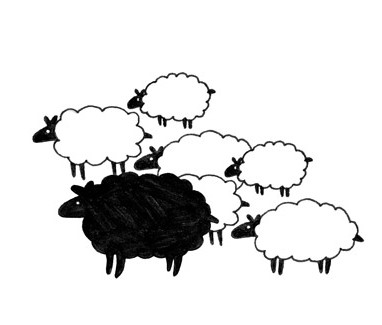
The television show “Sesame Street” sometimes has a lesson in the form of a song called One of these things is not like the others and I know what that experience is like in spades. There are interfaith communities that (seemingly) successfully co-exist within the same larger group, and there are interfaith families that are created and thrive for decades (such as my own), but that doesn’t mean it’s easy (which is what Lisa’s blog is all about).

But beyond being “not easy,” there are times when “not easy” becomes impossible or at least highly improbable, like a fourteen-year old boy from India who is a practicing Hindu, Christian, and Muslim, or the same boy two years later who manages to survive for seven months in the Pacific Ocean sharing a lifeboat with a large Bengal Tiger. How long can such a relationship between communities last before something gives?

Christmas at Arm’s Length

Interfaith and InclusiveAs always, as an interfaith community, our aim is not to meld, mash-up, mix, water-down or confuse our two religions. Instead, we strive to celebrate each holiday, whether Jewish or Christian, with full respect and all the trimmings. So how and why are these celebrations different from those you would find in any church or synagogue? Often, we begin and end a celebration by reciting our interfaith responsive reading, which is not a statement of creed, but a recognition that some of us are Jews, some of us are Christians, some of us have interfaith identities, and we are all equal members of this community. For me, simply knowing that we are an interfaith community changes my perception of any event: ancient rituals, songs and prayers, shimmer with the newness of radical inclusivity.

-Susan Katz Miller
“Lessons and Carols: Interfaith Community”
On Being Both

It’s Sunday morning as I write this and I’m avoiding church until January. Why? Because of Christmas.

Wait! Let me explain.

While Susan Katz Miller belongs to a community that can honor the different religious observances of its members, I’ve been attending a more traditional Baptist church. I remember hearing about how some of the church members participated in an anti-abortion rally at a new Planned Parenthood building some months back. Among the protesters were people from local Mormon and Catholic churches. My Pastor spoke of the event, but I don’t recall if it was from the pulpit or in a personal conversation with me. He said that a Catholic Priest was one of the speakers at the event and the Priest addressed the group with words something like, “We are all believers” or “We are all Christians.”

The point my Pastor had to make, representing the general perspective of our church, is that, because of the significant theological differences involved, he doesn’t consider Catholics and Mormons as “fellow believers” but rather, as those who are outside the Christian “camp.” Sure, they all came together at the event because of a common purpose, but the barriers constructed between those different faith communities, as far as he was concerned, were firm and inviolate.

I don’t say this to speak poorly about my Pastor or the church I attend. I consider him and the people I worship with to be truly devoted to God and desiring to serve Him in all that they do. However, there are distinct boundaries that contain the church and one may cross those barriers only at their own risk.

Almost a month ago, I called myself a Christian who studies Messianic Judaism. What that means in a nutshell, is that I am a non-Jewish believer in Jesus as the Jewish Messiah, and that I choose to study the Bible within a framework that takes into account the Jewish environment, perspectives, customs, and culture in which the Bible was authored, using that as a lens in filtering my view of Jesus.

As you might imagine, that somewhat crosses one or more of the barriers that contains my church’s theology and doctrine. My periodic meetings and conversations with my Pastor attest to the differences between us, and we’ve been honest that we are both trying to convince the other of our individual points of view.

I must say, I’m learning a lot, not only about church history and the development of fundamentalism in Christianity, but about my own opinions and where they come from. You never learn more about what you believe and why than when you are required to defend it.

Children's Christmas PageantPastor and his wife are spending the rest of the month (or most of it) in Florida to celebrate Christmas with his family. It will certainly be warmer than the December I’ve been experiencing here in Idaho. But that leaves behind Christmas at the church and today (as I write this) there won’t even be Sunday School.

There will be the Children’s Christmas Pageant. The kids have been practicing for about a month and I’m sure they’re looking forward to their big moment.

But that was several days ago as you read this, even though as I am writing, it is still before dawn on Sunday morning.

My family and I left Christmas behind about ten years or so ago and we’ve never looked back. That’s pretty much a given for my wife and kids since they’re Jewish. My married son’s wife is very much into Christmas and while my son doesn’t resist her efforts to put up a tree, lights, and decorations, he doesn’t participate either. The rest of my family just tries to ignore the season, although one of my sister-in-laws has been sending email Christmas cards of a humorous nature to the missus.

I quoted Miller’s blog post because it is a portrait of not blending together different faith traditions into a mixing bowl, but rather, interfaith families choosing to honor each other’s traditions and celebrations without having to surrender anything about their own.

Another member of our community confessed to me this week that he had bought his wife a Christmas present for the first time, after decades of marriage. A most loving and supportive husband, as a Jew he just had not been able to transcend the bitter history of religious conflict and wrap his head around the idea of a Christmas gift. He credited our interfaith community with his shift in thinking, and his ability to finally arrive, bearing a gift from afar.

I never said it was easy, but apparently, it’s possible. It requires a certain amount of willingness and a great deal of courage to overcome the fears and inhibitions of a lifetime. I don’t have a community like that either in my family or corporately, and even if I had access to a corporate community, attendance would conflict with my home life. I’m not even sure how my family tolerates my attending an “ordinary” church.

I’ve chosen a path that I believe is right and that I believe is right for me. In doing so, I have to walk away from all other paths. I suppose, from an outside observer’s point of view, it must look like I’m trying to walk both sides of the street, Christianity and Judaism. This actually isn’t the case. My wife and any Jewish person I’ve ever encountered, consider me a Christian, and so I am. A Christian is simply a person (typically non-Jewish) who has faith that the Jesus Christ of the Bible is the promised Savior and Messiah and the one who will return as the King of Israel and the world.

The only difference, and it’s a big one, is that my perspective of how I perceive God, Messiah, the Bible, and everything all that means, is substantially different from most of the traditional Church (big “C”). Most religious communities permit little or no permeability of their distinctive boundaries and barriers that contain who they are and keep out everyone else. The price of admission is to adopt the theologies, doctrines, and dogmas within their specific container and disavow everything else.

But my container is somewhat unique. Oh sure, a lot of other people occupy my container (more or less) but my container is virtual. It exists “in the cloud,” so to speak. The people who share a large portion of my understanding exist all over the world, but few, if any, are right here in “River City.” And as I said, even if we did get together, it would violate certain family requirements for me to participate in any significant or regular way.

Blogging is about as close as it gets and even that’s dicey sometimes.

One of the requirements contained within the church I attend is Christmas. It’s the day the vast majority of Christians choose to honor the birth of Jesus, and a great deal of custom, tradition, and fanfare surround not only that day, but the entire month in which it occurs.

But it’s not “me.” I don’t resonate with Christmas as a Christian. Watching everyone at church get really excited about Christmas (my Pastor was listening to Christmas music in his office even before Thanksgiving) just accentuates my sense of alienation, my “not-belongingness.”

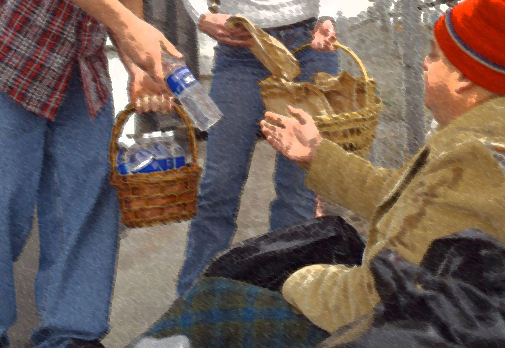
Helping the HomelessI don’t disdain those who choose to celebrate Christmas. In fact, some Christians use this time of year to exceptionally demonstrate their desire to serve God by behaving more “Christ-like” in giving to charity and showing kindness to others. If Christmas is their inspiration for doing good, who am I to argue?

Unlike Miller, I’m not “both,” I’m just “me,” whatever “me” is. Actually, I’m getting a better and clearer picture of what “me” is all the time. The mist is dissipating and the sun is beginning to shine on the path I have selected from all of the paths I’ve considered.

It’s just a path that doesn’t hold very many fellow travelers. And almost none of them celebrate Christmas. I’ll see what church is like after the lights and decorations have come down next month.

Addendum: I just wanted to add that some traditional Christians also don’t celebrate Christmas for a variety of reasons, I for one am not avoiding it out of some sense of paganoia (a term coined by First Fruits of Zion teacher and author Toby Janicki) or the irrational fear that celebrating Christmas automatically makes you an idol worshiper. It’s a matter of personal conviction and taking on board a more Judaic view of the Messiah. It’s as simple as that.

Being Jewish is a Gift

jewish-t-shirtMy great grandparents were born in New York. At the end of a high school Holocaust memorial assembly, students were asked to file out quietly in the following order: those who had parents who were Holocaust survivors, those who had grandparents who were survivors, and finally those who had great grandparents who were survivors. I remained sitting with three other students in the empty auditorium. We looked at each other across rows of empty seats, and I felt shock ripple through me. I didn’t know that most of my classmates’ grandparents were survivors.

On the stage the American flag rippled in the dim spotlights alongside the Israeli flag, and I thought about the refuge that this country has been for so many Jews. My grandmother used to tell the Santa Claus who offered us candy canes at the mall: “No thank you. We’re Jewish so we celebrate Hanukkah. But happy holidays!” I’ll never forget the way her green eyes lit up with her fiery pride for Judaism. As her granddaughter, I grew up believing that being Jewish was a gift…

-Sara Debbie Gutfreund
“Swastikas in New York”
Aish.com

“…being Jewish was a gift.”

I never really thought of it that way before. Being Jewish is precious. There aren’t that many Jewish people relative to the world-wide population, and usually when something is rare, it’s valuable.

Jewish people are survivors, not just of the Holocaust, but of the world. Look at Jewish history going back thousands of years and you’ll almost always find that someone is trying to kill them. Look at ancient, Biblical history. Israelites co-existed in a world with Canaanites, Hittites, Moabites, and a lot of other “ties.” Are any of those other nations or people groups still around?

No. Only the descendants of the Israelites, the Jewish people.

They even continued to exist when they were evicted from their national homeland nearly two-thousand years ago. Who’d have thought that when the Roman empire crushed ancient Israel under its boot, that homeland would be resurrected again in 1948? Who knew that after over six decades, this tiny nation in the middle east would not only continue, but thrive and be an innovator in technology and other industries? Who knew?

Being Jewish is a gift.

Which brings me to Christianity, Hebrew Roots, and Messianic Judaism, all movements that are loosely connected by a mutual worship of the God of Israel and discipleship under the King of Israel and Messiah.

The vast majority of Jews would disagree with the last part of my statement. I understand that. But there are a very tiny minority of halachically Jewish people who have recognized that the man called “Jesus Christ” in the Church is also Yeshua HaMoshiach, Son of David, Anointed One of Hashem.

Of those Jewish people, probably most of them are assimilated into the traditional Christian church and live mostly or completely like their Gentile counterparts, foregoing most or all of the mitzvot that would otherwise identify them as observant Jews.

The “gift” of Judaism is recognized by some Gentile Christians in the Church, prompting them to leave their usual world of pulpits and pews and to join some variation on a Hebrew Roots or Jewish Roots congregation. These groups typically attempt to incorporate some form of modern, Jewish synagogue worship into their Sabbath meetings, spend more time in the Tanakh (Old Testament) than the Apostolic Scriptures, and some even tend to elevate the Torah or the Five Books of Moses, above their former devotion to Christ. They see Judaism as a gift too, tempting some of them to convert.

It’s a confusing world.

churchesAlmost all the Jewish people I know in Messianic Judaism have a previous experience in a traditional Church. Almost all of them are intermarried to a non-Jew. Many of these families live observant Jewish lives, but a few are split, with the Jewish spouse (and perhaps kids) attending a Shabbat service at a Messianic or traditional synagogue and the Christian spouse going to church.

It’s a confusing world.

Does attraction to or involvement in Jewish/Hebrew Roots and/or Messianic Judaism lead to apostasy? Or, for that matter, does such involvement increase the risk of apostasy?

I have no data to draw from. I don’t know if as many, more, or fewer people in the Church (big “C”) leave the faith altogether than people in Jewish/Hebrew Roots and Messianic Judaism. I only have anecdotal information only. Whispers in the dark. Rumors of this family and that who left the worship of Yeshua and converted to Judaism or, if halachically Jewish, returned to an observant Jewish life.

I can say that the temptation is there. I remember my own involvement in Hebrew Roots back in the day. It’s easy to be persuaded that the ritual, the prayer service, the Torah service, donning a tallit, laying tefillin, relating to the Judaism of our ancient faith leads to a closer walk with God. It can generate an enormous pull. Of course, with my wife being Jewish, the thought of conversion was additionally fueled, but that was many years ago. I even toyed with the idea of suggesting to my wife that we make aliyah.

But that seems like another life.

Don’t seek Christianity and don’t seek Judaism. Seek an authentic encounter with God.

That’s one of the best pieces of advice I’ve ever received and it cuts to the heart of the problem. Who the heck are we anyway, Jew and Gentile, in the body of Messiah?

There are a lot of writers in the Messianic Jewish space who write about distinctiveness between Jews and Gentiles in the faith, about the obligations to the Torah and how they are applied differently, radically differently to Jewish members and Gentile members. Men like Mark Kinzer, Stuart Dauermann, and David Rudolph write periodically or even regularly about the drive, the need, the absolute requirement for Jews in Messianic Judaism to see all other Jewish people and national Israel as not them, but us.

In other words, Messianic Jews are Jews first and Messianics second. I think that’s what Dr. Dauermann’s statement means. But that statement, while it repairs many an old wound, creates other problems.

How do you balance Jewishness and Judaism against a faith that in any real sense, hasn’t been Jewish (for the most part) in nearly twenty centuries? The very word “Christian” immediately screams “GOY!” in the ears of any Jewish person.

jewish-repentanceBeing Jewish is a gift.

Yeah, I get it. And if a Jewish person comes to faith in Jesus…excuse me, Yeshua, then do they throw away that gift?

I know a few Jewish people in my church. At least one of them has a passing relationship with the larger Jewish community in my little corner of Southwest Idaho, but she’s actually Christian through and through. Did these Jewish Christians throw away that gift?

I know that Kinzer, Dauermann, Rudolph, and other Jewish scholars and writers are choosing to see being Jewish as a gift that being Messianic does not require to be returned to sender. The apostle Paul was Jewish, proud of his heritage as a Pharisee, circumcised on the eighth day, zealous for the Torah. He worked closely with many Gentile disciples, established Gentile congregations among Romans and Greeks in the Diaspora, was aided, shielded, and supported by the Goyishe believers for decades.

If any man had the opportunity to leave Judaism, assimilate into Gentile “Christianity,” and “go native” among the Greeks, it’s Paul.

And he didn’t (I’ll get a lot of pushback from both Christians and Jews on that one).

I’ve gotten just tons and tons of advice since the most recent apostasy scandal hit the Hebrew Roots and Messianic section of the blogosphere. Most of it basically says, “Keep your eyes on Jesus.”

I sometimes wonder where God went, that is, God the Father, the one Jesus could do nothing without, the one who Jesus watched and imitated perfectly, the one Jesus told his disciples to pray to. Jesus said “no one comes to the Father except through me,” but he didn’t say the Father was replaced by the Son. Shouldn’t I be looking at the Son because opening his door, reveals the Father?

Being Jewish is a gift.

jewish-christianAnd there’s a terrible crisis in the Jewish world today. Jews are turning their back on being Jewish and practicing any form of Judaism in droves. Jews in this country are assimilating into Christianity, other religions, or secular atheism at a tremendous rate.

Jewish children are no longer receiving even the most basic Jewish education. They grow up in communities that do not have children knowing that their parents, grandparents, or great-grandparents are Holocaust survivors.

I’m not Jewish so I can only imagine this. If you are passionately, religiously, ethically Jewish and also passionately and religiously a devoted disciple of the Messiah who the Church calls “Christ,” then you must feel powerfully torn in two directions.

Except…

…except if devotion to Moshiach was originally Jewish and considered a valid Jewish religious stream in the days right before and then after the destruction of the Second Temple, why can’t it be just as Jewish today? Why do there have to be two opposing directions for a Messianic Jew? Why isn’t it the same direction, another stream of Judaism among many streams of Judaism?

I know…two thousand years of anti-Semitic Christian church history has severely tainted those waters.

For a Messianic Jew, faith is an unavoidable tightrope walk. For non-Jews associated with Messianic Judaism or Hebrew Roots, the draw is there, but it’s different. We weren’t born into the covenant that every Jew who ever existed was born into. We don’t have the same spiritual connection that is infused into our blood, our flesh, our bones, our very DNA. For Jews who turn their back on the covenant of Sinai, I believe there will be an accounting one day.

We from among the nations are not called to that covenant, but we are called to God through the Messiah, through a faith that righteous Abraham demonstrated. Yeshua is the doorway but we must remember that Messiah, not Judaism, not Jewish practice, not Jewish identity, is the key to being reconciled to God. That was Paul’s entire point when he wrote his famous letter to the Galatians.

Being Jewish or not being Jewish doesn’t justify one before God. Faith justifies. However faith and justification doesn’t erase who we are. Men are still men, women are still women, Jews are still Jews, Gentiles are still Gentiles.

Being Jewish is a gift and most of us don’t receive that gift. A few Gentiles become Jewish by choice under the authority of the proper Rabbinic court, but born-Jewish, conversion to Jewish, or born something else, if we turn away from our sins and turn toward God, we must do so as who we are, knowing that our identity doesn’t justify, only faith in God through Messiah does.

prophetic_return1Being Jewish is a gift and I defend those Jews who believe their gift and their identity is being threatened by Christianity, by Gentiles who suffer from identity confusion, or by anything else linked to our religious streams and even how we search for God. I’m not Jewish but I understand that God chose the Jewish people from all of humanity for a special purpose, and as a Christian, I have a unique responsibility to cherish and uphold their purpose and their role, because only through the blessings of the covenants God made with the Jewish people do I have access to God at all.

But…

…but, that purpose and that role isn’t the end of all things. Being Jewish does not grant exclusive rights to enter the presence of God or a place in the world to come. God will do what God will do, but it is only the faith of Abraham that grants anyone righteousness before a righteous God. In that, Messiah is the gift, and he is a gift everyone may receive, to the Jew first and even to the Gentile.

Encouraging a Jewish Wife

apples-oranges-interfaithNo matter what the content, the fact that there are classes for Intermarried couples is a progress , because it is a doorway to observance and making a Jewish home, and even conversions. Sometimes it is the non-Jewish spouse who brings the Jewish partner back to Judaism so they need to be given a chance. This is different from being lenient about intermarriage. Since a lot of Jewish observance is done at home eg. Shabbat , people can be introduced to it and be encouraged because of the wonderful effect it has on family life, would be a good place to start with.

-Anonymous
Comment found on “What to Do about Intermarriage”
Aish.com

A lot of Jewish articles about intermarriage are difficult for me to read because many sound like “The goyim are bad for marrying Jewish men and women and causing them to assimilate.” Harold Berman’s article was much more refreshing, but Anonymous’s comment really hit home.

Sometimes it is the non-Jewish spouse who brings the Jewish partner back to Judaism so they need to be given a chance.

My daughter just returned from Israel a few days ago after spending nearly two weeks in the Land participating in the Birthright Israel program. While she was gone, one Friday afternoon, my wife got out the Shabbos candlesticks (sans actual candles). She didn’t light the candles, but she didn’t want me to put them away after Shabbos, either. They’re still sitting on our counter waiting and have been for two Friday evenings now, after gathering dust in our bookshelf for months.

Through casual conversation, I found out that my wife took our grandson for a visit to the home of the Chabad Rabbi and Rabbitzin. It came up when we were talking about a new Lego toy my wife bought our grandson, which was the result of him playing with the Rabbi’s children (I guess they’re heavily into Legos). Yesterday afternoon, my wife wasn’t home, but since she didn’t have to watch our grandson that day, I thought she was off doing errands and visiting friends. I was right, but not in the specifics. She’s spent the afternoon helping the Chabad Rabbitzin do some cooking. There was a hint that she might be planning on helping with some of the food preparation for the High Holidays as well.

birthright_taglitI couldn’t be happier. Well, yes I could. I’m delighted that the missus is becoming more involved with the Chabad community again. Actually, for all I know, she never stopped, but she stopped talking about it. I’m glad that part of her life is becoming more overt again. I keep wondering if she’s simply wishing that I would quit church and become more interested in Judaism.

It’s not like I didn’t try. After leaving my previous congregation, I suggested and hinted and finally asked about the two of us participating together in the Jewish community. Eventually it came out that it would be too embarrassing to have her “Messianic” husband meet with her Jewish friends. I guess a Christian husband is equally humiliating for her.

Welcoming is critical. But it’s not enough. And the question “how can we be welcoming” is the wrong starting point. Instead of asking how we can welcome interfaith families, we would serve them better by asking how we can help them transform themselves through Jewish life. Welcoming, without more, is simply a technique to get people in the door. But Jewish transformation goes to the heart of our passion and purpose as a people.

Helping intermarried families feel comfortable may encourage them to enter our doors. But it won’t help them grow. And it may not even convince them to stay. To be sure, being welcoming and effecting Jewish transformation is hardly an either/or equation, and notable examples of doing both well can be found. But the communal starting point is nearly always one of welcoming, hardly ever one of transformation, and in the meantime, the majority of intermarried families are either unengaged or under-engaged in Jewish life.

I’ve met intermarried couples who joined a synagogue because they were made to feel comfortable.

But I’ve never met an intermarried couple (or in-married, for that matter) who got excited about Jewish life, who gave their kids a rich Jewish education, who chose to become a Jewish family, simply because they felt comfortable. In virtually every case, they encountered a gifted Jewish teacher, had a meaningful experience in a service, or found that Judaism spoke profoundly to their worldview.

intermarriageNotice the first paragraph I’m quoting from Mr. Berman’s article says “interfaith” families, not just “intermarried.” Intermarried simply means that one member of the couple is Jewish and the other is Gentile but not necessarily religious (particularly Christian). Interfaith implies that the Jewish member is religiously Jewish on some level and the Gentile member is affiliated with another religion (probably Christianity).

The direction in which the article travels leads to not just welcoming interfaith/intermarried couples in the synagogue, but the drive to help them transform into Jewish families.

Another person commenting on the article said:

One cannot simultaneously believe that the Messiah has come & believe Ani Ma’anim with perfect faith in the coming of Moshiach. Raising children with nothing is nothing. Make a choice, give your child roots (whatever they are) so she IY”H can have wings.

Here we start moving into potentially hazardous territory. What happens to the Christian member of the marriage if the goal of welcoming interfaith/intermarried couples into Jewish life is to create Jewish families?

I know from a Messianic Jewish point of view what the answer could be but that doesn’t play if the Jewish person in the marriage does not have faith in Jesus as the Jewish Messiah.

My wife would never ask me to abandon my faith. I’ve considered saying I could cease all outward signs of my faith if it would help her to return to the synagogue and become more involved in Jewish community (I stop short of offering to abandon all internal signs of my faith), but first of all, I know she would decline, and second of all, it’s still a dangerous step for me to take.

And we’re not raising children. My youngest is twenty-five so as adults, my children are all responsible for their relationship with God and who they are (or aren’t) as Jews. The window of opportunity my wife and I had to instill a strong Jewish identity in our children has long since slammed shut.

woman_torahI want my wife and children to become as involved with the Jewish community, with the Torah, with the mitzvot as they want to be and in fact, as involved as God wants them to be. I would be more than happy to “go along for the ride,” so to speak, though as I said before, my presence would make my wife highly uncomfortable. I always come up against the same walls when I face being intermarried and I don’t know how to get over, around, or through them. No one in my church could understand and they’d probably be offended that I’m praying for my family to be more Jewish rather than for them to convert to Christianity.

But to the rest I say, not the Lord, that if any brother has a wife who is an unbeliever, and she consents to live with him, he must not divorce her. And a woman who has an unbelieving husband, and he consents to live with her, she must not send her husband away. For the unbelieving husband is sanctified through his wife, and the unbelieving wife is sanctified through her believing husband; for otherwise your children are unclean, but now they are holy. Yet if the unbelieving one leaves, let him leave; the brother or the sister is not under bondage in such cases, but God has called us to peace. For how do you know, O wife, whether you will save your husband? Or how do you know, O husband, whether you will save your wife?

1 Corinthians 7:12-16 (NASB)

I wonder if there’s an adaptation of Paul’s midrash on “intermarriage” that says the Christian husband can save the Jewish wife by leading her to be more Jewish? Probably not, but it’s a nice thought.

There’s an emphasis in certain corners of Messianic Judaism in general and in the First Fruits of Zion (FFOZ) ministry in specific that believes strongly that we Gentile Christians exist to provoke the Jewish people to zealousness in the mitzvot and a return to the Torah. I’ve come to believe this as well.

I just need to know how…or maybe the only answer is just for me to stay out of my wife’s way and let her do what she’s going to do. Maybe it’s just a matter letting go and trusting that God knows what He’s doing.

The Worlds Within Ourselves

??????????????????????????????????That’s when I noticed the rosary beads.

The woman next to me had them on her lap, running them through her fingers. Was she a nun? I didn’t want to violate the Code, so I couldn’t just turn and look. I also didn’t want to distract myself from my davening for too long. (How long is too long? I think it’s similar to the five-second rule for eating food you dropped on the floor – a moment is okay, after that you’re asking for trouble.)

Then I noticed the plastic divider in front of me, which separated us from the driver (affording him protection from spitballs, if nothing else). It was reflective, and I could see my seatmate perfectly well in it without having to turn.

She was middle-aged, dressed conservatively, her nondescript features notable only for the intensity of her expression, her lips moving in fervent prayer. Was she a nun on holiday, and thus out of her habit and habitat, or just a holy roller on her way to work? Was she even now praying for the return of Jerusalem to the Church’s hands? Had she noticed me with my siddur and added in a few prayers for the salvation of my soul? Or maybe its damnation! After all, she’d no doubt been taught that someone in my family had killed her Lord. Even though her Lord was actually someone in my family

-Eric Brand
“Peace on Earth in 30 Min., 45 with Traffic: Rosary beads, a yarmulke, and a lot of overthinking”
Aish.com

Eric Brand will never know how glad I am that he wrote this missive. Lately, I’ve been going through one or two challenges as far as how Jewish people see Christians. I haven’t experienced it as very complementary, to say the least.

On top of that, I’ve been musing about how my wife and children see my Christian faith. I’ve been taking a few conversations and a few cues and clues, and winding myself up quite a bit about what they mean. Maybe I’m right, but then again, like Mr. Brand, maybe I’m overthinking things.

A chance encounter on a public bus in New Jersey results in a Jewish man and a Catholic woman sitting next to each other. Both of them are praying, him with a siddur and her with rosary beads. Their religious orientations are unmistakable. While the “code” of riding public transportation from Jersey to New York forbids each of them from talking with or even looking at each other, what could they have been praying about?

That ticked me off. Was it right to stereotype and scapegoat me? Hadn’t my people suffered enough? Did I have to be subjected to this? I was just a guy on a bus!

I tried to go back to my siddur, but I could see those hands working the rosary beads out of the corner of my eye, and I could sense those lips going a mile a minute, spewing who knows what. Well, okay, lady, I thought, maybe this is a test from God to see if I have the right reaction! How about I throw in some prayers for your soul? How about we have a nice debate and pick apart your faulty theology?

I was mulling this over, thinking about a good opening crack, when I was struck by another thought. If I can see her, she can see me. And she can see me looking at her – and not davening. Better get those lips moving, buddy, you don’t want to give this religious nut a leg up on feeling superior.

I admire Brand’s transparency in describing his thoughts and feelings. I try to show that side of myself as well. What “teachable moment” might we inspire or intersect if we just write down what we think and feel about each other and let those words be accessible via the Internet? More than that, what can the writer learn in the writing?

I was still mouthing some words from the siddur when my brain re-engaged momentarily and focused on what I was reading. “God is close to all who call upon Him, to all who call upon Him sincerely.”

Oh, while there were two people in that seat, there were actually three “personalities” present. God had something to say to Brand and maybe to his Catholic traveling companion as well (we’ll never know what she was thinking during all this, alas).

“God is close to all who call upon Him, to all who call upon Him sincerely.”

jewish-christian-intermarriageI know the assumption in the text from the siddur is that “all who call upon Him” means “all Jewish people who call upon Him,” but if God’s House is really to be a house of prayer for all people, then all people aren’t just Jewish people. It’s everyone who “calls upon Him with sincerity.” What if the Catholic woman was calling upon God sincerely? Was God as close to her as He was to Brand? Is God close to all of us when we sincerely call upon Him? Is He as close to me, a Christian, when I pray as He is to a davening Jew?

We religious people make a lot of assumptions about God and we make a lot of assumptions about each other. It would have been a complete breach of public transportation etiquette for Brand to have introduced himself to his seat-mate and struck up a conversation with her about their faiths. But if that could have been accomplished, maybe his fears would have been allayed somewhat (or maybe not). One Catholic person commented on Brand’s column and this might help figure out what the woman on the bus could have been thinking:

As a Catholic, who reads aish.com, I can almost guarantee that very few of us are condemning anyone to hell. We are all G_d’s children.

While Brand never talked with the Catholic person next to him on the bus, God managed to get his attention in the pages of his siddur.

I know I’ve wondered if my Jewish wife feels at all threatened about me going to church and what that means about my attitude towards Jews, but I wish she’d believe that we’re all God’s children.

But more than my concerns about my wife’s fears about me, Brand taught me that my own imagination could well be creating a situation that isn’t real.

But I left the bus undaunted – even after Comb-Over stepped on my foot as he rushed to get to the escalator – with a smile on my face. Jewish tradition tells us we should consider the world as though it was created for each of us. Because each of us has a unique touch of godliness that gives the universe purpose.

But there’s another way to look at it. We each create the world for ourselves. Our perceptions, our attitudes, our thoughts produce the world around us every moment of our waking days. We see, hear, experience what we want, what we will. And in doing so, we affect all the other people busily creating their worlds.

That’s a big responsibility. I’m glad I was able to figure this out before the journey ended. Fortunately, there was traffic.

The world is still a big, bad, ugly place in many ways. There’s all kinds of trouble and troublesome people around. But we also create the world we live in. We can choose to be upset, anxious, or angry because we are choosing to imagine what people think and feel about us. We can choose to communicate or choose to be silent. And even if silent, we can choose how we consider the people in our lives, for good or for ill.

I’ve heard it said that an anxiety attack is a person’s response to an emergency that does not exist. It still feels real, but the only danger is the choice we’ve somehow (it’s not volitional) made inside. Perhaps my being a Christian isn’t the danger I’ve imagined it is to my wife and children. And if some Jewish people, including my friends, believe my faith is a problem, please talk to Eric Brand. Maybe my faith isn’t automatically against you. Maybe I love you.

Intermarriage: Not Peace, But A Sword

onfire.jpgTo die while committed to a belief system that is idolatrous, false and contrary to what G-d has revealed to us AND has resulted in the persecution of the Jewish people for the last two thousand years, even if it doesn’t affect our eternity through the ever burning hell fires that Christianity reserves for those who didn’t believe in Jesus, is still not something I would desire for myself or anyone.

-from a private conversation

The simple believes everything, but the prudent gives thought to his steps.

Proverbs 14:15

Faith and belief are both defined as accepting as true something which transcends logic and which may not be subject to proof by rational argument. Yet, belief in God is not the “blind faith” of a simpleton.

A simpleton does not think, either because he lacks the capacity or does not wish to make the effort. Therefore, he is gullible and can be easily swayed in any direction. Being credulous is not the same as having faith.

When we reflect on the concept of a Supreme Being, Who is in every way infinite, we are likely to feel bewilderment, because our finite minds cannot grasp the infinite. Since all of our experiences involve finite objects, we lack a point of reference for dealing with the infinite.

When this reflection brings us to realize that the question of the existence of an infinite Supreme Being cannot be logically resolved, we then turn to the unbroken mesorah, the teachings which have been transmitted from generation to generation, from the time when more than two million people witnessed the Revelation at Sinai. When we accept our faith on this basis, we do so as the culmination of a process of profound thought which is no way similar to the credulousness of a simpleton.

This process also helps us with other questions that we have about God. For instance, the fact that we cannot possibly logically understand God does not preclude our coming to a knowledge of His Presence.

Today I shall…

…strengthen my faith by reflecting on the unbroken chain of tradition since Sinai.

-Rabbi Abraham J. Twersky
“Growing Each Day, Elul 3”
Aish.com

I’d like to think I’m not a simpleton. I hope I’m thoughtfully considering my steps. I have faith. I believe. The faith and belief of the Jewish people ultimately rests at Sinai, at the giving of the Torah. It is said that each Jewish person is to consider himself or herself as having personally stood at Sinai and having received the Torah directly. This communicates a sense of direct “ownership” of the commandments of God, rather than just the tradition of having them passed down from one generation to the next.

For a Christian, faith and belief ultimately rests at the foot of the cross, in a pool of blood shed for our sins. Christians aren’t “commanded” to consider ourselves as having personally stood at the foot of the cross of Christ, watching him die for our sake and for the sake of the world. Maybe we should.

But even so, people like me have a difficult thing to face. In my case, I have a Jewish wife, two Jewish sons, and a Jewish daughter. My children don’t speak to me one way or the other about my attending church and professing my Christian faith, but occasionally my wife does. Occasionally a few (non-believing) Jewish friends do (although in strictest confidence) as well.

If I love my Jewish family and friends, how can I be a part of a faith that historically has been guilty of “the persecution of the Jewish people for the last two thousand years”? I thought I knew, but when someone you deeply care about asks that question, it’s not so easy to answer. The answer is long and involved, and when someone is responding to your Christianity on a really emotional level, they don’t always want to hear long, involved explanations that they’ll probably do their level best to shoot out of the water in any case.

I don’t really want to argue. If someone wants to hear about my faith, I’ll do my best to explain it to them. If they don’t, I’m not invested in beating people over the head with a copy of the New Testament.

intermarriageIt doesn’t help (ironically enough) that my wife used to be a believer. My limited experience with Jewish people who were once believers and then returned or adopted a more traditional Jewish practice and worship, is that they are more highly resistant to any idea that there could be validity in Christianity or Messianic Judaism. I can only imagine it’s like being a person who is an ex-smoker (I used to smoke a number of decades ago) and a smoker is trying to convince the non-smoker to light up again.

“Yuck,” is the predictable reaction, followed by a series of reasons from the non-smoker why lighting up is an incredibly bad idea, and harmful not only to the smoker, but to everyone around the smoker, particularly the smoker’s loved ones.

As a Christian among Jews, I feel like a smoker among long-term non-smokers. If I want to “light up,” I sure better take it outside, down the alley, and around back behind a shed where no one can see me or smell me. As a Christian among Jews, I feel as if they see me like this:

In 1391, the Jews of Barcelona, Spain were victims of a massacre. This was part of three months of deadly riots throughout Spain, which left the Jewish community crushed and impoverished. Incredibly, on this same date 70 years later, a bishop named Alfonso de Espina urged the establishment of the Spanish Inquisition. The Inquisition was designed to uncover those Jews who continued to practice Judaism in secret (called Conversos or Marranos). During the years of brutal Inquisition, an estimated 32,000 Jews were burned at the stake and another 200,000 were expelled from Spain.

-from “Day in Jewish History” for Elul 4
Aish.com

You may consider that example a little extreme, but I’m not sure it’s that far out. I think it’s one thing to be Jewish and to be aware of Christians in your general environment, at the grocery store, at work, at the park, driving the streets of your city, and another thing entirely to be close to and even to live with a Christian. While my wife will occasionally give voice to her concerns, my children haven’t. My daughter, who is the only child left at home, has become more distant from me in recent months. She says everything’s OK, but everything else she says and does communicates otherwise. I can’t absolutely say it’s because of my continued church attendance and my reading from the Christian Bible, but it wouldn’t be much of a stretch, either.

Authentic Jewish life is characterized by the study of Torah, the observance of Shabbat and Kashrut, and the thrice-daily worship of God. Not Shabbes leichter as museum pieces, but a generation of Jewish women who light their candles to usher in the holy Shabbat. Not klezmer concerts to evoke nostalgia for the shtetl, but Jewish bands playing Jewish music at Jewish weddings where Jewish communities are celebrating the beginning of a new generation of a Jewish family.

I wish my niece Jodi had had such a wedding.

-Sara Yoheved Rigler
“The Dead End of Jewish Culture”
Aish.com

magen-davidRigler wrote this article as a description of how Jewish people identifying themselves as Jewish entirely on the basis of Jewish culture (as opposed to Jewish faith, observance of the mitzvot, and study of Torah) are reaching a dead-end to their Jewish identity. The painful result, from Rigler’s perspective, is her Jewish niece Jodi’s (not her real name) wedding to a Catholic husband in a Catholic church.

Rigler writes:

One December afternoon, my precious four-year-old niece Jodi walked into my mother’s suburban New Jersey kitchen and asked, “Bubbie, are you Jewish?”

“Yes, I am,” my mother answered proudly.

“So am I,” Jodi confided, “but don’t tell Santa Claus.”

I laughed when my mother told me this story, and I chuckled every time I thought of it – for 22 years. Last week, Jodi got married, in a Catholic church, kneeling in front of a huge gilded cross. I stopped laughing.

Apparently, Jodi’s perception of Judaism as a liability grew with the years. At the age of four, being Jewish made her a persona non grata to Santa Claus. At the age of 16, growing up in a town whose century-old bylaws stipulated, “No Jews or Negroes,” Jewish identity must have been a social non-starter. At the age of twenty, as a sophomore at Boston University, being Jewish must have threatened her budding romance with a handsome Catholic senior.

I’m sure Jodi’s Catholic husband doesn’t imagine that he might be considered guilty of any wrongdoing to Jodi or Jodi’s Jewish family, but, based on my experience, eventually he’ll have to confront those feelings. At least I don’t have Jewish in-laws who are upset with me, just the nuclear family and a few other Jewish people.

He who loves father or mother more than Me is not worthy of Me; and he who loves son or daughter more than Me is not worthy of Me.

Matthew 10:37 (NASB)

That’s a tough one to take. How am I supposed to respond to that, God? And what about this?

For whoever is ashamed of Me and My words, the Son of Man will be ashamed of him when He comes in His glory, and the glory of the Father and of the holy angels.

Luke 9:26 (NASB)

This next one is even worse.

For in the case of those who have once been enlightened and have tasted of the heavenly gift and have been made partakers of the Holy Spirit, and have tasted the good word of God and the powers of the age to come, and then have fallen away, it is impossible to renew them again to repentance, since they again crucify to themselves the Son of God and put Him to open shame. For ground that drinks the rain which often falls on it and brings forth vegetation useful to those for whose sake it is also tilled, receives a blessing from God; but if it yields thorns and thistles, it is worthless and close to being cursed, and it ends up being burned.

Hebrews 6:4-8 (NASB)

It would be worse to come to faith in Messiah and to fall away than never to have come to faith in the first place. Ouch.

So how am I supposed to choose, or if a choice is impossible, what am I supposed to do? At least in terms of marriage, Paul (and not God) had this to say:

But to the rest I say, not the Lord, that if any brother has a wife who is an unbeliever, and she consents to live with him, he must not divorce her. And a woman who has an unbelieving husband, and he consents to live with her, she must not send her husband away. For the unbelieving husband is sanctified through his wife, and the unbelieving wife is sanctified through her believing husband; for otherwise your children are unclean, but now they are holy. Yet if the unbelieving one leaves, let him leave; the brother or the sister is not under bondage in such cases, but God has called us to peace. For how do you know, O wife, whether you will save your husband? Or how do you know, O husband, whether you will save your wife?

1 Corinthians 7:12-16 (NASB)

separation“But God has called us to peace.” Really? Not until Messiah comes/returns (depending on who you are).

I don’t want to give the impression that I’m fighting with the missus (or anyone else) tooth and nail, and that I’m constantly engaged in some sort of “battle” of faith with the Jewish people in my life, but I can hardly ignore the steady undercurrent in these relationships as well as the occasional flare ups, either.

“Do not think that I came to bring peace on the earth; I did not come to bring peace, but a sword. For I came to set a man against his father, and a daughter against her mother, and a daughter-in-law against her mother-in-law; and a man’s enemies will be the members of his household.

Matthew 10:34-36 (NASB)

“Not peace, but a sword.”

Whoever has faith in individual Divine Providence knows that “Man’s steps are established by G-d,” (Tehillim 37:23) that this particular soul must purify and improve something specific in a particular place. For centuries, or even since the world’s creation, that which needs purification or improvement waits for this soul to come and purify or improve it. The soul too, has been waiting – ever since it came into being – for its time to descend, so that it can discharge the tasks of purification and improvement assigned to it.

“Today’s Day”
Friday, Elul 3, 5703
Compiled by the Lubavitcher Rebbe; Translated by Yitschak Meir Kagan
Chabad.org

Assuming God is establishing my steps too, I have to believe that I have come to this place, this time, this circumstance, for a reason. What that reason is, I cannot say. May it be right that I am here for a good purpose, and that God intends my existence and my presence in order to correct and purify some part of the world around me. I have no desire to hurt anyone, least of all those people I love who are Jewish.