Tag Archives: intermarriage

Matot-Massei: Crossing the Street

bsa_cross_street1And Nobah went and captured Kenath and its dependencies, renaming it Nobah after himself.

Numbers 32:42 (JPS Tanakh)

Why did the Almighty include this verse in the Torah?

Rabbi Samson Raphael Hirsch elucidates: Throughout the world powerful leaders have wanted to leave monuments to themselves through statues and buildings named after them. Kings and conquerors have even named large cities after themselves. However, names can very easily be changed and then nothing is left, as happened to Novach. (Neither Novach nor the city he named after himself are remembered to history.) The good deeds of a person and his spiritual attainments are the only true everlasting monuments.

When you view the good that you do as your eternal monument, you will feel greater motivation to accomplish as much as you can. A life of spiritual attainments is everlasting. Feel joy in every positive act you do, for it gives greater splendor to your monument!

Dvar Torah for MatotMassei
based on Growth Through Torah by Rabbi Zelig Pliskin
as quoted by Rabbi Kalman Packouz in “Shabbat Shalom Weekly”
Aish.com

Rabbi Packouz also tells a story about the consequences of doing good.

It reminds me of the story of the father asking his son, the Boy Scout, if he did his good deed for the day. The boy says, “Sure, I helped an old lady cross the street. It took 12 of us.” “Why did it take 12 boys to help her across the street?” asks the father. Answers the son, “Because she didn’t want to cross!”

Every act of kindness has the possibility of a personal benefit. We must work to divest ourselves from our personal interest and to do kindness just to help someone.

Often, we choose to do the good deed or act of kindness that we want done for us or that we define as “good.” This is like the small boy who chooses to buy a toy he’s always wanted for a Mother’s Day gift. It would certainly seem like a kindness if he received the toy, but his mother might have other ideas about what she wants.

Forcing a “kindness” on someone who doesn’t want it is not only failing in your attempt to do good to another person, but it’s actually causing them harm. Imagine how the poor elderly woman felt in Rabbi Packouz’s story, when she found herself forced by twelve well-meaning but misguided boys, across the street. She is now where she didn’t want to be and, if she has difficulty crossing the street unaided, may not be able to easily get back home or to some place safe. And what if, in attempting to re-cross the street (without the aid of twelve “helpful” Boy Scouts this time), she is hit and injured by a car? Is that kindness?

I sometimes feel this way about sharing the gospel or the “good news” of Jesus, particularly with people who haven’t asked for such “news”. I remember the conversation that eventually led me to accept that Jesus is Messiah and Savior. I’d heard the same spiel many times before, and each time it was unwelcome and uncomfortable. I never wanted to be rude, but I also didn’t want to have to listen to someone tell me that I needed to be saved from my sins.

Fortunately, it wasn’t the spiel all by itself that resulted in my decision. A series of highly unlikely “coincidences” occurred over a period of six or more months finally resulted in getting me inside a church and then it took months and months more before I felt uncontrollably drawn (dragged kicking and screaming, metaphorically speaking) toward a life of faith and across the threshold into that life.

Almost immediately afterward, my life fell apart in more ways than I want to describe. Then, every time I thought I was starting to get a handle on what I was doing and why, another roadblock or explosion occurred. In more recent days, I tend to experience fewer explosions and more detours and frustrations on my journey.
intermarriageWhen my wife and I first married, neither one of us were religious, so her being Jewish and me being a Gentile didn’t make it seem like we were “intermarried.” There really weren’t any Jewish members of her family on our side of the country, so I never experienced Jewish in-laws. Faith and religion wasn’t an issue then as it is today.

I’ve been a believer for over fifteen years now, and if I could find the youth pastor who first shared the “good news” of Jesus Christ with me and started this ball rolling, I don’t know if I’d shake his hand or hit him.

No, I wouldn’t hit him and I don’t regret my decision.

But if I were a secular Gentile instead of a Christian, who I am wouldn’t be such an issue for my wife as a religious Jew. There are plenty of intermarried couples who freely attend the local synagogues in my community. Certainly the Reform shul doesn’t have difficulties with intermarried Jewish members. There are even non-Jews on the synagogue’s board. And the Chabad’s mission is to bring secular or assimilated Jews back to the Torah. As part of that effort, their non-Jewish spouses are welcome within their walls.

I once told my Pastor that one of the reasons I stopped any sort of overt “Messianic” worship or lifestyle was that my wife found it embarrassing. He asked something like, “She isn’t embarrassed about you being a church-going Christian?”

Actually, I strongly suspect she is. She doesn’t invite Jewish friends over to our house. She doesn’t go to shul anymore. She hasn’t even volunteered at either synagogue in a quite a while. She and my daughter used to spend a lot of time helping the Chabad Rebbitzin with various projects.

Was it a kindness to my wife that I became a Christian? Does that seem like a good deed to her? Is it what she asked for in a husband, or is it the moral equivalent of twelve overly zealous Boy Scouts forcing a helpless old lady across a busy city street?

Someone recently said to me that love does not see religion but people do. Another person has said to me not to seek any religion but to seek an encounter with God.

I trust I speak in charity, but the lack in our pulpits is real. Milton’s terrible sentence applies to our day as accurately as it did to his: “The hungry sheep look up, and are not fed.” It is a solemn thing, and no small scandal in the Kingdom, to see God’s children starving while actually seated at the Father’s table.

from the Preface of A.W. Tozer’s book
The Pursuit of God

I would hope one thing my wife and I have in common is the pursuit of God. Our paths are quite different, but perhaps not as different as you might imagine. While I would not abandon my faith in Jesus as Messiah, I would enter into her world in a heartbeat. As awkward as it might be for me (I don’t know Hebrew and the liturgical service would present quite a learning curve), I know now that I would strive to be a good and productive member of her community for her sake. But she’s told me that she would never, ever enter mine and, for the life of her, she can’t imagine why I would want to enter hers.

So would it be a kindness to try to introduce her to my world? She wouldn’t experience it that way and in fact, quite the opposite. She would feel like I was trying to drag her kicking and screaming into a place she never wanted to go. And whenever I’ve tried to enter her world, she’s always seen me as an intruder.

Rabbi Isaac Lichtenstein and many other Jewish people like him were not dragged kicking and screaming into faith in Yeshua as Messiah. They each followed the paths Hashem placed before them and by faith, they walked those paths, though it was always difficult and hazardous.

Rabbi-Isaac-LichtensteinNone of those Rabbis became Christians and none of them believed in “Jesus Christ.” They simply examined the Hebrew scriptures and what the church calls “the New Testament” and discovered the clues to the truth of Moshiach in their pages. If some missionary had tried to “convert” them, maybe some would have become “Christians” but Judaism would have lost great leaders and Messiah would have lost devoted Jewish disciples.

I don’t know that it is a kindness to cause a Jewish person to convert to Christianity. No, let me change that. I know it’s not a kindness. It’s not a kindness to destroy someone’s identity and purpose, especially if that identity and purpose was given to them directly by God. It is a kindness to help them on the next step on their journey, but they have to want to go. If they don’t want to start that part of the journey, you can’t force them to, even if you think it’s the best thing in the world for them. All you can do is open the door.

If they don’t go in, that doesn’t mean you’ve failed. If they don’t go in, that doesn’t mean you stop loving them. Kindness, compassion, and love, like all other things, are expressed by you and by me, but they are always from God.

God sets the course, He provides the path, He charts the journey. He does all this in love and compassion and kindness.

We can ask the elderly woman if she wants to cross the street and if she says, “no,” then we must let the answer be “no.” If the answer is “yes,” then it is a kindness to help her. If she wants to cross the street and asks for our help, we have a responsibility to be available, receptive, and then to escort her.

Kindness consists of loving people more than they deserve

-Jacqueline Schiff

God creates the street, but it is up to each person to ask for help crossing it. Then we can start walking and continue our journey.

Good Shabbos.

82 days.

Being Filled

jewish-temple-messiahWe celebrated Easter this year with our community of Christian and Jewish interfaith families. Our minister started off by pointing out that Easter is not in the Bible, and that our holiday traditions make reference to ancient goddesses, and the fertility rites of spring. She then gathered the children together and talked to them about the Buddhist metaphor of a cup of tea representing the comforting memories of life after the tea bag (or body) is gone. She’s not your typical minister.

Next, our rabbi gave an adult sermon about the themes of intimacy, transcendence and unity in the story of the resurrection of Jesus. Somehow, the idea of life beyond death, of renewal and regeneration, seemed completely universal to me as he spoke. As a Jew, I do not feel I need to believe in a messiah or a personal savior in order to celebrate these Easter messages. Our rabbi spent his career at Georgetown, knows his gospels, and has been called a “closet Catholic” by Catholic friends. And yet, he’s an erudite, dedicated and deeply spiritual Jew. He’s not your typical rabbi.

After our Easter morning with Christians and Jews, I made a quick change out of my pastel dress and Easter bonnet and into a bold print Senegalese outfit, in order to join a community of Catholics and Muslims for our second Easter event of the day, a gathering of the local Catholic Senegalese association. We had the great fortune to be invited to this event by two Senegalese-American friends, one Catholic and one Muslim, who are cousins from an interfaith family, and who know that my husband and I crave Senegalese food and company ever since our years in Dakar. Intermarriage between Muslims and Catholics is not uncommon in Senegal. In fact, both of the Muslim Presidents of Senegal I interviewed as a journalist (Abdou Diouf and Abdoulaye Wade) had Catholic wives.

-Susan Katz Miller
from “My Easter with Christians, Jews and Muslims”
On Being Both

There is even a Chassidic custom, instituted by the Baal Shem Tov and further developed by the Rebbes of Chabad, to conduct a “mirror-seder” in the closing hours of the last day of Passover, complete with matzah and four cups of wine. These are hours, say the Chassidic masters, when time relinquishes its last hold upon our lives; when the future, too, can be remembered, and the Era of Moshiach tasted and digested as the Exodus is on the seder night.

-Rabbi Yanki Tauber
“The Third Seder”
Chabad.org

Ever since Easter Sunday services and particularly this morning, I’ve been feeling a profound sense of disconnection or maybe it’s just disappointment. I don’t know what it is, but I don’t like it.

I don’t know what I expected out of Easter or Resurrection Day, but whatever it was, I didn’t get it. Then I read Susan Katz Miller’s article, which I partially quoted from above, and I was captivated by the variety and “differentness” of her intermarriage, multicultural celebration of the resurrection. I’m sure a staunch Christian would be set back on his/her heels by even reading of, let alone participating in, such a “mash-up” of different religious practices and calling it “Easter,” but then I can see the meaning infused in this series of events, meant to speak to people from different religious backgrounds and to bring them all together in the service of the King.

I’m not setting aside the idea that God is an objective God and that His understanding of Himself is the understanding of God, but human beings are highly variable. Even within this thing we call “Christianity,” there are hundreds or perhaps even thousands of different and distinct expressions, theologies, doctrines, and dogmas. That’s why we have such a tough time getting along with each other.

meal-of-moshiachAnd yet, Katz Miller deftly merges these different traditions together within the span of a short blog post, and makes them live together, if not seamlessly, then at least in a complementary manner. I mean, how many different ways and different cultural and religious contexts can be applied to the resurrection and still have a proper celebration? Easter is a tradition, not a mitzvah (at least not one explicitly expressed in scripture), so how far can it be extended beyond Christian choirs, ham dinners, cries of “He has risen,” and still remain “kosher?”

In the seventeenth century the founder of the Chassidic movement, Rabbi Israel ben Eliezer (the Baal Shem Tov) instituted a new custom for the last day of Passover. He called it the Meal of Messiah (Seudat Mashiach,סעודת משיח ). It consisted of a special, additional meal on the afternoon of the last day of Passover, paralleling the traditional third meal of Shabbat. The Baal Shem Tov emphasized that the main component of the meal was matzah. After all, it was the last meal on the last day of Chag HaMatzot, the feast of Unleavened Bread. A few generations later, the Rebbe Rashab (1860-1920) added the custom of four cups of wine, mirroring the seder of the first night. Some Chassidic Jews still celebrate this special Messiah seder on the last day of the festival. They gather together to end the festival with matzah, four cups of wine, and a special focus on the Messiah.

The entire theme of the meal focuses on the coming of Messiah and the final redemption. The meal is festive in spirit. Everyone wishes one another “L’chayim! (to life!)” while discussing their insights into Messiah and their dreams and hopes for the Messianic Era. The meal concludes with fervent singing and dancing in joyous elation over the promise of the Messianic redemption.

What is the connection between the last day of Passover and the coming of Messiah? The Tzemach Tzedek writes:

The last day of Pesach is the conclusion of that which began on the first night of Pesach. The first night of Pesach is our festival commemorating our redemption from Egypt by the Holy One, Blessed be He. It was the first redemption, carried out through Moshe Rabbeinu, who was the first redeemer; it was the beginning. The last day of Pesach is our festival commemorating the final redemption, when the Holy One, Blessed be He, will redeem us from the last exile through our righteous Moshiach, who is the final redeemer. The first day of Pesach is Moshe Rabbeinu’s festival; the last day of Pesach is Moshiach’s festival.

One is incomplete without the other: the first redemption is connected to the last. The sages say, “In Nisan they were redeemed and in Nisan they will be redeemed in the time to come.” In fact the prophet Jeremiah tells us that the second exodus will be so great that it will overshadow the first.

-Boaz Michael
“What is the Meal of Messiah? Part 2 of 3”
First Fruits of Zion (FFOZ)

I suppose there is a limit to how much diversity we can cram into Easter, and certainly the Baal Shem Tov’s creation of this meal probably exceeds the comfort zone of even the most liberal church, but if we consider the themes being introduced and recall that the Messiah is irrefutably, irreducibly Jewish, then we must allow the celebration of the resurrection of King Messiah to also be cast in a Jewish mold and produced as a Jewish rite and tradition.

And yet, as I said above, the Messiah also transcends Judaism and extends himself to all of the people groups and nations of the world.

“Thus it is written, that the Christ should suffer and on the third day rise from the dead, and that repentance and forgiveness of sins should be proclaimed in his name to all nations, beginning from Jerusalem.”

Luke 24:46-47

multicultural-celebrationWhat is Easter like for the Christians in Egypt, for the Christians in China, for the Christians in Norway, for the Christians in New Zealand? How many different peoples have how many different traditions to commemorate the risen King and the resurrected Jesus? What do they look like? What foods are eaten? What prayers are said? What songs are sung?

I imagine if you could gather representatives of the faith from each nation and province from the four corners of the earth, and have them join together to celebrate Resurrection Day, you’d get a set of observances something like what we see on Susan Katz Miller’s blog. Add the Meal of the Messiah on the last day of Matzot and it would be complete.

The Messiah is the hope of the Jewish nation and the King of the House of David, but although he first and foremost came for the lost sheep of Israel, we also see that he came for humanity. God so loved the world that He gave His only and unique son so that none should be lost but all who choose to come to faith should be saved.

What am I looking for? In my small corner of the world, perhaps it cannot be found. But if I can transcend my world, what I want to discover is this:

Some Chassidic sources say that participation in the Meal of Messiah causes the person to carry the light of Messiah within him throughout the rest of the year and thus it infuses every action of his day. It foreshadows the Messianic Era when all mankind will be saturated with Godliness. Through this feast, the Chassid hopes that he has connected with the very soul of Messiah.

Boaz Michael’s words express my desire for what I think we are all looking for…hope. Hope in the future, hope that there is a future, hope that our lives have meaning beyond the day-to-day routine and rut of existence, hope that there is a God and that He loves us, hope that we are more than we think we are, and that we can do more than the world around thinks we’re capable of.

Rabbi Tauber says of Passover:

The “first days” with its seders and its reliving of history, and the “final days” with its messianic themes — days that herald the divine goodness and perfection which, the prophets promise us, is the end-goal of creation and the fulfillment of our present-day lives.

What I was looking for, and what I’m still looking for is the encounter with the infinite, and to be filled full of the promises of the prophets, and the final promise, the Messiah, the end-goal of creation.

Someday, we are told that we will sit at the banquet table of Abraham, Isaac, and Jacob, each of us from the north, south, east, and west who proclaims Messiah, and we will eat of that meal

Jesus said to them, “I am the bread of life; whoever comes to me shall not hunger, and whoever believes in me shall never thirst.

John 6:35

…and be filled.

Converging On the House of Prayer

Walking TogetherIn each one of us there is an Egypt and a Pharaoh and a Moses and Freedom in a Promised Land. And every point in time is an opportunity for another Exodus.

Egypt is a place that chains you to who you are, constraining you from growth and change. And Pharaoh is that voice inside that mocks your gambit to escape, saying, “How could you attempt being today something you were not yesterday? Aren’t you good enough just as you are? Don’t you know who you are?”

Moses is the liberator, the infinite force deep within, an impetuous and all-powerful drive to break out from any bondage, to always transcend, to connect with that which has no bounds.

But Freedom and the Promised Land are not static elements that lie in wait. They are your own achievements which you may create at any moment, in any thing that you do, simply by breaking free from whoever you were the day before.

Last Passover you may not have yet begun to light a candle. Or some other mitzvah still waits for you to fulfill its full potential. This year, defy Pharaoh and light up your world. With unbounded light.

-Rabbi Tzvi Freeman
“The Inside Story on Passover”
Based on letters and talks of the Rebbe
Rabbi M. M. Schneerson
Chabad.org

But thanks be to God, that you who were once slaves of sin have become obedient from the heart to the standard of teaching to which you were committed, and, having been set free from sin, have become slaves of righteousness.

Romans 6:17-18 (ESV)

Speaking of slavery and freedom, I debated a great deal within myself whether or not to continue posting blog meditations for Tuesday and Wednesday, considering that the first two days of Passover are considered Sabbaths of complete rest. After all, I don’t post a meditation on the Saturday Shabbat (although I often write for the following days) in order to honor the Sabbath rest. And yet there is so much going on that, if I don’t write about it now, it will be lost, thanks to my failing middle-age memory.

I had a brief transaction with Derek Leman on this blog about my “adventures:”

Derek: I will be looking for the most interesting blog posts, James, which I expect will come from your Passover-and-also-Easter experience.

James: Thanks, Derek.

It’s interesting because events like this are a natural consequence behind Boaz Michael’s book Tent of David and yet no one seems to talk about them. I’m sure I can’t be the only one and in fact, I would be willing to bet (well, not literally) that there are some Christian/Jewish intermarrieds who have these experiences. You’d think they’d turn up more in the Messianic realm, since it tends to be a haven for many intermarried couples.

In a sense, I walk on both sides of the street, being a “practicing Christian” and being married to a Jewish wife. As you read this, it’s Tuesday morning and my family will have had our Passover Seder last night (it hasn’t happened yet as I’m writing this, but I promise to give you all a full report soon). Next Sunday morning, I’ll be attending sunrise services for Easter at my church. I’ll try not to feel too schizophrenic as a process both experiences inside my one and only brain.

But the reality of my life is that I’m not Jewish. As I’ve said on numerous occasions, I believe that the halachah James and the Counsel of Apostles in Jerusalem established for the Gentile disciples of the Master (i.e. Christians) does not obligate us to live our lives in precisely the same manner as the Jewish believers. I suppose if I was more closely connected to the local Jewish population or even if my wife and daughter were more observant, I might interrupt my daily meditations for the sake of the mitzvah of Pesach, but then again, they won’t be observing a full Shabbat’s rest during the festival, and on Wednesday evening, before havdalah to mark the end of the first two days of Passover, I will be meeting with Pastor Randy.

intermarriageWhat is it to be intermarried and to experience the subtle as well as the overt patterns and colors of a life in (for me, anyway) mostly Christianity with some Jewish overtones? What is freedom and what is slavery, or do we simply exchange one master for another as Paul suggests (sin to righteousness)? I’ve already said that there is ample evidence in the Bible of the Messiah’s Gentile disciples being well versed in Passover, so there’s no excuse for me to not observe it in some reasonable fashion.

But then where does that leave Easter? Are Passover and Easter mutually exclusive or can they be complementary? Or in fact, should they both be mandatory?

There’s no “point-blank” commandment to celebrate Easter or “Resurrection Day,” but there is a firm tradition in Christianity to do so. Some Christians reading this may be shocked that I call Easter a tradition, since it is arguably the single most Holy Day on the Christian calendar.

But many Jewish believers probably feel uncomfortable with Easter because historically, after every Passion Play, there’s been a pogrom. To respond to this, First Fruits of Zion (FFOZ) suggested an alternative to Easter in the Meal of the Messiah. That doesn’t do me any good because the only people I’ll be commemorating Pesach with are my immediate (non-believing) Jewish family, and the only ones I’ll be celebrating the resurrection with are the people at my church.

As I continue to process my experiences, I find that they are less “Messianic” and based more on interfaith and intermarriage issues. They are the result of my being the Gentile head of a Jewish family for nearly thirty-one years (although we’ve only been “religious” for about a third of that time).

At the first seder my father would be brief, in order to eat the afikoman before midnight. On the second night, however, he would expound at length; he began the seder before 9 p.m. and ended at about 3 or 4 in the morning, dwelling at length on the explanation of the Haggada.

The Alter Rebbe declared: The matza of the first evening of Pesach is called the Food of Faith; the matza of the second evening is called the Food of Healing. When healing brings faith (“Thank you, G-d, for healing me”) then clearly there has been illness. When faith brings healing, there is no illness to start with.

“Today’s Day”
Tuesday, Nissan 15 (1st day of chag ha’matzot – Pesach), 5703
Compiled by the Lubavitcher Rebbe
Translated by Yitschak Meir Kagan
Chabad.org

I included that last quote to shake up any Christians reading this message. I want to remind you all of the unique and special purpose and experience Passover has for the Jewish people. I want to emphasize to you all just how “Jewish” it is. I want to make sure that Christians of any sort don’t think they (we) now “own” Passover and that it is no longer Jewish. In spite of Paul teaching some of the God-fearing Gentile disciples about the Seder, I want to make sure we all understand that especially in today’s world, Christianity and Judaism stand apart, traveling two independent trajectories through history, and that a Christian attending a Seder let alone leading it, is a wonderful but also a strange thing. It would be just as strange as a religious Jew attending Easter services (and I don’t know any who are planning to do that next Sunday).

two-roads-joinI want to make sure everyone understands that we are still in the middle of an incomplete process. As believers, we may be free from sin thanks for the grace of Jesus Christ, but we are still slaves to our humanity and also to the plan of God in that the time for the Gentile disciples to return to our Jewish mentors has not yet come, although many, including me, can see the signs of an impending approach.

Israel was intended to be a light to the world, to attract and gather the people of the nations to God. That light came into the world in the form of a human being who most people call Jesus. He said he was the light of the world (John 8:12) and he has attracted millions to the God of Jacob as Israel’s firstborn Son. The Jewish and Gentile believers were added as differing members of the same Body of Messiah (Romans 12:4-5) and so there were two, parallel streams of people existing within a single, living being, the Son of David.

But then the two streams within a single container became two separate and diverging streams of humanity, growing further apart and more opposed to each other with each passing decade and century, until now, the idea of one believing person celebrating both Passover and Easter doesn’t seem just like a minor anomaly, but actually a strange and discordant event.

Except that the discordance is temporary.

So I ask, did they stumble in order that they might fall? By no means! Rather through their trespass salvation has come to the Gentiles, so as to make Israel jealous. Now if their trespass means riches for the world, and if their failure means riches for the Gentiles, how much more will their full inclusion mean!

Romans 11:11-12 (ESV)

Paul tells us how much full inclusion in the body of Messiah will mean to not just the Jewish people, but to all people. It is the completion of a dream, the healing of the horribly painful wound, and gift of the returning King.

Lest you be wise in your own sight, I do not want you to be unaware of this mystery, brothers: a partial hardening has come upon Israel, until the fullness of the Gentiles has come in.

Romans 11:25 (ESV)

I can’t summon the future but I can try to preview a tiny portion of it in the present. I can be the Christian leading a Seder in my Jewish family, and I can be the Christian who lives with a Jewish family who also attends a sunrise Easter service. As great a difficulty as intermarriage is for Judaism, perhaps there is a benefit as well. Who else but an intermarried person actually lives in both divergent worlds? And as they slowly draw closer to each other again in Messiah, who else will be able to navigate their currents and negotiate their paths than someone who already walks upon them?

sukkoth-feastLast year for Purim, I wrote Hadassah and the King, a tale of two heroes, the Jewish Queen and Gentile King of an ancient land where only an intermarried couple could save all of the Hebrews from certain destruction.

I’m not heroic but I and those like me have our parts to play out in God’s drama for humanity and his plan for the return of King Messiah. Today, as I write this, the Christian and Jewish worlds exist mainly apart, with just a few tenuous bridges connecting this bit of land and that. But days are coming when we’ll need to have greater fellowship, when we will be expected to attend the celebrations at our Monarch’s throne in Jerusalem, when believing Jew and Gentile will sit together at the Passover Seder, “and recline at table with Abraham, Isaac, and Jacob in the kingdom of heaven.” (Matthew 8:11)

On all other nights we eat while sitting upright, but on this night we eat reclining.

-from the Four Questions

We are limited by the very fact that we have human form. There is no freedom in following our whim, only further slavery to our own limited selves. Freedom can only come by connecting to something infinite and beyond us.

And so Moses was told, “When you take the people out from Egypt, you shall all serve G‑d on this mountain.”

-Rabbi Tzvi Freeman
“The Freedom Connection”
Chabad.org

…these I will bring to my holy mountain, and make them joyful in my house of prayer; their burnt offerings and their sacrifices will be accepted on my altar; for my house shall be called a house of prayer for all peoples.

Isaiah 56:7 (ESV)

May we all one day come together and as our own different and unique parts in the body of Messiah, serve our God and celebrate together in the house of prayer of our King.

Intermarriage After Thirty Years

jewish-christian-intermarriageFirstly, I must tell you how impressed I was by your honesty and sensitivity – especially, by what you wrote at the end about not wanting to convert just for him.

Here are my thoughts on the matter.

First of all, even though it is most gracious of you to agree to raise his children as Jews, there really wouldn’t be any point in it, for the children of a non-Jewish mother, (as wonderful as you may be) are not Jewish, even if the father is Jewish. This is the law of Judaism as has been handed down to us generation to generation for thousands of years.

So there is really only one of two choices.

A sincere conversion on your part, or breaking up as difficult as that may be.

From the “Ask the Rabbi” series
“Intermarriage Correspondence from a Non-Jew”
Aish.com

If you’ve been reading my blog for more than a day or two, you know that I often quote from Jewish religious or philosophical sources (and often from Aish.com) to create a foundation from which I then “dovetail” and expand upon to make some sort of daily commentary. As an intermarried Christian (my wife is Jewish), I have an attraction to Jewish thought and perspective as they apply (surprisingly enough) to my faith.

But that doesn’t mean Judaism and I don’t butt heads more than once in a while. The Rabbi’s suggestion to the (formerly) Catholic young woman about possibly marrying her Jewish boyfriend is just one of those “head butting” occasions.

But it’s a difficult discussion. I know the dangers intermarriage and assimilation pose to Jewish continuation and particularly on the children produced in such a marriage. The journey my own children have had to negotiate has not been an easy one and although they all self-identify as Jews (and are Jews according to halachah because their mother is Jewish), they are barely, if at all, observant of the mitzvot. I can’t say that my own home is observant either, through I’d like to support and encourage my spouse to live a more traditionally religious Jewish life. I can’t though, because she is “in charge” of her Jewishness, I’m not.

But when I read the “Ask the Rabbi’s” comment regarding the setting aside of a relationship between a Jewish and non-Jewish couple, I began to see red. My wife and I have been married for over thirty years and I have no intention of disrupting our relationship for the sake of a string of advice, even though it is dedicated to Jewish survival.

Hillel the Sage was able to remain patient even when someone purposely tried to provoke him. He felt no irritation whatsoever about any matter. There was no arousal of anger at all. This is what it means to be completely free from anger.

The level of Hillel is the level we should each strive for as regards to not getting angry. Of course it is not easy. But the first step is to increase your motivation and be totally resolved to conquer anger. Then feel joy with every drop of improvement!

-Rabbi Zelig Pliskin
“Daily Lift #755: Being Free From Anger”
Aish.com

It can be tough enough being intermarried and interfaith without reminders of what could have gone better and how many Jews are less than thrilled about our union. It’s not particularly apparent that we’re intermarried when we’re in public together, but I sometimes get the same feelings that an interracial couple might get when they receive stares from people who disapprove of “mixing the races” (and yes, it still happens). While I understand the perspectives of the Rabbis and realize the pitfalls of intermarriage, this is still my family and she is still my wife and all this is personal, not just some theoretical or theological puzzle to solve.

The irony is that it is because I’m intermarried that I dearly cling to my current perspective on the relationship of believing Jews and Gentiles in the body of Messiah, what we mean to each other, our roles, our understanding of Torah, and who we are in God. I’ve written whole commentaries based on our marriage such as Being Married to the Girl with the Jewish Soul and Cherishing Her Yiddisher Neshamah. Being a couple isn’t just a marital status, it is part of my very identity and woven into the fabric of my being.

julie-wienerThis isn’t to say that we don’t argue or that we have a perfect marriage. We aren’t perfect. We get on each other’s nerves and we both have our “moods,” but after over three decades of living together, sleeping together, raising three children together, playing with our grandson together, eating, cleaning, fighting, traveling, and making a home together, we’re together.

Among other resources, I follow Julie Wiener’s (her photo is on the left) In the Mix blog at The Jewish Week. Although I don’t have anything like the same intermarried experience Ms. Wiener and her husband (and children) have, it sometimes helps to realize that not only are there other intermarried couples out there, but that they’re not doing so badly either. Nearly a year ago, Wiener wrote a blog post called Shiny Happy Intermarried People.

The ending of that article goes like this:

Reminds me of when my “In the Mix” column first came out six years ago and a woman wrote to complain that it was bad enough I was writing in The Jewish Week about being intermarried, but the fact that I was happy — and actually smiling in my photo — was truly offensive.

Now, as you can imagine, I took issue with Alina using The Jewish Week as an example of media writing only negative things about intermarriage. Especially because the column she links to is Jack Wertheimer’s, which was a guest column and which I, a Jewish Week editor, responded to on The Jewish Week website, on THIS BLOG, which has as its sole focus realistically depicting intermarried life.

Not that I’m offended or anything, Alina. Just intrigued.

For any of you readers, Jewish or Christian (or anyone else) who are offended that I’m intermarried, have been intermarried for thirty years, and plan to stay intermarried to the same Jewish woman for the rest of my life, I am truly sorry. When we got married, neither one of us were religious and we didn’t give a second thought to what it would all mean ten, twenty, thirty or more years down the road. Maybe we should have, but we didn’t. Who knew?

But we are who we are and while you may complain about us, I insist that you don’t dismiss us. We’re here and we’re real. There are a lot of us and what was done cannot be undone, for good or for ill. Hopefully, we’ll have a seder in our home this year. I plan on going to Easter services at my church for the first time in many years. That may seem like a strange combination or an awful contradiction but it’s not. A Christian/Jewish intermarriage may not be the ideal circumstance and you may not want to experience it yourself. Our intermarriage has its pitfalls and trapdoors, but our marriage and our family isn’t strange or bizarre or bad. It’s just our life and its just who we are.

And God is still her God and my God and what He has brought together let no one tear apart.

Oh, and our thirty-first wedding anniversary is on Wednesday, April 3rd. Deal with it.

The Jewish Girl Who Saved Her Children

intermarriageSome of my friends began dating non-Jews. I stopped socializing with them in silent protest, after a more outspoken effort had failed. I self-righteously concluded that we had nothing in common, since they were prepared to give their Jewish identity the backseat. I was sitting firmly in the driver’s seat with mine, so much so that I became the leader of a Zionist youth movement, and started to mix with an idealistic new crowd.

In Ethics of Our Fathers, Rabbi Hillel warns us that we should be careful not to judge another person until we have stood in their place. And I was going places…

I don’t remember making conversation, but apparently I must have mumbled something, since the next morning the host of the party told me that Mr. Attractive had inquired after me. As I was catching my breath, she casually mentioned, “Oh, I told him you don’t date non-Jews, and he’s fine with that. He just wants to meet you. He really liked you.”

This was a delicate situation, to say the least. Here I was, being pursued by a bona fide heartthrob with absolutely no strings attached. He was an advertising executive. Flutter. He had a motorbike. Swoon. And, if that wasn’t enough for my ego, he was a commercial pilot.

Help!

-Jennifer Cooper
“My Non-Jewish Boyfriend”
Aish.com

You’ll never realize how many blog posts I don’t write just because I don’t have time. I’ll read something or hear a snippet of conversation, and my mind pursues it and I begin to internally construct a short essay on the topic between 1500 and 3000 words. I never mean to write as much as I do, which includes this story about the girl who would never intermarry. It just happens.

In Christianity, this is yet another thing about Judaism that simply doesn’t register with us. What’s the big deal exactly? OK, among many Christians, there’s the idea that it’s not a good thing to be “unequally yoked” and I suppose the equivalent quandary would involve a young Christian woman dating a handsome, talented, and very romantic atheist guy. Look out. Danger up ahead.

But there’s something more operating here. There’s a lot more operating here.

I’ve written many times before about intermarriage and part of this blog’s mission is to address the challenges and dynamics of Christians and Jews being married. You can see the angst and the ecstasy expressed in missives such as Opting Out of Yiddishkeit and Cherishing Her Yiddisher Neshamah. If my wife had been observant when we met or even if she had been raised in a secular Jewish home, we might never have gotten married since I am a goy (we were both atheists when we met and her parents were also intermarried).

I’ve been spending some blog time lately struggling to define why it’s important for believing Jews to continue to live as halalaic Jews. If Jesus saves, what difference does it make if a Jewish person lives a Jewish life or not?

Plenty, as Cooper’s story reminds me.

The next day I found myself in the car with my father. We parked in the driveway. There we sat for a good few minutes, lost in our separate worlds. I, in my bubble of optimistic self-gratification, and my father – mourning the potential loss of future generations. Finally, I broke the heavy silence.

“Dad, why is it so important that Jews marry Jews?”

“Because it’s important that we preserve our unique heritage.” he replied, surprised by this basic question coming from me.

I wasn’t buying it.

“Yes, but what’s so special about our heritage, I mean, why is it SO important that there be Jews in the world?” I challenged.

“Because we are supposed to be a light among the nations,” he stressed, wondering where this was going. I pressed on, going for the jugular.

“So, Dad, if our heritage is so special, and we have to be a light among the nations, and my entire future depends on it, why do I eat McDonalds, and why on earth don’t we keep Shabbat?!”

More silence. This time, it was my father that spoke. “I don’t know. I guess I never thought that far,” he admitted, somewhat ashamed.

For the first time ever, I had stumped my brilliant lawyer father. But he still had one last trick up his sleeve.

broken-marriageI’ve heard it said you can’t choose who you fall in love with, but Jennifer had a problem. Without intending to, she had fallen in love with a non-Jew and all of her determination to never “marry out” was fast evaporating. Her parents were culturally but not religiously Jewish, but you can’t dismiss the importance of Jewish identity based on lack of religious observance. Something deeper was in operation here and it was enough to turn Jennifer and her father into emotional pretzels, turned and twisted and trying to straighten out again.

My heart was heavy with respect for my parents and the desire to please them. I felt the weight of my Jewish identity on my fragile shoulders. What exactly was I trying to preserve and protect? After all, I was not religious. Why had it been so fundamentally clear to me that I would marry a Jew? And what had happened to that clarity?

I had been taking my Jewishness for granted. Jewish day school, Jewish friends, a traditional Jewish home. There had been no challenge, no threat, no temptation. No chance to think or look outside the box. But now my exclusive Jewish education and traditional upbringing was on trial. Was it enough to save me?

I took the witness stand. For the first time in my life, I consciously thought about, and decided, who I was, what I wanted to be, and what was truly important. I was first and foremost a Jew. My heritage mattered. I wanted it to continue to be a part of my life. And it was vitally important that my future husband feel the same.

The Verdict: A strong Jewish identity saves Jews.

It wasn’t so difficult after that. A short, tense phone call ended what would have been the mistake of a lifetime. I never saw or spoke to him again, although I cried for days. I don’t really know why, but I think it had something to do with my soul.

There’s something more to being Jewish than just a string of DNA or whether or not you eat McRibs at McDonalds. It’s not just the cultural aspects of Judaism because films like My Big Fat Greek Wedding (2002) have shown us that cultural differences can be bridged (Nia Vardalos wrote and starred in the film and in real life, she is a Greek woman married to a non-Greek man…Ian Gomez, who plays “Mike” in the film).

No, there’s more than just genetics, religion, and culture going on with Jennifer and with Jewish people in general, but you have to go back to Abraham, Issac, and Jacob to find it. You have to go back to Moses and Sinai to find it. You have to look into a pillar of cloud by day and a column of flame by night and deep inside you’ll see the God who molded, formed, fashioned, and defined the Jewish people to be a unique and special people before Him for all time.

And every intermarriage, particularly where the intermarried Jew does not maintain their identity and pass that identity along to the next generation removes not just one more Jew from eternity, but that Jew and all of his or her descendents. Yes, if Jennifer had married her handsome, charming goyishe suitor, her children would have been halachically Jewish, but how would they have been raised and how strongly would they cherish their own Jewish identity?

Memories and regrets are part of what it is to being human, and if I had it all to do over again, I would still have married my wife and had our children, but I would have fought tooth and nail to instill a strong Jewish identity in all of them.

But that ship has sailed and here I am standing at the dock watching it slip over the horizon and into the distance and darkness beyond.

We want our children to care about the meaning of being Jewish. We need to nurture their Jewish identity to the point that it becomes innate. Our homes are where we nurture, and where our children learn to care. Our homes are where we show our children what it is important to care about.

A lot of people feel that they need to make a great sacrifice to live out their Jewishness. It is an even greater sacrifice not to. We can’t be complacent for lack of funding, knowledge, the right address or social circle. The good news is, caring is not a sacrifice. It’s fun, and it’s far-reaching.

How do we put a little Yiddishkeit into our homes? If you ask anyone that grew up with it, they will tell you the same thing: it’s the simple rituals that have the greatest impact. Lighting Shabbat candles, decorating a sukkah or eating matzah on Passover, putting up mezuzahs on every doorway, laying some Jewish books proudly out on the coffee table, saying Shema Yisrael with our children, hanging out an Israeli flag on Israel’s Independence Day. These are the definitive moments that can carve a caring Jew out of the stoniest backdrop of threatened assimilation.

Our Torah and Jewish calendar are filled with a veritable treasure trove of tradition and meaningful ritual, enabling us to live uniquely enhanced lives filled with memorable moments of celebration and wisdom, all with that inimitable Jewish flavor.

These are the moments that kept me in the fold. They can impact you and your children, too.

jewish-t-shirtI can’t change the past, but I can tell you that I will not be responsible for separating even one more Jewish person from his or her God-given identity. I can’t change the past but I can learn from it, and more than that, I can teach from it. I can pass my knowledge on to whoever cares to read these words and explain that this is why it is not only important but absolutely vital that Jews who are Messianic must establish and maintain a strong Jewish identity, must observe the mitzvot, must walk in the footsteps of their Fathers and actively live out the wisdom of their sages.

I can’t tell you the right and wrong of every single mitzvot and the amazingly intricate details of each little item of halachah within each of the Judaisms in our world today, but I can tell you that without them, without all of the behaviors and the activities that define a person as a Jew, not only are the Jewish people in danger of disappearing from the face of the earth (although I believe God would never allow this), but that Jews who come to Jesus will vanish into the mass of Gentile Christians in the church, never to be seen or heard from again. Only God will know that Jews ever stood among the disciples of the Jewish Messiah in these latter days of history.

But it all starts with one Jewish person who realizes that his or her identity as a Jew is more important than almost anything because that identity comes directly from God. And we in the church must also learn to cherish Jewish uniqueness, to support it, to uphold it, to esteem it, for our Master said that “salvation comes from the Jews.” (John 4:22)

The story Jennifer Cooper relates occurred almost twenty years ago, but the heartbreaking actions of one young Jewish girl saved not only her, but her children, and future generations of children who would not otherwise be Jewish or value who God made them all to be. The Good Shepherd will come and seek out all of his sheep…those of the Gentile pen, but also those who know his voice from the sheep of Israel. God forbid that when he returns, he discovers that none of them survived.

18 Days: The Christian in the Middle of the Room

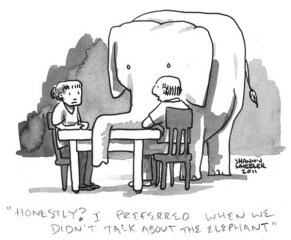
elephant-in-the-living-roomThis week, we learned of 23,000 people in England and Wales classified as having “Mixed Religion.” This news comes from the United Kingdom’s Office on National Statistics, which just released new numbers on religious identity from the 2011 government census.

-Susan Katz Miller
“‘Mixed Religion’ as Identity: Who Are These People?”
Blog posted 12/13/2012 1:25 pm
huffingtonpost.com

OK, let’s stop right there. I “get” being part of an interfaith family since I’m a Christian and my wife is Jewish. However, I have one religious identity and my wife has a different religious (and cultural) identity. Our children don’t have two religious identities. Of course, our family’s religious identity “split” came rather late in the game. We all started out as atheists, all came to faith as Christians at one point (even though my wife and children are halachically Jewish), and then through a long, drawn out process, I self-identified as Christian while my wife and kids proceeded to move away from Christianity and identified as more traditionally Jewish (to varying degrees of religiosity all the way down to zero).

My wife and daughter seem to have the clearest Jewish identities, one son is halachically Jewish but otherwise secular, and the other self-identifies as Jewish but will at least discuss his views on Christianity with me.

But I don’t think, based on my personal experience, that you can be both Christian and Jewish in a religious sense. Oh sure, you can worship in both a church and a synagogue, but you are very unlikely to feel completely at home in both. You are more likely to primarily identify with one religious identity and form of worship and be “OK” with the other, usually for the sake of your spouse and possibly the kids.

To me “interfaith marriage” means two people who are married, each one with a different religious identity, and those identities co-exist side-by-side with each other. There could be some overlap and usually is (I tend to be more “OK” with the overlap than my wife is), but it’s not like you can have a person who is equal parts Christian and Jewish (or any one religion and the other…and no, I’ve not yet read the book or watched the film Life of Pi).

I know what you’re thinking.

Sid: You’re never gonna impress Ellie like that.
Manfred: I don’t want to impress her.
Sid: Then why are you trying so hard to convince her she’s a mammoth?
Manfred: Because that’s what she is! I don’t care if she thinks she’s a possum. You can’t be two things.
Sid: Au contraire, mon “fered”. Tell that to the bullfrog, the chickenhawk, and the turtledove.

-dialog from the film
Ice Age: The Meltdown (2006)

Well, maybe that’s not what you were thinking. You may be thinking more along the lines of Susan Katz Miller:

The discovery of a cohort of “Mixed Religion” adherents in the U.K. serves as a reminder that the demographic reality of religious double-belonging among adults can no longer be ignored. Most religious institutions continue to urge interfaith couples to pick one religion for children, to beware of confusion, to stop blurring boundaries. The reaction to dual-faith adherence is too often panic and disapproval, and the attempt to close borders. But for the individual, especially an individual like me who was born into a family with more than one religious heritage, crossing borders can be exhilarating and bring great joy. Our celebration of both faiths goes beyond Hanukkah and Christmas, beyond all the history of tragic conflict and religious violence, to a place where love prevails over dogma. In this spirit, and in the season of light in darkness, I send greetings across the Atlantic to those who celebrate Christmas and Yule, Hanukkah and Diwali, all of the above, or none of the above.

All of that sounds wonderful, but I still agree with Manny. You can’t be two things. You can be one thing and participate in other things, but that participation does not necessarily work its way into your permanent, defining identity as a spiritual, religious, and ethnic human being. My wife and daughter have been kindling the Chanukah lights every night this week but while I’ve been present (and after all, it is my home), that doesn’t make me co-Christian/Jewish.

Judaism very strongly discourages intermarriage and does not believe that a person can have dual religious identities the way some individuals have dual national citizenship.

Honestly, I don’t think this can work. On many levels, you cannot have both a christening and a Bris. Because as nice as it would be for intermarried parents to be able to “cover both bases,” not have to make any big decisions just yet, and provide something for all of the grandparents, having a child brought into the Church of Jesus as well made part of the covenant of the Jewish people is not being honest to either tradition.

As “exclusionary” as this sounds, this position is based on common sense, respect for the integrity of both Judaism and Christianity as religions with particular and distinct messages as well as what has been found through years of experience as being in the ultimate best interest of the child.

Religiously speaking, children need to know who they are. They need to have a solid, unambiguous faith identity which gives them a place in the world, a spiritual tradition through which to experience the important times of life and a community of meaning, not just to know about, but to be a part of and to feel at home in. This means that, when it comes to religion, one is better than none and better than two.

“Intermarriage and Dual Religion”
from the “Ask the Rabbi” series
Aish.com

elephant_in_the_room_talkIn any intermarriage that produces children, sooner or later those children are going to have to make a decision as to who they are. In my family’s case, the choices are Christian, Jewish, or non-religious (or other religious). Halachically of course, my children will always be Jewish, regardless of their religious choices. I should say, in their case, they also have the option of self-identifying as Messianic Jewish (and as far as I know, none of them have made this choice) which, from my perspective, would be a completely halachically Jewish religious lifestyle that accepts Jesus (Yeshua) as the Moshiach and which is not the same thing as being a “Jewish Christian” or a Christian of any type (see Rabbi Dr Michael Schiffman’s blog post Messianic Judaism and Christianity: Two Religions With The Same Messiah for details).

For the sake of clarity, I must say that my wife would be the first to disagree that Messianic Judaism is a true Judaism, as would most secular and religious Jews in the world. A recent article written by Jewish Journalist Sarah Posner called Kosher Jesus: Messianic Jews in the Holy Land very thoroughly describes the Jewish perspective on the Messianic Jewish movement.

While I certainly respect Susan Katz Miller as a writer and an interfaith parent, her perspective and mine are different. My family doesn’t choose to celebrate both Christmas and Chanukah. I’m perfectly happy not celebrating Christmas and feel a great sense of freedom in not having to feel bound to the stress, pressure, and expense of either a commercial or religious demonstration of the holiday (Chanukah is much more low-key and even for a goy like me, more spiritually meaningful).

I may be a Christian but I don’t do Easter and I don’t do Lent, and I don’t even think of Shavuot as Pentecost. There is no “mixing” of religious expressions in our home. There are mezuzot on virtually every entry way in my home and the bookshelves in the living room are lined with siddurim, Talmudic commentary, copies of the Chumash, Tanakh, and even The Jewish Book of Why (the “Christian” books including Christian Bibles are either on the bookshelves in the study or in my “book closet”).

Even our “interfaith home” isn’t equally interfaith as you can see. As far as reading material, wall art, decorations, and halachah are concerned, it is primarily Jewish (although the kitchen isn’t kashered in the slightest) with the Christian aspects tucked away here and there. I suppose that’s fair since I’m the only Christian in evidence around the place.

You can’t be two things. Two things can co-exist in an environment but as you see, even the environment isn’t equally supportive of those two things. It’s like on the starship Enterprise in the TV show Star Trek, the Original Series (1966-1969). The ship’s life support settings favored the majority population on board, which were human beings, and the minority species on the ship (Vulcans, for instance) just had to put up with it and could tailor the environmental settings in their personal quarters to more closely fit their requirements.

I hadn’t really given it much thought before this, but I think the “duality” of religious/ethnic/cultural expression in my home is part of why I started the “Days” series. Although no one in my family opposes my pursuing a Christian identity in the slightest, the fact that I am a minority in my own home is abundantly evident. There are conversations we have when I suddenly become very aware that I’m a Christian (alone) and they are Jewish (together). There are times when I realize that I cannot have a detailed conversation about my faith with anyone I live with or any of those people I love the most without potentially crossing some very serious barriers.

If I were a religious none, I’d still be “different” in my home, but I wouldn’t be so “religiously” different from my family (culturally and halachically I would always be different). Given the less-than-comfortable history between Christianity and Judaism, I might even have a somewhat less “problematic” relationship in the home. If I were “nothing in particular,” while I wouldn’t be able to relate to my family on a “Jewish” plane, I at least wouldn’t clash with them religiously and spiritually.

Could I give up my faith for my family? I’ve considered that question carefully and believe me, there’ve been days… But no, I couldn’t do that, even for them. The “best” I could do would be to go “underground,” so to speak, not reading the Bible at home (or at all), not going to church, not calling myself a “Christian” in their presence or in the presence of others (particularly “Jewish” others). My faith would necessarily have to become isolated from the world, locked in a container that holds only God and me.

Running out of timeRight now, my “Days” countdown is focused on whether or not I continue to go to church beyond December 31st but it could easily expand to include ceasing any personal religious expression. But then, that would put me right back at the point of pulling the plug on this blog and I’ve already decided not to do that.

My recent “Days” blog posts have been on topics such as relationship (or lack thereof) and self-identity. An identity that includes faith and spirituality is composed of a life of decisions between options. Those decisions, and I write about them in abundance, are not easy, but they are decisions. There’s no way to fuse “left” and “right” or “up” and “down.” You can’t go in two opposite directions simultaneously.

Like Manny said, you can’t be two things. Ellie had to choose between being a possum and a mammoth. There wasn’t really a contest of course. She was unmistakably designed to be a mammoth and so physically, she made a lousy possum. She just needed another mammoth to show her who she was and how to live like a mammoth, even if they decided not to go with the herd…even if they decided just to be mammoths together.

Would that the choices were so obvious for me.