Tag Archives: Israel

Finding the Spirit of Haman in the Church

Recently a number of leaders in the Protestant community of the United States have urged the endorsement of far-reaching and unilateral political commitments to the people and land of Israel in the Israeli-Palestinian conflict, citing Holy Scripture as the basis for those commitments. To strengthen their endorsement, several of these leaders have also insisted that they speak on behalf of the seventy million people who constitute the American evangelical community.

It is good and necessary for evangelical leaders to speak out on the great moral issues of our day in obedience to Christ’s call for his disciples to be salt and light in the world. It is quite another thing, however, when leaders call for commitments that are based upon a serious misreading of Holy Scripture. In such instances, it is good and necessary for other evangelical leaders to speak out as well. We do so here in the hope that we may contribute to the cause of the Lord Christ, apart from whom there can never be true and lasting peace in the world.

At the heart of the political commitments in question are two fatally flawed propositions. First, some are teaching that God’s alleged favor toward Israel today is based upon ethnic descent rather than upon the grace of Christ alone, as proclaimed in the Gospel. Second, others are teaching that the Bible’s promises concerning the land are fulfilled in a special political region or “Holy Land,” perpetually set apart by God for one ethnic group alone. As a result of these false claims, large segments of the evangelical community, our fellow citizens, and our government are being misled with regard to the Bible’s teachings regarding the people of God, the land of Israel, and the impartiality of the Gospel.

In what follows, we make our convictions public. We do so acknowledging the genuine evangelical faith of many who will not agree with us. Knowing that we may incur their disfavor, we are nevertheless constrained by Scripture and by conscience to publish the following propositions for the cause of Christ and truth.

-from the introduction to
“An Open Letter to Evangelicals and Other Interested Parties:
The People of God, the Land of Israel, and the Impartiality of the Gospel”
Also known as the “Knox Seminary letter”
found at BibleResearcher.com

A few days ago, I had a private email conversation with someone over a number of issues and the name of a well-known Evangelical Christian Pastor came up in connection with the letter I quoted above (he’s supposed to be one of the later — but not one of the original — signatories). The association wasn’t complementary and having looked up and read the letter after finishing the email dialog, I can understand why.

From an Evangelical Christian point of view, when you read the ten points listed plus the rest of this letter’s content, you probably wouldn’t bat an eye. Nothing would seem amiss in the text of the letter and you’d probably think of it as standard, Evangelical Christian doctrine.

Sadly, it is standard Evangelical Christian doctrine and thereby hangs a tale.

I’m writing this “meditation” several days before you’ll read it. I’ve set it to publish automatically early (in my time zone) on Sunday morning, when millions of Christians across the country are getting ready to go to church. Today is also Purim, the celebration that is commanded of the Jews of Ahashuerus’ ancient Persian Kingdom, ”their descendants and all who joined them…” (Esther 9:27 – NRSV).

”All who joined them” is an interesting phrase because it seemingly refers to the objects of the following statement:

In every province and in every city, wherever the king’s command and his edict came, there was gladness and joy among the Jews, a festival and a holiday. Furthermore, many of the peoples of the country professed to be Jews, because the fear of the Jews had fallen upon them. (emph. mine)

Esther 8:17 (NRSV)

I mentioned before that we aren’t quite sure exactly what that statement means except that obviously many non-Jews became strongly affiliated, perhaps even to the point of conversion, with the Jewish people. They were the ones who ”joined them” and thus they, along with all their descendants, have received a commandment to perpetually celebrate two days of Purim each year.

The descendants of the Jews in that ancient Persian land are considered today to be all Jews everywhere, but what about the descendants of the Gentiles who joined with the Jews? If they were only converts to Judaism, then their descendants are also Jews. If ”professing to be Jews” however, meant pretending to be Jewish or perhaps coming alongside the Jewish people in fellowship and solidarity, then they are something else. Modern day Iranians perhaps, since King Ahasuerus’ kingdom realm is part of modern-day Iran? Those Gentile descendants could have traveled far and wide in the thousands of years since Esther (Hadassah) and Mordechai walked the earth. Today, they could be anyone.

I don’t think I can expand the concept so far as to “command” all Gentiles everywhere to celebrate Purim (although, why not, since it’s such a fun holiday?). So assuming we’re not just talking about born-Jews and proselytes today, who joins or comes alongside the Jews today?

UnityThe most obvious answer are the Gentiles participating in the various streams of Messianic Judaism and Hebrew Roots. None of the Gentile populations in the numerous branches of those two movements directly claims to be Jewish (with the exception of adherents to Two-House Theology) but all have an affiliation with the Jewish people and Israel to one type and degree or another. In my little corner of Messianic Judaism, it is common to say that Gentiles have come alongside Israel, we have joined them, not as Jews, but maybe like the Gentiles in Shushan.

Then it’s obvious that we non-Jews who are in some way among Jews in Jewish communities (or primarily Gentile communities who affiliate with Jewish or Hebrew practices in the case of Hebrew Roots) are, along with the Jews, commanded to celebrate Purim. And again, as I said before, I think there are excellent reasons for all Christians everywhere to celebrate Purim as well.

But obviously not all Christians will agree with that statement. Probably most Christians won’t agree with that statement, and certainly the original and later signatories of the aforementioned open letter would absolutely not agree with me.

I was tempted to go over each point of the letter and write a rebuttal, but since that letter has been around since 2002, plenty of other rebuttals already exist, including an article at pre-trib.org and the Rapture Ready discussion forum (not that I’m likely to agree with all the points or perspectives of either population, but I do want to illustrate that not all “normative” Christians go along with the Knox Seminary letter).

Just a few days ago, as I’m writing this, Tim at the Onesimus Files blog, wrote a short but powerful article with accompanying links in support of Israel as remaining in God’s promises and refuting that the Gentile Church has replaced “earthly Israel” as the “spiritual” or “new Israel.” A day or so later, Judah Himango at his blog Kineti L’Tziyon wrote Purim: 5 unusual lessons for Yeshua’s disciples (and for those of you who may not know, “Yeshua” is the original Hebrew name for “Jesus”).

I don’t always agree with either Tim’s or Judah’s perspectives on certain things, but we do agree that God has not done away with the centrality of Israel in God’s prophetic, Messianic promises, and that the non-Jewish people of the world must come alongside the Jewish people by becoming disciples of “the King of the Jews,” who came once as Yeshua ben Yosef and who will return in power as Yeshua ben David, and through the worship of the God of all, the One God, Israel’s God.

I will bless those who bless you, and the one who curses you I will curse; and in you all the families of the earth shall be blessed.

Genesis 12:3 (NRSV)

That’s God speaking to Abram (later named Abraham) and blessing him with an eternal blessing that applies to all of his descendants through Isaac and Jacob who today are the Jewish people. God not only promises to bless the nations who bless Abraham and his descendants and to curse those who curse them, but He inserts a veiled promise that all the families, the nations of the earth shall be blessed by Abraham’s seed, Messiah.

Now the promises were spoken to Abraham and to his seed. He does not say, “And to seeds,” as referring to many, but rather to one, “And to your seed,” that is, Christ.

Galatians 3:16 (NASB)

So we non-Jewish disciples of the Jewish Messiah come alongside Israel through Messiah, the seed of Abraham through whom the entire world will ultimately be blessed.

Roger Waters
Roger Waters

We can say that those people who are not Jewish and who have not come to faith in Jesus Christ have no obligation to observe Purim. However some atheists and agnostics and people of other religions do “bless” or support the right of Israel to exist as a Jewish state and who think well of the Jewish people, though it’s popular in secular society worldwide to refer to Israel as an “apartheid state” and to demand a boycott of Israel’s products and services, thus bringing themselves under a curse (they don’t believe the God of Israel exists and thus that the curse exists, but the Messiah hasn’t returned yet).

But are any authentically believing and faithful Christians under the same curse?

Bad Christian theology regarding the “Holy Land” contributed to the tragic cruelty of the Crusades in the Middle Ages. Lamentably, bad Christian theology is today attributing to secular Israel a divine mandate to conquer and hold Palestine, with the consequence that the Palestinian people are marginalized and regarded as virtual “Canaanites.” This doctrine is both contrary to the teaching of the New Testament and a violation of the Gospel mandate. In addition, this theology puts those Christians who are urging the violent seizure and occupation of Palestinian land in moral jeopardy of their own bloodguiltiness. Are we as Christians not called to pray for and work for peace, warning both parties to this conflict that those who live by the sword will die by the sword? Only the Gospel of Jesus Christ can bring both temporal reconciliation and the hope of an eternal and heavenly inheritance to the Israeli and the Palestinian. Only through Jesus Christ can anyone know peace on earth.

-from point ten of the Knox Seminary “open letter”

This is in direct contradiction to God’s giving the land of Israel to the Jewish people in perpetuity (see Genesis 15:18 and 17:8 … also see ”The Bible on Jewish Links to the Holy Land” at Jewish Virtual Library).

The quote from the “open letter’s” point ten reminds me of something called Christ at the Checkpoint which, according to their About Us page, exists:

To Challenge Evangelicals To Take Responsibility To Help Resolve the Conflicts in Israel-Palestine By Engaging With the Teaching of Jesus on the Kingdom of God.

That sounds very nice, except under About Us/Manifesto, one of the twelve points listed states:

Any exclusive claim to land of the Bible in the name of God is not in line with the teaching of Scripture.

I have no idea how any Christian who reads and understands the Bible can make such a statement, but I said before that recent news articles report Evangelicals pulling away from supporting a Jewish Israel. Sadly, it actually makes sense for Evangelical Christians to turn a cold shoulder toward Israel and the Jewish people. It took Hitler’s ghastly Holocaust to shock the Christian church out of centuries of anti-Semitism and supersessionism, but World War Two ended nearly seventy years ago, and if I know one thing about human beings, we’re very shortsighted and of limited memory.

Those who don’t know history are destined to repeat it.

-Edmund Burke

It seems that even those who (probably) do know the history of the Holocaust are (unfortunately) destined to repeat it as well, at least to the degree of denying that Israel is a Jewish state in accordance to the promises of God, and agreeing that it is not only reasonable but Biblical to carve up Israel into Israel and “Palestine.”

I will bless those who bless you, and the one who curses you I will curse…

Genesis 12:3 (NRSV)

Uh-oh.

Rosh Pina ProjectThe Rosh Pina Project has been running a rather lengthy series on the 2014 Christ at the Checkpoint (CaTC) event (which ended on Friday the 14th) from a Messianic Jewish perspective.  Several authors on this blog have posted detailed commentaries and multiple videos of this year’s event, so if you want to learn more, the Rosh Pina Project is the place to go.

I find it ironic that the image in the banner at the CaTC homepage quotes Matthew 6:10, ”Your Kingdom Come.” I can only imagine that the folks at Bethlehem Bible College and the other CaTC supporters and allies believe that when God’s Kingdom comes upon the return of Jesus, the way they, and the folks who signed the Knox Seminary open letter, view God’s Kingdom lines up with the complete elimination of Jewish possession of Israel. The fact that point nine of the open letter states, The entitlement of any one ethnic or religious group to territory in the Middle East called the “Holy Land” cannot be supported by Scripture. In fact, the land promises specific to Israel in the Old Testament were fulfilled under Joshua,” is, to me, a clear indication that the letter’s writers and signatories have no idea what God has promised Israel or what “Thy Kingdom Come” means.

I realize that makes me sound arrogant beyond belief. All of the signatories are Pastors and theologians with doctorate degrees up the wazoo, and I’m just one guy with no doctorate degrees and just a heck of a lot of chutzpah (and with chutzpah in mind, I invite anyone who agrees with the Knox Seminary letter and/or CaTC’s mission to watch The First Fruits of Zion episode Thy Kingdom Come for a bit of illumination).

I know it seems strange to say that there are Christians, well-known Christian Pastors even, who could be cursed by God because these well-known (and probably lots of not well-known) Christians believe ”the land promises specific to Israel in the Old Testament were fulfilled under Joshua,” and that ”bad Christian theology is today attributing to secular Israel a divine mandate to conquer and hold Palestine.” Really. They should just join the BDS Movement and be done with it. I bet they’re big fans of Roger Waters’ vile opinions on Israel.

If these Christians are banking on ”He who has believed and has been baptized shall be saved,” (Mark 16:16) they should remember Jesus also said:

“Not everyone who says to me, ‘Lord, Lord,’ will enter the kingdom of heaven, but only the one who does the will of my Father in heaven. On that day many will say to me, ‘Lord, Lord, did we not prophesy in your name, and cast out demons in your name, and do many deeds of power in your name?’ Then I will declare to them, ‘I never knew you; go away from me, you evildoers.’”

Matthew 7:21-23 (NRSV)

SheepRemember the parable of the sheep and the goats (Matthew 25:31-46). I used to think it was about being judged by how we do or don’t show kindness and compassion to others, especially strangers, but a year or so ago, I heard an alternative interpretation from a teacher at the church I attend, that Jesus is specifically addressing those Gentile believers who did not care for the disadvantaged, the hungry, thirsty, or naked of Israel, the Jewish people.

Imagine that.

I really hate to say this since I know it will hurt a lot of people’s feelings and make a lot of Christians mad at me, but the only conclusion I can pull out of all of this is that the “Spirit of Haman” not only roams the Islamic mosques and madrassas (seminaries) but that “Spirit” can also be found in some of our churches and seminaries. It breaks my heart to say that because there are a lot of good people in the church who indeed to love Israel and believe it is for the Jews only, but the evidence has been mounting that much of Christianity is turning away in the “Spirit of Haman” and bringing upon themselves the curse promised in the Abrahamic covenant, and the curse of Haman and his ten sons.

I wish I could have written a light, comedic “meditation” for today as a celebration of life and joy, but I discovered I’m not a comedy writer. I’m just a voice in the wilderness calling the churches of the nations back from where they’ve wandered off, pleading with them to repent of their ways, begging them to return to God before it’s too late.

John was a prophet in the wilderness and he called many Jews back to repentance in his day. I’m just a guy with a blog and I’m no prophet at all.

My friend Dan Hennessy is building an educational venture using “smart technology” to inform secondary and college-age students about the Holocaust. He’s developed a slogan for this “underground operation:”

“Education is resistance. Support the resistance.”

In our recent conversation, I countered with a quote from the film Terminator Salvation (2009) spoken by John Connor (actor Christian Bale) in the film’s trailer:

Humans have a strength that cannot be measured. This is John Connor. If you are listening to this, you are the resistance.

Like the scattered remnants of humanity all but decimated by the machines in John Connor’s fictional future world, I’m just a man alone or among a small group of partisans, fighting against a much larger and imposing force. But, like those celluloid (though movies aren’t on celluloid film anymore) resistance fighters, I’m just listening to a contraband radio set, so to speak, listening to words of freedom that have been all but forgotten, cherishing allies that have been thrown under the bus of “Christian political correctness.”

But I can hear a voice and because I’m listening, I am the resistance. Learn about Purim. Learn why the Knox Seminary open letter and Christ at the Checkpoint are tragically wrong about what the Bible says. I did so by becoming a student of Messianic Judaism but that’s not the only way. Become part of the resistance by blessing Israel and not cursing it, for surely we will all be judged by how we have treated Christ’s “little ones.”

If I forget you, O Jerusalem, let my right hand wither! Let my tongue cling to the roof of my mouth, if I do not remember you, if I do not set Jerusalem above my highest joy.

Psalm 137:5-6 (NRSV)

And I say with some irony, Chag Sameach Purim. Have a joyous Festival of Purim.

Does God Owe Us “Rights?”

“Being your slave, what should I do but tend
Upon the hours and times of your desire?
I have no precious time at all to spend,
Nor services to do, till you require.
Nor dare I chide the world without end hour
Whilst I, my sovereign, watch the clock for you,
Nor think the bitterness of absence sour
When you have bid your servant once adieu.
Nor dare I question with my jealous thought
Where you may be, or your affairs suppose,
But, like a sad slave, stay and think of nought
Save, where you are, how happy you make those.
So true a fool is love that in your will,
Though you do anything, he thinks no ill.”

-William Shakespeare
“Sonnet 57”

This is more of a question than a statement. Well, maybe it’s a statement and a question. I occasionally read commentaries on various blogs including several Hebrew Roots related blogs. One of the concepts that comes up repeatedly is the idea of “rights.” Specifically, whenever the topic of differentiation of identity between believing Jews and Gentiles within the Messianic Jewish or Hebrew Roots arenas comes up, and someone (like me) suggests that the Torah mitzvot are applied differently to Jewish people than to Gentile people, one of the classic responses from Hebrew Roots is “We have a right to observe the Torah in the same way as a Jewish person observes the mitzvot!”

It’s an odd thing to say that one has a “right” to be obligated. It’s like saying we have a “right” to be obligated to obey the speed limit while driving, or a “right” to be obligated to pay our taxes. Obligations and rights tend not to go hand in hand, even when we consider that obligation just and correct and even desirable. After all, when my children were young (they are all adults now), I had a legal obligation to provide a certain level of care for them, even though as a father who loves his children, I did so and more out of love, not legal obligation.

But the big question here is “does God grant us rights?”

According to the Declaration of Independence:

We hold these truths to be self-evident, that all men are created equal, that they are endowed by their Creator with certain unalienable Rights, that among these are Life, Liberty and the pursuit of Happiness.

But that’s the Declaration of Independence, which defines our rights as citizens of the United States of America, not the Bible which (among other things) defines our roles as human beings in relation to each other and in relation to God.

The Torah (in this case, I mean the Five Books of Moses) contains a large amount of law code that was to be applied to the ancient State of Israel, a state that existed as Earth’s only functioning Theocracy; the only nation ever to exist to be directly ruled by God as their King. Even after human Kings were anointed (first Saul, then David, and so on), the law code in the Torah was still valid.

the-divine-torahThe legal force and application of the various law codes and such have changed over the long centuries, in part because of the loss of the Temple, the Levitical priesthood, the Sanhedrin court system, the functional King, and the nation itself as Israel went into progressively longer exiles.

The modern State of Israel currently exists, but the vast majority of the Torah legal code is not applied to their laws, at least as originally intended in ancient days. They probably won’t be applied in that manner until the return of Messiah King, Son of David.

But be all that as it may, are any of the obligations to the citizenry of Israel considered “rights?” That is, does a Jewish person have a “right” to don tzitzit? Does a Jewish person have a “right” to daven with a minyan? Is it a “right” to recite the Modeh Ani upon awakening and the Bedtime Shema before retiring? Is it a “right” for a Jewish baby to have a bris on the eighth day of life?

I don’t see God so much as a “rights giver” but as a definer of identity and responsibility. According to the Master’s teaching:

“Teacher, which is the great commandment in the Law?” And He said to him, “‘You shall love the Lord your God with all your heart, and with all your soul, and with all your mind.’ This is the great and foremost commandment. The second is like it, ‘You shall love your neighbor as yourself.’ On these two commandments depend the whole Law and the Prophets.”

Matthew 22:36-40 (NASB)

These don’t sound like rights to “life, liberty, and the pursuit of happiness,” but obligations to love God with the entire scope of our resources and our being and to love our neighbor just as we love ourselves. Where are the “rights” in all that, since it is a summation of all of the Torah and the Prophets?

It seems like the focus of God and what He’s trying to tell us in the Bible is that it’s not all about us, believe it or not. It’s all about God and it’s all about what we do for other people. It’s not about what we can get out of the deal.

I know the Christian interpretation of the Gospel of Christ can be summed up as “a plan of personal salvation.” That is, we just have to believe and we, I, me, are, am personally saved from hell and damnation and promised a life of pleasure and peace when I die and go to Heaven.

While that’s terrifically good news, it also seems kind of self-centered and even narcissistic. It says absolutely nothing about how Jesus presented the two greatest commandments. It says nothing about loving God, being in awe of God, deeply respecting God, being thankful to God, and out of all of that, responding to human beings around us with love, respect, generosity, compassion, and, employing a rather Jewish way of looking at it, being thankful to the poor, the needy, the orphaned, for giving us the opportunity to serve God by serving them.

rabbi-prayingNone of that sounds like “rights” and all of that sounds like “obligation,” but even though we know that obligation is right and true and valid and what we really need to be doing all of the time, it’s always directed outward, from who we are to other people and to God. We are, in response to God, directing everything that we are, all of our resources, even our very lives, to the service of God and the human beings He loves (and He loves all human beings, even the ones we don’t love).

I’m really not convinced that observant Jews have a “right” to wear tzitzit or even a “right” to feed the hungry. Those are obligations assigned to them by God because they are Jews and they were set apart at Sinai based on a set of laws and responsibilities they agreed to uphold in perpetuity. Whether the Jewish person wants those obligations or not, they’ve got ’em. Only converts ask to be Jewish. People who are born Jewish didn’t ask to be born into a covenant relationship. It just happened by God’s will.

So whatever obligations you may feel you have to the service of God and people around you, I don’t think you, or I have a lot of room to be talking about “rights.” That doesn’t strike a very respectful tone in relating to God. After all, do you really think God owes you something?

Particularly as non-Jewish people who are grafted in and who aren’t even original parts of the tree, so to speak, do we have a right to define our obligations to God and a right to respond to those obligations as we see fit as individuals or as religious groups? What do you think?

Or talk to Job. He knows the answer.

Final Summary of The Mystery of Romans

up_to_jerusalemThroughout this study we have considered the contact of Paul’s apostolic ministry in the light of the two-step missionary pattern: “to the Jew first and also to the Greek” (Rom. 1:16; 2:10). His opening and closing address indicate that Paul must reach Rome to bring them within the two-step pattern God had appointed for the restoration of Israel and the salvation of the world, regardless of the fact that some gentiles in Rome had already believed in the good news before many of the Jews in Rome had even heard it (Rom. 1;5-17; 15:14-33; Acts 28:14-23, 24ff). They were struggling because their faith lacked a proper foundation (it was not “established”:Rom 1:11) — and they were ignorantly supposing that their new position in salvation history involved supplanting Israel (11:1, 11-32).

-Mark Nanos
“Chapter 5: Paul’s Two-Step Pattern And The Restoration Of ‘All Israel'”, pg 237
The Mystery of Romans: The Jewish Context of Paul’s Letters

As I write this, I’ve just finished reading this book, but before I move on, I want to offer my impressions and final summary of thoughts about what Nanos wrote. I realized that I’ve written a lot about this book so far, starting with Chapter One, the Nanos commentary on weak and strong, a presentation on the apostolic decree and how Paul applied it to the Gentile believers in Rome, as well as a comparison between Paul’s letter to Rome and his letter to the Galatians.

There’s a lot going on in this book but it rests on a few assumptions. It assumes that the Gentile and Jewish believers in Rome were regularly meeting in synagogues also commonly used by non-believing Jews. It assumes that non-believing Jews, believing Jews, and believing Gentiles all interacted with each other in these synagogues. It assumes that the Gentile believers thought, or were approaching the thought, that because of the grace of Christ and their freedom from Torah obligation, that the Torah was on its way out, along with a formal Judaism, and that the Gentiles would be supplanting the Jews in this religious stream.

Ironically, or should I say tragically, this last assumption has the ring of truth and indeed is exactly what has happened. It is also the prevailing thought in the Church today. We like to think a lot has changed in two-thousand years, but certain core ideas and prejudices haven’t gone away.

Nanos notes in Appendix 2 (pp 372-387) that there are some problems with the reading of Romans due to the edict of Claudius which suggests that all or most of the Jews were expelled from Rome during the relevant time period and that the Gentile Christians were meeting in small home churches, not Jewish synagogues. If this is true, then Nanos’ book falls apart. However, Nanos believes that the edict expired allowing the Jewish population to return to Rome or that perhaps not all of them were expelled (he estimates that the Jewish population of Rome at that time was between 20,000 and 50,000, which is a lot of people to move out).

I don’t have a historical background such that I can evaluate this issue, so I’m going to take it for granted (at this time) that Nanos is correct about his assumptions. I do however reserve the right to amend my opinion as more information comes my way.

In Chapter 5, Nanos continues to build his message that Paul’s letter to the Romans was a strong reminder to the Gentile Christians that they were under the authority of the apostolic decree and expected to exercise “obedience of faith” which would include restraining themselves from any behavior that would put a stumbling block in the way of their unbelieving Jewish co-participants in Roman synagogue life, and help them come to faith in Messiah.

The “two-step process” of Paul always first visiting the Jewish synagogue in any place he arrived at and then going to the Gentiles, was not just deference to the local Jewish population, but rather Paul’s and God’s plan of salvation. Jesus himself said “Salvation comes from the Jews” (John 4:22), and Paul believed that when he arrived in Rome, he could provoke Jewish “jealousy” of his mission to be a light to the nations (Isaiah 49:6), inspiring them to become part of Isaiah’s prophecy and God’s command.

But the door swings both ways. The Gentiles, by “obedience of faith” were to also “provoke” the non-believing Jews by revealing themselves as the “first fruits” of prophesy’s fulfillment:

On that day I will raise up the booth of David that is fallen, and repair its breaches, and raise up its ruins, and rebuild it as in the days of old; in order that they may possess the remnant of Edom and all the nations who are called by my name, says the Lord who does this. (emph. mine)

Amos 9:11-12 (NASB)

prophetic_return1The Tanakh (Old Testament) is replete with prophesies of Gentile participation in the national restoration of Israel and the return of Jewish exiles in the diaspora to their Land, so this assumption on Nanos’ part is certainly reasonable. But the prophetic promise was in danger of not being fulfilled among the Jews in Rome because of the Gentiles assuming a position that elevated the nations and diminished Israel, the Jewish people, and particularly Jewish Torah observance, reversing what God has decreed.

Paul, in the context of 11:1-29, 30ff., clarifies that while part of Israel may have “stumbled” it is not “so as to fall” but in order that they will be provoked to jealousy as the gospel brings salvation to the gentiles in fulfillment of prophecies. It is for this very reason that Paul magnifies “his ministry” as the “apostle of Gentiles” (v. 13). He hopes it will “move to jealousy my fellow countrymen and save some of them” (v. 14). Paul frames the purpose of his apostolic ministry with the vivid contrast between the present “riches” that have come to gentiles through the “stumbling” of some of his brothers and sisters (who have not believed in Christ or in the salvation of these gentiles) and the unfathomable success that will be realized by both the Christian gentiles and Israel when the apostolic ministry has at last fulfilled its destiny (see Rom. 11:12, 15).

-Nanos, pg 248

Paul’s two-step process placed Jews and believing Gentiles in complementary roles, whereby they needed each other to fulfill the prophetic promise that would be culminated upon Messiah’s return.

David Rudolph and Joel Willitts commented on this complementary relationship in terms of modern Messianic Judaism more than once in their book Introduction to Messianic Judaism: It’s Ecclesial Context and Biblical Foundations, and I used their material to comment to this point as well on my blog.

In Romans 11:18, Paul reminds the Christian Gentiles in Rome that the “root supports you” (Gentiles), not the other way around, thus, according to Nanos, Gentile salvation flows from Israel.

Rather than arrogantly assuming they have replaced fallen Israel, the gentiles are to recognize they must be servants of Israel’s salvation even as Paul is, for it is Israel’s success and not her failure that will bring the “revealing of the sons of God” for which the “creation” is anxiously longing (8:19).

-ibid, pg 255

Continuing to comment on Romans 11, Nanos says that the “mystery” is not if but how “all Israel will be saved” when it is stumbling.

I found Nanos less than completely revealing about who or what he thought “all Israel” was, whether a believing remnant of the Jewish people or miraculously, through the two-step process and the jealousy he provoked with his mission, literally all Israel would rise to become a light to the nations, as Paul had, and be the catalyst for a multi-national revival that would herald the return of Messiah.

tzitzitMany of my reviews of the First Fruits of Zion (FFOZ) television series The Promise of What is to Come, including Exile and Redemption and Ingathering of Israel address the process of the people of the nations taking hold of the Jewish people in order to join with them in learning of the God of Jacob, and praying in the Temple of Israel, so again, this idea of mutual dependence and participation in Israel’s national redemption and the restoration of the world is not without support.

According to Nanos, Jewish “hardness” (Romans 11:7) will end when the Gentiles enter in their fullness (Romans 15:29).

Chapter 6, the final chapter in the book, will likely make some Christians feel uncomfortable since it addresses “Christian Obedience to Synagogue Authority” based on Romans 13:1-7:

Let every person be subject to the governing authorities; for there is no authority except from God, and those authorities that exist have been instituted by God. Therefore whoever resists authority resists what God has appointed, and those who resist will incur judgment. For rulers are not a terror to good conduct, but to bad. Do you wish to have no fear of the authority? Then do what is good, and you will receive its approval; for it is God’s servant for your good. But if you do what is wrong, you should be afraid, for the authority does not bear the sword in vain! It is the servant of God to execute wrath on the wrongdoer. Therefore one must be subject, not only because of wrath but also because of conscience. For the same reason you also pay taxes, for the authorities are God’s servants, busy with this very thing. Pay to all what is due them—taxes to whom taxes are due, revenue to whom revenue is due, respect to whom respect is due, honor to whom honor is due.

The usual Christian interpretation of these verses is as Paul’s general injunction for believers to be subject to governmental authorities as well as employers and the like. However Nanos notes that it is an odd contextual diversion from the themes before and after, and he suggests that Paul is actually talking about the local synagogue authorities, advising the Gentile believers who are in the synagogue as to their proper response to the synagogue leadership (and the taxes being mentioned would be the Temple taxes, collected in diaspora synagogues and sent to Jerusalem).

This brings up the interesting question about whether or not believing Gentiles should respond to non-believing Jewish leadership in a Jewish synagogue setting while believers and non-believers are worshiping God in a common Jewish context. Citing verse 1 in Romans 13, Nanos quotes Paul saying that the “governing authorities” derive their authority from God. Again, the Church interprets this as saying any authority on earth in any capacity was given that authority by God, but in this context, Paul is saying that synagogue authority is from God and should be responded to as such by the Gentile believers present.

This is going to make many Christian readers bristle, but it at least implies that God was not done with even the non-believing Jews and indeed still recognized them as Israel, as His chosen and called out people, perhaps (my interpretation) due to the Mosaic covenant. That would mean the Mosaic covenant was still in force and that the beginnings of the New Covenant which, linked with certain conditions of the Abrahamic covenant, allowed Gentile entry into Jewish religious space without the requirement of conversion, was all additive rather than the later covenant replacing the earlier one (see Galatians 3:18).

Paul in his letter to the Romans, as Nanos frames its overall theme, is desperately concerned with bringing the non-believing Jews into Messiah faith and he wrote a strong warning to the believing Gentiles not to act as a stumbling block by disregarding Jewish sensitivities of Gentiles in their midst, but instead to comply with “obedience of faith,” which Paul defined as the apostolic decree. The apostolic decree established a legal status for the Gentile believers somewhat like “permanent alien residents” within national Israel, and draws the reader’s attention to the following:

and in order that the Gentiles might glorify God for his mercy. As it is written,

“Therefore I will confess you among the Gentiles,
and sing praises to your name”;
and again he says,

“Rejoice, O Gentiles, with his people”;
and again,

“Praise the Lord, all you Gentiles,
and let all the peoples praise him”;
and again Isaiah says,

“The root of Jesse shall come,
the one who rises to rule the Gentiles;
in him the Gentiles shall hope.”

Romans 15:9-12 (NASB)

To which Nanos responds:

Christian gentiles worshiping the One God in the midst of the congregation of Israel — my point exactly!

-Nanos, Chapter 6, pg 326

PaulPaul is urging the Gentile believers to take note of their position, their role, and their halachic status as “resident aliens” within the midst of corporate Israel, which here is the synagogue context in Rome.

Citing Romans 13:3-4, Nanos says that Paul did not believe the synagogue leaders were always right in their rulings (something of an understatement considering how many different leaders in many different synagogues in the diaspora had Paul thrown out, driven out, arrested, beaten, ridiculed, pursued, and so forth), but that they did have a right to administer their own religious and community space.

And there would be consequences for disobedience:

Therefore whoever resists authority resists what God has appointed, and those who resist will incur judgment.

Romans 13:2 (NASB)

I was somewhat reminded of a paper written by Noel S. Rabbinowitz called Matthew 23:2-4: Does Jesus Recognize the Authority of the Pharisees and Does He Endorse Their Halakhah (PDF). I invite you to read the paper yourself, but in short, Rabbinowitz concludes that while Jesus disagreed with the Pharisees (or some of them) on a number of issues, he did recognize that they did have the legal authority to establish binding rulings upon those who operated within the Pharisaic realm.

The implication is that the synagogue leaders of Rome also had the same God-assigned authority even if they didn’t always use it wisely (this also speaks to later Rabbinic Judaism and the authority of the sages in making halachah).

Looking back on the book as a whole, does Nanos make his point? I think so for the most part. As a non-scholar in New Testament studies, I’m obviously operating with certain weaknesses, but the benefit I see from Nanos’ research is that he shows us a Paul that acts like a sane human being; one who is consistent with his message across time (as measured by what we see of him in Luke’s Acts and Paul’s various letters). This is a serious refactoring of our typical understanding of Romans, so it deserves careful consideration, however, Church tradition about this letter, having been established many centuries ago, has not been given a serious “shake up” until now. I’m sure it’s time.

Just because the Church has had a tradition that typically interprets Romans in a certain way doesn’t make that tradition correct, especially as it was formed out of a long history in Christianity desiring to disconnect Judaism in all its forms from the Church and to establish the ascendency of the Church over the Jewish people and Judaism.

This “new perspective on Paul” has merit and seems to fit a perspective where God does not break, fold, spindle, or mutilate any of his former promises to Israel for the sake of Gentile admission. Rather, the first advent of Messiah and the beginning inclusion of Gentiles as co-participants in salvation and the restoration of Israel creates a seamless continuation “between the two testaments” rather than a jarring “jumping tracks” from the “Old” to the “New.” This is what you’d expect of a creative, all-powerful, always truthful, and organized God.

When the Jewish People are One

Rabbi Mendel TeldonI am not Orthodox.

There. I said it.

Yes, I look like I am. I have a full beard, I am the rabbi of a traditional synagogue and don’t eat anything not kosher. But I am finally comfortable enough with myself and my Judaism to come out and say what has been lying underneath the surface for so many years.

I just can’t classify myself anymore as an Orthodox Jew.

Truth be told, as I look at the membership list of my congregation here in suburban Long Island I feel that none of my community is really Orthodox either.

Please allow me to describe to you my journey on how I reached this conclusion.

-Rabbi Mendel Teldon
“I Am Not Orthodox”
Opinion piece written for
The Jewish Week

And so begins the (you should pardon the expression) “unorthodox” commentary of Rabbi Teldon about Jewish identity from his particular perspective. I must admit, when I read this article, the first thing I thought of was Rabbi Dr. Stuart Dauermann’s article in the most recent issue of Messiah Journal called “The Jewish People are Us – not Them” (read my review of the article for more details).

As his story progresses, Rabbi Teldon relates how, during one Erev Shabbat meal in his home, he asked his (Jewish) guests, “Do you consider yourself Conservative, Reform, Orthodox, None of the above or Other?”

The first guest thought for a few moments and said “I’m not sure. My parents were Conservative, we were married by an Orthodox rabbi, but our kids went to a Reform temple for nursery. I didn’t fast on this past Yom Kippur but my daughter’s upcoming Bat mitzvah is going to be done by an Orthodox rabbi.”

The next guy said he is Reform since currently he is not a member at any temple but he takes his family to a Reform temple in Westchester every year for the high holidays. Since his parents are on the board of directors they get a good price on tickets so it is worth the schlep. Also, while he hadn’t studied much lately, he feels that his beliefs are more in tune with the Reform movements ideas of Tikun Olam.

The third scratched his head and said, “My friends ask me this same question when they hear I am a member at an Orthodox congregation. My response is “Other” since I don’t fall into any of those categories.”

Not being Jewish, I have no real basis for evaluating the question much less the answer, except in relationship (perhaps) with Dr. Dauermann’s article. Dauermann also discusses the nature of Jewish identity and the vital necessity of Messianic Jews to relate first and foremost as Jews. That point dovetails quite nicely with what Rabbi Teldon says next:

That is when it suddenly hit me.

I am not Orthodox since there is no such thing as an Orthodox Jew. As there is no such thing as a Reform Jew or Conservative Jew.

These terms are artificial lines dividing Jews into classes and sub-classes ignoring the most important thing about us all. We share one and the same Torah given by the One and same God.

That is, from my point of view, the essence of what Rabbi Dauermann was communicating in his article. Jewish identity is more than just a label, it’s more than just whether or not you were Bar Mitzvahed by an Orthodox Rabbi, attend the High Holy Days in a Reform shul, and have your kids go to Hebrew school at a Conservative synagogue. Jewish identity is transcendent across all of these “labels.”

Of course, the Jewish people sharing affiliation across those different Jewish institutions or religious streams might have a problem with a Messianic Jew attempting to enter their spectrum of Jewish experience (and I just violated Rabbi Dauermann’s “Us, not them” emphasis).

I was also reminded of this:

We are on more solid ground if we attempt to define the term “Messianic Jew” – a Messianic Jew is simply a Jewish person who believes in Yeshua. Messianic Jews have all sorts of theological views, ranging from attending shul weekly and treasuring Yeshua in their hearts as a crypto-faith and living out a more Orthoprax Judaism, to attending a Pentecostal church every week, and simply maintaining an awareness of their Jewish identity.

-Dror
“The shape of the Messianic Jewish movement”
rosh pina project

IntermarriageBut all this introduces a level of complexity into the equation of Jewish identity and Jewish community. When trying to explain these concepts to my Pastor a few weeks ago, he asked me if Messianic Jews had more in common with Judaism or Christianity. He was getting at the idea that in Christ, we are all “one new man” (Ephesians 2:15) and are saved through Jesus on the cross, while most streams of Judaism deny Christ as Messiah and as the Son of God.

I don’t think I can adequately answer such a question without being Jewish. I don’t have a lived Jewish experience and a unique identity as a part of Israel. In Christianity, we are taught to revere Jesus above all else and our culture and identity is defined by our beliefs.

Jewish identity and covenant relationship with God is established at birth (with the exception of those who convert to Judaism, “Jews by choice”) and, as Rabbi Teldon said, are defined by the Torah and by God. Any Gentile can enter or leave Christianity, but a Jew is born a Jew and even if they reject that heritage, they can never leave and become an “unJew”.

Historically, as Rabbi Dauermann brought out in his article, Jews have always been required to make a choice when coming to faith in Yeshua as Messiah. Either surrender all Jewish identity, practice, and culture, or forget about becoming a disciple of Jesus and lose (or never attain) your salvation.

I seriously doubt that any Christian past or present has any idea what they were asking of Jewish people who desired to have a relationship with the Jewish Messiah. How can you ask a Jew to leave his covenant people in order to honor the capstone of Jewish history, the Messiah, Son of David, who is utterly devoted to his covenant people Israel?

Then we come to a recent debate in the blogosphere on Jewish apostasy, and by that, I mean Jews who previously were believers within a Messianic Jewish context, denouncing Jesus and re-entering another Jewish religious community. General Christian and Hebrew Roots consensus says that any Messianic Jew who desires to live a completely Jewish lifestyle in honor of his fathers, in honor of the Torah, and in honor of Messiah significantly risks leaving Yeshua-faith because, somehow, living as a completely observant Jew among completely observant Jews and focusing on Messiah are mutually exclusive experiences.

Rabbi Teldon’s commentary may seem heartwarming when applied to any other Jewish population, but Christians consider having Messianic Jews making transitions across multiple corridors of (non-Messianic) Judaism as a severe threat which will result in those Jews leaving Yeshua-faith for “dead” Jewish worship. Even many Gentiles in the Hebrew Roots movement who believe as non-Jews, they are obligated to “observe” Torah, are at least hesitant about if not actively critical of Jews in Messiah who want to actually live as Jews and among Jews. Go figure.

I wrote a review a few days ago on one of John MacArthur’s presentations at his Strange Fire conference, and at the end of my review, I brought into question who Christians should be focusing upon, God the Father, Jesus the Son, or the Holy Spirit? Christianity, including Hebrew Roots, insists that the only valid focus of Christian faith must be Jesus Christ, but if that’s true, do we simply disregard the God of Genesis, the God of Abraham,  the God of Jacob, and the God of Moses? Even at the end of all things, the Bible specifically mentions only “the throne of God and of the Lamb” (Revelation 22:3).

I don’t see how it can be reasonable to ask a Jew to stop being Jewish in order to worship the God of Israel and Messiah, Son of David, King of the Jews. What are Jewish families in Messiah supposed to do, shop at the mall on Saturday afternoon and serve shrimp at their daughter’s wedding?

Oh, not everyone thought Rabbi Teldon’s article was heartwarming. Here are a couple of comments from the blog post:

Dear Rabbi Mendel,

Will you daven in a shul that is not Orthodox? Will you sit next to a woman who is also davening, and consider yourself yotse? Will you pray in any shul, regardless of denomination? Do you recognize those with non-Orthodox smicha as rabbis? Do you count women in a minyan? Will you daven, in tefilla b’tzibur, if there are women forming the minyan of ten? Will you share a pulpit with a woman who is a Rabbi in doing a wedding, or leading a service? I imagine that you would say yes to all of the above, since you have publicly claimed you are not an Orthodox Rabbi. If you cannot say yes to all of the above, I encourage you to publish an apology and a detraction of your public statement about being not being an Orthodox Rabbi. If you cannot say yes to all of the above, to claim one is not Orthodox is both disingenuous and inaccurate.

Thank you.

And another comment…

What do you expect? He’s a Lubavitcher. For Lubavitchers, every other Jew from unaffiliated to Satmar is classified as either Lubavitcher or not-yet-Lubavitcher. Everyone is conversion fodder to them. If one regards O/C/R as affiliations, he’s not affiliated with any of the other Orthodox orgnaizations – Lubavitch institutionally does not join with other Jewish institutions.

Except that Orthodoxy, according to R’ Micha Berger, is not a movement, but an attribute a movement can have. OU, Agudah, Lubavitch organizations, they’re all Orthodox because of their adherence to certain ideas. IOW, this is a marketing move. Since R’ Teldon finds that his congregants eschew labels, he’ll eschew labels too. Doesn’t change what he believes.

judaismIn the Messianic Jewish and Hebrew Roots movements, the concept of Jewish identity is fiercely discussed, but it’s obviously a matter of concern among all of the other Judaisms as well.

I think Rabbi Teldon has the right idea. I think that the core of being Jewish must cut through all other distinctions. When the Nazis came for the Jews, it didn’t matter what the synagogue affiliation (if any) of their victims were. Jews were simply herded into cattle cars and taken away as slave labor or to the gas chambers.

While there may be some “bumps in the road” between different Jewish streams regarding who is or isn’t considered Jewish, no other form of Judaism attracts masses of non-Jews like Messianic Judaism. This has been a really BIG “bump in the road” for Jewish Messianics who desire a truly Jewish life and worship experience.

Derek Leman, who like many other congregation leaders in the Messianic movement, oversees a congregation of mostly non-Jews, and yet he also sees the need for “Jewish” Messianic Judaism, as he blogged recently. Naturally, his blog post generated a lot of discussion in the comments section, since many non-Jews associated with the movement and certainly most traditional Christians, are at least confused about why Judaism is such a big deal, to outright offended at the suggestion that Jews converting to Christianity is not God’s real plan for them.

Gentile involvement in Messianic Judaism, although well established historically, results in an interruption of Jewish community that Rabbi Teldon and those at his Shabbos table couldn’t possibly imagine. And yet, without Gentile Christian involvement and support, the vast majority of Messianic Jewish communities would not be able to exist. On top of that, most Jewish people I know in the Messianic movement originally came to faith within a Christian church context. It would seem that continued Christian Gentile involvement or crossover into Messianic Judaism is inevitable, regardless of the other problems this raises.

But God, one by one, calls back each of His Jewish children to stand before Him at Sinai and to recall the Torah of their fathers. God speaks to each Jewish person, reminding them of who He is and who they are in Him.

The apostle Paul probably understood this dilemma best. He was a Jew, a Pharisee, of the tribe of Benjamin, circumcised on the eighth day, zealous for the Torah, the Messiah, the Temple, and Hashem. And yet, he associated with many, many Gentiles. Yes, he always went to the synagogue first whenever he entered a town in the diaspora, and he told of the good news of Moshiach to the Jews first, and also to the Gentiles.

And yet, the Biblical record testifies that as Paul lived and eventually died among the Gentiles, he never compromised who he was as a Jew, nor was he required to make such a heinous compromise by Messiah in order to be an emissary to the Gentiles. If anything, Paul’s Jewish “credentials” underwent the most strenuous scrutiny and the apostle clung to who he was as a Jew with outstanding fidelity (see Acts 21 and subsequent chapters for multiple examples).

It was a difficult road to walk, and it is no wonder that Jews in the Messianic movement today struggle to find a path. If only it could be as Rabbi Teldon relates. If only the binding link between all Jews could be Hashem, and Torah, and the promise of Messiah, who is realized among Messianic Jews. A Messianic Jew living as a Jew among other observant Jews should never violate zealousness for Moshiach at all. It never once dimmed Paul, the Jewish emissary to the Gentile’s vision of the Messiah King.

I know both Christians and Jews will disagree with me in all that I’ve said. But when I read the Bible and factor in the historical, cultural, linguistic, and yes, Rabbinic (proto-Rabbinic) context of Paul’s world, that’s how I see him. I see Paul as a shining example that a Jew who is zealous for Torah does not have to compromise his observance or his Messianic faith in order to honor the King and to worship Hashem.

Messiah is the lynchpin, the capstone that holds all believers together, Jewish and Gentile alike, but there is a dimension possessed by Jews in Messiah that we non-Jewish disciples, by definition, cannot apprehend. God created at Sinai an identity and an experience of what it is to be Jewish in community with other Jews that is unique to the living descendants of Jacob. The Messiah means a great deal to Christians, and we would be hopelessly lost and separated from God without him. But he is even more than all that to the Jewish disciples.

Messiah is the culmination of the prophesies from the Tanakh which all speak of the personal, community, and national redemption of all Jews and of Israel. Messiah is the link that allows the people of the nations to come alongside Israel and share in the prophetic blessings. To demand that a Jew in Messiah stop being Jewish and stop participating in Judaism is to deny Biblical prophesy, deny God’s sovereign plan for Israel and the world, and frankly, when we are dumb enough to make such a silly demand, we Gentiles are shooting ourselves in the foot (remember, the Jews would offer sacrifices to God for the atonement of the nations of the Earth, and the Romans destroyed that atonement in 70 C.E.). Without Jewish Israel and Judaism, what links us to Messiah and to salvation at all?

Capstone archSomeday, Messiah will be the capstone, not only for the (mixed) body of Messiah, but for all Jews everywhere, as they flock to Jerusalem to celebrate the return of the King. We Gentile believers will also celebrate, but it is our job to help conduct the exiles back to their Torah and their Land in accordance to the will of our Master and the will of Hashem.

The party will be first and foremost for the Jewish people, the nation of Israel, the Holy people of God who He gathered to Himself at Sinai. We of the nations who are called by His Name are grafted in by a faith learned from Abraham and through the grace of Messiah and the providence of God.

Rabbi Teldon ended his article with these words:

When we are able to focus on the fact that while we have differences but a family truly remains connected eternally, it will reconfirm what we already knew: Am Yisroel Chai!

There must be a way for this to be accomplished also for Messianic Jews, because they too are part of the family, regardless of other differences. Paul is part of that family, as are James, Peter, John, and for that matter, Abraham, Isaac, and Jacob. Messiah is part of that family, and he leads that family and that nation, for he is, first and foremost, the Jewish King.

How can Gentile believers in the Church not understand that being Jewish is a gift and demand that Jews return that gift to their Father in Heaven in exchange for Gentile Christianity? Someday what Rabbi Teldon describes will become an overwhelming reality in a way we cannot possibly imagine. Someday Messiah will bring all of his people, all of Israel home. And on that day, I and my other non-Jewish brothers and sisters will line the highway leading up to Jerusalem and loudly, jubilantly applaud the return of the lost remnant of Judaism, and cheer in joy and gratitude that the will of God has finally come to pass…

…and  we will bless God that we among the nations were allowed to humbly be a part of it all.

The Door and the Capstone

messiah-prayerYeshua has been exalted to the Father’s right hand (to the position of supreme authority) to bring Israel to repentance and forgiveness, but repentance and forgiveness for what? This is a very important question, and one that is almost never asked or answered. Let’s do that today!

In part the answer you give to this question will be based on your presuppositions and your theological conditioning. Many people will reflexively say, “to repent for not having received him when he first came.” But is this answer satisfactory? I am afraid the answer must be, “Not at all!” That is, not if you want to be consistent and logical! Why am I saying that this reflexive answer is inadequate?

-Stuart Dauermann
“The Risen Messiah and Israel’s Return to Torah”
Interfaithfulness.org

I hope I don’t make a complete mess of the points Dr. Dauermann made in his blog post, but when I read it, a whole area of questions and (hopefully) answers opened up in my mind. One of the questions was one that some Christians ask me from time to time: “Why do Messianic Jews need Jesus?”

With all of the emphasis on Torah and Torah observance seen in the Messianic Jewish and Hebrew Roots worlds, it can look to an outside Christian viewer like Messianic Jews don’t require Jesus for personal salvation. It’s actually an interesting question, because prior to the first advent, there was a perfectly acceptable system in place for Jewish people to be reconciled to God and have their sins forgiven. That system had existed (off and on, relative to the destruction and rebuilding of different versions of the Temple) for thousands of years.

Then suddenly, Jewish and Biblical history seemed to take a sharp left-hand turn:

Jesus said to him, “I am the way, and the truth, and the life; no one comes to the Father but through Me.

John 14:6 (NASB)

All of a sudden, the system that God established many, many centuries before was no longer good enough. Faith and devotion to God (the Father) wasn’t good enough. An additional requirement was attached to the list, one that was never presupposed in the Torah and the Prophets. A very specific faith in and devotion to the Messiah, Son of David.

Progressive Revelation could probably answer that one, but I have problems with the concept. I have problems with the idea that I, as an average Christian guy with no special religious education or background, could know God more fully than a man like Abraham who was called God’s friend, or Moses, who was the greatest prophet ever known in Israel. But progressive revelation says I know stuff that those guys never had a clue about.

I don’t think the Bible could be that disjointed. If the entire Bible we have today is all “God-breathed,” then it can’t contradict itself. The Tanakh (Old Testament) mentions little or nothing about personal salvation. Any redemption, reconciliation, and restoration recorded in its pages all has to do with the redemption of Israel, the nation, the people as a body, as if they were all one man.

I know exactly why I need Jesus and what he provides me, because I had no hope of a relationship with God before Messiah. Every single Jewish person who has ever lived was born into a relationship with God, whether they choose to acknowledge that fact or not.

But what are we supposed to do about John 14:6?

His first sign fails to place the Messiah into proper perspective as the Jewish king who must remain subservient to HaShem. I know how it comes about that non-Jews in particular feel the need to focus on the Messiah as the center of their spiritual universe. I will describe it in terms of entering into a house. When one’s goal is to enter a house, one’s focus must be on the door as its key feature. Rav Yeshua identified himself as the door through which all who wish to approach the Father must enter (viz:John 14:6). But once one has entered, the door must no longer remain the primary focus of attention, because the purpose of entering the house is further inside. Continuing to focus on the door turns one back toward the outside rather than toward the original goal inside. There are reasons for doing both, but the priority is inside rather than outside. But those who remain outside, as in a regrettably real manner Christians have done for many centuries, cannot see the Father who is behind the door but can see only the door. Perhaps it might be said that their relationship with the Father inside consists solely of speaking through an only partially-opened doorway. Thus they continue to view the door itself as their central focus.

Now, I must caution everyone not to make of this analogy anything more than an illustration. It is not intended as an allegory of salvation, or the kingdom of heaven, or any other particular notion. It is not intended to deny the validity of anyone’s spiritual relationships or intentions. Its sole purpose is to challenge a too-narrow focus that misses a bigger picture. For all the splendid significance of the Messiah, and his impact on everything, he is not himself everything. The Father is where everything consists and exists, and too many fail to “grok” Him and this perspective.

Gateway to EdenI’m quoting from a Jewish person’s comment on one of Derek Leman’s blog posts. This comment drew some immediate criticism, since it seems to devalue Jesus in favor of God the Father, so the commenter followed up by saying, “One does not denigrate the door by focusing on the object for which the door exists. The door will always be the means for entering in. The question is whether one will do more than merely enter.”

I’ve provided the link above to the blog post in question so you can read the entire record of comments for additional context. However, I believe we can take an added dimension to John 14:6 out of this. It may not answer all of the questions we have about Jewish access to God pre vs. post-Jesus, but I think the metaphor gives us a better understanding of Jesus as a “door.”

Saying that the sin[s] for which Yeshua was exalted for to bring Israel to repentance and forgiveness was/were the sin[s] of not accepting Him when he first came is also inadequate when considered against the broader background of scripture. Is the Messiah connected in any manner with dealing with sin more broadly considered, and is the repentance with which He is connected specifically identified anywhere? The answer is “Yes.”

The Messiah is our sin-bearer, and it is a form of crazy circular reasoning to imagine that the sin which he bears on our behalf is our failure to receive him. While we shall see that this is part of Israel’s sin, it is NOT the aspect of Israel’s sin that is in focus here.

Now we can return to Dauermann and his perspective of the Jewish Messiah and Messiah’s role in Israel’s redemption. Is it only personal salvation, one individual at a time and nothing else? Was the sin that Israel committed that Jesus must atone for Jewish rejection of Jesus? I agree with Dauermann. That’s crazy. Did the sin that Jesus came to save the rest of us, the non-Jewish world, from the rejection of Jesus…or all of our disobedience before God?

The entire Book of Ezekiel chronicles how Israel fell away from life with God through rejection of his commandments. In this, I like to quote from biblical scholar Preston Sprinkle who demonstrates how Ezekiel clearly teaches that just as Israel’s deterioration and exile, a form of national death, was connected with her failure to walk in the statutes and judgments of Torah, so her national resurrection and renewal would necessitate a divinely engineered national return to obeying the very same statutes and judgments, the nuts and bolts of Torah living. It is not that Israel causes her return to the Land through her return to his statutes and judgments, but that Israel is restored to the land where she is restored to Torah obedience and life with God.

This is what I get out of Ezekiel as well, and it adds to the picture of Messiah and Israel’s redemption I’ve been trying to paint in one way or another for the last eighteen months. Israel’s sin historically has always been its failure to walk in God’s commandments and statutes, the Torah. God has always called Israel back to Him through Torah. Messiah’s Gospel message was always, “Repent, for the Kingdom of Heaven is at hand,” (Matthew 4:17). Repent of what sin? Failing to walk in God’s laws. Yeshua atones for Israel’s sin of failing to walk in the Torah and calls his people Israel to return to God’s statues.

Messiah’s first coming ushered in the very beginning of the New Covenant, but the enactment of the New Covenant, as described in Jeremiah 31, is a process, not an event. It won’t be completed probably until the second coming of Messiah. It is true that God never intended that only the blood of bulls and goats should be the eternal atonement for Israel. Messiah was required for a better and permanent atonement, just as the New Covenant is God’s law written on the circumcised heart, not merely on a scroll, but he doesn’t “undo” all that God previously decreed, including the Torah, the Temple service, and the primacy of national Israel.

Messiah adds to and completes the framework of Israel, the litany of prophesies, the entire collection of promises God made to the Jewish people from Abraham forward. Messiah is the culmination, the capstone, the piece to the house that, at the very top of the structure, holds everything together, allowing all of the other parts to rest against him, and he supports everything.

Capstone archIn a very real way, the capstone is also the doorway into the structure. Without the capstone, everything that was built, everything from Genesis through Revelation, would fall apart. That includes Israel, the Torah, Judaism, the Jewish people, the grafting in of Gentiles, all that there is that God has intended to accomplish. You don’t pour the foundation, let it set, build the house on it, put the final piece, the capstone, in place, and then pull the foundation out from under the house. It would collapse as if built on sand instead of cement. The capstone doesn’t take the place of any of the other pieces, but it is the key piece that ensures all of the other pieces stay solidly in exactly the positions they need to be for the structure to stand.

In that sense, you could say that everything God built before the coming of the Messiah was important and even vital to the overall structure, but it was incomplete. You can also say that even though the capstone exists and is being laid in place, it is not in its final position yet. Otherwise everything that needed to be done would be done, and we would have no need for a second coming. We would already be living in complete and eternal peace.

And a quick look at the world around us tells me that hasn’t happened yet.

Now I have a better image in my mind of the role of Messiah, both for the Jew and for the Gentile. Piece by piece, I’m putting my puzzle together and seeing what the picture that’s forming is telling me. Day by day, I’m getting a better understanding of who Messiah is and the multi-level set of roles he has played, is playing, and will play in our world and how he fulfills the need of all mankind as a doorway into the house of God and in holding together that house.

Perhaps the very universe itself would cease to exist if the capstone were to vanish. Perhaps we would all be locked outside in the cold and dark without the presence of a doorway. All we have to do is open the door and go inside. All we have to do is realize that the capstone gives us absolute assurance that we live in the strong and comforting shelter of the Rock.

Vayeira: Those Whom God Has Blessed

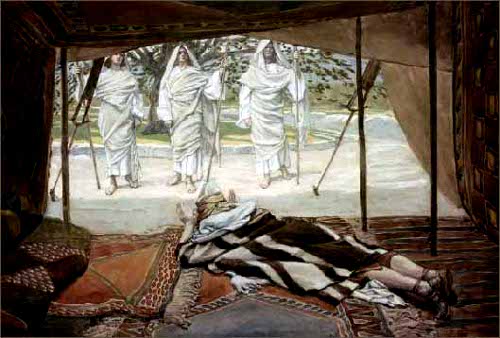
abrahams visitorsThe Lord appeared to him by the terebinths of Mamre; he was sitting at the entrance of the tent as the day grew hot.

Genesis 18:1 (JPS Tanakh)

The Lord took note of Sarah as He had promised, and the Lord did for Sarah as He had spoken. Sarah conceived and bore a son to Abraham in his old age, at the set time of which God had spoken. Abraham gave his newborn son, whom Sarah had borne him, the name of Isaac. And when his son Isaac was eight days old, Abraham circumcised him, as God had commanded him.

Genesis 21:1-4 (JPS Tanakh)

In this week’s Torah portion, Avraham is recovering from Bris Mila. Later, Isaac is born and has a Bris Mila. So, I thought to share a few insights on … Bris Mila!

-Rabbi Kalman Packouz
“Shabbat Shalom Weekly”
Commentary on Torah Portion Vayeira
Aish.com

The vast majority of people in the Church don’t imagine that baby boys born into Christian families must receive a ritual circumcision, called a Bris or Brit Milah, on the eighth day of life. It’s one of those things that we think of as uniquely “Jewish.”

But if we who are in the body of Christ are called the spiritual Sons of Abraham (Romans 9:8), and if we are “one body and one Spirit, just as you were called to one hope when you were called; one Lord, one faith, one baptism; one God and Father of all,” (Ephesians 4:4-6), then why are we too not obligated to be circumcised?

Then after an interval of fourteen years I went up again to Jerusalem with Barnabas, taking Titus along also. It was because of a revelation that I went up; and I submitted to them the gospel which I preach among the Gentiles, but I did so in private to those who were of reputation, for fear that I might be running, or had run, in vain. But not even Titus, who was with me, though he was a Greek, was compelled to be circumcised. But it was because of the false brethren secretly brought in, who had sneaked in to spy out our liberty which we have in Christ Jesus, in order to bring us into bondage.

Galatians 2:1-4 (NASB)

Paul came also to Derbe and to Lystra. And a disciple was there, named Timothy, the son of a Jewish woman who was a believer, but his father was a Greek, and he was well spoken of by the brethren who were in Lystra and Iconium. Paul wanted this man to go with him; and he took him and circumcised him because of the Jews who were in those parts, for they all knew that his father was a Greek.

Acts 16:1-3 (NASB)

A great deal has been made about why Paul did not have Titus circumcised but he did so for Timothy. The only obvious difference between them in scripture is that Timothy’s mother was Jewish but both parents of Titus were Greek (presumably, since Luke refers to Titus as “a Greek” in Acts 16).

Brit_MilahToday, it is common in the various streams of Judaism to consider anyone Jewish who was born of a Jewish mother, regardless of whether or not the father was Jewish. In the days of Paul, this may not have necessarily been the case, but if Timothy wasn’t Jewish, we are at a loss as to why Paul made such a distinction between he and Titus.

But getting back to what I was saying before, should any distinction be made between Jews and Gentiles in the body of Christ. Aren’t we all one in Messiah with ethnic differences swept away by the hand of God as a scorching sirocco sweeps over the desert sands?

But wait a second.

The Almighty commanded Abraham, “… My covenant you shall keep — you and your descendants after you for all generations. This is my covenant which you shall keep between Me and you and your descendants after you — circumcise all males. And you shall circumcise the flesh of the foreskin and it shall be the sign of the covenant between Me and you. And at eight days old every male shall be circumcised throughout all of your generations … My covenant shall be in your flesh for an everlasting covenant” (Genesis 17:9-13).

-Rabbi Packouz

This is the “ethnic” part of God’s covenant with Abraham and his physical descendants through Isaac, Jacob, the Children of Israel, and beyond. I previously said that in this portion of the covenant ratified by God with Abraham…

God promises to make Abraham a father of many nations and of many descendants and the land of Canaan as well as other parts of Middle East will go to his descendants. God declares that circumcision is to be the sign of the covenant for Abraham and all his male descendants and that this will be an eternal covenant.

But the blessings of the earlier portion of the Abrahamic covenant God makes with Abram are significant because that portion can be applied outside the ethnic, genetic, biological stream of Abraham and his offspring.

And I will bless those who bless you, and the one who curses you I will curse. And in you all the families of the earth will be blessed.”

Genesis 12:3 (NASB)

We have to access Paul’s midrash on Abraham to make better sense of this.

Now the promises were spoken to Abraham and to his seed. He does not say, “And to seeds,” as referring to many, but rather to one, “And to your seed,” that is, Christ. What I am saying is this: the Law, which came four hundred and thirty years later, does not invalidate a covenant previously ratified by God, so as to nullify the promise.

Galatians 3:16-17 (NASB)

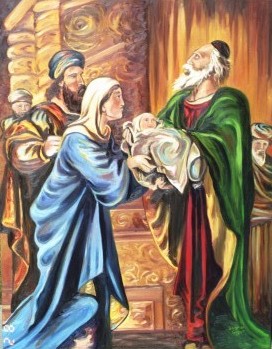
infant-jesus-templeThe “seed” is Messiah, Christ. He is the blessing, and this promise and blessing was established before the covenant was ratified and God required circumcision of Abraham and his offspring through Isaac, and through Jacob, and through all of Jacob’s offspring, and so on across the ethnic linkage that ultimately becomes the Jewish people.

In his letter to the churches in Galatia, Paul is strongly discouraging the Gentile disciples from being circumcised because, by that point in history, circumcision was the “shorthand” expression for ritual conversion to Judaism. If the Gentiles, through the blessings of Abraham’s seed (singular) and faith in Messiah, were already justified before God, and received the one Spirit, just as the Jews received that same Spirit, then for the purposes of justification, nothing else is required of the Gentile disciples.

Therefore I, the prisoner of the Lord, implore you to walk in a manner worthy of the calling with which you have been called, with all humility and gentleness, with patience, showing tolerance for one another in love, being diligent to preserve the unity of the Spirit in the bond of peace. There is one body and one Spirit, just as also you were called in one hope of your calling; one Lord, one faith, one baptism, one God and Father of all who is over all and through all and in all.

Ephesians 4:1-6 (NASB)

One body, one Spirit, one justification, one salvation, a unity of Spirit still doesn’t have to mean a uniformity of identity.

There’s a saying that goes, “everyone’s unique but no one is special,” but I don’t know if I can buy into that. I’m all for equal access to job opportunities and equal pay for equal work, but God did some really unique things. He chose the ethnic Jewish people, that is, those who were physically descended from Abraham, and Isaac, and Jacob, and Jacob’s sons, and the children of Jacob’s sons, who were all of the people led by Moses to Mount Horeb in the Sinai to receive the covenant and ultimately all of the promises, including the Land of Israel.

We can discuss the “mixed multitude” who eventually assimilated into the tribes after several generations and disappeared from the face of history, a process that cannot be anachronistically applied to modern times or even the time of James, Peter, and Paul. We can discuss ritual conversion to Judaism which existed in the time of James, Peter, and Paul and which exists today. I agree that you can’t “convert” to a tribal affiliation (which is why the ancient “gerim” in Torah were not converts). Judaism has long allowed for a few, select outsiders to join them, not because of ancestry, but by choice. But then, one choses to go “all the way,” so to speak, not retaining Gentile identity while living as a Jew. If we accept that God granted the Jewish community the authority to establish legally binding customs since antiquity, then we can accept Jewish converts.

But according to Paul and ultimately the Jerusalem Council (Acts 15), circumcision (conversion) is not required of the Gentile disciples of Messiah. We are one in Spirit and “co-inhabit” the body of Messiah. The body of Messiah is like the human body, which has different organs and structures, all of which are required for a healthy living person, and just like the body of Messiah, actually requires different parts.

abraham1All of this was set into motion thousands of years ago with Abraham and it is a blessing that the whole world isn’t required to convert to Judaism in order to be reconciled to God. No stream of Judaism I’m aware of requires conversion and circumcision in order to be right with God. The Bible and God have always presupposed a world made up of Jews and Gentiles who are reconciled before our Creator. Messianic Judaism is the living example of a Judaism that recognizes the spiritual equality of Jews and Gentiles in Messiah without compelling circumcision and full Torah observance upon the Gentiles in the body (not that we can’t take on board more of the mitzvot voluntarily).

I know this won’t satisfy the Hebrew Roots Gentiles who believe in uniformity in the Messianic body, nor the traditional Christians who also require uniformity. But those alternatives either rob the uniqueness God gave to the Jewish people through circumcision, the Torah, and Israel by having Gentiles say “it belongs to us too,” or strips that uniqueness away, defying God’s will by Christians telling Jewish people they must cease their ethnic and religious uniqueness and performance of the mitzvot if they wish to worship Moshiach, requiring that Jewish believers live like the Gentiles in the Church.

Why has this mitzvah survived in strength while so many other mitzvot have fallen to the wayside by otherwise minimally observant Jews? Perhaps the answer is found in the 2,000 year old words of Rabbi Shimon ben Gamliel, “Every mitzvah that they (the Jewish people) accepted upon themselves with joy … they still perform with joy.” (Talmud, Shabbos 130a). Deep in our collective psyche we know that the Jewish people is eternal, that we have a mission to be a “Light Unto the Nations” and to perfect the world, that the Almighty loves us and watches over us — and that it is our great joy and privilege to be a part of that Covenant!

-Rabbi Packouz

However you choose to view this in terms of being Gentile members of the body of Christ, the creation of “the Church” didn’t eliminate the promises God made to Israel. Paul said (Galatians 3:17) that “the law, introduced 430 years later, does not set aside the covenant previously established by God and thus do away with the promise.” So too the work of Messiah did not annul the covenants previously established by God, but rather, Messiah was and is the crystallization of prophesy, the perfect expression of all of the covenants, the doorway allowing both people who are uniquely Jewish and those of us who are uniquely Gentile, to enter into relationship with God, co-inhabitants in a body that does require the heart, liver, lungs, spleen, stomach and many other organs, as opposed to being a single body, with a single organ, and a single identity, and a single function. A human being with only a stomach and no other parts couldn’t possibly live, so demanding absolute uniformity and canceling diversity within the body of Messiah kills the body.

Rabbi Packouz says the Jewish people are eternal. Circumcision is one of the signs of that eternal and unique existence before God. Opposing this is opposing God’s will. We can only be one in Messiah and possess the One Spirit of God by living in accordance with that One Spirit and that One God.

Therefore Jesus answered and was saying to them, “Truly, truly, I say to you, the Son can do nothing of Himself, unless it is something He sees the Father doing; for whatever the Father does, these things the Son also does in like manner.

John 5:19 (NASB)

I’ve often heard that we should imitate our Master, but I don’t think in this case it means so much what we eat or what we wear, but rather, how we treat those who God has uniquely blessed. If we bless the Jewish people, we too are blessed by Israel and by Messiah. Of course, there is the converse.

Good Shabbos.