Tag Archives: Jewish

Acting Jewishly But Not Jewish, Part 2

First things first. Mark Nanos graciously contacted me to let me know I didn’t quite grasp everything he was saying in his paper ‘Paul’s Non-Jews Do Not Become “Jews,” But Do They Become “Jewish”?: Reading Romans 2:25-29 Within Judaism, Alongside Josephus,’ which I highlighted in Part 1 of this two-part series.

Two clarifications:

  1. While many do hold that the Jews were expelled from Rome in mass or entirely, in the appendix to The Mystery of Romans Nanos explains why that is almost certainly mistaken historically, and not helpful for explaining Romans.
  2. More importantly, Nanos does not argue that Paul was actually criticizing Jews in Rome for being hypocritical; rather, he was using the ideal of Jews not being hypocritical as the backdrop for developing a diatribal character, not a real one or even a real accusation as if it is happening, but what it would be like and how obviously hypocritical if so, that one who would call himself a Jew would seek to teach non-Jews Torah if not also committed to keeping Torah, or to get circumcised if not living as one who is circumcised is, dedicated in heart to doing what one separated to God should do regardless of whatever anyone else does or thinks about him and what he does or does not do. That hypothetical character is used to challenge any incipient pride or temptation to judge or behave hypocritically among the non-Jews he addresses directly by way of this diatribal fiction.

I appreciate Dr. Nanos bringing this to my attention and correcting my misreading of his paper where I thought he was saying that Paul was criticizing the Jews in Rome for hypocrisy (and it should be obvious that I’m leveraging Nanos’s words in the numbered list above).

To quote Lt. Cmdr Data, “It is clear that I have much to learn.”

In reporting my impressions on Nanos’ paper last time, I deliberately left out some significant portions for the sake of space. I’m including them here for further discussion.

There are many striking elements in Josephus’s account about Izates, the king of the Parthian client territory of Adiabene, and his mother, Helena, who were not born Jews and ruled a non-Jewish/non-Judean people (Ant. 20.17-96). The events overlap with Paul’s ministry in the 40s and 50s CE (20.15-17), and include interesting parallels to elements of Paul’s approach to and instructions for non-Jews in the Roman Empire. Several scenes warrant discussion.

-Nanos, p. 13

Nanos relates the story of Izates who prior to being crowned King, was sent to Charax Spasini for his own protection. There, Izates encountered the Jewish merchant Ananias. Ananias had been teaching Jewish traditions and customs to several women in the royal family and Izates also became his student.

Or to quote Nanos:

…who taught several women of the royal family with whom Izates was staying to “worship God [the Deity] according to the Jewish ancestral traditions…” (20.34).

-ibid, p. 14
HelenaIt is doubtful there was a Jewish community or synagogue present in Adiabene and questionable if Izates and the “women of the royal family” were undergoing this training as part of the proselyte rite (at least at this point in the process), nevertheless, we have several Gentiles being taught to worship the God of Israel “according to the Jewish ancestral traditions.” This at least suggests that said-Gentiles were A) worshiping the God of Israel, and B) doing so “jewishly,” that is, employing Jewish traditions and methods in worshiping Hashem.

While it’s tempting to think that the Ananias in question is the same person who the Master sent to Paul to relieve him of his blindness (Acts 9:9-19) and thus believe that Izates and the “royal women” were being taught Judaism within the Messianic faith, there’s no evidence to support such a theory (see First Fruits of Zion’s Torah Club volume 6: Chronicles of the Apostles for a further discussion of Izates and Ananias in light of Acts 9).

By an amazing “coincidence,” when Izates returned home to assume the throne after the death of his father, he discovered in his absence, his mother had also been studying Judaism.

…he learned his mother had simultaneously begun to observe certain Jewish customs under the direction of a different Jew, who remains unnamed (20.35-38). Izates is described as becoming aware of Helena’s “rejoicing in the Jews’ customs,” (20.38), referred to also as “their laws/conventions” (20.35).

-ibid

It was at this point that Izates decided to extend his Jewish studies and undergo the proselyte rite, converting to Judaism. Here’s where it gets interesting.

It remains unclear whether Izates supposed heretofore that he had become a Jew, or if he was simply unaware of the distinction between adopting (some) Jewish behavior, most likely adding such behavior to the rest of the customs and cult practices of his people as well as those of the people among whom he was residing, and becoming a Jew. Since the matter of circumcision with its signification of identity transformation does not pertain to Helena, it is also unclear if she is still a non-Jew or is recognized to have become a Jew.

-ibid, p. 15
The Jewish PaulFrom Paul’s point of view relative to his teaching Jewish practices to Gentiles within the context of Messiah worship, the distinction between Jew and non-Jew in Messiah was clearer, at least to him. But from an outside observer’s perspective, would Paul’s disciples have been seen acting any differently than Izates and Helena? How closely can the two cases be compared, particularly when we realize that nothing called “Christianity” existed in those days as a stand-alone religious entity? Paul’s disciples and Izates and Helena as disciples of other Jewish teachers may have had a great deal in common in acting “jewishly” but not being Jewish (maybe).

Ananias strongly discouraged Izates from converting because of how he thought his non-Jewish royal subjects would react to being ruled by a Jew. But while both Ananias and Helena opposed Izates’ conversion, they “did not, however, oppose him observing certain Jewish beliefs and behavior!”

Tweaking that last statement just slightly, could I call Izates a (somewhat) Torah-observant non-Jew? Nanos asks a similar question:

…it is worth pausing to ask whether Helena and Izates at this point represent jewish non-Jews? They are behaving jewishly, and their jewishness is observably different from that of other nobles and their subjects…

Much of the Apostolic Scriptures record the struggle Paul had in integrating Gentile Jesus-believers into Jewish religious and community space as co-equal participants with the Jewish occupants, particularly in defining how unconverted Gentiles could still receive the covenant blessings that were promised by God to Israel alone. And yet in Paul’s conceptualization, he seemingly had a clear vision of who the Gentiles in Christ were relative to Jews in Messiah (and the wider body of Jewish people).

But in the persons of Helena and particularly Izates, we have a greater degree of ambiguity. Was Izates what we would call a God-fearing Gentile, was he a proselyte, or was he something in-between? He was certainly a Gentile (up to the point when he finally converted) who was practicing at least some aspects of Judaism. How far was he allowed to go?

If Paul’s Gentile disciples had a less ambiguous status in terms of Jewish practices and Judaism than Izates, how do we answer the same questions on their behalf? Can we, as Nanos asks regarding Izates and Helena (p. 17), consider them “jewish” Non-Jews who were gathering in Jewish assemblies or synagogues?

I’ve avoided asking the obvious question so far, but how does any of this apply to Gentile Christianity today, particularly to those of us who call ourselves Messianic Gentiles? Twenty centuries ago or close to it, we have a record of many non-Jewish people co-mingling with Jews within Jewish assemblies and communities and being treated as near-equals or equals in social and even covenant standing. The Gentiles were largely, and some probably fully entrenched in Jewish cultural practices. What does that say about Gentiles interacting and worshiping with Jewish Jesus-believers (Messianic Jews) in Jewish community space today?

Goyish is not bad. Goyish is good. It may not be good for Jews, but if you’re a Gentile—goy is good! It is what God made you. ENJOY!!! And realize that salvation has come to the Gentiles as Gentiles. You don’t have to discover your Jewish roots. You should not abandon or disparage the churches from which you came or where you still live, and move, and have your being. You should enrich them through engagement with the Bible, through discovering and expressing your spiritual gifts, and through your whole-hearted participation, but please please please: Don’t despise your roots or imagine that you have to abandon them to find God. God has come to find you and your people just as you are and where you are.

-Dr. Rabbi Stuart Dauermann
“The Problem With Hebrew Roots, or, It’s Good to be a Goy”
Interfaithfulness.org

Up to JerusalemThis might almost be seen as the same view from the opposite end of the telescope. It’s an expression (if I’m reading this right) of how the Gentile Jesus-believers do not have to adopt Jewish cultural traits and practices in order to be faithful Jesus-believers and benefit from the Jewish covenant blessings of salvation, justification, and the resurrection to come.

In Paul’s day, there was no template for integrating faith in the Jewish Messiah within the various Gentile cultures, so it was probably easier to bring the Gentiles into Jewish culture. Paul probably wouldn’t have known how to teach about Messiah and the God of Israel in any other way. But two-thousand years later, Christianity has a rich (and sometimes dark) history and culture of its own. Each church could be said to be its own cultural milieu with its traditions and mores and very little if any of it looks at all Jewish.

Some Gentile believers feel kind of ripped off by the Church, especially when they learn to read the Bible, and particularly the Apostolic Scriptures, as God encountering man within Jewish culture and community. It seems inviting to witness the first Gentile believers being taught by Paul and Barnabas at the “Synagogue of the Way” in Syrian Antioch (see Acts 11).

But can or should a Gentile’s faith in the Jewish Messiah be expressed within a Jewish community and cultural context today? From the above-quoted blog post of R. Dauermann, in answer to a comment, he replies:

Yes, right Chris, learning about the Jewish/Hebrew roots of what CHristians believe is instructive and helpful, but not when a Gentile is erroneously steered in the direction of seeking to establish their *own* alleged Jewish roots as a passport to greater spiritual authenticity. As I said above, “It is true that Christianity at its inception had Jewish roots, but this is not Not NOT and never to be understood as recommending that Christians think they have Jewish roots or that they need to find those roots in order to legitimize themselves and their faith.”

From my point of view, I think there are circumstances when Gentile believers can and even should appropriately express their faith within a Jewish cultural context. In fact, at least in the United States, most authentically Messianic Jewish synagogues contain a significant if not majority population of Gentiles in their membership. Like Izates, there will always be Gentiles who are inexorably drawn to Judaism for whatever reason and they will find their way into Jewish community. Further, there are numerous intermarried couples who would benefit from the Jewish spouse participating in Messianic Jewish community along with the Gentile spouse. This is particularly important if they have Jewish children who need to learn and preserve what it is to be Jewish and to be Messianic.

But I was thinking in church last Sunday about Christians (which I suppose isn’t surprising). What do we do about them?

The first thing to consider is that most Christians are more than overjoyed to be in their churches and couldn’t imagine any other venue for their worship of and devotion to Jesus Christ. From their viewpoint, they neither want nor need to engage Jesus within a Jewish cultural context and doing so would just make them feel uncomfortable if not downright alienated.

But that’s not to say that the Church is perfect nor that they cannot learn from what Messianic Jews and Gentiles teach. I was talking to a young fellow after Sunday school class the other day about Jewish traditions and the benefits they possess. We talked about the set times of prayer and the abundance of blessings a Jew recites on various occasions. I also told him that a Christian does not specifically have to adopt Jewish practices in order to gain the benefits of the values that lie behind the traditions.

ShabbatOn Erev Shabbat for example, it is traditional for Jewish parents to bless their children in a specifically proscribed manner. I told my young friend that he and his wife could also chose to bless their children, but they didn’t have to do it “jewishly”. The values behind Jewish traditions and culture provide context, identity, and meaning to Jewish families, and I think Christians can and sometimes do employ similar practices for the same reasons and can get similar results.

Two-thousand years of history have separated most Christians from even the idea that we could act “jewishly” and for most Christians, it would drive them crazy even to consider the possibility. But if someone like me, who has a few “jewish” ideas to relate to my Christian counterparts, can communicate those concepts in the Church, maybe it will build a bridge between the two worlds.

For those Christians who are drawn to a more “jewish” lifestyle, many of them either come from family and culture that melds into behaving more “jewishly” or they learn to do so through marriage or some other process.

The main takeaway for me is that it’s not a “have to,” that is, I don’t feel compelled by God that I must live “jewishly” and that it’s a sin not to. It may well have been acceptable for Izates and Helena to live “jewishly” and never to convert to Judaism, at least in a formalized manner. Certainly Paul’s Gentile disciples lived “jewishly” probably by default, since there was no other cultural pattern one could employ for a Gentile to live as a disciple of a Jewish teacher.

But that was then, and this is now. While some Gentiles elect to live “jewishly” as an expression of their faith, it doesn’t seem absolutely necessary, at least in the current age. I’ve seen some Christians in the Church observe more of the weightier matters of Torah than I have some Hebrew Roots Gentiles in One Law gatherings.

It isn’t the cultural or religious context that makes the person of faith, it’s the heart. One circumcised heart is worth ten-thousand kippot and tallitot wearing people with uncircumcised hearts (not that you can’t be a kippah and tallit wearing Gentile with a circumcised heart, of course).

To love him with all your heart, with all your understanding and with all your strength, and to love your neighbor as yourself is more important than all burnt offerings and sacrifices.”

Mark 12:33 (NASB)

A friend of mine said it best: Don’t seek Christianity and don’t seek Judaism. Seek an encounter with God.

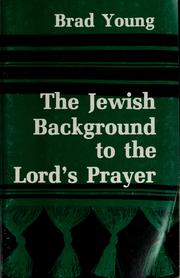
Book Review: The Jewish Background to the Lord’s Prayer

brad-young-bookThe main problem is one of approach. Too often, the importance of the Jewish background of the prayer and of the language that Jesus used has been overlooked or minimized. Jesus was a Jew, speaking Hebrew to his Jewish followers during the difficult days of the Roman occupation of Israel in the Second Temple Period. A modern Christian has a quite different understanding of prayer, Scripture, and faith than a Jewish teacher like Jesus, not to mention the great differences in language, culture, and history. One can easily miss the great depth of Jesus’ message, even while believing in him. Here we will try to rediscover something of the original Jewish atmosphere in which Jesus taught his followers how to approach God in prayer.

-Brad Young
from “Introduction: The Disciples’ Prayer,” pg 1
The Jewish Background to the Lord’s Prayer

I’ll start by profusely thanking Toby Janicki for graciously lending me his personal copy of Young’s book. Apparently it is out of print, and even used copies on Amazon are kind of pricey, especially for a forty-six page text.

As Young states, we Christians in the Church tend to almost take the Lord’s Prayer, or rather “the Disciples’ Prayer” for granted. It’s one of those things we read in the New Testament that we think we all understand correctly and completely. After all, the prayer itself is quite short. What’s there to misunderstand, right?

The answer to that question is “plenty,” and for the reasons I quoted above.

To start off, I won’t quote the Disciples Prayer here. It should be pretty familiar to most Christians, even those who don’t spend a lot of time in the Bible. For reference, there are two, parallel versions of this prayer in the Bible and they aren’t identical. You can find them in Matthew 6:9-13 and Luke 11:2-4. The differences, I suspect, have to do with the different audiences of each Gospel, with Matthew written to the Jews and Luke written to the Greeks.

Our Father Who Art In Heaven

Young suspects (pg 3) that Luke removed the “Jewish elements” of the prayer, since his version does not contain the words we read in English, “who art in heaven”. This was a familiar prayer formula in first century Judaism but would have seemed foreign to Greek readers. Picturing a “Father in Heaven” might have summoned images in Greek minds of some “god” such as Zeus sitting on an Olympian throne (pg 4). Luke may have felt it prudent to avoid such false associations by editing Jesus’ words (a Gospel writer editing the words of the Master to fit a specific audience is somewhat startling, don’t you think?).

But for a Jewish audience, the “Father in Heaven” reminded them of the love and care Hashem had and has for the Jewish people, and they would have recalled many references from scripture of the kindness of God toward Israel:

Whoever is wise let him note these things, and they will comprehend the kindnesses of Hashem.

Psalm 107:43 (Stone Edition Tanakh)

Jesus taught his disciples that God is not just a generic Father in Heaven, but He is “your” Father and “our” Father. The relationship between God and Israel isn’t just corporate, it’s personal. As Gentile disciples of the Master, we are grafted into that relationship with God, and thus we can call God “our” Father and “my” Father in Heaven.

Hallowed Be Thy Name

PrayingYoung says (pg 7) that the word we read as “Hallowed,” at least in the King James Translation, is more accurately rendered “sanctified”. He “retrotranslated” the Greek into the Hebrew word “yitkadesh” which means “be sanctified” so the phrase should read like “may Your Name be sanctified”. He also compares this to the Hebrew word “v’hitkadishti” found in Ezekiel 38:23

I will be exalted and I will be sanctified… (emph. mine)

Ezekiel 38:23 (Stone Edition Tanakh)

But as Young asks (pg 8), two-thousand years ago, what did “sanctify” mean to the Master’s Jewish disciples? Young makes comparisons to Leviticus 22:32 and Ezekiel 36:23 but he also said this:

The name of the Lord can be either sanctified or profaned by the conduct of people. In fact, because a martyr would frequently cause others to glorify God as a result of his sacrifice, the Hebrew idiom, “to sanctify the Name,” was often understood as referring to someone who would give his life for his faith.

-Young, pg 8

Adds some dimension to the crucifixion of Christ, doesn’t it? Perhaps as his disciples watched Jesus slowly dying on the cross, they remembered these words and what they truly meant to the Master. Perhaps they finally understood one day, that to pray this prayer was to ask that they be considered worthy to also die for the sake of Heaven.

But it’s not just how you die, but how you live, for “one sanctifies God by living a holy life.” Recall Matthew 5:16 (DHE Gospels):

So also, shine your light before sons of men, so that they may see your good deeds and praise your Father who is in heaven.

Thy Kingdom Come

Young spends a significant portion of this small book discussing the meaning of the Kingdom, and it’s somewhat reminiscent of an episode of the First Fruits of Zion television series called Thy Kingdom Come.

According to Young (pg 10), we mistakenly believe this phrase refers to Heaven or some future, Messianic Kingdom that Jesus will establish after he returns. But what did Jesus mean when he said, as he often did, “the Kingdom of Heaven?”

The Greek word “eltheto” doesn’t have an exact equivalent in English but it suggests “may it be” or “let it be”. But again, in Hebrew and to a Second Temple Era Jewish audience, what did this mean? Young (pg 11) says the phrase is quite similar to words we find in the Kaddish: “May He cause His Kingdom to reign.” Young also makes a comparison to the Hebrew words “tamlich malchutcha” or “May you continue establishing Your Kingship,” indicating a continual process rather than a point fixed in time. It is associated with the idea of a Kingdom that has already arrived, and yet is still in the process of coming.

I wrote a review last week about a portion of D. Thomas Lancaster’s Holy Epistle to the Hebrews sermon series called The Partisans that speaks to this difficult to comprehend matter.

Lancaster
D. T. Lancaster

The overarching concept of God having reigned, His currently reigning, and His reigning forever, is all over the Bible. Exodus 15:18, Psalm 93:1, and Psalm 146:10 only scratch the surface, and all of these references may well have come to the minds of the disciples as they listened to Jesus teach them how to pray.

Young states (pg 13) that, referencing Matthew 10:7, “The Kingdom of Heaven is at hand,” the phrase “at hand” or “engiken” in Greek (Heb. “karav”), is “the perfect indicative” and is better understood as an already completed action. It’s could be better said as “The Kingdom of Heaven is here.”

On the Day of Atonement, the High Priest would say the holiest name for God. When he pronounced the Tetragrammaton, the people would fall on their faces and affirm, “His honorable name is blessed and his Kingdom is forever and ever.” The Kingdom is present. God is reigning. He rules as the people recognize his Kingship. He rules when he redeems people. (emph. mine)

-Young, pg 14

This not only speaks directly to Lancaster’s point in the aforementioned sermon, but it expands the meaning of how God’s Kingdom can already be here in a completed form and still having not quite arrived. As each individual comes to faith and acknowledges the Kingship of God in the world and in their lives, the Kingdom is continuing to be established, one human being at a time, across all time, and across human history. As the Gospel message is progressively spread throughout the Earth, the Kingdom is also being spread, expanded, established, affirmed. When the time of the Gentiles (Romans 11:25) is fulfilled, Israel will be redeemed by Messiah and the Kingdom that has already arrived and yet still arriving, will become perfected in our world, and the Messiah King who is already enthroned in the Heavenly Court, will ascend to his place of honor in Jerusalem.

Blessed are the poor in spirit, for theirs is the kingdom of heaven.

Matthew 5:3 (NASB)

Young says this is a poor translation of the Greek “hoti auton estin” and does not actually imply that the poor can “own” the Kingdom of Heaven.” The “poor in spirit” (followers of Jesus) do not own the Kingdom as a possession. Young renders the same verse in Hebrew and then translates that back into English to say, “Blessed are the poor in spirit, for they make up the Kingdom of Heaven.” In other words, the followers of Jesus comprise, or are the building blocks, or are the substance of the Kingdom.

These are people who have already accepted the rule of the King and thus not only become part of the Kingdom as subjects, but are the very essence of the Kingdom of Heaven, the Messiah’s Kingdom. “May you continue establishing your Kingdom, and may your will be done” are parallel phrases in this prayer and declare that we desire more hearts turn to the Father by way of the Son, further establishing God’s rule and the Kingdom of Heaven on Earth.

Thy Will Be Done, On Earth As In Heaven

We already touched on this phrase in the section above, stating that this is an affirmation of what God is already doing. Young (pg 18) references the Greek “genathato” as “may it be,” translating it back into the Hebrew “hayah” which is “to be” or “asah” which indicates “to do”. A more literal translation, taking the Hebrew into account, would be “Let it be your will in heaven and earth” or “Let your will prevail in heaven and earth”.

The Death of the MasterYoung says (pg 19) that “to do His will” is idiomatic Hebrew indicating that it is people who do God’s will, thus is a call for obedience or a declaration of obedience to God, for one continually establishes His Kingdom by continual obedience, thus sanctifying His Name.

No finer act of sacrificial obedience to God can be found than in Jesus at Gethsemane (Matthew 26:36-46, Luke 22:39:46):

Of course, the greatest example of the battle to do the will of God is Jesus himself in Gethsemane. Jesus had already predicted his betrayal and sufferings. The brutality of Roman executions was well known, and more than a few had actually witnessed crucifixion. Jesus was keenly aware of the deeper significance of his sufferings. Still, conscious of his own crucifixion looming before him in the next hours, he prayed, “Father, if thou art willing, remove this cup from me; nevertheless, not my will, but thine, be done” (Luke 22:42). Jesus did not succumb but performed the will of God. A person overrules his own volition in order to do God’s will.

-Young, pp 20-21

Jesus has been called an Apostle (Hebrews 3:1), a “sent out one,” and he taught that no servant is greater than the one who sent him (John 13:16), thus Jesus depicted the perfect servant of God, who would obey, even to the death, as an act of love toward his disciples ( John 13:34, John 15:13) and ultimately toward humanity (John 3:16).

Young quotes from Rabbi Alexandri’s prayer (pg 21), saying, “Sovereign of the universe, it is revealed and known to You that our will is to do Your will.” We must all repent continually for it is sin that causes us to rebel against God, preventing us from making His will our will and establishing His Kingdom.

Give Us This Day Our Daily Bread

You wouldn’t think this would need interpreting. Why isn’t it plain that we are to ask God to fulfill our daily needs? Is this asking for our food today, or that our food be prepared for the following day? Young makes a connection to Proverbs 30:8 stating that Jesus may have been deliberately alluding to the scripture, “Remove me far from falsehood and lying; give me neither poverty nor riches; feed me with food that is needful for me.”

So “daily bread” may mean something more like “all of my needs”. This simple phrase in the prayer can be unpacked into a complex set of Jewish conceptualizations interconnected throughout the Bible.

Consider Exodus 16:4-10 and particularly verse 4:

Hashem said to Moses, “Behold! — I shall rain down for you food from heaven; let the people go out and pick each day’s portion on its day, so that I can test them, whether they will follow My teaching or not.”

This speaks not only to obedience but utter dependence and emphasizes not only the study of Torah, according to Rabbi Simeon ben Yochai (pg 25), but being “totally dependent upon God for…every need.”

God is the great provider and we should not even doubt that His providence will always be available (see Matthew 6:25-26, Luke 12:22-24).

And Forgive Us Our Debts, As We Also Have Forgiven Our Debtors

ForgivenessYoung cites (pg 29) Matthew 18:23-35 as a lesson in forgiveness and links how we as disciples forgive others to how we will be forgiven by God. He shows a parallel between this part of the Disciples’ Prayer and what Ben Sira (Sirach) taught (170 BCE): “Forgive your neighbor the wrong he has done, and then your sins will be pardoned when you pray.”

But is it that we impact how or if God will forgive our sins by the quality of forgiveness in our own hearts, or is an unforgiving heart inhibited in prayer, thus never reaching God…or is it a little of both?

“Rabbi, which is the greatest mitzvah in the Torah?” Yeshua said to him, “Love HaShem your God with all of your heart, with all of your soul, and with all your knowledge. This is the greatest and first mitzvah. But the second is similar to it: Love your fellow as yourself. The entire Torah and the Prophets hang on these two mitzvot.”

Matthew 22:36-40 (DHE Gospels)

There’s a slight difference in Luke’s version of the prayer. Matthew asks for forgiveness of “debts” where Luke says “sins.” Young (pg 30) says this is probably associated with the use of the Hebrew word “chayav” which can mean both guilt to which we are accountable and a debt to be paid.

If we again consider Jesus as an Apostle of God, then to the degree he forgave represented God’s forgiveness, and Jesus forgave generously, even to his enemies:

Yeshua said, “My Father, forgive them; for they do not know what they are doing.”

Luke 23:34 (DHE Gospels)

Lead Us Not Into Temptation, But Deliver Us From Evil

Young (pg 31) considers “lead us not into temptation” and “deliver us from evil” to be parallel statements. The word for “temptation” in Hebrew suggests “test” or “trial,” just as HaSatan tested the Master (Matthew 4:1-11, Mark 1:1-12, Luke 4:1-13) hoping to cause him to stumble. Please keep in mind that it wouldn’t have been much of a test if Jesus was totally incapable of sinning, of disobedience to God. He would only have been exalted by resisting the temptation to do what was evil in God’s eyes, that is, if it was possible for him to fail.

When Jesus taught his disciples this portion of the prayer, he of course knew that it was not only possible for the disciples to fall prey to testing and to sin, but that indeed, they would fail. Consider Peter’s denial of the Master after declaring that he would follow Jesus even unto death (Mark 14:66-72, Luke 22:54-62, John 18:15-27).

Young notes parallels (pg 32) not only in scripture (Psalm 119:133) but in one of the Psalm scrolls from the Dead Sea Scrolls discovered in Cave 11, “Let not Satan nor an unclean spirit rule over me” (Heb. “al tashlet bi satqan v’ruach tumah”). Also, the Testament of Levi states, “And do not let Satan rule over me to lead me astray.” Young further quotes abundantly from the Talmud where very similar wording is to be found.

Conclusion

We see here, as I’ve written in other “meditations,” that there is a great deal more information packaged into even the briefest portions of our Bible than we might imagine, even if we are seasoned students of the Bible. If we apprehend scripture from a solely Christian perspective but fail to take into account the Hebrew thought behind the Greek text, we fail not only to get the full message of Jesus, but in many cases, the correct message of Jesus. Thus even with the best intentions and a wholehearted desire to serve God, we end up traveling down many unintended and undesirable paths in relation to God, to the Jewish people, to Judaism, and to Israel.

That said:

Even though Jesus taught his disciples this prayer in Hebrew, in an entirely different setting nearly two millenniums ago, the petitions contained in this short prayer transcend time and are appropriate to the modern-day disciple. Today, perhaps more than ever before, Jesus’ followers need to be challenged again to respond to this timeless message.

-Young, pg 36

DHE Gospels
Delitzsch Hebrew Gospels

The challenge is to encounter the teachings of Jesus and his Jewish disciples on their own terms, meeting them on their own “home ground,” so to speak, rather than in the places that make us feel comfortable. Most Christians get a little nervous when a lesson about Jesus seems “too Jewish.” Oh sure, they can accept a few Hebrew words and a few Jewish thoughts, but once you start re-translating the entire concept of the Gospel message of Moshiach into a wholly Jewish context, most Gentile Christians, especially those raised in the Church and quite accustomed to the traditions associated with Biblical interpretation, will quickly lose their bearings and feeling in danger of becoming lost, will retreat to more familiar territory, even if that territory has a poorer view of the revered Savior.

Young’s small book was published thirty years ago and sadly is very expensive to acquire, but it also is part of a larger body of scholarship that is continually being added to, which holds the promise of truly illuminating the mind and heart of each and every believer, showing us the Jewish face of Yeshua behind the Gentile mask of Jesus.

Imagine if a forty-six page booklet can say so much about just a few verses in the Gospel that teach such a brief prayer, what could be learned if we approached the entire Bible from the same perspective?

Vayigash: Will the King Show Us Mercy?

king-davidAnd Joseph said to his brothers, “I am Joseph!”

Genesis 45:3

The Chofetz Chaim comments that from the time the brothers first came to Egypt to get food — when Joseph spoke with them roughly and accused them of being spies — they were puzzled about what exactly was happening and why it was happening. In both encounters with Joseph they had many questions about their experiences. As soon as they heard the words, “I am Joseph” all their questions were answered. The difficulties they had in understanding the underlying meaning of the events — why Joseph accused them of being spies, yet treated them well, accused them of lying and stealing, but gave them a banquet, insisted on bringing the younger brother to Egypt, etc. — were now completely clarified.

Similarly, says the Chofetz Chaim, when the entire world will hear the words “I am the Almighty” at the final redemption of the Jewish people, all the questions and difficulties that people had about the history of the world with all of its suffering will be answered. The entire matter will be clarified and understood. Everyone will see how the hand of the Almighty caused everything ultimately for our benefit.

Dvar Torah for Torah Portion Vayigash based on
Growth Through Torah by Rabbi Zelig Pliskin
Referenced by Rabbi Kalman Packouz
at Aish.com

The brothers of Joseph discover a startling reality. The ruler of the Egyptians who has been treating them harshly all of this time is really their brother Joseph. In an instant, all the cruelty they showed him, including trying to murder him, must have come to the forefront of their conscience.

Before this, the Egyptian ruler had the power to do anything to them, imprison them, make them slaves, even kill them, but “it wasn’t personal.” That is, the sons of Jacob were no more or less significant to an Egyptian ruler than anyone else.

Now they not only discover that this man has the power of life and death over them, but that he is their brother, who they left for dead, who almost surely has a personal motive for seeking revenge. The brothers knew they had no right to appeal to Joseph for mercy, for they had not showed him mercy. They could only hope that in the years he ascended from slavery and imprisonment to being a viceroy of Egypt, second only to Pharaoh in power and authority, that he had learned wisdom and compassion and would be willing to offer them something they did not deserve: mercy and the continuation of their very lives.

Now look at what Rabbi Pliskin had to say from the above-quoted text:

Similarly, says the Chofetz Chaim, when the entire world will hear the words “I am the Almighty” at the final redemption of the Jewish people, all the questions and difficulties that people had about the history of the world with all of its suffering will be answered.

How much of the non-Jewish world will tremble at the feet of God when they realize the Almighty has appeared at the final redemption and that He is not at all pleased with how His people Israel have been treated?

Over the long march of centuries since Abraham, Isaac, and Jacob, since Joseph confronted his brothers, since Moses, Aaron, and Miriam liberated the Israelites from Egyptian slavery and set them before God at Sinai, and on and on across history, every people, tribe, and tongue throughout the Earth has been seeking to kill the Jewish people, God’s splendorous treasure, the apple of His eye.

This includes the Church of Jesus Christ. How confusing it will be in those days to be a Christian who has harbored hatred toward Jewish people, Judaism, and Israel, and to be confronted by an angry Jewish King. How strange it will seem to many Christians who have loved Israel but continued to deny the validity of the Torah, the Temple, and the adherence of Jewish people to a Jewish way of life for those Gentile believers to be faced with a Jewish King who upholds the “Jewishness” of his people Israel.

“Then He will also say to those on His left, ‘Depart from Me, accursed ones, into the eternal fire which has been prepared for the devil and his angels; for I was hungry, and you gave Me nothing to eat; I was thirsty, and you gave Me nothing to drink; I was a stranger, and you did not invite Me in; naked, and you did not clothe Me; sick, and in prison, and you did not visit Me.’ Then they themselves also will answer, ‘Lord, when did we see You hungry, or thirsty, or a stranger, or naked, or sick, or in prison, and did not take care of You?’ Then He will answer them, ‘Truly I say to you, to the extent that you did not do it to one of the least of these, you did not do it to Me.’ These will go away into eternal punishment, but the righteous into eternal life.”

Matthew 25:41-46 (NASB)

Woman in the darkI used to think this was an injunction for believers to show kindness and compassion for all of the needy people around us (and I still think we should), but almost a year ago, I heard a good and kind Christian man in a Sunday school class interpret this statement as the duty we Gentile believers have to take care of all the needy of Israel.

And if that statement is true, then woe be to the many, many Christians past and present who have utterly failed to do so because those needy people were “just Jews.”

In the case of the brothers of Joseph, their kinsman who was also ruler and King over them was merciful after all:

Now do not be distressed or reproach yourselves because you sold me hither; it was to save life that God sent me ahead of you. It is now two years that there has been famine in the land, and there are still five years to come in which there shall be no yield from tilling. God has sent me ahead of you to ensure Your survival on earth, and to save your lives in an extraordinary deliverance. So, it was not you who sent me here, but God; and He has made me a father to Pharaoh, lord of all his household, and ruler over the whole land of Egypt.

Genesis 45:5-8 (JPS Tanakh)

But was it for Jacob’s sake that Joseph spared his brothers? And for whose sake shall the King of Israel spare those among the nations and particularly those among the Church who have treated his little ones poorly?

…but whoever causes one of these little ones who believe in Me to stumble, it would be better for him to have a heavy millstone hung around his neck, and to be drowned in the depth of the sea.

Matthew 18:6 (NASB)

Mark Nanos in his book The Mystery of Romans defines the “weak” and “stumbling,” relative to Paul’s letter to the Romans, as the Jews in the synagogues of Rome who had not yet come to faith in Messiah. I’ll write a detailed “meditation” on this topic in a few days, but Nanos understands Paul’s admonition to the “strong,” the Gentile believers, as failing to uphold their responsibility to encourage the stumbling Jewish people, resulting in them stumbling even further away from faith. Paul never gave up on the stumbling, and he would have sacrificed everything for them.

For I could wish that I myself were accursed, separated from Christ for the sake of my brethren, my kinsmen according to the flesh, who are Israelites, to whom belongs the adoption as sons, and the glory and the covenants and the giving of the Law and the temple service and the promises, whose are the fathers, and from whom is the Christ according to the flesh, who is over all, God blessed forever. Amen.

Romans 9:3-5 (NASB)

It was the Master himself who called his people Israel “lost sheep” (Matthew 10:6, 15:24) and who are we to disdain those “sheep,” for it is obvious that even in their unbelief, God loves them with a great intensity and will violently protect them, even from those of us who are so arrogant as to believe their Father has cut them off from His care and compassion.

bk_kotelPaul says that all of Israel will be saved (Romans 11:26), though we in the Church cannot fathom this. But though the Jews have always been few in number (Deuteronomy 4:27) and suffered exile and dispersion (Leviticus 26:33), yet they shall be redeemed and live in peace (Micah 4:1-4), for God has declared that Israel shall eternally be a nation before Him (Genesis 17:7, Leviticus 26:43, Deuteronomy 4:26-27, 28:63-64).

It is within the power of the Jewish Messiah King, Yeshua, Jesus, to judge his Gentile Church and to cast out those of us who have failed in our duty to his people Israel in opposition to the prophesies and the commandments. The patriarchs were terrified of their powerful and very human brother for the vengeance he could exact upon them. How much more should we be terrified of an infinitely powerful and eternal King?

It is a terrifying thing to fall into the hands of the living God.

Hebrews 10:31 (NASB)

Tremble and sin not, reflect in your hearts while on your beds, and be utterly silent. Selah.

Psalm 4:4 (from the Siddur, nighttime blessings)

Let the world that has always hated the Jewish people learn to repent before it’s too late, and let each Christian who has hated or dismissed the Jewish people lie in his or her bed and tremble and be utterly silent before their King whose hand will always uplift Israel and whose greatest desire is to save his precious nation and redeem her as he has promised.

Good Shabbos.

Imperfect and Perfect

praying_at_masadaGod appeared to Abram and said to him, “I am Almighty God. Walk before Me and be perfect.”

Genesis 17:1

If a human being cannot be perfect, why did God demand perfection of Abraham?

The entire context of the verse indicates both the definition of this perfection and the way in which it can be achieved. It is obvious that no human being can aspire to equal God’s degree of perfection. What man can achieve is to live according to God’s teachings and thereby live up to his own human potential; more than man’s personal maximum is not possible or expected. Thus, God did not say simply, “Be perfect”; He said, “Walk before Me + and thereby you will be perfect.” When a person tries to live according to the Divine teachings, that constitutes human perfection, although one is technically never perfect.

Rabbi Samson Raphael Hirsch notes that the Hebrew word for “walk” in the above verse is not telech but heshalech which implies, “Go your way in spite of opposition, not making your progress dependent on external circumstances, but being led from within yourself: Let your movement proceed from your own free-willed decisions.”

The picture is now complete; human perfection can be achieved by making a free-willed choice to live according to the Divine teaching.

Today I shall…

…try to realize that although I cannot be absolutely without flaw, I can be perfect if I make free-will decisions to obey the Divine will.

-Rabbi Abraham J. Twerski
“Growing Each Day – Cheshvan 6”
Aish.com

This brings to mind something my Pastor and I periodically discuss. Perhaps I’d better preface this with scripture:

For whoever keeps the whole law and yet stumbles in one point, he has become guilty of all.

James 2:10 (NASB)

No one keeps the Law (Torah) perfectly. No one can. So when I insist that Jewish people, including Messianic Jewish people, remain obligated to the mitzvot, he counters with James 2:10. No one can keep the law perfectly, therefore, no one can keep the law. It’s like he’s saying, “if no one can keep the law perfectly, why bother trying to keep it at all?”

Jesus once said that if a man looks at a woman with lust in his heart, it’s as if he had physically committed adultery with her (Matthew 5:28). And yet, probably most men at one time or another in their lives have found themselves looking at a beautiful woman and having lustful thoughts, even momentarily. Does that mean such men, having failed once (or more than once), should throw their marriage vows to the winds and start having physical “relations” with every woman who strikes their fancy?

praying-apostleI should hope not. As people of faith, we should strive to live out our lives in as close an approximation to the perfection of our Master as we can, all the while knowing we will never behave in a perfect manner. We try to better ourselves, we pray for God’s help in bettering us, but even if we come closer to our Master’s example, we’ll never match it.

Remember the word that I said to you, ‘A slave is not greater than his master.’

John 15:20 (NASB)

I don’t think “perfection” is what Jesus had in mind when he made that statement, but it seems to fit today’s example. Just because we can’t be perfect like our Master doesn’t mean we should stop trying.

Putting all this back into the original context, and summoning Rabbi Twerski’s example, just because an observant Jewish person cannot perform all of the mitzvot perfectly (and may not perform some of the mitzvot at all) doesn’t mean that they should abandon their obligation to the Torah of Moses as a way to draw closer to God, or to surrender the lifestyle God gave to the Jewish people which uniquely identifies them as Jewish.

My understanding of one of the purposes of performing the mitzvot is to help a Jewish person continually be reminded that they are Jewish. You wouldn’t think remembering this would be much of a chore, but consider how rampant assimilation of Jews is in our society today. The mainstream culture works very hard at getting everyone to fit in, blend in, assimilate to the will of the world’s “marketing department,” and never, ever to be different or distinct in any way whatsoever.

So being an observant Jew is a lot of work. It would be much easier to assimilate. It would be much easier to be able to go to any restaurant in town and to order anything on the menu. It would be much easier to drive, cook, shop, play golf, and surf the Internet on Shabbat. It would be much easier not to have to study Torah, study Mishnah, study Hebrew (and in some cases Yiddish). It would be much easier to set aside the fixed times of prayer every day, easier to not don tzitzit, easier to not lay tefillin.

But being born into the covenant as all Jewish people are, it is incumbent upon each Jew to live as a Jew. God gave people, including Jewish people, free will, so a Jewish person can choose to observe the mitzvot or not (or choose which of the mitzvot to observe and which ones to ignore), but sooner or later, God will get around to reminding each Jewish person that they are indeed Jewish. The reminders are not always pleasant or easy to endure.

rabbi-prayingI’ve said before that only faith justifies one before God, not observing the mitzvot. It’s not what we do but why we do it and who we do it for that matters. If our thoughts and behavior are not focused on God and responding to God’s will, no matter how well we do something and no matter who we may show kindness to, it begins and ends with us. There is no connection to eternity.

But faith and justification are only the beginning of the journey. Once we have grasped onto “God’s fringes” tightly, we must respond to grace and faith by living life as God wills. For a Jew, that means Torah observance. How to observe the Torah, which of the mitzvot to start with, which tradition to employ in the observance (for instance, there’s more than one way to lay tefillin and to tie tzitzit) is a question and I don’t have the answer. But that doesn’t mean the Jewish person ceases in being obligated to try. Who is to say that the Ashkenazi way to tie tzitzit is any better or worse than the Sephardic tradition? Perhaps both are pleasing to God.

If a Jewish person were to wait around for iron-clad confirmation of exactly which way to do a particular mitzvah, they could wait around until Messiah comes (or returns).

It’s like my current frustration with the politicians in Washington over their lack of action in solving the debt ceiling crisis. I want to scream at them, “Just do something!” The Nike company’s well-known slogan of “Just Do It!” comes to mind.

Rabbi Twerski said that even though he knows he cannot be without flaw, still he does his best to walk in the way of his fathers and of God. He also said something peculiar:

Although I cannot be absolutely without flaw, I can be perfect if I make free-will decisions to obey the Divine will.

How can performing the mitzvot make one perfect simply by exercising free-will in obeying God?

Therefore you are to be perfect, as your heavenly Father is perfect.

Matthew 5:48 (NASB)

Jesus can’t possibly expect literal perfection from his disciples since none of us are perfect. Nothing we can do will ever be perfect. No thought we possess, even our faith is never perfect, so where does this expectation come from?

The road to perfection is infinitely long, and no matter how far we walk down that road, we are always at the starting line. God has to reach out to us to cover the distance we are incapable of traveling. All we can do is to turn to God in teshuvah and to do our best (which will never be good enough) in faith and love, and let God’s grace bridge the gap between lowly man and a Heavenly God.

In the performance of the Torah mitzvot, all a Jewish person can do is that…turn to God in faith and love, imperfectly attempting to do His will by living as a Jew, and letting God’s grace make the imperfect into the perfect.

jews_praying_togetherThe blood of goats and bulls never saved, but faith and grace saved. Davening Shacharit while wearing a tallit katan and laying tefillin doesn’t save, but faith and grace will save. However, in ancient times, God required (not requested, required) the Israelites to sacrifice goats and bulls, and even to this day, God requires (not requests, requires) Jewish people to observe the mitzvot, which includes davening Shacharit while wearing a tallit katan and laying tefillin.

It doesn’t save. It never did. And Jewish people won’t be perfect at all of the mitzvot all of the time. But they are still obeying the will of God in the best way they know how…just like the rest of us, just like Christians in the Church. We’re all doing what we can do. God will take care of what we can’t do. We just need to realize that when we’re tempted to judge others.

People who live in glass houses shouldn’t throw stones.

-Popular idiom

“Do not judge so that you will not be judged. For in the way you judge, you will be judged; and by your standard of measure, it will be measured to you. Why do you look at the speck that is in your brother’s eye, but do not notice the log that is in your own eye? Or how can you say to your brother, ‘Let me take the speck out of your eye,’ and behold, the log is in your own eye? You hypocrite, first take the log out of your own eye, and then you will see clearly to take the speck out of your brother’s eye.

Matthew 7:1-5 (NASB)

It does not become a Christian to criticize a Jew for not being perfect in the performance of the Torah mitzvot when there is no Christian, even under the full grace of Jesus, who lives a perfect life in Christ.

By the way, this is my one thousandth “morning meditation.”

A Quick View of the Coming of Messiah Through a Jewish Lens

cloaked-in-light-tallitBelief in the eventual coming of the mashiach is a basic and fundamental part of traditional Judaism. It is part of Rambam’s 13 Principles of Faith, the minimum requirements of Jewish belief. In the Shemoneh Esrei prayer, recited three times daily, we pray for all of the elements of the coming of the mashiach: ingathering of the exiles; restoration of the religious courts of justice; an end of wickedness, sin and heresy; reward to the righteous; rebuilding of Jerusalem; restoration of the line of King David; and restoration of Temple service.

Modern scholars suggest that the messianic concept was introduced later in the history of Judaism, during the age of the prophets. They note that the messianic concept is not explicitly mentioned anywhere in the Torah (the first five books of the Bible).

However, traditional Judaism maintains that the messianic idea has always been a part of Judaism. The mashiach is not mentioned explicitly in the Torah, because the Torah was written in terms that all people could understand, and the abstract concept of a distant, spiritual, future reward was beyond the comprehension of some people. However, the Torah contains several references to “the End of Days” (acharit ha-yamim), which is the time of the mashiach; thus, the concept of mashiach was known in the most ancient times.

from “Mashiach: The Messiah”
Judaism 101

The Jewish people are compared to the stars twinkling in the high heavens. By their light, even he who walks in the darkness of night shall not blunder. Every Jew, man or woman, possesses enough moral and spiritual strength to influence friends and acquaintances, and bring them into the light.

-from “Today’s Day”
Wednesday – Cheshvan 5 – 5704
Compiled by the Lubavitcher Rebbe; Translated by Yitschak Meir Kagan
Chabad.org

Tales of the Messianic Era series

A few days ago, I wrote a blog post called A Quick View of Revelation Through a Christian Lens, which presented what I thought was a traditional fundamentalist Christian viewpoint of the Book of Revelation and the “end times.” It turned out to be one of my more popular blog posts and I hope laid the groundwork for further investigations into this area of study.

I want to be fair, and since I’m searching for a more Jewish understanding of this topic, I thought the next step should be for me to offer the opposite side of the coin: to show a portrait of a wholly and non-Messianic Jewish perspective on the coming of Moshiach. What would a distillation of the Jewish prophesies about Messiah taken just from the Tanakh (Old Testament) look like? Fortunately a few days ago, one fell quite conveniently in my lap.

The real Jewish messiah appears on the scene. He’s not Jesus, but a virtuous and devout Jewish man who is able to unite all Jews, a scholar and wise military leader. The nations of the world hate and oppose him and work against him, as they’ve done to every Jewish leader in Israel’s history. He’s nothing like what they expected to see – not the glorious all-powerful heavenly Jesus. He regathers the rest of the Jews from all around the world. Many wars against Israel break out, but the Messiah leads Israel in defeating their many enemies and in rebuilding the Third and final Temple.

True prophets once again appear in Israel and they are able to recognize the lineage of all Jews, including of priests, Levites and especially that of the Messiah himself, with many Jews recognizing their leader as the awaited Messiah. Christians, however, almost unanimously speak against him, brand him the “antichrist” of their bible, preaching fiery sermons in their churches against the “antichrist” and against the Jews who fell “under his spell just as Jesus, Paul and John predicted”. No Christian may believe in him, or they risk losing their salvation. Jews are ridiculed and the New Testament is held up as having predicted everything the Jews will do. Muslims, who along with Christians likewise believe that Jesus is the Messiah and that no one else fits the bill, also reject the kingship of the Jewish Messiah and join with the Western world in their opposition to him and the nation of Israel.

Finally, all nations gather against Israel for the ultimate conflagration, attacking Jerusalem and causing much damage. The war against Israel appears to be won and situation is hopeless. However, G-d himself intervenes, and sends his fire on earth and destroys the armies of “G-g and Magog and all the cohorts.” The weakest in Israel chases away thousands. The nations of the world are humbled, they are in awe of what G-d has done for Israel, of His salvation. The idols of the nations which do not save (including Jesus) are destroyed, are put away for good and are remembered no more. All false prophets and idol worshipers will be ashamed, they will realize that they inherited nothing but lies from their forefathers. The earth will be finally at peace. G-d raises all the righteous dead and all peoples of the earth are required to come to Jerusalem to worship Hashem in his Temple. The true Messiah of Israel (which could be the resurrected king David himself) will fear G-d, rule justly and will forever reign as prince/king over the Jewish people.

Jewish in Jerusalem(I just want to mention that although Islam considers Jesus a prophet, they do not see him as their “Messiah.” Rather, the Mahdi is the redeemer of Islam).

Just about all Christians and not a few Hebrew Roots and Messianic Jewish adherents are bound to find the above rendition of the coming of Messiah disturbing. The Jewish Messiah is treated by Christians as the “antichrist” because he’s “too Jewish” and fits the description of Moshiach in Jewish understanding too closely. The Church is waiting for someone who never comes, waiting for a rapture up to Heaven that never occurs. In the end, Christianity becomes just another enemy of Judaism and Israel that God defeats. Humiliated, Christians all over the world discover that they’ve been following a false god all along, and either they surrender their “faith” and pay homage the true King of Israel and worship Israel’s God, or they remain defiant, and continue to pray for a Jesus who never existed and who will never answer.

That’s a horrible thought. Here’s a worse one.

The above summary, at least on the surface, seems to fit quite well with what we understand of the Messianic prophesies in the Tanakh. That is, if we don’t factor in the New Testament, this summary seems to connect almost seamlessly with the words of the ancient Jewish prophets about the coming Moshiach.

You don’t have to worry about the distinctions between the raptured Church and resurrected Israelites because no such dissonance exists. It’s all about Israel. Period.

Interestingly enough, this isn’t tremendously far from what I’ve been trying to find in Messianic Judaism, a completely Jewish Messiah King whose focus is first and foremost on national Israel and the Jewish people. From this focus, the people of the rest of the world receive blessings, but ultimately it’s all about Israel. Period.

If there isn’t a “happy meeting place” between the ancient portrait of the Jewish Messiah King who has yet to come and the promise of a resurrected Yeshua who will come again, then either New Testament Christians must be ready to admit that there is a very fuzzy connection between the Old Testament prophesies of Messiah and how the New Testament describes Jesus, or we have to take a whole new look at the Messianic prophesies in the Tanakh and see who we are really supposed to be waiting for.

This isn’t going to be easy, especially when I’m tossing aside the Church’s assumptions and traditions that make it possible to reconcile what doesn’t seem to fit very well, and re-examine the identity of Messiah and his redemptive mission at its core.

I know in my previous blog post, I received a large number of responses explaining the problems with some of the Christian assumptions about the return of Jesus. I’m hoping a similar reaction will be forthcoming, discussing the Jewish viewpoint of Moshiach and how (or if) a Jewish perspective can factor in and make it understandable that Jesus is the same Messiah we find in the Old and New Testaments.

Now it will come about that
In the last days
The mountain of the house of the Lord
Will be established as the chief of the mountains,
And will be raised above the hills;
And all the nations will stream to it.
And many peoples will come and say,
“Come, let us go up to the mountain of the Lord,
To the house of the God of Jacob;
That He may teach us concerning His ways
And that we may walk in His paths.”
For the law will go forth from Zion
And the word of the Lord from Jerusalem.
And He will judge between the nations,
And will render decisions for many peoples;
And they will hammer their swords into plowshares and their spears into pruning hooks.
Nation will not lift up sword against nation,
never again will they learn war.

Isaiah 2:2-4 (NASB)

tallit-prayerWho is the Messiah who will redeem Israel, gather in her exiles, restore tranquility within her borders, vanquish her enemies, rebuild the Temple, and establish a rule of peace and justice over the entire world? Is it the man we see described by such prophets as Isaiah, Jeremiah, Ezekiel, Hosea, and Micah? Or is it the Son of God who we encounter in Matthew, Mark, Luke, and John, the one spoken of by the apostle Paul as he established the churches of the Gentiles, and the one who we find in all majesty and glory within the pages of Revelation?

Or somehow, is it both?

The Sukkot Season of Joy

have-sukkah-will-travelSeven days shall you dwell in booths (Leviticus 23:42) … and you shall only be rejoicing (Deuteronomy 16:15).

Succos is the festival designated as the season of our gladness. Yet the commentaries state that one of the symbolisms of the succah, a temporary hut, is that we dwell in it for seven days to symbolize man’s temporary sojourn on earth for his average life span of seven decades (Psalms 90:10).

Human mortality is a rather sobering thought; it is hardly conducive to rejoicing. Most often we do not think about our mortality, and when circumstances force us to face it, we quickly dismiss it from our minds and go on acting as though we will live forever.

How different Torah values are from secular values! The Torah teaches us that there is an eternal life, a wholly spiritual life, whose bliss is far greater than the human mind can imagine. We are placed on this planet for our ephemeral earthly existence only to give us an opportunity to prepare for the eternal life.

The Torah teaches us to enjoy life, and if it restricts some pleasures, it is because we should enjoy life in a manner that befits a human being. Furthermore, our joy of living should not be diminished by the awareness of our mortality, nor need we deny it. The succah – the symbol of our temporary stay on earth – is beautifully decorated, and we enjoy our festive meals therein. Even our temporary existence can be beautiful and happy, and our faith in the eternal life should enhance that happiness.

Today I shall …

… try to enjoy life as befits a spiritual person, knowing that the true life of man is not the fleeting one, but that of eternity.

-Rabbi Abraham J. Twerski
“Growing Each Day, Tishrei 15”
Aish.com

I have to admit that at this time of year, sometimes I envy Jewish people. The traditions surrounding the celebration of Sukkot are so rich and full of life. Sure, I can build a sukkah and I can observe, to some degree, the same traditions, but I wonder what it must be like to have a life-long experience of such celebrations. What memories do Jewish people have of childhood, eating in a sukkah each year, “partying” with relatives and friends, singing, dancing, rejoicing?

I’ve come to the party far too late and worse, I was too late to bring my children. If I had been more timely, perhaps, my son would build a sukkah for his wife and child each year. Face it, in terms of traditions and spiritual depth, Sukkot has got Christmas beat all hollow.

I recently came across a Facebook page called Jewish People Around the World. The stories and photos of Sukkot observance are just fabulous. Certainly if, as Rabbi Twerski says, the Torah teaches us to enjoy life, then Sukkot is one of the crowning jewels of that Torah sentiment.

Rabbi Twerski also said this:

God wants us to enjoy worldly goods, but to do so in a manner that befits a spiritual people, a kingdom of priests and a holy nation.

Sukkot_Priestly_BlessingSukkot, for all its focus on being a “season of joy” does not focus on just the individual seeking his or her own joy as another of Rabbi Twerski’s commentaries notes:

Rabbi Mordechai of Nesh’chiz looked forward all year to the mitzvah of the Four Species on Succos. Since a fine esrog was costly and Rabbi Mordechai was hardly a man of means, he would accumulate small coins all year round, even depriving himself of food, in order to be able to afford an esrog.

A few days before Succos, Rabbi Mordechai joyfully took the money he had saved, and in high spirits, went off to buy the coveted esrog. On the way, he encountered a man sitting at the side of the road, weeping bitterly. He inquired as to the reason for the man’s grief, and the latter told him, “Woe is to me! I earn my living with my horse and wagon, and this morning my nag died. How am I to feed my wife and children?”

“How much do you need to buy another horse?” Rabbi Mordechai asked.

The sum that the man specified was exactly the amount that Rabbi Mordechai had laboriously saved all year long for the esrog. Without giving it another thought, he gave his purse to the man. “Here, my dear man. Go buy yourself a horse’

After the man joyfully left with the money, Rabbi Mordechai said, “Oh well. All of Israel will be fulfilling the mitzvah of the Four Species with an esrog, but I will do so with a horse.”

Rabbi Mordechai’s sacrifice of his personal comfort all year round teaches us how precious is the mitzvah of the Four Species, but his final act teaches us that the mitzvah of tzedakah (charity) is even greater.

Today I shall…

… try to realize the greatness of the commandment of charity, to make certain that another person has the means to survive.

I mentioned Christmas before, which I suppose is the closest thing in Christian tradition to Sukkot (apart from Thanksgiving, which strictly speaking, isn’t a “Christian” holiday). I think for some Christians, teaching charity and giving is the focus of that holiday, but for most people, including most Christians, all attention is drawn on buying and consuming material goods for their own sake and for ours, not for the sake of other people.

Also, as we read in the first quote from Rabbi Twerski, Sukkot teaches us the difference between temporal, material values and those for the sake of Heaven, and yet even eternal values are celebrated with the joys of our material world. Our mortal life is much like living in a sukkah, while what is beyond can be compared to basking in the glory of God on His Throne.

If it comes down to experiencing our own joy and providing joy to others in material ways that summon the eternal, I say, is it too much to ask for both?