Tag Archives: Jewish

Mishpatim: Law and Spirit

tzitzit1There was once a Jewish girl who stopped in Israel on her way to India to seek spirituality. Friends suggested that she go to Neve Yerushalayim to take a class and give Judaism one last shot before seeking other pathways to spirituality. The one class happened to be studying the laws regarding returning a lost item — when is an item considered lost, what if the person gave up hope of its return, what constitutes a legitimate identifying mark to claim the item, to what extent and cost of time and money are you obligated for returning the item… The girl was furious! This is NOT spirituality. She left in a huff and headed off to India.

Six months later she and her guru were discussing a philosophical matter while walking through the village. They came upon a wallet filled with rupees. The guru picked it up, put it in his pocket and continued with his point. The girl interrupted him and asked, “Aren’t you going to see if there is identification in the wallet to return it?” The guru replied, “No. It was his karma that he lost it; it’s my karma that I found it. It’s mine.” The girl implored, “But, he might have a large family and that might be his monthly earnings … they could starve if you don’t return it!” The guru responded, “That is their karma.”

-Rabbi Kalman Packouz
“Shabbat Shalom Weekly”
Commentary on Torah Portion Mishpatim
Aish.com

You may be wondering what all this has to do with this week’s Torah study. Consider that, according to Rabbi Packouz, Mishpatim is one of “the most mitzvah-filled Torah portions, containing 23 positive commandments and 30 negative commandments. Included are laws regarding: the Hebrew manservant and maidservant, manslaughter, murder, injuring a parent, kidnapping, cursing a parent, personal injury, penalty for killing a slave, personal damages, injury to slaves, categories of damages and compensatory restitution, culpability for personal property damage, seduction, occult practices, idolatry, oppression of widows, children and orphans.”

For most Christians and probably many Jewish people, reading Mishpatim can seem like not only an incredible bore, but completely irrelevant to leading a life of spirituality and holiness…

…until you read the commentary about the Jewish girl seeking spirituality, which I quoted above. Let’s “cut to the chase” and see what the Jewish student in India concluded about her experiences.

The young lady then remembered the class she took in Jerusalem — and realized that spirituality without justice, kindness and concern for others is just a false spiritual high, corrupt emotion. She returned to Jerusalem and ultimately returned to her Torah heritage.

I imagine there are a lot of people who believe spirituality is a rather “warm and fuzzy” and “feel good” state of being where one contemplates self, God, and the nature of the universe, and through this, the wear and tear of daily living can be put to the side as if it were a cast off garment. And yet, as the Jewish student learned, it is nothing of the sort. Spirituality is a “lived” experience that permeates our day-to-day lives. There is not one aspect of what we do, from the moment we wake up until the instant our heads hit our pillows at night where God is not present (and He’s present when we sleep as well) and we are not acting either within his will our outside of it.

This past week, I’ve been commenting extensively on Acts 15 and the implications of admitting non-Jewish disciples of the Messiah into a wholly Jewish religious sect. There is a single sentence within that chapter which has caused much confusion among Christian and Jewish commentators and scholars.

For from ancient generations Moses has had in every city those who proclaim him, for he is read every Sabbath in the synagogues.”

Acts 15:21 (ESV)

I’ll give that statement more treatment in my Return to Jerusalem series in the next few days, but we can take a look at it now from the perspective of this Torah Portion commentary. What did James and the rest of the Apostles expect the Gentile God-fearing disciples to learn by going to the synagogue each Shabbat and hearing the Torah read, especially if, as I’ve said previously, the Apostles never desired that the Gentiles convert to Judaism and thus be obligated to the full yoke of Torah?

karmaWhat was the Jewish student supposed to learn by “studying the laws regarding returning a lost item?” When she was in India following the path she thought she really wanted, she discovered the answer.

While there is much in the Torah that has to do with the specifics of living a Jewish life, there is also much more that teaches us, all of us, how to live an ethical and moral life within a spiritual and material world context. The student in India didn’t have to be Jewish to learn that lesson, it could have been learned by anyone. Hopefully, it is being learned by everyone who reads the Bible and studies the mitzvot delivered by God to humanity through Moses and the Prophets.

The “Law” isn’t boring (unless you let it be). It’s all “God-breathed and is useful for teaching, rebuking, correcting and training in righteousness, so that the servant of God may be thoroughly equipped for every good work.” (2 Timothy 3:16-17)

Studying scripture is like spending time with God in prayer. It is an act of intimacy. It is like this:

On the seventh day He called to Moses from the midst of the cloud. Now the Presence of the Lord appeared in the sight of the Israelites as a consuming fire on the top of the mountain. Moses went inside the cloud and ascended the mountain; and Moses remained on the mountain forty days and forty nights.

Exodus 24:16-18 (JPS Tanakh)

Good Shabbos.

Yitro: Walking with Israel

Har_SinaiOn the third new moon after the Israelites had gone forth from the land of Egypt, on that very day, they entered the wilderness of Sinai. Having journeyed from Rephidim, they entered the wilderness of Sinai and encamped in the wilderness. Israel encamped there in front of the mountain, and Moses went up to God. The Lord called to him from the mountain, saying, “Thus shall you say to the house of Jacob and declare to the children of Israel: ‘You have seen what I did to the Egyptians, how I bore you on eagles’ wings and brought you to Me. Now then, if you will obey Me faithfully and keep My covenant, you shall be My treasured possession among all the peoples. Indeed, all the earth is Mine, but you shall be to Me a kingdom of priests and a holy nation.’ These are the words that you shall speak to the children of Israel.” Moses came and summoned the elders of the people and put before them all that the Lord had commanded him. All the people answered as one, saying, “All that the Lord has spoken we will do!” And Moses brought back the people’s words to the Lord.

Exodus 19:1-8 (JPS Tanakh)

Did you ever get angry about what someone did and say, “I would have never done that if I were him!”? Probably most of us have said that one time or another.

I’ve got news for you! You would have done EXACTLY what he did if you were him. If you had his genes, his upbringing, his education and philosophy on life along with his desires and attitudes … you would have done precisely what he did. The proof is … that’s what HE did! The difference is that you are not him and you think that with all that you are, that you would have acted differently. Hopefully, if you were in his situation, you would not do what he did.

What we have here is a failure to judge our fellow human being favorably.

-Rabbi Kalman Packouz
“Shabbat Shalom Weekly”
Commentary on Torah Portion Yitro
Aish.com

This week’s Torah Portion is kind of a big deal. It’s the parashah where we see the Children of Israel “as one man” receiving the Torah from God! This is the defining moment when Israel truly becomes a nation before God and it also is what, more than any other single event, defines the Jewish people today, in spite of what some people may say about Jews, Judaism, and Israel.

But we have a problem, at least on the surface. The Children of Israel stood before Moses and before God and said as a single group, as a nation, that “All that the Lord has spoken we will do!” That response is not only the agreement of all the people who were actually there, but for all of their descendants across the ages as well. Israel said that they would do everything that God had spoken, all of His laws, all of His ordinances, everything.

Did they? Do they?

I won’t go through a lengthy list of quotes from the Tanakh, but the simple answer is “no.” That first generation out of Israel did not enter the Land and take it at the command of God. Forty years of wandering in the wilderness was also forty years of struggling with God as well as Moses and Aaron struggling with God to preserve the People from their own disobedience and grumbling.

Even after Joshua led the next generation to take the Land (and Moses was also disobedient and as a consequence, was not allowed to enter Israel), there were problems. In fact, reading through the Tanakh reveals a significant history of Israel and her Kings, even David and Solomon, disobeying God and failing to do all that the Lord had said.
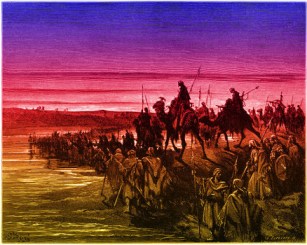
joshua-in-israelNo, I’m not going out of my way to “Jew bash,” simply stating what we all know. Does that mean the Torah is useless, the Israelites weak and disobedient, and the modern Jewish people are followers of a “dead religion?”

Absolutely not. What it means is that they are human.

I’ve sat in a Bible study in church (not the church I go to now…this was many years ago) and heard a man, a retired Pastor (normally a very nice guy) say point-blank that “we Christians” would never disobey God the way the Israelites did.

Oh really?

Remember what Rabbi Packouz said above?

If we were living in those days, had experienced what they experienced, had lived through slavery, were suddenly thrust into a brand new world, even experienced the amazing, awesome, unimaginable presence of God among us, yes we too would have said and done all the things the Children of Israel did.

Sorry to say.

There is a saying in Pirke Avos 2:5 (“Ethics of the Fathers”), “Hillel says, ‘Don’t judge your fellow human being until you have been in his place.” It is upon us to try to put ourselves in someone else’s situation before passing judgment.

Also in Pirke Avos 4:3, Ben Azai says, “Do not scorn any person, nor be disdainful of any thing for there is no person who does not have his hour and no thing which does not have its place.”

The Torah source for this mitzvah, commandment, is “You shall judge your fellow human being with righteousness” (Leviticus 19:15). This verse obligates us to give someone the benefit of the doubt when we see him performing an action that could be interpreted in his favor.

The Torah also teaches us, “Love your fellow human being as yourself …” (Leviticus 19:18). The Baal Shem Tov used to say, “Love others as yourself. You know that you have many faults, nevertheless, you still love yourself. That is how you should feel toward your friend. Despite his faults, love him” (Likutai Abraham, p. 221).

Setting aside Rabbi Packouz, what can we learn from another “Rav” with whom we Christians might be more familiar?

“Judge not, that you be not judged. For with the judgment you pronounce you will be judged, and with the measure you use it will be measured to you. Why do you see the speck that is in your brother’s eye, but do not notice the log that is in your own eye? Or how can you say to your brother, ‘Let me take the speck out of your eye,’ when there is the log in your own eye? You hypocrite, first take the log out of your own eye, and then you will see clearly to take the speck out of your brother’s eye.

Matthew 7:1-5 (ESV)

old-city-jerusalemAll week long, I’ve been writing blog post after blog post presenting some rather unusual ideas about the Torah, the instructions to the Israelites from God, and how it is lived out in Judaism and sometimes within Christianity. My friend Boaz Michael says that the weightier matters of the Torah are also taught in church, such as love of kindness, feeding the hungry, compassion for the widow, and so on. Granted when we get into the area of halachah and how the Jewish community will walk before God, things become complicated, but lately, I’ve been encouraged to see halachah as the communal conversation and response of the Jewish people to the Torah and to God. It’s a living, interactive process by which Jews seek to obey God and live their lives before God as Jews. By definition, Christians, who are taught to conceptualize God and the Bible in fundamentally different ways, are going to have a tough time with this (even some Jewish people have a tough time with this).

But do we judge the ancient Israelites, the more recent Jewish population who lived in the days of Jesus, Peter, and Paul, and the modern Jewish community, particularly those in the Messianic space, by our own Gentile Christian standards, given that those standards do not have much of a basis in common with Judaism? Have we walked a mile in the shoes of a Jew?

Even if you are a Christian who has spent a lot of time with the Jewish community, either here in the U.S. or even in Israel, while you may have some insights into Jews and Judaism that many Christians lack, there’s still a long road between living with Jews and being Jewish. Even converts to Judaism will struggle to make up the distance, the lack of a Jewish childhood, the lack of Jewish parents and growing up in a Jewish community.

There’s a lot of judgement and disdain of Jews by Christians, including those in the Hebrew Roots community, but upon what is it based? It is especially surprising and disappointing that a Gentile Christian can say they are “observing Torah,” wear a kippah and tallit katan in their daily lives, daven with a siddur while wearing a tallit gadol and laying tefillin, keep Leviticus 11 “kosher,” and claim to love Israel and the Jewish people, and yet still judge and reject everything it is to be Jewish and to live as a Jew. Sometimes, I think it’s even worse for some of those same Gentiles who style themselves as “academic” or “resource institute” experts to treat the Jewish people as a “thing” or an “object” for study (and it’s easier to throw away an object than a human being), rather than as living, breathing, people.

You don’t have to agree with how Jewish people conceptualize their world, but then again, you don’t have to attempt to live as a Jew either, if that is your opinion.

It’s been a busy and difficult week in this little corner of the blogosphere. I don’t usually spend so much time and effort on a single topic across an entire week, but this theme took over my thoughts and emotions and I had to write (and write and write) about it.

I don’t claim to bear any great wisdom or insights, but writing is what I do when I want to explore and I’m trying to understand. Blog comment contributor “ProclaimLiberty” has suggested that halachah is akin to the Jewish communal conversation with God and the sages. Writing is part of what I do as an individual when I’m trying to talk to God. I just share the conversation (my end of it, anyway) with the Internet.

PleadThe Children of Israel failed God because we all fail God! If God’s grace wasn’t with humanity from the very beginning, we never would have survived, and there would be no human population in the world today. God is gracious and we know this, but we cannot even begin to comprehend the extent, scope, and vastness of His graciousness to us all, and especially to Israel, the apple of His eye, His treasured, splendorous people.

The Lord said to Moses: Thus shall you say to the Israelites: You yourselves saw that I spoke to you from the very heavens…

Exodus 20:19 (JPS Tanakh)

And Jesus said, “Father, forgive them, for they know not what they do.”

Luke 23:34 (ESV)

God speaks to us all but we don’t always understand. It would have been amazing if we could have been there among Israel to actually see and hear God speak from the very heavens, but God gives us enough. And yet we don’t always know what we’re doing, including when we curse rather than bless Israel. We should try to understand Israel and understand God.

The first positive mitzva is, in the words of Rambam, (Maimonides: Mishneh Torah, Yesodei haTorah 1:1.) “To know that there is a First Being, who caused the existence of all beings…The knowledge of this principle is a positive command, as it is said, I am the Eternal your G-d.”

This is a Mitzva relating to mind and intellect. True, every one of Israel believes in G-d with a simple faith, and his heart is whole with G-d; still it is the duty of the mind and intellect to bring this faith to a level of knowledge and comprehension. This is the meaning of “To know that there is a First Being;” the Mitzva specifies comprehension and intellectual grasp, as written in Torah: “Know the G-d of your father and serve Him with a whole heart” (Divrei Hayamim I, 28:9.) and it is also written, “know this day etc.” (Devarim 4:9.)

“Today’s Day”
Monday, Sh’vat 19, 5703
Compiled by the Lubavitcher Rebbe
Translated by Yitschak Meir Kagan
Chabad.org

If we don’t understand Israel perhaps it is because we don’t really understand God, and we should spend some time in Jewish shoes; standing in their place. Failing that, we should seek God’s wisdom and particularly, we should repent and seek His forgiveness.

Erev Shabbat is coming. This would be a good time.

Good Shabbos.

An Invitation to Keruv

Shabbat-Made-Easy-paintingThough there are an estimated 175,000 to 250,000 Messianic Jews in the U.S. and 350,000 worldwide, according to various counts, they are a tiny minority in Israel — just 10,000-20,000 people by some estimates — but growing, according to both its proponents and critics. Messianic Jews believe that Jesus is the Jewish messiah, and that the Bible prophesizes that God’s plan is for him to return to Jerusalem, prevail in an apocalyptic battle with the Antichrist, and rule the world from the Temple Mount. Unlike Jews for Jesus, which focuses on bringing Jews into churches, Messianic Jews seek to make Jews believers in Jesus while still maintaining congregations that identify as Jewish and observe Jewish customs and holidays.

While these Messianic Jews are derisive of Orthodox Jewish fundamentalism (particularly what they call its “legalism”), they pick and choose some of the practices of traditional Judaism, such as weekly Torah readings — although they add New Testament verses to it.

They import to Israel many of the worship practices and the political agenda of the American Christian right. They are tightly knit with an American-born global revival movement that holds that modern-day prophets and apostles receive direct revelations from God, forming an elite army of prayer warriors on a mission to carry out God’s plans to purify Christianity, “restore” Israel, and bring the Messiah back.

-Sarah Posner
“Kosher Jesus: Messianic Jews in the Holy Land”
An article written for
the Atlantic

In a previous blog post, I mentioned that it’s helpful to take a look at that entity we call “Messianic Judaism” from outside the Messianic Jewish and Hebrew Roots contexts. We have a tendency to see our arguments through a very narrow tube that significantly limits our vision, not only of who and what Messianic Judaism is (along with Hebrew Roots and its variants such One Law, One Torah, Sacred Name, and Two-House), but how the rest of the world perceives it and them.

The above-quote from a recent online magazine article was apparently written by a Jewish reporter who, in all likelihood (but I can’t know for sure), is not religious (I say this based on the overall content of the full article). Her description of Messianic Jews in Israel was either so biased as to make the Jews she interviewed seem overly Christian (and certainly not Jewish in a cultural or halakhic sense) or indeed, the Jews she spoke with were very “Christianized.” But if the latter is true, then did this reporter choose a representative sample of the Messianic Jews in the Land or did she bias her research to only select the most “Christian-like” Jews in the Israeli Messianic environment?

In other words, are there any authentically, halachically, and culturally Jewish Messianic Jews in Israel, and can Messianic Judaism be fairly assessed by a Jewish reporter who may have “issues” with whether or not the Jewish participants in Messianic Judaism are actually Jewish?

When I write about Messianic Judaism as a Judaism (as opposed to “a Christianity”), I’m usually criticized, typically from Hebrew Roots proponents, saying that the majority of people involved in what I term as Messianic Judaism are not Jewish. True enough. As I’ve said before, Messianic Judaism as it exists today is a goal or an ideal. It is not a fully realized movement among the other Judaisms of our era.

And that’s probably Christianity’s fault.

Granted, “ownership” of the Jewish Messiah passed from Jewish to Gentile hands nearly 2,000 years ago and it’s only within the past century or less that any Jews at all have even considered the possibility that Jesus is the Messiah and that it’s “Jewish” to honor him. Tsvi Sadan in his article “You Have Not Obeyed Me in Proclaiming Liberty”, written for the Fall 2012 issue of Messiah Journal, says of past and present Messianic Judaism in Israel:

In the past, leadership was largely in the hands of Christian missionaries. Today leadership is predominately held by American Jews, American “wannabe” Jews, and American Christians. Where Jewish Israelis are in leadership, they have received their education – if they have any – from Christian institutions either in North America or Great Britain. In addition, with the influx of immigrants from the former Soviet Union in the 1990s, Russian speakers began to establish new churches and assume leadership positions in existing churches (congregations). Yet though some of the people and organizations have changed, the present-day leadership is essentially operating in the same way as their missionary predecessors did. While Hebrew is now the spoken language in most Israeli churches, modes of operation and models of leadership which grew mostly out of evangelical worldviews still dominate the scene.

christians-love-israelSo perhaps Ms Posner’s report on Messianic Jews in Israel wasn’t particularly inaccurate or biased after all. However, Posner ends her article with a chilling pronouncement:

In the meantime, Messianic Jews are assiduously attempting to, essentially, redeem Israel from its Jewishness. That seems to be the task at hand at the Jerusalem Prayer Tower, another 24-7 prayer meeting place located on the top floor of an office building on the bustling downtown thoroughfare Jaffa Street. At the “Restoring Jerusalem” prayer meeting, an American Christian woman read about Jezebel from the Book of Revelation, and exhorted the half dozen people in the room to pray to “purify” and “cleanse” Jerusalem.

Another woman prayed for the Jews “to change their mind, to feel you, Lord, to convert to you, Lord.” The first woman resumed her prayers, hoping that Jesus will give Israeli Prime Minister Benjamin Netanyahu “a great understanding of who you are.” She seems to earnestly believe this is a plausible scenario. “Help him, Lord,” she implores. “Bring him to Messiah.”

I was especially taken by the statement, “Messianic Jews are assiduously attempting to, essentially, redeem Israel from its Jewishness.” This comment clashes incredibly against what most of the Jewish Messianics I interact with tell me. In the article “Messianic Judaism: Reconsidering the One-Law, Two-House Trajectories” written by Boaz Michael, also for Messiah Journal, in addressing Gentile and Jewish roles, Boaz states:

In rejecting the right and responsibility of the Jewish people to define what it means to be Jewish and to practice Judaism, One-Law theology strikes directly at the core of authentic Judaism. One-Law replaces the Jewish rabbis and sages with self-appointed Gentiles who believe that they are divinely sanctioned to interpret the Torah outside of a Jewish context: whatever conclusions they come to are given greater weight than those of Jewish halachic authorities.

There is a struggle to define Messianic Jewish practice as Jewish and some of the Jews in the Messianic Jewish movement are caught between two forces: Evangelical Christianity and Hebrew Roots. Both groups of non-Jews are vying for the opportunity to define the Jewish worshipers of Christ in some manner that removes significant parts of what it is to be a Jew. In the vast majority of cases, this isn’t done from the malicious desire to harm Jews or Judaism, but intentions aside, the results are obvious. Even many Jews in Messianic Judaism believe that to accept Jesus as the Jewish Messiah, they must reduce or eliminate their Jewish identities. Those Jews who accept the One Law proposal are required to surrender their unique Jewish identity to any Christian demanding an equal share in the Torah.

111-mjThe latest discussion (as I write this) in the “Messianic blogosphere” on this struggle is Derek Leman’s article, CRITIQUE: Tim Hegg’s Article on Acts 15. By the time you read this “morning meditation,” the comments section of Derek’s blog will most likely have heated up to the temperature where lead melts (621.5 degrees F or 327.5 degrees C). There is a great deal of tension in this communications dynamic largely because each group, Evangelical Christianity, Hebrew Roots (One Law, Two House), and Messianic Judaism, have “turf” to defend. But while both Evangelical Christianity and Hebrew Roots see themselves as pro-Judaism and pro-Israel, it has been strenuously asserted by Messianic Jews that their impact is otherwise.

Boaz Michael says:

These movements damage and diminish Jewish identity in several ways. In one way, a very practical and real diminishing of Jewish identity occurs when people who are not Jewish begin to dress and act like they are Jewish (particularly like Orthodox Jews). When Jewish customs and Jewish apparel are taken on outside the context of a Jewish community and authentic Jewish identity, it diminishes real Judaism and real Jewish life. It sends a message to the Jewish people: “All of the things that make you unique and identifiably Jewish are mine too.”

Tzitzit are a prime example. In a traditional Jewish context, tzitzit have real meaning. They send a specific message: “The person wearing these is shomer Shabbos. They keep a high standard of kashrut. They are serious about traditional Judaism.” To see a person with tzitzit, for example, eating a cheeseburger or driving on the Sabbath actually diminishes the Torah and casts Messiah (and Messianics) in a negative light. It is application without understanding. It strips tzitzit of their meaning and significance.

That final statement could be extended to say that such a person “strips Judaism of its meaning and significance.”

Again, the large portion of the blame for this mess is Christianity, not in its intent but in its approach. Sadan stated that many Jews in Israel have come to know the Messiah, not through Jewish people or contexts, but through Evangelical Christians or Jews who have an Evangelical mindset. In the United States, many Jews come to know the Messiah, either through the traditional Church or through Hebrew Roots churches, and particularly One Law groups. My wife and I were introduced to “Messianic Judaism” through a local One Law congregation and for quite some time, we thought this was the only expression of Messianic Judaism. It was our introduction to “Judaism” without having to actually enter into a Jewish community (the vast, vast majority of people present were Gentiles). Jewish customs and practices were very poorly mimicked and an understanding of even the prayers was only elementary.

It wasn’t until my wife joined first our local Reform-Conservative shul and later the Chabad, that we both began to understand actual Judaism. From my wife’s point of view, it was in the form of a real, lived experience, and for me, it was largely by observation.

But I got to observe a lot.

Tsvi Sadan’s article presents an alternate method of introducing the Jewish Messiah to Jewish people in Israel:

Instead of this traditional Mission approach with its “proclamation of alienation,” Messianic Jews should consider the “proclamation of Keruv,” not as a tactical maneuver but as a state of being. Keruv is a Hebrew word that comes from “near” (karov). Essentially therefore, Keruv is a mission to call Jews to draw nearer to God and one another, first and foremost through familiarity with their own religion and tradition. The Jewish people, as taught by Jesus, cannot comprehend his message apart from Moses (John 5:46). Talking about the significance of Jesus apart from the everlasting significance of Israel is that which renders evangelism ineffective. Keruv on the other hand is all about reassuring the Jewish people that Jesus came to reinforce the hope for the Jews as a people under a unique covenant.

elul-shofarIt’s impossible to change the past but we have the power to summon the future. We have the ability to change directions and to correct our mistakes. In order to introduce the Jewish Messiah to Jewish people without damaging Jewish identity, either by removing it or co-opting it from Jews, it must be communicated that Judaism and the Jewish Messiah are mutually confirming and supporting. Instead of Messianic Judaism being seen as trying to “redeem Israel from its Jewishness,” it must behave in a manner that is totally consistent with restoring Jewishness to Israel and the Jewish people. This is not to say that Israel and Jewish people aren’t currently Jewish, but that the Messiah affirms, supports, and restores the rightful place of Israel and the Jewish nation as the head of nations and as a people called out by God to be completely unique from among the nations and peoples of the earth, including Gentile Christians.

This doesn’t diminish the Christian in the slightest. Even non-Messianic Jews assert that Jews are not better than Christians or any other group of Gentiles, just different and unique. I’ve said many times before that we Christians have a responsibility to support Jews, both materially and in their return to the Torah of their Fathers, all for the sake of the Kingdom and the return of the Messiah. As Boaz Michael said in a recent blog post, “The completion or resolution of Israel’s story does not and will not occur until she is redeemed from her exile, planted firmly in the land God has promised to her, and returned to a state of loving obedience to the Torah under the leadership of the Son of David, Yeshua the Messiah.”

We serve One God and we have one Messiah King who will return to rule over all of Creation. As servants and sons, we each have our roles and duties. We can’t afford to let our limitations, biases, and human ambitions restrict who we are and who God created us to be…both the Jew and the Gentile. Christian support of Israel does not mean taking control of the process of defining Israel. It’s allowing the Jewish people and nation the space to define themselves, and supporting them in this effort through whatever means are at our disposal. That is a Christian’s unique role and purpose in life. It’s time we start living it.

Reposted: Missiles Fired on Nuclear Reactor in Dimona

I’m reposting this news item from VirtualJerusalem.com

Palestinian terrorists have fired missiles at the Nuclear Reactor in the Israeli city of Dimona.

The missiles fell in an open field and did not cause any injuries, nor did it hit the intended target.

The missiles were launched shortly after the IDF launched operation “Amud Anan” early on Wednesday, November 14th with the targeted assassination of the commander of Hamas’s “military” terror wing, Ahmed Jaabari.

“Amud Anan” was launched in response to the hundreds of rockets that the residents of Southern Israel have encountered in the past week.

Prime Minister Netanyahu held a press conference on Wednesday evening stating that Israel will not “come to terms” with the attacks on its citizens.

The alert level in Israel was raised to “gimel”

Pray for the peace of Jerusalem, the safety of the nation of Israel, and all of the souls she nurtures and protects.

Lech Lecha: The Course of My Spiritual Travels

abrahams-servantIn the course of one’s spiritual travels, a person encounters situations which can only be overcome with a struggle, and which may even cause one to fall. Nevertheless, since all phases of life’s journey are guided by Divine Providence, we must realize that the purpose of every experience is positive. Even when we fall, we are being given an opportunity to borrow an expression from our Sages (Cf. Makkos 8a.) to descend in order to ascend.

Why must a person face such challenges? Two reasons are given:

a) To bring out the power of one’s soul. As long as a person remains untested, he can “get by” without having to tap his core. When, by contrast, one faces a fundamental challenge, it becomes necessary to call upon one’s spiritual resources in order to succeed.

b) In the process of overcoming a challenge, a person recognizes and thus elevates the sparks of G-dliness contained therein. For all existence is maintained by G-d’s creative energy; that energy is hidden within the world’s material substance. As a result of this “hiddeness,” challenges arise. By overcoming these challenges, a human reveals the true G-dly nature of existence.

Avraham’s spiritual journey contained such challenges. Shortly after he entered Eretz Yisrael, he was forced to descend to Egypt, described as “the nakedness of the land.” (Cf. Genesis 42:9, 12.) The very name of the land, mitzrayim, is related to the word meitzarim, meaning “boundaries” or “limitations.” (Torah Or, Va’eira, p. 57b ff.)

And yet even Avraham’s descent brought him blessing. He left Egypt “very rich in cattle, in silver, and gold.” (Genesis 13:2.) Moreover, this wealth came from spiritual effort; Avraham had elevated some of the sparks of G-dliness invested in that country.

-Rabbi Eli Touger
“A Journey To One’s True Self: Avraham’s Odyssey As A Lesson For His Descendants”
Commentary on Torah Portion Lech Lecha; Genesis 12:1-17:27
Chabad.org

Four mornings during the work week, I get up at 4 a.m. and by five, I’m picking up my son David at his place so we can go to the gym together and work out for 60 or 70 minutes before getting ready to commute to our jobs. Although that sounds like a really early hour to go through such exertion, we encourage each other and one of us always helps the other one to do the best we can. Some days are better than others, but we both know that only through hard work can we move toward our goals. David is suffering from a number of physical disabilities he incurred during his service in the Marines, and I’m just plain getting older. We both have our challenges to overcome, but thankfully we don’t have to go the course alone.

As Rabbi Touger’s commentary on this week’s Torah reading teaches, we also encounter a number of spiritual challenges in our lives, all of us. While working out physically is a choice (I could choose to be lazy, eat what I want, become ever larger, and damage the quality of my life as I continue to age), it really isn’t if I want to remain healthy and even to improve my physical condition as I get older. The same goes for spiritual growth.

But if you think getting up at four in the morning just so you can start sweating by five is no fun, imagine making yourself face, not just traditional Bible readings and devotionals, but challenges and conflicts both within yourself and your understanding of God, and outside of yourself in the world of religious dialog (to put it politely). Sometimes, I’d rather face any machine and any exercise I could possibly work with at my gym than spend five minutes wrangling with some “attitude” in the religious blogosphere.

As I mentioned though, those challenges don’t have to be externally driven. I’ve got enough internal challenges to last me for a good, long while. How exactly do the blessings in the Abrahamic covenant bind the Christian to God in covenant relationship? What effect does the New Covenant have on the Abrahamic for a Christian? Why does or doesn’t the Mosaic covenant factor into the line of other covenant blessings for the non-Jews in the church? Other people seem to think the Bible and what is says is a “slam-dunk” as far as what it all means. For me, it’s an endless adventure story wrapped in darkest mystery that has inspired me to the heights of ecstasy and driven me to miserable despair.

A person’s spiritual quest should not be a lonely journey. On the contrary, one of the hallmarks of personal development is an increasing capacity to inspire others. Avraham surely gained such an ability, as our Sages comment (Sotah 10a.) with regard to the verse, (Genesis 21:33.) “And he called in the name of the G-d of the universe”: “Do not read ויקרא (‘And he called’), read ויקריא (‘And he had others call’).”

This concept is also reflected in the changing of his name from Avram to Avraham. (Ibid. 17:5.) Rashi (In his commentary to that verse.) explains that Avram implies merely “father of Aram,” while Avraham alludes to the Hebrew words meaning “father of many nations.” The change implies that Avraham had been given the potential to inspire and influence all the nations of the world to begin striving toward spiritual goals.

“It is not good that..man should be alone.” (Genesis 2:18 ESV) Although Rabbi Touger suggests that the “not alone” part in Abraham’s case, was his ability to teach and to inspire others to call out to God, it implies (for most of us, I think) that we should seek out companionship, not just to inspire them, but so that they can inspire us, much like my son David and I inspire each other. Avraham Avinu was the father of many nations, not just the Hebrews, and according to Paul, this was through his seed.

Now the promises were made to Abraham and to his offspring. It does not say, “And to offsprings,” referring to many, but referring to one, “And to your offspring,” who is Christ.

Galatians 3:16 (ESV)

Paul explains that we Christians too can call Abraham our father because of our relationship with his seed, the Jewish Messiah, Jesus Christ. Jesus was never alone. He was always teaching. He was surrounded by his disciples. He was surrounded by multitudes of those who were desperate. He was the shepherd to the lost sheep of Israel. I can’t recall the source (and a quick Google search doesn’t reveal it), but I seem to remember a principle in some corners of Judaism saying that a teacher will learn as much from his students as they will from him. I don’t know if this could be applied to Jesus, but perhaps it can be to those who came after him.

As one who has taught (albeit in a rather small setting) before, I can certainly say it is true of me.

As you may know from my comments in my Days series, I have been inspired, or maybe challenged is the better word, to seek out a more traditional Christian fellowship venue. This is with the idea that I not only can learn and be supported by my fellow believers, but that I also have something of value to give back. What that is may be apparent to my blog audience, but it remains to be seen if a face-to-face group of Christians will agree.

There’s only so much encouragement I can give and receive via the web. At some point, like Abraham, I must leave, at God’s command, what is familiar and comfortable to proceed into the unknown. Abraham trusted God with everything he had, and it was accounted to him as righteousness. (Genesis 15:6, Romans 4:3) Abraham’s example teaches me that it is not good that I be alone and that risk is part of the “business” of faith and trust in God. Abraham took everything he had, his family, his entire household, and all his possessions, and followed God to a land he never knew.

What a person believes about himself and his abilities is a self-fulfilling prophecy. A person who does not consider himself “important” will not free himself from negative habits.

Believing you are inferior, untalented, unimportant or incapable, influences your abilities. If you view yourself as unable to do things, you will be unable to do them. On the other hand, if you see yourself as talented, capable, and important, your self-concept will open up powers and talents that would have otherwise remained dormant.

Hardly anyone utilizes his entire capabilities. We can accomplish much more than we realize. By raising the perception of your capabilities, you will accomplish more.

-Rabbi Zelig Pliskin
“Daily Lift #618”
Aish.com

A week from today, I begin the first step on a journey into a land that, while not entirely unknown, seems rather alien to me after so many years. One difference is that I don’t take with me everything I have. Certainly my family will not be accompanying me on the journey. Unlike Abraham, I walk alone, with only the promise that it will not always be this way.

Good Shabbos.

Stealing a Conversation About Ephesians, Jesus, and Being a Christian

The big problem in christianity and also messianic judaism is that there seems to be little knowledge on why Yeshua came an what His proclaimed Kingdom of Heaven / Kingdom of G-d meant and what the goal of entity for the Jews really was.

If everyone would see that, than there was not so much competition on to be or to be not Yisrael (though important still) and urge to take the law upon him or herself because of thinking that is the goal.

Did Yeshua come to bring the law? He certainly didn’t come to take it away! But why did he come and what was His message?

-Shmuel haLevi
October 15, 2012 11:52 am
Daily Minyan

This probably won’t be as organized or concise as I’d like it to be, but there was a terrific conversation on Gene Shlomovich’s blog post One-Law Gentile has a change of heart and I wanted to try and preserve some of the more helpful contributions. Most information about the New Testament and the purpose of Jesus in coming “first the Jew and then the Gentile” is interpreted by traditional Christian doctrine, with some “fringy” commentary by “edge case scholars,” so it’s difficult to get a more balanced perspective. I’ve recently been accessing Volume 6 of the Torah Club, which is a study on the book of Acts produced by First Fruits of Zion (FFOZ), to round out my education somewhat, but additional sources are most helpful.

I am attempting to put together the information I’ve gathered from the discussion at Gene’s blog in a way that not only presents it to readers visiting my blog in a meaningful way, but also to help clarify my understanding of some of the New Testament writings from a more Jewish perspective.

Above, Shmuel haLevi brings up an important issue. If the Torah was supposed to be generalized to the entire world as a “universal law” for everyone, and not exclusively to the Jewish nation in all its aspects, why couldn’t Israel have “evangelized” the nations at any time it wanted? Why was Jesus necessary to “spread the Torah” to his non-Jewish disciples, and yet not require that they convert to Judaism?

Unless, of course, the Jewish Messiah commanded his Jewish disciples to bring the nations into discipleship not specifically to turn them into “Jews without a circumcision,” so to speak.

The following is a collection of selected quotes from Gene’s blog post comments section. I’ve provided the links to the original source above so you can see all of the material in context.

That’s an excellent point, Shmuel. If people think that the goal of Yeshua’s coming was to give the Torah to the Gentles, so to speak, then the entire goal of their (our/my) faith will be in “keeping the (mechanics of the) Law” … Alternately, if he came to bring the nations into reconciliation to God and to allow us to become members of the Kingdom as the goal, then our entire focus changes. Love, grace, compassion, mercy all become our focus and the mitzvot of feeding the hungry, visiting the sick, and granting mercy and grace as it has been granted to us becomes the fabric woven into our lives as believers.

-me
October 15, 12:08 pm

…like many others you discovered there were geirim in TaNaCH. And there was the same law for them and for the inborn Yisraelites. But that was not the reason why Yeshua came. The Hebrews had already received the Torath Mosheh and Gentiles were welcome to join, becoming Jews in nationality. So, that could not have been the reason for the coming of the Mashiach. Gentiles already could be righteous, adhering to the Torath for Adam weNoach. That was enough. But if one insisted, felt drawn to join Yisrael and wanting to serve HASHEM in the same way, that was possible but certainly not obliged. Nor is it in the New Covenant.

-Shmuel haLevi
October 15, 5:05 pm

So if a Gentile could convert to Judaism to take on the Torah mitzvot, and if a Gentile could be considered righteous under the covenant God made with Noah, why indeed did Jesus come? Could the secret be somehow concealed with Cornelius the Roman (see Acts 10) as well as Nebuchadnezzer, King of Babylon and the King of the city of Ninevah?

“Every convert in history became part of Israel.” ???

But not every true servant of the Most High became part of Israel.

“Now I, Nebuchadnezzar, praise, exalt and honor the King of heaven, for all His works are true and His ways just, and He is able to humble those who walk in pride.”

Nebuchadnezzar remained King of Babylon.

The city of Nineveh sincerely repented in sackcloth, and remained Assyrian.

The Roman Centurian, who loved Israel, remained Roman.

The uncircumcised listed above were true servants of G-d and did not become part of Israel.

-benkeshet
October 15, 6:31 pm

This may seem kind of disjointed and please remember, I’m “cherry picking” the content to try and “copy and paste” the most relevant pieces of the conversation together, so there are obvious sections of the conversation that have not been included.

Except for Cornelius and his acceptance of discipleship under Jesus that we find at the end of Acts 10, we don’t see an apparent role for Jesus in the above examples. The Kings of Babylon and Ninevah (and in fact, the entire population of Ninevah) were considered “righteous Gentiles” and did not have to join the nation of Israel in any sense in order to be considered righteous. In fact, as we recall from Paul’s letter to the Romans, Abraham was considered righteous by faith before taking on the covenant sign of circumcision. (see Genesis 15:6, Romans 4:3)

But while this is a good argument that a non-Jew doesn’t have to become a Jew or a member of the nation of Israel to attain righteousness, where does Jesus come in?

Paulos said the be the Jews as a Jew, Greeks as a Greek. You cannot come in the same way with the Good Message to the Jews as to the Gentiles. So the way he spoke and the focus in the words of Yeshua before His last instructions where Yisraelite centered.

-Shmuel haLevi
October 16, 3:02 pm

So is there some sort of dual path to righteousness, one for the Jew and one for the Gentile?

…if Paulos meant here that they now became citizens of Yisrael. Also the Yisraelite had not jet reached their destination. Yeshua said, in the house of my Father are many mansions (John 14:2). The resemblance on earth of the Fathers House was the Temple, which had on each side the mansions of the Cohanim – the Priests. This was the promess that Yeshua disclosed since it was done and proclaimed in Shemoth 19:6. According to Yeshayahu 61:6 it would occur in the Messianic age. Making it possible to come to this status, the heavenly Heichal was disclosed for those, the Heichal (Temple) is were the King resides on His throne, so there is were the Kingdom is. That day that the heavenly Heichal will be joined with Yerushalayim, the Kingdom of HASHEM wil be established to rule over all the aerth. But we can chose to be part of it right know and spread the good message that was spread through our Mashiach to Tzion: That their G-d is King (Yeshayahu 52:7).

So it is my question if the focus was to only being brought near to Yisrael, or even something which was not jet reached by Yisrael itself: The Mamlecheth Cohanim – the Kingdom of Priests. This citizenship might be where Paulos pointed at. The higher plan that was promised! We Jews all know that the land of Yisrael is Holy, but Yerushalayim even more, and The Templecourt even more, and Holy place even more and and the Holy of Holies even more. It is because what they represent and are as, connected with it, as in Heaven also on Earth.

-Shmuel haLevi
October 26, 3:36 pm

Now here’s where the role of Jesus comes in for the Gentile.

The focus of Moshiach has always been the entire world.

“3 And many people shall go and say, Come ye, and let us go up to the mountain of the Lord, to the house of the God of Jacob; and he will teach us of his ways, and we will walk in his paths: for out of Zion shall go forth the law, and the word of the Lord from Jerusalem.”

Yeshayahu was speaking of Yeshua Rabbeinu. Yeshua didn’t change plans. His plans are consistent. His plans ALWAYS included the gentiles–even if it appeared as though He didn’t care about the gentiles.”

He came first to the Jews and than the maessage came to the Greeks as prophecied: Yeshayahu 49:3-6.

-Shmuel haLevi
October 16, 3:39 pm

So what we have so far is that Jesus has the focus of the entire world, Jew and Gentile alike, but while (and I’ve alluded to this previously) the Jews were already a covenant people under all of the prior covenants God made with Israel, the rest of the world could not access the same covenant closeness with God except through “Abraham’s seed,” the Messiah. The Messiah, Jesus, is required for the non-Jewish people of the world to come into covenant relationship with God in any way whatsoever!

benkeshet (at October 18, 4:32 pm) delivers an excellent analysis of Ephesians 2 which is too long for me to replicate here in its entirety. However, I’ll quote some of the relevant portions. Here’s a description of the non-Jewish races without Jesus:

And you were dead in the trespasses and sins 2 in which you once walked, following the course of this world, following the prince of the power of the air, the spirit that is now at work in the sons of disobedience—3 among whom we all once lived in othe passions of our flesh, carrying out the desires of the body and the mind, and were by nature children of wrath, like the rest of mankind.

Now here are verses 13-20 with additional emphasis by benkeshet:

13 But now in Messiah Yeshua you who once were far off [as children of wrath] have been brought near by the blood of Messiah. 14 For he himself is our peace, who has made us both [Israel and the Nations] one and has broken down in his flesh the dividing wall of hostility 15 by abolishing the law of commandments expressed in ordinances, that he might create in himself one new man [or one new Humanity] in place of the two [i.e. Israel at enmity with the Nations], so making peace, 16 and might reconcile us both [Israel and the Nations] to God in one body through the cross, thereby killing the hostility. 17 And he came and preached peace to you who were far off [Nations who had been children of wrath] and peace to those who were near [Israel]. 18 For through him we both [Israel and the Nations] have access in one Spirit to the Father. 19 So then you [Nations] are no longer strangers and aliens [or children of wrath], 4 but you are fellow citizens with the saints [Israel] and members of the household of God, [Genesis 22:18 and in your Offspring shall all the Nations of the earth be blessed – i.e. redeeming them from being children of wrath] 20 built on the foundation of the apostles and prophets, Messiah Yeshua himself being the cornerstone…

What we gather here is that Jews and Gentiles are both reconciled to God through Messiah but both groups retain their identity (i.e. Israel and the Nations). The “belonging” that we Gentiles become inserted in is not Israel; that is, we do not become Israel, rather, we become citizens of the Kingdom of God, but Israel is still Israel and the Christians from the nations are still citizens of their respective nations. The only shared citizenship between a Jew and a Christian under Messiah, is citizenship in God’s Kingdom. What Jews and Christians equally share in is that we have “access in one Spirit to the Father” (verse 18).

benkeshet describes it this way:

Israel and the Nations do not lose their distinctiveness. Rather, what was lost was the enmity between them, which has been destroyed by Messiah’s sacrifice. Both Israel and the Nations have access to the Father via ONE SPIRIT because of faith in Messiah.

This is just the best description of the whole “one man out of two” discussion of Ephesians 2 that I’ve read and I especially wanted to share it here. I’m thankful to Gene, Shmuel haLevi, and benkeshet for their contributions to not only the source discussion, but to my personal education.

There is quite a bit more discussion at Gene’s blog so again, please visit it for the entire content. I know I can be accused of “stacking the deck,” so to speak, by presenting only certain fragments of the conversation, but my goal was to illustrate how we can look at portions of the New Testament, and especially Ephesians 2, in a different and more “Jewish” way, to see a clearer picture of how we non-Jews are brought closer to God by Jesus and what that does to the relationship between Christian and Jew. As you can tell, this perspective is a bit different that what you may have been taught, and it’s different than what some people want to believe, but it’s important to at least consider the possibility that the traditional Christian viewpoint on Ephesians 2 isn’t sustainable, given not only modern Biblical scholarship, but a more authentic Jewish interpretation of (the Jewish) Paul’s understanding of the topic at hand.

Shmuel haLevi (October 18, 1:33 pm) re-enforced the citizenship issue.

Yeshu talks frequently of the Kingdom of G-d. That citizenship is Paulos talking about. Both Jews and gentiles have to go into there for the true government.

I have only covered a portion of the full length of the discussion and I could add more, but then this “meditation” would be ridiculously excessive.

I hope I’ve provided enough information to make some of you curious and perhaps even to inspire a few (friendly, please) comments. I’m not trying to steal Gene’s thunder, so to speak, or to rob from his blog (and I received his permission to copy the above-quoted content prior to publishing it), but a lot of very good information is lost in the comments sections of the endless number of blogs on the web, and I wanted some of the key parts of this conversation to survive Internet oblivion.